Market Minds Advisory
Chip-On-Flex Market

Chip-On-Flex Market: Chip-On-Flex Market. Trends and Forecast 2026 to 2036

Foldable smartphones, wearable health patches, and next-generation smart cards are pushing chip-on-flex assembly past rigid substrate limits, forcing display driver packagers toward finer bonding pitch and flexible integration economics that reward East Asian assembly scale.

Lead Analyst

Published

September 2026

Make Smarter Decisions with Customized Research Insights

Request a free sample report and evaluate market opportunities, growth trends, and competitive dynamics relevant to your business needs.

2025 MARKET VALUE$2.9BMarket Size 2025
2036 FORECAST VALUE$8.7BBase Case , 2026 to 2036
CAGR 2026 TO 203610.5 %Bull 11.8% / Bear 9.2%
INCREMENTAL OPPORTUNITY$5.5BNet 10- year value creation
EXPANSION MULTIPLE2.72x2036 value over 2026 base
Strategic Levers
M&A Pipeline
Regional Outlook
Country Rankings
Competitive Intelligence
Segmental Deep-dive
Call-Us : 91 93563 13602

Executive Snapshot and Market Trajectory.

Chip-on-flex assembly has shifted from a niche smart card bonding technique into the default packaging route for foldable displays and skin-worn medical sensors, compressing driver IC footprints well below what rigid FR4 substrate designs have ever been able to achieve on a comparable production timeline.
Foldable smartphone volumes, continuous health-monitoring patches, and slimmer hearing aids are converging on flexible polyimide bonding as brands chase lighter, bendable form factors that rigid boards cannot deliver, while Taiwanese and Korean outsourced assembly houses expand fine bump pitch capacity to match rising driver IC channel counts, concentrating commercial activity within a handful of assembly clusters positioned near the display panel makers that now specify chip-on-flex as a bill-of-materials default rather than a premium option.
Competitive intensity centers on a small group of Asian outsourced assembly and test specialists competing on bonding yield and pitch precision rather than price, even as regulatory pressure on medical wearable data privacy and looming domestic packaging incentives across the United States and India threaten to pull a meaningful share of future capacity away from its current East Asian concentration well before the end of the forecast decade.
Market Definition
The chip-on-flex market covers bare semiconductor die and driver ICs bonded directly onto flexible polyimide circuit substrates for displays, wearables, smart cards, and medical devices. It excludes rigid PCB assembly, chip-on-glass and chip-on-board packaging, and the flexible substrate film itself sold without die attachment.
Base Year Value
$2.9B in 2025 (MMA Primary Research Dataset, September 2026)
Forecast Period
2026 to 2036, eleven discrete annual values
CAGR
10.5% base case. Bull 11.8%. Bear 9.2%.
Fastest Growth Segment
Chip-on-Flex for Foldable and Wearable Displays: 15.5% CAGR
Fastest Growth Country
South Korea: 12.5% CAGR
Fastest Growth Region
South Asia and Pacific: 12.5% CAGR
Largest Region
East Asia: 42% of 2025 global value
Market Leaders
Leading suppliers: Chipbond Technology, ChipMOS Technologies, STS Semiconductor, Samsung Electro-Mechanics, LX Semicon. Source: MMA Primary Research Dataset, July 2026.
Primary Survey
n=3,800 procurement and R&D decision-makers, Q4 2025, six countries
Methodology
Demand-side build-up, cross-validated against public data, 47 expert interviews

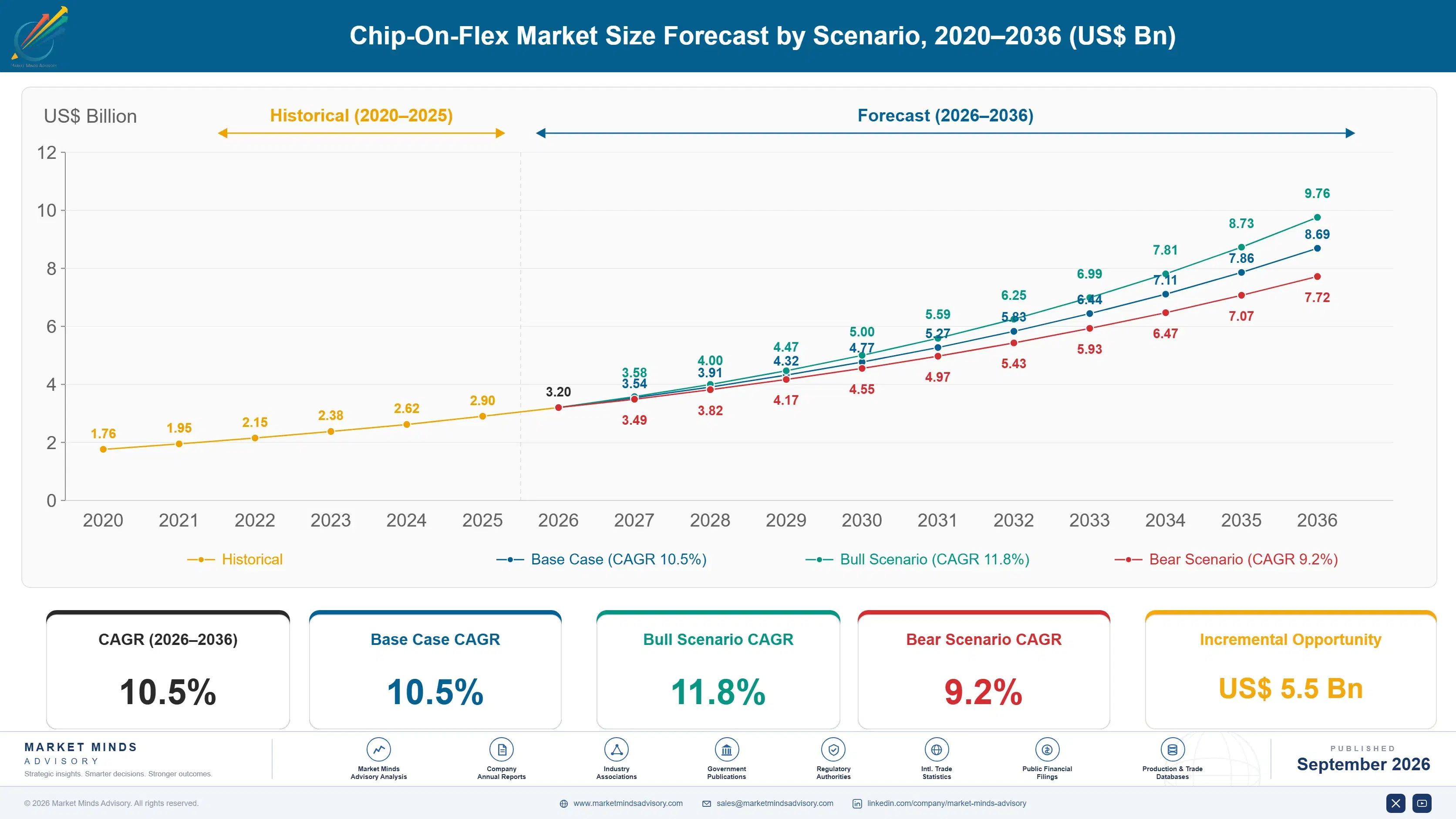
Chip-On-Flex Market Forecast Scenarios

chip-on-flex-market-size-forecast-scenario-1789998743312
Between 2020 and 2025, chip-on-flex assembly grew from a smart card and hearing aid niche into a mainstream display packaging route as early foldable phone launches proved bendable bonding could survive hundreds of thousands of fold cycles, lifting demand well ahead of broader semiconductor packaging output and pulling outsourced assembly capital toward finer pitch bonding lines across Taiwan and South Korea.
The base case assumes continued foldable and wearable adoption and rests on three commercial mechanisms: expanding foldable smartphone unit shipments across mid-tier price bands, wider adoption of continuous glucose and cardiac monitoring patches under national reimbursement frameworks, and payment card issuers migrating to thinner flexible biometric modules that require finer bump pitch bonding, each reinforcing capacity investment across the existing Asian assembly base through the back half of the forecast window.
A bull case built on faster-than-expected rollable and stretchable display commercialization, paired with accelerating hearing aid miniaturization, could push volumes meaningfully above trend, while a bear scenario tied to prolonged foldable device price resistance and slower medical wearable reimbursement approval would compress driver IC channel counts and delay new assembly line qualification across the region.

Chip-on-Flex: Bonding Economics and Assembly Concentration

Chip-on-flex packaging has moved from a specialty smart card and hearing aid process into a mainstream route for display driver integration, and the shift has concentrated capital in a small number of outsourced assembly houses that can hold bump pitch tolerances tight enough for foldable panel qualification while still running high daily throughput volumes across multiple simultaneous customer programmes.
MARKET CONCENTRATIONCR5 52%top five assemblers hold over half of global volume
AVERAGE SELLING PRICE$0.18 per bond padpricing reflects pitch fineness and bonding complexity level
TOP PRODUCING COUNTRY SHARESouth Korea 29%leads volume ahead of Taiwan and mainland China
CAPACITY UTILISATION87%assembly lines run near ceiling during panel launch cycles
TRADE INTENSITY68% exportedfinished modules ship onward to overseas device assemblers
FEEDSTOCK COST SHARE41%polyimide film and gold bump materials dominate input cost
Pricing tracks pitch fineness rather than raw die area, so assemblers who can reliably bond at forty microns or below command a durable premium over coarser pitch competitors, and that premium widens further as foldable phone volumes push driver IC channel counts higher with each successive product generation, rewarding early capital commitments to finer bonding equipment ahead of rival assembly houses.
Gold bump and polyimide film costs move with precious metal and specialty polymer markets largely independently of semiconductor demand cycles, which means margin volatility in this industry often has little to do with chip demand itself and everything to do with input markets several supply tiers removed from the end customer placing the original purchase order for finished flexible circuit modules destined for foldable devices.
"Chip-on-flex is one of the few packaging segments where the customer pays for precision they cannot see. Bond pitch, not brand, decides who wins the next design cycle."
Director, Semiconductor Packaging Practice · MMA Technology Practice · September 2026

Market Trends

Foldable Smartphone Volumes Push Bump Pitch Below Forty Microns

Foldable smartphone shipments crossing roughly 45 million units in 2025 have forced display driver IC suppliers to move standard bonding pitch below forty microns, a threshold that only a handful of Taiwanese and Korean outsourced assembly houses can currently hold at production yield. Panel makers now specify chip-on-flex as the default driver attachment method rather than a premium alternative, and second-tier assemblers without fine pitch equipment are being excluded from new design wins entirely. Capital expenditure on bonding tool upgrades has become a condition of staying in the qualified supplier pool rather than a discretionary investment decision for these firms.
Market Impact: Over 20 module suppliers certified
Continuous Glucose Monitor Reimbursement Expansion Lifts Medical Flex Demand

Expanded national reimbursement coverage for continuous glucose monitoring patches across the United States, Germany, and Japan has pulled chip-on-flex demand into a medical device category that previously used only rigid boards. Roughly 38 million patients now use reimbursed continuous monitoring devices, each requiring a flexible sensor interface bonded directly to a disposable adhesive patch replaced every ten to fourteen days. That replacement cadence multiplies unit volume far beyond what device population figures alone would suggest, turning medical wearables into a recurring assembly order rather than a one-time design win for suppliers holding the qualified bonding process.
Market Impact: Volume passed 25 million units

Market Opportunities and Growth Drivers

Biometric Payment Card Migration Drives Thinner Flexible Module Demand

Card issuers rolling out fingerprint-authenticated payment cards are replacing rigid embedded modules with chip-on-flex construction to fit a sensor, secure element, and battery within an eighty-micron card body. Visa and Mastercard pilot programmes across Europe and Southeast Asia have already certified more than 20 flexible module suppliers, up from under five in 2022, and issuer volume commitments now run into the tens of millions of cards annually. Each certified design win locks in a multi-year supply relationship, since card body tooling and bonding qualification cannot be swapped between suppliers without a full recertification cycle that issuers are reluctant to repeat.
Market Impact: Yield falls near 80 percent

Hearing Aid Miniaturization Standardizes Chip-on-Flex Across Receiver Modules

Hearing aid makers have standardized on chip-on-flex bonding for receiver-in-canal designs as the category shifts toward invisible, rechargeable form factors that leave no room for rigid substrate. Global hearing aid unit volume surpassed 25 million devices in 2025, and roughly seventy percent of new premium models now use flexible chip attachment inside the receiver housing rather than the ceramic hybrid modules common a decade earlier. Suppliers that mastered the tight bend radius required for canal-shaped modules gained a durable advantage, since audiologists and distributors resist switching brands once fitting reliability has been established with a given design.
Market Impact: Gold costs rose over 30 percent

Market Restraints and Challenges

Fine Pitch Bonding Yield Losses Erode Assembly Margins Sharply

Bonding below forty-micron pitch pushes first-pass yield down to roughly 92 percent at qualified assemblers and closer to 80 percent during initial line ramp, and every rejected unit carries the full cost of a bonded die that cannot be reworked once flexible substrate lamination has occurred. The root cause is thermal expansion mismatch between the polyimide film and the die during reflow, a physics constraint that finer pitch makes progressively harder to control. Assemblers are exploring lower-temperature conductive film formulations and laser-assisted bonding to narrow the gap, but neither has yet matched established thermocompression reliability at scale.
Market Impact: Foldable shipments hit 45 million units

Gold Bump Material Cost Volatility Squeezes Assembler Profitability

Gold bump bonding remains the dominant interconnect method for chip-on-flex, and gold prices climbing more than 30 percent over the past two years have pushed material costs to nearly a quarter of total bonding expense at several assemblers. The underlying cause is limited qualified alternative interconnect chemistry, since copper and solder bump alternatives have not yet matched gold's oxidation resistance on thin flexible substrates. Larger assemblers are hedging bullion exposure through forward purchase agreements, while smaller houses without treasury scale are passing cost increases directly into customer pricing, weakening their position in competitive bids.
Market Impact: Covers 38 million reimbursed patients
3 additional market trends, 4 additional growth drivers, and 3 additional restraints and challenges are covered in the full report. Contact sales@marketmindsadvisory.com to access the complete intelligence.

Segment CAGR and Growth Architecture

Chip-on-flex is segmented by end-product application rather than by die type or substrate material, since bonding process requirements, qualification cycles, and reliability testing differ sharply across foldable displays, wearable electronics, smart cards, medical devices, flexible sensors, and automotive circuits despite the shared underlying assembly equipment base spanning every one of these six distinct product categories.
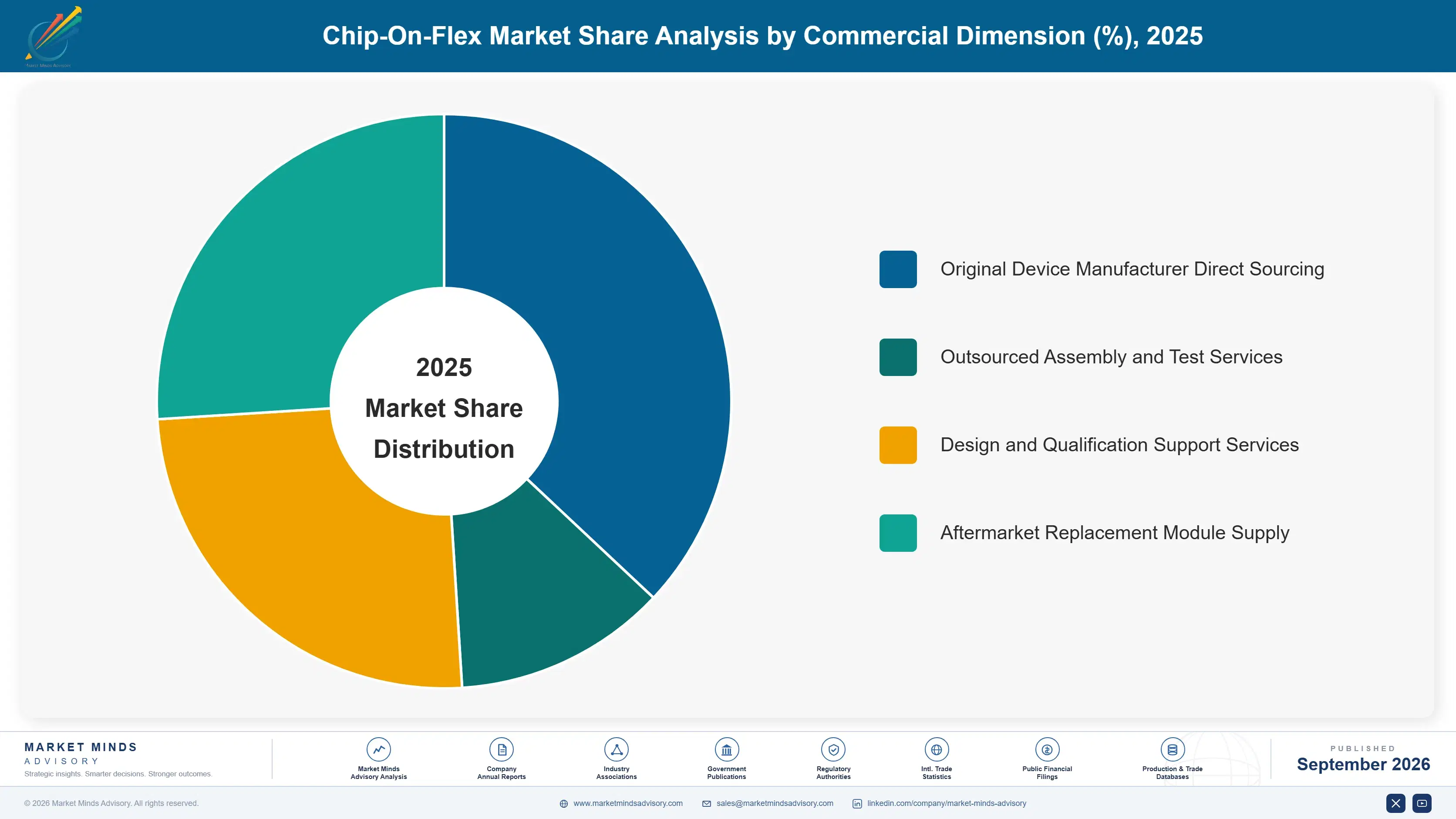
chip-on-flex-market-market-share-analysis-1789998743932

Display Driver COF for Foldable and Wearable Displays

Display driver chip-on-flex is the fastest-growing segment, expanding at 15.5 percent annually as foldable smartphone and tablet shipments push driver IC channel counts higher each product cycle. Panel makers now qualify chip-on-flex bonding as the default attachment method for both the main fold hinge zone and secondary cover displays, and that dual qualification requirement has doubled the bonded area per device compared with earlier single-panel foldable designs. Korean and Taiwanese assemblers who invested early in sub-forty-micron bonding equipment now hold multi-year capacity commitments from the two largest foldable device brands, leaving little open capacity for new entrants to bid into current design cycles regardless of the price they are willing to offer against incumbent contracts.
CAGR 15.5%

Chip-on-Flex for Wearable Electronics and Smart Patches

Wearable electronics and smart patch chip-on-flex is the second-fastest segment, growing at 13.5 percent annually as continuous health monitoring devices move from clinical settings into consumer and reimbursed home use. Flexible sensor interfaces bonded directly onto disposable adhesive patches must survive repeated skin contact, moisture exposure, and a replacement cycle as short as ten days, which multiplies unit volume well beyond device population counts alone across the installed patient base worldwide. Suppliers who cleared biocompatibility and skin adhesion qualification for one reimbursed monitoring category are increasingly winning adjacent wearable design wins without repeating the full regulatory qualification process from scratch, compounding their advantage each successive product cycle across the forecast period.
CAGR 13.5%
Full segment breakdown across 6 segments available in the complete report.

Regional Architecture and Country Demand Map

Chip-on-flex demand concentrates wherever display panel fabrication, driver IC design, and outsourced assembly capacity sit within the same tight supply corridor, which pulls the bulk of global bonding volume into East Asia while leaving every other region heavily dependent on imported finished flexible circuit modules.

North America

Chip-on-flex demand in North America centers on wearable health device brands and payment card issuers rather than assembly capacity, since almost no fine pitch bonding capacity exists on the continent today. Roughly 38 million reimbursed continuous glucose monitoring patients in the United States drive recurring sensor module orders that ship in from Asian assemblers on tight replacement schedules. Fingerprint payment card pilots across major regional banks add a second demand channel, layered onto foldable device brand design activity concentrated in California. A handful of proposed domestic packaging incentive programmes could add modest assembly capacity before the end of the decade, but design and specification work, not bonding volume, remains the region's genuine commercial contribution today.
Share: 22% | CAGR: 11.0% (2026 to 2036)

Western Europe

Western Europe's chip-on-flex share sits below the standard regional band because the region hosts neither foldable device brands nor meaningful outsourced assembly capacity, leaving demand concentrated in medical device and payment card design houses. German and Swiss medical technology firms specify chip-on-flex for implantable and wearable cardiac monitors under strict European conformity requirements, while Nordic and French banks lead early fingerprint payment card pilots ahead of most global peers. Hearing aid manufacturers headquartered in Denmark and Switzerland source flexible receiver modules under long-term supply contracts with Asian assemblers rather than building local bonding lines. The region's commercial role stays weighted toward device specification and regulatory-grade qualification work rather than physical bonding throughput.
Share: 16% | CAGR: 9.0% (2026 to 2036)
Regional intelligence for 5 additional markets available in the complete report: East Asia, South Asia and Pacific, Latin America, Middle East and Africa, Eastern Europe. Contact sales@marketmindsadvisory.com.
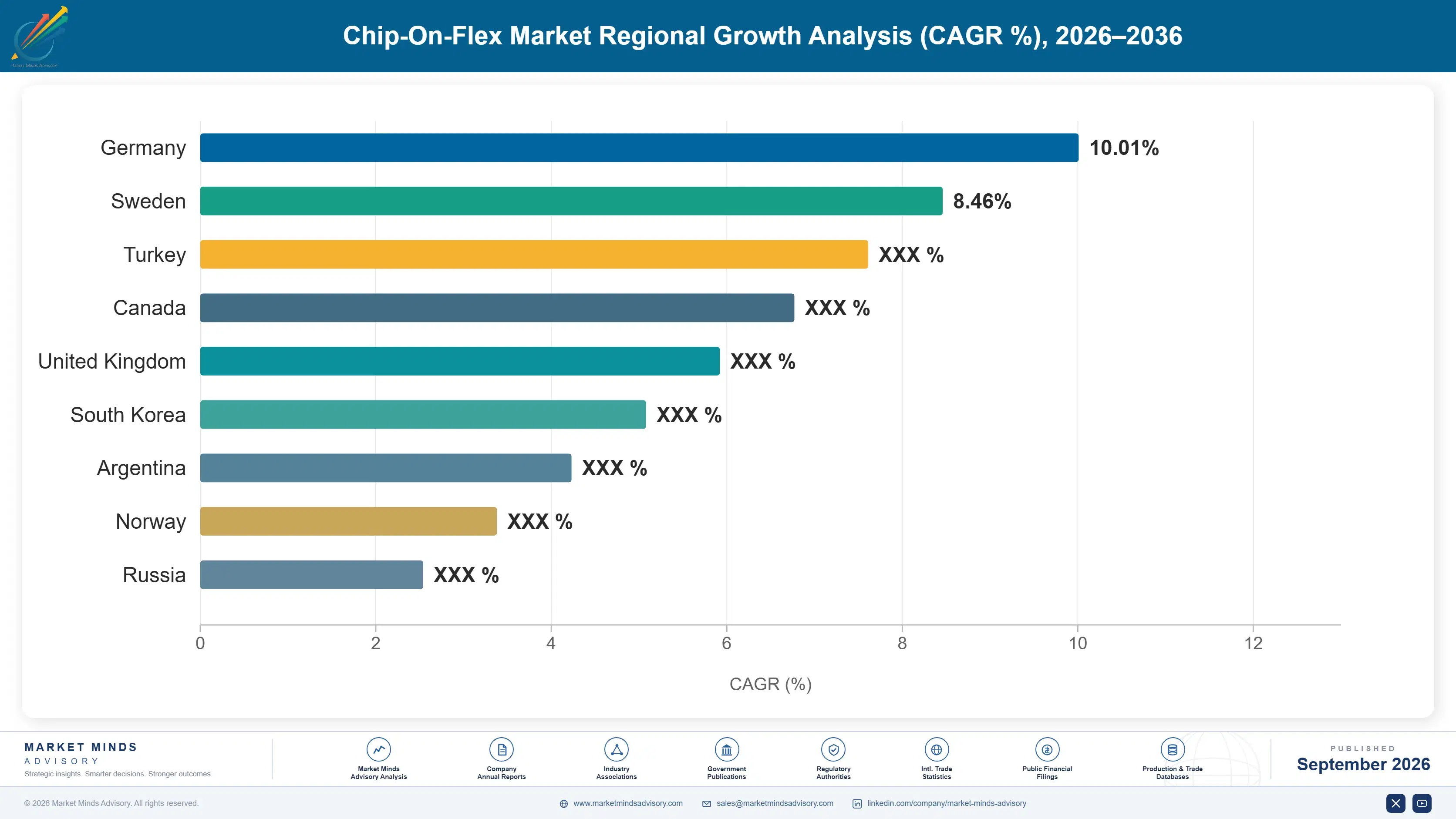
chip-on-flex-market-country-cagr-analysis-1789998744451

Bonding Precision and Recurring Module Revenue Pathways

Chip-on-flex suppliers can expand revenue well beyond per-unit bonding fees by moving up the value chain into qualification design support services, recurring replacement supply for medical patches, precision process licensing to smaller regional rivals, and bundled reliability testing that competitors without genuine fine pitch bonding capability cannot easily replicate or undercut on price alone.

Fine Pitch Qualification and Design Support Services

Assemblers who help panel makers qualify new foldable hinge zones and driver IC layouts before mass production begins can charge separately for design support engineering, capturing revenue months before the first bonded unit ships. This pre-production engagement typically runs 8 to 12 weeks per new design and carries margins above 40 percent, well ahead of standard bonding fees, because it draws on scarce fine pitch process expertise that few competitors hold. Customers who pay for qualification support also tend to award the resulting production volume to the same supplier, converting a service fee into a multi-year manufacturing contract.
Market Impact: Design support work carries margins above 40 percent

Recurring Replacement Supply for Medical Monitoring Patches

Continuous glucose and cardiac monitoring patches require sensor module replacement every ten to fourteen days, and suppliers who win the initial design slot capture a recurring order stream worth roughly 26 replacement units per patient annually rather than a single transaction. This annuity-like revenue pattern is far more valuable than one-time foldable display design wins, since patient population growth compounds on top of the existing base each year rather than resetting with each new product launch. Suppliers are increasingly bidding on medical patch programmes specifically for this durable, predictable revenue characteristic.
Market Impact: Delivers about 26 recurring orders per patient yearly

Licensing Proprietary Low-Temperature Bonding Process Technology

A small number of assemblers have developed proprietary lower-temperature anisotropic conductive film bonding processes that reduce thermal stress on flexible substrates, and some now license this process technology to smaller regional assemblers for an upfront fee plus a running royalty near 3 percent of licensee bonding revenue each year. This converts research investment into a second income stream without requiring any additional capital expenditure on new physical capacity. Licensing also extends the technology's market reach into regions where the original developer lacks direct assembly presence, growing adoption of the underlying process standard.
Market Impact: Royalty fees run near 3 percent of revenue

Bundled Testing and Reliability Certification Add-On Packages

Beyond bonding itself, assemblers can bundle accelerated life testing, bend cycle certification, and moisture ingress validation as a paid add-on package rather than folding these steps quietly into base pricing structures. Customers requiring formal reliability certificates for medical or automotive qualification pay a premium of roughly 15 percent over standard bonding fees for this bundled service, and the testing data generated often becomes reusable across multiple customer programmes at no incremental cost to the assembler. This add-on has become a meaningful profit center for assemblers serving regulated end markets that demand documented evidence.
Market Impact: Adds a 15 percent premium over standard fees

Who Controls the Margin Pool

Chip-on-flex assembly sits in the hands of a concentrated group of outsourced assembly and test specialists, with a CR5 near 52 percent that reflects how few firms can hold sub-forty-micron bonding tolerances at production yield. The gap between the leading assembler and the next tier is wide: the top two firms hold multi-year capacity commitments from major foldable device brands that smaller challengers simply cannot bid into.
Current competitive activity centers on capacity expansion at existing fine pitch sites rather than new market entry, since qualifying a new bonding line for foldable display work now takes eighteen months or more including customer reliability sign-off. Firms are differentiating through process patents on lower-temperature bonding chemistry and through dedicated engineering teams embedded at panel maker design centers well ahead of production.

Emerging pressure comes from medical device and payment card programmes that reward biocompatibility certification and financial industry security standards rather than raw bonding speed, opening space for specialist challengers outside the display supply chain. Rankings could shift meaningfully if a mid-tier assembler secures a second major foldable brand relationship or if a licensing-based entrant scales its royalty model faster than incumbents can respond with proprietary process investment of their own.
chip-on-flex-market-company-positioning-matrix-1789998744981

Competitive Moat and Risk Dimensions

CHIPBOND TECHNOLOGY CORPORATION

Moat: Sub-Forty-Micron Bonding Scale

Chipbond operates the industry's largest installed base of sub-forty-micron bonding lines, giving it first access to new foldable display design cycles before smaller rivals can even quote. Its scale lets it absorb the eighteen-month qualification timeline for new customer programmes without idling capacity, a burden that keeps most challengers from bidding on the largest brand relationships at all.
CHIPBOND TECHNOLOGY CORPORATION

Risk: Customer Concentration Among Two Brands

A large share of Chipbond's fine pitch revenue traces back to just two foldable smartphone brands, leaving earnings exposed to any single brand's shipment slowdown or a decision to dual-source with a rival assembler. Diversifying into medical or automotive flexible circuits would reduce this exposure but requires certification investment the firm has been slow to commit.
CHIPMOS TECHNOLOGIES

Moat: Diversified Driver IC Customer Base

ChipMOS serves a broader mix of display driver IC customers across foldable, automotive, and conventional panel segments than most rivals, insulating its revenue from any single end market's demand swing. This diversification also gives its engineering teams exposure to a wider range of bonding challenges, compounding process knowledge that narrower competitors lack.
CHIPMOS TECHNOLOGIES

Risk: Thinner Margins on Legacy Volume

Because ChipMOS still runs meaningful legacy driver IC volume at coarser bonding pitch, its blended margins trail rivals who have shifted entirely toward premium fine pitch work. Competing simultaneously on commodity price and premium capability strains capital allocation decisions, and the firm has been slower to commit fully to next-generation bonding equipment as a result.

Players Tracked

Prominent Players

Chipbond Technology Corporation
ChipMOS Technologies
STS Semiconductor and Telecom
Samsung Electro-Mechanics
LX Semicon

Other Key Players

Nepes Corporation
Chip Packaging Technologies
Powertech Technology
King Yuan Electronics
Siliconware Precision Industries
Amkor Technology
ASE Technology Holding
JCET Group
Tongfu Microelectronics
Hana Micron
SFA Semiconductor
Walton Advanced Engineering
Formosa Advanced Technologies
UTAC Holdings
Unisem Group

Recent Developments

MARCH 2026

Chipbond Expands Sub-Forty-Micron Bonding Capacity

Chipbond announced organic capacity expansion at its Hsinchu facility, adding sub-forty-micron bonding lines dedicated to foldable display driver IC assembly. Funded through internal capital, the expansion should lift qualified fine pitch capacity roughly thirty percent once commissioned in early 2027, addressing customer demand for tighter tolerances.
Signal: Signals sustained capital commitment to fine pitch leadership rather than pursuing new market diversification bets now.
JULY 2025

STS Semiconductor Signs Medical Patch Supply Agreement

STS Semiconductor entered a multi-year supply agreement with a continuous glucose monitoring device maker to bond flexible sensor interfaces for a reimbursed patch programme spanning three countries. The agreement is a commercial supply contract rather than an acquisition or joint venture, marking STS's first major push into medical wearable work.
Signal: Marks a deliberate diversification move by STS beyond its historical, long-standing smart card customer base entirely.
NOVEMBER 2025

ChipMOS Acquires Flexible Sensor Bonding Specialist

ChipMOS completed the acquisition of a smaller Taiwanese bonding specialist focused on flexible MEMS sensor modules, adding proprietary low-temperature bonding chemistry to its process portfolio. The acquired firm's roughly 200 employees and existing customer contracts transferred fully, giving ChipMOS immediate access to automotive sensor design wins.
Signal: Confirms acquisition, rather than organic capacity build, remains ChipMOS's preferred route into new adjacent bonding segments.

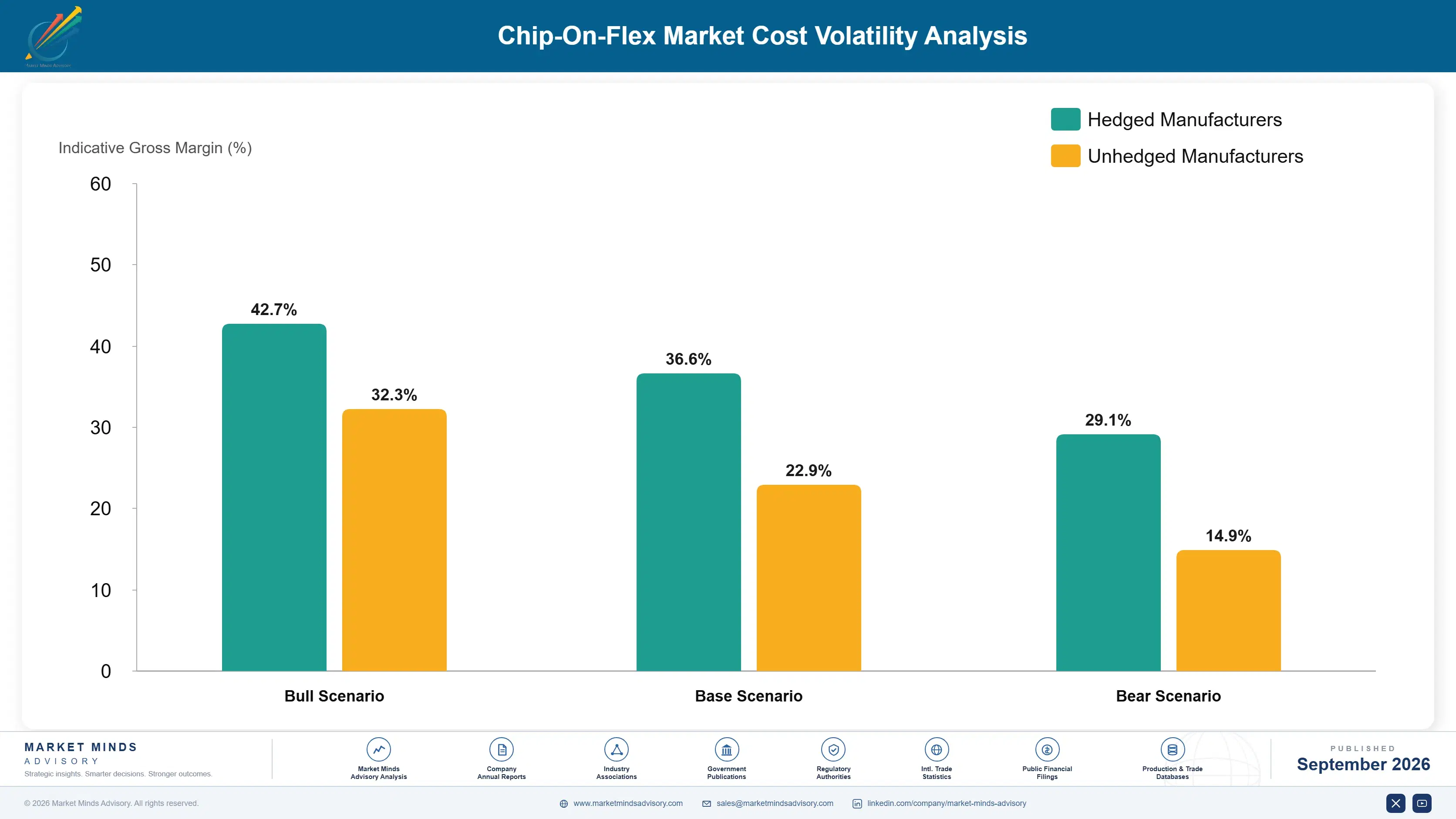
Gold and Polyimide Price Exposure in Bonding

Gold bump wire and polyimide film together account for roughly 41 percent of chip-on-flex bonding cost of goods sold, with gold sourced primarily from refiners in Switzerland and South Africa while specialty polyimide film comes almost entirely from a small number of Japanese and Korean chemical producers. This narrow supplier base leaves assemblers with genuinely limited substitution options during periods of price stress.
Gold prices climbed more than 30 percent between early 2024 and mid-2025 according to IEA commodity tracking data, pushing several mid-tier assemblers to renegotiate customer pricing mid-contract for the first time in years. The volatility coincided with broader safe-haven demand for precious metals, and assemblers without forward purchase hedges absorbed the bulk of the cost swing directly into compressed quarterly margins before pricing adjustments took effect.

Smaller regional assemblers without treasury functions capable of hedging bullion exposure sit at a clear disadvantage against larger rivals who lock in gold pricing months ahead through forward contracts. This gap widens further for assemblers operating outside East Asia, where local currency volatility compounds commodity price risk and makes long-term customer pricing commitments considerably harder to sustain profitably across multi-year contracts.
chip-on-flex-market-cost-volatility-analysis-1789998745179

Forward Purchase Hedging Against Gold Price Volatility

Larger assemblers are extending forward purchase agreements with bullion suppliers from three months to as long as twelve months, locking in gold pricing well ahead of production runs and smoothing quarterly cost of goods sold across multiple concurrent customer programmes. This reduces earnings surprise risk for both the assembler and the customers who depend on stable long-term pricing commitments.

Copper and Solder Bump Alternatives to Gold

Several process teams are qualifying copper and solder-based bump alternatives to gold in order to reduce precious metal exposure, though oxidation resistance on thin flexible substrates remains unproven at full production scale for now. Early pilot lines running at two assemblers suggest a commercially viable alternative path could emerge within roughly two more years of development.

Portfolio Architecture for Margin Defence

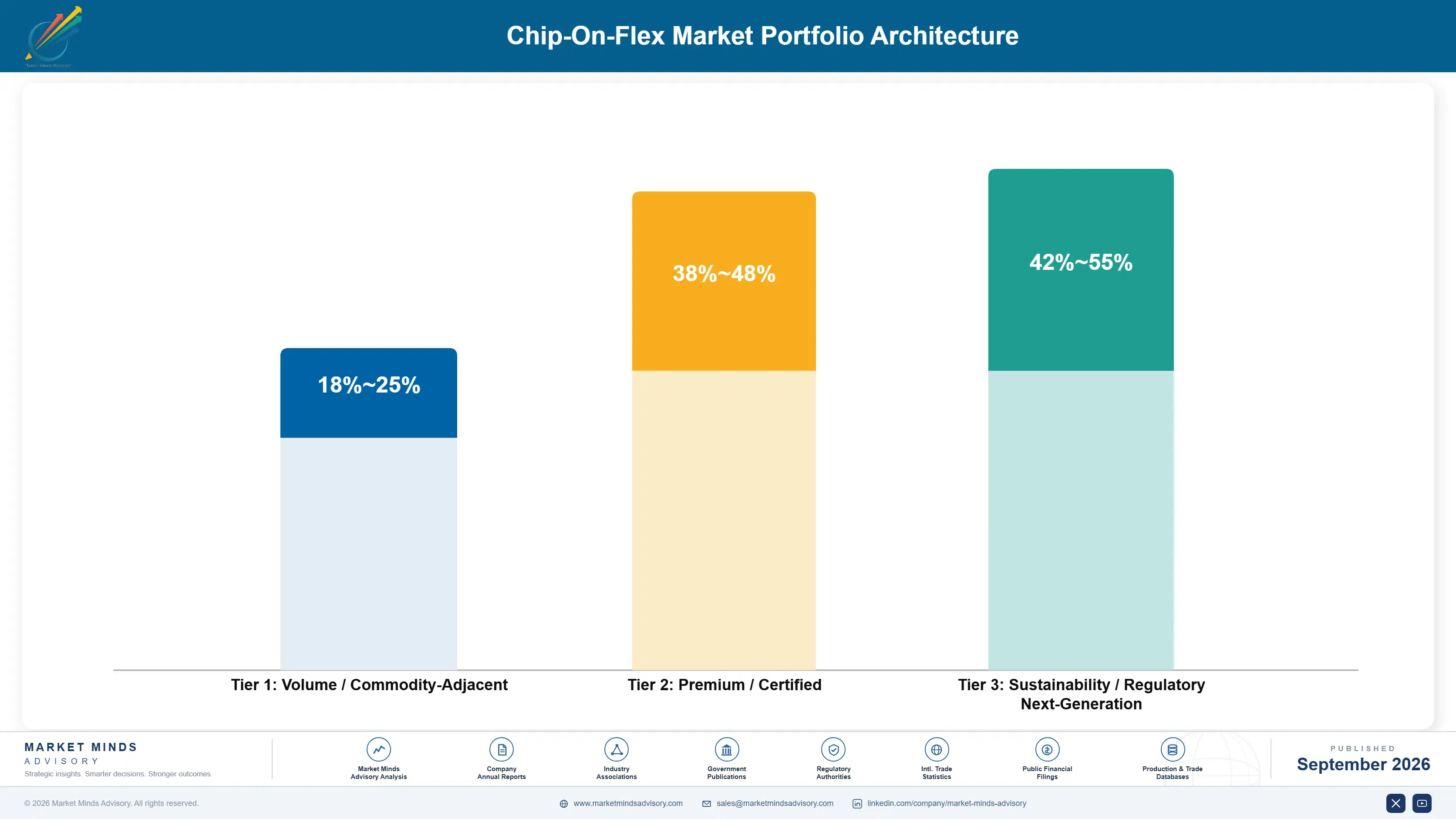
Chip-on-flex margin economics separate cleanly along bonding pitch fineness rather than product category, with the widest gross margins concentrated in sub-forty-micron work regardless of whether the end application is a foldable display, a medical patch, or a payment card module. Volume-tier smart card bonding runs on thinner margins sustained purely by high daily throughput volume.
The tension between volume and premium tiers plays out most clearly in capital allocation decisions: every dollar spent upgrading a coarse pitch line to fine pitch capability pulls capacity away from lower-margin smart card and RFID work that still generates steady, if unglamorous, cash flow each quarter. Most established assemblers maintain both tiers simultaneously rather than fully committing capital to one over the other.

High-value margin pools concentrate overwhelmingly in medical device and foldable display work, where certification barriers and reliability requirements keep new entrants out far more effectively than pricing power alone ever could achieve. Sustainability and regulatory-driven segments remain small today but are positioned to absorb a growing share of new capital investment as certification requirements around recyclable substrate materials tighten across major markets over the coming years.

Volume / Commodity-Adjacent

Coarse pitch bonding for smart cards, RFID tags, and legacy hearing aid modules, running on high volume and thin unit margins sustained by throughput rather than process complexity or design differentiation.
Gross Margin: 18-25%

Premium / Certified

Fine pitch bonding for foldable displays and biometric payment cards, where certification, reliability testing, and sub-forty-micron bonding precision command a durable price premium over commodity assembly work at every design cycle.
Gross Margin: 38-48%

Sustainability / Regulatory / Next-Generation

Medical wearable and recyclable substrate bonding tied to reimbursement approval and emerging environmental regulation, still small in volume but drawing rising capital allocation from established assemblers positioning ahead of tightening rules.
Gross Margin: 42-55%
chip-on-flex-market-portfolio-architecture-1789998745696

High-value Sub-segments and Strategic Watch-out

Display Driver Chip-on-Flex for Foldable Devices

The fastest-growing, highest-margin segment, driven by expanding foldable smartphone unit shipments and rising driver IC channel counts per device. Certification barriers around sub-forty-micron bonding tolerance protect incumbent margins, and the segment is expected to absorb the largest share of new capital investment through the forecast window.
Gross Margin: 42-50%

Wearable and Medical Patch Chip-on-Flex

High-value and growing steadily as reimbursed continuous monitoring programmes expand across major healthcare markets, with recurring replacement cycles compounding unit demand well beyond device population growth alone. Biocompatibility certification requirements keep margins elevated relative to non-medical wearable applications, and reimbursement expansion into new countries should sustain this trajectory.
Gross Margin: 38-46%

Smart Card and RFID Chip-on-Flex

The volume core of the market, sustained by ongoing biometric payment card migration and steady identity card issuance across developing and mature economies alike, though margins stay thin because bonding complexity is lower and competition on price remains intense among a wider pool of qualified regional suppliers worldwide.
Gross Margin: 18-24%

Automotive Flexible Circuit Chip-on-Flex

A strategic watch-out segment where slower-than-expected in-cabin display and sensor adoption could leave committed bonding capacity underutilized, even as electric vehicle interior redesigns create a plausible long-term growth path that has not yet materialized into predictable, firmly contracted order volume for most assemblers currently active in the segment.
Gross Margin: 28-36%

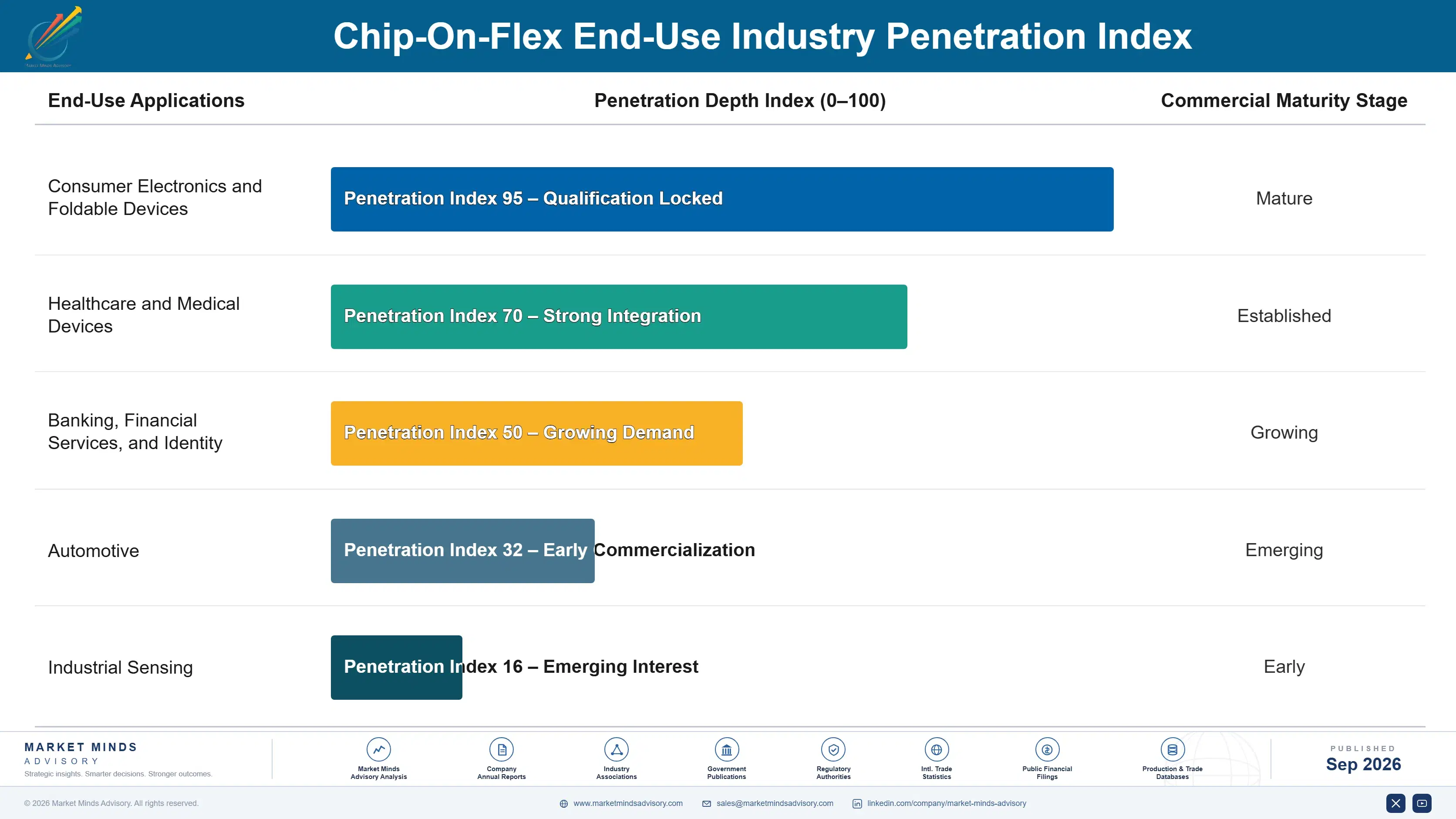
Recurring Demand Beneath Chip-on-Flex Design Wins

Chip-on-flex revenue behaves less like a one-time component sale and more like an annuity once a design win is secured, since medical patch replacement cycles and multi-year foldable brand contracts lock in repeat orders that persist well beyond the original qualification project across the entire relationship lifetime.
Stickiness varies sharply by end-use vertical: medical monitoring patches carry the deepest lock-in because biocompatibility recertification with a new supplier can take well over a year and a full clinical validation cycle, while smart card bonding is far more contestable since issuers routinely dual-source across two or three qualified suppliers each renewal cycle. Foldable display relationships sit closer to medical stickiness, anchored by shared engineering roadmaps developed jointly between assembler and panel maker over several product generations.

Buyer profiles are shifting generationally as procurement authority moves from component engineers focused purely on unit cost toward reliability and regulatory teams who weigh certification history and supply continuity far more heavily than price alone. This generational change favors incumbents with documented reliability track records over new entrants offering only lower price, reshaping how future contracts get awarded across every segment of the market through the remainder of the forecast decade.
chip-on-flex-market-end-use-penetration-index-1789998746196

Where Bonding Precision Decides Market Position

These are among the four positions where our research anticipates prominent divergence between winners and laggards over the coming forecast period. Each is grounded in the demand model, the regulatory perimeter, and the announced capacity pipeline.
01 / CAPACITY INVESTMENT TIMING

Commit to Fine Pitch Before Capacity Fully Locks Up

Assemblers still running coarse pitch lines should commit decisively to sub-forty-micron bonding upgrades now, before the largest foldable device brands finish allocating their remaining qualified capacity slots for the next two full product generations. Waiting even one design cycle risks permanent exclusion from the highest-margin segment of this entire market, a mistake that is difficult to reverse later. Early movers who invested ahead of the 2024 foldable volume ramp are already locking in multi-year contracts that latecomers cannot easily displace.
02 / MEDICAL CERTIFICATION ENTRY

Pursue Biocompatibility Certification to Access Recurring Revenue

Suppliers without medical device certification should pursue it deliberately and soon, since reimbursed monitoring patches generate recurring replacement orders that dwarf the value of any single foldable display design win over comparable time horizons and customer relationships. The certification process takes well over a year and demands sustained capital investment that most smaller competitors will simply not commit to voluntarily given the uncertain payback timeline involved. Firms that clear this bar first should expect to hold meaningful pricing power over the resulting patient population for years afterward.
03 / COMMODITY COST HEDGING

Lock In Gold Forward Contracts Before the Next Price Spike

Assemblers still buying gold bump wire purely on spot terms should move decisively toward forward purchase agreements immediately, since the last major price spike compressed quarterly margins sharply at every firm without hedging already in place at the time. This is no longer a discretionary treasury decision given how large gold now sits within total bonding cost of goods sold across most active production lines. Competitors with hedging programmes already established will simply out-price unhedged rivals during the next inevitable volatility episode.
04 / GEOGRAPHIC DIVERSIFICATION BET

Evaluate Selective Capacity Outside the East Asian Core

Firms weighing new assembly capacity should evaluate select sites outside the East Asian core carefully and methodically, particularly where domestic packaging incentives in the United States or India could offset meaningfully higher build cost over time and improve project economics. This diversification carries real execution risk and should not be treated as a near-term volume shift away from established Asian capacity commitments already in place. It functions best as an option on future policy change rather than a present-day operating strategy commitment for most firms.

Engagement Snapshot From the Field

A live engagement with an industry participant carrying material or product regulatory and market exposure ahead of a defining policy shift, showing how our research translates into a defensible multi-year portfolio strategy.
MARKET MINDS ADVISORY · CLIENT ENGAGEMENT SUMMARY
Chip-On-Flex Producer Strategic Portfolio Review and Transition Roadmap 2026·Investment Scenario on Chip-On-Flex Exposure Evaluation 2025-26
CLIENT PROFILE
The client is a mid-sized consumer wearable health device brand preparing to launch a continuous cardiac monitoring patch under a national reimbursement programme. The company had previously relied entirely on rigid PCB assembly for its existing wrist-worn product line and had no prior sourcing relationship with chip-on-flex assemblers. Its engineering team understood the technical bonding requirements conceptually but lacked hands-on qualification experience.
STRATEGIC CHALLENGE
The client needed to identify and qualify a chip-on-flex assembly partner capable of meeting medical device reliability standards within an aggressive nine-month launch window tied to a fixed reimbursement approval date. Existing supplier relationships in rigid PCB assembly offered no relevant qualification pathway, and the client's engineering team had never evaluated bonding pitch or biocompatibility certification requirements before this programme.
MMA APPROACH
MMA conducted a structured supplier assessment across twelve qualified chip-on-flex assemblers, screening for medical biocompatibility certification history, sub-fifty-micron bonding capability, and reimbursement-relevant regulatory experience specific to the target countries. The assessment combined primary interviews with assembler engineering leadership and a review of each candidate's documented reliability testing track record over the prior three years.
KEY FINDINGS
  1. Only three of twelve assessed assemblers held current medical-grade biocompatibility certification directly relevant to the client's target reimbursement markets and launch timeline.
  2. The client's initial preferred assembler lacked documented accelerated life testing data entirely, a gap that would have delayed regulatory submission by several months at minimum.
  3. Recurring patch replacement volume, once modeled properly against reimbursement cadence, represented roughly nine times the annual unit volume of the client's existing rigid wrist-worn product line.
  4. Two of the twelve candidate assemblers offered bundled reliability certification packages that meaningfully reduced the client's internal testing burden and shortened the overall submission timeline.
CLIENT PROFILE
The client is a mid-sized consumer wearable health device brand preparing to launch a continuous cardiac monitoring patch under a national reimbursement programme. The company had previously relied entirely on rigid PCB assembly for its existing wrist-worn product line and had no prior sourcing relationship with chip-on-flex assemblers. Its engineering team understood the technical bonding requirements conceptually but lacked hands-on qualification experience.
STRATEGIC CHALLENGE
The client needed to identify and qualify a chip-on-flex assembly partner capable of meeting medical device reliability standards within an aggressive nine-month launch window tied to a fixed reimbursement approval date. Existing supplier relationships in rigid PCB assembly offered no relevant qualification pathway, and the client's engineering team had never evaluated bonding pitch or biocompatibility certification requirements before this programme.
MMA APPROACH
MMA conducted a structured supplier assessment across twelve qualified chip-on-flex assemblers, screening for medical biocompatibility certification history, sub-fifty-micron bonding capability, and reimbursement-relevant regulatory experience specific to the target countries. The assessment combined primary interviews with assembler engineering leadership and a review of each candidate's documented reliability testing track record over the prior three years.
KEY FINDINGS
  1. Only three of twelve assessed assemblers held current medical-grade biocompatibility certification directly relevant to the client's target reimbursement markets and launch timeline.
  2. The client's initial preferred assembler lacked documented accelerated life testing data entirely, a gap that would have delayed regulatory submission by several months at minimum.
  3. Recurring patch replacement volume, once modeled properly against reimbursement cadence, represented roughly nine times the annual unit volume of the client's existing rigid wrist-worn product line.
  4. Two of the twelve candidate assemblers offered bundled reliability certification packages that meaningfully reduced the client's internal testing burden and shortened the overall submission timeline.
RECOMMENDED STRATEGY
Phase 1: Phase 1 (Supplier Screening): Narrow the twelve candidate assemblers down to three finalists based on documented certification history and bonding pitch capability. Phase 2: Phase 2 (Reliability Validation): Commission independent accelerated life testing on finalist samples before committing to any long-term production supply contract. Phase 3: Phase 3 (Contract Structuring): Negotiate a multi-year supply agreement with volume-based pricing tiers tied directly to reimbursement rollout milestones and volume ramp.
OUTCOME
The client selected an assembler with documented medical certification and completed reliability validation two months ahead of the original schedule, allowing regulatory submission to proceed on time. Reported first-year patch replacement volume came in near the modeled projection, though exact figures remain (client-reported, unverified by MMA).

Frequently Asked Questions

Foundational context covering the market sizes, CAGR, scope, country, region and competition that inform every finding below. This section is provided to cover basics and most often pre-purchase conversations, answered from the MMA Primary Research Dataset.

What is the current size of the Chip-On-Flex Market?

The global chip-on-flex market reached an estimated $2.9 billion in 2025, driven by rising foldable display and medical wearable adoption. This base-year figure reflects MMA Primary Research Dataset estimates as of July 2026.

How large will the Chip-On-Flex Market be by 2036?

The chip-on-flex market is forecast to reach $8.69 billion by 2036, up from $3.2 billion in 2026. Growth is led by foldable displays, wearable health patches, and biometric payment card demand.

What is the CAGR for the Chip-On-Flex Market 2026 to 2036?

The chip-on-flex market is projected to grow at a 10.5 percent compound annual growth rate between 2026 and 2036. This reflects sustained foldable device and medical wearable adoption across the forecast period.

Which segment is growing fastest?

Display driver chip-on-flex for foldable and wearable displays is the fastest-growing segment, expanding at 15.5 percent annually. That is roughly 1.48 times the overall market's 10.5 percent growth rate.

Who are the major companies in the Chip-On-Flex Market?

Major companies include Chipbond Technology, ChipMOS Technologies, STS Semiconductor, Samsung Electro-Mechanics, and LX Semicon. These five firms hold a combined CR5 near 52 percent of global assembly volume.

Which country is growing fastest?

South Korea is growing fastest among individual countries, expanding at roughly 12.5 percent annually. Its foldable display driver base and biometric payment card pilots are pulling bonding volume upward each year.

Report Segmentation Architecture

The full report scope spans multiple orthogonal segmentation dimensions, with cross-tabulated demand data provided for each dimension pair. Coverage extends further to regional breakdowns, trend trajectories, and the competitive detail needed to support segment-level decision-making.

By Primary Market Dimension

  • Display Driver COF for Foldable and Wearable Displays
  • Chip-on-Flex for Wearable Electronics and Smart Patches
  • COF for Smart Cards and RFID/NFC Tags
  • COF for Hearing Aids and Medical Implantable Devices
  • COF for Flexible Sensors and MEMS Modules
  • COF for Automotive Flexible Circuits

By End-Use Industry

  • Consumer Electronics and Foldable Devices
  • Healthcare and Medical Devices
  • Banking, Financial Services, and Identity
  • Automotive
  • Industrial Sensing

By Commercial Dimension

  • Original Device Manufacturer Direct Sourcing
  • Outsourced Assembly and Test Services
  • Design and Qualification Support Services
  • Aftermarket Replacement Module Supply

By Region

  • North America
  • Western Europe
  • East Asia
  • South Asia and Pacific
  • Latin America
  • Middle East and Africa
  • Eastern Europe

Scope, Methodology, and Coverage

Every figure in this report is reproducible from documented input assumptions. The scope below maps the historical period, the forecast horizon, the segmentation dimensions, and the countries covered, alongside the underlying primary and qualitative methodology.
Historical Period
2020 to 2025
Forecast Period
2026 to 2036
Base Year
2025 (USD billions; MMA Primary Research Dataset, September 2026)
Market Definition
The chip-on-flex market covers bare semiconductor die and driver ICs bonded directly onto flexible polyimide circuit substrates for displays, wearables, smart cards, and medical devices. It excludes rigid PCB assembly, chip-on-glass and chip-on-board packaging, and the flexible substrate film sold without die attachment.
Quantitative Units
USD billions (current prices); unit shipment volume where applicable
Segmentation Dimensions
By Primary Market Dimension; By End-Use Industry; By Commercial Dimension; By Region
Regions Covered
North America, Western Europe, East Asia, South Asia and Pacific, Latin America, Middle East and Africa, Eastern Europe
Countries Covered
USA, China, Germany, France, UK, Japan, South Korea, India, Australia, Canada, Brazil, Mexico, Indonesia, Vietnam, Thailand, Malaysia, UAE, Saudi Arabia, South Africa, Nigeria, Turkey, Poland, Netherlands, Italy, Spain, Sweden, Switzerland, Argentina, Colombia, Singapore, and additional markets relevant to this sector
Key Companies Profiled
Chipbond Technology Corporation, ChipMOS Technologies, STS Semiconductor and Telecom, Samsung Electro-Mechanics, LX Semicon, Nepes Corporation, Chip Packaging Technologies, Powertech Technology, King Yuan Electronics, Siliconware Precision Industries, Amkor Technology, ASE Technology Holding, JCET Group, Tongfu Microelectronics, Hana Micron, SFA Semiconductor, Walton Advanced Engineering, Formosa Advanced Technologies, UTAC Holdings, Unisem Group
Quantitative Methodology
Primary survey, n=3,800 respondents, Q4 2025, six countries; demand-side model with trade association cross-validation
Qualitative Methodology
47 expert interviews, Q4 2025; applied to validate demand model assumptions, identify emerging dynamics, and assess competitive positioning
Report Format
PDF and XLSX data workbook (Word format preview document)
Publisher
Market Minds Advisory
Report Code
MMA-2026-TEC-960
Published
September 2026
Contact
sales@marketmindsadvisory.com | www.marketmindsadvisory.com

Purchase the full Chip-On-Flex Market Report (2026 to 2036).

The full report expands on every dimension summarized here, delivering complete segment-by-segment financial modeling, all seven regional profiles with country-level detail, and an extended competitive landscape covering all twenty profiled companies. It includes the complete methodology behind MMA's primary survey of 3,800 respondents and 47 expert interviews conducted across six countries in the fourth quarter of 2025. Buyers also receive downloadable data tables supporting every chart and figure referenced throughout the analysis. A dedicated appendix walks through the underlying assumptions behind every forecast scenario, and purchasers gain access to a live analyst briefing session to discuss findings directly.
Complete six-segment financial model, 2020 to 2036
All seven regional profiles with country detail
Twenty-company competitive benchmarking and profiling dataset
Primary survey and expert interview data tables
Live analyst briefing session included with purchase
Editable data appendix in spreadsheet format

Built For The People Who Decide

From boardroom strategy to bench-side execution, this report is read cover-to-cover by leaders shaping the next decade of their industry, turning demand scenarios, market dynamics and valuation benchmarks into decisions.
CXOs/ Presidents/ VPs/ Managers
M&A and Corporate Development
Strategy Teams and R&D Heads
Procurement and Product Directors
Regulatory and Compliance Leaders
Investor Relations and Equity Analysts