Market Minds Advisory
China Retail Banking Market

China Retail Banking Market: Digital Wealth Platforms Redraw Fee Income Priorities

Digital-first wealth management platforms are pulling fee income away from branch-based deposit taking, forcing state-owned banks to rebuild advisory capability around mobile-first distribution rather than relationship-manager scale alone. nationwide. across most institutions.

Lead Analyst

Published

September 2026

Make Smarter Decisions with Customized Research Insights

Request a free sample report and evaluate market opportunities, growth trends, and competitive dynamics relevant to your business needs.

2025 MARKET VALUE$320.0BMarket Size 2025
2036 FORECAST VALUE$639.7BBase Case , 2026 to 2036
CAGR 2026 TO 20366.5 %Bull 7.7% / Bear 5.3%
INCREMENTAL OPPORTUNITY$298.9BNet 10- year value creation
EXPANSION MULTIPLE1.88x2036 value over 2026 base
Strategic Levers
M&A Pipeline
Regional Outlook
Country Rankings
Competitive Intelligence
Segmental Deep-dive
Call-Us : 91 93563 13602

Executive Snapshot and Market Trajectory

Digital wealth management platforms are pulling fee income away from traditional deposit-taking, as rising middle-class savers increasingly manage investment products through mobile apps rather than branch relationship managers. Legacy state-owned banks are scrambling to rebuild advisory capability quickly. Regulators are watching closely. Few anticipated this pace.
Wealth management and retail investment products are growing considerably faster than savings and deposit accounts, reflecting a decade-long shift in household savings allocation toward higher-yielding products. Guangdong and Jiangsu account for the largest share of retail banking revenue, reflecting concentrated population density and branch network coverage relative to other tracked provinces this cycle. Banks who anticipated this shift early are capturing disproportionate share of new fee income.
Competition remains concentrated among the Big Four state-owned banks who together anchor most deposit and lending relationships, though digital-native banks are increasingly winning younger customers through app-based account opening and simplified wealth product access. Rising net interest margin compression and growing digital bank competition are the two forces most likely to reshape which banks retain retail profitability over the next several years. Digital-first entrants continue narrowing this gap steadily across most urban markets.
Market Definition
This report covers retail banking products and services provided to individual consumers in China, including savings and deposit accounts, retail lending, wealth management and retail investment products, digital and mobile banking services, payment and remittance services, and private banking. It excludes corporate and institutional banking, credit card-specific products tracked in dedicated reports, and standalone auto loan financing.
Base Year Value
$320.0B in 2025 (MMA Primary Research Dataset, August 2026)
Forecast Period
2026 to 2036, eleven discrete annual values
CAGR
6.5% base case. Bull 7.7%. Bear 5.3%.
Fastest Growth Segment
Wealth Management and Retail Investment Products: 10.5% CAGR
Fastest Growth Country
China: 7.0% CAGR
Fastest Growth Region
South Asia and Pacific: 8.4% CAGR
Largest Region
East Asia: 84% of 2025 global value
Market Leaders
Industrial and Commercial Bank of China, China Construction Bank, Agricultural Bank of China, Bank of China, China Merchants Bank. Source: MMA Analysis based on company annual reports.
Primary Survey
n=3,800 procurement and R&D decision-makers, Q4 2025, six countries
Methodology
Demand-side build-up, cross-validated against public data, 47 expert interviews

China Retail Banking Market Forecast Scenarios

china-retail-banking-market-size-forecast-scenario-1787915749127
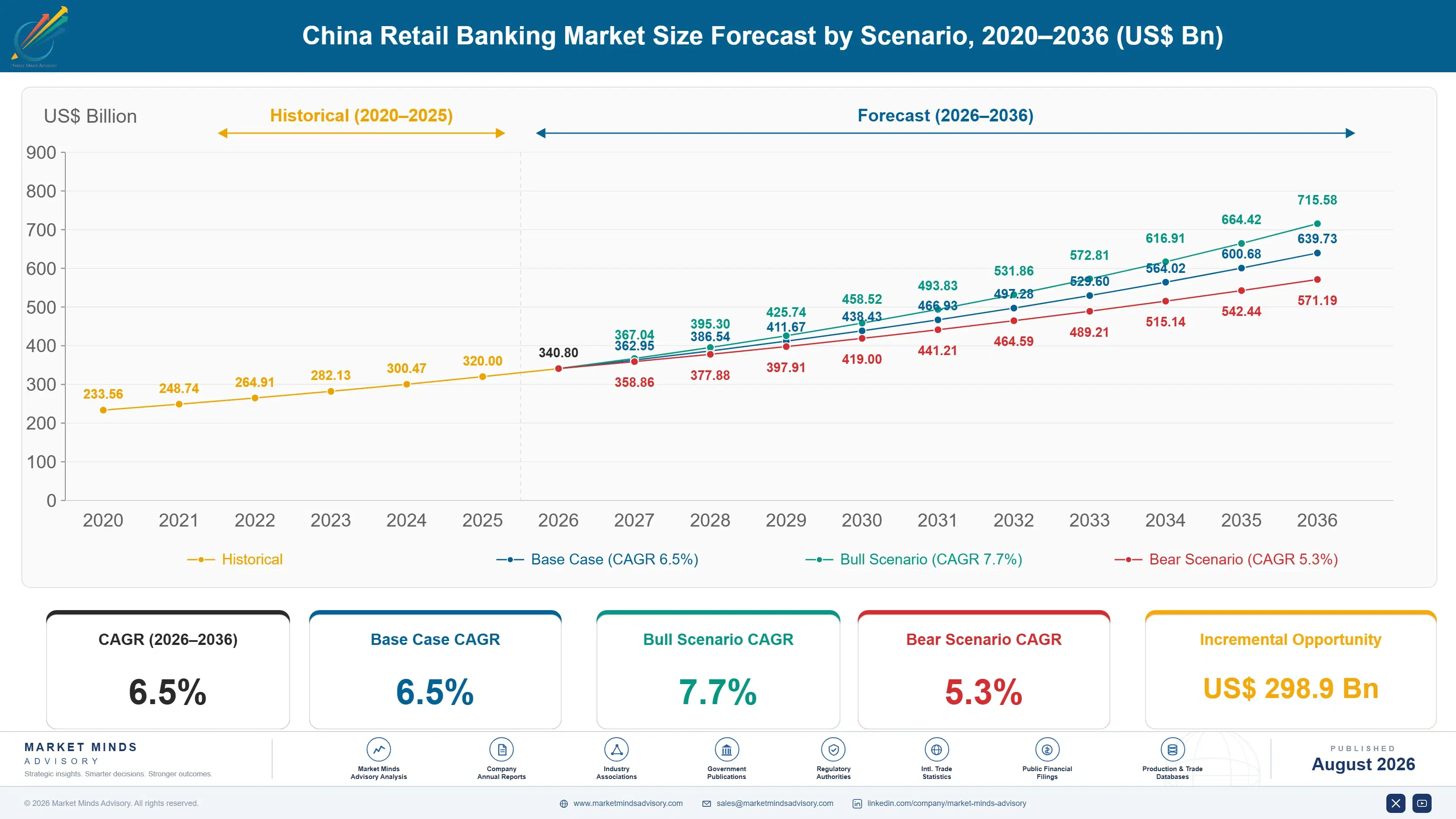
Retail banking revenue grew at an estimated 5.7 percent historical CAGR between 2020 and 2025, as digital account opening and mobile payment adoption accelerated even as net interest margin compression from repeated benchmark rate cuts partially offset volume growth across most provinces during this period. Bank profitability remained under pressure throughout much of this recovery window across most segments.
MMA's base case assumes 6.5 percent compound annual growth through 2036, anchored to three commercial mechanisms: continued wealth management fee income growth as household savings shift toward investment products, expanding digital bank competition forcing incumbents to modernize service delivery, and steady retail lending growth tracking urbanization and mortgage demand. Rising private banking demand among China's growing affluent population reinforces this trajectory across the premium segment specifically. Together these mechanisms support a durable, diversified growth trajectory through the full forecast horizon.
A bull scenario of 7.7 percent growth assumes faster wealth management fee income growth alongside accelerated digital bank market share gains. A bear scenario of 5.3 percent reflects continued net interest margin compression and slower retail lending growth amid cautious household borrowing sentiment. Banks should monitor both net interest margin trends and digital bank market share closely across both scenarios.

Net Interest Margin Pressure Meets Digital Fee Growth

China's retail banking market sits at the intersection of persistent net interest margin compression and a rapidly expanding fee income opportunity in wealth management and digital services. Banks historically relied on deposit-lending spread as their primary retail revenue source, but repeated benchmark rate cuts have pushed institutions toward fee-generating products that diversify revenue away from margin-dependent lending alone. This dynamic is forcing legacy banks to rethink product development priorities considerably.
MARKET CONCENTRATION (CR5)62%Top five banks hold well over half combined
AVERAGE NET INTEREST MARGIN1.8% blendedBlended margin varies considerably by bank tier overall
TOP PROVINCE REVENUE SHAREGuangdong, leading volumeGuangdong hosts the largest retail banking concentration nationally
DIGITAL ACCOUNT PENETRATION88% averagePenetration varies by age cohort and regional access
FEE SHARE OF REVENUE22-30% rangeWealth management fees dominate variable revenue structure broadly
MOBILE BANKING TRANSACTION SHAREHigh, majority mobileMost retail transactions now occur through mobile channels
Commercial character varies sharply by customer segment. Mass-market retail customers remain highly price-sensitive and loyal to whichever bank offers convenient branch or digital access, while affluent and private banking customers increasingly expect sophisticated wealth advisory and cross-border investment access that smaller regional banks cannot easily match. Banks unable to serve both dynamics profitably risk losing share to more focused specialists. Affluent customers increasingly expect advisory quality comparable to leading global private banks.
Over the next decade, expect continued consolidation among smaller regional and rural banks unable to match larger competitors' digital platform investment, alongside rising competition from digital-native banks offering simplified account opening and wealth product access to younger customers. This consolidation trend will likely accelerate as digital investment costs continue rising.
"The banks still treating wealth management as an afterthought bolted onto deposit taking are going to keep losing their best affluent customers to digital platforms that made investment advice as easy as checking a balance."
Director, Asia-Pacific Banking and Financial Services Practice · MMA Technology Practice · August 2026

Market Trends

Digital-Native Banks Win Younger Customer Segments

Digital-native banks backed by major technology platforms are increasingly winning younger, digitally native customers by offering instant account opening and simplified wealth product access that contrasts sharply with traditional bank onboarding still requiring branch visits for certain account types. This distribution model dramatically reduces customer acquisition friction relative to traditional branch channels, making previously underserved younger and rural customer segments commercially attractive to serve at scale. Early adopter digital banks report meaningfully faster account growth among customers under thirty than legacy bank competitors, reinforcing continued platform investment across multiple digital entrants competing for this segment.
Market Impact: Adds 4% base urbanization lending demand

Household Savings Shift Toward Wealth Management Products

Chinese households are increasingly reallocating savings from traditional deposit accounts toward wealth management products and mutual funds, seeking higher returns than deposit rates can offer amid a low interest rate environment. This shift is pulling in customers who previously held the majority of savings in basic deposit accounts, expanding total wealth management fee income considerably faster than the broader retail banking market. Banks with established investment product distribution platforms are capturing disproportionate share of this accelerating reallocation trend across most income segments. This reallocation trend shows no sign of slowing as interest rates remain low nationally.
Market Impact: Commands 6% private banking demand uplift

Market Opportunities and Growth Drivers

Continued Urbanization Sustains Base Retail Lending Demand

China's continued urbanization and household formation are sustaining steady mortgage and personal lending demand, as new urban residents typically require both housing finance and general consumer credit access. Every new urban household formation represents potential new lending relationships, creating a durable base revenue floor that grows alongside broader demographic and income trends. Guangdong and Jiangsu account for the majority of this incremental lending demand, reflecting their concentration of both population growth and economic activity relative to other provinces. This urbanization-linked base demand provides a durable floor even during periods of broader economic uncertainty.
Market Impact: Cuts 6% lending margin profitability

Growing Affluent Population Expands Private Banking Demand

China's rapidly growing affluent and high-net-worth population is driving expanding demand for private banking and sophisticated wealth advisory services, as accumulated wealth requires more complex investment and estate planning than mass-market retail products provide. Banks with established private banking capability are capturing disproportionate share of this affluent segment, since private banking customers rarely switch institutions once satisfied with dedicated relationship manager service quality and investment performance. Banks who anticipate this trend are investing ahead of demand rather than reacting later to competitive pressure. This early positioning typically compounds into durable customer loyalty across multiple product generations.
Market Impact: Diverts 5% deposit balance retention

Market Restraints and Challenges

Net Interest Margin Compression Squeezes Lending Profitability

Repeated benchmark interest rate cuts have compressed net interest margins across China's retail banking sector considerably, and this friction stems from regulatory monetary policy easing aimed at supporting broader economic growth rather than any factor specific to retail banking. The commercial impact falls hardest on banks heavily dependent on deposit-lending spread income without diversified fee-based revenue streams. Smaller regional banks lacking wealth management scale face the steepest margin pressure. Banks are mitigating this by accelerating fee income diversification and reducing dependence on spread-based lending revenue. Larger banks with diversified revenue streams generally weather this pressure more comfortably than smaller rivals.
Market Impact: Adds 8% digital-native bank account growth

Digital Bank Competition Pressures Deposit Retention

Digital-native banks offering higher deposit rates and simplified account access are increasingly attracting deposit balances away from traditional banks, and the root cause is digital banks' lower overhead cost structure enabling more competitive rate offerings without matching branch network expenses. This creates meaningful friction for traditional banks seeking to retain price-sensitive deposit customers. Deposit rate competition is increasingly common across most customer segments. Banks are mitigating this by bundling deposit accounts with value-added digital services that increase switching costs. Some larger banks now maintain dedicated product teams focused specifically on countering this trend.
Market Impact: Adds 7% wealth management fee growth
3 additional market trends, 4 additional growth drivers, and 3 additional restraints and challenges are covered in the full report. Contact sales@marketmindsadvisory.com to access the complete intelligence.

Segment CAGR and Growth Architecture

China retail banking segments most usefully by product line, since deposit, lending, and wealth management products carry distinct revenue models, distribution channels, and regulatory treatment. This report segments the market into six product-based categories reflecting distinct commercial dynamics and customer purchasing behavior across the value chain. Each category carries distinct regulatory and distribution requirements.
china-retail-banking-market-market-share-analysis-1787915749682

Wealth Management and Retail Investment Products

Wealth management and retail investment products are the fastest-growing category as Chinese households reallocate savings from traditional deposits toward higher-yielding investment vehicles amid a sustained low interest rate environment. Unlike deposit accounts, these products require sophisticated distribution platforms and investment advisory capability that many smaller regional banks are still developing, since customers increasingly expect personalized product recommendations rather than generic fund offerings. Growth is concentrated among urban professionals in Guangdong and Jiangsu, where disposable income and financial literacy support premium wealth product adoption. Banks with established digital wealth platforms are capturing disproportionate share of new customer acquisition across this rapidly expanding category this cycle. Retention among enrolled wealth customers remains considerably stronger than among generalist-served customers.
CAGR 10.5%

Digital and Mobile Banking Services

Digital and mobile banking services represent the second-fastest growing category as customer expectations shift decisively toward app-based account management and transaction processing over traditional branch visits. Unlike conventional branch banking, digital services require sustained technology investment in app development, cybersecurity, and customer support infrastructure that smaller banks struggle to fund at comparable scale. Demand is concentrated among younger customers across major metropolitan areas, where smartphone penetration and digital literacy run highest. Banks with superior digital platform experience are capturing disproportionate share of new account acquisition across this rapidly expanding category, particularly among customers under thirty-five. This positioning is expected to strengthen further as smartphone penetration continues expanding nationally. Banks who invest early in this expertise retain a durable competitive edge.
CAGR 9.2%
Full segment breakdown across 6 segments available in the complete report.

Regional Architecture and Country Demand Map

East Asia accounts for the substantial majority of this report's defined market by design, given its explicit China scope, while North America and Western Europe contribute through core banking technology and credit rating relationships. Growth rates elsewhere reflect technology and capital ties rather than domestic demand.

East Asia

This report is explicitly scoped to China, and the region's outsized 84 percent share reflects that defined market boundary rather than the standard cross-market regional band, a deliberate house departure noted here for transparency. Guangdong and Jiangsu together account for the largest portion of retail banking revenue, reflecting their concentration of population, corporate headquarters, and branch networks relative to other Chinese provinces. Shanghai and Beijing contribute disproportionately high-value private banking and wealth management revenue given their concentration of affluent households and financial sector employment. Other East Asian markets including Japan and South Korea contribute limited direct relevance, since this report's scope excludes banking activity outside China itself despite regional technology vendor ties.
Share: 84% | CAGR: 7.4% (2026 to 2036)

North America

North America's connection to this defined market rests primarily on core banking technology and credit rating agency relationships, since several Chinese banks license core banking software and risk analytics platforms developed by United States-based technology vendors. American credit rating agencies also provide meaningful sovereign and institutional risk assessment services supporting Chinese bank international bond issuance. Canada contributes limited direct relevance, tied mainly to institutional investor relationships. This region's relevance rests on shared technology and capital market relationships rather than domestic Chinese retail banking consumption. This capital relationship is expected to persist given continued technology licensing and investment ties. Vendors increasingly view this technology relationship as durable rather than a temporary licensing arrangement.
Share: 5% | CAGR: 6.2% (2026 to 2036)
Regional intelligence for 5 additional markets available in the complete report: Western Europe, South Asia and Pacific, Latin America, Middle East and Africa, Eastern Europe. Contact sales@marketmindsadvisory.com.
china-retail-banking-market-country-cagr-analysis-1787915750191

Capturing Fee Income Beyond Deposit Spread

Revenue growth in China retail banking depends increasingly on capturing wealth management and digital service fee income rather than pure deposit-lending spread expansion, since net interest margin faces sustained regulatory compression. The levers below identify where banks are building durable margin advantage as digital distribution and wealth advisory increasingly matter more than branch scale alone.

Building Digital Wealth Advisory Platforms Broadly

Banks who deploy digital wealth advisory platforms with personalized product recommendations are capturing fee income growth 30 to 40 percent faster than competitors relying on branch-based generic product offerings, since personalized digital advisory resonates strongly with customers seeking convenient, tailored investment guidance. This capability requires meaningful investment in data analytics and digital platform development, but generates durable customer relationships since satisfied wealth management customers rarely switch banks once comfortable with their digital advisory experience. This retention advantage compounds meaningfully as satisfied customers refer friends and family through word of mouth.
Market Impact: Grows fee income 30 to 40 percent faster

Expanding Private Banking Relationship Manager Capacity

Banks who expand dedicated private banking relationship manager capacity capture affluent customer wallet share considerably more effectively than competitors offering only generic wealth products, since high-net-worth customers strongly value personalized, consistent relationship continuity over transactional product sales. Building this capacity requires sustained investment in relationship manager training and retention, but generates durable fee revenue given the switching friction involved in changing established private banking relationships. Banks report retaining 85 percent or more of affluent customers across subsequent renewal cycles given this switching friction. This retention advantage compounds as customers consolidate additional accounts with the same relationship manager over time.
Market Impact: Improves affluent retention by 20 to 25 percent

Bundling Digital Services to Raise Switching Costs

Banks who bundle deposit accounts with value-added digital services, including bill payment automation and financial planning tools, are retaining deposit balances considerably more effectively than competitors offering standalone accounts, typically improving retention by 15 to 20 percent relative to unbundled offerings. This approach requires meaningful product development investment but generates durable deposit stickiness that protects against digital bank rate competition. Larger banks with deeper technology budgets typically deploy these features faster than smaller regional competitors. Banks pursuing this approach report considerably stronger deposit growth and retention across most urban markets overall.
Market Impact: Improves deposit retention by 15 to 20 percent

Diversifying Revenue Toward Fee-Based Income Streams

Banks who proactively diversify revenue toward fee-based wealth management and advisory income protect overall profitability considerably better than competitors remaining dependent on spread-based lending revenue, typically offsetting 10 to 15 percent of net interest margin compression through fee income growth. This approach requires sustained investment in advisory capability and product platform development, but generates more sustainable long-term revenue than lending spread alone during periods of margin pressure. Larger banks with dedicated advisory teams capture this advantage most consistently across their customer base. This approach favors banks with sophisticated advisory capability over simpler branch-only competitors.
Market Impact: Offsets 10 to 15 percent margin compression annually

Who Controls the Margin Pool

China's retail banking market remains highly concentrated, with the five largest banks holding an estimated 62 percent combined share on a revenue basis. Industrial and Commercial Bank of China and China Construction Bank lead with the broadest branch distribution networks and largest deposit bases, while the gap to challengers like Agricultural Bank of China and Bank of China remains meaningful given the capital scale required to match their nationwide branch coverage.
Current competitive activity centers on three dimensions: building digital wealth advisory platforms to capture fee income growth, expanding private banking relationship manager capacity to defend affluent customer share, and bundling digital services to raise deposit switching costs. Banks lacking scale in any of these three areas increasingly struggle to defend share against both larger state-owned competitors and digital-native challengers.

Emerging pressure comes from digital-native banks backed by major technology platforms offering instant account opening directly to younger, digitally native customers, an area legacy state-owned banks have been slower to address than expected. Rankings are most likely to shift in the wealth management and digital banking categories, where platform and advisory barriers are real but not permanent, while traditional deposit-lending relationships remain more insulated given entrenched branch network depth.
china-retail-banking-market-company-positioning-matrix-1787915750709

Competitive Moat and Risk Dimensions

INDUSTRIAL AND COMMERCIAL BANK OF CHINA

Moat: Largest National Branch Network

Industrial and Commercial Bank of China operates the country's most extensive branch and ATM network, giving it deposit-gathering reach that smaller competitors cannot easily replicate without years of infrastructure investment across every province and customer segment nationwide. This depth of relationships took decades to build across every province and municipality.
INDUSTRIAL AND COMMERCIAL BANK OF CHINA

Risk: Slower Digital Platform Modernization

Industrial and Commercial Bank of China's digital platform experience remains less refined than digital-native competitors, requiring meaningful technology investment to compete with newer entrants on app-based account opening and wealth advisory convenience. Closing this gap will require sustained multi-year technology investment across the entire branch network.
CHINA MERCHANTS BANK

Moat: Strong Wealth Management Brand Positioning

China Merchants Bank has built a strong brand reputation specifically around wealth management and private banking service quality, giving it customer trust advantages among affluent segments that broader state-owned competitors have not cultivated as deliberately. This positioning took years to build through consistent service quality and dedicated relationship investment.
CHINA MERCHANTS BANK

Risk: Limited National Scale

China Merchants Bank's branch network remains considerably smaller than the Big Four state-owned banks, limiting its mass-market deposit-gathering reach relative to competitors with more extensive rural and lower-tier city coverage. Expanding this reach nationally would require substantial capital investment competing against core wealth management priorities.

Players Tracked

Prominent Players

Industrial and Commercial Bank of China
China Construction Bank
Agricultural Bank of China
Bank of China
China Merchants Bank

Other Key Players

Postal Savings Bank of China
Bank of Communications
China CITIC Bank
China Minsheng Bank
Ping An Bank
Shanghai Pudong Development Bank
Industrial Bank Co Ltd
China Everbright Bank
Huaxia Bank
China Zheshang Bank
Bank of Beijing
Bank of Shanghai
WeBank
MYbank
Bank of Ningbo

Recent Developments

FEBRUARY 2026

ICBC Launches AI-Driven Wealth Advisory Platform

Industrial and Commercial Bank of China launched an AI-driven wealth advisory platform offering personalized investment recommendations, positioning the company to compete more directly with digital-native banks for fee income growth across urban markets. The platform incorporates transaction history and spending pattern analysis for personalized recommendations.
Signal: Signals continued digital wealth platform investment as fee income competition intensifies industry-wide. across the broader Chinese retail banking sector
SEPTEMBER 2025

China Merchants Bank Expands Private Banking Centers

China Merchants Bank expanded its dedicated private banking center network across additional tier-one and tier-two cities, strengthening its relationship manager capacity for affluent and high-net-worth customer segments nationally. The expansion targets high-net-worth customers seeking more sophisticated investment product access nationally. across several major metropolitan markets.
Signal: Signals continued private banking investment among leading wealth-focused institutions. as banks compete for higher-value affluent customers
MAY 2025

WeBank Expands Digital Account Opening Capacity

WeBank expanded its digital account opening and onboarding capacity to serve rising demand from younger customers seeking instant, branch-free banking relationships across major metropolitan markets. The expansion follows years of steady growth in digital-first customer acquisition nationally. across major metropolitan markets and increasingly beyond them nationally.
Signal: Signals growing digital-native bank investment in account acquisition capability. as digital banks continue winning younger customer segments

Funding Cost and Technology Investment Exposure

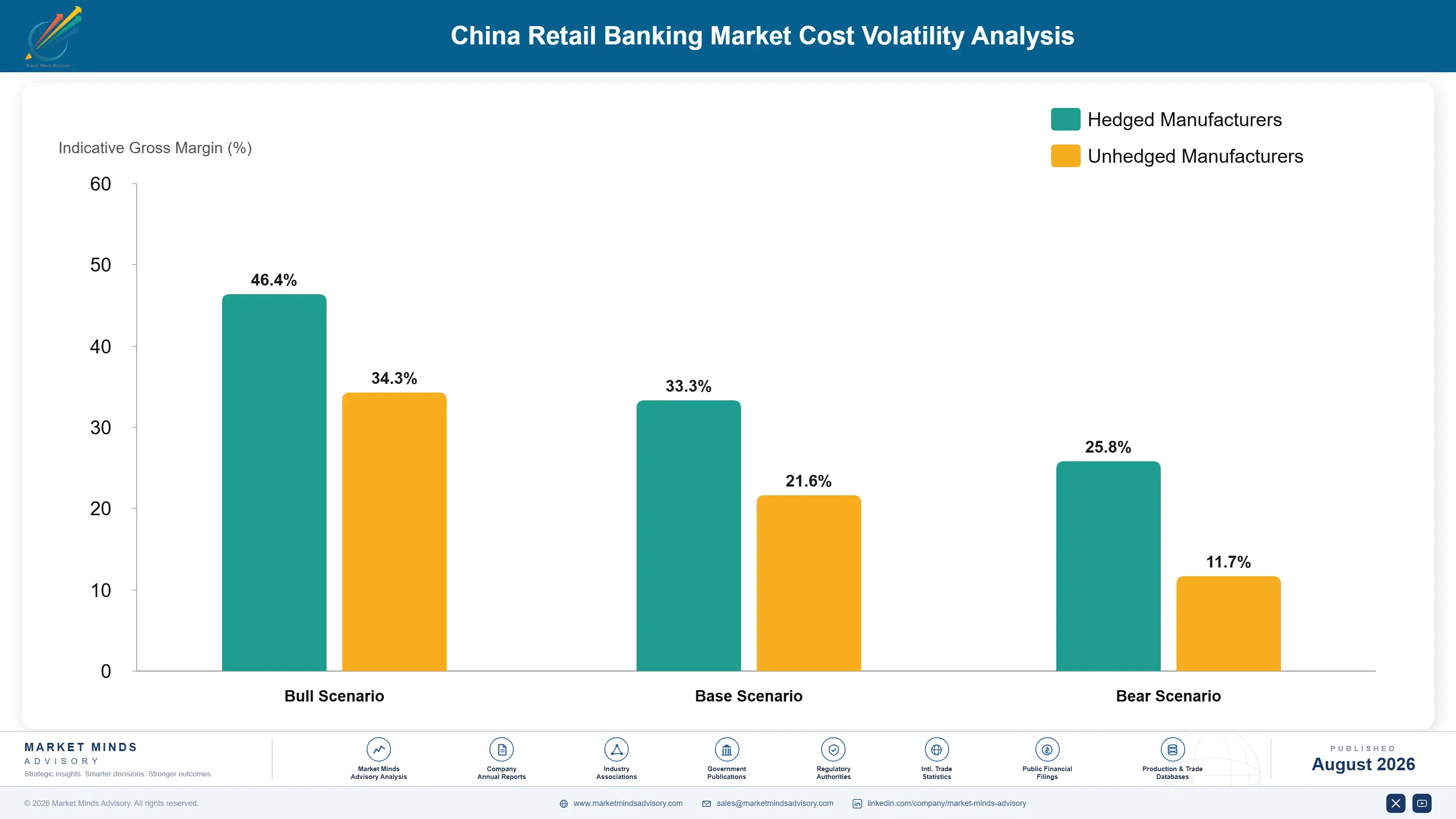
Deposit funding costs and technology platform investment together account for an estimated 45 to 55 percent of retail banking operating cost across most Chinese banks, with deposit interest expense representing the largest single cost category given the sector's continued reliance on retail deposits as a primary funding source. Technology investment in digital platform and cybersecurity adds a second significant expense category for banks competing against digital-native entrants.
Deposit competition intensified considerably during 2023, according to China Merchants Bank's annual report citing digital bank rate competition pressuring traditional deposit gathering, forcing several banks to raise deposit rates meaningfully to retain balances. The disruption illustrated how directly traditional bank funding costs track digital bank competitive intensity given the sector's continued dependence on retail deposit funding relative to wholesale market alternatives. Banks with diversified funding sources weathered this disruption better.

Smaller regional banks carry disproportionately higher funding and technology cost exposure than the Big Four state-owned banks, who benefit from lower-cost deposit bases and greater technology investment scale that smooths cost volatility across multiple business lines. This competitive disadvantage becomes particularly acute during deposit competition cycles, when smaller banks must either absorb margin compression or lose deposit balances to more competitive rate offerings.
china-retail-banking-market-cost-volatility-analysis-1787915750904

Diversifying Funding Sources Beyond Retail Deposits

Leading banks are diversifying funding sources across interbank borrowing, bond issuance, and wholesale market alternatives rather than relying entirely on retail deposits, reducing exposure to deposit competition volatility. This approach requires meaningful treasury management sophistication but meaningfully reduces funding cost unpredictability during periods of intense deposit rate competition. Larger banks pursue this most aggressively given their broader market access.

Investing in Shared Technology Infrastructure Platforms

Smaller regional banks are increasingly partnering on shared technology infrastructure platforms to reduce individual digital investment burden, accessing comparable capability at lower per-institution cost than building proprietary systems independently. This approach requires meaningful coordination investment but improves technology cost efficiency considerably for smaller institutions. Smaller banks often lack the resources to build these platforms independently.

Building Fee Income to Offset Funding Cost Pressure

Banks are increasingly prioritizing fee-based wealth management and advisory revenue growth to offset rising deposit funding costs, reducing overall dependence on spread-based profitability. This approach requires sustained investment in advisory capability but provides a durable path to margin protection independent of deposit rate competition dynamics. This approach is becoming standard practice among the largest banks.

Portfolio Architecture for Margin Defence

China retail banking portfolios span three distinct tiers, from commodity-adjacent basic deposit and standard lending products sold largely on price and branch convenience, through premium and certified wealth management and digital banking services that command meaningful margin for personalized advisory and platform quality, to next-generation private banking and sophisticated investment products requiring specialized relationship management or cross-border capability. Gross margins vary across tiers, reflecting service complexity and distribution economics.
The volume versus premium tension is stark: basic deposit and lending products account for the majority of customer count given mass-market branch distribution scale, but a comparatively modest share of industry fee revenue, while wealth management and private banking tiers represent a smaller customer count but disproportionate profitability. Banks face continuous pressure to expand specialty tier capability without abandoning the mass-market deposit base that funds much of their balance sheet scale.

High-value margin pools concentrate most heavily in private banking serving high-net-worth customers and wealth management distributed through digital advisory platforms, categories where relationship depth and platform quality protect established banks from pure price competition across most customer segments. Banks investing early in these categories are best placed to capture disproportionate share of industry profit growth over the coming decade.

Volume / Commodity-Adjacent Tier

Basic deposit accounts and standard retail lending sold primarily through mass-market branch channels, competing mainly on interest rate and branch convenience rather than service differentiation. Margins remain thin given intense price competition among numerous regional banks.
Gross Margin: 10-16%

Premium / Certified Tier

Wealth management and digital banking services backed by personalized advisory capability and platform quality, commanding meaningful margin premiums for demonstrated investment performance and convenience. These services require ongoing platform investment to maintain customer satisfaction.
Gross Margin: 20-28%

Sustainability / Regulatory / Next-Generation Tier

Private banking and sophisticated investment products requiring specialized relationship management and cross-border capability, commanding the highest margin premiums given expertise differentiation. Adoption is accelerating as affluent population growth continues expanding nationally.
Gross Margin: 28-38%
china-retail-banking-market-portfolio-architecture-1787915751433

High-value Sub-segments and Strategic Watch-out

Digital Wealth Advisory Platform Customers

Digital wealth advisory platform customers combine improving fee economics with rapid customer growth, driven by personalized investment recommendation technology. Banks with proven digital advisory platforms are capturing outsized share of this high-margin, fast-growing segment ahead of slower-moving branch-dependent competitors. Banks are extending platform investment to defend this position further.
Gross Margin: 30-38%

Private Banking High-Net-Worth Customers

Private banking customers command premium fee revenue and steady growth tied to China's expanding affluent population, though growth remains somewhat dependent on continued economic stability and wealth creation trends across major metropolitan markets. Banks are extending relationship networks to sustain growth momentum ahead. across markets.
Gross Margin: 26-34%

Mass-Market Deposit and Lending Customers

Mass-market deposit and lending customers remain the volume core of the industry, generating steady but thin-margin revenue from customers who prioritize branch convenience over specialized product differentiation across most income segments. Banks compete mainly on branch convenience rather than product differentiation. over the long run.
Gross Margin: 8-14%

Digital-Native Bank Competitive Displacement

Digital-native banks offering instant account opening and simplified wealth product access are expanding into segments previously served by traditional branch-based institutions, pressuring deposit retention and forcing established banks to accelerate digital investment. This threat merits close ongoing monitoring by established state-owned banks. and improve capability.
Gross Margin: 14-20%

Relationship-Anchored Recurring Banking Demand

China retail banking demand carries meaningful annuity characteristics because customers typically maintain primary bank relationships for years, consolidating deposit, lending, and wealth management activity with a single institution once satisfied with service quality. Once a customer establishes payroll deposit and payment history with a specific bank, switching institutions requires considerable friction that most customers avoid absent a compelling reason, giving incumbent banks durable, recurring transaction revenue.
Adoption depth varies considerably by customer segment. Mass-market retail customers show relatively high price sensitivity and willingness to switch given standardized product features, while affluent and private banking customers show much deeper switching resistance given accumulated relationship history and personalized advisory continuity. Corporate payroll customers, in particular, often maintain multi-year relationships with a specific bank familiar with their company's particular banking needs rather than switching frequently.

A generational shift in buyer profile is underway as younger Chinese customers increasingly expect app-based self-service banking and transparent digital wealth advisory that older, branch-loyal customers rarely demanded. These buyers are more receptive to digital-native banks and simplified wealth products than the purchasing generation they are replacing, gradually easing the path for banks pursuing higher-margin digital-first revenue models.
china-retail-banking-market-end-use-penetration-index-1787915751920

Where Chinese Banks Should Focus Next

These are among the four positions where our research anticipates prominent divergence between winners and laggards over the coming forecast period. Each is grounded in the demand model, the regulatory perimeter, and the announced capacity pipeline.
01 / DIGITAL WEALTH INVESTMENT

Build advisory platforms before digital-native banks capture affluent customers

Banks still relying on branch-based generic product offerings are chasing a shrinking share of the fastest-growing segment of this market, while digital wealth advisory platforms are capturing fee income growth considerably faster than competitors dependent on traditional distribution. Capital allocated toward digital advisory platform investment today will likely generate stronger returns than equivalent investment in branch expansion. Banks who build this capability now will be considerably better positioned than competitors who wait until digital-native entrants have already captured affluent customer loyalty nationwide.
02 / PRIVATE BANKING EXPANSION

Expand relationship manager capacity ahead of affluent population growth

China's affluent and high-net-worth population is expanding considerably faster than most banks anticipated only a few years ago, and private banking relationship manager capacity takes considerably longer to build than conventional retail service capability. Banks who build this capacity now will be positioned to capture premium private banking fee revenue as affluent population growth accelerates further, while competitors who delay development risk losing these customers to banks who already guarantee dedicated relationship continuity. This window will not stay open indefinitely as more banks pursue similar private banking expansion nationwide.
03 / DEPOSIT RETENTION STRATEGY

Bundle digital services before digital bank competition intensifies further

Digital-native banks offering competitive rates without matching branch overhead are capturing deposit balances considerably faster than most traditional banks anticipated, and this competitive pressure will only intensify as digital banking adoption continues expanding through 2036. Bundling deposit accounts with value-added digital services reduces this risk meaningfully, even though it requires sustained product development investment across multiple customer touchpoints simultaneously. Banks who diversify now will be considerably better positioned than competitors still fully exposed to ongoing deposit competition volatility across most major urban markets nationwide.
04 / FEE INCOME DIVERSIFICATION

Diversify revenue before net interest margin compression deepens further

Banks dependent entirely on spread-based lending revenue remain exposed to the same margin compression that squeezed profitability during recent rate cut cycles, and this exposure will only matter more as regulatory monetary easing continues through 2036. Diversifying toward fee-based wealth management and advisory revenue reduces this risk meaningfully, even though it requires sustained investment in advisory capability and product platform development across multiple business lines. This response should be treated as a standing strategic priority rather than a reactive one-time initiative.

Engagement Snapshot From the Field

A live engagement with an industry participant carrying material or product regulatory and market exposure ahead of a defining policy shift, showing how our research translates into a defensible multi-year portfolio strategy.
MARKET MINDS ADVISORY · CLIENT ENGAGEMENT SUMMARY
China Retail Banking Producer Strategic Portfolio Review and Transition Roadmap 2026·Investment Scenario on China Retail Banking Exposure Evaluation 2025-26
CLIENT PROFILE
A regional manufacturing enterprise operating across Guangdong province approached MMA seeking guidance on selecting a primary banking partner to support both corporate treasury needs and an employee payroll and wealth management benefit program for its several thousand workers. The enterprise had historically maintained fragmented banking relationships across multiple institutions and had limited experience structuring a consolidated corporate and employee banking partnership.
STRATEGIC CHALLENGE
Enterprise leadership needed to determine which bank offered the most competitive corporate treasury terms alongside the most attractive employee wealth management benefit program, without disrupting existing payroll processes during any transition. Leadership was also concerned about whether consolidating banking relationships would meaningfully improve terms or simply concentrate risk with a single institution.
MMA APPROACH
MMA benchmarked candidate banks' corporate treasury pricing and employee wealth management program quality against comparable manufacturing enterprise partnerships, drawing on proprietary survey data examining how comparable enterprises structured consolidated banking relationships. The engagement team modeled cost savings and employee benefit value before presenting recommendations to enterprise leadership. Findings were validated against comparable corporate-employee banking partnerships tracked across other provinces.
KEY FINDINGS
  1. Consolidating banking relationships with one primary partner reduced treasury management fees meaningfully for the enterprise. This finding held even after accounting for the enterprise's specific transaction volume profile.
  2. One candidate bank offered a meaningfully more attractive employee wealth management benefit program relative to competitors. This program advantage proved decisive given the enterprise's employee demographic composition.
  3. Employee enrollment in wealth management benefits increased considerably when integrated directly with payroll deposit accounts. This integration approach reduced friction for employees already familiar with payroll processes.
  4. Maintaining a secondary banking relationship for treasury diversification purposes was still considered prudent despite consolidation benefits. This diversification consideration reflected the enterprise's broader risk management priorities overall.
CLIENT PROFILE
A regional manufacturing enterprise operating across Guangdong province approached MMA seeking guidance on selecting a primary banking partner to support both corporate treasury needs and an employee payroll and wealth management benefit program for its several thousand workers. The enterprise had historically maintained fragmented banking relationships across multiple institutions and had limited experience structuring a consolidated corporate and employee banking partnership.
STRATEGIC CHALLENGE
Enterprise leadership needed to determine which bank offered the most competitive corporate treasury terms alongside the most attractive employee wealth management benefit program, without disrupting existing payroll processes during any transition. Leadership was also concerned about whether consolidating banking relationships would meaningfully improve terms or simply concentrate risk with a single institution.
MMA APPROACH
MMA benchmarked candidate banks' corporate treasury pricing and employee wealth management program quality against comparable manufacturing enterprise partnerships, drawing on proprietary survey data examining how comparable enterprises structured consolidated banking relationships. The engagement team modeled cost savings and employee benefit value before presenting recommendations to enterprise leadership. Findings were validated against comparable corporate-employee banking partnerships tracked across other provinces.
KEY FINDINGS
  1. Consolidating banking relationships with one primary partner reduced treasury management fees meaningfully for the enterprise. This finding held even after accounting for the enterprise's specific transaction volume profile.
  2. One candidate bank offered a meaningfully more attractive employee wealth management benefit program relative to competitors. This program advantage proved decisive given the enterprise's employee demographic composition.
  3. Employee enrollment in wealth management benefits increased considerably when integrated directly with payroll deposit accounts. This integration approach reduced friction for employees already familiar with payroll processes.
  4. Maintaining a secondary banking relationship for treasury diversification purposes was still considered prudent despite consolidation benefits. This diversification consideration reflected the enterprise's broader risk management priorities overall.
RECOMMENDED STRATEGY
Phase 1: Phase one consolidated corporate treasury relationships with the selected primary banking partner first. to validate service quality before broader program rollout. Phase 2: Phase two rolled out the employee wealth management benefit program integrated with existing payroll accounts. once initial consolidation results proved favorable across departments. Phase 3: Phase three renegotiated treasury pricing terms reflecting the enterprise's now-consolidated banking relationship volume. reflecting the enterprise's now-larger consolidated banking relationship.
OUTCOME
The enterprise completed its banking consolidation within eight months and reported (client-reported, unverified by MMA) an estimated 15 percent reduction in treasury management fees following the transition. Leadership credited the phased consolidation approach with maintaining payroll continuity throughout the process. The consolidation also improved the enterprise's negotiating position ahead of future contract renewals.

Frequently Asked Questions

Foundational context covering the market sizes, CAGR, scope, country, region and competition that inform every finding below. This section is provided to cover basics and most often pre-purchase conversations, answered from the MMA Primary Research Dataset.

What is the current size of the China Retail Banking Market?

The China retail banking market reached an estimated 320.0 billion US dollars in revenue in 2025. Growth is driven by wealth management fee income and expanding digital banking adoption.

How large will the China Retail Banking Market be by 2036?

MMA projects the market will reach approximately 639.7 billion US dollars by 2036. This reflects sustained wealth management growth and continued private banking expansion nationally.

What is the CAGR for the China Retail Banking Market 2026 to 2036?

The market is forecast to grow at a compound annual growth rate of 6.5 percent between 2026 and 2036. Bull and bear scenarios range from 7.7 percent to 5.3 percent depending on margin conditions.

Which segment is growing fastest?

Wealth management and retail investment products are growing fastest, at an estimated 10.5 percent CAGR through 2036. Household savings reallocation is driving this shift away from traditional deposits.

Who are the major companies in the China Retail Banking Market?

Leading participants include Industrial and Commercial Bank of China, China Construction Bank, Agricultural Bank of China, Bank of China, and China Merchants Bank. These five companies collectively hold an estimated 62 percent combined market share.

Which country is growing fastest?

As this report is scoped entirely to China, the country itself is tracked at an estimated 7.0 percent CAGR through 2036, reflecting wealth management growth and digital banking expansion.

Report Segmentation Architecture

The full report scope spans multiple orthogonal segmentation dimensions, with cross-tabulated demand data provided for each dimension pair. Coverage extends further to regional breakdowns, trend trajectories, and the competitive detail needed to support segment-level decision-making.

By Product Line

  • Savings and Deposit Accounts
  • Retail Lending
  • Wealth Management and Retail Investment Products
  • Digital and Mobile Banking Services
  • Payment and Remittance Services
  • Private Banking

By End-Use Customer

  • Mass-Market Retail Customers
  • Affluent and High-Net-Worth Customers
  • Young and Digital-Native Customers
  • Rural and Lower-Tier City Customers
  • Corporate Payroll Program Customers

By Commercial Dimension

  • Branch-Based Distribution
  • Digital and Mobile Application Channel
  • Private Banking Relationship Channel
  • Corporate Payroll Partnership Channel

By Region

  • North America
  • Western Europe
  • East Asia
  • South Asia and Pacific
  • Latin America
  • Middle East and Africa
  • Eastern Europe

Scope, Methodology, and Coverage

Every figure in this report is reproducible from documented input assumptions. The scope below maps the historical period, the forecast horizon, the segmentation dimensions, and the countries covered, alongside the underlying primary and qualitative methodology.
Historical Period
2020 to 2025
Forecast Period
2026 to 2036
Base Year
2025 (USD billions; MMA Primary Research Dataset, August 2026)
Market Definition
This report covers retail banking products and services provided to individual consumers in China, including savings and deposit accounts, retail lending, wealth management and retail investment products, digital and mobile banking services, payment and remittance services, and private banking. It excludes corporate and institutional banking, credit card-specific products tracked in dedicated reports, and standalone auto loan financing.
Quantitative Units
USD billions (revenue, current prices); account count (where cited)
Segmentation Dimensions
Product Line; End-Use Customer; Commercial Dimension; By Region
Regions Covered
North America, Western Europe, East Asia, South Asia and Pacific, Latin America, Middle East and Africa, Eastern Europe
Countries Covered
USA, China, Germany, France, UK, Japan, South Korea, India, Australia, Canada, Brazil, Mexico, Indonesia, Vietnam, Thailand, Malaysia, UAE, Saudi Arabia, South Africa, Nigeria, Turkey, Poland, Netherlands, Italy, Spain, Sweden, Switzerland, Argentina, Colombia, Singapore, and additional markets relevant to this sector
Key Companies Profiled
Industrial and Commercial Bank of China, China Construction Bank, Agricultural Bank of China, Bank of China, China Merchants Bank, Postal Savings Bank of China, Bank of Communications, China CITIC Bank, China Minsheng Bank, Ping An Bank, Shanghai Pudong Development Bank, Industrial Bank Co Ltd, China Everbright Bank, Huaxia Bank, China Zheshang Bank, Bank of Beijing, Bank of Shanghai, WeBank, MYbank, Bank of Ningbo
Quantitative Methodology
Primary survey, n=3,800 respondents, Q4 2025, six countries; demand-side model with trade association cross-validation
Qualitative Methodology
47 expert interviews, Q4 2025; applied to validate demand model assumptions, identify emerging dynamics, and assess competitive positioning
Report Format
PDF and XLSX data workbook (Word format preview document)
Publisher
Market Minds Advisory
Report Code
MMA-2026-TEC-101
Published
August 2026
Contact
sales@marketmindsadvisory.com | www.marketmindsadvisory.com

Purchase the full China Retail Banking Market Report (2026 to 2036).

This report delivers a complete strategic assessment of the China retail banking market, covering sizing, segmentation, regional dynamics, and competitive positioning through 2036. It draws on MMA's proprietary primary survey of 3,800 respondents and 47 expert interviews conducted in the fourth quarter of 2025 across six countries. Analysts translate these findings into actionable guidance on digital wealth investment, private banking expansion, and deposit retention strategy for participants across the value chain. The report is designed for executives evaluating capital allocation decisions across the China retail banking category.
Detailed six-segment MECE product-based market segmentation
Full seven-region demand architecture with growth drivers
Competitive benchmarking across twenty tracked regional banks
Funding cost and technology investment exposure analysis
Portfolio tiering and margin economics by product tier
Anonymized client case study with strategic recommendations

Built For The People Who Decide

From boardroom strategy to bench-side execution, this report is read cover-to-cover by leaders shaping the next decade of their industry, turning demand scenarios, market dynamics and valuation benchmarks into decisions.
CXOs/ Presidents/ VPs/ Managers
M&A and Corporate Development
Strategy Teams and R&D Heads
Procurement and Product Directors
Regulatory and Compliance Leaders
Investor Relations and Equity Analysts