Market Minds Advisory
China Mortgage/Loan Brokers Market

China Mortgage/Loan Brokers Market: Take Rates, Risk Bearing and the Rules That Changed in October 2025

An industry that once sold banks a borrower and now mostly sells them a guarantee, while the mortgage pool that built it shrinks and policy pushes every remaining participant toward small business credit.

Lead Analyst

Published

September 2026

Make Smarter Decisions with Customized Research Insights

Request a free sample report and evaluate market opportunities, growth trends, and competitive dynamics relevant to your business needs.

2025 MARKET VALUE$21.5BMarket Size 2025
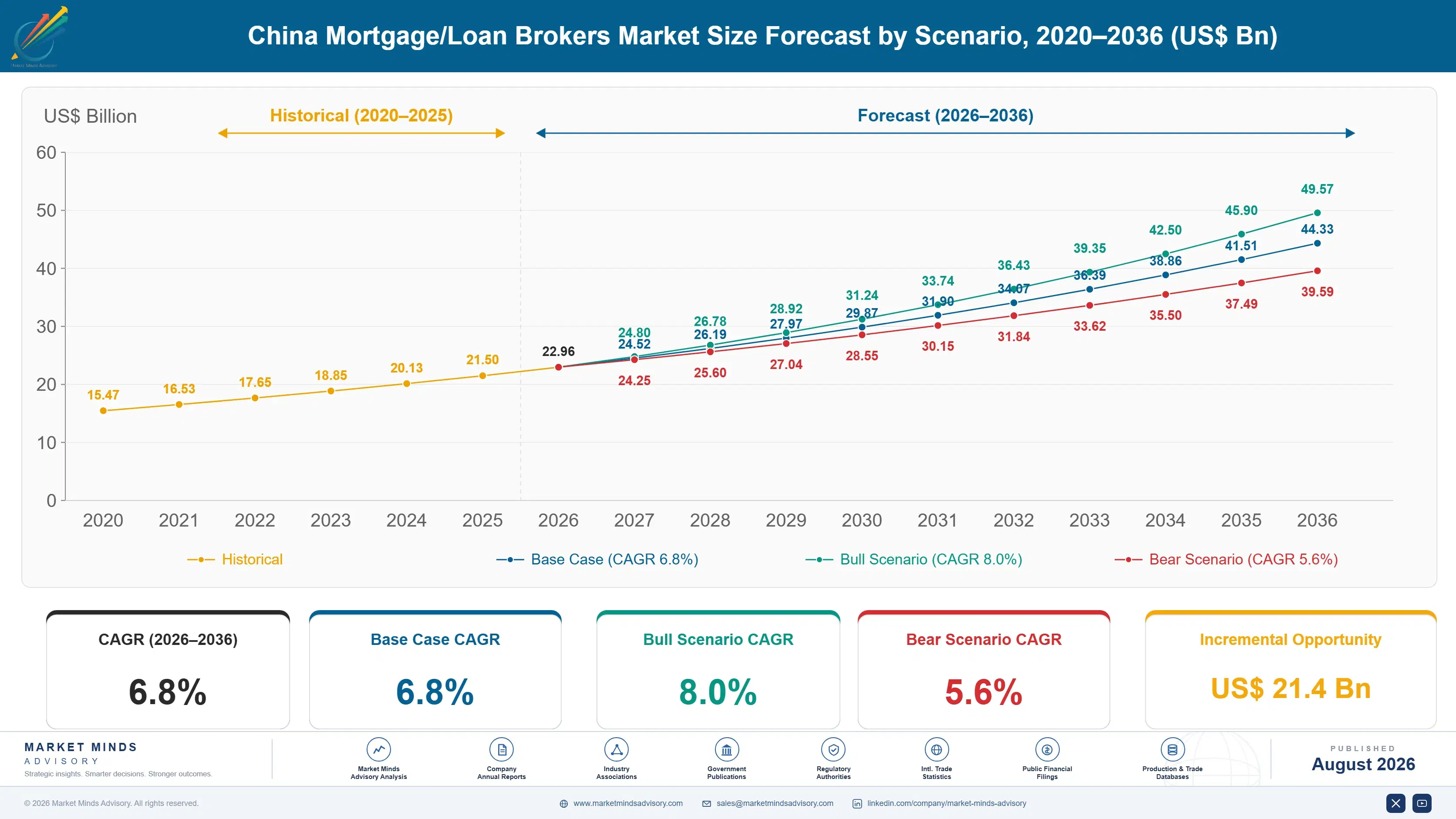
2036 FORECAST VALUE$44.3BBase Case , 2026 to 2036
CAGR 2026 TO 20366.8 %Bull 8.0% / Bear 5.6%
INCREMENTAL OPPORTUNITY$21.4BNet 10- year value creation
EXPANSION MULTIPLE1.93x2036 value over 2026 base
Strategic Levers
M&A Pipeline
Regional Outlook
Country Rankings
Competitive Intelligence
Segmental Deep-dive
Call-Us : 91 93563 13602

Executive Snapshot and Market Trajectory

Chinese loan brokers no longer earn their money by finding borrowers. Roughly 58% of facilitated volume now carries platform credit exposure through a licensed guarantee subsidiary, which means the industry sells risk absorption to banks and then calls it a technology service instead.
The regulatory direction is unambiguous. Rules issued in April 2025, effective from that October, tightened how commercial banks may work with facilitation partners, requiring genuine independent underwriting and clearer disclosure of the total cost a borrower actually pays. Take rates sitting near 3.4% of loan principal are under pressure from both ends: banks want more of the economics, and the effective all-in borrower cost is capped in practice at 24% for very nearly everybody.
Where the volume goes has changed as well. Residential mortgage origination, the pool that built most of these businesses, has contracted with property since 2021 and outstanding household housing loans have fallen outright. Policy has meanwhile pushed bank lending toward micro enterprises, so small and micro business credit grows fastest at 10.2% while the mortgage desk quietly shrinks in the background. Nobody in this industry planned for that reversal.
Market Definition
Revenue earned by intermediaries that source, screen and refer borrowers to licensed lenders in mainland China, comprising technology service fees, credit guarantee fees and referral commissions across mortgage, consumer and business credit. Net interest income earned by licensed banks and consumer finance companies on their own balance sheets is excluded, as is unlicensed private lending, pawn broking, and insurance or wealth product distribution.
Base Year Value
$21.5B in 2025 (MMA Primary Research Dataset, August 2026)
Forecast Period
2026 to 2036, eleven discrete annual values
CAGR
6.8% base case. Bull 8.0%. Bear 5.6%.
Fastest Growth Segment
Small and Micro Business Lending: 10.2% CAGR
Fastest Growth Country
Vietnam: 8.8% CAGR
Fastest Growth Region
South Asia and Pacific: 8.8% CAGR
Largest Region
East Asia: 90% of 2025 global value
Market Leaders
Lufax Holding, Qifu Technology, FinVolution Group, Yiren Digital and KE Holdings lead on facilitation and brokerage revenue. Source: company annual reports and MMA Primary Research Dataset, July 2026.
Primary Survey
n=3,800 procurement and R&D decision-makers, Q4 2025, six countries
Methodology
Demand-side build-up, cross-validated against public data, 47 expert interviews

China Mortgage/Loan Brokers Market Forecast Scenarios

china-mortgage-loan-brokers-size-forecast-scenario-1787917218406
The 2020 to 2025 period reshaped the industry twice. Internet lending rules issued in 2020 forced banks to conduct independent risk assessment and constrained joint funding arrangements, which ended the pure referral model for anybody operating at scale. Property then turned, taking mortgage origination volume with it. Revenue compounded near 5.8% across the period, entirely because business and consumer credit replaced what mortgages stopped delivering.
Three mechanisms support the base case. Policy-directed expansion of inclusive small and micro lending continues, and banks lacking rural and county-level distribution keep buying it from intermediaries. Consumer instalment credit grows with household consumption recovery, though more slowly than before. And take rate compression is partly offset by volume, since a platform earning 3.0% on a larger book can still grow revenue while the headline rate keeps falling each year.
The bull catalyst is meaningful property market stabilisation returning mortgage origination to growth, which would restore the highest-value product any of these businesses ever sold. The bear risk is regulatory tightening on guarantee arrangements: if platforms are forced to hold materially more capital against the credit they effectively underwrite, the economics of the risk-bearing model change fundamentally.

Selling Risk Absorption And Calling It Technology

The commercial question in Chinese loan facilitation is who carries the credit risk, and the answer has moved. A pure referral, where a platform introduces a borrower and collects a fee regardless, earns perhaps 1.5% of principal. A risk-bearing arrangement, where a licensed financing guarantee subsidiary stands behind the loan, earns double that or more. Around 58% of facilitated volume now runs on the second model.
MARKET CONCENTRATION CR541%Share of facilitation revenue held by the largest platforms
AVERAGE TAKE RATE3.4%Service fee earned against the loan principal facilitated
RISK-BEARING VOLUME SHARE58%Facilitated loans where the platform carries credit exposure
REPEAT BORROWER RATE67%Borrowers returning for another loan within two years
SMALL BUSINESS LOAN SHARE34%Portion of facilitated volume lent to micro enterprises
FUNDING PARTNER COUNT84Average licensed lenders connected to a large platform
Banks pushed the industry there deliberately. Internet lending rules from 2020 required commercial banks to perform their own risk assessment rather than outsource it, which removed the argument that a platform supplied superior credit judgement. What a bank will still pay for is somebody else absorbing the first loss. That is a different business with different capital requirements, and several participants moved into it without appreciating the distinction.
The April 2025 rules tightened the arrangement further, effective from October. Banks must now disclose the total cost a borrower bears including guarantee and service fees, must satisfy themselves the all-in rate stays within the practical 24% ceiling, and must manage partner concentration properly. Platforms that priced on an opaque total cost are repricing. Those already transparent have found the change works in their favour.
"Every platform in this market describes itself as a technology company supplying credit models to banks. Most of them are financing guarantee businesses with a good application, and the regulator worked that out several years before their investors did."
Director, Asia Credit Intermediation Practice · MMA Financial Services and Insurance Practice · August 2026

Market Trends

Total Cost Disclosure Reprices The Whole Product

Rules effective from October 2025 require commercial banks to account for the full cost a borrower bears, including platform service fees and guarantee charges rather than the nominal lending rate alone. Several participants had built pricing around a headline rate the borrower saw and a fee structure they largely did not. Bringing both into one disclosed figure pushed a portion of the book against the practical 24% ceiling, forcing either repricing or exit from the thinner credit tiers. Platforms that always disclosed the total figure gained share without changing anything at all.
Market Impact: Grows micro lending 10.2% annually
County And Rural Distribution Becomes The Scarce Asset

Policy directing large banks to expand inclusive small and micro lending has created demand those banks cannot satisfy from urban branch networks, because the borrowers sit in county towns and rural districts where they have no origination capability at all. Intermediaries with offline agent coverage in those areas now sell something genuinely scarce. Building that network takes years and the unit economics only work at density, which is why almost nobody has entered recently. The platforms that built it before the policy arrived are collecting the return now. That window will not stay open.
Market Impact: Returns 67% of borrowers biennially

Market Opportunities and Growth Drivers

Inclusive Finance Targets Push Volume Toward Micro Enterprises

Regulatory targets requiring large commercial banks to grow small and micro enterprise lending have produced sustained demand for origination capability those banks do not possess internally. The loans are small, the borrowers are dispersed, and the credit assessment relies on transaction and supply chain data rather than on collateral. Intermediaries holding merchant payment data or supply chain relationships can underwrite them where a branch cannot. That is why small and micro business credit grows at 10.2% while the rest of the market grows considerably more slowly. Policy created the pool, not demand.
Market Impact: Covers 58% of facilitated volume

Repeat Borrowing Lowers Acquisition Cost Substantially

Roughly 67% of borrowers return for another loan within two years, which changes the economics of the entire business. A first loan carries full customer acquisition cost against a modest service fee, while the second and third arrive at almost no marginal acquisition expense. Platforms holding a large seasoned borrower base therefore operate at a cost advantage newer entrants cannot match at any price. That base also supplies repayment history the platform owns rather than rents, which improves underwriting on every subsequent decision. Blended acquisition cost is the whole game here.
Market Impact: Cut mortgage origination 31% since 2021

Market Restraints and Challenges

Guarantee Model Carries Capital Requirements Platforms Underestimated

Bearing credit risk through a licensed financing guarantee subsidiary requires regulatory capital and produces losses in a downturn that a pure referral business would never see. The root cause is banks refusing to pay meaningfully for origination alone after 2020 rules made them responsible for their own underwriting. Commercially it converted technology companies into thinly capitalised credit institutions. Mitigation runs through capped guarantee ratios, sharing first loss with insurers, and shifting parts of the book back to pure referral where funding partners will still accept it. Very few said so publicly.
Market Impact: Caps all-in borrower cost 24%

Mortgage Origination Pool Has Been Contracting Since 2021

Outstanding household housing loans in China have fallen outright in recent years, an outcome no participant in this industry had modelled when they built mortgage referral desks. The root cause is a property market correction combined with households repaying early rather than borrowing more. Brokerage revenue attached to new mortgage origination fell accordingly and has not recovered. Mitigation has meant redeploying agents toward secured business lending against property collateral, refinancing work, and in several cases closing the mortgage desk entirely rather than carrying it. Nobody modelled a mortgage book that stops growing.
Market Impact: Reaches 2,800 county level markets
3 additional market trends, 4 additional growth drivers, and 2 additional restraints and challenges are covered in the full report. Contact sales@marketmindsadvisory.com to access the complete intelligence.

Segment CAGR and Growth Architecture

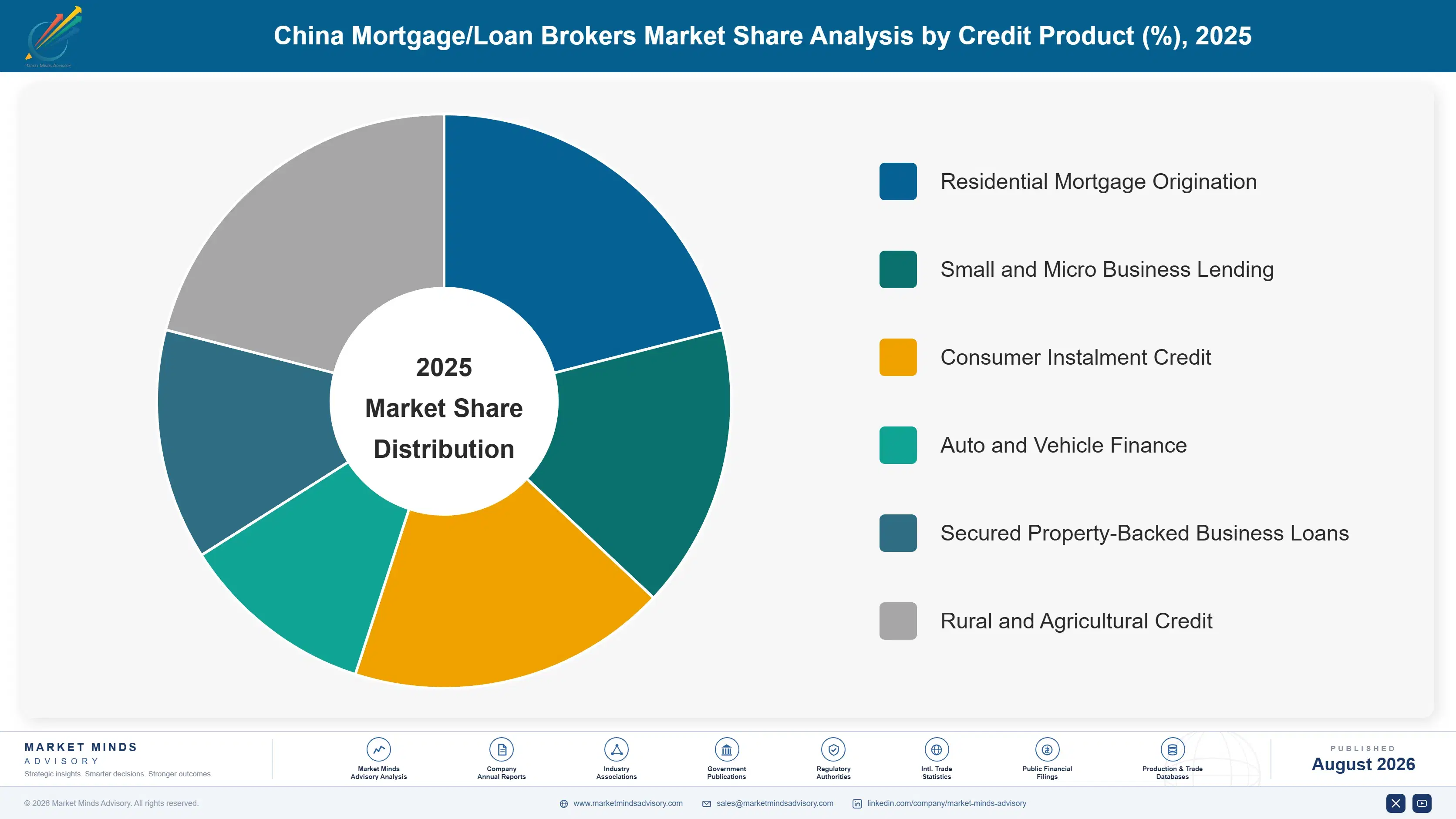
Segmentation follows credit product, because that is what determines the take rate, the risk arrangement and the regulatory treatment applied to any facilitated loan. Six products describe the market completely, from residential mortgage referral through consumer instalment credit to the rural and agricultural lending that policy has quite recently made unexpectedly attractive to everybody.
china-mortgage-loan-brokers-market-share-analysis-1787917218966

Small and Micro Business Lending

The fastest product grows at 10.2%, half again the market rate of 6.8%, and policy rather than borrower demand explains most of it. Regulatory targets require large commercial banks to expand inclusive lending to micro enterprises, and those banks have no origination capability for borrowers dispersed across county towns and small trading districts. Intermediaries holding merchant payment records, supply chain data or offline agent coverage can assess these borrowers where a branch cannot. Take rates run above the consumer average because the underwriting is genuinely harder and the alternatives are few. The risk is that policy support is exactly what created the pool, and policy can change direction faster than a loan book runs off.
CAGR 10.2%

Rural and Agricultural Credit

Rural credit grows at 8.6% on the same policy logic applied to a harder distribution problem. Borrowers are farming households and small agricultural traders whose income arrives seasonally and whose collateral is frequently a land use right rather than transferable property. Banks want the volume because inclusive finance targets count it, and they cannot originate it themselves at any sensible cost. The intermediaries that can are those who built county-level agent networks years ago, when nobody considered them valuable. Unit economics only work at genuine density, which explains why the field has stayed narrow and why entry now would take longer than the policy window itself is realistically likely to last.
CAGR 8.6%
Full segment breakdown across 6 segments available in the complete report.

Regional Architecture and Country Demand Map

This is a mainland China market and effectively all revenue is earned domestically. Other regions appear through offshore listing and capital, technology exported to comparable lending markets, and the outsourced development functions several platforms maintain, none of which generate facilitation revenue counted within this scope.

North America

Share sits far below the standard band because facilitation revenue is earned where the borrower and lender are, and both are in mainland China. The connection is capital markets rather than commerce. Lufax, Qifu Technology, FinVolution and Yiren Digital all carry United States listings, which means quarterly disclosure obligations, American accounting treatment of guarantee liabilities, and an investor base that has repeatedly valued these businesses as technology companies rather than as the credit institutions their balance sheets increasingly resemble. That disconnect has cost several of them dearly. Investors valuing a guarantee book on technology multiples eventually stop doing so, and the repricing when it arrives is abrupt rather than gradual in every case observed.
Share: 2% | CAGR: 6.2% (2026 to 2036)

Western Europe

Share falls far below the standard band on the same definitional basis, since no facilitation revenue is earned in the region. The links are narrow. A small number of European institutional investors hold positions in the listed platforms, and European regulatory approaches to buy now pay later disclosure have occasionally informed how Chinese participants anticipate their own rules developing. Some technology vendors supplying decisioning and collections software are European. None of it influences what a Chinese platform charges, who it lends to, or how its guarantee subsidiary is capitalised. The region is a source of capital and occasionally of regulatory precedent, and nothing more than that in any commercially meaningful sense at all.
Share: 2% | CAGR: 5.4% (2026 to 2036)
Regional intelligence for 5 additional markets available in the complete report: East Asia, South Asia and Pacific, Latin America, Middle East and Africa, Eastern Europe. Contact sales@marketmindsadvisory.com.
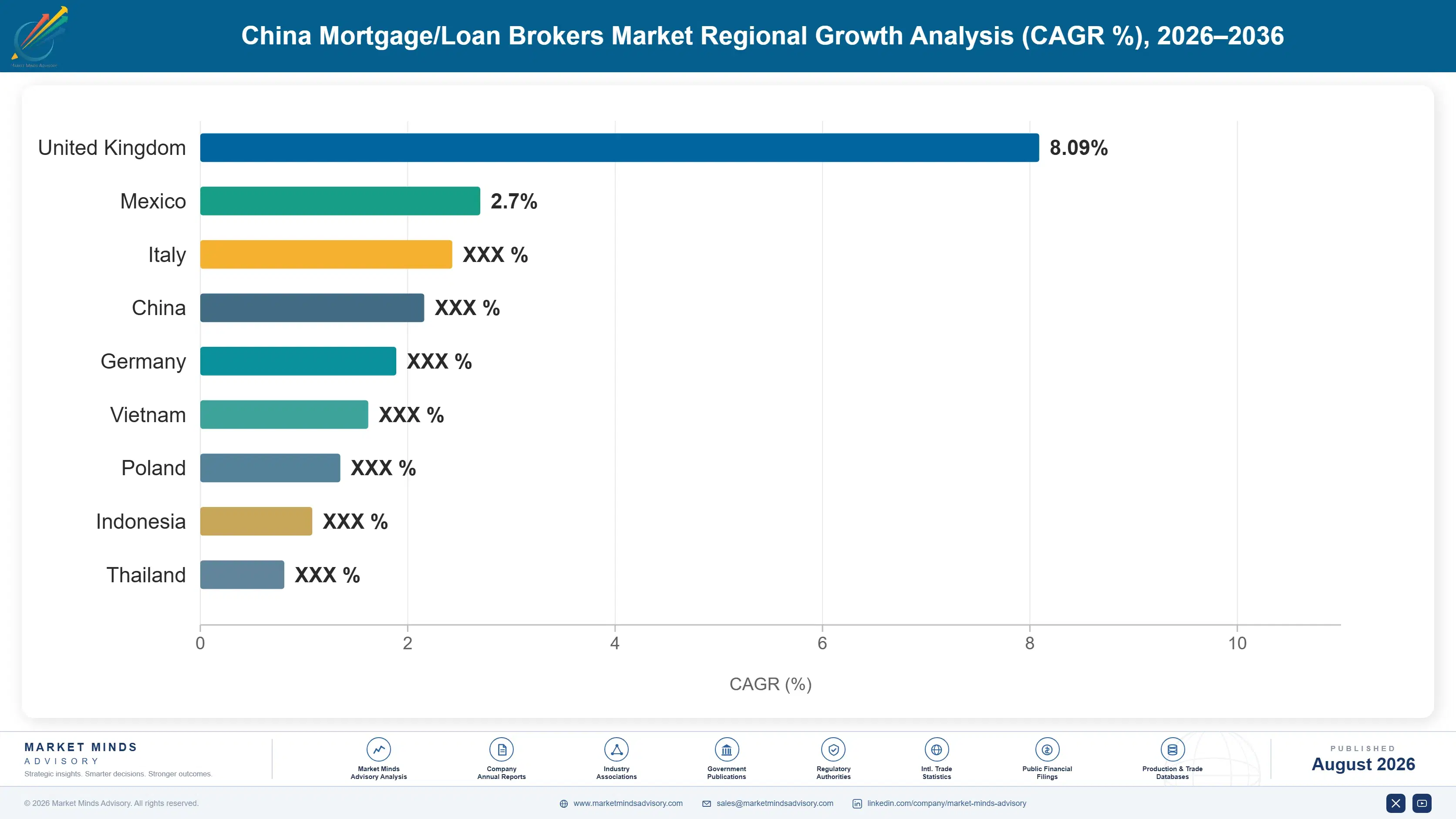
china-mortgage-loan-brokers-country-cagr-analysis-1787917219493

Where Facilitation Margin Actually Comes From

Four levers work on take rate, risk cost and distribution rather than on volume, which regulation now constrains directly. Guarantee ratio discipline, county network density, repeat borrower conversion and funding panel breadth each address something a platform genuinely controls under the rules that took effect in October 2025. Volume is no longer one of them.

Cap Guarantee Exposure Below The Funding Partner Demand

Funding partners will happily let a platform guarantee 100% of a loan book, because it removes their credit risk entirely. Accepting that converts a service business into a thinly capitalised lender. Platforms capping guaranteed exposure at 60% to 70% of facilitated volume and sharing first loss with credit insurers retain most of the take rate uplift while removing the tail that destroys capital in a downturn. The trade is volume, since some partners will move elsewhere. Participants that held the discipline through 2022 and 2023 emerged with balance sheets the others no longer had.
Market Impact: Caps guarantee exposure near 65% of facilitated volume

Build County Agent Density Before Policy Windows Close

Inclusive lending targets have created bank demand for micro enterprise and rural origination that no urban branch network can satisfy. Agent coverage across county towns is therefore scarce and currently well paid, with take rates running 120 to 180 basis points above comparable urban consumer facilitation. Networks take three to four years to reach the density where unit economics work, which is longer than most policy windows stay open. The platforms collecting this return today built the capability before anyone considered it valuable, and that timing advantage cannot be purchased now.
Market Impact: Earns roughly 150 basis points above urban facilitation

Convert First Loans Into Seasoned Repeat Relationships

A first loan carries full acquisition cost against a modest fee, while the second and third arrive with almost no marginal acquisition expense at all. Repeat rates near 67% across two years mean the difference between a platform converting 60% and one converting 75% is worth roughly 40% of contribution margin on the same origination spend. The mechanism is unglamorous: proactive pre-approval before a borrower shops elsewhere, credit line increases tied to repayment behaviour, and collections handled well enough that a repaid borrower returns rather than avoids you. Most treat collections as recovery instead.
Market Impact: Adds around 40% to the overall contribution margin

Widen The Funding Panel To Price Against Partners

A platform connected to a dozen funding partners negotiates from weakness, while one connected to 84 can price a loan into whichever balance sheet wants that risk most this quarter. Panel breadth converts funding from a constraint into an auction, and platforms running genuinely competitive allocation report funding cost 60 to 90 basis points below single-relationship peers. Building the panel is administrative work rather than innovation: licences reviewed, systems integrated, credit policies mapped. Most participants have not done it because it generates no headline anybody wants to publish. That is precisely why it stays available.
Market Impact: Cuts funding cost by around 75 basis points

Who Controls the Margin Pool

Concentration is moderate. The five largest platforms hold around 41% of facilitation revenue, and the gap between the leader and the challenger group has narrowed considerably since 2021 because the largest participants carried the most mortgage and consumer exposure when both turned. Below them sit consumer finance companies, bank-affiliated platforms and regional intermediaries whose county distribution matters more than their scale suggests. Scale alone no longer settles anything here.
Competition runs on three dimensions. Funding panel breadth is first: a platform with 84 partners prices risk into whichever balance sheet wants it, while one with a dozen accepts what it is offered. Risk-bearing capacity is second, because banks pay for absorption, not introduction. Offline distribution is third, and the scarcest, since policy pushed lending toward borrowers no branch network reaches.

Pressure is building from banks themselves. Several large institutions built direct consumer origination and now need intermediaries only for harder rural and micro business borrowers. Meanwhile the October 2025 disclosure rules squeeze participants who priced on opacity. Rankings move against platforms holding neither county distribution nor a broad funding panel, since both reduce to having nothing scarce to sell.
china-mortgage-loan-brokers-company-positioning-matrix-1787917220026

Competitive Moat and Risk Dimensions

LUFAX HOLDING

Moat: Small business focus and licences

Lufax built its position around small and micro enterprise credit rather than consumer instalment lending, which aligned with the direction policy subsequently took, and it holds financing guarantee and consumer finance licences that most competitors lack entirely. Ping An affiliation supplies funding relationships and offline reach few independents can match. Assembling equivalent licensing and distribution now is no longer realistic.
LUFAX HOLDING

Risk: Guarantee exposure through downturns

A high proportion of facilitated volume carries platform credit exposure, which produced substantial losses when small business conditions deteriorated and forced significant capital replenishment. The model earns well in benign conditions and consumes capital rapidly when they turn. Reducing that exposure means surrendering take rate to funding partners who will not otherwise pay for the origination alone.
QIFU TECHNOLOGY

Moat: Data depth and repeat conversion

Qifu operates one of the largest seasoned borrower bases in the market, with repayment history it owns rather than rents, and converts repeat borrowing at rates that materially reduce blended acquisition cost. That data advantage compounds because every additional cycle improves the next underwriting decision. Newer entrants must buy acquisition at full cost against models trained on considerably less history.
QIFU TECHNOLOGY

Risk: Consumer credit cycle concentration

The book is weighted toward consumer instalment credit, which correlates tightly with household income confidence and employment conditions rather than being diversified across business lending. A consumption slowdown affects origination volume, repayment performance and repeat conversion at the same time. Policy support meanwhile flows toward micro enterprise lending, where the platform holds a comparatively thinner position.

Players Tracked

Prominent Players

Lufax Holding
Qifu Technology
FinVolution Group
Yiren Digital
KE Holdings

Other Key Players

LexinFintech
Jiayin Group
X Financial
Du Xiaoman Financial
Ant Group
JD Technology
WeBank
MYbank
Mashang Consumer Finance
China Merchants Union Consumer Finance
Haier Consumer Finance
Bank of China Consumer Finance
Home Credit China
51 Credit Card
Centaline Property Agency

Recent Developments

APRIL 2025

Regulator tightened bank cooperation with facilitation platforms

The National Financial Regulatory Administration issued rules governing how commercial banks conduct internet assisted lending with external partners, effective from October 2025, covering total borrower cost disclosure and partner concentration management. This was regulatory issuance by the state, not a commercial arrangement between any market participants.
Signal: Pricing built on borrowers not seeing the total cost stopped working the moment disclosure became mandatory.
MAY 2024

Central bank removed the national mortgage rate floor

The People's Bank of China withdrew the nationwide lower limit on first and second home mortgage rates, allowing local authorities to set their own thresholds in response to weak property demand. This was a monetary policy adjustment rather than any transaction, merger or joint venture involving market participants.
Signal: Rate flexibility arrived long after the origination volume that would have benefited from it had already gone.
SEPTEMBER 2024

Existing mortgage rates reduced across the outstanding book

Authorities announced reductions to interest rates on existing residential mortgages, lowering payments across a large outstanding balance in an effort to slow early repayment. The measure was a policy intervention affecting lenders and borrowers directly, not a commercial agreement between any brokers or lending institutions.
Signal: Slowing early repayment protects bank balance sheets but generates no new origination for intermediaries at all.

What Facilitating A Loan Costs

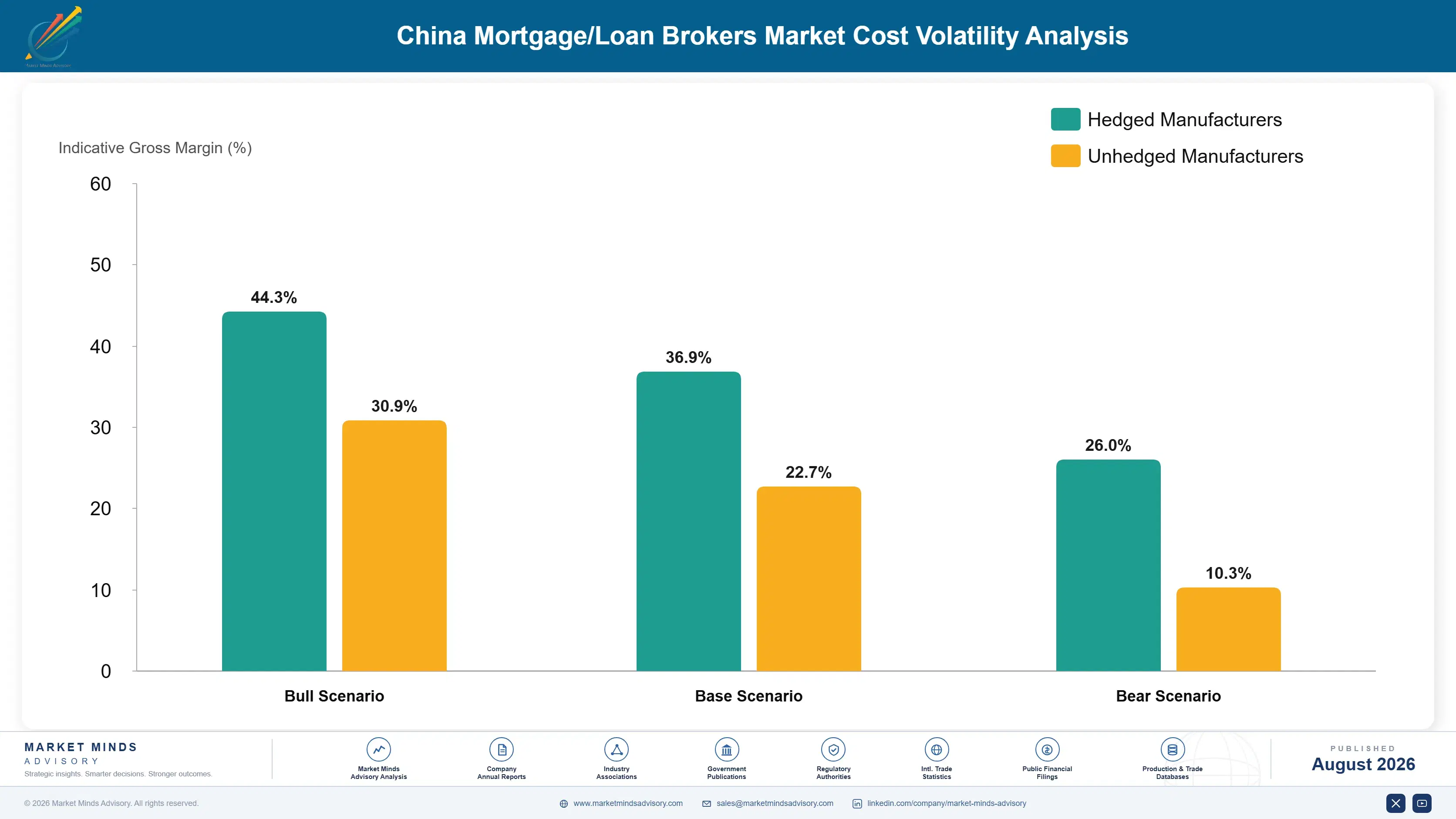
Cost divides into four components that behave very differently. Credit losses borne under guarantee arrangements account for roughly 44% of total cost and vary with the cycle rather than with activity. Borrower acquisition runs near 27%, servicing and collections near 17%, and technology with compliance together account for the remaining 12% for a typical large platform.
The 2022 and 2023 small business deterioration illustrates how quickly the largest component moves. Micro enterprise repayment performance weakened as consumption slowed, guarantee liabilities crystallised, and several platforms recognised credit losses at multiples of what their models had projected. Lufax disclosed substantial credit impairment across that period in its annual reporting, and Qifu Technology recorded elevated provisions in its own filings. Acquisition and servicing cost meanwhile stayed roughly flat, which made the concentration painfully visible.

Exposure varies by model and that variation decides who survives a downturn. Platforms guaranteeing most of their facilitated volume carry the credit cycle directly on their own balance sheets. Pure referral participants do not, but earn perhaps half the take rate. Broad funding panels let a platform move risk toward partners willing to hold it; those dependent on a few relationships accept whatever structure those partners require.
china-mortgage-loan-brokers-cost-volatility-analysis-1787917220225

Capped guarantee ratios with insurer first loss sharing

Limiting guaranteed exposure to a defined share of facilitated volume and placing part of the first loss with credit insurers retains most of the take rate uplift while removing the tail that consumes capital in a downturn. Funding partners resist it because they prefer full absorption. Platforms that held the line through 2022 kept balance sheets their competitors did not.

Repeat borrower conversion to reduce blended acquisition

Second and third loans arrive with almost no marginal acquisition expense, so raising repeat conversion moves blended cost far more efficiently than negotiating cheaper traffic ever does. The work is proactive pre-approval, behaviour-linked credit line increases and collections handled without destroying the relationship. Most platforms treat collections as a recovery function rather than a retention one.

Funding panel breadth to price risk across partners

Connecting to a wide panel of licensed lenders converts funding from a constraint into something close to an auction, allowing a platform to place each loan with whichever balance sheet wants that risk this quarter. The work is administrative rather than innovative. Platforms running genuinely competitive allocation report funding costs well below single-relationship peers consistently.

Portfolio Architecture for Margin Defence

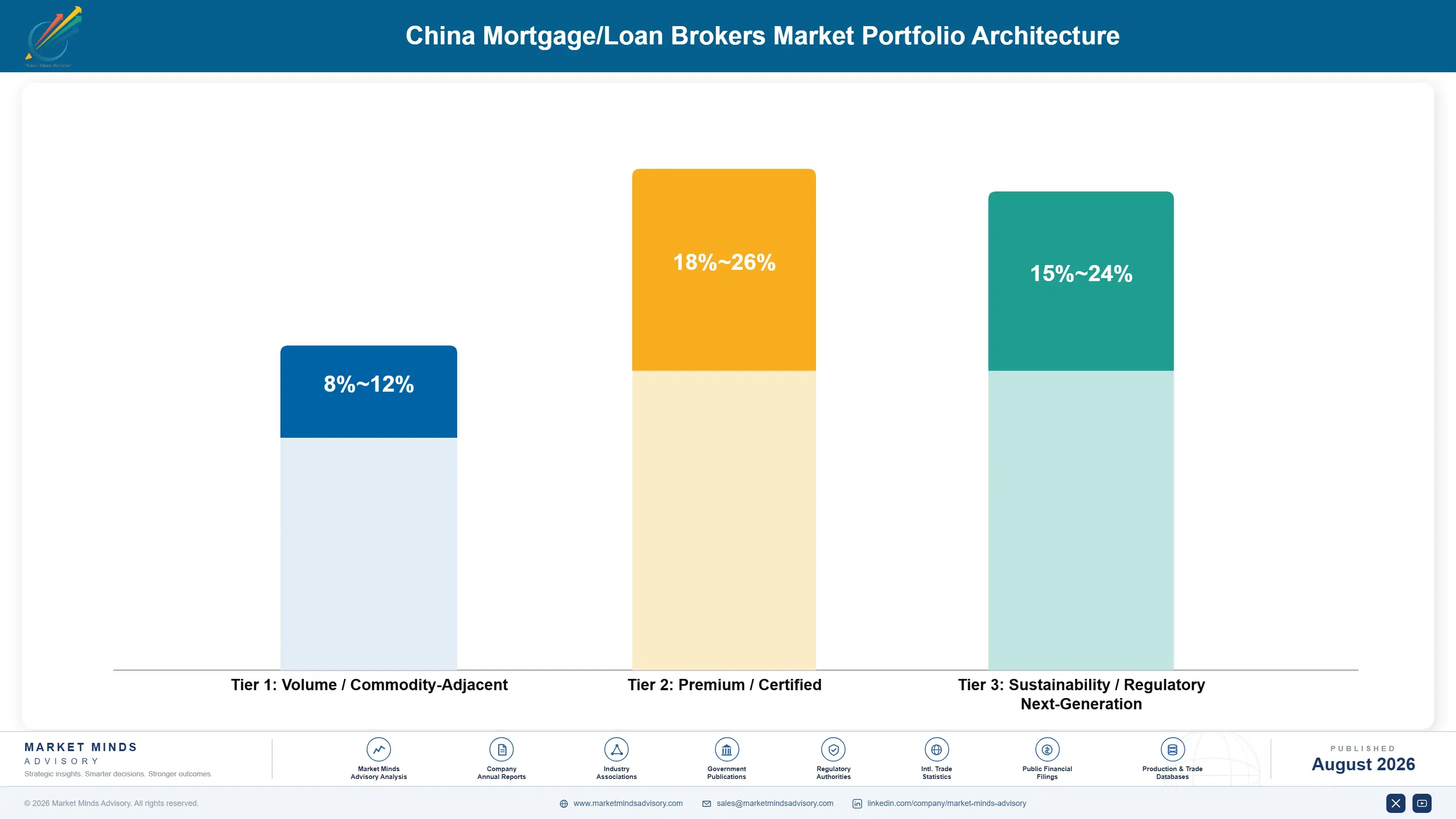
The portfolio separates by who holds the credit risk and how scarce the distribution is. Pure referral consumer facilitation forms the volume layer: high throughput, low take rate, no balance sheet exposure, and margins that survive only because the marginal cost of an additional loan through an existing platform is genuinely close to nothing. Participants hold it for scale and for the borrower data it generates.
Margin concentrates where the platform absorbs risk that banks will pay to avoid. Guaranteed consumer and business facilitation earns roughly double the pure referral take rate, and that difference is the entire commercial case for the guarantee subsidiary structure. The tension is that the same arrangement converts a service business into a credit institution, so the margin is real in benign conditions and disappears violently in a downturn.

The highest-value pools sit where policy demand meets distribution scarcity. Micro enterprise and rural credit both carry take rates well above urban consumer facilitation, because banks must grow those books and cannot originate them. That advantage lasts exactly as long as the policy direction and the shortage of county-level agent networks both persist.

Volume / Commodity-Adjacent

Pure referral consumer facilitation with no platform credit exposure. Range spans four points because traffic sourcing cost differs sharply between platforms with owned borrower bases and those buying acquisition externally each quarter.
Gross Margin: 8-12%

Premium / Certified

Risk-bearing consumer and business facilitation through licensed financing guarantee subsidiaries. Range spans eight points because guarantee ratio discipline and credit cycle timing produce entirely different outcomes on otherwise identical arrangements between two platforms.
Gross Margin: 18-26%

Sustainability / Regulatory / Next-Generation

Policy-supported micro enterprise and rural inclusive lending. Range spans nine points because county agent network density decides unit economics, and coverage varies enormously between platforms that built early and those attempting entry now.
Gross Margin: 15-24%
china-mortgage-loan-brokers-portfolio-architecture-1787917220723

High-value Sub-segments and Strategic Watch-out

Small and Micro Business Lending

High value and high growth at 10.2%, driven by inclusive finance targets banks cannot meet from urban branches. The seven point range separates platforms with genuine merchant transaction data from those underwriting on collateral and hope alone. The transaction data is the whole difference here.
Gross Margin: 17-24%

Rural and Agricultural Credit

High value with moderate growth at 8.6%, dependent entirely on county-level agent density that takes years to build. The six point range reflects network maturity, since unit economics only work above a coverage threshold most participants never reach. Thin coverage earns almost nothing at all.
Gross Margin: 14-20%

Consumer Instalment Credit

The volume core and the source of most borrower data in the market. Take rates are compressing as banks build direct origination capability, and the October 2025 disclosure rules pushed thinner credit tiers against the practical rate ceiling. No participant can afford to leave it behind.
Gross Margin: 10-15%

Residential Mortgage Origination

The strategic watch-out rather than a growth pool. Outstanding household housing loans have fallen outright, origination volume has contracted since 2021, and several participants have closed mortgage desks rather than carry the fixed cost of maintaining them. The fixed cost comfortably outlived the revenue attached.
Gross Margin: Variable

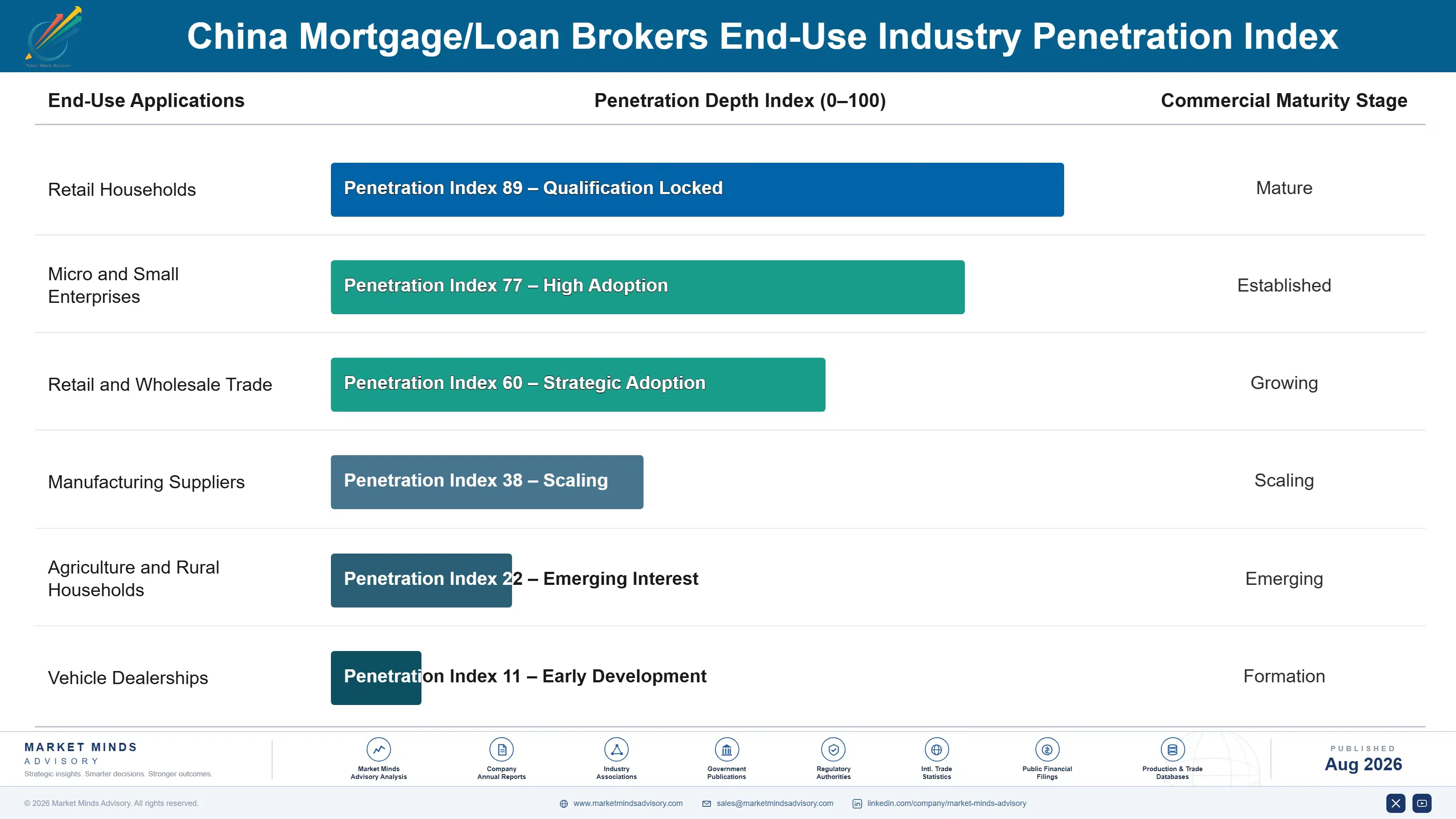
Why Borrowers Keep Coming Back

Repeat borrowing supplies the annuity economics this industry actually runs on. Around 67% of borrowers return within two years, and each return arrives with almost no marginal acquisition expense against a full service fee, which means a seasoned book generates contribution that a growing one does not. Platforms therefore compete on retention far more than the origination-focused public commentary suggests, and the oldest borrower bases hold advantages newer entrants cannot buy.
Stickiness varies enormously by borrower type. Micro enterprise borrowers return most reliably, because working capital needs recur seasonally and switching means re-establishing a credit relationship from nothing. Consumer instalment borrowers shop more actively, particularly at the thinner credit tiers where several platforms will approve them. Rural agricultural borrowers are the stickiest of all, since the alternative in a county town is frequently no formal credit provider at all.

Borrower profiles are shifting in ways that favour the harder segments. Younger urban borrowers increasingly reach credit through embedded point-of-sale arrangements rather than through any platform relationship, which commoditises that origination completely. Small business owners in county markets remain relationship-driven and value an agent who understands their trade. No platform currently serves both well, and most have stopped pretending otherwise.
china-mortgage-loan-brokers-end-use-penetration-index-1787917221218

Where Chinese Facilitation Margin Sits

These are among the four positions where our research anticipates prominent divergence between winners and laggards over the coming forecast period. Each is grounded in the demand model, the regulatory perimeter, and the announced capacity pipeline.
01 / GUARANTEE RATIO DISCIPLINE

Cap the exposure funding partners would happily let you take

Funding partners will let a platform guarantee its entire facilitated book because doing so removes their credit risk completely, and accepting that quietly converts a service business into a thinly capitalised lender. Capping guaranteed exposure near 65% of volume and placing part of the first loss with credit insurers retains most of the take rate uplift while removing the tail that destroys capital. Participants who held that discipline through 2022 emerged with balance sheets their competitors simply no longer had.
02 / COUNTY DISTRIBUTION DENSITY

Rural agent networks are the scarce asset policy created

Inclusive lending targets have produced bank demand for micro enterprise and rural origination that no urban branch network can possibly satisfy, and take rates in those markets run 120 to 180 basis points above comparable urban consumer facilitation. Networks require three to four years to reach the density at which unit economics actually work, which is longer than most policy windows stay open in practice. The platforms collecting that return built the capability before anybody considered it valuable at all.
03 / REPEAT CONVERSION ECONOMICS

Second loans carry the margin that first loans never do

A first loan absorbs the full acquisition cost against a modest service fee, while the second and third arrive with almost no marginal acquisition expense whatsoever. With repeat rates sitting near 67% across two full years, the difference between converting 60% and converting 75% is worth roughly 40% of contribution margin on exactly identical origination spend. The mechanism itself is thoroughly unglamorous: proactive pre-approval, behaviour-linked credit line increases, and collections handled well enough that repaid borrowers actually come back afterwards.
04 / FUNDING PANEL BREADTH

Eighty partners price risk, a dozen accept what is offered

A platform connected to a wide panel of licensed lenders can place each loan with whichever balance sheet wants that particular risk in this quarter, which converts funding from a binding constraint into something that closely resembles a genuine auction. Platforms running genuinely competitive allocation report funding costs 60 to 90 basis points below single-relationship peers across broadly comparable books. The work is administrative rather than innovative, which is precisely why so few participants have ever bothered to complete it properly.

Engagement Snapshot From the Field

A live engagement with an industry participant carrying material or product regulatory and market exposure ahead of a defining policy shift, showing how our research translates into a defensible multi-year portfolio strategy.
MARKET MINDS ADVISORY · CLIENT ENGAGEMENT SUMMARY
China Mortgage/Loan Brokers Producer Strategic Portfolio Review and Transition Roadmap 2026·Investment Scenario on China Mortgage/Loan Brokers Exposure Evaluation 2025-26
CLIENT PROFILE
A mainland Chinese loan facilitation platform operating across several provincial markets, originating consumer instalment and small business credit through a mix of online channels and a modest offline agent presence. The business had grown facilitated volume consistently for four years while contribution margin fell every year, and management attributed the decline to competitive pricing pressure rather than to anything in its own structure.
STRATEGIC CHALLENGE
The October 2025 disclosure rules were approaching and a substantial portion of the consumer book priced close enough to the practical ceiling that repricing looked unavoidable. The board needed to understand which parts of the book would survive full cost disclosure, and whether the guarantee arrangements it had accepted from funding partners were earning enough to justify the capital they consumed.
MMA APPROACH
MMA rebuilt the platform's contribution economics by product, cohort and funding partner, separating pure referral from guaranteed volume and attributing credit losses to the arrangements that generated them. Expert interviews with funding partners, credit insurers and county-level agents established what guarantee terms were genuinely negotiable and what agent network density competitors had actually achieved in comparable provinces.
KEY FINDINGS
  1. Guaranteed volume represented 81% of facilitated principal against an industry pattern nearer 58%, concentrating credit cycle risk on a capital base that could not absorb another downturn.
  2. Roughly 23% of the consumer book priced above the level that would survive full cost disclosure, and that portion carried the worst repayment performance in the entire portfolio.
  3. Repeat conversion stood at 54% against 67% for comparable platforms, driven by a collections approach that recovered balances effectively while ending the borrower relationship permanently.
  4. The offline agent network covered eleven county markets, well below the density threshold at which unit economics turn positive, so it consumed cost without earning the rural take rate premium.
CLIENT PROFILE
A mainland Chinese loan facilitation platform operating across several provincial markets, originating consumer instalment and small business credit through a mix of online channels and a modest offline agent presence. The business had grown facilitated volume consistently for four years while contribution margin fell every year, and management attributed the decline to competitive pricing pressure rather than to anything in its own structure.
STRATEGIC CHALLENGE
The October 2025 disclosure rules were approaching and a substantial portion of the consumer book priced close enough to the practical ceiling that repricing looked unavoidable. The board needed to understand which parts of the book would survive full cost disclosure, and whether the guarantee arrangements it had accepted from funding partners were earning enough to justify the capital they consumed.
MMA APPROACH
MMA rebuilt the platform's contribution economics by product, cohort and funding partner, separating pure referral from guaranteed volume and attributing credit losses to the arrangements that generated them. Expert interviews with funding partners, credit insurers and county-level agents established what guarantee terms were genuinely negotiable and what agent network density competitors had actually achieved in comparable provinces.
KEY FINDINGS
  1. Guaranteed volume represented 81% of facilitated principal against an industry pattern nearer 58%, concentrating credit cycle risk on a capital base that could not absorb another downturn.
  2. Roughly 23% of the consumer book priced above the level that would survive full cost disclosure, and that portion carried the worst repayment performance in the entire portfolio.
  3. Repeat conversion stood at 54% against 67% for comparable platforms, driven by a collections approach that recovered balances effectively while ending the borrower relationship permanently.
  4. The offline agent network covered eleven county markets, well below the density threshold at which unit economics turn positive, so it consumed cost without earning the rural take rate premium.
RECOMMENDED STRATEGY
Phase 1: Phase one: renegotiate guarantee ratios with the three largest funding partners and place first loss cover with a credit insurer before the disclosure rules take effect. Phase 2: Phase two: reprice or exit the consumer tiers that cannot survive full cost disclosure, redeploying that origination capacity toward small business lending instead. Phase 3: Phase three: concentrate agent investment into three provinces to reach genuine county density rather than maintaining thin coverage across eleven separate markets.
OUTCOME
The client reported contribution margin improving 3.6 points within four quarters and guaranteed volume falling to 64% of principal (client-reported, unverified by MMA). Repeat conversion rose to 61% after the collections approach was rebuilt. Facilitated volume fell 9% during the transition, which the board had accepted in advance as the cost of the restructuring.

Frequently Asked Questions

Foundational context covering the market sizes, CAGR, scope, country, region and competition that inform every finding below. This section is provided to cover basics and most often pre-purchase conversations, answered from the MMA Primary Research Dataset.

What is the current size of the China Mortgage/Loan Brokers Market?

The market is valued at USD 21.5 billion in 2025, measured as revenue earned by intermediaries facilitating loans to licensed lenders in mainland China. Bank net interest income is excluded entirely.

How large will the China Mortgage/Loan Brokers Market be by 2036?

MMA forecasts USD 44.33 billion by 2036, up from USD 22.96 billion in 2026. That represents incremental revenue of USD 21.37 billion and an expansion multiple of 1.93 times.

What is the CAGR for the China Mortgage/Loan Brokers Market 2026 to 2036?

The base case CAGR is 6.8%, with a bull case of 8.0% and a bear case of 5.6%. Growth depends on business and rural credit replacing the mortgage origination that has been contracting.

Which segment is growing fastest?

Small and micro business lending grows at 10.2%, half again the market rate of 6.8%. Inclusive finance targets require banks to expand books they cannot originate from urban branches.

Who are the major companies in the China Mortgage/Loan Brokers Market?

Lufax Holding, Qifu Technology, FinVolution Group, Yiren Digital and KE Holdings lead on facilitation and brokerage revenue, holding around 41% between them across the market.

Which country is growing fastest?

Vietnam grows fastest at 8.8%, reflecting technology and underwriting methodology exported by Chinese platforms into separately licensed local operations. That activity sits outside this market definition entirely.

Report Segmentation Architecture

The full report scope spans multiple orthogonal segmentation dimensions, with cross-tabulated demand data provided for each dimension pair. Coverage extends further to regional breakdowns, trend trajectories, and the competitive detail needed to support segment-level decision-making.

By Credit Product

  • Residential Mortgage Origination
  • Small and Micro Business Lending
  • Consumer Instalment Credit
  • Auto and Vehicle Finance
  • Secured Property-Backed Business Loans
  • Rural and Agricultural Credit

By End-Use Industry

  • Retail Households
  • Micro and Small Enterprises
  • Retail and Wholesale Trade
  • Manufacturing Suppliers
  • Agriculture and Rural Households
  • Vehicle Dealerships

By Commercial Dimension

  • Pure Referral Fee Model
  • Risk-Bearing Guarantee Model
  • Bank Joint-Lending Co-Funding
  • Embedded Point-of-Sale Origination
  • Offline Agent Networks
  • Property Agency Mortgage Referral

By Region

  • North America
  • Western Europe
  • East Asia
  • South Asia and Pacific
  • Latin America
  • Middle East and Africa
  • Eastern Europe

Scope, Methodology, and Coverage

Every figure in this report is reproducible from documented input assumptions. The scope below maps the historical period, the forecast horizon, the segmentation dimensions, and the countries covered, alongside the underlying primary and qualitative methodology.
Historical Period
2020 to 2025
Forecast Period
2026 to 2036
Base Year
2025 (USD billions; MMA Primary Research Dataset, August 2026)
Market Definition
Revenue earned by intermediaries that source, screen and refer borrowers to licensed lenders in mainland China, comprising technology service fees, credit guarantee fees and referral commissions across residential mortgage, consumer instalment, auto, small business, secured property-backed and rural agricultural credit. Net interest income earned by banks and consumer finance companies on their own balance sheets is excluded, along with unlicensed private lending, pawn broking, and insurance or wealth product distribution.
Quantitative Units
USD billions, intermediary revenue
Segmentation Dimensions
Credit product, end-use industry, commercial origination dimension, region
Regions Covered
North America, Western Europe, East Asia, South Asia and Pacific, Latin America, Middle East and Africa, Eastern Europe
Countries Covered
Mainland China, with technology export and capital market exposure across South Asia and Pacific, North America and Eastern Europe
Key Companies Profiled
Lufax Holding, Qifu Technology, FinVolution Group, Yiren Digital, KE Holdings, LexinFintech, Jiayin Group, X Financial, Du Xiaoman Financial, Ant Group
Quantitative Methodology
Primary survey, n=3,800 respondents, Q4 2025, six countries; demand-side model with trade association cross-validation
Qualitative Methodology
47 expert interviews, Q4 2025; applied to validate demand model assumptions, identify emerging dynamics, and assess competitive positioning
Report Format
PDF and XLSX data workbook (Word format preview document)
Publisher
Market Minds Advisory
Report Code
MMA-2026-TEC-381
Published
August 2026
Contact
sales@marketmindsadvisory.com | www.marketmindsadvisory.com

Purchase the full China Mortgage/Loan Brokers Market Report (2026 to 2036).

The full report examines Chinese loan facilitation as a credit risk business wearing technology clothing, and quantifies what the October 2025 disclosure rules changed. It separates pure referral from guaranteed volume across the market, models the capital consumed by guarantee arrangements through a full credit cycle, and identifies which consumer credit tiers cannot survive full cost disclosure. Segment analysis covers all six credit products with particular attention to why policy-created rural and micro business pools carry take rates urban consumer lending cannot approach. Competitive assessment ranks twenty participants on facilitation and brokerage revenue. Regional coverage addresses capital markets, technology export and offshore development as genuine influences on domestic economics.
Six credit product segmentation with growth rates
Guarantee versus referral contribution economics compared
Twenty participant assessment on facilitation revenue
County agent network density threshold analysis
Repeat conversion benchmarks across borrower segments
Funding panel breadth against realised funding cost

Built For The People Who Decide

From boardroom strategy to bench-side execution, this report is read cover-to-cover by leaders shaping the next decade of their industry, turning demand scenarios, market dynamics and valuation benchmarks into decisions.
CXOs/ Presidents/ VPs/ Managers
M&A and Corporate Development
Strategy Teams and R&D Heads
Procurement and Product Directors
Regulatory and Compliance Leaders
Investor Relations and Equity Analysts