Market Minds Advisory
Chemical Detector Market

Chemical Detector Market: Identification Speed Now Decides Emergency Response Outcomes

Emergency responders increasingly need to identify an unknown chemical in seconds, not send a sample to a lab, and the handheld Raman instruments built for that speed are being specified faster than certification allows.

Lead Analyst

Bilal Shaikh

Published

September 2026

Make Smarter Decisions with Customized Research Insights

Request a free sample report and evaluate market opportunities, growth trends, and competitive dynamics relevant to your business needs.

2025 MARKET VALUE$3.4BMarket Size 2025
2036 FORECAST VALUE$8.6BBase Case , 2026 to 2036
CAGR 2026 TO 20368.8 %Bull 10.0% / Bear 7.5%
INCREMENTAL OPPORTUNITY$4.9BNet 10- year value creation
EXPANSION MULTIPLE2.32x2036 value over 2026 base
Strategic Levers
M&A Pipeline
Regional Outlook
Country Rankings
Competitive Intelligence
Segmental Deep-dive
Call-Us : 91 93563 13602

Executive Snapshot and Market Trajectory

Chemical detection has shifted from a specialised defence procurement category to a mainstream industrial safety requirement, because workplace exposure regulation and emergency response protocols now specify instrument-confirmed identification rather than relying on odour or visual cues alone. Facility safety officers budget for detection equipment before a handling process is approved.
Commercial demand concentrates around industrial safety compliance, homeland security screening, and emergency response deployment, where identification speed directly determines both regulatory compliance and life-safety outcomes. Multi-sensor fusion systems are pulling ahead of single-technology instruments as responders demand fewer false positives across a wider range of unknown substances. North America leads deployment volume on homeland security and industrial safety spending, with East Asia close behind on expanding chemical manufacturing safety regulation.
Competitive character splits between diversified instrumentation majors bundling chemical detection into wider analytical and safety equipment portfolios and specialist detection technology makers selling purpose-built identification instruments. Regulatory pressure is a genuine constant here: workplace exposure limits, homeland security screening mandates, and chemical facility security standards in multiple jurisdictions increasingly specify certified detection capability as a condition of operating approval. That requirement reshapes qualification before an audit.
Market Definition
The chemical detector market covers portable and fixed instruments for detecting toxic industrial chemicals, chemical warfare agents, and hazardous chemical vapours, including photoionization detectors, ion mobility spectrometry detectors, electrochemical toxic gas sensors, colorimetric test strip detectors, Raman and FTIR chemical identification instruments, and multi-sensor fusion systems. It excludes combustible and flammable gas-only detectors, hydrogen-specific detectors, and laboratory analytical instruments not designed for field or portable detection use.
Base Year Value
$3.4B in 2025 (MMA Primary Research Dataset, August 2026)
Forecast Period
2026 to 2036, eleven discrete annual values
CAGR
8.8% base case. Bull 10.0%. Bear 7.5%.
Fastest Growth Segment
Multi-Sensor Fusion Detection Systems: 13.5% CAGR
Fastest Growth Country
India: 11.2% CAGR
Fastest Growth Region
South Asia and Pacific: 10.8% CAGR
Largest Region
North America: 29% of 2025 global value
Market Leaders
Smiths Detection, Bruker, Thermo Fisher Scientific, Bertin Technologies, Environics. Source: MMA Analysis based on company annual reports.
Primary Survey
n=3,800 procurement and R&D decision-makers, Q4 2025, six countries
Methodology
Demand-side build-up, cross-validated against public data, 47 expert interviews

Chemical Detector Market Forecast Scenarios

chemical-detector-market-size-forecast-scenario-1787302930838
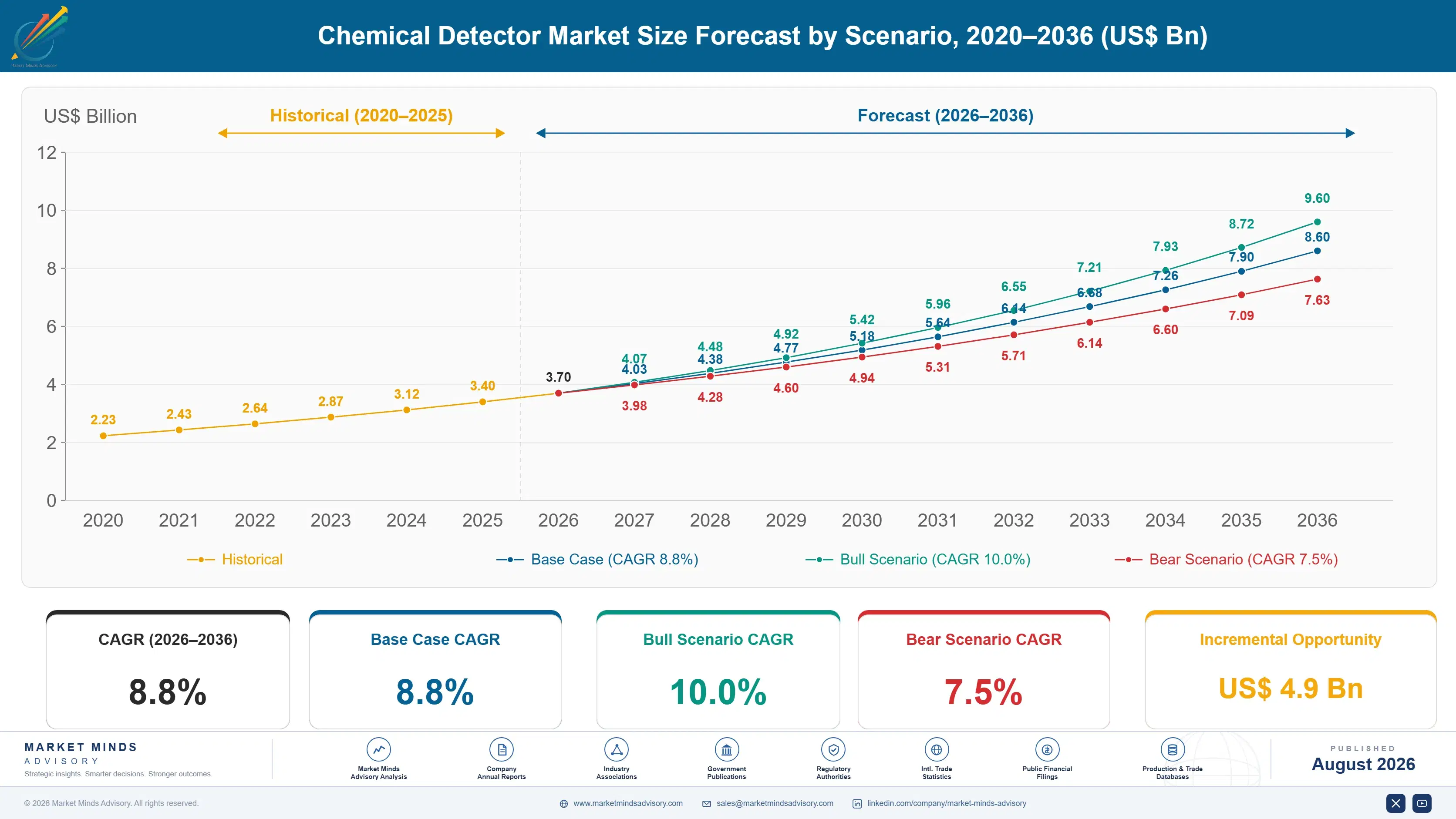
Between 2020 and 2025 the market grew at a 7.9% historical CAGR, anchored by steady homeland security and defence procurement demand across established markets. Growth tracked general safety instrumentation spending closely. Multi-sensor fusion adoption only gained real momentum from 2023 onward. Reporting during that period remained genuinely limited given how fragmented government procurement disclosure practices generally are.
The base case carries the market to an 8.8% CAGR through 2036 on three mechanisms. First, workplace exposure regulation in multiple jurisdictions increasingly specifies instrument-confirmed identification rather than relying on odour or visual detection alone. Second, chemical facility security standards push industrial operators toward certified detection capability as a condition of operating approval. Third, emergency response agencies replace ageing single-technology instruments with multi-sensor fusion systems that reduce false positives considerably.
The bull case reaches 10.0% if homeland security and industrial safety spending accelerates faster than currently modelled, pulling instrument replacement cycles forward across a compressed procurement timeline. The bear case falls to 7.5% if government procurement budgets tighten broadly, keeping demand tied mostly to standard replacement cycles rather than new capability specification. That volatility is already visible in extended lead times across several agency procurement cycles.

Why Identification Speed Became A Compliance Requirement

Three forces converge on chemical detector demand at once. Workplace exposure regulation increasingly specifies instrument-confirmed identification rather than odour or visual detection alone. Chemical facility security standards push industrial operators toward certified detection capability as a condition of operating approval. And emergency response agencies replace ageing single-technology instruments with multi-sensor fusion systems that reduce false positives.
MARKET CONCENTRATIONCR5: 40%Diversified instrumentation majors and specialists split roughly two-fifths
AVERAGE SELLING PRICEUSD 3,500 to 65,000 per unitPricing spans colorimetric strips to full Raman identification systems
TOP PRODUCING COUNTRY SHAREUSA: 28% of units shippedDefence and homeland security manufacturing concentrates production domestically
CAPACITY UTILISATION68 to 76%Certified production lines run consistently near committed capacity
INPUT COST SHARE25 to 32% of COGSDetection sensor elements dominate recurring component cost spending
REPLACEMENT CYCLE LENGTH6 to 10 yearsCertified instruments require periodic recalibration ahead of replacement
Commercially, the market behaves like specialised safety and security instrumentation rather than generic sensing equipment. Buyers specify by identification library breadth, response time, and false-positive rate rather than by price alone, because a missed or misidentified chemical can trigger a much larger safety incident than the instrument itself costs. That specification discipline protects margin for makers with genuine spectroscopy and sensor engineering depth and keeps generic instrumentation makers from moving into identification-critical contracts.
Over the next decade, sensor fusion becomes the real differentiator. Multi-sensor fusion and Raman identification instruments are closing the performance gap with laboratory analysis as portable spectroscopy technology continues improving considerably. Makers that combine reliable detection chemistry with expanding identification libraries, rather than single-technology instruments alone, will capture the emergency response and industrial contracts increasingly dominating new specification spending.
"A false positive shuts down a facility for hours, and a false negative can kill someone, so the instrument's identification confidence matters considerably more to buyers than almost any other specification on the data sheet."
Director, Chemical Detection and Industrial Safety Practice · MMA Industrial Saf

Market Trends

Multi-Sensor Fusion Cuts False Positives Across Unknown Substances

Emergency response agencies and industrial safety teams increasingly specify multi-sensor fusion instruments that combine several detection technologies in one device, since relying on a single sensing method produces false positive and false negative rates that responders no longer consider acceptable for genuinely unknown substance identification. That combination approach cross-validates readings across different detection chemistries before confirming an identification, cutting the false alarm rate considerably compared with single-technology instruments still common in older equipment fleets. Bruker and 908 Devices have both expanded multi-sensor product lines specifically to capture agencies replacing ageing single-technology fleets.
Market Impact: Requires 100% instrument-confirmed
Chemical Facility Security Standards Mandate Certified Detection

Chemical facility security regulations in multiple jurisdictions increasingly require documented, certified detection capability as a condition of operating approval, and facilities handling regulated chemicals of concern must demonstrate instrument-confirmed monitoring rather than relying on manual inspection procedures alone. That certification requirement has converted detection equipment specification from a discretionary safety investment into a standing regulatory compliance line item that facility operators cannot avoid. Smiths Detection and Thermo Fisher Scientific have both expanded certified product lines specifically to serve facilities navigating tightening security regulation. That certification requirement is already reshaping how facility operators plan capital budgets years ahead of construction.
Market Impact: Expands libraries to 10,000+ substa

Market Opportunities and Growth Drivers

Workplace Exposure Regulation Requires Instrument-Confirmed Identification

Workplace exposure regulations in multiple jurisdictions increasingly require documented, instrument-confirmed chemical identification rather than accepting odour or visual observation as adequate evidence of a safe working environment, particularly in facilities handling regulated toxic industrial chemicals at meaningful volume. That documentation requirement has moved detection equipment from an optional safety good practice into a standing compliance obligation that safety officers must satisfy with auditable instrument data rather than subjective judgment calls. Facility safety teams increasingly build detection equipment specification into new process design from the earliest planning stage rather than adding it after a process is already operating.
Market Impact: Adds 12-18 months to deployment tim

Emergency Response Agencies Replace Ageing Single-Technology Fleets

Fire departments and hazardous materials response teams operating detection equipment purchased a decade or more ago increasingly find that equipment inadequate against the wider range of industrial and precursor chemicals responders now encounter during real incidents. That capability gap has pushed agencies toward comprehensive fleet replacement programmes specifying multi-sensor fusion instruments with considerably broader identification libraries than their older equipment ever carried. Government procurement budgets increasingly treat detection equipment replacement as a standing multi-year line item rather than a one-time capital purchase decision. That budget treatment reflects how seriously agencies now weigh identification confidence against pure hardware acquisition cost.
Market Impact: Raises entry cost 2-4x single-techn

Market Restraints and Challenges

Certification Timelines Delay New Technology Deployment

New chemical detection instruments require extensive validation testing against established reference libraries before regulatory and procurement bodies will approve them for emergency response or industrial safety use, the root cause being that a false identification in either direction carries genuine life-safety consequences that certification bodies test for exhaustively before approval. That certification timeline routinely extends new instrument deployment by a year or more beyond the technology's actual readiness, delaying the safety benefit newer sensor fusion approaches could otherwise deliver considerably sooner. Makers are responding by engaging certification bodies earlier in development rather than waiting until a product is finalised.
Market Impact: Cuts false positive rates 40-60%

High Unit Cost Limits Fleet-Wide Deployment For Smaller Agencies

Full-featured multi-sensor fusion instruments cost considerably more than single-technology alternatives, a price gap that smaller municipal fire departments and industrial facilities absorb poorly across limited equipment budgets, the root cause being that combining multiple detection technologies into one certified instrument requires meaningfully more sensor hardware and calibration complexity than any single-technology device. That cost gap has kept comprehensive multi-sensor deployment concentrated among larger, well-funded agencies and facilities, leaving smaller responders equipped with older or narrower detection capability. Makers are responding with tiered product lines that let smaller agencies access core multi-sensor capability at a lower price point.
Market Impact: Requires certification on 100% of s
3 additional market trends, 3 additional growth drivers, and 2 additional restraints and challenges are covered in the full report. Contact sales@marketmindsadvisory.com to access the complete intelligence.

Segment CAGR and Growth Architecture

Segmentation follows detection technology, the single engineering logic that determines identification method, response time, and library breadth. Photoionization, ion mobility spectrometry, electrochemical, colorimetric, Raman and FTIR, and multi-sensor fusion instruments each carry genuinely distinct capability profiles evaluated consistently throughout this report. Underlying flammable and hydrogen-specific detectors sit outside this hierarchy, evaluated as separate categories.
chemical-detector-market-market-share-analysis-1787302931368

Multi-Sensor Fusion Detection Systems

Multi-sensor fusion detection systems grow fastest at 13.5%, about 1.53 times the market's 8.8% overall rate, as emergency response agencies and industrial safety teams demand fewer false positives across a wider range of genuinely unknown substances than any single detection technology can reliably deliver. These systems combine several detection chemistries in one certified instrument, cross-validating readings before confirming an identification, which cuts the false alarm rate considerably compared with older single-technology equipment still common in many fleets. Bruker and 908 Devices have both expanded multi-sensor product lines specifically to capture agencies replacing ageing fleets with comprehensive fusion capability. Adoption concentrates first among well-funded federal and municipal agencies, spreading into industrial safety as unit cost declines.
CAGR 13.5%

Raman and FTIR Chemical Identification Instruments

Raman and FTIR chemical identification instruments grow second-fastest at 11.5%, driven by portable spectroscopy technology reaching field-deployable maturity that laboratory-grade instruments alone could previously achieve, letting responders identify unknown substances on scene rather than waiting for laboratory confirmation that can take hours or days. Rather than detecting chemical vapour concentration alone, these instruments identify a substance's precise molecular signature, providing a considerably higher confidence identification than colorimetric or electrochemical methods can offer for genuinely unknown materials. Bruker and Agilent Technologies have both expanded portable Raman product lines specifically to serve emergency response and industrial safety customers demanding laboratory-grade confidence in the field. Adoption is fastest among responders handling genuinely unknown substances where identification confidence matters most.
CAGR 11.5%
Full segment breakdown across 6 segments available in the complete report.

Regional Architecture and Country Demand Map

Global demand concentrates where homeland security and industrial safety regulation run deepest. North America leads on security and industrial spending, East Asia follows on expanding chemical manufacturing regulation, and Western Europe trails both on a mature base. South Asia and Pacific is closing the gap fastest of any tracked region.

North America

The United States drives regional demand through homeland security procurement and industrial chemical facility security regulation, where federal agencies and large municipal fire departments continue replacing ageing single-technology detection fleets with comprehensive multi-sensor systems. Industrial safety compliance across the Gulf Coast chemical manufacturing corridor adds a further demand layer, with facility operators specifying certified detection as a standing condition of operating approval. Smiths Detection and Thermo Fisher Scientific both hold deep incumbency in North American federal and industrial contracts, bundling detection into wider safety and security platform relationships. Canada contributes a smaller layer through industrial safety applications tied to its domestic chemical manufacturing base. Growth of 9.6% tracks security and industrial regulation expansion more than any single procurement announcement.
Share: 29% | CAGR: 9.6% (2026 to 2036)

Western Europe

Germany, France, and the United Kingdom anchor demand through established homeland security procurement and chemical facility security regulation that continues tightening under EU-wide security and workplace safety frameworks. Bertin Technologies and Environics both hold genuine home-market advantage across French and Nordic government and industrial accounts, competing on detection chemistry depth against larger global instrumentation majors. Chemical manufacturing capacity has grown more slowly in the region than in Asia, capping the underlying industrial demand growth even as security procurement remains genuinely strong. Growth of 7.5% reflects that manufacturing capacity limitation directly, sitting below the global rate despite the region's deep security procurement base. Investment continues flowing toward higher-confidence multi-sensor systems rather than volume expansion alone.
Share: 22% | CAGR: 7.5% (2026 to 2036)
Regional intelligence for 5 additional markets available in the complete report: East Asia, South Asia and Pacific, Latin America, Middle East and Africa, Eastern Europe. Contact sales@marketmindsadvisory.com.
chemical-detector-market-country-cagr-analysis-1787302932051

Where Chemical Detection Makers Can Defend Margin

Procurement budgets are shifting toward makers who can guarantee both identification confidence and certified compliance breadth. The four levers below capture revenue before a procurement cycle locks its equipment list rather than after, and each rewards makers who can prove reliability credibly across a customer's full deployment fleet. That reliability increasingly wins the largest national contracts outright.

Bundle Detection Into Facility Security Design Contracts

Detection equipment specification increasingly happens during chemical facility security design rather than during later procurement, when compliance architecture and monitoring points are already fixed and costly to change. Makers that place detection engineers inside facility security design teams from the outset capture the full equipment scope rather than competing for a smaller retrofit order later. Smiths Detection reports that projects bundling detection into initial facility design carry order values roughly 28% higher than late-stage procurement contracts on comparable facilities. Early involvement also cuts the requalification risk that late-stage substitution otherwise carries across a fleet.
Market Impact: Lifts contract value roughly 28% ve

Sell Fleet-Wide Library Update Subscriptions Continuously

Chemical identification libraries require continuous updates as new industrial and precursor chemicals enter circulation, and agencies depending on outdated libraries risk missing genuinely novel substances during real incidents. Makers bundling instrument sales with subscription library update services are capturing recurring revenue worth 8 to 14% of the original instrument price annually, extending customer relationships well past the initial purchase and improving retention across renewal cycles considerably. Bruker has expanded its subscription library offering specifically to capture this recurring layer. That recurring layer compounds meaningfully as more agencies renew across multiple annual cycles.
Market Impact: Adds a durable 8-14% annual recurri

Build Tiered Product Lines For Smaller Agency Budgets

Smaller municipal fire departments and industrial facilities cannot justify the cost of full-featured multi-sensor fusion instruments, yet they represent a large, historically underserved segment of the market that larger makers previously found uneconomical to pursue directly. Makers offering tiered product lines with core multi-sensor capability at a lower price point capture this segment at a fraction of the full-instrument cost, cutting the effective entry price by roughly 40% for smaller budget-constrained buyers. 908 Devices has scaled exactly this tiered approach across smaller agencies since 2024. That advantage now covers a meaningful share of 908 Devices's smaller-agency accounts.
Market Impact: Cuts entry price by roughly 40% for

Target National Emergency Response Framework Agreements

National emergency response agencies coordinating detection equipment standards across multiple regional response units increasingly want one certified platform rather than a different instrument and library at every unit, which shifts the purchasing decision upstream to a small number of national procurement and standards teams. Securing a framework agreement covering an agency's full national deployment delivers volume that no number of individual unit orders can match. Thermo Fisher Scientific has pursued exactly this framework approach with several national agencies since 2023. That framework relationship now spans a meaningful share of Thermo Fisher's national government portfolio.
Market Impact: Locks in supply across a full 20+ u

Who Controls the Margin Pool

Concentration sits at CR5 40%, moderate for a category split between diversified instrumentation majors and specialist detection technology makers. Smiths Detection and Bruker lead on breadth, bundling chemical detection into wider security and analytical instrumentation portfolios, while the gap to specialists like Bertin Technologies and Environics is more about detection chemistry depth than manufacturing scale. All participants are assessed on one consistent basis, chemical detector revenue.
Current competitive activity runs across three dimensions. Product development concentrates on multi-sensor fusion to close the false-positive gap with single-technology instruments. Software investment focuses on identification library breadth and update frequency rather than hardware alone. And account structure centres on national framework agreements rather than one-off unit orders, a shift that rewards makers with genuine multi-region delivery capability.

Emerging pressure comes from Chinese instrumentation makers scaling behind the country's chemical manufacturing buildout, winning price-sensitive standard detection business that global incumbents once assumed was theirs by default. Rankings will shift toward makers who combine multi-sensor fusion capability with proven library breadth, since that combination is what large agencies and industrial operators are now specifying by default. Single-technology-only makers without a credible fusion roadmap face the sharpest erosion over the coming decade.
chemical-detector-market-company-positioning-matrix-1787302932959

Competitive Moat and Risk Dimensions

SMITHS DETECTION

Moat: Deep homeland security relationships

Smiths Detection holds decades of accumulated homeland security and defence procurement relationships across multiple governments, giving it a genuine credibility advantage winning large national framework agreements that newer entrants without comparable government relationship history cannot easily replicate. That relationship depth is difficult for newer entrants without comparable track record to replicate quickly.
SMITHS DETECTION

Risk: Exposed to government budget cycles

Smiths Detection's revenue concentration in government and homeland security procurement leaves it more exposed than diversified rivals to budget cycle volatility, since a delayed national procurement decision can push expected revenue meaningfully across fiscal years. That exposure grows whenever government fiscal priorities shift away from security spending unexpectedly.
BRUKER

Moat: Deep spectroscopy engineering base

Bruker draws on decades of accumulated spectroscopy engineering expertise from its wider analytical instrumentation business, giving it a genuine advantage in Raman and multi-sensor fusion formulations that competitors without comparable core spectroscopy depth cannot easily replicate. That accumulated expertise is difficult for newer entrants to replicate quickly at comparable scale.
BRUKER

Risk: Premium pricing invites undercutting

Bruker's premium instrumentation positioning sometimes trades off against the price competitiveness that fast-scaling Asian manufacturers increasingly demand, leaving room for regional competitors to win standard detection business on cost alone in price-sensitive markets. That gap is widening fastest in Asia, where domestic scale delivers a genuine cost advantage.

Players Tracked

Prominent Players

Smiths Detection
Bruker
Thermo Fisher Scientific
Bertin Technologies
Environics

Other Key Players

FLIR Systems Inc. (Teledyne FLIR)
RAE Systems Inc.
Honeywell International Inc.
Chemring Group PLC
Owlstone Nanotech Inc.
908 Devices Inc.
Agilent Technologies Inc.
Rapiscan Systems
Argon Electronics UK Ltd
Gastec Corporation
Dräger Safety AG & Co. KGaA
MSA Safety Incorporated
Block Engineering LLC
Teledyne Technologies Incorporated
Emerson Electric Co.

Recent Developments

APRIL 2025

Bruker launches handheld Raman instrument with expanded library

Bruker introduced a new handheld Raman chemical identification instrument with a considerably expanded reference library covering additional precursor and industrial chemicals. This was an organic product launch rather than an acquisition, extending Bruker's field identification coverage across a wider range of substances across its full instrument portfolio.
Signal: Incumbents are competing on library breadt
OCTOBER 2025

Smiths Detection acquires specialty trace detection technology company

Smiths Detection completed the acquisition of a specialty trace chemical detection technology company with proprietary sensor miniaturisation capability. The deal brought advanced trace detection engineering in-house, expanding Smiths Detection's product range considerably beyond its prior standard portable instrument line. The acquired team joins Smiths Detection's existing engineering organisation directly.
Signal: Trace detection miniaturisation is becomin
JULY 2025

Thermo Fisher signs supply agreement with national emergency response agency

Thermo Fisher Scientific entered a multi-year supply agreement to provide portable chemical detectors across a national emergency response agency's multiple regional deployment centres. The agreement was a commercial supply contract, not a joint venture or equity transaction, covering equipment across the agency's full national fleet.
Signal: Multi-year, multi-region supply agreements

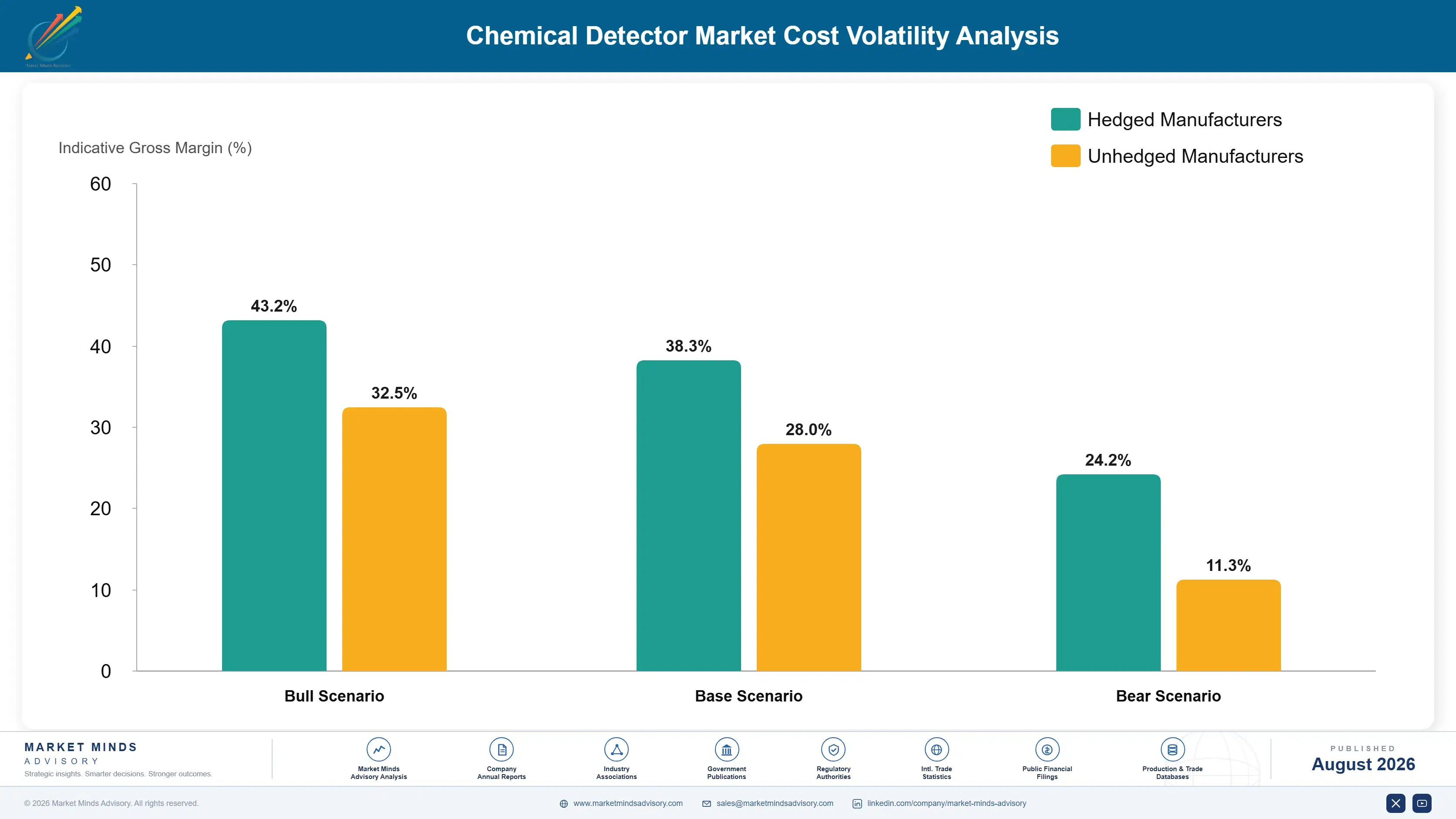
Sensor Element And Precision Optics Exposure

Detection sensor element materials, including ion mobility drift tube components and semiconductor sensing elements, run 25 to 32% of COGS, sourced from a concentrated set of specialised component manufacturers that also supply the wider analytical instrumentation industry. Precision optics used in Raman and FTIR instruments add a further 20 to 28%, with electronics and processing components accounting for most of the remainder.
The global semiconductor shortage running through 2021 and 2022 hit chemical detector production directly, since sensing elements and control electronics depend on specific chip families that compete for fabrication capacity against far larger consumer electronics orders. Thermo Fisher Scientific's 2022 Annual Report disclosed elevated component costs and extended lead times across its instrumentation segment, attributing part of the pressure to semiconductor allocation constraints that persisted through much of the year.

Exposure varies sharply by player type. Vertically integrated majors like Bruker manufacture much of their own precision optics and sensing elements in-house, insulating them from the worst allocation constraints, while smaller specialists depend on third-party component suppliers and absorb price spikes directly into thinner margins. Geography matters too, since makers sourcing components domestically face different exposure than those buying through longer, more exposed international supply chains.
chemical-detector-market-cost-volatility-analysis-1787302933324

Dual-Source Certified Sensor Component Families

Qualifying instrument designs against two sensor component families from separate suppliers, rather than one, keeps a shortage at either supplier from halting production entirely. Several makers adopted dual-sourcing as standard design practice after the 2021 shortage exposed how concentrated their supply chains genuinely were across multiple product lines. That approach has reduced allocation risk considerably.

Vertically Integrate Precision Optics Production Where Feasible

Manufacturing precision optics in-house rather than sourcing them externally insulates the largest makers from allocation shortages during industry-wide supply crunches. Smaller specialists lacking that scale have instead pursued long-term supply agreements with established optics manufacturers to secure priority allocation. That approach has meaningfully reduced spot-market exposure across their supply base. That investment continued even as broader markets stabilised.

Shift Product Mix Toward Software To Reduce Hardware Exposure

Subscription library update software carries little sensor component or optics exposure, giving makers a durable way to cut input cost volatility over time simply by shifting revenue mix as customers increasingly adopt continuous library update subscriptions alongside hardware. That mix shift has meaningfully improved blended margin across every regional product portfolio facing component pressure.

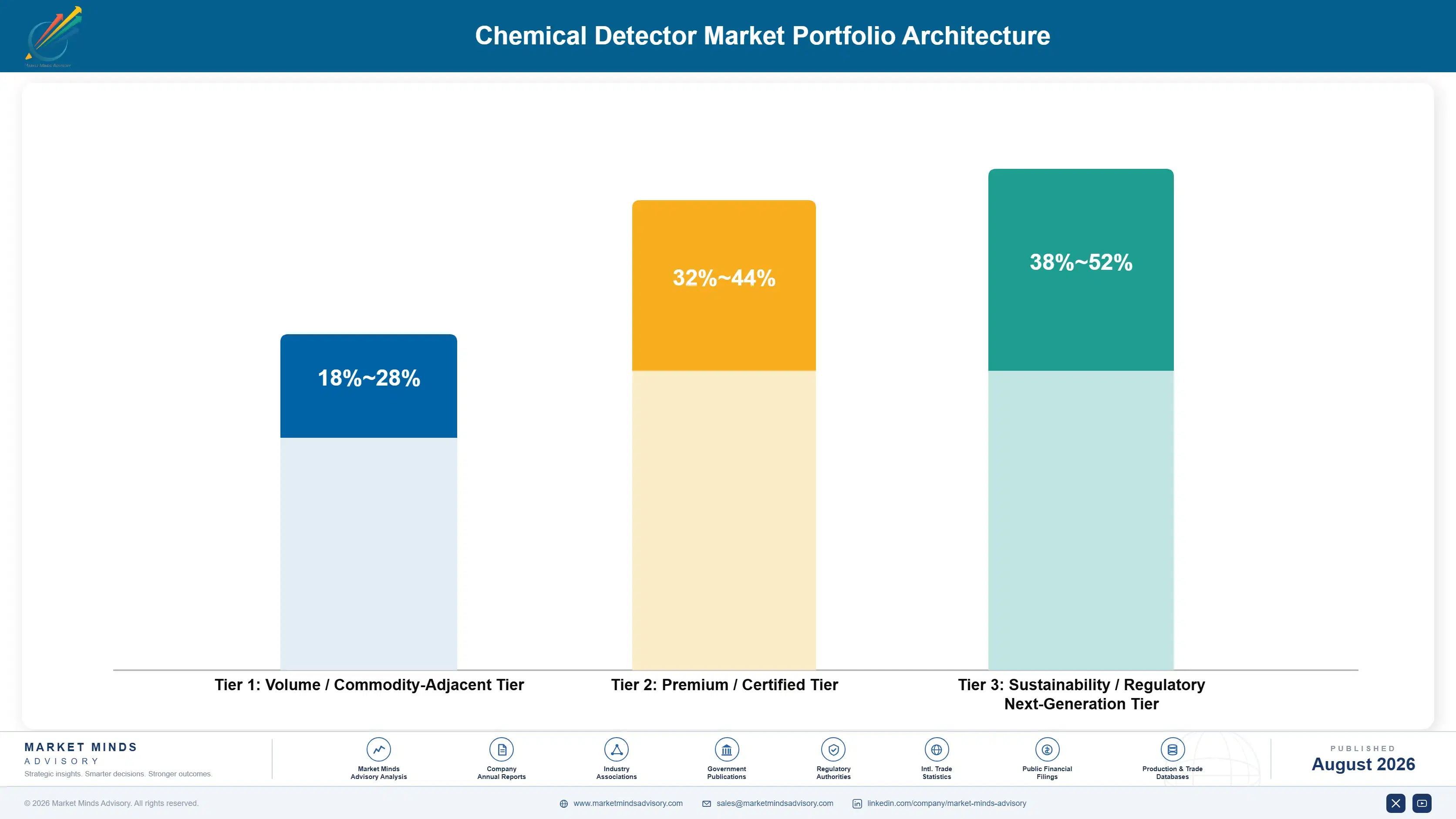
Portfolio Architecture for Margin Defence

The portfolio splits into three tiers with real margin separation, and the gap between tiers has widened as multi-sensor fusion becomes a genuine differentiator rather than an add-on feature. Volume-tier colorimetric and single-sensor instruments compete on price against generic detection equipment and earn modestly. Premium multi-sensor and framework-contracted equipment earns considerably more because it solves a genuine identification confidence problem that customers cannot engineer around c
The tension is between standard equipment volume and per-contract certified margin. Makers selling standard single-sensor instruments in bulk push hard on unit price, while national agencies standardising on multi-sensor framework agreements pay for identification reliability and library breadth rather than negotiating down to the last dollar on every unit. Makers serving both buyer types run genuinely different sales motions under one brand.

High-value pools concentrate in multi-sensor fusion and Raman identification instruments sold with library subscriptions and national framework agreements, where switching cost is highest and price sensitivity lowest. Legacy single-sensor business remains large in volume but persistently thin in margin, as customers treat it as a commodity purchase rather than a differentiated one, and few makers manage to change that perception.

Volume / Commodity-Adjacent Tier

Colorimetric and single-sensor instruments sold into standard replacement programmes, priced against generic detection equipment. Margin stays thin because buyers negotiate primarily on unit price rather than performance. Buyers rarely differentiate between makers on anything beyond delivery speed and price.
Gross Margin: 18-28%

Premium / Certified Tier

Multi-sensor fusion and framework-contracted equipment sold into agencies standardising national deployment specifications. Buyers pay for identification reliability and consistency rather than for hardware alone. Delivery timelines and library breadth matter as much as the hardware specification itself.
Gross Margin: 32-44%

Sustainability / Regulatory / Next-Generation Tier

Raman and FTIR identification systems bundled with library subscription services sold to national agencies and large industrial operators. Margin reflects both technology scarcity and recurring revenue. Few makers currently combine both elements convincingly at meaningful commercial scale.
Gross Margin: 38-52%
chemical-detector-market-portfolio-architecture-1787302934150

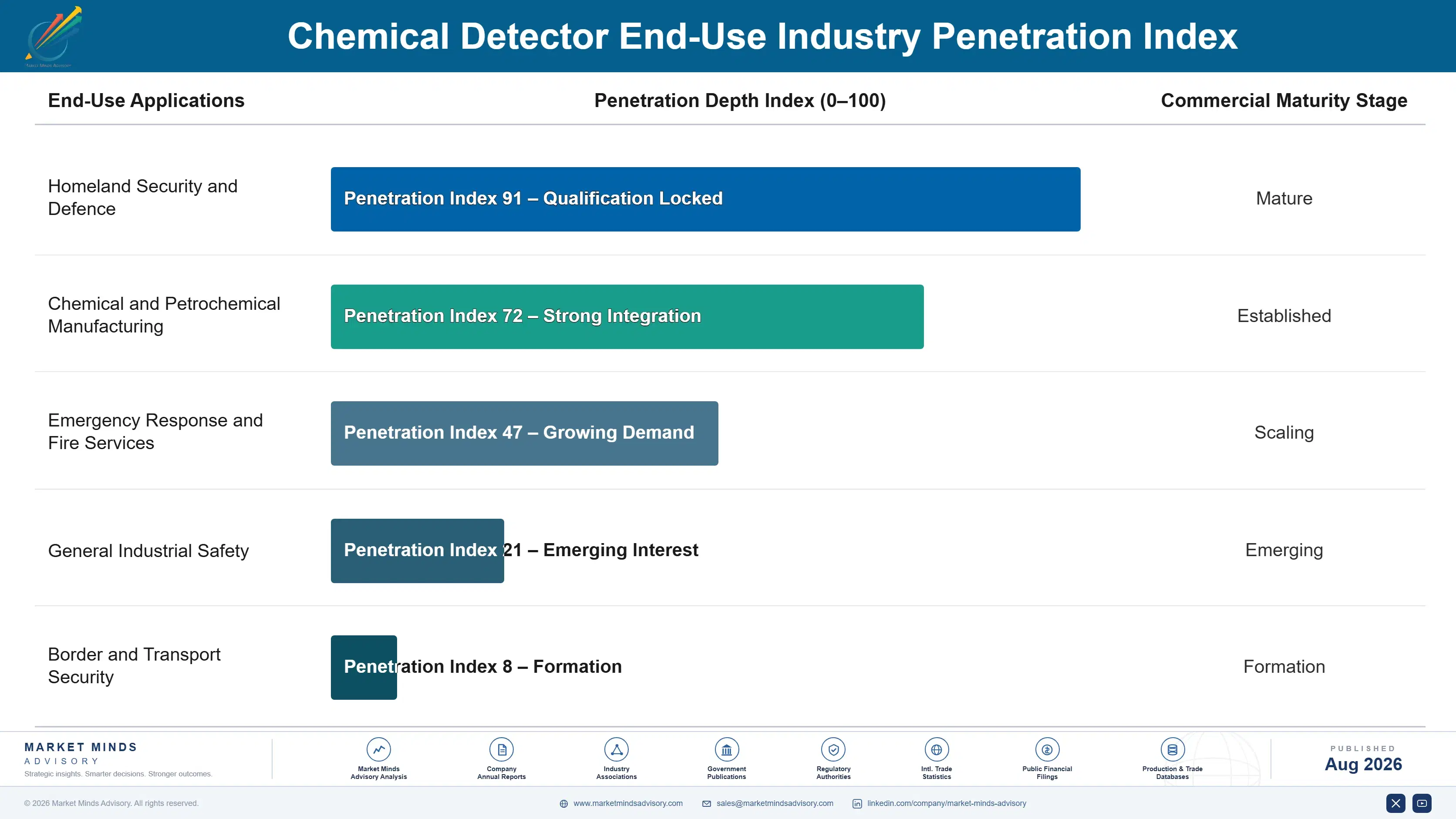
Compliance-Anchored Recurring Detection Demand

Demand behaves like an annuity once an agency or facility standardises on a certified platform, because certified instruments need periodic recalibration every 6 to 10 years and require library update subscriptions throughout that span. That renewal cycle, plus the underlying fleet expansion demand it eventually triggers, gives makers a predictable revenue tail well beyond the original purchase, converting a one-time equipment sale into an ongoing account relationship.
Adoption depth varies sharply by end-use vertical. Homeland security and emergency response agencies adopt fastest and deepest, since identification confidence directly determines life-safety outcomes during real incidents. Chemical and industrial facilities follow closely on facility security regulation timelines. Smaller commercial and municipal buyers adopt more slowly, often waiting for a budget cycle or an incident to force the equipment decision. Government agency buyers add a further demand layer through standing multi-year framework relationships.

Buyer profiles are shifting generationally. Procurement once sat with equipment officers evaluating individual instrument models; it now increasingly involves national standards and safety leaders who specify identification requirements before a single instrument is selected. That shift moves the real purchasing decision earlier into the planning cycle and rewards makers who can prove identification reliability credibly.
chemical-detector-market-end-use-penetration-index-1787302934938

Where Chemical Detection Value Concentrates

These are among the four positions where our research anticipates prominent divergence between winners and laggards over the coming forecast period. Each is grounded in the demand model, the regulatory perimeter, and the announced capacity pipeline.
01 / MULTI-SENSOR FUSION STRATEGY

Sensor Fusion Now Decides Long-Run Category Position

Multi-sensor fusion detection systems are growing at 13.5%, about 1.53 times the market's 8.8% overall rate, and that gap is widening as agencies demand fewer false positives across a wider range of unknown substances than single-technology instruments can reliably deliver. Makers still anchored on single-technology instruments alone risk losing the fastest-growing, highest-margin national framework contracts to rivals offering proven fusion capability already deployed at scale. The window to build credible fusion capability is closing within this forecast period, not the next one.
02 / LIBRARY SUBSCRIPTION STRATEGY

Continuous Library Updates Are Becoming Table Stakes

National agencies and large industrial operators increasingly refuse to specify instruments without continuous library update subscriptions, since a novel substance missing from an outdated library represents a genuine identification failure risk during a real incident. Makers who build this subscription capability capture recurring revenue and preferred-vendor status that hardware-only competitors cannot easily replicate at comparable scale. Those without a credible library update platform will find themselves excluded from the largest national framework agreements entirely, regardless of hardware performance or price.
03 / NATIONAL FRAMEWORK CHANNEL

Multi-Region Frameworks Will Outgrow Single-Unit Sales

National emergency response agencies are increasingly folding detection equipment specification into corporate national standards rather than leaving it to individual regional units, concentrating real purchasing power in a small number of framework decisions that smaller makers cannot easily access at scale. Makers who secure framework status with major national agencies capture volume across an entire national deployment that no number of individual unit orders can replicate. Those still selling purely unit by unit risk being locked out of this fastest-growing channel entirely.
04 / REGIONAL MANUFACTURING PRICING

East Asian Scale Will Keep Pressuring Global Pricing

China's chemical manufacturing buildout has scaled domestic instrumentation makers fast enough to win price-sensitive standard detection tenders that global incumbents once assumed were theirs by default, and that pricing pressure is starting to spread into South Asia and Pacific procurement decisions as well. Makers competing purely on price against fast-scaling Chinese entrants will struggle to hold margin over any meaningful time horizon. The more durable response is competing on multi-sensor fusion depth and library breadth, categories where Chinese entrants still visibly lag behind global incumbents.

Engagement Snapshot From the Field

A live engagement with an industry participant carrying material or product regulatory and market exposure ahead of a defining policy shift, showing how our research translates into a defensible multi-year portfolio strategy.
MARKET MINDS ADVISORY · CLIENT ENGAGEMENT SUMMARY
Chemical Detector Producer Strategic Portfolio Review and Transition Roadmap 2026·Investment Scenario on Chemical Detector Exposure Evaluation 2025-26
CLIENT PROFILE
A regional fire department hazardous materials response team approached MMA after a real incident exposed the limitations of its decade-old single-technology detection fleet during an unknown chemical release. The client reported the incident required an extended evacuation and multi-agency support before the substance could be confirmed, at a cost the department's leadership considered avoidable with modern equipment (client-reported, unverified by MMA).
STRATEGIC CHALLENGE
The department had operated the same single-technology detectors for over a decade without a fleet modernisation plan, assuming the equipment remained adequate so long as no prior incident had exposed its limitations. The recent incident forced leadership to confront how far behind current multi-sensor fusion capability its fleet had fallen, with a limited municipal budget available for replacement.
MMA APPROACH
MMA benchmarked the department's incident response timeline against comparable agencies already operating multi-sensor fusion fleets, quantifying the identification speed improvement a fleet modernisation would deliver. We evaluated tiered product options specifically sized to the department's budget constraints, and modelled a phased replacement schedule against the department's existing capital planning cycle.
KEY FINDINGS
  1. The department's single-technology instruments would have required considerably longer to confirm the substance involved in the recent incident, based on comparable equipment testing performed during the review.
  2. A tiered multi-sensor product line delivered core fusion capability within the department's available budget, avoiding the cost of the full-featured instrument line originally assumed necessary.
  3. Two of three vendors evaluated could deliver tiered instruments within the department's compressed budget cycle; the third offered only its full-featured line at a considerably higher price point.
  4. Phasing replacement across three budget cycles rather than requesting full funding at once considerably improved the proposal's approval odds with municipal leadership (client-reported, unverified by MMA).
CLIENT PROFILE
A regional fire department hazardous materials response team approached MMA after a real incident exposed the limitations of its decade-old single-technology detection fleet during an unknown chemical release. The client reported the incident required an extended evacuation and multi-agency support before the substance could be confirmed, at a cost the department's leadership considered avoidable with modern equipment (client-reported, unverified by MMA).
STRATEGIC CHALLENGE
The department had operated the same single-technology detectors for over a decade without a fleet modernisation plan, assuming the equipment remained adequate so long as no prior incident had exposed its limitations. The recent incident forced leadership to confront how far behind current multi-sensor fusion capability its fleet had fallen, with a limited municipal budget available for replacement.
MMA APPROACH
MMA benchmarked the department's incident response timeline against comparable agencies already operating multi-sensor fusion fleets, quantifying the identification speed improvement a fleet modernisation would deliver. We evaluated tiered product options specifically sized to the department's budget constraints, and modelled a phased replacement schedule against the department's existing capital planning cycle.
KEY FINDINGS
  1. The department's single-technology instruments would have required considerably longer to confirm the substance involved in the recent incident, based on comparable equipment testing performed during the review.
  2. A tiered multi-sensor product line delivered core fusion capability within the department's available budget, avoiding the cost of the full-featured instrument line originally assumed necessary.
  3. Two of three vendors evaluated could deliver tiered instruments within the department's compressed budget cycle; the third offered only its full-featured line at a considerably higher price point.
  4. Phasing replacement across three budget cycles rather than requesting full funding at once considerably improved the proposal's approval odds with municipal leadership (client-reported, unverified by MMA).
RECOMMENDED STRATEGY
Phase 1: Phase 1 (0 to 6 months): Deploy tiered multi-sensor instruments to the department's primary response units first, prioritising units serving the highest-risk response zones. Phase 2: Phase 2 (6 to 18 months): Extend deployment to secondary response units across the department's remaining budget cycle, validating performance across live training scenarios. Phase 3: Phase 3 (18 to 36 months): Fold multi-sensor fusion capability into the department's standing equipment replacement standard going forward, reviewing outcomes against annual training benchmarks.
OUTCOME
The department deployed tiered multi-sensor instruments to its primary response units within the original budget cycle and reported measurably faster identification confidence during subsequent training exercises. The phased replacement approach has since been adopted by two neighbouring departments facing comparable budget constraints (client-reported, unverified by MMA).

Frequently Asked Questions

Foundational context covering the market sizes, CAGR, scope, country, region and competition that inform every finding below. This section is provided to cover basics and most often pre-purchase conversations, answered from the MMA Primary Research Dataset.

What is the current size of the Chemical Detector Market?

The market was valued at USD 3.4 billion in 2025, with demand concentrated in homeland security, industrial safety, and emergency response applications across major manufacturing and government markets worldwide.

How large will the Chemical Detector Market be by 2036?

The market is projected to reach USD 8.57 billion by 2036, an expansion multiple of 2.32 times its 2026 value. Multi-sensor fusion drives much of that growth.

What is the CAGR for the Chemical Detector Market 2026 to 2036?

The base case CAGR is 8.8%, with a bull case of 10.0% and a bear case of 7.5%. The range reflects uncertainty around government procurement budget cycles.

Which segment is growing fastest?

Multi-sensor fusion detection systems grow fastest at 13.5%, about 1.53 times the overall market rate, as agencies demand fewer false positives across a wider range of unknown substances today.

Who are the major companies in the Chemical Detector Market?

Smiths Detection, Bruker, Thermo Fisher Scientific, Bertin Technologies, and Environics lead the market at CR5 40%, reflecting genuine detection engineering and library depth built up over decades.

Which country is growing fastest?

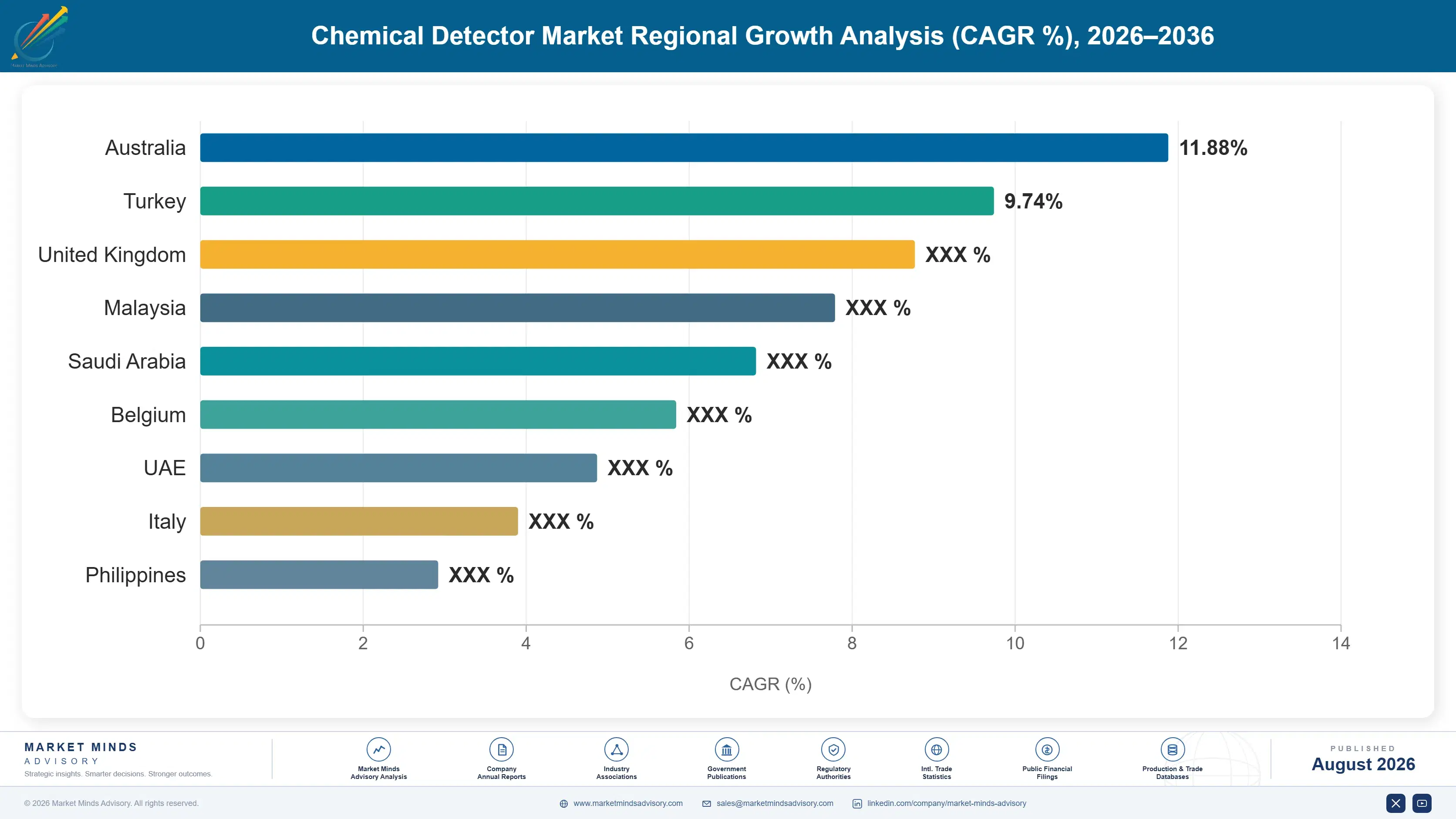
India grows fastest at 11.2%, driven by expanding chemical manufacturing capacity and tightening workplace safety enforcement. The United States remains the largest market by shipment volume.

Report Segmentation Architecture

The full report scope spans multiple orthogonal segmentation dimensions, with cross-tabulated demand data provided for each dimension pair. Coverage extends further to regional breakdowns, trend trajectories, and the competitive detail needed to support segment-level decision-making.

By Detection Technology

  • Photoionization Detectors
  • Ion Mobility Spectrometry Detectors
  • Electrochemical Toxic Gas Sensors
  • Colorimetric and Test Strip Detectors
  • Raman and FTIR Identification Instruments
  • Multi-Sensor Fusion Detection Systems

By End-Use Industry

  • Homeland Security and Defence
  • Chemical and Petrochemical Manufacturing
  • Emergency Response and Fire Services
  • General Industrial Safety
  • Border and Transport Security

By Commercial Dimension

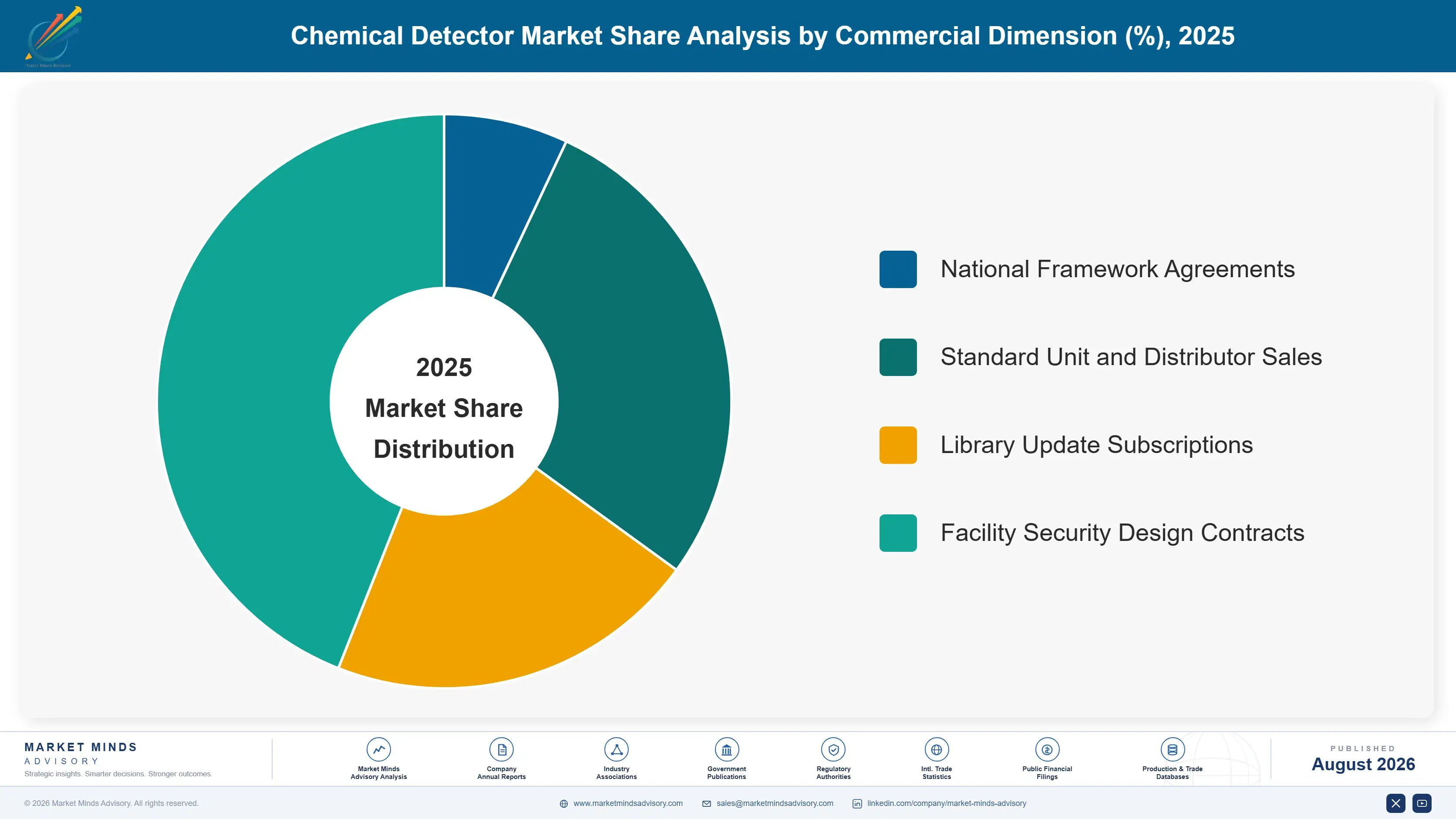
  • National Framework Agreements
  • Standard Unit and Distributor Sales
  • Library Update Subscriptions
  • Facility Security Design Contracts

By Region

  • North America
  • Western Europe
  • East Asia
  • South Asia and Pacific
  • Latin America
  • Middle East and Africa
  • Eastern Europe

Scope, Methodology, and Coverage

Every figure in this report is reproducible from documented input assumptions. The scope below maps the historical period, the forecast horizon, the segmentation dimensions, and the countries covered, alongside the underlying primary and qualitative methodology.
Historical Period
2020 to 2025
Forecast Period
2026 to 2036
Base Year
2025 (USD billions; MMA Primary Research Dataset, August 2026)
Market Definition
The chemical detector market comprises portable and fixed instruments for detecting toxic industrial chemicals, chemical warfare agents, and hazardous chemical vapours, spanning photoionization detectors, ion mobility spectrometry detectors, electrochemical toxic gas sensors, colorimetric test strip detectors, Raman and FTIR chemical identification instruments, and multi-sensor fusion systems. Combustible and flammable gas-only detectors, hydrogen-specific detectors, and laboratory analytical instruments not designed for field use are excluded.
Quantitative Units
USD billions (current prices); installed and deployed detection units where applicable
Segmentation Dimensions
By Detection Technology; By End-Use Industry; By Commercial Dimension; By Region
Regions Covered
North America, Western Europe, East Asia, South Asia and Pacific, Latin America, Middle East and Africa, Eastern Europe
Countries Covered
USA, China, Germany, France, UK, Japan, South Korea, India, Australia, Canada, Brazil, Mexico, Indonesia, Vietnam, Thailand, Malaysia, UAE, Saudi Arabia, South Africa, Nigeria, Turkey, Poland, Netherlands, Italy, Spain, Sweden, Switzerland, Argentina, Colombia, Singapore, and additional markets relevant to this sector
Key Companies Profiled
Smiths Detection, Bruker, Thermo Fisher Scientific, Bertin Technologies, Environics, FLIR Systems Inc. (Teledyne FLIR), RAE Systems Inc., Honeywell International Inc., Chemring Group PLC, Owlstone Nanotech Inc., 908 Devices Inc., Agilent Technologies Inc., Rapiscan Systems, Argon Electronics UK Ltd, Gastec Corporation, Dräger Safety AG & Co. KGaA, MSA Safety Incorporated, Block Engineering LLC, Teledyne Technologies Incorporated, Emerson Electric Co.
Quantitative Methodology
Primary survey, n=3,800 respondents, Q4 2025, six countries; demand-side model with trade association cross-validation
Qualitative Methodology
47 expert interviews, Q4 2025; applied to validate demand model assumptions, identify emerging dynamics, and assess competitive positioning
Report Format
PDF and XLSX data workbook (Word format preview document)
Publisher
Market Minds Advisory
Report Code
MMA-2026-CON-108
Published
August 2026
Contact
sales@marketmindsadvisory.com | www.marketmindsadvisory.com

Purchase the full Chemical Detector Market Report (2026 to 2036).

The full MMA Chemical Detector report sizes the market across six detection technologies, five end-use industries, four commercial dimensions, and seven regions through 2036. It profiles twenty participants on a consistent chemical detector revenue basis, scoring each on detection chemistry depth, library breadth, and multi-region delivery capability. Scenario models quantify how workplace exposure regulation, chemical facility security standards, and government procurement cycles move both demand and realised pricing. The report also includes delivered-cost modelling by detection technology and a national-framework benchmarking tool built for procurement, safety, and emergency response teams.
Detection technology cost and performance benchmarking
Identification library breadth comparison by region
National framework agreement structure and pricing tracker
Chemical facility security compliance timeline model
Component and materials supply chain risk screen
Library subscription revenue forecasting and retention model

Built For The People Who Decide

From boardroom strategy to bench-side execution, this report is read cover-to-cover by leaders shaping the next decade of their industry, turning demand scenarios, market dynamics and valuation benchmarks into decisions.
CXOs/ Presidents/ VPs/ Managers
M&A and Corporate Development
Strategy Teams and R&D Heads
Procurement and Product Directors
Regulatory and Compliance Leaders
Investor Relations and Equity Analysts