Market Minds Advisory
Charcoal Teeth Whitening Powder Market

Charcoal Teeth Whitening Powder Market: Charcoal Teeth Whitening Powder Market: Abrasivity, Credibility and the Number Nobody Publishes

A category the dental profession has publicly warned against, now splitting between abrasive powders losing shelf space and measured low-abrasivity formulations that dentists will finally stop actively arguing against in public.

Lead Analyst

Published

September 2026

Make Smarter Decisions with Customized Research Insights

Request a free sample report and evaluate market opportunities, growth trends, and competitive dynamics relevant to your business needs.

2025 MARKET VALUE$0.6BMarket Size 2025
2036 FORECAST VALUE$1.2BBase Case , 2026 to 2036
CAGR 2026 TO 20366.8 %Bull 8.0% / Bear 5.6%
INCREMENTAL OPPORTUNITY$0.6BNet 10- year value creation
EXPANSION MULTIPLE1.94x2036 value over 2026 base
Strategic Levers
M&A Pipeline
Regional Outlook
Country Rankings
Competitive Intelligence
Segmental Deep-dive
Call-Us : 91 93563 13602

Executive Snapshot and Market Trajectory.

This category has a credibility problem it has never answered. Dental associations decline to endorse charcoal whitening, peer-reviewed work questions both the abrasivity and the whitening claim, and no amount of social media reach fixes a dentist telling a patient to stop using it. That is the whole story.
Low-abrasivity formulations with a published RDA value grow at 10.2%, half again the market rate of 6.8%, because a measured number is the only thing that ends the argument. East Asia holds 28% of demand on a bamboo charcoal heritage that predates the trend by centuries, and South Asia takes 12% because tooth powder there is an ordinary format rather than a novelty. Western demand is by far the most volatile part.
Concentration is low at 22% and the tail is enormous, because making a charcoal powder requires a blender and a jar. That is also the problem: the category is judged on its worst products, and the worst products are abrasive enough to justify every warning the profession has issued. The participants who will survive are the ones publishing a number nobody else wants to measure at all.
Market Definition
The charcoal teeth whitening powder market covers powdered oral care products whose primary marketed function is tooth whitening or stain removal through activated charcoal, sold direct to consumers. Scope spans standard activated charcoal powders, low-abrasivity formulations tested to ISO 11609, charcoal blends with hydroxyapatite, clay or peroxide-free agents, and flavoured or botanical variants. Excluded are charcoal toothpastes in tube form, charcoal-infused toothbrushes and floss, professional in-chair bleaching systems, peroxide strips and gels, and traditional tooth powders sold without a whitening claim.
Base Year Value
$0.6B in 2025 (MMA Primary Research Dataset, August 2026)
Forecast Period
2026 to 2036, eleven discrete annual values
CAGR
6.8% base case. Bull 8.0%. Bear 5.6%.
Fastest Growth Segment
RDA-Tested Low-Abrasivity Formulations: 10.2% CAGR
Fastest Growth Country
India: 9.0% CAGR
Fastest Growth Region
South Asia and Pacific: 9.0% CAGR
Largest Region
East Asia: 28% of 2025 global value
Market Leaders
Colgate-Palmolive, Procter and Gamble, Unilever, Dabur India and Curaden. Source: MMA Analysis, July 2026.
Primary Survey
n=3,800 procurement and R&D decision-makers, Q4 2025, six countries
Methodology
Demand-side build-up, cross-validated against public data, 47 expert interviews

Charcoal Teeth Whitening Powder Market Forecast Scenarios

charcoal-teeth-whitening-powder-market-size-forecast-scenario-1788169595468
Between 2020 and 2025 the category compounded at 5.8%, and the number conceals a sharp reversal partway through. Social media drove explosive early growth that peaked around 2021, after which dental commentary caught up and Western retail listings thinned considerably. What kept the aggregate positive was South Asian and East Asian demand, where powder is a normal oral care format and nobody needed persuading.
The 6.8% base case rests on three mechanisms. Formulations publishing a measured RDA value are recovering the retail listings the category lost, because a buyer can defend a number in a way they cannot defend a claim. Hydroxyapatite blends give the product a remineralisation story that dentists will actually discuss. And Asian demand continues on a format that never depended on the whitening trend at all. None of the three requires the social media cycle to return.
The bull case at 8.0% turns on a recognised dental body accepting a specific low-abrasivity formulation, which would convert the category's largest liability into an asset overnight. The bear case at 5.6% is regulatory: a labelling requirement forcing abrasivity disclosure would remove most of the shelf, and several health authorities have signalled interest in exactly that.

The Number Nobody Publishes

Abrasivity is the whole technical argument and only 31% of products on sale disclose it. Relative dentin abrasivity is measured under ISO 11609, the method exists, the testing is neither expensive nor slow, and most participants simply choose not to do it. A powder that scores below 100 is gentler than many mainstream toothpastes. A powder that scores above 250 should not be on sale, and some are.
TOP FIVE CONCENTRATION22%Share held by the five largest charcoal oral care sellers
AVERAGE SELLING PRICEUSD 11.40Mean retail price per jar across major consumer channels
PUBLISHED RDA SHARE31%Portion of products disclosing a measured abrasivity value
CHARCOAL INPUT COST9% of COGSActivated carbon as proportion of finished product cost
REPEAT PURCHASE INTERVAL9 weeksMedian time between jar purchases among regular users
ONLINE CHANNEL SHARE58%Portion of volume sold through digital rather than physical retail
The economics are unusually forgiving, which is why the tail is so long. Activated carbon runs at 9% of cost of goods, the rest is calcium carbonate, flavour, packaging and a fill line that any contract manufacturer will run. Gross margins sit well above conventional oral care because the buyer is paying for a proposition rather than for materials. That attracts entrants who have no interest in testing anything.
Distribution has moved almost entirely online, at 58% of volume and rising, and that is both the category's engine and its weakness. A marketplace listing costs nothing to create and carries no gatekeeper who asks about abrasivity. Physical retail, which does ask, has been the channel contracting fastest. Any participant wanting durable shelf presence has to answer the question the internet never posed.
"The category spent five years arguing with dentists and lost. The way back is not better marketing, it is a tested abrasivity number on the jar, and the participants who understand that are already quietly taking the shelf space."
Director, Oral Care and Personal Health Practice · MMA Chemicals and Materials Practice · August 2026

Market Trends

Published abrasivity numbers are replacing whitening claims

Relative dentin abrasivity measured under ISO 11609 has become the deciding specification for retail listings in Western markets, because a buyer facing a dental complaint needs a number rather than a marketing claim. Only 31% of products currently disclose one. The participants who test and publish are recovering listings that the category lost between 2021 and 2024, and they are doing it without changing anything a consumer can see. The testing costs little and takes weeks, which makes the general reluctance to do it commercially difficult to explain at all.
Market Impact: Cuts shipping weight 33%

Hydroxyapatite blends give dentists something to endorse

Hydroxyapatite is the mineral tooth enamel is made from, it has decades of Japanese clinical use behind it, and it is approved for oral care in several jurisdictions where charcoal alone is merely tolerated. Blending it into a charcoal powder converts the proposition from stain removal to remineralisation, which is a conversation dentists will have rather than one they refuse. The formulation is harder than it sounds, since particle size and pH both matter, but the segment grows at 9.1% and it is the only part of the category with professional goodwill attached.
Market Impact: Reaches 9.0% Indian growth

Market Opportunities and Growth Drivers

Powder format carries a genuine packaging advantage

A powder contains no water, which means a glass jar rather than a laminated plastic tube, roughly a third of the shipping weight for the same number of uses, and a shelf life measured in years rather than months. None of that was why the category grew, and all of it is why it may persist. European retailers running plastic reduction targets have listed powder formats specifically for the packaging rather than the whitening, which is a demand source the category never went looking for and does not really understand yet.
Market Impact: Loses 24% of users annually

South Asian tooth powder tradition supports mainstream volume

Tooth powder is not a novelty format across South Asia, where dant manjan and similar preparations have been sold through general trade for generations and command genuine household penetration. Charcoal variants slot into an existing habit rather than creating one, which removes the education cost that Western participants have to fund on every launch. Indian demand grows at 9.0%, the fastest of any country covered, and it grows on distribution reach rather than on any trend cycle. The commercial implication is that the region rewards packaging and price rather than claims.
Market Impact: Ends usage after 2 purchases

Market Restraints and Challenges

Dental associations decline to endorse the category

No major dental association has granted acceptance to a charcoal whitening powder, and peer-reviewed reviews in the dental literature have questioned both the abrasivity profile and the evidence for whitening itself. The root cause is that charcoal removes surface stain by mechanical action rather than by any chemical whitening, so the claim as commonly worded is not supported. Commercial impact is severe and cumulative: every dental appointment is a potential lost customer. Participants are responding by testing abrasivity, blending in hydroxyapatite, rewording claims toward stain removal, and funding independent clinical work the category has never previously commissioned.
Market Impact: Discloses RDA on 31%

Powder format creates a messy usage experience

A jar of black powder in a white bathroom is a practical problem that no amount of formulation solves, and dropped-jar and stained-sink complaints are among the most common reasons users abandon the category after 2 purchases. The root cause is the format itself: powder does not dose cleanly onto a wet brush and the residue is highly visible. Commercial impact shows in repeat rates well below conventional oral care. Mitigation runs through wider-mouth jars, integrated scoops, compressed tablet formats and applicator brushes sold within the kit, though none of these fully removes the underlying issue.
Market Impact: Grows 9.1% with professional support
4 additional market trends, 3 additional growth drivers, and 2 additional restraints and challenges are covered in the full report. Contact sales@marketmindsadvisory.com to access the complete intelligence.

Segment CAGR and Growth Architecture

Segmentation follows formulation composition, the dimension that decides abrasivity, professional reception and retail listing eligibility all at once. Standard charcoal powders carry the legacy volume and the reputational damage. Tested low-abrasivity formulations and hydroxyapatite blends carry the growth, because both give a retail buyer something defensible to point at. That is a better position than the category held in 2022.
charcoal-teeth-whitening-powder-market-market-share-analysis-1788169596036

RDA-Tested Low-Abrasivity Formulations

Tested low-abrasivity formulations grow at 10.2%, half again the market rate of 6.8%, and the growth is coming from retail listings rather than from consumers asking for anything. A buyer who has fielded one dental complaint will not list an untested powder again, and a measured ISO 11609 value on the pack ends that conversation before it starts. Achieving a low score means finer charcoal particle sizing and a gentler abrasive base, which costs a little in stain removal speed and nothing that a consumer will notice over a week of use. The participants who tested early now hold shelf positions that latecomers simply cannot buy back at any price at all.
CAGR 10.2%

Charcoal and Hydroxyapatite Blends

Charcoal and hydroxyapatite blends at 9.1% are the only part of this category a dentist will discuss without warning you off it. Hydroxyapatite has a long Japanese clinical record and regulatory acceptance in oral care across several jurisdictions, so blending it converts the pitch from stain removal to enamel support. The formulation work is real: particle size, pH and the interaction between an adsorbent carbon and a mineral all need managing, and several early entrants shipped blends where the hydroxyapatite did nothing at all. Unit prices run roughly double the standard powder, and the buyer accepts it because the proposition finally sounds like oral care. That is the whole commercial value of the blend.
CAGR 9.1%
Full segment breakdown across 6 segments available in the complete report.

Regional Architecture and Country Demand Map

East Asia takes 28% on a bamboo charcoal tradition considerably older than the trend that made this category briefly famous. South Asia takes 12% because tooth powder is an ordinary product there. Western demand is the part that rises and falls on professional commentary alone.

East Asia

Bamboo charcoal has been used in Japanese and Korean oral care for far longer than the recent Western enthusiasm, which gives the region something no marketing budget buys: a product consumers already trust. Japanese hydroxyapatite formulation expertise is the other advantage, since the mineral has decades of domestic clinical use and regulatory acceptance there. Chinese manufacturing supplies most of the world's finished charcoal powder regardless of whose brand is on the jar. Growth at 7.6% is steady rather than spectacular, because penetration is already meaningful and the category never had the boom that Western markets experienced. Stability is worth more here than any headline growth rate here has ever been.
Share: 28% | CAGR: 7.6% (2026 to 2036)

North America

Retail listings were the casualty here and retail listings are the recovery. Physical chains delisted a considerable share of charcoal whitening products between 2021 and 2024 after dental complaints reached buyers, and marketplace selling absorbed the volume at lower margin and no shelf presence. Products publishing an ISO 11609 abrasivity value are winning those listings back, one buyer conversation at a time. Regulatory attention is a live risk rather than a current constraint, since the Food and Drug Administration treats most of these as cosmetics rather than drugs so long as the claims stay away from bleaching. That distinction is narrower than several participants appear to realise at all here.
Share: 24% | CAGR: 6.2% (2026 to 2036)
Regional intelligence for 5 additional markets available in the complete report: Western Europe, South Asia and Pacific, Latin America, Middle East and Africa, Eastern Europe. Contact sales@marketmindsadvisory.com.
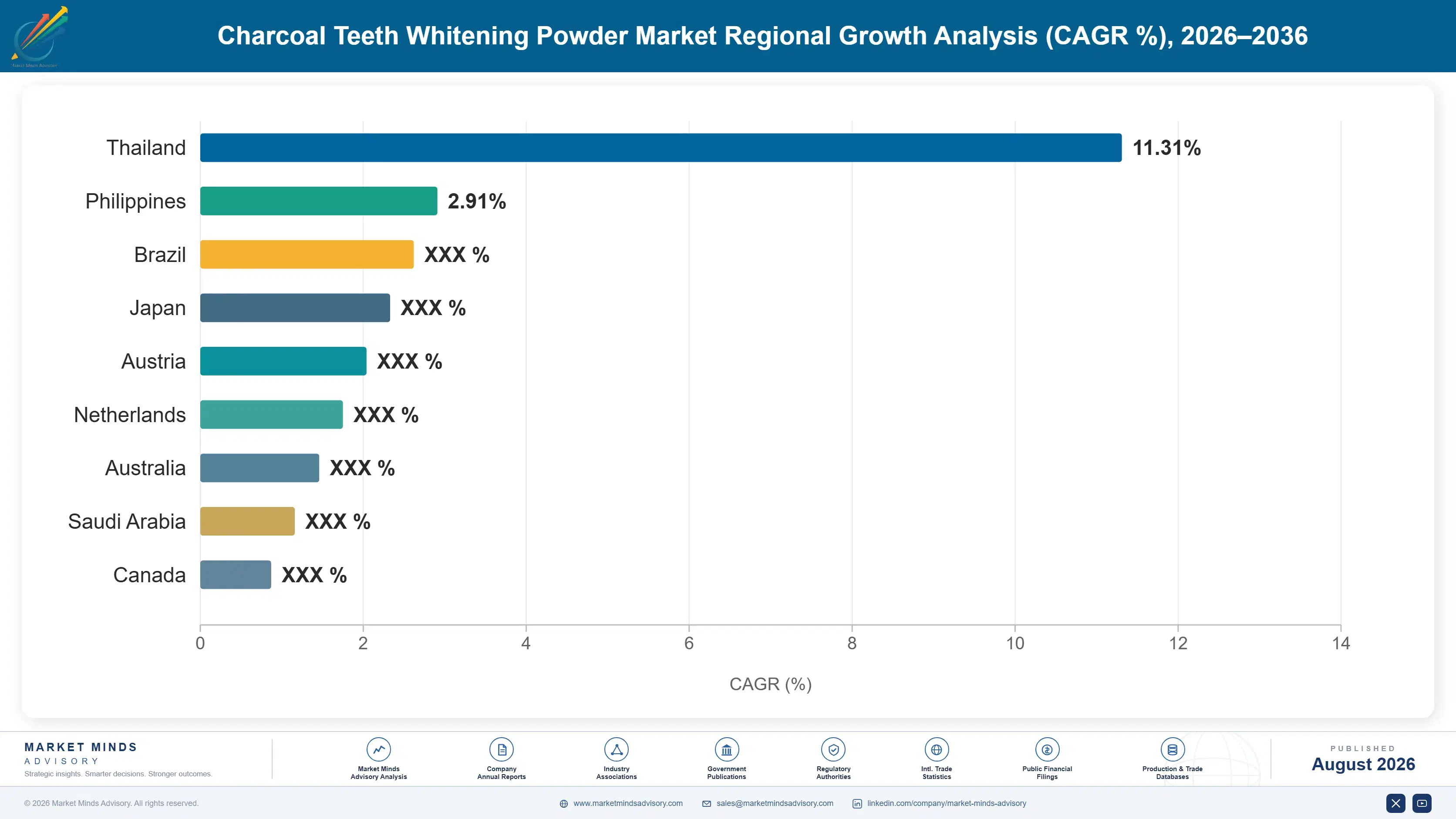
charcoal-teeth-whitening-powder-market-country-cagr-analysis-1788169596558

Four Ways Back To Credibility

None of these four requires a new claim, which is fortunate, because the claims are exactly what got this category into trouble. Each takes something the business can measure or already owns and turns it into a reason a retail buyer, or a dentist, will stop objecting. Three of the four cost less than a single influencer campaign.

Test abrasivity and print the number

ISO 11609 abrasivity testing costs a few thousand dollars and takes weeks, and only 31% of products on sale carry a published value. Printing a measured RDA figure on the pack changes a retail buyer conversation from a defensive one into a technical one, and it removes the single objection that cost this category its Western shelf space between 2021 and 2024. Products with a published value are growing at 10.2% against a category rate of 6.8%. The reluctance to test is difficult to explain commercially, and it is the cheapest advantage available here.
Market Impact: Joins the 31% of products publishing a measured value

Blend hydroxyapatite to open the professional conversation

Hydroxyapatite carries decades of Japanese clinical use and regulatory acceptance in oral care, which is precisely what charcoal alone does not have. Blending it moves the proposition from stain removal toward enamel support and gives a dentist something to discuss rather than dismiss. The segment grows at 9.1% and unit prices run roughly double the standard powder, so the margin covers the formulation work comfortably. Getting it right requires attention to particle size and pH, since an adsorbent carbon and a mineral in the same jar can leave the mineral doing nothing.
Market Impact: Doubles unit price in a 9.1% growth segment

Sell the packaging saving to grocery buyers

A powder has no water in it, which means a glass jar instead of a laminated tube and roughly 33% less shipping weight for the same number of uses. European grocery buyers running plastic reduction targets have listed powder formats specifically for that reason, entirely independent of any whitening interest. The category has barely pitched this, because it has spent its energy defending claims instead. Approaching sustainability buyers rather than beauty buyers opens a channel where the dental argument does not arise at all and the competition is conventional toothpaste.
Market Impact: Cuts 33% of shipping weight on every unit

Fix the mess before chasing repeat purchase

Users abandon this category after roughly 2 purchases and the most common stated reason is not efficacy, it is the black residue in a white bathroom. Wider-mouth jars, an integrated dosing scoop, and compressed tablet formats all address a problem the category treats as unavoidable. The repeat purchase interval sits at 9 weeks among users who persist, so extending retention by even one cycle changes lifetime value materially. Very few participants have spent anything on usage experience, having concentrated entirely on acquisition, which is why the churn looks the way it does.
Market Impact: Extends usage beyond 2 purchases for each user

Who Controls the Margin Pool

CR5 stands at 22%, measured on retail and marketplace revenue, since almost no participant reports this category separately. The number is low because entry is nearly free: a contract blender, a jar and a listing is the whole requirement. The gap between the multinational oral care groups and the specialist brands is smaller than in conventional toothpaste, because scale buys less here than credibility does.
Competition runs on three things and advertising is not one. Abrasivity documentation decides which retailers will list you. Formulation credibility, meaning a hydroxyapatite or clinical reference, decides whether a dental professional will refrain from warning against you. Manufacturing relationships decide cost, though cost matters less than usual in a category with this much gross margin. The participants losing ground are the ones still competing on shade of black.

Rankings will move toward whoever documents first. A multinational with laboratory capability can test and publish across a whole range in a quarter, and several have started doing exactly that. The specialist brands that built the category on social reach have no laboratory and no habit of using one. The pressure is unusual in consumer goods: it runs from the technical department rather than from marketing.
charcoal-teeth-whitening-powder-market-company-positioning-matrix-1788169597079

Competitive Moat and Risk Dimensions

COLGATE-PALMOLIVE

Moat: Laboratory and regulatory capability

The group can test abrasivity, run clinical work and defend a claim to a regulator using capability that already exists for its main toothpaste business, at effectively no incremental cost. In a category where documentation has become the deciding purchase criterion for retail buyers, that is a decisive advantage. A specialist brand would have to build the function from nothing.
COLGATE-PALMOLIVE

Risk: Core portfolio cannibalisation risk

Every jar of charcoal powder sold is a tube of toothpaste not sold, and the conventional product carries larger absolute volume through the same retail accounts. Internal incentives therefore work against pushing the category hard, and the commercial teams on the core brands have no reason to help. That tension slows decisions that a specialist competitor makes in an afternoon.
DABUR INDIA

Moat: Traditional format household penetration

Tooth powder is an ordinary product in Indian households rather than a novelty, and the group has sold into that habit through general trade for generations. Charcoal variants extend an existing shelf position instead of creating one, which removes the education cost every Western entrant carries. Distribution reach across small format retail is not something a competitor buys quickly.
DABUR INDIA

Risk: Limited Western market presence

Revenue concentration in South Asia leaves the group exposed to one regional demand pattern and away from the premium price points that Western and Gulf markets support. A Western position means competing on abrasivity documentation and clinical credibility rather than on distribution reach, which is a different capability set. Traditional positioning translates poorly into markets where the format is unfamiliar.

Players Tracked

Prominent Players

Colgate-Palmolive
Procter and Gamble
Unilever
Dabur India
Curaden

Other Key Players

Active Wow
Hismile
Cali White
MySmile
Twin Lotus
Himalaya Wellness
Patanjali Ayurved
Vicco Laboratories
LION Corporation
Kobayashi Pharmaceutical
LG Household and Health Care
Amway
Church and Dwight
Georganics
Ecodenta

Recent Developments

MARCH 2025

Colgate-Palmolive published abrasivity data across its charcoal range

Colgate-Palmolive published measured relative dentin abrasivity values for its charcoal oral care products, tested to ISO 11609. The disclosure was voluntary rather than required by any regulator, and it repositioned the range against specialist competitors who had never published a comparable figure for their own formulations.
Signal: Voluntary disclosure has become a competitive weapon in a category that spent years avoiding measurement entirely.
JULY 2025

Dabur expanded charcoal tooth powder manufacturing capacity

Dabur India brought additional charcoal tooth powder capacity into operation at an Indian facility, an organic capacity expansion rather than any acquisition or joint venture. The investment supports general trade distribution across smaller towns, where tooth powder remains a mainstream oral care format rather than a whitening novelty.
Signal: The largest volume growth in this category is happening where nobody markets it as a whitening product at all.
NOVEMBER 2025

European retailers listed powder formats under plastic reduction targets

Several European grocery and drug retailers added charcoal and mineral tooth powders to ranges assembled under plastic reduction commitments, selecting them for glass jar packaging rather than for any whitening claim. Suppliers were asked for packaging data and lifecycle figures instead of the efficacy evidence they had prepared.
Signal: A channel opened for reasons the category never pitched, and most participants missed it almost completely.

Carbon Is Not The Cost

Activated carbon accounts for only 9% of cost of goods, which surprises people who assume the black powder is the expensive part. Calcium carbonate and silica abrasives add roughly 14%, flavour systems and sweeteners 11%, and glass jar packaging a further 26%. Coconut shell carbon comes largely from the Philippines, Indonesia and Sri Lanka, while bamboo carbon originates in China.
Glass is the volatile input, not carbon. European container glass producers absorbed severe energy cost increases through 2022 and 2023, and the pass-through to small format cosmetic jars was substantial and slow to reverse. The International Energy Agency documented the scale of European industrial gas price movement across that period. Participants using glass for the sustainability positioning found the positioning had a price attached, and several quietly moved to aluminium or recycled plastic without changing their messaging.

Exposure varies by scale unusually here. A multinational buying glass across a whole personal care portfolio barely notices a jar price movement. A specialist brand buying a few hundred thousand jars a year takes the full increase and cannot pass it to a marketplace price point competitors will undercut. Geography matters less than usual, since the finished product is light and ships cheaply.
charcoal-teeth-whitening-powder-market-cost-volatility-analysis-1788169597274

Dual-qualify glass and aluminium jar suppliers

Glass carries the sustainability message and the energy price exposure in equal measure. Qualifying an aluminium or recycled resin jar alongside it costs a tooling and stability programme and gives the business somewhere to go when European glass reprices. Both formats can carry the same packaging argument credibly, which is more than most participants have checked before committing.

Contract carbon supply across two origin countries

Coconut shell carbon concentrates in the Philippines, Indonesia and Sri Lanka, all exposed to the same typhoon and harvest risks in different measure. Holding qualified supply from two origins costs a second specification approval and removes a single point of failure that would otherwise stop production entirely. Carbon is cheap, but a plant with no carbon makes nothing at all.

Move filling closer to the largest demand region

Finished powder is light and ships cheaply, but jars are bulky and fragile and travel badly. Filling near the demand rather than near the blending operation cuts freight and breakage together, and it shortens the response time when a retailer wants a promotional pack. Contract fillers with cosmetic approval exist in every major region, so this needs no capital.

Portfolio Architecture for Margin Defence

Gross margin in this category is high everywhere and that is exactly the problem. Materials cost almost nothing, so the tier structure reflects credibility rather than input cost, and a jar with an ISO tested abrasivity number earns considerably more than an identical jar without one. Participants have historically priced on positioning alone, which invited an enormous tail of entrants with no cost disadvantage at all.
The volume and premium tension runs through the channel rather than the product. Marketplace volume is cheap to win, price-driven and disloyal, but it funds the manufacturing minimums that make the premium formulations viable. Retail and pharmacy listings carry the margin and the credibility but demand documentation and slow buying cycles. Abandoning marketplace volume raises unit cost across everything, which several premium entrants discovered the hard way.

High-value pools sit in hydroxyapatite blends and in the sustainability channel that the category never targeted. Both command premium pricing for reasons unconnected to whitening, which is precisely why they are durable. The third pool is contract formulation: participants holding tested low-abrasivity formulations are selling development services to brands that need documentation and have no laboratory, at margins the finished product cannot match.

Volume / Commodity-Adjacent

Standard activated charcoal powders sold through marketplaces at low price points with no published abrasivity data. Competes on price and listing visibility against an enormous tail of near-identical products. The 9 point spread reflects how much volume moves through fulfilment services rather than direct.
Gross Margin: 48 to 57%

Premium / Certified

Formulations tested to ISO 11609 with a published abrasivity value, listed in physical retail and pharmacy channels. Documentation rather than formulation supports the price, and buyers require it before listing. The 8 point spread reflects the difference between own-brand retail and wholesale supply.
Gross Margin: 62 to 70%

Sustainability / Regulatory / Next-Generation

Hydroxyapatite blends, refillable glass systems sold into plastic reduction ranges, and contract formulation supplied to brands lacking laboratory capability. Margins are high because credibility is scarce rather than because volume is large. The 12 point spread separates product sales from development service contracts.
Gross Margin: 66 to 78%
charcoal-teeth-whitening-powder-market-portfolio-architecture-1788169597779

High-value Sub-segments and Strategic Watch-out

Charcoal and Hydroxyapatite Blends

High value and high growth at 9.1%. The mineral carries clinical history and regulatory acceptance that charcoal alone does not, which converts a dental objection into a discussion. The 8 point spread reflects whether the hydroxyapatite is sourced as a commodity or as a characterised pharmaceutical grade.
Gross Margin: 68 to 76%

RDA-Tested Low-Abrasivity Formulations

High value with the highest growth at 10.2%. A published abrasivity number is what physical retail buyers now require, and only 31% of products carry one. The 9 point spread reflects whether the brand holds its own testing relationship or relies on a contract manufacturer's data.
Gross Margin: 60 to 69%

Standard Activated Charcoal Powder

The volume core. It grows at only 3.4% and carries the reputational damage, but it funds the manufacturing minimums and the marketplace presence that the premium formulations depend on. The 10 point spread reflects fulfilment cost, which varies enormously between direct and marketplace logistics arrangements.
Gross Margin: 46 to 56%

Untested High-Abrasivity Product

The strategic watch-out. A labelling requirement forcing abrasivity disclosure would remove this product from every regulated shelf at once, and several health authorities have signalled interest. The 17 point spread reflects how much of it sells at premium marketplace pricing rather than at commodity clearance.
Gross Margin: 38 to 55%

Why Users Come Back

The annuity is real but shallow. Regular users repurchase every 9 weeks, which is a good interval for a consumable, and the cost of goods is low enough that lifetime value looks excellent on a spreadsheet. The problem sits before that: most buyers never become regular users, abandoning after roughly 2 purchases, so the annuity applies to a minority of everybody it acquires.
Stickiness varies by why somebody started. Buyers who came for the packaging rather than the whitening are the most durable, because the reason they bought does not depend on a claim anybody disputes. Buyers who came through social media churn fastest, since the same channel that recruited them delivers the dental commentary that stops them. South Asian buyers behave differently, treating the product as ordinary oral care and expecting nothing dramatic.

Buyer profiles have shifted and the category has been slow to notice. The early buyer wanted a visible result and arrived through a video. The current buyer is often making a packaging decision, or following a dentist's suggestion toward a low-abrasivity formulation, and they read the label before they read the brand. Products still merchandised on dramatic before-and-after imagery are speaking to somebody who already left.
charcoal-teeth-whitening-powder-market-end-use-penetration-index-1788169598268

How This Category Recovers

These are among the four positions where our research anticipates prominent divergence between winners and laggards over the coming forecast period. Each is grounded in the demand model, the regulatory perimeter, and the announced capacity pipeline.
01 / MEASURED ABRASIVITY DOCUMENTATION

Publish the number the whole argument turns on

ISO 11609 testing costs a few thousand dollars and takes weeks, and only 31% of products on sale carry a published relative dentin abrasivity value. Printing that number converts a retail buyer conversation from a defensive exchange about dental complaints into a technical one that ends quickly. Formulations with published data grow at 10.2% against a category rate of 6.8%, and the general reluctance to spend the money is the strangest commercial decision anybody makes in this entire market today.
02 / MINERAL BLEND CREDIBILITY

Add the mineral dentists already accept

Hydroxyapatite carries decades of Japanese clinical use and regulatory acceptance in oral care, which is precisely the credibility charcoal alone has never obtained anywhere. Blending it shifts the proposition from stain removal to enamel support and gives a dental professional something to discuss instead of something to warn against. The segment grows at 9.1% at roughly double the standard unit price, so the formulation work pays for itself well inside a single product cycle in very nearly every single case.
03 / PACKAGING CHANNEL ACCESS

Pitch the jar to grocery, not the whitening

A powder carries no water, which means a glass jar rather than a laminated tube and roughly 33% less shipping weight for the same number of uses. European grocery buyers running plastic reduction targets have listed powder formats for exactly that reason, with no interest in the whitening claim at all. It is a channel where the dental argument never arises, the competition is conventional toothpaste, and almost nobody in this category has bothered to approach it properly at all.
04 / USAGE EXPERIENCE RETENTION

Solve the mess or keep buying customers twice

Users abandon this category after roughly 2 purchases and the most cited reason is black residue in a white bathroom rather than any real doubt about efficacy. Wider-mouth jars, integrated dosing scoops and compressed tablet formats all address a problem the category has simply accepted as inherent to the powder format. With a 9 week repurchase interval among users who persist, extending retention by one cycle changes lifetime value more than any acquisition spending the business could ever hope to fund.

Engagement Snapshot From the Field

A live engagement with an industry participant carrying material or product regulatory and market exposure ahead of a defining policy shift, showing how our research translates into a defensible multi-year portfolio strategy.
MARKET MINDS ADVISORY · CLIENT ENGAGEMENT SUMMARY
Charcoal Teeth Whitening Powder Producer Strategic Portfolio Review and Transition Roadmap 2026·Investment Scenario on Charcoal Teeth Whitening Powder Exposure Evaluation 2025-26
CLIENT PROFILE
A specialist natural oral care brand selling charcoal and mineral tooth powders through online marketplaces and a direct site across four English-speaking markets, with annual revenue in the low tens of millions of dollars (client-reported, unverified by MMA). The business had grown quickly on social media acquisition and had never commissioned abrasivity testing on any product in its range.
STRATEGIC CHALLENGE
Acquisition costs had roughly doubled in two years while repeat purchase stayed flat, and two physical retail buyers had declined listings citing dental concerns. Management wanted to know whether the business could reach physical retail at all, and whether the growing customer acquisition bill reflected a marketing problem or a product one they had not yet examined.
MMA APPROACH
MMA commissioned independent abrasivity testing on the client's full range and on eight competitor products, then mapped the results against retail listing status across the four markets. Forty-seven expert interviews with retail buyers, dental professionals and contract formulators established what documentation would actually change a listing decision and what a hydroxyapatite blend would require.
KEY FINDINGS
  1. Three of the client's five products tested below an RDA of 100, gentler than several mainstream toothpastes, and nobody in the business knew it.
  2. Every retail buyer interviewed said a published abrasivity value would move a listing from automatic refusal to ordinary commercial consideration on its merits.
  3. The two highest-abrasivity products in the range accounted for 38% of revenue and generated most of the negative reviews mentioning tooth sensitivity directly.
  4. European grocery buyers approached during the study were interested in the glass jar packaging and asked no questions about whitening at all.
CLIENT PROFILE
A specialist natural oral care brand selling charcoal and mineral tooth powders through online marketplaces and a direct site across four English-speaking markets, with annual revenue in the low tens of millions of dollars (client-reported, unverified by MMA). The business had grown quickly on social media acquisition and had never commissioned abrasivity testing on any product in its range.
STRATEGIC CHALLENGE
Acquisition costs had roughly doubled in two years while repeat purchase stayed flat, and two physical retail buyers had declined listings citing dental concerns. Management wanted to know whether the business could reach physical retail at all, and whether the growing customer acquisition bill reflected a marketing problem or a product one they had not yet examined.
MMA APPROACH
MMA commissioned independent abrasivity testing on the client's full range and on eight competitor products, then mapped the results against retail listing status across the four markets. Forty-seven expert interviews with retail buyers, dental professionals and contract formulators established what documentation would actually change a listing decision and what a hydroxyapatite blend would require.
KEY FINDINGS
  1. Three of the client's five products tested below an RDA of 100, gentler than several mainstream toothpastes, and nobody in the business knew it.
  2. Every retail buyer interviewed said a published abrasivity value would move a listing from automatic refusal to ordinary commercial consideration on its merits.
  3. The two highest-abrasivity products in the range accounted for 38% of revenue and generated most of the negative reviews mentioning tooth sensitivity directly.
  4. European grocery buyers approached during the study were interested in the glass jar packaging and asked no questions about whitening at all.
RECOMMENDED STRATEGY
Phase 1: Phase one: publish the tested abrasivity values on pack and in trade materials, and reformulate the two highest-scoring products immediately. Phase 2: Phase two: develop a hydroxyapatite blend for the premium position, using a characterised pharmaceutical grade rather than a commodity mineral supply. Phase 3: Phase three: approach European grocery sustainability buyers with the packaging argument, keeping the whitening claim entirely out of that conversation.
OUTCOME
Within three quarters the brand had secured listings with two physical retail chains that had previously declined it, and acquisition spending fell as retail presence carried some of the discovery burden (client-reported, unverified by MMA). The hydroxyapatite blend launched at nearly double the previous top price point and sold through faster than the standard range.

Frequently Asked Questions

Foundational context covering the market sizes, CAGR, scope, country, region and competition that inform every finding below. This section is provided to cover basics and most often pre-purchase conversations, answered from the MMA Primary Research Dataset.

What is the current size of the Charcoal Teeth Whitening Powder Market?

The global charcoal teeth whitening powder market was valued at USD 0.6 billion in 2025, covering powdered charcoal oral care sold on a whitening claim. The 2026 figure reaches USD 0.64 billion.

How large will the Charcoal Teeth Whitening Powder Market be by 2036?

MMA forecasts USD 1.24 billion by 2036, an increase of USD 0.6 billion over the 2026 base. That represents an expansion multiple of 1.94 times across the forecast period.

What is the CAGR for the Charcoal Teeth Whitening Powder Market 2026 to 2036?

The base case compound annual growth rate is 6.8%, with a bull case at 8.0% and a bear case at 5.6%. Historical growth between 2020 and 2025 ran at 5.8%.

Which segment is growing fastest?

Tested low-abrasivity formulations grow at 10.2%, half again the market rate of 6.8%, because a published abrasivity value is what retail buyers now require. Hydroxyapatite blends follow at 9.1%.

Who are the major companies in the Charcoal Teeth Whitening Powder Market?

Colgate-Palmolive, Procter and Gamble, Unilever, Dabur India and Curaden lead on retail and marketplace revenue, with combined CR5 of 22%. The remaining tail is unusually long.

Which country is growing fastest?

India grows fastest at 9.0%, driven by general trade distribution of tooth powder as a mainstream oral care format rather than a novelty. South Asia and Pacific leads regionally at 9.0%.

Report Segmentation Architecture

The full report scope spans multiple orthogonal segmentation dimensions, with cross-tabulated demand data provided for each dimension pair. Coverage extends further to regional breakdowns, trend trajectories, and the competitive detail needed to support segment-level decision-making.

By Formulation Composition

  • Standard Activated Charcoal Powder
  • RDA-Tested Low-Abrasivity Formulations
  • Charcoal and Hydroxyapatite Blends
  • Charcoal with Peroxide-Free Whitening Agents
  • Flavoured and Botanical-Infused Charcoal Powders
  • Charcoal and Clay Remineralising Powders

By End-Use Industry

  • Consumer Oral Care
  • Dental Practice Dispensary
  • Pharmacy and Drug Retail
  • Spa and Wellness Retail
  • Hospitality Amenity Supply
  • Private Label Manufacturing

By Commercial Dimension

  • Online Marketplaces
  • Brand Direct Channels
  • Grocery and Mass Retail
  • Pharmacy Chains
  • Direct Selling Networks
  • Subscription and Replenishment

By Region

  • North America
  • Western Europe
  • East Asia
  • South Asia and Pacific
  • Latin America
  • Middle East and Africa
  • Eastern Europe

Scope, Methodology, and Coverage

Every figure in this report is reproducible from documented input assumptions. The scope below maps the historical period, the forecast horizon, the segmentation dimensions, and the countries covered, alongside the underlying primary and qualitative methodology.
Historical Period
2020 to 2025
Forecast Period
2026 to 2036
Base Year
2025 (USD billions; MMA Primary Research Dataset, August 2026)
Market Definition
The charcoal teeth whitening powder market covers powdered oral care products whose primary marketed function is tooth whitening or stain removal through activated charcoal, sold direct to consumers. Scope spans standard activated charcoal powders, low-abrasivity formulations tested to ISO 11609, charcoal blends with hydroxyapatite, clay or peroxide-free agents, and flavoured or botanical variants. Excluded are charcoal toothpastes in tube form, charcoal-infused toothbrushes and floss, professional in-chair bleaching systems, peroxide strips and gels, and traditional tooth powders sold without a whitening claim.
Quantitative Units
USD billion, 2025 base year, 2026 to 2036 forecast period
Segmentation Dimensions
Formulation composition, end-use industry, commercial channel, region
Regions Covered
North America, Western Europe, East Asia, South Asia and Pacific, Latin America, Middle East and Africa, Eastern Europe
Countries Covered
United States, Canada, Germany, France, United Kingdom, Italy, Spain, Poland, China, Japan, South Korea, India, Australia, Brazil, Mexico, Saudi Arabia, United Arab Emirates, South Africa
Key Companies Profiled
20 companies across multinational oral care groups, specialist brands and contract formulators
Quantitative Methodology
Primary survey, n=3,800 respondents, Q4 2025, six countries; demand-side model with trade association cross-validation
Qualitative Methodology
47 expert interviews, Q4 2025; applied to validate demand model assumptions, identify emerging dynamics, and assess competitive positioning
Report Format
PDF and XLSX data workbook (Word format preview document)
Publisher
Market Minds Advisory
Report Code
MMA-2026-CHM-201
Published
August 2026
Contact
sales@marketmindsadvisory.com | www.marketmindsadvisory.com

Purchase the full Charcoal Teeth Whitening Powder Market Report (2026 to 2036).

The full MMA report on the charcoal teeth whitening powder market runs to detailed formulation and regional models across the 2026 to 2036 forecast period, with measured abrasivity benchmarks compiled across the leading products on sale. It profiles 20 companies on a consistent retail and marketplace revenue basis, covering multinational oral care groups, specialist brands and the contract formulators supplying both. Retail listing criteria are set out by channel and region. Regional chapters cover the seven MMA regions with country-level detail on the eighteen markets surveyed. Primary research draws on a quantitative survey of 3,800 respondents across six countries and 47 expert interviews conducted in Q4 2025.
Measured abrasivity benchmarks across leading products
Retail listing criteria by channel and region
Hydroxyapatite blend formulation cost and sourcing analysis
Twenty company profiles on consistent revenue basis
Packaging channel opportunity sizing across European grocery
Seven regional chapters with eighteen country detail tables

Built For The People Who Decide

From boardroom strategy to bench-side execution, this report is read cover-to-cover by leaders shaping the next decade of their industry, turning demand scenarios, market dynamics and valuation benchmarks into decisions.
CXOs/ Presidents/ VPs/ Managers
M&A and Corporate Development
Strategy Teams and R&D Heads
Procurement and Product Directors
Regulatory and Compliance Leaders
Investor Relations and Equity Analysts