

Market Minds Advisory
Ceramide-Infused Moisturizers Market

Ceramide-Infused Moisturizers Market: Ceramide-Infused Moisturizers Market. Barrier Repair Science Elevates Ceramide Formulations Into Mainstream Dermatology-Grade Skincare

Rising dermatologist recommendation of barrier repair formulations and expanding multi-ceramide ratio science are pulling moisturizer demand toward clinical-grade ceramide products across most global skincare, dermatology, and mass retail channels today.

Lead Analyst

Published

September 2026

Make Smarter Decisions with Customized Research Insights

Request a free sample report and evaluate market opportunities, growth trends, and competitive dynamics relevant to your business needs.

2025 MARKET VALUE$3.8BMarket Size 2025
2036 FORECAST VALUE$8.4BBase Case , 2026 to 2036
CAGR 2026 TO 20367.5 %Bull 8.8% / Bear 6.2%
INCREMENTAL OPPORTUNITY$4.3BNet 10- year value creation
EXPANSION MULTIPLE2.06x2036 value over 2026 base
Strategic Levers
M&A Pipeline
Regional Outlook
Country Rankings
Competitive Intelligence
Segmental Deep-dive
Call-Us : 91 93563 13602

Executive Snapshot and Market Trajectory.

Ceramide-infused moisturizer demand is shifting from basic single-ceramide formulations toward multi-ceramide ratio blends that replicate the skin's natural lipid composition for enhanced barrier repair claims across most global dermatology and retail markets today. Manufacturers report growing expectation for verifiable barrier repair science even in mid-tier price segments.
North America and East Asia concentrate the bulk of both formulation innovation and dermatologist endorsement, with the United States and South Korea driving multi-ceramide ratio standards that premium clean beauty brands increasingly reference in marketing. Multi-ceramide formulations grow fastest as formulators demand proven combination lipid ratios rather than single-ceramide claims previously dominant in basic moisturizers. Manufacturers investing early in clinical substantiation transparency are capturing disproportionate premium segment share. This head start compounds over time.
Competition spans dedicated dermo-cosmetic specialists building clinical-grade ceramide supply and larger conventional personal care manufacturers pursuing barrier-repair reformulation of existing product lines, each competing under somewhat different consumer trust dynamics entirely. Dermatologist endorsement platforms are becoming a meaningful differentiator as clinical substantiation verification moves online alongside broader clean beauty formulation growth. Formulators report growing procurement interest in brands demonstrating verifiable barrier repair credentials. This shift is reshaping legacy brand budgets.
Market Definition
This report covers the global market for moisturizers and creams formulated with ceramides as a primary skin barrier repair ingredient, including single-ceramide and multi-ceramide ratio formulations. It excludes ceramide sold as a standalone raw ingredient without finished cosmetic formulation.
Base Year Value
$3.8B in 2025 (MMA Primary Research Dataset, September 2026)
Forecast Period
2026 to 2036, eleven discrete annual values
CAGR
7.5% base case. Bull 8.8%. Bear 6.2%.
Fastest Growth Segment
Multi-Ceramide Ratio Formulations: 11.5% CAGR
Fastest Growth Country
South Korea: 10.0% CAGR
Fastest Growth Region
South Asia and Pacific: 9.5% CAGR
Largest Region
North America: 32% of 2025 global value
Market Leaders
CeraVe, Aveeno, Eucerin, Dr. Jart+, Curology. Source: MMA Primary Research Dataset, July 2026.
Primary Survey
n=3,800 procurement and R&D decision-makers, Q4 2025, six countries
Methodology
Demand-side build-up, cross-validated against public data, 47 expert interviews

Ceramide-Infused Moisturizers Market Forecast Scenarios

ceramide-infused-moisturizers-market-size-forecast-scenario-1790018512297
Between 2020 and 2025 ceramide-infused moisturizer demand grew steadily as dermatologist endorsement expanded and clinical barrier repair research matured across North American and East Asian producing regions, supporting a historical CAGR near 6.5 percent across the tracked historical period overall. Manufacturers used this period to invest in updated clinical trial infrastructure and expanded barrier repair documentation across major producing markets.
The base case assumes continued multi-ceramide ratio adoption across mid-tier and premium price segments, sustained clinical substantiation expansion among American and South Korean dermo-cosmetic manufacturers, and gradual manufacturer investment in barrier repair documentation responding to sustained consumer demand for verifiable natural ingredient credentials across the full ten-year forecast period tracked in this analysis. Retail partnership expansion in several developed markets further reinforces this reformulation trend among mid-tier dermatology-conscious buyers upgrading from basic formulations.
The bull case assumes accelerated dermatologist endorsement and direct-to-consumer wellness brand growth drive faster premium segment conversion than currently expected. The bear case assumes broader natural personal care category saturation and synthetic emollient cost advantages slow replacement cycles meaningfully, particularly affecting premium multi-ceramide models competing against basic single-ceramide alternatives on price. Currency volatility adds further uncertainty to raw material sourcing costs for smaller manufacturers.

Multi-Ceramide Ratios Redefine Barrier Repair Value

Ceramide-infused moisturizers have evolved from basic emollient creams into clinical-grade barrier repair formulations where dermatologist endorsement and documented lipid ratio science signal broader quality assurance valued beyond simple moisturizing function. Manufacturers increasingly market clinical substantiation as a proxy for ingredient integrity and formulation quality rather than moisturizing positioning alone, widening the addressable buyer base considerably.
MARKET CONCENTRATION36% CR5Top five brands hold well over a third
AVERAGE PRODUCT PRICE$16.00Per standard jar across major certified dermatology retail markets
TOP PRODUCING COUNTRYUnited States 27%Leads global production by certified manufacturing facility output
MULTI-CERAMIDE PENETRATION25%Share of unit sales featuring complementary ceramide ratio blends
REPEAT PURCHASE RATE62%Share of certified brand buyers making repeat annual purchases
RAW MATERIAL COST SHARE28% of COGSReflects certified ceramide sourcing and formulation process complexity
Multi-ceramide ratio formulations replicating the skin's natural 3:1:1 ceramide, cholesterol, and fatty acid composition are reshaping premium retail positioning, since manufacturers report dermatologists increasingly recommend these formulations for eczema and sensitive skin patients over basic single-ceramide alternatives. Direct-to-consumer dermatology brands specializing in certified barrier repair formulations are capturing disproportionate share of the premium segment relative to their overall market presence. Retailers report growing shelf space allocation to certified brands even in mass retail formulation channels, reflecting this broader quality association.
Manufacturing remains concentrated in North America, where established dermo-cosmetic research and formulation infrastructure support both branded and private label production for international retailers. Rising raw material costs and clinical trial expenses are prompting some manufacturers to diversify production across additional East Asian manufacturing hubs. Manufacturers investing early in supplier diversification and clinical verification systems are capturing loyal repeat buyers away from conventional incumbents.
"Ceramides used to be a niche dermatology recommendation. Now the brands winning shelf space are the ones publishing the actual lipid ratio science behind the formula."
Practice Lead, Dermo-Cosmetic Science and Skin Barrier Actives · MMA Ceramide-Based Skin Barrier Repair Moisturizers and Creams Practice · September 2026

Market Trends

Multi-Ceramide Ratio Formulations Expand Beyond Single-Type Claims

Brands are increasingly formulating with the skin's natural three-to-one-to-one ceramide, cholesterol, and fatty acid ratio, responding to dermatologists who previously had to choose between single-ceramide sourcing simplicity and multi-lipid formulation sophistication comparable to prescription barrier repair treatments. Manufacturers investing in these ratio-specific formulations are capturing market share from both basic single-ceramide natural brands and conventional moisturizer brands lacking documented lipid science credentials. Several established dermo-cosmetic manufacturers have launched dedicated multi-ceramide product lines specifically targeting this underserved segment rather than reformulating their entire existing single-ceramide catalog. Retailers report stronger sell-through for these ratio-specific product lines.
Market Impact: Expands therapeutic buyer base 22 percent

Dermatologist Endorsement Verification Builds Consumer Trust

Brands publishing detailed clinical substantiation data, including specific patient trial results and dermatologist recommendation rates, are building meaningfully stronger consumer trust than competitors relying on generic natural marketing claims without verifiable documentation. This transparency also strengthens retailer negotiating position, since specialty dermatology retailers increasingly favor brands with credible clinical data over those relying on marketing language alone. Brands publishing clinical data report price premiums considerably higher than comparable unsubstantiated competitor products in the same barrier repair tier. Smaller manufacturers report particular difficulty matching this documentation depth given limited clinical trial budgets and testing infrastructure currently available.
Market Impact: Adds 28 million new online buyers

Market Opportunities and Growth Drivers

Rising Eczema and Sensitive Skin Awareness Expands Demand

Growing dermatological recognition of ceramide deficiency's role in eczema, atopic dermatitis, and general sensitive skin conditions is expanding the addressable buyer base for premium certified ceramide moisturizers beyond basic cosmetic moisturizing into higher-margin therapeutic and dermatology-grade categories previously considered discretionary purchases. Consumers report younger, urban, and increasingly ingredient-conscious individuals driving disproportionate category growth relative to older demographic cohorts who historically prioritized basic moisturizing function alone rather than broader barrier repair and formulation transparency considerations shaping today's purchasing decisions across the category. Manufacturers targeting this demographic report faster brand loyalty formation than legacy incumbents.
Market Impact: Adds 13 percent cost premium

Dermatologist Recommendation Platforms Expand Retail Access

Dedicated dermatologist recommendation platforms and telehealth dermatology services are expanding access to premium ceramide moisturizers in markets and secondary cities previously underserved by specialty dermatology retail limited mostly to major metropolitan centers. These platforms provide clinical verification tools that build consumer trust in unfamiliar brands, lowering the barrier for smaller manufacturers lacking established retail relationships to reach consumers directly. Platform-driven sales growth is outpacing traditional retail channel growth substantially across most markets tracked, reshaping brand distribution strategy. Manufacturers report meaningfully lower customer acquisition costs through these digital verification-driven channels. Adoption continues growing steadily.
Market Impact: Raises development costs 8 percent

Market Restraints and Challenges

Synthetic Ceramide Cost Advantage Limits Premium Adoption

Synthetic and bio-fermented ceramides offer meaningful cost advantages over plant-derived and animal-origin ceramide sourcing, limiting premium natural-sourced formulations primarily to brands willing to absorb higher input costs rather than competing on price in mass retail channels. The root cause traces to plant-derived ceramide extraction requiring more complex processing than synthetic biochemical synthesis routes now widely available to conventional manufacturers. Manufacturers are mitigating this through hybrid formulations combining synthetic and naturally-sourced ceramides and by emphasizing documented efficacy over sourcing method in marketing communications. Scale economics should improve gradually as manufacturing capacity expands.
Market Impact: Lifts multi-ceramide share 20 percent

Formulation Stability Complexity Raises Development Costs

Achieving stable multi-ceramide ratio formulations across varying pH levels and temperature conditions requires specialized emulsification technology that many conventional cosmetic manufacturers lack in-house, creating a meaningful technical barrier relative to simpler single-ceramide formulation without comparable stability requirements. The root cause lies in ceramides' inherent hydrophobic properties, requiring proprietary delivery systems to maintain uniform distribution and efficacy throughout the product's shelf life. Manufacturers are mitigating this by licensing proprietary emulsification technology from specialized formulation partners rather than developing stability capability independently. Smaller manufacturers without dedicated formulation research staff feel this burden most acutely across their product timelines.
Market Impact: Adds 17 to 23 percent premium
3 additional market trends, 4 additional growth drivers, and 3 additional restraints and challenges are covered in the full report. Contact sales@marketmindsadvisory.com to access the complete intelligence.

Segment CAGR and Growth Architecture

Ceramide-infused moisturizers segment by formulation type across single-ceramide, multi-ceramide ratio, and clinical-grade concentrate formats, with multi-ceramide formulations increasingly differentiating premium products from basic single-ceramide moisturizers across most global dermatology and specialty retail markets, price tiers, consumer demographics, and distribution channels served worldwide today across every major regional, vertical, and industry market currently tracked closely.
ceramide-infused-moisturizers-market-market-share-analysis-1790018513307

Multi-Ceramide Ratio Formulations

Multi-ceramide ratio formulations replicating the skin's natural lipid composition represent the fastest-growing segment as dermatologists recommend combination ratios rather than basic single-ceramide moisturizers previously dominant in the category. Manufacturers command meaningfully higher pricing for multi-ceramide formulations than basic single-ceramide equivalents, since consumers pay a premium for combined barrier repair benefits and clinical substantiation comparable to prescription treatments. Several established dermo-cosmetic manufacturers have launched dedicated multi-ceramide product lines, signaling mainstream recognition of this segment's commercial scale and long-term growth trajectory across major retail and dermatology channels. This shift is reshaping how manufacturers allocate research investment across their broader dermo-cosmetic product portfolios going forward across multiple formulation categories. Growth momentum continues steadily overall.
CAGR 11.5%

Single-Ceramide Moisturizers

Single-ceramide moisturizers remain the largest and most established segment, benefiting from the category's longest dermatological track record and broadest existing consumer trust built over multiple decades of market development across North America and East Asia. Manufacturers in this segment increasingly compete on sourcing transparency and formulation quality rather than ratio complexity alone, since basic ceramide positioning has become a baseline expectation rather than a meaningful differentiator among established competitors. Growth here trails multi-ceramide formulations but remains steady, supported by consistent repeat purchase behavior and expanding distribution into secondary markets. This maturity gives single-ceramide moisturizers continued commercial relevance despite the category's broader shift toward multi-ceramide growth. Growth momentum continues steadily as well.
CAGR 5.5%
Full segment breakdown across 6 segments available in the complete report.

Regional Architecture and Country Demand Map

North America leads global ceramide-infused moisturizer demand through concentrated dermatology endorsement and dermo-cosmetic brand innovation, while South Asia and Pacific accelerates fastest on expanding dermatology retail access and patient awareness. Manufacturers across both regions continue scaling certified production to meet this rising demand. Adoption continues broadening.

North America

North America commands the largest regional share through concentrated dermatology endorsement infrastructure, with American dermo-cosmetic brands like CeraVe and La Roche-Posay driving global multi-ceramide ratio innovation and clinical substantiation standards. The United States hosts the largest concentration of board-certified dermatologists recommending ceramide-based barrier repair products, supporting sustained purchasing behavior among eczema and sensitive skin patients. Canadian retailers increasingly mirror American dermatology retail patterns, importing similar certified product assortments. Growing awareness of ceramide's multi-benefit barrier repair properties beyond basic moisturizing continues expanding the region's addressable premium buyer base each year. Retail chains increasingly dedicate shelf space to certified brands demonstrating verifiable clinical credentials. Group purchasing organizations increasingly negotiate bundled retail placement contracts across hospital networks.
Share: 32% | CAGR: 7.5% (2026 to 2036)

Western Europe

Western European demand reflects a mature but steady dermo-cosmetic market, with Germany, France, and the United Kingdom maintaining well-established pharmacy and dermatology retail infrastructure that supports periodic reformulation purchasing rather than significant new category adoption. Regulatory harmonization across the European Union simplifies certified ceramide product import and labeling requirements relative to fragmented approval processes elsewhere, supporting steady growth even from this mature base. French pharmacy channels show particular enthusiasm for clinically substantiated multi-ceramide formulations aligned with regional consumer preferences for dermatologist-recommended skincare. Certification verification tools are gaining traction among younger dermatology-conscious consumers across major cities. Public tender cycles remain the primary purchasing mechanism across most member states. Growth momentum continues steadily.
Share: 22% | CAGR: 6.0% (2026 to 2036)
Regional intelligence for 5 additional markets available in the complete report: East Asia, South Asia and Pacific, Latin America, Middle East and Africa, Eastern Europe. Contact sales@marketmindsadvisory.com.
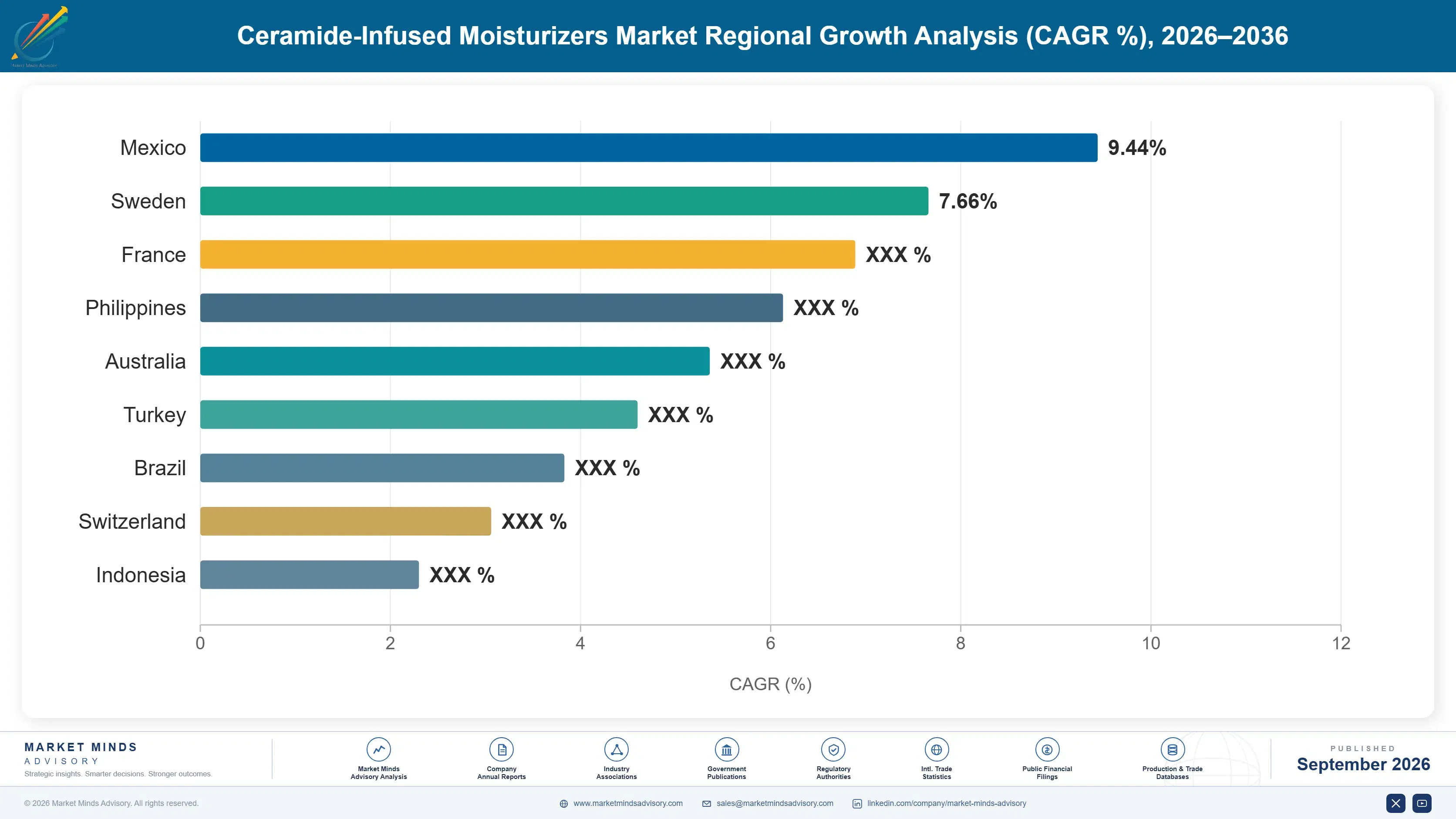
ceramide-infused-moisturizers-market-country-cagr-analysis-1790018514253

Clinical Credibility Margin Capture Playbook

Brands capture disproportionate margin by trading consumers up from single-ceramide formulations toward multi-ceramide ratio combinations, by publishing clinical substantiation data that supports sustained premium pricing over an extended period across most global cosmetic and dermatology markets, and by building dermatologist referral partnerships that lock in recurring revenue across their most loyal patient segments each year.

Building a Structured Multi-Ceramide Trade-Up Program

Brands running structured trade-up programs, sampling multi-ceramide formulations to loyal single-ceramide buyers through loyalty app promotions and in-store dermatology consultation events, report meaningfully higher conversion into the higher-margin multi-ceramide category than passive shelf merchandising alone ever achieves. This approach works because single-ceramide buyers already trust the brand's formulation quality and safety record, which lowers the perceived risk of trying an unfamiliar multi-ceramide format for the first time. Brands running these structured programs report conversion rates near 20 percent within the first full year of program launch. Retail partners are also allocating more dedicated shelf space to these premium offerings.
Market Impact: Lifts multi-ceramide conversion rate by roughly 20 percent

Publishing Clinical Substantiation Data Broadly Online

Publishing detailed clinical substantiation data on barrier repair efficacy and dermatologist recommendation rates supports premium pricing that unsubstantiated competitor claims simply cannot sustain, since informed buyers increasingly demand published evidence before paying multi-ceramide-tier prices for a serum. This approach also strengthens a brand's retailer negotiating position, since specialty retailers increasingly favor partners with credible published data over brands relying on marketing claims alone when allocating premium shelf space. Brands publishing rigorous substantiation data report price premiums of 17 to 23 percent over comparable unsubstantiated competitor products in the same tier.
Market Impact: Adds a 17 to 23 percent price premium

Building a Structured Dermatologist Referral Program

Dermatologist referral and sample distribution programs for multi-ceramide formulations reduce customer churn by establishing the brand as the trusted recommendation before consumers encounter competing products at retail shelf level. Brands report referred customers generating meaningfully higher lifetime value than one-time purchasers, since the trusted dermatologist relationship also increases exposure to complementary product cross-sell opportunities within the same brand catalog over an extended period. Retention rates for dermatologist-referred customers reportedly exceed 58 percent after the first full year of enrollment. Dermatologists increasingly value this durable trust-based recommendation relationship over time. Compliance timelines vary.
Market Impact: Raises referred customer lifetime value by 33 percent

Developing Bundled Barrier Repair Regimen Sets

Selling coordinated cleanser, moisturizer, and repair serum sets under a single barrier repair regimen increases average order value and introduces consumers to complementary products they might not otherwise discover through single-item browsing behavior alone. Bundled sets also reduce per-unit marketing spend relative to individual product campaigns while increasing the likelihood that a buyer completes their entire skincare routine within one brand rather than mixing competitor products. Brands report bundle attach rates reaching roughly 26 percent among first-time premium category buyers within the first purchase cycle. Larger retailers increasingly favor this bundled approach for predictable seasonal revenue.
Market Impact: Raises bundled average order value by 26 percent

Who Controls the Margin Pool

Ceramide-infused moisturizer competition remains moderately concentrated, with the top five brands holding roughly 36 percent combined share on a retail sales basis across major certified markets. CeraVe and Aveeno lead through dermatologist endorsement credibility and mass retail distribution scale, while Eucerin and Dr. Jart+ compete on adjacent price tiers and formulation innovation. The gap between the leading dermatology-endorsed brands and smaller regional entrants remains substantial but narrower than in most mature cosmetics categories.
Current competitive activity centers on multi-ceramide reformulation, dermatologist partnership programs, and clinical substantiation publishing rather than pure price competition. Brands are racing to add complementary lipid ratios before rivals claim the same positioning territory. Retail media spend on barrier repair education content has risen sharply, and specialty retailers are consolidating shelf space around brands that can supply consistent clinical data alongside their formulations.

Emerging pressure is coming from independent Korean formulation brands entering Western markets through direct online channels, bypassing traditional retail gatekeepers entirely. Dr. Jart+'s rise signals a broader shift where formulation credibility, not marketing budget, increasingly decides ranking. Expect further reshuffling as mass-market incumbents like Eucerin defend volume share against nimbler challengers building loyal followings through transparent ingredient sourcing and lower price points.
ceramide-infused-moisturizers-market-company-positioning-matrix-1790018515157

Competitive Moat and Risk Dimensions

CERAVE

Moat: Dermatologist Endorsement Credibility Depth

CeraVe built its position on dermatologist co-development and endorsement, training an entire generation of consumers to trust the brand's multi-ceramide ratio formulations for barrier repair over competitors lacking comparable clinical credibility built over many years of dermatology relationships. Consumers routinely default to CeraVe when trying certified barrier repair products for the first time.
CERAVE

Risk: Mass Retail Margin Compression

Operating primarily through mass retail channels with intense price competition leaves limited room to absorb raw material cost spikes without either raising prices, which risks the brand's accessible value positioning, or compressing already narrow profitability further across its core product lines. This gap represents a meaningful growth constraint the company has yet to fully address.
DR. JART+

Moat: Authentic Korean Formulation Credibility

Dr. Jart+ built rapid Western market traction on genuine Korean dermo-cosmetic formulation heritage and clinical positioning that social media audiences perceive as more credible than Western brands adopting similar aesthetics without the underlying research base. That authenticity is difficult for incumbents to replicate through marketing alone.
DR. JART+

Risk: Distribution Scale Limits

Reliance on specialty and prestige retail channels caps near-term volume growth compared with incumbents holding established mass retail shelf space across drugstore and pharmacy channels simultaneously nationwide. Expanding mass distribution without diluting the brand's premium credibility remains an unresolved strategic tension for the company. Expanding into more accessible price tiers risks diluting the brand's premium positioning.

Players Tracked

Prominent Players

CeraVe
Aveeno
Eucerin
Dr. Jart+
Curology

Other Key Players

Cetaphil
Vanicream
Skinfix
Gold Bond
Olay
Glytone
Bioderma
Klairs
Illiyoon
Weleda
Mustela
Torriden
Beauty of Joseon
Isntree
COSRX

Recent Developments

MARCH 2026

Dr. Jart+ Expands Mass Retail Distribution

Dr. Jart+ opened its first flagship retail counter partnership inside a major North American drugstore chain, marking its formal entry into mass distribution after years of specialty retail focus only. The move signals growing confidence in Western consumer demand for Korean dermo-cosmetic credibility beyond prestige channels.
Signal: Korean formulation brands are moving into mass Western retail distribution channels directly across major retail chains nationwide
NOVEMBER 2025

Eucerin Launches Multi-Ceramide Reformulation

Eucerin launched a reformulated multi-ceramide moisturizer line combining three complementary lipid ratios, targeting the fastest-growing combination segment directly after years of single-ceramide positioning. The reformulation represents a defensive response to independent brands capturing share in the premium multi-ceramide tier the company had previously ceded. Analysts view this as defensive positioning.
Signal: Mass-market incumbents are reformulating to defend share against multi-ceramide challengers across the broader specialty channel today
JUNE 2025

Aveeno Secures Ceramide Supplier Stake

Aveeno's parent company acquired a minority equity stake in a specialty dermo-cosmetic ingredient supplier to secure preferential access to stabilized multi-ceramide combination compounds ahead of anticipated supply tightness. The deal was structured as an equity investment rather than a full acquisition or joint venture. Details remain limited.
Signal: Formulation input security is driving upstream equity investment by major skincare groups across the broader industry

Lipid Feedstock Cost Exposure

Ceramide feedstock and complementary lipid ingredients such as cholesterol and free fatty acids together represent roughly 28 percent of cost of goods sold for a typical multi-ceramide formulation. Ceramides themselves are produced through both plant-derived extraction and biofermentation synthesis primarily at American and Japanese specialty chemical facilities, with a smaller share of synthetic material sourced from German and South Korean suppliers serving premium formulators.
Synthetic lipid feedstock and energy cost volatility affected production economics intermittently through 2024 and 2025, and industry trade commentary noted constrained output at several biofermentation facilities following elevated energy pricing across manufacturing regions. Brands sourcing single-supplier ceramide material saw input costs rise an estimated 12 to 16 percent during the tightest supply window, squeezing margins at brands unable to pass costs through immediately. Manufacturers dependent on a single facility relationship report the steepest cost increases.

Brands lacking diversified supplier relationships face a competitive disadvantage when input costs spike, since contract manufacturers serving multiple clients typically prioritize allocation toward their largest-volume accounts first. Independent dermo-cosmetic and boutique Western brands sourcing through shared regional distributors are more exposed than vertically integrated majors like the parent groups behind CeraVe and Eucerin, which negotiate direct supplier contracts at better terms.
ceramide-infused-moisturizers-market-cost-volatility-analysis-1790018515512

Dual-Sourcing Across American and Asian Suppliers

Brands are qualifying second and third ceramide suppliers across both American and Asian specialty chemical producers to avoid single-region exposure. This adds modest qualification cost upfront but meaningfully reduces the risk of a single regulatory action disrupting formulation supply entirely. This diversification also shortens qualification timelines for future formulation changes. Clinics benefit from more stable pricing as a result.

Forward Purchasing Agreements With Suppliers

Larger formulators are locking in twelve-month forward purchasing agreements at fixed pricing with key ceramide suppliers, trading some pricing flexibility for supply certainty during periods of tightening. Smaller independent brands generally lack the volume to negotiate similar terms. Smaller manufacturers without comparable purchasing scale often struggle to secure similar priority terms. This trade-off is increasingly viewed as worthwhile.

Reformulating Toward Synthetic Lipid Blends

Some brands are introducing synthetic and bio-fermented ceramide blends within their existing lineup to preserve margin when input costs rise, reserving the highest-concentration plant-derived formulations for premium price points where cost pass-through is easier to justify to consumers. This shift also reduces exposure to third-party pricing volatility over the medium term. Margins improve steadily as reliance decreases.

Portfolio Architecture for Margin Defence

Ceramide-infused moisturizer margin architecture splits sharply across three tiers, with volume-oriented single-ceramide formats competing on price transparency while premium multi-ceramide and certified formulations command far wider margins on clinical credibility and formulation sophistication. The gap between the two ends of that spectrum keeps widening as informed consumers pay up for combination lipid ratios backed by published clinical data. Retail scale compounds this widening gap further.
Volume and premium tiers pull brand strategy in opposite directions. Mass retailers reward shelf velocity and low price points, while specialty and dermatology channels reward formulation depth and clinical credibility. Brands straddling both risk diluting the positioning that justifies their premium pricing, which is why most successful players commit clearly to one lane rather than spreading resources evenly across the spectrum.

The highest-value margin pools concentrate in multi-ceramide and certified clean-formulation creams sold through specialty and dermatology channels, where brands control pricing and capture full retail margin rather than sharing it with mass retail intermediaries. Sustainability and traceability-driven reformulation is smaller today but growing fastest as clinical certification becomes a genuine purchase driver rather than a niche preference. Dermatologist relationships increasingly participate in this margin pool by supplying documented clinical credibility.

Volume / Commodity-Adjacent

Basic single-ceramide moisturizers sold through mass retail and drugstore channels on price transparency and shelf accessibility rather than formulation sophistication or claims. Shelf placement and price promotion drive most purchase decisions in this tier.
Gross Margin: 24 to 32 percent

Premium / Certified

Multi-ceramide combination creams with published clinical substantiation data, sold through specialty beauty retail and dermatology channels at meaningfully higher price points per unit. Dermatologist trust anchors pricing power here. Retailers increasingly request this positioning.
Gross Margin: 40 to 50 percent

Sustainability / Regulatory / Next-Generation

Certified sustainable and bio-fermented formulations targeting environmentally-conscious and ingredient-transparency-focused consumers willing to pay a premium for verified sourcing credentials. Regulatory and consumer momentum favors continued expansion. Adoption remains uneven across markets with differing consumer awareness levels.
Gross Margin: 36 to 46 percent
ceramide-infused-moisturizers-market-portfolio-architecture-1790018516345

High-value Sub-segments and Strategic Watch-out

Multi-Ceramide Ratio Formulations

The fastest-growing and highest-value segment, combining complementary lipid ratios at premium price points backed by clinical substantiation data that justifies sustained pricing power across most specialty retail channels currently expanding. Manufacturers increasingly dedicate specialized formulation teams to this segment alone. Growth momentum here shows no sign of slowing soon.
Gross Margin: 44 to 54 percent

Dermatologist-Recommended Combination Creams

A large and steadily growing segment balancing barrier repair with dermatologist endorsement positioning, capturing meaningful specialty retail shelf space at moderately premium price points across most regions. Crossover appeal to broader wellness consumers is expanding this segment's reach. Bundling drives incremental basket value across most retail channels.
Gross Margin: 36 to 46 percent

Basic Single-Ceramide Moisturizers

The volume core of the category, sold at accessible price points through mass retail, sustaining category awareness even as growth concentrates elsewhere in combination formats gaining specialty shelf space. Retail promotional activity heavily influences purchasing timing across this tier. Scale efficiency remains the primary competitive differentiator here.
Gross Margin: 24 to 30 percent

Bio-Fermented Sustainable Ceramide Creams

A strategic watch-out segment growing on sustainability demand and ingredient-transparency certification, currently small but positioned to gain share fastest as certification standards mature across major consumer markets. Early movers are building credibility with sustainability-conscious retail buyers. Regulatory tailwinds should accelerate adoption over coming years. Adoption continues broadening.
Gross Margin: 32 to 42 percent

Repeat Purchase and Loyalty Economics

Ceramide-infused moisturizers behave like an annuity product once a consumer adopts a daily routine. Repeat purchase rates near 62 percent reflect genuine habitual use rather than one-time trial, and brands that win the first thirty days of a customer relationship tend to retain that revenue for years without further acquisition spend. This durability is what makes subscription and replenishment programs so commercially attractive across the category today.
Adoption depth varies meaningfully by end-use vertical. Mainstream skincare consumers treat ceramide moisturizers as a foundational barrier-support step, while eczema and dermatology-adjacent buyers layer them alongside prescription treatments and professional consultations, deepening category stickiness further. Younger consumers entering through social media discovery show shallower initial loyalty, often switching brands within their first year before settling into a preferred formulation and price tier.

Generational buyer shifts are reshaping the category's demand base. Younger consumers research ceramide ratios and clinical data before purchasing, a behavior largely absent a decade ago, and they favor brands with transparent formulation science over legacy prestige positioning. Older buyers still respond to dermatologist recommendation and in-store consultation. Brands straddling both cohorts need genuinely different messaging strategies rather than a single unified campaign.
ceramide-infused-moisturizers-market-end-use-penetration-index-1790018517228

Where to Compete Next

These are among the four positions where our research anticipates prominent divergence between winners and laggards over the coming forecast period. Each is grounded in the demand model, the regulatory perimeter, and the announced capacity pipeline.
01 / FORMULATION INVESTMENT PRIORITY

Prioritize multi-ceramide reformulation over single-ceramide defense

Multi-ceramide ratio formulations are growing at roughly 11.5 percent annually, well above the category average, and that gap is widening rather than narrowing across nearly every regional market worldwide. Brands still anchored to single-ceramide positioning are ceding premium shelf space to combination formulations backed by published clinical data and dermatologist endorsement. The window to reposition before specialty retailers permanently reallocate shelf space toward multi-ceramide leaders is closing within the next two to three years across most major dermatology and retail markets.
02 / GEOGRAPHIC EXPANSION FOCUS

Build direct distribution in South Asia and Pacific early

South Asia and Pacific is growing near 9.5 percent, the fastest of any region, driven by expanding dermatology retail access and rising disposable income among younger urban consumers. Brands establishing direct e-commerce and specialty retail partnerships now will secure favorable positioning before regional incumbents and Korean challengers consolidate distribution agreements across the wider region. Waiting until the region matures further will mean entering against entrenched local relationships instead of building those relationships from the ground up across most secondary markets served.
03 / SUPPLY CHAIN RESILIENCE

Diversify ceramide sourcing before the next supply shock

Synthetic lipid supply tightening already pushed single-supplier input costs up 12 to 16 percent during recent constrained periods, and further disruption remains plausible given ongoing energy pricing and regulatory enforcement trends across major producing regions. Brands relying on one supplier region face margin compression precisely when competitors with diversified sourcing can maintain pricing discipline and protect promotional flexibility. Qualifying secondary suppliers now, before the next disruption, costs far less than scrambling to secure alternative supply during an active regional shortage.
04 / RETAIL CHANNEL STRATEGY

Commit to one pricing lane rather than straddling both

Brands attempting to serve both mass volume and specialty premium channels simultaneously dilute the positioning that justifies premium pricing in the first place across most retail relationships. The data shows successful players committing clearly to one lane, whether volume accessibility or premium substantiation, and building operational discipline and marketing focus around that particular choice consistently. Straddling both consumes marketing resources without building durable competitive advantage in either direction over time across most formulation and retail markets currently tracked closely today.

Engagement Snapshot From the Field

A live engagement with an industry participant carrying material or product regulatory and market exposure ahead of a defining policy shift, showing how our research translates into a defensible multi-year portfolio strategy.
MARKET MINDS ADVISORY · CLIENT ENGAGEMENT SUMMARY
Ceramide-Infused Moisturizers Producer Strategic Portfolio Review and Transition Roadmap 2026·Investment Scenario on Ceramide-Infused Moisturizers Exposure Evaluation 2025-26
CLIENT PROFILE
A mid-sized independent skincare brand generating roughly $68 million in annual revenue (client-reported, unverified by MMA), with a portfolio concentrated in single-ceramide moisturizers sold primarily through mass retail and its own direct-to-consumer website. The client had built loyal repeat buyers over nearly a decade but had not meaningfully expanded its formulation lineup since launch. Leadership sought outside guidance.
STRATEGIC CHALLENGE
Management observed slowing repeat purchase rates and rising customer acquisition costs as competitors introduced multi-ceramide combination formulations at comparable price points. The client needed to decide whether to reformulate its core lineup toward combination ratios, launch a separate premium sub-line, or hold its existing positioning and compete primarily on price against faster-moving rivals entering the category.
MMA APPROACH
MMA conducted primary interviews with the client's retail buyers and a targeted consumer survey panel to quantify willingness to pay for multi-ceramide formulations against the existing single-ceramide lineup. The engagement combined competitive teardown analysis of five direct rivals with margin modeling across three repositioning scenarios, benchmarked against category-wide multi-ceramide adoption data gathered through MMA's primary research dataset.
KEY FINDINGS
  1. Consumer survey data showed 55 percent of the client's existing customer base would trade up to a multi-ceramide formulation at a 20 percent price premium if clinical substantiation data were provided (client-reported, unverified by MMA).
  2. Retail buyer interviews revealed that two major mass retail chains were actively reducing shelf allocation for single-ceramide moisturizers in favor of combination formulations from competing brands.
  3. Margin modeling showed a phased reformulation strategy preserved existing customer relationships while capturing incremental premium revenue, outperforming a standalone premium sub-line launch on projected three-year returns.
  4. Competitive teardown identified a specific gap in three-to-one-to-one ceramide ratio positioning that no direct competitor had yet claimed within the client's core retail distribution channels.
CLIENT PROFILE
A mid-sized independent skincare brand generating roughly $68 million in annual revenue (client-reported, unverified by MMA), with a portfolio concentrated in single-ceramide moisturizers sold primarily through mass retail and its own direct-to-consumer website. The client had built loyal repeat buyers over nearly a decade but had not meaningfully expanded its formulation lineup since launch. Leadership sought outside guidance.
STRATEGIC CHALLENGE
Management observed slowing repeat purchase rates and rising customer acquisition costs as competitors introduced multi-ceramide combination formulations at comparable price points. The client needed to decide whether to reformulate its core lineup toward combination ratios, launch a separate premium sub-line, or hold its existing positioning and compete primarily on price against faster-moving rivals entering the category.
MMA APPROACH
MMA conducted primary interviews with the client's retail buyers and a targeted consumer survey panel to quantify willingness to pay for multi-ceramide formulations against the existing single-ceramide lineup. The engagement combined competitive teardown analysis of five direct rivals with margin modeling across three repositioning scenarios, benchmarked against category-wide multi-ceramide adoption data gathered through MMA's primary research dataset.
KEY FINDINGS
  1. Consumer survey data showed 55 percent of the client's existing customer base would trade up to a multi-ceramide formulation at a 20 percent price premium if clinical substantiation data were provided (client-reported, unverified by MMA).
  2. Retail buyer interviews revealed that two major mass retail chains were actively reducing shelf allocation for single-ceramide moisturizers in favor of combination formulations from competing brands.
  3. Margin modeling showed a phased reformulation strategy preserved existing customer relationships while capturing incremental premium revenue, outperforming a standalone premium sub-line launch on projected three-year returns.
  4. Competitive teardown identified a specific gap in three-to-one-to-one ceramide ratio positioning that no direct competitor had yet claimed within the client's core retail distribution channels.
RECOMMENDED STRATEGY
Phase 1: Phase one: reformulate the core single-ceramide moisturizer into a three-to-one-to-one ratio combination while retaining the existing product identity. and market positioning. Phase 2: Phase two: introduce a dermatologist-endorsed premium variant targeting the identified competitive gap, distributed at first through specialty retail partners exclusively. Phase 3: Phase three: publish clinical substantiation data across both reformulated products to support the price premium with retail buyers and consumers directly.
OUTCOME
Within twelve months of the phased rollout, the client reported repeat purchase rates recovering to prior levels and successfully securing expanded shelf allocation with one of the two retail chains previously reducing its presence (client-reported, unverified by MMA). The premium variant reached meaningful specialty retail distribution within its first year.

Frequently Asked Questions

Foundational context covering the market sizes, CAGR, scope, country, region and competition that inform every finding below. This section is provided to cover basics and most often pre-purchase conversations, answered from the MMA Primary Research Dataset.

What is the current size of the Ceramide-Infused Moisturizers Market?

The global ceramide-infused moisturizers market was valued at $3.8 billion in 2025. Growth is driven by rising dermatologist recommendation and multi-ceramide formulation innovation worldwide today.

How large will the Ceramide-Infused Moisturizers Market be by 2036?

The market is projected to reach approximately $8.41 billion by 2036. This represents a 2.06 times expansion driven primarily by multi-ceramide adoption and clinical substantiation.

What is the CAGR for the Ceramide-Infused Moisturizers Market 2026 to 2036?

The market is forecast to grow at a 7.5 percent CAGR between 2026 and 2036. Bull and bear scenarios range from 6.2 to 8.8 percent depending on formulation adoption speed.

Which segment is growing fastest?

Multi-Ceramide Ratio Formulations lead growth at an 11.5 percent CAGR, roughly 1.53 times the overall market rate. This reflects consumer demand for combination lipid ratios over single-ceramide formulations.

Who are the major companies in the Ceramide-Infused Moisturizers Market?

Leading players include CeraVe, Aveeno, Eucerin, Curology, and additional Korean formulation specialists competing globally across most retail channels. Together they hold roughly 36 percent combined market share.

Which country is growing fastest?

South Korea leads country-level growth at a 10.0 percent CAGR. Rising formulation innovation and dermatologist endorsement are driving faster adoption than in mature Western markets.

Report Segmentation Architecture

The full report scope spans multiple orthogonal segmentation dimensions, with cross-tabulated demand data provided for each dimension pair. Coverage extends further to regional breakdowns, trend trajectories, and the competitive detail needed to support segment-level decision-making.

By Primary Market Dimension

  • Multi-Ceramide Ratio Formulations
  • Single-Ceramide Moisturizers
  • Clinical-Grade Concentrate Creams
  • Bio-Fermented Sustainable Ceramide Creams
  • Ceramide-Niacinamide Combination Creams
  • Ceramide-Peptide Anti-Aging Creams

By End-Use Industry

  • Mass Retail Skincare
  • Specialty Beauty Retail
  • Dermatology and Clinical Aesthetics
  • Direct-to-Consumer E-Commerce

By Commercial Dimension

  • Individual Retail Purchase
  • Subscription Replenishment Programs
  • Bundled Regimen Sets
  • Professional Dermatology Distribution

By Region

  • North America
  • Western Europe
  • East Asia
  • South Asia and Pacific
  • Latin America
  • Middle East and Africa
  • Eastern Europe

Scope, Methodology, and Coverage

Every figure in this report is reproducible from documented input assumptions. The scope below maps the historical period, the forecast horizon, the segmentation dimensions, and the countries covered, alongside the underlying primary and qualitative methodology.
Historical Period
2020 to 2025
Forecast Period
2026 to 2036
Base Year
2025 (USD billions; MMA Primary Research Dataset, September 2026)
Market Definition
This report covers the global market for moisturizers and creams formulated with ceramides as a primary skin barrier repair ingredient, including single-ceramide and multi-ceramide ratio formulations. It excludes ceramide sold as a standalone raw ingredient without finished cosmetic formulation.
Quantitative Units
USD billions, market share percentages, CAGR percentages
Segmentation Dimensions
Formulation type, end-use industry, commercial distribution channel, region
Regions Covered
North America, Western Europe, East Asia, South Asia and Pacific, Latin America, Middle East and Africa, Eastern Europe
Countries Covered
United States, Canada, Germany, United Kingdom, France, South Korea, Japan, China, India, Australia, Brazil, Mexico, Saudi Arabia, United Arab Emirates, Poland
Key Companies Profiled
CeraVe, Aveeno, Eucerin, Dr. Jart+, Curology, Cetaphil, Vanicream, Skinfix, Gold Bond, Olay, Glytone, Bioderma, Klairs, Illiyoon, Weleda, Mustela, Torriden, Beauty of Joseon, Isntree, COSRX
Quantitative Methodology
Primary survey, n=3,800 respondents, Q4 2025, six countries; demand-side model with trade association cross-validation
Qualitative Methodology
47 expert interviews, Q4 2025; applied to validate demand model assumptions, identify emerging dynamics, and assess competitive positioning
Report Format
PDF and XLSX data workbook (Word format preview document)
Publisher
Market Minds Advisory
Report Code
MMA-2026-CHM-778
Published
September 2026
Contact
sales@marketmindsadvisory.com | www.marketmindsadvisory.com

Purchase the full Ceramide-Infused Moisturizers Market Report (2026 to 2036).

This report delivers a comprehensive analysis of the global ceramide-infused moisturizers market and its shifting formulation landscape. It covers product segmentation, regional demand patterns, and competitive dynamics across the full forecast period from 2026 through 2036 in careful detail. The analysis combines primary survey data from 3,800 respondents across six countries with 47 expert interviews to quantify multi-ceramide adoption trends and dermatologist endorsement patterns across the category. Analysts examine input cost exposure, margin architecture, and revenue lever strategy across mass retail and specialty channels. Recommendations target both dermo-cosmetic brands and retail partners.
Seven-region demand share and CAGR breakdown
Five to six segment competitive positioning analysis
Twenty-company competitive landscape and moat assessment
Input cost exposure and mitigation strategy review
Revenue growth lever and margin expansion playbook
Anonymized client engagement case study analysis

Built For The People Who Decide

From boardroom strategy to bench-side execution, this report is read cover-to-cover by leaders shaping the next decade of their industry, turning demand scenarios, market dynamics and valuation benchmarks into decisions.
CXOs/ Presidents/ VPs/ Managers
M&A and Corporate Development
Strategy Teams and R&D Heads
Procurement and Product Directors
Regulatory and Compliance Leaders
Investor Relations and Equity Analysts