Market Minds Advisory
Ceramic Membranes Market

Ceramic Membranes Market: Substrate Innovation and the Polymeric Substitution Curve

Ceramic membrane makers are riding a decade-long swap out of polymeric filtration across water reuse, dairy processing, and produced-water treatment, even as alumina feedstock costs and Chinese capacity expansion compress pricing power for mid-tier fabricators.

Lead Analyst

Bilal Shaikh

Published

September 2026

Make Smarter Decisions with Customized Research Insights

Request a free sample report and evaluate market opportunities, growth trends, and competitive dynamics relevant to your business needs.

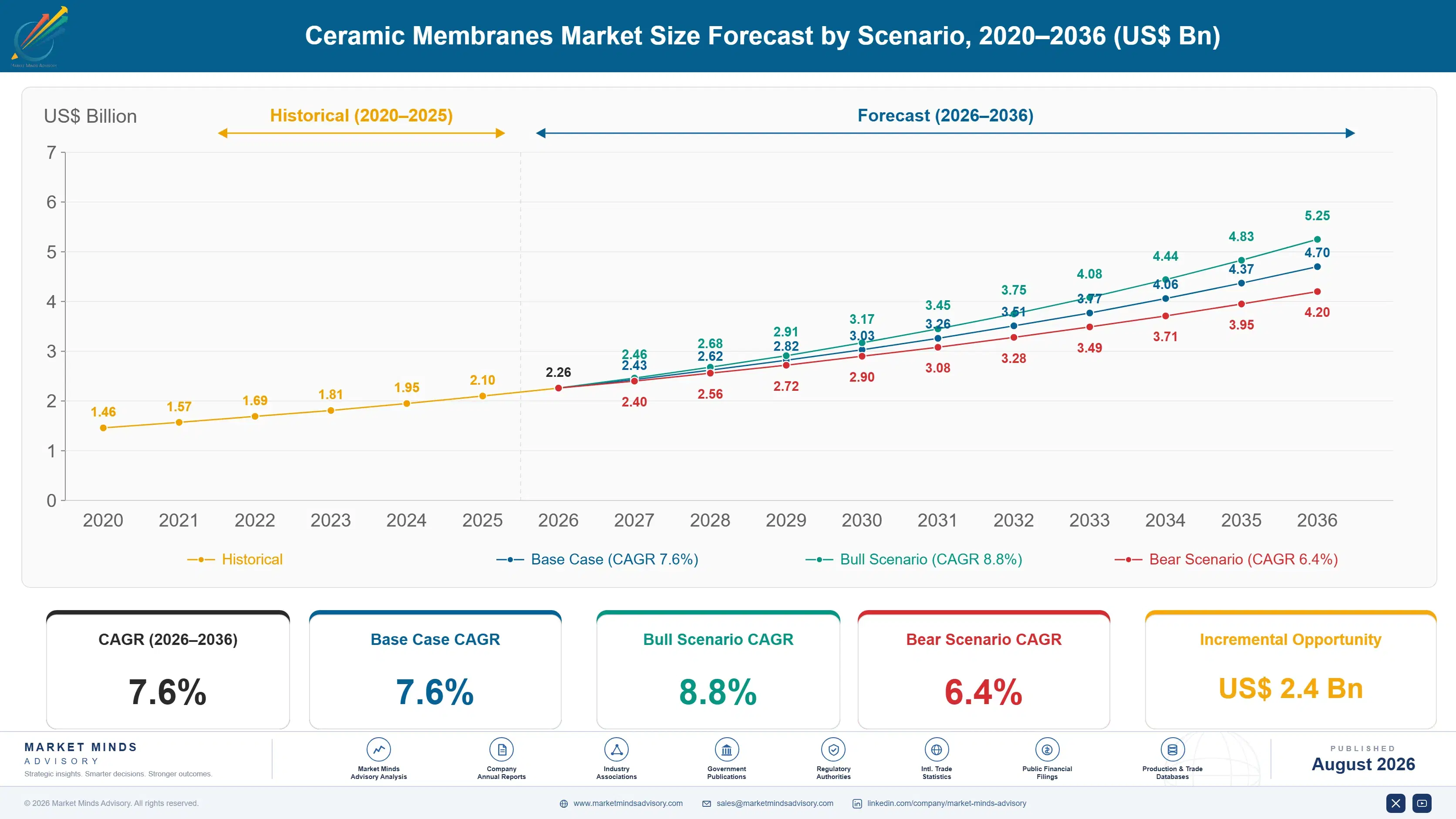
2025 MARKET VALUE$2.1BMarket Size 2025
2036 FORECAST VALUE$4.7BBase Case , 2026 to 2036
CAGR 2026 TO 20367.6 %Bull 8.8% / Bear 6.4%
INCREMENTAL OPPORTUNITY$2.4BNet 10- year value creation
EXPANSION MULTIPLE2.08x2036 value over 2026 base
Strategic Levers
M&A Pipeline
Regional Outlook
Country Rankings
Competitive Intelligence
Segmental Deep-dive
Call-Us : 91 93563 13602

Executive Snapshot and Market Trajectory

Water utilities and food processors are replacing polymeric membranes with ceramic alternatives wherever fouling resistance and chemical-cleaning tolerance justify the higher upfront cost. That substitution logic, not new capacity alone, is what is pulling ceramic membrane demand ahead of broader industrial filtration spending this year.
Silicon carbide and zirconia formulations are capturing the fastest growth as oil and gas produced-water treatment and pharmaceutical ultrafiltration push past the cost-performance threshold that once favored alumina alone. China's fabricators now supply a growing share of global tubular and flat-sheet output, pressuring European and Japanese incumbents on price even as those incumbents hold the advanced multi-channel designs that mining and dairy customers still specify by name.
Competitive intensity sits below what the addressable market size would suggest, since only a handful of producers can hold the tight pore-size tolerances that regulated water reuse and biopharma separation demand. The EU's revised urban wastewater treatment directive and expanding produced-water discharge limits in the Gulf region are pulling procurement forward, while additive manufacturing of monolithic supports is eroding the fabrication cost gap that has kept ceramic membranes a premium niche for two decades.
Market Definition
The ceramic membranes market covers inorganic filtration elements manufactured from alumina, zirconia, titania, and silicon carbide substrates, used in microfiltration, ultrafiltration, and nanofiltration applications across water and wastewater treatment, food and beverage processing, pharmaceutical separation, and industrial gas and liquid filtration. It excludes polymeric and metallic membrane technologies, complete filtration system housings sold without membrane elements, and membrane bioreactor services that do not manufacture the ceramic element itself.
Base Year Value
$2.1B in 2025 (MMA Primary Research Dataset, August 2026)
Forecast Period
2026 to 2036, eleven discrete annual values
CAGR
7.6% base case. Bull 8.8%. Bear 6.4%.
Fastest Growth Segment
Silicon Carbide-Based Elements: 10.2% CAGR
Fastest Growth Country
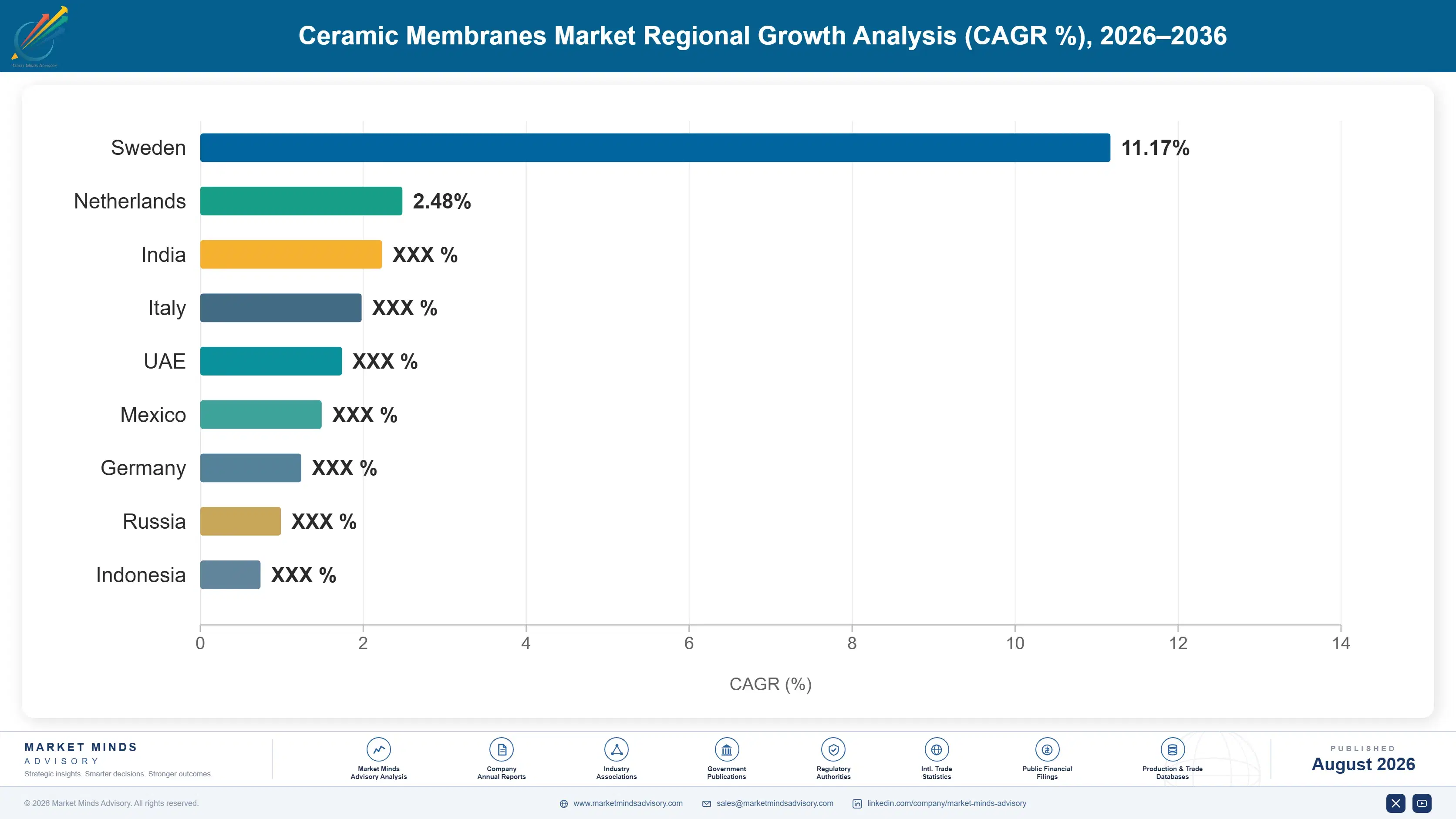
India: 10.5% CAGR
Fastest Growth Region
South Asia and Pacific: 9.6% CAGR
Largest Region
East Asia: 29% of 2025 global value
Market Leaders
Pall Corporation, LiqTech International, Metawater Co. Ltd., TAMI Industries, CoorsTek Inc. Source: MMA Analysis based on company annual reports and investor filings.
Primary Survey
n=3,800 procurement and R&D decision-makers, Q4 2025, six countries
Methodology
Demand-side build-up, cross-validated against public data, 47 expert interviews

Ceramic Membranes Market Forecast Scenarios

ceramic-membranes-market-size-forecast-scenario-1787300514732
Ceramic membrane demand grew unevenly between 2020 and 2025, with early pandemic disruption to capital projects in food processing giving way to a sharp rebound as water utilities resumed deferred reuse and desalination pretreatment tenders. Producers expanded tubular capacity in China and South Korea, and the segment closed 2025 at an estimated 6.6% historical CAGR, ahead of broader industrial filtration.
The base case rests on three reinforcing mechanisms. First, tightening discharge limits for produced water in shale and offshore basins are pushing operators toward ceramic ultrafiltration ahead of reverse osmosis polishing. Second, dairy and beverage processors are replacing polymeric microfiltration on cleaning-in-place cost grounds, since ceramic elements tolerate caustic and acid cycles without the fouling penalty polymeric membranes carry. Third, municipal water reuse mandates across the Gulf Cooperation Council are converting pilot installations into multi-year procurement contracts.
The bull case turns on India's National Mission for Clean Ganga extending ceramic ultrafiltration mandates to 200-plus municipal sewage treatment plants, pulling volumes ahead of the base forecast. The bear risk is Chinese oversupply: at least four new alumina substrate lines commissioned since 2024 could push tubular element pricing down faster than volume growth offsets, compressing margins for smaller Western fabricators.

Fouling Resistance Economics and the Polymeric Substitution Curve

Ceramic membranes sit at the intersection of two converging pressures: water scarcity regulation that raises the cost of discharge non-compliance, and food and pharmaceutical manufacturers that increasingly price total cost of ownership rather than upfront capital. Both forces favor a material that costs more per element but survives ten to fifteen years of caustic cleaning cycles that would degrade a polymeric membrane within three.
MARKET CONCENTRATION38% CR5Top five producers hold meaningful but incomplete pricing power
AVERAGE SELLING PRICE$180-420 per m² elementPrice varies steeply by pore size and substrate grade
TOP PRODUCING COUNTRYChina, 34% shareChinese fabricators supply the largest single national output share
CAPACITY UTILISATION76%Utilisation trails polymeric membrane plants across most regions
TRADE INTENSITY41% cross-borderNearly half of elements cross a border before installation
FEEDSTOCK COST SHARE29% of COGSAlumina and zirconia powder costs dominate input spending lines
Commercially, the market behaves like a specialty materials business rather than a capital equipment category: element replacement, not new system sales, now generates the larger share of producer revenue as the installed base matures. Fabricators that once competed purely on pore-size precision are adding predictive fouling monitoring and cleaning-chemistry services, turning a one-time hardware sale into a recurring account relationship worth defending.
Over the next decade, substrate innovation will matter more than pore-size refinement alone. Silicon carbide and graphene-oxide hybrid coatings promise lower fouling propensity at a manufacturing cost that is still falling, and additive manufacturing of monolithic ceramic supports could compress lead times from months to weeks, changing how quickly utilities and processors can specify ceramic over incumbent polymeric systems.
"The polymeric-to-ceramic swap in water reuse isn't a technology story anymore, it's a total cost of ownership story that finance teams settled two years ago. The interesting fight now is over who owns the cleaning-chemistry relationship once the membrane is installed."
Director, Advanced Materials and Filtration Practice · MMA Chemicals and Materia

Market Trends

Silicon Carbide Substrates Displacing Alumina in High-Fouling Duty

Silicon carbide ceramic substrates are displacing alumina in the highest-fouling duty cycles, particularly produced-water treatment ahead of reverse osmosis in shale basins and mine dewatering circuits. The material's inherent hydrophilicity cuts fouling rates that once forced weekly chemical cleaning down to roughly monthly intervals, extending element service life past eight years in several documented Permian Basin installations. Producers including LiqTech International have expanded silicon carbide tubular capacity twice since 2023 to meet operator demand, and unit pricing has fallen closer to premium alumina, narrowing the gap that once confined silicon carbide to niche mining applications only.
Market Impact: Doubles produced-water capacity need by 2030
Additive Manufacturing Shortens Monolithic Support Lead Times

Binder-jet and extrusion-based additive manufacturing of monolithic ceramic membrane supports is moving from pilot lines to commercial output at several European fabricators. The technique removes the multi-week kiln-firing bottleneck that traditional extrusion and isostatic pressing impose on complex multi-channel geometries, cutting prototype-to-production lead time from around fourteen weeks to under five in early deployments. TAMI Industries and smaller German specialists have both disclosed additive pilot lines since 2024, targeting custom geometries for pharmaceutical and specialty gas separation customers who previously waited two quarters for a qualified element. Wider adoption depends on proving long-term thermal cycling durability against conventionally fired substrates.
Market Impact: Cuts membrane replacement spend about 40%

Market Opportunities and Growth Drivers

Produced Water Discharge Rules Tighten Across Shale Basins

The US EPA's Effluent Limitations Guidelines review for oil and gas extraction is pushing operators toward zero-discharge and beneficial-reuse pathways for produced water, and ceramic ultrafiltration is the pretreatment step most operators specify ahead of reverse osmosis. Permian Basin operators treated more than 5 million barrels per day of produced water in 2025, and treatment capacity needs to roughly double by 2030 to meet announced beneficial-reuse commitments. Ceramic elements tolerate the high dissolved solids and hydrocarbon carryover that foul polymeric membranes within weeks, an edge operators pay for despite higher upfront capacity cost.
Market Impact: Adds 5 to 8% breakage cost

Dairy Processors Adopt Ceramic Microfiltration for CIP Savings

Dairy and beverage processors are converting cleaning-in-place cost data into a case for ceramic microfiltration, since caustic and acid cleaning cycles that run twice daily degrade polymeric membranes within two years but leave ceramic elements largely unaffected after a decade. A European dairy cooperative disclosed in its 2025 sustainability report that switching four cheese-whey lines to ceramic cut membrane replacement spend roughly 40% over five years, while also reducing cleaning chemical volume. That combination, lower ownership cost plus a smaller chemical footprint, is moving ceramic microfiltration from a premium option toward the default specification for new dairy capacity.
Market Impact: Defers revenue recognition by 2-3 quarters

Market Restraints and Challenges

Brittle Ceramic Elements Raise Installation and Handling Costs

Ceramic membrane elements are mechanically brittle compared to polymeric alternatives, a direct consequence of the sintered microstructure that gives the material its chemical resistance, and that brittleness drives up handling and installation cost. Breakage during transport or housing insertion can run five to eight percent of shipped units on projects using inexperienced crews, and each cracked element forces a production stoppage until a replacement arrives weeks later given custom firing lead times. Producers are responding with reinforced end-cap designs, factory-trained installation certification, and regional consignment stock held closer to major customers, aimed at cutting replacement cycles from weeks to days.
Market Impact: Cuts fouling-driven downtime nearly 60%

Custom Firing Lead Times Slow Capacity Response

Custom ceramic membrane geometries require a kiln-firing and quality-qualification cycle of ten to fourteen weeks, a pace set by ceramic sintering physics rather than factory automation. That lead time costs producers project wins outright: engineering firms on compressed schedules increasingly specify polymeric interim solutions rather than wait, then retrofit ceramic once available, deferring ceramic revenue recognition by two to three quarters per project. Mitigation efforts center on standardizing a smaller catalog of multi-channel geometries, pre-firing generic blanks ahead of order confirmation, and the additive manufacturing pilots described elsewhere, though none has cut qualified lead time below eight weeks yet.
Market Impact: Cuts lead times roughly 60%
3 additional market trends, 3 additional growth drivers, and 3 additional restraints and challenges are covered in the full report. Contact sales@marketmindsadvisory.com to access the complete intelligence.

Segment CAGR and Growth Architecture

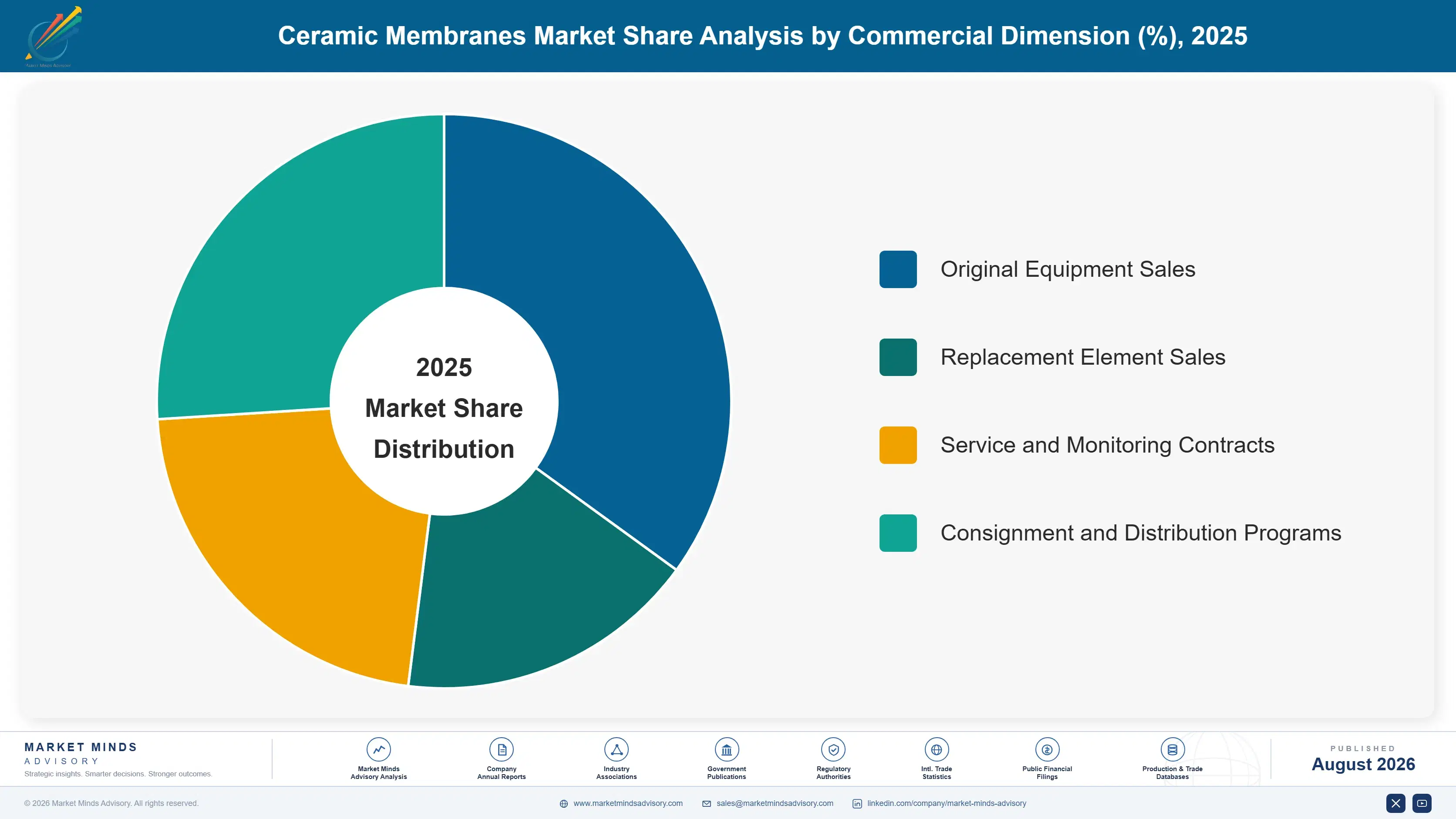
Segmentation follows substrate material rather than application, because pore-size architecture, thermal tolerance, and chemical resistance are set at the material stage and determine which downstream uses a given element can serve. Alumina remains the volume base, but silicon carbide, zirconia, titania, and composite multi-layer substrates now address duty cycles alumina alone cannot economically handle.
ceramic-membranes-market-market-share-analysis-1787300515293

Silicon Carbide-Based Elements

Silicon carbide substrates are the fastest-growing segment in ceramic membranes, expanding at an estimated 10.2% CAGR against a market average of 7.6%, roughly 1.34 times the overall pace. Demand concentrates in produced-water treatment ahead of reverse osmosis in shale and offshore basins, mine dewatering circuits, and select pharmaceutical ultrafiltration lines that need the material's superior hydrophilicity and fouling resistance under high total dissolved solids loading. Element pricing remains a premium over alumina, but the gap has narrowed as producers including LiqTech International scale tubular capacity, and operators increasingly justify the premium against extended service life and reduced chemical cleaning frequency. Continued adoption depends on further cost reduction and on regulatory pressure for produced-water reuse holding through the forecast window.
CAGR 10.2%

Zirconia-Based Elements

Zirconia-based substrates rank second-fastest, growing at an estimated 9.1% CAGR as biopharmaceutical separation and specialty gas filtration customers specify zirconia for its narrower achievable pore-size distribution relative to alumina. The segment benefits from tightening sterile filtration validation requirements in biologics manufacturing, where zirconia's chemical inertness under repeated steam-in-place sterilization cycles reduces batch failure risk that pharmaceutical quality teams price highly. Zirconia costs more to fire than alumina and requires tighter process control during sintering, which keeps the supplier base smaller and more specialized than the broader alumina segment. Growth is concentrated among a handful of qualified pharmaceutical-grade producers, and qualification cycles with individual biologics manufacturers can run twelve to eighteen months before volume orders begin.
CAGR 9.1%
Full segment breakdown across 5 segments available in the complete report.

Regional Architecture and Country Demand Map

Ceramic membrane demand concentrates where regulated water reuse, dairy processing scale, and produced-water treatment overlap. East Asia leads on fabrication output and installation volume, North America follows on produced-water and pharmaceutical demand, and Western Europe retains the advanced multi-channel design base, though its cost position keeps eroding.

North America

Produced-water discharge compliance is the single largest demand driver across North America, as shale operators in the Permian and Eagle Ford basins scale ceramic ultrafiltration ahead of reverse osmosis to meet tightening state and federal beneficial-reuse targets. The region's pharmaceutical and biotech manufacturing base, concentrated in the US Northeast and Research Triangle, adds a second high-value demand pool for sterile-grade zirconia and alumina elements used in bioprocessing separation. Municipal utilities in water-stressed states including California, Arizona, and Texas are expanding potable reuse pilots that specify ceramic pretreatment over polymeric alternatives on fouling-resistance grounds. Canada contributes a smaller share, weighted toward mining dewatering and dairy processing in Ontario and Quebec, while Mexico's contribution remains limited to a handful of maquiladora-adjacent installations.
Share: 24% | CAGR: 7.9% (2026 to 2036)

Western Europe

Regulation, not capacity growth, defines Western Europe's ceramic membrane market. The EU's revised Urban Wastewater Treatment Directive imposes quaternary treatment obligations on larger plants by the early 2030s, and utilities in Germany, France, and the Netherlands are running ceramic ultrafiltration pilots ahead of mandatory compliance dates. Dairy and beverage processing across France, Germany, and the Nordics remains a stable, mature demand base rather than a growth one, since most large cooperatives completed polymeric-to-ceramic conversion cycles years ago. European fabricators including TAMI Industries and several German specialists retain design leadership in complex multi-channel geometries, exporting engineering expertise as volume migrates toward lower-cost Asian production. Growth here trails the global average, closer to replacement-cycle maturity than expansion.
Share: 20% | CAGR: 6.2% (2026 to 2036)
Regional intelligence for 5 additional markets available in the complete report: East Asia, South Asia and Pacific, Latin America, Middle East and Africa, Eastern Europe. Contact sales@marketmindsadvisory.com.
ceramic-membranes-market-country-cagr-analysis-1787300515799

Where Ceramic Membrane Margins Concentrate Next

Four commercial moves separate producers capturing outsized margin from those competing purely on element price. Each depends on shifting revenue away from one-time hardware sales toward recurring service relationships, application-specific engineering, or geographic positioning that current capacity maps do not yet reflect, particularly as installed-base density grows faster than new system sales across mature water-reuse markets.

Predictive Fouling Monitoring as a Service

Producers that bundle predictive fouling monitoring sensors with element sales convert a one-time hardware transaction into an annuity relationship worth defending. Sensor packages tracking transmembrane pressure and flux decline let operators schedule cleaning before a costly unplanned shutdown, and early adopters report cutting unplanned downtime roughly 25% versus fixed-schedule maintenance. The service typically carries a subscription fee equal to eight to twelve percent of the original element price annually, a margin richer than the hardware sale itself. Fabricators without a monitoring offering increasingly lose renewal negotiations to rivals that can show a quantified downtime reduction.
Market Impact: Adds recurring revenue equal to 8-12% of element price

Custom Multi-Channel Geometry Engineering Fee Structure

Fabricators capable of custom multi-channel geometry design are charging separate engineering fees rather than folding design work into unit price, capturing value once given away to win volume orders. A qualified custom project can carry a one-time engineering fee of $40,000 to $120,000 depending on channel complexity, in addition to the recurring element revenue that follows. This matters most for pharmaceutical and specialty gas separation customers who need application-specific pore architectures that off-the-shelf tubular elements cannot match. Producers that formalize engineering as a distinct line report higher project margins, and the practice is spreading from European specialists to Asian fabricators.
Market Impact: Engineering fees add $40,000 to $120,000 per project

Regional Consignment Stock Near Major Accounts

Holding consignment inventory of standard-geometry elements at regional hubs near large industrial accounts converts a slow, custom-firing lead time into a same-week fulfillment promise that commands its own price premium. Producers running consignment programs report winning service contracts at prices 5 to 10 percent above list for guaranteed replacement turnaround, since unplanned downtime at a large dairy or water plant costs far more than any element markup. The approach requires tying up working capital in pre-positioned inventory, so only fabricators with sufficient balance-sheet strength can offer it credibly, and where offered it has become decisive against slower rivals.
Market Impact: Commands a 5-10% price premium on service contracts

Cross-Selling Cleaning Chemistry and Replacement Contracts

Producers that sell cleaning chemistry alongside membrane elements capture a second, higher-margin revenue stream from the same customer relationship, since agents formulated for a producer's own ceramic chemistry outperform generic alternatives and extend element life measurably. Bundled cleaning-chemistry and multi-year replacement contracts carry gross margins 10 to 15 percentage points above the element hardware business alone, and they lock customers into a single-supplier relationship difficult for competitors to break once established. The approach works best in dairy, beverage, and produced-water accounts running continuous operations, where cleaning frequency is high enough that chemistry spend becomes worth optimizing with the membrane supplier.
Market Impact: Adds 10 to 15 points of gross margin

Who Controls the Margin Pool

The top five producers hold an estimated 38% of global ceramic membrane output on a shipment-volume basis, a moderate concentration that still leaves meaningful share fragmented among specialized regional fabricators. Pall Corporation and LiqTech International lead on breadth and technical reputation, while the next tier of challengers competes mainly on price and delivery speed rather than differentiated technology.
Current competitive activity centers on three fronts. Capacity expansion in China and South Korea is compressing tubular element pricing across the mid-market. Silicon carbide product launches are redrawing the premium tier, with LiqTech and a handful of Danish and German specialists racing to qualify new formulations for produced-water customers. Several producers are also formalizing service and consignment offerings to lock in multi-year accounts before rivals can undercut on hardware price alone.

Emerging pressure comes from Chinese fabricators moving up the value chain into multi-channel and silicon carbide geometries once reserved for European and Japanese specialists, aided by domestic alumina and silicon carbide powder supply that keeps their input costs consistently lower. If that quality gap closes further, expect share to shift toward integrated Chinese producers, particularly in price-sensitive municipal water tenders where design sophistication matters less than delivered cost per element.
ceramic-membranes-market-company-positioning-matrix-1787300516315

Competitive Moat and Risk Dimensions

PALL CORPORATION (DANAHER)

Moat: Global Filtration Distribution Network

Pall's parent Danaher gives it a global sales and service network spanning water, biopharma, and industrial accounts that smaller ceramic specialists cannot match, letting it cross-sell ceramic elements into existing polymeric and cartridge filtration relationships across dozens of countries without building new customer access from scratch.
PALL CORPORATION (DANAHER)

Risk: Ceramic Share of Portfolio

Ceramic membranes remain a small piece of Pall's much larger filtration portfolio, so capital allocation and product development attention compete against higher-volume polymeric and cartridge lines, leaving room for ceramic-focused specialists to out-innovate Pall on pore-size precision and new substrate chemistry despite Pall's scale advantage.
LIQTECH INTERNATIONAL

Moat: Silicon Carbide Technical Leadership

LiqTech built its business specifically around silicon carbide ceramic membranes for the hardest fouling duty cycles, giving it a multi-year head start in produced-water and marine scrubber water treatment applications that larger diversified filtration companies are only now entering with less field-proven formulations, a lead that shows up in win rates on produced-water bids.
LIQTECH INTERNATIONAL

Risk: Customer and End-Market Concentration

LiqTech's revenue leans heavily on a small number of large produced-water and marine customers, so a slowdown in shale drilling activity or marine emissions regulation enforcement could hit its order book harder than it would hit more diversified competitors with broader end-market exposure. That concentration leaves less room to absorb a single large customer loss.

Key Players

Pall Corporation (Danaher)
LiqTech International
Metawater Co. Ltd.
TAMI Industries
CoorsTek Inc.

Others

Jiangsu Jiuwu Hi-Tech Co.
Nanostone Water Inc.
Atech Innovations GmbH
Cembrane ApS
Ceramiques Techniques et Industrielles (CTI SA)
Inopor GmbH
Hyflux Ltd
Toray Industries Inc.
Asahi Kasei Corporation
Mann+Hummel Group
3M Purification Inc.
Veolia Water Technologies
Ovivo Inc.
Cerafiltec Germany GmbH
Kubota Corporation

Recent Developments

MARCH 2025

LiqTech Expands Silicon Carbide Tubular Capacity in Denmark

LiqTech International commissioned a second silicon carbide tubular production line at its Ballerup, Denmark facility, roughly doubling output capacity dedicated to produced-water and marine scrubber water treatment customers. The expansion followed two years of order backlog growth that outpaced the company's prior single-line capacity, particularly from Permian Basin operators.
Signal: Signals silicon carbide moving from a niche technology toward a mainstream produced-water treatment specification among large shale operators.
SEPTEMBER 2024

Metawater and a Japanese Trading House Form Water Treatment Joint Venture

Metawater Co. Ltd. formed a joint venture with a Japanese trading house to co-develop and market ceramic membrane bioreactor systems for Southeast Asian municipal water utilities, combining Metawater's element manufacturing with the partner's project finance and government-tender relationships across the region. The venture targets Indonesia, Vietnam, and the Philippines first.
Signal: Signals Japanese producers pairing project-finance partnerships with local relationships to compete against lower-cost Chinese tender pricing.
JUNE 2025

TAMI Industries Opens Additive Manufacturing Pilot Line for Ceramic Supports

TAMI Industries commissioned a binder-jet additive manufacturing pilot line in France dedicated to monolithic ceramic membrane support production, targeting custom multi-channel geometries for pharmaceutical and specialty gas separation customers. The pilot aims to cut prototype-to-qualified-element lead time from roughly fourteen weeks to under six weeks within eighteen months.
Signal: Signals additive manufacturing beginning to challenge traditional extrusion and isostatic pressing on lead time for complex custom geometry orders.

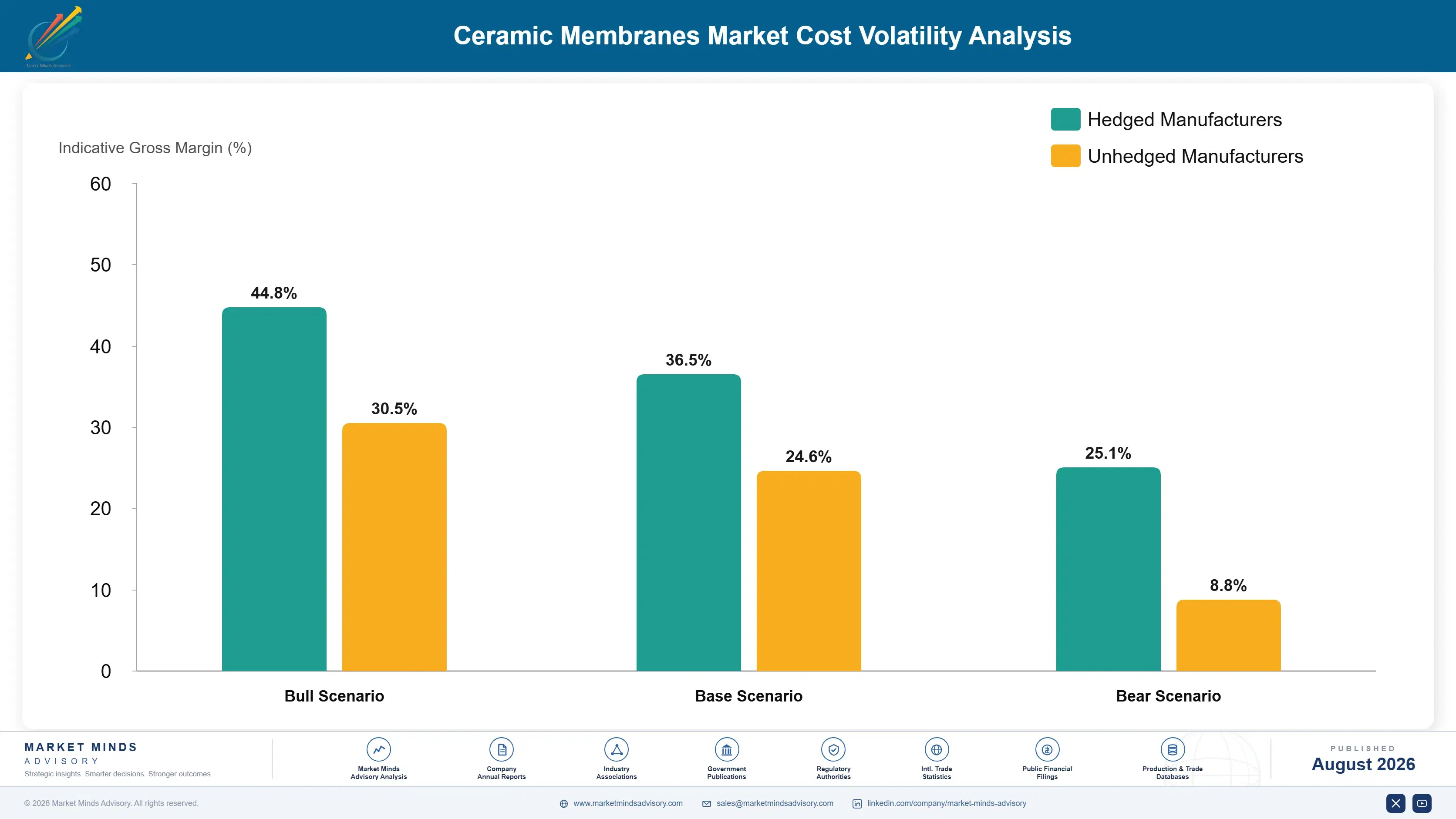
Alumina and Zirconia Powder Price Exposure

Alumina and zirconia powder feedstock together account for roughly 29% of cost of goods sold in ceramic membrane manufacturing, with high-purity alumina sourced from Chinese and Australian refineries and zirconia concentrate drawn mainly from South African and Australian mineral sands operations. Energy for kiln firing adds a meaningful share, in Europe where industrial gas prices remain elevated relative to Asian producers.
Zirconia concentrate prices spiked more than 30% during 2023 after South African producer Richards Bay Minerals reported operational disruptions, tightening supply as pharmaceutical-grade demand was accelerating. The IEA's 2024 critical minerals review flagged mineral sands as a supply chain with meaningful geographic concentration risk, since a small number of South African and Australian operations supply the large majority of global volume, leaving buyers exposed whenever either country experiences operational disruption.

Smaller regional fabricators without long-term feedstock contracts absorb these price swings directly in quoted element pricing, while larger diversified players including Pall Corporation hedge exposure across a broader raw-material book. European producers face a double exposure, since they import both ceramic powders and the industrial gas needed for firing, leaving them more sensitive to feedstock volatility than Chinese or South Korean fabricators with domestic energy and shorter supply chains.
ceramic-membranes-market-cost-volatility-analysis-1787300516510

Multi-Year Feedstock Supply Contracts

Larger fabricators are locking multi-year alumina and zirconia supply contracts with Australian and South African suppliers at fixed or collared pricing, trading some upside flexibility for budget predictability that lets them quote firm element prices on multi-year customer contracts without repricing risk mid-agreement, particularly for municipal utilities that now specify price stability as a formal award criterion.

Alternative Powder Sourcing Qualification

Several producers are qualifying secondary powder sources, including Indian and Brazilian mineral sands operations, as backup suppliers to reduce dependence on the concentrated South African and Australian supply base, though qualification cycles for pharmaceutical-grade material can take twelve months or longer before a new source enters production blends. Non-pharmaceutical industrial grades qualify considerably faster.

Kiln Energy Efficiency Retrofits

European fabricators are retrofitting kilns with higher-efficiency firing profiles and waste-heat recovery to offset elevated industrial gas costs, cutting firing energy consumption per element by a meaningful margin and partially closing the input cost gap against Asian competitors with cheaper domestic energy. A handful of larger plants have also begun piloting electric kiln technology to reduce natural gas dependence further.

Portfolio Architecture for Margin Defence

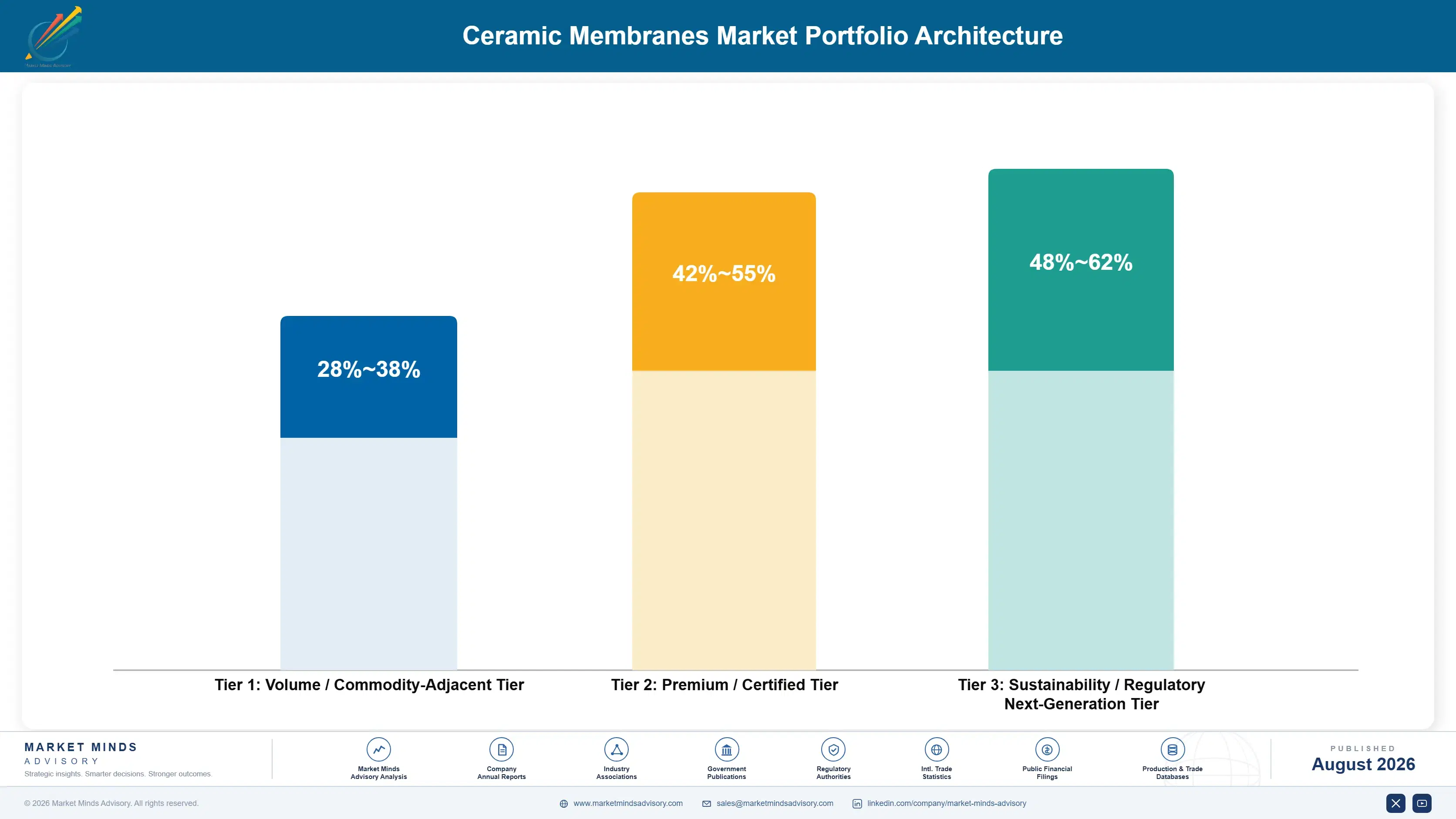
Ceramic membrane portfolios split across three tiers with meaningfully different margin economics. The volume tier, standard alumina tubular elements for municipal and industrial water treatment, competes largely on price and delivers gross margins in the 28 to 38% range. Premium certified elements for pharmaceutical and food-grade applications command materially higher margins, reflecting validation and qualification costs that limit competition to a smaller supplier set.
The tension between volume and premium tiers shapes capacity allocation decisions across the industry. Volume tubular capacity is easiest to scale and fastest to fund, but Chinese overcapacity keeps pricing pressure constant in that tier. Premium and sustainability-tier capacity requires tighter process control and slower qualification cycles, but rewards patient capital with margins that hold up even as volume-tier pricing erodes.

High-value margin pools concentrate in silicon carbide produced-water treatment, pharmaceutical-grade zirconia, and the emerging sustainability tier tied to water-reuse certification schemes. These pools remain small relative to total volume today, but they are growing faster than the base business and are where most producer capital expenditure is now directed. Producers that under-invest in these pools risk ceding the industry's fastest-growing margin dollars to more focused specialists.

Volume / Commodity-Adjacent Tier

Standard alumina tubular and flat-sheet elements sold into municipal and general industrial water treatment applications, where producers compete primarily on unit price, delivery lead time, and proven reliability rather than advanced pore-size engineering or specialty chemistry.
Gross Margin: 28-38%

Premium / Certified Tier

Pharmaceutical, food-grade, and validated biologics separation elements requiring formal qualification, traceable material documentation, and sterile-grade process control, sold to customers who price total validation cost and regulatory risk well above the underlying element hardware cost alone.
Gross Margin: 42-55%

Sustainability / Regulatory / Next-Generation Tier

Silicon carbide and additively manufactured elements tied to produced-water reuse mandates, mining dewatering compliance, and emerging water-reuse certification schemes, commanding the highest margins in the portfolio because supplier qualification remains limited to a small number of technically capable fabricators.
Gross Margin: 48-62%
ceramic-membranes-market-portfolio-architecture-1787300517013

High-value Sub-segments and Strategic Watch-out

Silicon Carbide Produced-Water Elements

The fastest-growing, highest-margin pool in the market, driven by shale and mining produced-water compliance that alumina cannot cost-effectively serve at required fouling resistance. Capacity remains concentrated among a handful of qualified silicon carbide fabricators, and pricing power should persist while that supplier base stays narrow.
Gross Margin: 50-62%

Pharmaceutical-Grade Zirconia Elements

A smaller but stable high-value pool tied to biologics manufacturing capacity growth, gated by long validation cycles that limit new supplier entry. Growth tracks biologics production capacity additions rather than broader industrial cycles, giving this segment more predictable, less cyclical demand than most of the ceramic membranes portfolio.
Gross Margin: 45-55%

Standard Alumina Tubular Elements

The volume core of the market, serving municipal and general industrial customers where price competition from Chinese capacity keeps margins compressed. This segment still generates the largest absolute revenue pool, and defending share here funds the capital investment that premium and sustainability-tier expansion actually requires.
Gross Margin: 28-36%

Generic Chinese Alumina Imports

A strategic watch-out segment where rapidly expanding low-cost capacity could pull pricing down across the entire volume tier faster than demand growth absorbs it. Producers without a genuine cost or technology advantage against these imports should expect continued margin erosion, making retreat toward premium tiers the more defensible path.
Gross Margin: 18-28%

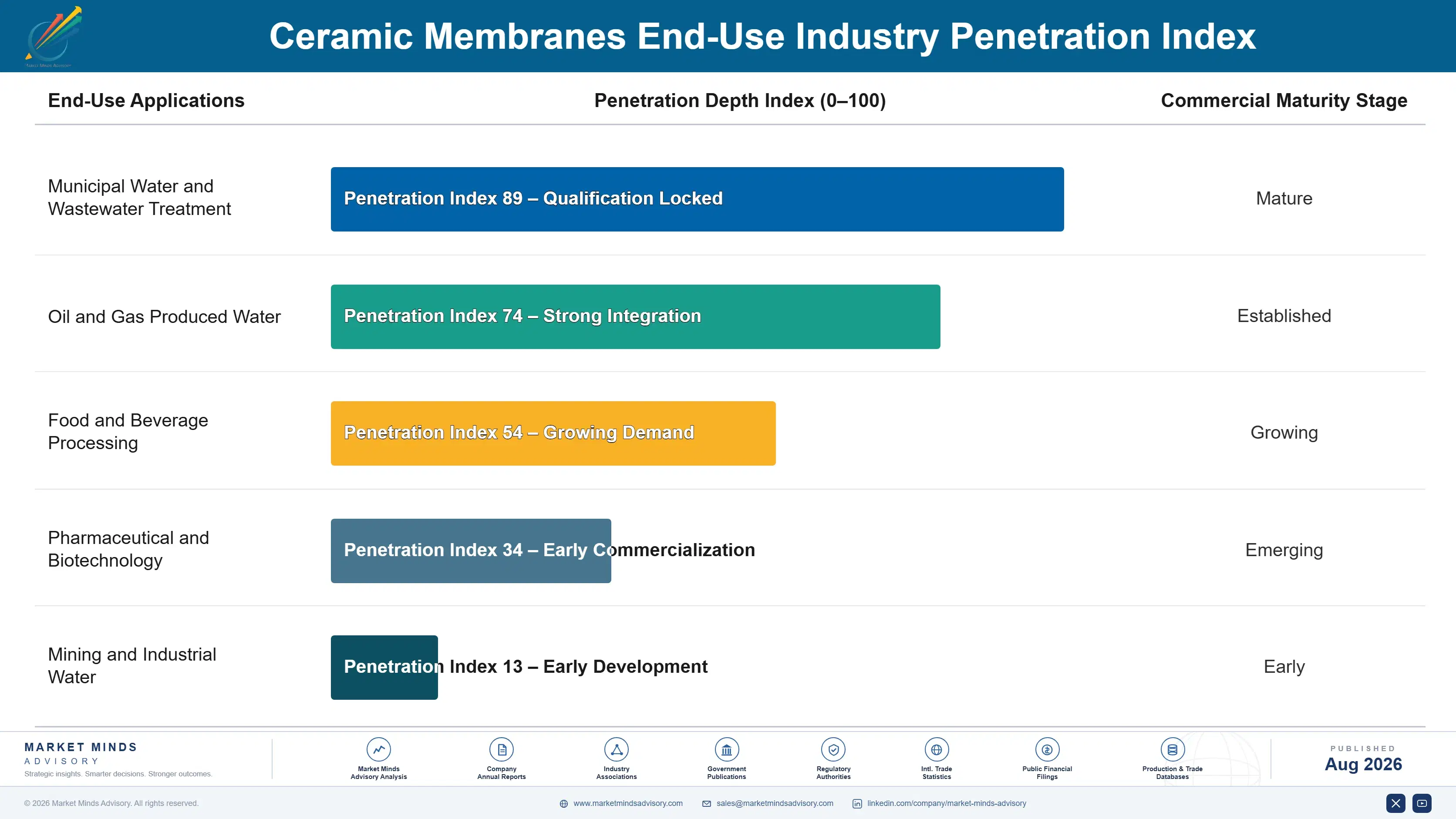
The Replacement-Cycle Annuity Underneath Ceramic

Ceramic membrane economics increasingly resemble an annuity business once the initial system sale closes. Element replacement, driven by gradual flux decline rather than catastrophic failure, generates predictable recurring revenue over a ten-to-fifteen-year installed asset life, and producers that track installed base density can forecast replacement demand with more confidence than most industrial equipment categories allow. Few industrial equipment categories offer that level of forecasting c
Adoption depth varies sharply by end-use vertical. Municipal water utilities and large dairy processors, once qualified on a producer's elements, rarely switch suppliers given the cost and risk of requalifying cleaning protocols and housing compatibility. Pharmaceutical and biologics customers show the deepest stickiness of all, since switching a validated filtration element requires regulatory revalidation that most quality teams avoid absent a serious performance failure.

A generational shift in buyer profiles is underway as sustainability and water-stewardship officers, rather than pure procurement, increasingly co-sign large capital decisions. These buyers weight lifecycle water and chemical use alongside upfront cost, a shift that favors ceramic membranes on total lifecycle grounds over polymeric alternatives priced on capital cost alone. That shift is still uneven across regions, but it is moving in one direction only.
ceramic-membranes-market-end-use-penetration-index-1787300517503

Where MMA Sees the Opportunity

These are among the four positions where our research anticipates prominent divergence between winners and laggards over the coming forecast period. Each is grounded in the demand model, the regulatory perimeter, and the announced capacity pipeline.
01 / SUBSTRATE TECHNOLOGY POSITIONING

Back silicon carbide and zirconia capacity ahead of alumina

Silicon carbide and zirconia substrates are growing roughly 1.34 times faster than the ceramic membranes market overall, driven by produced-water compliance and pharmaceutical separation demand that alumina alone cannot fully serve. Producers still weighted toward commodity alumina tubular capacity risk ceding the highest-margin accounts to specialists that qualified silicon carbide and zirconia formulations earlier. Capital allocated toward advanced substrate capacity and qualification now should pay back faster than incremental alumina tubular expansion into an increasingly crowded, price-competitive commodity tier that offers little room for margin expansion.
02 / SERVICE REVENUE BUILD-OUT

Convert element sales into monitoring and chemistry annuities

Producers that still sell ceramic membranes as one-time hardware transactions are leaving margin on the table that predictive fouling monitoring, cleaning-chemistry bundles, and consignment stocking programs are already capturing for early movers. These service layers carry materially higher margins than the underlying element sale and, more importantly, lock customers into renewal cycles that are difficult for price-only competitors to break. Building this capability now, before it becomes table stakes across the industry, is worth more than matching a rival's tubular capacity expansion unit for unit.
03 / FEEDSTOCK COST HEDGING

Lock multi-year alumina and zirconia supply contracts now

Feedstock costs already run close to 29% of cost of goods sold, and zirconia concentrate has shown it can spike more than 30% within a single year when South African supply is disrupted. Producers without multi-year supply agreements are forced to reprice element quotes mid-contract or absorb margin compression, either of which damages customer trust in multi-year municipal and pharmaceutical procurement relationships. Locking supply now, even at a premium to spot pricing, protects margin stability and the credibility needed to win long-duration contracts against competitors still exposed to spot-market volatility.
04 / REGIONAL CAPACITY POSITIONING

Weigh East Asian scale against Western design premium carefully

East Asia now holds the largest single regional share of ceramic membrane output and continues expanding capacity faster than most other regions, making cost leadership there increasingly difficult for Western fabricators to contest directly. Western producers still hold a genuine advantage in complex multi-channel geometry design and application engineering that Chinese fabricators have not yet fully closed. The sounder strategy is not chasing East Asian scale on commodity alumina, but doubling down on the design and application engineering capability that Asian competitors still cannot replicate at comparable quality.

Engagement Snapshot From the Field

A live engagement with an industry participant carrying material or product regulatory and market exposure ahead of a defining policy shift, showing how our research translates into a defensible multi-year portfolio strategy.
MARKET MINDS ADVISORY · CLIENT ENGAGEMENT SUMMARY
Ceramic Membranes Producer Strategic Portfolio Review and Transition Roadmap 2026·Investment Scenario on Ceramic Membranes Exposure Evaluation 2025-26
CLIENT PROFILE
The client is a mid-sized municipal water utility serving roughly 900,000 residents in a water-stressed region of the southwestern United States, operating two conventional treatment plants and facing new state-level potable reuse discharge requirements. The utility's engineering team had limited experience evaluating ceramic membrane technology against its incumbent polymeric systems and needed an independent, vendor-neutral assessment before committing capital to a plant-wide retrofit (client-reported, unverified by MMA).
STRATEGIC CHALLENGE
The utility needed to decide between retrofitting existing polymeric ultrafiltration trains or transitioning to ceramic membranes ahead of a 2028 compliance deadline for potable reuse discharge limits, without clear internal data on lifecycle cost, expected service life, or realistic vendor qualification timelines. Board members were also wary of committing to a materially higher capital cost per element without a defensible total cost of ownership case.
MMA APPROACH
MMA conducted a vendor-neutral technology and total cost of ownership assessment spanning five qualified ceramic membrane suppliers, benchmarking capital cost, expected service life, cleaning chemistry requirements, and realistic delivery lead times against the utility's incumbent polymeric baseline. The assessment drew on MMA's primary survey dataset and structured interviews with engineering staff at three comparable plants that had already completed similar retrofits.
KEY FINDINGS
  1. Ceramic elements showed a fifteen-year expected service life against six to eight years for the incumbent polymeric membranes, materially changing the lifecycle cost comparison in ceramic's favor despite higher upfront capital cost.
  2. Cleaning chemical consumption dropped by an estimated 35% in ceramic pilot testing, reducing both operating cost and the utility's wastewater discharge permit exposure from spent cleaning solution.
  3. Vendor lead times for custom multi-channel geometries ranged from ten to sixteen weeks across the five suppliers assessed, materially longer than the utility's prior procurement assumptions from polymeric system experience.
  4. Two of the five qualified suppliers offered consignment inventory programs that could shorten effective replacement turnaround to under one week, a factor the utility had not previously weighted in vendor selection.
CLIENT PROFILE
The client is a mid-sized municipal water utility serving roughly 900,000 residents in a water-stressed region of the southwestern United States, operating two conventional treatment plants and facing new state-level potable reuse discharge requirements. The utility's engineering team had limited experience evaluating ceramic membrane technology against its incumbent polymeric systems and needed an independent, vendor-neutral assessment before committing capital to a plant-wide retrofit (client-reported, unverified by MMA).
STRATEGIC CHALLENGE
The utility needed to decide between retrofitting existing polymeric ultrafiltration trains or transitioning to ceramic membranes ahead of a 2028 compliance deadline for potable reuse discharge limits, without clear internal data on lifecycle cost, expected service life, or realistic vendor qualification timelines. Board members were also wary of committing to a materially higher capital cost per element without a defensible total cost of ownership case.
MMA APPROACH
MMA conducted a vendor-neutral technology and total cost of ownership assessment spanning five qualified ceramic membrane suppliers, benchmarking capital cost, expected service life, cleaning chemistry requirements, and realistic delivery lead times against the utility's incumbent polymeric baseline. The assessment drew on MMA's primary survey dataset and structured interviews with engineering staff at three comparable plants that had already completed similar retrofits.
KEY FINDINGS
  1. Ceramic elements showed a fifteen-year expected service life against six to eight years for the incumbent polymeric membranes, materially changing the lifecycle cost comparison in ceramic's favor despite higher upfront capital cost.
  2. Cleaning chemical consumption dropped by an estimated 35% in ceramic pilot testing, reducing both operating cost and the utility's wastewater discharge permit exposure from spent cleaning solution.
  3. Vendor lead times for custom multi-channel geometries ranged from ten to sixteen weeks across the five suppliers assessed, materially longer than the utility's prior procurement assumptions from polymeric system experience.
  4. Two of the five qualified suppliers offered consignment inventory programs that could shorten effective replacement turnaround to under one week, a factor the utility had not previously weighted in vendor selection.
RECOMMENDED STRATEGY
Phase 1: Phase 1 (Months 1 to 4): Complete vendor technology qualification and pilot testing at one treatment train before committing to plant-wide retrofit. Phase 2: Phase 2 (Months 5 to 14): Execute phased retrofit of the first treatment plant, negotiating a consignment inventory arrangement to de-risk replacement lead times. Phase 3: Phase 3 (Months 15 to 24): Extend retrofit to the second treatment plant using lessons learned, and formalize a multi-year cleaning chemistry supply contract.
OUTCOME
The utility selected a ceramic membrane supplier offering consignment inventory and began phased retrofit of its first treatment plant in early 2026, ahead of the 2028 compliance deadline. Early operating data showed cleaning chemical use tracking close to the pilot's 35% reduction estimate, though full lifecycle validation will not be available until the retrofit completes (client-reported, unverified by MMA).

Frequently Asked Questions

Foundational context covering the market sizes, CAGR, scope, country, region and competition that inform every finding below. This section is provided to cover basics and most often pre-purchase conversations, answered from the MMA Primary Research Dataset.

What is the current size of the Ceramic Membranes Market?

The global ceramic membranes market reached an estimated $2.1 billion in 2025. Growth is concentrated in water treatment, dairy processing, and produced-water applications where fouling resistance outweighs the higher upfront element cost.

How large will the Ceramic Membranes Market be by 2036?

MMA forecasts the market reaching approximately $4.70 billion by 2036, more than double its 2026 value. Silicon carbide and zirconia substrates are expected to drive the largest share of that incremental growth.

What is the CAGR for the Ceramic Membranes Market 2026 to 2036?

The base case CAGR is 7.6% across the forecast period, with a bull case near 8.8% and a bear case near 6.4% depending on produced-water regulation and Chinese capacity trends.

Which segment is growing fastest?

Silicon carbide-based elements are the fastest-growing segment, expanding at roughly 10.2% CAGR, about 1.34 times the overall market pace, driven by produced-water and mining demand.

Who are the major companies in the Ceramic Membranes Market?

Leading producers include Pall Corporation, LiqTech International, Metawater, TAMI Industries, and CoorsTek. The top five hold an estimated 38% of global output on a shipment-volume basis.

Which country is growing fastest?

China leads growth in absolute volume terms, but India is expanding fastest in percentage terms, driven by national wastewater mission mandates and textile zero liquid discharge rules.

Report Segmentation Architecture

The full report scope spans multiple orthogonal segmentation dimensions, with cross-tabulated demand data provided for each dimension pair. Coverage extends further to regional breakdowns, trend trajectories, and the competitive detail needed to support segment-level decision-making.

By Substrate Material Type

  • Alumina-Based Elements
  • Zirconia-Based Elements
  • Titania-Based Elements
  • Silicon Carbide-Based Elements
  • Composite and Multi-Layer Elements

By End-Use Industry

  • Municipal Water and Wastewater Treatment
  • Oil and Gas Produced Water
  • Food and Beverage Processing
  • Pharmaceutical and Biotechnology
  • Mining and Industrial Water

By Commercial Dimension

  • Original Equipment Sales
  • Replacement Element Sales
  • Service and Monitoring Contracts
  • Consignment and Distribution Programs

By Region

  • North America
  • Western Europe
  • East Asia
  • South Asia and Pacific
  • Latin America
  • Middle East and Africa
  • Eastern Europe

Scope, Methodology, and Coverage

Every figure in this report is reproducible from documented input assumptions. The scope below maps the historical period, the forecast horizon, the segmentation dimensions, and the countries covered, alongside the underlying primary and qualitative methodology.
Historical Period
2020 to 2025
Forecast Period
2026 to 2036
Base Year
2025 (USD billions; MMA Primary Research Dataset, August 2026)
Market Definition
The ceramic membranes market covers inorganic filtration elements manufactured from alumina, zirconia, titania, and silicon carbide substrates, used in microfiltration, ultrafiltration, and nanofiltration applications across water and wastewater treatment, food and beverage processing, pharmaceutical separation, and industrial gas and liquid filtration. It excludes polymeric and metallic membrane technologies, complete filtration system housings sold without membrane elements, and membrane bioreactor services that do not manufacture the ceramic element itself.
Quantitative Units
USD billions (current prices); element shipment volume in square meters where disclosed
Segmentation Dimensions
By Substrate Material Type; By End-Use Industry; By Commercial Dimension; By Region
Regions Covered
North America, Western Europe, East Asia, South Asia and Pacific, Latin America, Middle East and Africa, Eastern Europe
Countries Covered
USA, China, Germany, France, UK, Japan, South Korea, India, Australia, Canada, Brazil, Mexico, Indonesia, Vietnam, Thailand, Malaysia, UAE, Saudi Arabia, South Africa, Nigeria, Turkey, Poland, Netherlands, Italy, Spain, Sweden, Switzerland, Argentina, Colombia, Singapore, and additional markets relevant to this sector
Key Companies Profiled
Pall Corporation (Danaher), LiqTech International, Metawater Co. Ltd., TAMI Industries, CoorsTek Inc., Jiangsu Jiuwu Hi-Tech Co., Nanostone Water Inc., Atech Innovations GmbH, Cembrane ApS, Ceramiques Techniques et Industrielles (CTI SA), Inopor GmbH, Hyflux Ltd, Toray Industries Inc., Asahi Kasei Corporation, Mann+Hummel Group, 3M Purification Inc., Veolia Water Technologies, Ovivo Inc., Cerafiltec Germany GmbH, Kubota Corporation
Quantitative Methodology
Primary survey, n=3,800 respondents, Q4 2025, six countries; demand-side model with trade association cross-validation
Qualitative Methodology
47 expert interviews, Q4 2025; applied to validate demand model assumptions, identify emerging dynamics, and assess competitive positioning
Report Format
PDF and XLSX data workbook (Word format preview document)
Publisher
Market Minds Advisory
Report Code
MMA-2026-CHM-114
Published
August 2026
Contact
sales@marketmindsadvisory.com | www.marketmindsadvisory.com

Purchase the full Ceramic Membranes Market Report (2026 to 2036).

The full Ceramic Membranes Market report delivers a comprehensive assessment of substrate technology, competitive positioning, and regional demand through 2036. It includes detailed segmentation by material type, end-use industry, and commercial dimension, alongside profiles of all twenty companies covered in this summary. The report quantifies regional market size and growth across all seven world regions, with country-level detail for the thirty-plus markets MMA tracks. Buyers receive access to MMA's underlying primary survey dataset and expert interview transcripts, enabling further custom analysis. A dedicated chapter benchmarks feedstock cost exposure and mitigation strategies across producer types.
Substrate-level segmentation across five material technology categories
Profiles of twenty leading ceramic membrane producers worldwide
Regional sizing and forecasts across all seven world regions
Feedstock cost exposure and mitigation strategy benchmarking chapter
Primary survey dataset access covering 3,800 respondent interviews
Competitive development tracking with dated corporate event log

Built For The People Who Decide

From boardroom strategy to bench-side execution, this report is read cover-to-cover by leaders shaping the next decade of their industry, turning demand scenarios, market dynamics and valuation benchmarks into decisions.
CXOs/ Presidents/ VPs/ Managers
M&A and Corporate Development
Strategy Teams and R&D Heads
Procurement and Product Directors
Regulatory and Compliance Leaders
Investor Relations and Equity Analysts