Market Minds Advisory
Cellulitis Management Market

Cellulitis Management Market: A Budget Problem Dressed Up As A Clinical One

One injection costing four and a half thousand dollars replaces an admission costing nearly eleven thousand. The pharmacy budget and the bed budget belong to different people, which is why adoption stalled.

Lead Analyst

Alice Ballenger

Published

September 2026

Make Smarter Decisions with Customized Research Insights

Request a free sample report and evaluate market opportunities, growth trends, and competitive dynamics relevant to your business needs.

2025 MARKET VALUE$3.4BMarket Size 2025
2036 FORECAST VALUE$6.5BBase Case , 2026 to 2036
CAGR 2026 TO 20366.0 %Bull 7.3% / Bear 4.8%
INCREMENTAL OPPORTUNITY$2.9BNet 10- year value creation
EXPANSION MULTIPLE1.79x2036 value over 2026 base
Strategic Levers
M&A Pipeline
Regional Outlook
Country Rankings
Competitive Intelligence
Segmental Deep-dive
Call-Us : 91 93563 13602

Executive Snapshot and Market Trajectory

The health economics here are settled and the adoption is not. A single dose of a long-acting lipoglycopeptide costs around USD 4,500 and displaces an admission averaging USD 10,800, yet uptake keeps stalling, because the drug budget and the bed budget sit with different people entirely.
The market reaches USD 3.4 billion in 2025 and compounds at 6.0% to USD 6.45 billion by 2036, an expansion multiple of 1.79 times. Long-acting lipoglycopeptides grow fastest at 9.0%, exactly 1.50 times the market rate, delivering a full course in a single administration. North America holds 29% of value on high infection incidence, elevated resistance rates, and pricing for newer agents that no other region approaches by any measure at all.
Concentration sits at 36% across the top five, splitting branded long-acting agents against a deep generic field where the great majority of treatment still happens. Roughly 30% of patients admitted with cellulitis turn out to have something else entirely, which means a meaningful share of this market is treatment nobody actually needed at all. Recurrence at 27% within three years is where the real clinical burden sits.
Market Definition
The cellulitis management market covers antibacterial pharmacotherapy used to treat acute bacterial skin and skin structure infection presenting as cellulitis or erysipelas, spanning long-acting lipoglycopeptides, oxazolidinones, anti-MRSA cephalosporins, glycopeptides and lipopeptides, beta-lactams and first-line oral agents, and lincosamides, tetracyclines and sulphonamides. Wound care products and dressings, compression therapy for lymphoedema, surgical debridement, diabetic foot ulcer management, necrotising fasciitis, and diagnostic imaging or microbiology are excluded.
Base Year Value
$3.4B in 2025 (MMA Primary Research Dataset, August 2026)
Forecast Period
2026 to 2036, eleven discrete annual values
CAGR
6.0% base case. Bull 7.3%. Bear 4.8%.
Fastest Growth Segment
Long-Acting Lipoglycopeptides: 9.0% CAGR
Fastest Growth Country
India: 9.6% CAGR
Fastest Growth Region
South Asia and Pacific: 8.4% CAGR
Largest Region
North America: 29% of 2025 global value
Market Leaders
Pfizer, AbbVie, Melinta Therapeutics, Merck and Co, Fresenius Kabi. Source: MMA Primary Research Dataset, July 2026.
Primary Survey
n=3,800 procurement and R&D decision-makers, Q4 2025, six countries
Methodology
Demand-side build-up, cross-validated against public data, 47 expert interviews

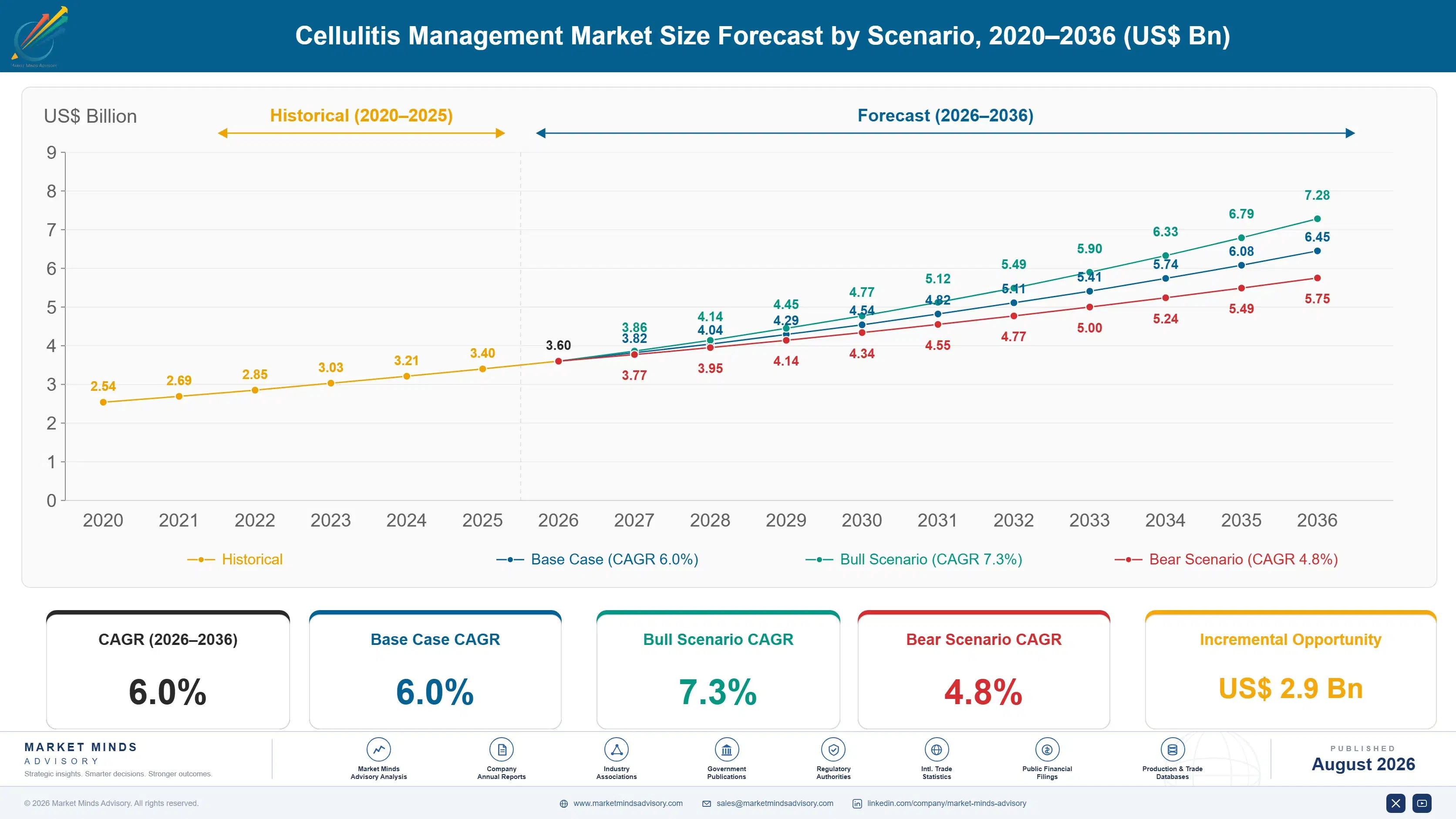
Cellulitis Management Market Forecast Scenarios

cellulitis-management-market-size-forecast-scenario-1787298175127
Between 2020 and 2025 hospital avoidance did more to shape this market than any clinical development. Emergency departments under pandemic pressure discharged patients who would previously have been admitted, and single-dose long-acting agents finally found the use case their launch data always claimed. That behaviour partly persisted afterwards. A 4.9% historical CAGR combines genuine novel agent uptake against continuing generic price erosion underneath.
Three mechanisms carry the 6.0% base case. Outpatient parenteral therapy programmes are the largest, since they give a hospital a route to treat without admitting and make single-dose economics visible to the people who hold the bed budget. Diabetes and obesity prevalence is the second, both driving cellulitis incidence directly. And Asian access to newer anti-MRSA agents is the third, as domestic manufacturers bring pricing within reach of hospital formularies.
The 7.3% bull case rests on bundled payment models spreading, which would put the drug cost and the admission cost inside one budget and remove the silo blocking adoption of agents that already demonstrate favourable economics. The 4.8% bear case is better diagnosis, since roughly 30% of admitted cellulitis proves to be something else and any serious effort to correct that shrinks the treated population directly.

Two Budgets, One Patient

The commercial obstacle in this market is organisational rather than clinical. A single-dose long-acting lipoglycopeptide costs roughly USD 4,500 and reliably avoids an admission averaging USD 10,800 across a median stay of 5.4 days. Every health economist who has looked at it reaches the same conclusion. Pharmacy directors carry the drug cost, bed managers carry the admission, and almost nowhere do those two budgets meet.
TOP FIVE CONCENTRATION36%Branded long-acting agents against a deep generic field
SINGLE-DOSE AGENT COSTUSD 4,500Price of one long-acting lipoglycopeptide administration to a patient
AVOIDED ADMISSION VALUEUSD 10,800Cost of the inpatient stay a single dose replaces
MISDIAGNOSIS RATE30%Share of admitted patients who prove to have something else
THREE-YEAR RECURRENCE27%Portion of patients presenting again within that time window
MEDIAN INPATIENT STAY5.4 daysLength of a typical hospital admission for this infection
A third of the market may not be a market at all. Studies consistently find that around 30% of patients admitted with a cellulitis diagnosis have venous stasis dermatitis, lymphoedema, gout, contact dermatitis, or deep vein thrombosis instead, and receive antibiotics that cannot help them. Better diagnostic discipline would improve care and shrink treated volume simultaneously, which is an uncomfortable position for anybody selling into it.
Recurrence is where the clinical burden actually concentrates and where the least commercial attention goes. Around 27% of patients present again within three years, driven by lymphoedema, obesity, venous insufficiency, and untreated tinea pedis rather than by any failure of the original antibiotic. Prophylactic penicillin works while taken and adherence collapses quickly. Nobody has built a durable commercial model around prevention.
"I have watched three companies fail to sell an obviously cost-effective drug because the person saving the money was not the person spending it. Bundled payment fixes this overnight, and everybody is waiting for somebody else to go first."
Director, Hospital Therapeutics And Care Pathway Practice · MMA Healthcare Pract

Market Trends

Outpatient Parenteral Programmes Make Single-Dose Economics Visible

Outpatient parenteral antibiotic therapy gives an emergency department a route to treat a patient properly without occupying a bed, and it is the setting where single-dose long-acting agents genuinely make sense. Where these programmes exist and are funded at the service level rather than the pharmacy level, the drug cost and the avoided admission finally appear in the same budget. Adoption of newer agents in those settings runs several times the rate seen in hospitals without a programme, which tells you the barrier was never clinical. Funding structure has governed uptake since launch.
Market Impact: Diabetes affects 11% of adults

Diagnostic Scrutiny Threatens A Third Of Treated Volume

Repeated studies find roughly 30% of patients admitted with cellulitis have venous stasis dermatitis, lymphoedema, gout, or deep vein thrombosis instead, and dermatology consultation or thermal imaging can identify most of them. Health systems are beginning to fund that scrutiny because misdiagnosis costs bed days and exposes patients to antibiotics without benefit. Every correctly reclassified patient improves care and removes a treatment course from this market, which is a trend the industry rarely discusses openly. Anybody forecasting from current admitted volume is overstating the addressable population by a meaningful margin.
Market Impact: Pricing falls 70% on genericisation

Market Opportunities and Growth Drivers

Diabetes And Obesity Prevalence Drive Infection Incidence

Cellulitis incidence tracks diabetes, obesity, venous insufficiency, and lymphoedema far more closely than it tracks any microbiological factor at all, and all four of those are rising across essentially every market MMA covers. Impaired skin integrity, reduced lymphatic drainage, and poor peripheral circulation each raise the risk that an ordinary skin breach becomes an infection requiring systemic antibiotic treatment. Diabetic populations across India and China are expanding fast enough that cellulitis incidence growth in those countries outruns population growth by a considerable margin, and nothing in the projections suggests that slows.
Market Impact: USD 4,500 against USD 10,800

Asian Manufacturers Bring Newer Anti-MRSA Agents Within Reach

Linezolid, daptomycin, and increasingly tedizolid are all now produced by Chinese and Indian manufacturers at prices that make provincial and state hospital formulary listing viable where imported product never came close. Methicillin-resistant Staphylococcus aureus rates across Asian hospitals justify the clinical need comfortably, and what had been missing all along was affordability rather than any clinical argument. Volume growth across these markets exceeds value growth quite substantially, and it establishes prescribing patterns that persist long after the pricing advantage narrows, as newer agents follow the same route into those formularies.
Market Impact: Generic courses cost under USD 20

Market Restraints and Challenges

Budget Silos Block Drugs With Proven Economics

A single-dose agent costing USD 4,500 that avoids an admission costing USD 10,800 fails on the pharmacy budget line while succeeding on the total cost of care, and the pharmacy director is the one who has to sign. The root cause is that hospital budgets are allocated by department rather than by patient episode. Commercially this has stalled products with genuinely favourable evidence for a decade. Participants are mitigating through bundled payment advocacy, through outpatient therapy programme funding, and through risk-sharing arrangements tied directly to avoided admissions rather than to units dispensed.
Market Impact: Adoption runs 4 times higher

Generic Beta-Lactams Treat Most Cases Perfectly Well

Uncomplicated cellulitis without resistance risk responds to flucloxacillin, cephalexin, or amoxicillin with clavulanate at a few dollars a course, and most cases are exactly that. The root cause is that the causative organisms in the majority of presentations remain fully susceptible to agents discovered decades ago. Commercially this caps the addressable population for anything newer at the resistant and complicated fraction of presentations. Mitigation runs toward patients with resistance risk factors, toward those unsuitable for oral therapy, and toward avoided admission arguments rather than any claim of superior clinical efficacy.
Market Impact: Around 30% prove misdiagnosed
3 additional market trends, 4 additional growth drivers, and 2 additional restraints and challenges are covered in the full report. Contact sales@marketmindsadvisory.com to access the complete intelligence.

Segment CAGR and Growth Architecture

Segmentation follows antibacterial class, because class determines the resistance coverage an agent provides, the dosing schedule and therefore the care setting it suits, the price a hospital pays, and whether the supplier is an innovator or a generic manufacturer. Care setting, infection severity, and payer type are handled in the framework rather than as segments.
cellulitis-management-market-market-share-analysis-1787298175666

Long-Acting Lipoglycopeptides

Long-acting lipoglycopeptides grow fastest at 9.0%, exactly 1.50 times the market rate, delivering a complete treatment course in one or two infusions through half-lives measured in days rather than hours. Dalbavancin and oritavancin both sit here. The clinical argument is adherence and admission avoidance rather than superior efficacy, since a patient who receives the whole course before leaving the department cannot fail to complete it. Course pricing near USD 4,500 places the entire commercial case on avoided bed days rather than on outcomes. Outpatient parenteral therapy programmes are where adoption actually happens, and uptake outside them runs at a fraction of the rate. Nothing about the clinical evidence explains that gap.
CAGR 9.0%

Oxazolidinones

Oxazolidinones grow at 7.2%, covering linezolid and tedizolid, and their real commercial strength is oral bioavailability equivalent to intravenous dosing, which allows a patient to be discharged on tablets midway through a treatment course. That single property does more for length of stay than any efficacy difference between agents. Methicillin-resistant coverage is reliable and well established across treatment guidelines everywhere. Linezolid is now widely genericised across Asia at prices that have opened hospital formularies which imported product never reached, while tedizolid holds a tolerability advantage on extended courses that matters in patients requiring longer treatment. Discharge on oral therapy is worth more to a hospital than any efficacy difference between these agents.
CAGR 7.2%
Full segment breakdown across 6 segments available in the complete report.

Regional Architecture and Country Demand Map

Cellulitis incidence tracks diabetes, obesity, and venous disease rather than anything geographic, so regional value here is set by how each system chooses to treat it and what it pays. Newer agents concentrate wherever the care pathway can actually capture the value of an avoided admission.

North America

North America holds 29% of value, the largest share of any region, on a combination of high incidence and pricing for newer agents that nothing elsewhere approaches. Obesity and diabetes prevalence drive cellulitis presentation rates well above European levels, and community methicillin-resistant Staphylococcus aureus is more established here than in most health systems. Outpatient parenteral antibiotic therapy programmes are the most developed anywhere, which is exactly why long-acting agents have found real use. Budget silos between pharmacy and bed management remain the binding constraint. Bundled payment pilots are furthest advanced here and would change adoption quickly if they spread. Growth at 5.1% trails the global rate on an already high base.
Share: 29% | CAGR: 5.1% (2026 to 2036)

East Asia

Twenty-five percent of global value sits in East Asia, driven by Chinese hospital volume and by methicillin-resistant Staphylococcus aureus rates that exceed those in most Western health systems. Domestic manufacturers supply linezolid and daptomycin at prices that have opened provincial hospital formularies which imported product never reached, and the prescribing patterns established there tend to persist as newer agents follow the same route in. Japanese and Korean practice is considerably more conservative on newer agents and more disciplined on antimicrobial stewardship. Diabetes prevalence across China is rising fast enough to add genuine incidence on top of that. Growth at 7.0% exceeds the global rate on access widening rather than on incidence alone.
Share: 25% | CAGR: 7.0% (2026 to 2036)
Regional intelligence for 5 additional markets available in the complete report: Western Europe, South Asia and Pacific, Latin America, Middle East and Africa, Eastern Europe. Contact sales@marketmindsadvisory.com.
cellulitis-management-market-country-cagr-analysis-1787298176184

Selling Past The Pharmacy Budget

The obstacle here is a budget boundary rather than a clinical argument, so every lever works by moving the conversation somewhere the avoided admission is actually visible. Service-level funding, risk-sharing, recurrence prevention, and Asian access each do that in a different way. Four follow, and none of them involves another efficacy trial nobody needed.

Sell Into Outpatient Parenteral Therapy Service Budgets

An outpatient parenteral antibiotic therapy programme holds a service budget that includes both the drug and the bed day it saves, which is the only place in most hospitals where single-dose economics are visible to one decision maker. Adoption of long-acting agents in funded programmes runs three to four times the rate seen elsewhere in the same institutions. Selling to programme leads rather than to pharmacy directors changes the buying question from USD 4,500 per dose to cost per treated episode entirely, and that is a comparison the product wins.
Market Impact: Adoption runs 3 to 4 times higher there

Offer Risk-Sharing Tied To Avoided Admissions

A hospital unconvinced that a USD 4,500 dose will genuinely prevent a USD 10,800 admission can be offered the arithmetic as a contract rather than as a slide. Agreements that rebate the drug cost when a treated patient is admitted within a defined window remove the financial risk from the pharmacy budget and place it with the supplier who believes the evidence. Rebate exposure typically runs below 12% at realistic readmission rates, which makes the offer considerably cheaper than the formulary access it purchases. Very few suppliers in this category have been willing to put the claim into a contract.
Market Impact: Rebate exposure typically stays below 12% of revenue

Build A Commercial Model Around Recurrence Prevention

Around 27% of patients present again within three years, driven by lymphoedema, obesity, and untreated tinea pedis rather than by any antibiotic failure, and almost nobody has built a product position around it. Prophylactic penicillin works reliably while it is taken, and adherence collapses within a few months of discharge. A long-acting prophylactic regimen paired with lymphoedema and skin care support addresses the largest untreated burden in this condition, and recurrent patients are already flagged in every hospital record system without any additional identification effort. No competitor holds a position in prevention at all.
Market Impact: Recurrence affects 27% of patients within 3 years

Partner On Local Manufacture For Asian Formulary Access

Methicillin-resistant rates across Asian hospitals justify newer agents clinically, while Western pricing puts those same agents entirely out of reach of provincial and state hospital formularies. Licensed local manufacture converts an otherwise unreachable market into a genuinely viable one, and the prescribing patterns established through generic linezolid show how durably those positions tend to hold afterwards. Asian volume growth exceeds value growth by roughly 3 times, which looks unattractive on a pure revenue view until the installed prescribing habit is valued properly against what building one anywhere else actually costs.
Market Impact: Volume growth exceeds value growth by 3 times

Who Controls the Margin Pool

Concentration at 36% across the top five overstates control of a market where most treatment still runs on generic beta-lactams nobody profits from meaningfully. All participants here are compared on measured global revenue from antibacterial products used in acute bacterial skin and skin structure infection, which requires apportioning broad-spectrum agents across indications and is the only basis placing innovators and generic injectable suppliers on comparable terms.
Competition among newer agents runs on care pathway fit rather than on efficacy, since head-to-head differences in cure rates are small and well understood. AbbVie and Melinta both compete in long-acting single-dose administration where the argument is admission avoidance. Pfizer holds oxazolidinone positions where oral bioavailability shortens stay. Merck competes across daptomycin and tedizolid. Generic suppliers including Fresenius Kabi carry the overwhelming majority of actual treatment volume.

Pressure is building from two directions. Asian manufacturers are genericising newer agents and establishing prescribing habits in markets Western companies never served, while diagnostic scrutiny threatens to remove roughly a third of admitted cellulitis from the treated population entirely. Rankings shift most where a company secures service-level funding rather than pharmacy formulary listing, because that is where the economics actually become visible.
cellulitis-management-market-company-positioning-matrix-1787298176714

Competitive Moat and Risk Dimensions

PFIZER

Moat: Oxazolidinone Prescribing Familiarity Worldwide

Linezolid has been in clinical use long enough that a generation of physicians learned methicillin-resistant skin infection management around it, and guideline positions reflect that history across essentially every market. Oral bioavailability equal to intravenous dosing gives it a discharge advantage no competitor matches. Prescribing habit built over two decades survives generic entry considerably better than most brands manage.
PFIZER

Risk: Generic Erosion Across Core Products

Linezolid is widely genericised and Asian manufacturers now supply it at a fraction of originator pricing, which removes the revenue while leaving the prescribing habit behind. The company's newer anti-infective pipeline in this indication is thin against competitors focused on it. Volume persists comfortably; the margin attached to that volume does not.
ABBVIE

Moat: Single-Dose Administration Care Pathway Position

Dalbavancin delivers a full treatment course in one administration, which fits outpatient parenteral therapy programmes in a way nothing dosed daily can. Where those programmes are funded at service level, the product becomes the pathway rather than an option within it. That positional advantage is difficult to displace once a hospital has restructured its skin infection pathway around it.
ABBVIE

Risk: Dependence On Budget Structure Reform

The commercial case rests entirely on the avoided admission being visible to whoever signs for the drug, and in most hospitals it is not. Growth therefore depends on bundled payment and service-level funding spreading, which the company cannot influence directly and which has moved slowly for a decade. Strong evidence has not been sufficient so far.

Players Tracked

Prominent Players

Pfizer
AbbVie
Melinta Therapeutics
Merck and Co
Fresenius Kabi

Other Key Players

Teva Pharmaceutical Industries
Sandoz
Hikma Pharmaceuticals
Cipla
Sun Pharmaceutical Industries
Aurobindo Pharma
Baxter International
B. Braun
Xellia Pharmaceuticals
Basilea Pharmaceutica
Shionogi
Almirall
Wockhardt
Zydus Lifesciences
Qilu Pharmaceutical

Recent Developments

JANUARY 2025

European Health System Expands Outpatient Parenteral Therapy Funding

A European health system extended service-level funding for outpatient parenteral antibiotic therapy across additional hospital trusts, covering both the drug cost and the ambulatory care delivery within a single budget line. The change is a funding mechanism reform rather than any clinical guideline revision or procurement arrangement.
Signal: Placing the drug cost and the bed cost in one budget is what actually enables single-dose adoption
APRIL 2025

Dermatology Consultation Programme Reduces Cellulitis Admissions

A hospital group reported meaningful reductions in cellulitis admissions after introducing routine dermatology consultation for suspected cases, with a substantial share reclassified as venous stasis dermatitis or other conditions. The programme was an internal care pathway change rather than any partnership or externally funded initiative.
Signal: Better diagnostic scrutiny improves patient care while it permanently removes treated volume from this whole market
AUGUST 2025

Indian Manufacturer Launches Domestic Tedizolid Formulation

An Indian pharmaceutical manufacturer launched a domestically produced tedizolid formulation into state and private hospital formularies at pricing well below imported equivalents. The launch followed domestic regulatory approval and was an organic commercial expansion rather than any licensing arrangement with the originator company holding the molecule.
Signal: Local manufacture establishes prescribing habits that persist for years after the initial pricing advantage has narrowed

Ingredients And Sterile Capacity

Active pharmaceutical ingredient accounts for roughly 6% to 12% of branded long-acting agent revenue and 38% to 52% of generic injectable price, with beta-lactam and glycopeptide synthesis concentrated across a limited number of qualified Chinese and Indian sites. Sterile fill and finish adds 20% to 28% on the generic tier. Lipoglycopeptide semi-synthesis is considerably more complex and carries a narrower supplier base again.
Generic injectable antibacterial supply has been repeatedly disrupted by sterile manufacturing quality failures rather than by input pricing, and vancomycin and several first-line agents appeared on shortage lists through 2023 and 2024. The United States Food and Drug Administration documented sustained sterile injectable shortages across that period. Beta-lactam production requires segregated facilities, so capacity cannot simply transfer between lines when a site is taken down.

Exposure separates by tier rather than by company size. A long-acting agent priced near USD 4,500 per course is essentially indifferent to input cost and its commercial risk lies entirely with hospital budget structure. A generic vancomycin supplier operates on margins where one containment failure removes a year of product profit. Asian manufacturers hold both the ingredient supply and the lowest conversion cost across the generic tier.
cellulitis-management-market-cost-volatility-analysis-1787298176913

Qualify Active Ingredient Supply Across Two Countries

Beta-lactam and glycopeptide intermediate synthesis concentrates heavily in China and India, and single-country sourcing carries trade and regulatory exposure that has nothing whatever to do with chemistry. Qualifying a second country source needs registration variations and stability work over twelve to eighteen months, and it removes a dependency that becomes unfixable at exactly the moment it matters.

Maintain Segregated Sterile Capacity Redundancy

Cross-contamination rules mean beta-lactam production cannot shift to another line when a facility goes down for remediation, so one site failure stops supply outright rather than merely slowing it. Holding qualified capacity at a second segregated facility carries genuine fixed cost, and it is the only real protection against the shortages this category produces every few years.

Contract Semi-Synthesis Capacity For Long-Acting Agents

Lipoglycopeptide semi-synthesis is complex enough that very few contract manufacturers can perform it to the required standard, which leaves innovators dependent on a supplier base narrow enough to count. Multi-year committed capacity agreements secure both availability and pricing, and the volumes involved here are small enough that the commitment risk stays entirely manageable for either party.

Portfolio Architecture for Margin Defence

Margin architecture separates sharply by whether the buyer has an alternative that works. Generic beta-lactams, vancomycin, and oral first-line agents earn 7% to 19% and periodically turn negative when a sterile facility requires remediation. Long-acting lipoglycopeptides and branded oxazolidinones earn 68% to 82% per course, though the volume those margins apply to is a fraction of what the clinical need would suggest.
The tension is that the high-margin tier is blocked by a budget boundary rather than by any clinical or commercial failing. Products with genuinely favourable health economics sit unused because the pharmacy director signing the invoice does not receive the bed day saved. Almost every commercial initiative in this market is really an attempt to route around an accounting structure, which is an unusual place for a therapeutic industry to find itself.

High-value pools concentrate in outpatient programme supply, risk-shared admission avoidance contracts, and recurrence prevention. All three either place the drug where its economics are visible or address a burden nobody currently serves. Long-acting agents carry the widest margin range in the market, because the same product sold into a funded programme and into a pharmacy formulary produces entirely different outcomes.

Volume / Commodity-Adjacent

Generic beta-lactams, vancomycin, clindamycin, and oral first-line agents supplied on hospital tender, carrying most treatment volume at minimal margin. The twelve-point range separates manufacturers with reliable segregated sterile capacity from those absorbing remediation costs across their networks.
Gross Margin: 7% to 19%

Premium / Certified

Long-acting lipoglycopeptides and branded oxazolidinones priced against avoided admissions rather than against comparator drug cost. The fourteen-point range reflects negotiated formulary discounting and risk-sharing rebates, which vary considerably between health systems and individual hospital groups.
Gross Margin: 68% to 82%

Sustainability / Regulatory / Next-Generation

Outpatient programme supply arrangements, risk-shared admission avoidance contracts, and recurrence prevention regimens. The forty-two point range reflects genuine divergence: rebated risk-sharing carries real exposure while funded programme supply produces the best economics in this market.
Gross Margin: 44% to 86%
cellulitis-management-market-portfolio-architecture-1787298177415

High-value Sub-segments and Strategic Watch-out

Outpatient Programme Supply

Highest value and strongest growth, because a funded service budget holds both the drug cost and the avoided bed day where one decision maker can see them. Adoption in funded programmes runs three to four times the rate seen in the same hospitals outside them.
Gross Margin: 72% to 86%

Long-Acting Single-Dose Agents

High margin per course with growth constrained entirely by budget structure rather than by clinical evidence or competition. A course costing four and a half thousand dollars displaces an admission costing nearly eleven thousand, and pharmacy directors across most health systems still decline to list it.
Gross Margin: 68% to 82%

Generic First-Line Antibacterials

The volume core of this market, treating the great majority of uncomplicated cellulitis effectively at a few dollars a course on hospital tender pricing. Shortage risk rather than margin erosion is the real exposure, and segregated sterile capacity requirements make it genuinely hard to fix.
Gross Margin: 7% to 19%

Inpatient Vancomycin Escalation

Strategic watch-out here. Heavy vancomycin use across Asia and Latin America reflects unaffordable alternatives rather than clinical preference, and it carries the monitoring burden and nephrotoxicity risk that newer agents avoid entirely. Volume should fall steadily as genericised alternatives finally reach those hospital formularies at acceptable prices.
Gross Margin: 9% to 21%

Where The Burden Actually Sits

The recurring element in cellulitis is the patient rather than any contract. Around 27% present again within three years, driven by lymphoedema, obesity, venous insufficiency, and untreated tinea pedis rather than by any failure of the original antibiotic course. That makes the recurrent population identifiable in every hospital record system, predictable in its needs, and almost entirely unserved by any commercial proposition anyone has built.
Depth varies sharply by care setting rather than by severity. Funded outpatient parenteral therapy programmes are the stickiest, since a pathway restructured around single-dose administration does not casually revert. Inpatient formulary positions are next, protected by protocol inertia and microbiology relationships. Emergency department prescribing is shallower, following whatever the local protocol says that quarter. Primary care oral prescribing is shallowest of all and moves purely on cost.

Buyer profiles have shifted in ways that cut both directions. Purchasing moved from individual prescribers to pharmacy and therapeutics committees focused explicitly on drug budget containment, which penalises higher-priced agents regardless of total episode cost. Service line leaders running ambulatory programmes now hold their own budgets, which helps enormously. Suppliers who engage the second group rather than the first are the ones actually growing.
cellulitis-management-market-end-use-penetration-index-1787298177908

Where We Come Out

These are among the four positions where our research anticipates prominent divergence between winners and laggards over the coming forecast period. Each is grounded in the demand model, the regulatory perimeter, and the announced capacity pipeline.
01 / SERVICE BUDGET TARGETING

Sell to whoever owns the bed, not the pharmacy

A single dose costing four and a half thousand dollars that avoids an admission costing nearly eleven thousand fails on the pharmacy line while succeeding decisively on total episode cost, and the pharmacy director is the one who signs. Outpatient parenteral therapy programmes hold service budgets containing both numbers, and adoption inside funded programmes runs three to four times the rate seen elsewhere in the same hospitals. Commercial teams still calling on formulary committees are calling on the wrong people entirely.
02 / RISK-SHARED CONTRACTING APPROACH

Put the arithmetic in a contract, not a slide deck

Hospitals unconvinced that a single dose will genuinely prevent an admission can be offered that claim as a commercial guarantee rather than as evidence they are simply asked to trust. Rebating the drug cost whenever a treated patient is admitted within a defined window moves the financial risk onto the supplier who actually believes its own data. Exposure runs below twelve percent at realistic readmission rates, which makes the offer considerably cheaper than the formulary access it purchases in return.
03 / RECURRENCE PREVENTION POSITIONING

A quarter of these patients come back and nobody serves them

Roughly twenty-seven percent of cellulitis patients present again within three years, driven by lymphoedema, obesity, and untreated tinea pedis rather than by any antibiotic failing to work as intended. Prophylactic penicillin is effective while it is taken and adherence collapses within months of discharge, which nobody has yet built any product position around. A long-acting prophylactic regimen paired with skin and lymphoedema care addresses the largest untreated burden in this condition, and the eligible population is already flagged in every hospital record system.
04 / DIAGNOSTIC REALITY ACKNOWLEDGEMENT

Roughly a third of this market should not exist

Repeated studies find around thirty percent of patients admitted with cellulitis actually have venous stasis dermatitis, lymphoedema, gout, or deep vein thrombosis, and receive antibiotics that cannot possibly help them. Health systems are beginning to fund the dermatology consultation and imaging that identifies those cases, because misdiagnosis costs bed days. Any forecast built on current treated volume without discounting for diagnostic correction is overstating the addressable population meaningfully, and that correction is already well under way across several major health systems.

Engagement Snapshot From the Field

A live engagement with an industry participant carrying material or product regulatory and market exposure ahead of a defining policy shift, showing how our research translates into a defensible multi-year portfolio strategy.
MARKET MINDS ADVISORY · CLIENT ENGAGEMENT SUMMARY
Cellulitis Management Producer Strategic Portfolio Review and Transition Roadmap 2026·Investment Scenario on Cellulitis Management Exposure Evaluation 2025-26
CLIENT PROFILE
A specialty anti-infectives company marketing a long-acting single-dose agent for skin and skin structure infection across nine markets, with roughly USD 84 million in annual product revenue (client-reported, unverified by MMA). The commercial organisation was built around hospital pharmacy and therapeutics committees, and uptake was running at about a third of the internal launch forecast four years after approval.
STRATEGIC CHALLENGE
Health economic evidence for admission avoidance was strong and consistently accepted by clinicians, yet formulary approvals kept stalling on acquisition cost. The board needed to establish whether the product was mispriced, whether the evidence was insufficient, or whether the commercial model was addressing the wrong decision maker entirely before committing to another funding round.
MMA APPROACH
MMA analysed uptake against care pathway structure at 96 target hospitals, interviewed thirty-four pharmacy directors, ambulatory service leads, and emergency physicians on decision authority, and modelled risk-shared contracting exposure at observed readmission rates. Recurrence population size and prophylaxis willingness were assessed separately as an adjacent commercial opportunity the client had never examined.
KEY FINDINGS
  1. Hospitals with funded outpatient parenteral therapy programmes used the product at 3.4 times the rate of hospitals without one, and the client had no programme-specific commercial coverage.
  2. Twenty-nine of thirty-four pharmacy directors accepted the admission avoidance evidence entirely and still declined listing, because the saving did not accrue to their budget.
  3. Modelled rebate exposure under an admission-linked risk-sharing agreement was 9.6% of gross revenue at observed readmission rates, against a listing rate uplift of roughly 40%.
  4. Recurrent patients represented 26% of the eligible population and were already identifiable in hospital records, with no prophylaxis offering from any competitor in the market.
CLIENT PROFILE
A specialty anti-infectives company marketing a long-acting single-dose agent for skin and skin structure infection across nine markets, with roughly USD 84 million in annual product revenue (client-reported, unverified by MMA). The commercial organisation was built around hospital pharmacy and therapeutics committees, and uptake was running at about a third of the internal launch forecast four years after approval.
STRATEGIC CHALLENGE
Health economic evidence for admission avoidance was strong and consistently accepted by clinicians, yet formulary approvals kept stalling on acquisition cost. The board needed to establish whether the product was mispriced, whether the evidence was insufficient, or whether the commercial model was addressing the wrong decision maker entirely before committing to another funding round.
MMA APPROACH
MMA analysed uptake against care pathway structure at 96 target hospitals, interviewed thirty-four pharmacy directors, ambulatory service leads, and emergency physicians on decision authority, and modelled risk-shared contracting exposure at observed readmission rates. Recurrence population size and prophylaxis willingness were assessed separately as an adjacent commercial opportunity the client had never examined.
KEY FINDINGS
  1. Hospitals with funded outpatient parenteral therapy programmes used the product at 3.4 times the rate of hospitals without one, and the client had no programme-specific commercial coverage.
  2. Twenty-nine of thirty-four pharmacy directors accepted the admission avoidance evidence entirely and still declined listing, because the saving did not accrue to their budget.
  3. Modelled rebate exposure under an admission-linked risk-sharing agreement was 9.6% of gross revenue at observed readmission rates, against a listing rate uplift of roughly 40%.
  4. Recurrent patients represented 26% of the eligible population and were already identifiable in hospital records, with no prophylaxis offering from any competitor in the market.
RECOMMENDED STRATEGY
Phase 1: Phase one: redirect the field organisation toward ambulatory service leads and outpatient programme managers rather than hospital pharmacy and therapeutics committees. Phase 2: Phase two: offer admission-linked risk-sharing agreements at target accounts, accepting rebate exposure in exchange for formulary access that evidence alone had not delivered. Phase 3: Phase three: develop a recurrence prophylaxis positioning and generate the supporting evidence, targeting the identifiable recurrent population nobody currently serves.
OUTCOME
The client restructured its field organisation within two quarters and offered risk-sharing at thirty-one accounts. Formulary listings rose from 38% to 61% of target hospitals over the following year, revenue grew 44%, and realised rebate exposure came in at 8.1% against the 9.6% modelled (client-reported, unverified by MMA).

Frequently Asked Questions

Foundational context covering the market sizes, CAGR, scope, country, region and competition that inform every finding below. This section is provided to cover basics and most often pre-purchase conversations, answered from the MMA Primary Research Dataset.

What is the current size of the Cellulitis Management Market?

The global cellulitis management market reached USD 3.4 billion in 2025, covering antibacterial pharmacotherapy for acute bacterial skin and skin structure infection presenting as cellulitis or erysipelas. Wound care and compression therapy are excluded.

How large will the Cellulitis Management Market be by 2036?

MMA forecasts USD 6.45 billion by 2036, up from USD 3.6 billion in 2026, an increase of USD 2.85 billion. That represents an expansion multiple of 1.79 times across the forecast period.

What is the CAGR for the Cellulitis Management Market 2026 to 2036?

The base case CAGR is 6.0%, with a bull case of 7.3% and a bear case of 4.8%. Historical growth between 2020 and 2025 ran at 4.9%, combining novel agent uptake against continuing generic price erosion.

Which segment is growing fastest?

Long-acting lipoglycopeptides grow fastest at 9.0%, exactly 1.50 times the market rate, delivering a full course in one administration. Oxazolidinones follow at 7.2% on oral bioavailability that shortens length of stay.

Who are the major companies in the Cellulitis Management Market?

Pfizer, AbbVie, Melinta Therapeutics, Merck and Co, and Fresenius Kabi lead, together holding 36% of the market. Most actual treatment volume still runs on generic beta-lactams.

Which country is growing fastest?

India grows fastest at 9.6%, driven by diabetes prevalence expanding faster than the general population and by domestic manufacture bringing newer agents within formulary reach. Volume growth exceeds value growth substantially.

Report Segmentation Architecture

The full report scope spans multiple orthogonal segmentation dimensions, with cross-tabulated demand data provided for each dimension pair. Coverage extends further to regional breakdowns, trend trajectories, and the competitive detail needed to support segment-level decision-making.

By Antibacterial Class

  • Long-Acting Lipoglycopeptides
  • Oxazolidinones
  • Anti-MRSA Cephalosporins
  • Glycopeptides And Lipopeptides
  • Beta-Lactams And First-Line Oral Agents
  • Lincosamides, Tetracyclines And Sulphonamides

By End-Use Industry

  • Emergency Departments
  • Inpatient Hospital Wards
  • Outpatient Parenteral Therapy Programmes
  • Primary And Community Care
  • Long-Term Care And Rehabilitation

By Commercial Dimension

  • Hospital Formulary Direct Supply
  • Ambulatory Service Budget Supply
  • Group Purchasing Tender Contracts
  • Risk-Shared Outcome Agreements
  • Retail And Community Dispensing

By Region

  • North America
  • East Asia
  • Western Europe
  • South Asia and Pacific
  • Latin America
  • Middle East and Africa
  • Eastern Europe

Scope, Methodology, and Coverage

Every figure in this report is reproducible from documented input assumptions. The scope below maps the historical period, the forecast horizon, the segmentation dimensions, and the countries covered, alongside the underlying primary and qualitative methodology.
Historical Period
2020 to 2025
Forecast Period
2026 to 2036
Base Year
2025 (USD billions; MMA Primary Research Dataset, August 2026)
Market Definition
The cellulitis management market covers antibacterial pharmacotherapy used to treat acute bacterial skin and skin structure infection presenting clinically as cellulitis or erysipelas, across emergency, inpatient, ambulatory, and community care settings. Scope spans long-acting lipoglycopeptides, oxazolidinones, anti-MRSA cephalosporins, glycopeptides and lipopeptides, beta-lactams and first-line oral agents, and lincosamides, tetracyclines and sulphonamides, together with prophylactic regimens for recurrent disease. Wound dressings, compression therapy, surgical debridement, diabetic foot ulcer management, necrotising fasciitis, and diagnostics are excluded.
Quantitative Units
USD billions at manufacturer revenue level; treatment courses annually; cost per course by class.
Segmentation Dimensions
By antibacterial class; by end-use industry; by commercial dimension; by region.
Regions Covered
North America, East Asia, Western Europe, South Asia and Pacific, Latin America, Middle East and Africa, Eastern Europe
Countries Covered
United States, Canada, United Kingdom, Germany, France, Italy, Spain, Netherlands, Poland, Romania, China, Japan, South Korea, India, Thailand, Australia, Brazil, Mexico, Saudi Arabia, South Africa.
Key Companies Profiled
Pfizer, AbbVie, Melinta Therapeutics, Merck and Co, Fresenius Kabi, Teva Pharmaceutical Industries, Sandoz, Hikma Pharmaceuticals, Cipla, Sun Pharmaceutical Industries, Aurobindo Pharma, Baxter International, B. Braun, Xellia Pharmaceuticals, Basilea Pharmaceutica, Shionogi, Almirall, Wockhardt, Zydus Lifesciences, Qilu Pharmaceutical.
Quantitative Methodology
Primary survey, n=3,800 respondents, Q4 2025, six countries; demand-side model with trade association cross-validation
Qualitative Methodology
47 expert interviews, Q4 2025; applied to validate demand model assumptions, identify emerging dynamics, and assess competitive positioning
Report Format
PDF and XLSX data workbook (Word format preview document)
Publisher
Market Minds Advisory
Report Code
MMA-2026-HLT-834
Published
August 2026
Contact
sales@marketmindsadvisory.com | www.marketmindsadvisory.com

Purchase the full Cellulitis Management Market Report (2026 to 2036).

The full MMA report on cellulitis management covers antibacterial class, regional, and competitive analysis in detail, with separate treatment of the hospital budget structure that determines whether cost-effective agents reach patients at all. It includes admission avoidance economics modelling by health system, outpatient parenteral therapy programme mapping and adoption rates, recurrence population sizing and prophylaxis opportunity assessment, and diagnostic misclassification impact on addressable volume. Regional chapters cover twenty countries with care pathway structure assessed individually. Competitive profiling spans twenty companies on a consistent revenue basis.
Twenty country care pathway and access chapters
Admission avoidance economics modelling by health system
Outpatient parenteral therapy programme mapping and adoption
Recurrence population sizing and prophylaxis opportunity assessment
Twenty company competitive profiles compared consistently
Diagnostic misclassification impact on addressable treated volume

Built For The People Who Decide

From boardroom strategy to bench-side execution, this report is read cover-to-cover by leaders shaping the next decade of their industry, turning demand scenarios, market dynamics and valuation benchmarks into decisions.
CXOs/ Presidents/ VPs/ Managers
M&A and Corporate Development
Strategy Teams and R&D Heads
Procurement and Product Directors
Regulatory and Compliance Leaders
Investor Relations and Equity Analysts