Market Minds Advisory
Cellulite Treatment Market

Cellulite Treatment Market: Wrong Mechanism, Withdrawn Injectable, and the Subcision Answer

Cellulite is not fat but fibrous tethering beneath the skin, which explains why an industry that spent two decades selling fat reduction produced so little durable improvement for the patients paying.

Lead Analyst

Alice Ballenger

Published

September 2026

Make Smarter Decisions with Customized Research Insights

Request a free sample report and evaluate market opportunities, growth trends, and competitive dynamics relevant to your business needs.

2025 MARKET VALUE$1.6BMarket Size 2025
2036 FORECAST VALUE$3.8BBase Case , 2026 to 2036
CAGR 2026 TO 20368.2 %Bull 9.4% / Bear 7.0%
INCREMENTAL OPPORTUNITY$2.1BNet 10- year value creation
EXPANSION MULTIPLE2.20x2036 value over 2026 base
Strategic Levers
M&A Pipeline
Regional Outlook
Country Rankings
Competitive Intelligence
Segmental Deep-dive
Call-Us : 91 93563 13602

Executive Snapshot and Market Trajectory

Cellulite is fibrous septae tethering skin to underlying fascia, not excess fat, and treatments built on fat reduction were always addressing the wrong anatomy. That mismatch explains two decades of disappointing durability across an enormous patient population. The anatomy was never in dispute; the commercial positioning simply ignored it.
Mechanical subcision compounds at 12.3%, a full 1.50x the market rate, because releasing the tethering bands directly is the only mechanism producing improvement that persists at multi-year follow-up rather than fading within months. North America holds the largest share at 30%, on the highest procedure pricing anywhere and the deepest cleared device portfolio, though Latin America is materially overweight against its economic size. Brazilian procedure volumes rank second globally, behind only the United States.
Concentration is moderate at 38%, and cellulite is rarely why a practice buys a platform, which caps what any standalone system can command. Roughly 88% of post-pubertal women have some degree of cellulite and no treatment cures it. Everything here is cash-pay, so demand tracks consumer confidence rather than clinical need, and cellulite sits well below facial work in patient priority when household budgets tighten. Practices respond with financing arrangements.
Market Definition
This market covers products and systems marketed for the treatment or visible improvement of cellulite, spanning energy-based devices, mechanical subcision systems, injectable products, topical cosmetic preparations and suction or massage-based systems, measured at manufacturer revenue including associated single-use consumables. General body contouring and fat reduction devices without a cellulite indication, surgical liposuction and excisional procedures, skin tightening treatments marketed solely for laxity, compression garments and clinic service revenue are excluded.
Base Year Value
$1.6B in 2025 (MMA Primary Research Dataset, August 2026)
Forecast Period
2026 to 2036, eleven discrete annual values
CAGR
8.2% base case. Bull 9.4%. Bear 7.0%.
Fastest Growth Segment
Mechanical Subcision Systems: 12.3% CAGR
Fastest Growth Country
Brazil: 12.4% CAGR
Fastest Growth Region
South Asia and Pacific: 10.2% CAGR
Largest Region
North America: 30% of 2025 global value
Market Leaders
Cutera, Cynosure Lutronic, Candela, InMode, and Merz Aesthetics. Source: MMA Primary Research Dataset, July 2026.
Primary Survey
n=3,800 procurement and R&D decision-makers, Q4 2025, six countries
Methodology
Demand-side build-up, cross-validated against public data, 47 expert interviews

Cellulite Treatment Market Forecast Scenarios

cellulite-treatment-market-size-forecast-scenario-1787304875238
Growth ran near 7.0% from 2020 to 2025 through an unusually eventful period. Aesthetic demand rebounded strongly as patients returned with accumulated savings and heightened awareness of their appearance from video calls. Then the category's most promising product disappeared: an approved injectable collagenase was withdrawn commercially in 2023 despite genuine efficacy data, on tolerability grounds that clinicians had flagged from the beginning.
Base case growth of 8.2% rests on three mechanisms. Mechanical subcision delivers durability that energy-based treatment never achieved, and durable results generate referral in a way temporary ones do not. Multi-indication platforms bring cellulite treatment into practices that would never buy a dedicated system. And emerging market aesthetic spending continues rising faster than developed market spending, particularly across Latin America where body contouring demand is culturally embedded. None of the three requires the others to arrive first.
The bull case at 9.4% assumes an injectable returns with an acceptable tolerability profile, restoring a treatment option that requires no capital equipment and reaches practices no device can. The bear case at 7.0% is discretionary contraction: treatment is entirely cash-pay, sits well down the aesthetic priority list behind facial work, and is among the first procedures deferred when budgets tighten.

Cellulite Treatment: Anatomy, Durability and Cash Demand

The commercial history of this category is a story about treating the wrong tissue. Cellulite is produced by fibrous septae that tether the skin down to underlying fascia, creating dimples as fat pushes up between them. It is not caused by excess fat, which is why patients who lose weight frequently see no improvement, and why a generation of fat-reduction devices sold real technology against a mechanism it did not address.
TOP FIVE CONCENTRATION38%Aesthetic device manufacturers competing across multiple body treatment indications
AVERAGE TREATMENT PRICEUSD 2,400Typical patient cost for a full course, entirely self-funded
PATIENT RETREATMENT RATE44%Patients returning for further treatment after initial course completion
DEVICE CAPITAL COSTUSD 95,000Typical practice investment for a cleared multi-indication treatment platform
CONSUMABLE ATTACH RATE31%Share of system revenue arriving as recurring single-use consumable sales
FEMALE PREVALENCE RATE88%Post-pubertal women showing some visible degree of the condition
The category's most instructive event was a withdrawal rather than a launch. An injectable collagenase reached approval with efficacy data clinicians respected, then came off the market in 2023 because bruising and post-inflammatory hyperpigmentation proved unacceptable to patients paying out of pocket. Efficacy was never the problem. Tolerability in an elective, self-funded setting was the binding constraint nobody priced correctly.
What remains is a market where roughly 88% of post-pubertal women have the condition, no treatment cures it, and the average patient pays around USD 2,400 for improvement rather than resolution. Mechanical subcision addresses the actual anatomy and holds results at multi-year follow-up, which is genuinely new. It is also operator-dependent and bruises visibly, so it cannot scale the way a topical or injectable could.
"This category sold fat reduction to people whose problem was never fat, and then lost its best product because patients paying their own money will not tolerate bruising for a cosmetic outcome. The lesson is that in cash-pay aesthetics, tolerability is efficacy."
Principal Analyst, Aesthetic Medicine and Body Contouring Practice · MMA Healthc

Market Trends

Subcision addresses the tethering bands rather than the fat

Mechanical subcision systems pass a small blade or needle beneath the skin to release the fibrous septae that create dimpling, targeting the structure responsible rather than the fat surrounding it. Published follow-up shows improvement persisting well beyond a year, which no energy-based approach has matched convincingly. The segment compounds at 12.3% on that durability argument alone. Operator technique matters considerably, and bruising is common enough that patient counselling determines satisfaction as much as the result itself does. Practitioner training rather than device specification separates good outcomes from mediocre ones, a dimension the energy-based category never had to manage.
Market Impact: Prevalence reaching 88% of women
Cellulite becomes an indication on multi-purpose platforms

Practices rarely buy equipment for cellulite alone, so manufacturers now add the indication to radiofrequency and acoustic platforms purchased primarily for skin tightening, body contouring or facial work. Typical platform capital cost runs near USD 95,000, and the cellulite indication justifies almost none of it. That distribution route reaches far more practices than any dedicated system could, and it simultaneously caps what a cellulite-specific device can charge for equivalent capability. Manufacturers accordingly compete on breadth of cleared indications rather than cellulite performance, and a dedicated single-indication system faces a purchase decision most practices decline outright.
Market Impact: Brazil compounding at 12.4% yearly

Market Opportunities and Growth Drivers

Near-universal prevalence with no curative option available

Roughly 88% of post-pubertal women show some visible degree of cellulite, largely determined by connective tissue architecture, hormonal influence and genetics rather than by body weight or fitness. Nothing available cures it, and improvement fades in most modalities. That combination creates a patient population that is enormous, permanently dissatisfied and repeatedly willing to try the next approach, with retreatment rates near 44% across cleared treatment options. No health system anywhere reimburses treatment, so that entire population funds attempts from discretionary income at an average course cost near USD 2,400. Willingness to try repeatedly is the commercial foundation of the category.
Market Impact: Product withdrawn after 2 years

Latin American body aesthetics demand outpaces economic weight

Brazil compounds at 12.4% and the wider region holds a share materially above what its economic size alone would suggest, because body contouring occupies a cultural position there that it does not hold in most developed markets. Aesthetic procedure volumes in Brazil rank second globally behind the United States despite a far smaller economy. Practitioner density is high, treatment pricing is lower, and patients treat body work as routine rather than exceptional. Regional pricing sits well below North American levels, so unit volumes rather than value per procedure drive the position.
Market Impact: Course cost averaging USD 2,400

Market Restraints and Challenges

Tolerability rather than efficacy limits what patients accept

An approved injectable collagenase with respectable efficacy data was commercially withdrawn in 2023 because bruising and post-inflammatory hyperpigmentation proved unacceptable to patients funding a cosmetic result themselves. The root cause is that elective self-funded aesthetics tolerates far less downtime than reimbursed medicine does. Commercial impact removed the category's most scalable option entirely. Participants are pursuing reduced dosing schedules, staged treatment protocols and combination approaches that lower the visible bruising burden considerably. None of those pathways has yet returned an injectable to market, and the route to practices holding no capital equipment remains unserved.
Market Impact: Compounding at 12.3% annually

Entirely discretionary spending with no reimbursement anywhere

No health system anywhere reimburses cellulite treatment, so every dollar comes from household discretionary budgets at an average course cost near USD 2,400. The root cause is straightforward: the condition carries no functional impairment, so no payer has grounds to cover it. Commercial impact is demand that tracks consumer confidence rather than clinical need, and cellulite sits below facial treatment in patient priority. Practices respond with financing arrangements, membership models and staged payment plans. Bundling cellulite treatment with facial programmes has proved more effective than discounting it standalone. Demand consequently tracks consumer confidence closely.
Market Impact: Platform cost near USD 95,000
3 additional market trends, 4 additional growth drivers, and 2 additional restraints and challenges are covered in the full report. Contact sales@marketmindsadvisory.com to access the complete intelligence.

Segment CAGR and Growth Architecture

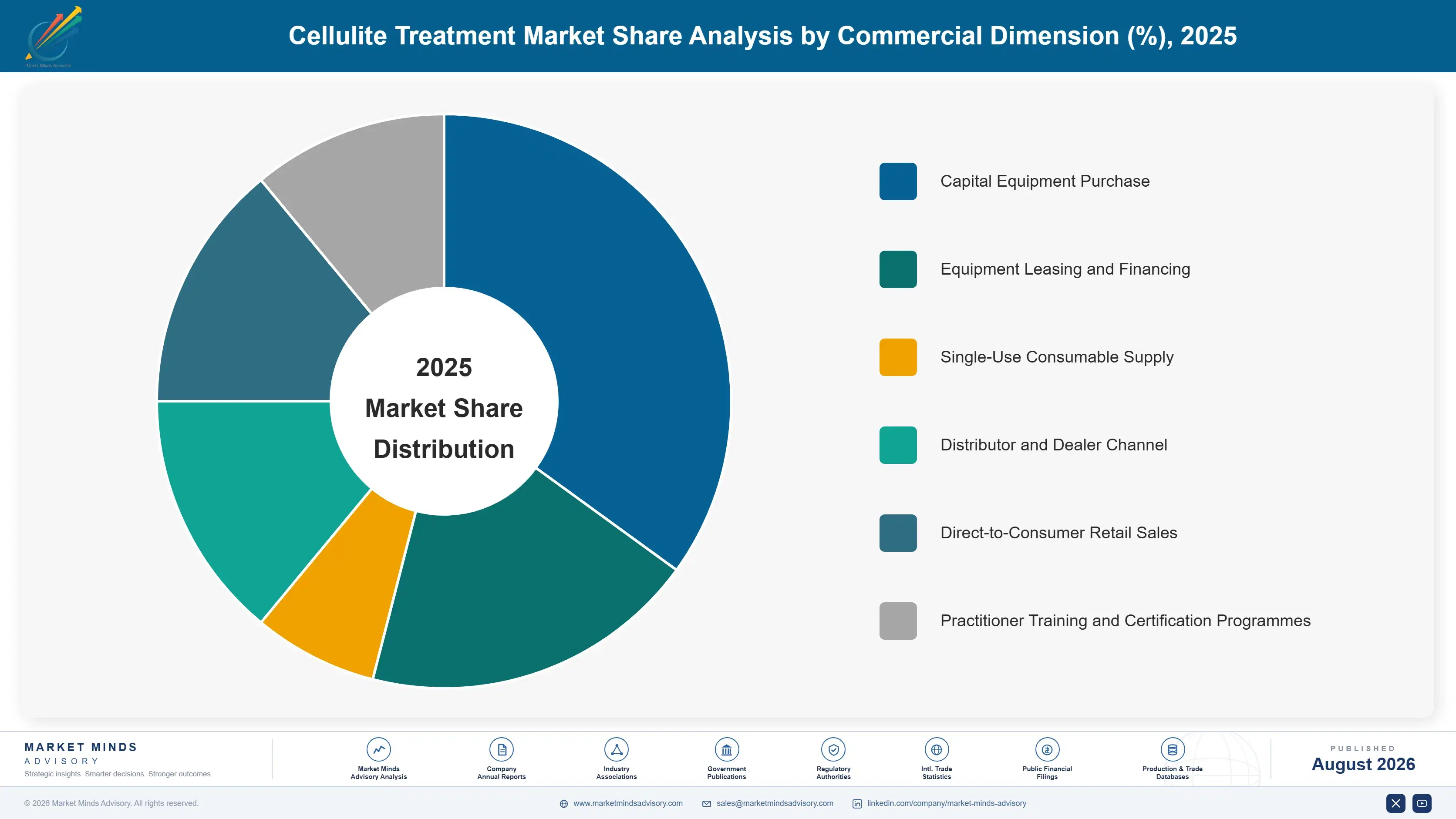
Segmentation follows product type, because type determines the treatment mechanism, the regulatory pathway, the capital requirement for a practice and how revenue arrives. Five product types cover cellulite treatment supply without overlap between them. Treatment setting and body area cut across every type at once and are treated here as use attributes rather than as segments.
cellulite-treatment-market-market-share-analysis-1787304876118

Mechanical Subcision Systems

Growing at 12.3%, a full 1.50x the market rate, mechanical subcision releases the fibrous septae responsible for dimpling by passing a blade or needle beneath the skin, addressing the actual anatomy rather than the fat around it. Published follow-up shows improvement persisting well past a year, which nothing energy-based has matched convincingly, and durable results generate referral in a way temporary ones never did. The constraints are honest ones: technique matters considerably, bruising is common, and the procedure requires a practitioner rather than a technician, which limits how far the modality can scale commercially. Training and certification programmes have become a genuine commercial asset for manufacturers here. Certification is becoming a barrier as much as a service.
CAGR 12.3%

Energy-Based Devices

Energy-based devices grow at 8.6%, principally because the cellulite indication now travels on radiofrequency and acoustic platforms that practices purchase for skin tightening, body contouring or facial work. Cellulite justifies very little of the roughly USD 95,000 capital outlay, which is exactly why the route works: the manufacturer reaches practices that would never buy a dedicated system. Durability remains the weakness, with improvement typically fading within months and retreatment rates near 44% reflecting that directly. Consumable attach provides recurring revenue that the capital sale alone would not. Price competition from Korean and Chinese manufacturers offering comparable radiofrequency capability has compressed capital margins steadily across export markets, which makes the consumable stream more important to defend than the equipment sale itself.
CAGR 8.6%
Full segment breakdown across 5 segments available in the complete report.

Regional Architecture and Country Demand Map

Regional value follows aesthetic spending culture rather than population or income, and the two diverge sharply here. Body contouring occupies a very different cultural position across Latin America than it does in East Asia or Northern Europe. Income and population explain remarkably little of the pattern below.

North America

North America holds the largest share at 30% on the highest treatment pricing anywhere and the deepest portfolio of cleared devices, which is a genuine rather than a default position: regulatory clearance for cellulite indications concentrated here first, and practices command course pricing well above USD 2,400 in metropolitan markets. Medical spa and practitioner density is high, and multi-indication platform purchasing is the norm rather than the exception. The 2023 injectable withdrawal was felt most sharply here, since United States practices had built treatment programmes around a product that then disappeared from their treatment menus entirely. Consumable attach rates are the highest anywhere, reflecting both procedure volume and closed platform architectures.
Share: 30% | CAGR: 7.6% (2026 to 2036)

East Asia

Twenty-two per cent of value, growing at 9.4%. South Korean and Chinese aesthetic markets are enormous and expanding, but body contouring demand skews toward fat reduction and skin tightening rather than cellulite specifically, reflecting different body composition patterns and different aesthetic priorities across the region. Korean device manufacturers compete aggressively on price against Western platforms and increasingly export them. Chinese approval timelines for aesthetic devices have shortened, widening the cleared options available to practices there. Consumer awareness of cellulite specifically is lower than in Western markets, and practitioners more often present it as one component of a broader body programme rather than as a treatment indication in its own right. That framing shapes how manufacturers position platforms here.
Share: 22% | CAGR: 9.4% (2026 to 2036)
Regional intelligence for 5 additional markets available in the complete report: Western Europe, Latin America, South Asia and Pacific, Middle East and Africa, Eastern Europe. Contact sales@marketmindsadvisory.com.
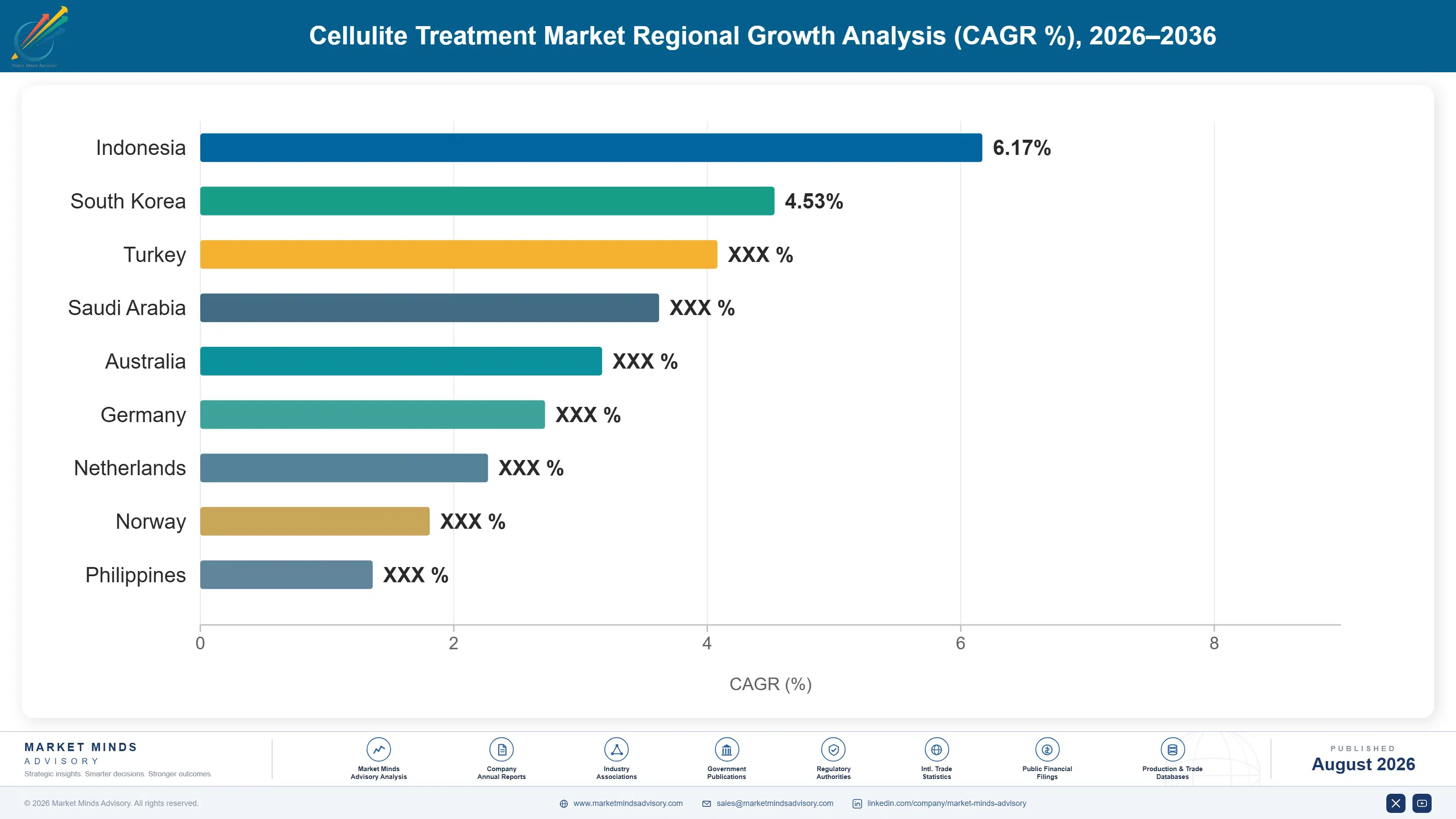
cellulite-treatment-market-country-cagr-analysis-1787304876997

Where Cellulite Treatment Margin Concentrates

Practices rarely buy equipment for cellulite alone, patients pay entirely from discretionary income, and durability determines whether anyone refers a friend. Margin therefore accrues to manufacturers who reach practices through platforms bought for other reasons, and who can defend a durability claim honestly. Everything else here competes on specification against lower-cost alternatives that keep arriving.

Distribute the indication on platforms bought for something else

Cellulite justifies almost none of a roughly USD 95,000 platform purchase, which is precisely why adding the indication to radiofrequency and acoustic systems bought for skin tightening or facial work reaches practices no dedicated device ever will. The manufacturer captures treatment volume without needing the customer to justify the capital on cellulite alone. Dedicated single-indication systems face a purchase decision that most practices decline, and that gap explains far more of the market structure than technology differences do. Distributor economics work the same way, since a distributor carries platforms rather than indications.
Market Impact: Reaches practices already spending

Build the commercial case on durability rather than immediate effect

Mechanical subcision compounds at 12.3% on results that persist past a year, while energy-based treatment carries retreatment rates near 44% as improvement fades. Durable outcomes generate patient referral, which is by far the cheapest acquisition channel in cash-pay aesthetics. Manufacturers claiming durability they cannot support damage the referral engine for everyone, and this category has already lost credibility twice that way. Honest positioning against a shorter durability window still beats an overclaim that patients discover themselves. Patients now research modalities before consulting and arrive naming them, which shortens the distance between an overclaim and its discovery considerably.
Market Impact: Retreatment rates currently running

Treat tolerability as a commercial specification, not a clinical footnote

An approved injectable with respectable efficacy came off the market in 2023 because bruising and hyperpigmentation proved unacceptable to patients paying for a cosmetic result out of their own pockets. In elective self-funded treatment, downtime is a purchase criterion rather than a side effect note. Development programmes weighting efficacy over tolerability are optimising the wrong variable entirely. Staged protocols, reduced dosing and combination approaches that lower visible bruising are worth more commercially than incremental efficacy gains. Younger patients funding treatment from constrained budgets tolerate visible downtime least of all. That group is growing.
Market Impact: One approved product was withdrawn

Attach recurring consumables to every capital placement

Consumables currently deliver roughly 31% of system revenue, and that proportion decides whether an installed base is an annuity or a one-time sale. Single-use tips, cartridges and treatment applicators generate income tied to procedure volume rather than to equipment replacement, which in aesthetics runs long and unpredictably. Manufacturers selling open platforms with third-party consumable compatibility have surrendered the more durable half of the business, and recovering it after installation is close to impossible. Practices with open platforms have switched to third-party tips within roughly a year of installation, and no commercial arrangement afterwards has reliably brought them back.
Market Impact: Consumables now delivering 31% of t

Who Controls the Margin Pool

Concentration is moderate at 38% across the top five, measured on annual revenue from cellulite-indicated systems, injectables, topicals and associated consumables, the single basis applied throughout. Cutera, Cynosure Lutronic, Candela, InMode and Merz Aesthetics lead, though none derives the majority of its revenue from cellulite, which is itself the most important fact about the competitive structure here.
Competition runs on dimensions that reflect that. Platform manufacturers compete on breadth of cleared indications, since a practice buying one system wants it to earn across several treatment types. Dedicated subcision specialists compete on durability evidence and practitioner training, a different contest entirely. Topical manufacturers compete on retail distribution and marketing spend, and share almost nothing commercially with the device businesses beyond the patient population.

Pressure builds from two directions. Korean and Chinese device manufacturers compete on price against Western platforms with increasingly comparable capability, and they have moved well beyond their home markets. Separately, the absence of an injectable leaves an unserved route to practices holding no capital equipment. Rankings shift most if an injectable returns with acceptable tolerability, since that would reach a practice population devices cannot economically serve.
cellulite-treatment-market-company-positioning-matrix-1787304877900

Competitive Moat and Risk Dimensions

INMODE

Moat: Multi-indication platform breadth

Platforms cleared across a wide range of body and facial indications let a practice justify capital on the total earning capability rather than on cellulite alone, which is the purchasing logic that actually governs this market. A direct sales organisation with deep practitioner relationships supports adoption of additional indications on installed systems without requiring any new equipment purchase.
INMODE

Risk: Aesthetic capital cycle exposure

Revenue depends heavily on practices making discretionary capital equipment purchases, and aesthetic capital spending contracts quickly when consumer demand softens or credit tightens. Korean and Chinese manufacturers offer comparable radiofrequency capability at materially lower prices. Cellulite durability claims across the energy-based category remain vulnerable to subcision comparison data.
CUTERA

Moat: Installed base and consumables

A large installed base across aesthetic practices generates recurring single-use consumable revenue tied to procedure volume rather than equipment replacement, which is the more durable half of this business. Long-standing practitioner relationships and established service coverage support additional indication adoption on systems already sitting in treatment rooms.
CUTERA

Risk: Financial and competitive pressure

The company has operated under sustained financial pressure in recent years, which constrains the sales investment and product development that competitive aesthetic markets demand continuously. Price competition from Asian manufacturers has compressed capital equipment margins across the category. Cellulite remains a secondary indication rather than a revenue driver in its own right.

Players Tracked

Prominent Players

Cutera
Cynosure Lutronic
Candela
InMode
Merz Aesthetics

Other Key Players

Revelle Aesthetics
Alma Lasers
BTL Industries
Venus Concept
EndyMed
Solta Medical
Lumenis
Zimmer MedizinSysteme
LPG Systems
Sisram Medical
AbbVie
Endo
Sofwave Medical
Beiersdorf
Clarins

Recent Developments

JUNE 2025

Subcision follow-up data extends durability claims past two years

Longer-term follow-up from mechanical subcision studies reported improvement persisting beyond two years in treated dimples, an evidence development rather than a corporate transaction, and one that widened the durability gap against energy-based alternatives considerably. Practitioners began citing the data directly in patient consultations across several markets.
Signal: Durability evidence is now becoming the co
OCTOBER 2025

Korean manufacturers expand body platform presence in Western markets

Korean aesthetic device manufacturers widened their distribution across European and Latin American markets through organic channel expansion, offering radiofrequency body platforms with cellulite indications at prices materially below established Western competitors. Distributors in several markets added Korean lines alongside existing Western platforms rather than replacing them outright.
Signal: Capital equipment price competition has fi
FEBRUARY 2026

Combination protocols pair subcision with energy-based skin tightening

Practitioners increasingly combined mechanical subcision for dimple release with radiofrequency skin tightening in staged protocols, an organic clinical practice development addressing the two distinct anatomical contributors rather than treating either one alone. Manufacturers have been slower to market combination protocols than practitioners have been to adopt them.
Signal: Clinical practice is converging on combina

Applicator, Component and Clinical Evidence Costs

Cost structure divides between capital systems and the consumables that follow them. Radiofrequency generators, acoustic transducers and handpiece assemblies account for roughly 42% of system cost of goods, drawn from specialist electronic component suppliers concentrated in East Asia and Western Europe. Single-use applicators, tips and cartridges carry considerably lower unit cost and considerably higher margin. Clinical evidence generation sits outside cost of goods yet frequently exceeds it e
Semiconductor and specialist component availability through 2021 and 2022 disrupted aesthetic device manufacturing more than the sector's low volumes would suggest, because low-volume specialist parts carry no foundry priority whatsoever. Manufacturer annual reports across that period recorded extended lead times and component redesign work. Several manufacturers built inventory buffers afterwards at a working capital cost that persisted well beyond the disruption that prompted them originally.

Exposure varies sharply by business model. Manufacturers relying on capital sales carry full component exposure on every unit, while those with high consumable attach earn recurring margin on parts costing little to produce. Geography matters too: Korean and Chinese manufacturers with domestic component supply operate at cost structures Western competitors cannot match, which is why price competition has intensified so quickly.
cellulite-treatment-market-cost-volatility-analysis-1787304878199

Build consumable attach into platform design from the outset

Consumables deliver roughly 31% of system revenue at margins the capital sale cannot approach, and the decision that determines attach rate is made at design stage rather than commercially afterwards. Open platforms accepting third-party tips surrender that revenue permanently, and recovering it from an installed base is effectively impossible once practices have found cheaper alternatives.

Qualify second-source suppliers for specialist electronic components

Aesthetic device volumes are far too low to command supply priority when specialist components tighten, as several manufacturers discovered through 2021 and 2022 at considerable cost. Qualifying alternate sources during normal conditions costs engineering time rather than capital and removes the redesign scramble entirely. Platform commonality across product lines multiplies the same protection considerably further.

Fund durability evidence as a commercial rather than regulatory expense

Regulatory clearance requires far less evidence than a credible durability claim does, and durability is now the dimension that decides practitioner recommendation in this category. Treating long-term follow-up as a marketing investment rather than a compliance cost changes both the budget and the study design, and the resulting data is worth considerably more commercially.

Portfolio Architecture for Margin Defence

Margin architecture separates on whether revenue recurs. Capital equipment sold into a competitive aesthetic market earns respectable but pressured margins, and price competition from Asian manufacturers has compressed them steadily. Single-use consumables tied to procedure volume earn considerably better and arrive continuously rather than at replacement. Topical products occupy a different economic model again, carrying retail margins alongside marketing costs that consume most of the differen
The volume against premium tension is unusually stark here. Topicals reach by far the largest number of consumers at low prices with no durable efficacy, and they fund the category's consumer awareness almost single-handedly. Device-based treatment reaches a fraction of that population at course pricing near USD 2,400 with genuine but partial results. Neither side of that split converts patients toward the other as often as either would like.

High-value pools concentrate around recurring revenue and defensible claims. Consumable streams tied to procedure volume, subcision systems with durability evidence behind them, and platforms whose cleared indication breadth justifies practice capital all command premium. Standalone capital equipment competing on specification against lower-cost Asian alternatives does not, and that competitive pressure is intensifying rather than easing across every export market.

Volume / Commodity-Adjacent Tier

Topical cosmetic preparations and entry-level suction or massage systems, competing on retail distribution and marketing spend without any durable clinical efficacy claim to defend or substantiate. Marketing spend consumes most of the retail margin available.
Gross Margin: 34-48%

Premium / Certified Tier

Cleared energy-based platforms with multiple treatment indications, protected by practitioner relationships, service coverage and the capital already committed to systems sitting in treatment rooms. Price competition from Asian manufacturers keeps compressing this tier.
Gross Margin: 52-64%

Sustainability / Regulatory / Next-Generation Tier

Mechanical subcision systems with multi-year durability evidence and their associated single-use consumables, commanding premium because no competing modality has matched the persistence of the result. Practitioner training and certification programmes reinforce the position considerably further.
Gross Margin: 66-78%
cellulite-treatment-market-portfolio-architecture-1787304879010

Discretionary Courses and Consumable Annuities

Revenue reaches manufacturers through two entirely different routes here. Capital equipment arrives as a single large payment from a practice making a discretionary investment decision, and the aesthetic replacement cycle is long, unpredictable and highly sensitive to credit conditions. Consumables arrive continuously with every procedure performed, tracking practice activity rather than purchasing intent, and currently delivering roughly 31% of system revenue.
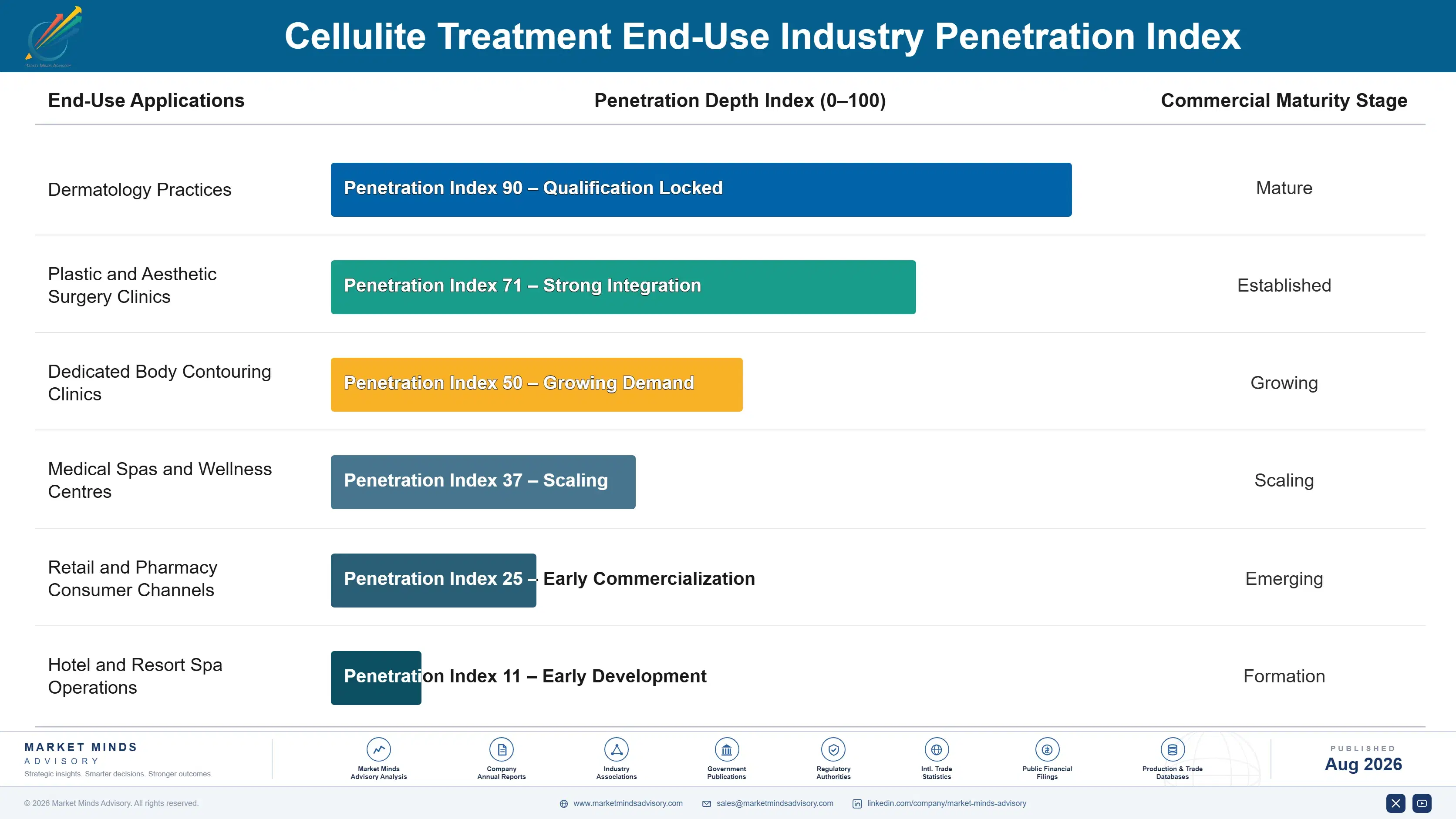
Adoption depth varies considerably by practice type. Dermatology and plastic surgery practices adopt cellulite treatment as one indication among many on platforms justified by their total earning capability, and they treat it as a secondary revenue line. Dedicated body contouring clinics build treatment programmes around it and generate far higher procedure volume per system. Medical spas sit between the two, constrained by scope of practice rules varying by jurisdiction.

Patient profiles have shifted in ways that matter commercially. The category was built on women in their forties and fifties seeking correction, and demand now extends considerably younger as social media raised awareness among patients in their twenties. Those younger patients research treatment mechanisms before consulting, arrive asking about specific modalities by name, and are markedly less tolerant of durability claims that their own experience later contradicts.
cellulite-treatment-market-end-use-penetration-index-1787304879905

Where Cellulite Strategy Must Land

These are among the four positions where our research anticipates prominent divergence between winners and laggards over the coming forecast period. Each is grounded in the demand model, the regulatory perimeter, and the announced capacity pipeline.
01 / MECHANISM HONESTY DISCIPLINE

Treating fat never addressed the actual anatomy

Cellulite is produced by fibrous septae tethering skin down to underlying fascia, which is precisely why patients who lose substantial weight frequently see no visible improvement whatsoever in their dimpling. A whole generation of fat reduction and skin tightening devices sold genuine technology against a mechanism that it simply did not address at all. Mechanical subcision compounds at 12.3% precisely because it releases those fibrous bands directly, and the durability difference visible in published follow-up data is not merely a marketing distinction.
02 / TOLERABILITY PURCHASE CRITERION

In cash-pay aesthetics, downtime is a specification

An approved injectable collagenase with efficacy data clinicians respected was commercially withdrawn in 2023 because bruising and post-inflammatory hyperpigmentation proved unacceptable to patients funding a purely cosmetic result entirely from their own pockets. Efficacy was never the problem in that particular case, and treating tolerability as a clinical footnote rather than a genuine purchase criterion is what cost the category its most scalable option. Development programmes still weighting efficacy above tolerability in this category are optimising quite the wrong variable altogether.
03 / PLATFORM DISTRIBUTION LOGIC

Nobody buys a system for cellulite alone

A treatment platform costs a practice roughly USD 95,000 and the cellulite indication justifies almost none of that capital outlay on its own commercial merits under any realistic practice model. Adding the indication to radiofrequency and acoustic systems already purchased for skin tightening or facial work reaches practices that would never in any circumstances approve a dedicated single-indication purchase. That distribution logic explains considerably more about this market's competitive structure than any technical comparison of the underlying treatment technologies ever will.
04 / CONSUMABLE ATTACH DESIGN

The annuity is decided at design stage

Single-use consumables currently deliver roughly 31% of total system revenue at margins that no capital equipment sale in this fiercely competitive category can realistically approach anywhere. That revenue tracks actual procedure volume rather than the long and highly unpredictable aesthetic replacement cycle, which makes it by far the more durable half of the whole business. Open platforms accepting third-party tips surrender that revenue permanently, and recovering the position from an existing installed base afterwards is close to impossible in practice.

Engagement Snapshot From the Field

A live engagement with an industry participant carrying material or product regulatory and market exposure ahead of a defining policy shift, showing how our research translates into a defensible multi-year portfolio strategy.
MARKET MINDS ADVISORY · CLIENT ENGAGEMENT SUMMARY
Cellulite Treatment Producer Strategic Portfolio Review and Transition Roadmap 2026·Investment Scenario on Cellulite Treatment Exposure Evaluation 2025-26
CLIENT PROFILE
A mid-sized aesthetic device manufacturer with a radiofrequency body platform carrying a cellulite indication, a modest consumable line and no position in mechanical subcision. Annual revenue was approximately USD 180 million (client-reported, unverified by MMA), weighted heavily toward capital equipment sales through distributors across Europe, Latin America and the Middle East. Consumable attach was well below category average across the installed base.
STRATEGIC CHALLENGE
Capital equipment pricing had eroded steadily against Korean competitors offering comparable radiofrequency capability, while emerging subcision durability data was reframing how practitioners discussed cellulite outcomes with patients. The board needed to decide whether to defend platform pricing through added indications, or to acquire subcision capability and reposition the portfolio around durability evidence instead.
MMA APPROACH
MMA conducted 47 expert interviews spanning dermatologists, plastic surgeons, body contouring clinic owners, medical spa directors, aesthetic device distributors and practice financial managers across six countries. A quantitative survey of 3,800 respondents established patient treatment expectations, tolerance for downtime, retreatment behaviour and willingness to pay across modalities. We then modelled revenue and margin under both options against observed capital pricing and procedure volumes.
KEY FINDINGS
  1. Practitioners in five of six markets reported that patients now arrive naming specific treatment modalities, and that durability questions dominate consultations in a way they did not three years ago.
  2. Practice owners justified platform capital almost entirely on total indication breadth, and none surveyed would have approved the same purchase for a cellulite indication alone.
  3. Patient tolerance for visible bruising proved far lower than clinical trial dropout data implied, and it fell further among younger patients paying from constrained discretionary budgets.
  4. Consumable attach rates varied enormously between manufacturers, and practices with open-architecture platforms had switched to third-party tips within roughly a year of installation.
CLIENT PROFILE
A mid-sized aesthetic device manufacturer with a radiofrequency body platform carrying a cellulite indication, a modest consumable line and no position in mechanical subcision. Annual revenue was approximately USD 180 million (client-reported, unverified by MMA), weighted heavily toward capital equipment sales through distributors across Europe, Latin America and the Middle East. Consumable attach was well below category average across the installed base.
STRATEGIC CHALLENGE
Capital equipment pricing had eroded steadily against Korean competitors offering comparable radiofrequency capability, while emerging subcision durability data was reframing how practitioners discussed cellulite outcomes with patients. The board needed to decide whether to defend platform pricing through added indications, or to acquire subcision capability and reposition the portfolio around durability evidence instead.
MMA APPROACH
MMA conducted 47 expert interviews spanning dermatologists, plastic surgeons, body contouring clinic owners, medical spa directors, aesthetic device distributors and practice financial managers across six countries. A quantitative survey of 3,800 respondents established patient treatment expectations, tolerance for downtime, retreatment behaviour and willingness to pay across modalities. We then modelled revenue and margin under both options against observed capital pricing and procedure volumes.
KEY FINDINGS
  1. Practitioners in five of six markets reported that patients now arrive naming specific treatment modalities, and that durability questions dominate consultations in a way they did not three years ago.
  2. Practice owners justified platform capital almost entirely on total indication breadth, and none surveyed would have approved the same purchase for a cellulite indication alone.
  3. Patient tolerance for visible bruising proved far lower than clinical trial dropout data implied, and it fell further among younger patients paying from constrained discretionary budgets.
  4. Consumable attach rates varied enormously between manufacturers, and practices with open-architecture platforms had switched to third-party tips within roughly a year of installation.
RECOMMENDED STRATEGY
Phase 1: Phase one: close the platform architecture on consumables for new placements, since attach rate is decided at design stage and cannot be recovered afterwards. Phase 2: Phase two: acquire or license mechanical subcision capability rather than build it, because durability evidence takes years the competitive position does not allow. Phase 3: Phase three: reposition marketing around combination protocols pairing subcision with the existing radiofrequency platform, matching where clinical practice has already moved.
OUTCOME
The client closed its consumable architecture on new placements, licensed a subcision system rather than developing one, and redirected roughly USD 22 million toward combination protocol evidence (client-reported, unverified by MMA). Consumable revenue share rose by several points within a year, capital pricing stabilised in two regions, and practitioner recommendation scores improved measurably against the Korean competitors.

Frequently Asked Questions

Foundational context covering the market sizes, CAGR, scope, country, region and competition that inform every finding below. This section is provided to cover basics and most often pre-purchase conversations, answered from the MMA Primary Research Dataset.

What is the current size of the Cellulite Treatment Market?

The global cellulite treatment market was valued at USD 1.6 billion in 2025, spanning energy-based devices, mechanical subcision systems, injectables, topicals and suction or massage systems. Roughly 88% of post-pubertal women show some visible degree of the condition.

How large will the Cellulite Treatment Market be by 2036?

MMA forecasts the market at USD 3.81 billion by 2036, expanding 2.20 times from the 2026 base of USD 1.73 billion. That represents roughly USD 2.08 billion of incremental value across the forecast decade.

What is the CAGR for the Cellulite Treatment Market 2026 to 2036?

The base case compound annual growth rate is 8.2%, with a bull case of 9.4% and a bear case of 7.0%. The bull case assumes an injectable returns to market with an acceptable tolerability profile.

Which segment is growing fastest?

Mechanical subcision systems grow at 12.3%, a full 1.50x the overall market rate. Releasing the fibrous septae directly is the only mechanism producing improvement that persists at multi-year follow-up.

Who are the major companies in the Cellulite Treatment Market?

Cutera, Cynosure Lutronic, Candela, InMode and Merz Aesthetics together hold 38% of revenue. None derives the majority of its revenue from cellulite, which shapes the competitive structure more than anything else.

Which country is growing fastest?

Brazil grows fastest at 12.4%, with body contouring holding a cultural centrality it lacks in most developed markets. North America remains the largest region at 30% of value on the highest treatment pricing worldwide.

Report Segmentation Architecture

The full report scope spans multiple orthogonal segmentation dimensions, with cross-tabulated demand data provided for each dimension pair. Coverage extends further to regional breakdowns, trend trajectories, and the competitive detail needed to support segment-level decision-making.

By Product Type

  • Energy-Based Devices
  • Mechanical Subcision Systems
  • Injectable Products
  • Topical Cosmetic Products
  • Suction and Massage Systems

By End-Use Industry

  • Dermatology Practices
  • Plastic and Aesthetic Surgery Clinics
  • Dedicated Body Contouring Clinics
  • Medical Spas and Wellness Centres
  • Retail and Pharmacy Consumer Channels
  • Hotel and Resort Spa Operations

By Commercial Dimension

  • Capital Equipment Purchase
  • Equipment Leasing and Financing
  • Single-Use Consumable Supply
  • Distributor and Dealer Channel
  • Direct-to-Consumer Retail Sales
  • Practitioner Training and Certification Programmes

By Region

  • North America
  • East Asia
  • Western Europe
  • Latin America
  • South Asia and Pacific
  • Middle East and Africa
  • Eastern Europe

Scope, Methodology, and Coverage

Every figure in this report is reproducible from documented input assumptions. The scope below maps the historical period, the forecast horizon, the segmentation dimensions, and the countries covered, alongside the underlying primary and qualitative methodology.
Historical Period
2020 to 2025
Forecast Period
2026 to 2036
Base Year
2025 (USD billions; MMA Primary Research Dataset, August 2026)
Market Definition
This market comprises products and systems marketed for the treatment or visible improvement of cellulite, measured at manufacturer revenue across capital equipment purchase, equipment leasing, single-use consumable supply, distributor channels, direct consumer retail and practitioner training programmes. Coverage spans energy-based devices including radiofrequency, laser and acoustic wave systems carrying cellulite indications, mechanical subcision systems and their single-use blades or needles, injectable products indicated for cellulite, topical cosmetic preparations marketed for cellulite appearance, and suction, vacuum or massage-based treatment systems. General body contouring and fat reduction devices without a cellulite indication, surgical liposuction and excisional procedures, skin tightening treatments marketed solely for laxity, compression garments and shapewear, dietary supplements, and clinic service or procedure fee revenue fall outside scope.
Quantitative Units
USD millions (current prices); systems placed by product type; procedures performed; average course price; consumable units consumed; retreatment rate; practice installed base
Segmentation Dimensions
By Product Type; By End-Use Industry; By Commercial Dimension; By Region
Regions Covered
North America, East Asia, Western Europe, Latin America, South Asia and Pacific, Middle East and Africa, Eastern Europe
Countries Covered
United States, Canada, Mexico, Brazil, Argentina, Colombia, Chile, Germany, France, United Kingdom, Italy, Spain, Netherlands, Switzerland, China, Japan, South Korea, Taiwan, India, Australia, Thailand, Malaysia, Indonesia, United Arab Emirates, Saudi Arabia, Israel, Turkey, South Africa, Poland, Czechia, Romania, and additional markets relevant to aesthetic treatment analysis
Key Companies Profiled
Cutera, Cynosure Lutronic, Candela, InMode, Merz Aesthetics, Revelle Aesthetics, Alma Lasers, BTL Industries, Venus Concept, EndyMed, Solta Medical, Lumenis, Zimmer MedizinSysteme, LPG Systems, Sisram Medical, AbbVie, Endo, Sofwave Medical, Beiersdorf, Clarins
Quantitative Methodology
Primary survey, n=3,800 respondents, Q4 2025, six countries; demand-side model with trade association cross-validation
Qualitative Methodology
47 expert interviews, Q4 2025; applied to validate demand model assumptions, identify emerging dynamics, and assess competitive positioning
Report Format
PDF and XLSX data workbook (Word format preview document)
Publisher
Market Minds Advisory
Report Code
MMA-2026-HLT-262
Published
August 2026
Contact
sales@marketmindsadvisory.com | www.marketmindsadvisory.com

Purchase the full Cellulite Treatment Market Report (2026 to 2036).

The full MMA report separates what actually treats cellulite from what has historically been sold against it, quantifying the durability gap between mechanisms and what it means commercially. It sizes five product types and seven regions to 2036, modelling system placements, procedure volumes, course pricing, consumable consumption and retreatment behaviour separately so that recurring revenue can be assessed on its own terms. Competitive assessment covers twenty manufacturers on one consistent revenue basis. Cost exposure is traced through component, applicator and clinical evidence inputs. Four commercial levers and a strategic verdict close the report, grounded in 47 expert interviews and a 3,800-respondent survey.
Five product types sized separately through 2036
Durability evidence compared across competing treatment mechanisms
Consumable attach rates modelled against capital placement volumes
Twenty manufacturers assessed on one consistent basis
Latin American demand concentration quantified against economic weight
Anonymised client engagement with tested strategic recommendations

Built For The People Who Decide

From boardroom strategy to bench-side execution, this report is read cover-to-cover by leaders shaping the next decade of their industry, turning demand scenarios, market dynamics and valuation benchmarks into decisions.
CXOs/ Presidents/ VPs/ Managers
M&A and Corporate Development
Strategy Teams and R&D Heads
Procurement and Product Directors
Regulatory and Compliance Leaders
Investor Relations and Equity Analysts