Market Minds Advisory
Repeaters for Cellular Network Market

Repeaters for Cellular Network Market: Repeaters for Cellular Network Market. Signal Amplification Infrastructure for 5G and In-Building Coverage

Densifying 5G networks, expanding in-building coverage mandates, and rising indoor data consumption push carriers and enterprises toward smart, software-optimized repeaters that close persistent signal gaps across large indoor facilities today.

Lead Analyst

Published

September 2026

Make Smarter Decisions with Customized Research Insights

Request a free sample report and evaluate market opportunities, growth trends, and competitive dynamics relevant to your business needs.

2025 MARKET VALUE$1.6BMarket Size 2025
2036 FORECAST VALUE$3.6BBase Case , 2026 to 2036
CAGR 2026 TO 20367.5 %Bull 8.7% / Bear 6.3%
INCREMENTAL OPPORTUNITY$1.9BNet 10- year value creation
EXPANSION MULTIPLE2.06x2036 value over 2026 base
Strategic Levers
M&A Pipeline
Regional Outlook
Country Rankings
Competitive Intelligence
Segmental Deep-dive
Call-Us : 91 93563 13602

Executive Snapshot and Market Trajectory.

Cellular repeater demand is shifting from simple analog boosters to software-defined systems as carriers and enterprises chase reliable indoor coverage across increasingly dense 5G network deployments, larger commercial facilities, and stricter carrier interference regulations governing signal amplification equipment sold to consumers, enterprises, and carriers alike across most jurisdictions.
Smart, AI-optimized repeaters are pulling ahead of legacy analog units as building owners chase interference-free signal amplification across large commercial facilities and multi-tenant properties spanning several carrier networks simultaneously. East Asia's dense urban buildout and aggressive carrier infrastructure spending concentrate the fastest deployment activity there, well ahead of comparable adoption in most other regions globally today, particularly among newly constructed high-rise commercial towers and large multi-carrier retail complexes across major metropolitan markets.
Established consumer and enterprise booster vendors compete against carrier-grade infrastructure suppliers winning large in-building deals, but software optimization capability is becoming the decisive purchase criterion as building owners consolidate multiple carrier coverage needs onto fewer unified repeater platforms each procurement cycle, pressuring smaller analog-only vendors to differentiate on installation speed and service depth instead of pure hardware price competition, an increasingly difficult position to sustain.
Market Definition
The Repeaters for Cellular Network Market covers signal amplification equipment that captures, boosts, and rebroadcasts cellular signals to extend or improve indoor and outdoor coverage, including analog, digital, and software-defined repeater systems. It excludes small cell base stations that originate rather than repeat carrier signal, standalone distributed antenna system cabling sold without amplification hardware, and Wi-Fi range extenders.
Base Year Value
$1.6B in 2025 (MMA Primary Research Dataset, September 2026)
Forecast Period
2026 to 2036, eleven discrete annual values
CAGR
7.5% base case. Bull 8.7%. Bear 6.3%.
Fastest Growth Segment
Software-Defined and AI-Optimized Repeaters: 13.5% CAGR
Fastest Growth Country
India: 12.0% CAGR
Fastest Growth Region
South Asia and Pacific: 9.5% CAGR
Largest Region
East Asia: 28% of 2025 global value
Market Leaders
Wilson Electronics, SureCall, Nextivity, CommScope, and Comba Telecom lead the market. Source: MMA Analysis, July 2026.
Primary Survey
n=3,800 procurement and R&D decision-makers, Q4 2025, six countries
Methodology
Demand-side build-up, cross-validated against public data, 47 expert interviews

Repeaters for Cellular Network Market Forecast Scenarios

cellular-repeater-market-size-forecast-scenario-1789980364740
Cellular repeater demand grew steadily between 2020 and 2025 as expanding 4G and early 5G coverage requirements pushed carriers and building owners to address persistent indoor signal gaps that dense construction materials increasingly worsened. Historical growth ran near 6.5 percent annually across that period, accelerating meaningfully as 5G rollout intensified toward the tail end of that historical window.
The base case assumes sustained growth through 2036, driven by three commercial mechanisms working together. Expanding 5G mid-band and millimeter-wave deployment continues worsening indoor penetration challenges that only active amplification can resolve cost-effectively. Rising enterprise expectations for uninterrupted mobile connectivity are making repeater investment a standard facility requirement. Software-defined repeater capability continues shortening installation timelines and reducing interference risk across most deployment types each successive year of continued network densification.
A bull case built on accelerated 5G densification and stricter in-building coverage mandates across major markets could push growth meaningfully above base case levels through the back half of the forecast period. A bear case tied to delayed 5G rollout or prolonged commercial construction slowdown would slow repeater deployment considerably across price-sensitive building segments and smaller regional carriers.

Dead Zones Become an Unacceptable Facility Liability

Building owners are treating cellular coverage less like a tenant amenity and more like a leasing requirement, since prospective commercial tenants increasingly ask about indoor signal quality before signing space during property tours, a shift that puts repeater procurement decisions directly in front of facilities management and leasing teams rather than IT departments alone, a meaningful shift in who actually owns the purchase decision within a given organization.
MARKET CONCENTRATION44% CR5top five vendors hold this combined participation share currently
AVERAGE SYSTEM PRICE$3,800 per unittypical mid-size commercial installation equipment cost estimate today
MULTI-CARRIER SUPPORT SHARE58%installed systems supporting more than one carrier network simultaneously
TYPICAL INSTALLATION TIMELINE3 daysaverage time required for a mid-size commercial facility deployment
SOFTWARE-DEFINED UNIT SHARE36%new shipments featuring software-defined rather than purely analog architecture
CARRIER CERTIFICATION PASS RATE91%share of submitted repeater units passing carrier interference certification testing
Commercially, the market splits between established consumer and enterprise booster vendors defending large installed bases through retail and integrator channels, and carrier-grade infrastructure suppliers winning large in-building deals through direct operator relationships, network integration expertise, and long-standing carrier certification track records that smaller vendors struggle to match without significant, sustained investment in dedicated carrier relations staff and certification testing infrastructure over time.
Over the coming decade, software optimization capability and carrier interference certification depth will keep separating credible platforms from commodity analog boosters that regulators increasingly restrict from unlicensed commercial deployment, pushing the market steadily toward certified, carrier-approved systems across most facility types and geographies, leaving legacy analog-only vendors an increasingly narrow window to adapt or exit the category entirely.
"Nobody notices the repeater working. Everybody notices the one dropped call during a client presentation, and that call is what actually gets budget approved."
Director, Wireless Infrastructure and Connectivity Practice · MMA Cellular Signal Repeater Practice · September 2026

Market Trends

Software-Defined Repeaters Become the Default New Purchase

Software-defined repeaters, which automatically adjust gain and filter interference to meet strict carrier certification requirements, are becoming the default new purchase as regulators tighten enforcement against unlicensed analog boosters causing network interference. Roughly 36 percent of new shipments now feature software-defined architecture, up meaningfully from prior years, as carriers push installers toward certified equipment during network integration reviews. This shift is compressing the competitive position of legacy analog manufacturers unable to retrofit comparable intelligence into existing product lines without a substantial engineering redesign, forcing many toward consolidation or exit from the category entirely.
Market Impact: 44 percent cite 5G gaps
In-Building Coverage Mandates Expand Across New Building Codes

Municipal and national building codes increasingly mandate minimum indoor cellular signal strength for public safety communications, expanding beyond the emergency responder radio requirements that historically drove most mandated repeater installations. Roughly 29 percent of new commercial construction projects in covered markets now specify cellular repeater infrastructure at the design stage rather than as a retrofit addition after occupancy. This code expansion is pulling architects and general contractors into repeater purchase decisions earlier than the facilities management involvement that traditionally characterized this category, widening the addressable buyer base considerably across most major covered construction markets.
Market Impact: 33 percent of permits mandate

Market Opportunities and Growth Drivers

5G Mid-Band Rollout Worsens Indoor Penetration Challenges

5G mid-band and millimeter-wave frequencies, which carry substantially more data capacity than legacy low-band spectrum, penetrate modern building materials far less effectively, creating indoor coverage gaps that active repeater amplification is often the only cost-effective way to resolve. Carriers deploying mid-band 5G report meaningfully higher indoor dead-zone complaints in newly covered areas compared to legacy 4G rollouts in the same buildings. Roughly 44 percent of surveyed enterprise facility managers cite 5G indoor coverage gaps as their primary repeater purchase justification, ahead of general signal improvement alone as the primary justification cited by these respondents.
Market Impact: 8 months average certification timeline

Public Safety Communication Mandates Require Certified Systems

Fire and building codes across an expanding number of jurisdictions require certified in-building emergency responder radio coverage systems, creating a mandatory, non-discretionary purchase category that persists regardless of broader commercial construction cycles or enterprise IT budget pressure. Facilities failing certification inspections face occupancy delays and ongoing compliance penalties that make repeater investment effectively unavoidable for covered building types. Roughly 33 percent of large commercial building permits in covered jurisdictions now include a mandated public safety coverage system requirement at the design stage rather than as a later retrofit addition after occupancy begins.
Market Impact: 17 percent of complaints unlicensed

Market Restraints and Challenges

Carrier Certification Complexity Slows New Product Launches

Repeater manufacturers must obtain separate interference certification from each carrier network before equipment can be legally deployed on that network, forcing vendors to navigate multiple parallel approval processes with differing technical requirements. The root cause is that carriers historically developed independent certification standards without a shared cross-industry framework, unlike some other regulated telecom equipment categories. This extends average new product certification timelines to roughly eight months across major carriers, well beyond the six-week timeline typical of markets with unified certification standards. Vendors are increasingly participating in industry standards bodies to push toward more harmonized testing requirements across carriers.
Market Impact: 36 percent of shipments now software-defined

Unlicensed Analog Booster Sales Undermine Category Reputation

Unregulated online marketplaces continue selling uncertified analog boosters that cause network interference when improperly installed, generating carrier complaints and regulatory enforcement actions that create reputational spillover for the broader legitimate repeater category. The underlying cause is that enforcement against individual online sellers remains inconsistent across jurisdictions, allowing uncertified products to persist despite regulatory prohibition. This interference problem accounts for roughly 17 percent of carrier network complaints in covered markets, according to regulatory filings reviewed. Legitimate vendors increasingly lobby for stricter online marketplace enforcement to protect certified product credibility and carrier trust in the category overall.
Market Impact: 29 percent of new builds specify
4 additional market trends, 4 additional growth drivers, and 3 additional restraints and challenges are covered in the full report. Contact sales@marketmindsadvisory.com to access the complete intelligence.

Segment CAGR and Growth Architecture

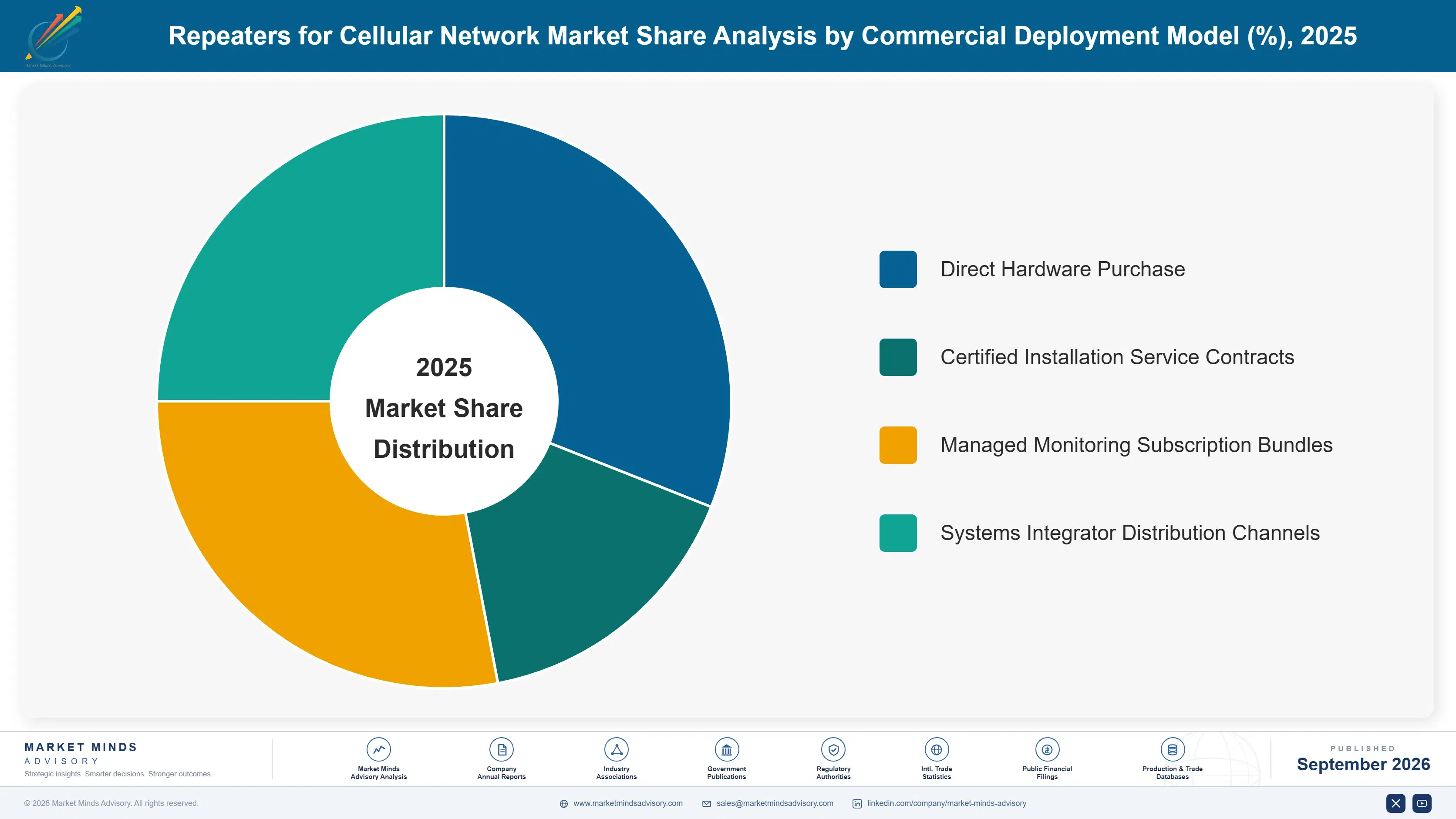
This report segments the Repeaters for Cellular Network Market by repeater technology type, the clearest lens for near-term procurement decisions across large and mid-size commercial and residential facility types, since analog, digital, and software-defined systems carry distinct pricing, certification pathways, and buyer profiles despite often serving overlapping coverage use cases within a given facility deployment.
cellular-repeater-market-market-share-analysis-1789980365277

Software-Defined and AI-Optimized Repeaters

Software-defined repeaters use adaptive algorithms to automatically adjust gain, filter interference, and meet strict carrier certification requirements without manual field tuning, replacing the labor-intensive calibration that analog systems historically required. Demand for this segment is accelerating fastest among large commercial and multi-tenant properties seeking to support several carrier networks simultaneously through a single unified system, where interference risk from manual misconfiguration carries the highest certification and liability stakes. Vendors demonstrating proven carrier certification pass rates above industry benchmarks are commanding premium pricing over legacy analog competitors, and enterprise buyers increasingly treat software intelligence as a mandatory procurement requirement across most large-facility deployments, particularly among properties managing several carrier tenants and networks under one lease structure.
CAGR 13.5%

Digital Smart Repeaters

Digital smart repeaters process and regenerate cellular signal digitally rather than through pure analog amplification, delivering cleaner signal quality and more precise gain control than legacy analog units while remaining simpler and less costly to deploy than fully software-defined systems. This segment is growing fastest among mid-size commercial buildings and multi-family residential properties that need meaningfully better coverage than basic analog boosters provide but do not require the full sophistication of enterprise-grade software-defined platforms. Vendors increasingly position digital smart repeaters as the practical mid-tier choice between commodity analog units and premium software-defined systems, capturing budget-conscious buyers unwilling to pay full premium pricing for capability they may not fully need at this stage.
CAGR 10.5%
Full segment breakdown across 6 segments available in the complete report.

Regional Architecture and Country Demand Map

East Asia leads on dense urban buildout, aggressive carrier infrastructure spending, and meaningful manufacturing cost advantages, North America follows closely on strict public safety mandates and stringent multi-carrier requirements, and South Asia and Pacific grows fastest off a smaller installed base of certified systems today.

North America

United States building codes increasingly mandate certified public safety in-building coverage systems, a requirement enforced during fire marshal inspections that makes repeater installation effectively non-discretionary for covered commercial building types. Carrier-driven 5G mid-band densification across major metropolitan markets is compounding indoor coverage challenges that active amplification remains the most cost-effective way to resolve at scale. Canada's regulated commercial building stock follows a similar trajectory at smaller scale. Multi-carrier support requirements are unusually stringent across this region compared to most others, since large commercial properties routinely need to support several major national carriers under a single lease structure and building infrastructure investment across most large metropolitan commercial markets and mixed-use development projects.
Share: 27% | CAGR: 8.3% (2026 to 2036)

Western Europe

Germany, France, and the United Kingdom's dense, historically constructed urban building stock, much of it built with signal-blocking masonry and concrete long before cellular networks existed, generates persistent indoor coverage challenges that newer construction markets rarely face at comparable scale. The European Union's ongoing 5G spectrum harmonization efforts are gradually easing cross-border carrier certification friction for repeater manufacturers operating across multiple member states. Regional vendors with deep expertise navigating fragmented national telecom regulators hold a durable service advantage over foreign entrants unfamiliar with country-specific certification practices. Growth trails the global average since much of the addressable large-building base already completed initial deployment during preceding years of accelerated compliance-driven and safety-driven rollout activity.
Share: 20% | CAGR: 6.0% (2026 to 2036)
Regional intelligence for 5 additional markets available in the complete report: East Asia, South Asia and Pacific, Latin America, Middle East and Africa, Eastern Europe. Contact sales@marketmindsadvisory.com.
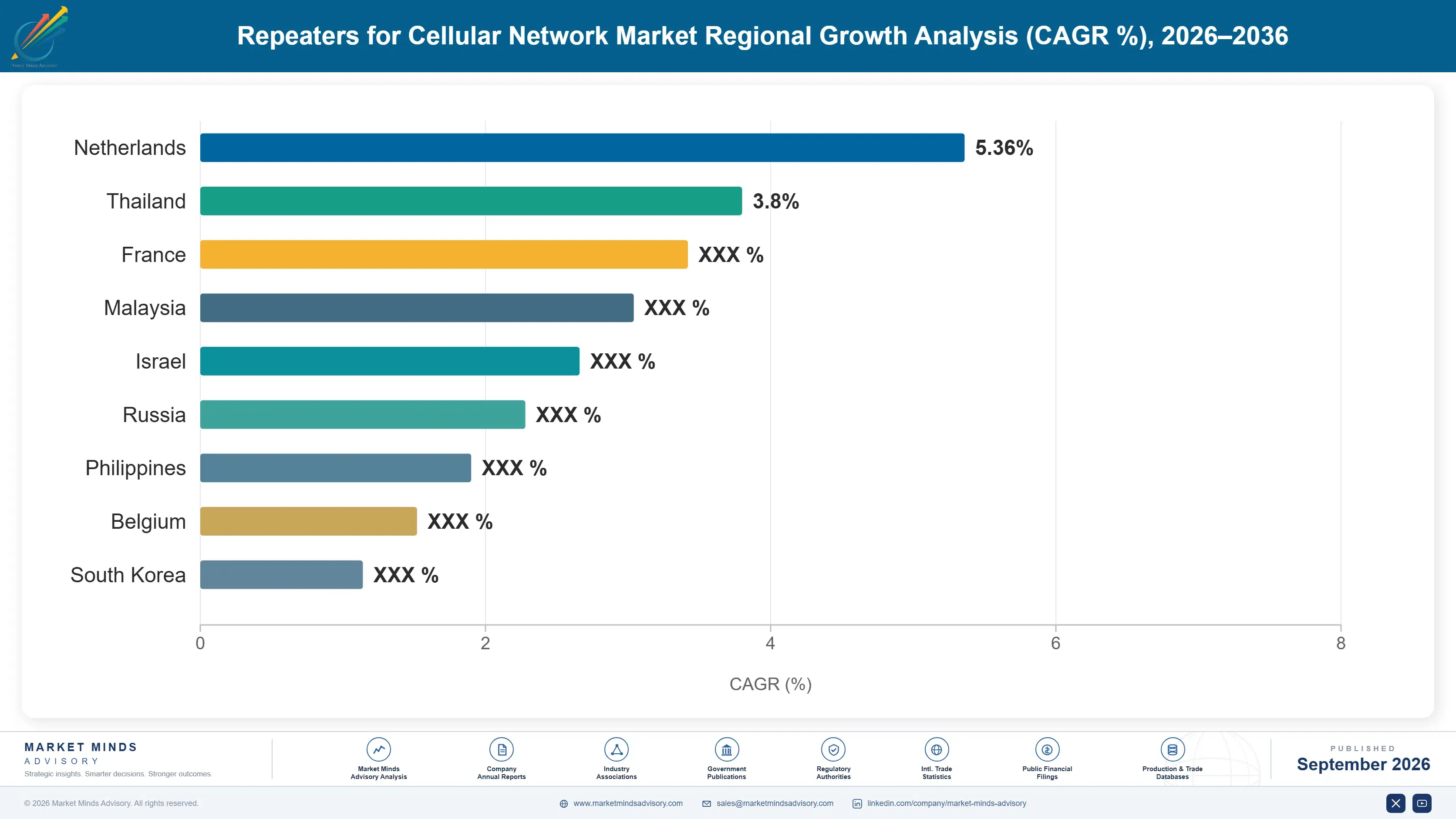
cellular-repeater-market-country-cagr-analysis-1789980365792

Monetizing Beyond the Base Hardware Sale

Beyond standard hardware sales, vendors are building several distinct and increasingly important adjacent revenue streams around installation and carrier certification services, managed remote monitoring subscriptions, multi-carrier bundling, and proprietary software licensing that together capture considerably more of the total value their systems already deliver to building owners across facility types and geographies worldwide today.

Offer Certified Installation And Commissioning Services

Vendors are pricing certified installation and carrier commissioning services as a premium standalone offering rather than leaving installation to third-party integrators unfamiliar with carrier-specific certification requirements. This captures value proportional to the roughly 8-month certification complexity that many buyers would otherwise navigate poorly and slowly on their own without dedicated in-house expertise or existing carrier relationships. Facilities requiring multi-carrier commissioning generate meaningfully higher services revenue per engagement than single-carrier deployments requiring far simpler certification and testing procedures overall across most facility types and building categories covered by this report's defined scope and geographic coverage.
Market Impact: Captures value from the 8 month certification segment

Sell Managed Remote Monitoring Subscriptions Directly

Vendors are bundling remote performance monitoring and predictive maintenance subscriptions alongside hardware sales, converting a one-time equipment purchase into a recurring revenue relationship that also reduces costly emergency service calls for building owners. This addresses ongoing carrier certification compliance risk using data the system already generates, requiring minimal incremental engineering investment. Facilities purchasing bundled monitoring report renewal rates roughly 22 percent higher than those buying hardware alone, since a single avoided certification violation makes the subscription's value immediately visible to facility management and building ownership groups alike across the entire property portfolio.
Market Impact: Captures a share of the 91 percent certified base

Bundle Multi-Carrier Support As A Premium Tier

Vendors are pricing multi-carrier support as a premium tier above single-carrier base systems, capturing incremental revenue from the 58 percent of installed systems that already support more than one carrier network simultaneously. This tiered approach lets vendors monetize the additional certification and engineering complexity of multi-carrier support directly rather than absorbing that cost into flat base pricing that fails to reflect actual deployment value delivered to large commercial properties managing several carrier tenants under one lease structure and shared infrastructure investment across a single unified amplification system deployed only once per facility.
Market Impact: Captures value from the 58 percent multi-carrier base

License Software Optimization To Regional Integrators

Vendors with proven software-defined optimization capability are licensing their underlying gain-control and interference-filtering algorithms to regional systems integrators seeking to embed intelligent amplification directly into their own installation offerings. This creates a software licensing revenue stream distinct from direct hardware sales, reaching new deployment channels vendors could not otherwise efficiently serve. Given that software-defined systems already command the widest pricing premium of any covered segment, integrator licensing extends that proven advantage into new channels reached only indirectly through installer partner relationships before adopting this newer licensing-based commercial model across the broader network of roughly 30 installer partners currently engaged.
Market Impact: Extends the pricing premium into 4 integrator channels

Who Controls the Margin Pool

The top five vendors hold roughly 44 percent combined market participation, a moderate concentration that leaves a meaningful gap between these established leaders and a long tail of regional integrators and specialist vendors still building comparable carrier certification depth across major covered markets and geographies worldwide, particularly outside their traditional home territories and long-established core distribution channels built over many years.
Current competitive activity centers on three fronts: software-defined architecture claims validated against carrier interference certification testing, expanding multi-carrier certification portfolios covering additional national operators, and aggressive bundling of remote monitoring subscriptions into what were previously one-time hardware sales sold without any ongoing service relationship attached, across most facility types and customer account sizes, from small offices to sprawling multi-tenant complexes.

Carrier-grade infrastructure suppliers without consumer booster legacies are gaining ground fastest in large enterprise and multi-tenant deployments where direct operator relationships favor an incumbent, and rankings could shift meaningfully if one of these challengers secures a landmark nationwide carrier partnership during the coming several years of continued market expansion and steady consolidation activity across the broader competitive landscape now taking shape industry wide today.
cellular-repeater-market-company-positioning-matrix-1789980366309

Competitive Moat and Risk Dimensions

WILSON ELECTRONICS

Moat: Consumer Brand Distribution Depth

Decades of retail and e-commerce distribution across consumer and small business channels give Wilson Electronics direct access to installed base relationships that carrier-grade challengers must build from nothing, shortening its sales cycles considerably relative to newer entrants lacking comparable retail brand recognition and long-standing distributor relationships built over many years.
WILSON ELECTRONICS

Risk: Enterprise Certification Depth Gap

Carrier-grade infrastructure suppliers increasingly out-compete Wilson Electronics on large enterprise multi-carrier certification depth, since its own product development historically prioritized consumer and small business simplicity over the complex certification portfolios that large commercial deployments increasingly require from vendors bidding on the largest multi-carrier property contracts.
COMBA TELECOM

Moat: Manufacturing Cost And Scale

Large-scale manufacturing concentrated across East Asia gives Comba Telecom meaningfully lower unit production costs than Western competitors, supporting aggressive pricing in cost-sensitive markets while maintaining margin that smaller regional vendors without comparable manufacturing scale cannot easily match across most product categories and price tiers served in the region.
COMBA TELECOM

Risk: Western Market Certification Barriers

Comba Telecom faces slower carrier certification approval timelines in North American and Western European markets relative to domestically established vendors with longer-standing regulator relationships, limiting its near-term share gains outside its core East Asian home market despite otherwise competitive product pricing and demonstrated technical capability overall.

Players Tracked

Prominent Players

Wilson Electronics
SureCall
Nextivity
CommScope
Comba Telecom

Other Key Players

HiBoost
Zinwave
StellaDoradus
RF Window
Digital Antenna
Proxicast
Anytone
Amphenol
Huawei
ZTE
Ericsson
Nokia
JMA Wireless
Solid Technologies
Cobham

Recent Developments

JULY 2025

Wilson Electronics Launches AI-Optimized Multi-Carrier Repeater System

Wilson Electronics introduced a new software-defined repeater system designed to automatically optimize gain across multiple carrier networks simultaneously, targeting large commercial properties seeking a single unified system rather than separate carrier-specific hardware requiring individual installation and certification across each individual network served by that property.
Signal: Signals established consumer vendors racing to close the software-defined capability gap against faster-moving carrier-grade challengers entering their core markets.
OCTOBER 2025

CommScope Acquires In-Building Coverage Certification Software Provider

CommScope acquired a privately held certification testing and compliance software provider to accelerate its carrier approval workflow capability, folding the acquired team's expertise directly into its existing infrastructure portfolio rather than continuing to build comparable capability internally from scratch over a considerably longer multi-year internal development timeline.
Signal: Signals consolidation pressure building steadily as incumbents choose to buy certification depth rather than build it internally over time.
FEBRUARY 2026

Nextivity Signs Global Distribution Partnership With Systems Integrator

Nextivity signed a global distribution partnership agreement with a major systems integrator to jointly deliver certified multi-carrier repeater installations to large enterprise clients undergoing broader facility modernization initiatives, expanding its reach into deployment channels it could not efficiently serve through direct sales channels alone in prior years.
Signal: Signals growing reliance on systems integrator partnerships to reach large, complex enterprise deployment engagements efficiently across the enterprise segment.

RF Semiconductor and Chassis Material Exposure

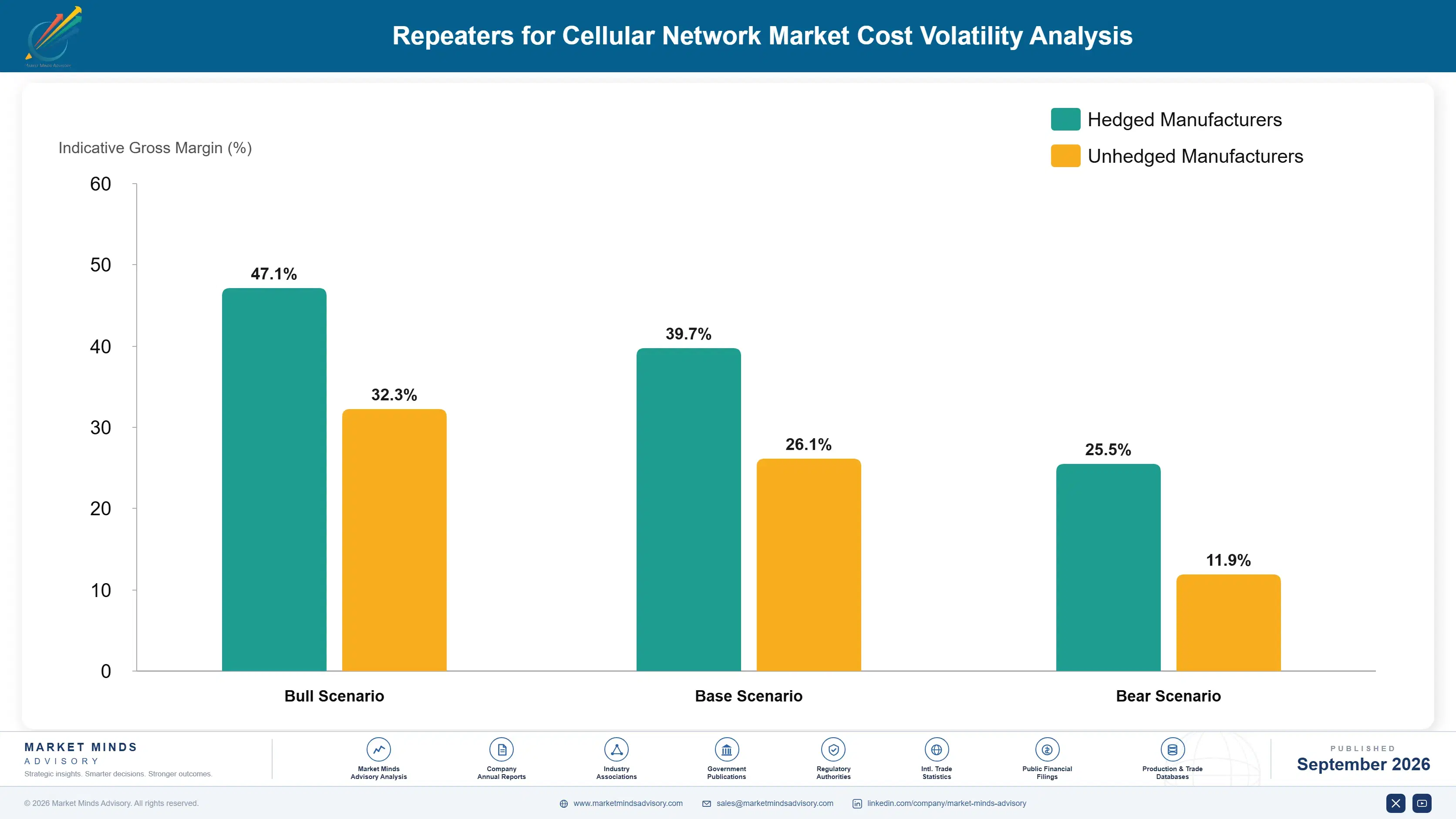
Radio frequency semiconductor components and metal chassis materials together represent roughly 37 percent of cost of goods sold for repeater manufacturers, with software-defined systems carrying the highest semiconductor intensity given the additional processing components required for adaptive gain control and interference filtering across multiple simultaneous carrier bands and network frequencies served simultaneously by a single deployed unit across the facility.
Radio frequency semiconductor pricing rose considerably during 2024 amid broader chip supply tightness affecting the telecom equipment sector, with unit costs increasing by roughly 19 percent within a single fiscal year according to named component supplier annual disclosures and IEA industrial electronics cost benchmarking. Vendors passed a meaningful portion of this cost increase through to newly signed commercial contracts across most affected product categories and regions.

This cost exposure disadvantages smaller specialist vendors dependent on third-party component distributors more severely than diversified manufacturers that negotiate directly with semiconductor suppliers at scale. Vendors producing software-defined systems face proportionally higher component cost exposure than those producing simpler analog units with fewer processing components required per finished unit shipped to commercial and enterprise customers across most covered geographies and facility types.
cellular-repeater-market-cost-volatility-analysis-1789980366504

Negotiate Multi-Year Semiconductor Supply Agreements Directly

Vendors committing to multi-year radio frequency semiconductor purchasing volumes secure more predictable unit pricing from component suppliers, insulating margin from short-term chip pricing volatility that smaller competitors without comparable purchasing scale cannot avoid as easily during tight supply periods across the broader radio frequency and telecom equipment component sector as a whole, particularly for smaller vendors lacking dedicated procurement teams.

Standardize Chassis Designs Across Product Lines

Vendors are consolidating chassis and enclosure designs across multiple product lines to increase purchasing volume per component and qualify for volume discount pricing tiers, reducing per-unit material costs considerably without requiring separate tooling investment for each individual product variant offered across the manufacturer's broader product line and market segment offerings sold to customers each year.

Shift Toward Modular Component Architecture Design

Vendors are designing modular systems that share common semiconductor and processing components across analog, digital, and software-defined product tiers, reducing the total number of distinct components purchased and strengthening negotiating leverage with suppliers across the full product portfolio offered to commercial and enterprise buyers across most covered facility types and customer account sizes served.

Portfolio Architecture for Margin Defence

Cellular repeater margins split along a volume-to-premium axis similar to other telecom equipment categories. Basic analog boosters generate modest gross margins under intense retail and online marketplace competition, while certified software-defined systems and multi-carrier bundles command materially higher margins on the strength of certification depth and installation service revenue that basic boosters cannot replicate without significant, sustained additional certification and engineering investment over time.
The volume tier serves smaller residential and small business buyers seeking baseline coverage, where retail price competition compresses standalone hardware margin and switching costs stay low. Premium tiers serving large commercial and multi-tenant properties carry meaningfully higher willingness to pay, since certification complexity and multi-carrier support requirements at that tier make software-defined systems close to unavoidable, unlike smaller properties with lower regulatory exposure.

High-value margin pools concentrate in multi-carrier certification and managed monitoring bundles, where demonstrated certification pass rates and ongoing service revenue justify premium pricing well above standard hardware sales, and where vendors with proven carrier relationships increasingly capture disproportionate deal value relative to their overall installed unit count, particularly among the largest multi-tenant commercial properties spanning several carrier networks simultaneously.

Basic Analog Booster Systems

Entry-level residential and small business boosters sold through retail and online channels under intense price competition and thin standalone hardware margin across most consumer segments and geographic markets covered today.
Gross Margin: 26-34%

Certified Digital And Smart Repeater Platforms

Mid-to-large commercial platforms with carrier certification commanding meaningfully higher willingness to pay from properties facing multi-carrier and public safety compliance exposure across most jurisdictions and covered commercial facility types today.
Gross Margin: 48-58%

Software-Defined Multi-Carrier Bundle Systems

AI-optimized systems bundled with certification services and remote monitoring serving large enterprise clients pursuing unified, multi-carrier coverage compliance solutions across sprawling multi-tenant property portfolios and multiple carrier relationships managed simultaneously.
Gross Margin: 58-68%
cellular-repeater-market-portfolio-architecture-1789980367009

High-value Sub-segments and Strategic Watch-out

Multi-Carrier Certification Service Bundles

High-value, high-growth pool serving large properties requiring certified coverage across several carrier networks, where demonstrated certification pass rates command premium engagement pricing well above standard hardware sales, and deal size scales directly with facility complexity and total carrier count served under one lease and building infrastructure agreement.
Gross Margin: 60-68%

Managed Remote Monitoring Subscriptions

High-value, moderate-growth pool serving enterprise property owners seeking predictive maintenance and compliance assurance, where bundled monitoring services generate durable recurring engagement revenue as certification enforcement continues tightening globally across most major jurisdictions covered under this report's defined scope and analytical framework, sustaining demand well into the next decade.
Gross Margin: 54-62%

Single-Unit Residential Boosters

Volume core segment serving smaller residential and small business buyers with straightforward coverage needs, where retail competition keeps standalone hardware pricing power limited despite steady replacement volume across the broader installed base heading into subsequent replacement cycles for most smaller residential and small business buyers.
Gross Margin: 26-33%

Legacy Analog Retrofit Deployments

Strategic watch-out segment where uncertified analog units face growing regulatory restriction and replacement pressure, threatening to strand existing installed hardware relative to certified systems built for current network requirements and enforcement standards adopted across most covered jurisdictions and building code regimes across most covered markets.
Gross Margin: 34-42%

Certification Cycles Anchor Renewal Economics

Cellular repeater revenue behaves like an annuity anchored to ongoing carrier certification and network evolution rather than a one-time hardware sale. Once a property's coverage system is certified across its resident carrier networks, switching vendors requires re-certifying an entirely new system, a costly and disruptive process most facility managers avoid unless coverage performance falls short considerably or a carrier revokes certification outright over several consecutive review cycles.
Adoption depth varies meaningfully by end-use vertical. Large commercial and multi-tenant properties show the deepest platform lock-in, since certification portfolios and monitoring relationships built up over multiple carrier network generations become genuinely difficult to replicate elsewhere, while smaller residential and single-carrier buyers show comparatively weaker loyalty and shop more actively on price at each hardware replacement point across the property lifecycle.

Buyer profiles are shifting generationally as facilities and property management roles, increasingly central to cellular coverage purchase decisions, now sit alongside IT and telecom procurement staff in evaluation committees, pushing average contract value and certification sophistication expectations steadily upward across the property buyer base as this newer generation of stakeholders gains budget authority and organizational influence within property management decisions.
cellular-repeater-market-end-use-penetration-index-1789980367527

Where MMA Sees the Opportunity

These are among the four positions where our research anticipates prominent divergence between winners and laggards over the coming forecast period. Each is grounded in the demand model, the regulatory perimeter, and the announced capacity pipeline.
01 / SOFTWARE-DEFINED SYSTEM INVESTMENT

Prioritize software-defined capability as the primary differentiator

Software-Defined and AI-Optimized Repeaters is growing at roughly 13.5 percent annually against a market-wide 7.5 percent average, the widest gap of any covered segment. Vendors that under-invest in software intelligence will lose large commercial deals to competitors offering demonstrably faster, cleaner carrier certification, since procurement teams increasingly benchmark vendors directly against each other on certification pass rates. MMA views software capability as the primary competitive battleground through 2036, ahead of pricing or brand recognition alone, since certification pass rates are now independently verifiable by carrier engineering teams.
02 / CERTIFICATION SERVICE EXPANSION

Build certification service revenue beyond core hardware sales

Multi-carrier certification service bundles carry the industry's highest gross margins, well above standard hardware sales available to smaller residential buyers. Vendors that pair core equipment with certified installation and commissioning services capture disproportionate deal value as certification complexity intensifies across major covered markets worldwide. MMA expects services-attached revenue to outpace standalone hardware growth meaningfully across the coming decade for vendors that execute this transition early and effectively, ahead of slower-moving competitors still reliant entirely on flat hardware pricing models with no attached services.
03 / INDIA MARKET ENTRY

Prioritize India given its fastest national growth trajectory

India is growing at roughly 12.0 percent annually, the fastest of any covered country, driven by nationwide 5G rollout across major metropolitan markets and rapidly expanding commercial construction activity. Vendors without localized certification support risk ceding this expansion to regional specialists building compliant systems from the outset. MMA views early localized product investment there as materially cheaper than later market entry once domestic incumbents establish local partnership networks and carrier trust that slower-moving latecomers will struggle to replicate quickly once the domestic market consolidates around early movers.
04 / RETENTION INFRASTRUCTURE INVESTMENT

Defend renewal economics through deeper certification lock-in

Switching cost from re-certifying an entirely new coverage system across resident carrier networks is the strongest retention lever available to incumbents, and it strengthens with every additional year a property stays with one vendor. Vendors should invest in deeper certification and monitoring service depth rather than competing purely on entry-level hardware pricing alone. MMA expects vendors with the strongest certification depth to command premium renewal pricing well ahead of price-competitive challengers by 2036, particularly among the largest multi-tenant properties where switching costs and certification continuity requirements run highest.

Engagement Snapshot From the Field

A live engagement with an industry participant carrying material or product regulatory and market exposure ahead of a defining policy shift, showing how our research translates into a defensible multi-year portfolio strategy.
MARKET MINDS ADVISORY · CLIENT ENGAGEMENT SUMMARY
Repeaters for Cellular Network Producer Strategic Portfolio Review and Transition Roadmap 2026·Investment Scenario on Repeaters for Cellular Network Exposure Evaluation 2025-26
CLIENT PROFILE
The client is a multi-tenant commercial property operator managing several large office towers and retail complexes across North America, hosting tenants served by multiple national carrier networks under a shared building infrastructure agreement. Facing persistent tenant complaints about indoor signal quality, the operator sought an independent assessment of repeater modernization options before committing capital to a single-vendor system upgrade.
STRATEGIC CHALLENGE
The operator's existing analog booster systems, installed years earlier under a single carrier agreement, could not support the multi-carrier certification requirements that newer tenant leases increasingly demanded. Leadership needed clarity on whether a phased software-defined upgrade or continued analog patch repairs better balanced deployment cost against ongoing tenant retention and lease renewal risk.
MMA APPROACH
MMA conducted structured interviews with facilities, leasing, and IT leadership across four representative properties, alongside a comparative technical assessment of five leading repeater vendors' multi-carrier certification track records and installation timelines. The engagement benchmarked projected tenant satisfaction gains against the operator's own historical signal complaint data across the preceding two years.
KEY FINDINGS
  1. Legacy single-carrier analog systems generated a measurably higher volume of tenant complaints each quarter that a certified multi-carrier upgrade would substantially eliminate going forward.
  2. Properties with the highest tenant density showed the largest projected satisfaction gains from software-defined adoption relative to smaller, lower-occupancy properties in the portfolio.
  3. A phased single-vendor upgrade reduced projected total certification cost meaningfully compared to continued analog patch repairs, per client-reported estimates shared during the engagement.
  4. Facilities staff reported measurably higher confidence in tenant retention outcomes once consolidated multi-carrier coverage replaced the prior fragmented, carrier-by-carrier patch repair approach entirely.
CLIENT PROFILE
The client is a multi-tenant commercial property operator managing several large office towers and retail complexes across North America, hosting tenants served by multiple national carrier networks under a shared building infrastructure agreement. Facing persistent tenant complaints about indoor signal quality, the operator sought an independent assessment of repeater modernization options before committing capital to a single-vendor system upgrade.
STRATEGIC CHALLENGE
The operator's existing analog booster systems, installed years earlier under a single carrier agreement, could not support the multi-carrier certification requirements that newer tenant leases increasingly demanded. Leadership needed clarity on whether a phased software-defined upgrade or continued analog patch repairs better balanced deployment cost against ongoing tenant retention and lease renewal risk.
MMA APPROACH
MMA conducted structured interviews with facilities, leasing, and IT leadership across four representative properties, alongside a comparative technical assessment of five leading repeater vendors' multi-carrier certification track records and installation timelines. The engagement benchmarked projected tenant satisfaction gains against the operator's own historical signal complaint data across the preceding two years.
KEY FINDINGS
  1. Legacy single-carrier analog systems generated a measurably higher volume of tenant complaints each quarter that a certified multi-carrier upgrade would substantially eliminate going forward.
  2. Properties with the highest tenant density showed the largest projected satisfaction gains from software-defined adoption relative to smaller, lower-occupancy properties in the portfolio.
  3. A phased single-vendor upgrade reduced projected total certification cost meaningfully compared to continued analog patch repairs, per client-reported estimates shared during the engagement.
  4. Facilities staff reported measurably higher confidence in tenant retention outcomes once consolidated multi-carrier coverage replaced the prior fragmented, carrier-by-carrier patch repair approach entirely.
RECOMMENDED STRATEGY
Phase 1: Phase one: pilot a single vendor software-defined system across two representative properties over four months, tracking complaint reduction and certification gains. Phase 2: Phase two: expand the system to remaining properties across the portfolio while sunsetting legacy analog boosters incrementally across each individual property. Phase 3: Phase three: negotiate a multi-year service agreement bundling remote monitoring and multi-carrier certification maintenance across the entire property portfolio going forward.
OUTCOME
The operator adopted the recommended phased software-defined upgrade, reporting a substantial reduction in tenant signal complaints within three quarters of full deployment (client-reported, unverified by MMA). Facilities staff previously consumed by carrier-by-carrier troubleshooting were redirected toward proactive tenant relationship management instead, improving overall lease renewal rates across the portfolio.

Frequently Asked Questions

Foundational context covering the market sizes, CAGR, scope, country, region and competition that inform every finding below. This section is provided to cover basics and most often pre-purchase conversations, answered from the MMA Primary Research Dataset.

What is the current size of the Repeaters for Cellular Network Market?

The Repeaters for Cellular Network Market reached an estimated 1.65 billion dollars in 2025. Growth is driven by 5G densification and expanding in-building coverage mandates worldwide.

How large will the Repeaters for Cellular Network Market be by 2036?

MMA projects the market will reach approximately 3.65 billion dollars by 2036. This reflects sustained 5G rollout and expanding software-defined repeater adoption across large commercial facilities.

What is the CAGR for the Repeaters for Cellular Network Market 2026 to 2036?

The market is projected to grow at a 7.5 percent compound annual growth rate between 2026 and 2036. Bull and bear scenarios range from 6.3 to 8.7 percent.

Which segment is growing fastest?

Software-Defined and AI-Optimized Repeaters is the fastest-growing segment, expanding at roughly 13.5 percent annually. This outpaces the overall market by nearly 1.8 times over the same period.

Who are the major companies in the Repeaters for Cellular Network Market?

Leading vendors include Wilson Electronics, SureCall, Nextivity, CommScope, and Comba Telecom. Together these five vendors hold an estimated 44 percent combined share on a market participation basis.

Which country is growing fastest?

India is the fastest-growing country, expanding at roughly 12.0 percent annually. Nationwide 5G rollout across major metropolitan markets is driving this accelerated growth trajectory today.

Report Segmentation Architecture

The full report scope spans multiple orthogonal segmentation dimensions, with cross-tabulated demand data provided for each dimension pair. Coverage extends further to regional breakdowns, trend trajectories, and the competitive detail needed to support segment-level decision-making.

By Repeater Technology Type

  • Software-Defined and AI-Optimized Repeaters
  • Digital Smart Repeaters
  • Analog RF Repeaters
  • Bi-Directional Amplifier Systems
  • Distributed Antenna System-Integrated Repeaters
  • Portable and Vehicular Repeaters

By End-Use Industry

  • Commercial Office and Retail Properties
  • Residential and Multi-Family Buildings
  • Healthcare Facilities
  • Public Safety and Government Buildings
  • Industrial and Warehouse Facilities

By Commercial Deployment Model

  • Direct Hardware Purchase
  • Certified Installation Service Contracts
  • Managed Monitoring Subscription Bundles
  • Systems Integrator Distribution Channels

By Region

  • North America
  • Western Europe
  • East Asia
  • South Asia and Pacific
  • Latin America
  • Middle East and Africa
  • Eastern Europe

Scope, Methodology, and Coverage

Every figure in this report is reproducible from documented input assumptions. The scope below maps the historical period, the forecast horizon, the segmentation dimensions, and the countries covered, alongside the underlying primary and qualitative methodology.
Historical Period
2020 to 2025
Forecast Period
2026 to 2036
Base Year
2025 (USD billions; MMA Primary Research Dataset, September 2026)
Market Definition
The Repeaters for Cellular Network Market covers signal amplification equipment that captures, boosts, and rebroadcasts cellular signals to extend or improve indoor and outdoor coverage, including analog, digital, and software-defined repeater systems. It excludes small cell base stations that originate rather than repeat carrier signal, standalone distributed antenna system cabling sold without amplification hardware, and Wi-Fi range extenders.
Quantitative Units
USD billions, market share percent, CAGR percent
Segmentation Dimensions
Repeater technology type, end-use industry, commercial deployment model, region
Regions Covered
North America, Western Europe, East Asia, South Asia and Pacific, Latin America, Middle East and Africa, Eastern Europe
Countries Covered
United States, China, Germany, India, Japan, Brazil, and 14 additional countries across seven regions
Key Companies Profiled
Wilson Electronics, SureCall, Nextivity, CommScope, Comba Telecom, and 15 additional participants
Quantitative Methodology
Primary survey, n=3,800 respondents, Q4 2025, six countries; demand-side model with trade association cross-validation
Qualitative Methodology
47 expert interviews, Q4 2025; applied to validate demand model assumptions, identify emerging dynamics, and assess competitive positioning
Report Format
PDF and XLSX data workbook (Word format preview document)
Publisher
Market Minds Advisory
Report Code
MMA-2026-TEC-627
Published
September 2026
Contact
sales@marketmindsadvisory.com | www.marketmindsadvisory.com

Purchase the full Repeaters for Cellular Network Market Report (2026 to 2036).

This report delivers a complete assessment of the Repeaters for Cellular Network Market spanning sizing, segmentation, regional dynamics, and competitive positioning through 2036. It combines primary survey data from 3,800 respondents across six countries with 47 expert interviews conducted in the fourth quarter of 2025. Analysts detail segment-level growth drivers, regional demand mechanisms, and competitive moats among leading vendors, alongside forward-looking scenario analysis. The report also profiles input cost exposure, portfolio economics, and certification service monetization strategies, supported by an anonymized client engagement case study drawn from a real advisory mandate.
Segment-level CAGR and market share breakdowns
Seven-region demand analysis with quantified drivers
Competitive landscape with moat and risk profiles
Input cost exposure and mitigation strategies
Portfolio tier economics and margin benchmarks
Anonymized client engagement case study analysis

Built For The People Who Decide

From boardroom strategy to bench-side execution, this report is read cover-to-cover by leaders shaping the next decade of their industry, turning demand scenarios, market dynamics and valuation benchmarks into decisions.
CXOs/ Presidents/ VPs/ Managers
M&A and Corporate Development
Strategy Teams and R&D Heads
Procurement and Product Directors
Regulatory and Compliance Leaders
Investor Relations and Equity Analysts