Market Minds Advisory
Cell Line Development Services Market

Cell Line Development Services Market: Gateway Economics, Clonality Documentation, and Royalty-Free Host Shift

A cell line is chosen once and manufactured from for twenty years, so the provider who builds it usually keeps the manufacturing, which is why this service is frequently sold at cost.

Lead Analyst

Alice Ballenger

Published

September 2026

Make Smarter Decisions with Customized Research Insights

Request a free sample report and evaluate market opportunities, growth trends, and competitive dynamics relevant to your business needs.

2025 MARKET VALUE$1.6BMarket Size 2025
2036 FORECAST VALUE$5.0BBase Case , 2026 to 2036
CAGR 2026 TO 203611.0 %Bull 12.4% / Bear 9.8%
INCREMENTAL OPPORTUNITY$3.3BNet 10- year value creation
EXPANSION MULTIPLE2.83x2036 value over 2026 base
Strategic Levers
M&A Pipeline
Regional Outlook
Country Rankings
Competitive Intelligence
Segmental Deep-dive
Call-Us : 91 93563 13602

Executive Snapshot and Market Trajectory

Nobody prices this service on what it costs to deliver. A cell line built today supplies commercial manufacturing for two decades, and the provider who develops it almost always keeps that manufacturing, so development is sold as a gateway rather than as a business. Reported margins understate the economics.
Clone screening and lead selection compounds at 16.5%, a full 1.50x the market rate, because titre stopped being the constraint and product quality attributes became the thing worth screening for. East Asia holds the largest share at 30%, since a very large proportion of the world's cell line development happens inside Chinese and Korean contract organisations rather than in sponsor laboratories. Sponsor location explains little.
Concentration sits at 44%, with WuXi Biologics and Lonza leading through manufacturing networks the development work feeds. Roughly 38% of programmes still carry a royalty obligation on the host cell line, and sponsors increasingly refuse that. Regulatory clonality documentation added a step that did not exist a decade ago and is now entirely non-negotiable. Providers without manufacturing capacity cannot replicate those economics at any price they could reasonably charge for the work itself.
Market Definition
This market covers contract services developing stable recombinant cell lines for biologics manufacturing, spanning host cell line licensing and access, expression vector design and construction, transfection with selection and pool generation, single-cell cloning with clonality assurance documentation, clone screening and lead selection, and master and working cell bank manufacture with characterisation. Measurement is at service and licensing revenue. Downstream process development, clinical and commercial manufacturing, analytical testing sold independently, and cell culture media or equipment are excluded.
Base Year Value
$1.6B in 2025 (MMA Primary Research Dataset, August 2026)
Forecast Period
2026 to 2036, eleven discrete annual values
CAGR
11.0% base case. Bull 12.4%. Bear 9.8%.
Fastest Growth Segment
Clone Screening and Lead Selection: 16.5% CAGR
Fastest Growth Country
India: 16.2% CAGR
Fastest Growth Region
South Asia and Pacific: 13.2% CAGR
Largest Region
East Asia: 30% of 2025 global value
Market Leaders
WuXi Biologics, Samsung Biologics, Lonza, Thermo Fisher Scientific, and Sartorius. Source: MMA Primary Research Dataset, July 2026.
Primary Survey
n=3,800 procurement and R&D decision-makers, Q4 2025, six countries
Methodology
Demand-side build-up, cross-validated against public data, 47 expert interviews

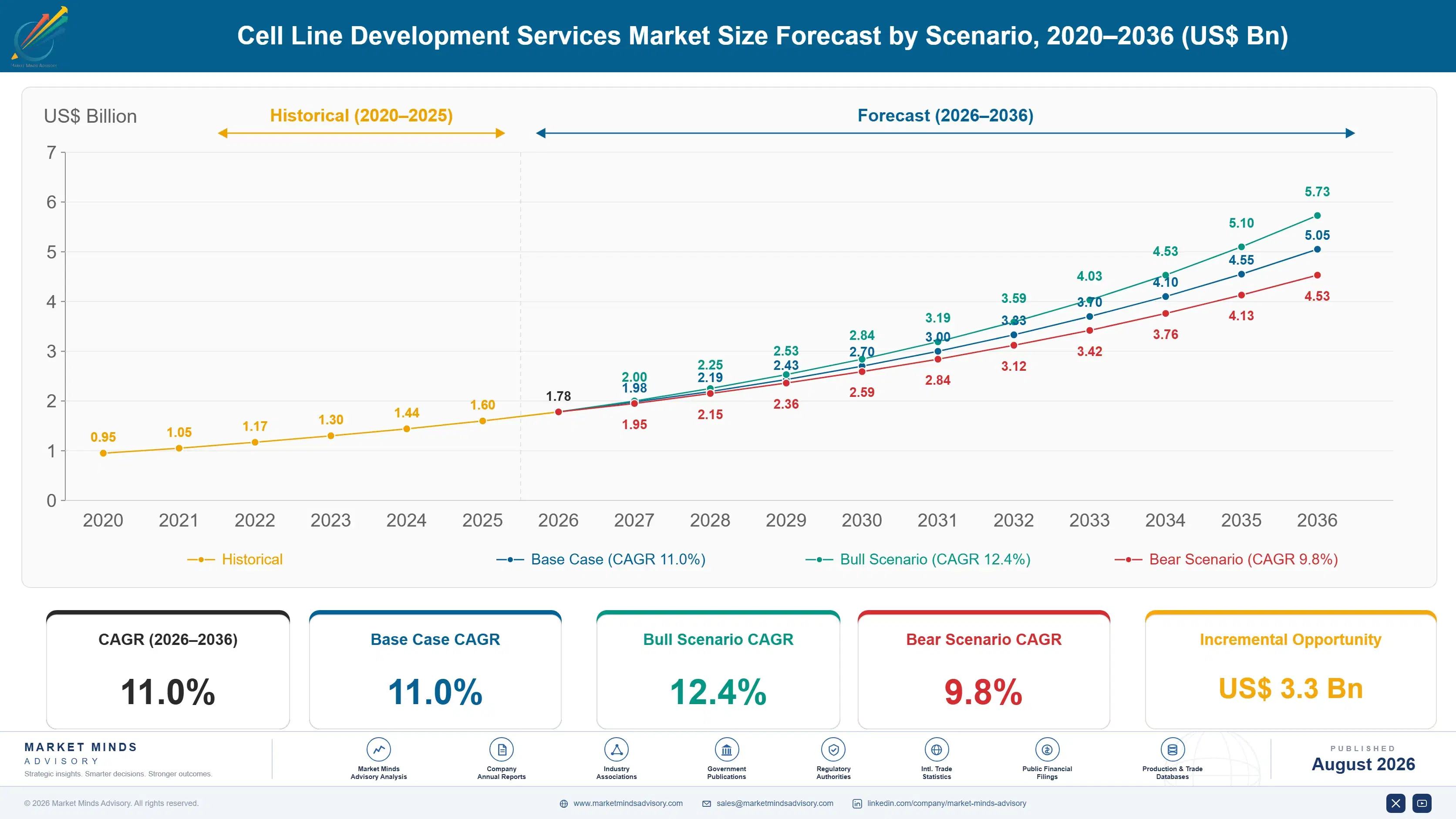
Cell Line Development Services Market Forecast Scenarios

cell-line-development-services-market-size-forecast-scenario-1787304223325
Growth ran at roughly 9.7% between 2020 and 2025, and two very different forces produced it. Biologics pipelines expanded across antibodies, bispecifics and fusion proteins, each requiring a dedicated cell line before anything else could happen. Meanwhile regulatory expectations around clonal derivation hardened into documented requirements, which added a step and a cost to every programme regardless of what the sponsor was developing.
Base case growth of 11.0% rests on three mechanisms. Biologics programme starts keep rising as bispecific and multispecific formats multiply the number of molecules entering development. Screening has shifted from maximising titre toward selecting on glycosylation, charge variants and aggregation behaviour, which requires far more clones assessed per programme. And geopolitical sourcing pressure has sponsors dual-sourcing development away from single-country concentration. Roughly 30% of work is redistributing on jurisdiction rather than on performance.
The bull case at 12.4% assumes automated high-throughput screening becomes standard across sponsors rather than confined to the largest, which multiplies clones assessed and the fees attached. The bear case at 9.8% is a biotechnology funding case: early-stage programme starts follow venture capital availability closely, and a sustained funding contraction removes exactly the small sponsors who outsource development entirely rather than partially.

Cell Line Development: Gateway Pricing and Screening Shift

The commercial logic here is unlike anything else in contract services. A cell line becomes the permanent source of that product, written into regulatory filings and manufactured from for twenty years. Changing it afterwards requires comparability studies few sponsors will contemplate. The provider who builds the line therefore holds an enormous advantage on the manufacturing that follows.
TOP FIVE CONCENTRATION44%Contract manufacturers using development work to secure downstream production
DNA TO FILING TIMELINE9 monthsTypical interval from gene sequence to regulatory submission readiness
AVERAGE PROJECT FEEUSD 480,000Blended charge for a complete development programme excluding downstream work
TITRE ROUTINELY ACHIEVED6 gramsProduct concentration per litre now standard in fed-batch culture
ROYALTY-BEARING HOST SHARE38%Programmes carrying ongoing obligations on the licensed host line
CLONE SCREENING THROUGHPUT8,000 clonesCandidates assessed per programme under automated high throughput workflows
Screening priorities have changed completely and most commentary has not caught up. Fed-batch titres of six grams per litre are now routine, and downstream purification rather than upstream expression is the manufacturing bottleneck in most facilities. Selecting a clone purely on yield therefore optimises the wrong variable. Programmes now screen thousands of candidates on glycosylation profile, charge variant distribution and aggregation behaviour, because those determine comparability and shelf life.
Host cell line economics have become contentious. Historic licensing arrangements attached ongoing royalties to any product expressed in a proprietary host, and roughly 38% of programmes still carry that obligation. Sponsors increasingly refuse to accept a permanent claim on a molecule they intend to commercialise, and royalty-free hosts have taken share accordingly. The licensing model that funded host development for two decades is now a competitive disadvantage.
"Everybody still talks about titre and nobody downstream can process what the cells already make. The clone that matters is the one whose glycans and charge variants stay where they were during the twenty years you have to keep making it."
Director, Biologics Development and Contract Services Practice · MMA Healthcare

Market Trends

Screening shifts from titre toward product quality attributes

Fed-batch expression routinely reaches six grams per litre and downstream purification capacity, not upstream yield, limits most manufacturing facilities. Selecting clones on titre alone therefore optimises a variable that stopped constraining anything. Programmes now assess thousands of candidates on glycosylation profile, charge variant distribution, aggregation propensity and stability under stress, because those attributes determine comparability across manufacturing changes and shelf life afterwards. That requires automated screening platforms and analytical throughput that sponsors rarely hold internally, which pushes the work toward specialist providers. Providers bundling that stage into a flat fee are giving away exactly what distinguishes them.
Market Impact: Requires up to 4 lines

Sponsors reject ongoing royalty claims on host cell lines

Proprietary host cell lines historically carried licensing terms attaching royalties to any product expressed in them, which funded host development for two decades and is now widely resisted. A sponsor developing a molecule it intends to commercialise sees a permanent claim on future revenue attached to a technical choice made at the very beginning. Roughly 38% of programmes still carry such an obligation, down considerably, and royalty-free hosts have taken the difference despite offering no clear performance advantage. Providers still monetising hosts through royalties now lose programmes at the selection stage.
Market Impact: Applies to 100% of programmes

Market Opportunities and Growth Drivers

Bispecific formats multiply cell lines required per approved product

A conventional monoclonal antibody needs one cell line. Bispecific and multispecific formats frequently require several construct configurations to be developed and compared before one is selected, and many programmes build lines for multiple candidate designs simultaneously because pairing behaviour cannot be predicted reliably. Clinical-stage biologics pipelines now contain a substantial and rising share of these formats, so cell line development volume grows considerably faster than the number of molecules eventually reaching approval does. Several candidate designs are frequently developed in parallel because pairing behaviour cannot be predicted reliably in advance.
Market Impact: Priced below cost by 100%

Regulatory clonality assurance became a documented requirement

Regulators expect evidence that a production cell line derives from a single progenitor cell, and assurance statements now require documented imaging or comparable evidence from the isolation step rather than statistical argument alone. That converted a scientific preference into a procedural requirement with equipment, documentation and cost attached. Every programme now carries it, and providers without imaging-based single-cell isolation and the supporting documentation package cannot compete for regulated work at all. The stage has consolidated toward organisations that invested in imaging platforms early rather than waiting for the requirement to become explicit.
Market Impact: Redistributes roughly 30% of work

Market Restraints and Challenges

Gateway pricing suppresses margins across the whole service

Contract manufacturers price cell line development at or below cost because the line they build becomes the permanent source for a product manufactured across two decades, and the manufacturing revenue that follows dwarfs any development fee. The root cause is that switching a cell line after regulatory filing requires comparability work almost no sponsor will accept. Commercial impact falls on specialist providers without manufacturing capacity, who cannot subsidise development the same way and must compete against pricing designed to lose money. Reported development margins therefore understate the real economics enormously.
Market Impact: Screens up to 8,000 clones

Sourcing policy pressure fragments where development happens

Legislative and procurement pressure in Western markets has pushed sponsors to reduce single-country concentration in biologics development and manufacturing, regardless of technical performance or price. The root cause is geopolitical rather than scientific, and it applies to a service whose output is embedded in a regulatory filing for decades. Commercial impact is dual-sourcing that raises sponsor cost and redistributes work toward Korean, Indian, Japanese and European providers. Chinese organisations respond by establishing capacity outside China entirely. Building presence in a second jurisdiction takes years rather than quarters, and sponsors will not wait for it.
Market Impact: Royalty-bearing down to 38%
3 additional market trends, 4 additional growth drivers, and 2 additional restraints and challenges are covered in the full report. Contact sales@marketmindsadvisory.com to access the complete intelligence.

Segment CAGR and Growth Architecture

Segmentation follows the development workflow stage, because each stage carries its own technical requirement, equipment base, documentation burden and pricing convention. Six stages cover cell line development without overlap. Expression system, whether mammalian, microbial or insect, cuts across every stage and is treated as a platform attribute rather than a separate segment here. Stage sets the commercial rules.
cell-line-development-services-market-market-share-analysis-1787304223862

Clone Screening and Lead Selection

Growing at 16.5%, a full 1.50x the market rate, screening has become the most valuable stage because what it selects for changed entirely. Titre stopped constraining manufacturing once fed-batch routinely reached six grams per litre, and programmes now assess thousands of candidates on glycosylation profile, charge variant distribution, aggregation behaviour and stability instead. That demands automated picking, imaging and analytical throughput that most sponsors do not hold internally. Providers with high-throughput platforms and the analytical capacity behind them charge substantially more for this stage than for anything else in the workflow. Providers pricing this stage separately capture value that sponsors could not replicate internally without building a whole platform. Bundling it away surrenders the differentiation entirely.
CAGR 16.5%

Single-Cell Cloning and Clonality Assurance

Single-cell cloning grows at 13.2% because regulators converted a scientific preference into a documented requirement. Assurance of clonal derivation now expects imaging evidence or comparable documentation from the isolation step rather than statistical probability arguments, and every regulated programme carries it. That created equipment requirements, documentation packages and a discrete billable stage where previously there was a technique. Providers without imaging-based isolation platforms and the supporting documentation cannot compete for regulated work, which has consolidated the stage toward organisations that invested in the capability early. Equipment requirements, documentation packages and a discrete billable stage all appeared where previously there had been only a laboratory technique. Nothing about the underlying science changed at all.
CAGR 13.2%
Full segment breakdown across 6 segments available in the complete report.

Regional Architecture and Country Demand Map

Regional value follows where development work is physically performed rather than where sponsors are headquartered, and the two have separated substantially. Contract organisations concentrated in Asia perform a large share of development for Western sponsors who retain the resulting assets. Sponsor location explains very little here.

East Asia

East Asia takes the largest share at 30%, and contract organisation concentration rather than domestic pipeline explains it. WuXi Biologics performs a very large proportion of the world's cell line development for Western sponsors, and Samsung Biologics has built comparable capability in South Korea with a deliberate positioning as an alternative to Chinese sourcing. Japanese providers including Fujifilm Diosynth serve both domestic and international programmes. Chinese domestic biologics pipelines are also substantial and growing. Sourcing policy pressure in Western markets is the principal risk to this position rather than any technical or commercial factor. Technical capability across the region is not in question, and geography increasingly is. Positioning as an alternative to Chinese sourcing has become a genuine commercial asset.
Share: 30% | CAGR: 12.2% (2026 to 2036)

North America

Twenty-six per cent of value, growing at 10.0%. Most biologics programmes originate here, though a substantial share of the development work is performed elsewhere under contract. Large pharmaceutical companies retain internal cell line development capability and outsource selectively, while emerging biotechnology companies outsource entirely because building the capability makes no sense for a single molecule. Legislative pressure to reduce single-country sourcing concentration has redirected work toward domestic and allied providers regardless of price. Fee levels here are the highest of any region tracked. Emerging biotechnology companies outsource entirely because building capability for one molecule makes no sense at all, while large pharmaceutical developers retain internal capacity and outsource selectively against it.
Share: 26% | CAGR: 10.0% (2026 to 2036)
Regional intelligence for 5 additional markets available in the complete report: Western Europe, South Asia and Pacific, Latin America, Middle East and Africa, Eastern Europe. Contact sales@marketmindsadvisory.com.
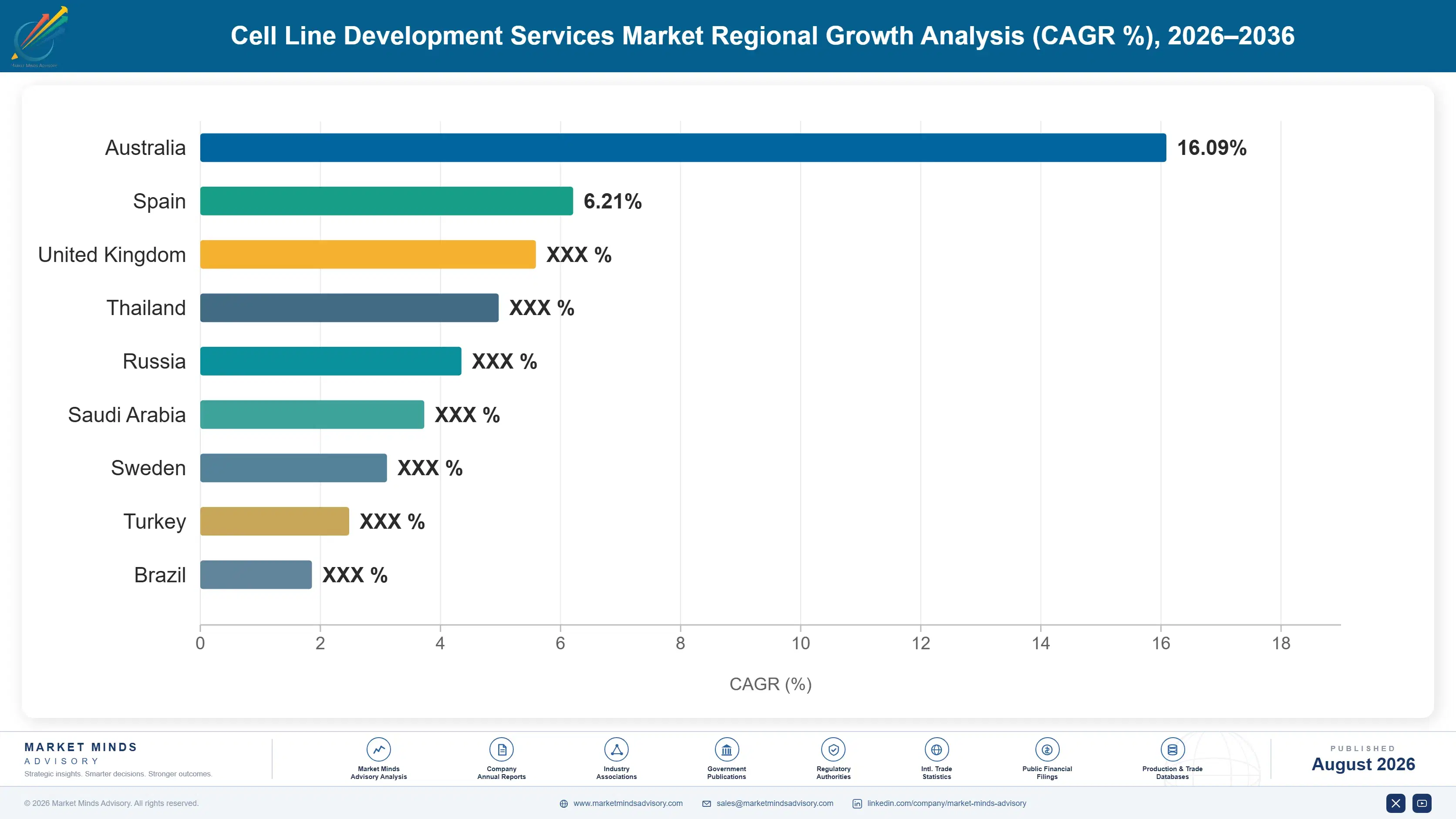
cell-line-development-services-market-country-cagr-analysis-1787304224382

Where Development Service Value Is Captured

This service is a gateway rather than a business, and everybody serious prices it accordingly. Value accrues to whoever converts development into manufacturing, whoever charges properly for the screening stage that now matters, and whoever removed the royalty obligation sponsors have stopped accepting. Fee levels reveal remarkably little about the underlying economics of this business.

Price development to win the manufacturing that follows

A cell line becomes the permanent source of a product manufactured across twenty years and written into regulatory filings, and changing it afterwards requires comparability work almost no sponsor will accept. The development provider therefore holds a decisive advantage on manufacturing worth many multiples of any development fee. Pricing at or below cost to secure that position is rational rather than reckless, and providers without manufacturing capacity are competing against economics they cannot replicate at any price. Manufacturing revenue across that period exceeds any development fee by a factor of 20 or more.
Market Impact: Secures roughly 20 years of manufac

Charge properly for screening rather than bundling it away

Titre stopped constraining manufacturing once fed-batch reached six grams per litre, and screening now selects on glycosylation, charge variants and aggregation across up to 8,000 candidates per programme. That requires automated picking, imaging and analytical throughput representing genuine capital investment. Providers bundling screening into a flat development fee are giving away the stage that actually differentiates them, while those pricing it separately capture the value of capability sponsors cannot replicate internally without building a platform. Sponsors cannot replicate that throughput internally without building an entire platform of their own. Capital investment there is substantial and genuinely differentiating.
Market Impact: Assesses up to 8,000 clones for eac

Offer royalty-free host access as a commercial position

Roughly 38% of programmes still carry ongoing royalty obligations on the host cell line, and sponsors increasingly refuse a permanent claim on a molecule they intend to commercialise. Royalty-free hosts have taken share despite offering no clear performance advantage, which tells you the objection is commercial rather than technical. Providers still monetising hosts through downstream royalties are defending a model that funded two decades of development and now actively costs them programmes at the selection stage. The objection is commercial rather than technical and conceding it costs less than losing the programme.
Market Impact: Removes royalty obligations across

Establish development capability outside single-country concentration

Legislative and procurement pressure has sponsors reducing concentration in biologics development sourcing regardless of technical performance or price, and roughly 30% of work is being redistributed on that basis alone. The output of this service sits in a regulatory filing for decades, which makes sponsors unusually cautious about geopolitical exposure. Providers with capability in multiple jurisdictions can serve sponsors who would otherwise exclude them entirely, and building that presence takes years rather than quarters. Sponsors maintain approved provider lists defined by jurisdiction alone, and a provider absent from those lists never reaches technical evaluation at all.
Market Impact: Affects roughly 30% of all redistri

Who Controls the Margin Pool

Concentration sits at 44% across the top five, measured on annual revenue from cell line development services and associated host licensing, the single basis applied throughout. WuXi Biologics and Lonza lead through integrated positions where development feeds manufacturing networks. Samsung Biologics follows with comparable integration, while Thermo Fisher Scientific and Sartorius compete through platform technologies, host cell lines and screening instrumentation rather than through service de
Competition runs on three dimensions that rarely include price directly. Manufacturing capacity behind the service decides who can price development as a gateway, which specialist providers without plants simply cannot match. Screening capability decides who can select on product quality attributes rather than titre. Documentation quality and regulatory track record decide who a sponsor trusts with an asset embedded in a filing for two decades.

Pressure builds from two directions. Sourcing policy in Western markets is redistributing work away from single-country concentration regardless of performance, which advantages Korean, Indian, Japanese and European providers directly. Separately, sponsors are refusing royalty-bearing host arrangements that funded platform development historically. Rankings shift most where a provider pairs high-throughput screening capability with manufacturing capacity in a jurisdiction sponsors are comfortable filing from.
cell-line-development-services-market-company-positioning-matrix-1787304224906

Competitive Moat and Risk Dimensions

WUXI BIOLOGICS

Moat: Integrated development to manufacturing scale

WuXi Biologics performs cell line development at a volume no competitor matches and converts a large share of it into clinical and commercial manufacturing across its own network. That integration lets it price development aggressively, and speed from gene sequence to filing readiness has been genuinely faster than most alternatives, which sponsors value more than any fee difference.
WUXI BIOLOGICS

Risk: Sourcing policy exposure

Legislative and procurement pressure in Western markets is pushing sponsors to reduce concentration in Chinese biologics sourcing regardless of technical performance or price. An asset embedded in a regulatory filing for decades makes sponsors unusually cautious about that exposure. Establishing capacity outside China mitigates the position without removing the concern entirely.
LONZA

Moat: Regulatory credibility and host platform

Lonza combines long-established regulatory track record with both American and European authorities, an extensively used expression platform, and manufacturing capacity across multiple jurisdictions. Sponsors filing globally value documentation quality and inspection history heavily on an asset that will sit in filings for twenty years, and that credibility is not something a newer provider can assemble quickly.
LONZA

Risk: Royalty model transition

Historic host licensing attached ongoing royalties that funded platform development and which sponsors now widely resist, and royalty-free alternatives have taken share without offering performance advantages. Cost position against Korean and Indian providers is difficult on straightforward programmes. Screening platform investment must keep pace with specialists competing on that stage alone.

Players Tracked

Prominent Players

WuXi Biologics
Samsung Biologics
Lonza
Thermo Fisher Scientific
Sartorius

Other Key Players

Catalent
Fujifilm Diosynth Biotechnologies
Boehringer Ingelheim BioXcellence
AGC Biologics
Charles River Laboratories
Syngene International
Biocon Biologics
ProBioGen
Selexis
Abzena
Rentschler Biopharma
Revvity
Bruker Cellular Analysis
JSR Life Sciences
Batavia Biosciences

Recent Developments

MARCH 2025

Western sponsors accelerate dual-sourcing of biologics development work

Biopharmaceutical sponsors accelerated dual-sourcing arrangements for cell line development and early manufacturing, responding to legislative and procurement pressure to reduce single-country concentration in supply chains that produce assets embedded in regulatory filings for decades. Technical performance was not the deciding factor anywhere. Dual-sourcing raised sponsor cost accordingly.
Signal: Sourcing geography is now a selection crit
AUGUST 2025

Providers expand royalty-free host cell line offerings for sponsors

Several contract development organisations widened royalty-free host cell line offerings, responding to sponsor resistance to ongoing obligations attached to molecules they intend to commercialise, despite those hosts offering no demonstrated expression or stability advantage over licensed alternatives. Upfront fees rose to compensate for the change.
Signal: The objection to royalty-bearing hosts is
JANUARY 2026

Automated screening platforms extend product quality attribute selection

Contract providers extended automated clone screening platforms to assess glycosylation profiles, charge variant distribution and aggregation behaviour across thousands of candidates per programme, reflecting that downstream purification rather than upstream titre now limits manufacturing throughput in most facilities. Titre screening alone is no longer sufficient anywhere.
Signal: Screening on titre alone optimises a varia

Scientific Labour, Media and Instrument Exposure

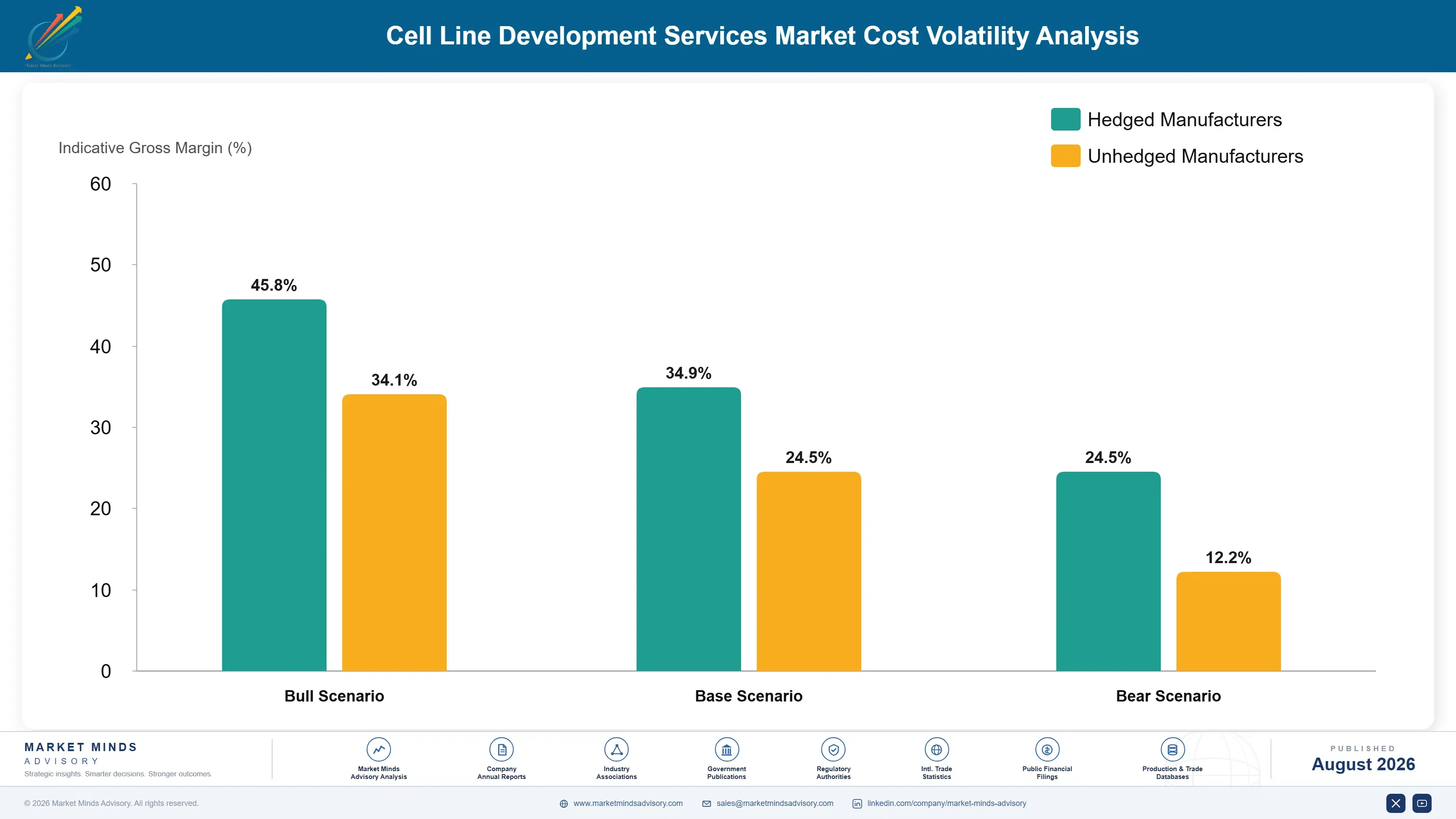
Cost structures here are dominated by people and by analytical capacity rather than by materials. Specialist scientific labour covering cell culture, molecular biology and analytical characterisation accounts for roughly 46% of cost of delivery, which is high even by contract research standards. Cell culture media, sera-free supplements and single-use consumables contribute around 18%, and automated screening instrumentation depreciation carries most of the balance.
Scientific labour cost through 2022 and 2024 illustrated the exposure clearly. Competition for experienced cell line development scientists intensified as biologics capacity expanded globally, and Lonza and Samsung Biologics both referenced personnel cost and availability pressure in their reporting across those years. Fixed-fee development contracts signed before the increase could not be repriced, and providers absorbed the difference across programme durations measured in months. Programme durations measured in months made that unavoidable.

The disadvantage falls on Western providers competing against Indian and Chinese cost bases on straightforward programmes. A European or American organisation pays several times the scientific salary for equivalent work, and on a programme without unusual technical complexity that difference decides the award. Geography compounds it: instrumentation and media cost comparably worldwide, so labour carries the entire gap.
cell-line-development-services-market-cost-volatility-analysis-1787304225101

Automate screening to reduce scientist hours per programme

Scientific labour dominates cost of delivery and competition for experienced staff is not easing anywhere. Automated picking, imaging and analytical workflows cut hours per programme substantially while simultaneously increasing the number of clones assessed, which improves the service and the cost position together. Capital investment is significant and the payback runs across programme volume rather than any single contract.

Write fee escalation into multi-month development contracts

Fixed-fee contracts signed before the last labour cost movement transferred the whole increase onto providers across programmes running many months. Newer agreements increasingly carry narrow adjustment tied to published scientific sector wage indices. Sponsors accept that more readily than a general escalator, because the underlying data is external and clearly outside any provider's control.

Locate routine workflow stages in lower-cost scientific labour markets

Not every stage requires the same seniority, and pool generation, banking and routine characterisation can be performed competently in markets with far lower scientific salary levels. Keeping vector design, screening strategy and regulatory documentation in higher-cost locations preserves quality where sponsors actually evaluate it while removing labour cost where they do not. Sponsors evaluate the higher-cost stages closely.

Portfolio Architecture for Margin Defence

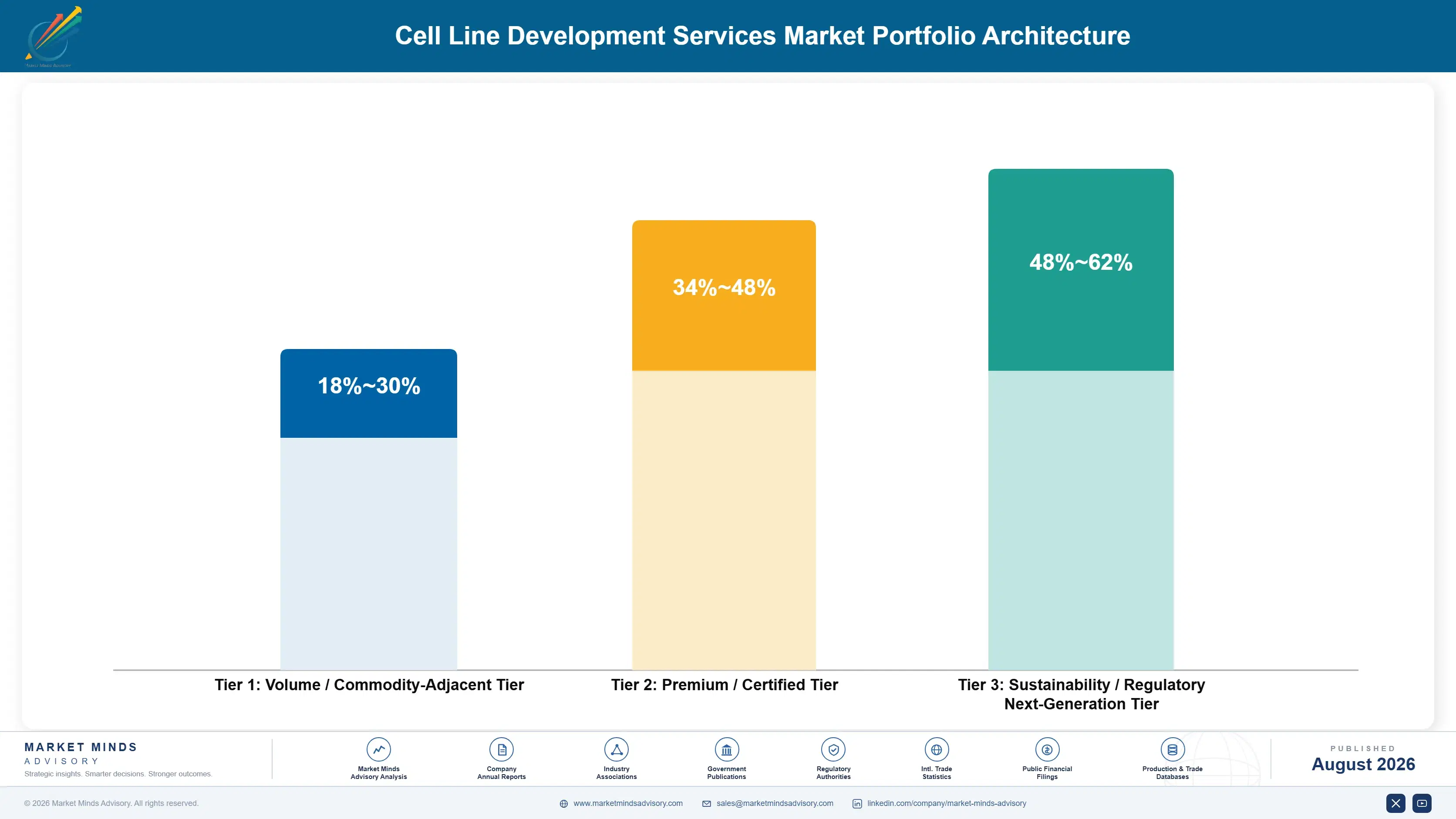
Margin architecture here is deliberately distorted by the gateway effect. Integrated contract manufacturers price development at or below cost because the manufacturing that follows is worth many multiples of any fee, so reported development margins understate the economics enormously. Specialist providers without manufacturing must price to cover cost and compete against that, which is a difficult position however good their science happens to be.
The volume versus premium tension runs between routine and complex programmes. Straightforward monoclonal antibody development is now close to commoditised, delivered competently by many providers, and decided largely on cost where Indian and Chinese organisations hold a permanent cost advantage. Bispecific, multispecific and difficult-to-express molecules require genuine expertise, take longer and price accordingly, and Western providers compete far better there.

High-value pools sit where capability rather than capacity decides. Automated screening on product quality attributes, difficult expression problems, clonality documentation meeting the strictest regulatory expectations, and development performed in jurisdictions sponsors are comfortable filing from all price on scarcity. Routine antibody line generation for a well-behaved molecule sits at the other extreme entirely, competing on delivered cost and timeline against providers with permanently lower cost bases.

Volume / Commodity-Adjacent Tier

Routine monoclonal antibody cell line generation for well-behaved molecules, delivered competently by many providers and decided largely on cost and timeline where Indian and Chinese organisations hold a permanent advantage.
Gross Margin: 18-30%

Premium / Certified Tier

Bispecific, multispecific and difficult-to-express molecule development requiring genuine construct expertise and iterative problem solving, where technical capability rather than delivered cost decides which provider a sponsor selects. Earlier failed attempts raise willingness to pay substantially.
Gross Margin: 34-48%

Sustainability / Regulatory / Next-Generation Tier

High-throughput screening on product quality attributes, clonality documentation meeting the strictest regulatory expectations, and royalty-free host access in jurisdictions sponsors are comfortable filing from. Best margins available anywhere here. Capability rather than capacity decides every one of these awards.
Gross Margin: 48-62%
cell-line-development-services-market-portfolio-architecture-1787304225607

One Decision Across Twenty Manufacturing Years

This is the most consequential single decision in a biologic's commercial life and it is taken at the earliest possible moment. The cell line selected becomes the permanent source, written into regulatory filings, manufactured from for twenty years or longer, and changed afterwards only through comparability work that few sponsors will contemplate. Everything downstream inherits whatever that clone does, including the glycosylation and aggregation behaviour nobody can adjust later.
Stickiness is therefore close to absolute once a programme progresses. A sponsor that developed a line with one provider and filed on it faces genuine obstacles moving manufacturing elsewhere, because technology transfer requires comparability demonstration and regulatory acceptance. That is precisely why development is priced as a gateway. Programmes failing in preclinical development generate no such lock-in at all.

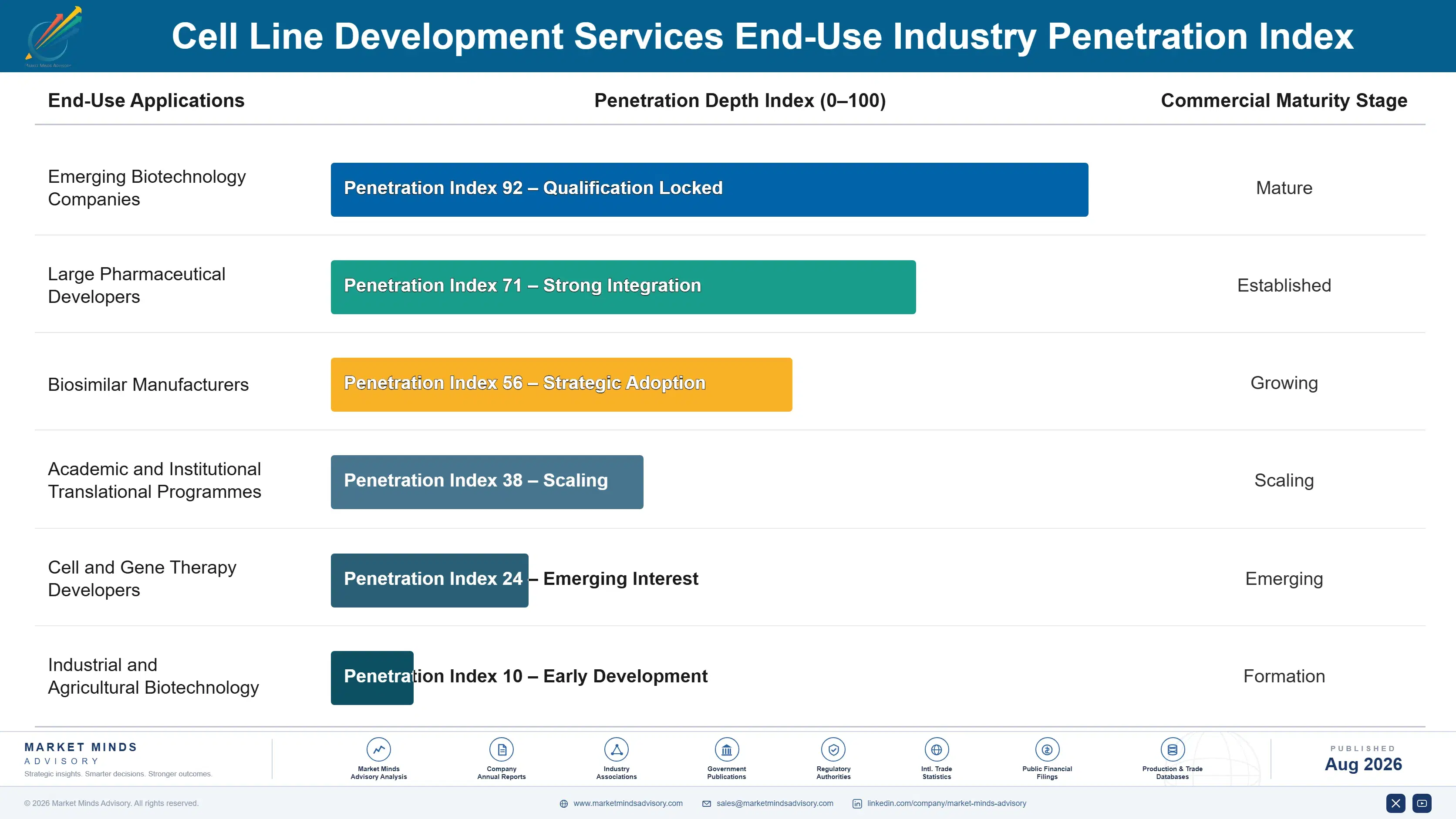
Buyer profiles differ sharply by sponsor size. Large pharmaceutical companies retain internal capability and outsource selectively, negotiating hard because they can walk away and do it themselves. Emerging biotechnology companies outsource entirely, since building the capability for one molecule makes no sense, and they select on speed and regulatory credibility rather than on price. Sourcing policy now sits above both, sometimes excluding providers before any technical evaluation happens.
cell-line-development-services-market-end-use-penetration-index-1787304226096

Where Development Service Strategy Lands

These are among the four positions where our research anticipates prominent divergence between winners and laggards over the coming forecast period. Each is grounded in the demand model, the regulatory perimeter, and the announced capacity pipeline.
01 / GATEWAY PRICING LOGIC

Nobody profitable prices this service on its own economics

A cell line becomes the permanent source of a product manufactured across twenty years and written into regulatory filings, and changing it afterwards demands comparability work that almost no sponsor will contemplate seriously. The provider who develops it therefore holds a decisive advantage on manufacturing revenue worth many multiples of any development fee charged. Pricing at or below cost to secure that position is entirely rational rather than reckless, and specialists without manufacturing capacity face economics they simply cannot replicate at all.
02 / SCREENING VALUE CAPTURE

Titre stopped mattering and the pricing has not caught up

Fed-batch expression routinely reaches six grams per litre while downstream purification, not upstream yield, limits throughput across most manufacturing facilities today. Screening therefore selects on glycosylation, charge variants and aggregation across up to eight thousand candidates, which demands automated platforms and analytical capacity representing genuine capital investment. Providers bundling that stage into a flat development fee are giving away precisely the capability that distinguishes them from every commoditised competitor in the market, which is a considerable amount of value to surrender.
03 / ROYALTY MODEL CONCESSION

Sponsors have stopped accepting claims on their molecules

Roughly 38% of programmes still carry ongoing royalty obligations attached to a licensed host cell line, and sponsors increasingly refuse a permanent claim on a molecule they intend to commercialise themselves. Royalty-free hosts have taken share despite demonstrating no expression or stability advantage whatsoever, which shows the objection is commercial rather than technical. Providers still defending downstream royalty streams are protecting a model that now costs them programmes at the selection stage rather than earning anything from them at all.
04 / JURISDICTION DIVERSIFICATION PRIORITY

Geography is now a criterion before any technical evaluation

Legislative and procurement pressure has sponsors reducing single-country concentration in biologics development sourcing regardless of technical performance or delivered price, and roughly 30% of all development work is now redistributing on that basis alone. The output sits inside a regulatory filing for decades, which makes sponsors unusually cautious about geopolitical exposure they cannot unwind later. Providers holding capability across multiple jurisdictions can serve sponsors who would otherwise exclude them before any technical evaluation happened, and building that presence takes years.

Engagement Snapshot From the Field

A live engagement with an industry participant carrying material or product regulatory and market exposure ahead of a defining policy shift, showing how our research translates into a defensible multi-year portfolio strategy.
MARKET MINDS ADVISORY · CLIENT ENGAGEMENT SUMMARY
Cell Line Development Services Producer Strategic Portfolio Review and Transition Roadmap 2026·Investment Scenario on Cell Line Development Services Exposure Evaluation 2025-26
CLIENT PROFILE
A European contract development organisation providing cell line development, expression platform access and early process development to biotechnology and pharmaceutical sponsors, with annual cell line development revenue of approximately USD 68 million (client-reported, unverified by MMA). The company held a proprietary host cell line licensed on royalty-bearing terms and operated no clinical or commercial manufacturing capacity of any kind.
STRATEGIC CHALLENGE
Integrated contract manufacturers were pricing development below the client's cost to secure downstream manufacturing it could not offer, while sponsors were increasingly refusing the royalty terms attached to its host cell line. The board wanted to know whether to acquire manufacturing capacity to match gateway economics, or to reposition around screening capability and difficult expression problems where capability rather than capacity decides awards.
MMA APPROACH
MMA conducted 47 expert interviews across biotechnology chief scientific officers, large pharmaceutical outsourcing directors, regulatory affairs specialists, contract manufacturer commercial leads and process development scientists in six countries. A quantitative survey of 3,800 respondents established provider selection criteria, royalty tolerance and sourcing policy constraints across sponsor types. We then modelled revenue and margin under both options against observed pricing behaviour and programme award patterns.
KEY FINDINGS
  1. Emerging biotechnology sponsors selected providers on speed and regulatory credibility rather than price, but rejected royalty-bearing host terms outright in four of six markets surveyed.
  2. Integrated manufacturers openly priced development below cost, and specialist providers reported losing straightforward antibody programmes on price they could not profitably match.
  3. Difficult-to-express and bispecific programmes were awarded on demonstrated technical capability, with sponsors reporting willingness to pay substantially more where earlier attempts had failed.
  4. Sourcing policy constraints excluded certain providers before any technical evaluation occurred, and several sponsors maintained approved provider lists defined by jurisdiction alone.
CLIENT PROFILE
A European contract development organisation providing cell line development, expression platform access and early process development to biotechnology and pharmaceutical sponsors, with annual cell line development revenue of approximately USD 68 million (client-reported, unverified by MMA). The company held a proprietary host cell line licensed on royalty-bearing terms and operated no clinical or commercial manufacturing capacity of any kind.
STRATEGIC CHALLENGE
Integrated contract manufacturers were pricing development below the client's cost to secure downstream manufacturing it could not offer, while sponsors were increasingly refusing the royalty terms attached to its host cell line. The board wanted to know whether to acquire manufacturing capacity to match gateway economics, or to reposition around screening capability and difficult expression problems where capability rather than capacity decides awards.
MMA APPROACH
MMA conducted 47 expert interviews across biotechnology chief scientific officers, large pharmaceutical outsourcing directors, regulatory affairs specialists, contract manufacturer commercial leads and process development scientists in six countries. A quantitative survey of 3,800 respondents established provider selection criteria, royalty tolerance and sourcing policy constraints across sponsor types. We then modelled revenue and margin under both options against observed pricing behaviour and programme award patterns.
KEY FINDINGS
  1. Emerging biotechnology sponsors selected providers on speed and regulatory credibility rather than price, but rejected royalty-bearing host terms outright in four of six markets surveyed.
  2. Integrated manufacturers openly priced development below cost, and specialist providers reported losing straightforward antibody programmes on price they could not profitably match.
  3. Difficult-to-express and bispecific programmes were awarded on demonstrated technical capability, with sponsors reporting willingness to pay substantially more where earlier attempts had failed.
  4. Sourcing policy constraints excluded certain providers before any technical evaluation occurred, and several sponsors maintained approved provider lists defined by jurisdiction alone.
RECOMMENDED STRATEGY
Phase 1: Phase one: convert the proprietary host to royalty-free access with a higher upfront fee, since royalty terms were costing programmes at the selection stage. Phase 2: Phase two: invest in automated high-throughput screening on product quality attributes rather than acquiring manufacturing capacity the company could not operate competitively. Phase 3: Phase three: withdraw from competing on straightforward antibody programmes entirely and concentrate commercial effort on difficult expression and bispecific work instead.
OUTCOME
The client moved its host to royalty-free terms within two quarters and commissioned automated screening capability the following year (client-reported, unverified by MMA). Programme win rates on bispecific and difficult expression work improved materially, average project fees rose roughly a quarter, and no further programmes were lost on royalty terms.

Frequently Asked Questions

Foundational context covering the market sizes, CAGR, scope, country, region and competition that inform every finding below. This section is provided to cover basics and most often pre-purchase conversations, answered from the MMA Primary Research Dataset.

What is the current size of the Cell Line Development Services Market?

The global cell line development services market was valued at USD 1.6 billion in 2025, covering host licensing, vector construction, transfection, single-cell cloning, clone screening and cell banking. Downstream process development and manufacturing fall outside this definition.

How large will the Cell Line Development Services Market be by 2036?

MMA forecasts the market at USD 5.04 billion by 2036, expanding 2.83 times from the 2026 base of USD 1.78 billion. That represents roughly USD 3.26 billion of incremental value across the forecast decade.

What is the CAGR for the Cell Line Development Services Market 2026 to 2036?

The base case compound annual growth rate is 11.0%, with a bull case of 12.4% and a bear case of 9.8%. The bear case reflects biotechnology funding contraction removing the small sponsors who outsource entirely.

Which segment is growing fastest?

Clone screening and lead selection grows at 16.5%, a full 1.50x the overall market rate. Screening now selects on glycosylation, charge variants and aggregation rather than on titre that no longer constrains manufacturing.

Who are the major companies in the Cell Line Development Services Market?

WuXi Biologics, Samsung Biologics, Lonza, Thermo Fisher Scientific and Sartorius together hold 44% of revenue. The leaders price development as a gateway to manufacturing rather than as a standalone business.

Which country is growing fastest?

India grows fastest at 16.2%, capturing work redirected by sourcing diversification at cost positions Western providers cannot match. East Asia remains the largest region at 30% of value.

Report Segmentation Architecture

The full report scope spans multiple orthogonal segmentation dimensions, with cross-tabulated demand data provided for each dimension pair. Coverage extends further to regional breakdowns, trend trajectories, and the competitive detail needed to support segment-level decision-making.

By Development Workflow Stage

  • Host Cell Line Licensing and Access
  • Expression Vector Design and Construction
  • Transfection, Selection and Pool Generation
  • Single-Cell Cloning and Clonality Assurance
  • Clone Screening and Lead Selection
  • Cell Bank Manufacture and Characterisation

By End-Use Industry

  • Emerging Biotechnology Companies
  • Large Pharmaceutical Developers
  • Biosimilar Manufacturers
  • Academic and Institutional Translational Programmes
  • Cell and Gene Therapy Developers
  • Industrial and Agricultural Biotechnology

By Commercial Dimension

  • Fee-for-Service Development Contracts
  • Integrated Development and Manufacturing Agreements
  • Royalty-Bearing Host Licensing
  • Royalty-Free Host Access Arrangements
  • Milestone-Linked Development Partnerships
  • Platform Technology Licensing

By Region

  • East Asia
  • North America
  • Western Europe
  • South Asia and Pacific
  • Latin America
  • Middle East and Africa
  • Eastern Europe

Scope, Methodology, and Coverage

Every figure in this report is reproducible from documented input assumptions. The scope below maps the historical period, the forecast horizon, the segmentation dimensions, and the countries covered, alongside the underlying primary and qualitative methodology.
Historical Period
2020 to 2025
Forecast Period
2026 to 2036
Base Year
2025 (USD billions; MMA Primary Research Dataset, August 2026)
Market Definition
This market comprises contract services developing stable recombinant cell lines for biologics manufacturing, measured at service and licensing revenue across fee-for-service contracts, integrated development and manufacturing agreements, host licensing arrangements and platform technology licensing. Coverage spans host cell line licensing and access including royalty-bearing and royalty-free terms, expression vector design and construction, transfection with selection and stable pool generation, single-cell cloning with clonality assurance documentation and imaging evidence, automated clone screening and lead selection including product quality attribute assessment, and master and working cell bank manufacture with associated characterisation and stability testing. Downstream process development and purification development, clinical and commercial manufacturing, analytical method development and release testing sold independently, cell culture media, reagents and single-use equipment, transgenic animal and plant expression platforms, and cell therapy manufacturing services fall outside scope.
Quantitative Units
USD billions (current prices); development programmes completed by workflow stage; average fee per programme; clones screened per programme; royalty-bearing share of host arrangements
Segmentation Dimensions
By Development Workflow Stage; By End-Use Industry; By Commercial Dimension; By Region
Regions Covered
East Asia, North America, Western Europe, South Asia and Pacific, Latin America, Middle East and Africa, Eastern Europe
Countries Covered
China, South Korea, Japan, Taiwan, United States, Canada, Switzerland, Germany, United Kingdom, Ireland, Netherlands, Denmark, France, Italy, India, Australia, Singapore, Malaysia, Brazil, Argentina, Mexico, Cuba, Israel, Saudi Arabia, United Arab Emirates, South Africa, Poland, Czechia, Hungary, and additional markets relevant to biologics development capability analysis
Key Companies Profiled
WuXi Biologics, Samsung Biologics, Lonza, Thermo Fisher Scientific, Sartorius, Catalent, Fujifilm Diosynth Biotechnologies, Boehringer Ingelheim BioXcellence, AGC Biologics, Charles River Laboratories, Syngene International, Biocon Biologics, ProBioGen, Selexis, Abzena, Rentschler Biopharma, Revvity, Bruker Cellular Analysis, JSR Life Sciences, Batavia Biosciences
Quantitative Methodology
Primary survey, n=3,800 respondents, Q4 2025, six countries; demand-side model with trade association cross-validation
Qualitative Methodology
47 expert interviews, Q4 2025; applied to validate demand model assumptions, identify emerging dynamics, and assess competitive positioning
Report Format
PDF and XLSX data workbook (Word format preview document)
Publisher
Market Minds Advisory
Report Code
MMA-2026-HLT-227
Published
August 2026
Contact
sales@marketmindsadvisory.com | www.marketmindsadvisory.com

Purchase the full Cell Line Development Services Market Report (2026 to 2036).

The full MMA report treats cell line development as the gateway it actually is, quantifying how manufacturing lock-in distorts pricing across the whole service and where value is genuinely captured instead. It sizes six workflow stages and seven regions to 2036, modelling programme volumes, fees by stage, screening throughput and royalty-bearing share separately so that capability-driven value can be distinguished from commoditised delivery. Competitive assessment covers twenty providers on one consistent revenue basis. Cost exposure is traced through scientific labour, media and automated screening instrumentation. Four commercial levers and a strategic verdict close the report, grounded in 47 expert interviews and a 3,800-respondent survey.
Six workflow stages sized separately to 2036
Gateway pricing economics modelled against downstream manufacturing value
Product quality attribute screening quantified across programme volumes
Twenty providers assessed on one consistent basis
Sourcing policy redistribution mapped by provider jurisdiction
Anonymised client engagement with tested strategic recommendations

Built For The People Who Decide

From boardroom strategy to bench-side execution, this report is read cover-to-cover by leaders shaping the next decade of their industry, turning demand scenarios, market dynamics and valuation benchmarks into decisions.
CXOs/ Presidents/ VPs/ Managers
M&A and Corporate Development
Strategy Teams and R&D Heads
Procurement and Product Directors
Regulatory and Compliance Leaders
Investor Relations and Equity Analysts