Market Minds Advisory
Cavity RF Filter Market

Cavity RF Filter Market: Cavity RF Filter Market: Tuning Labour, Spectrum Crowding and Where Machined Metal Still Wins 2026 to 2036

A machined metal box tuned by hand still outperforms every printed alternative at high power. That is why an industry obsessed with miniaturisation keeps buying components that look like plumbing.

Lead Analyst

Published

September 2026

Make Smarter Decisions with Customized Research Insights

Request a free sample report and evaluate market opportunities, growth trends, and competitive dynamics relevant to your business needs.

2025 MARKET VALUE$2.8BMarket Size 2025
2036 FORECAST VALUE$5.5BBase Case , 2026 to 2036
CAGR 2026 TO 20366.4 %Bull 7.6% / Bear 5.2%
INCREMENTAL OPPORTUNITY$2.5BNet 10- year value creation
EXPANSION MULTIPLE1.83x2036 value over 2026 base
Strategic Levers
M&A Pipeline
Regional Outlook
Country Rankings
Competitive Intelligence
Segmental Deep-dive
Call-Us : 91 93563 13602

Executive Snapshot and Market Trajectory.

A machined metal cavity tuned by hand still outperforms every printed alternative at high power and tight rejection. That is precisely why an industry which talks constantly about miniaturisation keeps on buying components that look, to anybody outside it, remarkably like plumbing fittings.
The market reaches USD 3.0 billion in 2026 and USD 5.5 billion by 2036, a 1.83 times expansion at 6.4%. Ceramic loaded cavity filters for dense deployment grow at 9.6%, half again the market rate of 6.4%, because dielectric loading shrinks the cavity without surrendering the rejection that makes them worth using. East Asia holds 42% of global shipment revenue, well above the usual band ceiling, and India compounds fastest of any market at 10.8%.
Five manufacturers hold just 41% of shipment revenue, which is low for a component category, because the real barrier is skilled tuning labour rather than any capital equipment somebody has to buy. Ericsson, Filtronic, Kathrein, Comba Telecom and Microwave Filter Company lead the field between them. Around 44% of unit cost is tuning and test labour, which explains where manufacturing sits and why automation attempts keep disappointing everybody.
Market Definition
This report covers cavity radio frequency filters by construction class: ceramic loaded cavity filters for dense deployment, air-filled coaxial cavity filters, waveguide cavity filters for high frequency bands, combline and interdigital cavity filters, tunable and reconfigurable cavity assemblies, and duplexers and multiplexers built from cavity resonators. It excludes surface acoustic wave and bulk acoustic wave filters, printed and lumped element filters, digital filtering performed in software, antennas and radomes, and amplifiers or transceiver electronics of any kind.
Base Year Value
$2.8B in 2025 (MMA Primary Research Dataset, September 2026)
Forecast Period
2026 to 2036, eleven discrete annual values
CAGR
6.4% base case. Bull 7.6%. Bear 5.2%.
Fastest Growth Segment
Ceramic Loaded Cavity Filters For Dense Deployment: 9.6% CAGR
Fastest Growth Country
India: 10.8% CAGR
Fastest Growth Region
South Asia and Pacific: 8.5% CAGR
Largest Region
East Asia: 42% of 2025 global value
Market Leaders
Ericsson, Filtronic, Kathrein, Comba Telecom and Microwave Filter Company lead on cavity radio frequency filter shipment revenue. Source: MMA Analysis.
Primary Survey
n=3,800 procurement and R&D decision-makers, Q4 2025, six countries
Methodology
Demand-side build-up, cross-validated against public data, 47 expert interviews

Cavity RF Filter Market Forecast Scenarios

cavity-rf-filter-market-size-forecast-scenario-1789996416104
Between 2020 and 2025 the category compounded at 5.3%, shaped by a fifth-generation buildout that arrived and then subsided. Base station deployment peaked around 2022 and fell as coverage obligations were met, taking cavity filter volume down with it. What held the market up was defence radar, satellite ground stations and broadcast, none of which follows a telecom capital cycle.
The base case holds 6.4% on three mechanisms working together. Spectrum keeps getting more crowded, which raises the rejection requirements that only cavity construction reliably meets at genuinely useful power levels. Defence radar and electronic warfare programmes keep expanding across every major procurement budget worldwide. And satellite ground segment construction continues steadily as constellation operators build out the terrestrial gateway infrastructure without which their orbital assets are commercially useless to anybody.
The bull case at 7.6% assumes defence radar procurement accelerates beyond announced programmes, since those buyers pay for performance rather than negotiating on unit price. The bear case at 5.2% is substitution at the edges: acoustic and printed filters keep improving, and every application they take is one that never comes back to cavity construction regardless of what happens afterwards.

Machined Metal Still Wins

Physics keeps this category alive against every attempt to replace it. A resonant metal cavity loses around 0.4 decibels passing signal through and handles 500 watts continuously, while printed and acoustic alternatives lose far more and fail outright at those power levels. Nothing about that is likely to change, because it follows from the material properties rather than from any manufacturing limitation somebody might eventually solve.
TOP FIVE CONCENTRATION41%Low, since skilled tuning labour rather than capital limits entry
TUNING LABOUR SHARE44%Skilled adjustment and test work within total unit cost
TYPICAL INSERTION LOSS0.4 decibelsSignal lost passing through against far higher printed alternatives
POWER HANDLING CEILING500 wattsContinuous handling where printed filter alternatives fail entirely
TUNING TIME PER UNIT22 minutesSkilled adjustment required before a unit meets specification
DEFENCE SHARE OF REVENUE31%Portion of demand from radar and electronic warfare programmes
The commercial problem is that around 44% of unit cost is skilled tuning and test labour, roughly 22 minutes per unit performed by somebody who has spent years learning to do it. Automation attempts have delivered less than promised for two decades. That labour intensity explains why manufacturing concentrates where skilled technical labour is affordable, and why concentration sits at only 41% in a category most people assume would be consolidated.
Demand has also shifted away from telecom toward defence, which changed the customer considerably. Radar and electronic warfare programmes now account for roughly 31% of revenue, and those buyers evaluate on performance and qualification rather than negotiating hard on unit price. A supplier organised around telecom volume pricing frequently discovers it has been leaving money on the table in defence for years.
"Every few years somebody announces a printed filter that will finally replace cavities. Then a customer needs half a kilowatt through it and the conversation ends. The physics has not moved and will not move. What moves is where the tuning is done and how much that costs."
Director, Radio Frequency Components and Microwave Systems Practice · MMA Technology Practice · September 2026

Market Trends

Ceramic Loading Shrinks Cavities Without Losing Rejection

Dielectric loading lets a cavity resonate at the same frequency in a considerably smaller volume, which addresses the one genuine objection to cavity construction without surrendering any of the rejection or power handling that makes it worth using. Ceramic loaded cavity filters for dense deployment grow at 9.6% against 6.4% for the market as a whole. Adoption concentrates wherever physical space is genuinely constrained, principally across small cell sites and mounted radar assemblies, and the ceramic material itself adds real cost that only those constrained applications will ever actually justify.
Market Impact: Loss stays near 0.4 decibels

Defence Demand Replaces Telecom As The Anchor

Radar and electronic warfare programmes together now generate roughly 31% of category revenue, up very considerably from where they sat before base station deployment subsided after the fifth-generation buildout completed. Those particular buyers evaluate on measured performance and on qualification status rather than negotiating hard on unit price, which is an entirely different sort of commercial conversation from the telecom one. Suppliers organised entirely around telecom volume pricing frequently discover that they have been underpricing defence work for years without anybody in the business ever noticing the difference at all.
Market Impact: India compounds at 10.8% yearly

Market Opportunities and Growth Drivers

Spectrum Crowding Raises Rejection Requirements Everywhere

As more and more services occupy adjacent frequency allocations, the rejection required to keep them from interfering with one another rises steadily, and cavity construction is the only approach that reliably delivers that rejection at genuinely useful power levels. Insertion loss near 0.4 decibels against far higher figures for printed alternatives is what makes the difference in any system where the signal budget actually matters. Regulatory allocation of previously unused bands keeps creating fresh adjacency problems that somebody has to filter properly, and cavity construction is invariably what they reach for.
Market Impact: Tuning consumes 22 minutes each

Satellite Ground Segment Construction Adds Steady Volume

Constellation operators keep on building out terrestrial gateway infrastructure, because their orbital assets are commercially useless without ground stations able to reach them reliably enough. Those gateway installations use waveguide and coaxial cavity filters at power levels where nothing else functions at all reliably, and they are built entirely new rather than converted from anything that already exists. India compounds at 10.8% annually, faster than any other market measured anywhere, on ground station and defence radar construction proceeding together under national capability programmes rather than through any purely commercial ventures.
Market Impact: Cavities handle 500 watts continuously

Market Restraints and Challenges

Skilled Tuning Labour Limits Capacity And Margin

Around 44% of unit cost is skilled tuning and test work at roughly 22 minutes per unit, performed by technicians who take years to train properly and cannot simply be recruited at short notice. The root cause is that each machined cavity varies slightly and must be adjusted individually to meet specification. Commercially this caps available capacity with headcount rather than with any equipment purchase. Mitigation runs through tighter machining tolerances reducing tuning time, through automated tuning wherever the geometry permits it, and through design choices making units considerably less sensitive.
Market Impact: Insertion loss holds near 0.4 decibels

Printed And Acoustic Filters Take The Easier Applications

Acoustic and printed filters keep improving and take every application where power levels and rejection requirements sit inside what they can manage, and none of those applications ever return to cavity construction afterwards. The root cause is that cavities win on the physics rather than on cost, so any application where the physics is not binding goes elsewhere. Commercially this erodes the category from below continuously and permanently. Mitigation runs through high power, tight rejection and defence applications, where 500 watt continuous handling genuinely has no alternative available at all.
Market Impact: Defence now generates 31% of revenue
3 additional market trends, 4 additional growth drivers, and 2 additional restraints and challenges are covered in the full report. Contact sales@marketmindsadvisory.com to access the complete intelligence.

Segment CAGR and Growth Architecture

Segmentation follows construction class, since the physical arrangement determines frequency range, power handling, size and how much tuning labour each unit demands. Six classes cover the market, spanning ceramic loaded, air-filled coaxial, waveguide, combline and interdigital, tunable assemblies, and multiplexers built from cavity resonators. End-use application and procurement route are separate dimensions handled elsewhere.
cavity-rf-filter-market-market-share-analysis-1789996416637

Ceramic Loaded Cavity Filters For Dense Deployment

Ceramic loaded cavity filters for dense deployment grow at 9.6%, half again the market rate of 6.4%, because dielectric loading lets a cavity resonate at exactly the same frequency inside a considerably smaller physical volume. That answers the one genuine objection to cavity construction without giving up any of the rejection or the 500 watt power handling that makes it worth choosing in the first place. Adoption concentrates wherever physical space is genuinely constrained: small cell sites, mounted radar assemblies and airborne installations of every kind. The ceramic material adds real cost, so applications with physical room to spare continue using air-filled construction and will almost certainly keep doing so indefinitely.
CAGR 9.6%

Waveguide Cavity Filters For High Frequency Bands

Waveguide cavity filters for high frequency bands compound at 8.2% on satellite ground segment construction and on radar systems operating at frequencies where coaxial construction becomes entirely impractical to build. These are the highest performing filters found anywhere in the category and also among the most expensive to produce, with tuning labour running well above the 22 minute category average, because machining tolerances tighten considerably as operating frequency rises. Demand here follows ground station construction and defence programmes rather than any commercial replacement cycle at all, which makes demand lumpy but considerably more predictable than telecom volume ever proved to be across a full decade. Tolerances tighten sharply as operating frequency rises.
CAGR 8.2%
Full segment breakdown across 6 segments available in the complete report.

Regional Architecture and Country Demand Map

East Asia holds 42% of shipment revenue, well above the usual band ceiling, because tuning labour is 44% of unit cost and skilled technical labour is most affordable right across the region. North America follows at 24% on defence radar and satellite ground segment demand.

East Asia

East Asia takes 42% of shipment revenue, well above the 30% band ceiling, and labour economics rather than technology explain nearly all of it. Around 44% of unit cost is skilled tuning work at roughly 22 minutes per unit, and Chinese manufacturers built enormous capacity staffed by technicians trained for exactly that. Comba Telecom and a large group of domestic suppliers serve both local base station demand and export markets. Japanese and South Korean suppliers hold higher specification positions in defence and satellite work. Growth at 7.4% sits above the global rate on domestic radar and ground station construction proceeding at pace. Manufacture and consumption sit together here more than anywhere.
Share: 42% | CAGR: 7.4% (2026 to 2036)

North America

Twenty-four percent of shipment revenue reaches North America, where defence radar, electronic warfare and satellite ground segment demand together account for the clear majority. Those buyers evaluate on measured performance and qualification status rather than negotiating hard on unit price, which sustains margins that telecom volume never did. Microwave Filter Company and several specialist suppliers hold established positions serving programmes with long qualification cycles. Domestic manufacturing persists here despite labour cost, because defence sourcing requirements frequently prohibit offshore production entirely. Growth at 6.0% sits marginally below the global rate on a market where telecom volume has faded and defence procurement moves on its own timetable rather than any commercial cycle.
Share: 24% | CAGR: 6.0% (2026 to 2036)
Regional intelligence for 5 additional markets available in the complete report: Western Europe, South Asia and Pacific, Latin America, Middle East and Africa, Eastern Europe. Contact sales@marketmindsadvisory.com.
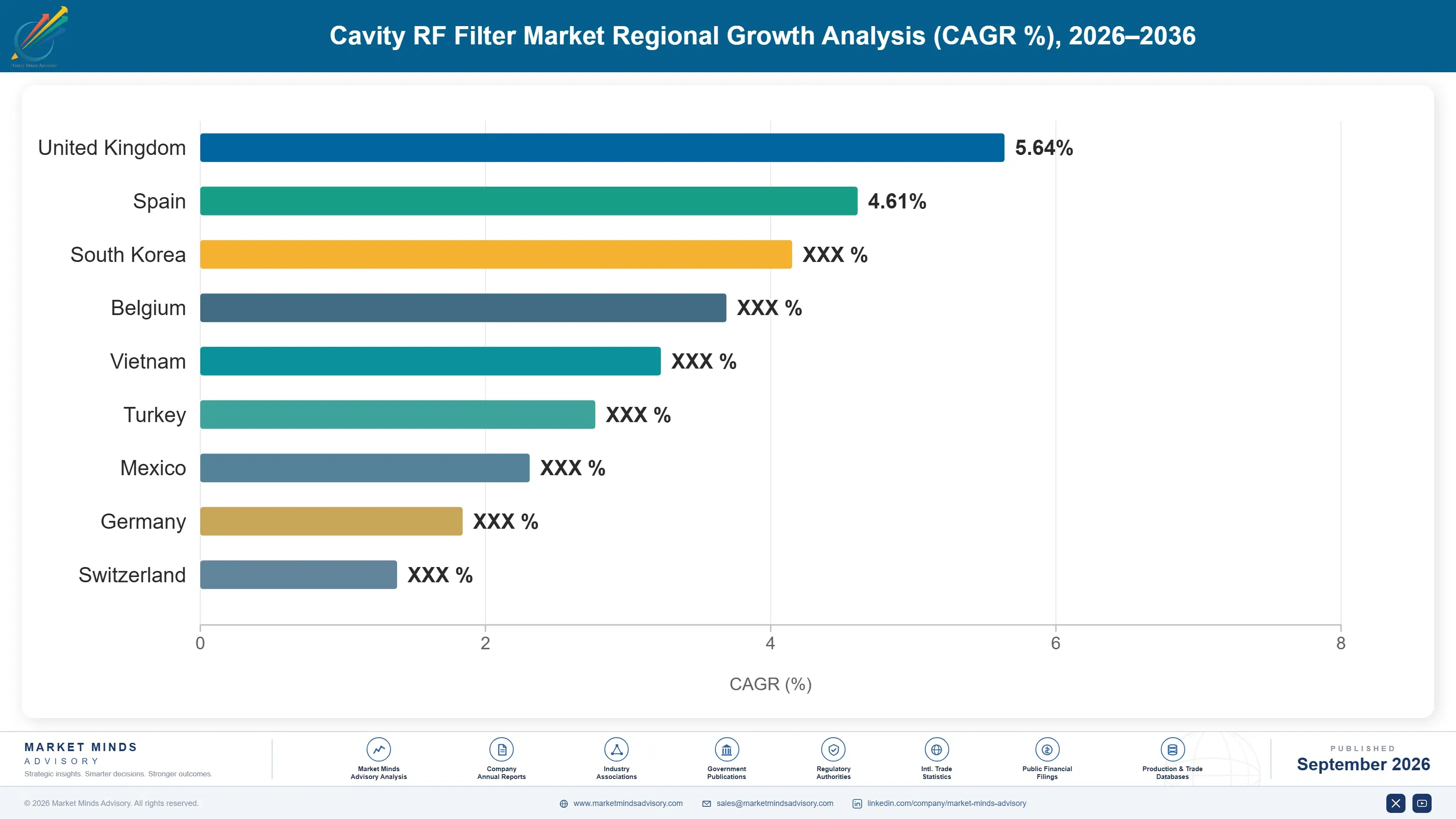
cavity-rf-filter-market-country-cagr-analysis-1789996417159

Where Cavity Filter Margin Lives

Nearly half of the unit cost is skilled labour that has resisted automation for two full decades now, defence buyers evaluate on performance rather than on price, and every application the physics does not require moves permanently to printed alternatives. The four levers below follow those conditions rather than any argument about filter topology.

Reduce Tuning Time Through Machining Precision

Around 44% of total unit cost is skilled tuning and test work at roughly 22 minutes per unit, and capacity scales with trained technicians rather than with equipment that can simply be purchased. Tighter machining tolerances reduce how much adjustment each unit needs before it meets its specification, which converts recurring labour cost into a one-off investment in machine capability. Suppliers pursuing automated tuning have been disappointed for two full decades now. Those pursuing machining precision instead have quietly improved their cost position without attracting anything like the same publicity.
Market Impact: Tuning consumes 22 minutes on every single unit

Price Defence Work On Performance Not Volume

Radar and electronic warfare programmes generate roughly 31% of category revenue and evaluate suppliers on measured performance and qualification status rather than negotiating hard on unit price. Suppliers applying telecom volume pricing discipline to their defence work are leaving real margin on the table on every single order, frequently for years before anybody examines it. The commercial discipline here is recognising that these are two entirely different businesses which happen to share a manufacturing line, and then pricing each of them according to how its buyer actually evaluates the purchase.
Market Impact: Defence generates fully 31% of all category revenue

Concentrate On Applications Physics Actually Requires

Printed and acoustic filters take every application where the power and rejection requirements sit inside what they can manage, and none of those applications ever return to cavity construction. The defensible ground here is 500 watt continuous handling and insertion loss near 0.4 decibels, where no alternative technology functions at all. Suppliers competing for applications that a printed filter could serve adequately are competing on cost against a fundamentally cheaper technology. Those concentrating where the physics is genuinely binding compete instead on capability that nobody else can offer at all.
Market Impact: Cavities handle a full 500 watts continuously each

Follow Ground Station And Radar Construction

Satellite gateway installations and radar programmes are built entirely new rather than converted, and each installation specifies its filters during system design rather than through any replacement cycle at all. India compounds at 10.8% annually on exactly that construction, proceeding under national capability funding rather than commercially. Reaching those projects means engaging with system integrators and programme offices rather than with any procurement departments, because the filter specification gets settled at the point when the radio architecture is first drawn, rather than when purchase orders are eventually issued to somebody.
Market Impact: India alone compounds at fully 10.8% every year

Who Controls the Margin Pool

Five manufacturers hold just 41% of cavity filter shipment revenue, which is low for a component category and reflects that the barrier is skilled tuning labour rather than any capital equipment somebody must buy. Ericsson, Filtronic, Kathrein, Comba Telecom and Microwave Filter Company lead. All participants here are assessed consistently on cavity radio frequency filter shipment revenue rather than on any broader components or systems business they also operate.
Competition runs on tuning cost in commercial applications and on qualification status in defence ones, which are two genuinely different contests fought against different buyers. Commercial telecom customers compare unit price against suppliers with lower labour costs. Defence programmes instead compare measured performance and approval history, where unit price barely enters the discussion and switching suppliers requires a requalification nobody wants to undertake.

Pressure comes from printed and acoustic filter suppliers taking every application where the physics does not genuinely require cavity construction, which erodes the category from below continuously. Rankings shift wherever defence and ground station construction is happening rather than where telecom equipment gets built, particularly across India, Poland and the Gulf at present.
cavity-rf-filter-market-company-positioning-matrix-1789996417696

Competitive Moat and Risk Dimensions

FILTRONIC

Moat: High Frequency Design Depth

Filtronic holds genuine design capability at the higher frequency bands, where tolerances tighten sharply and tuning becomes considerably harder than the 22 minute average suggests. That capability accumulated across many satellite and defence programmes and cannot be assembled quickly. Customers at those frequencies have very few alternatives, which beats competing on unit cost in commercial telecom.
FILTRONIC

Risk: Programme Timing Dependency

Revenue depends substantially on satellite and defence programmes that move on procurement timetables nobody controls and that arrive unevenly across years. A programme delay removes revenue with very little notice and no commercial recourse available. Commercial volume would smooth that, though competing there means facing manufacturers with considerably lower tuning labour costs.
COMBA TELECOM

Moat: Tuning Labour Cost Position

Comba Telecom manufactures where skilled tuning technicians are available at costs Western suppliers cannot match, which matters enormously when 44% of unit cost is exactly that labour. Building comparable capability means assembling and training a technical workforce rather than purchasing equipment, and that takes years wherever it is attempted. The cost position is genuine and it is durable.
COMBA TELECOM

Risk: Defence Sourcing Exclusion

Defence programmes across several major markets prohibit offshore sourcing entirely, which excludes the company from roughly 31% of category revenue regardless of cost or capability. That share is also the part growing fastest and paying best. Cost advantage in commercial applications does not open a door that procurement rules keep firmly closed.

Players Tracked

Prominent Players

Ericsson
Filtronic
Kathrein
Comba Telecom
Microwave Filter Company

Other Key Players

CommScope
Radio Frequency Systems
Anaren
Dover Microwave
Mercury Systems
Smiths Interconnect
Cobham Microwave
Wainwright Instruments
K and L Microwave
Networks International Corporation
Shenzhen Tatfook Technology
Grentech
Bird Technologies
Reactel
Delta Electronics

Recent Developments

APRIL 2025

European Defence Programmes Expand Radar System Procurement

European defence ministries expanded radar and electronic warfare system procurement under increased spending commitments, a procurement development rather than any corporate transaction. Those buyers evaluate filter suppliers on measured performance and qualification status rather than negotiating hard on unit price, which is a materially different commercial conversation from telecom.
Signal: Defence buyers evaluate on performance and approval history rather than on any unit price comparison at all.
OCTOBER 2024

Indian Programmes Fund Ground Station And Radar Construction

Indian national programmes funded satellite ground station and defence radar construction across several locations, capability development rather than any commercial transaction. Filter specification is settled when the radio architecture is designed rather than when purchase orders are issued, which places the decision well upstream of any procurement department.
Signal: Filter selection happens when the radio architecture is first drawn, not when the order is finally placed.
JULY 2025

Ceramic Loaded Designs Extend Into Dense Site Deployments

Filter manufacturers extended ceramic loaded cavity designs across product ranges serving physically constrained installations, an engineering development rather than any merger. Dielectric loading lets a cavity resonate at the same frequency inside a considerably smaller volume, which addresses the size objection without surrendering rejection or power handling.
Signal: Ceramic loading answers the size objection without giving up any of the physics that justifies cavities.

What A Cavity Filter Costs

Skilled tuning and test labour accounts for roughly 44% of unit cost, performed at around 22 minutes per unit by technicians who take years to train. Machined aluminium and silver plating absorb about 21%, with plating quality directly affecting insertion loss. Ceramic dielectric material takes around 14% in loaded designs specifically, and enclosures with connectors absorb most of the remaining balance across production.
Silver pricing rose sharply through 2024 and into 2025, feeding directly into plating costs that manufacturers had contracted at earlier levels, while aluminium moved less dramatically over the same period. Ericsson Annual Report 2024 and Filtronic Annual Report 2024 both record materials and labour cost as principal operating variables across radio frequency component lines. Suppliers holding contracted metal supply managed that movement considerably better than spot buyers did.

The competitive disadvantage mechanism is tuning labour availability rather than material price. A manufacturer with a trained technical workforce can convert machined parts into specification-meeting product at predictable cost, while one recruiting into a tight technical labour market cannot. Exposure concentrates among Western manufacturers where technicians capable of this work are both scarce and expensive, which is precisely why so much production migrated to Asia.
cavity-rf-filter-market-cost-volatility-analysis-1789996417892

Invest In Machining Tolerance Before Tuning Automation

Tuning consumes roughly 44% of unit cost at around 22 minutes per unit, and automation attempts have disappointed for two decades because each cavity varies slightly. Tighter machining tolerances reduce how much adjustment each unit needs, which addresses that cost through a route that actually works. The investment sits in machine capability rather than in robotics.

Contract Silver Supply Across Production Years

Silver plating affects insertion loss directly and cannot be substituted without degrading the performance that justifies cavity construction in the first place. Silver pricing moved sharply while manufacturers held contracts written at earlier levels. Contracting supply across the production year removes exposure on a material whose specification is effectively fixed by physics rather than by any commercial preference.

Train Tuning Technicians Ahead Of Demand

Skilled tuning capacity scales with the number of trained people rather than with equipment, and technicians take years to reach full productivity on difficult high frequency work. Training ahead of demand costs real money against no immediate return, and it is the only thing that expands capacity when orders eventually arrive. Manufacturers recruiting reactively find nothing available at all.

Portfolio Architecture for Margin Defence

Margin architecture separates on frequency, qualification and tuning difficulty. Combline and interdigital filters for commercial telecom earn least, competing directly on unit price against manufacturers with lower labour costs. Air-filled coaxial designs sit above on power handling. Waveguide filters, ceramic loaded designs and defence-qualified assemblies earn most, because each combines difficult tuning with either scarce capability or approval status competitors cannot quickly replicate.
The volume versus premium tension runs between commercial telecom and defence, which share a manufacturing line and almost nothing else. Telecom volume keeps technicians occupied and covers fixed costs at thin margin. Defence work pays properly and arrives unevenly on procurement timetables. Suppliers abandoning telecom entirely find their technical workforce underemployed between defence programmes, which is an expensive way to hold skilled labour.

High-value pools concentrate in waveguide filters and in defence-qualified assemblies, and neither is reached through manufacturing capability alone. Waveguide work requires design depth at frequencies where tolerances punish any error. Defence qualification requires approval history built across programmes that took years. Both explain why the leading positions have proved unusually durable in a category with such low apparent barriers to entry.

Volume / Commodity-Adjacent

Combline and interdigital filters for commercial telecom at standard specifications, competing directly on unit price against manufacturers holding considerably lower tuning labour costs. The ten point spread separates suppliers with trained workforces from those recruiting into tight technical labour markets.
Gross Margin: 16% to 26%

Premium / Certified

Air-filled coaxial cavity filters and duplexers, where power handling and rejection performance determine selection alongside price across broadcast and infrastructure applications. The twelve point spread tracks how much of a supplier's volume carries qualification against how much competes purely on delivered unit cost.
Gross Margin: 30% to 42%

Sustainability / Regulatory / Next-Generation

Waveguide filters, ceramic loaded designs and defence-qualified assemblies, combining difficult high frequency tuning with scarce capability or approval status. The sixteen point spread reflects qualification depth, which takes years of programme history to build and cannot be shortened.
Gross Margin: 46% to 62%
cavity-rf-filter-market-portfolio-architecture-1789996418406

High-value Sub-segments and Strategic Watch-out

Ceramic Loaded Cavity Filters For Dense Deployment

Grows at fully 9.6% because dielectric loading shrinks the cavity without surrendering rejection or the power handling that justifies choosing one at all. The sixteen point spread here reflects underlying design capability. The ceramic material adds cost that only genuinely space-constrained applications will ever justify.
Gross Margin: 46% to 62%

Waveguide Cavity Filters For High Frequency Bands

Grows at fully 8.2% on satellite ground segment work and radar systems operating at frequencies where coaxial construction becomes entirely impractical. The sixteen point spread here reflects high frequency design depth. Tuning labour runs well above the 22 minute average as machining tolerances tighten with frequency.
Gross Margin: 46% to 62%

Air-Filled Coaxial Cavity Filters

Grows at only 5.8% on broadcast, infrastructure and defence applications where physical space is available and 500 watt handling genuinely matters. The twelve point spread here reflects programme qualification coverage. It remains the volume backbone of this whole category despite growing slower than the average.
Gross Margin: 30% to 42%

Combline And Interdigital Cavity Filters

Grows at 3.4%, slowest of the six construction classes, on commercial telecom applications competing directly on unit price against lower labour cost manufacturers. The ten point spread here reflects the workforce cost position. Base station demand faded away once the fifth-generation buildout subsided more or less everywhere.
Gross Margin: 16% to 26%

Why Filter Choices Persist

The annuity here is qualification rather than any supply agreement. A filter approved into a radar or satellite system stays there for the programme's life, because requalifying means retesting a radio chain that already meets its specification for no benefit anybody can point to. Programme lives run a decade or considerably longer in defence. A supplier qualified once therefore ships against that programme for years without renegotiating much of anything.
Depth varies sharply between defence and commercial work. A defence-qualified filter inside an approved system is effectively fixed for the programme duration. A waveguide filter matched to a specific ground station radio chain is similarly locked. A commercial telecom filter meeting a published specification is entirely substitutable, and operators switch on unit price without much deliberation at all. Suppliers frequently price both as though the same defensibility applied.

The buyer differs completely between the two halves of this market. A telecom procurement function compares unit price across qualified suppliers offering equivalent specifications. A defence programme office evaluates measured performance, approval history and whether sourcing rules even permit the supplier. Manufacturers organised around one of those conversations consistently underperform in the other, which is why so few serve both markets well.
cavity-rf-filter-market-end-use-penetration-index-1789996418899

What Decides Filter Selection

These are among the four positions where our research anticipates prominent divergence between winners and laggards over the coming forecast period. Each is grounded in the demand model, the regulatory perimeter, and the announced capacity pipeline.
01 / TUNING COST REDUCTION

Machine Tighter, Do Not Automate Tuning

Around 44% of unit cost is skilled tuning and test work at roughly 22 minutes per unit, and capacity scales with trained technicians rather than with equipment that can simply be purchased off a shelf. Tighter machining tolerances reduce how much adjustment each unit actually needs before it meets specification, which addresses exactly the same cost through a route that has demonstrably worked. Suppliers pursuing automated tuning have been disappointed repeatedly for two full decades now, and continue to be.
02 / DEFENCE PRICING DISCIPLINE

Stop Applying Telecom Pricing To Radar

Radar and electronic warfare programmes generate roughly 31% of category revenue and evaluate suppliers on measured performance and qualification status rather than negotiating hard on unit price at all. Suppliers applying telecom volume pricing discipline to defence work are leaving margin on the table on every single order, frequently for years at a time before anybody in the business examines the numbers properly. These are two entirely different businesses that simply happen to share the same manufacturing line and workforce.
03 / PHYSICS BOUND TARGETING

Sell Only Where Alternatives Cannot Function

Printed and acoustic filters now take every application where power levels and rejection requirements sit comfortably inside what they can manage, and none of those applications ever return to cavity construction afterwards at any point. The genuinely defensible ground here is 500 watt continuous handling and insertion loss near 0.4 decibels, where no alternative technology functions at all. Suppliers competing for applications that a printed filter could serve perfectly adequately are competing on cost against a fundamentally cheaper technology altogether.
04 / PROGRAMME DESIGN ENGAGEMENT

Win The Architecture, Not The Order

Satellite gateway installations and radar programmes are built entirely new rather than converted from anything, and each installation specifies its filters during system design rather than through any replacement cycle at all. India compounds at 10.8% annually on exactly that kind of construction, proceeding under national capability funding rather than commercially. Reaching those projects means engaging with system integrators and programme offices rather than with procurement departments, since the specification settles when the radio architecture is first drawn on paper.

Engagement Snapshot From the Field

A live engagement with an industry participant carrying material or product regulatory and market exposure ahead of a defining policy shift, showing how our research translates into a defensible multi-year portfolio strategy.
MARKET MINDS ADVISORY · CLIENT ENGAGEMENT SUMMARY
Cavity RF Filter Producer Strategic Portfolio Review and Transition Roadmap 2026·Investment Scenario on Cavity RF Filter Exposure Evaluation 2025-26
CLIENT PROFILE
A European radio frequency component manufacturer producing cavity filters for both telecom infrastructure and defence radar customers on exactly the same production line. Margins had compressed for three consecutive years while order volumes held broadly steady, and management had simply assumed the cause was Asian competition on unit price right across the whole product range.
STRATEGIC CHALLENGE
Sales wanted to move manufacturing offshore to match competitor pricing, which finance supported on the arithmetic presented. Engineering objected that defence customers would be excluded by sourcing rules. Nobody had separated margin performance between the telecom and defence halves of the business, and the two turned out to behave in completely opposite directions.
MMA APPROACH
MMA separated revenue, cost and margin between telecom and defence work across three years, then benchmarked the client's defence pricing against how those buyers actually evaluate purchases. We measured tuning time per unit across the product range and assessed where machining tolerance improvements would reduce it. Work drew on 47 expert interviews conducted in Q4 2025 with manufacturers and programme buyers.
KEY FINDINGS
  1. Defence work generated around 3 in 10 of revenue and considerably more than that share of gross margin, while telecom work was close to breaking even.
  2. Defence pricing had been set using telecom volume discounting conventions that those particular buyers had never once requested or expected to receive.
  3. Moving manufacturing offshore would have excluded the company from defence programmes entirely under sourcing rules nobody had checked (client-reported, unverified by MMA).
  4. Tuning time varied from 14 to 38 minutes across the range, driven almost entirely by machining tolerance rather than by design complexity.
CLIENT PROFILE
A European radio frequency component manufacturer producing cavity filters for both telecom infrastructure and defence radar customers on exactly the same production line. Margins had compressed for three consecutive years while order volumes held broadly steady, and management had simply assumed the cause was Asian competition on unit price right across the whole product range.
STRATEGIC CHALLENGE
Sales wanted to move manufacturing offshore to match competitor pricing, which finance supported on the arithmetic presented. Engineering objected that defence customers would be excluded by sourcing rules. Nobody had separated margin performance between the telecom and defence halves of the business, and the two turned out to behave in completely opposite directions.
MMA APPROACH
MMA separated revenue, cost and margin between telecom and defence work across three years, then benchmarked the client's defence pricing against how those buyers actually evaluate purchases. We measured tuning time per unit across the product range and assessed where machining tolerance improvements would reduce it. Work drew on 47 expert interviews conducted in Q4 2025 with manufacturers and programme buyers.
KEY FINDINGS
  1. Defence work generated around 3 in 10 of revenue and considerably more than that share of gross margin, while telecom work was close to breaking even.
  2. Defence pricing had been set using telecom volume discounting conventions that those particular buyers had never once requested or expected to receive.
  3. Moving manufacturing offshore would have excluded the company from defence programmes entirely under sourcing rules nobody had checked (client-reported, unverified by MMA).
  4. Tuning time varied from 14 to 38 minutes across the range, driven almost entirely by machining tolerance rather than by design complexity.
RECOMMENDED STRATEGY
Phase 1: Phase one: reprice defence work on performance and qualification rather than on telecom volume discounting conventions those buyers had never asked for. Phase 2: Phase two: abandon the offshore manufacturing plan, since it would have excluded the company from its most profitable customers entirely. Phase 3: Phase three: invest in machining tolerance on the products showing the longest tuning times, rather than pursuing tuning automation again.
OUTCOME
The manufacturer repriced defence work and kept production onshore, investing instead in machining precision (client-reported, unverified by MMA). Gross margin recovered measurably within a year without any volume loss. Telecom and defence are now managed and priced as separate businesses, which is the change that outlasted the engagement itself.

Frequently Asked Questions

Foundational context covering the market sizes, CAGR, scope, country, region and competition that inform every finding below. This section is provided to cover basics and most often pre-purchase conversations, answered from the MMA Primary Research Dataset.

What is the current size of the Cavity RF Filter Market?

Global value reaches USD 3.0 billion in 2026, measured as cavity filter shipment revenue across six construction classes. The 2025 base for the market is USD 2.8 billion.

How large will the Cavity RF Filter Market be by 2036?

The market reaches USD 5.5 billion by 2036, an increase of USD 2.5 billion across the forecast period. That represents 1.83 times expansion from the 2026 base.

What is the CAGR for the Cavity RF Filter Market 2026 to 2036?

The base case runs at 6.4% annually, with a bull case at 7.6% if defence radar procurement accelerates beyond announced programmes and a bear case at 5.2% if printed alternatives take more applications.

Which segment is growing fastest?

Ceramic loaded cavity filters for dense deployment grow at 9.6%, half again the market rate of 6.4%. Dielectric loading shrinks the cavity without surrendering rejection or power handling.

Who are the major companies in the Cavity RF Filter Market?

Ericsson, Filtronic, Kathrein, Comba Telecom and Microwave Filter Company lead on shipment revenue, together holding 41%. CommScope, Mercury Systems and Smiths Interconnect hold smaller positions.

Which country is growing fastest?

India leads at 10.8%, on satellite ground station and defence radar programmes proceeding together under national capability funding. Saudi Arabia and Poland follow behind it.

Report Segmentation Architecture

The full report scope spans multiple orthogonal segmentation dimensions, with cross-tabulated demand data provided for each dimension pair. Coverage extends further to regional breakdowns, trend trajectories, and the competitive detail needed to support segment-level decision-making.

By Construction Class

  • Ceramic Loaded Cavity Filters For Dense Deployment
  • Waveguide Cavity Filters For High Frequency Bands
  • Air-Filled Coaxial Cavity Filters
  • Duplexers And Multiplexers From Cavity Resonators
  • Tunable And Reconfigurable Cavity Assemblies
  • Combline And Interdigital Cavity Filters

By End-Use Industry

  • Defence Radar And Electronic Warfare
  • Satellite Ground Segment Infrastructure
  • Telecom Base Station Equipment
  • Broadcast Transmission Systems
  • Aerospace And Avionics
  • Test And Measurement Instrumentation

By Commercial Dimension

  • Defence Programme Qualification
  • System Integrator Specification
  • Direct Manufacturer Supply
  • Original Equipment Manufacturer Integration
  • Distributor And Channel Sales
  • Aftermarket And Spares Supply

By Region

  • North America
  • Western Europe
  • East Asia
  • South Asia and Pacific
  • Latin America
  • Middle East and Africa
  • Eastern Europe

Scope, Methodology, and Coverage

Every figure in this report is reproducible from documented input assumptions. The scope below maps the historical period, the forecast horizon, the segmentation dimensions, and the countries covered, alongside the underlying primary and qualitative methodology.
Historical Period
2020 to 2025
Forecast Period
2026 to 2036
Base Year
2025 (USD billions; MMA Primary Research Dataset, September 2026)
Market Definition
This report covers cavity radio frequency filters by construction class: ceramic loaded cavity filters for dense deployment, air-filled coaxial cavity filters, waveguide cavity filters for high frequency bands, combline and interdigital cavity filters, tunable and reconfigurable cavity assemblies, and duplexers and multiplexers built from cavity resonators. It excludes surface acoustic wave and bulk acoustic wave filters, printed and lumped element filters, software filtering, antennas, and transceiver electronics.
Quantitative Units
USD millions, filter shipment revenue basis; shipped units; insertion loss in decibels; continuous power handling in watts; tuning time per unit in minutes; labour share of unit cost as a percentage.
Segmentation Dimensions
Construction class; end-use application; commercial procurement and qualification route; geography across seven regions.
Regions Covered
North America, Western Europe, East Asia, South Asia and Pacific, Latin America, Middle East and Africa, Eastern Europe
Countries Covered
China, Japan, South Korea, Taiwan, India, Australia, United States, Canada, Mexico, Brazil, United Kingdom, Germany, France, Italy, Sweden, Poland, Romania, Israel, Saudi Arabia, United Arab Emirates.
Key Companies Profiled
Ericsson, Filtronic, Kathrein, Comba Telecom, Microwave Filter Company, CommScope, Radio Frequency Systems, Mercury Systems, Smiths Interconnect, Cobham Microwave, K and L Microwave, Shenzhen Tatfook Technology, Bird Technologies, Reactel, Delta Electronics.
Quantitative Methodology
Primary survey, n=3,800 respondents, Q4 2025, six countries; demand-side model with trade association cross-validation
Qualitative Methodology
47 expert interviews, Q4 2025; applied to validate demand model assumptions, identify emerging dynamics, and assess competitive positioning
Report Format
PDF and XLSX data workbook (Word format preview document)
Publisher
Market Minds Advisory
Report Code
MMA-2026-TEC-791
Published
September 2026
Contact
sales@marketmindsadvisory.com | www.marketmindsadvisory.com

Purchase the full Cavity RF Filter Market Report (2026 to 2036).

This report sizes the global cavity radio frequency filter market from 2026 to 2036 across six construction classes, six applications and seven regions. It explains why a hand-tuned machined metal component survives in an industry obsessed with miniaturisation, quantifying insertion loss near 0.4 decibels and continuous handling at 500 watts against printed alternatives. Tuning labour at roughly 44% of unit cost is analysed as the variable determining where manufacturing sits and why automation keeps disappointing. Defence demand at 31% of revenue is examined as an entirely separate pricing problem. Regional analysis explains why East Asia holds 42% of shipment revenue.
Six construction classes sized through to 2036
Tuning labour quantified against total unit cost
Defence and telecom pricing behaviour assessed separately
Twenty named manufacturers assessed on filter revenue
Four revenue levers with quantified commercial impact
Anonymised component manufacturer pricing engagement documented in full

Built For The People Who Decide

From boardroom strategy to bench-side execution, this report is read cover-to-cover by leaders shaping the next decade of their industry, turning demand scenarios, market dynamics and valuation benchmarks into decisions.
CXOs/ Presidents/ VPs/ Managers
M&A and Corporate Development
Strategy Teams and R&D Heads
Procurement and Product Directors
Regulatory and Compliance Leaders
Investor Relations and Equity Analysts