Market Minds Advisory
Cattle Handling Systems Market

Cattle Handling Systems Market: Traceability Mandates and Ranch Labor Shortages Drive Equipment Automation

Mandatory electronic identification rollouts and persistent ranch labor shortages are pushing cattle operations across North America, Brazil, and Australia toward automated squeeze chutes and RFID-integrated sorting gates, resetting decades-old equipment replacement cycles industry-wide.

Lead Analyst

David Horsley

Published

September 2026

Make Smarter Decisions with Customized Research Insights

Request a free sample report and evaluate market opportunities, growth trends, and competitive dynamics relevant to your business needs.

2025 MARKET VALUE$2.1BMarket Size 2025
2036 FORECAST VALUE$4.2BBase Case , 2026 to 2036
CAGR 2026 TO 20366.5 %Bull 7.8% / Bear 5.1%
INCREMENTAL OPPORTUNITY$2.0BNet 10- year value creation
EXPANSION MULTIPLE1.88x2036 value over 2026 base
Strategic Levers
M&A Pipeline
Regional Outlook
Country Rankings
Competitive Intelligence
Segmental Deep-dive
Call-Us : 91 93563 13602

Executive Snapshot and Market Trajectory

Ranch labor shortages are quietly reshaping equipment purchasing decisions, as operations that once relied on three or four hands to work cattle now specify hydraulic and automated systems built for a single operator working alone across most working days year-round nationwide and across most seasons.
Squeeze chutes and loading ramps anchor the bulk of installed volume, but RFID and electronic identification hardware carry the specification premium that manufacturers increasingly chase as traceability mandates expand across major beef-producing countries worldwide today and every year hereafter. North America and Latin America together account for more than half of global demand, reflecting both the United States' capital-intensive ranch operations and Brazil's sheer commercial herd scale and continued rapid expansion.
Competition remains moderately fragmented at 32 percent five-firm concentration, leaving genuine room for regional manufacturers to compete on price while established incumbents defend share through hydraulic engineering depth, dealer network reach, and electronic identification integration few smaller rivals can match at scale across most working accounts and tender categories today. National traceability regulation and automation demand are simultaneously reshaping which equipment wins each new ranch replacement cycle issued across the wider industry and its buyers.
Market Definition
The cattle handling systems market covers equipment used to restrain, sort, and process cattle for veterinary treatment, weighing, and identification, spanning hydraulic and manual squeeze chutes, loading ramps and alleyways, portable corral and panel systems, RFID and electronic identification tracking hardware, and automated sorting gates used across every operation type. It excludes general fencing, feed handling equipment, and veterinary instruments not integrated into a handling structure.
Base Year Value
$2.1B in 2025 (MMA Primary Research Dataset, August 2026)
Forecast Period
2026 to 2036, eleven discrete annual values
CAGR
6.5% base case. Bull 7.8%. Bear 5.1%.
Fastest Growth Segment
RFID and EID Tracking and Scale Systems: 10.6% CAGR
Fastest Growth Country
Australia: 9.4% CAGR
Fastest Growth Region
South Asia and Pacific: 8.6% CAGR
Largest Region
North America: 30% of 2025 global value
Market Leaders
Priefert Manufacturing Company Inc, Powder River Sioux Corporation, Moly Manufacturing Inc, Arrowquip, Datamars SA. Source: MMA Analysis based on company annual reports.
Primary Survey
n=3,800 procurement and R&D decision-makers, Q4 2025, six countries
Methodology
Demand-side build-up, cross-validated against public data, 47 expert interviews

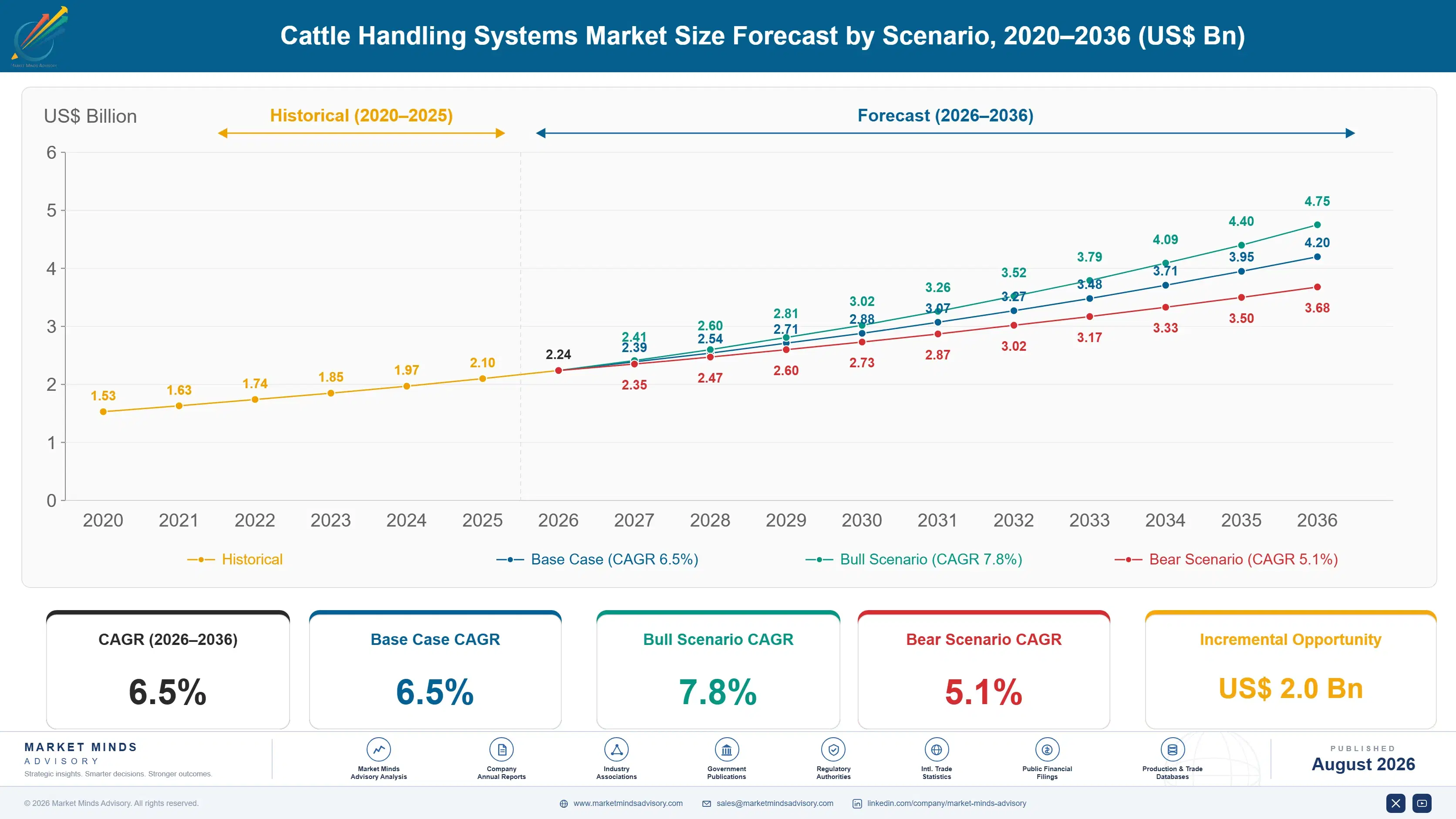
Cattle Handling Systems Market Forecast Scenarios

cattle-handling-systems-market-size-forecast-scenario-1787300563515
Between 2020 and 2025 the market grew at a steady 5.5 percent as beef cattle herds rebuilt following drought-driven liquidation cycles and ranch operations gradually replaced aging manual equipment with hydraulic systems across most producing countries tracked closely. Growth held firm even as cattle prices fluctuated, since equipment replacement decisions track herd rebuilding cycles more than short-term price swings.
The base case assumes continued national electronic identification mandate rollouts across major beef-producing countries, sustained ranch labor cost inflation favoring single-operator hydraulic systems, and a steady replacement cycle as manual equipment installed decades earlier reaches end of service life across established operations and their working facilities. These three mechanisms together sustain above-historical growth through 2036 even as mature North American demand grows closer to herd-size-linked replacement rates over the coming decade.
A bull scenario depends on accelerated electronic identification mandate enforcement forcing rapid RFID-integrated equipment adoption across every major beef-exporting country simultaneously and without delay. The bear case centers on a sustained cattle price downturn that delays ranch capital equipment purchases across smaller family-owned operations that represent a substantial share of the addressable customer base globally today.

Automation and Traceability Reshape Ranch Equipment Specification

Three forces are converging on this historically stable category at once. Ranch labor shortages are pushing operations toward hydraulic and automated systems built for a single operator working alone across most working days without any additional help at all. National electronic identification mandates are forcing equipment replacement well ahead of any planned upgrade cycle across major beef-producing countries. And Brazil's continued herd expansion is creating sustained equipment demand indep
MARKET CONCENTRATIONCR5 32%fragmented across regional manufacturers and established equipment incumbents
AVERAGE SELLING PRICEUSD 4,800/unitblended price masks wide spread across hydraulic and manual tiers
TOP PRODUCING COUNTRY SHAREUS 24%concentrated manufacturing capacity serves both domestic and export demand
CAPACITY UTILISATION69%meaningful headroom remains before new plant investment triggers
TRADE INTENSITY21% exportedmodest cross-border flow from North American and Australian manufacturing hubs
STEEL COST SHARE44% of COGSstructural steel volatility directly compresses manufacturer gross margins
Commercially, the market splits cleanly between a high-volume, price-competitive manual equipment segment dominated by regional manufacturers, and a lower-volume, substantially higher-margin hydraulic and electronic identification segment where established incumbents defend share through engineering depth and dealer network reach most regional competitors cannot credibly match at scale across most tenders, procurement boards, and evaluation committees reviewed regularly.
The next decade will be defined by how fast electronic identification integration spreads beyond early-mandate countries like Australia and the United Kingdom, and by how aggressively Brazilian and regional manufacturers expand capacity to serve the world's largest commercial cattle herd base directly and profitably over the coming years ahead of us.
"Cattle handling equipment used to be the most boring line item in a ranch capital budget. Electronic identification mandates just made chute specification a genuinely strategic decision for the first time in decades."
Director, Agriculture and Livestock Equipment Practice · MMA Agriculture / Lives

Market Trends

National Electronic Identification Mandates Expand Globally

Australia's National Livestock Identification System, already mandatory nationwide, is now being replicated in modified form across the United Kingdom, the European Union, and several American states considering comparable traceability legislation following recent animal disease outbreaks. USDA's Animal Disease Traceability program has expanded electronic identification tag requirements for interstate cattle movement since 2024, according to agency implementation guidance, pushing ranch operations toward handling equipment with integrated RFID reader compatibility. Equipment manufacturers without proven electronic identification integration are increasingly excluded from large commercial ranch tenders that now specify compatibility as a baseline procurement requirement rather than an optional feature.
Market Impact: Adds 1.3 points to base CAGR
Ranch Labor Shortage Accelerates Single-Operator Automation

American Farm Bureau Federation labor availability surveys show ranch and livestock operation job vacancy rates running well above the broader agricultural sector average, a shortage forcing operations to specify hydraulic squeeze chutes and automated sorting gates one person can safely operate without additional hands. Manufacturers report automated system orders growing substantially faster than manual equipment across nearly every major beef-producing region tracked, as operators calculate labor savings directly against the price premium. This shift is particularly pronounced among mid-sized operations too small to justify a full-time crew but too large to work cattle safely alone.
Market Impact: Adds 1.1 points to base CAGR

Market Opportunities and Growth Drivers

Global Beef Demand Sustains Herd Rebuilding Cycles

The United States Department of Agriculture projects global beef production will continue climbing through 2030 as consumption growth across Asia and the Middle East outpaces production gains in mature markets, sustaining herd rebuilding cycles that directly drive equipment replacement demand across major producing countries. Brazil's commercial cattle herd, already the largest in the world at an estimated 234 million head according to national agricultural census data, continues expanding into previously underutilized pastureland, creating substantial incremental equipment demand independent of any developed-market dynamic. This baseline demand floor does not depend on any single country's policy cycle or currency movement.
Market Impact: Compresses gross margin 4 points

Animal Disease Outbreaks Accelerate Traceability Investment

Recent foot-and-mouth disease and bovine tuberculosis outbreaks across several major beef-exporting regions have pushed national governments to accelerate electronic identification and movement tracking requirements, according to World Organisation for Animal Health outbreak reporting and national veterinary service disclosures. Ranch operations facing new tracking mandates report equipment replacement timelines compressed from a planned multi-year cycle into an immediate compliance requirement, since existing manual equipment cannot support the electronic reading and data capture now required. This regulatory acceleration has moved equipment specification decisions from a discretionary capital expenditure into a mandatory compliance cost for affected operations.
Market Impact: Delays upgrades by roughly 3 years

Market Restraints and Challenges

Steel Price Volatility Compresses Manufacturer Margins

Structural steel tubing and plate together represent roughly 44 percent of cost of goods sold for a typical hydraulic squeeze chute, and this input has shown double-digit price swings within single years recently. The root cause is direct exposure to global steel markets that smaller regional manufacturers cannot meaningfully hedge without long-term contracts the largest incumbents can negotiate but smaller competitors typically cannot. The impact falls hardest on manufacturers bidding fixed-price dealer contracts months before actual steel costs are known. Several larger manufacturers now include quarterly price adjustment clauses in dealer agreements rather than accepting fixed exposure.
Market Impact: EID-compatible equipment share up 12 points

Smaller Operations Delay Equipment Upgrades on Cost

Hydraulic and electronic identification-integrated equipment carries list prices two to four times those of comparable manual systems, a gap smaller family-owned cattle operations, representing a substantial share of the customer base, often cannot justify against thinner operating margins than large commercial ranches enjoy. The root cause is that equipment financing terms available to smaller operations rarely match the multi-year payback horizon labor savings actually deliver. The impact shows up as a widening equipment quality gap between large commercial operations and smaller family ranches. Several manufacturers are piloting extended financing and leasing programs as an emerging fix.
Market Impact: Automated system orders up 15 points
3 additional market trends, 3 additional growth drivers, and 4 additional restraints and challenges are covered in the full report. Contact sales@marketmindsadvisory.com to access the complete intelligence.

Segment CAGR and Growth Architecture

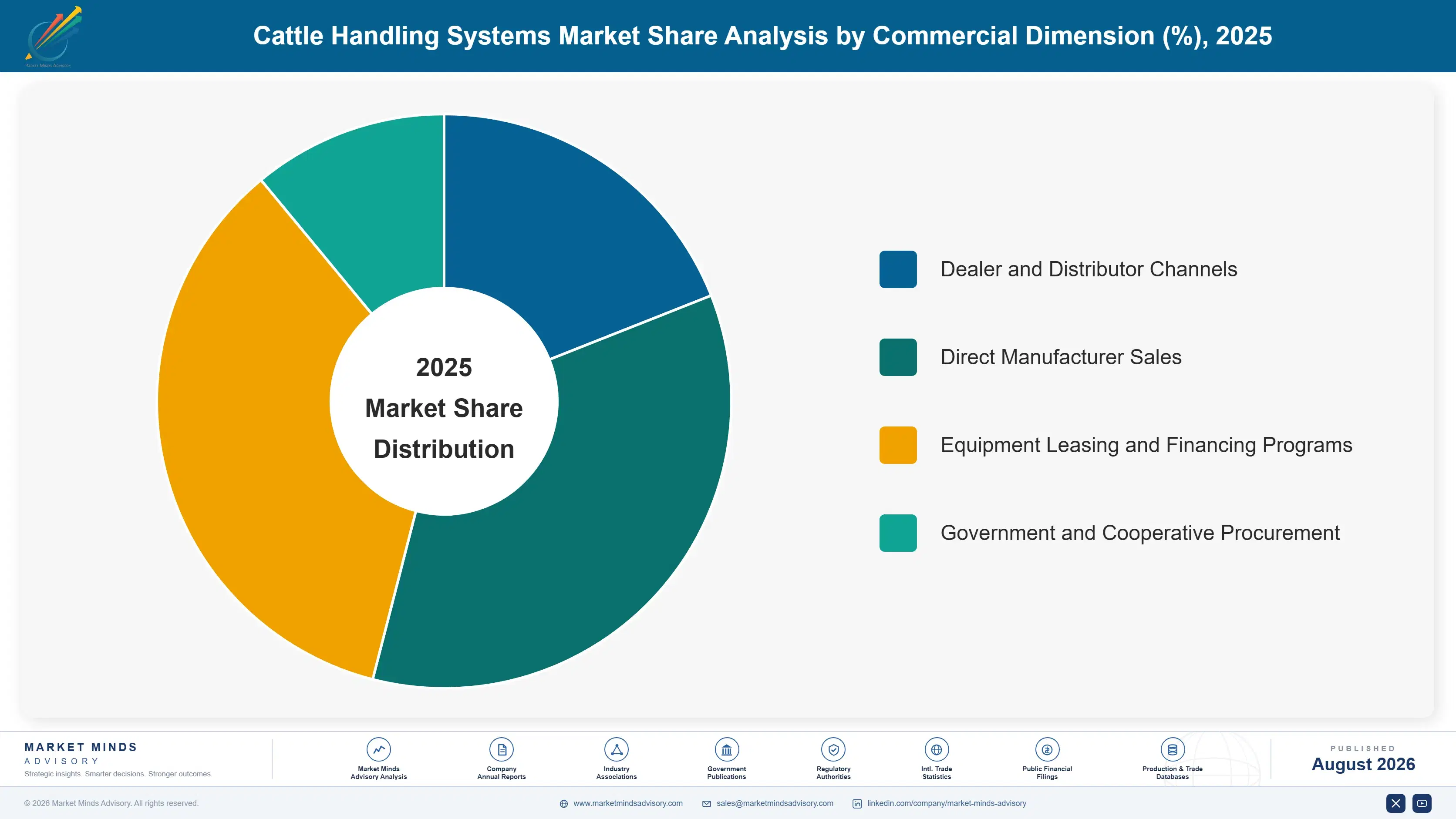
Segmentation follows equipment type and restraint technology, the classification ranch operators and equipment dealers actually specify against herd size, labor availability, and traceability compliance requirements, distinguishing chutes, ramps, and identification hardware across every operation type, geography, and commercial channel served by manufacturers today worldwide across all buyer segments, certification tiers, and dealer networks tracked closely.
cattle-handling-systems-market-market-share-analysis-1787300564042

RFID and EID Tracking and Scale Systems

RFID and electronic identification tracking systems are the category's clearest growth story, expanding fastest wherever national traceability mandates make manual record-keeping an increasingly unworkable compliance approach for commercial cattle operations. Integrated scale and reader systems that capture weight and identification data simultaneously during a single chute pass have compressed processing time significantly compared to separate manual weighing and tag reading, a labor efficiency gain that has genuinely changed purchasing psychology from viewing electronic identification as a compliance cost into a productivity investment. Manufacturers who paired reader hardware with ranch management software report the strongest order growth, since operators value data flowing directly into herd records. Supply chains favor manufacturers with proven electronics integration over pure mechanical specialists.
CAGR 10.6%

Automated Sorting Gates

Automated sorting gates are benefiting from two converging forces: ranch labor shortages that make manual sorting increasingly impractical for mid-sized and large operations, and electronic identification integration that lets sorting decisions trigger automatically based on tag data rather than requiring an operator to recognize individual animals visually. Commercial feedlots and larger cow-calf operations increasingly specify automated sorting for weight-based or health-status-based cattle segregation, a capability manual gate systems simply cannot replicate at comparable speed and accuracy. Manufacturers compete heavily on reader response time and gate cycling speed, since throughput directly determines how many cattle an operation can process daily. The segment carries meaningfully higher average selling prices than manual sorting alleys but delivers labor savings that increasingly justify the premium.
CAGR 8.9%
Full segment breakdown across 6 segments available in the complete report.

Regional Architecture and Country Demand Map

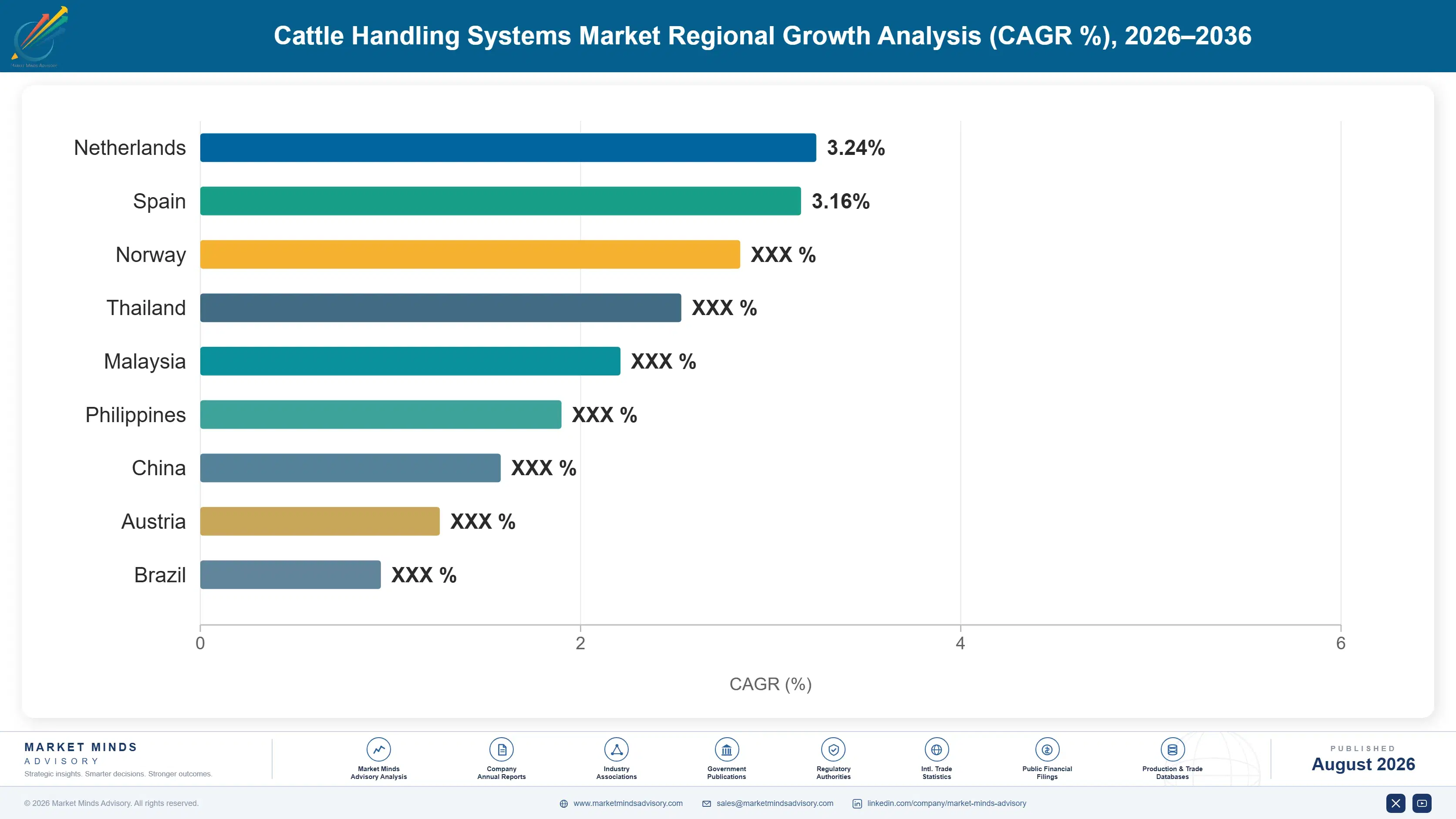
North America leads on capital-intensive ranch scale and manufacturing depth, Latin America follows closely on Brazil's enormous commercial herd size, and South Asia and Pacific posts the fastest growth on Australia's traceability-driven mechanization push nationwide across most cattle stations, dairy operations, and modern feedlots today.

North America

The United States anchors regional demand through the world's most capital-intensive ranch operations, where equipment manufacturers including Priefert and Powder River maintain dense dealer networks reaching even remote rural operations across every major cattle-producing state. USDA's expanding electronic identification requirements for interstate cattle movement are compressing equipment replacement timelines across operations that previously worked cattle with manual systems installed decades ago. Canada's cattle sector, concentrated in Alberta and Saskatchewan, follows similar traceability-driven procurement logic tied to its own national livestock identification program. Growth trails the fastest-growing regions because the installed base here is already mature and largely mechanized, leaving less room for the volume expansion happening in less-penetrated markets globally.
Share: 30% | CAGR: 5.9% (2026 to 2036)

Western Europe

Germany and France anchor regional demand through European Union animal health regulation that increasingly mandates electronic identification for cattle movement tracking across member states, a requirement pushing operations toward compatible handling equipment ahead of any planned replacement cycle. The United Kingdom's post-Brexit traceability system, developed independently but closely modeled on comparable European frameworks, sustains similar equipment demand across British livestock operations. The region's smaller average farm size relative to North America and Brazil limits the addressable market for large commercial-scale hydraulic systems, favoring compact and portable equipment formats instead. Growth trails Latin America and Asia because the region's cattle herd size is not expanding, unlike the genuine consumption and herd growth happening elsewhere globally.
Share: 18% | CAGR: 4.8% (2026 to 2036)
Regional intelligence for 5 additional markets available in the complete report: East Asia, South Asia and Pacific, Latin America, Middle East and Africa, Eastern Europe. Contact sales@marketmindsadvisory.com.
cattle-handling-systems-market-country-cagr-analysis-1787300564552

Where Equipment Manufacturers Can Expand Margin

Manufacturers face a market splitting between price-driven manual equipment volume and specification-driven hydraulic and electronic identification demand, creating several distinct paths to margin expansion beyond simply competing on unit price across every dealer contract, geography, and certification category served today across the wider sector, its buyers, and evolving compliance standards worldwide each fiscal cycle tracked.

Integrate Electronic Identification Reader Hardware Fully

Engineering integrated RFID and electronic identification reader compatibility into handling equipment opens access to premium commercial ranch contracts that basic mechanical equipment manufacturers cannot credibly bid against, since larger operations increasingly specify traceability compatibility explicitly in equipment procurement decisions. Manufacturers with proven electronic identification integration report average selling prices roughly 32 percent above standard mechanical product lines in these specification-driven segments. The integration investment is meaningful but pays back quickly once a manufacturer wins its first several commercial ranch and feedlot contracts, since reference installations then become the credibility basis for future dealer network expansion across the wider industry.
Market Impact: EID-integrated ASP runs 32 points higher on average

Expand Dealer Financing and Leasing Programs

Offering extended financing and equipment leasing directly through dealer networks captures smaller family-owned operations that cannot justify large upfront hydraulic system purchases against thinner operating margins than commercial ranches enjoy. Manufacturers offering integrated financing report dealer network sales roughly 18 percentage points higher than cash-only competitors, since smaller operations value the reduced upfront capital burden highly enough to accept modest financing costs. This lever requires partnerships with agricultural lending institutions and a willingness to carry receivables risk, a capability that favors established manufacturers with existing dealer relationships over new market entrants lacking similar ties.
Market Impact: Lifts dealer sales by 18 total points overall

Build Ranch Management Software Integration Fully

Pairing handling equipment with cloud-based herd management software that automatically captures weight and identification data during processing builds switching costs and deepens dealer relationships ahead of the next equipment replacement cycle, since operators increasingly value data that flows directly into breeding and health records without manual re-entry. Manufacturers offering integrated software report renewal rates roughly 3 times higher than hardware-only competitors, since operators value the reduced administrative burden highly enough to prefer a single integrated vendor relationship. This lever requires ongoing software development investment that favors established incumbents over pure hardware manufacturers lacking similar resources.
Market Impact: Lifts renewal rate 3x versus hardware only sales

Localize Manufacturing Inside Brazil's Growing Market

Establishing manufacturing facilities within Brazil directly reduces import tariff exposure and shipping cost while positioning manufacturers to serve the world's largest commercial cattle herd base without the freight cost disadvantage international exporters face competing from North America or Europe. Manufacturers with local Brazilian manufacturing presence report winning 2 to 3 times more regional dealer contracts than pure exporters competing from outside the country entirely. The upfront capital investment is substantial, but manufacturers moving early are securing preferred dealer relationships before competitors catch up to the same regional opportunity now attracting additional international investment nationwide.
Market Impact: Wins 2 to 3x more regional dealer contracts

Who Controls the Margin Pool

Five companies hold 32 percent of the category, a concentration low enough that regional Brazilian and Australian manufacturers compete credibly for meaningful volume against established North American incumbents. The gap between global leaders and regional challengers is widest in specification-driven electronic identification segments, narrower in conventional manual equipment where dealer network reach and unit price matter more than engineering depth.
Competitive activity currently plays out across three dimensions: electronic identification integration investment as manufacturers race to capture traceability-driven commercial ranch contracts, dealer financing program expansion to capture smaller family-owned operations previously priced out of premium equipment, and local manufacturing investment inside Brazil to capture the world's largest commercial herd base directly. Established incumbents are increasingly acquiring regional manufacturers rather than building local capacity from scratch, given how long organic dealer network development typically takes.

Pressure is building most visibly from Brazilian and Argentine manufacturers expanding domestic production to serve Latin America's massive herd base at price points North American incumbents cannot match without local production presence. At the same time, electronics-focused equipment specialists are moving into adjacent conventional segments previously served by generalist mechanical manufacturers, a shift that could reshape competitive rankings within the next several years.
cattle-handling-systems-market-company-positioning-matrix-1787300565070

Competitive Moat and Risk Dimensions

PRIEFERT MANUFACTURING COMPANY INC

Moat: Dealer network depth and reach

Priefert's decades of dense North American dealer network coverage, reinforced by proven hydraulic engineering across a broad equipment lineup, give it distribution advantages smaller manufacturers struggle to replicate, particularly reaching remote rural ranch operations across every major American cattle-producing state, region, and dealer territory served.
PRIEFERT MANUFACTURING COMPANY INC

Risk: Slower international expansion pace

Priefert's North American concentration leaves it less positioned than some competitors to capture growth in Brazil and Australia, the two fastest-growing regional markets in the category, risking share loss to manufacturers already investing in local production and dealer relationships in those specific growth markets and territories.
DATAMARS SA

Moat: Electronic identification engineering depth

Datamars has built deep electronic identification and RFID reader engineering credibility through its Tru-Test brand, resonating strongly with operations facing traceability mandates, giving it a genuine technical edge in specification-driven contracts where documented compliance capability outweighs upfront price considerations by a wide and growing margin.
DATAMARS SA

Risk: Limited mechanical equipment breadth

Datamars' electronics-focused positioning leaves it more dependent on partnerships with mechanical equipment manufacturers for complete handling system sales, a dependency that pure hardware-and-electronics integrated competitors increasingly threaten as they build comparable identification capability in-house at meaningful scale and considerable speed each fiscal year tracked closely.

Key Players

Priefert Manufacturing Company Inc
Powder River Sioux Corporation
Moly Manufacturing Inc
Arrowquip
Datamars SA

Others

Hi-Hog Farm and Ranch Equipment Ltd
WW Livestock Systems Inc
For-Most Livestock Equipment
Behlen Country
Titan West Inc
Ritchie Industries Inc
Q-Catch Livestock Equipment Ltd
Wheatheart Elmers Manufacturing Ltd
Allflex Livestock Intelligence
Gallagher Group Limited
Bud Box Livestock Equipment
Farmtek Inc
Tarter Farm and Ranch Equipment
Pearson Livestock Equipment
Stockmans Choice

Recent Developments

FEBRUARY 2026

Priefert Opens Regional Distribution Center in Brazil

Priefert Manufacturing opened a dedicated distribution and light assembly facility in Brazil, targeting the country's massive commercial cattle herd base and reducing lead times for dealer network fulfillment across major cattle-producing states significantly ahead of the next herd rebuilding cycle and upcoming working season nationwide.
Signal: Confirms Brazilian market entry as the required strategy for competing in the fastest-growing regional segment tracked.
SEPTEMBER 2025

Datamars Acquires Ranch Management Software Startup

Datamars completed the acquisition of a privately held cloud-based herd management software developer, adding integrated data capture capability to its electronic identification hardware portfolio across North American and Australian commercial ranch accounts already using its reader systems and existing multi-year dealer network relationships built previously with distributors.
Signal: Signals software integration is shifting from a marketing claim to genuine infrastructure investment industry-wide today across markets.
MAY 2025

Moly Manufacturing Signs Distribution Agreement in Australia

Moly Manufacturing signed a multi-year distribution and technical support agreement with an Australian livestock equipment dealer network, positioning the Silencer brand to compete directly for growing electronic identification-integrated equipment demand across Australia's expanding commercial cattle station operations and adjacent regional export markets nearby and beyond.
Signal: Marks accelerating North American manufacturer expansion into Australia's traceability-driven market and its dealer network steadily this cycle.

Structural Steel and Electronics Component Exposure

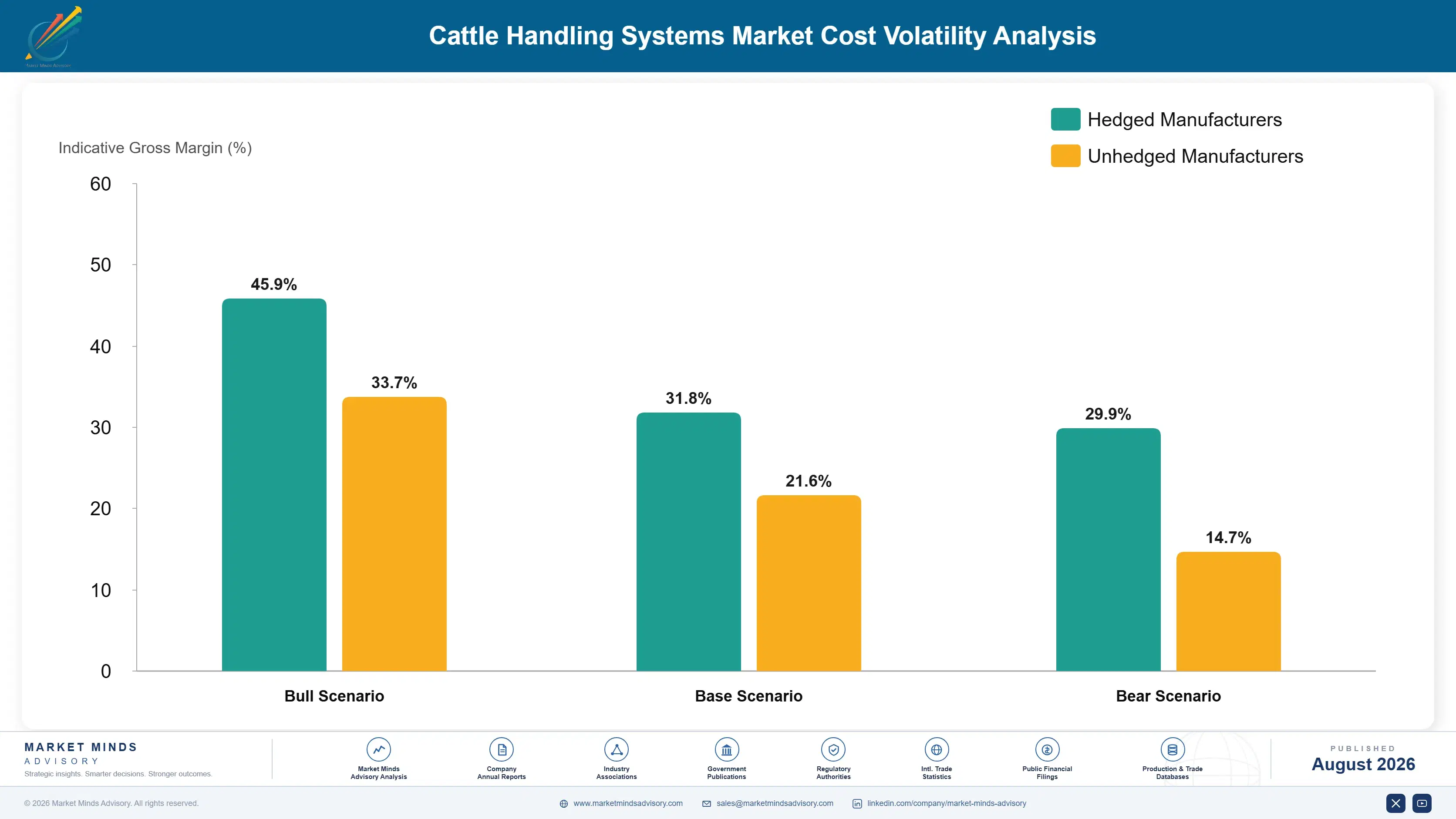
Structural steel tubing and plate together represent roughly 44 percent of cost of goods sold for a typical hydraulic squeeze chute, sourced primarily from steel mills across the United States, Brazil, and China. Hydraulic components and electronic identification reader hardware add a further 19 percent combined, giving manufacturers with diversified sourcing a genuine hedge against single-input price volatility that smaller specialists cannot avoid.
Steel prices rose approximately 16 percent through 2024 as construction and infrastructure demand competed directly with equipment manufacturers for rolled steel supply, according to Priefert's disclosed supplier cost commentary and industry trade association pricing surveys, which cited steel cost inflation as a meaningful margin headwind across ranch equipment manufacturing broadly. Electronic component costs, tied closely to global semiconductor supply cycles, added a further layer of volatility manufacturers had not historically needed to hedge simultaneously.

Exposure varies by manufacturer scale and portfolio breadth. Large incumbents with long-term steel contracts and hedging programs have absorbed volatility more effectively than smaller regional manufacturers on spot markets, widening the cost gap between established leaders and price-competitive entrants over time. Manufacturers with diversified electronics sourcing retain more pricing control than those dependent entirely on a single supplier exposed to one cycle.
cattle-handling-systems-market-cost-volatility-analysis-1787300565266

Long-Term Steel Supply Contracts

Locking multi-year fixed-volume agreements with steel mills reduces spot market exposure meaningfully, though it requires balance sheet commitment that smaller regional manufacturers often cannot match against larger incumbents with stronger credit access and negotiating leverage across global sourcing relationships spanning multiple steel-producing regions, currencies, and supplier networks worldwide each fiscal year and contract cycle.

Electronics Supplier Diversification

Sourcing RFID reader and electronic identification components from multiple semiconductor suppliers reduces dependency on any single supply chain disruption, a strategy several mid-sized manufacturers have accelerated specifically in response to recent component shortages across the category and its many exposed product lines, subsidiaries, distributors, and export markets worldwide today, this year, and going forward steadily.

Steel Cost Pass-Through Clauses

Including quarterly steel price adjustment clauses in multi-year dealer agreements protects margin against feedstock volatility between contract signing and actual production, a practice increasingly standard among larger manufacturers but still resisted by some cost-conscious regional dealers evaluating bids each budget cycle nationwide, regionally, and even well beyond their own national borders and territories too.

Portfolio Architecture for Margin Defence

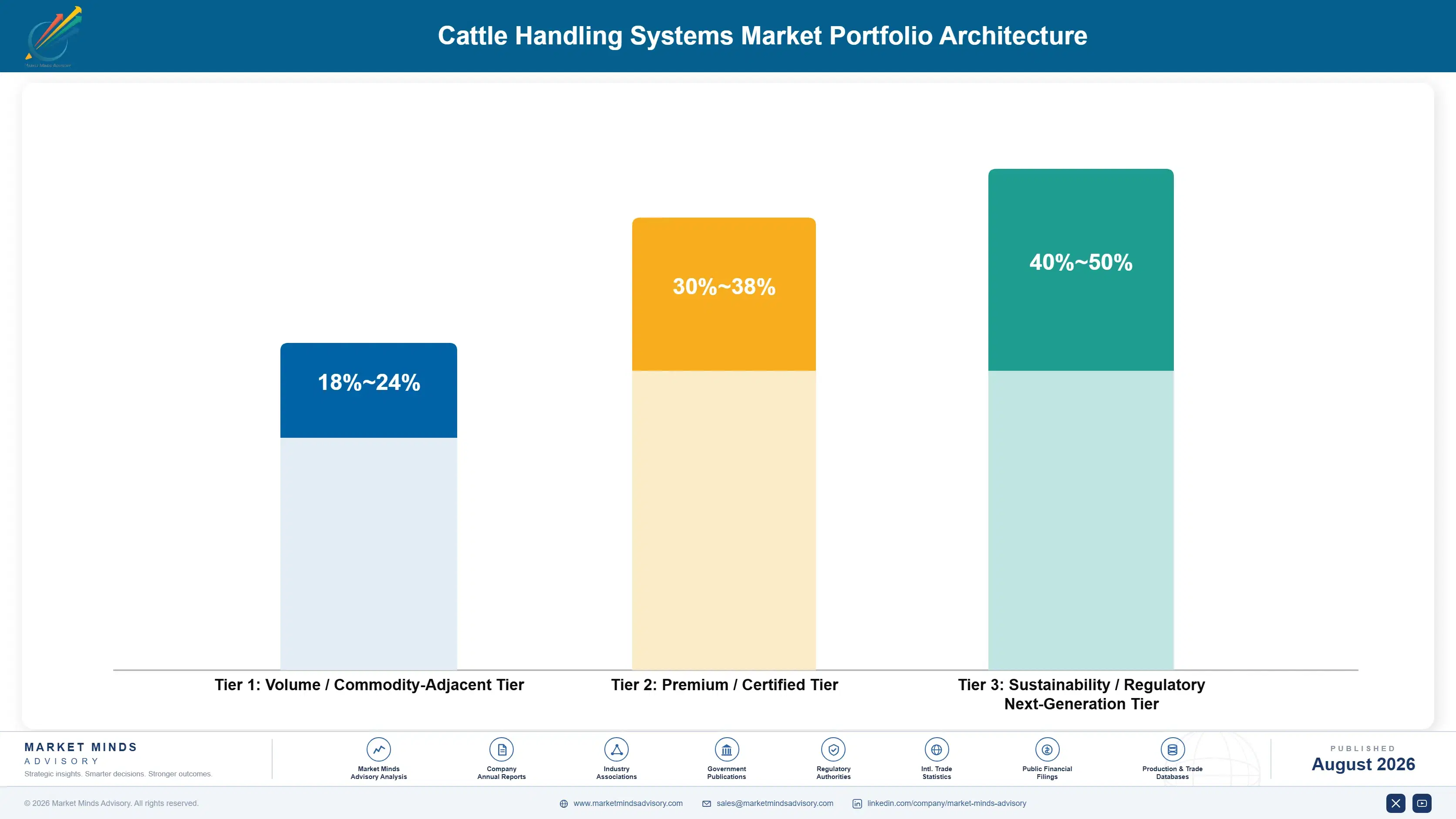
Three tiers structure manufacturer portfolios today, each serving genuinely different buyers with distinct purchasing logic and financing requirements applied at the point of dealer sale and ongoing service. Commodity-adjacent manual equipment sits at the volume base with thin margins, certified hydraulic and electronic identification-compatible systems occupy a specification-driven middle tier, and fully integrated automated sorting and software-connected systems anchor a next-generation tier w
The tension between volume and premium shows up clearly in how manufacturers allocate capital: regional players chase manual equipment volume through aggressive dealer pricing while established incumbents concentrate investment in hydraulic engineering, electronic identification integration, and software connectivity that justify premium positioning against increasingly capable low-cost competitors entering steadily from Brazil and elsewhere across the wider hemisphere.

High-value margin pools concentrate in electronic identification-integrated systems and automated sorting gates carrying software attachments, where gross margins run meaningfully above the category average across nearly every tracked region and tender type reviewed regularly and updated annually. Standard manual equipment increasingly competes on price alone as Brazilian and regional manufacturing capacity continues expanding rapidly across export markets worldwide today and tomorrow.

Volume / Commodity-Adjacent Tier

Standard manual squeeze chutes and loading ramps sold primarily on unit price into dealer and direct ranch channels, with limited technical differentiation across most price-sensitive regional markets and distribution networks.
Gross Margin: 18-24%

Premium / Certified Tier

Hydraulic and electronic identification-compatible systems carrying reader integration, positioned for commercial ranch contracts requiring documented traceability compliance and multi-year dealer service commitments from established manufacturers with proven track records nationwide.
Gross Margin: 30-38%

Sustainability / Regulatory / Next-Generation Tier

Automated sorting gates and software-connected systems with proven data integration credentials, priced at the top of the category range consistently across nearly every geography and tender category served by manufacturers today.
Gross Margin: 40-50%
cattle-handling-systems-market-portfolio-architecture-1787300565768

High-value Sub-segments and Strategic Watch-out

Electronic Identification-Integrated Systems

Highest growth and highest margin combination anywhere in the category, favored wherever national traceability mandates require proven electronic identification credentials across major commercial ranch operations tracked closely by MMA analysts each fiscal quarter reviewed and updated regularly across the wider industry and its many buyers.
Gross Margin: 42-50%

Automated Sorting and Software-Connected Gates

Strong growth with solid margins, driven by ranch labor shortages forcing operations toward durability-optimized automated formats that command meaningfully higher specification-driven pricing across most tracked commercial operations today and increasingly tomorrow too worldwide, especially larger feedlots, cooperatives, and export-oriented commercial ranches nationwide, regionally, and abroad.
Gross Margin: 38-46%

Standard Manual Squeeze Chutes and Ramps

The volume core of the category, generating stable revenue but facing continuous margin compression as Brazilian and regional manufacturing capacity expands and price competition intensifies across every dealer channel and export territory served worldwide today and increasingly tomorrow as demand keeps steadily growing further each year.
Gross Margin: 18-24%

Legacy Non-Compatible Manual Equipment

A strategic watch-out segment: cheaper upfront but increasingly excluded from commercial ranch tenders specifying electronic identification compatibility, eroding demand for manufacturers still relying on outdated mechanical-only designs broadly across smaller regional markets, rural territories, and family-run operations nationwide and increasingly further abroad too each year.
Gross Margin: 12-18%

Replacement Cycles Anchor Recurring Ranch Volume

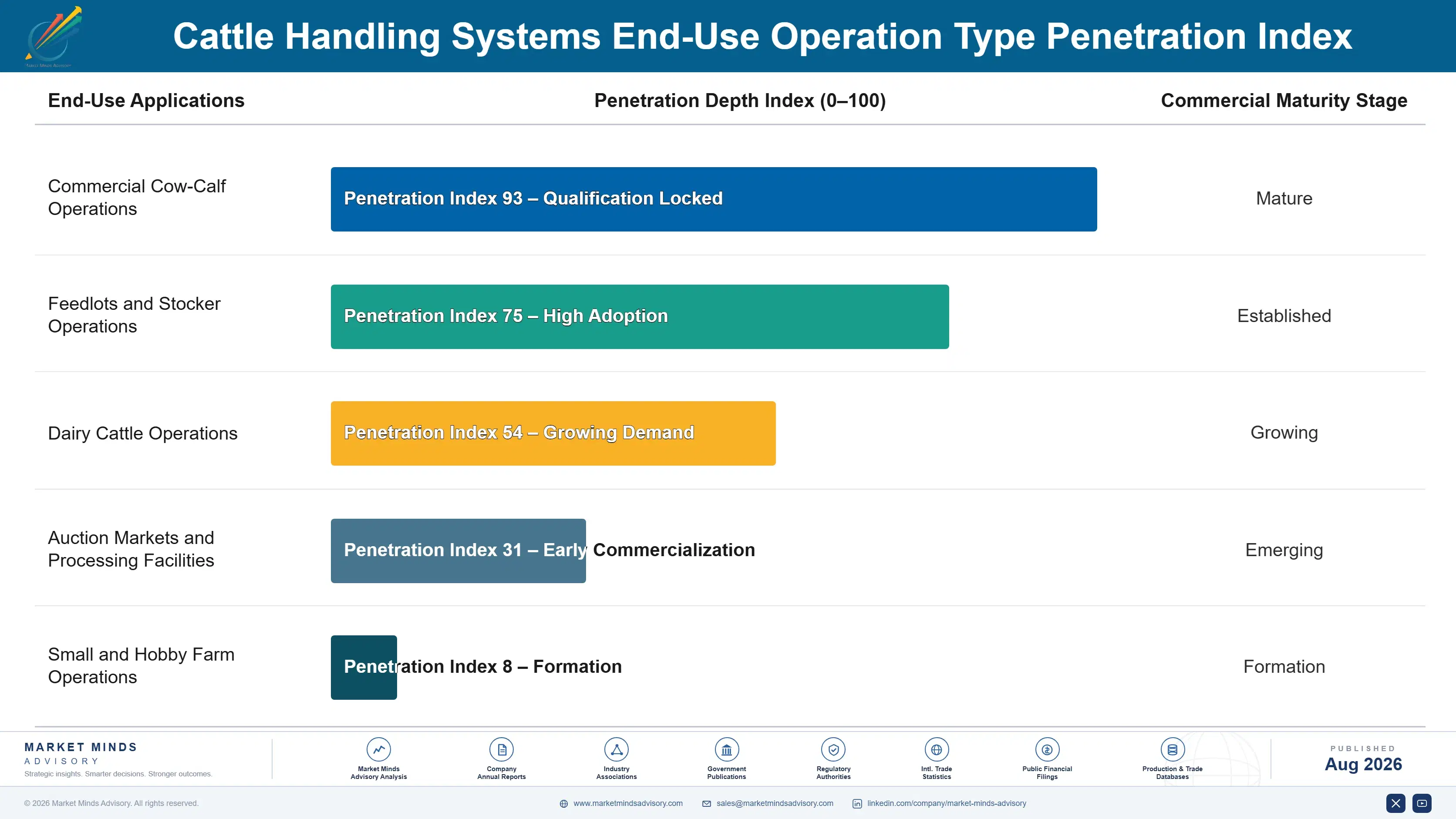
Cattle handling equipment demand behaves like a replacement annuity once a ranch operation's herd size stabilizes across a given property. A typical hydraulic squeeze chute operates for fifteen to twenty years before hydraulic seal degradation or structural wear prompts replacement, generating predictable recurring volume that dwarfs new-operation startup demand across mature ranching regions with established herds already in place today.
Adoption depth varies sharply by end-use vertical across the category and its many distinct buyer types. Large commercial feedlots and export-oriented operations adopt electronic identification-integrated systems fastest because traceability compliance and processing efficiency carry direct budget consequences, mid-sized family ranches adopt more gradually as financing programs and labor cost pressure slowly shift purchasing psychology, and smaller hobby and part-time operations lag furthest behind, often relying on decades-old manual equipment passed down across generations.

A generational shift is underway in buyer profiles: younger ranch operators increasingly evaluate total labor cost savings and data integration capability alongside upfront equipment price, a meaningful departure from the pure durability-focused purchasing pattern that dominated ranch equipment decisions for decades, and this cohort weighs electronic identification compatibility far more heavily than their predecessors ever did.
cattle-handling-systems-market-end-use-penetration-index-1787300566255

Where MMA Sees the Category Heading

These are among the four positions where our research anticipates prominent divergence between winners and laggards over the coming forecast period. Each is grounded in the demand model, the regulatory perimeter, and the announced capacity pipeline.
01 / ELECTRONIC IDENTIFICATION STRATEGY

Manufacturers without EID integration risk losing commercial contracts

National traceability mandates are moving from voluntary programs to compliance requirements across an expanding list of major beef-producing countries, not a niche concern limited to early-adopter markets like Australia alone. Any manufacturer whose portfolio depends entirely on mechanical-only equipment should expect to lose commercial ranch tender eligibility steadily across exactly the markets generating the most stable long-term replacement revenue. Building genuine electronic identification integration credentials, not just badge-engineering a third-party reader attachment, is close to a survival requirement in these markets now and going forward.
02 / DEALER FINANCING INVESTMENT

Financing access offers the most defensible volume expansion path

Smaller family-owned operations represent a substantial share of the addressable customer base but increasingly cannot justify premium hydraulic equipment purchases against thinner operating margins than commercial ranches enjoy without extended financing support available. Manufacturers building dealer financing and leasing programs now are capturing volume that cash-only competitors simply cannot access at all across this large underserved customer segment nationwide. This has become a genuine market access decision as much as a product engineering decision for most manufacturers competing in the category today.
03 / BRAZILIAN MARKET INVESTMENT

Local production offers the most defensible growth in Latin America

Brazil's commercial cattle herd, the largest in the world by head count, represents genuinely underserved demand that international exporters cannot capture profitably without local manufacturing presence to offset freight cost disadvantages against domestic competitors nearby. Manufacturers establishing local production now, ahead of competitors, are securing preferred dealer relationships that will be difficult and costly for latecomers to dislodge once firmly established. This has become a genuine market access decision as much as a manufacturing cost decision for most global incumbents today.
04 / INPUT COST MANAGEMENT

Steel exposure will keep separating winners from laggards

Rising steel and electronic component prices driven by overlapping construction and semiconductor cycles are compressing margins hardest for manufacturers without long-term supply contracts or diversified sourcing portfolios in place already at scale. This cost asymmetry will keep widening the margin gap between well-hedged incumbents and exposed regional competitors over successive fiscal years and commodity cycles that lie ahead of us. Supply diversification and pass-through clauses both offer partial relief, but neither fully eliminates the underlying exposure facing the category overall today.

Engagement Snapshot From the Field

A live engagement with an industry participant carrying material or product regulatory and market exposure ahead of a defining policy shift, showing how our research translates into a defensible multi-year portfolio strategy.
MARKET MINDS ADVISORY · CLIENT ENGAGEMENT SUMMARY
Cattle Handling Systems Producer Strategic Portfolio Review and Transition Roadmap 2026·Investment Scenario on Cattle Handling Systems Exposure Evaluation 2025-26
CLIENT PROFILE
The client operates a commercial cow-calf and stocker cattle operation across 45,000 acres in the American Great Plains, running approximately 8,200 head of cattle annually (client-reported, unverified by MMA), with handling infrastructure spanning three separate working facilities that required substantial modernization to meet approaching state-level traceability requirements and address a chronic, worsening seasonal labor shortage.
STRATEGIC CHALLENGE
The operation faced escalating labor costs and chronic difficulty hiring seasonal help during peak working seasons, while its existing manual handling equipment, installed predominantly during the 1990s, had not been designed for the electronic identification compliance now increasingly required to maintain access to premium buyer programs and export-eligible markets nationwide.
MMA APPROACH
MMA benchmarked the operation's existing equipment against current hydraulic and electronic identification standards, modeled total cost of ownership across three modernization pathways weighted by labor savings and compliance risk, and evaluated financing structures including equipment leasing tied to measured processing time improvements achieved during multi-site pilot testing programs conducted onsite.
KEY FINDINGS
  1. The existing manual system required four workers per processing day, while comparable hydraulic and automated systems at peer operations reportedly operated safely with a single operator most days.
  2. Electronic identification-integrated equipment carried a 38 percent price premium over standard hydraulic systems but delivered payback within four years through measured labor savings alone, before counting premium buyer program access.
  3. Financing terms varied far more than expected across the three evaluated manufacturers, with meaningful differences in equipment leasing structures and dealer service response times during peak season specifically.
  4. Staff training on new electronic systems, not procurement price itself, emerged as the primary barrier to faster equipment modernization across the operation's seasonal workforce.
CLIENT PROFILE
The client operates a commercial cow-calf and stocker cattle operation across 45,000 acres in the American Great Plains, running approximately 8,200 head of cattle annually (client-reported, unverified by MMA), with handling infrastructure spanning three separate working facilities that required substantial modernization to meet approaching state-level traceability requirements and address a chronic, worsening seasonal labor shortage.
STRATEGIC CHALLENGE
The operation faced escalating labor costs and chronic difficulty hiring seasonal help during peak working seasons, while its existing manual handling equipment, installed predominantly during the 1990s, had not been designed for the electronic identification compliance now increasingly required to maintain access to premium buyer programs and export-eligible markets nationwide.
MMA APPROACH
MMA benchmarked the operation's existing equipment against current hydraulic and electronic identification standards, modeled total cost of ownership across three modernization pathways weighted by labor savings and compliance risk, and evaluated financing structures including equipment leasing tied to measured processing time improvements achieved during multi-site pilot testing programs conducted onsite.
KEY FINDINGS
  1. The existing manual system required four workers per processing day, while comparable hydraulic and automated systems at peer operations reportedly operated safely with a single operator most days.
  2. Electronic identification-integrated equipment carried a 38 percent price premium over standard hydraulic systems but delivered payback within four years through measured labor savings alone, before counting premium buyer program access.
  3. Financing terms varied far more than expected across the three evaluated manufacturers, with meaningful differences in equipment leasing structures and dealer service response times during peak season specifically.
  4. Staff training on new electronic systems, not procurement price itself, emerged as the primary barrier to faster equipment modernization across the operation's seasonal workforce.
RECOMMENDED STRATEGY
Phase 1: Phase 1 (Months 1 to 4): Replace the primary working facility with a hydraulic, electronic identification-integrated system, prioritizing the site with the highest annual throughput volume. Phase 2: Phase 2 (Months 5 to 12): Extend modernization to the two remaining facilities while negotiating an equipment leasing arrangement tied to measured labor savings. Phase 3: Phase 3 (Months 13 to 18): Integrate ranch management software across all three facilities to build a unified herd data record going forward.
OUTCOME
Within eighteen months of beginning equipment modernization, the operation reported measurably lower labor costs and successful qualification for a premium export-eligible buyer program requiring documented traceability (client-reported, unverified by MMA), while ranch management reported greater confidence in long-term labor planning under the new equipment framework MMA helped establish.

Frequently Asked Questions

Foundational context covering the market sizes, CAGR, scope, country, region and competition that inform every finding below. This section is provided to cover basics and most often pre-purchase conversations, answered from the MMA Primary Research Dataset.

What is the current size of the Cattle Handling Systems Market?

The global cattle handling systems market reached an estimated USD 2.1 billion in 2025, spanning hydraulic and manual squeeze chutes, loading ramps, portable corral systems, and electronic identification tracking hardware.

How large will the Cattle Handling Systems Market be by 2036?

MMA projects the market will reach approximately USD 4.20 billion by 2036, roughly doubling from its 2026 base as traceability mandates and ranch labor shortages both accelerate equipment demand.

What is the CAGR for the Cattle Handling Systems Market 2026 to 2036?

The base case CAGR is 6.5 percent, with a bull scenario of 7.8 percent and a bear scenario of 5.1 percent depending largely on cattle price cycle trajectories.

Which segment is growing fastest?

RFID and electronic identification tracking and scale systems are growing fastest at a 10.6 percent CAGR, roughly 1.63 times the overall market rate, as national traceability mandates accelerate.

Who are the major companies in the Cattle Handling Systems Market?

Priefert Manufacturing, Powder River, Moly Manufacturing, Arrowquip, and Datamars lead the category, together holding just under one third of global market share across equipment types.

Which country is growing fastest?

Australia is growing fastest at an estimated 9.4 percent CAGR, driven by its mandatory National Livestock Identification System pushing continued nationwide equipment mechanization across most stations.

Report Segmentation Architecture

The full report scope spans multiple orthogonal segmentation dimensions, with cross-tabulated demand data provided for each dimension pair. Coverage extends further to regional breakdowns, trend trajectories, and the competitive detail needed to support segment-level decision-making.

By Equipment Type and Technology

  • Hydraulic Squeeze Chutes
  • Manual and Mechanical Squeeze Chutes
  • Loading Ramps and Alleyways
  • Portable Corral and Panel Systems
  • RFID and EID Tracking and Scale Systems
  • Automated Sorting Gates

By End-Use Operation Type

  • Commercial Cow-Calf Operations
  • Feedlots and Stocker Operations
  • Dairy Cattle Operations
  • Auction Markets and Processing Facilities
  • Small and Hobby Farm Operations

By Commercial Dimension

  • Dealer and Distributor Channels
  • Direct Manufacturer Sales
  • Equipment Leasing and Financing Programs
  • Government and Cooperative Procurement

By Region

  • North America
  • Western Europe
  • East Asia
  • South Asia and Pacific
  • Latin America
  • Middle East and Africa
  • Eastern Europe

Scope, Methodology, and Coverage

Every figure in this report is reproducible from documented input assumptions. The scope below maps the historical period, the forecast horizon, the segmentation dimensions, and the countries covered, alongside the underlying primary and qualitative methodology.
Historical Period
2020 to 2025
Forecast Period
2026 to 2036
Base Year
2025 (USD billions; MMA Primary Research Dataset, August 2026)
Market Definition
The cattle handling systems market covers equipment used to restrain, sort, and process cattle for veterinary treatment, weighing, and identification, spanning hydraulic and manual squeeze chutes, loading ramps and alleyways, portable corral and panel systems, RFID and electronic identification tracking hardware, and automated sorting gates. It excludes general fencing, feed handling equipment, and veterinary instruments not integrated into a handling structure.
Quantitative Units
USD billions (current prices); unit volumes in thousands of equipment systems where applicable
Segmentation Dimensions
By Equipment Type and Technology; By End-Use Operation Type; By Commercial Dimension; By Region
Regions Covered
North America, Western Europe, East Asia, South Asia and Pacific, Latin America, Middle East and Africa, Eastern Europe
Countries Covered
USA, China, Germany, France, UK, Japan, South Korea, India, Australia, Canada, Brazil, Mexico, Indonesia, Vietnam, Thailand, Malaysia, UAE, Saudi Arabia, South Africa, Nigeria, Turkey, Poland, Netherlands, Italy, Spain, Sweden, Switzerland, Argentina, Colombia, Singapore, and additional markets relevant to this sector
Key Companies Profiled
Priefert Manufacturing Company Inc, Powder River Sioux Corporation, Moly Manufacturing Inc, Arrowquip, Datamars SA, Hi-Hog Farm and Ranch Equipment Ltd, WW Livestock Systems Inc, For-Most Livestock Equipment, Behlen Country, Titan West Inc, Ritchie Industries Inc, Q-Catch Livestock Equipment Ltd, Wheatheart Elmers Manufacturing Ltd, Allflex Livestock Intelligence, Gallagher Group Limited, Bud Box Livestock Equipment, Farmtek Inc, Tarter Farm and Ranch Equipment, Pearson Livestock Equipment, Stockmans Choice
Quantitative Methodology
Primary survey, n=3,800 respondents, Q4 2025, six countries; demand-side model with trade association cross-validation
Qualitative Methodology
47 expert interviews, Q4 2025; applied to validate demand model assumptions, identify emerging dynamics, and assess competitive positioning
Report Format
PDF and XLSX data workbook (Word format preview document)
Publisher
Market Minds Advisory
Report Code
MMA-2026-AGR-105
Published
August 2026
Contact
sales@marketmindsadvisory.com | www.marketmindsadvisory.com

Purchase the full Cattle Handling Systems Market Report (2026 to 2036).

The full report delivers a complete competitive and commercial analysis of the cattle handling systems market across all seven regions and six equipment segments tracked closely. It includes detailed company profiles for twenty manufacturers, traceability mandate and regulatory policy tracking across major markets, and a ten-year forecast model with bull and bear scenario sensitivity built in. Buyers receive underlying segmentation data by country and equipment type alongside the full qualitative analysis. A dedicated appendix tracks recent acquisitions, capacity expansions, and dealer network developments relevant to competitive strategy planning.
Ten-year revenue and volume forecast model
Traceability mandate and regulatory policy tracker
Twenty-company competitive profile database and scorecard
Equipment-level segmentation broken out by country
Steel and electronics cost sensitivity model
Quarterly market update subscription option for buyers

Built For The People Who Decide

From boardroom strategy to bench-side execution, this report is read cover-to-cover by leaders shaping the next decade of their industry, turning demand scenarios, market dynamics and valuation benchmarks into decisions.
CXOs/ Presidents/ VPs/ Managers
M&A and Corporate Development
Strategy Teams and R&D Heads
Procurement and Product Directors
Regulatory and Compliance Leaders
Investor Relations and Equity Analysts