Market Minds Advisory
Cathodic Protection Market in Korea

Cathodic Protection Market in Korea: Protection Nobody Checks Is Not Protection

Anodes are installed, energised, and then largely forgotten about, and Korean survey data keeps finding buried assets sitting well below the accepted protection criterion for years without anyone ever noticing.

Lead Analyst

David Horsley

Published

September 2026

Make Smarter Decisions with Customized Research Insights

Request a free sample report and evaluate market opportunities, growth trends, and competitive dynamics relevant to your business needs.

2025 MARKET VALUE$0.5BMarket Size 2025
2036 FORECAST VALUE$0.8BBase Case , 2026 to 2036
CAGR 2026 TO 20365.4 %Bull 6.6% / Bear 4.2%
INCREMENTAL OPPORTUNITY$0.3BNet 10- year value creation
EXPANSION MULTIPLE1.71x2036 value over 2026 base
Strategic Levers
M&A Pipeline
Regional Outlook
Country Rankings
Competitive Intelligence
Segmental Deep-dive
Call-Us : 91 93563 13602

Executive Snapshot and Market Trajectory

Cathodic protection is installed once and then verified almost never. Korean survey work keeps finding around 29% of protected buried assets sitting below the accepted protection criterion, in most cases for years. The anodes were fitted correctly. Nobody went back to measure whether they were still working.
Growth runs at 5.4% and monitoring rather than hardware carries it. Remote monitoring and survey services grow at 8.1%, exactly 1.50 times the market rate, because a system nobody measures is a compliance record rather than corrosion protection. Coastal industrial and port infrastructure around Ulsan, Yeosu, and Busan accounts for the majority of protected asset value. Impressed current systems follow at 6.4%, since coastal conditions demand adjustable output.
Concentration reaches 44% across the top five measured on protected asset kilometres and structures, split between engineering contractors, anode manufacturers, and specialist survey firms. The survey firms hold the growth and the smallest revenue, which is a familiar pattern in any market where verification was treated as optional. Monitoring vendors are also selling verification directly to operators, bypassing the construction chain. Korean anode manufacturers are meanwhile moving upward into monitoring and survey services themselves.
Market Definition
This market covers cathodic protection systems and services applied to buried, submerged, and immersed metallic assets within South Korea, spanning sacrificial anode systems, impressed current cathodic protection systems, anode and rectifier hardware supply, remote monitoring and survey services, and design, commissioning and retrofit engineering. Protective coatings applied without cathodic protection, corrosion inhibitor chemicals, stainless and alloy material substitution, general pipeline construction, and internal pipeline corrosion control fall outside scope.
Base Year Value
$0.5B in 2025 (MMA Primary Research Dataset, August 2026)
Forecast Period
2026 to 2036, eleven discrete annual values
CAGR
5.4% base case. Bull 6.6%. Bear 4.2%.
Fastest Growth Segment
Remote Monitoring and Survey Services: 8.1% CAGR
Fastest Growth Country
South Korea: 5.4% CAGR
Fastest Growth Region
South Asia and Pacific: 7.2% CAGR
Largest Region
East Asia: 52% of 2025 global value
Market Leaders
Samsung Heavy Industries, Hyundai Engineering, Daehan Corrosion Engineering, Korea Anode, Hanjoo ENC. Source: MMA Analysis based on company annual reports.
Primary Survey
n=3,800 procurement and R&D decision-makers, Q4 2025, six countries
Methodology
Demand-side build-up, cross-validated against public data, 47 expert interviews

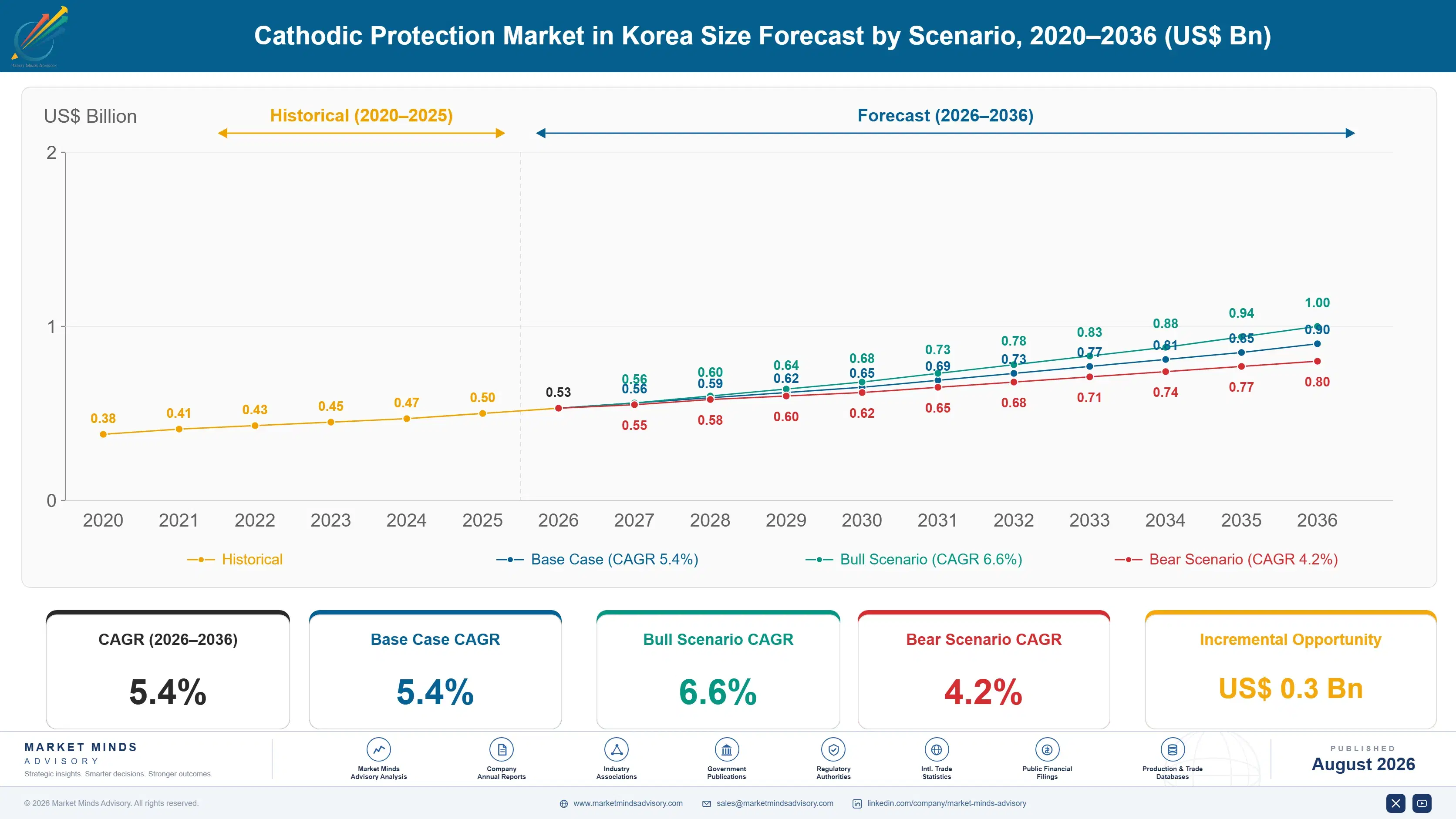
Cathodic Protection Market Forecast Scenarios

cathodic-protection-market-in-korea-size-forecast-scenario-1787301063640
The 2020 to 2025 period ran at 4.4% and new industrial construction carried it rather than any maintenance discipline. Petrochemical and port capital projects continued through the disruption while survey and inspection work fell sharply, since it requires site access and travel. Several operators deferred verification programmes entirely and have not fully restarted them, which is precisely how protection quietly stops working.
Three mechanisms carry the 5.4% base case. Ageing coastal industrial infrastructure is the largest, since Ulsan and Yeosu complexes built in the seventies and eighties now need retrofit rather than maintenance. Remote monitoring adoption is the second, because continuous measurement costs less than the survey crews it replaces. And offshore wind foundation protection is the third, growing from almost nothing. None of the three depends on new corrosion control technology arriving.
The 6.6% bull case rests on offshore wind reaching planned installation volumes, where monopile and jacket protection is specified from design and monitored continuously as standard. The 4.2% bear case is deferred maintenance budgets across petrochemical operators combined with slow offshore wind permitting, which would leave the market dependent on a construction cycle that is itself softening.

Installed Once and Measured Never

Cathodic protection works reliably when it is designed properly and verified regularly. The Korean problem is entirely in the second half. Survey work keeps finding roughly 29% of protected buried assets sitting below the accepted protection potential, generally because an anode has depleted, a rectifier has drifted, or a coating defect has changed the current demand since commissioning. None of that is exotic.
ASSETS BELOW CRITERION29%Of protected buried assets found underperforming during survey work
COASTAL ASSET CONCENTRATION71%Of protected asset value located in coastal industrial complexes
ANODE REPLACEMENT INTERVAL17 yearsDesign life for sacrificial systems on typical buried applications
SURVEY COVERAGE RATE38%Of installed systems surveyed within the recommended interval
TOP FIVE CONCENTRATION44%Moderate, across contractors, anode makers, and survey specialists
RETROFIT COST MULTIPLE6 timesAgainst protecting the same asset during original construction
Only around 38% of installed systems are surveyed within the recommended interval. Verification requires access, instruments, and trained technicians, and it produces no visible output when everything is working, which makes it the easiest maintenance line to defer. Operators who defer it are not taking a considered risk. They are usually unaware that protection has stopped, because a functioning system and a failed one look identical from the surface.
The economics of getting it wrong are steep. Retrofitting protection onto a corroded asset costs around six times what protecting it during construction would have, before counting the excavation, the shutdown, and whatever the corrosion has already consumed. That multiple is why remote monitoring, which pays back against survey crew costs in roughly three years, is the fastest-growing part of this market.
"An operator showed me twenty years of compliance certificates for a tank farm. We took readings and half the anode beds had been dead for a decade. The certificates were real. Nobody had measured anything since commissioning."
Director, Corrosion Control and Asset Integrity Practice · MMA Construction and

Market Trends

Remote Monitoring Replaces Survey Crews Entirely

Continuous potential monitoring with cellular reporting is displacing periodic manual survey across Korean buried and coastal assets, growing at 8.1% against 5.4% for the market. The argument is straightforward: monitoring pays back against survey crew cost in roughly three years and catches a failure the day it happens rather than at the next inspection interval. Only around 38% of systems are currently surveyed on schedule, which is the gap continuous measurement actually closes. It also converts one-time hardware supply into recurring revenue across an asset operating life. That changes account economics far more than anode margin ever does.
Market Impact: Monitoring growing at 8.1%

Ageing Coastal Complexes Move From Maintenance To Retrofit

Petrochemical and refining complexes at Ulsan, Yeosu, and Daesan built through the nineteen seventies and eighties are reaching the point where buried piping and tank bottoms need protection systems rebuilt rather than maintained. Retrofit costs around six times original installation, and the work usually requires excavation and partial shutdown. Operators discovering this through a leak rather than through survey pay considerably more, which is the argument monitoring vendors now lead with. Excavation and shutdown rather than the anodes themselves dominate that retrofit cost entirely. Staged programmes catching degradation before corrosion establishes are considerably cheaper.
Market Impact: Some 71% sits coastal

Market Opportunities and Growth Drivers

Offshore Wind Foundations Specify Protection From Design

Korean offshore wind development around Jeonnam and the southwest coast requires cathodic protection on monopiles, jackets, and subsea cabling from the design stage, since retrofitting anything below water costs several times what it costs onshore. These systems are specified with continuous monitoring as standard rather than as an option, because nobody sends a survey crew offshore casually. The segment grows from almost nothing and carries far better specification than onshore work. Onshore projects still treat monitoring as an optional upgrade specified years after energising. That gap between offshore and onshore practice is the clearest commercial opportunity here.
Market Impact: Only 38% surveyed on schedule

Coastal Concentration Raises Corrosion Rates Substantially

Roughly 71% of Korean protected asset value sits in coastal industrial complexes where chloride exposure, soil resistivity, and tidal groundwater movement all accelerate corrosion well beyond inland conditions. Systems designed to inland assumptions underperform there, and current demand rises as coatings age in a way generic design allowances do not capture. That concentration makes Korean cathodic protection a more demanding engineering problem than the market size alone would suggest. Systems sized on generic design tables underperform and contribute directly to the assets found below criterion. Measuring local conditions costs a fraction of either design error.
Market Impact: Retrofit costs 6 times original

Market Restraints and Challenges

Verification Is Deferred Because Nothing Visible Happens

Only around 38% of installed systems are surveyed within the recommended interval, and roughly 29% of protected assets are found below criterion when anybody checks. The root cause is that verification produces no visible output when protection is working, which makes it the easiest maintenance line to defer indefinitely. Commercial impact is protection that has silently stopped. Mitigation runs through continuous monitoring that reports without a site visit, and through survey obligations written into operating permits. A functioning system and a failed one look identical from the surface, which is the whole difficulty.
Market Impact: Monitoring growing at 8.1%

Retrofit Economics Punish The Discovery Of A Problem

Rebuilding protection on a corroded asset costs around six times original installation, and the root cause is that access, excavation, and shutdown dominate the work rather than the anodes themselves. Commercial impact is operators who find a problem facing a bill large enough to encourage further deferral rather than action. Mitigation runs through staged retrofit programmes, monitoring that catches degradation before corrosion is established, and protection specified properly during original construction. An operator discovering the problem through a leak pays considerably more than one finding it through survey. Excavation and shutdown dominate the bill rather than anodes.
Market Impact: Retrofit costs 6 times more
3 additional market trends, 4 additional growth drivers, and 2 additional restraints and challenges are covered in the full report. Contact sales@marketmindsadvisory.com to access the complete intelligence.

Segment CAGR and Growth Architecture

Segmentation follows system type and service delivery, because those determine design life, current demand, monitoring requirement, and whether revenue arrives once at construction or recurs across an operating life. Asset type and industry sector both cut across every system rather than separating them, which makes either a weaker primary dimension here. Service delivery decides whether revenue recurs at all.
cathodic-protection-market-in-korea-market-share-analysis-1787301064206

Remote Monitoring And Survey Services

The fastest category at 8.1%, exactly 1.50 times the market rate, and the only one that recurs rather than arriving once at construction. Continuous potential monitoring pays back against survey crew cost in roughly three years and reports a failure the day it happens instead of at the next inspection. Only around 38% of Korean systems are surveyed on schedule, which is precisely the gap this closes. Offshore wind foundations specify it as standard, since sending a crew below water for a routine reading is not practical. Accumulated survey records also make a monitoring proposal concrete rather than generic, since the operator sees their own history. Data continuity then defends the contract afterward.
CAGR 8.1%

Impressed Current Cathodic Protection Systems

Second fastest at 6.4%, and the system type that coastal Korean conditions increasingly demand. Impressed current delivers adjustable output that sacrificial anodes cannot, which matters where chloride exposure and ageing coatings raise current demand well beyond original design assumptions across roughly 71% of protected asset value. Rectifier drift is the recurring failure mode, and it is invisible without monitoring, so these systems and continuous measurement are increasingly sold together rather than separately as they historically were. Impressed current also demands more design attention, since output must be set against measured soil resistivity rather than generic tables. Coastal Korean conditions differ sharply enough from inland that those tables mislead consistently. Interference with neighbouring assets requires care.
CAGR 6.4%
Full segment breakdown across 5 segments available in the complete report.

Regional Architecture and Country Demand Map

This report covers South Korea, so the regional table below is repurposed to show where the anodes, rectifiers, and monitoring technology installed in Korean systems originate. Every share sits outside its framework band by construction rather than judgment. Equipment origin, not installation location, is the axis here.

East Asia

Fifty-two percent of the anodes, rectifiers, and monitoring equipment installed in Korean systems originates within the region, far outside the framework band because this table shows technology and equipment origin rather than installation location. Korean manufacturers supply sacrificial anodes, rectifiers, and reference cells at scale, supported by domestic shipbuilding and heavy engineering groups with long corrosion control experience. Japanese suppliers contribute precision reference electrodes and monitoring instruments. Growth at 6.2% runs above the market rate on domestic supply substitution continuing. Korean shipbuilding groups in particular carry marine corrosion control experience that transfers directly into offshore wind work. Monitoring hardware nonetheless remains largely imported despite considerable domestic anode and rectifier capability.
Share: 52% | CAGR: 6.2% (2026 to 2036)

Western Europe

Twenty percent, and European suppliers hold disproportionate positions in impressed current rectifiers, offshore anode systems, and the design standards Korean engineers work to. Dutch, British, German, and Norwegian firms brought offshore corrosion control capability developed in the North Sea, and Korean offshore wind projects specify it directly. Design software and calculation standards also originate here. Growth at 4.4% is the slowest of any origin, reflecting mature positions and rising Korean domestic manufacturing rather than any decline in relevance. The 20% share sits inside its framework band coincidentally rather than by design, since this table maps origin. Offshore capability developed in the North Sea is what Korean wind projects actually specify.
Share: 20% | CAGR: 4.4% (2026 to 2036)
Regional intelligence for 5 additional markets available in the complete report: North America, South Asia and Pacific, Middle East and Africa, Eastern Europe, Latin America. Contact sales@marketmindsadvisory.com.
cathodic-protection-market-in-korea-country-cagr-analysis-1787301064727

Selling Measurement Rather Than Anodes

Around 29% of protected assets sit below criterion, only 38% are surveyed on schedule, retrofit costs six times original installation, and monitoring pays back in three years. Value comes from selling recurring measurement, from targeting ageing coastal complexes, and from specifying monitoring at design. Measurement rather than hardware is what actually protects an asset.

Sell Continuous Measurement Rather Than Periodic Survey

Only around 38% of Korean systems are surveyed within the recommended interval, and roughly 29% of protected assets are found below criterion whenever anybody actually checks. Continuous monitoring pays back against survey crew cost in about three years and reports a failure the day it occurs rather than at the next scheduled inspection. It also converts one-time hardware supply into recurring revenue, which changes the economics of an account far more than any anode margin does. Accumulated survey records make the proposal concrete, since an operator sees their own asset history.
Market Impact: Monitoring pays back within about 3 years typically

Target Ageing Coastal Complexes Before The Leak

Petrochemical and refining assets at Ulsan, Yeosu, and Daesan built in the nineteen seventies and eighties are now reaching retrofit rather than maintenance, and retrofit costs around six times original installation once excavation and shutdown are included. An operator who discovers the problem through a leak pays considerably more than one who finds it through survey. Approaching these operators with survey data rather than a product proposal is what converts the conversation into a funded programme. Roughly 29% of protected assets sit below criterion whenever anybody actually takes a reading.
Market Impact: Retrofit costs 6 times the original installation cost

Specify Monitoring At Design Not As An Upgrade

Monitoring installed during original construction costs a fraction of retrofitting it onto an energised system, and offshore wind projects already specify it as standard because sending a survey crew below water is impractical. Onshore projects rarely do, and the upgrade conversation then competes against maintenance budgets years later. Suppliers who reach the design engineer rather than the maintenance manager capture the specification when it costs the customer least and wins most readily. Only around 38% of Korean systems are currently surveyed within the recommended interval. Design-stage specification avoids that upgrade conversation entirely.
Market Impact: Only 38% are currently surveyed on a schedule

Design For Coastal Current Demand Not Inland Assumptions

Roughly 71% of Korean protected asset value sits in coastal complexes where chloride exposure, soil resistivity, and tidal groundwater all raise current demand well beyond inland design allowances. Systems sized on generic assumptions underperform there and contribute directly to the 29% of assets found below criterion. Designing to measured local conditions costs more upfront and produces systems that hold protection across their intended seventeen-year life rather than drifting below it quietly. Interference with neighbouring buried assets also requires design attention that generic tables never address at all, and coastal sites make that considerably harder.
Market Impact: Around 71% of asset value sits on the coast

Who Controls the Margin Pool

Concentration reaches 44% across the top five measured on protected asset kilometres and structures, and three quite different business models sit inside it. Heavy engineering and construction groups capture protection scope inside larger capital projects, anode and rectifier manufacturers supply hardware into those projects and into maintenance, and specialist survey firms hold the verification work. The leader to challenger gap is narrow because a single large industrial or offshore award reor
Competitive activity runs on three fronts. Capital project access is the first and most decisive, since cathodic protection is specified inside a construction package rather than tendered independently on most Korean projects. Monitoring platform capability is the second, where the growth and the recurring revenue both concentrate. And offshore corrosion engineering is the third, currently held largely by European firms working through Korean contractors.

Pressure comes from two directions. Monitoring vendors with no anode manufacturing are selling verification directly to asset operators, bypassing the construction chain. And Korean anode manufacturers are moving upward into monitoring and survey services. Both pressures attack the position that project access and hardware supply historically defended.

Rankings shift on capital project awards rather than product cycles.
cathodic-protection-market-in-korea-company-positioning-matrix-1787301065243

Competitive Moat and Risk Dimensions

SAMSUNG HEAVY INDUSTRIES

Moat: Offshore engineering and project access

Holding engineering and construction scope on offshore and heavy industrial projects determines which protection system gets specified long before any competitive evaluation happens, because cathodic protection sits inside the construction package rather than being tendered separately. Offshore corrosion capability developed through shipbuilding and platform work reinforces that position. Neither can be acquired by a specialist supplier improving a product.
SAMSUNG HEAVY INDUSTRIES

Risk: Project exposure without recurrence

Revenue tied to capital projects falls with the construction cycle and produces nothing between awards, while the growth in this market sits in recurring monitoring that a construction organisation is poorly structured to deliver. Asset operators increasingly buy verification directly from specialists. Project access secures the installation and captures none of the operating life that follows.
DAEHAN CORROSION ENGINEERING

Moat: Survey capability and asset knowledge

Accumulated survey records across Korean coastal industrial assets create knowledge of local soil conditions, historical performance, and specific asset behaviour that a new entrant cannot assemble at any speed. That data also makes a monitoring proposal concrete rather than theoretical, since the operator is shown their own asset history. Trained survey technicians are scarce and take years to develop.
DAEHAN CORROSION ENGINEERING

Risk: Monitoring displaces the survey business

Continuous monitoring exists specifically to replace the periodic survey work that currently generates this revenue, and it pays back against survey crew cost within roughly three years. A survey specialist that does not move into monitoring is selling the service its own customers are about to stop buying. Cannibalising deliberately is the only route through, and it is uncomfortable.

Key Players

Samsung Heavy Industries
Hyundai Engineering
Daehan Corrosion Engineering
Korea Anode
Hanjoo ENC

Others

Corrpro Companies
MATCOR
Cathodic Protection Co
Vector Corrosion Technologies
Nakabohtec Corrosion Protection
Imenco
BAC Corrosion Control
Deepwater Corrosion Services
Aegion Corporation
Farwest Corrosion Control
TWS Korea
Sungjin Geotec
Daelim Anode
Jeil Corrosion
Hyosung Heavy Industries

Recent Developments

FEBRUARY 2025

Petrochemical operator installs continuous monitoring across tank farm

A Korean petrochemical operator installed continuous potential monitoring across a coastal tank farm following survey findings that several anode beds had failed years earlier without any detection. The installation was a maintenance capital decision rather than any joint venture, acquisition, or partnership with a monitoring supplier.
Signal: Operators discover that protection has stopped only when somebody finally takes a reading from those systems
MAY 2025

Offshore wind project specifies monitoring within foundation design

A Korean offshore wind developer specified continuous cathodic protection monitoring within monopile and jacket foundation design rather than as a later addition, citing the impracticality of routine survey below water. The specification was a design decision rather than any acquisition, joint venture, or supply arrangement with a monitoring provider.
Signal: Offshore specifies at design what onshore projects still treat as an optional upgrade years after energising.
AUGUST 2025

Survey firm launches monitoring service against own revenue base

A Korean corrosion survey specialist launched a continuous monitoring service directly replacing periodic survey work across its existing customer base, accepting displacement of its established service revenue. The launch was organic service development rather than any acquisition, joint venture, or licensing arrangement with an equipment supplier.
Signal: Cannibalising survey revenue deliberately beats having a monitoring vendor do it instead to that customer base.

Anodes, Rectifiers and Field Labour

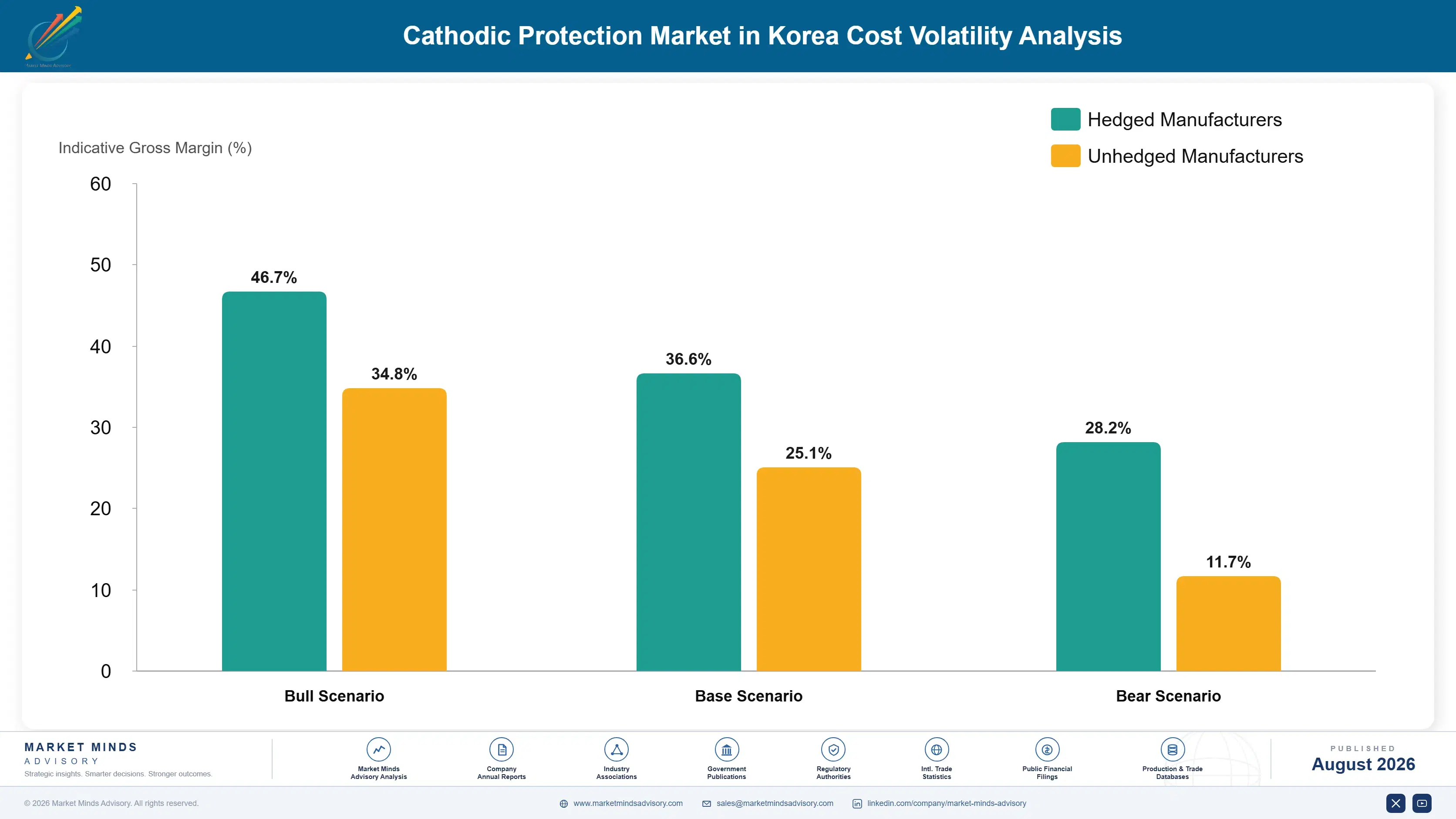
Anode material carries roughly 24% of installed system cost, spanning magnesium, zinc, aluminium, and mixed metal oxide depending on system type, with alloy pricing set on global metal markets. Rectifiers and electrical equipment add about 18%, cabling and reference cells near 11%, excavation and field installation labour around 32%, and design, commissioning, and testing the balance across a typical Korean project.
Magnesium and zinc alloy prices moved sharply through 2021 and 2022 across Asian markets, and several corrosion control suppliers disclosed material cost pressure and project margin compression in annual filings covering those years. Metal pricing has since stabilised at higher levels. Korean field labour cost rose persistently through the same period and has not retreated, which now represents the larger and more durable pressure on installed cost.

The competitive disadvantage mechanism runs through field labour productivity rather than through anode purchasing. Excavation and installation carry roughly 32% of installed cost and vary enormously between contractors depending on crew experience, ground condition assessment, and how much rework a poorly surveyed site generates. Anode alloy costs the same for everyone; the ground does not, and site investigation quality determines that difference more than anything else.
cathodic-protection-market-in-korea-cost-volatility-analysis-1787301065443

Invest in site investigation before mobilising installation crews

Excavation and field installation carry roughly 32% of installed system cost, and rework from unexpected ground conditions is the largest avoidable component within it. Soil resistivity surveys and utility mapping ahead of mobilisation cost little against crew days lost on site. Contractors who skip that step to win on price routinely lose the difference during installation and blame the ground.

Standardise rectifier and enclosure specifications across projects

Rectifiers and electrical equipment carry about 18% of installed cost, and specifying differently on every project prevents any volume position with suppliers and complicates spares holding across an operator's estate. Standard specifications shared across a portfolio reduce both. Customers frequently specify their own preferences, so this requires negotiation at design rather than imposition afterward.

Design anode alloy selection against measured soil conditions

Anode material carries roughly 24% of installed cost, and alloy selection made on generic assumptions rather than measured resistivity produces either over-specification that wastes money or under-specification that contributes to the 29% found below criterion. Measurement costs a fraction of either error. Coastal Korean conditions differ sharply enough from inland that generic tables mislead consistently.

Portfolio Architecture for Margin Defence

Three tiers describe this business and the spread follows whether revenue recurs rather than technical difficulty. Anode and rectifier hardware sits at the bottom, sold once into a project with alloy pricing set on global metal markets. Installation and retrofit engineering occupies the middle, priced against field labour that rises every year. Monitoring and survey services sit at the top, recurring across an asset's operating life.
The tension is that capital projects supply the volume and the installed base, while the operating life supplies the margin and the recurrence. Contractors capturing protection scope inside construction packages install a great deal and capture nothing of the seventeen years that follow. Survey specialists hold the operating relationship and reach very few new assets. Very few Korean participants currently hold both positions properly.

High-value pools concentrate where verification cannot be deferred. Offshore wind foundations are the clearest case, since nobody dispatches a survey crew below water for a routine reading and monitoring is therefore specified at design. Ageing coastal complexes pool value similarly, since retrofit programmes are large and repeat across an estate. Both pools sit outside the hardware pricing contest entirely.

Volume / Commodity-Adjacent Tier

Sacrificial anode and rectifier hardware supply, sold once into a project with alloy pricing set on global metal markets that no supplier influences. Korean and Indian manufacturing has compressed pricing here considerably over recent years.
Gross Margin: 17-24%

Premium / Certified Tier

Installation, retrofit, and design engineering priced against Korean field labour carrying roughly 32% of installed cost. Margin varies widely between contractors according to site investigation quality rather than any commercial capability.
Gross Margin: 26-34%

Sustainability / Regulatory / Next-Generation Tier

Remote monitoring and survey services recurring across an asset's operating life rather than arriving once at construction. Best margin by a clear distance, and the only category addressing the roughly 29% of assets found below protection criterion.
Gross Margin: 42-52%
cathodic-protection-market-in-korea-portfolio-architecture-1787301065946

High-value Sub-segments and Strategic Watch-out

Remote Monitoring And Survey Services

Fastest growth at 8.1%, exactly 1.50 times the market rate, and the only category producing recurring revenue across an operating life. Payback against survey crew cost arrives in roughly three years, and offshore projects specify it as standard. Accumulated asset data defends the contract afterward.
Gross Margin: 42-52%

Offshore Wind Foundation Protection

High value and growing from almost nothing, since nobody dispatches a survey crew below water for a routine reading. Monitoring is specified within foundation design rather than added later, which is where onshore practice still lags badly. Subsea retrofit work costs several times its onshore equivalent everywhere.
Gross Margin: 42-52%

Anode And Rectifier Hardware Supply

The volume core, sold once into projects with alloy pricing set by global metal markets that no supplier influences at all. Korean and Indian manufacturing has compressed margin here considerably and continues to do so each year. Specification is straightforward enough that substitution stays genuinely easy.
Gross Margin: 17-24%

Unverified Installed Base Exposure

The strategic watch-out, since only around 38% of systems are surveyed on schedule and roughly 29% sit below criterion. Operators discovering this through a leak face retrofit at six times original installation cost. Deferral compounds because nothing visible ever happens. Monitoring is the only practical remedy available.
Gross Margin: 26-34%

Projects, Life and Verification

Revenue arrives at construction and then largely stops, since sacrificial systems run around seventeen years before replacement and generate nothing in between unless somebody is monitoring or surveying. That pattern makes the project award disproportionately valuable to contractors and leaves the operating life almost entirely unmonetised by whoever installed the system. Monitoring contracts are the only mechanism converting that long silence into recurring income.
Stickiness follows accumulated asset knowledge rather than any contractual position. A survey specialist holding twenty years of readings on a coastal tank farm knows that asset in a way a competitor cannot replicate at any price, and that history makes every subsequent recommendation credible. Hardware supply sticks not at all and is retendered on alloy price. Monitoring contracts sit between the two, defended by data continuity.

Buyer profiles shifted as asset integrity functions absorbed corrosion control from maintenance departments. The earlier buyer was a maintenance engineer approving a survey against an annual budget. The current one is increasingly an integrity manager comparing measured protection performance across a whole estate and asking why the coverage gap exists. Coverage gaps that maintenance departments tolerated for years are now visible at estate level.
cathodic-protection-market-in-korea-end-use-penetration-index-1787301066450

What We Would Tell a Board

These are among the four positions where our research anticipates prominent divergence between winners and laggards over the coming forecast period. Each is grounded in the demand model, the regulatory perimeter, and the announced capacity pipeline.
01 / RECURRING MEASUREMENT REVENUE

Sell the reading, because the anode sells once

Only around 38% of Korean systems are surveyed within the recommended interval, and roughly 29% of protected assets are found below criterion whenever anybody actually takes a reading on them. Continuous monitoring pays back against survey crew cost in about three years and reports a failure the day it happens rather than at the next scheduled inspection. It also converts one-time hardware supply into recurring revenue across an operating life, which changes account economics far more than any anode margin ever will.
02 / AGEING ASSET TARGETING

Reach the operator before the leak does

Petrochemical and refining assets at Ulsan, Yeosu, and Daesan built through the nineteen seventies and eighties are now reaching retrofit rather than maintenance, and retrofit costs around six times original installation once excavation and shutdown are properly included. An operator discovering the problem through a leak pays considerably more than one who finds it through routine survey. Approaching those operators with their own survey data rather than with a product proposal is what converts the conversation into a funded retrofit programme.
03 / DESIGN STAGE SPECIFICATION

Monitoring costs least before the system is energised

Monitoring installed during original construction costs a fraction of retrofitting it onto an energised system later, and Korean offshore wind projects already specify it as standard because sending a survey crew below water is entirely impractical. Onshore projects rarely do the same, so the upgrade conversation then has to compete against maintenance budgets several years afterward. Suppliers who reach the design engineer rather than the maintenance manager capture that specification at the point where it costs the customer least and wins most readily.
04 / COASTAL DESIGN DISCIPLINE

Generic design tables mislead on this coastline

Roughly 71% of Korean protected asset value sits in coastal complexes where chloride exposure, soil resistivity, and tidal groundwater movement all raise current demand well beyond standard inland design allowances. Systems sized on generic assumptions underperform badly there, and they contribute directly to the roughly 29% of assets found sitting below protection criterion. Designing against measured local conditions costs more upfront and delivers systems that genuinely hold protection across their intended seventeen-year design life rather than drifting quietly below it.

Engagement Snapshot From the Field

A live engagement with an industry participant carrying material or product regulatory and market exposure ahead of a defining policy shift, showing how our research translates into a defensible multi-year portfolio strategy.
MARKET MINDS ADVISORY · CLIENT ENGAGEMENT SUMMARY
Cathodic Protection in Korea Producer Strategic Portfolio Review and Transition Roadmap 2026·Investment Scenario on Cathodic Protection in Korea Exposure Evaluation 2025-26
CLIENT PROFILE
A Korean corrosion engineering contractor with approximately 52 million dollars in annual revenue (client-reported, unverified by MMA), installing cathodic protection systems on industrial and pipeline projects and providing periodic survey services across coastal complexes. Project installation carried most of the revenue, survey work was a small and declining service line, and monitoring capability was absent entirely.
STRATEGIC CHALLENGE
Management saw remote monitoring as a threat to survey revenue and proposed defending the survey business by cutting its pricing. The board wanted an independent read on whether that defence was viable before committing to a price position that would remove most of the remaining margin on the service line.
MMA APPROACH
We modelled monitoring economics against the client's own survey pricing and cost base across representative customer sites. Survey coverage across the client's installed base was compared against recommended intervals. Historical survey findings were reviewed for how many assets were below criterion, and the retrofit revenue arising from those findings was traced through the following three years.
KEY FINDINGS
  1. Monitoring economics displaced periodic survey comfortably on every representative site modelled, and no achievable survey price reversed that comparison at all. The comparison was decisive.
  2. Survey coverage across the client's own installed base sat far below recommended intervals, meaning most systems were unverified rather than being surveyed by a competitor.
  3. Historical survey findings showed a substantial share of assets below criterion, and those findings had generated retrofit revenue several times the survey fee itself.
  4. The client's accumulated survey records represented asset knowledge no competitor or monitoring vendor could replicate, and it was not being used commercially.
CLIENT PROFILE
A Korean corrosion engineering contractor with approximately 52 million dollars in annual revenue (client-reported, unverified by MMA), installing cathodic protection systems on industrial and pipeline projects and providing periodic survey services across coastal complexes. Project installation carried most of the revenue, survey work was a small and declining service line, and monitoring capability was absent entirely.
STRATEGIC CHALLENGE
Management saw remote monitoring as a threat to survey revenue and proposed defending the survey business by cutting its pricing. The board wanted an independent read on whether that defence was viable before committing to a price position that would remove most of the remaining margin on the service line.
MMA APPROACH
We modelled monitoring economics against the client's own survey pricing and cost base across representative customer sites. Survey coverage across the client's installed base was compared against recommended intervals. Historical survey findings were reviewed for how many assets were below criterion, and the retrofit revenue arising from those findings was traced through the following three years.
KEY FINDINGS
  1. Monitoring economics displaced periodic survey comfortably on every representative site modelled, and no achievable survey price reversed that comparison at all. The comparison was decisive.
  2. Survey coverage across the client's own installed base sat far below recommended intervals, meaning most systems were unverified rather than being surveyed by a competitor.
  3. Historical survey findings showed a substantial share of assets below criterion, and those findings had generated retrofit revenue several times the survey fee itself.
  4. The client's accumulated survey records represented asset knowledge no competitor or monitoring vendor could replicate, and it was not being used commercially.
RECOMMENDED STRATEGY
Phase 1: Phase 1 (months one to nine): abandon the survey price defence, launch a monitoring service into the existing customer base deliberately. Phase 2: Phase 2 (months nine to twenty-one): use accumulated survey records to build asset-specific monitoring proposals rather than generic offers. for each site. Phase 3: Phase 3 (months twenty-one to thirty-six): pursue design-stage monitoring specification on new industrial and offshore wind projects. across the southwest coast.
OUTCOME
The price defence was abandoned. Monitoring contracts were signed with existing survey customers within two quarters, retrofit revenue arising from monitoring findings exceeded the survey revenue displaced, and design-stage specification work began on two offshore projects (client-reported, unverified by MMA). Survey technicians were retrained rather than released.

Frequently Asked Questions

Foundational context covering the market sizes, CAGR, scope, country, region and competition that inform every finding below. This section is provided to cover basics and most often pre-purchase conversations, answered from the MMA Primary Research Dataset.

What is the current size of the Cathodic Protection market in Korea?

The market is valued at USD 0.46 billion in 2025, rising to USD 0.48 billion in 2026. Scope covers systems and services for buried, submerged, and immersed assets, not coatings, inhibitors, or material substitution.

How large will the Korean Cathodic Protection market be by 2036?

MMA forecasts USD 0.82 billion by 2036, an increase of USD 0.34 billion over the 2026 base. That represents an expansion multiple of 1.71 times across the forecast period.

What is the CAGR for the Korean Cathodic Protection market 2026 to 2036?

The base case CAGR is 5.4%, with a bull case of 6.6% and a bear case of 4.2%. The historical rate from 2020 to 2025 was 4.4%, carried by new construction rather than maintenance.

Which segment is growing fastest?

Remote monitoring and survey services at 8.1%, exactly 1.50 times the market rate. Monitoring pays back against survey crew cost in roughly three years and is the only recurring revenue in this market.

Who are the major companies in the Korean Cathodic Protection market?

Samsung Heavy Industries, Hyundai Engineering, Daehan Corrosion Engineering, Korea Anode, and Hanjoo ENC lead on protected asset kilometres and structures. The top five hold 44% across contractors, manufacturers, and survey specialists.

Which country is growing fastest?

South Korea at 5.4%, which is nominal since this report covers a single national market. Growth varies far more by asset age and by coastal exposure than by location within Korea.

Report Segmentation Architecture

The full report scope spans multiple orthogonal segmentation dimensions, with cross-tabulated demand data provided for each dimension pair. Coverage extends further to regional breakdowns, trend trajectories, and the competitive detail needed to support segment-level decision-making.

By System Type And Service Delivery

  • Sacrificial Anode Protection Systems
  • Impressed Current Cathodic Protection Systems
  • Anode And Rectifier Hardware Supply
  • Remote Monitoring And Survey Services
  • Design, Commissioning And Retrofit Engineering

By End-Use Industry

  • Petrochemical And Refining Complexes
  • Oil, Gas And Water Pipelines
  • Ports, Harbours And Marine Structures
  • Offshore Wind And Subsea Infrastructure
  • Power Generation And Utility Assets

By Commercial Model

  • Specified Within Capital Project Contracts
  • Direct Operator Retrofit Procurement
  • Recurring Monitoring Service Contracts
  • Periodic Survey And Inspection Engagements
  • Hardware Supply Through Distribution

By Region

  • East Asia
  • Western Europe
  • North America
  • South Asia and Pacific
  • Middle East and Africa
  • Eastern Europe
  • Latin America

Scope, Methodology, and Coverage

Every figure in this report is reproducible from documented input assumptions. The scope below maps the historical period, the forecast horizon, the segmentation dimensions, and the countries covered, alongside the underlying primary and qualitative methodology.
Historical Period
2020 to 2025
Forecast Period
2026 to 2036
Base Year
2025 (USD billions; MMA Primary Research Dataset, August 2026)
Market Definition
This market comprises cathodic protection systems and associated services applied to buried, submerged, and immersed metallic assets located within South Korea, measured at delivered system and service revenue including hardware, engineering, and field installation labour. Coverage spans sacrificial anode protection systems, impressed current cathodic protection systems, anode and rectifier hardware supply, remote monitoring and periodic survey services, and design, commissioning and retrofit engineering. Protective coatings applied without cathodic protection, corrosion inhibitor chemicals, stainless steel and alloy material substitution, general pipeline and civil construction, internal pipeline corrosion control, and reinforced concrete repair without cathodic protection fall outside scope.
Quantitative Units
USD billions (current prices); protected asset kilometres and structures; systems meeting protection criterion; survey coverage against recommended interval
Segmentation Dimensions
By System Type And Service Delivery; By End-Use Industry; By Commercial Model; By Region
Regions Covered
East Asia, Western Europe, North America, South Asia and Pacific, Middle East and Africa, Eastern Europe, Latin America
Countries Covered
South Korea, with technology and equipment origin coverage across Japan, China, Taiwan, Germany, Netherlands, United Kingdom, Norway, United States, Canada, India, Australia, Poland, Czechia, Brazil, Saudi Arabia, United Arab Emirates, and additional origins relevant to this sector
Key Companies Profiled
Samsung Heavy Industries, Hyundai Engineering, Daehan Corrosion Engineering, Korea Anode, Hanjoo ENC, Corrpro Companies, MATCOR, Cathodic Protection Co, Vector Corrosion Technologies, Nakabohtec Corrosion Protection, Imenco, BAC Corrosion Control, Deepwater Corrosion Services, Aegion Corporation, Farwest Corrosion Control, TWS Korea, Sungjin Geotec, Daelim Anode, Jeil Corrosion, Hyosung Heavy Industries
Quantitative Methodology
Primary survey, n=3,800 respondents, Q4 2025, six countries; demand-side model with trade association cross-validation
Qualitative Methodology
47 expert interviews, Q4 2025; applied to validate demand model assumptions, identify emerging dynamics, and assess competitive positioning
Report Format
PDF and XLSX data workbook (Word format preview document)
Publisher
Market Minds Advisory
Report Code
MMA-2026-CON-651
Published
August 2026
Contact
sales@marketmindsadvisory.com | www.marketmindsadvisory.com

Purchase the full Cathodic Protection Market in Korea Report (2026 to 2036).

The full report sizes Korean cathodic protection across five system and service types, five end-use industries, five commercial models, and the domestic market in detail, with equipment and technology origin mapped across supplying countries. Survey coverage is quantified against recommended intervals and against the share of assets found below protection criterion, since that gap describes this market more honestly than installed capacity does. Retrofit economics are modelled against original installation cost. Competitive profiling covers twenty companies on protected asset kilometres and structures, and monitoring payback is compared against survey service pricing.
Survey coverage quantified against recommended inspection intervals
Assets below protection criterion measured across the installed base
Retrofit economics modelled against original installation cost
Monitoring payback compared against periodic survey service pricing
Coastal current demand analysed against generic design allowances
Offshore wind foundation protection assessed by specification stage

Built For The People Who Decide

From boardroom strategy to bench-side execution, this report is read cover-to-cover by leaders shaping the next decade of their industry, turning demand scenarios, market dynamics and valuation benchmarks into decisions.
CXOs/ Presidents/ VPs/ Managers
M&A and Corporate Development
Strategy Teams and R&D Heads
Procurement and Product Directors
Regulatory and Compliance Leaders
Investor Relations and Equity Analysts