Market Minds Advisory
Catenary Infrastructure Inspection Market

Catenary Infrastructure Inspection Market: Catenary Infrastructure Inspection Market. Trends and Forecast 2026 to 2036

High-speed rail expansion, aging overhead contact line infrastructure, and machine vision technology are pushing catenary maintenance away from manual checks toward automated sensor-based systems, rewarding vendors who detect wear before service disruption occurs.

Lead Analyst

Published

September 2026

Make Smarter Decisions with Customized Research Insights

Request a free sample report and evaluate market opportunities, growth trends, and competitive dynamics relevant to your business needs.

2025 MARKET VALUE$1.4BMarket Size 2025
2036 FORECAST VALUE$3.8BBase Case , 2026 to 2036
CAGR 2026 TO 20369.5 %Bull 10.8% / Bear 8.2%
INCREMENTAL OPPORTUNITY$2.3BNet 10- year value creation
EXPANSION MULTIPLE2.48x2036 value over 2026 base
Strategic Levers
M&A Pipeline
Regional Outlook
Country Rankings
Competitive Intelligence
Segmental Deep-dive
Call-Us : 91 93563 13602

Executive Snapshot and Market Trajectory.

Catenary infrastructure inspection has moved from a manual visual patrol discipline into a sensor-driven predictive maintenance category, as rail operators adopt machine vision and laser scanning systems that detect overhead contact line wear long before it causes a service-disrupting failure across the entire electrified network nationwide.
High-speed rail network expansion, aging overhead contact line infrastructure in mature rail systems, and machine vision technology maturation are converging on automated inspection trains and drone-based systems that replace slower manual patrol methods entirely across the network, while Chinese and European equipment manufacturers concentrate scarce engineering talent and manufacturing scale within a handful of specialized rail technology firms serving both domestic and export rail operators directly across the globe and its growing high-speed corridors.
Competitive intensity centers on a moderately concentrated group of rail technology specialists competing on detection accuracy and false-positive reduction rather than price, even as tight rail operator capital budgets and lengthy procurement cycles threaten to slow the replacement pace for legacy manual inspection methods still used across a meaningful share of the world's electrified rail network today and for many years to come across every continent and jurisdiction.
Market Definition
The catenary infrastructure inspection market covers sensor, machine vision, laser scanning, and drone-based systems purpose-built for monitoring overhead contact line condition on electrified rail networks. It excludes general rail track inspection equipment, signaling system diagnostics, and manual hand-tool inspection methods without automated sensing capability.
Base Year Value
$1.4B in 2025 (MMA Primary Research Dataset, September 2026)
Forecast Period
2026 to 2036, eleven discrete annual values
CAGR
9.5% base case. Bull 10.8%. Bear 8.2%.
Fastest Growth Segment
AI-Based Machine Vision Inspection Systems for Catenary Wear Detection: 15.0% CAGR
Fastest Growth Country
China: 12.0% CAGR
Fastest Growth Region
South Asia and Pacific: 11.5% CAGR
Largest Region
East Asia: 41% of 2025 global value
Market Leaders
Leading suppliers: MERMEC, Plasser and Theurer, CRRC Corporation, Omnicom Engineering, Balfour Beatty Rail. Source: MMA Primary Research Dataset, July 2026.
Primary Survey
n=3,800 procurement and R&D decision-makers, Q4 2025, six countries
Methodology
Demand-side build-up, cross-validated against public data, 47 expert interviews

Catenary Infrastructure Inspection Market Forecast Scenarios

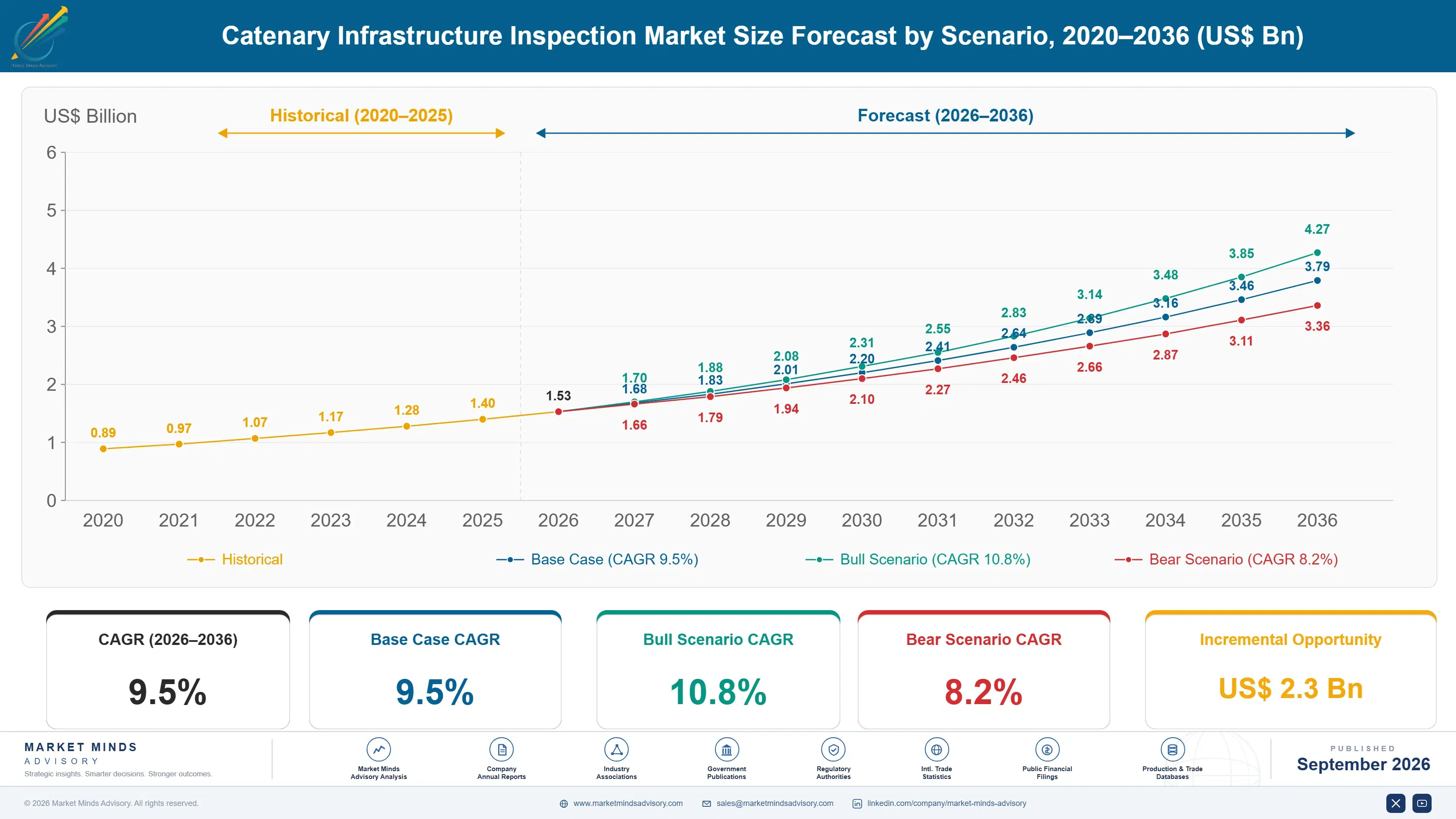
catenary-infrastructure-inspection-market-size-forecast-scenario-1790002552410
Between 2020 and 2025, catenary inspection demand grew steadily as high-speed rail network expansion in Asia and Europe pushed operators toward automated inspection trains capable of scanning contact wire condition at operating speed, lifting volume well ahead of broader rail maintenance equipment market growth across the entire period and across every major rail-electrified economy worldwide.
The base case assumes continued rail electrification and modernization adoption and rests on three commercial mechanisms: expanding high-speed rail network mileage requiring dense inspection coverage across every new corridor built, aging overhead contact line infrastructure in mature European and Japanese rail systems reaching replacement age, and machine vision technology maturation lowering the cost of automated defect detection, each reinforcing capacity investment in inspection system fabrication through the back half of the forecast window.
A bull case built on faster-than-expected AI-based defect detection accuracy improvement and accelerating high-speed rail construction could push volumes meaningfully above trend, while a bear scenario tied to tight rail operator capital budgets and delayed infrastructure modernization programmes would compress order backlogs and slow new inspection system deployment across major rail networks worldwide and internationally in the years ahead.

Catenary Inspection: Detection Accuracy Sets Vendor Economics

Catenary inspection economics hinge on detection accuracy far more than on hardware sophistication alone, since a system that misses a wear defect exposes the rail operator to service disruption risk that dwarfs the cost difference between competing inspection platforms and their respective purchase prices, particularly on the busiest high-speed corridors where any unplanned outage cascades quickly across the entire national schedule and beyond.
MARKET CONCENTRATIONCR5 44%top five vendors hold a moderate combined share
AVERAGE SELLING PRICE$2.1 million per inspection trainpricing scales with sensor count and detection sophistication
TOP PRODUCING COUNTRY SHAREChina 30%leads volume ahead of Germany and Italy nationally
CAPACITY UTILISATION73%assembly lines run moderate amid lumpy tender-driven ordering
TRADE INTENSITY48% exportedfinished systems ship onward to overseas rail operators
FEEDSTOCK COST SHARE34%optical sensors and specialty cameras dominate input cost
Pricing rewards vendors who can reduce false-positive alert rates while maintaining full defect detection sensitivity, so machine vision specialists command a durable premium over older mechanical contact-based inspection systems that generate far more maintenance callouts per defect actually found along the entire route, wasting scarce maintenance crew time and specialized equipment availability that could otherwise be deployed elsewhere on the broader network.
Optical sensor and specialty camera costs move with broader machine vision component cycles rather than rail industry demand specifically, which means margin timing in this business often depends more on imaging semiconductor supply availability than on rail operator capital budget announcements or procurement tender timing decided months or even years in advance of actual system deployment, commissioning, and final acceptance testing.
"A missed wear defect on the contact wire doesn't cause a delay, it causes a shutdown. That asymmetry is why rail operators pay a premium for detection accuracy that would look excessive in almost any other industrial inspection category."
Director, Rail Infrastructure Technology Practice · MMA Construction and Industrial Equipment Practice · September 2026

Market Trends

AI-Based Defect Classification Reduces False Positive Alerts Sharply

Machine vision inspection vendors have deployed AI-based defect classification models that cut false-positive alert rates by roughly 55 percent compared with earlier rule-based image processing systems, dramatically reducing unnecessary maintenance crew dispatches across the entire network. This accuracy improvement has shifted vendor competition away from raw sensor resolution toward algorithm training data quality and model refinement, since two systems using identical cameras can produce meaningfully different accuracy outcomes. Rail operators increasingly specify minimum false-positive rate thresholds in procurement tenders, effectively excluding vendors who have not invested in comparable AI classification capability.
Market Impact: Over 30 percent predates 1990

High-Speed Rail Expansion Drives Dense Inspection Coverage Requirements

Global high-speed rail network mileage surpassed 59,000 kilometers in 2025, with China alone accounting for more than 40,000 kilometers requiring dense catenary inspection coverage at frequencies far exceeding conventional rail maintenance schedules established decades earlier across most legacy systems. This expansion has created sustained demand for inspection train fleets capable of scanning entire high-speed corridors within tight overnight maintenance windows between passenger service hours. Vendors who can deliver inspection systems compatible with high-speed rolling stock platforms are winning contracts that slower legacy inspection equipment cannot physically fulfill within available time constraints.
Market Impact: Inspection frequency requirements rose 25 percent

Market Opportunities and Growth Drivers

Aging European Rail Infrastructure Approaches Mandatory Replacement Age

More than 30 percent of overhead contact line infrastructure across major European rail networks was installed before 1990 and is approaching the 40-year design life threshold that typically triggers mandatory replacement or comprehensive inspection intensification under national rail safety regulation. This aging infrastructure wave is forcing European rail operators to accelerate inspection programme investment well ahead of actual replacement capital expenditure, since regulators require documented condition assessment before authorizing continued operation past design life. Inspection vendors serving European markets are seeing multi-year contract visibility tied directly to this regulatory replacement timeline.
Market Impact: Cycles run 18 to 24 months

Rail Safety Regulation Mandates Documented Inspection Frequency Increases

National rail safety regulators across major markets have increased mandatory catenary inspection frequency requirements by roughly 25 percent over the past three years following several high-profile overhead line failure incidents that disrupted major passenger corridors nationwide and drew regulatory scrutiny. This regulatory tightening directly expands the addressable inspection services market, since operators must now contract for more frequent inspection cycles regardless of underlying infrastructure condition or age. Vendors who can demonstrate compliance with the most stringent documentation and audit trail requirements are winning disproportionate share of new regulatory-driven contract awards.
Market Impact: Budgets trail inflation by 12 percent

Market Restraints and Challenges

Lengthy Public Procurement Cycles Slow Contract Award Timelines

Rail operator procurement cycles for major inspection system contracts typically run 18 to 24 months from initial tender publication to final award, considerably longer than comparable industrial inspection equipment sales in less regulated sectors. The root cause is genuine public procurement law requiring extensive competitive bidding documentation and multi-stage technical evaluation for any publicly funded rail infrastructure purchase above modest thresholds. Vendors are mitigating the friction by maintaining dedicated tender response teams and pre-qualifying under framework agreements that shorten subsequent procurement cycles, though this approach requires sustained bidding investment with uncertain near-term payoff.
Market Impact: False positives fell roughly 55 percent

Tight Rail Operator Capital Budgets Delay Fleet Modernization

Many national rail operators operate under fixed multi-year capital budgets that have trailed cumulative inflation by roughly 12 percent over the past five years, leaving inspection system modernization competing directly against higher-priority rolling stock and track maintenance spending for the same limited funds. The root cause is a broader public infrastructure funding environment where rail capital allocation decisions weigh passenger-visible improvements more heavily than inspection technology upgrades that riders never directly observe. Suppliers are exploring leasing and outcome-based service models that shift inspection spending from capital budgets into operating expense categories, easing the approval burden for cash-constrained operators.
Market Impact: High-speed rail mileage passed 59,000 kilometers
3 additional market trends, 4 additional growth drivers, and 3 additional restraints and challenges are covered in the full report. Contact sales@marketmindsadvisory.com to access the complete intelligence.

Segment CAGR and Growth Architecture

Catenary infrastructure inspection is segmented here in this analysis by sensing technology rather than by rail network type, since machine vision, laser scanning, mechanical contact, and drone-based systems carry distinct cost structures and detection capabilities despite serving overlapping high-speed and conventional rail customers worldwide across every major electrified network, geography, and operator scale today.
catenary-infrastructure-inspection-market-market-share-analysis-1790002552978

AI-Based Machine Vision Inspection Systems for Catenary Wear Detection

AI-based machine vision inspection systems for catenary wear detection are the fastest-growing segment, expanding at 15.0 percent annually as rail operators replace older rule-based image processing with deep learning models trained on far larger defect image datasets accumulated over many years of continuous operational service and testing. This segment benefits directly from regulatory pressure to reduce false-positive maintenance callouts, since accurate classification translates immediately into lower crew dispatch cost and less disruption to passenger service schedules nationwide. Chinese and European vendors have moved fastest to commercialize this technology, pairing camera hardware improvements with proprietary training data accumulated across thousands of kilometers of prior inspection runs across their entire operating fleets.
CAGR 15.0%

Drone-Based Aerial Inspection Systems

Drone-based aerial inspection systems are the second-fastest segment, growing at 13.5 percent as rail operators adopt unmanned aerial platforms for inspecting catenary sections in remote or difficult-to-access terrain where ground-based inspection trains cannot easily operate at all today under normal scheduling constraints and current maintenance crew staffing levels. This segment addresses a coverage gap that traditional inspection train fleets leave unaddressed, since mountainous and rural rail segments often see inspection train scheduling deprioritized relative to high-traffic urban corridors. Regulatory approval for beyond-visual-line-of-sight drone operation near live overhead electrical infrastructure remains an ongoing constraint that vendors are working through jurisdiction by jurisdiction across the entire world and every regulatory regime encountered.
CAGR 13.5%
Full segment breakdown across 6 segments available in the complete report.

Regional Architecture and Country Demand Map

Catenary inspection demand concentrates wherever electrified high-speed rail network mileage, regulatory inspection mandates, and domestic equipment manufacturing capacity all converge together at genuine national scale today, pulling a disproportionate share of total global inspection volume into East Asia well ahead of every other region worldwide.

North America

North America's share sits below the standard regional band because the region operates minimal electrified rail infrastructure compared with Europe and Asia, with most freight and passenger rail running diesel-electric locomotives that require no catenary inspection whatsoever across most of the continent and its rail corridors. Amtrak's Northeast Corridor represents the region's densest concentration of overhead contact line infrastructure requiring regular inspection, though its total mileage remains modest relative to Chinese or European high-speed networks. Canadian passenger rail electrification remains limited to a handful of commuter corridors around major metropolitan areas. Proposed high-speed rail projects in California and Texas could meaningfully expand the region's addressable market if construction proceeds past current planning stages.
Share: 12% | CAGR: 8.5% (2026 to 2036)

Western Europe

Western Europe's demand rests on one of the world's oldest and densest electrified rail networks, with Germany, France, and Italy all operating catenary infrastructure installed across multiple decades that now requires intensifying inspection frequency under tightening national safety regulation and heightened public scrutiny following several recent notable incidents nationwide. French high-speed TGV corridors and German ICE routes both specify automated inspection train deployment as standard practice rather than exception. Italian and Spanish high-speed rail expansion continues to add new catenary mileage requiring inspection coverage from initial commissioning onward. Aging infrastructure replacement cycles across the region's oldest conventional rail lines provide a steady secondary demand channel independent of high-speed network growth.
Share: 24% | CAGR: 8.0% (2026 to 2036)
Regional intelligence for 5 additional markets available in the complete report: East Asia, South Asia and Pacific, Latin America, Middle East and Africa, Eastern Europe. Contact sales@marketmindsadvisory.com.
catenary-infrastructure-inspection-market-country-cagr-analysis-1790002553525

Detection Accuracy Precision and Recurring Data Revenue

Catenary inspection vendors can expand revenue well beyond one-time equipment sales by moving into recurring data analytics subscriptions, long-term inspection-as-a-service operating contracts for national rail operators, proprietary AI defect classification model licensing to smaller regional competitors abroad, and bundled asset management software packages that hardware-only competitors cannot easily replicate or match on price alone.

Recurring Inspection Data Analytics Subscription Services

Vendors who bundle a recurring data analytics subscription alongside inspection hardware capture ongoing revenue per kilometer inspected rather than a single upfront equipment sale, converting what was historically a one-time capital purchase into an annuity-like customer relationship spanning many years of operation. This subscription layer typically carries margins above 60 percent, far exceeding hardware margins, because it draws on cloud infrastructure and defect trend analysis capability that scales efficiently across an operator's entire network. Customers who adopt analytics subscriptions also renew equipment contracts at meaningfully higher rates than hardware-only buyers.
Market Impact: Analytics subscriptions carry margins well above 60 percent

Long-Term Inspection Service Contracts for Rail Operators

Vendors who offer inspection as an ongoing service, providing the train, crew, and analysis rather than selling equipment outright, can secure multi-year contracts worth roughly 3 to 5 times the equivalent hardware sale value spread evenly across the entire contract term and every subsequent renewal period negotiated later. This model shifts inspection spending from rail operator capital budgets into operating expense categories, easing internal approval processes for cash-constrained operators who might otherwise delay equipment purchases indefinitely. Vendors offering this service model report meaningfully lower customer churn than pure equipment sellers.
Market Impact: Service contracts run 3 to 5 times hardware value

Licensing Proprietary Defect Classification AI Models

A small number of vendors have developed proprietary AI defect classification models trained on unusually large inspection image datasets accumulated over many years of continuous field deployment across thousands of kilometers, and some now license this software to smaller regional competitors for an upfront fee plus a running royalty near 7 percent of licensee revenue each year. This converts research investment into a second income stream without requiring additional capital expenditure on manufacturing capacity. Licensing also extends the technology's reach into markets where the original developer lacks direct sales and distribution presence.
Market Impact: Royalty fees run near 7 percent of revenue

Bundled Asset Management Software for Rail Operators

Beyond inspection hardware itself, vendors can bundle asset management software that tracks catenary condition history across the entire network as a paid add-on package rather than folding this capability into base equipment pricing. Rail operators requiring centralized condition dashboards and predictive maintenance scheduling pay a premium of roughly 20 percent over standard inspection equipment fees for this software layer, and the underlying platform often becomes reusable across multiple network segments at no incremental development cost. This add-on has become a meaningful profit center for vendors serving large national rail operators.
Market Impact: Adds a 20 percent premium over standard fees

Who Controls the Margin Pool

Catenary inspection supply sits in the hands of a moderately concentrated group of rail technology specialists, with a CR5 near 44 percent that reflects the coexistence of large integrated rail equipment conglomerates and smaller specialized inspection technology firms. The gap between the leading suppliers and mid-tier challengers is meaningful but not overwhelming, since detection technology has not yet fully consolidated around a single dominant sensing approach.
Current competitive activity centers on AI defect classification accuracy and inspection train manufacturing capacity rather than raw sensor specifications, since most leading systems have converged on broadly similar camera and laser hardware across the industry. Firms are differentiating through proprietary training data accumulated across their installed base and through bundled inspection-as-a-service contract offerings that pure equipment sellers struggle to match.

Emerging pressure comes from drone-based inspection specialists who reward flexible deployment and remote terrain access over traditional inspection train scale, opening space for smaller technology-first entrants outside the established rail equipment supply chain. Rankings could shift meaningfully if a mid-tier vendor secures a major national rail modernization contract or if a drone-focused entrant scales regulatory approval faster than incumbents can respond.
catenary-infrastructure-inspection-market-company-positioning-matrix-1790002554059

Competitive Moat and Risk Dimensions

MERMEC

Moat: Proprietary AI Defect Training Data

MERMEC has accumulated proprietary defect image training data across more kilometers of inspection runs than any rival, giving its AI classification models a durable accuracy advantage that newer entrants cannot replicate quickly. This data advantage compounds with every additional inspection run, since each new dataset further refines detection accuracy across an ever-widening range of defect types and environmental conditions.
MERMEC

Risk: Narrow Product Category Concentration

A large share of MERMEC's revenue traces back to rail inspection specifically, leaving it comparatively more exposed to rail capital spending cycles than diversified equipment conglomerates who can shift resources across broader infrastructure categories. Expanding into adjacent inspection markets would require capabilities and customer relationships outside its current core competency.
CRRC CORPORATION

Moat: Integrated Manufacturing Advantage

CRRC manufactures both the inspection trains and the rolling stock that runs alongside them, giving it integrated procurement advantages that pure inspection technology vendors cannot match when bidding on Chinese domestic contracts. This vertical integration also gives CRRC direct access to vast domestic deployment data that feeds back into product improvement faster than competitors relying on third-party partnerships.
CRRC CORPORATION

Risk: Limited Western Market Access

Trade restrictions and security concerns around Chinese rail technology have limited CRRC's ability to win contracts in North American and some European markets, constraining its addressable market despite substantial domestic scale. Expanding into these restricted markets would require overcoming political barriers that are largely outside the company's direct control.

Players Tracked

Prominent Players

MERMEC
Plasser and Theurer
CRRC Corporation
Omnicom Engineering
Balfour Beatty Rail

Other Key Players

Fugro
MER MEC USA
Konux
ENSCO Rail
Loram Maintenance of Way
Amberg Technologies
Zoller and Frohlich
Voestalpine Signaling
Speno International
Robel Bahnbaumaschinen
Getzner Werkstoffe
Harsco Rail
Windhoff Bahn- und Anlagentechnik
Rosenqvist Rail
Trimble Rail

Recent Developments

FEBRUARY 2026

MERMEC Expands AI Defect Classification Model Coverage

MERMEC announced an expansion of its AI defect classification model training dataset, adding coverage for three additional catenary component types following two years of field data collection. The expansion should lift detection accuracy roughly 15 percent across the newly covered component categories once fully deployed across the installed base.
Signal: Signals sustained investment in proprietary AI training data as MERMEC's primary competitive moat going forward permanently.
JULY 2025

Balfour Beatty Rail Signs Multi-Year Service Agreement

Balfour Beatty Rail entered a multi-year inspection-as-a-service agreement with a national European rail operator to provide ongoing catenary inspection across a major high-speed corridor. The agreement is a commercial service contract rather than an acquisition or joint venture, marking a shift from equipment sales toward recurring service revenue.
Signal: Confirms rail equipment vendors are moving decisively toward inspection-as-a-service models over prior one-time hardware sales entirely.
NOVEMBER 2025

Plasser and Theurer Acquires Drone Inspection Startup

Plasser and Theurer completed the acquisition of a smaller drone-based rail inspection startup focused on remote terrain catenary monitoring, adding aerial inspection capability to its product portfolio. The acquired firm's roughly 40 employees and existing regulatory approvals transferred fully, giving Plasser immediate access to drone inspection technology.
Signal: Confirms acquisition, rather than organic internal development, remains Plasser's clearly preferred route into drone-based rail inspection.

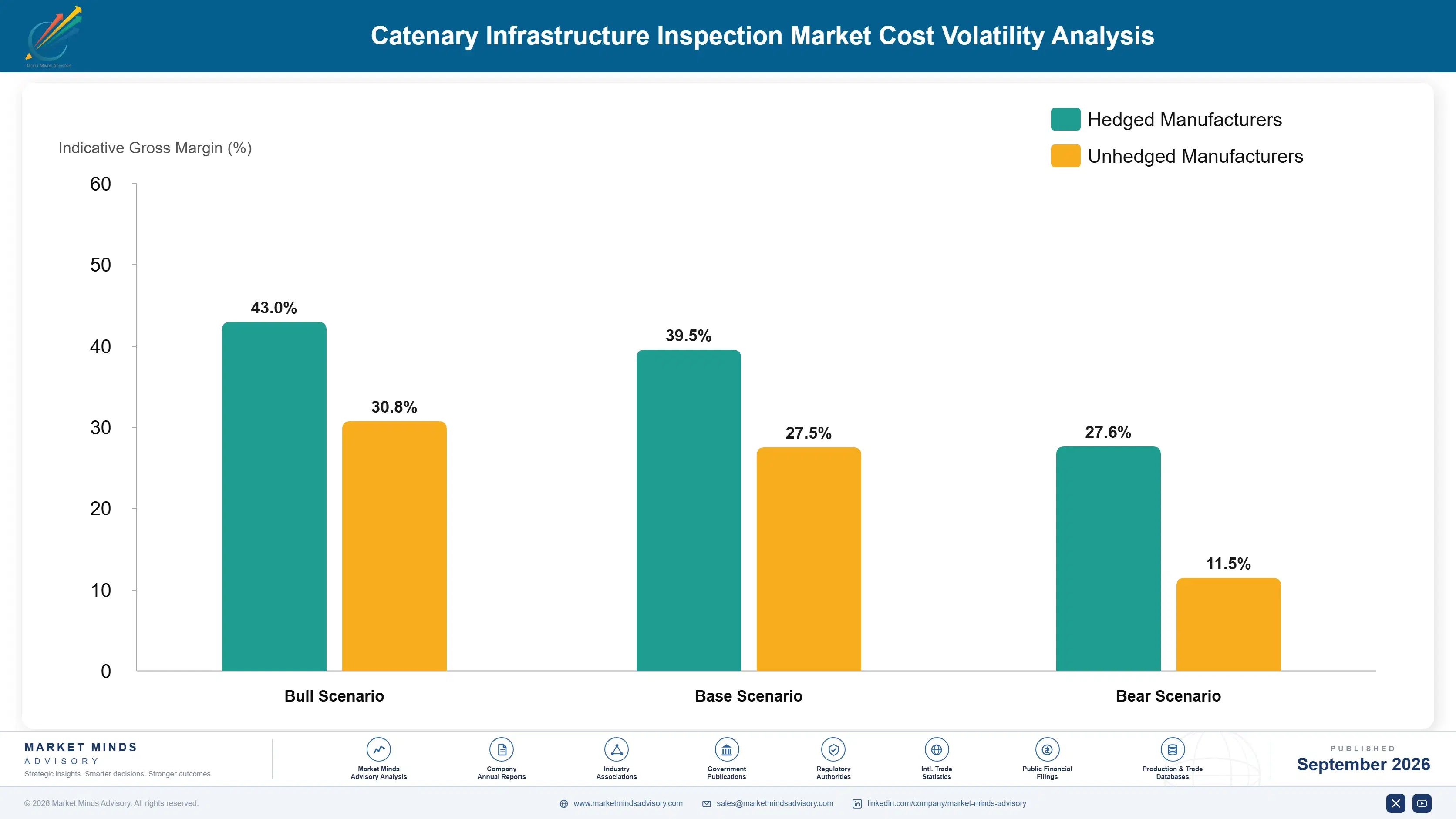
Optical Sensor Price Exposure in System Assembly

Optical sensors and specialty cameras together account for roughly 34 percent of catenary inspection system cost of goods sold, with imaging sensors sourced primarily from Japanese and Chinese semiconductor makers while specialty laser components concentrate among a handful of German and American photonics specialists holding genuinely limited spare capacity for sudden demand surges across the industry.
Global imaging semiconductor shortages tied to broader automotive and consumer electronics demand pushed component lead times past 40 weeks between 2022 and 2024 according to industry supply chain tracking, forcing several inspection system manufacturers to delay deliveries while renegotiating component allocation with suppliers directly. The shortage disproportionately affected smaller inspection vendors without long-term supply contracts already in place, forcing them to absorb the bulk of resulting delay penalties directly.

Larger manufacturers who secured long-term component supply agreements with imaging semiconductor makers are insulated from these shortages in ways that smaller competitors buying on the spot market simply are not able to match. This gap widens further for vendors competing on price in emerging markets, where thinner margins leave less room to absorb sudden component cost increases without raising customer prices sharply.
catenary-infrastructure-inspection-market-cost-volatility-analysis-1790002554257

Securing Long-Term Imaging Sensor Supply Agreements

Larger manufacturers are locking in multi-year imaging sensor supply agreements with semiconductor producers rather than purchasing on the spot market, insulating themselves from component shortages that hit smaller competitors hardest during extended periods of tight global supply. This approach requires substantial upfront negotiation but pays back through predictable input cost over the equipment's operational life.

Qualifying Alternative Laser Component Suppliers

Several manufacturers are qualifying alternative laser component suppliers beyond their traditional German and American sources to reduce dependence on any single specialty photonics producer, even though these newer suppliers currently carry slightly higher qualification costs during initial testing and extensive certification phases each cycle. This diversification smooths supply continuity risk during future component shortages.

Portfolio Architecture for Margin Defence

Catenary inspection margin economics separate cleanly along detection technology and service attachment rather than hardware specification alone, with the widest gross margins concentrated in AI-based systems bundled with recurring analytics subscriptions regardless of whether the customer is a high-speed operator or a conventional rail authority purchasing at moderate scale. Mechanical contact-based equipment runs on considerably thinner margins sustained by legacy contract renewals.
The tension between volume and premium tiers plays out most clearly in go-to-market strategy: every dollar spent developing AI classification capability and subscription infrastructure pulls resources away from mechanical inspection equipment sales that still generate steady, if unglamorous, revenue from budget-constrained operators each fiscal year. Most established vendors pursue both tiers simultaneously rather than fully committing to one over the other.

High-value margin pools concentrate overwhelmingly in AI-based systems with attached analytics subscriptions and service contracts, where technology barriers and data accumulation advantages keep new entrants out far more effectively than pricing power alone ever could achieve on its own. Drone-based and regulatory-driven segments remain smaller today but are positioned to absorb a growing share of new capital investment as approval frameworks mature further.

Volume / Commodity-Adjacent

Mechanical contact-based inspection equipment and basic geometry measurement systems for conventional rail networks, running on modest volume and thin unit margins sustained by legacy contract renewals rather than technology differentiation.
Gross Margin: 18-26%

Premium / Certified

AI-based machine vision and laser scanning systems bundled with recurring analytics subscriptions, where detection accuracy, training data depth, and regulatory compliance documentation command a durable premium over legacy inspection equipment sales.
Gross Margin: 40-50%

Sustainability / Regulatory / Next-Generation

Drone-based aerial inspection platforms and next-generation predictive maintenance software tied to regulatory modernization mandates, still small in volume today but drawing rising capital allocation from established vendors positioning early ahead of demand.
Gross Margin: 36-46%
catenary-infrastructure-inspection-market-portfolio-architecture-1790002554756

High-value Sub-segments and Strategic Watch-out

AI-Based Machine Vision for Catenary Wear Detection

The fastest-growing, highest-margin segment, driven by regulatory pressure to reduce false-positive maintenance callouts and aging infrastructure replacement cycles across major networks. Training data advantages protect incumbent margins, and the segment is expected to absorb the largest share of new capital investment through the forecast window.
Gross Margin: 42-50%

Drone-Based Aerial Inspection for Remote Terrain

High-value and growing steadily as rail operators specify unmanned aerial platforms for difficult-to-access sections and remote terrain across mountainous and rural rail segments nationwide, with regulatory approval progress across jurisdictions gradually expanding the addressable coverage area beyond current ground-based inspection train limitations and staffing constraints.
Gross Margin: 34-42%

Automated Inspection Trains for High-Speed Corridors

The volume core of the market, sustained by ongoing high-speed rail network expansion and steady scheduled maintenance demand across major global markets today and every year, though margins stay moderate because established inspection train platforms face competition from a wider pool of qualified regional suppliers.
Gross Margin: 26-34%

Mechanical Contact-Based Inspection Equipment

A strategic watch-out segment where accelerating replacement of mechanical contact inspection with machine vision and laser scanning alternatives could leave committed manufacturing capacity substantially underutilized well before existing multi-year service contracts naturally expire across the entire broader legacy supplier base entirely over the coming years.
Gross Margin: 16-22%

Recurring Analytics Revenue Beneath Equipment Sales

Catenary inspection revenue behaves less like a one-time equipment sale and more like an annuity once an analytics subscription or service contract is attached, since regulatory inspection frequency mandates and switching friction lock in recurring payments that persist well beyond the original hardware purchase across the entire contract lifetime.
Stickiness varies sharply by end-use vertical: high-speed rail operators carry the deepest lock-in because requalifying a new inspection vendor mid-contract can take years and risks disrupting a safety-critical maintenance schedule across the entire corridor, while conventional rail operators using mechanical inspection are far more contestable since procurement law requires periodic competitive rebidding. Drone-based service relationships sit closer to conventional stickiness, anchored by regulatory approval investment specific to each vendor's platform.

Buyer profiles are shifting generationally as procurement authority moves from maintenance engineers focused purely on unit cost toward safety compliance and data analytics teams who weigh detection accuracy and audit trail documentation far more heavily than price alone. This generational change favors incumbents with documented AI training data depth over new entrants offering only lower hardware cost, reshaping how future contracts get awarded across the industry.
catenary-infrastructure-inspection-market-end-use-penetration-index-1790002555255

Where Detection Accuracy Decides Contract Awards

These are among the four positions where our research anticipates prominent divergence between winners and laggards over the coming forecast period. Each is grounded in the demand model, the regulatory perimeter, and the announced capacity pipeline.
01 / AI TRAINING DATA PRIORITY

Invest in AI Training Data Before Accuracy Gaps Widen

Vendors without proprietary AI defect classification capability should invest decisively in training data accumulation now, before leading competitors finish widening the accuracy gap that increasingly decides procurement tender outcomes across the industry. Waiting even one procurement cycle risks permanent exclusion from the highest-margin segment of this entire market, a mistake that is genuinely difficult to reverse afterward. Early movers who invested ahead of the accuracy race are already locking in multi-year contracts that latecomers cannot easily displace at this stage.
02 / SERVICE MODEL TRANSITION

Shift Toward Inspection-as-a-Service to Capture Recurring Revenue

Equipment-only vendors should shift deliberately and quickly toward inspection-as-a-service contract models offered to rail operators, since recurring service revenue generates far more lifetime value than a single hardware sale ever could produce alone. Building credible service delivery capability takes real investment and demands sustained commitment most smaller competitors will simply not make voluntarily given the uncertain near-term payback timeline involved. Firms that clear this bar first should expect to hold meaningful customer relationship advantages over hardware-only rivals for years afterward.
03 / DRONE REGULATORY INVESTMENT

Pursue Drone Approval Before Regulatory Frameworks Fully Mature

Vendors without beyond-visual-line-of-sight drone approval should pursue it immediately and without further delay, since regulatory frameworks are still forming jurisdiction by jurisdiction and early approval creates a durable first-mover position that later entrants cannot easily replicate at any reasonable scale. This is no longer a discretionary product decision given how quickly rail operators are specifying drone coverage for remote terrain nationwide and increasingly abroad. Competitors with regulatory approval already secured will simply capture design wins that unapproved rivals cannot even bid for.
04 / COMPONENT SOURCING DIVERSIFICATION

Diversify Imaging Sensor Sourcing Before the Next Shortage

Firms weighing supply chain resilience should evaluate select alternative imaging sensor and laser component sourcing carefully and methodically over an extended planning horizon spanning several years, particularly where diversified suppliers could offset exposure to future semiconductor shortages meaningfully over time. This diversification carries real quality risk during initial qualification and should not be treated as a near-term cost reduction measure alone. It functions best as an option on future supply security rather than a present-day cost optimization strategy for most vendors.

Engagement Snapshot From the Field

A live engagement with an industry participant carrying material or product regulatory and market exposure ahead of a defining policy shift, showing how our research translates into a defensible multi-year portfolio strategy.
MARKET MINDS ADVISORY · CLIENT ENGAGEMENT SUMMARY
Catenary Infrastructure Inspection Producer Strategic Portfolio Review and Transition Roadmap 2026·Investment Scenario on Catenary Infrastructure Inspection Exposure Evaluation 2025-26
CLIENT PROFILE
The client is a national rail infrastructure authority overseeing more than 800 kilometers of electrified conventional rail network, preparing to modernize its catenary inspection programme ahead of a scheduled infrastructure safety audit. The authority had previously relied entirely on mechanical contact-based inspection equipment and had no prior sourcing relationship with AI-based machine vision vendors. Its engineering team understood traditional inspection requirements but lacked experience evaluating machine learning defect detection technology.
STRATEGIC CHALLENGE
The client needed to identify and qualify a machine vision inspection vendor capable of meeting safety audit documentation standards within a twelve-month deployment window tied to a fixed regulatory compliance deadline. Existing supplier relationships in mechanical inspection equipment offered no relevant qualification pathway, and the client's engineering team had never evaluated AI defect classification accuracy or training data requirements before this specific programme.
MMA APPROACH
MMA conducted a structured supplier assessment across nine qualified machine vision inspection vendors, screening for detection accuracy track record, regulatory documentation capability, and integration compatibility with the client's existing conventional rail network specifications. The assessment combined primary interviews with vendor engineering leadership and a review of each candidate's field performance data from comparable conventional rail deployments over the prior three years.
KEY FINDINGS
  1. Only three of nine assessed vendors held detection accuracy data specific to conventional rail conditions rather than high-speed corridor deployments alone entirely.
  2. The client's initial preferred vendor lacked adequate documentation capability for the specific audit standard required, a gap that would have delayed compliance by months.
  3. Recurring analytics subscription revenue, once modeled properly across the network, represented a cost roughly 40 percent lower than maintaining equivalent mechanical inspection staffing.
  4. Two of the nine candidate vendors offered bundled compliance documentation services that reduced the client's internal audit preparation burden quite considerably overall.
CLIENT PROFILE
The client is a national rail infrastructure authority overseeing more than 800 kilometers of electrified conventional rail network, preparing to modernize its catenary inspection programme ahead of a scheduled infrastructure safety audit. The authority had previously relied entirely on mechanical contact-based inspection equipment and had no prior sourcing relationship with AI-based machine vision vendors. Its engineering team understood traditional inspection requirements but lacked experience evaluating machine learning defect detection technology.
STRATEGIC CHALLENGE
The client needed to identify and qualify a machine vision inspection vendor capable of meeting safety audit documentation standards within a twelve-month deployment window tied to a fixed regulatory compliance deadline. Existing supplier relationships in mechanical inspection equipment offered no relevant qualification pathway, and the client's engineering team had never evaluated AI defect classification accuracy or training data requirements before this specific programme.
MMA APPROACH
MMA conducted a structured supplier assessment across nine qualified machine vision inspection vendors, screening for detection accuracy track record, regulatory documentation capability, and integration compatibility with the client's existing conventional rail network specifications. The assessment combined primary interviews with vendor engineering leadership and a review of each candidate's field performance data from comparable conventional rail deployments over the prior three years.
KEY FINDINGS
  1. Only three of nine assessed vendors held detection accuracy data specific to conventional rail conditions rather than high-speed corridor deployments alone entirely.
  2. The client's initial preferred vendor lacked adequate documentation capability for the specific audit standard required, a gap that would have delayed compliance by months.
  3. Recurring analytics subscription revenue, once modeled properly across the network, represented a cost roughly 40 percent lower than maintaining equivalent mechanical inspection staffing.
  4. Two of the nine candidate vendors offered bundled compliance documentation services that reduced the client's internal audit preparation burden quite considerably overall.
RECOMMENDED STRATEGY
Phase 1: Phase 1 (Vendor Screening): Narrow the nine candidate vendors down to three finalists based on detection accuracy and documentation capability. Phase 2: Phase 2 (Pilot Deployment): Commission a pilot inspection run across a representative network segment before committing to the full rollout. Phase 3: Phase 3 (Contract Structuring): Negotiate a subscription-inclusive service agreement with pricing tiers tied directly to full network coverage completion milestones.
OUTCOME
The client selected a vendor with proven conventional rail detection accuracy and completed the pilot deployment three weeks ahead of the audit deadline, satisfying regulatory documentation requirements on schedule. Reported inspection efficiency improvement across the full network exceeded internal targets according to client assessment, though exact figures remain (client-reported, unverified by MMA).

Frequently Asked Questions

Foundational context covering the market sizes, CAGR, scope, country, region and competition that inform every finding below. This section is provided to cover basics and most often pre-purchase conversations, answered from the MMA Primary Research Dataset.

What is the current size of the Catenary Infrastructure Inspection Market?

The global catenary infrastructure inspection market reached an estimated $1.4 billion in 2025, driven by high-speed rail expansion and machine vision adoption. This base-year figure reflects MMA Primary Research Dataset estimates as of July 2026.

How large will the Catenary Infrastructure Inspection Market be by 2036?

The catenary infrastructure inspection market is forecast to reach $3.79 billion by 2036, up from $1.53 billion in 2026. Growth is led by AI-based machine vision, drone inspection, and aging infrastructure replacement demand.

What is the CAGR for the Catenary Infrastructure Inspection Market 2026 to 2036?

The catenary infrastructure inspection market is projected to grow at a 9.5 percent compound annual growth rate between 2026 and 2036. This reflects sustained high-speed rail expansion and regulatory inspection mandates across the forecast period.

Which segment is growing fastest?

AI-based machine vision inspection systems for catenary wear detection are the fastest-growing segment, expanding at 15.0 percent annually. That is roughly 1.58 times the overall market's 9.5 percent growth rate.

Who are the major companies in the Catenary Infrastructure Inspection Market?

Major companies include MERMEC, Plasser and Theurer, CRRC Corporation, Omnicom Engineering, and Balfour Beatty Rail. These five firms hold a combined CR5 near 44 percent of global orders.

Which country is growing fastest?

China is growing fastest among individual countries, expanding at roughly 12.0 percent annually. Its high-speed rail network mileage and domestic equipment manufacturing scale are pulling demand upward each year.

Report Segmentation Architecture

The full report scope spans multiple orthogonal segmentation dimensions, with cross-tabulated demand data provided for each dimension pair. Coverage extends further to regional breakdowns, trend trajectories, and the competitive detail needed to support segment-level decision-making.

By Primary Market Dimension

  • AI-Based Machine Vision Inspection Systems for Catenary Wear Detection
  • Laser Scanning and LiDAR Geometry Measurement Systems
  • Automated Inspection Trains and Rolling Stock Platforms
  • Drone-Based Aerial Inspection Systems
  • Mechanical Contact-Based Inspection Equipment
  • Inspection Data Analytics and Asset Management Software

By End-Use Industry

  • High-Speed Rail Networks
  • Conventional Passenger Rail Networks
  • Freight Rail Electrified Corridors
  • Urban and Commuter Rail Transit
  • Rail Infrastructure Regulatory Bodies

By Commercial Dimension

  • Direct Equipment Sales to Rail Operators
  • Inspection-as-a-Service Contract Model
  • Government Tender and Public Procurement
  • Licensed Technology Transfer Agreements

By Region

  • North America
  • Western Europe
  • East Asia
  • South Asia and Pacific
  • Latin America
  • Middle East and Africa
  • Eastern Europe

Scope, Methodology, and Coverage

Every figure in this report is reproducible from documented input assumptions. The scope below maps the historical period, the forecast horizon, the segmentation dimensions, and the countries covered, alongside the underlying primary and qualitative methodology.
Historical Period
2020 to 2025
Forecast Period
2026 to 2036
Base Year
2025 (USD billions; MMA Primary Research Dataset, September 2026)
Market Definition
The catenary infrastructure inspection market covers sensor, machine vision, laser scanning, and drone-based systems purpose-built for monitoring overhead contact line condition on electrified rail networks. It excludes general rail track inspection equipment, signaling system diagnostics, and manual hand-tool inspection methods without automated sensing capability.
Quantitative Units
USD billions (current prices); unit shipment volume where applicable
Segmentation Dimensions
By Primary Market Dimension; By End-Use Industry; By Commercial Dimension; By Region
Regions Covered
North America, Western Europe, East Asia, South Asia and Pacific, Latin America, Middle East and Africa, Eastern Europe
Countries Covered
USA, China, Germany, France, UK, Japan, South Korea, India, Australia, Canada, Brazil, Mexico, Indonesia, Vietnam, Thailand, Malaysia, UAE, Saudi Arabia, South Africa, Nigeria, Turkey, Poland, Netherlands, Italy, Spain, Sweden, Switzerland, Argentina, Colombia, Singapore, and additional markets relevant to this sector
Key Companies Profiled
MERMEC, Plasser and Theurer, CRRC Corporation, Omnicom Engineering, Balfour Beatty Rail, Fugro, MER MEC USA, Konux, ENSCO Rail, Loram Maintenance of Way, Amberg Technologies, Zoller and Frohlich, Voestalpine Signaling, Speno International, Robel Bahnbaumaschinen, Getzner Werkstoffe, Harsco Rail, Windhoff Bahn- und Anlagentechnik, Rosenqvist Rail, Trimble Rail
Quantitative Methodology
Primary survey, n=3,800 respondents, Q4 2025, six countries; demand-side model with trade association cross-validation
Qualitative Methodology
47 expert interviews, Q4 2025; applied to validate demand model assumptions, identify emerging dynamics, and assess competitive positioning
Report Format
PDF and XLSX data workbook (Word format preview document)
Publisher
Market Minds Advisory
Report Code
MMA-2026-CON-118
Published
September 2026
Contact
sales@marketmindsadvisory.com | www.marketmindsadvisory.com

Purchase the full Catenary Infrastructure Inspection Market Report (2026 to 2036).

The full report expands on every dimension summarized here, delivering complete segment-by-segment financial modeling, all seven regional profiles with country-level detail, and an extended competitive landscape covering all twenty profiled companies. It includes the complete methodology behind MMA's primary survey of 3,800 respondents and 47 expert interviews conducted across six countries in the fourth quarter of 2025. Buyers also receive downloadable data tables supporting every chart and figure referenced throughout the analysis. A dedicated appendix walks through the underlying assumptions behind every forecast scenario, and purchasers gain access to a live analyst briefing session to discuss findings directly.
Complete six-segment financial model, 2020 to 2036
All seven regional profiles with country detail
Twenty-company competitive benchmarking and profiling dataset
Primary survey and expert interview data tables
Live analyst briefing session included with purchase
Editable data appendix in spreadsheet format

Built For The People Who Decide

From boardroom strategy to bench-side execution, this report is read cover-to-cover by leaders shaping the next decade of their industry, turning demand scenarios, market dynamics and valuation benchmarks into decisions.
CXOs/ Presidents/ VPs/ Managers
M&A and Corporate Development
Strategy Teams and R&D Heads
Procurement and Product Directors
Regulatory and Compliance Leaders
Investor Relations and Equity Analysts