Market Minds Advisory
Castor Oil Derivatives Market

Castor Oil Derivatives Market: Bio-Based Feedstock for Polymers, Lubricants, and Specialty Chemicals

A single Indian region supplies the overwhelming majority of world castor seed, and buyers across polymers, lubricants, and cosmetics are racing to lock in derivative supply against a feedstock base with no real substitute.

Lead Analyst

Bilal Shaikh

Published

September 2026

Make Smarter Decisions with Customized Research Insights

Request a free sample report and evaluate market opportunities, growth trends, and competitive dynamics relevant to your business needs.

2025 MARKET VALUE$3.2BMarket Size 2025
2036 FORECAST VALUE$6.5BBase Case , 2026 to 2036
CAGR 2026 TO 20366.7 %Bull 8.0% / Bear 5.4%
INCREMENTAL OPPORTUNITY$3.1BNet 10- year value creation
EXPANSION MULTIPLE1.91x2036 value over 2026 base
Strategic Levers
M&A Pipeline
Regional Outlook
Country Rankings
Competitive Intelligence
Segmental Deep-dive
Call-Us : 91 93563 13602

Executive Snapshot and Market Trajectory

Castor oil derivatives sit on a feedstock base so geographically concentrated that supply security has become the dominant purchasing concern for polymer, lubricant, and cosmetics buyers worldwide, ahead of price and even ahead of certification depth in most procurement conversations today.
Bio-based polyurethane demand is pulling castor polyols into automotive seating and building insulation applications fastest, while sebacic acid gains share in bioplastic and plasticizer end uses facing tightening restrictions elsewhere. India's Gujarat region supplies the overwhelming majority of global castor seed, giving South Asia a production concentration with no real parallel in the specialty chemicals sector, while China leads downstream derivative consumption growth as its domestic processing base matures rapidly.
Competitive intensity centers on securing long-term seed procurement relationships with Indian crushers, since derivative producers without direct sourcing ties face materially higher input cost volatility during tight harvest seasons that occur with some regularity across Gujarat's growing districts. Bio-based content certification requirements in automotive and construction end markets are reshaping which derivative grades win new specification wins across every major manufacturing region tracked in this report, from established Western markets to fast-growing Asian production hubs.
Market Definition
The castor oil derivatives market covers chemical products manufactured from castor oil through hydrogenation, pyrolysis, esterification, or other processing routes, including sebacic acid, 12-hydroxystearic acid, ricinoleic acid and its esters, castor polyols, undecylenic acid, and dehydrated castor oil. It excludes unprocessed crude castor oil sold without further chemical transformation and unrelated vegetable oil derivatives sourced from other oilseed feedstocks.
Base Year Value
$3.2B in 2025 (MMA Primary Research Dataset, August 2026)
Forecast Period
2026 to 2036, eleven discrete annual values
CAGR
6.7% base case. Bull 8.0%. Bear 5.4%.
Fastest Growth Segment
Castor Polyols: 9.6% CAGR
Fastest Growth Country
China: 8.9% CAGR
Fastest Growth Region
South Asia and Pacific: 8.7% CAGR
Largest Region
South Asia and Pacific: 28% of 2025 global value
Market Leaders
Jayant Agro-Organics Ltd, Arkema SA, Itoh Oil Chemicals Co Ltd, NK Proteins Pvt Ltd, Gokul Overseas. Source: MMA Analysis based on company annual reports.
Primary Survey
n=3,800 procurement and R&D decision-makers, Q4 2025, six countries
Methodology
Demand-side build-up, cross-validated against public data, 47 expert interviews

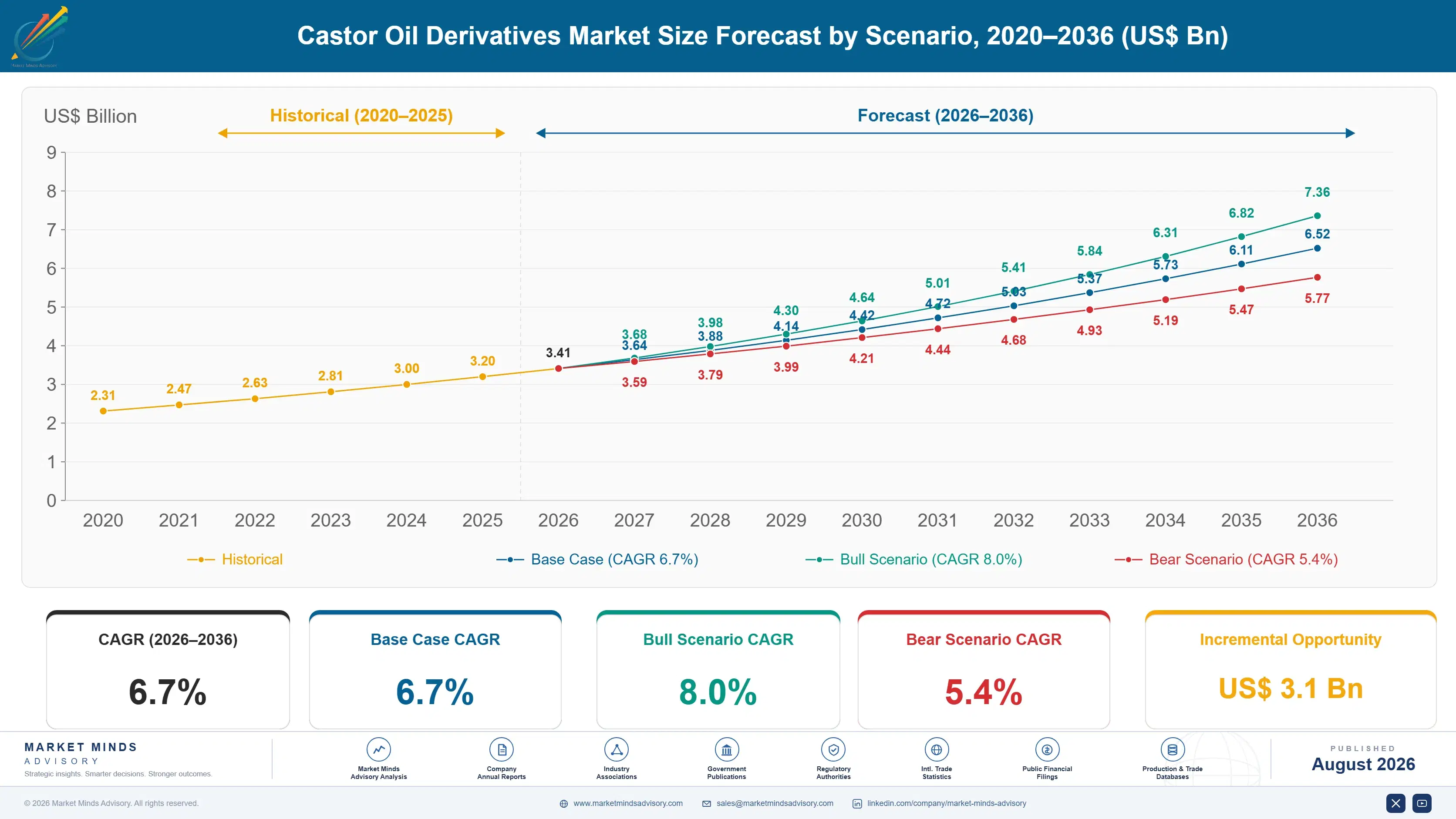
Castor Oil Derivatives Market Forecast Scenarios

castor-oil-derivatives-market-size-forecast-scenario-1787302473095
Between 2020 and 2025, castor derivative demand grew steadily as lubricant and cosmetics applications provided a stable base, with bio-based polyurethane and bioplastic applications adding accelerating momentum from 2023 onward as automotive and construction buyers pursued bio-content certification targets across major manufacturing regions, a shift that meaningfully reshaped the demand mix by the end of the historical period.
The base case rests on three mechanisms holding through 2036: continued bio-based polyurethane substitution in automotive and construction applications as certification requirements tighten further across major manufacturing regions, sebacic acid gaining further share in nylon and plasticizer end uses as petrochemical alternatives face tightening environmental scrutiny across major regulated markets, and Indian crushing capacity expanding enough to keep feedstock availability from constraining downstream derivative production growth across every region covered in this report.
A bull scenario hinges on faster bio-content mandate adoption in automotive manufacturing pulling castor polyol demand forward across Europe and North America simultaneously. The bear risk is a poor Gujarat castor seed harvest, driven by monsoon variability, that spikes feedstock pricing and forces derivative producers to pass through cost increases that slow downstream adoption across price-sensitive commodity applications.

Feedstock Concentration and Derivative Demand Economics

Three forces are converging on this market at once right now. Bio-based content requirements in automotive and construction specifications have turned castor polyols from a niche sustainability choice into a genuine specification requirement across most major manufacturers, sebacic acid has gained ground in bioplastic applications as petrochemical nylon precursors face tightening environmental scrutiny, and Gujarat's castor seed harvest volatility has pushed downstream buyers to secure long-term
MARKET CONCENTRATIONCR5 38%moderately concentrated among Indian crushers and global processors today
AVERAGE SELLING PRICE$2.85 per kilogramvaries substantially by specific derivative grade and application
TOP PRODUCING COUNTRYIndia, 82% of global seed supplyholds an unmatched concentration in raw feedstock supply
CAPACITY UTILIZATION71% average crushing utilizationreflects seasonal harvest-driven processing patterns each crop year
TRADE INTENSITY68% of derivatives cross-border exportedreflects India's role as the dominant global exporter overall
FEEDSTOCK COST SHARE58% of COGS from castor seedremains the single dominant variable cost across producers
The commercial character of this market sits firmly within specialty chemicals rather than commodity oleochemicals, with derivative-specific processing technology and feedstock security increasingly determining which supplier wins large industrial contracts, not delivered price alone, particularly for automotive and engineering plastics accounts facing the strictest documentation requirements from their own downstream customers.
The next decade will be shaped by continued bio-content certification expansion across automotive and construction end markets, Indian crushing capacity investment aimed at reducing seasonal supply volatility, and downstream derivative producers pursuing geographic diversification of processing capacity away from India to reduce single-country concentration risk that customers increasingly flag during supplier audits and periodic contract renewal reviews.
"Every buyer we talk to eventually asks the same uncomfortable question: what happens to my supply chain if one bad monsoon hits Gujarat. There is no real second source for castor seed at this scale, and that fact is finally being priced into contracts."
Director, Bio-Based Materials Practice · MMA Specialty Chemicals and Bio-Based M

Market Trends

Bio-Based Polyurethane Specification Requirements Expanding in Automotive Seating

Major automotive manufacturers in Europe and North America have introduced bio-based content requirements for interior foam components, citing corporate sustainability commitments and, in the European Union, regulatory pressure tied to end-of-life vehicle recyclability targets. Castor-derived polyols qualify readily for these specifications because castor oil requires no hydrogenation before polyol conversion, unlike several competing vegetable oil feedstocks, giving it a processing cost advantage in bio-polyol manufacturing. More than a dozen global automotive suppliers have qualified castor polyol-based foam systems for seating and headliner applications since 2023, with qualification volumes continuing to expand into 2026 model year programmes.
Market Impact: Lifts construction segment volume 1
Sebacic Acid Gaining Share in Bioplastic and Plasticizer Applications

Sebacic acid, derived from castor oil through a pyrolysis process, is gaining specification share in nylon 6,10 and nylon 6,12 bioplastic production as manufacturers seek partial bio-content alternatives to fully petrochemical nylon precursors. The chemistry also serves as a bio-based plasticizer alternative in applications facing tightening restrictions on phthalate plasticizers across the European Union and several United States states. Chinese and Indian sebacic acid producers have both expanded capacity since 2024 to meet this growing dual-application demand, with Chinese buyers absorbing much of the incremental bioplastic-linked volume domestically and Indian producers focusing added capacity on export-bound nylon precursor customers instead.
Market Impact: Adds 15,000 tonnes nylon precursor

Market Opportunities and Growth Drivers

Automotive and Construction Bio-Content Certification Requirements

Regulatory and corporate sustainability commitments increasingly require automotive and construction manufacturers to document a minimum bio-based content share in polyurethane foam and insulation products, and castor polyols consistently qualify at higher bio-content percentages than several competing vegetable oil-derived alternatives due to castor oil's naturally higher hydroxyl functionality. European Union construction product regulation updates taking effect since 2024 have accelerated specification of certified bio-based insulation foam in new commercial building projects specifically, with several major insulation manufacturers now offering castor polyol-based product lines as their standard bio-based option across the continent.
Market Impact: Cuts harvest-year output by 20 perc

Petrochemical Nylon Precursor Substitution in Engineering Plastics

Sebacic acid-based nylon 6,10 and nylon 6,12 are gaining specification share against fully petrochemical nylon 6,6 in engineering plastic applications requiring lower moisture absorption and better dimensional stability, properties the castor-derived monomer delivers naturally. Automotive fuel line and industrial tubing manufacturers have driven much of this substitution, valuing both the performance characteristics and the partial bio-content credential for corporate sustainability reporting purposes. Chinese engineering plastics producers have been the fastest adopters of this substitution pathway, integrating sebacic acid supply agreements directly into their nylon compounding operations since 2023 to reduce reliance on volatile petrochemical monomer pricing.
Market Impact: Limits non-India supply to 8 percen

Market Restraints and Challenges

Gujarat Monsoon Variability Threatening Feedstock Supply Predictability

Castor seed cultivation in Gujarat depends heavily on monsoon timing and intensity, and a poor monsoon season can reduce regional harvest volume by twenty percent or more within a single crop year, directly constraining derivative production capacity across the entire global supply chain. The root cause is that castor cultivation remains concentrated in a single climatic zone with no meaningful geographic diversification, unlike most other oleochemical feedstocks grown across multiple continents. Producers are responding by building larger seed and oil inventory buffers and, in some cases, funding extension programmes aimed at improving Gujarat farmer yields.
Market Impact: Adds 38,000 tonnes annual polyol de

Limited Geographic Diversification of Castor Seed Cultivation Outside India

Efforts to establish commercial-scale castor cultivation in Brazil, China, and parts of Africa have progressed slowly, held back by castor's specific climatic requirements and the toxicity of ricin-containing plant material, which complicates mechanized harvesting and raises worker safety compliance costs relative to other oilseed crops. The underlying cause is that decades of concentrated cultivation expertise and processing infrastructure in Gujarat have created a knowledge and logistics advantage new growing regions struggle to match quickly. Several derivative producers are funding pilot cultivation programmes in Brazil and East Africa specifically to build a genuine second sourcing option over the next decade.
Market Impact: Expands addressable applications by
3 additional market trends, 4 additional growth drivers, and 3 additional restraints and challenges are covered in the full report. Contact sales@marketmindsadvisory.com to access the complete intelligence.

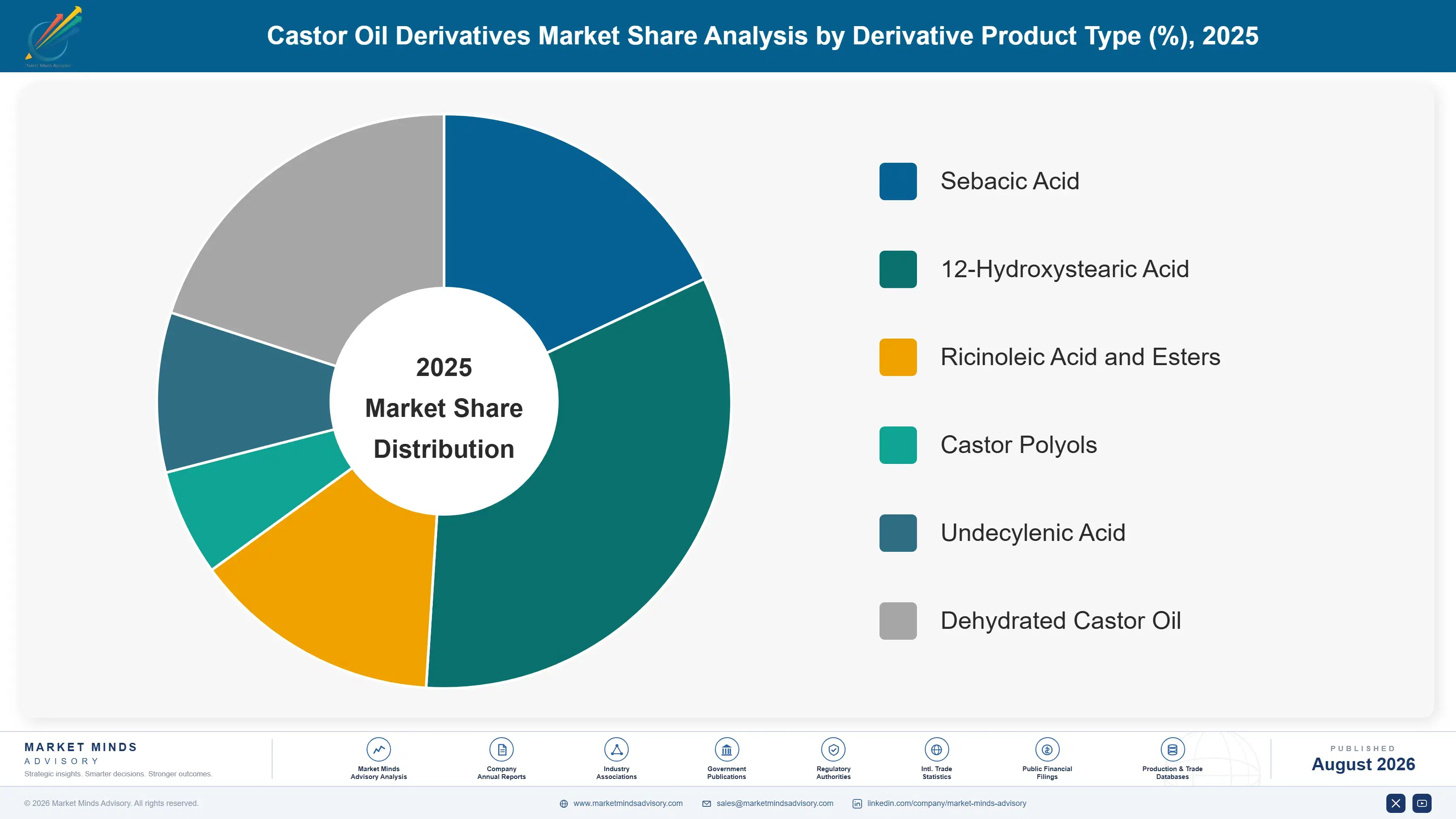
Segment CAGR and Growth Architecture

Segmentation follows derivative product chemistry, since each processing route, hydrogenation, pyrolysis, or esterification, produces a distinct chemistry with its own end-use qualification pathway, making product type the axis buyers and specification engineers organize around when writing technical requirements into a supplier qualification brief for any new industrial programme they intend to launch across their markets.
castor-oil-derivatives-market-market-share-analysis-1787302473688

Castor Polyols

Castor polyols are the fastest-growing segment, pulled forward directly by bio-based polyurethane specification requirements across automotive seating, headliner, and construction insulation applications. Castor oil's naturally high hydroxyl functionality lets it convert to polyol without the hydrogenation step several competing vegetable oil feedstocks require, giving castor-derived polyols a processing cost and bio-content percentage advantage that has made them the default choice wherever specification engineers prioritize genuine bio-based content over blended alternatives. Demand has grown fastest in Europe and North America, where automotive and construction bio-content requirements are most stringent, though Chinese polyurethane foam manufacturers are increasingly qualifying castor polyol systems as domestic sustainability expectations rise alongside export requirements from international automotive customers.
CAGR 9.6%

Sebacic Acid

Sebacic acid is the second-fastest-growing segment, valued for its role in bio-based nylon 6,10 and nylon 6,12 production and as a phthalate-free plasticizer alternative facing less regulatory scrutiny than conventional options. Its dual application base across engineering plastics and plasticizers gives it broader demand resilience than single-application derivatives, insulating it somewhat from downturns in any one end market. Chinese and Indian producers have both expanded pyrolysis capacity specifically for sebacic acid production since 2024, responding to automotive fuel line and industrial tubing manufacturers who value the monomer's moisture resistance properties alongside its partial bio-content credential for corporate sustainability disclosure purposes and reporting requirements that customers increasingly demand upfront in bid documentation.
CAGR 8.3%
Full segment breakdown across 6 segments available in the complete report.

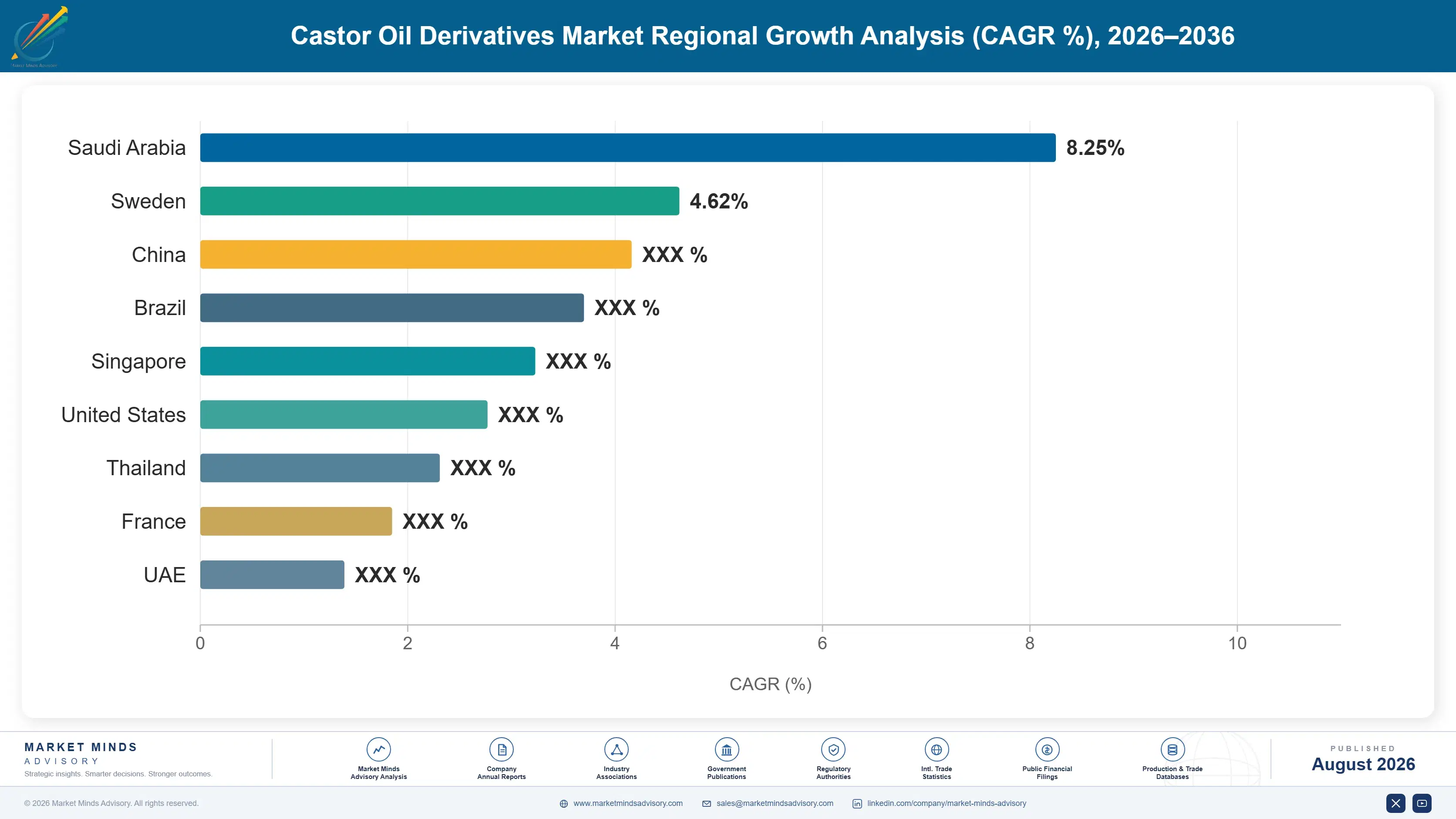
Regional Architecture and Country Demand Map

South Asia dominates global supply on India's unmatched castor seed cultivation base, an unusually concentrated production geography that has no real parallel elsewhere in specialty chemicals, while East Asia and North America lead downstream derivative consumption and certification-driven demand growth across their respective manufacturing bases.

North America

United States automotive and construction manufacturers drive the bulk of regional demand as they specify castor polyol-based bio-content foam systems to meet corporate sustainability commitments and, in several states, updated building product environmental disclosure requirements that increasingly reward documented renewable content over blended alternatives. Lubricant and grease formulators contribute a steady secondary demand pool, particularly for 12-hydroxystearic acid used in high-temperature grease thickeners across industrial and automotive applications facing demanding performance specifications. Canada's smaller manufacturing base follows similar demand patterns, generally importing finished derivatives from both Indian and domestic United States processing operations depending on grade, volume, and lead time requirements set by individual customer contracts and inventory planning cycles.
Share: 22% | CAGR: 7.0% (2026 to 2036)

Western Europe

Germany and France anchor regional demand through automotive and construction manufacturers facing the European Union's most stringent bio-content and end-of-life recyclability requirements, which favor castor-derived polyols over less-documented alternative bio-based feedstocks lacking comparable certification history. The United Kingdom's cosmetics and pharmaceutical sector drives steady demand for ricinoleic acid derivatives used in emulsifiers and specialty formulation ingredients across premium personal care lines. Regional growth trails North America somewhat as automotive bio-content adoption timelines differ slightly across major European manufacturers, though the underlying demand mechanism remains essentially identical across both markets and is expected to converge steadily over the coming years of this forecast period as certification timelines gradually align across jurisdictions.
Share: 18% | CAGR: 5.2% (2026 to 2036)
Regional intelligence for 5 additional markets available in the complete report: East Asia, South Asia and Pacific, Latin America, Middle East and Africa, Eastern Europe. Contact sales@marketmindsadvisory.com.
castor-oil-derivatives-market-country-cagr-analysis-1787302474203

Where Castor Derivative Suppliers Can Expand Margin

Delivered price per kilogram increasingly understates where margin actually concentrates in this market. Suppliers are shifting toward feedstock security, certification services, and application-specific formulation support that create pricing power beyond raw derivative economics, and toward geographic diversification strategies that shorten lead times for fast-growing regional customers seeking resilient, well-documented, and independently auditable supply chains overall.

Long-Term Seed Procurement Agreements with Gujarat Farmer Networks

Derivative producers that establish direct, multi-year procurement relationships with Gujarat farmer cooperatives secure feedstock priority during tight harvest years, when spot market castor seed pricing can spike sharply beyond contracted rates. This direct sourcing model bypasses intermediate traders who otherwise capture margin during periods of supply tightness, and producers with established farmer relationships report feedstock cost roughly 8 to 13 percent below spot market rates during volatile harvest periods. The approach requires sustained on-the-ground agricultural relationship investment that smaller derivative producers often cannot replicate at comparable scale, reliability, or geographic reach across Gujarat's fragmented growing districts.
Market Impact: Cuts feedstock cost by 8 to 13 perc

Bio-Content Certification and Documentation Services for Automotive Customers

Suppliers that provide comprehensive bio-content certification documentation alongside derivative shipments win specification wins more reliably from automotive and construction customers navigating complex regulatory disclosure requirements across multiple jurisdictions simultaneously. This certification service layer commands a price premium over uncertified equivalent chemistry and creates a stickier customer relationship, since switching suppliers means re-establishing documentation continuity that large manufacturers are reluctant to disrupt once qualified. Certified suppliers report win rates on new automotive specification bids roughly 30 percent higher than uncertified competitors bidding the same opportunity across comparable jurisdictions and vehicle platforms.
Market Impact: Lifts new specification win rate by

Geographic Diversification of Processing Capacity Beyond India

Establishing derivative processing capacity in China, Europe, or North America closer to end-use customers reduces logistics cost and lead time compared to importing finished derivatives from India, while also giving customers a supply chain risk mitigation story that increasingly matters in procurement decisions across regulated industries. Producers operating diversified processing footprints report winning roughly 11 percent more large industrial contracts that require documented supply chain resilience as a bid qualification criterion, a requirement that has become more common since pandemic-era supply disruption exposed single-source feedstock risk broadly across specialty chemicals.
Market Impact: Wins an additional 11 percent of la

Application-Specific Formulation Support for Polyol and Nylon Customers

Suppliers that embed application engineers directly with polyurethane foam formulators and nylon compounders win deeper, more durable customer relationships than those competing purely on delivered derivative price. This co-development approach shifts the commercial relationship toward strategic partnership status, and suppliers report formulation support customers renewing contracts at rates roughly 25 percent higher than transactional accounts lacking dedicated technical engagement of any kind. The model works best for polyol and nylon precursor customers facing genuine formulation complexity rather than commodity lubricant buyers purchasing on price alone across every account tier served.
Market Impact: Improves annual contract renewal ra

Who Controls the Margin Pool

CR5 sits at 38 percent, reflecting a market moderately concentrated among large Indian crushers with direct seed procurement and global specialty chemical processors with downstream application expertise built over decades. The gap between the top five suppliers and mid-tier challengers is widest in certified, application-specific grades, where feedstock security and formulation support matter more than in commodity derivative categories sold largely on price.
Current competitive activity centers on three fronts: direct farmer procurement agreements that lock in feedstock priority ahead of tight harvest years, geographic processing diversification away from single-site India dependence toward China, Europe, and the Americas, and bio-content certification programmes racing to meet automotive and construction specification requirements before rivals can establish comparable documentation credibility with the same accounts.

Emerging pressure comes from Chinese sebacic acid and polyol processors expanding downstream integration into nylon compounding and polyurethane foam manufacturing, threatening the margin captured by suppliers selling only intermediate derivative chemistry without downstream application capability. Expect ranking shifts wherever Brazilian or East African cultivation pilots mature enough to offer buyers a credible alternative to India-concentrated feedstock sourcing over the coming decade of this forecast.
castor-oil-derivatives-market-company-positioning-matrix-1787302474727

Competitive Moat and Risk Dimensions

JAYANT AGRO-ORGANICS LTD

Moat: Direct Gujarat Seed Procurement Network

Jayant Agro-Organics maintains direct procurement relationships across Gujarat's castor-growing districts, giving it feedstock priority and cost advantages during tight harvest years that derivative producers relying on open market or trader-intermediated seed purchases cannot easily replicate at comparable scale, reliability, or farmer relationship depth built over decades.
JAYANT AGRO-ORGANICS LTD

Risk: Castor Crop Yield Volatility Risk

Despite its procurement network, Jayant remains fundamentally exposed to Gujarat monsoon variability, since no amount of farmer relationship depth can fully offset a genuinely poor regional harvest, and its scale means yield shortfalls flow through to reported volumes and margins more visibly than for smaller, geographically diversified competitors with narrower single-region exposure.
ARKEMA SA

Moat: Downstream Polymer Integration Depth

Arkema's integration into downstream nylon 11 polymer production through its Rilsan brand gives it a formulation and application engineering advantage that pure derivative suppliers lack, allowing it to capture margin across the full value chain from castor oil through finished engineering plastic products sold directly to automotive customers.
ARKEMA SA

Risk: Single-Region Feedstock Sourcing Risk

Arkema's downstream integration does not eliminate its underlying dependence on Indian castor oil feedstock, and its global manufacturing footprint means feedstock disruption in Gujarat can affect production across multiple facilities simultaneously rather than being contained to a single regional operation, amplifying the commercial impact of any single harvest shortfall.

Players Tracked

Prominent Players

Jayant Agro-Organics Ltd
Arkema SA
Itoh Oil Chemicals Co Ltd
NK Proteins Pvt Ltd
Gokul Overseas

Other Key Players

Vertellus Holdings LLC
Hokoku Corporation
Thai Castor Oil Industries Co Ltd
IOI Oleochemical Industries Berhad
Adani Wilmar Limited
RIT Chemicals Corporation
Ambuja Solvex Pvt Ltd
Solvay SA
BASF SE
Hallstar Company
Kanoria Chemicals and Industries Ltd
Ganga Rasayanie Pvt Ltd
Ammann Group
Nissan Chemical Corporation
Sasol Limited

Recent Developments

MARCH 2025

Arkema Expands Nylon 11 Production Capacity at French Facility

Arkema completed a capacity expansion for Rilsan nylon 11 production at its Serquigny facility in France, citing sustained demand growth from automotive fuel line and industrial tubing customers seeking bio-based engineering plastic alternatives to conventional petrochemical nylon across European and North American markets served from this facility.
Signal: Confirms a sustained downstream investment
JULY 2025

Jayant Agro-Organics Signs Multi-Year Supply Agreement with European Polyol Manufacturer

Jayant Agro-Organics entered a multi-year castor polyol supply agreement with a major European polyurethane foam manufacturer, securing volume commitments tied to that customer's automotive bio-content specification requirements while providing Jayant greater revenue visibility across the full multi-year contract term negotiated between both parties involved in the arrangement.
Signal: Signals a growing customer preference for
NOVEMBER 2025

Chinese Sebacic Acid Producer Announces Pyrolysis Capacity Expansion

A leading Chinese sebacic acid producer announced a significant pyrolysis capacity expansion aimed at serving growing domestic nylon 6,10 compounding demand, reducing Chinese engineering plastics manufacturers' dependence on imported sebacic acid from Indian and European processors currently supplying most of that volume into the domestic Chinese market.
Signal: Establishes China as an increasingly self-

Castor Seed Feedstock Concentration Risk

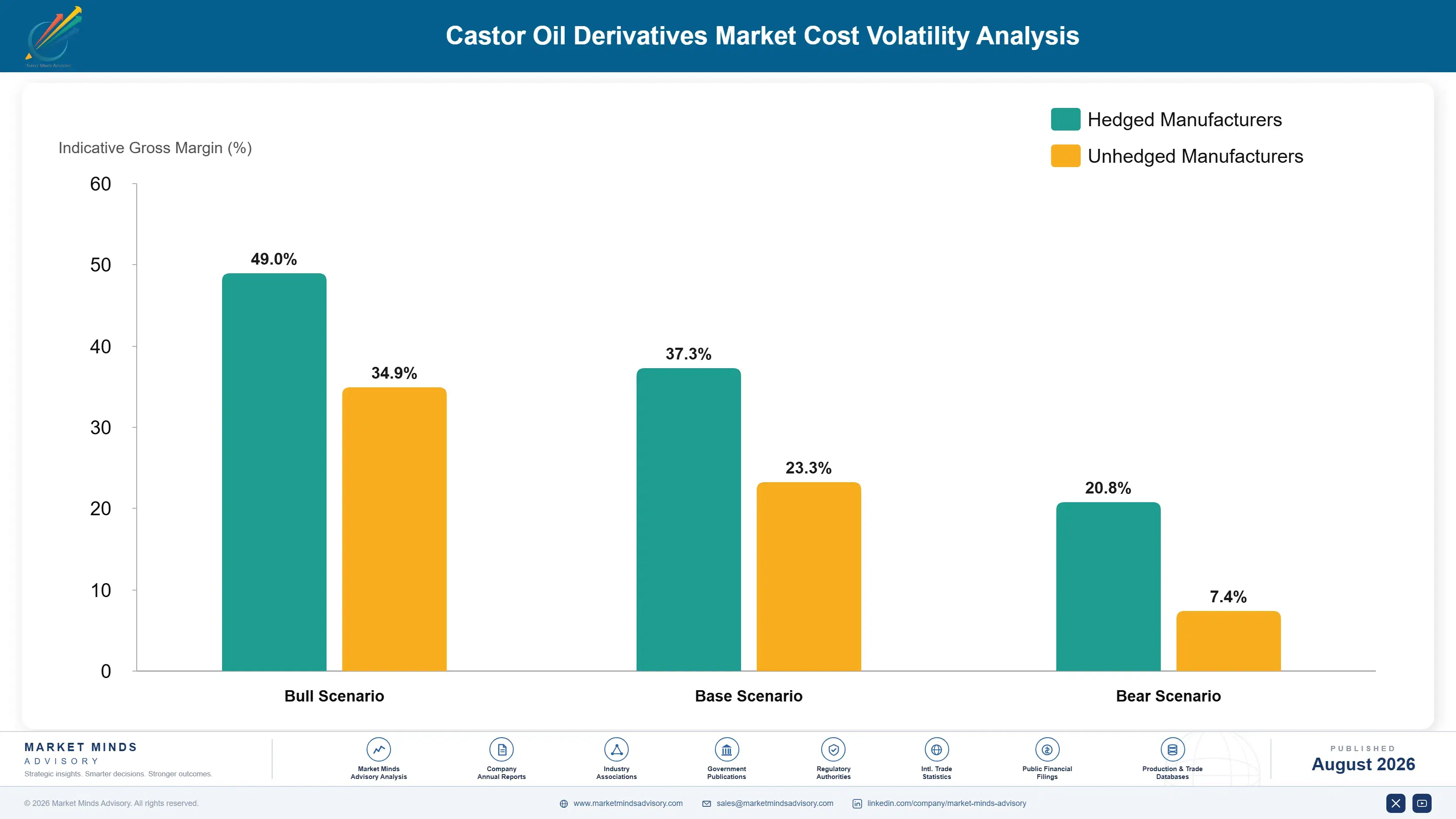
Castor seed typically accounts for 58 percent of operating cost of goods sold for derivative production, sourced almost entirely from Gujarat, India, where roughly eighty percent of global castor seed cultivation is concentrated according to Indian government agricultural data. Processing energy and catalyst costs for hydrogenation and pyrolysis routes add a further 16 percent, rounding out the majority of variable production cost across the industry.
Castor seed prices spiked more than 45 percent within a single season during the 2021 to 2022 period according to Indian commodity exchange reporting, driven by a below-average monsoon that reduced Gujarat harvest volume meaningfully below trend. The episode forced several derivative producers to renegotiate customer contracts mid-term to pass through unhedged feedstock cost increases, and it accelerated interest in geographic cultivation diversification pilots outside India that remain in early stages today.

Producers without direct farmer procurement relationships carry meaningfully higher exposure than those with established Gujarat sourcing networks, and this gap widens further during tight harvest years when open market seed becomes scarce. Geographic exposure also varies: derivative processors located in India face lower logistics-driven cost volatility than European, North American, and East Asian buyers importing finished derivatives across longer supply chains.
castor-oil-derivatives-market-cost-volatility-analysis-1787302474923

Direct Farmer Procurement Agreements in Gujarat

Establishing multi-year procurement relationships directly with Gujarat farmer cooperatives secures feedstock priority during tight harvest years and removes intermediate trader margin from the cost structure, a practice increasingly standard among the largest Indian derivative producers following the 2021 to 2022 price spike that exposed the fragility of open market sourcing for smaller regional buyers without established local relationships.

Strategic Seed and Oil Inventory Buffering

Larger producers maintain multi-month castor seed and crude oil inventory buffers to smooth production planning through harvest volatility, accepting additional working capital cost in exchange for reduced exposure to sudden mid-season feedstock price and availability shocks affecting the wider industry and its downstream customer base across every major end-use application category tracked in this report.

Geographic Cultivation Diversification Pilot Programmes

Several derivative producers are funding early-stage castor cultivation pilots in Brazil and East Africa specifically to establish a genuine second sourcing option over the coming decade, accepting near-term investment cost against the possibility of meaningfully reduced India concentration risk over the longer run of this forecast, even though commercial-scale output remains several years away from materializing.

Portfolio Architecture for Margin Defence

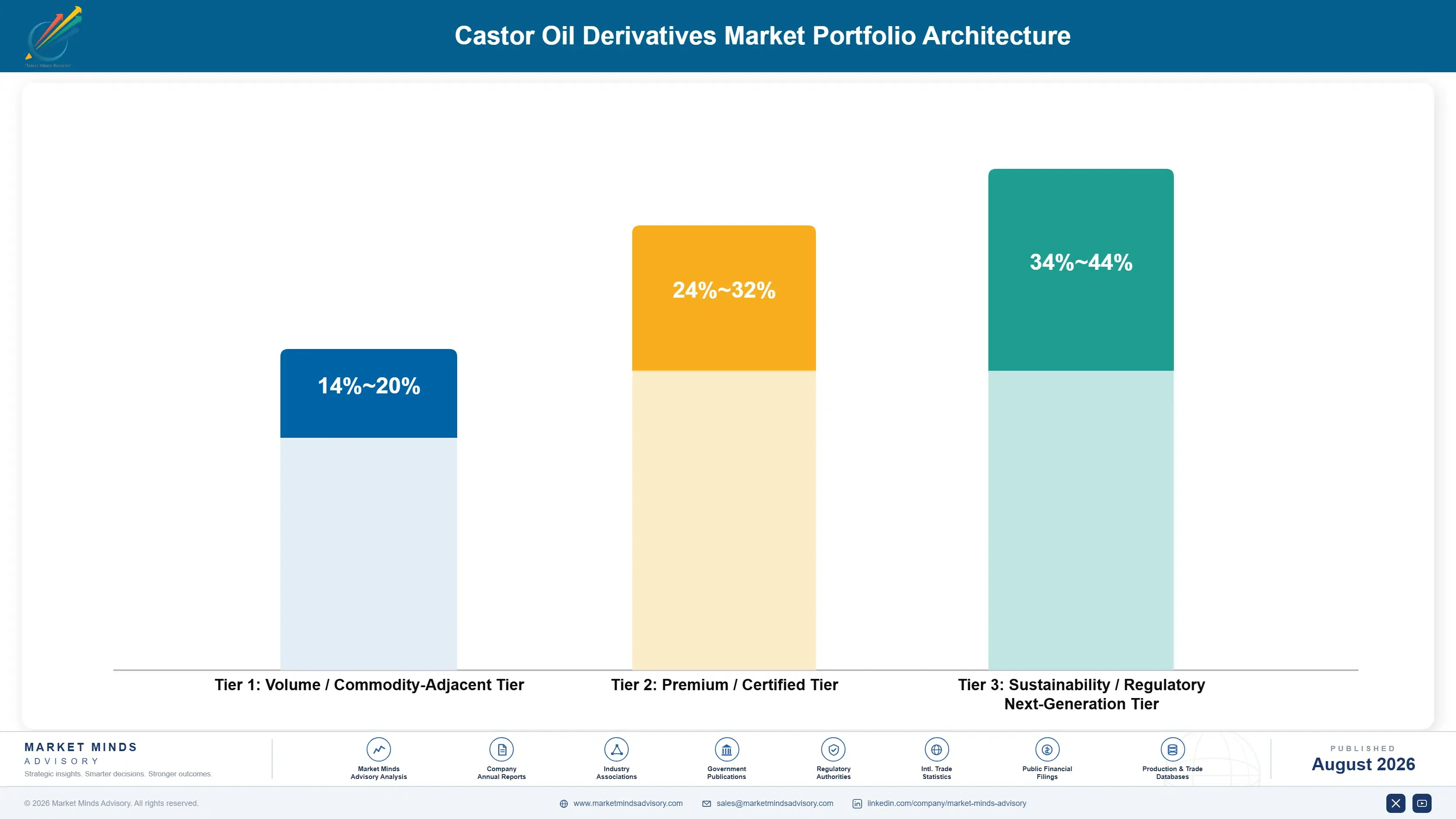
Castor derivative portfolios span three tiers with margin economics that track closely to processing complexity and application specificity. Commodity-grade lubricant and industrial chemical derivatives compete largely on delivered price per kilogram and carry the thinnest margins, while certified bio-content polyols and engineering plastic precursors command materially higher pricing power tied to formulation support and documentation depth rather than raw chemistry alone, a distinction custome
The volume versus premium tension is sharpest in lubricant applications, where large-volume industrial buyers remain highly price-sensitive even as certification requirements push toward higher-documentation grades elsewhere in the portfolio, forcing suppliers to defend margin through feedstock security rather than price competition alone, a pattern that increasingly separates scaled Indian crushers from smaller regional traders lacking direct sourcing depth or farmer relationship history.

High-value margin pools concentrate in automotive-grade bio-polyols and nylon precursor chemistry, and in the certification and formulation support services that increasingly accompany premium account relationships rather than standing as a separately billed revenue line, a bundling trend reshaping how suppliers structure commercial proposals across the wider industry today.

Volume / Commodity-Adjacent Tier

Standard lubricant and industrial grade castor derivatives sold primarily on delivered price per kilogram to price-sensitive commodity chemical buyers across mass industrial channels prioritizing cost over documentation depth and formulation support.
Gross Margin: 14%-20%

Premium / Certified Tier

Bio-content certified polyols and specialty ricinoleic acid derivatives serving automotive and cosmetics formulations across major retail and industrial channels worldwide, including private label and export-oriented product lines sold under multiple brand names.
Gross Margin: 24%-32%

Sustainability / Regulatory / Next-Generation Tier

Engineering plastic precursor chemistry and next-generation bio-polyols with the most extensive documentation commanding the highest pricing power available across the entire portfolio, particularly for automotive-grade applications sold under long-term contract.
Gross Margin: 34%-44%
castor-oil-derivatives-market-portfolio-architecture-1787302475413

Feedstock-Anchored Supply Relationships

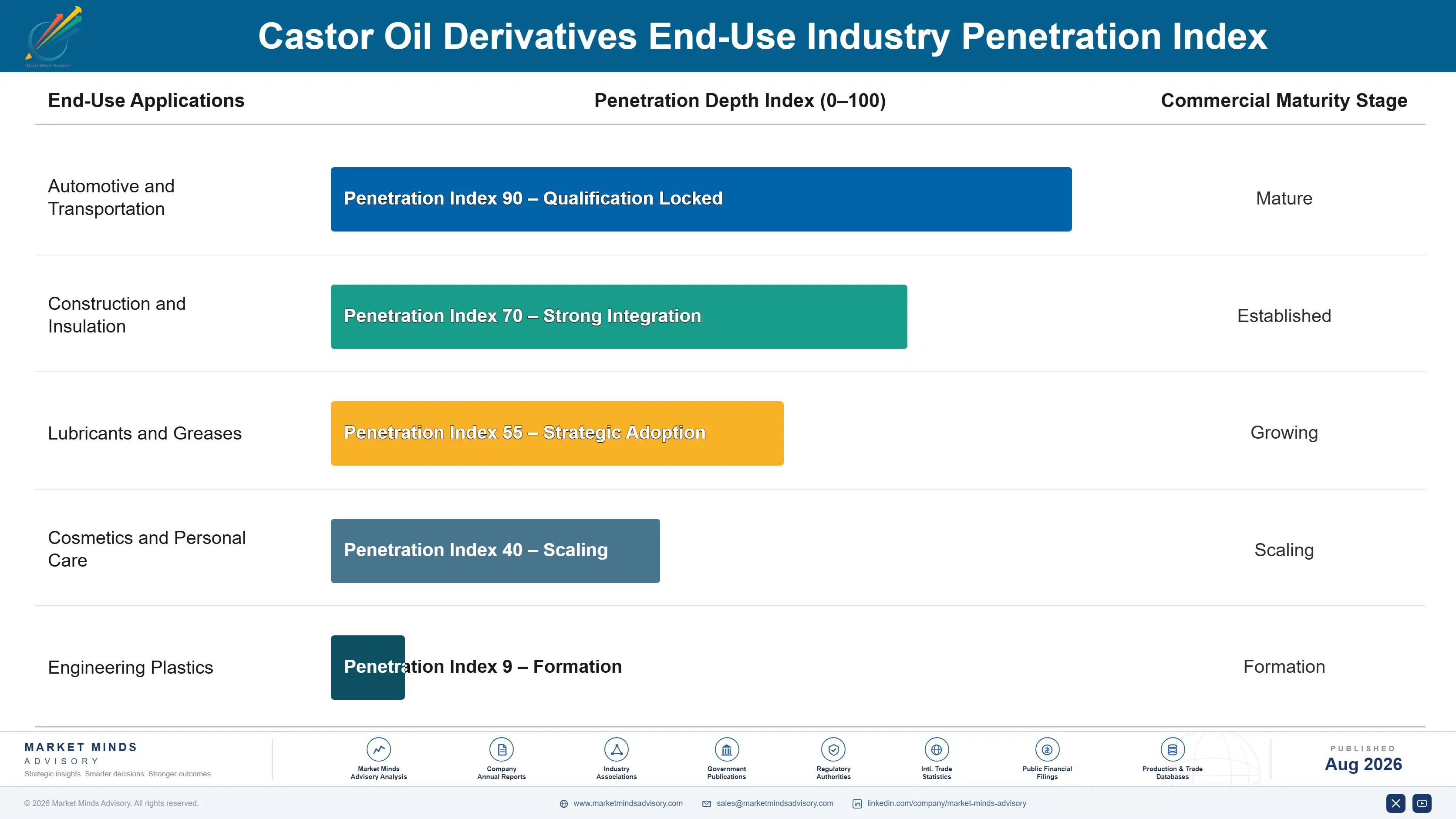
Castor derivative demand increasingly resembles a supply security relationship rather than a simple commodity purchasing decision. Once a customer secures a reliable derivative supply chain, especially one with direct Gujarat farmer procurement ties, switching suppliers carries meaningful perceived risk that keeps relationships intact for years beyond what pure price competition would predict, particularly among automotive customers underwriting multi-year vehicle platform commitments that span
Adoption depth varies sharply by vertical. Automotive and engineering plastics customers show the deepest stickiness, embedding qualified derivative grades across multiple product platforms and rarely displacing them once bio-content certification is complete, while lubricant customers show more price-driven switching behavior given lower certification lock-in and more frequent competitive rebidding at contract renewal across commodity-grade product lines sold on thin margins.

Buyer profiles are shifting generationally too. Procurement teams that once treated castor derivatives as a minor specialty chemical line item now report to supply chain resilience committees evaluating single-country feedstock concentration risk explicitly, elevating supplier selection criteria well beyond simple cost and performance comparison and lengthening qualification timelines for any new entrant seeking to win premium accounts across regulated end markets.
castor-oil-derivatives-market-end-use-penetration-index-1787302475902

Where Castor Derivative Demand Is Headed

These are among the four positions where our research anticipates prominent divergence between winners and laggards over the coming forecast period. Each is grounded in the demand model, the regulatory perimeter, and the announced capacity pipeline.
01 / FEEDSTOCK CONCENTRATION RISK

India's castor monopoly will persist through 2036 despite diversification efforts

Brazilian and East African cultivation pilots will mature slowly, and India will still supply the overwhelming majority of global castor seed by 2036, meaning feedstock concentration risk remains a permanent feature of this market rather than a temporary condition buyers can simply wait out. Derivative producers will increasingly compete on how well they manage that concentration risk through farmer relationships and inventory buffering rather than on eliminating it outright. Expect supply chain resilience documentation to become a standard bid qualification requirement across automotive and construction customer segments specifically.
02 / BIO-CONTENT SPECIFICATION TRAJECTORY

Automotive bio-polyol adoption will keep accelerating through the decade

Bio-based content requirements in automotive and construction specifications will keep tightening through 2036, and castor polyols' natural hydroxyl functionality advantage over competing vegetable oil feedstocks will keep it the preferred choice wherever genuine bio-content percentage matters more than blended alternatives. Expect castor polyol penetration in automotive interior foam to approach near-universal levels across European and North American vehicle platforms well before the end of the forecast period. Chinese automotive suppliers will follow this adoption pattern with a modest lag tied to domestic sustainability requirement timing.
03 / DOWNSTREAM INTEGRATION STRATEGY

Vertical integration into engineering plastics will separate margin leaders

Producers integrating downstream into nylon compounding and polyurethane foam manufacturing will capture materially more margin through 2036 than those selling only intermediate derivative chemistry, a gap that will keep widening as Chinese processors pursue the same integration strategy aggressively across their domestic customer base. Expect continued consolidation as smaller derivative-only producers either pursue downstream partnerships or accept permanently compressed margins relative to vertically integrated competitors with broader product portfolios. This dynamic will favor suppliers with both feedstock security and application engineering capability simultaneously over the full forecast period.
04 / GEOGRAPHIC PROCESSING SHIFT

China will keep gaining share of downstream derivative processing capacity

Chinese sebacic acid and polyol processors will keep expanding domestic capacity through 2036, reducing dependence on imported finished derivatives even as raw castor seed and crude oil continue flowing overwhelmingly from India into Chinese processing facilities regardless of that shift. Western and Indian suppliers will increasingly compete on certification credibility and formulation support rather than processing cost alone as this shift continues to play out across the industry. Expect several additional processing capacity announcements from Chinese producers over the next several years of this forecast period.

Engagement Snapshot From the Field

A live engagement with an industry participant carrying material or product regulatory and market exposure ahead of a defining policy shift, showing how our research translates into a defensible multi-year portfolio strategy.
MARKET MINDS ADVISORY · CLIENT ENGAGEMENT SUMMARY
Castor Oil Derivatives Producer Strategic Portfolio Review and Transition Roadmap 2026·Investment Scenario on Castor Oil Derivatives Exposure Evaluation 2025-26
CLIENT PROFILE
The client is a global automotive interior foam supplier serving major vehicle manufacturers across North America and Europe, with annual castor polyol procurement volume representing an estimated 340 million dollars in raw material spend (client-reported, unverified by MMA). The client faced mounting customer pressure to document supply chain resilience following widely publicized feedstock disruption across other specialty chemical categories.
STRATEGIC CHALLENGE
The client needed to assess its exposure to India-concentrated castor feedstock risk and identify a credible diversification and contracting strategy that would satisfy automotive customer supply chain resilience requirements without materially increasing procurement cost or disrupting existing bio-content certification credentials across its qualified product lines and long-standing customer relationships built over many years.
MMA APPROACH
MMA conducted a comprehensive supply chain risk assessment across the client's four primary castor polyol suppliers, benchmarking feedstock sourcing depth, inventory buffering practices, and geographic processing diversification against automotive customer resilience documentation requirements across its priority markets and product platforms, supplemented by on-site supplier facility visits in India and China.
KEY FINDINGS
  1. Only one of four evaluated suppliers maintained direct Gujarat farmer procurement relationships, creating meaningful feedstock cost exposure for the other three suppliers.
  2. Suppliers with geographic processing diversification beyond India commanded a price premium of approximately 9 percent (client-reported, unverified by MMA) over India-only processors.
  3. Inventory buffering practices varied substantially across suppliers, with the strongest performer maintaining nearly double the industry-typical seed reserve buffer level currently held.
  4. Multi-supplier sourcing strategies reduced projected worst-case supply disruption exposure by an estimated 40 percent versus single-supplier dependence on any one processing facility.
CLIENT PROFILE
The client is a global automotive interior foam supplier serving major vehicle manufacturers across North America and Europe, with annual castor polyol procurement volume representing an estimated 340 million dollars in raw material spend (client-reported, unverified by MMA). The client faced mounting customer pressure to document supply chain resilience following widely publicized feedstock disruption across other specialty chemical categories.
STRATEGIC CHALLENGE
The client needed to assess its exposure to India-concentrated castor feedstock risk and identify a credible diversification and contracting strategy that would satisfy automotive customer supply chain resilience requirements without materially increasing procurement cost or disrupting existing bio-content certification credentials across its qualified product lines and long-standing customer relationships built over many years.
MMA APPROACH
MMA conducted a comprehensive supply chain risk assessment across the client's four primary castor polyol suppliers, benchmarking feedstock sourcing depth, inventory buffering practices, and geographic processing diversification against automotive customer resilience documentation requirements across its priority markets and product platforms, supplemented by on-site supplier facility visits in India and China.
KEY FINDINGS
  1. Only one of four evaluated suppliers maintained direct Gujarat farmer procurement relationships, creating meaningful feedstock cost exposure for the other three suppliers.
  2. Suppliers with geographic processing diversification beyond India commanded a price premium of approximately 9 percent (client-reported, unverified by MMA) over India-only processors.
  3. Inventory buffering practices varied substantially across suppliers, with the strongest performer maintaining nearly double the industry-typical seed reserve buffer level currently held.
  4. Multi-supplier sourcing strategies reduced projected worst-case supply disruption exposure by an estimated 40 percent versus single-supplier dependence on any one processing facility.
RECOMMENDED STRATEGY
Phase 1: Phase 1 (Months 1 to 2): Complete a comparative supplier resilience assessment using the full feedstock security and diversification framework developed. Phase 2: Phase 2 (Months 3 to 7): Negotiate dual-sourcing agreements with the two highest-resilience suppliers identified during the earlier assessment phase. Phase 3: Phase 3 (Months 8 to 12): Implement joint inventory buffering protocols and fully finalize customer-facing supply chain resilience documentation package.
OUTCOME
The client adopted a dual-supplier sourcing strategy combining its existing India-focused supplier with a geographically diversified processor, and implemented joint inventory buffering targets across both relationships. Projected worst-case supply disruption exposure improved by an estimated 38 percent (client-reported, unverified by MMA), and the client successfully retained its automotive customer bio-content certification without interruption.

Frequently Asked Questions

Foundational context covering the market sizes, CAGR, scope, country, region and competition that inform every finding below. This section is provided to cover basics and most often pre-purchase conversations, answered from the MMA Primary Research Dataset.

What is the current size of the Castor Oil Derivatives Market?

The castor oil derivatives market reached an estimated 3.2 billion dollars in base year 2025. Growth is concentrated in bio-based polyurethane and engineering plastic applications across South Asia and East Asia.

How large will the Castor Oil Derivatives Market be by 2036?

MMA projects the market will reach approximately 6.5 billion dollars by 2036 under the base case scenario. That represents nearly a doubling of the 2026 starting value over the forecast decade.

What is the CAGR for the Castor Oil Derivatives Market 2026 to 2036?

The base case CAGR is 6.7 percent, with a bull scenario of 8.0 percent and a bear scenario of 5.4 percent. Gujarat monsoon performance is the largest single swing factor between scenarios.

Which segment is growing fastest?

Castor polyols lead at a 9.6 percent CAGR, pulled forward by automotive and construction bio-content specification requirements. Sebacic acid follows as the second-fastest segment at 8.3 percent.

Who are the major companies in the Castor Oil Derivatives Market?

Jayant Agro-Organics, Arkema, Itoh Oil Chemicals, NK Proteins, and Gokul Overseas lead the market. CR5 sits at 38 percent, reflecting moderate concentration among Indian crushers and global processors.

Which country is growing fastest?

China leads at an 8.9 percent CAGR, driven by expanding domestic sebacic acid and polyol processing capacity. India remains dominant in raw feedstock, supplying roughly 82 percent of global castor seed.

Report Segmentation Architecture

The full report scope spans multiple orthogonal segmentation dimensions, with cross-tabulated demand data provided for each dimension pair. Coverage extends further to regional breakdowns, trend trajectories, and the competitive detail needed to support segment-level decision-making.

By Derivative Product Type

  • Sebacic Acid
  • 12-Hydroxystearic Acid
  • Ricinoleic Acid and Esters
  • Castor Polyols
  • Undecylenic Acid
  • Dehydrated Castor Oil

By End-Use Industry

  • Automotive and Transportation
  • Construction and Insulation
  • Lubricants and Greases
  • Cosmetics and Personal Care
  • Engineering Plastics

By Commercial Dimension

  • Direct Industrial Supply
  • Certified Bio-Content Contracts
  • Distributor and Trader Channels
  • Formulation Co-Development Agreements

By Region

  • North America
  • Western Europe
  • East Asia
  • South Asia and Pacific
  • Latin America
  • Middle East and Africa
  • Eastern Europe

Scope, Methodology, and Coverage

Every figure in this report is reproducible from documented input assumptions. The scope below maps the historical period, the forecast horizon, the segmentation dimensions, and the countries covered, alongside the underlying primary and qualitative methodology.
Historical Period
2020 to 2025
Forecast Period
2026 to 2036
Base Year
2025 (USD billions; MMA Primary Research Dataset, August 2026)
Market Definition
The castor oil derivatives market covers chemical products manufactured from castor oil through hydrogenation, pyrolysis, esterification, or other processing routes, including sebacic acid, 12-hydroxystearic acid, ricinoleic acid and its esters, castor polyols, undecylenic acid, and dehydrated castor oil. It excludes unprocessed crude castor oil sold without further chemical transformation and unrelated vegetable oil derivatives sourced from other oilseed feedstocks.
Quantitative Units
USD billions (current prices); volume in metric tonnes
Segmentation Dimensions
By Derivative Product Type; By End-Use Industry; By Commercial Dimension; By Region
Regions Covered
North America, Western Europe, East Asia, South Asia and Pacific, Latin America, Middle East and Africa, Eastern Europe
Countries Covered
USA, China, Germany, France, UK, Japan, South Korea, India, Australia, Canada, Brazil, Mexico, Indonesia, Vietnam, Thailand, Malaysia, UAE, Saudi Arabia, South Africa, Nigeria, Turkey, Poland, Netherlands, Italy, Spain, Sweden, Switzerland, Argentina, Colombia, Singapore, and additional markets relevant to this sector
Key Companies Profiled
Jayant Agro-Organics Ltd, Arkema SA, Itoh Oil Chemicals Co Ltd, NK Proteins Pvt Ltd, Gokul Overseas, Vertellus Holdings LLC, Hokoku Corporation, Thai Castor Oil Industries Co Ltd, IOI Oleochemical Industries Berhad, Adani Wilmar Limited, RIT Chemicals Corporation, Ambuja Solvex Pvt Ltd, Solvay SA, BASF SE, Hallstar Company, Kanoria Chemicals and Industries Ltd, Ganga Rasayanie Pvt Ltd, Ammann Group, Nissan Chemical Corporation, Sasol Limited
Quantitative Methodology
Primary survey, n=3,800 respondents, Q4 2025, six countries; demand-side model with trade association cross-validation
Qualitative Methodology
47 expert interviews, Q4 2025; applied to validate demand model assumptions, identify emerging dynamics, and assess competitive positioning
Report Format
PDF and XLSX data workbook (Word format preview document)
Publisher
Market Minds Advisory
Report Code
MMA-2026-CHM-102
Published
August 2026
Contact
sales@marketmindsadvisory.com | www.marketmindsadvisory.com

Purchase the full Castor Oil Derivatives Market Report (2026 to 2036).

The full report delivers a complete assessment of the castor oil derivatives market across product chemistry, end-use vertical, and commercial contracting model. It includes detailed competitive profiling of the twenty companies covered here, country-level demand modeling across thirty markets, and forward-looking scenario analysis through 2036. Buyers receive segment-level pricing benchmarks and full access to the underlying primary survey dataset referenced throughout this summary. A dedicated data appendix breaks out Gujarat harvest cycle sensitivity by derivative category for supply chain planning purposes, alongside a supplier resilience scorecard template tailored to automotive and construction procurement teams.
Twenty-company competitive profiles with moat and risk assessments
Country-level demand models across thirty markets
Segment-level pricing benchmarks by derivative product type
Ten-year scenario forecasts with bull and bear cases
Primary survey dataset access for underlying respondent data
Gujarat harvest cycle sensitivity appendix by category

Built For The People Who Decide

From boardroom strategy to bench-side execution, this report is read cover-to-cover by leaders shaping the next decade of their industry, turning demand scenarios, market dynamics and valuation benchmarks into decisions.
CXOs/ Presidents/ VPs/ Managers
M&A and Corporate Development
Strategy Teams and R&D Heads
Procurement and Product Directors
Regulatory and Compliance Leaders
Investor Relations and Equity Analysts