Market Minds Advisory
Casing Pipe Market

Casing Pipe Market: The Only Part Of A Well You Cannot Replace

Tubing can be pulled, pumps swapped, wellheads changed. Casing is cemented in place for the life of the well and for fifty years after it, and the grade was chosen by somebody under budget pressure.

Lead Analyst

David Horsley

Published

September 2026

Make Smarter Decisions with Customized Research Insights

Request a free sample report and evaluate market opportunities, growth trends, and competitive dynamics relevant to your business needs.

2025 MARKET VALUE$21.4BMarket Size 2025
2036 FORECAST VALUE$35.9BBase Case , 2026 to 2036
CAGR 2026 TO 20364.8 %Bull 6.0% / Bear 3.6%
INCREMENTAL OPPORTUNITY$13.4BNet 10- year value creation
EXPANSION MULTIPLE1.60x2036 value over 2026 base
Strategic Levers
M&A Pipeline
Regional Outlook
Country Rankings
Competitive Intelligence
Segmental Deep-dive
Call-Us : 91 93563 13602

Executive Snapshot and Market Trajectory

Casing is the one well component that can never be replaced, because it is cemented into the ground and must hold integrity for decades after production stops. Grade selection is consequential and invisible. The market reaches USD 21.4 billion in 2025 and grows at 4.8%.
Corrosion resistant alloy casing grows fastest at 8.9%, about 1.85 times the market rate, driven by sour and carbon dioxide rich fields and by carbon storage wells where wet CO2 attacks carbon steel aggressively. North America holds 32% of value on shale drilling footage alone. Middle East and Africa takes 18% and East Asia 15%, both well outside the bands this framework normally applies. Drilling geography drives all of it.
Concentration runs at 43%, held there by pierced and rolled mill capacity and heat treatment capability that few producers hold at the grades that matter. Competition turns on grade range, connection performance, and mill qualification with operators rather than on price at the standard end. Premium connections reach only 31% of casing shipped, which is considerably less than the well designs being drilled would justify. Well designs have moved faster than specification practice has.
Market Definition
The casing pipe market covers steel and alloy pipe run and cemented into oil and gas wellbores to isolate formations and support the well structure, across surface, intermediate, and production strings. It spans pierced-and-rolled and welded manufacture in standard carbon, high strength, sour service, and corrosion resistant alloy grades with API and proprietary connections. Production tubing, drill pipe, line pipe, coupling stock sold separately, wellheads, and casing running services are excluded.
Base Year Value
$21.4B in 2025 (MMA Primary Research Dataset, August 2026)
Forecast Period
2026 to 2036, eleven discrete annual values
CAGR
4.8% base case. Bull 6.0%. Bear 3.6%.
Fastest Growth Segment
Corrosion Resistant Alloy Casing: 8.9% CAGR
Fastest Growth Country
Guyana: 9.4% CAGR
Fastest Growth Region
South Asia and Pacific: 6.5% CAGR
Largest Region
North America: 32% of 2025 global value
Market Leaders
Tenaris, Vallourec, TMK, Nippon Steel, United States Steel. Source: MMA Primary Research Dataset, July 2026.
Primary Survey
n=3,800 procurement and R&D decision-makers, Q4 2025, six countries
Methodology
Demand-side build-up, cross-validated against public data, 47 expert interviews

Casing Pipe Market Forecast Scenarios

casing-pipe-market-size-forecast-scenario-1787333559475
Between 2020 and 2025 well counts fell and casing tonnage did not fall with them. Laterals lengthened, deepwater programmes resumed, and steel weight per well rose enough to offset a smaller rig count across most of the period. Grade mix moved upward as sour and high pressure targets took a larger share of drilling. A 3.7% historical CAGR combines falling activity with rising intensity per well.
Three mechanisms carry the 4.8% base case. Steel per well keeps rising as laterals extend and wells go deeper, which decouples casing tonnage from rig count entirely. Sour and carbon dioxide rich developments in the Middle East and offshore keep pushing grade mix toward alloys costing several times carbon steel. And carbon storage injection wells are emerging as a genuinely new demand pool requiring corrosion resistant casing with integrity horizons beyond anything oil and gas specified.
The 6.0% bull case turns on carbon storage reaching commercial scale on the timetables governments have set, which would add injection wells with unusually demanding casing specifications. The 3.6% bear case is a sustained oil price decline cutting drilling budgets, which reaches casing demand within two quarters. Both scenarios sit entirely outside the control of anybody making pipe.

A Component You Buy Once And Trust Forever

Every other component in a well can be replaced. Tubing pulls, pumps swap, packers retrieve, wellheads change. Casing is cemented into rock and stays there for the producing life of the well and for the regulatory life of the abandonment after it, which now runs beyond fifty years in most jurisdictions. Nothing else in upstream carries that combination of permanence and invisibility.
TOP FIVE CONCENTRATION43%Rolled mill capacity limits who can supply premium grades
AVERAGE SELLING PRICEUSD 1,340 per tonneBlended across carbon, sour service, and alloy grade classes
CASING PER WELLOver 620 tonnesAverage steel weight run into a modern horizontal well
PREMIUM CONNECTION SHARE31%Portion of casing shipped with proprietary rather than standard connections
DESIGN INTEGRITY LIFEBeyond 50 yearsPeriod casing must retain integrity after a well is abandoned
LEADING PRODUCER SHARE38%Rolled pipe production concentrates where steelmaking and rolling capacity exist
The commercial consequence is uncomfortable. A drilling engineer under authorisation for expenditure pressure chooses a grade that will be tested by decades of loading nobody will ever inspect. Standard API grades cost less and usually work. When they do not, the failure appears years later as a sustained casing pressure problem that is expensive, dangerous, and effectively unfixable. The engineer who chose the grade moved on twice by then.
Steel weight per well has risen sharply as laterals extended, now averaging above 620 tonnes on a modern horizontal, which decouples casing demand from rig count in a way most forecasting still misses. Blended price sits near USD 1,340 per tonne and moves with grade mix as much as with steel. Grade mix now moves the value of this market more than tonnage does.
"Ask any operator what their most permanent asset decision is and they will describe a facility. It is not. It is a grade selection made on a Tuesday by an engineer with a cost target, cemented into the ground, and never looked at again for half a century."
Director, Upstream Materials Practice · MMA Energy Practice ·

Market Trends

Steel Weight Per Well Decouples Demand From Rig Count

A modern horizontal well now runs above 620 tonnes of casing, against a fraction of that for the vertical wells the industry drilled a generation ago. Longer laterals need more intermediate and production string, deeper targets need heavier wall, and multi-string designs in high pressure formations add more again. That means casing tonnage can rise while the rig count falls, which is exactly what happened across much of the past five years. Anybody forecasting this market from well counts alone has been consistently wrong, and the gap between the two measures keeps widening.
Market Impact: Alloy grades cost 4 times carbon
Carbon Storage Wells Demand Unfamiliar Integrity Horizons

A carbon dioxide injection well presents a wet CO2 environment that attacks carbon steel far faster than most produced fluids, and the regulatory integrity requirement runs for decades beyond anything oil and gas has been asked to guarantee. That combination pushes specification straight to corrosion resistant alloys and premium connections regardless of what the project economics prefer. Storage operators are also subject to monitoring obligations that make any integrity failure immediately visible and publicly consequential. The volumes are small today and the specification precedent being set matters considerably more than the tonnage does.
Market Impact: Deepwater wells carry 3 times value

Market Opportunities and Growth Drivers

Sour And Carbon Dioxide Fields Force Alloy Selection Upward

Hydrogen sulphide and carbon dioxide both attack carbon steel, and the fields the industry is now developing carry more of both than the ones it developed thirty years ago. Middle Eastern sour gas, offshore high pressure high temperature targets, and mature fields with rising water cut all push specification toward sour service grades and corrosion resistant alloys costing several times carbon steel. That grade migration lifts market value considerably faster than tonnage, which is why the corrosion resistant alloy segment grows at 8.9% against a market at 4.8%. Nothing about the trend reverses.
Market Impact: Orders fall within 2 quarters

Deepwater Programmes Resume With Heavier String Designs

Guyana, Brazilian pre-salt, offshore Namibia, and the Gulf of Mexico have all returned to active development after a long capital drought, and deepwater wells carry casing designs considerably heavier than onshore equivalents. Water depth adds string weight, high pressure formations demand thicker wall and higher grades, and the cost of a failure offshore removes any appetite for specification economy. Operators in these programmes buy premium connections as a matter of course rather than as an upgrade. Volumes are modest against shale but value per well is a different order entirely.
Market Impact: Premium connections reach only 31%

Market Restraints and Challenges

Drilling Budgets Reach Casing Specification Within Two Quarters

Casing is bought against a drilling programme, and when an operator cuts capital the reduction reaches pipe orders faster than almost any other supply category. The root cause is that casing sits at the front of the well cost stack with no lead time cushion, so a deferred well is a cancelled order rather than a delayed one. Commercially this makes mill loading violently cyclical and forces producers to carry capacity through troughs they cannot forecast. Mitigation runs through long-term supply agreements, inventory financing arrangements with operators, and geographic diversification across drilling basins.
Market Impact: Modern wells run over 620 tonnes

Standard Grades Win On Price Where Consequences Arrive Late

An API standard grade costs meaningfully less than a sour service or premium connection alternative and usually performs adequately, which makes it the default whenever a well cost target is tight. The root cause is that integrity failures appear years after the specification decision and rarely trace back to the engineer who made it. Commercially this caps premium connection penetration at 31% and holds alloy adoption below what well designs justify. Suppliers are mitigating with lifecycle integrity modelling, failure database evidence, and by working through operator standards rather than through individual well designs.
Market Impact: Integrity required beyond 50 years
3 additional market trends, 2 additional growth drivers, and 4 additional restraints and challenges are covered in the full report. Contact sales@marketmindsadvisory.com to access the complete intelligence.

Segment CAGR and Growth Architecture

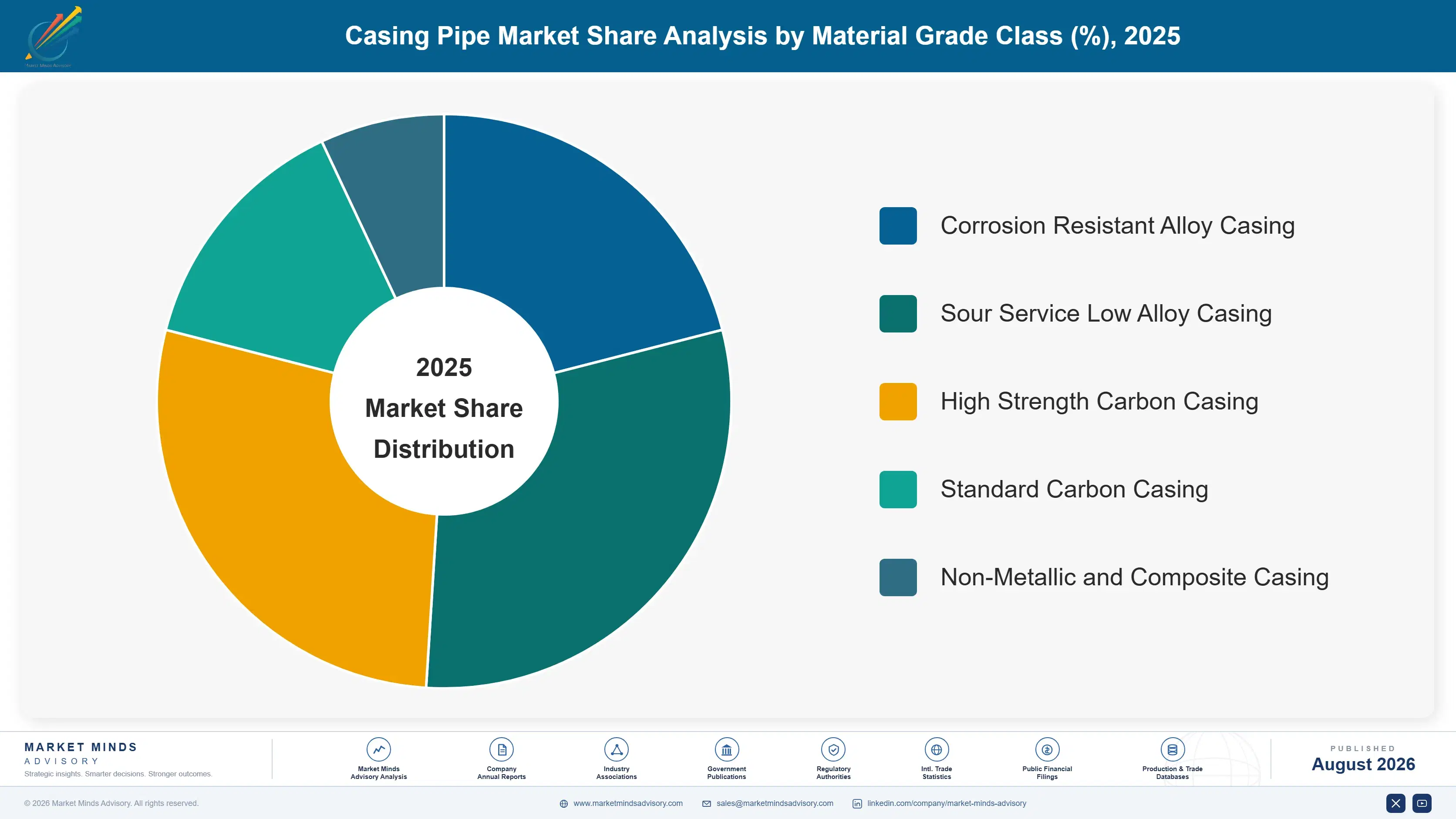
Segmentation follows material grade class, because grade determines the corrosive environment a string can survive, the loading it tolerates, the mill capability required to produce it, and the price bracket it occupies. Connection type, manufacturing route, and well application are handled in the framework and commentary, since each cuts across every grade class rather than defining one.
casing-pipe-market-market-share-analysis-1787333560048

Corrosion Resistant Alloy Casing

Corrosion resistant alloys grow fastest at 8.9%, about 1.85 times the market rate, and the driver is chemistry rather than volume. Chromium steels, duplex stainless, and nickel alloys resist hydrogen sulphide and carbon dioxide attack that destroys carbon steel over a well life, at prices running four times or more above standard grades. Middle Eastern sour gas and offshore high pressure targets account for most current demand. Carbon storage injection wells are the new and specification-setting application, because wet carbon dioxide is aggressively corrosive and the integrity horizon extends beyond fifty years. Mill capability is genuinely scarce here, and qualification with an operator takes years rather than a tender cycle.
CAGR 8.9%

Sour Service Low Alloy Casing

Sour service low alloy grades grow at 6.7%, occupying the position between standard carbon steel and full corrosion resistant alloys at a fraction of alloy pricing. Controlled hardness and tightly specified heat treatment give resistance to sulphide stress cracking without the alloying cost, which suits the very large population of moderately sour wells where full alloy specification would be economically indefensible. Qualification under the relevant materials standards is demanding and mill process control matters more than composition alone. Middle Eastern and Central Asian development drives most volume, with mature field water cut pushing more wells into the category every year as produced fluids turn increasingly aggressive. Process control matters more than composition here.
CAGR 6.7%
Full segment breakdown across 7 segments available in the complete report.

Regional Architecture and Country Demand Map

Regional shares here follow drilling activity and well design rather than industrial output, which puts almost every figure outside the bands this framework applies by default. Every out-of-band share is explained in its own paragraph below, and the reason is the same in each case.

North America

North America holds 32% of value, the largest share anywhere, because American shale drilling consumes more casing tonnage than any other activity on the planet. Long laterals in the Permian, Eagle Ford, Bakken, and Appalachian basins run substantial multi-string designs, and the number of wells drilled dwarfs conventional programmes elsewhere. Domestic mills supply much of it under trade protection that has reshaped import flows considerably. Canadian oil sands and Montney drilling add heavier designs. Grade mix skews toward standard and high strength carbon, because shale fluids are less aggressive than sour gas. Growth at 4.4% sits close to the global rate, driven by steel per well rather than by any expansion in the number of wells being drilled.
Share: 32% | CAGR: 4.4% (2026 to 2036)

Middle East and Africa

At 18% of value, Middle East and Africa stands far above the 6% ceiling this framework applies, for the straightforward reason that this is where a great deal of the world's drilling happens. Saudi Arabian, Emirati, Kuwaiti, and Iraqi programmes run continuously at scale, and Middle Eastern sour gas development pushes grade specification toward sour service and corrosion resistant alloys more consistently than anywhere else. National oil companies buy through long-term frameworks with mill qualification requirements that take years to satisfy. African activity concentrates in Nigeria, Angola, and increasingly Namibia offshore. Growth at 5.2% exceeds the global rate on sour gas development and on grade migration rather than on well count expansion.
Share: 18% | CAGR: 5.2% (2026 to 2036)
Regional intelligence for 5 additional markets available in the complete report: Western Europe, East Asia, South Asia and Pacific, Latin America, Eastern Europe. Contact sales@marketmindsadvisory.com.
casing-pipe-market-country-cagr-analysis-1787333560563

Where Casing Value Actually Concentrates

Four levers matter here, and price per tonne is the one every mill defaults to and the one that matters least. Operator qualification, grade range, connection evidence, and basin presence decide outcomes, because casing is bought from approved supplier lists. A mill competing on price where it is not qualified is quoting into nothing.

Get Qualified Before The Programme Is Awarded

Operators and national oil companies buy casing from approved mill lists built through qualification programmes taking two to three years, covering steelmaking route, heat treatment control, testing regime, and 3 years of audited production history. A mill outside that list does not lose tenders so much as never see them, because procurement filters on approval before any price is requested. Qualification costs sustained investment against no immediate revenue, which is exactly why it functions as a barrier. The mills holding approvals across the major national oil companies compete in a field a fraction the size of the apparent market.
Market Impact: Qualification takes 2 to 3 years to

Build Grade Range Upward, Not Volume Outward

Corrosion resistant alloys grow at 8.9% and sour service at 6.7% while standard carbon grows at 3.2%, and the price differential between the ends of that range runs four times or more. A mill adding alloy capability moves into demand growing at nearly triple the rate of the volume it already serves, at prices that change the economics of the whole asset. The metallurgy and heat treatment investment is substantial and takes years to qualify. Adding another standard grade rolling line instead competes for the slowest-growing and most contested tonnage in the category.
Market Impact: Alloy grades grow at 8.9% against 3

Evidence The Connection, Not Just The Pipe

Most casing failures are connection failures under the combined bending, tension, and thermal loading of long laterals and thermal recovery wells, and API connections were designed for vertical service. Premium connections cost 15% to 30% more and reach only 31% of casing shipped, which is well below what current well designs justify. A supplier with published full-scale test data and a failure database changes that conversation from a price comparison into a risk one. Operators writing standards rather than individual well designs are where that argument lands and lasts. Standards outlive individual well designs entirely.
Market Impact: Premium connections cost 15% to 30%

Position Inventory In The Basin, Not At The Mill

Shale operators drill to a schedule and a delayed casing delivery stops a rig costing around 40 thousand dollars a day, which makes availability worth considerably more than a price concession at the point of need. Basin-level stocking, consignment arrangements, and threading capacity near the wellsite all convert a commodity transaction into a service relationship. That costs working capital in a violently cyclical business, which is why most mills prefer to ship from stock at the works. Operators reward the ones who do not, consistently and at better prices. Availability beats price at the wellsite reliably.
Market Impact: Rig downtime costs 40 thousand doll

Who Controls the Margin Pool

Concentration sits at 43% for the top five, and it rises sharply as grade rises, because pierced and rolled mill capacity with the heat treatment and testing capability for alloy and sour service grades is genuinely scarce. The gap between leaders and challengers is operator qualification and grade range rather than tonnage capacity. All participants here are assessed on one basis, revenue from oil and gas well casing at mill selling prices.
Competition runs on four lines. Operator and national oil company qualification decides which tenders a mill can enter. Grade range decides access to the value end where growth actually is. Connection performance evidence decides premium adoption. Price decides standard carbon grades, where Chinese and trade-protected domestic mills set the level in their respective markets.

Two pressures will move positions. Trade measures have fragmented what was once a global market into regional ones with very different price levels, which rewards local mill ownership over export capability. Meanwhile grade migration toward alloys keeps concentrating value in the few mills that can produce them. Positions favour whoever holds broad qualification alongside genuine alloy metallurgy, and that combination is rarer than the participant count suggests.
casing-pipe-market-company-positioning-matrix-1787333561084

Competitive Moat and Risk Dimensions

TENARIS

Moat: Grade range and basin service

Tenaris holds the broadest grade and connection range in the industry alongside qualification with essentially every major operator and national oil company, which is a position built over decades and not purchasable. Basin-level service centres, threading, and inventory place pipe where rigs are rather than where mills are. Proprietary connection families carry published test evidence competitors struggle to match.
TENARIS

Risk: Exposure to drilling cycles

Revenue depends almost entirely on upstream capital spending, which moves violently and reaches casing orders within two quarters of any decision. Heavy fixed cost in mills and service centres has to be carried through troughs nobody forecasts accurately. Trade measures also fragment pricing across regions in ways that reduce the value of a global footprint.
VALLOUREC

Moat: Premium connections and offshore depth

Vallourec holds strong positions in deepwater and high pressure applications where connection performance decides specification and price sensitivity is lowest. Its premium connection families are qualified into offshore operator standards across Brazil, the Gulf of Mexico, and West Africa. Metallurgical capability in sour service and corrosion resistant grades reaches applications most mills cannot supply at all.
VALLOUREC

Risk: Restructured footprint limits reach

A substantially reduced European manufacturing footprint after restructuring leaves the company more dependent on Brazilian and American production than its competitive position elsewhere requires. Offshore concentration means exposure to a segment with long project cycles and few decisions. Standard grade competitiveness against Asian and domestic American mills remains permanently difficult.

Players Tracked

Prominent Players

Tenaris
Vallourec
TMK
Nippon Steel
United States Steel

Other Key Players

JFE Steel
Hyundai Steel
Baoshan Iron and Steel
Tianjin Pipe Corporation
Jindal SAW
Welspun Corp
ArcelorMittal
Hunting
NOV
Sandvik
Voestalpine
Borusan Mannesmann
Tubacex
Zekelman Industries
Chelyabinsk Pipe Rolling Plant

Recent Developments

FEBRUARY 2025

Carbon storage well standards set casing integrity requirements

Regulators and standards bodies advanced requirements for carbon dioxide injection well integrity, addressing casing material selection and long-term corrosion allowance for storage horizons extending decades beyond production well practice. These were standards developments rather than commercial events, and they push specification toward corrosion resistant alloys as a default.
Signal: A standard written for a new application s
SEPTEMBER 2024

Middle Eastern operators extend sour service framework agreements

National oil companies in the Gulf extended multi-year casing supply frameworks weighted toward sour service and corrosion resistant grades, reflecting reservoir chemistry in the fields now being developed. These were supply agreements rather than acquisitions, and mill qualification requirements attached to them exclude most of the potential supplier field.
Signal: A framework agreement awarded on qualifica
JULY 2024

Trade measures further fragment regional casing pricing

Additional trade remedies and content requirements across North America, Europe, and several emerging markets deepened the separation between regional casing prices for physically comparable product. These were policy actions rather than corporate transactions, and they reward domestic mill ownership over export capability in a way that has reshaped supply routes.
Signal: When trade policy sets regional prices, a

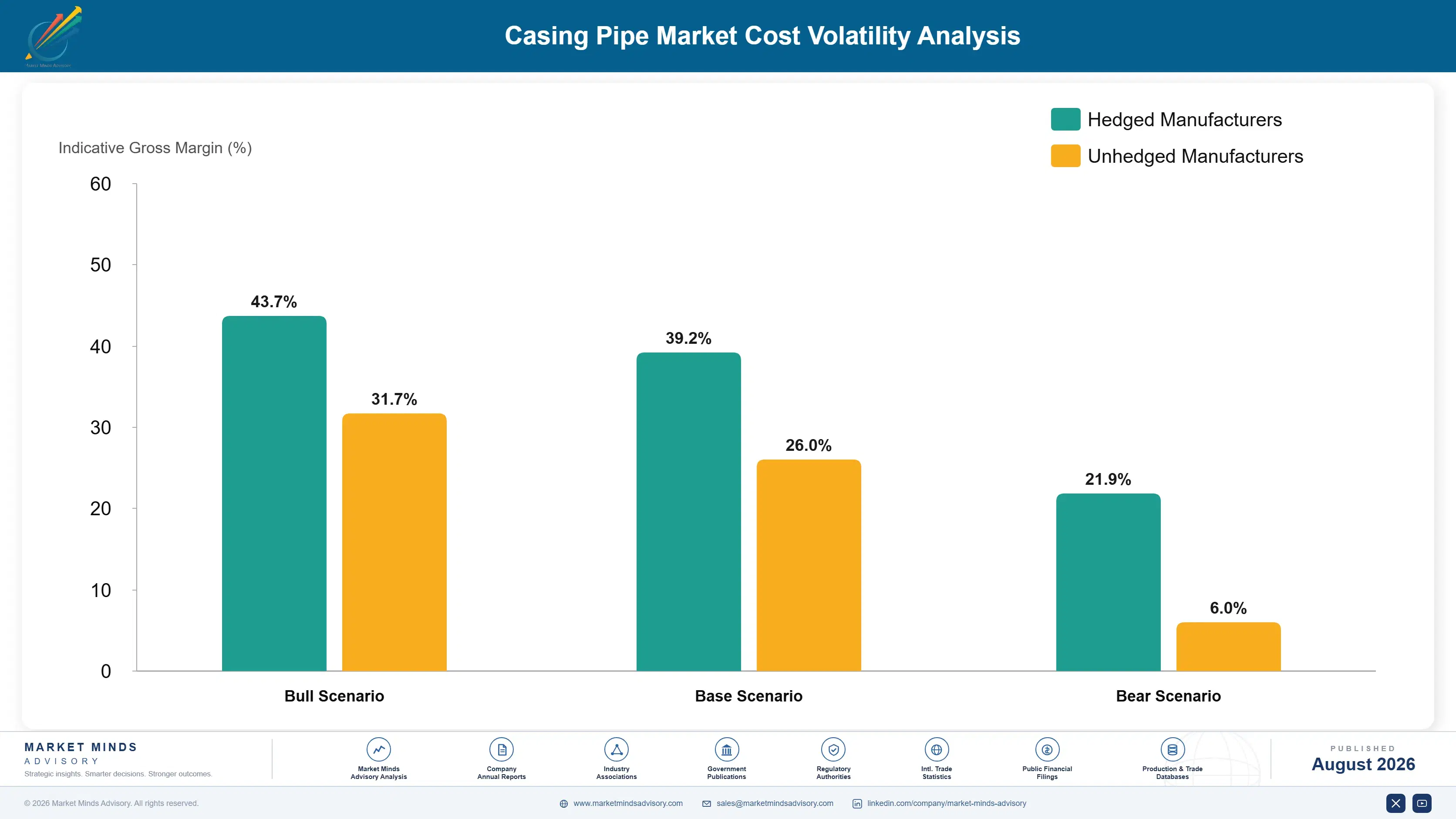
Steel, Alloying Elements, Energy, Heat Treatment

Steel input dominates and grade decides how much. Carbon steel billet and round carries 52% to 66% of a standard casing tonne, priced against regional steel benchmarks. Alloying elements, chromium and nickel above all, take that to 68% to 80% on corrosion resistant grades and move on entirely separate markets. Energy for reheating, piercing, and heat treatment adds 12% to 20%. Threading and testing take the balance.
European and Asian energy costs rose sharply through 2021 and 2022 while nickel moved violently in 2022 and chromium followed, and the IEA documented the energy constraint. Pierced and rolled production is energy intensive from reheating through quench and temper. Tenaris and Vallourec both disclosed input cost pressure across that period. Mills holding fixed-price national oil company frameworks had limited pass-through and absorbed most of it.

Each range above exceeds three points because a standard carbon string and a nickel alloy string share only the rolling mill. Exposure separates by grade mix. A standard grade producer carries steel price risk it can index against published benchmarks. An alloy producer carries nickel and chromium exposure on markets that move independently and violently. Energy separates European producers from Middle Eastern and Asian ones most.
casing-pipe-market-cost-volatility-analysis-1787333561280

Index framework agreements to alloy surcharges separately

Alloying elements take corrosion resistant grade cost to 80% of the tonne and move on nickel and chromium markets that have nothing to do with steel benchmarks. A framework agreement indexed only to carbon steel leaves that exposure entirely uncovered. Separate alloy surcharge mechanisms are standard practice in stainless and still absent from a surprising number of casing supply contracts.

Contract energy on multi-year terms at rolling mills

Reheating, piercing, and quench and temper make pierced and rolled casing production energy intensive at every stage, and energy runs to a fifth of conversion cost. European mills discovered in 2022 what an uncontracted position that size does to competitiveness. Multi-year power agreements cost commitment in a cyclical business and remove an exposure that already closed capacity.

Qualify alternative alloy sources before nickel moves again

Nickel and chromium supply for casing alloys runs through a narrow set of qualified producers, and switching requires requalifying the grade with every operator that approved it. That work takes months and cannot be compressed inside a shortage. Doing it while markets are calm costs paperwork only, and the alternative is an alloy line unable to ship.

Portfolio Architecture for Margin Defence

Three tiers sit inside this category and grade draws every line between them. Standard carbon casing forms the volume tier, sold against regional benchmarks where trade policy and mill proximity decide who wins. High strength and sour service grades earn more, because qualification and process control limit the field. Corrosion resistant alloys and premium connection packages price highest, since very few mills can produce them and operators cannot substitute.
The tension is between tonnage that fills the mill and grade that earns the return. A piercing and rolling mill is enormously expensive when underloaded, so producers take standard grade volume to hold utilisation and then find that volume sets the cost benchmark everything else is judged against. Alloy capability requires metallurgy investment and years of qualification with no revenue attached. Mills that invested before the grade migration arrived are earning now.

High-value pools concentrate where qualification or metallurgy limits competition: corrosion resistant alloys for sour and carbon storage service, premium connections in deepwater and thermal wells, national oil company frameworks requiring multi-year approval, and basin-level service in schedule-driven shale drilling. The commodity end is standard carbon casing sold against regional benchmarks, where trade policy matters more than capability.

Volume / Commodity-Adjacent Tier

Standard API carbon casing grades sold against regional steel benchmarks into conventional drilling programmes. The range is wide because trade protection and energy cost positions produce entirely different economics on physically identical pipe.
Gross Margin: 8-20%

Premium / Certified Tier

High strength and sour service grades requiring controlled hardness, documented heat treatment, and operator qualification. The range is wide because qualified mills hold pricing that unqualified capacity competing on the same specification cannot approach.
Gross Margin: 18-32%

Sustainability / Regulatory / Next-Generation Tier

Corrosion resistant alloy casing and premium connection packages for sour, deepwater, and carbon storage service. The range is wide because alloy input cost varies violently while the scarcity of qualified capacity supports pricing regardless.
Gross Margin: 26-44%
casing-pipe-market-portfolio-architecture-1787333561786

High-value Sub-segments and Strategic Watch-out

Corrosion Resistant Alloy Casing

High value and high growth at 8.9%, the fastest grade class, driven by sour and carbon dioxide rich development and by carbon storage wells with integrity horizons beyond fifty years. Mill capability is genuinely scarce and operator qualification takes years rather than a tender cycle to obtain.
Gross Margin: 26-44%

Sour Service Low Alloy Casing

High value with strong growth at 6.7%, sitting between carbon steel and full alloys for the large population of moderately sour wells. Controlled hardness and heat treatment process control matter more than composition, which is why qualified capacity is narrower than it looks. Qualified capacity is narrow.
Gross Margin: 18-32%

Standard Carbon Casing

The volume core by tonnage at 3.2%, carrying most shale and conventional onshore drilling where produced fluids are not aggressive. Trade policy rather than capability decides who supplies each region, and price is the only variable anybody discusses at all. Trade policy decides supply, not capability at all.
Gross Margin: 8-20%

Non-Metallic and Composite Casing

The strategic watch-out at 4.1%, technically capable in specific low pressure and highly corrosive applications and unable to reach the loads mainstream wells impose. Adoption has been discussed for two decades and remains confined to niches nobody expects to widen much. Two decades of discussion and very little adoption.
Gross Margin: 18-32%

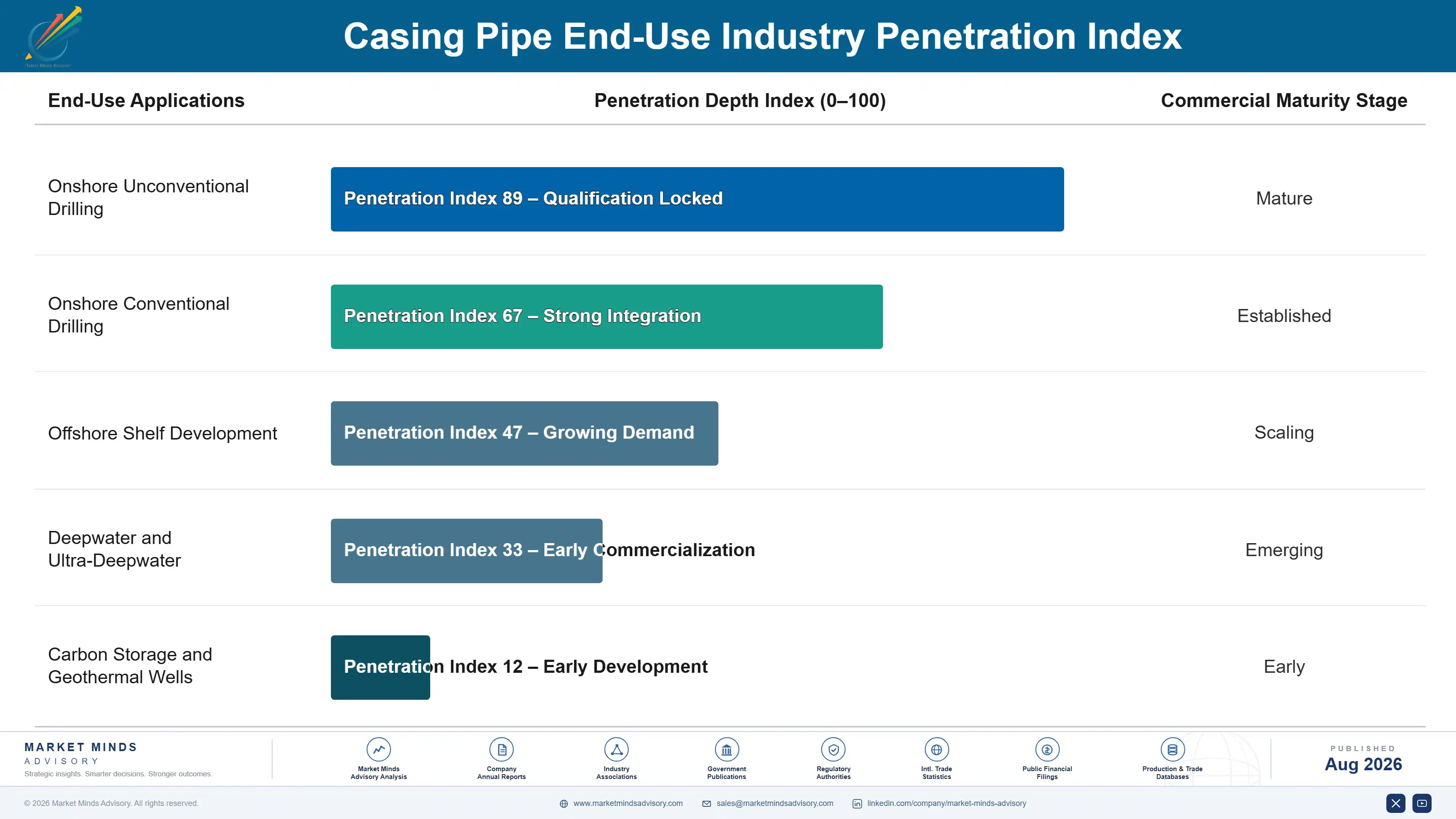
How Casing Demand Actually Commits

Demand commits at operator qualification and then repeats programme after programme for years, because a mill on an approved list gets bought from and one outside it is not considered. Qualification covers steelmaking route, heat treatment, testing, and audited history, and takes two to three years. That is a durable position for something sold by the tonne. The genuine competitive moments are a qualification round, a framework renewal, and a grade requirement the incumbent cannot meet.
Stickiness varies with how demanding the service environment is. National oil company sour service frameworks stick hardest, since requalifying means repeating years of audit for no gain. Deepwater operators stick nearly as hard through connection qualification tied to specific string designs. Shale operators stick least, because standard grades are interchangeable and buyers compare quarterly on price and availability.

The buyer has moved from a drilling engineer choosing per well to a corporate materials function writing standards across an entire portfolio. Twenty years ago a well design named a grade. Now a materials standard names approved mills and connection families for every well drilled anywhere, turning hundreds of decisions into one. Suppliers selling to drilling teams compete for orders a standards document already decided.
casing-pipe-market-end-use-penetration-index-1787333562274

Our Call On Casing Pipe

These are among the four positions where our research anticipates prominent divergence between winners and laggards over the coming forecast period. Each is grounded in the demand model, the regulatory perimeter, and the announced capacity pipeline.
01 / OPERATOR QUALIFICATION POSITION

Approval decides the market, not price

Operators and national oil companies buy casing from approved mill lists built through qualification programmes covering steelmaking route, heat treatment, testing, and audited production history over two to three years. A mill outside those lists never sees the tender rather than losing it, because procurement filters on approval long before any price is requested from anybody. Qualification costs sustained investment against no immediate revenue, which is precisely why it works as a barrier and why the genuinely contested field is a fraction of the apparent one.
02 / GRADE MIGRATION INVESTMENT

Move up the alloy range, not out on tonnage

Corrosion resistant alloys grow at 8.9% and sour service grades at 6.7% while standard carbon grows at 3.2%, and the price differential across that range runs four times or more per tonne. A mill investing in alloy metallurgy and heat treatment enters demand growing at nearly triple the rate of the tonnage it already serves, at prices that change the economics of the entire asset. Adding standard grade rolling capacity instead competes for the slowest-growing and most trade-distorted volume in the category.
03 / CONNECTION EVIDENCE SELLING

The pipe rarely fails, the connection does

Most casing failures occur at connections under combined bending, tension, and thermal loading that API threads were never designed for, since those designs assumed vertical wells rather than long horizontal laterals. Premium connections cost 15% to 30% more and reach only 31% of casing shipped, well below what current well designs would justify on any honest risk assessment. A supplier with published full-scale test data and a failure database moves that conversation from price to risk, and operator materials standards are where the argument lands permanently.
04 / BASIN INVENTORY DISCIPLINE

Availability beats price at the wellsite

A shale operator drilling to schedule loses roughly forty thousand dollars a day when a rig waits for pipe, which makes delivery certainty worth considerably more than any price concession a mill could offer instead. Basin-level stocking, consignment arrangements, and local threading convert a commodity transaction into a service relationship the operator will pay to keep. That costs working capital in a business whose demand collapses within two quarters of an oil price move, which is exactly why most mills prefer to ship from works.

Engagement Snapshot From the Field

A live engagement with an industry participant carrying material or product regulatory and market exposure ahead of a defining policy shift, showing how our research translates into a defensible multi-year portfolio strategy.
MARKET MINDS ADVISORY · CLIENT ENGAGEMENT SUMMARY
Casing Pipe Producer Strategic Portfolio Review and Transition Roadmap 2026·Investment Scenario on Casing Pipe Exposure Evaluation 2025-26
CLIENT PROFILE
A European pierced and rolled pipe producer with roughly USD 780 million in annual revenue engaged MMA after three years in which tonnage held steady and margin fell (client-reported, unverified by MMA). The company ran modern rolling capacity, held solid quality performance, and was losing share in exactly the grade classes where market value was growing fastest.
STRATEGIC CHALLENGE
Commercial leadership attributed the margin decline to Asian import pressure and wanted trade action. Operations wanted a rolling mill upgrade to lift throughput. Nobody had analysed which grade classes the company was actually qualified to supply and which operators had it on an approved list. The board needed a capital allocation decision before the next investment cycle.
MMA APPROACH
MMA mapped the client's operator and national oil company qualifications against the grade classes each buyer specifies, which the company had never assembled in one place. We modelled tonnage and margin by grade class across ten years under three investment routes. We then compared a rolling capacity upgrade, an alloy heat treatment investment, and a qualification programme targeting Middle Eastern sour service frameworks.
KEY FINDINGS
  1. The client held qualification for standard and high strength grades with most buyers and for sour service with almost none, which excluded it from the fastest-growing demand entirely (client-reported, unverified by MMA).
  2. Import pressure explained less of the margin decline than grade mix did, because the company was competing only where price is the sole variable.
  3. An alloy heat treatment investment modelled at roughly USD 90 million with operator qualification adding three years before any meaningful revenue arrived at all.
  4. A rolling capacity upgrade modelled worst of the three routes, adding tonnage into the one grade class already generating the weakest returns available.
CLIENT PROFILE
A European pierced and rolled pipe producer with roughly USD 780 million in annual revenue engaged MMA after three years in which tonnage held steady and margin fell (client-reported, unverified by MMA). The company ran modern rolling capacity, held solid quality performance, and was losing share in exactly the grade classes where market value was growing fastest.
STRATEGIC CHALLENGE
Commercial leadership attributed the margin decline to Asian import pressure and wanted trade action. Operations wanted a rolling mill upgrade to lift throughput. Nobody had analysed which grade classes the company was actually qualified to supply and which operators had it on an approved list. The board needed a capital allocation decision before the next investment cycle.
MMA APPROACH
MMA mapped the client's operator and national oil company qualifications against the grade classes each buyer specifies, which the company had never assembled in one place. We modelled tonnage and margin by grade class across ten years under three investment routes. We then compared a rolling capacity upgrade, an alloy heat treatment investment, and a qualification programme targeting Middle Eastern sour service frameworks.
KEY FINDINGS
  1. The client held qualification for standard and high strength grades with most buyers and for sour service with almost none, which excluded it from the fastest-growing demand entirely (client-reported, unverified by MMA).
  2. Import pressure explained less of the margin decline than grade mix did, because the company was competing only where price is the sole variable.
  3. An alloy heat treatment investment modelled at roughly USD 90 million with operator qualification adding three years before any meaningful revenue arrived at all.
  4. A rolling capacity upgrade modelled worst of the three routes, adding tonnage into the one grade class already generating the weakest returns available.
RECOMMENDED STRATEGY
Phase 1: Phase 1 (0 to 12 months): Abandon the rolling upgrade and begin sour service qualification with three Middle Eastern national oil companies. Phase 2: Phase 2 (12 to 36 months): Invest in alloy heat treatment capability and qualify corrosion resistant grades in parallel with the framework work. Phase 3: Phase 3 (36 to 60 months): Shift standard grade tonnage toward regional markets where trade position rather than cost decides supply.
OUTCOME
The board cancelled the rolling upgrade and funded the qualification programme, which operations resisted and the chief executive later called the least comfortable decision of the cycle. Two sour service qualifications have completed and the client reports its first framework inclusion on a Gulf programme (client-reported, unverified by MMA). Alloy heat treatment investment remains scheduled rather than committed.

Frequently Asked Questions

Foundational context covering the market sizes, CAGR, scope, country, region and competition that inform every finding below. This section is provided to cover basics and most often pre-purchase conversations, answered from the MMA Primary Research Dataset.

What is the current size of the Casing Pipe Market?

The global market is valued at USD 21.4 billion in 2025, covering steel and alloy casing run into oil and gas wellbores across all grade classes. Production tubing, drill pipe, and line pipe are excluded.

How large will the Casing Pipe Market be by 2036?

The market is forecast to reach USD 35.85 billion by 2036 in the base case, about 1.60 times the 2026 level. That represents incremental value of roughly USD 13.42 billion.

What is the CAGR for the Casing Pipe Market 2026 to 2036?

The market grows at a 4.8% CAGR in the base case, with bull and bear scenarios at 6.0% and 3.6%. The spread turns on carbon storage deployment and on upstream capital spending.

Which segment is growing fastest?

Corrosion resistant alloy casing grows fastest at 8.9%, about 1.85 times the overall rate, driven by sour service and carbon storage well requirements. Sour service low alloy grades follow at 6.7%.

Who are the major companies in the Casing Pipe Market?

Leading participants include Tenaris, Vallourec, TMK, Nippon Steel, and United States Steel. Concentration sits at roughly 43% and rises sharply as grade rises, because alloy mill capability is scarce.

Which country is growing fastest?

Guyana grows fastest at a 9.4% CAGR, as deepwater development ramps with heavy string designs and premium connections specified as standard. Argentina follows on Vaca Muerta shale expansion.

Report Segmentation Architecture

The full report scope spans multiple orthogonal segmentation dimensions, with cross-tabulated demand data provided for each dimension pair. Coverage extends further to regional breakdowns, trend trajectories, and the competitive detail needed to support segment-level decision-making.

By Material Grade Class

  • Corrosion Resistant Alloy Casing
  • Sour Service Low Alloy Casing
  • High Strength Carbon Casing
  • Standard Carbon Casing
  • Non-Metallic and Composite Casing

By End-Use Industry

  • Onshore Unconventional Drilling
  • Onshore Conventional Drilling
  • Offshore Shelf Development
  • Deepwater and Ultra-Deepwater
  • Carbon Storage and Geothermal Wells

By Procurement Route

  • Long-Term Framework Agreement
  • Project Tender Award
  • Distributor and Stockist Supply
  • Consignment and Basin Inventory

By Region

  • North America
  • Middle East and Africa
  • Western Europe
  • East Asia
  • South Asia and Pacific
  • Latin America
  • Eastern Europe

Scope, Methodology, and Coverage

Every figure in this report is reproducible from documented input assumptions. The scope below maps the historical period, the forecast horizon, the segmentation dimensions, and the countries covered, alongside the underlying primary and qualitative methodology.
Historical Period
2020 to 2025
Forecast Period
2026 to 2036
Base Year
2025 (USD billions; MMA Primary Research Dataset, August 2026)
Market Definition
The casing pipe market comprises the manufacture and sale of steel and alloy pipe run into oil and gas wellbores and cemented in place to isolate formations, support the wellbore, and maintain well integrity, valued at mill selling prices to operators, drilling contractors, distributors, and national oil companies. It spans conductor, surface, intermediate, and production casing strings produced by piercing and rolling or by electric resistance and submerged arc welding, in standard API carbon grades, high strength grades, controlled hardness sour service grades, corrosion resistant alloys including chromium steels, duplex stainless and nickel alloys, and non-metallic and composite constructions, supplied with API or proprietary premium connections and the couplings, accessories, and thread protection provided with them. Production tubing strings, drill pipe and drill collars, line pipe for gathering and transmission, coupling stock and connection licences sold independently, wellheads and christmas trees, cement and cementing materials, and casing running, cementing, and inspection services are excluded. Pipe recovery, reconditioning, and inspection services sold independently sit outside scope.
Quantitative Units
USD billions (current prices); volume in millions of tonnes shipped
Segmentation Dimensions
By Material Grade Class; By End-Use Industry; By Procurement Route; By Region
Regions Covered
North America, Middle East and Africa, Western Europe, East Asia, South Asia and Pacific, Latin America, Eastern Europe
Countries Covered
USA, Canada, Mexico, Saudi Arabia, United Arab Emirates, Kuwait, Iraq, Qatar, Oman, Nigeria, Angola, Namibia, Algeria, Egypt, China, Japan, South Korea, India, Australia, Indonesia, Malaysia, Thailand, Brazil, Guyana, Argentina, Colombia, Trinidad and Tobago, Norway, United Kingdom, Netherlands, Denmark, Russia, Kazakhstan, Azerbaijan, Turkmenistan, Romania, and additional markets relevant to this sector
Key Companies Profiled
Tenaris, Vallourec, TMK, Nippon Steel, United States Steel, JFE Steel, Hyundai Steel, Baoshan Iron and Steel, Tianjin Pipe Corporation, Jindal SAW, Welspun Corp, ArcelorMittal, Hunting, NOV, Sandvik, Voestalpine, Borusan Mannesmann, Tubacex, Zekelman Industries, Chelyabinsk Pipe Rolling Plant
Quantitative Methodology
Primary survey, n=3,800 respondents, Q4 2025, six countries; demand-side model with trade association cross-validation
Qualitative Methodology
47 expert interviews, Q4 2025; applied to validate demand model assumptions, identify emerging dynamics, and assess competitive positioning
Report Format
PDF and XLSX data workbook (Word format preview document)
Publisher
Market Minds Advisory
Report Code
MMA-2026-ENE-505
Published
August 2026
Contact
sales@marketmindsadvisory.com | www.marketmindsadvisory.com

Purchase the full Casing Pipe Market Report (2026 to 2036).

The full MMA Casing Pipe report sizes the market across five material grade classes, five drilling applications, four procurement routes, and seven regions through 2036. It profiles 20 participants on a consistent basis of well casing revenue at mill selling prices, scoring each on operator qualification breadth, alloy metallurgy capability, connection performance evidence, and basin service presence. Scenario models quantify how upstream capital spending, grade migration, and carbon storage deployment move both volume and achievable margin. The report also includes steel weight per well modelling by basin and well type, operator qualification mapping by mill, grade mix forecasting by region, and connection failure analysis across major well design classes.
Five-grade and four-route market sizing to 2036
Twenty-participant benchmark on well casing mill revenue
Steel weight per well modelling by basin and design
Operator qualification mapping by mill and grade class
Grade mix forecasting by region and reservoir chemistry
Connection failure analysis across major well design classes

Built For The People Who Decide

From boardroom strategy to bench-side execution, this report is read cover-to-cover by leaders shaping the next decade of their industry, turning demand scenarios, market dynamics and valuation benchmarks into decisions.
CXOs/ Presidents/ VPs/ Managers
M&A and Corporate Development
Strategy Teams and R&D Heads
Procurement and Product Directors
Regulatory and Compliance Leaders
Investor Relations and Equity Analysts