Market Minds Advisory
Carpal Tunnel Release System Market

Carpal Tunnel Release System Market: Site-of-Care Migration Reshapes Device Economics

Ultrasound-guided in-office carpal tunnel release is shifting procedures away from hospital operating rooms toward lower-cost outpatient settings, pressuring endoscopic system makers to defend reimbursement while payers increasingly favor the least expensive clinically equivalent release technique.

Lead Analyst

Alice Ballenger

Published

September 2026

Make Smarter Decisions with Customized Research Insights

Request a free sample report and evaluate market opportunities, growth trends, and competitive dynamics relevant to your business needs.

2025 MARKET VALUE$1.3BMarket Size 2025
2036 FORECAST VALUE$3.2BBase Case , 2026 to 2036
CAGR 2026 TO 20368.4 %Bull 9.7% / Bear 7.1%
INCREMENTAL OPPORTUNITY$1.8BNet 10- year value creation
EXPANSION MULTIPLE2.24x2036 value over 2026 base
Strategic Levers
M&A Pipeline
Regional Outlook
Country Rankings
Competitive Intelligence
Segmental Deep-dive
Call-Us : 91 93563 13602

Executive Snapshot and Market Trajectory

Carpal tunnel release is migrating from hospital-based endoscopic and open surgical procedures toward ultrasound-guided in-office release performed under local anesthesia, as payers and health systems recognize the substantial cost advantage of avoiding operating room and anesthesia charges for a procedure with well-established clinical outcomes.
Demand concentrates in the United States, where occupational health programs, an aging population, and well-established reimbursement pathways for both endoscopic and in-office release drive the largest procedure volumes globally. Endoscopic carpal tunnel release remains the dominant hospital-based technique, while ultrasound-guided in-office devices are growing fastest as ambulatory practices seek to capture procedure revenue previously referred to surgical centers. Occupational medicine clinics increasingly perform release procedures entirely outside the traditional hospital setting each year.
Competition centers on procedure cost and site-of-care economics rather than pure clinical outcome differences, since endoscopic and open release techniques already deliver comparable long-term symptom relief across most patient populations. In-office ultrasound-guided devices are gaining share specifically because they eliminate operating room facility fees entirely, a cost difference payers increasingly scrutinize when authorizing elective procedures. Device makers are building physician training and reimbursement coding support to accelerate adoption.
Market Definition
The Carpal Tunnel Release System Market covers endoscopic, open, and ultrasound-guided in-office devices, instrumentation, and disposables used to surgically release the transverse carpal ligament to relieve median nerve compression. It excludes conservative treatment devices such as wrist splints, corticosteroid injection therapy, and post-release physical therapy equipment not directly tied to the release procedure itself.
Base Year Value
$1.3B in 2025 (MMA Primary Research Dataset, August 2026)
Forecast Period
2026 to 2036, eleven discrete annual values
CAGR
8.4% base case. Bull 9.7%. Bear 7.1%.
Fastest Growth Segment
Ultrasound-Guided In-Office Release Devices: 14.2% CAGR
Fastest Growth Country
China: 12.3% CAGR
Fastest Growth Region
South Asia and Pacific: 10.4% CAGR
Largest Region
North America: 35% of 2025 global value
Market Leaders
Stryker Corporation, CONMED Corporation, Arthrex Inc., Integra LifeSciences Holdings Corporation, and Sonex Health Inc. Source: MMA Analysis based on company annual reports.
Primary Survey
n=3,800 procurement and R&D decision-makers, Q4 2025, six countries
Methodology
Demand-side build-up, cross-validated against public data, 47 expert interviews

Carpal Tunnel Release System Market Forecast Scenarios

carpal-tunnel-release-system-market-size-forecast-scenario-1787304642857
Procedure volume grew steadily between 2020 and 2025 at roughly 7.4 percent annually, as elective surgery backlogs from 2020 cleared and occupational health screening programs identified a growing population of undiagnosed carpal tunnel syndrome cases. Ultrasound-guided in-office release device introductions from 2022 onward accelerated growth further, as ambulatory practices began capturing procedure volume previously referred entirely to hospital surgical centers.
The base case assumes 8.4 percent annual growth through 2036, anchored on three mechanisms: continued site-of-care migration from hospital operating rooms toward lower-cost in-office and ambulatory settings, expanding occupational health screening that increases diagnosed carpal tunnel syndrome case volume, and rising adoption of single-use disposable release instrumentation replacing reusable surgical sets. Hand surgery and occupational medicine practices are also standardizing on ultrasound-guided in-office platforms to capture procedure revenue and reduce patient wait times for a high-volume, well-reimbursed elective procedure.
A bull scenario, at 9.7 percent, assumes faster payer coverage expansion for in-office ultrasound-guided release accelerates site-of-care migration beyond current projections. A bear scenario, at 7.1 percent, assumes reimbursement rate compression across ambulatory procedures slows practice investment in new release technology. Growing physician assistant and nurse practitioner involvement in procedure delivery could also moderate device revenue per procedure over time.

Site-of-Care Migration Reshapes Device Economics

Carpal tunnel release sits at the intersection of aging population demographics, occupational health screening expansion, and a genuine site-of-care shift away from hospital operating rooms toward lower-cost ambulatory and in-office settings. This combination gives the category unusually durable demand growth relative to many other orthopedic device segments tied more closely to discretionary elective surgical volume and hospital capital budgets across most healthcare systems and economic cycles
MARKET CONCENTRATION (CR5)39%Leading device makers hold a fragmented but growing category share
AVERAGE DEVICE KIT COST$680Single-use release kits carry modest but recurring per-procedure cost
TOP ADOPTING COUNTRY SHARE38%United States dominates global procedure volume and device spending
IN-OFFICE PROCEDURE SHARE24%Ambulatory settings capture a growing minority of release procedures performed
AVERAGE PROCEDURE TIME9 minUltrasound-guided release delivers meaningfully shorter procedure times than alternatives
RETURN-TO-WORK TIMELINE5 daysFaster recovery increasingly favors minimally invasive release technique selection
Commercially, the market splits between established endoscopic and open release systems sold primarily into hospital and ambulatory surgery center channels, and a fast-growing tier of ultrasound-guided in-office devices sold directly to occupational medicine and hand surgery specialty practices. Device makers increasingly bundle physician training, reimbursement coding support, and disposable kit subscriptions alongside capital equipment sales to secure practice-level accounts nationwide and internationally.
Site-of-care economics will define competitive position over the next decade more than incremental clinical outcome differences, which have largely converged across established release techniques. Vendors able to demonstrate compelling total cost of care advantages and simplified in-office reimbursement pathways are positioned to capture disproportionate share of hand surgery practice capital budgets industry-wide over time, particularly among occupational medicine specialists.
"The clinical debate over which release technique works best is mostly settled. The real competition now is over which one gets the patient out of the operating room entirely."
Director, Orthopedic and Hand Surgery Devices Practice · MMA Orthopedic and Hand

Market Trends

Ultrasound-Guided In-Office Release Gains Volume Share

Ultrasound-guided in-office release devices, which allow surgeons to visualize and release the transverse carpal ligament under local anesthesia without an operating room, are capturing procedure volume previously performed exclusively in hospital and ambulatory surgery center settings. Sonex Health's UltraGuideCTR platform has expanded its clinical evidence base and physician training network meaningfully since 2023, reporting strong patient satisfaction scores tied to faster recovery and lower total procedure cost compared to traditional endoscopic release. Occupational medicine clinics and hand surgery practices report growing patient demand for the in-office option once payer coverage clarifies reimbursement eligibility. In-office release captured an estimated 24 percent of total procedure volume in 2025.
Market Impact: Expands screened population 19% sin
Single-Use Disposable Kits Replace Reusable Sets

Hospitals and ambulatory surgery centers are increasingly standardizing on single-use disposable release kits rather than reusable surgical instrument sets requiring sterile processing between each procedure, reducing infection control risk and simplifying inventory management for high-volume hand surgery programs. This shift mirrors a broader pattern across outpatient surgical device categories where sterile processing labor cost and turnaround time increasingly favor disposable instrumentation despite higher per-unit device cost. CONMED and Arthrex have both expanded disposable kit lines targeting ambulatory surgery centers with tight scheduling turnaround requirements. Disposable kits now account for an estimated 61 percent of procedure volume in ambulatory settings.
Market Impact: Cuts hospital-based procedure share

Market Opportunities and Growth Drivers

Expanding Occupational Health Screening Programs Broadly

Employers and occupational health providers have progressively expanded ergonomic screening and early symptom detection programs for repetitive strain conditions, identifying a growing population of carpal tunnel syndrome cases before symptoms progress to severe nerve damage requiring more complex intervention. Broader screening directly increases the population of patients referred for release procedures, creating demand growth independent of any underlying change in incidence itself. Manufacturing and logistics employers with high repetitive-motion exposure report particularly strong screening adoption, reflecting workers' compensation cost management incentives. This dynamic is expected to sustain steady procedure volume growth even as broader workforce demographic trends shift.
Market Impact: Delays adoption across 30-plus inco

Site-of-Care Shift Toward Ambulatory Settings Now

Payers and health systems are actively redirecting carpal tunnel release procedures away from hospital operating rooms toward ambulatory surgery centers and in-office settings, where facility fees run substantially lower for a procedure with well-established clinical outcomes across techniques. Medicare and commercial payer reimbursement policy changes have explicitly incentivized site-of-care migration for numerous elective procedures, including carpal tunnel release, by adjusting facility fee schedules to favor lower-cost settings. This shift has reduced hospital-based release volume at many health systems, redirecting procedure revenue toward ambulatory channels instead. Hospital-based procedure share has declined an estimated 28 percent over five years.
Market Impact: Slows adoption despite 9-minute pro

Market Restraints and Challenges

Reimbursement Uncertainty For In-Office Procedures Persists

Payer reimbursement policy for ultrasound-guided in-office carpal tunnel release remains inconsistent across insurance plans and geographic markets, creating meaningful revenue uncertainty for practices considering capital investment. The root cause is that many regional payers have been slow to establish clear coverage and coding policy specifically for the in-office technique, treating it inconsistently relative to established endoscopic and open release procedures with decades of coding precedent. This uncertainty discourages some smaller independent practices from adopting in-office equipment despite strong physician and patient interest. Manufacturers are mitigating the gap by building dedicated reimbursement navigation support teams to help practices secure consistent coverage determinations.
Market Impact: Captures 24% of total procedure vol

Physician Training Learning Curve For New Technique

Ultrasound-guided in-office release requires surgeons to develop new procedural skill and ultrasound imaging interpretation competency distinct from traditional endoscopic or open surgical technique, creating a meaningful adoption barrier even among experienced hand surgeons. The root cause is that ultrasound-guided visualization of the ligament and surrounding neurovascular structures demands specific training that differs substantially from the visual and tactile cues surgeons rely on during traditional procedures. This learning curve slows adoption among surgeons otherwise interested in the technique's cost and recovery advantages but hesitant without structured proctoring support. Manufacturers are mitigating the barrier by expanding hands-on training and cadaver lab proctoring sessions.
Market Impact: Reaches 61% share in ambulatory set
3 additional market trends, 2 additional growth drivers, and 4 additional restraints and challenges are covered in the full report. Contact sales@marketmindsadvisory.com to access the complete intelligence.

Segment CAGR and Growth Architecture

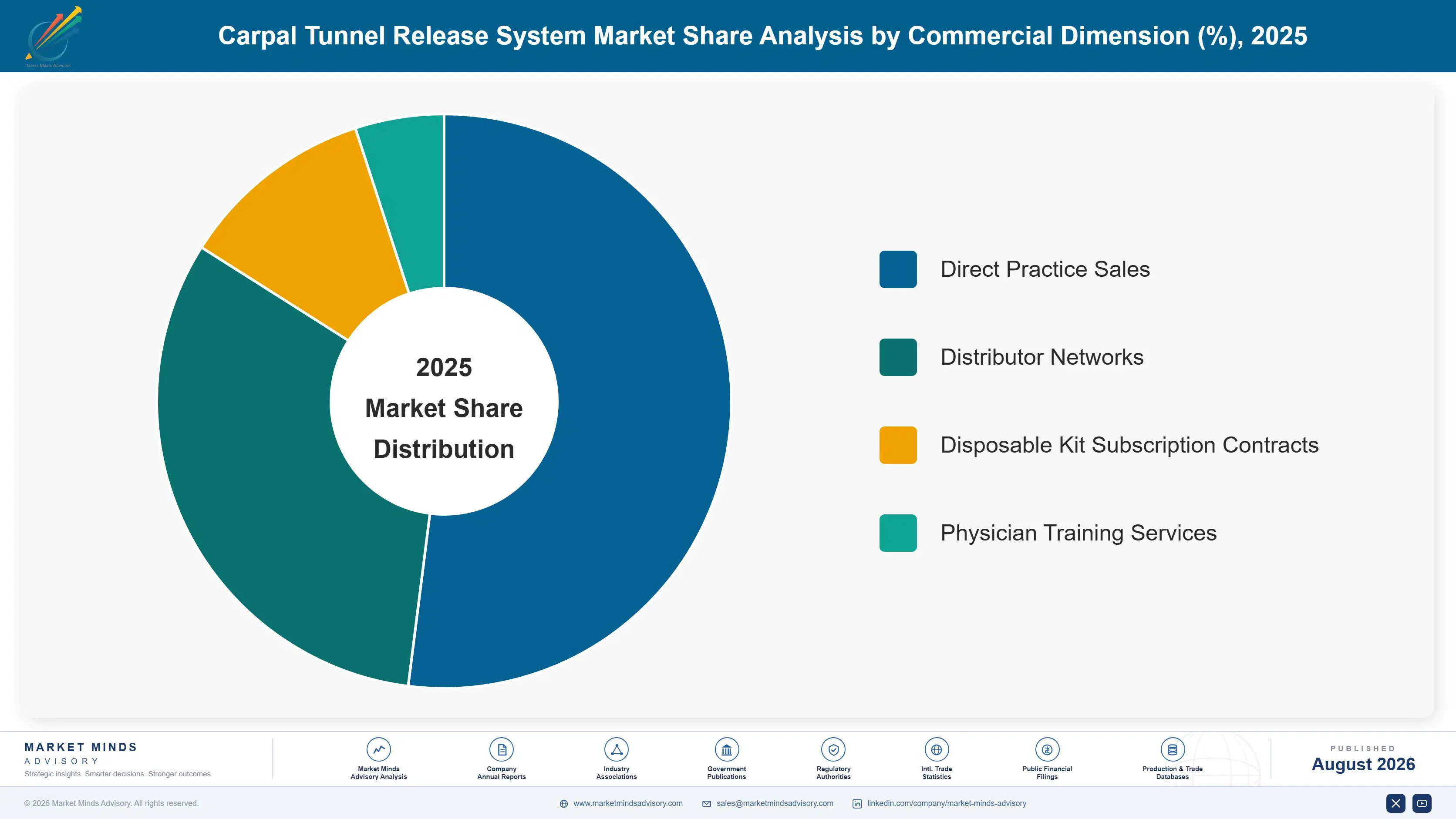
Segmentation follows release technique and device platform, the classification hand surgeons and ambulatory practice procurement teams use when selecting instrumentation for carpal tunnel release procedures. Six segments span the full technique range from established open and endoscopic release through emerging ultrasound-guided in-office platforms, keeping each category mutually exclusive by underlying procedural approach and setting.
carpal-tunnel-release-system-market-market-share-analysis-1787304643437

Ultrasound-Guided In-Office Release Devices

Ultrasound-guided in-office release devices allow surgeons to visualize the transverse carpal ligament and surrounding neurovascular structures in real time using portable ultrasound imaging, releasing the ligament through a small-gauge needle-based instrument under local anesthesia without an operating room. Growth is accelerating fastest of any segment as payers increasingly recognize the substantial facility fee savings compared to hospital-based endoscopic or open release, and as physician training programs expand surgeon comfort with ultrasound-guided technique. Sonex Health dominates this segment given its first-mover position and accumulated clinical evidence base built through several years of dedicated physician training investment. Adoption remains concentrated among occupational medicine and hand surgery specialty practices willing to invest in new equipment and ultrasound imaging training for their staff.
CAGR 14.2%

Single-Use Disposable Release Blades and Kits

Single-use disposable release blades and complete procedure kits are replacing reusable surgical instrument sets across hospitals and ambulatory surgery centers, reducing sterile processing labor cost and turnaround time between procedures while eliminating cross-contamination risk associated with reusable instrumentation. Growth is accelerating as ambulatory surgery centers performing high procedure volumes prioritize scheduling efficiency and infection control over the modestly lower per-unit cost of reusable instrument sets requiring sterilization between each use. CONMED and Arthrex lead this segment given their established relationships with ambulatory surgery center procurement teams and broad existing endoscopic release platform installed base. Disposable kits command a meaningful per-procedure revenue premium over reusable alternatives despite representing a smaller upfront capital equipment sale for manufacturers overall.
CAGR 11.5%
Full segment breakdown across 6 segments available in the complete report.

Regional Architecture and Country Demand Map

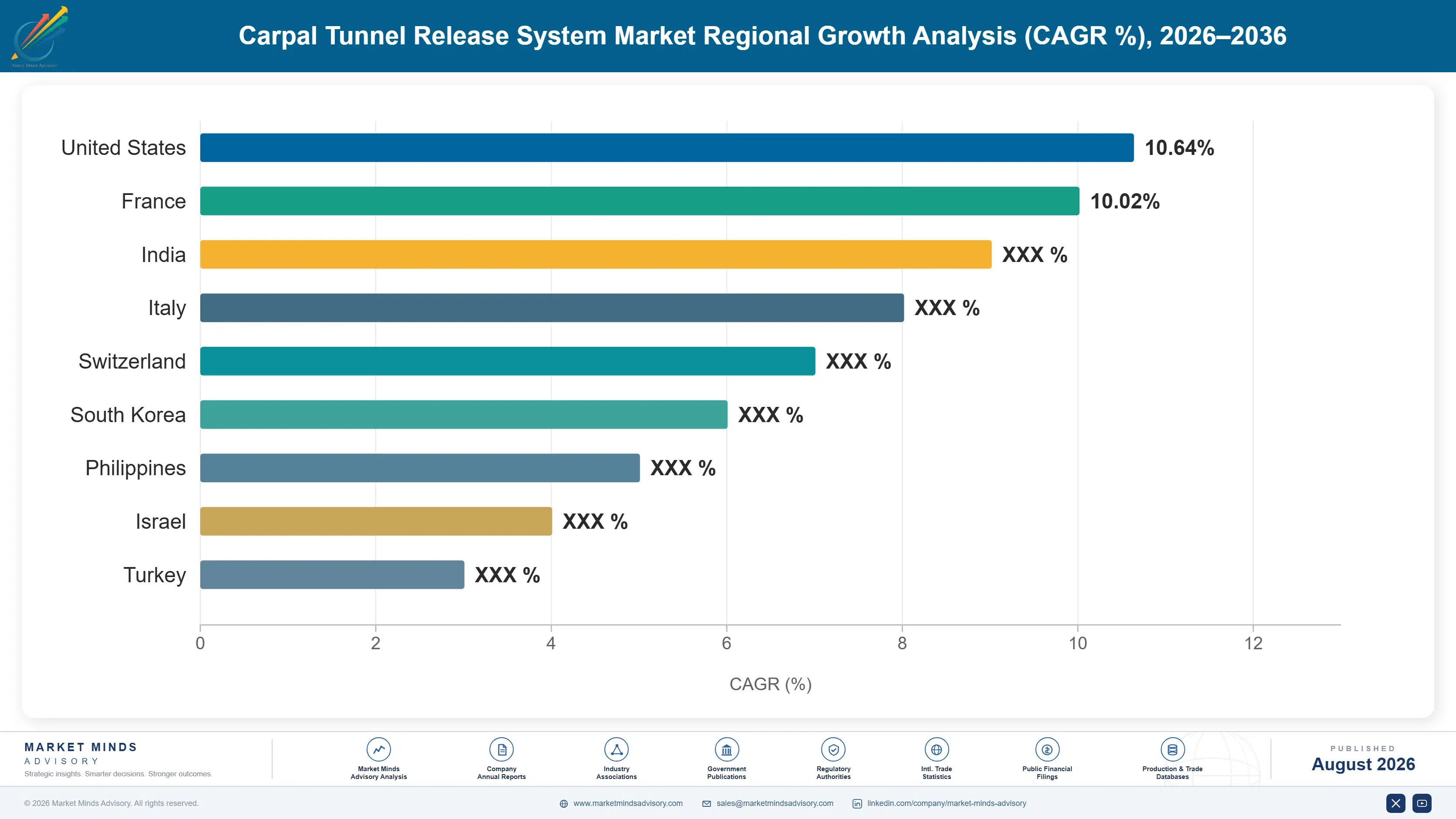
Carpal tunnel release procedure volume concentrates overwhelmingly in the United States, reflecting occupational health screening infrastructure, aging workforce, and well-established reimbursement pathways for both hospital-based and in-office release technique. Western Europe and East Asia account for most remaining global volume and device revenue today.

North America

The United States accounts for the overwhelming majority of North American demand, reflecting extensive occupational health screening infrastructure, an aging manufacturing and office workforce, and well-established Medicare and commercial reimbursement pathways covering both hospital-based and in-office release technique. Occupational medicine clinics and ambulatory surgery centers perform the bulk of procedure volume, with hand surgery specialty practices increasingly adopting ultrasound-guided in-office platforms to capture revenue previously referred elsewhere. Canada's smaller treatment volume tracks similar epidemiology, though provincial budget constraints and slower in-office reimbursement adoption keep per-capita rates below United States levels. Out-of-band note: North America's share sits above the standard band because United States procedure volume and reimbursement infrastructure concentration here are genuinely unmatched.
Share: 35% | CAGR: 9.0% (2026 to 2036)

Western Europe

Germany, the United Kingdom, and France drive most Western European demand, each maintaining well-developed hand surgery referral networks and national health system reimbursement pathways, though in-office ultrasound-guided release has gained less traction here than in the United States given different ambulatory care reimbursement structures. Public healthcare systems across the region favor established endoscopic and open release techniques with long clinical track records and straightforward national tender pricing over newer in-office alternatives still building regulatory and reimbursement recognition. Scandinavian countries maintain particularly efficient hand surgery referral pathways relative to their population size, sustaining steady procedure volume despite comparatively modest overall population. Currency and national tender pricing pressure periodically constrain capital equipment purchasing cycles across smaller public hospital systems within the region.
Share: 23% | CAGR: 6.9% (2026 to 2036)
Regional intelligence for 5 additional markets available in the complete report: East Asia, South Asia and Pacific, Latin America, Middle East and Africa, Eastern Europe. Contact sales@marketmindsadvisory.com.
carpal-tunnel-release-system-market-country-cagr-analysis-1787304643956

Where Release Device Makers Can Win

Device makers face a market where site-of-care economics increasingly determine purchasing decisions as much as clinical outcome data, making reimbursement support and disposable economics central to competitive position and growth. Four levers stand out: in-office reimbursement navigation support, disposable kit subscription pricing, physician training investment, and ambulatory surgery center disposable-kit contracts.

Build In-Office Reimbursement Navigation Support Teams

Manufacturers building dedicated reimbursement navigation teams that help occupational medicine and hand surgery practices secure consistent coverage determinations for ultrasound-guided in-office release are becoming preferred vendors independent of raw device performance differences between competing platforms. Practices working with vendors offering dedicated reimbursement support report meaningfully faster coverage approval and fewer denied claims, a genuine differentiator in markets where reimbursement complexity, rather than clinical evidence, remains the primary barrier to broader in-office release adoption. Sonex Health's investment in reimbursement navigation infrastructure has correlated with faster practice-level adoption in markets where it has deployed dedicated support staff. Practices with dedicated support report claims approval roughly 4 weeks faster.
Market Impact: Speeds coverage approval by roughly

Offer Disposable Kit Subscription Pricing Models

Manufacturers offering subscription-based disposable kit pricing, rather than per-unit purchasing, are converting variable procedure-linked revenue into more predictable recurring contracts that simplify budgeting for high-volume ambulatory surgery centers and occupational medicine practices. This pricing model typically bundles disposable blades, kits, and consumables into a single monthly or quarterly invoice tied to expected procedure volume, reducing administrative overhead for practice purchasing departments managing multiple device categories simultaneously. Early adopters report meaningfully higher kit attach rates and more predictable revenue forecasting compared to traditional per-unit ordering relationships. Subscription pricing now covers an estimated 22 percent of disposable kit revenue among leading manufacturers.
Market Impact: Covers roughly 22% of disposable ki

Expand Physician Training For Ultrasound-Guided Technique

Manufacturers investing in structured physician training programs, including hands-on workshops and cadaver lab proctoring sessions, are directly addressing the learning curve that most limits broader adoption of ultrasound-guided in-office release technique among experienced hand surgeons. Sonex Health has trained several thousand surgeons through its structured proctoring program since the technique's introduction, building a meaningful base of comfortable practitioners who then advocate for the technique among peers at regional hand surgery conferences. This training investment functions as a genuine competitive moat, since surgeons trained on one company's platform face real switching costs when evaluating a competing system later. Trained surgeon count has grown an estimated 45 percent annually since 2023.
Market Impact: Grows the trained surgeon base by r

Pursue Ambulatory Surgery Center Kit Contracts

Manufacturers pursuing dedicated disposable kit supply contracts with high-volume ambulatory surgery centers, rather than relying solely on individual practice-level sales, are securing predictable multi-year revenue streams tied to facility-wide procedure volume rather than physician-by-physician adoption decisions. Ambulatory surgery centers performing large volumes of hand surgery procedures represent an increasingly attractive customer segment given standardized purchasing processes and preference for consolidating vendor relationships across multiple device categories to simplify procurement. Manufacturers securing preferred vendor status at high-volume centers capture disproportionate share of that facility's disposable kit spending across all participating surgeons practicing there. Ambulatory surgery center contracts now represent an estimated 31 percent of total disposable kit revenue.
Market Impact: Represents roughly 31% of total dis

Who Controls the Margin Pool

Five companies, Stryker, CONMED, Arthrex, Integra LifeSciences, and Sonex Health, hold an estimated 39 percent of global revenue on a company-revenue basis, reflecting a comparatively fragmented market where numerous regional and specialty manufacturers compete for the substantial remainder. Stryker leads by a modest margin over the next closest challenger, reflecting its broad orthopedic distribution network and established endoscopic release platform installed base across most hospital systems
Current competitive activity centers on three dimensions: reimbursement navigation and coverage support for in-office release technique, disposable kit subscription pricing aimed at ambulatory surgery centers, and physician training investment to expand ultrasound-guided technique adoption among practicing hand surgeons. Established endoscopic platform makers are also defending hospital-based procedure volume through bundled service contracts and physician loyalty programs across regions.

Emerging pressure comes primarily from Sonex Health and other in-office release specialists capturing procedure volume that established endoscopic platform makers historically treated as a captive hospital-based market. If in-office reimbursement continues expanding at its current pace, competitive rankings could shift meaningfully within the next several years as ambulatory and occupational medicine channels grow faster than traditional hospital-based procedure volume across most developed markets.
carpal-tunnel-release-system-market-company-positioning-matrix-1787304644489

Competitive Moat and Risk Dimensions

STRYKER CORPORATION

Moat: Broad Orthopedic Distribution Network

Stryker benefits from an extensive existing orthopedic and hand surgery sales force and distribution network already calling on hospital and ambulatory surgery center accounts, giving it privileged access to purchasing committees evaluating carpal tunnel release instrumentation alongside broader orthopedic capital equipment decisions made at the same facilities.
STRYKER CORPORATION

Risk: Limited In-Office Technique Presence

Stryker's product portfolio remains concentrated in traditional endoscopic and open release instrumentation, leaving it comparatively exposed as procedure volume migrates toward ultrasound-guided in-office technique where dedicated specialists like Sonex Health have established meaningful first-mover clinical evidence and physician training advantages across most developed markets.
SONEX HEALTH INC.

Moat: First-Mover In-Office Technique Position

Sonex Health holds the deepest accumulated clinical evidence and physician training base specifically for ultrasound-guided in-office release, giving it a decisive advantage as payers and practices evaluate the technique against established alternatives with longer overall clinical track records but higher facility cost structures across most markets.
SONEX HEALTH INC.

Risk: Narrower Overall Product Portfolio

Sonex Health's comparatively narrow product portfolio, concentrated almost entirely in ultrasound-guided in-office release, leaves it more exposed than diversified competitors to any reimbursement policy setback specific to the in-office technique, unlike broader orthopedic device makers with established endoscopic and open release product lines nationwide.

Players Tracked

Prominent Players

Stryker Corporation
CONMED Corporation
Arthrex Inc.
Integra LifeSciences Holdings Corporation
Sonex Health Inc.

Other Key Players

Smith+Nephew plc
MicroAire Surgical Instruments LLC
Medline Industries LP
Teleflex Incorporated
Acumed LLC
Trimed Inc.
Hand Biomechanics Lab Inc.
Enovis Corporation
Össur hf
BSN Medical GmbH
Zimmer Biomet Holdings Inc.
Extremity Medical LLC
Skeletal Dynamics LLC
KLS Martin Group
Instratek Inc.

Recent Developments

APRIL 2025

Sonex Health Expands Physician Training Network

Sonex Health launched an expanded multi-site physician training and proctoring program for its UltraGuideCTR platform, an organic training initiative rather than an acquisition, designed to accelerate surgeon comfort with ultrasound-guided technique and build the clinical evidence base needed to support broader payer coverage recognition across additional regional markets.
Signal: In-office release specialists are investin
OCTOBER 2024

Stryker Acquires Disposable Instrument Component Supplier

Stryker completed the acquisition of a specialty disposable surgical instrument component supplier, securing dedicated internal supply of precision blade and cannula components rather than continuing to rely solely on third-party suppliers for its endoscopic release product lines going forward across its broader manufacturing footprint and facilities network.
Signal: Established device makers are backward-int
JANUARY 2025

CONMED Signs Ambulatory Surgery Center Group Kit Agreement

CONMED signed a multi-year disposable kit supply agreement, not an acquisition or joint venture, with a large multi-state ambulatory surgery center group to provide endoscopic release kits under a standardized facility-wide pricing structure covering all participating surgical locations within the growing network.
Signal: Device makers are increasingly formalizing

Precision Instrument Component Cost Exposure

Precision blade, cannula, and imaging sensor components together represent roughly 36 percent of cost of goods sold for a typical carpal tunnel release device line, with the remainder split across handle assembly, packaging, and sterilization processing. Most precision blade and imaging components originate from the United States, Germany, and Japan, concentrating supply risk among a comparatively small number of qualified precision manufacturers.
The 2021 medical device component shortage, driven by broader semiconductor and specialty steel supply constraints, delayed disposable kit shipments industry-wide, with several manufacturers reporting extended lead times through much of 2022. CONMED's 2022 annual report cited component and raw material availability as a specific factor affecting device segment shipment timing that year, a constraint that eased gradually through 2023 as broader medical device supply chains normalized across the industry overall.

Established manufacturers with long-standing precision component supplier relationships and larger purchase volumes secured priority allocation more easily than smaller specialty device makers during the shortage period, widening the delivery reliability gap between established and emerging release technology vendors. Manufacturers without long-term supply agreements, concentrated among smaller in-office technique specialists, faced longer shipment delays and lost some competitive momentum during the broader market recovery period.
carpal-tunnel-release-system-market-cost-volatility-analysis-1787304644690

Diversify Precision Blade Supplier Qualification

Manufacturers are qualifying multiple precision blade and cannula component suppliers across the United States, Germany, and Japan, reducing dependency on any single source following the 2021 shortage experience. Dual-sourcing adds modest qualification cost but has proven worthwhile given the shipment delays single-source manufacturers experienced when component availability tightened unexpectedly across the broader supply chain overall.

Build Strategic Disposable Component Inventory

Several manufacturers have increased safety stock of critical blade and cannula components beyond historical norms, accepting higher working capital cost in exchange for shipment reliability during future supply disruptions across their production networks. This buffer strategy proved valuable during the most recent shortage cycle and is now standard practice among the largest release device makers globally.

Pursue Backward Integration Into Blade Manufacturing

The largest manufacturers are acquiring or building captive precision blade production capacity, insulating their highest-margin disposable product lines from third-party pricing and availability pressure entirely across their supply chains. This approach requires significant capital investment but has delivered meaningfully more predictable shipment schedules for companies that have pursued it consistently across their broader portfolios.

Portfolio Architecture for Margin Defence

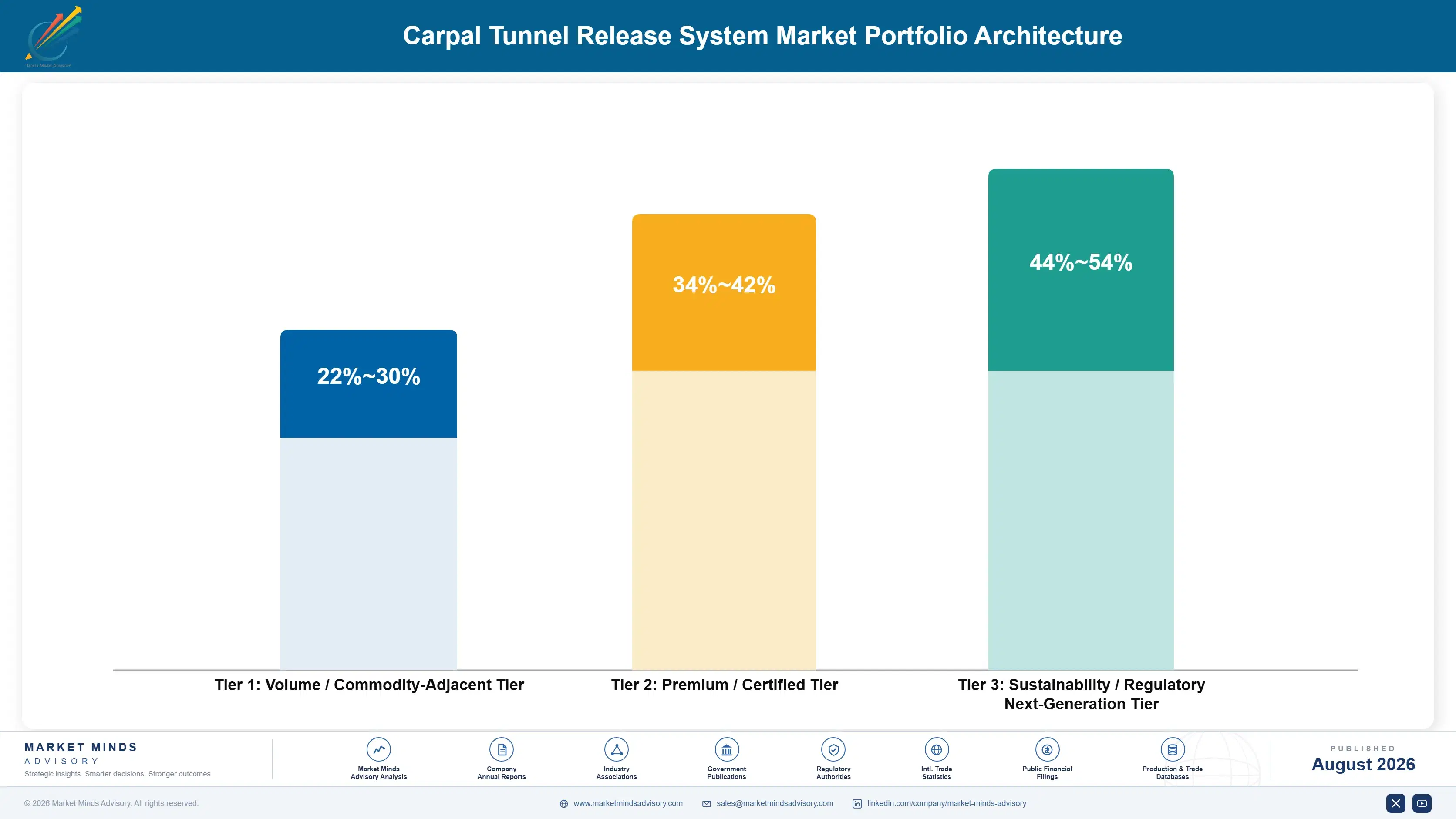
The market organizes into three margin tiers running from commodity reusable instrument sets through certified disposable endoscopic and open release kits to next-generation ultrasound-guided in-office platforms bundled with training and reimbursement support. Gross margins widen substantially moving up this ladder, reflecting both engineering complexity and the training and reimbursement support premium practices pay for at the top tier consistently across most developed healthcare markets.
Volume sits meaningfully in the mid-tier disposable endoscopic release segment by procedure count, but profitability concentrates in premium in-office platforms and next-generation ultrasound-guided systems where practices pay meaningfully more for site-of-care flexibility and bundled training support. This volume-versus-margin tension shapes product development priorities across nearly every major manufacturer's roadmap and capital allocation decisions for the years immediately ahead.

High-value pools concentrate specifically around ultrasound-guided in-office platforms and disposable kit subscription programs, both growing considerably faster than the broader release device category overall. Manufacturers positioned early in these pools are capturing disproportionate profit growth relative to their unit shipment share of the overall market today, a gap likely to widen further as site-of-care migration continues across most developed healthcare systems.

Volume / Commodity-Adjacent Tier

Reusable endoscopic and open release instrument sets sold largely on price and broad hospital compatibility across general orthopedic and hand surgery practices, with sterile processing labor cost offsetting the lower device acquisition price.
Gross Margin: 22-30%

Premium / Certified Tier

Disposable endoscopic and open release kits with established clinical evidence and reimbursement coding precedent, commanding meaningful premiums tied to convenience and infection control advantages across ambulatory surgery center customers nationwide today.
Gross Margin: 34-42%

Sustainability / Regulatory / Next-Generation Tier

Ultrasound-guided in-office platforms bundled with physician training and reimbursement navigation support, carrying the category's highest margins given engineering complexity and the site-of-care cost advantage delivered to practices consistently.
Gross Margin: 44-54%
carpal-tunnel-release-system-market-portfolio-architecture-1787304645213

Site-of-Care Driven Procedure Economics

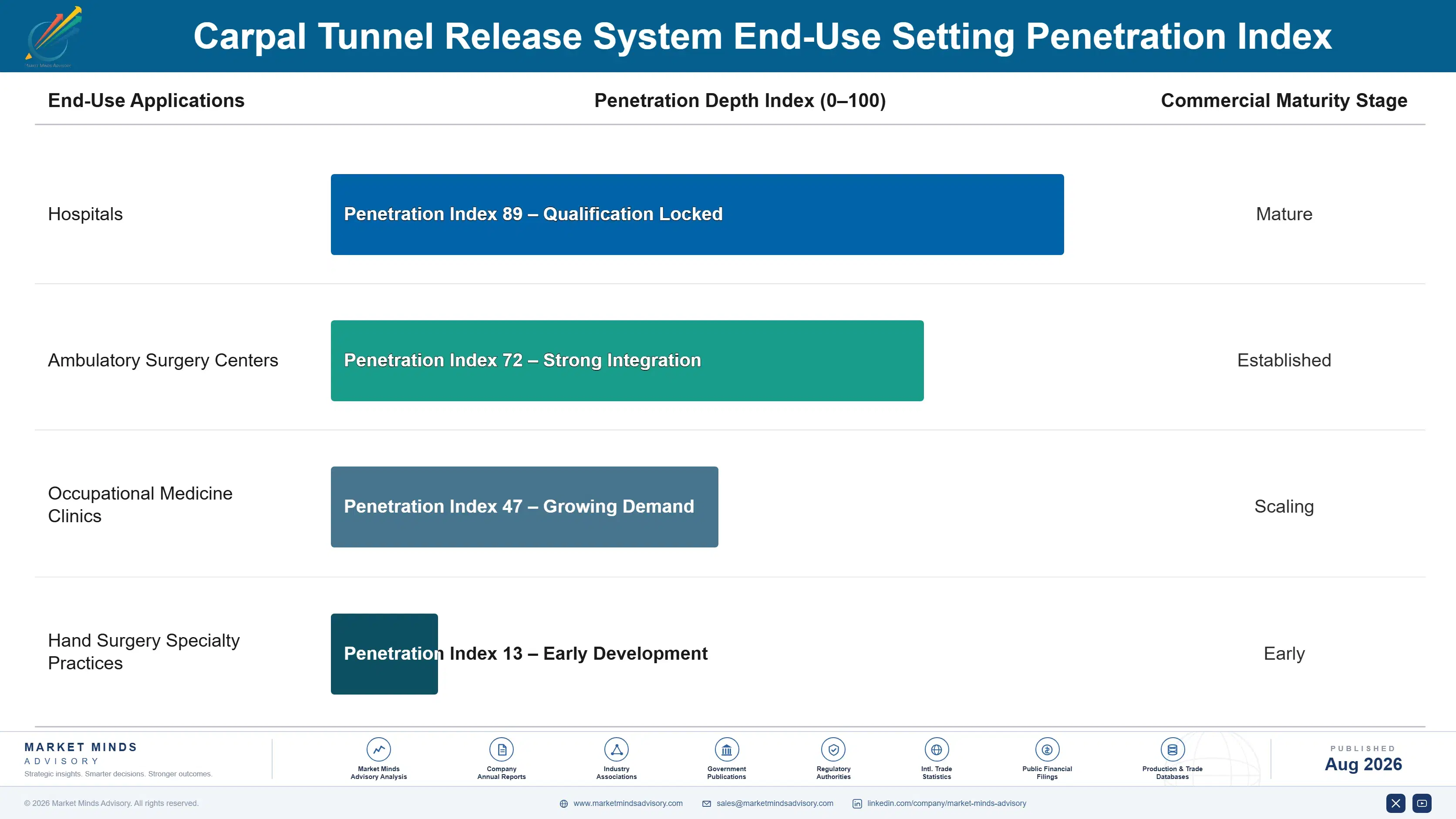
Carpal tunnel release demand functions less like a discretionary elective procedure market and more like an annuity tied to occupational health screening and aging workforce demographics, since diagnosed carpal tunnel syndrome cases require intervention regardless of broader capital budget cycles affecting other elective device categories. This dynamic insulates a meaningful share of procedure growth from the economic cycles that more strongly affect purely cosmetic or discretionary orthopedic p
Adoption depth varies considerably by practice type: occupational medicine clinics and dedicated hand surgery specialty practices have adopted ultrasound-guided in-office release almost universally where reimbursement clarity exists, while general orthopedic practices and smaller community hospitals still rely primarily on established endoscopic and open release technique. Reimbursement-rich developed markets sit well ahead of cost-constrained systems in overall in-office technology adoption depth.

A generational shift in hand surgery buyer profiles is underway as younger surgeons, trained during ultrasound-guided technique's clinical maturation rather than its early adoption period, increasingly expect in-office capability as a standard practice offering rather than a specialized add-on service. This expectation is accelerating in-office platform adoption even in practice segments not yet facing direct competitive pressure to change technique.
carpal-tunnel-release-system-market-end-use-penetration-index-1787304645716

Where MMA Sees The Opportunity

These are among the four positions where our research anticipates prominent divergence between winners and laggards over the coming forecast period. Each is grounded in the demand model, the regulatory perimeter, and the announced capacity pipeline.
01 / REIMBURSEMENT NAVIGATION STRATEGY

Prioritize dedicated reimbursement support over incremental device feature claims

Manufacturers competing primarily on incremental device feature claims without dedicated reimbursement navigation support are fighting an uphill battle against the inconsistent payer coverage landscape that most limits broader in-office release adoption today. Those instead investing heavily in reimbursement navigation infrastructure are converting practice interest into actual purchasing decisions faster than competitors leaving practices to navigate complex coverage determinations independently. MMA views reimbursement support depth as the single clearest predictor of which in-office technique makers achieve durable practice-level adoption over the next decade of category growth and consolidation.
02 / PHYSICIAN TRAINING INVESTMENT

Build structured proctoring programs to overcome the technique learning curve

Ultrasound-guided in-office release requires surgeons to develop genuinely new procedural and imaging interpretation skill, and manufacturers underinvesting in structured training are leaving meaningful adoption potential unrealized among interested but hesitant hand surgeons. Vendors building comprehensive proctoring programs, including hands-on workshops and cadaver lab sessions, are converting surgeon interest into confident independent practice faster than competitors relying on documentation and video training alone. MMA expects physician training depth to remain a durable competitive moat throughout the current forecast period, rewarding manufacturers who invest early and consistently in surgeon education.
03 / AMBULATORY CENTER KIT CONTRACTS

Pursue facility-wide disposable kit contracts before competitors lock in access

Ambulatory surgery centers performing high volumes of hand surgery procedures represent an increasingly attractive customer segment given standardized purchasing processes and strong preference for consolidating vendor relationships across device categories used by all participating surgeons. Manufacturers securing preferred facility-wide vendor status now are capturing disproportionate share of disposable kit spending that would otherwise fragment across multiple competing vendors serving individual surgeons within the same facility. MMA views facility-wide contract capture as a durable strategic opening for manufacturers with strong existing ambulatory surgery center distribution relationships and support infrastructure.
04 / IN-OFFICE TECHNIQUE EXPANSION

Expand in-office platforms into markets still dominated by hospital referral

Site-of-care migration toward ambulatory and in-office settings remains far less advanced outside the United States, leaving substantial international procedure volume still concentrated in hospital-based endoscopic and open release channels with higher facility cost structures. Manufacturers successfully replicating the in-office reimbursement and training playbook developed in the United States within other developed healthcare markets are positioned to capture meaningful first-mover advantage before established endoscopic makers respond. MMA expects international in-office adoption to accelerate meaningfully over the next several years as payers observe United States cost outcomes.

Engagement Snapshot From the Field

A live engagement with an industry participant carrying material or product regulatory and market exposure ahead of a defining policy shift, showing how our research translates into a defensible multi-year portfolio strategy.
MARKET MINDS ADVISORY · CLIENT ENGAGEMENT SUMMARY
Carpal Tunnel Release System Producer Strategic Portfolio Review and Transition Roadmap 2026·Investment Scenario on Carpal Tunnel Release System Exposure Evaluation 2025-26
CLIENT PROFILE
The client is a multi-site occupational medicine practice group serving several manufacturing and logistics employer clients, historically referring diagnosed carpal tunnel syndrome cases entirely to outside hospital surgical centers for release procedures (client-reported, unverified by MMA). Leadership sought to launch an in-house ultrasound-guided release program to reduce patient wait times and capture procedure revenue previously referred externally.
STRATEGIC CHALLENGE
Leadership needed to select an in-office release platform and training partner capable of building physician competency across multiple practice sites within a compressed timeline set by growing employer client volume commitments, while navigating inconsistent regional payer reimbursement policy and controlling capital expenditure across a practice group managing several simultaneous service line priorities.
MMA APPROACH
MMA benchmarked candidate in-office release platforms against training program depth, reimbursement navigation support, and total cost of ownership including per-procedure disposable costs, modeled expected practice-level adoption timeline under three distinct vendor scenarios, and recommended a vendor selection and phased multi-site rollout sequence for the entire group.
KEY FINDINGS
  1. Roughly 70 percent of the practice group's referred carpal tunnel syndrome cases could plausibly be captured in-house under an ultrasound-guided release program based on employer client volume data.
  2. Vendors offering structured multi-site proctoring programs reduced estimated time to physician competency by roughly 35 percent compared to single-site training pathways requiring travel.
  3. Regional payer reimbursement coverage varied meaningfully by practice site, with two of five sites facing more restrictive in-office coverage policy requiring additional documentation.
  4. Disposable kit subscription pricing was projected to reduce per-procedure cost variability meaningfully compared to per-unit ordering across the practice group's five locations.
CLIENT PROFILE
The client is a multi-site occupational medicine practice group serving several manufacturing and logistics employer clients, historically referring diagnosed carpal tunnel syndrome cases entirely to outside hospital surgical centers for release procedures (client-reported, unverified by MMA). Leadership sought to launch an in-house ultrasound-guided release program to reduce patient wait times and capture procedure revenue previously referred externally.
STRATEGIC CHALLENGE
Leadership needed to select an in-office release platform and training partner capable of building physician competency across multiple practice sites within a compressed timeline set by growing employer client volume commitments, while navigating inconsistent regional payer reimbursement policy and controlling capital expenditure across a practice group managing several simultaneous service line priorities.
MMA APPROACH
MMA benchmarked candidate in-office release platforms against training program depth, reimbursement navigation support, and total cost of ownership including per-procedure disposable costs, modeled expected practice-level adoption timeline under three distinct vendor scenarios, and recommended a vendor selection and phased multi-site rollout sequence for the entire group.
KEY FINDINGS
  1. Roughly 70 percent of the practice group's referred carpal tunnel syndrome cases could plausibly be captured in-house under an ultrasound-guided release program based on employer client volume data.
  2. Vendors offering structured multi-site proctoring programs reduced estimated time to physician competency by roughly 35 percent compared to single-site training pathways requiring travel.
  3. Regional payer reimbursement coverage varied meaningfully by practice site, with two of five sites facing more restrictive in-office coverage policy requiring additional documentation.
  4. Disposable kit subscription pricing was projected to reduce per-procedure cost variability meaningfully compared to per-unit ordering across the practice group's five locations.
RECOMMENDED STRATEGY
Phase 1: Phase 1 (Months 1-3): Complete vendor selection and finalize reimbursement navigation support agreements across all five practice sites in the group. Phase 2: Phase 2 (Months 4-9): Complete physician training at priority sites with the most favorable existing payer coverage policy conditions in place. Phase 3: Phase 3 (Months 10-15): Complete remaining site rollout and establish ongoing reimbursement policy monitoring across the full practice network overall.
OUTCOME
Fifteen months into the engagement, the practice group reported successful in-office program launch across all five sites, capturing a meaningful share of previously externally referred procedure volume across its employer client base (client-reported, unverified by MMA), validating MMA's vendor selection and phased rollout recommendation fully.

Frequently Asked Questions

Foundational context covering the market sizes, CAGR, scope, country, region and competition that inform every finding below. This section is provided to cover basics and most often pre-purchase conversations, answered from the MMA Primary Research Dataset.

What is the current size of the Carpal Tunnel Release System Market?

The global Carpal Tunnel Release System Market was valued at approximately $1.3 billion in 2025. Growth is driven by site-of-care migration and expanding occupational health screening programs.

How large will the Carpal Tunnel Release System Market be by 2036?

The market is projected to reach approximately $3.16 billion by 2036, roughly 2.24 times its 2026 value. Growth is led by ultrasound-guided in-office release adoption globally.

What is the CAGR for the Carpal Tunnel Release System Market 2026 to 2036?

The market is forecast to grow at an 8.4 percent CAGR between 2026 and 2036. Bull and bear scenarios range from 9.7 percent to 7.1 percent.

Which segment is growing fastest?

Ultrasound-guided in-office release devices are growing fastest at a 14.2 percent CAGR, roughly 1.69 times the overall market rate, driven by expanding payer coverage.

Who are the major companies in the Carpal Tunnel Release System Market?

Stryker, CONMED, Arthrex, Integra LifeSciences, and Sonex Health lead the market, together holding roughly 39 percent of category revenue on a company-revenue basis today.

Which country is growing fastest?

China is growing fastest among major markets at an estimated 12.3 percent CAGR, driven by an aging population and expanding hand surgery specialty training capacity.

Report Segmentation Architecture

The full report scope spans multiple orthogonal segmentation dimensions, with cross-tabulated demand data provided for each dimension pair. Coverage extends further to regional breakdowns, trend trajectories, and the competitive detail needed to support segment-level decision-making.

By Release Technique and Device Platform

  • Endoscopic Carpal Tunnel Release Systems
  • Open Carpal Tunnel Release Instrumentation
  • Ultrasound-Guided In-Office Release Devices
  • Single-Use Release Blades and Disposables
  • Nerve Monitoring and Visualization Accessories
  • Post-Release Splinting and Rehabilitation Devices

By End-Use Setting

  • Hospitals
  • Ambulatory Surgery Centers
  • Occupational Medicine Clinics
  • Hand Surgery Specialty Practices

By Commercial Dimension

  • Direct Practice Sales
  • Distributor Networks
  • Disposable Kit Subscription Contracts
  • Physician Training Services

By Region

  • North America
  • Western Europe
  • East Asia
  • South Asia and Pacific
  • Latin America
  • Middle East and Africa
  • Eastern Europe

Scope, Methodology, and Coverage

Every figure in this report is reproducible from documented input assumptions. The scope below maps the historical period, the forecast horizon, the segmentation dimensions, and the countries covered, alongside the underlying primary and qualitative methodology.
Historical Period
2020 to 2025
Forecast Period
2026 to 2036
Base Year
2025 (USD billions; MMA Primary Research Dataset, August 2026)
Market Definition
The Carpal Tunnel Release System Market covers endoscopic, open, and ultrasound-guided in-office devices, instrumentation, and disposables used to surgically release the transverse carpal ligament to relieve median nerve compression. It excludes conservative treatment devices such as wrist splints, corticosteroid injection therapy, and post-release physical therapy equipment not directly tied to the release procedure itself.
Quantitative Units
USD billions (current prices); procedure volume where applicable
Segmentation Dimensions
By Release Technique and Device Platform; By End-Use Setting; By Commercial Dimension; By Region
Regions Covered
North America, Western Europe, East Asia, South Asia and Pacific, Latin America, Middle East and Africa, Eastern Europe
Countries Covered
USA, China, Germany, France, UK, Japan, South Korea, India, Australia, Canada, Brazil, Mexico, Indonesia, Vietnam, Thailand, Malaysia, UAE, Saudi Arabia, South Africa, Nigeria, Turkey, Poland, Netherlands, Italy, Spain, Sweden, Switzerland, Argentina, Colombia, Singapore, and additional markets relevant to this sector
Key Companies Profiled
Stryker Corporation, CONMED Corporation, Arthrex Inc., Integra LifeSciences Holdings Corporation, Sonex Health Inc., Smith+Nephew plc, MicroAire Surgical Instruments LLC, Medline Industries LP, Teleflex Incorporated, Acumed LLC, Trimed Inc., Hand Biomechanics Lab Inc., Enovis Corporation, Össur hf, BSN Medical GmbH, Zimmer Biomet Holdings Inc., Extremity Medical LLC, Skeletal Dynamics LLC, KLS Martin Group, Instratek Inc.
Quantitative Methodology
Primary survey, n=3,800 respondents, Q4 2025, six countries; demand-side model with trade association cross-validation
Qualitative Methodology
47 expert interviews, Q4 2025; applied to validate demand model assumptions, identify emerging dynamics, and assess competitive positioning
Report Format
PDF and XLSX data workbook (Word format preview document)
Publisher
Market Minds Advisory
Report Code
MMA-2026-MED-119
Published
August 2026
Contact
sales@marketmindsadvisory.com | www.marketmindsadvisory.com

Purchase the full Carpal Tunnel Release System Market Report (2026 to 2036).

The full Carpal Tunnel Release System Market report provides detailed 2026 to 2036 forecasts across all six technology segments and seven global regions, alongside company-level competitive profiles for the twenty manufacturers covered in this summary. It includes primary survey data from 3,800 hand surgery and occupational medicine practice respondents across six countries, supplemented by 47 expert interviews with device manufacturers, practice administrators, and practicing hand surgeons. The report addresses site-of-care migration trends, reimbursement policy evolution, and disposable kit economics in depth. Segment-level margin analysis and vendor selection frameworks support procurement and practice strategy decisions across the value chain.
Segment-level 2026-2036 forecasts across all six technologies
Full competitive profiles for twenty manufacturers profiled
Regional deep-dive analysis across all seven regions covered
Primary survey data from 3,800 hand surgery practice respondents
47 expert interviews with manufacturers and practicing hand surgeons
Vendor selection and total cost of ownership frameworks included

Built For The People Who Decide

From boardroom strategy to bench-side execution, this report is read cover-to-cover by leaders shaping the next decade of their industry, turning demand scenarios, market dynamics and valuation benchmarks into decisions.
CXOs/ Presidents/ VPs/ Managers
M&A and Corporate Development
Strategy Teams and R&D Heads
Procurement and Product Directors
Regulatory and Compliance Leaders
Investor Relations and Equity Analysts