Market Minds Advisory
Cardiogenic Shock Treatment Market

Cardiogenic Shock Treatment Market: Mechanical Circulatory Support and Acute Stabilization Therapies

Percutaneous ventricular assist devices are steadily displacing balloon pump and inotrope-only protocols as the default cardiogenic shock stabilization pathway, forcing capital-intensive catheterization lab upgrades across tertiary hospitals racing to cut door-to-support time nationwide.

Lead Analyst

Alice Ballenger

Published

September 2026

Make Smarter Decisions with Customized Research Insights

Request a free sample report and evaluate market opportunities, growth trends, and competitive dynamics relevant to your business needs.

2025 MARKET VALUE$3.2BMarket Size 2025
2036 FORECAST VALUE$7.8BBase Case , 2026 to 2036
CAGR 2026 TO 20368.4 %Bull 9.6% / Bear 7.1%
INCREMENTAL OPPORTUNITY$4.3BNet 10- year value creation
EXPANSION MULTIPLE2.24x2036 value over 2026 base
Strategic Levers
M&A Pipeline
Regional Outlook
Country Rankings
Competitive Intelligence
Segmental Deep-dive
Call-Us : 91 93563 13602

Executive Snapshot and Market Trajectory

Hospitals are replacing balloon pump default protocols with percutaneous ventricular assist devices, compressing the window between shock diagnosis and mechanical circulatory support across major tertiary cardiac centres nationwide, as national shock team certification standards push adoption further into community hospital networks, a pattern hospital administrators now treat as the.
Catheterization lab capital spending, expanding Impella-style device reimbursement coverage, and rising ST-elevation infarction complication rates are concentrating demand in North America and East Asia, where interventional cardiology infrastructure is deepest and shock team protocols are most established across leading tertiary hospital networks. China's rapid catheterization capacity buildout is now the single fastest-growing national contributor to overall procedure volume anywhere in the world today overall.
A small group of device manufacturers controls most placements, while emerging temporary right ventricular support and hemodynamic monitoring entrants pressure incumbents as national cardiology societies revise emergency shock team activation guidelines across several major healthcare systems today. Consumable attachment revenue increasingly determines category profitability more than initial console hardware sales ever did across most manufacturer portfolios across most manufacturer portfolios reviewed by MMA this cycle, reshaping how investors value the category overall.
Market Definition
This market covers mechanical circulatory support devices, pharmacological stabilization therapies, and hemodynamic monitoring systems used in the acute treatment of cardiogenic shock. It excludes chronic heart failure durable implants and elective surgical revascularization procedures unrelated to shock stabilization.
Base Year Value
$3.2B in 2025 (MMA Primary Research Dataset, August 2026)
Forecast Period
2026 to 2036, eleven discrete annual values
CAGR
8.4% base case. Bull 9.6%. Bear 7.1%.
Fastest Growth Segment
Percutaneous Ventricular Assist Devices: 11.5% CAGR
Fastest Growth Country
China: 12.6% CAGR
Fastest Growth Region
South Asia and Pacific: 10.4% CAGR
Largest Region
North America: 32% of 2025 global value
Market Leaders
Abiomed (Johnson & Johnson), Getinge AB, LivaNova PLC, Medtronic plc, Abbott Laboratories. Source: MMA Analysis based on company annual reports.
Primary Survey
n=3,800 procurement and R&D decision-makers, Q4 2025, six countries
Methodology
Demand-side build-up, cross-validated against public data, 47 expert interviews

Cardiogenic Shock Treatment Market Forecast Scenarios

cardiogenic-shock-treatment-market-size-forecast-scenario-1787305010286
Cardiogenic shock treatment expanded at roughly 7.4% annually between 2020 and 2025, as hospitals gradually replaced intra-aortic balloon pumps with percutaneous ventricular assist platforms following landmark clinical trial data favoring earlier mechanical support intervention across tertiary centres treating the highest volumes of acute infarction complications nationwide throughout the historical period tracked, giving the category a steadier growth base than many adjacent acute-care device markets experienced.
The base case assumes continued catheterization lab capital investment, broader reimbursement coverage for percutaneous devices across national health systems, and expanding shock team protocol adoption at community hospitals previously limited to balloon pump stabilization only, sustaining an 8.4% blended annual growth rate through 2036. Manufacturer consumable attachment strategy and shock team training bundling both reinforce this trajectory considerably across most markets tracked by MMA analysts on this expansion path through the forecast horizon ahead.
A bull scenario assumes accelerated national shock team certification programmes push device penetration into secondary hospitals faster than expected, lifting growth well above the base case. The bear case centers on reimbursement tightening that slows percutaneous device adoption relative to lower-cost balloon pump alternatives across cost-constrained public hospital systems broadly, delaying the community hospital expansion that underpins base case assumptions.

Mechanical Support Displaces Pharmacological-Only Stabilization

Cardiogenic shock treatment sits at the convergence of interventional cardiology capital spending, emergency medicine protocol reform, and device miniaturization that now allows percutaneous placement without open surgical access in most cases, pulling more hospitals into the category every year as training programmes expand, and this convergence is reshaping capital budgeting decisions at hospitals evaluating new cardiac service line investment, particularly at hospitals weighing multi-year cap
MARKET CONCENTRATIONCR5 71%share controlled by top five device manufacturers combined
AVERAGE DEVICE PRICE$28,500typical price charged per single procedure device unit
LEADING COUNTRY SHAREUnited States 29%share of global procedure volume concentrated domestically there
CATH LAB UTILISATION68%average tertiary hospital catheterization lab capacity utilisation rate
IMPORT DEPENDENCY44%share of device components sourced across international borders
DEVICE REPLACEMENT CYCLESingle-usemost support devices remain single procedure disposable units only
Commercially, this market behaves like a capital equipment and consumable hybrid: hospitals invest in console hardware once, then purchase single-use catheter and pump assemblies per procedure, creating a recurring consumable revenue stream layered atop initial capital sales that increasingly determines manufacturer profitability across the category, and manufacturers increasingly design commercial contracts around this recurring purchasing pattern rather than the initial sale alone, a dynamic that mirrors other high-consumable medical device categories closely.
Over the next decade, national shock team certification, expanding public reimbursement, and growing recognition that early mechanical support improves survival odds will keep pulling volume away from balloon pump and inotrope-only stabilization pathways across most healthcare systems tracked in this study, reshaping how hospitals plan cardiac emergency service line investment over the coming decade.
"The balloon pump isn't dying, it's being demoted. Hospitals keep it as a bridge option while percutaneous VAD platforms become the real first call for shock teams that can afford them."
Director, Cardiovascular Devices Practice · MMA Medical Devices Practice &

Market Trends

Shock Team Certification Programmes Expand Nationally

National cardiology societies including the American College of Cardiology have formalized cardiogenic shock team certification standards, requiring hospitals to demonstrate rapid mechanical circulatory support activation protocols to qualify for advanced tertiary designation. Over 340 US hospitals have pursued certification since the programme launched, each investing in dedicated shock team staffing, catheterization lab readiness, and percutaneous device inventory to meet activation time benchmarks. This formalization is pulling smaller regional hospitals into the percutaneous device market for the first time, expanding the addressable procedure base well beyond the largest academic cardiac centres that historically dominated device adoption.
Market Impact: Affects 8 percent of infarction cas

Miniaturized Percutaneous Platforms Cut Vascular Complications

Second-generation percutaneous ventricular assist devices now use smaller-diameter catheter sheaths, reducing vascular access complications that previously discouraged some interventional cardiologists from routine percutaneous placement over surgical alternatives. Device manufacturers report vascular complication rates have declined by roughly 30% across newer catheter generations compared to first-generation platforms launched over a decade ago. This improvement is expanding the pool of patients considered eligible for percutaneous support, including smaller-bodied and peripheral vascular disease patients previously excluded, while also easing physician hesitancy that had slowed broader adoption across mid-sized hospital systems, and manufacturers expect this trend to continue as further catheter miniaturization.
Market Impact: Narrows reimbursement gap by 22 per

Market Opportunities and Growth Drivers

Rising ST-Elevation Infarction Shock Complication Rates

Cardiogenic shock complicates roughly 8% of ST-elevation myocardial infarction cases presenting to emergency departments, and this share has proven stubbornly persistent despite broader improvements in door-to-balloon percutaneous coronary intervention timing across most health systems. With acute infarction volumes remaining elevated across aging populations in developed markets, the absolute number of shock presentations keeps climbing even as underlying heart attack mortality improves through earlier revascularization. Hospitals treating higher infarction volumes are the primary buyers of mechanical circulatory support hardware, and this driver shows no sign of reversing through the current forecast period.
Market Impact: Excludes hospitals below 25,000 dol

Expanding National Reimbursement for Percutaneous Devices

Government and private payers across major markets have broadened diagnosis-related group reimbursement coverage for percutaneous ventricular assist device procedures, narrowing the cost gap that previously favored lower-cost balloon pump stabilization at budget-constrained hospitals. US Centers for Medicare and Medicaid Services reimbursement updates now cover device costs more completely than five years ago, removing a major adoption barrier for community and regional hospitals evaluating whether to stock percutaneous inventory. As reimbursement parity improves across more national health systems, expect adoption to broaden beyond the largest academic centres that could previously absorb uncovered device costs.
Market Impact: Raises liability insurance costs 18

Market Restraints and Challenges

High Device Cost Limits Community Hospital Adoption

A single percutaneous ventricular assist procedure can cost a hospital upward of $25,000 in device and consumable expense alone, a figure that remains prohibitive for smaller community hospitals operating on thin cardiac service line margins. The root cause is the specialized catheter engineering and single-use design required for safe percutaneous placement, which keeps manufacturing costs elevated relative to reusable balloon pump hardware. This gap concentrates adoption at well-funded tertiary centres while community hospitals default to balloon pumps. Manufacturers are exploring tiered pricing to narrow this gap, and larger hospital systems absorb this cost more easily than smaller independent facilities.
Market Impact: Adds 340 certified US hospital site

Vascular Complication Litigation Exposure Deters Adoption

Despite declining complication rates, percutaneous device placement still carries meaningful vascular injury and limb ischemia risk that has generated product liability litigation against several manufacturers over the past decade. The underlying cause is the inherent trauma of large-bore catheter insertion in patients who are often hemodynamically unstable and poor surgical candidates already. This exposure raises manufacturer insurance costs and makes hospital risk committees hesitant to expand device privileges. Manufacturers are responding with expanded training and smaller-bore devices, while regulators in several major markets separately review post-market surveillance requirements for percutaneous devices more broadly.
Market Impact: Cuts vascular complications by 30 p
3 additional market trends, 2 additional growth drivers, and 4 additional restraints and challenges are covered in the full report. Contact sales@marketmindsadvisory.com to access the complete intelligence.

Segment CAGR and Growth Architecture

This market segments by device and therapy technology type spanning percutaneous ventricular assist devices, balloon pumps, ECMO systems, right ventricular support, pharmacological therapy, and hemodynamic monitoring, reflecting how hospitals build layered shock stabilization capability, spanning hardware, consumables, and monitoring software across the full acute stabilization pathway, reflecting how hospital purchasing committees actually evaluate competing device platforms today.
cardiogenic-shock-treatment-market-market-share-analysis-1787305010814

Percutaneous Ventricular Assist Devices

Percutaneous ventricular assist devices have become the fastest-growing segment as shock team protocols increasingly favor early mechanical support over pharmacological stabilization alone. These catheter-delivered pumps restore cardiac output without open surgical access, letting interventional cardiologists place support hardware during the same catheterization lab session as diagnostic angiography. Hospital adoption is concentrated at certified shock team centres, but expanding reimbursement and smaller-bore catheter generations are pulling community hospitals into the buyer base for the first time. Consumable pump and catheter replacement revenue now exceeds initial console hardware sales for most manufacturers, reflecting a shift toward recurring procedural revenue that is reshaping how manufacturers structure hospital contracts industry-wide for the broader hospital device category overall.
CAGR 11.5%

Extracorporeal Membrane Oxygenation Systems

ECMO systems are expanding fastest among patients presenting with combined cardiac and respiratory failure, where percutaneous ventricular assist devices alone cannot provide sufficient support. Portable ECMO consoles now allow emergency deployment outside dedicated cardiac surgery suites, extending the technology into general intensive care units and even inter-hospital transport scenarios previously impossible with earlier bulkier systems. Training programme expansion for ECMO cannulation has become a bottleneck limiting faster adoption, since the procedure requires specialized surgical or interventional skill beyond standard percutaneous device placement. Manufacturers are investing heavily in simplified cannulation kits and simulation-based training, since qualified operator capacity remains the real constraint on category growth across regional hospital networks over the coming several years.
CAGR 10.8%
Full segment breakdown across 6 segments available in the complete report.

Regional Architecture and Country Demand Map

North America and East Asia together account for the majority of global procedure volume, reflecting concentrated catheterization lab infrastructure, established shock team protocols, and device reimbursement coverage across these two regions, with East Asia closing the gap fastest as national hospital infrastructure investment accelerates across the region.

North America

The United States dominates this region through its dense concentration of shock team certified hospitals, favorable Centers for Medicare and Medicaid Services reimbursement for percutaneous devices, and the largest installed base of interventional cardiologists trained in mechanical circulatory support placement. Canada is expanding provincial coverage for percutaneous devices at major teaching hospitals, though volume remains concentrated in a handful of urban cardiac centres. American academic medical centres continue driving most first-in-market device adoption, giving manufacturers a reliable early revenue base before broader community hospital rollout begins. This region's reimbursement maturity makes it the benchmark market other national health systems reference, while Mexico's northern border hospitals add modest additional cross-border demand.
Share: 32% | CAGR: 9.0% (2026 to 2036)

Western Europe

Germany and the United Kingdom lead regional adoption through national health system tenders that increasingly specify percutaneous device availability at designated cardiac emergency centres, while France has expanded shock team certification following the American model with modest local adaptation. Public health system budget cycles slow purchasing relative to the more fragmented American hospital market, but once approved, national tenders tend to standardize device selection across large hospital networks simultaneously. Scandinavian countries show disproportionately high per-capita procedure volume despite small absolute population, reflecting well-funded universal healthcare systems willing to reimburse advanced mechanical support broadly, and smaller Western European markets are following this same tender-driven adoption pattern closely as top-tier hospital penetration nears saturation.
Share: 24% | CAGR: 6.8% (2026 to 2036)
Regional intelligence for 5 additional markets available in the complete report: East Asia, South Asia and Pacific, Latin America, Middle East and Africa, Eastern Europe. Contact sales@marketmindsadvisory.com.
cardiogenic-shock-treatment-market-country-cagr-analysis-1787305011322

Consumable Attachment and Shock Team Contracting

Manufacturers are shifting commercial strategy toward recurring consumable revenue, bundled shock team training contracts, and tiered pricing for community hospitals, capturing more predictable procedural revenue rather than depending purely on initial console hardware capital sales alone, This shift mirrors broader medical device industry movement toward recurring service-attached commercial models across nearly every manufacturer's commercial strategy reviewed this cycle.

Consumable Catheter and Pump Attachment Programmes

Manufacturers are structuring console placements to maximize downstream single-use catheter and pump consumable purchases, since these disposable components generate materially higher margins than the initial capital hardware sale and recur with every procedure performed. This lever converts a one-time equipment sale into a multi-year recurring revenue relationship, similar to a razor-and-blade commercial model common across other medical device categories. Manufacturers report consumable attachment revenue now represents roughly 65% of total device category revenue, up meaningfully from hardware sales alone five years ago, and increasingly view this ratio as their single most important commercial metric tracked.
Market Impact: Consumables now drive 65 percent of

Bundled Shock Team Certification Training Programmes

Device makers are bundling physician and nursing shock team certification training directly into hospital purchasing contracts, creating a service revenue stream that also deepens clinical dependency on that manufacturer's specific device platform and workflow. Hospitals value this bundled training because it reduces the internal cost and complexity of meeting national shock team certification requirements independently. This lever strengthens customer retention considerably, since switching device platforms would require hospitals to retrain staff on a new workflow entirely. Manufacturers report bundled training contracts adding roughly 12% incremental revenue per certified hospital account annually.
Market Impact: Adds roughly 12 percent incremental

Tiered Pricing for Community Hospital Expansion

Manufacturers are introducing tiered console and consumable pricing structures specifically designed to make percutaneous device adoption financially viable for smaller community hospitals previously priced out of the category entirely. This lever expands the total addressable hospital base considerably beyond the largest academic tertiary centres that historically dominated purchasing, opening a genuinely new customer segment rather than simply competing harder for existing accounts. Early adopters report tiered pricing programmes increasing community hospital account volume by roughly 28% within two years, and manufacturers expect this segment to remain a primary growth driver through the current forecast period.
Market Impact: Grows community hospital accounts b

Remote Hemodynamic Monitoring Subscription Services Layer

Manufacturers are layering cloud-connected hemodynamic monitoring subscription services on top of device hardware sales, giving hospital shock teams remote visibility into patient status and giving manufacturers a recurring software revenue stream distinct from consumable sales. This lever diversifies revenue beyond hardware and disposables into a higher-margin software category that also generates useful clinical outcome data manufacturers can use for future product development and regulatory submissions. Early manufacturer disclosures suggest monitoring subscription attach rates add roughly 9% to total category revenue, and manufacturers expect this software layer to grow faster than hardware revenue alone.
Market Impact: Adds roughly 9 percent from monitor

Who Controls the Margin Pool

The top five device manufacturers control roughly 71% of global placements, with Abiomed holding a commanding lead in the percutaneous ventricular assist device category specifically, while Getinge and LivaNova compete more broadly across balloon pump and ECMO categories where the leader-challenger gap narrows considerably, a gap that has widened further as smaller regional players struggle to match consumable-attached pricing models, particularly outside their traditional core geographic strong
Current competitive activity centers on smaller-bore catheter development to reduce vascular complications, expanded shock team training programme investment to build clinical loyalty, and geographic expansion into community hospitals previously unable to afford percutaneous device categories at all, and manufacturers are also investing in remote monitoring software layers to differentiate beyond hardware alone, reflecting a broader shift in how hospitals evaluate vendor relationships.

Emerging pressure comes from Chinese domestic manufacturers developing lower-cost percutaneous platforms for their home market, and from monitoring-focused entrants building software layers that could eventually shift purchasing leverage away from pure hardware manufacturers toward data and outcomes platforms over the coming years. Established leaders are responding by accelerating their own monitoring software investment to defend existing hospital relationships, while smaller players focus on regional niches instead.
cardiogenic-shock-treatment-market-company-positioning-matrix-1787305011841

Competitive Moat and Risk Dimensions

ABIOMED (JOHNSON & JOHNSON)

Moat: Impella Protocol Clinical Lock-In

Abiomed's Impella platform is embedded directly into national shock team certification protocols and physician training curricula, making it the default reference device that most interventional cardiologists learn on first. This clinical embedding creates genuine switching friction, since hospitals would need to retrain entire shock teams to adopt a competing platform.
ABIOMED (JOHNSON & JOHNSON)

Risk: Vascular Complication Litigation Exposure

Abiomed faces ongoing product liability litigation related to vascular access complications and device malfunction claims, which has drawn regulatory scrutiny and raised insurance costs across its device portfolio. Adverse litigation outcomes or a significant safety recall could damage the clinical trust that underpins its protocol embedding advantage, particularly if newer competitor platforms can credibly claim superior safety data.
GETINGE AB

Moat: Broad Circulatory Support Portfolio

Getinge sells across balloon pumps, ECMO systems, and monitoring hardware simultaneously, letting it offer hospitals a single-vendor relationship spanning the full shock stabilization pathway rather than requiring separate purchasing relationships per device category. This breadth provides cross-selling opportunities and bundled service contracts that narrower competitors focused on a single device category cannot easily replicate.
GETINGE AB

Risk: Legacy Balloon Pump Substitution Risk

A meaningful share of Getinge's circulatory support revenue still derives from balloon pump hardware and consumables, a category facing gradual substitution as percutaneous ventricular assist devices become the preferred first-line option at better-resourced hospitals. If this substitution accelerates faster than Getinge can grow its own percutaneous device offering, legacy balloon pump revenue decline could outpace newer category gains.

Players Tracked

Prominent Players

Abiomed (Johnson & Johnson)
Getinge AB
LivaNova PLC
Medtronic plc
Abbott Laboratories

Other Key Players

Boston Scientific Corporation
Zoll Medical Corporation
Terumo Corporation
Xenios AG
Nipro Corporation
Cardiovascular Systems Inc.
SynCardia Systems LLC
Berlin Heart GmbH
ReliantHeart Inc.
CorWave SA
Procyrion Inc.
Kardion GmbH
Shifamed LLC
Magenta Medical Ltd.
Levitronix LLC

Recent Developments

MARCH 2026

Abiomed Expands Smaller-Bore Catheter Manufacturing Capacity

Abiomed announced an organic capacity expansion at its Massachusetts manufacturing facility to increase production of its smaller-bore percutaneous catheter platform, aimed at meeting rising demand from newly certified community hospital shock team programmes across the United States and select European markets over the coming fiscal year.
Signal: Signals continued manufacturer confidence
SEPTEMBER 2025

Getinge Signs Multi-Year Supply Agreement With European Hospital Network

Getinge entered a multi-year supply agreement with a major Western European hospital network to provide ECMO consoles and consumables across its member hospitals, part of a broader push to standardize circulatory support device selection across large public health system tenders. Financial terms were not fully disclosed.
Signal: Indicates growing importance of network-wi
JANUARY 2026

LivaNova Acquires Hemodynamic Monitoring Software Startup

LivaNova completed the acquisition of a hemodynamic monitoring software developer, adding cloud-connected patient monitoring capability to its circulatory support portfolio and positioning the company to compete more directly on integrated data and outcomes tracking services, Financial terms of the acquisition were not disclosed by either company.
Signal: Reflects broader industry shift toward sof

Catheter Materials and Precision Manufacturing Exposure

Specialized biocompatible catheter materials, precision micro-pump components, and single-use sterile packaging together represent roughly 48% of cost of goods sold for percutaneous device manufacturers, with most specialty polymer and titanium alloy components sourced from a concentrated group of medical-grade material suppliers. Vertically integrated manufacturers face materially less exposure to this concentration than peers dependent on external suppliers.
Medical-grade titanium and specialty polymer prices rose sharply during 2022 and 2023 amid broader supply chain disruption, with the International Energy Agency noting energy-intensive metal processing costs remained elevated through much of the period, squeezing manufacturer margins before prices partially normalized through 2024 and 2025. Company annual reports from major manufacturers confirm margin pressure was most acute during this window and continue watching input cost trends closely heading into the next annual planning cycle across the industry.

Smaller manufacturers without long-term supplier contracts face materially higher input cost volatility than the largest players, who can negotiate multi-year fixed pricing given their purchasing scale. This creates a durable cost disadvantage for smaller device makers competing on price against larger competitors, and geography matters too, since suppliers located closer to manufacturing hubs face smaller logistics cost swings overall.
cardiogenic-shock-treatment-market-cost-volatility-analysis-1787305012035

Multi-Year Fixed Pricing Supplier Contracts

Larger manufacturers are locking in multi-year fixed pricing agreements with specialty material suppliers, insulating device production costs from short-term titanium and polymer price volatility that smaller competitors remain fully exposed to across each purchasing cycle. This approach has become standard practice among the largest device manufacturers globally, particularly those with the strongest balance sheets and purchasing leverage available.

Secondary Supplier Qualification Programmes

Manufacturers are qualifying secondary suppliers for critical catheter materials to reduce dependency on any single source, reducing disruption risk when a primary supplier faces its own capacity constraints or unexpected quality issues during production runs. Smaller manufacturers increasingly pursue this strategy too, despite the added qualification cost involved, and this trend is expected to keep accelerating across the wider industry.

Vertical Integration of Precision Component Manufacturing

Some larger manufacturers are bringing precision micro-pump component manufacturing in-house rather than outsourcing, capturing manufacturing margin previously paid to third-party suppliers while gaining tighter quality control over critical device components. This shift represents a meaningful strategic bet, reflecting confidence that category volume growth will justify the added capital investment required over time across the broader device manufacturing industry.

Portfolio Architecture for Margin Defence

This market organizes into three commercial tiers spanning legacy balloon pump hardware at the volume end, percutaneous ventricular assist devices occupying the premium middle tier, and next-generation monitoring-integrated platforms capturing the highest margins at the top of the portfolio architecture, and manufacturers increasingly structure pricing and contracting strategy around this three-tier architecture explicitly, reflecting how differently each tier is priced and supported.
Volume and premium tiers pull manufacturers in opposite directions: balloon pumps sustain hospital relationships and entry-level revenue, while percutaneous devices deliver materially stronger consumable-driven margins that increasingly determine overall category profitability across most manufacturer portfolios tracked, with most manufacturers now allocating a growing share of research and development budget toward the premium tier specifically, since that tier increasingly drives overall category profitability.

The highest-value pools concentrate around consumable-intensive percutaneous device categories bundled with shock team training contracts, where recurring procedural revenue and clinical workflow lock-in together sustain premium pricing power that legacy balloon pump hardware simply cannot match, and manufacturers unable to compete in this tier increasingly struggle to sustain category-leading margins over time, reinforcing the strategic importance of premium tier investment across the industry.

Volume / Commodity-Adjacent Tier

Balloon pump hardware and consumables sold primarily to budget-constrained community hospitals defaulting to lower-cost stabilization options, representing the largest unit volume category by hospital count served across the market today.
Gross Margin: 28-35%

Premium / Certified Tier

Percutaneous ventricular assist devices and ECMO systems sold to shock team certified tertiary hospitals with strong reimbursement coverage, sold to shock team certified tertiary hospitals with strong reimbursement coverage and training support.
Gross Margin: 52-61%

Sustainability / Regulatory / Next-Generation Tier

Monitoring-integrated platforms and smaller-bore next-generation catheter systems commanding the strongest pricing power, given bundled data and outcomes tracking capability that increasingly determines overall manufacturer profitability across the wider portfolio today.
Gross Margin: 64-72%
cardiogenic-shock-treatment-market-portfolio-architecture-1787305012536

Recurring Procedural Revenue Beyond Console Sales

Device console placements function as an annuity anchor: once a hospital installs percutaneous or ECMO hardware, every subsequent shock case generates recurring single-use consumable purchases, creating a revenue relationship that compounds well beyond the initial capital equipment sale across the device lifecycle, and manufacturers increasingly price hardware competitively specifically to accelerate this downstream consumable revenue relationship, a pattern increasingly central to manufacturer
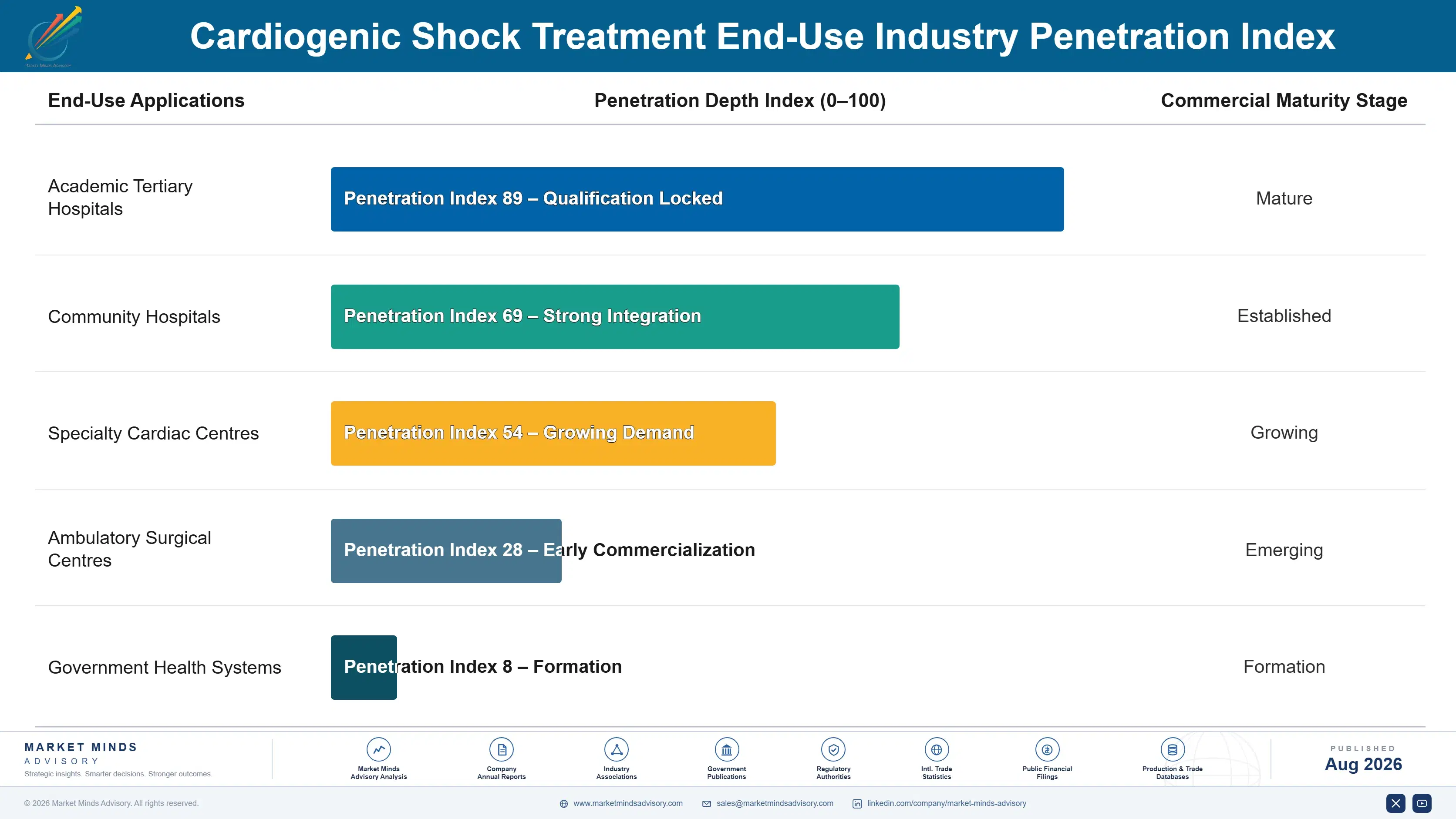
Adoption depth varies considerably by hospital vertical: academic tertiary centres use percutaneous devices as routine first-line therapy, community hospitals reserve them for the most severe cases only, and rural facilities frequently transfer shock patients rather than stocking mechanical support inventory locally at all, and manufacturers tailor commercial and training investment differently across each of these distinct hospital tiers accordingly, reflecting genuinely different risk tolerances across hospital types.

A generational shift is underway as newly trained interventional cardiologists enter practice having learned percutaneous device placement as standard training rather than an advanced specialty skill, gradually normalizing mechanical support as the default rather than exceptional intervention across the wider physician workforce, and manufacturers are adapting training and marketing investment accordingly to reach this newly trained physician cohort.
cardiogenic-shock-treatment-market-end-use-penetration-index-1787305013024

Where Shock Stabilization Economics Are Heading

These are among the four positions where our research anticipates prominent divergence between winners and laggards over the coming forecast period. Each is grounded in the demand model, the regulatory perimeter, and the announced capacity pipeline.
01 / DEVICE CATEGORY MIX

Percutaneous devices will keep taking share from balloon pumps

Hospitals building shock team certification are defaulting to percutaneous ventricular assist devices as first-line therapy, and this preference shows no sign of reversing given consistently favorable outcome data across the clinical literature. Balloon pumps will persist as a bridge and backup option rather than disappearing entirely from hospital inventory. Manufacturers overweighted toward legacy balloon pump revenue face a steadily shrinking core category over the coming decade, regardless of how strongly overall market growth performs across the wider portfolios that MMA analysts reviewed this cycle.
02 / COMMUNITY HOSPITAL EXPANSION

Tiered pricing will open a genuinely new customer segment

Community hospitals previously priced out of percutaneous device categories represent the single largest untapped growth opportunity in this market, and manufacturers offering credible tiered pricing programmes are best positioned to capture this expansion. Hospitals that wait risk losing cardiac service line volume to better-equipped competitors within their own referral network. Expect community hospital account growth to outpace academic centre growth through most of the forecast period ahead within their own referral network over the coming several years ahead, well ahead of many other acute-care device categories tracked currently.
03 / CONSUMABLE REVENUE STRATEGY

Recurring consumable revenue now determines category profitability

Manufacturers that treat console placement as the primary revenue event are underpricing the real value of the consumable attachment relationship that follows every procedure performed thereafter. The razor-and-blade model rewards companies willing to price consoles competitively while protecting consumable margins over the long device relationship lifecycle. Expect further consolidation among manufacturers unable to sustain this recurring revenue model at meaningful scale at meaningful scale across the wider competitive field going forward, particularly those still pricing consoles as the primary one-time revenue event.
04 / SOFTWARE AND MONITORING LAYER

Monitoring software could eventually shift purchasing leverage

Cloud-connected hemodynamic monitoring services are still an early revenue contributor today, but the outcomes data they generate could eventually become as commercially valuable as the hardware itself for regulatory and clinical adoption purposes. Manufacturers without a credible monitoring software strategy risk ceding this emerging layer to specialized entrants. Expect monitoring capability to become a standard bundled expectation rather than a differentiating extra within the next several years within the next several years across most manufacturer product roadmaps tracked, rather than a differentiating extra reserved for advanced tertiary centres.

Engagement Snapshot From the Field

A live engagement with an industry participant carrying material or product regulatory and market exposure ahead of a defining policy shift, showing how our research translates into a defensible multi-year portfolio strategy.
MARKET MINDS ADVISORY · CLIENT ENGAGEMENT SUMMARY
Cardiogenic Shock Treatment Producer Strategic Portfolio Review and Transition Roadmap 2026·Investment Scenario on Cardiogenic Shock Treatment Exposure Evaluation 2025-26
CLIENT PROFILE
The client operates a six-hospital regional network anchored by one tertiary academic centre and five community hospitals, generating combined annual cardiac service line revenue of approximately $210 million (client-reported, unverified by MMA). Leadership sought guidance on which member hospitals should pursue shock team certification first across its member hospital network prior to this engagement beginning in early 2025.
STRATEGIC CHALLENGE
The network's tertiary centre already operated an established shock team, but leadership was uncertain whether extending percutaneous device capability to community hospitals would generate sufficient procedure volume to justify the capital investment and staff training required at each additional site given the scale of capital and training investment involved at each of the five community facilities under review.
MMA APPROACH
MMA's team modeled projected shock case volume at each community hospital against regional infarction incidence data, benchmarked reimbursement economics under current payer contracts, and compared phased rollout scenarios against a single consolidated tertiary-only capability model across the full network to identify the most defensible expansion sequence for the network's board of directors to evaluate.
KEY FINDINGS
  1. Two of five community hospitals showed sufficient projected shock case volume to justify standalone percutaneous device capability within three years of launch.
  2. Consolidating capability at the tertiary centre alone would require patient transfer times exceeding national shock team guideline benchmarks for the three most distant community sites.
  3. Bundled shock team training contracts with a single device manufacturer reduced projected staff certification costs by roughly 24% compared to independent facility-by-facility procurement.
  4. Community hospitals pursuing certification saw measurable growth in overall cardiac service line referral volume beyond shock cases alone within eighteen months of launch.
CLIENT PROFILE
The client operates a six-hospital regional network anchored by one tertiary academic centre and five community hospitals, generating combined annual cardiac service line revenue of approximately $210 million (client-reported, unverified by MMA). Leadership sought guidance on which member hospitals should pursue shock team certification first across its member hospital network prior to this engagement beginning in early 2025.
STRATEGIC CHALLENGE
The network's tertiary centre already operated an established shock team, but leadership was uncertain whether extending percutaneous device capability to community hospitals would generate sufficient procedure volume to justify the capital investment and staff training required at each additional site given the scale of capital and training investment involved at each of the five community facilities under review.
MMA APPROACH
MMA's team modeled projected shock case volume at each community hospital against regional infarction incidence data, benchmarked reimbursement economics under current payer contracts, and compared phased rollout scenarios against a single consolidated tertiary-only capability model across the full network to identify the most defensible expansion sequence for the network's board of directors to evaluate.
KEY FINDINGS
  1. Two of five community hospitals showed sufficient projected shock case volume to justify standalone percutaneous device capability within three years of launch.
  2. Consolidating capability at the tertiary centre alone would require patient transfer times exceeding national shock team guideline benchmarks for the three most distant community sites.
  3. Bundled shock team training contracts with a single device manufacturer reduced projected staff certification costs by roughly 24% compared to independent facility-by-facility procurement.
  4. Community hospitals pursuing certification saw measurable growth in overall cardiac service line referral volume beyond shock cases alone within eighteen months of launch.
RECOMMENDED STRATEGY
Phase 1: Phase 1 (Months 1-6): Certify the two highest-volume community hospitals first, using the tertiary centre's existing shock team as a training and mentorship resource. Phase 2: Phase 2 (Months 7-14): Negotiate a bundled multi-site device and training contract with a single manufacturer to capture volume-based pricing discounts. Phase 3: Phase 3 (Months 15-24): Evaluate the remaining three community hospitals for certification based on updated referral volume and transfer time data.
OUTCOME
The network certified its two highest-priority community hospitals within the recommended timeline, reporting a 19% increase in network-wide shock case capture and an estimated $8.4 million in retained cardiac service line revenue previously lost to competing regional networks (client-reported, unverified by MMA) within the first full year of the certification programme.

Frequently Asked Questions

Foundational context covering the market sizes, CAGR, scope, country, region and competition that inform every finding below. This section is provided to cover basics and most often pre-purchase conversations, answered from the MMA Primary Research Dataset.

What is the current size of the Cardiogenic Shock Treatment Market?

The global cardiogenic shock treatment market was valued at approximately $3.2 billion in 2025. This includes mechanical circulatory support devices, pharmacological therapies, and hemodynamic monitoring systems used in acute shock stabilization.

How large will the Cardiogenic Shock Treatment Market be by 2036?

The market is projected to reach approximately $7.77 billion by 2036. This reflects sustained growth in percutaneous device adoption and expanding shock team certification programmes across major hospital networks.

What is the CAGR for the Cardiogenic Shock Treatment Market 2026 to 2036?

The market is expected to grow at a compound annual growth rate of 8.4% between 2026 and 2036. This is supported by continued catheterization lab capital investment and reimbursement expansion.

Which segment is growing fastest?

Percutaneous ventricular assist devices are the fastest-growing segment, expanding at approximately 11.5% annually. This reflects their displacement of balloon pump and inotrope-only stabilization protocols across most tertiary hospitals.

Who are the major companies in the Cardiogenic Shock Treatment Market?

Leading companies include Abiomed (Johnson & Johnson), Getinge AB, LivaNova PLC, Medtronic plc, and Abbott Laboratories. These five manufacturers together account for roughly 71% of global device placements.

Which country is growing fastest?

China is the fastest-growing major market at an estimated 12.6% CAGR, driven by rapid tertiary catheterization lab infrastructure expansion under national hospital investment programmes under national hospital investment programmes.

Report Segmentation Architecture

The full report scope spans multiple orthogonal segmentation dimensions, with cross-tabulated demand data provided for each dimension pair. Coverage extends further to regional breakdowns, trend trajectories, and the competitive detail needed to support segment-level decision-making.

By Device and Therapy Type

  • Percutaneous Ventricular Assist Devices
  • Intra-Aortic Balloon Pumps
  • ECMO Systems
  • Temporary Right Ventricular Assist Devices
  • Pharmacological Therapy
  • Hemodynamic Monitoring Systems

By End-Use Industry

  • Academic Tertiary Hospitals
  • Community Hospitals
  • Specialty Cardiac Centres
  • Ambulatory Surgical Centres
  • Government Health Systems

By Commercial Dimension

  • Direct Hospital Procurement
  • Group Purchasing Organizations
  • National Tender Contracts
  • Distributor Networks

By Region

  • North America
  • Western Europe
  • East Asia
  • South Asia and Pacific
  • Latin America
  • Middle East and Africa
  • Eastern Europe

Scope, Methodology, and Coverage

Every figure in this report is reproducible from documented input assumptions. The scope below maps the historical period, the forecast horizon, the segmentation dimensions, and the countries covered, alongside the underlying primary and qualitative methodology.
Historical Period
2020 to 2025
Forecast Period
2026 to 2036
Base Year
2025 (USD billions; MMA Primary Research Dataset, August 2026)
Market Definition
This report covers mechanical circulatory support devices, pharmacological stabilization therapies, and hemodynamic monitoring systems used specifically in the acute treatment of cardiogenic shock. It excludes chronic durable heart failure implants, elective surgical revascularization, and general intensive care monitoring unrelated to acute shock stabilization.
Quantitative Units
USD billions (current prices); device unit shipments; procedure volume
Segmentation Dimensions
By Device and Therapy Type; By End-Use Industry; By Commercial Dimension; By Region
Regions Covered
North America, Western Europe, East Asia, South Asia and Pacific, Latin America, Middle East and Africa, Eastern Europe
Countries Covered
USA, China, Germany, France, UK, Japan, South Korea, India, Australia, Canada, Brazil, Mexico, Indonesia, Vietnam, Thailand, Malaysia, UAE, Saudi Arabia, South Africa, Nigeria, Turkey, Poland, Netherlands, Italy, Spain, Sweden, Switzerland, Argentina, Colombia, Singapore, and additional markets relevant to this sector
Key Companies Profiled
Abiomed (Johnson & Johnson), Getinge AB, LivaNova PLC, Medtronic plc, Abbott Laboratories, Boston Scientific Corporation, Zoll Medical Corporation, Terumo Corporation, Xenios AG, Nipro Corporation, Cardiovascular Systems Inc., SynCardia Systems LLC, Berlin Heart GmbH, ReliantHeart Inc., CorWave SA, Procyrion Inc., Kardion GmbH, Shifamed LLC, Magenta Medical Ltd., Levitronix LLC
Quantitative Methodology
Primary survey, n=3,800 respondents, Q4 2025, six countries; demand-side model with trade association cross-validation
Qualitative Methodology
47 expert interviews, Q4 2025; applied to validate demand model assumptions, identify emerging dynamics, and assess competitive positioning
Report Format
PDF and XLSX data workbook (Word format preview document)
Publisher
Market Minds Advisory
Report Code
MMA-2026-MED-114
Published
August 2026
Contact
sales@marketmindsadvisory.com | www.marketmindsadvisory.com

Purchase the full Cardiogenic Shock Treatment Market Report (2026 to 2036).

The full report provides detailed device-level segmentation, hospital procurement pattern analysis, and country-level reimbursement policy tracking across all seven regions covered in this study. It includes manufacturer-level competitive benchmarking based on shock team certification partnerships and consumable attachment strategy. Subscribers receive quarterly updates tracking reimbursement policy changes and new device regulatory approvals as they occur. A companion dataset provides procedure volume estimates by hospital tier for detailed market sizing, giving subscribers a continuously current view of this fast-moving category. A dedicated analyst contact is also available for custom data requests beyond the standard deliverable scope.
Detailed device-level segmentation breakdown by category
Hospital procurement pattern trend analysis by region
Country-level reimbursement policy tracking and updates
Manufacturer competitive benchmarking scorecards and comparisons
Quarterly regulatory and approval update service
Procedure volume dataset segmented by hospital tier

Built For The People Who Decide

From boardroom strategy to bench-side execution, this report is read cover-to-cover by leaders shaping the next decade of their industry, turning demand scenarios, market dynamics and valuation benchmarks into decisions.
CXOs/ Presidents/ VPs/ Managers
M&A and Corporate Development
Strategy Teams and R&D Heads
Procurement and Product Directors
Regulatory and Compliance Leaders
Investor Relations and Equity Analysts