

Market Minds Advisory
Cardiac Ultrasound Systems Market

Cardiac Ultrasound Systems Market: The Sonographer Constraint, Handheld Dilution, and Catheter Consumables

Echocardiography is the most ordered cardiac test in the world and the hardest to acquire well, which is why the binding constraint on this market is trained hands rather than installed machines.

Lead Analyst

Alice Ballenger

Published

September 2026

Make Smarter Decisions with Customized Research Insights

Request a free sample report and evaluate market opportunities, growth trends, and competitive dynamics relevant to your business needs.

2025 MARKET VALUE$2.3BMarket Size 2025
2036 FORECAST VALUE$5.0BBase Case , 2026 to 2036
CAGR 2026 TO 20367.4 %Bull 8.6% / Bear 6.2%
INCREMENTAL OPPORTUNITY$2.6BNet 10- year value creation
EXPANSION MULTIPLE2.04x2036 value over 2026 base
Strategic Levers
M&A Pipeline
Regional Outlook
Country Rankings
Competitive Intelligence
Segmental Deep-dive
Call-Us : 91 93563 13602

Executive Snapshot and Market Trajectory

Image quality in echocardiography depends on the person holding the probe far more than on the machine they are holding, and trained sonographers are in short supply almost everywhere. Departments across developed markets now own scanners they cannot reliably staff. Machines are not the binding constraint anywhere in this market.
Intracardiac echocardiography compounds at 11.1%, a full 1.50x the market rate, because single-use imaging catheters guiding ablation and structural heart procedures bring consumable economics into a capital equipment category that has never had them before. East Asia holds the largest share at 28% on unit volumes, driven by Chinese hospital equipping programmes and by domestic manufacturers who now compete credibly on cardiac imaging performance. Unit volumes there exceed every other region comfortably.
Concentration is high at 76%, with GE HealthCare and Philips holding the cardiology-dedicated premium positions that carry the highest prices in the category. Handheld devices now account for roughly 41% of units shipped and a far smaller fraction of value. Replacement cycles have stretched to 8.5 years as software upgrades let hospitals defer capital purchases far longer than before, which puts sale timing firmly in the customer's hands.
Market Definition
This market covers ultrasound imaging systems and devices dedicated to or substantially used for cardiac examination, spanning premium and mid-range cart-based cardiovascular systems, compact and portable cardiac scanners, handheld cardiac devices, transesophageal echocardiography systems and intracardiac echocardiography systems including their single-use catheters. Measurement is at manufacturer revenue for systems, dedicated probes and catheters. General-purpose radiology and obstetric ultrasound, cardiac MRI and CT, nuclear cardiology, standalone image analysis software sold separately from hardware, and third-party service contracts are excluded.
Base Year Value
$2.3B in 2025 (MMA Primary Research Dataset, August 2026)
Forecast Period
2026 to 2036, eleven discrete annual values
CAGR
7.4% base case. Bull 8.6%. Bear 6.2%.
Fastest Growth Segment
Intracardiac Echocardiography Systems: 11.1% CAGR
Fastest Growth Country
India: 11.8% CAGR
Fastest Growth Region
South Asia and Pacific: 9.4% CAGR
Largest Region
East Asia: 28% of 2025 global value
Market Leaders
GE HealthCare, Philips, Siemens Healthineers, Canon Medical Systems, and Mindray. Source: MMA Primary Research Dataset, July 2026.
Primary Survey
n=3,800 procurement and R&D decision-makers, Q4 2025, six countries
Methodology
Demand-side build-up, cross-validated against public data, 47 expert interviews

Cardiac Ultrasound Systems Market Forecast Scenarios

cardiac-ultrasound-systems-market-size-forecast-scenario-1787304861557
Growth ran near 6.4% from 2020 to 2025, held back at the start by deferred hospital capital and pulled forward later by point-of-care adoption that the same period accelerated sharply. Handheld and compact devices sold in volumes nobody had forecast, while cart replacement stalled and then recovered unevenly. Chinese manufacturers took meaningful cardiac share from the established four across Asia and beyond.
Base case growth of 7.4% rests on three mechanisms operating largely independently of each other. Structural heart and electrophysiology procedure volumes keep rising, and each procedure now consumes imaging catheters rather than merely occupying a scanner. Artificial intelligence guidance lets less experienced operators acquire diagnostic images, which partially relieves the staffing constraint. And replacement demand from a large installed base resumes as deferred capital cycles finally close. None of the three depends on the others arriving first.
The bull case at 8.6% assumes intracardiac imaging becomes standard practice in atrial fibrillation ablation, converting a capital market into a consumables one across a large procedure population. The bear case at 6.2% is a staffing failure: vacancies worsen faster than guidance software compensates, scan volumes fall short of referral demand, and hospitals defer replacement because utilisation never justifies it.

Cardiac Ultrasound: Constrained Hands, Lengthening Cycles

Echocardiography has a problem that no other major imaging modality shares. A cardiac CT is acquired by a machine following a protocol; an echocardiogram is acquired by a person angling a probe between ribs, and the diagnostic value of the study depends heavily on how well they do it. Inter-operator variability in ejection fraction measurement remains stubbornly wide. Every technology direction here, guidance software included, traces back to that difficulty.
TOP FIVE CONCENTRATION76%Established imaging manufacturers plus one fast-rising domestic Chinese competitor
PREMIUM SYSTEM PRICEUSD 165,000Typical cardiology-configured cart system with dedicated transducers and software
SYSTEM REPLACEMENT CYCLE8.5 yearsAverage interval between cardiology department cart system replacements, and lengthening
INSTALLED BASE WORLDWIDE385,000 systemsCardiac-capable ultrasound systems in clinical service across all care settings
GUIDED ACQUISITION ADOPTION34%Cardiology departments using software guidance for image acquisition support
HANDHELD UNIT SHARE41%Proportion of cardiac units shipped that are handheld devices
The consequence is a staffing constraint rather than an equipment one. Cardiac sonographer vacancy rates run high across North America and Western Europe, training takes years, and repetitive strain injury pushes experienced staff out of the profession early. Departments hold machines they cannot fully use. That is why guidance software sells on workflow rather than diagnostic arguments: no payer reimburses scanning with fewer trained people.
Meanwhile the fastest-growing part of the category is barely a system business at all. Intracardiac echocardiography catheters are single-use devices consumed during ablation and structural heart procedures, and they bring per-case revenue into a market otherwise built on capital sales every eight and a half years. Cardiology device manufacturers understand that model instinctively, while imaging manufacturers formed by selling carts have adapted more slowly.
"Hospitals keep asking vendors for better image quality when what they actually lack is somebody available to acquire the image. The vendor that solves the staffing arithmetic rather than the pixel count will take share, and it may well not be one of the traditional four."
Principal Analyst, Diagnostic Imaging and Cardiovascular Devices Practice · MMA

Market Trends

Guidance software lets non-experts acquire diagnostic cardiac images

Acquisition guidance software tells an operator in real time how to angle and position the probe to obtain a standard cardiac view, and cleared products from several developers now support novices reaching diagnostic quality. Roughly 34% of cardiology departments use some form of acquisition support. The commercial argument is staffing rather than accuracy: a department short of sonographers can extend scanning to nurses and trainees. Reimbursement pays nothing extra for it, so the entire value case rests on throughput. Several health systems have formally extended scanning duties to nurse practitioners on exactly that basis.
Market Impact: Procedure volumes rising 9% yearly

Imaging catheters bring consumable economics into capital equipment

Intracardiac echocardiography catheters are single-use devices consumed during each ablation or structural heart procedure, generating per-case revenue in a category otherwise dependent on capital purchases spaced 8.5 years apart. Procedure volumes in atrial fibrillation ablation and left atrial appendage closure keep rising, and each case pulls a catheter with it. Cardiology device manufacturers arrived with the right commercial model already built, while imaging manufacturers accustomed to selling carts have adapted more slowly. Installed cart base confers no advantage here, because the buying decision sits inside the procedure room rather than with an imaging committee.
Market Impact: Roughly 4 scans per patient annuall

Market Opportunities and Growth Drivers

Structural heart procedure volumes pull cardiac imaging with them

Transcatheter valve replacement, mitral repair and left atrial appendage closure have moved from specialist referral centres into mainstream cardiology, and every one of those procedures requires imaging before, during and after intervention. Transesophageal and intracardiac imaging are both procedural requirements rather than optional additions. As eligibility criteria widen toward lower-risk patients, procedure populations grow substantially, and imaging demand grows with them at essentially the same rate. Appendage closure and mitral repair volumes have risen steeply from a small base, and each case now consumes an imaging catheter alongside the procedural device itself.
Market Impact: Vacancy rates above 12%

Heart failure management requires repeated serial echocardiography

Heart failure patients receive echocardiograms at diagnosis, after each therapy change and at regular intervals thereafter, which makes the modality a recurring examination rather than a single diagnostic event. Guideline-directed medical therapy now involves four drug classes titrated over months, each adjustment prompting reassessment of ventricular function. Prevalence continues rising with ageing populations across every developed market. Scan volume growth consistently outpaces the capacity of departments to deliver it. Departments report referral backlogs rather than idle capacity, and the shortfall is staffing rather than equipment. Demand of this kind is unusually predictable and the gap remains difficult to close.
Market Impact: Cycles stretched to 8.5 years

Market Restraints and Challenges

Sonographer shortages leave installed systems substantially underused

Cardiac sonographer vacancy rates run into double digits across North America and Western Europe, and departments routinely hold scanners they cannot staff for a full working day. The root cause is a training pipeline measured in years combined with repetitive strain injury that shortens careers considerably. Commercial impact is deferred replacement, because a hospital will not buy a system it cannot run. Guidance software, task-shifting to nurse practitioners and ergonomic probe redesign are the pathways participants are pursuing. None of those pathways closes the gap quickly, since the training pipeline itself is what limits supply.
Market Impact: Adopted by 34% of departments

Software upgrades let hospitals defer capital replacement repeatedly

Cart systems now receive substantial functional improvement through software releases rather than hardware refresh, and replacement cycles have accordingly stretched to around 8.5 years from closer to six a decade ago. The root cause is that manufacturers built upgradeable platforms to sell software, then found the same platforms let customers postpone buying new hardware. Commercial impact falls on capital revenue. Vendors are responding with subscription pricing, managed equipment services and usage-based contracts that decouple revenue from replacement timing. Whether customers accept those models at scale remains genuinely unresolved. Capital revenue forecasting has become materially harder as a result.
Market Impact: Compounding at 11.1% annually
4 additional market trends, 3 additional growth drivers, and 2 additional restraints and challenges are covered in the full report. Contact sales@marketmindsadvisory.com to access the complete intelligence.

Segment CAGR and Growth Architecture

Segmentation follows device class, because class determines price point, purchasing process, care setting and whether revenue arrives as capital or consumable. Six classes cover cardiac ultrasound supply without overlap between them. Clinical application and care setting cut across several classes at once and are therefore treated as use attributes rather than as segments in this framework.
cardiac-ultrasound-systems-market-market-share-analysis-1787304862094

Intracardiac Echocardiography Systems

Growing at 11.1%, a full 1.50x the market rate, intracardiac echocardiography uses a single-use imaging catheter advanced into the heart to guide ablation and structural intervention from inside the chamber being treated. Procedure volumes in atrial fibrillation ablation and left atrial appendage closure drive it directly, and each case consumes a catheter rather than merely occupying a scanner. That per-case revenue model is unlike anything else in cardiac ultrasound. Cardiology device manufacturers hold strong positions here precisely because the commercial model matches what they already do everywhere else. Imaging manufacturers arriving from departmental sales have found the procedure room a considerably harder room to enter than expected. That gap is commercial rather than technical.
CAGR 11.1%

Handheld Cardiac Ultrasound Devices

Handheld devices grow at 9.6% and now represent roughly 41% of cardiac units shipped while contributing a far smaller share of value, which is the central tension in this segment. They extend cardiac imaging to the bedside, the ambulance, the primary care clinic and the emergency department, where no cart would ever be placed. Acquisition guidance software matters most here, since operators are frequently not trained sonographers. The commercial risk is dilution: every handheld sold to a department that might otherwise have bought a compact system substitutes a small sale for a large one. Whether that dilution is worth the volume depends entirely on whether handheld buyers were ever realistic cart customers, and frequently they were not.
CAGR 9.6%
Full segment breakdown across 6 segments available in the complete report.

Regional Architecture and Country Demand Map

Regional value reflects two different things at once: unit volumes driven by hospital equipping programmes, and value per unit driven by procedure mix and premium configuration. The two do not point to the same regions at all. Reading either measure alone misleads on where cardiac demand actually concentrates.

East Asia

East Asia takes the largest share at 28%, on unit volumes rather than on price. Chinese hospital equipping programmes extended cardiac imaging capability into county-level facilities that previously referred every echocardiogram onward, and the resulting installed base is now the largest anywhere. Mindray and SonoScape compete credibly on cardiac performance at prices the established manufacturers struggle to meet, and they have taken domestic share accordingly. Japanese and South Korean demand is replacement-driven and premium-weighted, with Canon and Samsung Medison holding strong home positions. Procedural imaging adoption lags North America considerably. Structural heart programmes are expanding quickly from a small base, particularly across Chinese tertiary centres, which will lift procedural imaging demand materially over the forecast period.
Share: 28% | CAGR: 8.4% (2026 to 2036)

North America

Twenty-seven per cent of value on materially fewer units than East Asia, because procedure mix and configuration push average selling prices higher here than anywhere else. Structural heart and electrophysiology volumes are the highest globally, which makes this the principal market for transesophageal and intracardiac imaging alike. Sonographer vacancy rates are severe enough that guidance software sells on staffing arguments rather than clinical ones. Replacement cycles have lengthened as hospital capital committees stretched budgets, and managed equipment service contracts have grown in response to exactly that pressure. Handheld adoption in emergency departments and prehospital settings is the most advanced anywhere, and much of it bypassed capital committee approval entirely. Guidance software adoption leads globally.
Share: 27% | CAGR: 7.0% (2026 to 2036)
Regional intelligence for 5 additional markets available in the complete report: Western Europe, South Asia and Pacific, Latin America, Middle East and Africa, Eastern Europe. Contact sales@marketmindsadvisory.com.
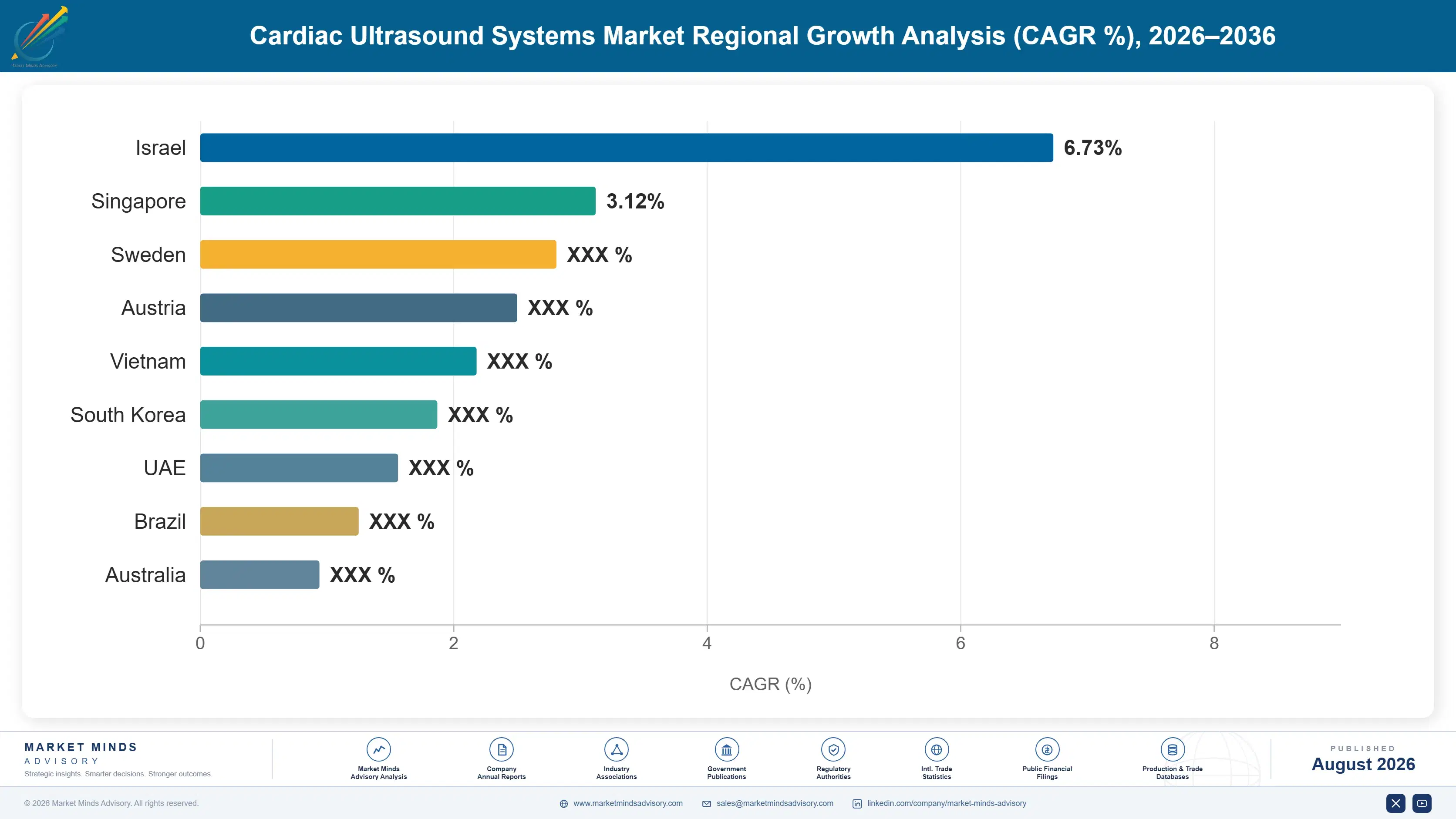
cardiac-ultrasound-systems-market-country-cagr-analysis-1787304862620

Where Cardiac Ultrasound Margin Actually Sits

Capital sales arrive every 8.5 years and are being deferred further, so revenue durability now depends on what a manufacturer sells between replacements. Consumables, software and service each decouple revenue from the replacement cycle, and each requires commercial habits that imaging manufacturers did not historically need. Selling only at replacement now means selling on a schedule the customer sets.

Build a per-case consumable position in procedural imaging

Intracardiac echocardiography catheters generate revenue with every ablation and structural heart case rather than once every 8.5 years, and the segment compounds at 11.1% on rising procedure volumes. That converts a capital relationship into a recurring one without requiring the customer to buy anything new. Cardiology device manufacturers built this model decades ago and apply it instinctively. Imaging manufacturers who treat catheters as an accessory to a scanner are misreading where the durable revenue in this category now sits. Procedure room access is the real barrier, and it is a commercial problem rather than a technical one.
Market Impact: Recurring revenue from a segment gr

Sell guidance software against the staffing constraint

Cardiac sonographer vacancy rates exceed 12% across developed markets, and departments hold systems they cannot staff for a full day. Acquisition guidance lets nurses and trainees produce diagnostic images, which addresses the constraint that actually limits scan volume. Roughly 34% of departments have adopted some form of it. No payer reimburses guidance separately, so the argument must be throughput and staffing economics rather than diagnostic accuracy, and vendors still pitching image quality are answering a question nobody asked. Throughput gains are measurable within a quarter, which makes the business case unusually easy for a department manager to defend internally.
Market Impact: Addresses sonographer vacancy rates

Convert capital purchasing into subscription and managed service

Replacement cycles have stretched from roughly six years to 8.5 as software upgrades let hospitals defer hardware entirely, and capital committees under pressure will keep stretching them. Subscription pricing, managed equipment services and usage-based contracts move revenue off the replacement calendar and onto an annual basis the customer budgets differently. European public procurement has proved receptive to total-cost framework agreements. Manufacturers still forecasting revenue from installed base age are forecasting against a cycle that keeps moving. Annual contracting also gives forecast visibility that capital sales never provided, and customers budget it differently.
Market Impact: Decouples revenue from the 8.5 year

Defend mid-range share against credible domestic competition

Mindray and SonoScape now compete on cardiac imaging performance at prices established manufacturers cannot match, and they have taken meaningful share across Asia while advancing into Latin America and Eastern Europe. Roughly 28% of category value sits in East Asia where that competition is fiercest. Defending mid-range positions requires either cost structures that do not currently exist or clinical differentiation genuine enough to justify the gap. Ceding the segment entirely surrenders the installed base that premium upgrades later depend upon. Selective defence, chosen on service revenue and installed base rather than on tender share, is the workable middle position.
Market Impact: Defends roughly 28% of the total ca

Who Controls the Margin Pool

Concentration is high at 76% across the top five, measured on annual revenue from cardiac ultrasound systems, dedicated probes and imaging catheters, the single basis applied throughout this analysis. GE HealthCare and Philips hold the cardiology-dedicated premium positions carrying the highest prices, with Siemens Healthineers and Canon Medical close behind on installed base. Mindray reached the top five from outside the traditional imaging group entirely.
Competition runs on three dimensions that rarely resolve together. Premium cart competition turns on cardiology-specific imaging performance, strain and quantification software, and long-standing relationships with academic cardiology departments. Mid-range competition is increasingly a price contest that Chinese manufacturers are winning across several regions. Procedural imaging is a different contest again, fought on procedure-room access rather than on imaging department relationships.

Pressure builds from two directions simultaneously. Handheld specialists including Butterfly Network and Exo Imaging sell into settings the established manufacturers never served, and every such sale potentially displaces a compact system purchase later. Separately, guidance software developers are establishing positions independent of hardware entirely. Rankings shift most in procedural imaging, where installed cart base confers no advantage and the buying decision sits with interventional cardiologists rather than with imaging departments.
cardiac-ultrasound-systems-market-company-positioning-matrix-1787304863145

Competitive Moat and Risk Dimensions

GE HEALTHCARE

Moat: Cardiology department installed base

The cardiology-dedicated cart line holds deep positions in academic and high-volume cardiology departments, where quantification workflows, stored study archives and sonographer familiarity all raise the cost of switching considerably. Departments that have measured ejection fraction on one platform for a decade resist changing the tool that generates their serial comparisons, and that inertia is genuinely valuable.
GE HEALTHCARE

Risk: Capital cycle revenue exposure

Revenue remains weighted toward capital cart sales at a time when replacement cycles have stretched to 8.5 years and hospital capital committees keep deferring further. Position in single-use procedural imaging is considerably weaker than in departmental systems. Chinese competition in mid-range configurations erodes the installed base that future premium upgrades are expected to come from.
PHILIPS

Moat: Premium cardiology imaging performance

The cardiovascular ultrasound line holds a long-established reputation for transthoracic and transesophageal image quality in demanding structural heart work, which matters enormously to interventional cardiologists selecting procedural imaging. Integration with the wider interventional imaging portfolio gives procedure-room access that pure ultrasound manufacturers cannot easily replicate through departmental relationships alone.
PHILIPS

Risk: Portfolio and execution distraction

Cardiac ultrasound sits inside a broad health technology portfolio that has absorbed considerable management attention on unrelated matters in recent years, which risks underinvestment in a category moving quickly. Handheld and guidance software entrants are addressing the staffing constraint faster. Mid-range price competition from Chinese manufacturers pressures volume positions across several growth regions.

Players Tracked

Prominent Players

GE HealthCare
Philips
Siemens Healthineers
Canon Medical Systems
Mindray

Other Key Players

Fujifilm Sonosite
Samsung Medison
Konica Minolta Healthcare
SonoScape Medical
Esaote
Butterfly Network
EchoNous
Exo Imaging
Clarius Mobile Health
Boston Scientific
Johnson & Johnson MedTech
Abbott Laboratories
Chison Medical Imaging
Ultrasight
Us2.ai

Recent Developments

FEBRUARY 2025

Guidance software clearances extend cardiac scanning to non-specialist operators

Regulatory clearances for acquisition guidance software supporting novice operators broadened across several developers, allowing nurses and trainees to obtain diagnostic-quality cardiac views in departments where sonographer vacancies had left installed systems substantially underused. Several health systems formally extended scanning duties to nurse practitioners on that basis.
Signal: Vendors are now selling directly against t
SEPTEMBER 2025

Intracardiac imaging adoption widens in atrial fibrillation ablation

Electrophysiology centres expanded routine intracardiac echocardiography use during ablation procedures, an organic practice shift rather than any corporate transaction, driven by rising ablation volumes and by growing preference for imaging without general anaesthesia requirements. Adoption widened fastest in high-volume centres where anaesthesia scheduling had constrained throughput.
Signal: Single-use catheters are quietly convertin
DECEMBER 2025

Chinese manufacturers extend cardiac share beyond Asian home markets

Mindray and SonoScape recorded further mid-range cardiac system share gains across Latin America and Eastern Europe through competitive public tender awards, an organic commercial advance built on cardiology imaging performance at prices established manufacturers could not match. Service coverage rather than price alone decided several of those awards.
Signal: Mid-range cardiac competition has become a

Transducer, Semiconductor and Assembly Exposure

Transducers dominate the bill of materials, accounting for roughly 32% of system cost of goods, and they depend on piezoelectric ceramic and increasingly on silicon-based transducer arrays fabricated in specialist semiconductor facilities. Application-specific processing chips and field-programmable gate arrays add a further 18%, sourced overwhelmingly from Taiwanese and South Korean foundries. Final assembly, display hardware and enclosure make up most of the remainder, with cabling disproporti
Semiconductor allocation shortages between 2021 and 2023 hit imaging manufacturers harder than the headline chip shortage narrative suggested, because ultrasound processing components are low-volume specialist parts competing for foundry capacity against automotive and consumer allocations. Delivery lead times extended materially and several manufacturers redesigned boards around available components. Company reporting documented both the disruption and the inventory buffers subsequently built at similar cost. Handheld specialists were affected most severely of all.

The disadvantage falls hardest on smaller manufacturers and handheld specialists who lack the volume to secure allocation priority and cannot absorb component redesign cost across a broad product line. Established manufacturers negotiate foundry relationships across imaging, monitoring and interventional businesses together. Geography matters too: Chinese manufacturers with domestic component supply faced different exposure entirely, which shaped their price positions through the shortage.
cardiac-ultrasound-systems-market-cost-volatility-analysis-1787304863340

Qualify second-source transducer and processing component supply

Transducer arrays and specialist processing chips both carry long qualification timelines, which is precisely why single-sourcing them creates exposure that cannot be resolved quickly when allocation tightens. Qualifying alternates in normal conditions removes the redesign scramble entirely. Manufacturers who did this before 2021 fared visibly better throughout the shortage. The engineering time is paid once, in advance.

Design platforms for component substitution rather than fixed specification

Board architectures that accommodate several processing component options let manufacturers switch sources without regulatory resubmission or redesign, which is where most of the delay actually accumulates during a shortage. The engineering overhead is modest at design stage and enormous afterwards. Platform commonality across product tiers multiplies the same benefit considerably further. Regulatory resubmission is usually the longest single delay involved.

Negotiate foundry allocation across the full portfolio

Ultrasound processing components are low-volume specialist parts that command little foundry priority on their own account. Manufacturers negotiating allocation across imaging, patient monitoring and interventional businesses together present volumes that actually matter to a foundry. Standalone ultrasound businesses lack that position entirely, which is a genuine argument for portfolio breadth. Standalone ultrasound businesses face this exposure alone and unaided.

Portfolio Architecture for Margin Defence

Margin architecture in cardiac ultrasound separates on price defensibility rather than on technology. Mid-range cart systems sold on public tender against credible Chinese competition earn the least, and the gap has widened as those manufacturers improved. Premium cardiology configurations hold considerably better margins, protected by academic relationships and by switching costs around stored serial measurements. Single-use imaging catheters earn best of all.
The volume against premium tension here is really about who the customer is. Handheld devices sell in the largest unit numbers at the lowest prices, frequently to buyers who never purchased ultrasound before, and each one potentially substitutes for a compact system sale later. Premium cardiology carts sell in modest numbers to a shrinking set of departments with genuine capital budgets. Neither pattern alone builds a durable business.

High-value pools concentrate wherever revenue recurs. Imaging catheters consumed per procedure, software subscriptions renewed annually, and managed equipment service contracts all generate income between capital cycles that keep lengthening. Departmental cart sales, whatever their headline price, arrive once every 8.5 years and are being deferred further. Manufacturers whose revenue mix still tracks installed base age are exposed to a cycle that customers now control.

Volume / Commodity-Adjacent Tier

Mid-range cart systems and entry handheld devices sold on public tender and price comparison, where credible Chinese manufacturers have compressed margins across Asia, Latin America and Eastern Europe considerably. Service coverage frequently decides these awards.
Gross Margin: 28-40%

Premium / Certified Tier

Cardiology-configured premium carts with quantification software, strain analysis and dedicated transducers, protected by academic department relationships and by switching costs around stored serial measurement archives. Replacement timing sits with the hospital rather than the vendor.
Gross Margin: 52-64%

Sustainability / Regulatory / Next-Generation Tier

Single-use intracardiac imaging catheters and cleared acquisition guidance software, earning per-case or subscription revenue that recurs independently of the capital replacement cycle entirely. Both revenue streams recur annually or per case, which gives them forecast visibility that capital sales have never offered manufacturers.
Gross Margin: 66-80%
cardiac-ultrasound-systems-market-portfolio-architecture-1787304863838

Serial Scanning Against Procedural Consumption

Two demand patterns operate here and they generate revenue in entirely different ways. Departmental scanning is high volume and recurring clinically but not commercially: a heart failure patient may receive four echocardiograms a year, and none of them generates revenue for the manufacturer beyond the original capital sale. Procedural imaging consumes a catheter per case, which converts clinical activity directly into recurring manufacturer income.
Adoption depth varies sharply by setting. Academic cardiology departments run premium systems intensively with trained sonographers and full quantification workflows, and they change platforms rarely because stored serial measurements lose comparability. Community hospitals and outpatient cardiology run mid-range systems on tighter budgets with less specialist staffing. Emergency departments, ambulances and primary care adopted handhelds for a focused set of questions rather than for full studies.

Buyer profiles have shifted in ways that matter commercially. Imaging department managers and radiology committees historically controlled ultrasound purchasing; procedural imaging is now specified by interventional cardiologists and electrophysiologists inside the procedure room, where installed cart base confers no advantage whatsoever. Handheld purchasing has moved further still, toward emergency physicians and clinical directors buying devices individually rather than through capital committee approval processes.
cardiac-ultrasound-systems-market-end-use-penetration-index-1787304864328

Where Cardiac Ultrasound Strategy Lands

These are among the four positions where our research anticipates prominent divergence between winners and laggards over the coming forecast period. Each is grounded in the demand model, the regulatory perimeter, and the announced capacity pipeline.
01 / RECURRING REVENUE CONVERSION

Capital cycles keep stretching, so sell between them

Replacement cycles have lengthened from roughly six years to 8.5 as software upgrades let hospitals defer hardware purchases they can no longer easily justify to capital committees under sustained budget pressure. Revenue that arrives only at replacement is revenue the customer now controls the timing of entirely. Imaging catheters, software subscriptions and managed equipment service contracts each generate income between capital events, and manufacturers still forecasting revenue from installed base age alone are forecasting against a target that keeps moving away from them.
02 / STAFFING CONSTRAINT FOCUS

The shortage is trained hands, not installed machines

Cardiac sonographer vacancy rates exceed 12% across developed markets, training pipelines run to years, and repetitive strain injury shortens careers, leaving departments holding systems they simply cannot staff for a full working day. Guidance software addresses that constraint directly by letting nurses and trainees acquire diagnostic images, and roughly 34% of departments have adopted some form already. Vendors still competing on image quality improvement alone are answering a question that most of their customers stopped asking some considerable time ago.
03 / PROCEDURAL ACCESS PRIORITY

Procedure room buyers are not imaging department buyers

Intracardiac imaging is specified by interventional cardiologists and electrophysiologists working inside the procedure room itself, where an installed departmental cart base confers no purchasing advantage of any kind whatsoever. Cardiology device manufacturers already hold those procedure room relationships and already understand per-case consumable economics thoroughly from every other product line they sell into the same customers. Imaging manufacturers treating catheters as a scanner accessory are misreading both the buyer and the fastest-growing revenue model anywhere in the entire category today.
04 / MID-RANGE COST DEFENCE

Chinese competition is a cost problem, not a quality one

Mindray and SonoScape now compete on genuine cardiac imaging performance at prices that established manufacturers simply cannot currently match, and they have advanced from their Asian home markets into Latin American and Eastern European public tenders very successfully. Roughly 28% of category value sits in East Asia where that competition is already fiercest of all. Surrendering mid-range positions altogether gives away the very installed base from which future premium upgrade revenue was always supposed to come in the first place.

Engagement Snapshot From the Field

A live engagement with an industry participant carrying material or product regulatory and market exposure ahead of a defining policy shift, showing how our research translates into a defensible multi-year portfolio strategy.
MARKET MINDS ADVISORY · CLIENT ENGAGEMENT SUMMARY
Cardiac Ultrasound Systems Producer Strategic Portfolio Review and Transition Roadmap 2026·Investment Scenario on Cardiac Ultrasound Systems Exposure Evaluation 2025-26
CLIENT PROFILE
A mid-sized diagnostic ultrasound manufacturer with a established cardiology cart line, a recently launched compact system and no position in procedural imaging or acquisition guidance software. Annual cardiac ultrasound revenue was approximately USD 240 million (client-reported, unverified by MMA), weighted heavily toward mid-range cart sales through public tender across Europe, Latin America and Southeast Asia.
STRATEGIC CHALLENGE
Mid-range tender win rates had fallen sharply against Chinese manufacturers competing on cardiac performance at prices the client could not profitably meet, while premium share showed no sign of improving against the established cardiology leaders. The board needed to decide whether to defend mid-range volume through cost reduction or redirect investment toward procedural imaging and guidance software instead.
MMA APPROACH
MMA conducted 47 expert interviews spanning cardiology department managers, cardiac sonographers, interventional cardiologists, electrophysiologists, hospital capital committee members and public procurement officers across six countries. A quantitative survey of 3,800 respondents established purchasing criteria, replacement timing behaviour, staffing constraints and handheld substitution patterns. We then modelled revenue and margin outcomes under both strategic options against observed tender pricing and procedure volume growth.
KEY FINDINGS
  1. Public procurement officers in five of six countries ranked delivered price and total service cost above cardiac imaging performance once a minimum clinical threshold had been demonstrably met.
  2. Cardiology department managers reported holding systems unstaffed for part of each working week, and rated acquisition guidance above image quality improvement in purchasing priority.
  3. Interventional cardiologists selected procedural imaging entirely independently of departmental ultrasound purchasing, and most surveyed could not name their own department's current cart supplier.
  4. Handheld devices had displaced planned compact system purchases in roughly a third of surveyed departments, substituting small sales for larger ones without any competitive tender.
CLIENT PROFILE
A mid-sized diagnostic ultrasound manufacturer with a established cardiology cart line, a recently launched compact system and no position in procedural imaging or acquisition guidance software. Annual cardiac ultrasound revenue was approximately USD 240 million (client-reported, unverified by MMA), weighted heavily toward mid-range cart sales through public tender across Europe, Latin America and Southeast Asia.
STRATEGIC CHALLENGE
Mid-range tender win rates had fallen sharply against Chinese manufacturers competing on cardiac performance at prices the client could not profitably meet, while premium share showed no sign of improving against the established cardiology leaders. The board needed to decide whether to defend mid-range volume through cost reduction or redirect investment toward procedural imaging and guidance software instead.
MMA APPROACH
MMA conducted 47 expert interviews spanning cardiology department managers, cardiac sonographers, interventional cardiologists, electrophysiologists, hospital capital committee members and public procurement officers across six countries. A quantitative survey of 3,800 respondents established purchasing criteria, replacement timing behaviour, staffing constraints and handheld substitution patterns. We then modelled revenue and margin outcomes under both strategic options against observed tender pricing and procedure volume growth.
KEY FINDINGS
  1. Public procurement officers in five of six countries ranked delivered price and total service cost above cardiac imaging performance once a minimum clinical threshold had been demonstrably met.
  2. Cardiology department managers reported holding systems unstaffed for part of each working week, and rated acquisition guidance above image quality improvement in purchasing priority.
  3. Interventional cardiologists selected procedural imaging entirely independently of departmental ultrasound purchasing, and most surveyed could not name their own department's current cart supplier.
  4. Handheld devices had displaced planned compact system purchases in roughly a third of surveyed departments, substituting small sales for larger ones without any competitive tender.
RECOMMENDED STRATEGY
Phase 1: Phase one: hold mid-range positions selectively where service revenue and installed base justify it, rather than defending tender share indiscriminately on price. Phase 2: Phase two: acquire or license cleared acquisition guidance software, positioning it against the staffing constraint that departments consistently rated above image quality. Phase 3: Phase three: build procedural imaging access through interventional cardiology relationships, which requires an entirely separate commercial organisation from departmental sales.
OUTCOME
The client licensed acquisition guidance software rather than building it, redirected roughly USD 30 million from mid-range cost reduction into procedural imaging development (client-reported, unverified by MMA), and established a separate interventional sales function. Mid-range tender participation narrowed deliberately, blended margin improved by several points within a year, and guidance software attach rates exceeded internal forecast.

Frequently Asked Questions

Foundational context covering the market sizes, CAGR, scope, country, region and competition that inform every finding below. This section is provided to cover basics and most often pre-purchase conversations, answered from the MMA Primary Research Dataset.

What is the current size of the Cardiac Ultrasound Systems Market?

The global cardiac ultrasound systems market was valued at USD 2.3 billion in 2025, spanning cart-based, compact, handheld, transesophageal and intracardiac devices with their dedicated probes and catheters. Roughly 385,000 cardiac-capable systems are in clinical service worldwide.

How large will the Cardiac Ultrasound Systems Market be by 2036?

MMA forecasts the market at USD 5.04 billion by 2036, expanding 2.04 times from the 2026 base of USD 2.47 billion. That represents roughly USD 2.57 billion of incremental value across the forecast decade.

What is the CAGR for the Cardiac Ultrasound Systems Market 2026 to 2036?

The base case compound annual growth rate is 7.4%, with a bull case of 8.6% and a bear case of 6.2%. The bull case assumes intracardiac imaging becomes standard practice in atrial fibrillation ablation.

Which segment is growing fastest?

Intracardiac echocardiography systems grow at 11.1%, a full 1.50x the overall market rate. Single-use imaging catheters consumed during ablation and structural heart procedures bring per-case revenue into a capital equipment category.

Who are the major companies in the Cardiac Ultrasound Systems Market?

GE HealthCare, Philips, Siemens Healthineers, Canon Medical Systems and Mindray together hold 76% of revenue. Mindray reached the top five from outside the traditional imaging manufacturer group entirely.

Which country is growing fastest?

India grows fastest at 11.8%, as private hospital chains build cardiology capability across tier-two and tier-three cities. East Asia is the largest region at 28% of value, driven by unit volumes rather than price.

Report Segmentation Architecture

The full report scope spans multiple orthogonal segmentation dimensions, with cross-tabulated demand data provided for each dimension pair. Coverage extends further to regional breakdowns, trend trajectories, and the competitive detail needed to support segment-level decision-making.

By Device Class

  • Premium Cart-Based Cardiovascular Systems
  • Mid-Range Cart-Based Systems
  • Compact and Portable Cardiac Systems
  • Handheld Cardiac Ultrasound Devices
  • Transesophageal Echocardiography Systems
  • Intracardiac Echocardiography Systems

By End-Use Industry

  • Academic and Tertiary Cardiology Centres
  • Community Hospital Cardiology Departments
  • Cardiac Catheterisation and Electrophysiology Labs
  • Outpatient Cardiology and Imaging Clinics
  • Emergency and Critical Care Settings
  • Primary Care and Prehospital Services

By Commercial Dimension

  • Hospital Capital Equipment Purchase
  • Public Tender and Framework Agreements
  • Managed Equipment Service Contracts
  • Software Subscription and Licensing
  • Single-Use Catheter Consumable Supply
  • Distributor and Dealer Channel Sales

By Region

  • East Asia
  • North America
  • Western Europe
  • South Asia and Pacific
  • Latin America
  • Middle East and Africa
  • Eastern Europe

Scope, Methodology, and Coverage

Every figure in this report is reproducible from documented input assumptions. The scope below maps the historical period, the forecast horizon, the segmentation dimensions, and the countries covered, alongside the underlying primary and qualitative methodology.
Historical Period
2020 to 2025
Forecast Period
2026 to 2036
Base Year
2025 (USD billions; MMA Primary Research Dataset, August 2026)
Market Definition
This market comprises ultrasound imaging systems and devices dedicated to or substantially used for cardiac examination, measured at manufacturer revenue across hospital capital purchase, public tender, managed service contracts, software subscription, consumable catheter supply and distributor channels. Coverage spans premium and mid-range cart-based cardiovascular systems, compact and portable cardiac scanners, handheld cardiac ultrasound devices, transesophageal echocardiography systems and probes, intracardiac echocardiography systems with their single-use imaging catheters, and cardiac-dedicated transducers supplied with those platforms. General-purpose radiology, obstetric and vascular ultrasound systems without cardiac configuration, cardiac magnetic resonance and computed tomography, nuclear cardiology imaging, standalone image analysis and reporting software sold independently of hardware, third-party equipment service and refurbishment businesses, and ultrasound contrast agents fall outside scope.
Quantitative Units
USD millions (current prices); system units shipped by device class; installed base; average selling price by class; imaging catheter units consumed; replacement cycle length
Segmentation Dimensions
By Device Class; By End-Use Industry; By Commercial Dimension; By Region
Regions Covered
East Asia, North America, Western Europe, South Asia and Pacific, Latin America, Middle East and Africa, Eastern Europe
Countries Covered
China, Japan, South Korea, Taiwan, United States, Canada, Mexico, Germany, France, United Kingdom, Italy, Spain, Netherlands, Sweden, India, Australia, South Korea, Indonesia, Thailand, Brazil, Argentina, Colombia, Chile, Saudi Arabia, United Arab Emirates, Israel, South Africa, Poland, Romania, Czechia, Turkey, and additional markets relevant to cardiac imaging analysis
Key Companies Profiled
GE HealthCare, Philips, Siemens Healthineers, Canon Medical Systems, Mindray, Fujifilm Sonosite, Samsung Medison, Konica Minolta Healthcare, SonoScape Medical, Esaote, Butterfly Network, EchoNous, Exo Imaging, Clarius Mobile Health, Boston Scientific, Johnson & Johnson MedTech, Abbott Laboratories, Chison Medical Imaging, Ultrasight, Us2.ai
Quantitative Methodology
Primary survey, n=3,800 respondents, Q4 2025, six countries; demand-side model with trade association cross-validation
Qualitative Methodology
47 expert interviews, Q4 2025; applied to validate demand model assumptions, identify emerging dynamics, and assess competitive positioning
Report Format
PDF and XLSX data workbook (Word format preview document)
Publisher
Market Minds Advisory
Report Code
MMA-2026-MED-248
Published
August 2026
Contact
sales@marketmindsadvisory.com | www.marketmindsadvisory.com

Purchase the full Cardiac Ultrasound Systems Market Report (2026 to 2036).

The full MMA report separates the two businesses inside cardiac ultrasound: departmental capital sales on a lengthening replacement cycle, and procedural imaging consumed per case. It sizes six device classes and seven regions to 2036, modelling unit shipments, average selling prices, installed base, catheter consumption and replacement timing separately so that capital and recurring revenue can be assessed on their own terms. Competitive assessment covers twenty manufacturers on one consistent revenue basis. Cost exposure is traced through transducer, semiconductor and assembly inputs. Four commercial levers and a strategic verdict close the report, grounded in 47 expert interviews and a 3,800-respondent survey.
Six device classes sized separately through 2036
Replacement cycle and installed base modelled by region
Procedural catheter consumption separated from capital system revenue
Twenty manufacturers assessed on one consistent basis
Sonographer staffing constraint quantified against guidance software adoption
Anonymised client engagement with tested strategic recommendations

Built For The People Who Decide

From boardroom strategy to bench-side execution, this report is read cover-to-cover by leaders shaping the next decade of their industry, turning demand scenarios, market dynamics and valuation benchmarks into decisions.
CXOs/ Presidents/ VPs/ Managers
M&A and Corporate Development
Strategy Teams and R&D Heads
Procurement and Product Directors
Regulatory and Compliance Leaders
Investor Relations and Equity Analysts