Market Minds Advisory
Cardiac Surgery Devices Market

Cardiac Surgery Devices Market: Catheter Displacement, Perfusion Consumables, and the Support Device Shift

Catheters have taken most of the aortic valve work and are advancing on the mitral, so a device category built around the sternotomy now depends on the procedures that catheters still cannot reach.

Lead Analyst

Alice Ballenger

Published

September 2026

Make Smarter Decisions with Customized Research Insights

Request a free sample report and evaluate market opportunities, growth trends, and competitive dynamics relevant to your business needs.

2025 MARKET VALUE$10.6BMarket Size 2025
2036 FORECAST VALUE$18.5BBase Case , 2026 to 2036
CAGR 2026 TO 20365.2 %Bull 6.4% / Bear 4.0%
INCREMENTAL OPPORTUNITY$7.4BNet 10- year value creation
EXPANSION MULTIPLE1.66x2036 value over 2026 base
Strategic Levers
M&A Pipeline
Regional Outlook
Country Rankings
Competitive Intelligence
Segmental Deep-dive
Call-Us : 91 93563 13602

Executive Snapshot and Market Trajectory

Roughly 72% of isolated aortic valve replacement in developed markets is now performed through a catheter rather than a sternotomy, and mitral therapies are following. This category's customer is a procedure that keeps shrinking at its most accessible edges. The straightforward cases have already gone to the catheter laboratory.
Mechanical circulatory support compounds at 7.8%, a full 1.50x the market rate, because donor heart supply is fixed while heart failure prevalence is not, so durable pumps absorb a widening gap that transplantation cannot. North America holds the largest share at 30% on device pricing rather than procedure volume, since durable support implantation is overwhelmingly performed there and priced several times above any other region.
Concentration is moderate at 62%, and the most durable economics sit in perfusion, where a heart-lung machine lasts 12 years while its disposable circuit is consumed every single case. Roughly 46% of perfusion revenue arrives as consumables. Surgical patients are meanwhile older and sicker, since the straightforward ones now go to the catheter laboratory. That lengthens perfusion times and raises consumable use per operation, so revenue per case rises even where counts fall.
Market Definition
This market covers devices used in open and minimally invasive cardiac surgery, spanning perfusion systems and oxygenators, surgical heart valves and annuloplasty devices, mechanical circulatory support devices, cardiac ablation and rhythm surgery devices, vascular grafts and conduits, and surgical access, closure and instrumentation, measured at manufacturer revenue including single-use disposables. Transcatheter valve and structural heart devices, electrophysiology catheter ablation systems, coronary stents and interventional cardiology products, diagnostic imaging, and hospital service revenue are excluded.
Base Year Value
$10.6B in 2025 (MMA Primary Research Dataset, August 2026)
Forecast Period
2026 to 2036, eleven discrete annual values
CAGR
5.2% base case. Bull 6.4%. Bear 4.0%.
Fastest Growth Segment
Mechanical Circulatory Support Devices: 7.8% CAGR
Fastest Growth Country
India: 9.6% CAGR
Fastest Growth Region
South Asia and Pacific: 7.4% CAGR
Largest Region
North America: 30% of 2025 global value
Market Leaders
Medtronic, Edwards Lifesciences, Abbott, LivaNova, and Getinge. Source: MMA Primary Research Dataset, July 2026.
Primary Survey
n=3,800 procurement and R&D decision-makers, Q4 2025, six countries
Methodology
Demand-side build-up, cross-validated against public data, 47 expert interviews

Cardiac Surgery Devices Market Forecast Scenarios

cardiac-surgery-devices-market-size-forecast-scenario-1787304854153
Growth ran near 4.2% from 2020 to 2025 through a period of genuine displacement. Transcatheter aortic valve replacement moved decisively into intermediate and then low-risk patients, taking the great majority of isolated aortic valve work in developed markets. Extracorporeal membrane oxygenation meanwhile expanded permanently after respiratory failure demand exposed how thin capacity had been, and that installed base did not contract afterwards.
Base case growth of 5.2% rests on three mechanisms. Mechanical circulatory support expands as durable pumps absorb heart failure patients that a fixed donor supply cannot reach. Coronary bypass volumes hold up in multi-vessel and diabetic disease where the trial evidence continues favouring surgery. And Asian procedure growth adds volume in rheumatic valve disease and coronary surgery at prices far below Western levels but on considerably larger patient numbers. None of the three depends on the others.
The bull case at 6.4% assumes durable support devices reach broader heart failure populations as complication rates improve, converting a salvage therapy into an earlier intervention. The bear case at 4.0% is faster catheter displacement: transcatheter mitral and tricuspid therapies mature quicker than expected, concomitant surgical procedures fall with them, and perfusion volumes decline alongside the operations that require them.

Cardiac Surgery: Displacement, Disposables and Support

The central fact about cardiac surgery devices is that the operation itself is under sustained attack. Transcatheter aortic valve replacement now accounts for roughly 72% of isolated aortic valve procedures in developed markets, having moved from inoperable through intermediate to low risk in barely a decade. Mitral and tricuspid transcatheter therapies are following the same path. A device category built around opening the chest is watching its most accessible indications leave.
TOP FIVE CONCENTRATION62%Concentrated across large device manufacturers with distinct category positions
ANNUAL CARDIAC PROCEDURES1.9 millionOpen and minimally invasive cardiac operations performed worldwide each year
TRANSCATHETER AORTIC SHARE72%Isolated aortic valve replacements performed by catheter in developed markets
PERFUSION DISPOSABLE ATTACH46%Perfusion revenue arriving as single-use circuit and oxygenator sales
DURABLE SUPPORT DEVICE COSTUSD 105,000Typical implant cost for a durable ventricular assist device
HEART-LUNG MACHINE LIFE12 yearsAverage service life of a perfusion console before hospital replacement
What remains is harder work. Coronary bypass has proved durable in multi-vessel and diabetic disease where randomised evidence still favours surgery, and complex aortic and multi-valve procedures cannot be done percutaneously at all. The surgical patient is consequently older, sicker and more likely to need concomitant procedures than a decade ago. Rising complexity against falling counts is awkward for any volume forecast.
The most reliable economics in the category sit somewhere unglamorous. A heart-lung machine is a capital purchase lasting about 12 years, while the oxygenator, tubing pack and cannulae are consumed entirely in every single case, and disposables generate roughly 46% of perfusion revenue with most of its margin. That is a razor-and-blade business hiding inside a capital equipment market, tracking operations rather than budgets.
"Every strategy deck in this category treats transcatheter as the threat and misses that perfusion disposables are the annuity. You cannot do a bypass without a circuit, and nobody has invented a way to do one through the femoral artery."
Principal Analyst, Cardiovascular Surgery and Circulatory Devices Practice · MMA

Market Trends

Durable pumps absorb the heart failure transplantation cannot reach

Donor heart availability is effectively fixed by mortality patterns and consent rates, while advanced heart failure prevalence keeps rising with an ageing population and improved survival after infarction. Durable ventricular assist devices absorb that widening gap, increasingly as destination therapy rather than as a bridge to a transplant that will never come. The segment compounds at 7.8%, and at roughly USD 105,000 per implant it carries value density unmatched anywhere else in cardiac surgery. Complication rates rather than pump performance now determine how far the eligible population extends, which makes clinical investment the route to volume rather than engineering refinement.
Market Impact: Bypass holding 41% of procedures

Surgical patients grow older as simple cases leave

With roughly 72% of isolated aortic valve work now done by catheter, the patients still reaching the operating theatre are those catheters cannot serve: multi-valve disease, complex aortic pathology, endocarditis, redo procedures and multi-vessel coronary disease in diabetic patients. Case volume falls while case complexity rises, which lengthens perfusion times, increases concomitant procedure rates and raises consumable use per operation. Revenue per case is therefore rising even as procedure counts decline in developed markets. Programme consolidation compounds it, concentrating complex work in institutions that adopt readily and negotiate hard. Value density now beats unit volume.
Market Impact: India compounding at 9.6% annually

Market Opportunities and Growth Drivers

Coronary bypass evidence holds firm in complex vessel disease

Randomised comparisons in multi-vessel and left main coronary disease, and particularly in diabetic patients, continue favouring surgical revascularisation over percutaneous intervention on longer-term outcomes. Guidelines reflect that, and heart team decision-making sends those patients to surgery rather than to the catheter laboratory. Bypass therefore remains the volume foundation beneath perfusion, graft and closure device demand, and its evidence base has proved considerably more resilient than valve surgery's has under transcatheter competition. Heart teams combining surgeons and interventional cardiologists make that referral decision, which makes them the most consequential audience in this market and the one manufacturers address least directly.
Market Impact: Displacement reaching 72% of cases

Rheumatic valve disease sustains Asian and African surgical volume

Rheumatic heart disease remains common across South Asia, Africa and parts of Latin America, presenting in patients far younger than degenerative valve disease does and requiring durable mechanical valves rather than tissue prostheses. India compounds at 9.6% substantially on this burden, performing mechanical valve volumes that Western surgery has largely stopped doing. Prices sit well below Western levels, which has ceded much of the segment to Indian and Chinese manufacturers serving it directly. Mechanical valves last decades and require lifelong anticoagulation, a trade suiting young patients where repeat surgery is hard to access.
Market Impact: Programmes reduced by 18% since 201

Market Restraints and Challenges

Transcatheter substitution keeps removing the accessible procedures

Catheter-based valve therapy has taken roughly 72% of isolated aortic valve replacement in developed markets and is advancing through mitral and tricuspid indications on the same trajectory. The root cause is patient and payer preference for avoiding sternotomy where outcomes are comparable, which is a preference no surgical device improvement addresses. Commercial impact falls across valves, perfusion and closure together. Participants are responding by building transcatheter portfolios themselves, and by concentrating on procedures catheters cannot perform. None of those responses restores the valve volume that has already moved. Portfolio rebalancing is the practical response.
Market Impact: Compounding at 7.8% each year

Cardiac surgery programmes consolidate into fewer higher-volume centres

Outcome data linking surgical volume to mortality has driven programme consolidation across developed health systems, closing lower-volume units and concentrating cases into fewer institutions. The root cause is a genuine and well-documented volume-outcome relationship rather than any commercial pressure. Commercial impact reduces capital equipment placements, since fewer programmes need fewer heart-lung machines, while concentrating negotiating strength among remaining buyers. Manufacturers are responding with managed equipment contracts and consumable agreements that tie supply to case volume instead. Remaining institutions negotiate considerably harder as a result. Capital placements have fallen accordingly across every developed market.
Market Impact: Catheters taking 72% of aortic case
3 additional market trends, 4 additional growth drivers, and 2 additional restraints and challenges are covered in the full report. Contact sales@marketmindsadvisory.com to access the complete intelligence.

Segment CAGR and Growth Architecture

Segmentation follows device function within the operation, because function determines the manufacturing base, the regulatory pathway, the purchasing route inside a hospital and whether revenue arrives as capital or as per-case consumption. Six device functions cover cardiac surgery supply without overlap. Surgical approach and patient indication cut across every function and are treated as use attributes.
cardiac-surgery-devices-market-market-share-analysis-1787304854693

Mechanical Circulatory Support Devices

Growing at 7.8%, a full 1.50x the market rate, mechanical circulatory support spans durable ventricular assist devices, temporary support pumps and extracorporeal membrane oxygenation systems. The growth logic is arithmetic rather than clinical fashion: donor heart supply is fixed by mortality and consent patterns while advanced heart failure prevalence keeps rising, so durable pumps absorb a widening gap as destination therapy. At roughly USD 105,000 an implant the value density is unmatched in cardiac surgery. Haemocompatibility complications, driveline infection and the concentration of implanting expertise in relatively few centres all constrain how fast the segment can broaden. Reimbursement outside North America remains materially more restrictive, which shapes where the segment actually grows.
CAGR 7.8%

Cardiac Ablation and Rhythm Surgery Devices

Surgical ablation grows at 6.6% on a straightforward gap between guidance and practice. Concomitant treatment of atrial fibrillation during other cardiac surgery is recommended and substantially underperformed, largely because it lengthens an already long operation and surgeons weigh that against uncertain individual benefit. Simplified energy delivery and clip-based appendage exclusion have reduced the added time considerably. Hybrid procedures combining surgical epicardial ablation with catheter endocardial work represent the newer opportunity, and they require cardiologists and surgeons to cooperate in ways that many institutions still find organisationally difficult. Left atrial appendage exclusion using clip devices has grown alongside, adding a stroke prevention argument that surgeons find easier to justify to patients than the ablation itself. That pairing has helped adoption considerably.
CAGR 6.6%
Full segment breakdown across 6 segments available in the complete report.

Regional Architecture and Country Demand Map

Regional value here diverges sharply from procedure volume, because device pricing between the United States and Asian markets differs by considerably more than any difference in the number of operations performed. Reading procedure counts alone puts this market in quite different places. Both measures are worth reading together.

North America

North America holds the largest share at 30% on device pricing rather than procedure count, which is the honest explanation: durable ventricular assist implantation is overwhelmingly performed here at roughly USD 105,000 a device, and premium tissue valves and support systems carry prices several times Asian levels. Transcatheter displacement is furthest advanced anywhere, so surgical valve volumes have fallen while case complexity has risen. Programme consolidation into higher-volume centres has reduced capital placements and concentrated purchasing strength considerably among the institutions that remain active. Value analysis committees now scrutinise every implant against comparative cost, which surgeons find a considerable change from earlier practice. Circulatory support programmes are concentrated in relatively few implanting institutions.
Share: 30% | CAGR: 4.4% (2026 to 2036)

East Asia

Twenty-six per cent of value and the largest procedure volume of any region, growing at 6.2%. Chinese cardiac surgery capacity has expanded steadily into provincial centres, and volume-based procurement has compressed device pricing sharply across valves, perfusion and grafts. Domestic manufacturers including Weigao and Ningbo Medical now hold meaningful share against multinational suppliers on exactly that basis. Japanese and South Korean practice is closer to Western Europe, with mature transcatheter programmes and declining surgical valve volumes. Extracorporeal support adoption across the region has grown substantially. Procedure volume here exceeds any other region while realised device value trails North America substantially, which is the clearest illustration of how far pricing diverges in this category.
Share: 26% | CAGR: 6.2% (2026 to 2036)
Regional intelligence for 5 additional markets available in the complete report: Western Europe, South Asia and Pacific, Latin America, Middle East and Africa, Eastern Europe. Contact sales@marketmindsadvisory.com.
cardiac-surgery-devices-market-country-cagr-analysis-1787304855215

Where Cardiac Surgery Value Still Sits

The accessible procedures are leaving for the catheter laboratory and programme consolidation is reducing capital placements. Value therefore accrues to per-case consumables that track operations rather than budgets, to indications catheters cannot reach, and to the support devices that a fixed donor supply makes inevitable. Capital placements are the least reliable revenue in this category now.

Defend the per-case consumable annuity inside perfusion

A heart-lung machine is a capital purchase lasting roughly 12 years while its oxygenator, tubing pack and cannulae are consumed entirely in every case, and disposables already deliver 46% of perfusion revenue with most of the margin behind it. That revenue tracks operations performed rather than capital budgets approved, which makes it the most predictable stream in the category. Open architectures that accept third-party circuits surrender it permanently, and no commercial arrangement afterwards reliably recovers the position. Perfusionists rather than procurement decide circuit selection, and they change rarely. Workflow familiarity outweighs price comparison.
Market Impact: Disposables now deliver 46% of all

Concentrate on procedures catheters genuinely cannot perform

Transcatheter therapy has taken roughly 72% of isolated aortic valve work and is advancing on mitral and tricuspid indications, but complex aortic pathology, multi-valve disease, endocarditis, redo surgery and multi-vessel coronary disease in diabetic patients all remain surgical. Those cases are longer, more complex and consume more per operation. Portfolio investment aimed at competing with catheters on their own ground has repeatedly failed, while investment aimed at the procedures they cannot reach has held value considerably better. Case complexity in the remaining surgical population is rising measurably. Revenue per case is rising accordingly.
Market Impact: Retains the 28% that catheters simp

Build support device capability against fixed donor supply

Donor heart availability is constrained by mortality and consent patterns that no clinical advance changes, while advanced heart failure prevalence continues rising. Durable pumps absorb that gap as destination therapy and compound at 7.8%, carrying roughly USD 105,000 of value per implant. The barriers are haemocompatibility complications, driveline infection and implanting expertise concentrated in relatively few centres, so investment in complication reduction opens patient population directly rather than merely improving a specification. Programme directors rate complication rates above pump performance when selecting devices, and few will switch without comparative outcome data. That makes clinical evidence the commercial instrument here.
Market Impact: Implants each carrying USD 105,000

Serve rheumatic valve demand at the prices it supports

Rheumatic heart disease presents across South Asia, Africa and Latin America in patients decades younger than degenerative disease does, requiring durable mechanical valves in volumes Western surgery no longer generates, and India compounds at 9.6% substantially on that basis. Western manufacturers largely ceded this segment to Indian and Chinese producers on price. Serving it requires a genuinely different cost structure rather than a discounted premium product, which is why discounting attempts have consistently failed to recover share. Local manufacture rather than exported discounting is what the segment actually requires. Discounting has repeatedly failed here.
Market Impact: Indian procedure volume growing 9.6

Who Controls the Margin Pool

Concentration is moderate at 62% across the top five, measured on annual revenue from cardiac surgery devices and their single-use disposables, the single basis applied throughout this analysis. Medtronic, Edwards Lifesciences, Abbott, LivaNova and Getinge lead through positions in largely different parts of the operation, from surgical valves through circulatory support to perfusion, with limited direct overlap between several of them.
Competition therefore runs as several separate contests. Surgical valve competition turns on durability data and surgeon preference while the underlying procedure population contracts. Perfusion competition is an installed base and disposable attach contest, closer to a consumables business than to capital equipment. Circulatory support competition is a small-field clinical contest fought on complication rates in a handful of high-volume implanting centres worldwide.

Pressure builds from two directions simultaneously. Chinese domestic manufacturers have taken meaningful share in perfusion, valves and grafts under volume-based procurement, and their quality has improved enough that multinational positions are genuinely exposed. Separately, the manufacturers displacing surgical valves with transcatheter devices are frequently the same companies selling the surgical ones. Rankings shift most where a supplier holds consumable attach that procedure volume decline cannot easily erode.
cardiac-surgery-devices-market-company-positioning-matrix-1787304855737

Competitive Moat and Risk Dimensions

LIVANOVA

Moat: Perfusion installed base attach

A large installed heart-lung machine base across cardiac surgery programmes generates recurring oxygenator and circuit revenue tied to operations performed rather than to capital budgets, which is the most predictable income in this category. Perfusionist familiarity with a console and its disposables raises switching costs well beyond what price comparison alone would suggest, and consoles last around twelve years.
LIVANOVA

Risk: Single category volume exposure

Revenue depends heavily on cardiac surgery case volume in developed markets, which transcatheter displacement and programme consolidation are both reducing simultaneously. Chinese manufacturers compete effectively on perfusion disposables under volume-based procurement. The company lacks a transcatheter position to offset surgical decline the way broader competitors can.
ABBOTT

Moat: Durable support device leadership

Leadership in durable ventricular assist devices gives Abbott the highest value density in cardiac surgery at roughly USD 105,000 an implant, in a segment growing because fixed donor heart supply cannot meet rising heart failure prevalence. Implanting centre relationships and accumulated outcome data create barriers that a competing pump must overcome clinically rather than commercially.
ABBOTT

Risk: Complication rate sensitivity

Durable support adoption depends directly on haemocompatibility complications, driveline infection and stroke rates, and any adverse signal moves implant volumes quickly in a small and closely watched clinical community. Implanting expertise concentrated in relatively few centres limits how fast the segment can broaden. Reimbursement outside North America remains considerably more restrictive.

Players Tracked

Prominent Players

Medtronic
Edwards Lifesciences
Abbott
LivaNova
Getinge

Other Key Players

Terumo
Corcym
AtriCure
Artivion
Baxter
B. Braun
Nipro
Berlin Heart
Jarvik Heart
BiVACOR
Braile Biomedica
Peters Surgical
Shandong Weigao Group
Ningbo Medical System
Fresenius Medical Care

Recent Developments

APRIL 2025

Transcatheter mitral therapies extend displacement beyond aortic indications

Transcatheter mitral repair and replacement programmes widened their treated populations across major markets, an organic clinical expansion extending catheter-based substitution beyond the aortic position where it had already taken the large majority of isolated procedures. Concomitant surgical procedures declined alongside the primary operations. Perfusion volumes declined with them.
Signal: Surgical valve displacement is progressing
SEPTEMBER 2025

Chinese volume-based procurement compresses cardiac device pricing further

Further rounds of Chinese centralised volume-based procurement covered cardiac surgery consumables and valves, an organic policy process that compressed pricing substantially and advanced domestic manufacturer share against multinational suppliers across the country's provincial hospital network. Multinational suppliers lost meaningful volume in several product categories. Pricing fell sharply across affected categories.
Signal: Domestic manufacturers now hold genuine sh
JANUARY 2026

Durable support devices extend toward less advanced heart failure

Clinical programmes examined durable ventricular assist implantation in patients earlier in the heart failure course than current practice supports, an evidence development rather than a corporate transaction, and one that would widen the eligible population considerably if it succeeds. Complication rate improvement remains the gating factor on any such expansion.
Signal: Complication rate improvement rather than

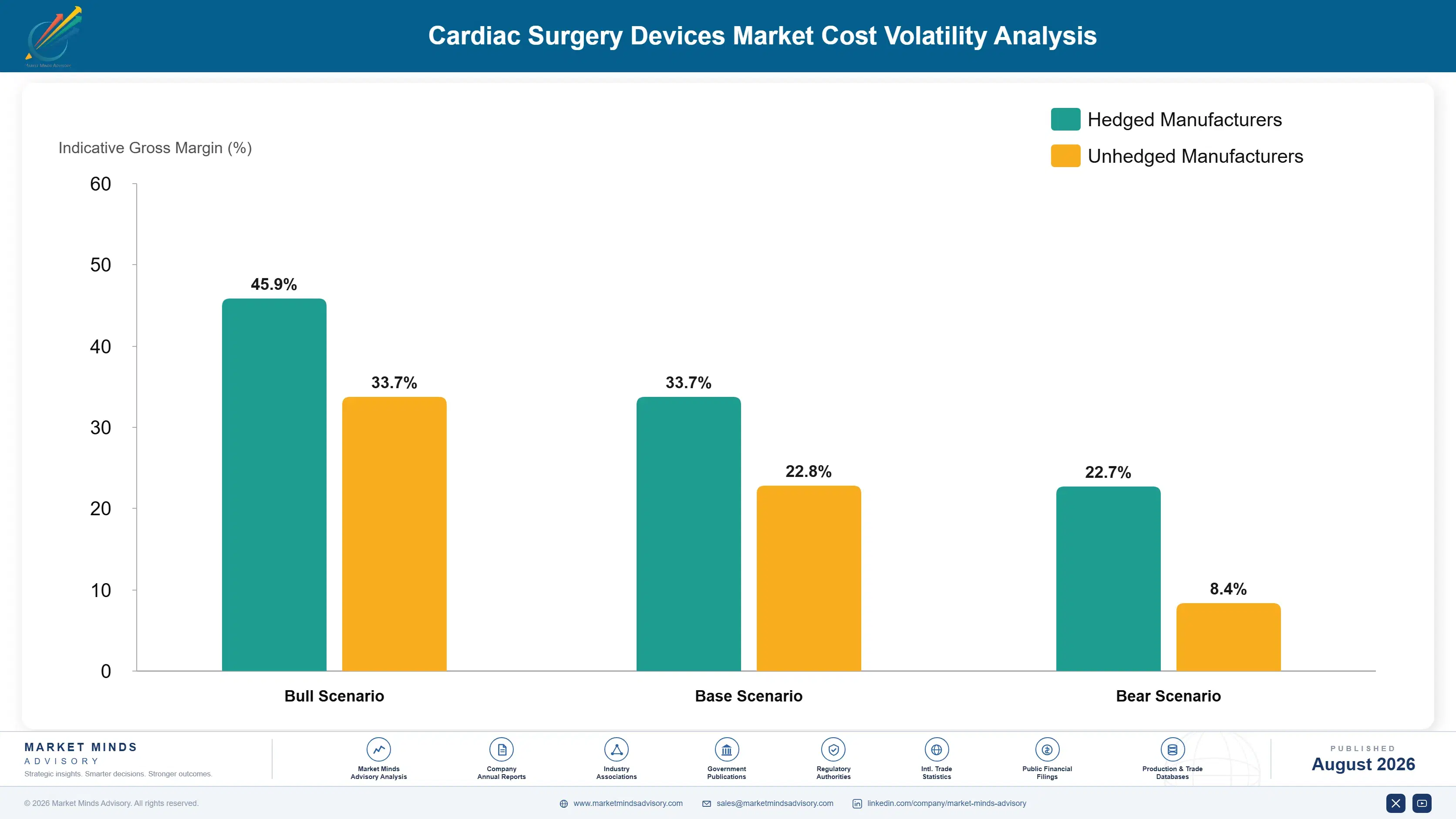
Polymer, Titanium and Tissue Input Exposure

Cost structures diverge sharply by device type. Perfusion disposables depend on medical grade polymers, hollow fibre membrane and surface coatings, together roughly 39% of cost of goods, sourced from specialist processors in Western Europe, Japan and the United States. Circulatory support devices carry titanium, rare earth magnets and precision machining. Bioprosthetic valves depend on bovine and porcine pericardial tissue with extensive sourcing, screening and fixation processing behind it.
Medical polymer and resin supply tightened materially through 2021 and 2022 as several producers exited medical grades entirely, citing liability exposure disproportionate to volume, and device manufacturers found themselves requalifying materials on short notice. Manufacturer annual reports across the period documented both the supply disruption and the inventory positions built afterwards. Rare earth magnet pricing for support device pumps also moved sharply, with supply concentrated in a single country.

Exposure varies most by material specificity rather than by scale. Perfusion manufacturers can substitute polymer grades with qualification work, while bioprosthetic valve producers depend on animal tissue supply chains with traceability and disease screening requirements that permit no rapid substitution at all. Geography compounds it: Chinese manufacturers with domestic polymer, titanium and magnet supply operate at cost structures Western competitors cannot approach.
cardiac-surgery-devices-market-cost-volatility-analysis-1787304855932

Qualify alternate medical polymer grades before suppliers exit

Several polymer producers withdrew from medical grades entirely because liability exposure outweighed the volume involved, and device manufacturers discovered the dependency only when supply stopped. Qualifying alternate grades during normal conditions costs validation and regulatory filing work rather than capital. The exposure is easy to overlook precisely because these materials have been reliably available for decades at modest cost.

Secure long-term bioprosthetic tissue sourcing with traceability

Bovine and porcine pericardial tissue carries sourcing, screening and traceability requirements that make substitution slow and regulatory approval of a new source lengthy. Multi-year agreements with qualified abattoir and processing partners protect continuity in a way spot purchasing cannot. Disease outbreak in a sourcing region can remove supply with no notice whatsoever and no available alternative.

Diversify rare earth magnet supply for circulatory support pumps

Durable support device pumps depend on rare earth magnets whose supply is concentrated in a single country, and pricing has moved sharply on policy decisions rather than on demand. Qualifying alternative magnet sources takes engineering time that must be spent before an interruption rather than during one, and redesigning around lower-grade material is slower still.

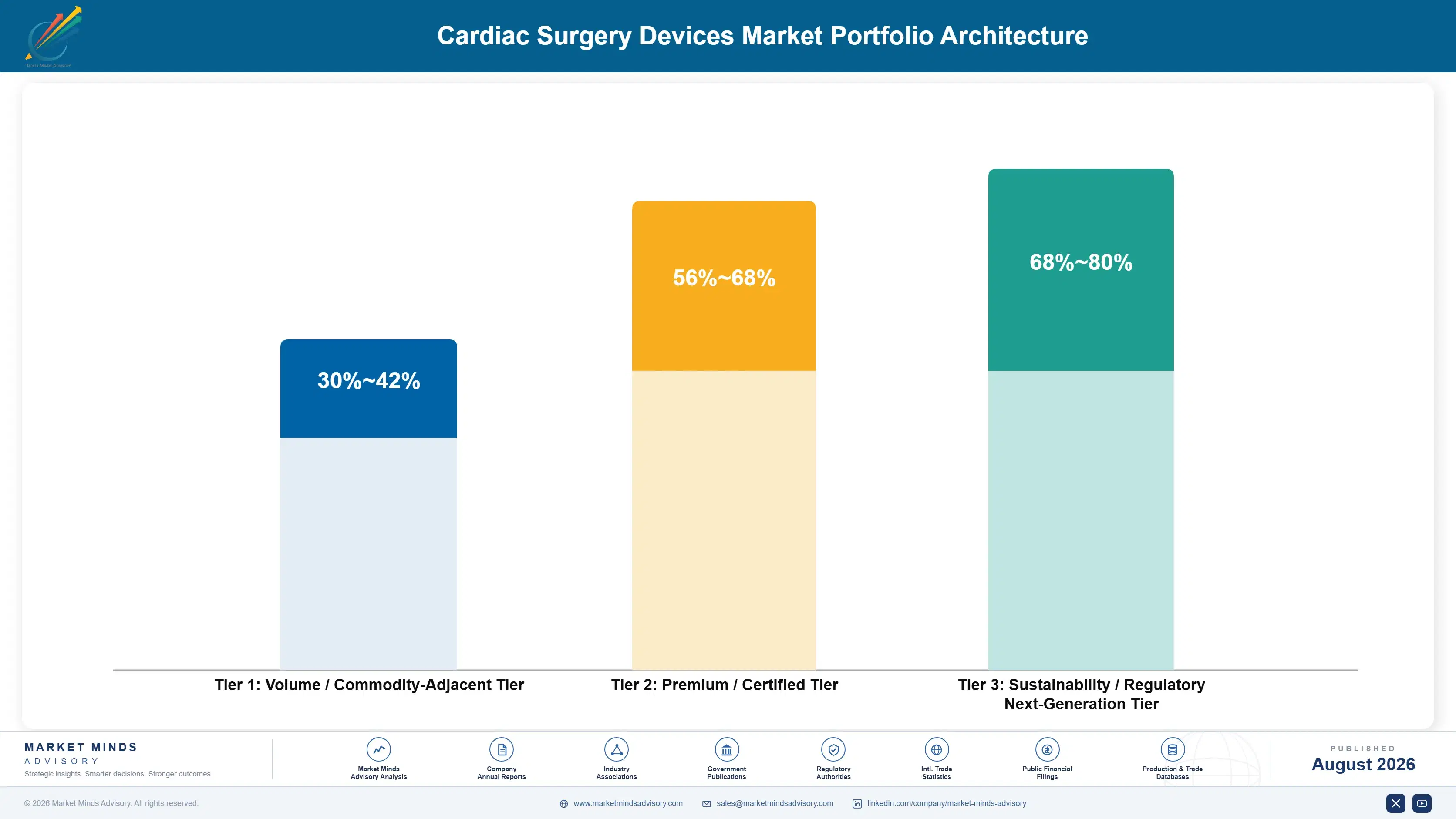
Portfolio Architecture for Margin Defence

Margin architecture separates on whether revenue recurs per case. Capital consoles and instrumentation sold into consolidating surgical programmes earn respectable margins on shrinking placement volumes, and negotiating strength has shifted toward the fewer, larger institutions that remain. Single-use perfusion circuits and cannulae earn better and arrive with every operation performed. Durable circulatory support devices earn best of all on value density, though clinical support costs consume m
The volume against premium tension here runs along geography. Western markets pay several times Asian prices for comparable devices while performing fewer and more complex operations, and Asian markets generate the larger procedure volume at prices that volume-based procurement has compressed hard. Rheumatic valve demand across South Asia and Africa is large, young and served almost entirely by manufacturers with cost structures Western producers have never attempted to build.

High-value pools concentrate around per-case consumption and around what catheters cannot do. Perfusion disposables tied to operations, circulatory support implants against fixed donor supply, and devices for complex aortic and multi-valve procedures all hold value that transcatheter substitution does not reach. Surgical aortic valves face a procedure population that has already largely moved.

Volume / Commodity-Adjacent Tier

Standard cannulae, tubing packs, sternal closure and mechanical valves sold under volume-based procurement and public tender, where Chinese and Indian manufacturers compete effectively on cost structures Western producers cannot match.
Gross Margin: 30-42%

Premium / Certified Tier

Bioprosthetic valves, annuloplasty devices and branded perfusion disposables, protected by surgeon preference, long-term durability evidence and the perfusionist familiarity that raises switching costs beyond price comparison. Surgeon preference changes slowly and rarely on price alone.
Gross Margin: 56-68%

Sustainability / Regulatory / Next-Generation Tier

Durable circulatory support devices and complex aortic and hybrid ablation systems, commanding premium on value density and on clinical positions that require outcome data rather than commercial effort to contest.
Gross Margin: 68-80%
cardiac-surgery-devices-market-portfolio-architecture-1787304856426

Case-Linked Consumption and Capital Cycles

Two revenue patterns operate here and only one of them is predictable. Capital equipment arrives as a large single payment when a programme replaces a console roughly every twelve years, and programme consolidation has reduced how many such purchases occur at all. Per-case consumables arrive with every operation, tracking surgical activity directly rather than any budget cycle, and they currently deliver roughly 46% of perfusion revenue.
Adoption depth follows programme volume rather than geography. High-volume academic centres perform complex aortic, multi-valve and redo procedures that no catheter can reach, run circulatory support programmes and adopt new devices readily. Mid-volume community programmes concentrate on coronary bypass and straightforward valve work, and it is exactly those cases that transcatheter therapy and consolidation are removing. The gap between the two tiers has widened considerably over the past decade.

Decision profiles have shifted meaningfully. Cardiac surgeons once specified devices with limited institutional challenge, and value analysis committees now scrutinise every implant against comparative cost. Perfusionists effectively decide disposable selection through familiarity and workflow. Heart teams combining surgeons and interventional cardiologists determine whether a patient reaches surgery at all, which makes them the most consequential audience and the one manufacturers address least directly.
cardiac-surgery-devices-market-end-use-penetration-index-1787304856921

Where Cardiac Surgery Strategy Lands

These are among the four positions where our research anticipates prominent divergence between winners and laggards over the coming forecast period. Each is grounded in the demand model, the regulatory perimeter, and the announced capacity pipeline.
01 / CONSUMABLE ANNUITY DEFENCE

The disposables outlast every capital cycle argument

A perfusion console is a capital purchase lasting roughly twelve years while its oxygenator, circuit and cannulae are consumed entirely in every single operation performed on it. Disposables already deliver about 46% of all perfusion revenue and carry most of its margin, tracking surgical activity directly rather than any hospital budget approval cycle whatsoever. Open architectures accepting third-party circuits surrender that annuity permanently, and no commercial arrangement afterwards has ever reliably recovered a position once it has been given away.
02 / CATHETER-PROOF INDICATION FOCUS

Compete where catheters cannot go, not against them

Transcatheter therapy has already taken roughly 72% of isolated aortic valve replacement in developed markets and is advancing steadily through mitral and tricuspid indications on precisely the same trajectory. Complex aortic pathology, multi-valve disease, endocarditis, redo procedures and multi-vessel coronary disease in diabetic patients all remain genuinely and durably surgical indications. Portfolio investment aimed at matching catheters on their own ground has repeatedly failed to return anything, while investment aimed at what they cannot reach has held its value considerably better.
03 / DONOR SUPPLY ARITHMETIC

Fixed transplant supply guarantees the support device gap

Donor heart availability is constrained by mortality patterns and consent rates that no clinical advance meaningfully changes, while advanced heart failure prevalence continues rising with ageing populations and improved survival after infarction. Durable pumps absorb that steadily widening gap as destination therapy, compounding at 7.8% and carrying roughly USD 105,000 of device value per implant performed. Investment in reducing haemocompatibility complications and driveline infection rates opens the eligible patient population directly rather than merely improving a device specification on paper.
04 / RHEUMATIC COST STRUCTURE

Discounted premium valves never win these markets

Rheumatic heart disease presents across South Asia, Africa and Latin America in patients decades younger than degenerative valve disease does, requiring durable mechanical valves at volumes that Western surgery no longer generates in any quantity. India compounds at 9.6% substantially on that disease burden alone, and volumes there keep rising. Western manufacturers ceded that whole segment to Indian and Chinese producers on price, and repeated discounting of premium products has consistently failed to recover any share because the cost structure underneath was never competitive.

Engagement Snapshot From the Field

A live engagement with an industry participant carrying material or product regulatory and market exposure ahead of a defining policy shift, showing how our research translates into a defensible multi-year portfolio strategy.
MARKET MINDS ADVISORY · CLIENT ENGAGEMENT SUMMARY
Cardiac Surgery Devices Producer Strategic Portfolio Review and Transition Roadmap 2026·Investment Scenario on Cardiac Surgery Devices Exposure Evaluation 2025-26
CLIENT PROFILE
A cardiovascular device manufacturer with a surgical valve line, a perfusion disposables business and no position in circulatory support or transcatheter therapy. Annual cardiac surgery revenue was approximately USD 780 million (client-reported, unverified by MMA), weighted toward surgical aortic valves in North American and European markets where transcatheter substitution was furthest advanced. Perfusion console architecture had been left open to third-party circuits.
STRATEGIC CHALLENGE
Surgical aortic valve volumes had fallen steadily as catheter therapy moved into low-risk patients, while the perfusion disposables business was growing modestly and generating disproportionate margin. The board needed to decide whether to enter transcatheter therapy late against entrenched competitors, or redirect investment toward perfusion, complex aortic devices and circulatory support instead.
MMA APPROACH
MMA conducted 47 expert interviews spanning cardiac surgeons, interventional cardiologists, perfusionists, heart team coordinators, hospital value analysis committee members and circulatory support programme directors across six countries. A quantitative survey of 3,800 respondents established referral pathways, device selection authority, disposable switching behaviour and programme consolidation effects. We then modelled revenue and margin outcomes under both strategic options against observed substitution rates and procedure volume data.
KEY FINDINGS
  1. Heart teams in five of six markets referred low-risk aortic patients to catheter therapy by default, and surgeons reported having limited influence over that decision in practice.
  2. Perfusionists rather than surgeons or procurement selected disposable circuits in most institutions, and switching had occurred rarely once a console and circuit combination was established.
  3. Complex aortic, multi-valve and redo procedures showed no substitution at all, and case complexity per operation had risen measurably across every surveyed programme.
  4. Circulatory support programme directors rated device complication rates well above pump performance when selecting, and few would switch without comparative outcome data.
CLIENT PROFILE
A cardiovascular device manufacturer with a surgical valve line, a perfusion disposables business and no position in circulatory support or transcatheter therapy. Annual cardiac surgery revenue was approximately USD 780 million (client-reported, unverified by MMA), weighted toward surgical aortic valves in North American and European markets where transcatheter substitution was furthest advanced. Perfusion console architecture had been left open to third-party circuits.
STRATEGIC CHALLENGE
Surgical aortic valve volumes had fallen steadily as catheter therapy moved into low-risk patients, while the perfusion disposables business was growing modestly and generating disproportionate margin. The board needed to decide whether to enter transcatheter therapy late against entrenched competitors, or redirect investment toward perfusion, complex aortic devices and circulatory support instead.
MMA APPROACH
MMA conducted 47 expert interviews spanning cardiac surgeons, interventional cardiologists, perfusionists, heart team coordinators, hospital value analysis committee members and circulatory support programme directors across six countries. A quantitative survey of 3,800 respondents established referral pathways, device selection authority, disposable switching behaviour and programme consolidation effects. We then modelled revenue and margin outcomes under both strategic options against observed substitution rates and procedure volume data.
KEY FINDINGS
  1. Heart teams in five of six markets referred low-risk aortic patients to catheter therapy by default, and surgeons reported having limited influence over that decision in practice.
  2. Perfusionists rather than surgeons or procurement selected disposable circuits in most institutions, and switching had occurred rarely once a console and circuit combination was established.
  3. Complex aortic, multi-valve and redo procedures showed no substitution at all, and case complexity per operation had risen measurably across every surveyed programme.
  4. Circulatory support programme directors rated device complication rates well above pump performance when selecting, and few would switch without comparative outcome data.
RECOMMENDED STRATEGY
Phase 1: Phase one: close perfusion circuit architecture on new console placements and target perfusionist relationships directly, since they decide disposable selection rather than procurement. Phase 2: Phase two: redirect valve development capital toward complex aortic and multi-valve devices, where catheter substitution has shown no progress whatsoever. Phase 3: Phase three: acquire rather than build circulatory support capability, because comparative outcome data takes years the competitive position does not allow.
OUTCOME
The client closed perfusion circuit architecture on new placements, redirected roughly USD 210 million from surgical aortic valve development into complex aortic devices, and acquired a temporary circulatory support business (client-reported, unverified by MMA). Perfusion disposable revenue share rose several points within eighteen months, and complex aortic revenue grew while the aortic valve line continued its expected decline.

Frequently Asked Questions

Foundational context covering the market sizes, CAGR, scope, country, region and competition that inform every finding below. This section is provided to cover basics and most often pre-purchase conversations, answered from the MMA Primary Research Dataset.

What is the current size of the Cardiac Surgery Devices Market?

The global cardiac surgery devices market was valued at USD 10.6 billion in 2025, spanning perfusion, surgical valves, circulatory support, ablation, grafts and instrumentation. Roughly 1.9 million cardiac operations are performed worldwide each year.

How large will the Cardiac Surgery Devices Market be by 2036?

MMA forecasts the market at USD 18.51 billion by 2036, expanding 1.66 times from the 2026 base of USD 11.15 billion. That represents roughly USD 7.36 billion of incremental value across the forecast decade.

What is the CAGR for the Cardiac Surgery Devices Market 2026 to 2036?

The base case compound annual growth rate is 5.2%, with a bull case of 6.4% and a bear case of 4.0%. The bull case assumes durable support devices reach broader heart failure populations as complications improve.

Which segment is growing fastest?

Mechanical circulatory support grows at 7.8%, a full 1.50x the overall market rate. Donor heart supply is fixed while heart failure prevalence rises, so durable pumps absorb a widening gap.

Who are the major companies in the Cardiac Surgery Devices Market?

Medtronic, Edwards Lifesciences, Abbott, LivaNova and Getinge together hold 62% of revenue. They lead in largely different parts of the operation, with limited direct overlap between several of them.

Which country is growing fastest?

India grows fastest at 9.6%, performing large mechanical valve volumes for rheumatic heart disease in patients decades younger than Western valve patients. North America remains the largest region at 30% of value on pricing.

Report Segmentation Architecture

The full report scope spans multiple orthogonal segmentation dimensions, with cross-tabulated demand data provided for each dimension pair. Coverage extends further to regional breakdowns, trend trajectories, and the competitive detail needed to support segment-level decision-making.

By Device Function

  • Perfusion Systems and Oxygenators
  • Surgical Heart Valves and Annuloplasty Devices
  • Mechanical Circulatory Support Devices
  • Cardiac Ablation and Rhythm Surgery Devices
  • Vascular Grafts and Conduits
  • Surgical Access, Closure and Instrumentation

By End-Use Industry

  • Academic and Tertiary Cardiac Centres
  • Community Hospital Surgical Programmes
  • Dedicated Cardiac Specialty Hospitals
  • Paediatric and Congenital Cardiac Services
  • Transplant and Circulatory Support Programmes
  • Military and Government Health Systems

By Commercial Dimension

  • Hospital Capital Equipment Purchase
  • Per-Case Consumable Supply Agreements
  • Group Purchasing Organisation Contracts
  • Volume-Based and Public Tender Procurement
  • Distributor and Dealer Channel Supply
  • Managed Equipment and Service Contracts

By Region

  • North America
  • East Asia
  • Western Europe
  • South Asia and Pacific
  • Latin America
  • Middle East and Africa
  • Eastern Europe

Scope, Methodology, and Coverage

Every figure in this report is reproducible from documented input assumptions. The scope below maps the historical period, the forecast horizon, the segmentation dimensions, and the countries covered, alongside the underlying primary and qualitative methodology.
Historical Period
2020 to 2025
Forecast Period
2026 to 2036
Base Year
2025 (USD billions; MMA Primary Research Dataset, August 2026)
Market Definition
This market comprises devices used in open and minimally invasive cardiac surgery, measured at manufacturer revenue across hospital capital purchase, per-case consumable supply agreements, group purchasing contracts, volume-based and public tender procurement, distributor channels and managed equipment services. Coverage spans perfusion consoles, oxygenators, tubing packs, cannulae and cardioplegia systems, surgical mechanical and bioprosthetic heart valves with annuloplasty rings and bands, durable and temporary mechanical circulatory support devices including extracorporeal membrane oxygenation systems, surgical ablation and left atrial appendage exclusion devices, vascular grafts and conduits, and surgical access, sternal closure and dedicated instrumentation. Transcatheter valve and structural heart devices, electrophysiology catheter ablation systems, coronary stents and interventional cardiology products, cardiac rhythm management implants, diagnostic imaging equipment, and hospital procedure or service revenue fall outside scope.
Quantitative Units
USD millions (current prices); procedures performed by type; devices implanted; consumable units per case; average selling price by category; console installed base; replacement cycle length
Segmentation Dimensions
By Device Function; By End-Use Industry; By Commercial Dimension; By Region
Regions Covered
North America, East Asia, Western Europe, South Asia and Pacific, Latin America, Middle East and Africa, Eastern Europe
Countries Covered
United States, Canada, Mexico, Brazil, Argentina, Colombia, Chile, Germany, France, United Kingdom, Italy, Spain, Netherlands, Sweden, Switzerland, China, Japan, South Korea, Taiwan, India, Australia, Thailand, Indonesia, Saudi Arabia, United Arab Emirates, Egypt, South Africa, Poland, Czechia, Hungary, Turkey, and additional markets relevant to cardiac surgery analysis
Key Companies Profiled
Medtronic, Edwards Lifesciences, Abbott, LivaNova, Getinge, Terumo, Corcym, AtriCure, Artivion, Baxter, B. Braun, Nipro, Berlin Heart, Jarvik Heart, BiVACOR, Braile Biomedica, Peters Surgical, Shandong Weigao Group, Ningbo Medical System, Fresenius Medical Care
Quantitative Methodology
Primary survey, n=3,800 respondents, Q4 2025, six countries; demand-side model with trade association cross-validation
Qualitative Methodology
47 expert interviews, Q4 2025; applied to validate demand model assumptions, identify emerging dynamics, and assess competitive positioning
Report Format
PDF and XLSX data workbook (Word format preview document)
Publisher
Market Minds Advisory
Report Code
MMA-2026-MED-304
Published
August 2026
Contact
sales@marketmindsadvisory.com | www.marketmindsadvisory.com

Purchase the full Cardiac Surgery Devices Market Report (2026 to 2036).

The full MMA report separates the parts of cardiac surgery that catheters are taking from the parts they cannot reach, quantifying where device value survives procedural displacement. It sizes six device functions and seven regions to 2036, modelling procedure volumes, device pricing, consumable consumption per case, console installed base and substitution rates separately. Competitive assessment covers twenty manufacturers on one consistent revenue basis. Cost exposure is traced through polymer, titanium and bioprosthetic tissue inputs. Four commercial levers and a strategic verdict close the report, grounded in 47 expert interviews and a 3,800-respondent survey.
Six device functions sized separately through 2036
Transcatheter substitution modelled by valve position and region
Per-case consumable revenue separated from capital equipment placements
Twenty manufacturers assessed on one consistent revenue basis
Rheumatic valve demand quantified against degenerative disease populations
Anonymised client engagement with tested strategic recommendations

Built For The People Who Decide

From boardroom strategy to bench-side execution, this report is read cover-to-cover by leaders shaping the next decade of their industry, turning demand scenarios, market dynamics and valuation benchmarks into decisions.
CXOs/ Presidents/ VPs/ Managers
M&A and Corporate Development
Strategy Teams and R&D Heads
Procurement and Product Directors
Regulatory and Compliance Leaders
Investor Relations and Equity Analysts