Market Minds Advisory
Cardiac Rehabilitation Market

Cardiac Rehabilitation Market: Home-Based Telehealth Platforms Displace Center-Based-Only Models

Home-based telehealth rehabilitation platforms increasingly supplement center-based programs as remote monitoring technology matures, Medicare reimbursement expansion accelerates hybrid program adoption, and providers without validated telehealth platforms lose patient enrollment to digitally equipped competitors.

Lead Analyst

Alice Ballenger

Published

September 2026

Make Smarter Decisions with Customized Research Insights

Request a free sample report and evaluate market opportunities, growth trends, and competitive dynamics relevant to your business needs.

2025 MARKET VALUE$6.8BMarket Size 2025
2036 FORECAST VALUE$17.2BBase Case , 2026 to 2036
CAGR 2026 TO 20368.8 %Bull 10.1% / Bear 7.4%
INCREMENTAL OPPORTUNITY$9.8BNet 10- year value creation
EXPANSION MULTIPLE2.32x2036 value over 2026 base
Strategic Levers
M&A Pipeline
Regional Outlook
Country Rankings
Competitive Intelligence
Segmental Deep-dive
Call-Us : 91 93563 13602

Executive Snapshot and Market Trajectory

Home-based telehealth rehabilitation platforms now extend supervised cardiac recovery beyond center-based facilities, and health system purchasing committees increasingly treat remote monitoring integration as the deciding program selection factor over facility capacity alone across most post-cardiac-event recovery pathways currently in use today and going forward quite steadily.
Home-based telehealth rehabilitation platforms lead growth at 15.0%, roughly 1.70 times the overall rate, as health systems shift toward hybrid recovery models that extend supervised care beyond limited center-based facility capacity following cardiac events across most patient populations treated today and consistently. North America now holds the largest regional share, driven by established Medicare reimbursement infrastructure and concentrated center-based program density among all tracked markets worldwide.
Competitive intensity concentrates around moderate levels held by five providers and platform manufacturers, since clinical validation requirements and reimbursement relationships limit new entrant credibility relative to more fragmented digital health categories elsewhere in medical technology overall and broadly today. Wearable cardiac monitoring devices are becoming a meaningful secondary differentiator distinct from core program structure alone, reshaping how providers structure competing rehabilitation offerings across most health system markets currently and going forward quite steadily.
Market Definition
This report covers the global market for cardiac rehabilitation products and services, spanning center-based supervised programs, home-based telehealth rehabilitation platforms, cardiac monitoring and telemetry devices, wearable rehabilitation monitoring devices, and patient education services following cardiac events. It excludes acute cardiac surgical interventions, implantable cardiac devices, and general fitness equipment not specific to structured cardiac recovery programs.
Base Year Value
$6.8B in 2025 (MMA Primary Research Dataset, August 2026)
Forecast Period
2026 to 2036, eleven discrete annual values
CAGR
8.8% base case. Bull 10.1%. Bear 7.4%.
Fastest Growth Segment
Home-Based Telehealth Rehabilitation Platforms: 15.0% CAGR
Fastest Growth Country
China: 11.8% CAGR
Fastest Growth Region
South Asia and Pacific: 10.8% CAGR
Largest Region
North America: 30% of 2025 global value
Market Leaders
Philips Healthcare, GE HealthCare, Hillrom (Baxter), Kencor Health, Recora Inc. Source: MMA Analysis, July 2026.
Primary Survey
n=3,800 procurement and R&D decision-makers, Q4 2025, six countries
Methodology
Demand-side build-up, cross-validated against public data, 47 expert interviews

Cardiac Rehabilitation Market Forecast Scenarios

cardiac-rehabilitation-market-size-forecast-scenario-1787304262756
Cardiac rehabilitation demand grew steadily between 2020 and 2025 as telehealth rehabilitation platforms expanded well beyond pandemic-driven necessity into standard hybrid care delivery models across most established healthcare markets nationwide, with the historical growth rate running somewhat below the coming decade's pace as remote monitoring integration matures further across most established and emerging healthcare systems tracked.
The base case assumes continued telehealth platform adoption, expanding wearable monitoring device integration, and steady replacement demand from established center-based program equipment formularies across major markets worldwide today and going forward steadily. Rising cardiovascular disease incidence and expanding insurance coverage for hybrid rehabilitation models in several markets sustain enrollment volume even as average program pricing compresses modestly through the forecast period as competition among established providers intensifies across most commoditized categories tracked.
The bull case centers on remote monitoring reimbursement expanding faster than expected, pulling forward hybrid program adoption across mainstream health system markets worldwide today and consistently. The bear case centers on reimbursement tightening for telehealth-delivered rehabilitation in cost-constrained health systems, which would slow overall program enrollment growth across most price-sensitive public health markets significantly and further still.

Telehealth Integration Redefines Cardiac Program Purchasing

Cardiac rehabilitation sits at the intersection of clinical supervision and remote care delivery, since center-based facility capacity alone no longer serves growing patient volume without accompanying telehealth extension that reaches patients unable to attend in-person sessions regularly today. Providers converging both capabilities into a single hybrid program model are winning health system contracts that center-based-only competitors increasingly lose despite comparable clinical outcomes on
MARKET CONCENTRATION (CR5)41%Top five providers hold combined global market revenue share
AVERAGE PROGRAM COST$3,200Typical twelve-week supervised cardiac rehabilitation program price per enrollment
TOP PRODUCING COUNTRY SHARE27%United States leads global cardiac rehabilitation platform manufacturing output
PROGRAM COMPLETION RATE58%Share of enrolled patients completing full rehabilitation program courses
TRADE INTENSITY34%Share of total platform units sold across export markets globally
TELEHEALTH ATTACH RATE31%New rehabilitation programs now including telehealth platform components
Commercial character favors providers with direct health system relationships over those relying solely on independent clinic operators, since large hospital networks increasingly standardize rehabilitation program purchasing across their full system rather than negotiating facility by facility individually. Remote patient monitoring reimbursement codes have become a meaningful revenue channel distinct from traditional bundled program fees alone, rewarding providers with proven digital health infrastructure.
The next decade will be shaped by reimbursement policy for telehealth-delivered rehabilitation, regulatory pathways for wearable monitoring device integration, and the pace at which hybrid program models expand into underserved rural and suburban markets nationwide. Providers positioned across all three forces simultaneously will capture disproportionate share as cardiac rehabilitation matures beyond its current center-based-dominant positioning toward broader hybrid delivery.
"Center-based capacity was always the ceiling on this market. Now the ceiling moved because the monitoring happens at home, and programs still built around a physical building are enrolling fewer patients than they used to."
Director, Cardiovascular Care and Digital Health Practice · MMA Medical Devices

Market Trends

Home-Based Telehealth Platforms Gain Health System Standard Adoption

Health systems are increasingly bringing home-based telehealth rehabilitation platforms into standard post-cardiac-event care pathways rather than reserving them as pandemic-era contingency options, as reimbursement policy and clinical evidence both matured substantially. Roughly 31% of new rehabilitation program enrollments in 2025 included telehealth platform components, up sharply from a much smaller share five years earlier, as remote monitoring reimbursement codes expanded and clinical trial data demonstrated comparable outcomes to center-based-only care. Health systems without validated telehealth platforms increasingly lose program enrollment share to competitors offering hybrid delivery models already positioned for these evolving reimbursement structures.
Market Impact: Survival gains expand population 15
Wearable Monitoring Devices Expand Remote Patient Surveillance

Wearable cardiac monitoring devices increasingly extend clinical surveillance beyond scheduled telehealth sessions, providing continuous data that supplements structured rehabilitation visits with real-time cardiovascular status tracking between appointments across most program formats today. Manufacturers report wearable device integration now covers roughly 26% of hybrid rehabilitation programs in leading markets, up from a negligible base five years ago, as device accuracy improved and clinicians gained confidence interpreting continuous monitoring data remotely. This integration is pulling program design away from scheduled-visit-only models toward continuous surveillance formats across most major health system markets currently.
Market Impact: Insurance expansion covers 40 milli

Market Opportunities and Growth Drivers

Rising Global Cardiovascular Disease Burden Sustains Baseline Demand

Cardiovascular disease remains a leading cause of hospitalization worldwide, with growing incidence across aging populations and expanding risk factor prevalence sustaining consistent baseline demand for post-event rehabilitation services independent of telehealth adoption trends. Cardiac event survival rates have improved steadily across most developed and several emerging markets over the past decade, according to national health agency reporting on cardiovascular outcomes, directly expanding the surviving patient population requiring structured rehabilitation care. This baseline demand provides providers a stable revenue floor even as premium telehealth adoption drives incremental growth on top of it.
Market Impact: Completion rates run 42% below targ

Expanding Insurance Coverage Drives Program Enrollment Growth

Insurance coverage for structured cardiac rehabilitation continues expanding across multiple health systems, directly increasing the addressable patient population able to access supervised recovery programs beyond those with comprehensive private coverage alone. Medicare and equivalent public health insurance programs have expanded telehealth rehabilitation coverage steadily over recent years, according to government health agency policy reporting, requiring providers to build compliant remote delivery infrastructure to capture this growing reimbursed population. This coverage expansion sustains enrollment growth even in regions where per-program spending remains below the most premium market levels, broadening the addressable market meaningfully.
Market Impact: Billing friction limits coverage by

Market Restraints and Challenges

Low Program Completion Rates Limit Full Revenue Realization

Many patients enroll in cardiac rehabilitation programs but fail to complete the full recommended course, limiting realized revenue per enrolled patient and reducing the clinical benefit that sustained rehabilitation participation would otherwise provide to most enrolled patients. The root cause is multifactorial: transportation barriers, work schedule conflicts, and patient motivation challenges all contribute to attrition throughout the typical multi-week program duration. Providers are expanding telehealth delivery options and simplified scheduling flexibility to address this gap, gradually improving completion rates among patients who previously dropped out due to logistical barriers alone.
Market Impact: Telehealth enrollment reaches 31% o

Reimbursement Variation Complicates Telehealth Program Billing

Telehealth rehabilitation reimbursement policy varies considerably across payers, with some insurers covering remote delivery fully while others still require in-person components before authorizing payment, creating administrative friction for providers building hybrid programs nationwide and quite internationally. The root cause traces to payer reimbursement systems built around traditional in-person billing codes that have not fully adapted to telehealth-delivered rehabilitation formats now common in clinical practice. Providers and clinical associations are jointly advocating for simplified telehealth billing codes with major payers, gradually reducing this administrative friction across most major markets over time.
Market Impact: Wearable integration reaches 26% of
4 additional market trends, 3 additional growth drivers, and 3 additional restraints and challenges are covered in the full report. Contact sales@marketmindsadvisory.com to access the complete intelligence.

Segment CAGR and Growth Architecture

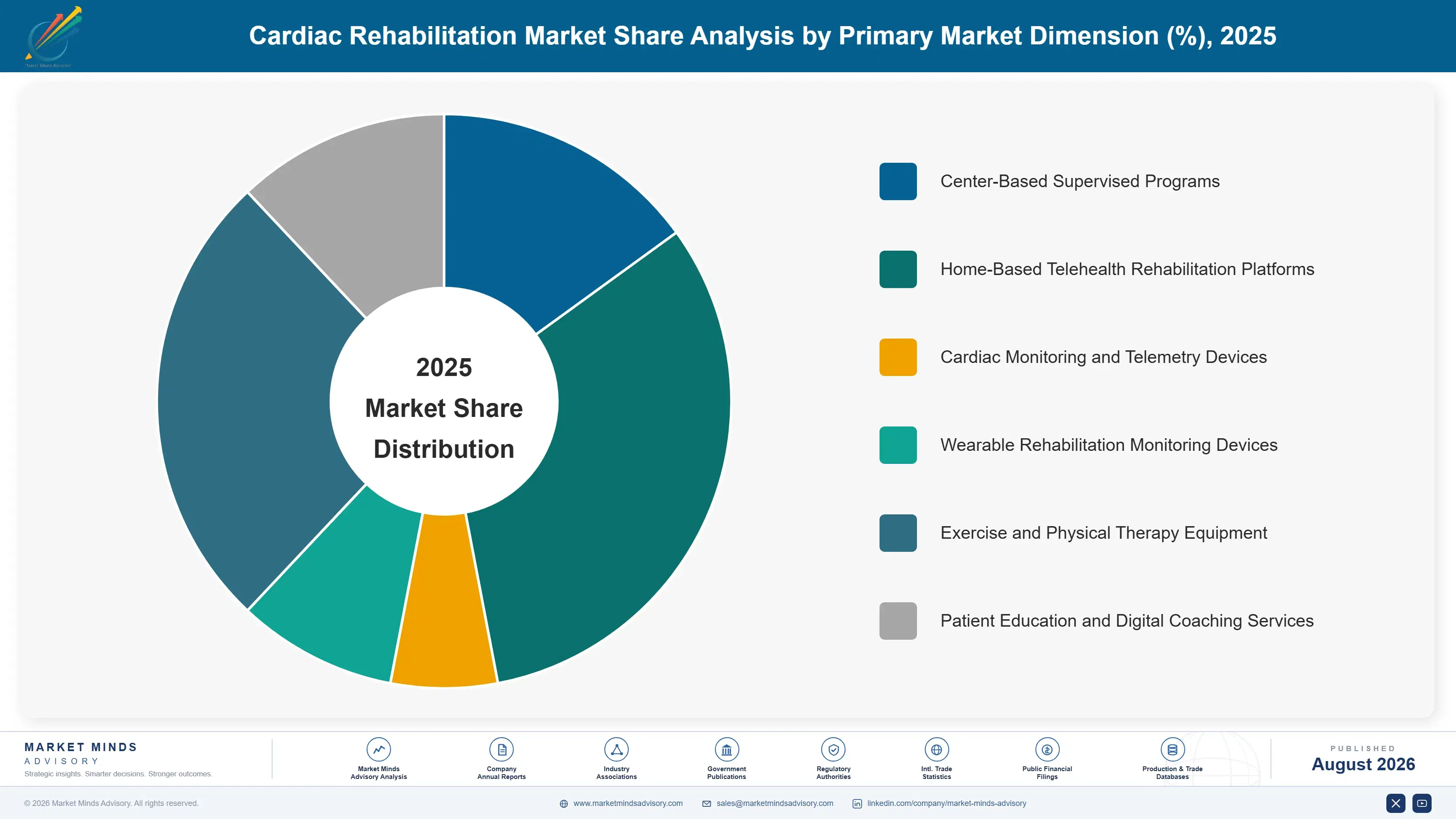
Cardiac rehabilitation segmentation follows delivery model and monitoring technology rather than clinical protocol alone, since the same provider base develops distinct program formats across delivery channels. Six segments span center-based supervised programs, home-based telehealth platforms, cardiac monitoring and telemetry devices, wearable rehabilitation monitoring devices, exercise and physical therapy equipment, and patient education services, each requiring distinct reimbursement pathway
cardiac-rehabilitation-market-market-share-analysis-1787304263292

Home-Based Telehealth Rehabilitation Platforms

Home-based telehealth rehabilitation platforms are growing fastest as health systems increasingly extend supervised cardiac recovery beyond limited center-based facility capacity to reach patients unable to attend in-person sessions regularly across most rural and suburban service areas nationwide and internationally today and quite consistently. Large multi-site hospital networks and health systems are driving early adoption, since telehealth platforms currently justify their investment primarily through documented enrollment expansion and improved program completion rates relative to center-based-only delivery. Providers with proven remote monitoring integration capability are capturing disproportionate share of new program contract discussions as health systems increasingly specify this format explicitly for expanding underserved patient populations across leading cardiovascular care networks nationwide.
CAGR 15.0%

Wearable Cardiac Rehabilitation Monitoring Devices

Wearable cardiac rehabilitation monitoring devices grow second-fastest, driven by their ability to extend clinical surveillance continuously between scheduled telehealth sessions rather than relying solely on periodic in-person or virtual check-ins across most program formats today and increasingly so each passing year and season. Health systems increasingly favor wearable-integrated programs for patients with complex cardiovascular risk profiles, since continuous monitoring data enables earlier intervention than scheduled-visit-only formats can provide reliably and consistently. Manufacturers with validated wearable accuracy and clinical integration data are capturing disproportionate share of this demand, since providers increasingly evaluate platform selection based on continuous monitoring capability rather than program structure alone, reshaping purchasing criteria across leading health systems.
CAGR 13.0%
Full segment breakdown across 6 segments available in the complete report.

Regional Architecture and Country Demand Map

Revenue concentrates where Medicare reimbursement infrastructure and center-based program density intersect, with North America and East Asia together capturing more than half of global revenue. Growth rates skew fastest toward South Asia and Pacific as telehealth infrastructure expands rapidly there while established markets mature steadily.

North America

North America holds the largest revenue share, driven by established Medicare reimbursement infrastructure and concentrated center-based program density among all tracked markets worldwide today and consistently and quite reliably too and quite steadily. The United States accounts for most of this share, supported by extensive hospital network rehabilitation program coverage, expanding telehealth reimbursement codes, and academic medical centers driving early wearable monitoring adoption ahead of most other regions and markets tracked. Health system consolidation continues concentrating program purchasing decisions disproportionately in this region ahead of most other markets nationwide. Providers without validated telehealth platforms increasingly lose program enrollment share to competitors holding strong clinical outcomes data and established payer relationships.
Share: 30% | CAGR: 9.2% (2026 to 2036)

Western Europe

Western Europe combines centralized national health system procurement with steady but measured telehealth platform adoption across its largest member states and established cardiovascular care networks nationwide and internationally today and consistently over quite some time. Germany, France, and the United Kingdom drive most regional revenue, since national health authorities there move deliberately on new telehealth reimbursement decisions relative to faster-moving markets elsewhere in the world. Center-based program penetration remains higher here than in the United States, reflecting national health system emphasis on supervised in-person care across cardiac recovery categories broadly and consistently. Telehealth platform uptake trails the United States by a meaningful margin per launch, as reimbursement approval requires additional evidence.
Share: 22% | CAGR: 7.3% (2026 to 2036)
Regional intelligence for 5 additional markets available in the complete report: East Asia, South Asia and Pacific, Latin America, Middle East and Africa, Eastern Europe. Contact sales@marketmindsadvisory.com.
cardiac-rehabilitation-market-country-cagr-analysis-1787304263817

Remote Monitoring Integration Drives Program Retention

Revenue growth concentrates around four commercial mechanisms rewarding providers who move fastest on telehealth platform validation, wearable integration, and health system network relationships across most major markets today and going forward quite steadily and consistently. Center-based-only differentiation is losing pricing power as facility capacity plateaus, pushing providers toward hybrid delivery and remote monitoring reimbursement channels.

Validate Telehealth Program Completion Outcomes Data

Providers validating telehealth program completion and clinical outcomes data fastest capture disproportionate share of health system contract renewal conversations before competitors can match comparable hybrid delivery evidence. Validated telehealth programs now retain 68% of health system contracts at renewal, according to recent contract data across major health networks, since systems increasingly consolidate rehabilitation purchasing toward the fewest platform relationships possible. Providers without validated telehealth outcomes face mounting pressure to either partner with established platform vendors or develop internal capability quickly, since the trend is accelerating faster than most center-based-only competitors can independently respond.
Market Impact: Validated telehealth programs retai

Expand Wearable Monitoring Device Reimbursement Coding

Providers securing simplified reimbursement billing codes for wearable monitoring integration accelerate program adoption and reduce administrative friction that currently slows continuous surveillance format expansion across many payer relationships nationwide. Simplified billing code adoption has expanded to cover roughly 44% of major payers in leading markets, up from a much smaller share two years ago, as provider and clinical association advocacy efforts gained traction with payer policy committees. Providers leading this advocacy effort are positioned to benefit disproportionately as simplified billing removes a key adoption barrier across the broader payer landscape.
Market Impact: Simplified billing now covers 44% o

Reduce Telehealth Platform Deployment Costs Broadly

Providers investing in telehealth platform deployment cost reduction are positioned to capture the category's next growth wave as pricing approaches levels accessible to mid-tier regional health systems rather than remaining confined to large academic medical centers today. Platform deployment costs have declined an estimated 19% over the past three years as cloud infrastructure scales and integration processes mature, narrowing the price gap with conventional center-based-only program costs. Providers achieving further cost reduction fastest will capture disproportionate share of the anticipated transition toward broader hybrid delivery adoption over the coming years.
Market Impact: Deployment costs have declined 19%

Build Direct Health System Account Relationships

Providers building direct account relationships with large hospital health systems rather than relying solely on independent clinic partnerships capture higher realized program pricing and stronger contract retention against competitors without comparable specialist relationships. Direct account management now covers approximately 55% of health system rehabilitation program purchasing among leading providers, up from a much lower share five years ago, as systems increasingly value dedicated clinical support over fragmented independent clinic relationships. Providers with the strongest direct account networks are converting this relationship advantage into durable contract retention that smooths competitive pressure from lower-cost entrants.
Market Impact: Direct accounts now cover 55% of al

Who Controls the Margin Pool

Five providers and platform manufacturers hold 41% combined share on a global revenue basis, a relatively fragmented concentration level reflecting the mix of established medical device manufacturers and newer digital health platform entrants within the same overall market. Philips Healthcare leads the field through its integrated telehealth and monitoring platform, giving it a strong position ahead of GE HealthCare, the nearest challenger, whose strength concentrates more heavily in cardiac mon
Current competitive activity centers on telehealth platform clinical validation, wearable monitoring device integration, and health system network partnership investment rather than price competition on center-based program fees alone. Providers are racing to secure simplified reimbursement billing codes supporting hybrid delivery models, since health systems increasingly condition contract renewal on documented completion rate improvements. Distribution partnerships with regional hospital networks now shape access economics across many mid-tier markets.

Emerging pressure comes from specialized digital health startups pursuing next-generation wearable and AI-assisted monitoring platforms, and from established medical device manufacturers scaling telehealth capability across broader cardiovascular product lines. Rankings shift most where telehealth validation and health system contract wins combine, since a single provider's outcomes publication can meaningfully reorder near-term market share among otherwise comparable competitors.
cardiac-rehabilitation-market-company-positioning-matrix-1787304264362

Competitive Moat and Risk Dimensions

PHILIPS HEALTHCARE (ROYAL PHILIPS N.V.)

Moat: Integrated Telehealth and Monitoring Platform

Philips maintains a fully integrated telehealth and cardiac monitoring platform spanning both hardware and software components, giving it broader health system relationships than competitors offering fragmented point solutions. This integration lets Philips bundle purchasing conversations within larger health system technology negotiations, reinforcing its lead in comprehensive hybrid program contracts across most major markets.
PHILIPS HEALTHCARE (ROYAL PHILIPS N.V.)

Risk: Premium Pricing Access Constraint

Philips's premium integrated platform pricing limits its addressable market among smaller regional health systems and lower-income markets where public procurement programs prioritize unit cost over comprehensive integration. If cost-sensitive procurement continues growing faster than premium integrated segments, Philips's positioning could face growing pressure from lower-cost point-solution competitors gaining share in exactly those expanding markets.
GE HEALTHCARE TECHNOLOGIES INC.

Moat: Cardiac Monitoring Hardware Depth

GE HealthCare maintains the deepest cardiac monitoring and telemetry hardware installed base across hospital systems worldwide, giving it disproportionate access to health systems already standardized on its monitoring infrastructure. This installed base advantage lets GE HealthCare capture disproportionate share of new telehealth platform decisions as health systems increasingly prefer extending existing validated hardware relationships.
GE HEALTHCARE TECHNOLOGIES INC.

Risk: Slower Software Platform Development

GE HealthCare has moved more slowly into fully integrated telehealth software platforms than Philips and several smaller specialized competitors, leaving a capability gap in the fastest-growing segment of the broader market. If software-driven differentiation continues accelerating faster than GE HealthCare's internal development timeline allows, the company risks ceding disproportionate share of hybrid program contract decisions to software-focused competitors.

Players Tracked

Prominent Players

Philips Healthcare (Royal Philips N.V.)
GE HealthCare Technologies Inc.
Hillrom (Baxter International Inc.)
Kencor Health
Recora Inc.

Other Key Players

iRhythm Technologies, Inc.
AliveCor, Inc.
Biotricity Inc.
VitalConnect, Inc.
Cardiac Insight, Inc.
Preventice Solutions, Inc.
Boston Scientific Corporation
Medtronic plc
Zoll Medical Corporation
InfoBionic, Inc.
Current Health Ltd.
Teladoc Health, Inc.
Omron Healthcare, Inc.
Withings SA
Masimo Corporation

Recent Developments

JANUARY 2026

Philips Publishes Telehealth Program Completion Outcomes Data

Philips Healthcare announced expanded clinical outcomes data supporting its telehealth cardiac rehabilitation platform, demonstrating comparable completion rates to center-based-only programs across a multi-site health system study conducted nationwide recently. The publication targets faster health system contract adoption requiring documented evidence before approving hybrid delivery models.
Signal: Signals clinical evidence is becoming a pr
SEPTEMBER 2025

GE HealthCare Wins Regional Hospital Network Supply Agreement

GE HealthCare signed a multi-year supply agreement with a regional hospital network to provide integrated cardiac monitoring and telehealth platform infrastructure across newly affiliated rehabilitation centers, expanding its network presence significantly. The agreement covers equipment, software licensing, and ongoing technical support across dozens of participating facilities.
Signal: Signals hospital network supply agreements
APRIL 2025

Hillrom Licenses Continuous Cardiac Surveillance Sensor Technology

Hillrom and a specialized wearable monitoring technology firm announced a licensing agreement covering next-generation continuous cardiac surveillance sensor technology, aimed at accelerating commercial wearable platform development across multiple product categories. The partnership combines Hillrom's existing manufacturing scale with the partner's specialized sensor engineering expertise and patent portfolio.
Signal: Signals established manufacturers increasi

Cloud and Sensor Sourcing Shapes Platform Cost

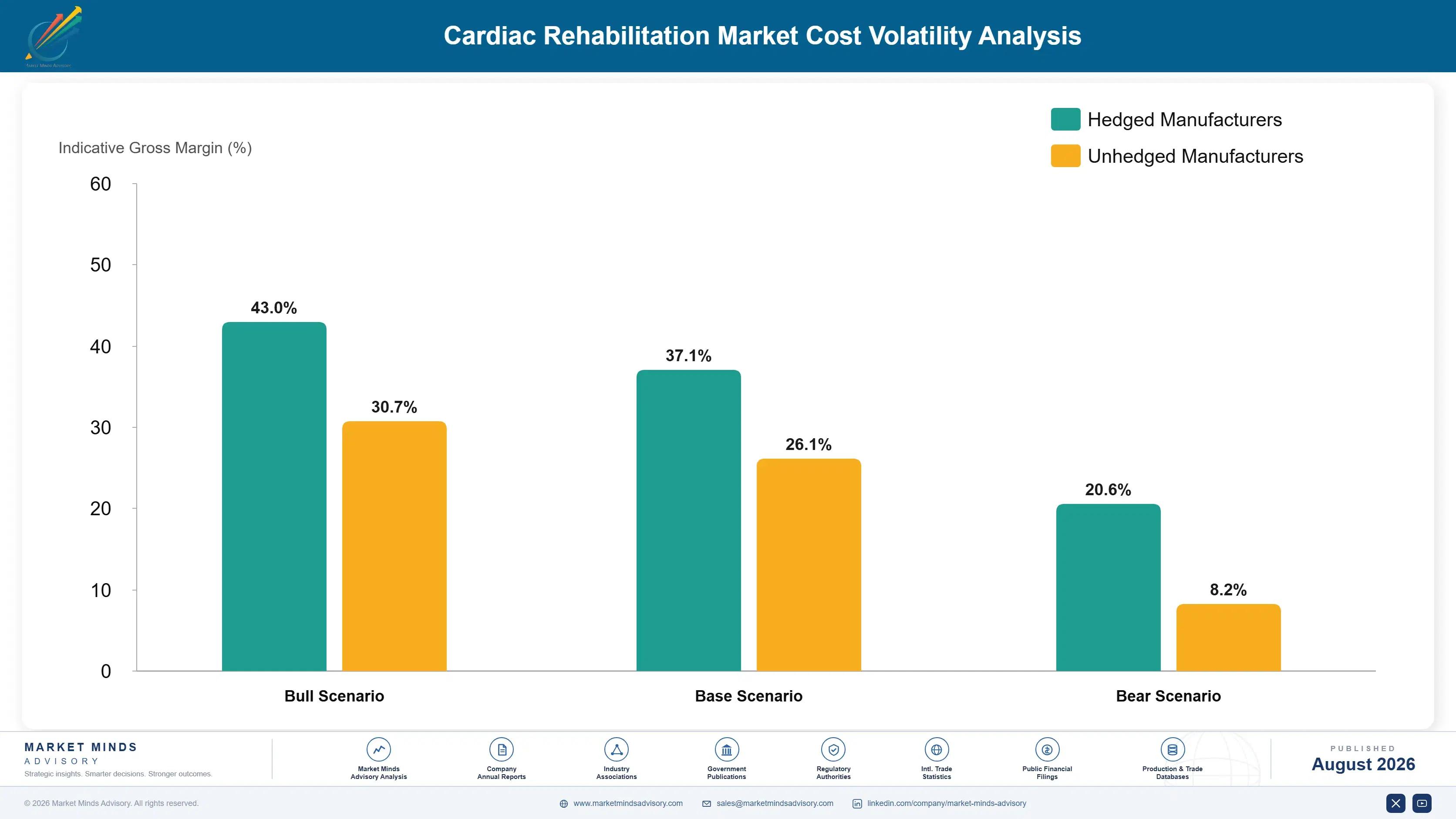
Cloud infrastructure hosting, wearable sensor components, and software development labor account for roughly 36% of cost of goods sold across telehealth cardiac rehabilitation platform delivery, with a further 19% attributable to clinical support staffing and data security compliance. Most cloud infrastructure and sensor component sourcing concentrates among specialized technology suppliers in the United States and East Asia.
Cloud computing infrastructure costs rose an estimated 8% during 2023, according to company annual report disclosures citing broader technology infrastructure cost pressure affecting the digital health platform sector, before stabilizing through 2024 as providers optimized infrastructure efficiency. Wearable sensor component costs also saw measurable volatility over the same period, according to EIA-adjacent electronics trade data covering semiconductor and sensor manufacturing inputs relevant to wearable device production.

Larger providers with vertically integrated software development and cloud infrastructure capacity absorb input cost volatility more easily than smaller specialized competitors dependent on third-party technology vendors for critical platform components. Providers serving public health system contracts face the sharpest exposure, since multi-year fixed-price government contracts leave little room to pass through input cost increases once agreements are signed and locked in place.
cardiac-rehabilitation-market-cost-volatility-analysis-1787304264561

Qualify Secondary Cloud Infrastructure Providers

Providers increasingly qualify secondary cloud infrastructure vendors across multiple technology suppliers, reducing exposure to any single vendor's capacity constraints or pricing volatility entirely. This dual-sourcing approach adds modest qualification cost upfront but has measurably reduced service interruption incidents for providers who adopted it early, ahead of recent cloud infrastructure cost pressure affecting the sector.

Vertically Integrate Software Development Capacity

Larger providers are investing directly in in-house software development and cloud infrastructure management capacity rather than relying entirely on external technology vendors, reducing exposure to third-party pricing and integration delay constraints. This vertical integration requires substantial upfront capital investment but has already shortened deployment times for providers pursuing it ahead of broader industry adoption of comparable capability.

Structure Multi-Year Health System Pricing Agreements

Providers serving public health system contracts increasingly negotiate multi-year technology infrastructure pricing agreements with key vendors that mirror the multi-year government contracts they themselves sign, aligning cost and revenue timing more closely. This reduces margin compression risk from mismatched contract cycles, though it requires vendors willing to accept longer-term price certainty over spot-market flexibility.

Portfolio Architecture for Margin Defence

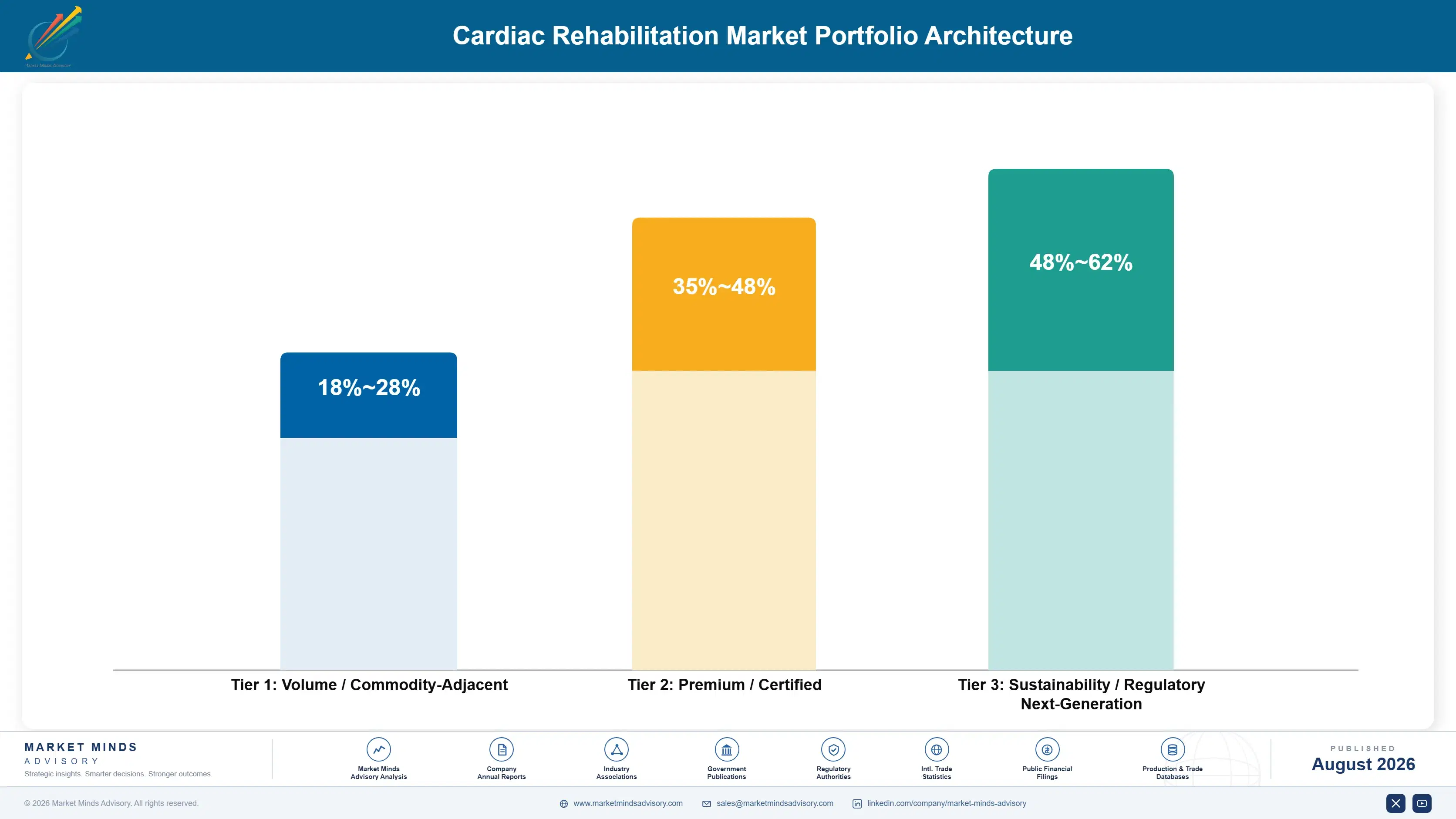
Portfolio economics split across three tiers defined by delivery model and monitoring depth rather than facility size alone. Volume center-based standard programs carry moderate margins driven by steady multi-provider competition, while premium telehealth and wearable-integrated formats command materially wider margins, reflecting clinical validation investment and remote monitoring positioning that center-based-only competitors cannot easily replicate across most treatment markets tracked close
Volume and premium tiers pull provider strategy in different directions, since public health system procurement rewards providers who can supply reliable standard programs at competitive per-enrollment cost, while academic health systems reward providers who can demonstrate telehealth or wearable differentiation through validated clinical outcomes. Few providers compete credibly across both tiers, since the technology investment, clinical validation, and delivery infrastructure required for each differ substantially.

High-value margin pools concentrate almost entirely in telehealth and wearable-integrated categories serving leading health systems in North America, Western Europe, and East Asia's premium private healthcare segments. Volume tiers generate the overwhelming majority of enrollment count but a comparatively modest share of total industry profit pool, a divergence widening as telehealth validation accelerates faster than center-based pricing pressure eases considerably.

Volume / Commodity-Adjacent

Center-based standard supervised programs and conventional monitoring equipment sold predominantly through public procurement and general hospital distribution, competing largely on unit cost and facility capacity across most global regions today.
Gross Margin: 18-28%

Premium / Certified

Cardiac monitoring and telemetry devices sold through specialist hospital and health system channels, commanding meaningfully wider margins through clinical differentiation and dedicated remote monitoring support capability offered broadly and consistently.
Gross Margin: 35-48%

Sustainability / Regulatory / Next-Generation

Telehealth rehabilitation platforms and wearable-integrated monitoring formats still expanding into mainstream health system adoption, priced at the category's highest premium levels given limited near-term competitive alternatives available currently and steadily.
Gross Margin: 48-62%
cardiac-rehabilitation-market-portfolio-architecture-1787304265065

Enrollment Duration Anchors Recurring Revenue

Cardiac rehabilitation revenue functions on a fixed-duration enrollment model rather than a purely transactional service, since each patient completes a defined multi-week program generating predictable per-enrollment revenue regardless of which specific delivery format the patient ultimately uses. This recurring dynamic underpins provider willingness to invest heavily in completion rate improvement and remote monitoring integration, since higher completion rates directly translate into fuller r
Adoption depth varies meaningfully by end-use vertical, running deepest in academic health systems and large hospital networks that standardize program delivery across their full patient population, and shallowest in smaller independent clinics still defaulting to center-based-only delivery models. Telehealth stickiness proves particularly strong once patients experience the convenience of remote monitoring firsthand, with dropout rates to center-based-only care remaining low across most programs tracked.

Buyer profiles are shifting generationally as younger cardiologists trained on telehealth-integrated care increasingly expect hybrid delivery as a baseline program requirement rather than a premium option reserved for geographically distant patients. Procurement committees report this generational preference is accelerating purchasing decisions toward telehealth-inclusive program contracts faster than reimbursement policy has formally adjusted, pulling premium delivery adoption earlier into typical health system procurement cycles.
cardiac-rehabilitation-market-end-use-penetration-index-1787304265559

Where MMA Sees the Advantage

These are among the four positions where our research anticipates prominent divergence between winners and laggards over the coming forecast period. Each is grounded in the demand model, the regulatory perimeter, and the announced capacity pipeline.
01 / TELEHEALTH VALIDATION PRIORITY

Prioritize Telehealth Outcomes Validation Before Standard Consolidates

Providers without validated telehealth completion and outcomes data are losing health system contract renewals to competitors who invested early in hybrid delivery evidence instead of relying on center-based-only clinical reputation alone across most contract negotiations tracked in recent renewal cycles. Contract data now shows health systems default to whichever provider demonstrates comparable or superior completion rates through telehealth, not whichever operates the most established physical facilities. MMA sees telehealth validation depth, not facility reputation alone, as the clearer near-term differentiator through the current ten-year forecast window.
02 / HEALTH SYSTEM NETWORK POSITIONING

Build Direct Health System Relationships Before Competitors Lock Them In

Direct health system account relationships built early tend to persist through subsequent contract renewal cycles, giving first movers durable purchasing advantages that later entrants find genuinely costly to displace once agreements are formally in place and renewed regularly and consistently. Providers waiting for health system relationships to mature organically are ceding this advantage to faster-moving competitors already embedded in multi-year account management investments across several regions and networks. MMA views health-system positioning as a multi-year strategic asset worth pursuing immediately.
03 / WEARABLE REIMBURSEMENT ADVOCACY

Lead Simplified Wearable Billing Code Advocacy With Major Payers

Providers investing early in payer advocacy for simplified wearable monitoring billing codes reduce the administrative friction that currently slows continuous surveillance format reimbursement approval across many payer relationships nationwide and across most program categories tracked in this evolving digital health market and industry landscape. GE HealthCare's hospital network approach illustrates how payer relationship investment compounds as billing simplification expands across additional major payers over time. MMA recommends leading this advocacy effort rather than waiting for industry associations alone to drive change.
04 / PLATFORM COST REDUCTION

Invest in Telehealth Deployment Scale to Broaden Access

Providers that reduce telehealth platform deployment costs fastest will capture the category's next growth wave as pricing approaches levels accessible to mid-tier regional health systems rather than remaining confined to large academic medical centers indefinitely across most current markets and treatment settings tracked. Competitors delaying deployment scale investment risk ceding this transition entirely to whichever provider reaches broader affordability first, a timing advantage that compounds meaningfully once achieved across expanding regional health systems. MMA sees this cost curve as the clearest strategic inflection point ahead for the category.

Engagement Snapshot From the Field

A live engagement with an industry participant carrying material or product regulatory and market exposure ahead of a defining policy shift, showing how our research translates into a defensible multi-year portfolio strategy.
MARKET MINDS ADVISORY · CLIENT ENGAGEMENT SUMMARY
Cardiac Rehabilitation Producer Strategic Portfolio Review and Transition Roadmap 2026·Investment Scenario on Cardiac Rehabilitation Exposure Evaluation 2025-26
CLIENT PROFILE
The client operates a five-hospital regional health system in the Southeastern United States with reported annual cardiac rehabilitation program revenue of approximately 11 million US dollars (client-reported, unverified by MMA) split across center-based and emerging telehealth delivery formats. The system sought to expand telehealth rehabilitation capacity but lacked comparative completion rate and cost data to guide investment decisions across its five hospital sites.
STRATEGIC CHALLENGE
Leadership needed to determine how much capacity to shift from center-based programs toward telehealth delivery without reducing overall program completion rates, given uncertain patient preference for remote monitoring across the system's diverse rural and suburban patient population, varying broadband access, and quite differing age demographics across all five hospital sites.
MMA APPROACH
MMA combined its primary survey dataset with expert interviews across regional cardiologists and program administrators to model completion rate and cost impact from expanding telehealth capacity across the system's five hospital sites and diverse patient populations served. The engagement produced site-specific capacity allocation recommendations rather than a single system-wide telehealth mandate.
KEY FINDINGS
  1. Telehealth delivery increased program completion rates by an estimated 12% among patients living more than thirty minutes from a rehabilitation facility site.
  2. Two of five hospital sites served patient populations with limited broadband access, requiring hybrid rather than fully remote delivery for those locations specifically.
  3. Patients aged under 65 showed meaningfully higher telehealth engagement than older patients, suggesting age-stratified delivery model recommendations made more sense than uniform rollout.
  4. Center-based program capacity utilization remained high enough at two urban sites that telehealth expansion there offered limited near-term completion rate improvement potential.
CLIENT PROFILE
The client operates a five-hospital regional health system in the Southeastern United States with reported annual cardiac rehabilitation program revenue of approximately 11 million US dollars (client-reported, unverified by MMA) split across center-based and emerging telehealth delivery formats. The system sought to expand telehealth rehabilitation capacity but lacked comparative completion rate and cost data to guide investment decisions across its five hospital sites.
STRATEGIC CHALLENGE
Leadership needed to determine how much capacity to shift from center-based programs toward telehealth delivery without reducing overall program completion rates, given uncertain patient preference for remote monitoring across the system's diverse rural and suburban patient population, varying broadband access, and quite differing age demographics across all five hospital sites.
MMA APPROACH
MMA combined its primary survey dataset with expert interviews across regional cardiologists and program administrators to model completion rate and cost impact from expanding telehealth capacity across the system's five hospital sites and diverse patient populations served. The engagement produced site-specific capacity allocation recommendations rather than a single system-wide telehealth mandate.
KEY FINDINGS
  1. Telehealth delivery increased program completion rates by an estimated 12% among patients living more than thirty minutes from a rehabilitation facility site.
  2. Two of five hospital sites served patient populations with limited broadband access, requiring hybrid rather than fully remote delivery for those locations specifically.
  3. Patients aged under 65 showed meaningfully higher telehealth engagement than older patients, suggesting age-stratified delivery model recommendations made more sense than uniform rollout.
  4. Center-based program capacity utilization remained high enough at two urban sites that telehealth expansion there offered limited near-term completion rate improvement potential.
RECOMMENDED STRATEGY
Phase 1: Phase 1 (Months 1-3): Expand telehealth capacity at the three rural and suburban sites first, prioritizing patients living farthest from facilities. Phase 2: Phase 2 (Months 4-8): Deploy hybrid delivery models at the two limited-broadband sites while monitoring completion rate improvements very closely. Phase 3: Phase 3 (Months 9-12): Reassess urban site telehealth investment once initial rural and suburban results confirm expected completion rate gains.
OUTCOME
The system adopted the phased telehealth expansion approach, reporting a 10% increase in overall program completion rates across rural and suburban sites within the first six months of rollout (client-reported, unverified by MMA). Urban site investment was deferred pending confirmation of sustained completion rate gains.

Frequently Asked Questions

Foundational context covering the market sizes, CAGR, scope, country, region and competition that inform every finding below. This section is provided to cover basics and most often pre-purchase conversations, answered from the MMA Primary Research Dataset.

What is the current size of the Cardiac Rehabilitation Market?

The global cardiac rehabilitation market was valued at approximately 6.8 billion US dollars in 2025. This figure spans center-based programs, telehealth platforms, monitoring devices, and wearable rehabilitation technology across all tracked regions.

How large will the Cardiac Rehabilitation Market be by 2036?

The market is projected to reach approximately 17.2 billion US dollars by 2036, up from 7.4 billion in 2026. This represents a 2.32 times expansion over the ten-year forecast period.

What is the CAGR for the Cardiac Rehabilitation Market 2026 to 2036?

The market is forecast to grow at an 8.8% compound annual growth rate between 2026 and 2036. Bull and bear scenarios range from 10.1% to 7.4%, reflecting telehealth reimbursement adoption pace uncertainty.

Which segment is growing fastest?

Home-based telehealth rehabilitation platforms are the fastest-growing segment, expanding at 15.0% annually, roughly 1.70 times the overall market rate. Health systems are extending supervised recovery beyond limited center-based facility capacity.

Who are the major companies in the Cardiac Rehabilitation Market?

Leading companies include Philips Healthcare, GE HealthCare, Hillrom, Kencor Health, and Recora. These five providers collectively hold 41% combined share on a global revenue basis.

Which country is growing fastest?

China is the fastest-growing country market, expanding at 11.8% annually as cardiovascular disease burden and hospital network investment continue expanding nationwide. This growth reflects volume expansion under national health infrastructure investment.

Report Segmentation Architecture

The full report scope spans multiple orthogonal segmentation dimensions, with cross-tabulated demand data provided for each dimension pair. Coverage extends further to regional breakdowns, trend trajectories, and the competitive detail needed to support segment-level decision-making.

By Primary Market Dimension

  • Center-Based Supervised Programs
  • Home-Based Telehealth Rehabilitation Platforms
  • Cardiac Monitoring and Telemetry Devices
  • Wearable Rehabilitation Monitoring Devices
  • Exercise and Physical Therapy Equipment
  • Patient Education and Digital Coaching Services

By End-Use Industry

  • Academic Health Systems
  • Community Hospitals
  • Independent Rehabilitation Clinics
  • Public Health and Government Programs
  • Home Care and Post-Acute Settings

By Commercial Dimension

  • Direct Health System Sales
  • Government and Public Procurement Tenders
  • Payer and Insurance Reimbursement Contracts
  • Distributor and Wholesale Channel

By Region

  • North America
  • Western Europe
  • East Asia
  • South Asia and Pacific
  • Latin America
  • Middle East and Africa
  • Eastern Europe

Scope, Methodology, and Coverage

Every figure in this report is reproducible from documented input assumptions. The scope below maps the historical period, the forecast horizon, the segmentation dimensions, and the countries covered, alongside the underlying primary and qualitative methodology.
Historical Period
2020 to 2025
Forecast Period
2026 to 2036
Base Year
2025 (USD billions; MMA Primary Research Dataset, August 2026)
Market Definition
This report covers the global market for cardiac rehabilitation products and services, spanning center-based supervised programs, home-based telehealth rehabilitation platforms, cardiac monitoring and telemetry devices, wearable rehabilitation monitoring devices, and patient education services following cardiac events. It excludes acute cardiac surgical interventions, implantable cardiac devices, and general fitness equipment not specific to structured cardiac recovery programs.
Quantitative Units
USD billions (current prices); program completion rate and telehealth attach rate percentages where applicable
Segmentation Dimensions
By Primary Market Dimension; By End-Use Industry; By Commercial Dimension; By Region
Regions Covered
North America, Western Europe, East Asia, South Asia and Pacific, Latin America, Middle East and Africa, Eastern Europe
Countries Covered
USA, China, Germany, France, UK, Japan, South Korea, India, Australia, Canada, Brazil, Mexico, Indonesia, Vietnam, Thailand, Malaysia, UAE, Saudi Arabia, South Africa, Nigeria, Turkey, Poland, Netherlands, Italy, Spain, Sweden, Switzerland, Argentina, Colombia, Singapore, and additional markets relevant to this sector
Key Companies Profiled
Philips Healthcare (Royal Philips N.V.); GE HealthCare Technologies Inc.; Hillrom (Baxter International Inc.); Kencor Health; Recora Inc.; iRhythm Technologies, Inc.; AliveCor, Inc.; Biotricity Inc.; VitalConnect, Inc.; Cardiac Insight, Inc.; Preventice Solutions, Inc.; Boston Scientific Corporation; Medtronic plc; Zoll Medical Corporation; InfoBionic, Inc.; Current Health Ltd.; Teladoc Health, Inc.; Omron Healthcare, Inc.; Withings SA; Masimo Corporation
Quantitative Methodology
Primary survey, n=3,800 respondents, Q4 2025, six countries; demand-side model with trade association cross-validation
Qualitative Methodology
47 expert interviews, Q4 2025; applied to validate demand model assumptions, identify emerging dynamics, and assess competitive positioning
Report Format
PDF and XLSX data workbook (Word format preview document)
Publisher
Market Minds Advisory
Report Code
MMA-2026-MED-515
Published
August 2026
Contact
sales@marketmindsadvisory.com | www.marketmindsadvisory.com

Purchase the full Cardiac Rehabilitation Market Report (2026 to 2036).

This report delivers a complete assessment of the global cardiac rehabilitation market, covering center-based programs, home-based telehealth platforms, cardiac monitoring devices, wearable rehabilitation devices, and patient education services across all seven MMA-tracked regions through 2036. It combines primary survey data from 3,800 respondents with 47 expert interviews across cardiologists, health system administrators, and providers to quantify segment, regional, and competitive dynamics. Readers receive detailed sizing, forecast scenarios, and margin analysis across three commercial tiers. The report also profiles twenty companies and includes a full competitive assessment of moat and risk positioning across the five leading providers.
Ten-Year Forecast Across Three Growth Scenarios
Seven-Region Market Sizing With Country-Level Detail
Twenty Company Competitive Profiles and Benchmarking
Segment-Level Growth Analysis Across Six Categories
Input Cost and Supply Chain Risk Assessment
Portfolio Margin Architecture Across Three Tiers

Built For The People Who Decide

From boardroom strategy to bench-side execution, this report is read cover-to-cover by leaders shaping the next decade of their industry, turning demand scenarios, market dynamics and valuation benchmarks into decisions.
CXOs/ Presidents/ VPs/ Managers
M&A and Corporate Development
Strategy Teams and R&D Heads
Procurement and Product Directors
Regulatory and Compliance Leaders
Investor Relations and Equity Analysts