Market Minds Advisory
Card Printer Ribbons Market

Card Printer Ribbons Market: Financial Inclusion and Security Printing Demand

Financial inclusion programs across South Asia and Africa are pulling first-time card printer buyers into a consumables cycle mature markets built decades ago, while counterfeit pressure pushes holographic security ribbons from optional to mandatory.

Lead Analyst

David Horsley

Published

September 2026

Make Smarter Decisions with Customized Research Insights

Request a free sample report and evaluate market opportunities, growth trends, and competitive dynamics relevant to your business needs.

2025 MARKET VALUE$1.6BMarket Size 2025
2036 FORECAST VALUE$3.2BBase Case , 2026 to 2036
CAGR 2026 TO 20366.4 %Bull 7.6% / Bear 5.2%
INCREMENTAL OPPORTUNITY$1.5BNet 10- year value creation
EXPANSION MULTIPLE1.88x2036 value over 2026 base
Strategic Levers
M&A Pipeline
Regional Outlook
Country Rankings
Competitive Intelligence
Segmental Deep-dive
Call-Us : 91 93563 13602

Executive Snapshot and Market Trajectory

Ribbon consumables, not printer hardware margin, now decide which card printer vendor wins a long-term institutional contract, as banks, governments, and enterprises evaluate total cost of ownership over a printer's multi-year service life rather than sticker price alone at the point of purchase.
India anchors the fastest growth in this report, as financial inclusion programs and expanding formal banking penetration pull first-time card issuers into a printer and ribbon replacement cycle mature markets built decades ago. Retransfer print ribbons lead everywhere, but holographic overlay ribbons follow closely on counterfeit-prevention economics. East Asia anchors both manufacturing scale and demand even as security-feature growth concentrates in South Asia and government identity programs specifically.
Competitive intensity centers heavily on certified OEM compatibility and long-term printer lock-in, since manufacturers design proprietary ribbon formats third-party suppliers rarely replicate reliably at scale. Regulatory pressure adds a second front: several governments now mandate holographic or UV security features on national identity and financial cards, and vendors able to certify compliant ribbons fastest are winning tenders.
Market Definition
The card printer ribbons market covers dye-sublimation and thermal transfer ribbon consumables used in direct-to-card and retransfer card printers to produce ID badges, government identity documents, and financial cards, spanning full-color, monochrome, retransfer, and security overlay ribbon types. It excludes the card printer hardware itself and blank card stock sold without accompanying ribbon consumables.
Base Year Value
$1.6B in 2025 (MMA Primary Research Dataset, August 2026)
Forecast Period
2026 to 2036, eleven discrete annual values
CAGR
6.4% base case. Bull 7.6%. Bear 5.2%.
Fastest Growth Segment
Retransfer Print Ribbons: 9.8% CAGR
Fastest Growth Country
India: 10.6% CAGR
Fastest Growth Region
South Asia and Pacific: 8.4% CAGR
Largest Region
East Asia: 29% of 2025 global value
Market Leaders
HID Global Corporation, Entrust Corporation, Evolis SA, Matica Technologies Group, Zebra Technologies Corporation. Source: MMA Analysis based on company annual reports.
Primary Survey
n=3,800 procurement and R&D decision-makers, Q4 2025, six countries
Methodology
Demand-side build-up, cross-validated against public data, 47 expert interviews

Card Printer Ribbons Market Forecast Scenarios

card-printer-ribbons-market-size-forecast-scenario-1787301584746
Card printer ribbon demand grew unevenly between 2020 and 2025. Pandemic-era office closures depressed badge and ID printing volumes through 2021, then a sustained rebound from 2022 onward tracked India's expanding financial inclusion programs and renewed enterprise badge issuance. Growth over the period compounded at an estimated 5.6%, trailing the forecast years because retransfer and security-ribbon adoption, still early, had not yet become the dominant demand driver across major markets.
The base case assumes 6.4% annual growth through 2036, anchored on three mechanisms. First, India's financial inclusion and national identity programs keep expanding the installed printer base faster than any other large economy tracked. Second, counterfeit pressure keeps pushing holographic and UV security ribbons from an optional upgrade into a mandated government and financial-card specification across an expanding list of jurisdictions. Third, retransfer printing adoption keeps rising as financial card issuers demand edge-to-edge print quality direct-to-card technology cannot reliably match at comparable cost.
A bull case builds if additional national governments mandate security-feature ribbons on identity documents, pushing growth toward 7.6%. The bear risk is digital identity substitution: several countries are piloting mobile-based digital identity credentials that could reduce physical card issuance volume, capping ribbon replacement demand and growth near 5.2% if adoption accelerates faster than currently expected across major economies.

OEM Lock-In Economics and the Security Printing Cycle

Card printer ribbons sit inside a classic razor-and-blade business model, where printer hardware margin matters far less to vendors than the recurring, proprietary ribbon consumable sold across a printer's multi-year service life. Institutional buyers increasingly evaluate total cost of ownership across the full replacement cycle rather than upfront printer price, reshaping how vendors structure long-term contracts and pricing.
MARKET CONCENTRATION61% CR5Five global vendors control well over half of demand
AVERAGE SELLING PRICE$38 per ribbon rollBlended price across full-color, retransfer, and security types
TOP PRODUCING COUNTRYJapan, 31%Single country supplies nearly a third of global output
CAPACITY UTILISATION73%Coating lines run below peak amid rising security-ribbon demand
TRADE INTENSITY58% export shareWell over half of ribbon rolls cross a border
INPUT COST SHARE36% of COGSPolyester film base and dye-sublimation coatings dominate costs
Vendors compete less on ribbon price than on OEM compatibility and certification: government and financial institution buyers standardize on ribbons certified for their specific printer platform and security requirements rather than comparing generic third-party alternatives on price alone. Manufacturing remains concentrated in Japan, the United States, and increasingly China, with India gaining share in assembly and distribution as demand grows domestically and steadily.
The next decade will be shaped by two forces pulling in the same direction: expanding financial inclusion in South Asia and Africa and tightening security-feature mandates on government identity documents worldwide. Both push ribbon replacement demand upward even as mature markets see printer installed base growth slow toward simple hardware replacement rather than genuine expansion.
"The printer is basically the loss leader. Every card that comes out of it needs another ribbon, and that's where the real business has always lived."
Director, Identity and Security Printing Technology Practice · MMA Identity and

Market Trends

Holographic Security Ribbons Become a Government Mandate

National governments issuing identity documents and financial regulators overseeing payment card issuance are increasingly mandating holographic or UV-visible security features as a baseline anti-counterfeiting requirement rather than an optional upgrade issuers could previously decline. This is converting holographic overlay ribbons from a niche premium product into a standard specification across national identity and financial card programs, particularly across South Asia, Africa, and Latin America where document fraud has drawn sustained regulatory attention. Manufacturers with established security-feature engineering are capturing disproportionate share of new government tenders as procurement officers increasingly treat certified security credentials as a non-negotiable requirement.
Market Impact: Lifts ribbon revenue per card 65%

India's Financial Inclusion Programs Expand Printer Installed Base

India's continued push toward universal banking access and formal identity documentation is expanding the country's card printer installed base faster than any other large economy tracked in this report, as banks, cooperatives, and government agencies that once issued paper documents move to durable plastic identity and payment cards. HID Global and Entrust have built India-specific distribution and service networks to capture this conversion, recognizing that ribbon replacement revenue, not initial printer sales, determines long-term account value here. This positions India as the single fastest-growing large ribbon market tracked anywhere in this report.
Market Impact: Raises annual ribbon consumption 22

Market Opportunities and Growth Drivers

Retransfer Printing Adoption Raises Ribbon Value Per Card

Financial card issuers increasingly specify retransfer printing over direct-to-card technology because retransfer printing applies image to a clear film first, then fuses it to the card surface, producing edge-to-edge print quality and durability direct-to-card printing cannot reliably match on cards handled daily for years. Retransfer ribbons carry meaningfully higher price per roll, since the process requires a separate transfer film ribbon alongside the color ribbon, effectively doubling consumable revenue per card printed. This pulls ribbon revenue growth ahead of printer unit growth in financial and premium identity segments, as issuers upgrade fleets to capture reliable durability.
Market Impact: Threatens 15% of mature-market volu

Enterprise Badge Reissuance Cycles Shorten Industry-Wide

Corporate security policies increasingly mandate shorter badge reissuance cycles, driven by employee turnover, contractor access management, and tightening physical security requirements at large enterprises and government facilities managing sensitive sites. This is increasing ribbon consumption per badge printer beyond what simple headcount growth alone would predict, since each reissued badge consumes another full print cycle regardless of whether total badge holder count changed year over year. Large enterprise and government buyers increasingly negotiate ribbon supply contracts directly with manufacturers rather than through resellers, seeking volume pricing that reflects genuinely higher consumption tied to reissuance policy.
Market Impact: Displaces 24% of authorized volume

Market Restraints and Challenges

Digital Identity Credentials Threaten Long-Term Card Demand

Several governments are piloting mobile-based digital identity credentials that could eventually reduce reliance on physical identity cards, threatening the long-term demand base for card printer ribbons in markets that adopt digital alternatives at scale. The root cause is a genuine substitution risk: smartphone penetration has crossed a threshold in several markets where a digital wallet credential is technically feasible for many use cases once requiring a physical card. This creates long-term demand uncertainty for manufacturers most exposed to markets furthest along in digital rollout. Manufacturers are mitigating this by diversifying into physical security features digital credentials cannot easily replicate.
Market Impact: Adds 38% to security ribbon demand

Counterfeit Ribbon Imports Undercut OEM Pricing

Counterfeit and unauthorized third-party ribbons, particularly prevalent across price-sensitive South Asian and African markets, undercut authorized OEM ribbon pricing by a wide margin while frequently causing printer damage and producing cards that fail security certification entirely. The root cause is weak intellectual property enforcement in several fast-growing markets, where customs authorities lack capacity to distinguish authorized ribbons from counterfeit imports at the volume now entering through informal channels. This slows authorized manufacturer share gains precisely in the fastest-growing markets tracked in this report. Manufacturers are mitigating this through embedded authentication chips printers verify automatically, rejecting unauthorized cartridges before printing begins.
Market Impact: Adds 2.4 million printer installati
3 additional market trends, 3 additional growth drivers, and 3 additional restraints and challenges are covered in the full report. Contact sales@marketmindsadvisory.com to access the complete intelligence.

Segment CAGR and Growth Architecture

MMA segments the market by ribbon print technology and function, the classification printer manufacturers and institutional buyers use when specifying consumables and comparing OEM certification compatibility across competing vendor bids. This avoids blending downstream card application categories, a separate commercial dimension entirely, with the ribbon technology types that define compatibility with a specific printer platform.
card-printer-ribbons-market-market-share-analysis-1787301585291

Retransfer Print Ribbons

Retransfer ribbons are converting from a premium niche into the segment vendors compete hardest to win, as financial card issuers and premium government identity programs specify edge-to-edge print quality and durability direct-to-card ribbons cannot reliably deliver across a card's full service life. Growth concentrates wherever financial card issuance and premium identity documentation intersect, particularly across India, the Gulf states, and Southeast Asia's expanding banking sector. HID Global and Entrust have each built dedicated retransfer ribbon manufacturing lines, recognizing that the two-ribbon process, film plus color, roughly doubles consumable revenue per card relative to standard ribbons. At a 9.8% forecast CAGR, roughly 1.5 times the market average, this segment pulls investment away from slower-growing color ribbon categories.
CAGR 9.8%

Holographic Overlay Ribbons

Security overlay ribbons track government and financial regulatory mandates more directly than any other segment, making counterfeit-prevention policy a disproportionate growth driver for this category specifically. Matica Technologies and Zebra Technologies lead on certified security-feature engineering, while regional manufacturers compete on price for lower-tier institutional badge applications without regulatory mandates attached. Demand here is less tied to general printer installed base growth than other segments, since security ribbon adoption follows regulatory timeline announcements rather than organic replacement cycles alone. Growth tracks government procurement and financial regulator mandate timing more closely than general economic conditions, giving this segment a distinct, policy-driven demand cycle apart from the rest of the broader portfolio described throughout this report.
CAGR 8.6%
Full segment breakdown across 6 segments available in the complete report.

Regional Architecture and Country Demand Map

Demand concentrates where institutional card issuance volume, security-mandate regulation, and manufacturing capability overlap most tightly. East Asia leads on manufacturing and mature institutional demand, North America and Western Europe follow on enterprise and financial card replacement cycles, while South Asia and Pacific converts fastest as India's financial inclusion programs expand.

North America

United States enterprises and government agencies anchor regional demand, replacing badge and identity ribbons on established security-driven reissuance cycles across thousands of large corporate and federal facilities nationwide. HID Global and Entrust give domestic buyers deep OEM certification and service support that importing regional players cannot easily replicate across such a large, security-sensitive installed base. Canada follows a similar enterprise-driven replacement pattern at smaller scale, tied closely to its own federal identity document programs. Growth stays close to the global base rate because the region's institutional installed base is already largely mature, leaving mostly steady replacement demand rather than substantial first-time adoption opportunity ahead for most vendors active in the category today.
Share: 25% | CAGR: 6.0% (2026 to 2036)

Western Europe

Germany and France anchor regional demand, tied to national identity card programs and a mature financial card issuance base that replaces ribbons on documented institutional procurement cycles rather than ad hoc reordering. The United Kingdom follows with steady enterprise badge and financial card demand tied to corporate security policy tightening across large employers. Regulatory pressure compounds this: European Union identity document security standards keep tightening, forcing periodic ribbon specification upgrades even at already well-equipped government agencies and financial institutions across member states. Growth trails East Asia and South Asia because Western Europe's institutional installed base is already thoroughly modernized, leaving less first-time conversion opportunity than emerging identity-documentation economies still expanding.
Share: 20% | CAGR: 4.9% (2026 to 2036)
Regional intelligence for 5 additional markets available in the complete report: East Asia, South Asia and Pacific, Latin America, Middle East and Africa, Eastern Europe. Contact sales@marketmindsadvisory.com.
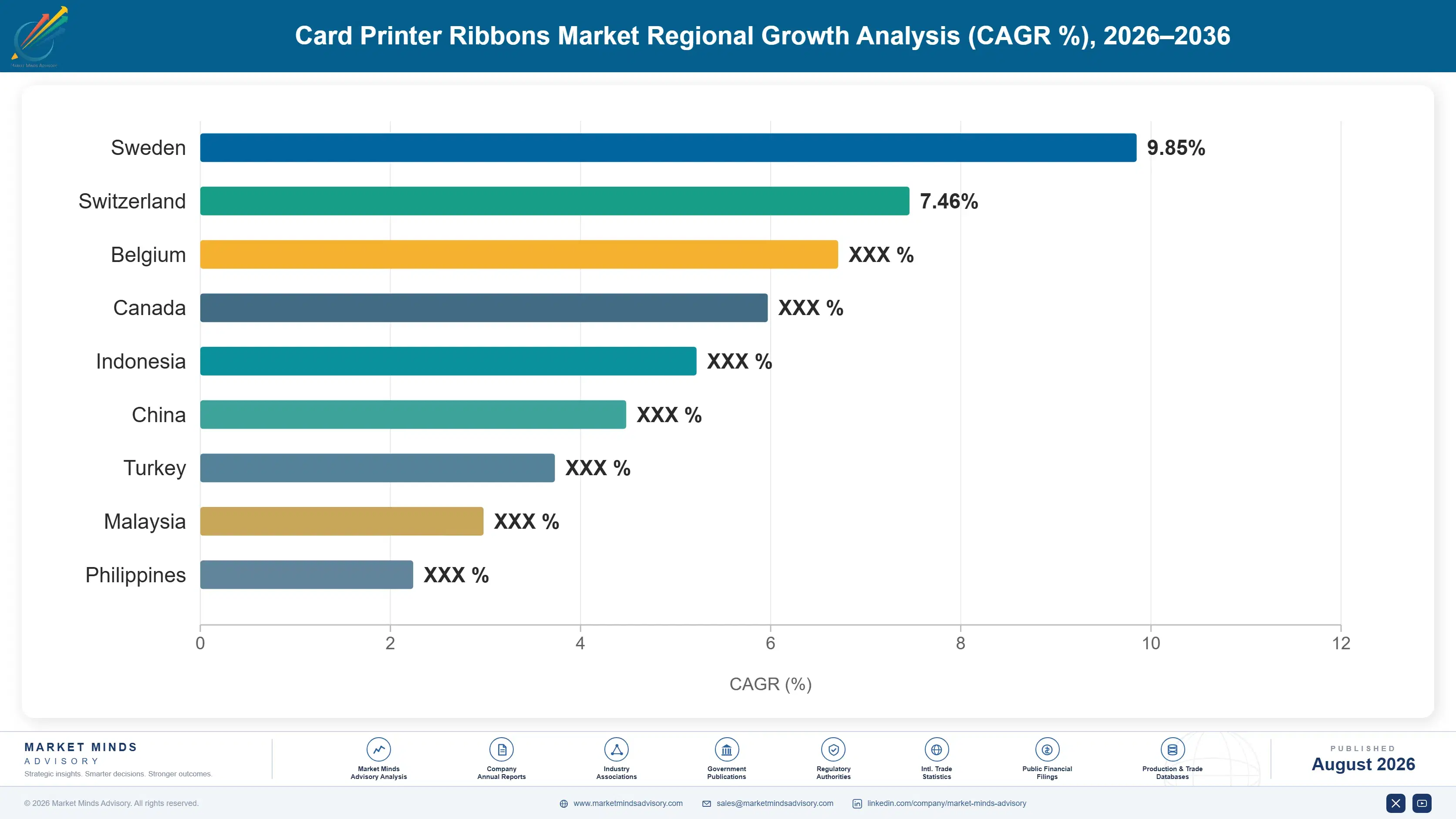
card-printer-ribbons-market-country-cagr-analysis-1787301585808

Where Ribbon Vendors Actually Capture Margin

Printer hardware increasingly competes on price as manufacturing standardizes, so the vendors protecting margin monetize the parts of the transaction adjacent to the printer itself: certified ribbon consumables, security-feature licensing, and long-term supply contracts. The four levers below reflect where MMA's interviews with institutional buyers show real, sustained willingness to pay a genuine premium.

Long-Term Certified Ribbon Supply Agreements for Institutions

Government and financial institution buyers increasingly sign multi-year ribbon supply agreements guaranteeing certified, security-compliant consumables at locked pricing, converting what used to be a series of individual reorders into predictable recurring revenue worth roughly 70% of a printer's total lifetime revenue for the manufacturer. Vendors offering these agreements gain visibility into future demand that supports capacity planning, while buyers gain protection against counterfeit ribbon risk and price volatility across a multi-year procurement cycle. This is becoming a standard requirement in large government tenders specifically, where security certification continuity across the full contract term matters more than per-unit ribbon price alone.
Market Impact: Locks in 70 percent of lifetime rev

Embedded Ribbon Authentication Chip Licensing Deals

Manufacturers embedding authentication chips in ribbon cartridges, which printers verify automatically before allowing printing, capture licensing revenue while simultaneously blocking counterfeit ribbon usage on their printer platforms entirely. This technology converts an anti-counterfeiting measure into a direct revenue stream, since printer manufacturers charge for the authentication feature both to third-party ribbon makers seeking compatibility licensing and, implicitly, to end customers through premium-priced authenticated ribbons carrying a 12-point margin premium. Vendors report meaningfully higher gross margin on authenticated ribbon lines compared with unauthenticated legacy ribbon products still sold into older printer platforms lacking the verification capability entirely.
Market Impact: Adds roughly 12 points of gross mar

Security-Feature Certification and Compliance Support Services

Government identity programs require extensive security-feature certification documentation, and procurement processes frequently favor vendors who can demonstrate compliance quickly against evolving national security standards across multiple regulatory jurisdictions simultaneously. Manufacturers building in-house regulatory affairs teams to handle certification testing and documentation on behalf of government buyers are converting what used to be a lengthy procurement bottleneck into a vendor-managed service, closing large tenders roughly 30% faster than competitors leaving buyers to navigate certification processes independently and without dedicated support throughout the entire bidding cycle from submission to award.
Market Impact: Cuts tender award timeline by 30 pe

Printer Fleet Monitoring and Predictive Reordering

Connected card printers that report ribbon usage and remaining capacity back to a vendor's monitoring platform let manufacturers offer automatic predictive reordering, ensuring institutional buyers never run out of certified ribbon stock during high-volume issuance periods tied to enrollment drives or badge renewal cycles. For large enterprises and government agencies managing dozens of printers across multiple facilities, the value proposition is eliminated stockout risk and simplified procurement administration. Early adopters report predictive reordering attach rates approaching 26% on large institutional fleet contracts, growing faster than any other service line vendors currently track.
Market Impact: Reaches nearly 26 percent attach ra

Who Controls the Margin Pool

CR5 sits at 61%, reflecting a category more consolidated than most printing consumables segments, as OEM certification requirements and proprietary ribbon formats reward scale and discourage fragmentation. HID Global and Entrust lead on a revenue basis, with a meaningful gap separating them from the next tier of challengers, including Evolis and Matica, each strong in specific regional or application niches rather than across the board.
Current activity centers on three dimensions: OEM ribbon certification breadth across printer platforms, security-feature engineering depth for government and financial applications, and long-term supply contract capability for large institutional buyers. Vendors lacking broad certification coverage are partnering with regional distributors rather than losing government tenders on compliance-documentation terms alone, since institutional buyers now shortlist based on demonstrated multi-jurisdiction certification depth.

Emerging pressure comes from Chinese and Korean manufacturers, particularly Seaory Technology and IDP Corporation, expanding aggressively on price and certification breadth into markets historically dominated by Western and Japanese brands. If India and African demand growth continues outpacing mature markets, expect rankings among the next five challengers to shift by 2030, as manufacturers with strong South Asian distribution convert early positioning into lasting share against slower-moving incumbents.
card-printer-ribbons-market-company-positioning-matrix-1787301586330

Competitive Moat and Risk Dimensions

HID GLOBAL CORPORATION

Moat: Fargo-Branded OEM Ribbon Lock-In

HID Global's Fargo printer platform and certified ribbon lineup give it a proprietary lock-in few competitors can match, letting it capture recurring ribbon revenue across a large installed base of government and enterprise printers already deployed. That combined footprint makes HID Global the default vendor for institutions standardizing security-certified identity printing infrastructure.
HID GLOBAL CORPORATION

Risk: Exposure to Physical ID Decline

HID Global's revenue remains tied significantly to continued physical card issuance, leaving it exposed to any accelerated shift toward digital identity credentials in markets furthest along in mobile wallet adoption. Diversifying into digital identity and access technology requires balancing continued ribbon-segment investment against a genuinely different, software-driven product category and sales motion.
ENTRUST CORPORATION

Moat: Financial Card Issuer Relationships

Entrust's deep relationships with major financial institutions and payment networks give it certification credibility and distribution reach into financial card issuance that pure identity-badge vendors cannot easily replicate. That reputation lets it command premium pricing on retransfer and security ribbons where financial-grade certification matters more than price alone.
ENTRUST CORPORATION

Risk: Slower Consumer ID Segment Growth

Entrust's strength in financial and government institutional channels has translated less quickly into the fast-growing consumer and enterprise badge segments where smaller, more agile competitors are gaining share on price and service responsiveness. Closing this gap requires channel investment that competes directly with Entrust's traditional institutional sales motion for capital and management attention.

Players Tracked

Prominent Players

HID Global Corporation
Entrust Corporation
Evolis SA
Matica Technologies Group
Zebra Technologies Corporation

Other Key Players

IDP Corporation
Magicard Ltd.
Nisca Corporation
Swiftcolor Inc.
Advent Solutions Ltd.
IDenticard Systems
Plasco ID
Seaory Technology Co., Ltd.
NBS Technologies Inc.
Ci Solution Co., Ltd.
Dai Nippon Printing Co., Ltd.
ColorID LLC
Javelin Card Systems
Smart Kaarten B.V.
Wuhan Tianyu Information Industry Co., Ltd.

Recent Developments

APRIL 2025

HID Global Launches Next-Generation Holographic Security Ribbon Line

HID Global introduced an upgraded holographic overlay ribbon line featuring enhanced tamper-evident features designed to meet tightening national identity document security standards across multiple regulatory jurisdictions worldwide. The launch targets government tenders requiring certified security features ahead of upcoming procurement cycles across several major markets.
Signal: Signals HID Global positioning security-fe
OCTOBER 2025

Entrust Expands India Manufacturing and Distribution for Retransfer Ribbons

Entrust announced an expansion of its India manufacturing and distribution footprint dedicated to retransfer ribbon production, adding local assembly capacity to serve growing financial inclusion demand without relying entirely on imports. The expansion targets shorter delivery lead times for India's fast-growing banking and identity documentation channels specifically.
Signal: Signals Entrust prioritizing direct India
FEBRUARY 2026

Evolis Partners with Regional Distributor to Expand African Coverage

Evolis signed a distribution partnership with a regional African identity solutions provider, gaining direct service and installation capability across several West African markets rather than relying on a single continental distributor. The deal strengthens Evolis's ability to bid on national identity program contracts directly across the region.
Signal: Signals Evolis building direct regional se

Polyester Film and Dye Coating Costs

Polyester film base and dye-sublimation coating materials together account for roughly 36% of ribbon cost of goods sold, with specialty coatings contributing the larger share on security and retransfer ribbon types specifically. Film base is sourced from a concentrated group of specialty polymer film producers, while dye and holographic coating materials come from a smaller number of manufacturers concentrated in Japan and Germany.
Specialty polymer film prices spiked through 2023 as global demand for thin-film substrates, driven partly by electronics and packaging applications, competed directly with ribbon manufacturers for the same specialized film supply, according to Japan's METI materials tracking. Manufacturers without long-term supply contracts saw film costs rise faster than they could pass through to institutional pricing, compressing margins on fixed-price government tenders signed before the spike occurred across the industry.

Smaller regional manufacturers without hedging arrangements or long-term film supply contracts absorb price volatility directly into thin margins, while larger players like HID Global and Entrust use group-level procurement scale to negotiate forward pricing across multiple product lines simultaneously. Manufacturers without in-house coating development carry additional exposure compared with vertically integrated competitors who capture more of the specialty materials value chain themselves.
card-printer-ribbons-market-cost-volatility-analysis-1787301586525

Forward Polyester Film Purchasing Agreements

Larger manufacturers are locking twelve to eighteen months of specialty film supply through forward agreements directly with polymer producers rather than buying spot, smoothing input cost volatility into predictable production budgeting across major ribbon product lines. This reduces exposure to spikes like the 2023 thin-film-driven surge, though it requires balance-sheet capacity smaller manufacturers typically lack in practice.

In-House Dye Coating Formulation Development

The largest manufacturers are investing directly in dye and holographic coating formulation development rather than relying entirely on third-party material suppliers, capturing more of the specialty materials value chain and reducing exposure to spot-market price swings across the category's highest-margin ribbon types specifically. This requires sustained capital investment smaller manufacturers cannot easily commit to matching.

Dual-Sourcing Specialty Film Substrate Components

Vendors are qualifying second film substrate suppliers across different countries rather than depending on a single specialized manufacturing source, reducing single-point-of-failure risk after recent regional supply disruptions affected delivery timelines across the industry broadly and unpredictably during peak demand periods. This adds qualification cost but protects delivery schedules during localized shortages, a tradeoff most manufacturers now accept.

Portfolio Architecture for Margin Defence

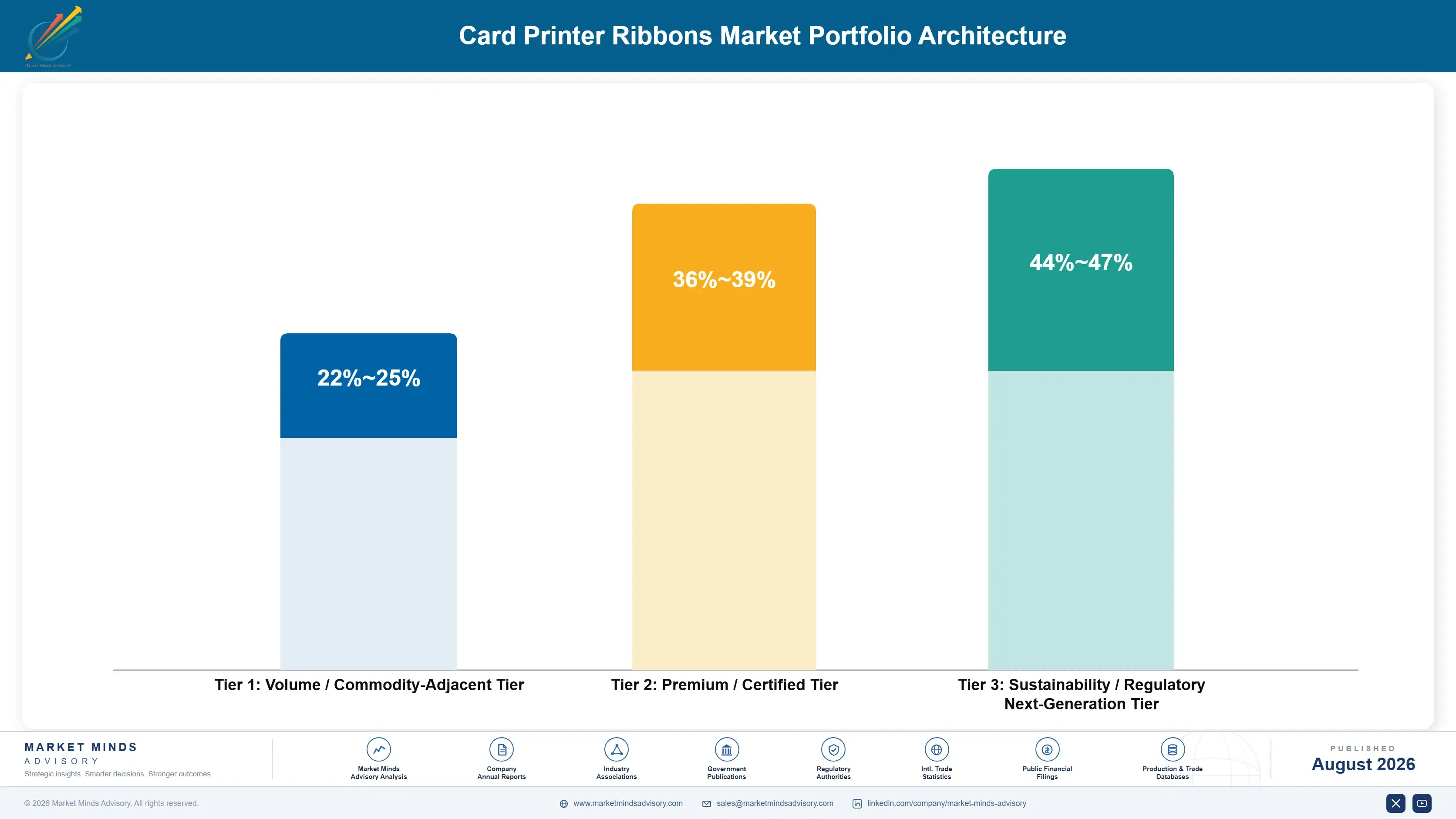
MMA's tier architecture separates the category into three margin bands. Volume and commodity-adjacent monochrome and basic color ribbons compete on price against unauthorized imports and carry thin margin, premium and certified retransfer and security ribbons carry higher margin on OEM certification depth and compliance guarantees, and sustainability-linked next-generation lines, including authenticated ribbons and recycled-film products, command the highest margin as the newest tier. Margin dis
The tension between volume and premium plays out most visibly in India's expanding financial inclusion channel, where first-time issuers want certified security features at closer to commodity-ribbon price, and vendors most want to move these buyers up-tier through long-term supply agreements and certification bundling. Counterfeit and unauthorized import competition remains the most price-sensitive segment and the hardest to convert toward authorized, branded purchasing.

High-value margin pools concentrate in government and financial institutional orders bundled with certification services, authentication licensing, and predictive reordering contracts, where service and software-attach revenue increasingly outweighs the margin earned on any individual ribbon sale alone. That shift is pushing vendors to organize sales teams around total account value rather than unit sales.

Volume / Commodity-Adjacent Tier

Basic monochrome and standard color ribbons sold primarily on price against unauthorized imports, serving cost-sensitive enterprise badge buyers where gross margin stays thin and competition is driven almost entirely by landed unit cost and OEM compatibility claims.
Gross Margin: 22%-25%

Premium / Certified Tier

Retransfer and standard security ribbons specified by financial institutions and government agencies requiring documented certification, service coverage, and long-term supply agreements, commanding meaningfully higher margin on compliance depth and reliability.
Gross Margin: 36%-39%

Sustainability / Regulatory / Next-Generation Tier

Authenticated holographic ribbons and recycled-film products positioned for institutions chasing counterfeit prevention and sustainability procurement criteria, where certification depth and licensing revenue support the category's highest margin overall across nearly every region tracked in this report today.
Gross Margin: 44%-47%
card-printer-ribbons-market-portfolio-architecture-1787301587033

Consumable Lock-In and Certification Economics

A card printer sale is rarely the primary transaction anymore. Certified ribbon supply agreements, authentication licensing, and predictive reordering contracts convert what used to be a one-time hardware purchase into a recurring revenue relationship that can run the length of a printer's multi-year operating life. Vendors that capture the ribbon and certification attachment at time of first sale retain far more lifetime value per customer than those competing purely on printer hardware price.
Adoption depth varies sharply by buyer type. Large government agencies and financial institutions convert fastest and most completely, standardizing entire printer fleets onto one certified platform once a pilot proves out, which makes them the highest-value account type despite competitive institutional-level pricing. Small and mid-sized enterprises convert more slowly and partially, often relying on generic ribbons for years before adopting certified, authenticated consumables.

A generational shift in buyers is compounding the certification-driven shift. Younger procurement officers entering government and financial institution roles increasingly expect authenticated, fraud-resistant ribbons as standard, a purchasing expectation an older generation of buyers, who bought consumables individually as needed, rarely held. That shift is accelerating premium-tier adoption even among institutions that have not yet faced a documented counterfeiting incident.
card-printer-ribbons-market-end-use-penetration-index-1787301587521

What Matters Most Through 2036

These are among the four positions where our research anticipates prominent divergence between winners and laggards over the coming forecast period. Each is grounded in the demand model, the regulatory perimeter, and the announced capacity pipeline.
01 / SECURITY CERTIFICATION CAPABILITY

Build dedicated regulatory certification teams before rivals do

Security-feature mandates now decide a majority of government institutional purchasing decisions across the markets tracked in this report, and certification delay remains a leading reason large tenders slip past planned procurement deadlines. Vendors that build dedicated certification facilitation capability convert tender win rates meaningfully higher than competitors leaving buyers to navigate regulatory bureaucracy alone, according to MMA's expert interviews with government procurement committees. Continuing to treat certification as the buyer's problem rather than the vendor's opportunity risks ceding the fastest-growing distribution channel to competitors willing to build that capability first.
02 / INDIA MARKET INVESTMENT

Build India-specific manufacturing ahead of financial inclusion demand

India is growing faster than any other large ribbon market tracked in this report, yet most manufacturers still serve it primarily through imports designed for other markets and certification regimes entirely. Vendors that build India-specific manufacturing, distribution, and certification support now will capture disproportionate share of the financial inclusion conversion already underway, before competitors with deeper pockets catch up on local presence. Waiting for India's market to fully mature before investing risks losing first-mover advantage in the single fastest-growing large market covered here.
03 / AUTHENTICATION TECHNOLOGY INVESTMENT

Prioritize embedded authentication over price-based ribbon competition

Counterfeit ribbons displace a meaningful share of authorized volume precisely in the fastest-growing markets covered in this report, and embedded authentication chips convert a defensive anti-counterfeiting measure into a durable, licensable revenue stream competitors without similar technology cannot easily match. Manufacturers that build authentication infrastructure now will extend brand protection and margin defensibility simultaneously, a combination difficult for price-focused competitors to replicate without comparable engineering investment. This remains underexploited by every manufacturer outside the two largest global vendors currently active in the category.
04 / DIGITAL IDENTITY CONTINGENCY PLANNING

Diversify into physical security features digital credentials cannot replace

Digital identity pilots in several markets pose a genuine long-term substitution risk to physical card issuance volume, and manufacturers overly dependent on simple ribbon replacement revenue face real exposure if digital adoption accelerates faster than currently projected. Vendors that diversify into tactile and physical verification features digital credentials cannot easily replicate, including embossed security elements and physical authentication layers, will retain relevance even as some use cases shift toward digital alternatives over the coming decade. This diversification requires investment well before any substitution actually threatens core ribbon revenue materially.

Engagement Snapshot From the Field

A live engagement with an industry participant carrying material or product regulatory and market exposure ahead of a defining policy shift, showing how our research translates into a defensible multi-year portfolio strategy.
MARKET MINDS ADVISORY · CLIENT ENGAGEMENT SUMMARY
Card Printer Ribbons Producer Strategic Portfolio Review and Transition Roadmap 2026·Investment Scenario on Card Printer Ribbons Exposure Evaluation 2025-26
CLIENT PROFILE
The client is a national banking group operating several thousand branches across a South Asian country, most still relying on older direct-to-card printers and basic color ribbons for debit card issuance. Facing new central bank security mandates requiring holographic features on all newly issued cards, leadership needed a modernization sequencing plan covering a planned capital and consumables outlay of roughly $36 million (client-reported, unverified by MMA).
STRATEGIC CHALLENGE
The banking group needed to meet the new security mandate across its entire branch network within a regulator-imposed deadline, but individual branches had different printer ages and card issuance volumes, and available capital covered only a fraction of branches needing full modernization simultaneously. Leadership needed a sequencing plan prioritizing which branches to modernize first, balancing regulatory urgency against realistic capital and vendor delivery capacity constraints.
MMA APPROACH
MMA built a branch-level prioritization model combining card issuance volume, existing printer compatibility with security ribbons, and regulatory deadline proximity, ranking all branches into three modernization-priority tiers. The analysis drew on MMA's primary survey data and expert interviews with ribbon manufacturers and banking regulators to benchmark realistic equipment costs and supply timelines available to a banking group of this scale and geographic spread.
KEY FINDINGS
  1. The highest-volume branches accounted for a disproportionate share of total card issuance, making them the clear first-priority modernization tier regardless of existing printer age or condition elsewhere.
  2. Branches with printers already compatible with security ribbons through a simple firmware update offered the fastest and cheapest compliance path, requiring no hardware replacement at all.
  3. Vendor-provided certification documentation cut regulatory approval turnaround meaningfully, allowing the group to compress its compliance timeline for early-priority branches by several weeks.
  4. Branch managers responded far more positively to modernization framed around regulatory compliance and fraud prevention than to messaging centered on printing efficiency or cost savings alone.
CLIENT PROFILE
The client is a national banking group operating several thousand branches across a South Asian country, most still relying on older direct-to-card printers and basic color ribbons for debit card issuance. Facing new central bank security mandates requiring holographic features on all newly issued cards, leadership needed a modernization sequencing plan covering a planned capital and consumables outlay of roughly $36 million (client-reported, unverified by MMA).
STRATEGIC CHALLENGE
The banking group needed to meet the new security mandate across its entire branch network within a regulator-imposed deadline, but individual branches had different printer ages and card issuance volumes, and available capital covered only a fraction of branches needing full modernization simultaneously. Leadership needed a sequencing plan prioritizing which branches to modernize first, balancing regulatory urgency against realistic capital and vendor delivery capacity constraints.
MMA APPROACH
MMA built a branch-level prioritization model combining card issuance volume, existing printer compatibility with security ribbons, and regulatory deadline proximity, ranking all branches into three modernization-priority tiers. The analysis drew on MMA's primary survey data and expert interviews with ribbon manufacturers and banking regulators to benchmark realistic equipment costs and supply timelines available to a banking group of this scale and geographic spread.
KEY FINDINGS
  1. The highest-volume branches accounted for a disproportionate share of total card issuance, making them the clear first-priority modernization tier regardless of existing printer age or condition elsewhere.
  2. Branches with printers already compatible with security ribbons through a simple firmware update offered the fastest and cheapest compliance path, requiring no hardware replacement at all.
  3. Vendor-provided certification documentation cut regulatory approval turnaround meaningfully, allowing the group to compress its compliance timeline for early-priority branches by several weeks.
  4. Branch managers responded far more positively to modernization framed around regulatory compliance and fraud prevention than to messaging centered on printing efficiency or cost savings alone.
RECOMMENDED STRATEGY
Phase 1: Phase 1 (Months 1 to 4): Modernize highest-volume branches and firmware-upgrade eligible printers, using vendor certification support to compress regulatory approval timelines. Phase 2: Phase 2 (Months 5 to 10): Replace incompatible printers at remaining high-volume branches, applying supply terms validated in phase one to accelerate procurement. Phase 3: Phase 3 (Months 11 to 15): Complete remaining branch modernization opportunistically as capital allows, using vendor relationships built in earlier phases to sustain momentum.
OUTCOME
The banking group met the regulatory security mandate across its highest-priority branches within seven months of the engagement, ahead of the original ten-month regulatory deadline, and reported zero compliance citations during the first post-deadline audit cycle (client-reported, unverified by MMA). The firmware-upgrade-first sequencing approach reduced total modernization capital spend meaningfully versus the group's original all-hardware replacement plan.

Frequently Asked Questions

Foundational context covering the market sizes, CAGR, scope, country, region and competition that inform every finding below. This section is provided to cover basics and most often pre-purchase conversations, answered from the MMA Primary Research Dataset.

What is the current size of the Card Printer Ribbons Market?

MMA estimates the global card printer ribbons market at $1.6 billion in 2025. Growth concentrates in South Asia and East Asia, driven by financial inclusion programs and tightening security-feature mandates.

How large will the Card Printer Ribbons Market be by 2036?

MMA forecasts the market reaching $3.2 billion by 2036, up from $1.7 billion in 2026. That represents roughly a 1.88 times expansion over the ten-year forecast period.

What is the CAGR for the Card Printer Ribbons Market 2026 to 2036?

MMA's base case forecasts a 6.4% compound annual growth rate, with a bull case of 7.6% and a bear case of 5.2% depending on digital identity adoption pace globally.

Which segment is growing fastest?

Retransfer print ribbons lead at a 9.8% CAGR, roughly 1.5 times the overall market rate, as financial card issuers specify edge-to-edge print quality direct-to-card ribbons cannot reliably match.

Who are the major companies in the Card Printer Ribbons Market?

HID Global, Entrust, Evolis, Matica Technologies, and Zebra Technologies lead the category, together holding an estimated 61% combined share on a revenue basis measured worldwide.

Which country is growing fastest?

India leads at an estimated 10.6% CAGR, outpacing the global average as financial inclusion programs and national identity documentation expand the country's printer installed base rapidly.

Report Segmentation Architecture

The full report scope spans multiple orthogonal segmentation dimensions, with cross-tabulated demand data provided for each dimension pair. Coverage extends further to regional breakdowns, trend trajectories, and the competitive detail needed to support segment-level decision-making.

By Ribbon Print Technology and Function

  • Full-Color YMCKO Ribbons
  • Monochrome Ribbons
  • Retransfer Print Ribbons
  • Holographic Overlay Ribbons
  • Specialty UV and Fluorescent Security Ribbons
  • Cleaning and Maintenance Ribbon Kits

By End-Use Industry

  • Government and National Identity Programs
  • Banking and Financial Services
  • Corporate and Enterprise Badging
  • Healthcare and Education Identification
  • Transportation and Access Control

By Commercial Dimension

  • Direct Institutional Purchase
  • Long-Term Supply Agreements
  • Distributor and Reseller Channel
  • Government and Financial Tenders

By Region

  • North America
  • Western Europe
  • East Asia
  • South Asia and Pacific
  • Latin America
  • Middle East and Africa
  • Eastern Europe

Scope, Methodology, and Coverage

Every figure in this report is reproducible from documented input assumptions. The scope below maps the historical period, the forecast horizon, the segmentation dimensions, and the countries covered, alongside the underlying primary and qualitative methodology.
Historical Period
2020 to 2025
Forecast Period
2026 to 2036
Base Year
2025 (USD billions; MMA Primary Research Dataset, August 2026)
Market Definition
This report covers dye-sublimation and thermal transfer ribbon consumables used in direct-to-card and retransfer card printers to produce ID badges, government identity documents, and financial cards, spanning full-color, monochrome, retransfer, and security overlay ribbon types. It excludes the card printer hardware itself and blank card stock sold without accompanying ribbon consumables.
Quantitative Units
USD billions (current prices); unit shipment volumes where cited
Segmentation Dimensions
By Ribbon Print Technology and Function; By End-Use Industry; By Commercial Dimension; By Region
Regions Covered
North America, Western Europe, East Asia, South Asia and Pacific, Latin America, Middle East and Africa, Eastern Europe
Countries Covered
USA, China, Germany, France, UK, Japan, South Korea, India, Australia, Canada, Brazil, Mexico, Indonesia, Vietnam, Thailand, Malaysia, UAE, Saudi Arabia, South Africa, Nigeria, Turkey, Poland, Netherlands, Italy, Spain, Sweden, Switzerland, Argentina, Colombia, Singapore, and additional markets relevant to this sector
Key Companies Profiled
HID Global Corporation, Entrust Corporation, Evolis SA, Matica Technologies Group, Zebra Technologies Corporation, IDP Corporation, Magicard Ltd., Nisca Corporation, Swiftcolor Inc., Advent Solutions Ltd., IDenticard Systems, Plasco ID, Seaory Technology Co., Ltd., NBS Technologies Inc., Ci Solution Co., Ltd., Dai Nippon Printing Co., Ltd., ColorID LLC, Javelin Card Systems, Smart Kaarten B.V., Wuhan Tianyu Information Industry Co., Ltd.
Quantitative Methodology
Primary survey, n=3,800 respondents, Q4 2025, six countries; demand-side model with trade association cross-validation
Qualitative Methodology
47 expert interviews, Q4 2025; applied to validate demand model assumptions, identify emerging dynamics, and assess competitive positioning
Report Format
PDF and XLSX data workbook (Word format preview document)
Publisher
Market Minds Advisory
Report Code
MMA-2026-TEC-303
Published
August 2026
Contact
sales@marketmindsadvisory.com | www.marketmindsadvisory.com

Purchase the full Card Printer Ribbons Market Report (2026 to 2036).

The full report provides detailed market sizing and ten-year forecasts for the global card printer ribbons market, broken out across all seven regions and six ribbon technology segments covered in this summary. It includes complete profiles of the top twenty manufacturers, including capacity, distribution footprint, and recent corporate developments, along with a detailed input-cost and certification-economics model calibrated to primary survey data. Buyers receive a full regional data workbook, segment-level forecast tables through 2036, and a competitive benchmarking matrix built on the same commercially consistent basis used throughout this summary. A dedicated chapter tracks security-mandate regulatory changes across major government identity programs.
Full regional data workbook across all seven regions
Twenty-vendor competitive profiles with capacity benchmarking
Segment-level forecast tables through 2036 by ribbon type
Security-mandate regulatory tracking chapter across major markets
Input-cost and specialty film pricing sensitivity model
Access to MMA analyst inquiry for three months

Built For The People Who Decide

From boardroom strategy to bench-side execution, this report is read cover-to-cover by leaders shaping the next decade of their industry, turning demand scenarios, market dynamics and valuation benchmarks into decisions.
CXOs/ Presidents/ VPs/ Managers
M&A and Corporate Development
Strategy Teams and R&D Heads
Procurement and Product Directors
Regulatory and Compliance Leaders
Investor Relations and Equity Analysts