Market Minds Advisory
Carboxy Therapy Market

Carboxy Therapy Market: A European Aesthetic Procedure Goes Global

A decades-old European vascular treatment is being repackaged as a social-media-friendly aesthetic procedure, pulling subcutaneous carbon dioxide injection out of specialty vascular clinics and into mainstream medical spas across additional continents entirely.

Lead Analyst

Alice Ballenger

Published

September 2026

Make Smarter Decisions with Customized Research Insights

Request a free sample report and evaluate market opportunities, growth trends, and competitive dynamics relevant to your business needs.

2025 MARKET VALUE$0.4BMarket Size 2025
2036 FORECAST VALUE$1.1BBase Case , 2026 to 2036
CAGR 2026 TO 20369.6 %Bull 10.8% / Bear 8.4%
INCREMENTAL OPPORTUNITY$0.7BNet 10- year value creation
EXPANSION MULTIPLE2.50x2036 value over 2026 base
Strategic Levers
M&A Pipeline
Regional Outlook
Country Rankings
Competitive Intelligence
Segmental Deep-dive
Call-Us : 91 93563 13602

Executive Snapshot and Market Trajectory

Carboxy therapy is splitting into two distinct businesses under one procedure name: an aesthetic treatment chasing social-media-driven demand for cellulite and dark circle reduction, and a medical therapy for peripheral vascular disease and chronic wounds that grows more slowly and predictably. almost entirely.
Western Europe holds the largest share, reflecting the procedure's Italian medical origin and deep aesthetic clinic penetration across Southern Europe. Under-eye dark circle treatment is growing fastest of any application, driven almost entirely by younger consumers seeking a non-surgical alternative to blepharoplasty after seeing the procedure discussed extensively online. South Korea's aesthetic medicine sector is adopting the technology particularly quickly, reinforcing East Asia's position as the fastest-growing region overall.
The competitive field remains fragmented, with the top five equipment makers holding barely more than a third of global device revenue, split between specialized European carboxytherapy manufacturers and diversified aesthetic device companies adding CO2 delivery lines. New entrants keep appearing as clinics discover the equipment's relatively low capital cost compared with laser or radiofrequency platforms. Rankings could shift meaningfully as lower-cost entrants close the marketing and training gap that differentiates today's category leaders.
Market Definition
The carboxy therapy market covers devices, equipment, and single-use consumables used to deliver subcutaneous or transdermal carbon dioxide gas for aesthetic applications including cellulite reduction, under-eye dark circle treatment, and stretch mark treatment, and for medical applications including peripheral vascular disease therapy and chronic wound healing. It excludes CO2 laser resurfacing systems, which use an entirely different energy-based mechanism, and surgical fat removal procedures.
Base Year Value
$0.4B in 2025 (MMA Primary Research Dataset, August 2026)
Forecast Period
2026 to 2036, eleven discrete annual values
CAGR
9.6% base case. Bull 10.8%. Bear 8.4%.
Fastest Growth Segment
Under-Eye Dark Circle Treatment: 12.4% CAGR
Fastest Growth Country
South Korea: 11.4% CAGR
Fastest Growth Region
South Asia and Pacific: 11.6% CAGR
Largest Region
Western Europe: 26% of 2025 global value
Market Leaders
Weyergans High Care AG, BOCAP CE, Sinclair Pharma, Fotona, and InMode lead global supply. Source: MMA Analysis based on company disclosures.
Primary Survey
n=3,800 procurement and R&D decision-makers, Q4 2025, six countries
Methodology
Demand-side build-up, cross-validated against public data, 47 expert interviews

Carboxy Therapy Market Forecast Scenarios

carboxy-therapy-size-forecast-scenario-1787465501874
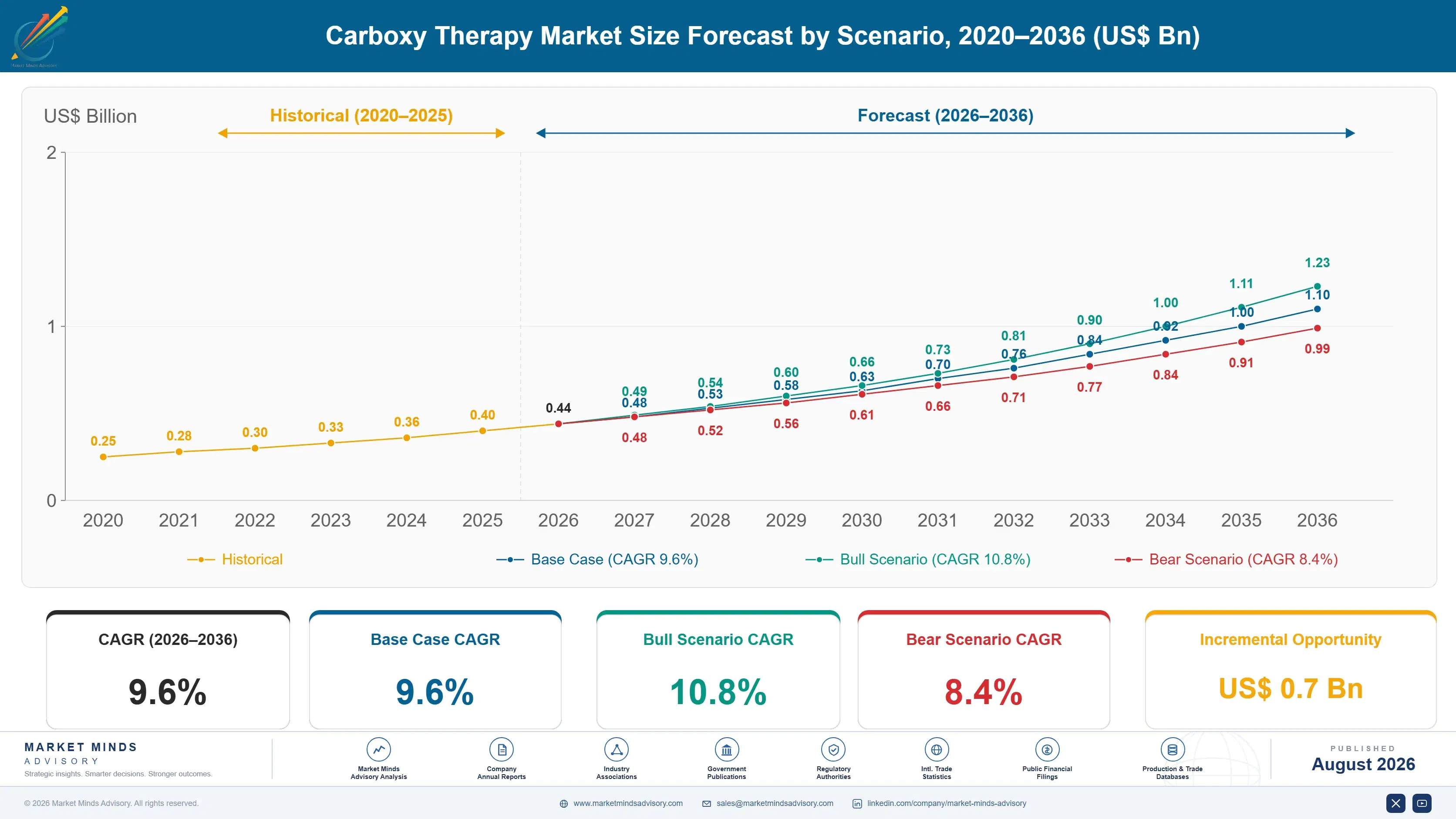
Between 2020 and 2025, carboxy therapy demand grew at an estimated 8.6% annually as medical spas expanded their non-surgical aesthetic menus and social media exposure introduced the treatment to younger consumers unfamiliar with its decades-old European medical origins. Weyergans High Care and BOCAP CE both expanded device production through the period to meet growing clinic demand across newly entering markets.
MMA's base case projects 9.6% annual growth to 2036 on three mechanisms: continued social-media-driven consumer demand for under-eye dark circle and cellulite treatment among younger demographics, expansion of medical spa networks into markets that previously lacked aesthetic clinic infrastructure, and growing physician interest in carboxy therapy as a lower-capital-cost alternative to laser and radiofrequency body contouring equipment for new practice openings. Growing physician awareness of the procedure's decades-long clinical safety record is reinforcing this shift among practitioners evaluating new equipment purchases.
A bull catalyst comes from viral social media exposure accelerating consumer awareness faster than currently projected, particularly for under-eye treatment among consumers in their twenties and thirties. The bear risk is competitive substitution: if newer non-invasive body contouring technologies demonstrate superior or faster results, clinics could reallocate equipment budgets away from carboxy therapy platforms entirely.

One Procedure Name, Two Different Markets

Carboxy therapy occupies an unusual position in aesthetic medicine: a treatment with decades of vascular medicine literature behind it, yet young enough as a mainstream cosmetic procedure that most consumers first heard about it through a social media video rather than a physician referral. That combination gives it more credibility than newer unproven aesthetic technologies while still riding a genuine growth wave.
MARKET CONCENTRATION38%Top five equipment makers hold just over a third
AVERAGE DEVICE PRICE$8,400Reflects gas delivery unit and control console cost
TOP ADOPTING COUNTRYItalyLargest concentration of formally trained carboxy therapy practitioners
CAPACITY UTILIZATION61%Clinic scheduling and seasonal demand constrain overall throughput
CONSUMABLE COST SHARE28% of COGSSingle-use needles and filtration cartridges dominate total cost
SESSION REPEAT RATE74%Share of patients returning for a full multi-session course
Commercially, the aesthetic and medical applications behave like separate markets sharing one gas delivery technology. Aesthetic clinics buy equipment based on treatment menu breadth and marketing appeal, prioritizing devices that support multiple applications from one console. Vascular and wound care specialists buy based on clinical protocol precision and dosing consistency, prioritizing an entirely different set of purchasing criteria. Equipment makers straddling both sides increasingly maintain separate sales teams for each buyer type.
Over the next decade, expect aesthetic application growth to outpace medical application growth by a meaningful margin, since most volume upside comes from expanding medical spa adoption rather than from new vascular disease incidence. Equipment makers that build aesthetic-specific marketing support alongside their devices are best positioned to capture this expanding consumer-driven segment of demand. Those slow to shift risk ceding ground to consumer-savvy competitors.
"This is a treatment that spent sixty years in vascular medicine journals before it spent six months going viral. The clinical pedigree is real, and that's exactly what's letting it scale into medical spas faster than newer, unproven alternatives."
Director, Aesthetic and Medical Device Technology Practice · MMA Aesthetic and Medical Gas-Delivery Devices Practice · August 2026

Market Trends

Social Media Drives Under-Eye Treatment Demand

Short-form video content showcasing visible under-eye dark circle improvement is driving a wave of younger consumers into medical spas specifically requesting carboxy therapy by name, a level of unprompted consumer awareness the procedure lacked just a few years ago. Sinclair Pharma and InMode have both expanded marketing support materials for clinics specifically targeting this younger demographic. At least several dozen major medical spa chains have added dedicated under-eye carboxy therapy packages since 2023, and clinic operators report this specific application now drives a meaningfully larger share of new patient inquiries than any other carboxy therapy indication.
Market Impact: Grows non-surgical volume 15%+ annually
Medical Spas Adopt CO2 Therapy as Entry Platform

New medical spa operators are increasingly selecting carboxy therapy equipment as an entry-level body contouring platform, given its meaningfully lower capital cost compared with laser or radiofrequency alternatives for newly opening practices. Weyergans High Care and BOCAP CE have both expanded distributor networks specifically to serve this growing new-practice customer segment. At least a few hundred new medical spa locations have opened with carboxy therapy as a core menu offering since 2023, and equipment distributors report this segment now represents a meaningfully larger share of new unit placements than established practice upgrades.
Market Impact: Expands addressable clinics 20%+ yearly

Market Opportunities and Growth Drivers

Rising Demand for Non-Surgical Aesthetic Alternatives

Consumers across major markets are increasingly seeking non-surgical alternatives to invasive procedures like blepharoplasty and liposuction, favoring treatments with minimal downtime and lower cost even when results require multiple sessions rather than a single intervention. Industry surveys show non-surgical aesthetic procedure volume has grown considerably faster than surgical procedure volume across most major markets over the past several years. Clinic operators report carboxy therapy specifically benefits from this shift because it requires no anesthesia and essentially no recovery time between sessions. Physicians increasingly report patient acceptance of longer treatment timelines when clear expectations are set at the initial consultation.
Market Impact: Affects up to 30% of starters

Medical Spa Network Expansion Into New Markets

Medical spa networks are expanding rapidly into markets that previously lacked meaningful aesthetic clinic infrastructure, creating substantial new distribution channels for carboxy therapy equipment makers beyond their traditional European base. Industry trade data show medical spa location counts have grown considerably across several major emerging markets over the past few years. Equipment distributors report this expanding footprint is opening genuinely new addressable demand rather than simply redistributing existing procedure volume among established competitors. Equipment distributors report establishing local training and support infrastructure remains the primary bottleneck slowing expansion into some of these newer markets.
Market Impact: Outcome variance exceeds 25% by clinic

Market Restraints and Challenges

Multi-Session Protocol Requirements Limit Patient Conversion

Carboxy therapy typically requires a course of six to ten sessions to achieve visible aesthetic results, and the root cause is that subcutaneous gas diffusion produces gradual, cumulative tissue effects rather than the immediate visible change some competing aesthetic technologies deliver in a single visit. This extended commitment requirement deters price-sensitive and time-constrained consumers who compare the total course cost unfavorably against single-session alternatives. Clinics report meaningful drop-off between session two and four before visible results become apparent. Clinics are mitigating this through bundled pricing and progress photography demonstrating early improvement.
Market Impact: Adds 30%+ new patient inquiries

Limited Standardized Training Creates Inconsistent Outcomes

Practitioner training for carboxy therapy remains largely informal and manufacturer-specific rather than standardized through recognized medical certification bodies, and the root cause is that the procedure sits administratively between aesthetic medicine and vascular therapy without a single governing specialty society. This training inconsistency produces variable outcomes across clinics using identical equipment, undermining consumer confidence and creating liability exposure for equipment makers whose devices get associated with poor results from undertrained operators. Equipment makers are mitigating this by developing standardized certification programs bundled directly with device purchase agreements. Some manufacturers are lobbying for shared industry training standards.
Market Impact: Drives 200+ new practice placements
3 additional market trends, 4 additional growth drivers, and 3 additional restraints and challenges are covered in the full report. Contact sales@marketmindsadvisory.com to access the complete intelligence.

Segment CAGR and Growth Architecture

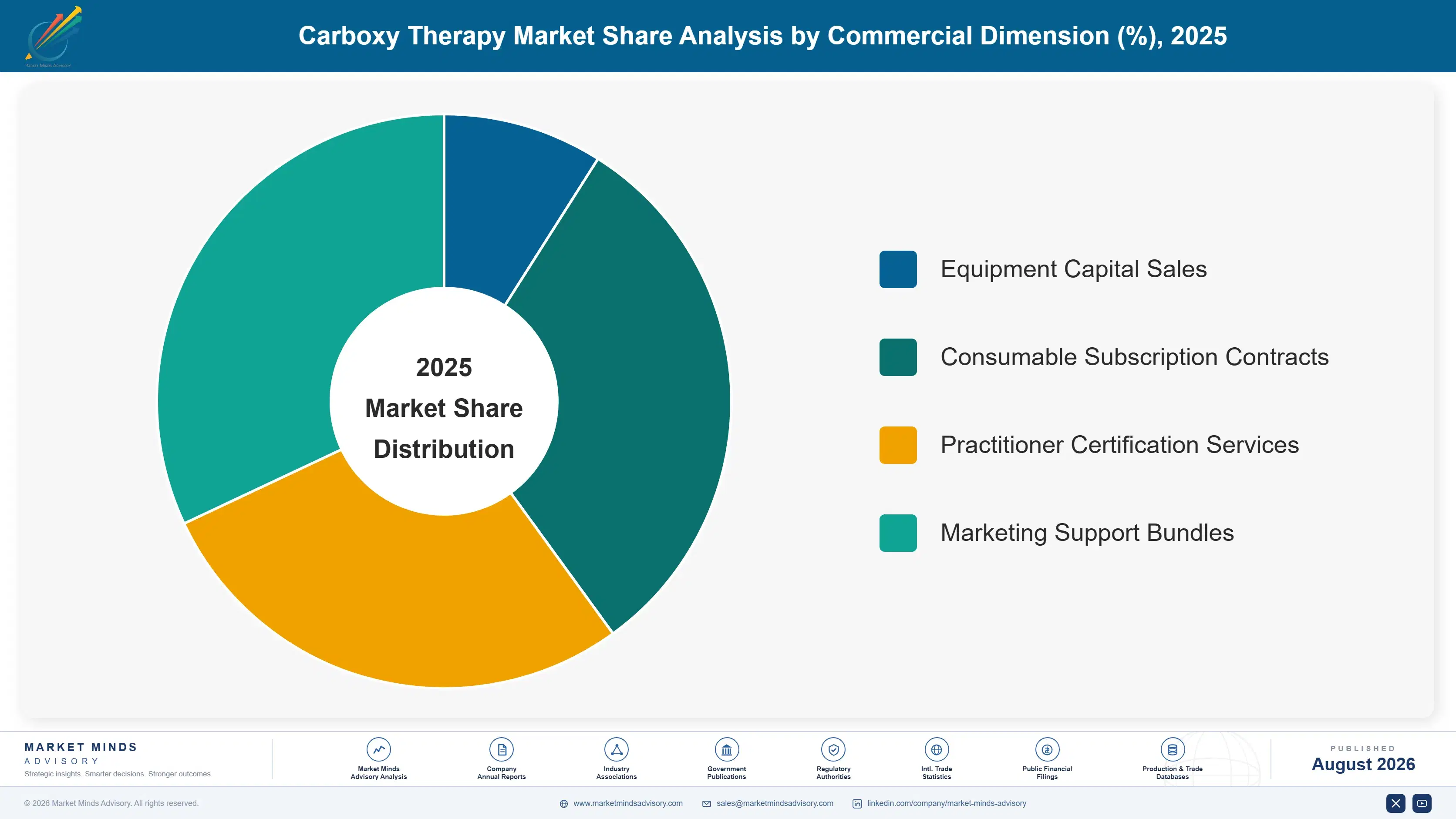
The carboxy therapy market is segmented by clinical application, the classification that determines purchasing buyer, regulatory pathway, and reimbursement status: cellulite reduction, under-eye dark circle treatment, stretch mark treatment, localized fat reduction, peripheral vascular disease therapy, and chronic wound healing each serve genuinely distinct clinical purposes and buyer types. Adjacent laser-based and surgical procedures sit in separately scoped markets.
carboxy-therapy-market-share-analysis-1787465502413

Under-Eye Dark Circle Treatment

Under-eye dark circle treatment is the fastest-growing application as social media exposure introduces the procedure to younger consumers seeking a non-surgical alternative to blepharoplasty and dermal filler approaches. Sinclair Pharma and InMode both benefit from established aesthetic clinic distribution relationships that let them market this specific application effectively to medical spa operators building younger-consumer treatment menus. Clinics increasingly market this application by session count and expected timeline to visible improvement rather than generic before-and-after imagery, reflecting growing consumer sophistication around realistic outcome expectations. Equipment pricing for this application remains comparable to standard carboxy therapy consoles, but marketing and training support increasingly differentiate competing equipment makers targeting this specific younger demographic.
CAGR 12.4%

Stretch Mark Treatment

Stretch mark treatment is scaling quickly as postpartum and weight-fluctuation consumer populations seek non-surgical options with meaningfully lower cost than laser resurfacing alternatives for treating this common cosmetic concern. Weyergans High Care and BOCAP CE both maintain established protocol documentation and clinical training materials specifically addressing this application, benefiting from decades of European clinical use predating the procedure's broader aesthetic popularity. Clinics increasingly bundle this application with complementary skin treatments to build comprehensive postpartum recovery packages, reflecting growing awareness of this specific consumer need. Pricing remains accessible relative to laser alternatives, reinforcing the segment's appeal among cost-conscious consumers seeking gradual, cumulative improvement. Insurance reimbursement generally does not apply, keeping pricing decisions fully within consumer discretionary purchasing behavior.
CAGR 10.8%
Full segment breakdown across 6 segments available in the complete report.

Regional Architecture and Country Demand Map

Western Europe leads the global carboxy therapy market by regional share, reflecting the procedure's Italian medical origin and deep aesthetic clinic penetration across Southern Europe, while North America follows closely on the strength of rapidly expanding medical spa networks and growing social media exposure nationwide.

Western Europe

Italy anchors regional demand as the procedure's medical birthplace, maintaining the world's deepest concentration of trained carboxy therapy practitioners and established vascular medicine clinics that later expanded into aesthetic applications. France and Spain both maintain substantial aesthetic clinic networks that adopted the technology early, given cultural proximity to Italian aesthetic medicine practice and shared professional training pathways. Germany's Weyergans High Care maintains significant regional manufacturing and distribution infrastructure supplying clinics across the broader European market. Regional growth trails faster-expanding markets because Western Europe's aesthetic clinic penetration is already comparatively mature relative to newer adopting regions. Scandinavian markets maintain smaller but steadily growing clinic networks influenced by broader European aesthetic medicine trends and training standards.
Share: 26% | CAGR: 8.1% (2026 to 2036)

North America

The United States drives most of the region's demand through its rapidly expanding medical spa industry, which has embraced carboxy therapy as an accessible entry-level body contouring and skin treatment offering for newly opening practices. Sinclair Pharma and InMode both maintain extensive domestic distribution networks supplying this growing medical spa customer base across major metropolitan markets. Canada follows a similar medical spa expansion pattern, though at meaningfully smaller absolute volume. Growth here is accelerating as social media exposure introduces the treatment to younger American consumers previously unfamiliar with its European medical origins. Employer wellness benefit trends and growing consumer discretionary spending on aesthetic treatments further support this expanding regional demand base.
Share: 25% | CAGR: 9.6% (2026 to 2036)
Regional intelligence for 5 additional markets available in the complete report: East Asia, South Asia and Pacific, Latin America, Middle East and Africa, Eastern Europe. Contact sales@marketmindsadvisory.com.
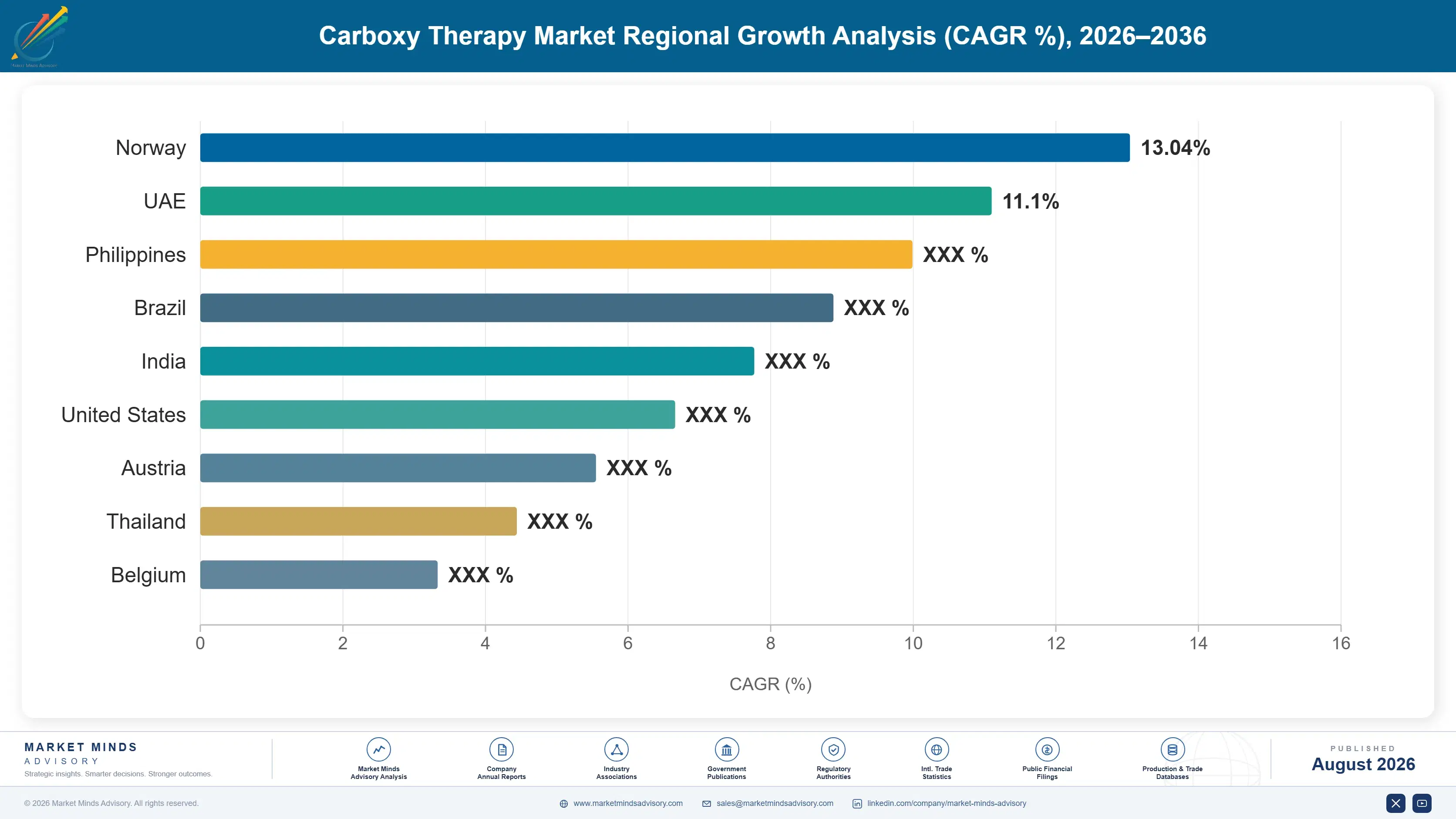
carboxy-therapy-country-cagr-analysis-1787465502939

Where Equipment Makers Can Capture Margin

Margin capture in carboxy therapy increasingly depends on marketing and training support investment rather than raw device manufacturing volume alone. Equipment makers that can supply proven consumer marketing materials, structured practitioner certification, and bundled consumable programs are commanding meaningfully better pricing than makers competing purely on standard console hardware cost. Standard-only competitors increasingly struggle to defend pricing here.

Consumer Marketing Support Package Investment Program

Equipment makers that develop ready-to-use consumer marketing materials targeting specific applications like under-eye treatment are capturing premium pricing from medical spa operators seeking to accelerate patient acquisition without building in-house marketing capability. Sinclair Pharma's marketing support package, expanded in 2024, reportedly drives a 20 to 30 percent higher new patient conversion rate for clinics adopting it. Competitors without comparable marketing infrastructure are increasingly partnering with digital marketing agencies to offer similar bundled support alongside their equipment sales. Purchasing decisions at leading medical spa chains now routinely factor in this specific marketing capability.
Market Impact: Drives 20 to 30 percent higher conversion rate

Standardized Practitioner Certification and Training Program

Equipment makers that develop standardized practitioner certification programs bundled with device purchase are capturing premium positioning among clinics concerned about outcome consistency and liability exposure from undertrained operators. Weyergans High Care's certification program reportedly commands a 15 to 25 percent price premium over uncertified equivalent equipment of comparable specification. Building this training infrastructure requires sustained investment in clinical education content over multiple years, a barrier that has kept this advantage concentrated among established European manufacturers. Physicians increasingly cite this credential when marketing their own services to prospective patients. That trust compounds over a career.
Market Impact: Commands a 15 to 25 percent price premium

Bundled Consumable Subscription Revenue Program Development

Equipment makers that offer bundled consumable subscription programs covering single-use needles and filtration cartridges are capturing recurring revenue and deepening customer retention beyond the initial equipment sale. Clinics enrolled in subscription programs reportedly generate a 25 to 35 percent higher lifetime consumable revenue per unit compared with clinics purchasing consumables on an ad hoc basis. This model requires reliable logistics infrastructure, a barrier that has kept this advantage concentrated among larger, more established equipment distributors. Clinics increasingly view this recurring relationship as central to long-term equipment vendor selection decisions. That relationship compounds over time.
Market Impact: Generates 25 to 35 percent more total revenue

Multi-Application Console Platform Design and Engineering

Equipment makers that develop consoles supporting multiple applications, from cellulite reduction to under-eye treatment, from a single device are capturing premium pricing from clinics seeking to maximize treatment menu breadth without purchasing separate equipment for each application. Multi-application consoles reportedly command a 30 to 40 percent price premium over single-application equivalents of comparable build quality. This engineering investment requires broader clinical protocol validation across applications, a barrier smaller manufacturers often cannot justify. Clinics increasingly view this flexibility as central when evaluating competing equipment platforms during purchasing cycles. That flexibility matters increasingly.
Market Impact: Commands a 30 to 40 percent price premium

Who Controls the Margin Pool

Five equipment makers hold just over a third of global device revenue, reflecting a genuinely fragmented market split between specialized European carboxytherapy manufacturers with decades of clinical heritage and diversified aesthetic device companies adding CO2 delivery as a complementary product line. The gap between the largest specialist and the smallest credible competitor is narrower here than in most aesthetic device categories, given the technology's relatively low engineering complexity. That narrower gap makes brand reputation and training support disproportionately important competitive differentiators.
Current competitive activity centers on three fronts: consumer marketing support development to capture social-media-driven demand, practitioner certification program development to address training inconsistency concerns, and multi-application console engineering to help clinics maximize treatment menu breadth from one device. Sinclair Pharma and Weyergans High Care have both announced meaningful investment in these fronts over the past two years.

Emerging pressure is coming from lower-cost manufacturers, particularly newer entrants offering simplified consoles at meaningfully reduced price points, threatening established manufacturers' pricing power among cost-sensitive new practice customers. Rankings could shift meaningfully over the next several years if these lower-cost entrants close the marketing and training support gap that currently differentiates established manufacturers from cheaper alternatives.
carboxy-therapy-company-positioning-matrix-1787465503479

Competitive Moat and Risk Dimensions

WEYERGANS HIGH CARE AG

Moat: Deepest European Clinical Heritage

Weyergans High Care AG maintains the deepest clinical heritage in this market, built through decades of direct engagement with the European vascular medicine community that originated the procedure. That heritage gives Weyergans credibility advantages with physicians skeptical of newer, purely aesthetic-focused competitors lacking comparable clinical grounding.
WEYERGANS HIGH CARE AG

Risk: Slower Adaptation to Aesthetic Marketing

Weyergans High Care AG's clinical medicine heritage has made the company somewhat slower to adapt to the consumer-facing, social-media-driven marketing approach that increasingly drives aesthetic application growth. Competitors with stronger consumer marketing capability could erode Weyergans's position specifically within the faster-growing aesthetic segment of the market.
SINCLAIR PHARMA

Moat: Strong Medical Spa Distribution Network

Sinclair Pharma has built an extensive medical spa distribution network across North America and Western Europe through its broader aesthetic device and dermal filler portfolio, giving it established customer relationships that specialized carboxytherapy-only competitors lack. That network lets Sinclair Pharma cross-sell carboxy therapy equipment efficiently into an already-engaged customer base.
SINCLAIR PHARMA

Risk: Limited Clinical Specialization Depth

Sinclair Pharma's broader aesthetic device portfolio focus means carboxy therapy receives less dedicated clinical research investment than it might from a specialized competitor focused solely on this single technology. Physicians seeking the deepest available clinical protocol expertise may still prefer specialized European manufacturers over Sinclair Pharma's broader portfolio approach.

Players Tracked

Prominent Players

Weyergans High Care AG
BOCAP CE
Sinclair Pharma
Fotona
InMode

Other Key Players

GIMA S.p.A.
Cutera
Cynosure
Sciton
Candela Medical
Lumenis
Merz Aesthetics
Venus Concept
Alma Lasers
BTL Industries
Classys
Jeisys Medical
WONTECH
Solta Medical
Apyx Medical

Recent Developments

APRIL 2024

Sinclair Pharma Launches Marketing Support Package

Sinclair Pharma launched an expanded consumer marketing support package for carboxy therapy clinics in April 2024, providing digital advertising templates and social media content specifically targeting younger consumers seeking under-eye dark circle treatment options, alongside training webinars for clinic marketing staff. Clinic partners report immediate uptake of the new content.
Signal: Signals equipment makers are competing increasingly on marketing capability rather than hardware improvements alone this cycle.
NOVEMBER 2023

Weyergans High Care Expands Certification Program

Weyergans High Care expanded its standardized practitioner certification program into additional North American markets in November 2023, responding to growing clinic demand for structured training that addresses documented outcome consistency concerns across multiple treatment applications and clinic types. Regional distributors welcomed the training expansion warmly.
Signal: Signals established manufacturers are investing in training infrastructure to differentiate from lower-cost, uncertified competing manufacturers entering the market.
FEBRUARY 2024

InMode Introduces Multi-Application Console Platform

InMode introduced a new multi-application console platform in February 2024 supporting cellulite reduction, under-eye treatment, and stretch mark treatment from a single device, targeting clinics seeking to expand treatment menu breadth without additional equipment purchases or added staff training. Early adopting clinics report strong initial patient interest.
Signal: Signals platform consolidation is emerging as a genuine competitive strategy where hardware differentiation has stayed limited.

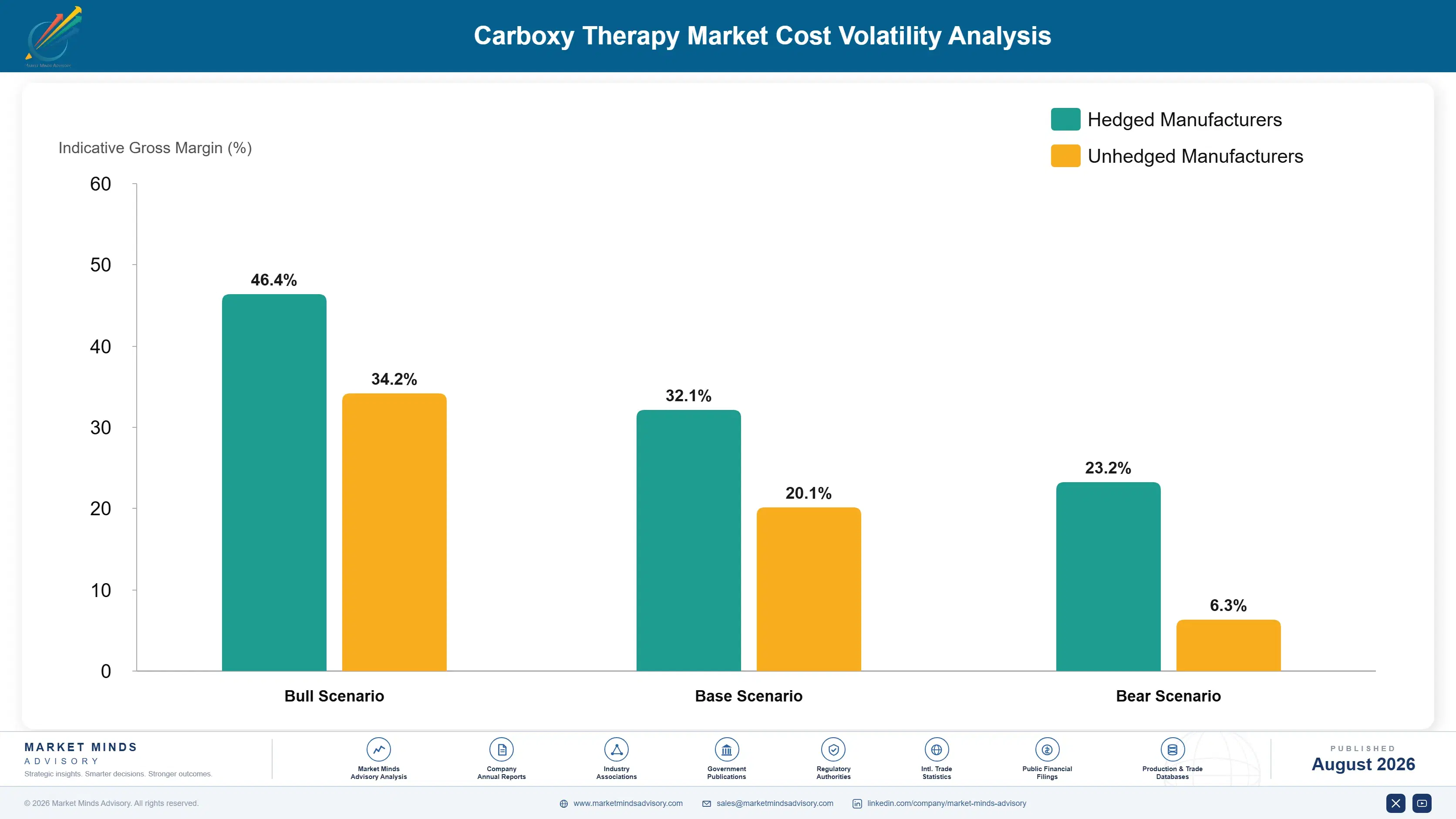
Medical-Grade Gas and Consumable Cost Exposure

Medical-grade carbon dioxide gas cartridges and single-use consumables together account for roughly twenty-eight percent of total procedure cost, reflecting the recurring disposable nature of the gas and needle components used in each treatment session. Gas cartridge costs track industrial and medical gas commodity pricing, while consumable component costs track specialty medical device manufacturing input trends across the broader industry.
Medical-grade gas pricing rose meaningfully during 2022 following broader industrial gas supply disruption across Europe, according to trade association reporting and equipment maker investor disclosures, increasing per-session consumable costs across the industry. Clinics without long-term gas supply contracts faced the steepest cost increases, since medical-grade gas purity requirements limit the pool of qualified alternative suppliers available on short notice. Several equipment distributors reported similar cost trends in subsequent trade publication interviews.

Smaller independent clinics relying on open-market gas purchases carry meaningfully more cost exposure than larger medical spa chains, which can negotiate volume-based supply agreements directly with gas producers. This exposure disadvantage compounds for independent clinics competing on price against larger chains with deeper supplier relationships and greater purchasing leverage across their broader multi-location consumable needs.
carboxy-therapy-cost-volatility-analysis-1787465503678

Negotiate Volume-Based Gas Supply Agreements

Larger medical spa chains are negotiating volume-based gas supply agreements directly with producers, reducing per-unit cost exposure relative to smaller independent clinics purchasing on the open market. This approach requires meaningful purchasing scale but has kept consumable costs more stable for chains that implemented it early. Smaller independent clinics typically lack the purchasing scale to secure comparable contract terms directly.

Diversify Medical-Grade Gas Sourcing Regionally

Equipment makers and larger clinic networks are qualifying medical-grade gas supply from multiple regional producers simultaneously, reducing the odds that one regional supply disruption cuts total availability. This diversification adds procurement complexity but has measurably reduced cost volatility for adopters. This approach also improves supply chain resilience against localized regulatory or logistics disruptions affecting a single producer.

Bundle Consumables Into Equipment Contracts

Equipment makers are bundling consumable supply directly into equipment purchase and service contracts, locking in pricing for clinics over multi-year terms rather than exposing them to spot market gas price volatility. This approach requires equipment makers to absorb some pricing risk themselves but has improved customer retention. This model requires careful pricing discipline to stay profitable long-term.

Portfolio Architecture for Margin Defence

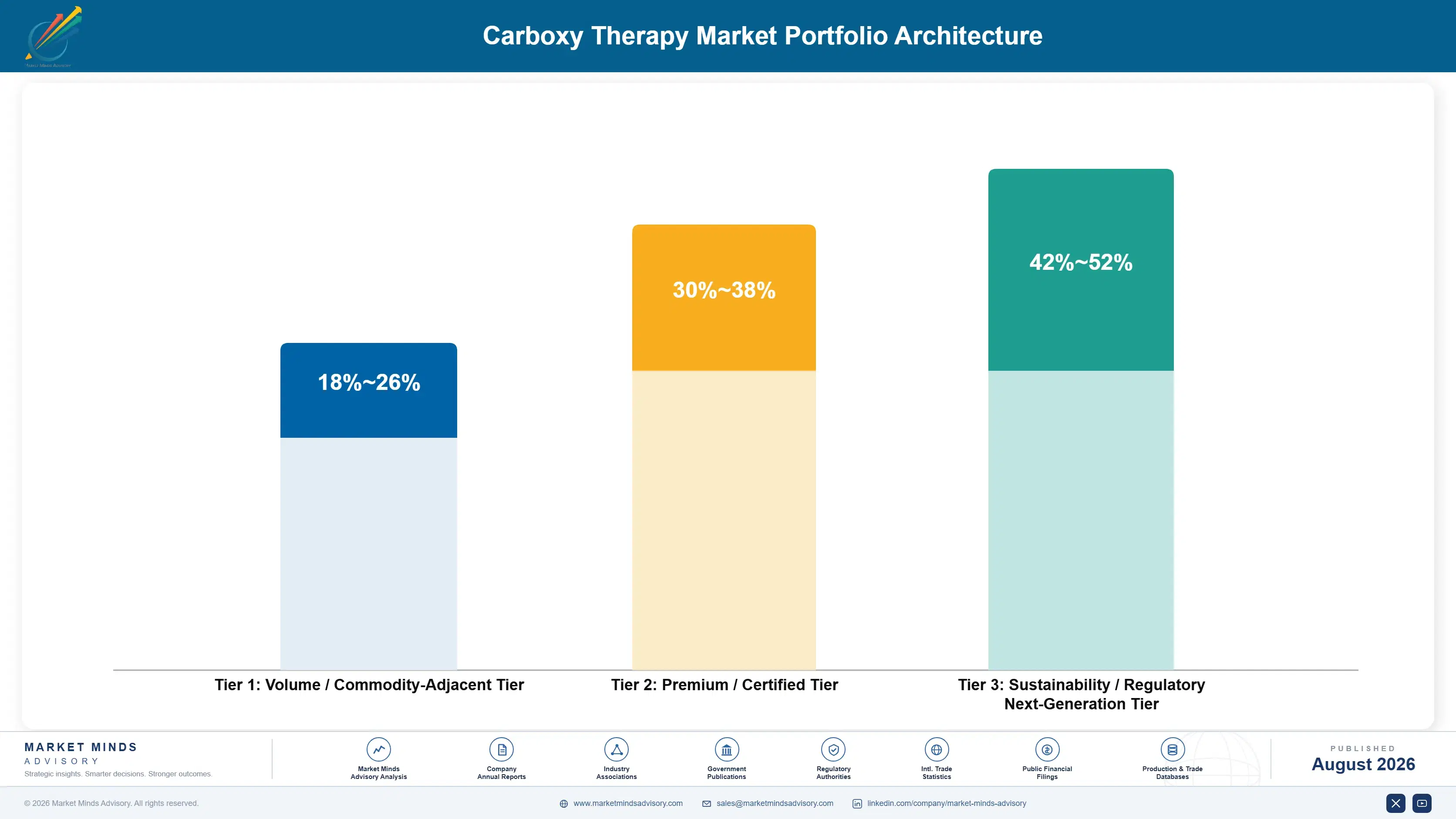
Equipment makers in this market operate a three-tier portfolio spanning standard single-application consoles sold largely on price into mainstream new-practice medical spa customers, multi-application platforms with marketing support commanding premium pricing from established clinics building broader treatment menus, and certified training-bundled systems positioned for the highest-margin accounts prioritizing outcome consistency and liability protection. Gross margins vary meaningfully across these tiers, from modest levels on standard consoles to well above forty percent on fully bundled premium systems.
The volume versus premium tension is intensifying as more manufacturers chase marketing-bundled and training-bundled margins, but standard single-application consoles still represent the majority of unit volume and remain essential for covering fixed manufacturing costs across the industry's large new-practice customer base. Manufacturers that abandon standard console volume too quickly risk underutilizing capacity built for broad market-entry scale.

High-value margin pools concentrate specifically in multi-application platforms sold to established clinics and in certification-bundled systems sold to chains prioritizing outcome consistency. Standard single-application consoles remain the volume anchor but carry thinner margins as lower-cost entrants intensify price competition at the entry-level tier. Manufacturers positioned only in the middle tier increasingly face pressure from both directions as clinics polarize their purchasing decisions.

Volume / Commodity-Adjacent Tier

Standard single-application consoles sold primarily on price into mainstream new-practice medical spa customers building their initial treatment menu offerings. Physician familiarity and low upfront capital requirements drive most purchasing decisions at this level of the market.
Gross Margin: 18-26%

Premium / Certified Tier

Multi-application platforms bundled with consumer marketing support, sold into established clinics building broader, more differentiated treatment menus. Clinics select vendors here based mainly on marketing support quality and application breadth rather than price alone.
Gross Margin: 30-38%

Sustainability / Regulatory / Next-Generation Tier

Certification-bundled systems positioned for chains prioritizing outcome consistency and liability protection, commanding the category's highest per-unit margins available. Purchasing decisions here center on training reputation and long-term brand partnership rather than upfront device cost alone.
Gross Margin: 42-52%
carboxy-therapy-portfolio-architecture-1787465504187

High-value Sub-segments and Strategic Watch-out

Multi-Application Console Platforms

Multi-application platforms are capturing the highest margins in the category as established clinics seek broader treatment menus, and equipment makers are accelerating engineering investment to defend this premium positioning against emerging lower-cost competitors. Established brand reputation increasingly drives purchasing decisions within this premium tier. Expect further engineering investment here.
Gross Margin: 42-52%

Certification-Bundled Training Systems

Certification-bundled systems are gaining share among chains prioritizing outcome consistency, though building credible training infrastructure remains concentrated among established European manufacturers with decades of clinical heritage. Growing regulatory attention could further strengthen demand for this credentialed approach. Expect standardization efforts to intensify meaningfully across the industry in coming years.
Gross Margin: 30-38%

Standard Single-Application Consoles

Standard consoles sold into new-practice medical spa customers remain the category's volume core, anchored by low capital cost but facing intensifying competition from lower-priced entrants. Established brand loyalty continues sustaining steady replacement demand within this segment. Expect price competition here to intensify further as entrants multiply.
Gross Margin: 18-26%

Uncertified Discount Import Equipment

Uncertified discount equipment imported without adequate quality controls faces rising clinic and regulatory scrutiny following documented safety and outcome concerns, making this a segment reputable distributors should actively avoid entirely. Reputable distributors are increasingly declining to carry this category altogether. Expect regulatory scrutiny to intensify meaningfully over time.
Gross Margin: 6-12%

Consumer Trend Meets Recurring Course Economics

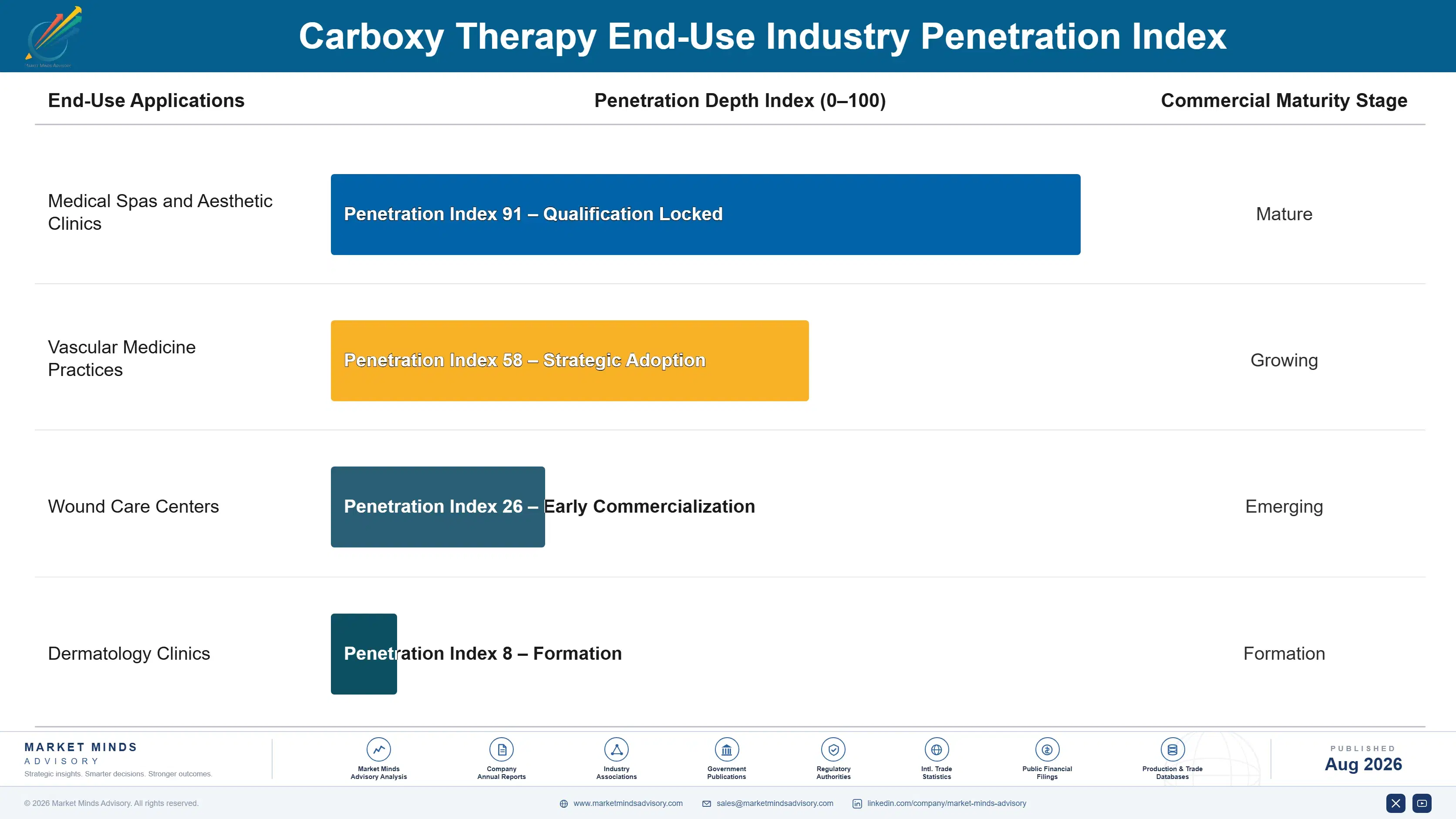
Carboxy therapy behaves like a recurring consumable relationship rather than a one-time equipment sale once a clinic adopts the platform, because each patient course requires multiple sessions of single-use consumables purchased continuously over the clinic's operating life. That structure gives equipment makers durable, multi-year consumable revenue visibility per placed unit, reinforced by the fact that clinics rarely switch equipment platforms once staff have trained on a specific system.
Adoption depth varies sharply by end-use vertical. Medical spas adopt new applications and marketing approaches relatively quickly given their consumer-facing, trend-responsive business model, while vascular medicine and wound care clinics move far more cautiously, waiting for established clinical protocols and reimbursement clarity before adjusting treatment approaches they have used successfully for years. Wound care specialists in particular tend to stay with one trusted vendor for a decade or longer.

Generational buyer shifts are visible mainly among younger clinic operators entering the medical spa industry, who favor multi-application platforms and social-media-friendly marketing support, while established vascular medicine practitioners remain anchored to standard equipment and clinical protocols they trust based on decades of accumulated professional experience. This generational divide will widen as social media keeps shaping how younger consumers discover aesthetic treatments.
carboxy-therapy-end-use-penetration-index-1787465504688

Where Carboxy Therapy Value Concentrates

These are among the four positions where our research anticipates prominent divergence between winners and laggards over the coming forecast period. Each is grounded in the demand model, the regulatory perimeter, and the announced capacity pipeline.
01 / CONSUMER MARKETING INVESTMENT

Invest in marketing support ahead of social media growth

Social media exposure is driving genuinely new consumer demand for under-eye and cellulite treatment, and equipment makers with proven marketing support materials are converting this awareness into new patient acquisition fastest. Sinclair Pharma has already demonstrated meaningful commercial traction with its marketing support package, confirming that clinics genuinely value this capability. MMA recommends manufacturers without comparable marketing infrastructure invest in it now, before competitors consolidate advantage in the fastest-growing consumer-driven segment of demand, a window that is closing faster than most manufacturers currently expect.
02 / CERTIFICATION PROGRAM DEVELOPMENT

Build certification programs ahead of training standardization

Outcome inconsistency from undertrained operators remains a genuine liability and reputation risk across this fragmented market, and manufacturers offering structured certification are differentiating meaningfully from lower-cost, uncertified competitors. Weyergans High Care has already demonstrated commercial traction through its certification program, confirming genuine clinic demand for structured training pathways. MMA recommends manufacturers without training infrastructure invest in it now, before regulatory bodies or industry associations impose formal standards that favor already-prepared competitors over those still building this capability from scratch across their existing clinic networks.
03 / MULTI-APPLICATION PLATFORM ENGINEERING

Develop multi-application platforms ahead of menu consolidation

Clinics increasingly prefer consoles supporting multiple applications from one device to maximize treatment menu breadth without additional capital investment, and manufacturers with proven multi-application platforms are capturing premium pricing accordingly. InMode has already demonstrated meaningful commercial traction with its multi-application console, confirming genuine clinic interest in this platform approach. MMA recommends manufacturers without comparable platforms invest in engineering now, before established competitors further consolidate this increasingly important premium tier of this fragmented equipment category as clinics consolidate their vendor relationships.
04 / CONSUMABLE SUBSCRIPTION MODEL DEVELOPMENT

Build subscription programs ahead of recurring revenue competition

Recurring consumable revenue represents the most durable margin pool in this market, and manufacturers offering structured subscription programs are capturing meaningfully more lifetime value per placed unit than those relying on ad hoc consumable sales. Manufacturers with established subscription infrastructure are positioned to defend this advantage as competitors increasingly recognize its commercial importance. MMA recommends manufacturers without subscription programs invest in logistics infrastructure now, while this recurring revenue opportunity remains underexploited across much of this fragmented, still-consolidating equipment market today.

Engagement Snapshot From the Field

A live engagement with an industry participant carrying material or product regulatory and market exposure ahead of a defining policy shift, showing how our research translates into a defensible multi-year portfolio strategy.
MARKET MINDS ADVISORY · CLIENT ENGAGEMENT SUMMARY
Carboxy Therapy Producer Strategic Portfolio Review and Transition Roadmap 2026·Investment Scenario on Carboxy Therapy Exposure Evaluation 2025-26
CLIENT PROFILE
The client is a mid-sized North American medical spa chain generating an estimated twenty-two million dollars in annual revenue (client-reported, unverified by MMA), operating across a dozen locations offering a broad menu of non-surgical aesthetic treatments including carboxy therapy. The client faced a decision about whether to consolidate onto a single multi-application equipment platform. Its patient base skews toward younger professionals seeking non-surgical treatment options.
STRATEGIC CHALLENGE
The client's locations operated several different single-application carboxy therapy consoles purchased over the years from different manufacturers, creating inconsistent treatment menus across locations and complicating staff training and equipment maintenance. Newer competing medical spa chains were marketing broader, more consistent treatment menus using multi-application platforms. Leadership worried the client's fragmented menu was becoming a competitive disadvantage in a crowded local market.
MMA APPROACH
MMA conducted a structured evaluation of multi-application platform options from three vendors, benchmarking application breadth, marketing support quality, and total replacement cost against the client's existing equipment inventory and location-level revenue data. The engagement included direct comparison of projected consumable cost changes under a consolidated platform approach. Recommendations were presented directly to the client's ownership group for final decision-making.
KEY FINDINGS
  1. The client's fragmented equipment base was limiting cross-location marketing consistency and creating meaningfully higher per-unit maintenance costs than a consolidated platform would require.
  2. Consolidating onto a single multi-application platform required a meaningful capital investment but reduced projected annual maintenance costs by roughly twenty percent across all locations combined.
  3. One of the three evaluated vendors offered meaningfully stronger marketing support materials specifically suited to the client's younger, urban patient demographic profile.
  4. The client's consolidation reportedly increased average per-location carboxy therapy revenue by roughly eighteen percent within the first year of full platform rollout (client-reported, unverified by MMA).
CLIENT PROFILE
The client is a mid-sized North American medical spa chain generating an estimated twenty-two million dollars in annual revenue (client-reported, unverified by MMA), operating across a dozen locations offering a broad menu of non-surgical aesthetic treatments including carboxy therapy. The client faced a decision about whether to consolidate onto a single multi-application equipment platform. Its patient base skews toward younger professionals seeking non-surgical treatment options.
STRATEGIC CHALLENGE
The client's locations operated several different single-application carboxy therapy consoles purchased over the years from different manufacturers, creating inconsistent treatment menus across locations and complicating staff training and equipment maintenance. Newer competing medical spa chains were marketing broader, more consistent treatment menus using multi-application platforms. Leadership worried the client's fragmented menu was becoming a competitive disadvantage in a crowded local market.
MMA APPROACH
MMA conducted a structured evaluation of multi-application platform options from three vendors, benchmarking application breadth, marketing support quality, and total replacement cost against the client's existing equipment inventory and location-level revenue data. The engagement included direct comparison of projected consumable cost changes under a consolidated platform approach. Recommendations were presented directly to the client's ownership group for final decision-making.
KEY FINDINGS
  1. The client's fragmented equipment base was limiting cross-location marketing consistency and creating meaningfully higher per-unit maintenance costs than a consolidated platform would require.
  2. Consolidating onto a single multi-application platform required a meaningful capital investment but reduced projected annual maintenance costs by roughly twenty percent across all locations combined.
  3. One of the three evaluated vendors offered meaningfully stronger marketing support materials specifically suited to the client's younger, urban patient demographic profile.
  4. The client's consolidation reportedly increased average per-location carboxy therapy revenue by roughly eighteen percent within the first year of full platform rollout (client-reported, unverified by MMA).
RECOMMENDED STRATEGY
Phase 1: Phase 1 (Weeks 1 to 3): Benchmark three multi-application platform vendors against menu breadth, marketing support, and total cost. and current maintenance records Phase 2: Phase 2 (Weeks 4 to 7): Validate consolidated platform economics against the client's existing location-level revenue and cost data. and location-level staffing plans Phase 3: Phase 3 (Weeks 8 to 14): Finalize vendor selection, complete staff training, and roll out the platform across all locations.
OUTCOME
The client successfully consolidated onto a single multi-application platform across all locations, increasing average per-location revenue within the first year of rollout (client-reported, unverified by MMA). The consolidation also simplified staff training and equipment maintenance considerably. Staff reported meaningfully higher confidence delivering treatments across the newly standardized equipment platform.

Frequently Asked Questions

Foundational context covering the market sizes, CAGR, scope, country, region and competition that inform every finding below. This section is provided to cover basics and most often pre-purchase conversations, answered from the MMA Primary Research Dataset.

What is the current size of the Carboxy Therapy Market?

The global carboxy therapy market is valued at approximately $0.42 billion in 2025. Growth is driven by social-media-fueled aesthetic demand and expanding medical spa adoption worldwide.

How large will the Carboxy Therapy Market be by 2036?

MMA projects the market will reach approximately $1.15 billion by 2036, roughly 2.5 times its 2026 base value. Under-eye dark circle treatment will account for a growing share of that expansion.

What is the CAGR for the Carboxy Therapy Market 2026 to 2036?

The market is expected to grow at a compound annual growth rate of 9.6% between 2026 and 2036. Bull and bear scenarios range from 8.4% to 10.8% depending on consumer trend momentum.

Which segment is growing fastest?

Under-eye dark circle treatment is the fastest-growing segment, expanding at roughly 12.4% annually, about 1.3 times the overall market rate. Social media exposure is the primary driver.

Who are the major companies in the Carboxy Therapy Market?

Weyergans High Care AG, BOCAP CE, Sinclair Pharma, Fotona, and InMode lead global supply. The top five equipment makers together hold just over a third of global device revenue.

Which country is growing fastest?

South Korea is growing fastest, driven by its globally influential aesthetic medicine industry and strong social media marketing culture. Medical tourism demand is reinforcing this lead.

Report Segmentation Architecture

The full report scope spans multiple orthogonal segmentation dimensions, with cross-tabulated demand data provided for each dimension pair. Coverage extends further to regional breakdowns, trend trajectories, and the competitive detail needed to support segment-level decision-making.

By Clinical Application

  • Cellulite Reduction
  • Under-Eye Dark Circle Treatment
  • Stretch Mark Treatment
  • Localized Fat Reduction
  • Peripheral Vascular Disease Therapy
  • Chronic Wound Healing Therapy

By End-Use Industry

  • Medical Spas and Aesthetic Clinics
  • Vascular Medicine Practices
  • Wound Care Centers
  • Dermatology Clinics

By Commercial Dimension

  • Equipment Capital Sales
  • Consumable Subscription Contracts
  • Practitioner Certification Services
  • Marketing Support Bundles

By Region

  • North America
  • Western Europe
  • East Asia
  • South Asia and Pacific
  • Latin America
  • Middle East and Africa
  • Eastern Europe

Scope, Methodology, and Coverage

Every figure in this report is reproducible from documented input assumptions. The scope below maps the historical period, the forecast horizon, the segmentation dimensions, and the countries covered, alongside the underlying primary and qualitative methodology.
Historical Period
2020 to 2025
Forecast Period
2026 to 2036
Base Year
2025 (USD billions; MMA Primary Research Dataset, August 2026)
Market Definition
The carboxy therapy market covers devices, equipment, and single-use consumables used to deliver subcutaneous or transdermal carbon dioxide gas for aesthetic applications including cellulite reduction, under-eye dark circle treatment, and stretch mark treatment, and for medical applications including peripheral vascular disease therapy and chronic wound healing. It excludes CO2 laser resurfacing systems, which use an entirely different energy-based mechanism, and surgical fat removal procedures.
Quantitative Units
USD billions (current prices); thousand treatment sessions performed annually where applicable
Segmentation Dimensions
By Clinical Application; By End-Use Industry; By Commercial Dimension; By Region
Regions Covered
North America, Western Europe, East Asia, South Asia and Pacific, Latin America, Middle East and Africa, Eastern Europe
Countries Covered
USA, Canada, Italy, France, Spain, Germany, UK, South Korea, Japan, China, Australia, India, Thailand, Singapore, Brazil, Mexico, Argentina, UAE, Saudi Arabia, South Africa, Poland, Russia, Czech Republic, Hungary, and additional markets relevant to this sector
Key Companies Profiled
Weyergans High Care AG, BOCAP CE, Sinclair Pharma, Fotona, InMode, GIMA S.p.A., Cutera, Cynosure, Sciton, Candela Medical, Lumenis, Merz Aesthetics, Venus Concept, Alma Lasers, BTL Industries, Classys, Jeisys Medical, WONTECH, Solta Medical, Apyx Medical
Quantitative Methodology
Primary survey, n=3,800 respondents, Q4 2025, six countries; demand-side model with trade association cross-validation
Qualitative Methodology
47 expert interviews, Q4 2025; applied to validate demand model assumptions, identify emerging dynamics, and assess competitive positioning
Report Format
PDF and XLSX data workbook (Word format preview document)
Publisher
Market Minds Advisory
Report Code
MMA-2026-MED-402
Published
August 2026
Contact
sales@marketmindsadvisory.com | www.marketmindsadvisory.com

Purchase the full Carboxy Therapy Market Report (2026 to 2036).

This report delivers a complete assessment of the global carboxy therapy market across all major clinical applications, end-use settings, and geographic regions through 2036. It includes competitive profiling of twenty companies, segmentation distinguishing aesthetic and medical applications, and regional demand modeling across all seven MMA-covered geographies. Buyers will find quantified forecasts for market size, segment growth, and regional CAGR alongside analysis of training standardization gaps, medical-grade gas cost exposure, and consumer marketing dynamics. A dedicated revenue lever framework identifies four specific commercial actions equipment makers can take to capture margin as social media exposure accelerates aesthetic demand.
Twenty-company competitive profiling with moat and risk analysis
Seven-region demand model with justified share and CAGR bands
Clinical application segmentation across six MECE categories
Quantified revenue lever framework for margin capture strategies
Medical-grade gas and consumable cost exposure analysis
Anonymized case study on multi-application platform consolidation

Built For The People Who Decide

From boardroom strategy to bench-side execution, this report is read cover-to-cover by leaders shaping the next decade of their industry, turning demand scenarios, market dynamics and valuation benchmarks into decisions.
CXOs/ Presidents/ VPs/ Managers
M&A and Corporate Development
Strategy Teams and R&D Heads
Procurement and Product Directors
Regulatory and Compliance Leaders
Investor Relations and Equity Analysts