Market Minds Advisory
Carbon Fiber Composites Prosthetics Market

Carbon Fiber Composites Prosthetics Market: Precision Materials Meeting Rising Reimbursement Demand

Lightweight carbon fiber sockets and blades are moving from elite sport into everyday reimbursement, yet insurers still price microprocessor knees against decades-old codes while diabetic amputation volumes climb faster than certified fitting capacity can expand.

Lead Analyst

Bilal Shaikh

Published

September 2026

Make Smarter Decisions with Customized Research Insights

Request a free sample report and evaluate market opportunities, growth trends, and competitive dynamics relevant to your business needs.

2025 MARKET VALUE$1.2BMarket Size 2025
2036 FORECAST VALUE$2.6BBase Case , 2026 to 2036
CAGR 2026 TO 20367.4 %Bull 8.6% / Bear 6.2%
INCREMENTAL OPPORTUNITY$1.3BNet 10- year value creation
EXPANSION MULTIPLE2.04x2036 value over 2026 base
Strategic Levers
M&A Pipeline
Regional Outlook
Country Rankings
Competitive Intelligence
Segmental Deep-dive
Call-Us : 91 93563 13602

Executive Snapshot and Market Trajectory

Carbon fiber composite prosthetics are shifting quickly from a premium niche into the default specification for active amputees as microprocessor knees, running blades, and lightweight sockets increasingly move onto standard reimbursement schedules across major insurance systems, compressing the gap between elite athletic components and everyday clinical prescriptions worldwide.
Demand concentrates where diabetic and vascular amputation volumes intersect with insurance systems willing to pay for advanced materials rather than basic exoskeletal designs. Microprocessor-integrated knee systems lead growth at 10.2%, roughly 1.38 times the overall rate, as component makers push sensor-driven stability into mid-tier price points. East Asia now commands the largest regional share at 29%, driven by expanding Chinese and South Korean insurance coverage and Japan's aging trauma and diabetic population.
Competitive intensity centers on five manufacturers controlling most branded component share, while dozens of smaller regional fabricators compete mainly on custom socket fitting rather than material innovation. Regulatory pressure is building: the FDA's 510(k) pathway now scrutinizes powered knee software more closely after several recall investigations, and the EU's Medical Device Regulation has pushed smaller European fabricators toward consolidation or outright exit, reshaping who can still afford certification.
Market Definition
The carbon fiber composites prosthetics market covers externally worn lower- and upper-limb prosthetic devices whose structural components, sockets, pylons, feet, and knee frames, use carbon fiber reinforced composite materials, including associated microprocessor and mechanical joint systems built on carbon fiber structures. It excludes titanium and aluminum-only prosthetic systems, orthotic braces, wheelchairs, and surgical implants such as osseointegration fixtures.
Base Year Value
$1.2B in 2025 (MMA Primary Research Dataset, August 2026)
Forecast Period
2026 to 2036, eleven discrete annual values
CAGR
7.4% base case. Bull 8.6%. Bear 6.2%.
Fastest Growth Segment
Microprocessor-Integrated Knee Systems: 10.2% CAGR
Fastest Growth Country
India: 12.8% CAGR
Fastest Growth Region
South Asia and Pacific: 9.4% CAGR
Largest Region
East Asia: 29% of 2025 global value
Market Leaders
Ottobock, Össur, Blatchford, Fillauer, WillowWood. Source: MMA Analysis based on company annual reports.
Primary Survey
n=3,800 procurement and R&D decision-makers, Q4 2025, six countries
Methodology
Demand-side build-up, cross-validated against public data, 47 expert interviews

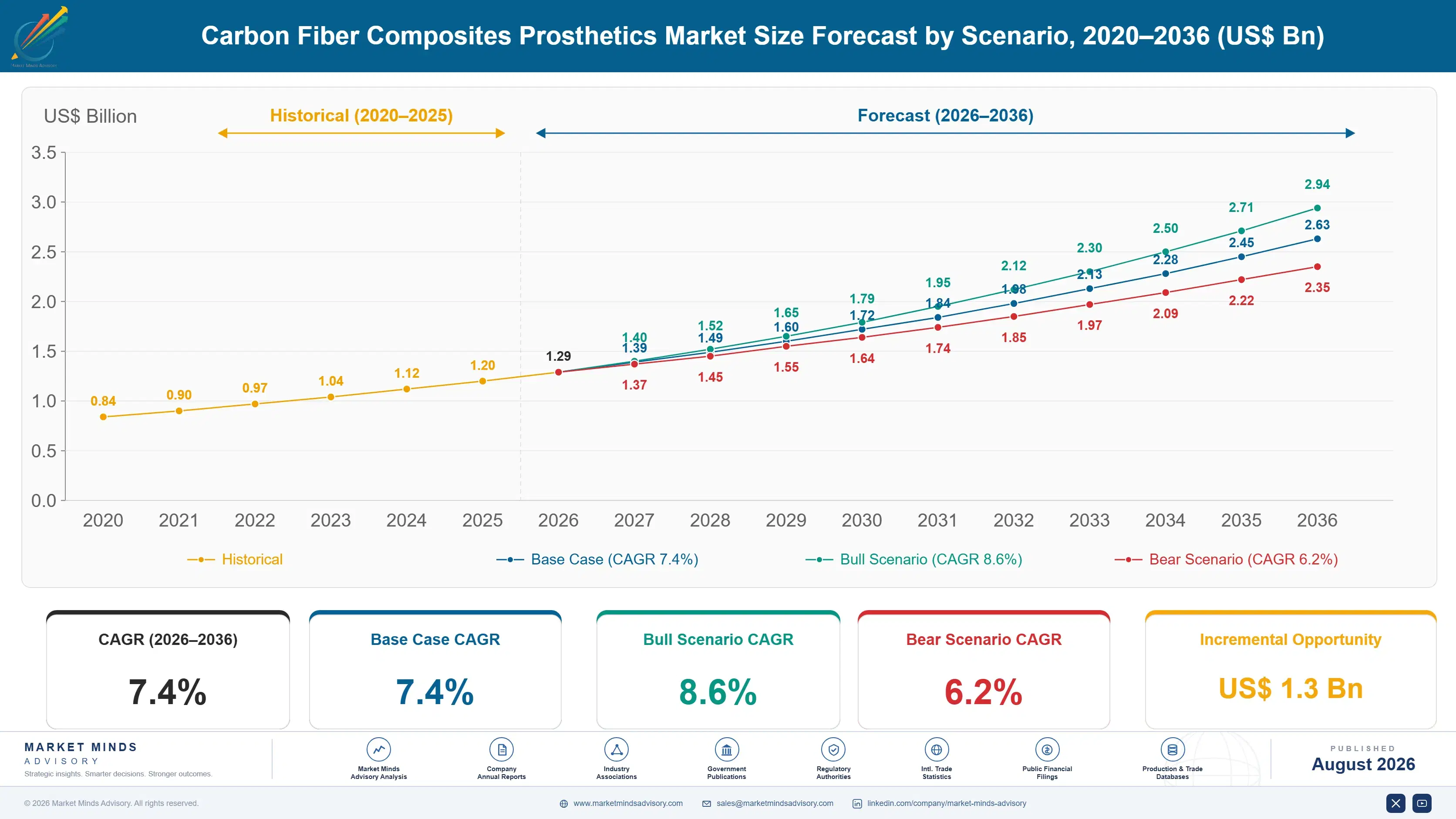
Carbon Fiber Composites Prosthetics Market Forecast Scenarios

carbon-fiber-composites-prosthetics-market-size-forecast-scenario-1787300689124
Between 2020 and 2025 the category grew at roughly 6.4% a year, held back early by pandemic-disrupted elective fittings and clinic closures, then accelerating as backlogged prosthetic prescriptions cleared and veteran and diabetic amputee populations kept expanding. Component makers used the slow years to shift manufacturing toward automated carbon layup, cutting socket lead times meaningfully. Recovery loaded most gains into the sector's back three years.
The base case carries the market to 7.4% annual growth through three mechanisms. First, insurers in the United States, Germany, and South Korea are widening coverage codes for microprocessor knees beyond catastrophic injury cases. Second, diabetic amputation incidence keeps climbing across aging populations in China, India, and Brazil, expanding the addressable patient pool. Third, additive manufacturing is cutting socket production cost enough that mid-market clinics can stock components once reserved for premium patients.
The bull case, 8.6%, assumes major insurers in the United States and Western Europe extend blanket coverage to running-specific blades for pediatric and working-age amputees, a policy shift piloted in three states. The bear case, 6.2%, assumes reimbursement agencies tighten prior-authorization rules for microprocessor components after cost-containment reviews, pushing clinics back toward cheaper exoskeletal alternatives and slowing the shift to carbon fiber.

Precision Materials Meeting Rising Reimbursement Demand

Three forces converge on this market at once. Amputation incidence keeps rising as diabetes prevalence climbs across aging populations, veteran care programs mature in the United States and several NATO member states, and clinicians increasingly default to carbon fiber over older exoskeletal designs because it cuts device weight without sacrificing load tolerance. Together these forces are pulling volume growth well ahead of population growth alone.
MARKET CONCENTRATIONCR5: 58%Top five manufacturers hold more than half global share
AVERAGE COMPONENT PRICEUSD 4,200 to 9,800Prices vary widely by device complexity and country
TOP PRODUCING COUNTRYGermany: 21% sharePrecision composite layup remains concentrated in specialized European facilities
CAPACITY UTILIZATION76%Specialized layup lines run near full operating capacity
CARBON FIBER COST SHARE28% of COGSRaw fiber and resin dominate total component manufacturing cost
REPLACEMENT CYCLE3 to 5 yearsActive users replace components more often than sedentary patients
Commercially, the category behaves less like a device market and more like a specialty materials business layered onto clinical service. Fabricators buy pre-preg carbon sheet and resin systems from a handful of aerospace-adjacent suppliers, then add most of the margin through custom fitting, alignment, and after-sale adjustment. That service layer, not the raw material, is what actually differentiates competitors and defends pricing against low-cost import components.
Over the next decade expect price discipline to tighten as public payers push value-based procurement, rewarding fabricators who can prove functional outcomes rather than material specification alone. Robotics-assisted socket scanning and predictive fit modelling will cut fitting time. Consolidation among smaller regional fabricators looks likely as certification costs rise faster than what standalone clinics can absorb.
"Carbon fiber stopped being the premium option the moment insurers realized it cuts long-term revision surgery costs. The real fight now is over who owns the fitting relationship, not who makes the best pylon."
Director, Medical Devices and Prosthetics Practice · MMA Medical Devices Practic

Market Trends

Insurers Widen Microprocessor Knee Coverage Codes

UnitedHealthcare and several state Medicaid programs expanded coverage policy in 2025 to include microprocessor knee systems for moderate-activity amputees, not just the highest mobility classification that previously gated approval. Germany's statutory health insurance funds followed with a similar reclassification the same year, widening the addressable patient pool by an estimated 40% in both markets. Component makers responded by launching mid-tier microprocessor knees priced below flagship models, explicitly targeting the newly eligible reimbursement tier. Clinics report faster prior-authorization turnaround, cutting the wait between prescription and fitting from months to weeks in several regions.
Market Impact: Expands diabetic-linked amputation base 580M
3D-Printed Sockets Cut Custom Fitting Time

Additive manufacturing has moved from prototyping into production sockets, with several major fabricators now 3D printing definitive carbon-reinforced sockets rather than hand-laminating them. Össur's digital scanning and print workflow, rolled out across roughly 60 clinics in 2024 and 2025, cut average socket turnaround from three weeks to under five days. That speed matters most for pediatric patients, who outgrow sockets every four to six months and previously waited weeks for each replacement. The technology also lowers the skilled-labor requirement per socket, letting smaller clinics in secondary cities offer service previously limited to major urban prosthetics centers.
Market Impact: Funds veteran components in 2025 budget

Market Opportunities and Growth Drivers

Diabetic Amputation Incidence Keeps Climbing Worldwide

The International Diabetes Federation estimates more than 580 million adults live with diabetes worldwide, and lower-limb amputation remains one of the condition's most severe complications when vascular disease goes unmanaged. The US Centers for Disease Control and Prevention has linked rising diabetic foot complications to an aging, increasingly overweight population, and national registries in Germany and Japan report comparable trends. Every additional amputation eventually becomes a prosthetic fitting, and a rising share of those patients now qualify for carbon fiber components rather than older aluminum designs, because payers increasingly recognize the weight and durability advantage in long-term cost comparisons.
Market Impact: Adds $10,000 average out-of-pocket cost

Veteran Care Programs Fund Advanced Components

The US Department of Veterans Affairs operates one of the world's most generous prosthetic benefit structures, authorizing replacement components on clinical need rather than strict cost caps, and its 2025 budget allocated additional funding specifically for microprocessor and carbon fiber running components for younger veterans. NATO member states run comparable, if smaller, veteran prosthetic programs, and several have expanded coverage following recent deployments. These programs matter disproportionately because military amputees are typically younger and more active than the broader amputee population, making them the natural early adopters that manufacturers use to validate new component designs before wider civilian rollout.
Market Impact: Waiting lists extend beyond 6 months

Market Restraints and Challenges

Reimbursement Caps Limit Premium Component Access

Many national insurance schedules still reimburse prosthetic components against fixed device categories written before microprocessor knees and carbon fiber running blades existed as options, so patients often pay thousands of dollars out of pocket to access current-generation components. The root cause is administrative lag: coding bodies revise device classifications on multi-year cycles that move slower than product development. The commercial impact is a two-tier market where wealthier patients access the newest materials while others remain on older aluminum designs for years longer than clinically necessary. Manufacturers are lobbying coding agencies directly and building outcome-data packages that support faster reclassification requests.
Market Impact: Expands eligible patient pool 40%

Certified Prosthetic Fitting Specialists Remain Persistently Scarce

Fitting a carbon fiber prosthesis correctly requires a certified prosthetist, and training programs graduate far fewer specialists than the patient population requires. The root cause is a long credentialing pipeline: most countries require multi-year clinical residencies before independent practice, and few new training programs have opened despite rising demand. The commercial impact shows up as multi-month waiting lists even where insurance coverage and product availability are not the constraint, delaying revenue recognition for manufacturers regardless of demand strength. Some fabricators now fund accelerated certification tracks and remote fitting-support software to extend specialists' reach into underserved regions.
Market Impact: Cuts socket turnaround to 5 days
3 additional market trends, 2 additional growth drivers, and 4 additional restraints and challenges are covered in the full report. Contact sales@marketmindsadvisory.com to access the complete intelligence.

Segment CAGR and Growth Architecture

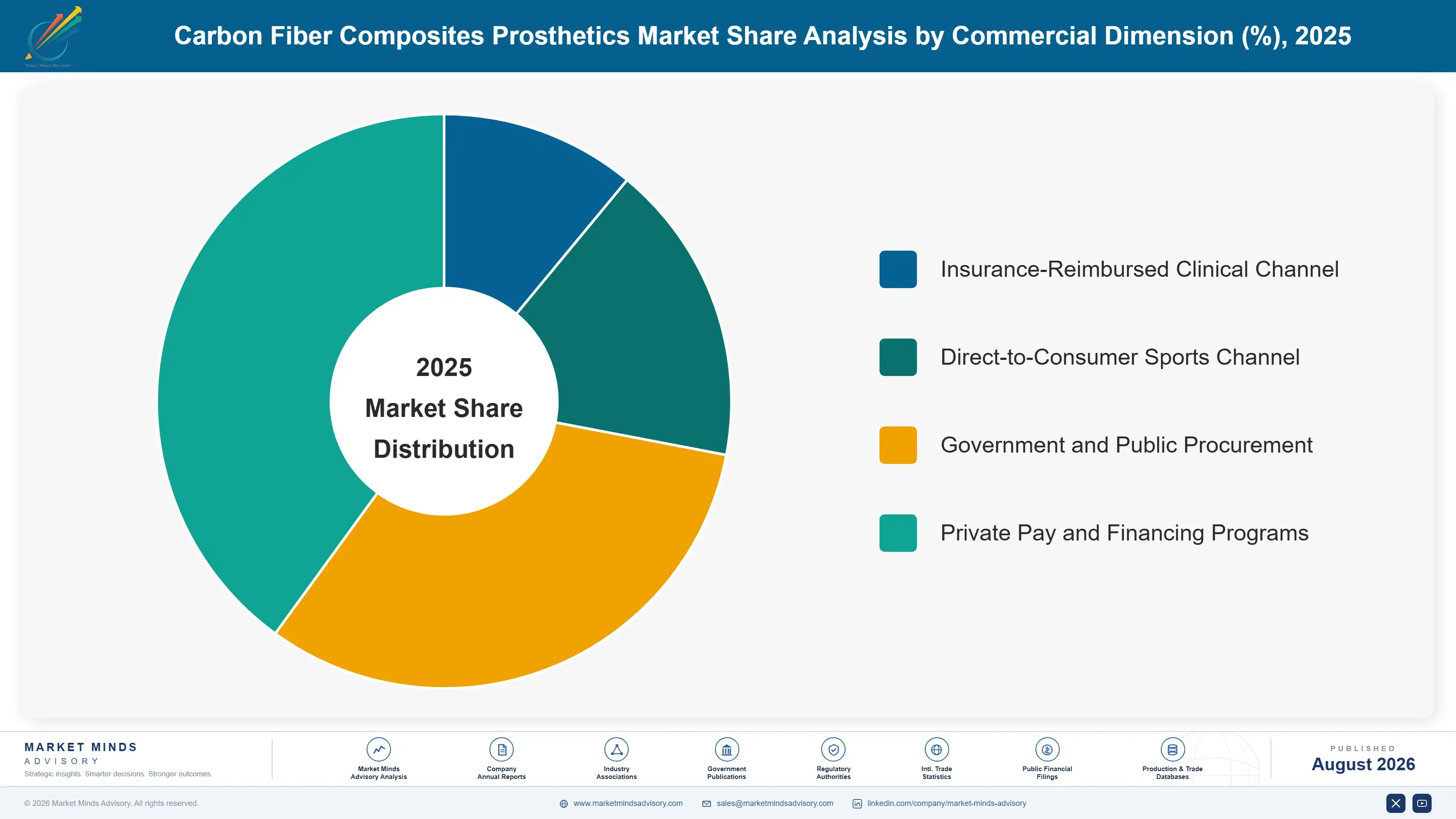
Segmentation follows product type, the single classification logic that matters most to buyers and payers alike. Each category, feet, sockets, pylons, upper-limb components, knee systems, and running-specific blades, carries its own certification pathway, reimbursement code, and buyer relationship, so commercial position tracks device function rather than fabrication process or material grade across the six categories evaluated here.
carbon-fiber-composites-prosthetics-market-market-share-analysis-1787300689685

Microprocessor-Integrated Knee Systems

Microprocessor-integrated knee systems grow fastest at 10.2%, roughly 1.38 times the overall market rate, as sensor-driven stability features move from flagship products into mid-tier price points that broader reimbursement schedules will actually cover. These knees use onboard processors and hydraulic or pneumatic actuators to adjust resistance in real time across gait phases, cutting fall risk meaningfully compared with mechanical alternatives. Össur, Ottobock, and Blatchford dominate the premium tier, while newer entrants target the expanding mid-tier segment insurers now approve for moderate-activity patients rather than only the highest mobility classification. Battery life and software reliability remain the main engineering constraints, and firmware update cycles increasingly resemble consumer electronics more than traditional orthopedic hardware, a shift regulators are still learning to evaluate.
CAGR 10.2%

Sports and Running-Specific Blades

Sports and running-specific blades grow second-fastest at 9.1%, about 1.23 times the overall rate, driven by expanding para-athletics participation and a slow but real shift toward covering activity-specific components rather than a single general-purpose foot for every patient. These J-shaped or C-shaped carbon fiber blades store and return energy during running gait, a function standard prosthetic feet cannot replicate efficiently. Össur's Flex-Foot lineage and Ottobock's running blade families lead the branded segment, while smaller specialist fabricators such as Ability Dynamics compete on custom stiffness tuning for individual athletes. Pediatric coverage remains the binding constraint, since growing children need frequent blade replacement that many insurers still classify as elective rather than medically necessary, limiting the segment's addressable base among younger amputees.
CAGR 9.1%
Full segment breakdown across 6 segments available in the complete report.

Regional Architecture and Country Demand Map

East Asia now leads on value, at 29% of the global total, ahead of North America's 27%, as Chinese, Japanese, and South Korean insurers widen coverage faster than device volume grows elsewhere. Western Europe, South Asia and Pacific, Latin America, the Middle East, and Eastern Europe complete a global distribution.

North America

US Department of Veterans Affairs procurement and generous private insurance reimbursement, more than expanding population, explain why North America holds 27% of global value. Roughly 1.6 million Americans live with limb loss, and Medicare's 2025 fee schedule revision widened coverage for microprocessor knees beyond the highest mobility classification, a change insurers had resisted for years. The Department of Veterans Affairs alone processes a disproportionate share of high-end component prescriptions relative to the general population, given the concentration of trauma amputees among younger veterans. Canada's public health system reimburses less generously, keeping most premium component volume concentrated in the United States specifically. Growth of 7.9% tracks steady diabetic amputation growth alongside this reimbursement widening, rather than any single dramatic policy shift.
Share: 27% | CAGR: 7.9% (2026 to 2036)

Western Europe

Germany alone accounts for the largest share of Western European value, its statutory health insurance funds among the most generous in covering carbon fiber components once a physician certifies functional need. France and the United Kingdom follow with National Health Service and Assurance Maladie reimbursement structures that cover basic components readily but require additional justification for microprocessor upgrades. The region's 20% share, near the lower end of its typical range, reflects genuine payer conservatism rather than weak demand: aging populations and strong universal coverage keep volume steady, but slower approval timelines for premium components hold value growth to 5.9%, the softest pace among the seven regions tracked here. Manufacturing remains concentrated in Germany and Iceland.
Share: 20% | CAGR: 5.9% (2026 to 2036)
Regional intelligence for 5 additional markets available in the complete report: East Asia, South Asia and Pacific, Latin America, Middle East and Africa, Eastern Europe. Contact sales@marketmindsadvisory.com.
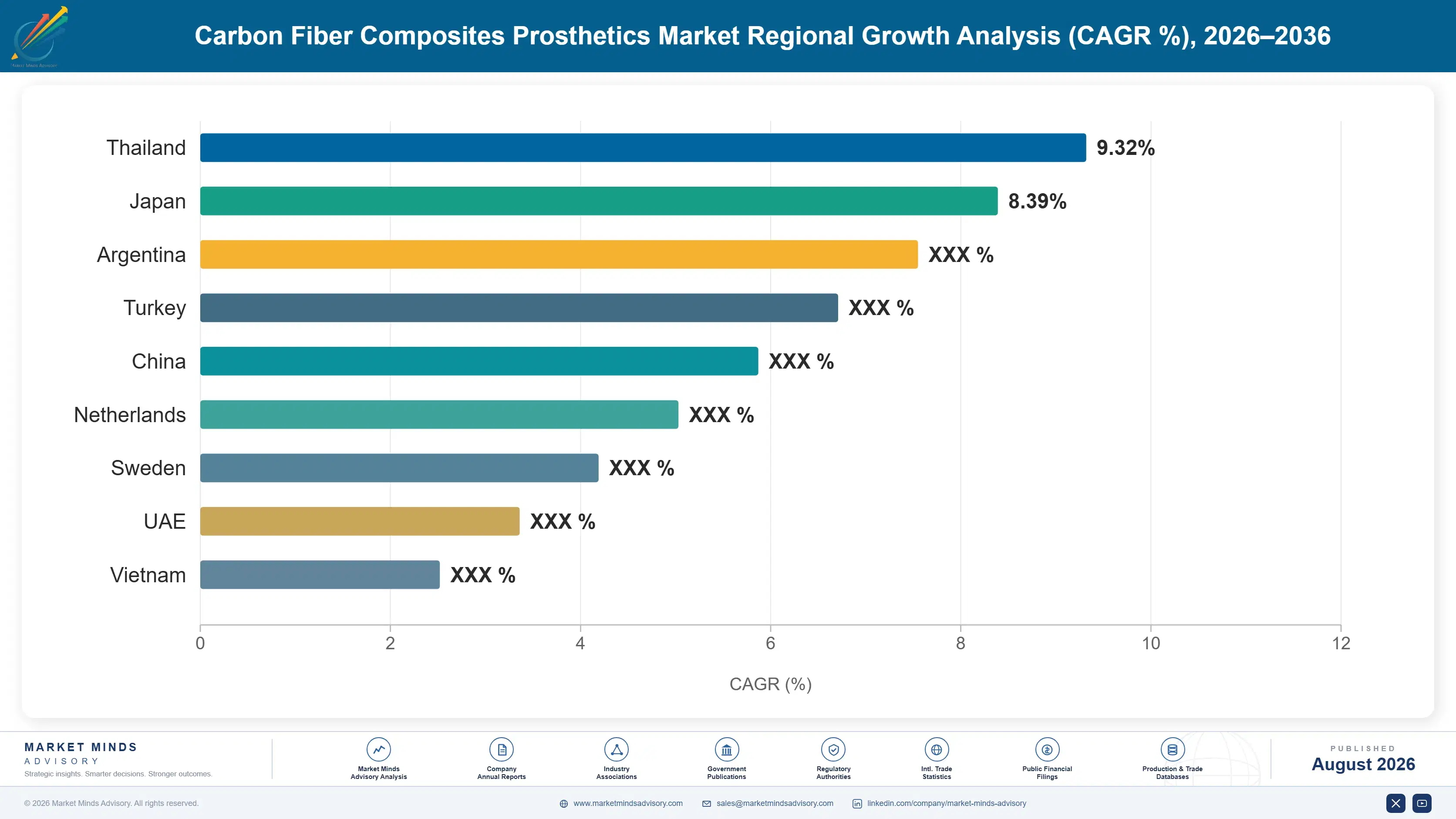
carbon-fiber-composites-prosthetics-market-country-cagr-analysis-1787300690197

New Ways Prosthetics Makers Can Earn

Component margin increasingly sits outside the material itself, in services, data, and financing structures wrapped around the physical device. The four levers below target revenue pools that carbon fiber manufacturers have historically left to clinics and distributors, converting one-time component sales into recurring, defensible income streams that compound faster than unit volume growth alone across the forecast period.

Bundle Outcome-Based Service Contracts With Component Sales

Manufacturers increasingly sell multi-year fitting, adjustment, and software update packages alongside the physical component rather than a one-time device sale. Ottobock's connected-knee service subscriptions, priced around USD 400 to 800 annually per patient, generate recurring revenue that persists regardless of whether the patient needs a new physical component that year. This shifts manufacturer economics away from pure unit sales toward a model closer to medical device-as-a-service, smoothing revenue against the multi-year replacement cycles that otherwise create lumpy, unpredictable demand. Clinics benefit too, since bundled contracts reduce billing friction with insurers who prefer predictable annual costs over unpredictable component-by-component claims.
Market Impact: Adds USD 400 to 800 recurring revenue annually

Monetize Fit Data Through Predictive Analytics Licensing

Every digital socket scan and gait analysis session generates data that, aggregated across thousands of patients, has real value to insurers building predictive models for component failure and replacement timing. Manufacturers running their own digital fitting platforms can license anonymized aggregate datasets to insurers and researchers, a revenue stream several device categories in orthopedics have already built successfully. Early licensing deals in adjacent orthopedic categories have generated more than USD 1 million in annual revenue for platform operators with sufficient patient volume. Building this requires data infrastructure and privacy investment, but the marginal cost is low against the revenue generated.
Market Impact: Generates $1 million-plus annual data licensing revenue streams

Expand Direct To Consumer Sports Blade Customization

Elite and recreational para-athletes increasingly buy performance-tuned running blades directly from manufacturers rather than through standard clinical channels, paying premium prices for custom stiffness categories and rapid turnaround outside insurance timelines. Össur and Ability Dynamics both run direct athlete programs that command list prices 30% to 50% above standard clinical blade pricing, reflecting the willingness of competitive athletes to pay for performance gains insurers will never reimburse. Scaling this channel requires almost no new manufacturing capacity, since it uses the same carbon layup lines as clinical products. Margin on direct sales typically runs meaningfully higher than insurance-billed equivalents.
Market Impact: Commands 30% to 50% premium on direct sales

Offer Component Financing For Uninsured And Underinsured Patients

Millions of patients globally lack insurance coverage sufficient to access carbon fiber components without meaningful out-of-pocket payment, particularly in the United States and across Latin America and South Asia. Manufacturer-backed financing programs, offering installment plans over 12 to 36 months, convert patients who would otherwise choose a cheaper aluminum device into carbon fiber customers, expanding the addressable market beyond what insurance alone supports. Comparable financing programs in dental and vision device categories have lifted premium conversion rates by 15 to 25 percentage points at the point of sale. Credit risk sits with the manufacturer, but incremental unit margin outweighs it.
Market Impact: Lifts premium conversion by 15 to 25 points

Who Controls the Margin Pool

Five manufacturers control 58% of global value, and the gap between leader and next challenger is real but not overwhelming. Ottobock and Össur both run diversified global distribution and own meaningful intellectual property in knee control software, while Blatchford, Fillauer, and WillowWood compete hard on specific categories rather than full-line breadth. Revenue is the basis used consistently throughout this assessment.
Competitive activity currently runs across three dimensions. Manufacturers race to secure reimbursement code approval in emerging markets before rivals establish distribution. Digital fitting platforms have become a genuine differentiator, with Össur and Ottobock investing heavily in proprietary scanning software that ties clinics to their component lines. Direct-to-athlete marketing, once marginal, now shapes brand perception among the broader clinical buyer base more than manufacturers expected.

Pressure is building from two directions that could reshuffle rankings within the decade. Chinese domestic manufacturers, still absent from the key player list, are scaling carbon layup capacity fast enough to threaten import dependence across East Asia. Smaller specialist fabricators focused on sports blades or pediatric sockets are proving that category focus can outcompete full-line manufacturers on dimensions patients actually care about, forcing larger players to decide whether to acquire that focus or replicate it internally.
carbon-fiber-composites-prosthetics-market-company-positioning-matrix-1787300690720

Competitive Moat and Risk Dimensions

OTTOBOCK SE & CO. KGAA

Moat: Deepest Reimbursement Code Coverage

Ottobock holds approved reimbursement codes across more national insurance systems than any competitor, built over decades of regulatory engagement in Germany, the United States, and dozens of secondary markets. That breadth lets it launch new components into markets where smaller rivals must first navigate lengthy code approval processes alone, giving Ottobock a meaningful head start on every major product cycle.
OTTOBOCK SE & CO. KGAA

Risk: Exposure To Public Payer Cuts

Ottobock's scale means a large share of revenue flows through public and quasi-public payers whose budgets face periodic austerity pressure, particularly across Western Europe. A single unfavorable reimbursement rate revision in a major market can move group revenue meaningfully, and the company has less flexibility than smaller private-pay-focused rivals to reprice quickly around any single country's policy shift.
ÖSSUR HF.

Moat: Dominant Sports Blade Brand Equity

Össur's Flex-Foot running blade lineage carries brand recognition among para-athletes and clinicians that decades of Paralympic sponsorship built, giving it pricing power in the direct-to-consumer sports segment competitors struggle to match. That brand halo also lifts perception of its broader clinical product line, even in categories where the underlying engineering is not meaningfully differentiated from rivals.
ÖSSUR HF.

Risk: Concentrated Manufacturing In Iceland

A significant share of Össur's premium carbon fiber component manufacturing runs through a small number of Icelandic and American facilities, creating exposure to single-site disruption, whether from energy costs, labor availability, or logistics, that more geographically distributed competitors like Ottobock do not carry to the same degree.

Key Players

Ottobock SE & Co. KGaA
Össur hf.
Blatchford Group
Fillauer LLC
WillowWood Global LLC

Others

Proteor SAS
Ability Dynamics LLC
College Park Industries Inc.
Freedom Innovations LLC
Trulife
Streifeneder ortho.production GmbH
Hosmer Dorrance Corporation
Ferrier Coupler Inc.
Coyote Design LLC
Naked Prosthetics Inc.
ALPS South LLC
Ortho Europe Group
PEL Supply Company
Bulldog Tools Inc.
Cascade Orthopedic Supply Inc.

Recent Developments

MARCH 2025

Össur Expands Digital Fitting Platform Across European Clinics

Össur rolled out its cloud-based digital scanning and socket design platform to an additional 200 partner clinics across Germany, France, and the United Kingdom, extending a system previously limited to flagship locations. The expansion standardizes fitting data collection across the network and shortens average socket delivery timelines for participating clinics.
Signal: Signals that digital fitting infrastructure is becoming table-stakes competitive ground rather than a differentiator reserved for premium clinics.
SEPTEMBER 2025

Ottobock Opens Carbon Component Facility In Bangalore

Ottobock opened a new carbon fiber component manufacturing and finishing facility in Bangalore, India, its first dedicated South Asian production site, aimed at reducing import lead times and tariff exposure for components previously shipped from Germany and serving the region's fastest-growing prosthetics market with locally finished components directly.
Signal: Signals Ottobock is committing manufacturing capital to South Asia well ahead of most competitors' regional investment plans.
JUNE 2025

WillowWood Acquires Pediatric Socket Design Specialist

WillowWood completed the acquisition of a small pediatric-focused socket design firm, adding specialized rapid-growth socket adjustment technology to its portfolio. The deal was structured as a full acquisition rather than a licensing or joint development arrangement, bringing the target's engineering team and patent portfolio fully in-house immediately.
Signal: Signals consolidation is reaching specialist niches as larger manufacturers buy targeted capability instead of building it internally.

What Actually Drives Component Cost

Carbon fiber pre-preg sheet and epoxy resin systems account for roughly 28% of component manufacturing cost, sourced primarily from Japanese, American, and German aerospace-adjacent fiber producers rather than commodity textile suppliers. Titanium and aluminum hardware for pylons and connectors add another 15%, while skilled labor for lamination and finishing makes up most of the remainder, reflecting how labor-intensive precision layup remains despite decades of process automation investment.
Carbon fiber pricing spiked sharply in 2022 as aerospace demand recovered from pandemic-era lows and competed directly with medical device fabricators for the same Japanese and American production capacity. Toray's 2023 annual report cited tight capacity utilization across its carbon fiber division through that period, and several prosthetics fabricators reported multi-month delays securing pre-preg allocation, pushing some smaller clinics toward lower-grade fiberglass-reinforced alternatives temporarily until supply eased into 2024.

Smaller independent fabricators carry the sharpest exposure, since they lack the purchase volume to negotiate long-term supply contracts that Ottobock and Össur secure directly with fiber producers. Regional exposure varies too: European fabricators sourcing from German-based converters face less currency risk than American or Asian buyers paying in dollars for Japanese fiber, a gap that widens whenever exchange rates move against smaller regional players.
carbon-fiber-composites-prosthetics-market-cost-volatility-analysis-1787300690916

Lock Multi-Year Supply Contracts With Fiber Producers

Manufacturers with sufficient purchase volume are negotiating three to five year supply agreements directly with Toray and other major fiber producers, trading some pricing flexibility for guaranteed allocation during capacity crunches. This approach favors the largest five manufacturers disproportionately, since minimum volume commitments required for favorable terms sit well beyond what smaller regional fabricators can commit to reliably.

Qualify Alternative Fiber Grades For Non-Critical Parts

Some fabricators now qualify lower-cost intermediate-modulus fiber grades for pylons and connectors where ultimate performance requirements are less demanding than in load-bearing sockets, reserving premium aerospace-grade fiber for components where weight and fatigue performance genuinely matter most, cutting blended material cost without compromising patient-facing performance or long-term component durability across the full replacement cycle.

Build Regional Finishing Capacity Near Demand Centers

Opening finishing and lamination facilities closer to major demand regions, as Ottobock did in India, cuts logistics cost and currency exposure even when raw fiber still ships from Japan or the United States, shortening the exposed portion of the supply chain and reducing overall inventory carrying costs across the wider regional distribution network quite significantly.

Portfolio Architecture for Margin Defence

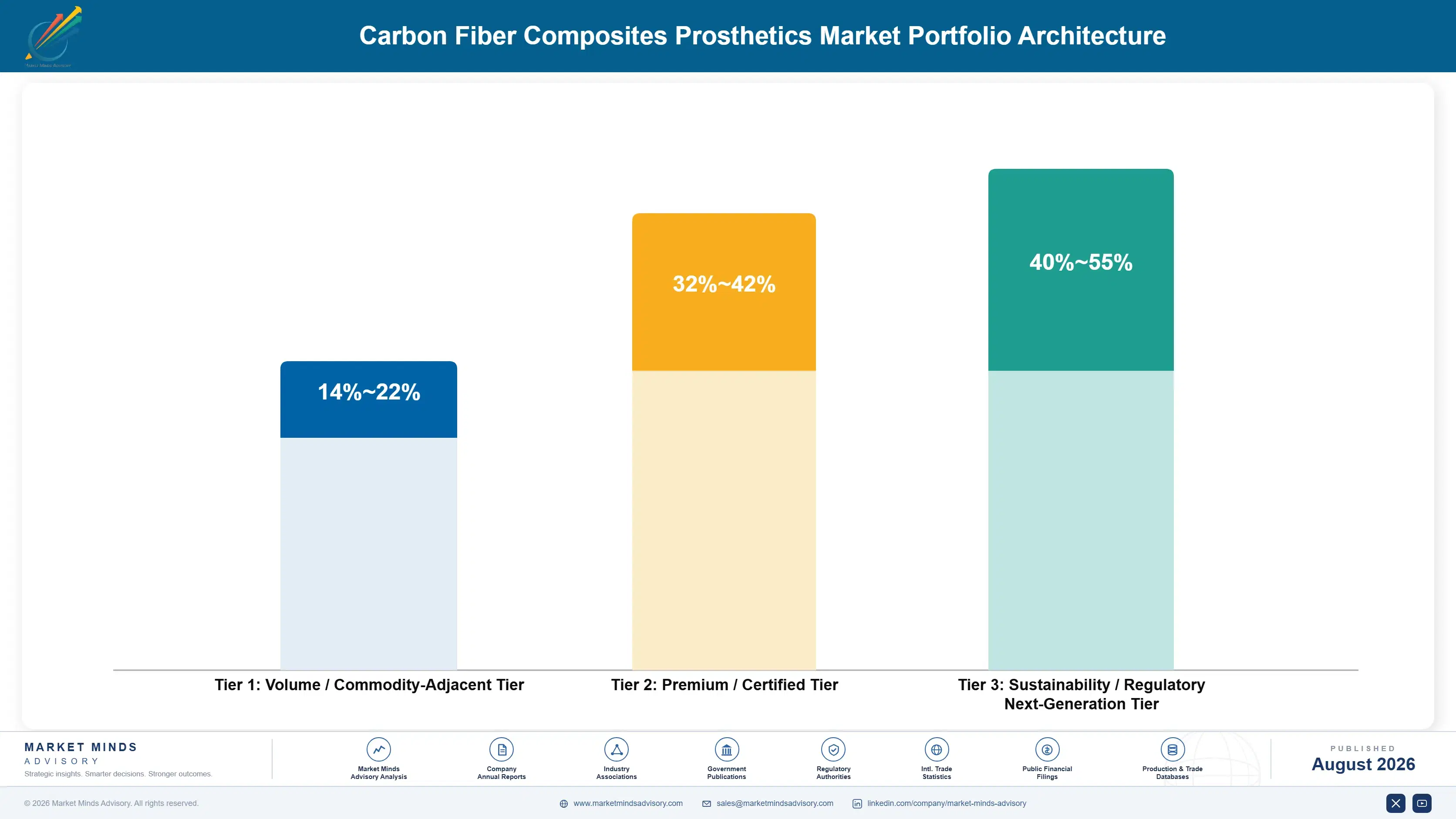
The portfolio splits into three tiers with real margin separation. Volume-tier products, standard aluminum-hybrid pylons and basic exoskeletal feet, compete against non-carbon alternatives on price and earn modestly. Premium certified components, covering most branded carbon fiber feet and sockets, earn considerably more because reimbursement codes exist and clinical trust is established. Next-generation microprocessor and sensor-integrated systems occupy the top tier, commanding the strongest m
The tension running through this portfolio is familiar to any specialty materials business: volume products fund the sales and distribution infrastructure that premium products depend on, yet volume growth alone cannot fund the R&D pipeline microprocessor and sensor development requires. Manufacturers who lean too heavily into premium innovation risk losing the distribution scale that makes market entry viable in price-sensitive regions, while those who stay purely volume-focused cede the fastest-growing, highest-margin segment entirely to competitors.

High-value pools concentrate where insurance coverage, clinical trust, and patient activity level intersect: working-age, moderately active amputees in markets with generous microprocessor coverage. That intersection is still narrow globally but expanding as reimbursement catalogues widen, which is why the next-generation tier grows fastest even while representing a modest share of total volume today.

Volume / Commodity-Adjacent Tier

Standard aluminum-hybrid pylons, basic exoskeletal feet, and entry sockets compete directly against non-carbon alternatives on price, serving cost-constrained public health systems and price-sensitive patients across emerging markets where premium reimbursement coverage remains limited or unavailable.
Gross Margin: 14%-22%

Premium / Certified Tier

Branded carbon fiber feet, sockets, and pylons carrying established reimbursement codes and strong clinical trust across major insurance systems, sold primarily to working-age and moderately active patients across North America, Western Europe, and East Asia.
Gross Margin: 32%-42%

Sustainability / Regulatory / Next-Generation Tier

Microprocessor knees, sensor-integrated components, and additively manufactured sockets representing the technology frontier, priced at a premium justified by functional outcome data and updated reimbursement coding standards across the most advanced insurance markets tracked in this report.
Gross Margin: 40%-55%
carbon-fiber-composites-prosthetics-market-portfolio-architecture-1787300691416

High-value Sub-segments and Strategic Watch-out

Microprocessor-Integrated Knee Systems

The fastest-growing and highest-margin segment, expanding at 10.2% as reimbursement schedules widen beyond the highest mobility classification that previously restricted access to premium components. Sensor-driven stability and real-time gait adjustment justify premium pricing, expanding the addressable patient population insurers are now increasingly willing to cover.
Gross Margin: 40%-55%

Sports and Running-Specific Blades

High margin through direct-to-athlete sales channels that bypass typical insurance pricing pressure entirely, though overall growth trails the microprocessor category since pediatric coverage constraints and a smaller addressable patient population cap the segment's ceiling somewhat compared with broader clinical categories serving the general amputee population.
Gross Margin: 35%-48%

Prosthetic Feet and Ankle Systems

The largest segment by unit volume and the category most exposed to price competition from non-carbon and lower-cost aluminum alternatives, generating steady but unspectacular margins across the broadest and most price-sensitive patient population tracked anywhere in this segmentation framework, where reimbursement gaps push many patients toward cheaper alternatives regularly.
Gross Margin: 18%-28%

Pylons and Connectors

A commoditizing category where component standardization across manufacturers is eroding differentiation and margin faster than in any other segment tracked here, forcing fabricators to compete increasingly on price alone unless pylons are bundled into broader system sales that preserve some pricing power across the wider component system.
Gross Margin: 12%-20%

How Prosthetic Demand Actually Compounds

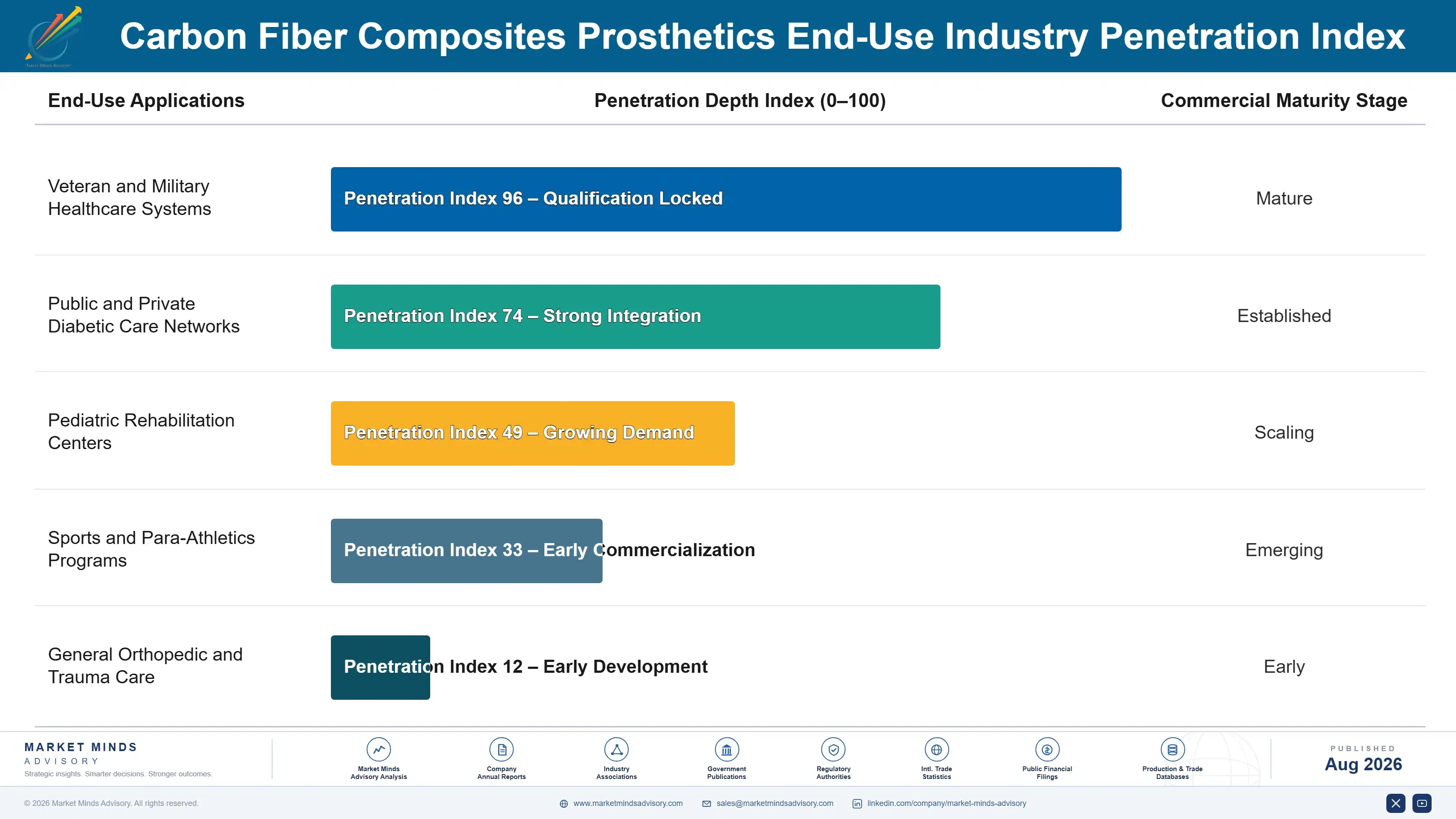
Demand here behaves like an annuity, not a single transaction. A single amputee typically requires an initial fitting, then component replacement every three to five years for the rest of their working life, sometimes decades, as sockets wear, technology improves, and physical needs change with age and activity level. That replacement cycle, more than any acquisition of new patients, drives the bulk of steady-state revenue across mature reimbursement markets.
Adoption depth varies sharply by end-use vertical. Veteran care systems adopt the newest carbon fiber technology fastest, since generous reimbursement removes the usual cost barrier entirely. Civilian diabetic amputees adopt more slowly and unevenly, often starting on basic components before qualifying for premium upgrades years later as insurers reassess eligibility. Pediatric patients occupy an unusual middle position: growth requires frequent replacement regardless of technology tier, but coverage of premium components for children lags behind adult coverage in most reimbursement systems.

Younger amputees increasingly research components online before their first clinical appointment, arriving with specific brand and feature preferences that previous generations left to their prosthetist's recommendation. That shift is pushing manufacturers toward more direct patient-facing marketing and transparent outcome data, even though prosthetists remain the purchasing decision-maker in every reimbursed transaction.
carbon-fiber-composites-prosthetics-market-end-use-penetration-index-1787300691905

Where This Market Rewards Focus

These are among the four positions where our research anticipates prominent divergence between winners and laggards over the coming forecast period. Each is grounded in the demand model, the regulatory perimeter, and the announced capacity pipeline.
01 / REIMBURSEMENT CODE STRATEGY

Winners will chase coding reclassification, not just product innovation

Product innovation alone no longer separates leading manufacturers, since most competitors can eventually match a given feature set within two or three product cycles. What genuinely separates winners is the speed and success rate of getting new components onto national reimbursement schedules, because a superior component sitting outside coverage generates no volume regardless of engineering merit. Manufacturers building dedicated regulatory affairs and health economics teams, rather than treating coding as an afterthought, will out-earn technically comparable rivals over the coming decade.
02 / EMERGING MARKET MANUFACTURING

Regional finishing capacity will decide who wins Asia

East Asia has become the largest single regional value pool, yet most premium components are still manufactured in Germany, Iceland, and the United States and shipped across long, tariff-exposed supply chains. Manufacturers who build finishing and assembly capacity closer to Chinese, Japanese, and South Korean demand will cut both landed cost and lead time in a region already growing faster than any other. Those still exporting finished components from distant factories will find themselves undercut on price and speed simultaneously within this decade.
03 / DATA AND SERVICE REVENUE

Recurring service revenue will matter more than unit sales

Manufacturers still pricing components as one-time transactions are leaving durable revenue on the table that subscription-style service and software update contracts already capture successfully in adjacent medical device categories. Digital fitting platforms and connected knee software create natural touchpoints for recurring billing relationships that persist between the multi-year physical replacement cycles that otherwise define this market's revenue pattern. Companies that build these recurring relationships early will earn materially more per patient over a decade than those still selling only hardware.
04 / CERTIFICATION AND TRAINING CAPACITY

The fitting bottleneck will constrain growth more than reimbursement

Even where insurance coverage and product availability align favorably, growth is capped by the number of certified prosthetists able to perform correct fittings, a constraint that neither manufacturers nor insurers directly control today. Manufacturers who invest in accelerated certification programs, remote fitting-support software, and partnerships with training institutions will effectively expand their own addressable market ahead of competitors who wait for public training pipelines to catch up naturally. This constraint will matter more to realized growth over the next decade than any single reimbursement policy decision.

Engagement Snapshot From the Field

A live engagement with an industry participant carrying material or product regulatory and market exposure ahead of a defining policy shift, showing how our research translates into a defensible multi-year portfolio strategy.
MARKET MINDS ADVISORY · CLIENT ENGAGEMENT SUMMARY
Carbon Fiber Composites Prosthetics Producer Strategic Portfolio Review and Transition Roadmap 2026·Investment Scenario on Carbon Fiber Composites Prosthetics Exposure Evaluation 2025-26
CLIENT PROFILE
A multi-site prosthetics and orthotics clinic network operating across the southeastern United States approached MMA while evaluating whether to add in-house digital socket scanning and 3D printing capability rather than continuing to outsource sockets to a regional fabricator. The client reported annual revenue near USD 38 million across its clinic network, with roughly 60% of that revenue tied to carbon fiber component fittings specifically (client-reported, unverified by MMA).
STRATEGIC CHALLENGE
Leadership believed in-house digital fabrication would cut turnaround time and improve margin, but nobody had modeled the capital cost against the outsourced fabricator's existing pricing, nor assessed whether patient volume across the network justified dedicated equipment at each site versus a centralized regional hub. The board needed a defensible capital allocation decision before committing to a facility lease renewal cycle.
MMA APPROACH
MMA modeled per-socket cost under three scenarios: continued outsourcing, a single centralized in-house hub serving all sites, and full per-site equipment deployment. We benchmarked capital and consumable costs against disclosed figures from comparable clinic networks and interviewed five practicing prosthetists across the client's network on realistic daily throughput assumptions under each scenario.
KEY FINDINGS
  1. A centralized regional hub broke even against outsourcing costs within roughly 18 months at the client's current patient volume, while per-site equipment would not break even for over four years (client-reported, unverified by MMA).
  2. Turnaround time improvements from in-house fabrication mattered more to patient satisfaction scores than the clinic's own leadership had assumed, based on structured patient interviews conducted during the engagement.
  3. Two of the network's five sites lacked sufficient patient volume to independently justify even shared centralized capacity, suggesting a phased three-site rollout rather than immediate network-wide deployment.
  4. Consumable and maintenance costs for digital scanning equipment ran meaningfully higher than vendor quotations suggested once realistic annual service contracts were included in the total cost comparison.
CLIENT PROFILE
A multi-site prosthetics and orthotics clinic network operating across the southeastern United States approached MMA while evaluating whether to add in-house digital socket scanning and 3D printing capability rather than continuing to outsource sockets to a regional fabricator. The client reported annual revenue near USD 38 million across its clinic network, with roughly 60% of that revenue tied to carbon fiber component fittings specifically (client-reported, unverified by MMA).
STRATEGIC CHALLENGE
Leadership believed in-house digital fabrication would cut turnaround time and improve margin, but nobody had modeled the capital cost against the outsourced fabricator's existing pricing, nor assessed whether patient volume across the network justified dedicated equipment at each site versus a centralized regional hub. The board needed a defensible capital allocation decision before committing to a facility lease renewal cycle.
MMA APPROACH
MMA modeled per-socket cost under three scenarios: continued outsourcing, a single centralized in-house hub serving all sites, and full per-site equipment deployment. We benchmarked capital and consumable costs against disclosed figures from comparable clinic networks and interviewed five practicing prosthetists across the client's network on realistic daily throughput assumptions under each scenario.
KEY FINDINGS
  1. A centralized regional hub broke even against outsourcing costs within roughly 18 months at the client's current patient volume, while per-site equipment would not break even for over four years (client-reported, unverified by MMA).
  2. Turnaround time improvements from in-house fabrication mattered more to patient satisfaction scores than the clinic's own leadership had assumed, based on structured patient interviews conducted during the engagement.
  3. Two of the network's five sites lacked sufficient patient volume to independently justify even shared centralized capacity, suggesting a phased three-site rollout rather than immediate network-wide deployment.
  4. Consumable and maintenance costs for digital scanning equipment ran meaningfully higher than vendor quotations suggested once realistic annual service contracts were included in the total cost comparison.
RECOMMENDED STRATEGY
Phase 1: Phase 1 (0 to 6 months): Deploy centralized digital scanning and printing capacity at the highest-volume site, routing sockets for two additional sites through it immediately. Phase 2: Phase 2 (6 to 18 months): Expand routing to the remaining two sites once throughput data confirms the centralized hub can absorb full network demand without turnaround delays. Phase 3: Phase 3 (18 to 36 months): Reassess per-site deployment only if patient volume growth at any single location independently justifies dedicated equipment against the proven hub economics.
OUTCOME
The client deployed the centralized hub model, reaching break-even against prior outsourcing costs in 17 months, slightly ahead of MMA's projection. Average socket turnaround fell from three weeks to six days across all five sites, and the network reported a USD 2.1 million reduction in annual fabrication cost within the first full year of operation (client-reported, unverified by MMA).

Frequently Asked Questions

Foundational context covering the market sizes, CAGR, scope, country, region and competition that inform every finding below. This section is provided to cover basics and most often pre-purchase conversations, answered from the MMA Primary Research Dataset.

What is the current size of the Carbon Fiber Composites Prosthetics Market?

The market stood at USD 1.2 billion in 2025, based on MMA Primary Research Dataset findings. Carbon fiber components now represent the fastest-growing material category within the broader global prosthetics industry.

How large will the Carbon Fiber Composites Prosthetics Market be by 2036?

MMA projects the market will reach USD 2.63 billion by 2036 under the base case scenario. That represents more than double the 2026 opening value across the eleven-year forecast period.

What is the CAGR for the Carbon Fiber Composites Prosthetics Market 2026 to 2036?

The base case CAGR is 7.4% annually. MMA's bull scenario reaches 8.6% while the bear scenario, reflecting tighter reimbursement rules, runs closer to 6.2% if prior-authorization requirements tighten faster than expected.

Which segment is growing fastest?

Microprocessor-integrated knee systems lead at 10.2% CAGR, roughly 1.38 times the overall market rate, as reimbursement schedules widen beyond the highest mobility classification alone, expanding the pool of eligible moderate-activity patients substantially.

Who are the major companies in the Carbon Fiber Composites Prosthetics Market?

Ottobock, Össur, Blatchford, Fillauer, and WillowWood lead the market, together controlling an estimated 58% of global value on a consistent revenue basis across all profiled participants.

Which country is growing fastest?

India posts the fastest national growth at 12.8% CAGR, driven by expanding government assistive technology procurement and rising domestic manufacturing capacity for carbon fiber components.

Report Segmentation Architecture

The full report scope spans multiple orthogonal segmentation dimensions, with cross-tabulated demand data provided for each dimension pair. Coverage extends further to regional breakdowns, trend trajectories, and the competitive detail needed to support segment-level decision-making.

By Product Type

  • Prosthetic Feet and Ankle Systems
  • Prosthetic Sockets
  • Pylons and Connectors
  • Upper-Limb Prosthetic Components
  • Microprocessor-Integrated Knee Systems
  • Sports and Running-Specific Blades

By End-Use Industry

  • Veteran and Military Healthcare Systems
  • Public and Private Diabetic Care Networks
  • Pediatric Rehabilitation Centers
  • Sports and Para-Athletics Programs
  • General Orthopedic and Trauma Care

By Commercial Dimension

  • Insurance-Reimbursed Clinical Channel
  • Direct-to-Consumer Sports Channel
  • Government and Public Procurement
  • Private Pay and Financing Programs

By Region

  • North America
  • Western Europe
  • East Asia
  • South Asia and Pacific
  • Latin America
  • Middle East and Africa
  • Eastern Europe

Scope, Methodology, and Coverage

Every figure in this report is reproducible from documented input assumptions. The scope below maps the historical period, the forecast horizon, the segmentation dimensions, and the countries covered, alongside the underlying primary and qualitative methodology.
Historical Period
2020 to 2025
Forecast Period
2026 to 2036
Base Year
2025 (USD billions; MMA Primary Research Dataset, August 2026)
Market Definition
The carbon fiber composites prosthetics market covers externally worn lower- and upper-limb prosthetic devices whose structural components, sockets, pylons, feet, and knee frames, use carbon fiber reinforced composite materials, including associated microprocessor and mechanical joint systems built on carbon fiber structures. It excludes titanium and aluminum-only prosthetic systems, orthotic braces, wheelchairs, and surgical implants such as osseointegration fixtures.
Quantitative Units
USD billions (current prices); component unit shipments and average selling price where applicable
Segmentation Dimensions
By Product Type; By End-Use Industry; By Commercial Dimension; By Region
Regions Covered
North America, Western Europe, East Asia, South Asia and Pacific, Latin America, Middle East and Africa, Eastern Europe
Countries Covered
USA, China, Germany, France, UK, Japan, South Korea, India, Australia, Canada, Brazil, Mexico, Indonesia, Vietnam, Thailand, Malaysia, UAE, Saudi Arabia, South Africa, Nigeria, Turkey, Poland, Netherlands, Italy, Spain, Sweden, Switzerland, Argentina, Colombia, Singapore, and additional markets relevant to this sector
Key Companies Profiled
Ottobock SE & Co. KGaA, Össur hf., Blatchford Group, Fillauer LLC, WillowWood Global LLC, Proteor SAS, Ability Dynamics LLC, College Park Industries Inc., Freedom Innovations LLC, Trulife, Streifeneder ortho.production GmbH, Hosmer Dorrance Corporation, Ferrier Coupler Inc., Coyote Design LLC, Naked Prosthetics Inc., ALPS South LLC, Ortho Europe Group, PEL Supply Company, Bulldog Tools Inc., Cascade Orthopedic Supply Inc.
Quantitative Methodology
Primary survey, n=3,800 respondents, Q4 2025, six countries; demand-side model with trade association cross-validation
Qualitative Methodology
47 expert interviews, Q4 2025; applied to validate demand model assumptions, identify emerging dynamics, and assess competitive positioning
Report Format
PDF and XLSX data workbook (Word format preview document)
Publisher
Market Minds Advisory
Report Code
MMA-2026-MED-112
Published
August 2026
Contact
sales@marketmindsadvisory.com | www.marketmindsadvisory.com

Purchase the full Carbon Fiber Composites Prosthetics Market Report (2026 to 2036).

The full MMA Carbon Fiber Composites Prosthetics report sizes the market across six product categories, five end-use verticals, four commercial channels, and seven regions through 2036. It profiles 20 participants on a consistent revenue basis, scoring the top five on reimbursement code breadth, manufacturing footprint, and digital fitting capability. Scenario models quantify how insurance coverage expansion, additive manufacturing adoption, and certified prosthetist capacity constraints move both demand and realizable pricing. The report also includes delivered-cost modelling by product category, a reimbursement policy tracker across major markets, and a competitive benchmarking tool built for manufacturer strategy, clinic procurement, and investor due diligence teams.
Six-category product segmentation with regional cross-tabulation
Reimbursement policy tracker across twelve major markets
Competitive benchmarking on consistent revenue basis
Delivered-cost modelling by product category and region
Scenario models for coverage expansion and policy risk
Certified prosthetist capacity constraint analysis by geography

Built For The People Who Decide

From boardroom strategy to bench-side execution, this report is read cover-to-cover by leaders shaping the next decade of their industry, turning demand scenarios, market dynamics and valuation benchmarks into decisions.
CXOs/ Presidents/ VPs/ Managers
M&A and Corporate Development
Strategy Teams and R&D Heads
Procurement and Product Directors
Regulatory and Compliance Leaders
Investor Relations and Equity Analysts