Market Minds Advisory
Carbon Dioxide Incubators Market

Carbon Dioxide Incubators Market: Contamination Consequence, Undisturbed Culture, and Consumable Tie-In

An incubator's actual job is preventing contamination rather than holding temperature, because a single event destroys weeks of culture work and, in fertility laboratories, an embryo cohort nobody can replace.

Lead Analyst

Alice Ballenger

Published

September 2026

Make Smarter Decisions with Customized Research Insights

Request a free sample report and evaluate market opportunities, growth trends, and competitive dynamics relevant to your business needs.

2025 MARKET VALUE$0.9BMarket Size 2025
2036 FORECAST VALUE$2.1BBase Case , 2026 to 2036
CAGR 2026 TO 20367.8 %Bull 9.1% / Bear 6.5%
INCREMENTAL OPPORTUNITY$1.1BNet 10- year value creation
EXPANSION MULTIPLE2.12x2036 value over 2026 base
Strategic Levers
M&A Pipeline
Regional Outlook
Country Rankings
Competitive Intelligence
Segmental Deep-dive
Call-Us : 91 93563 13602

Executive Snapshot and Market Trajectory

Every design decision in this category traces back to contamination. Copper interiors, filtration, high-temperature decontamination cycles and chamber subdivision all exist because a single event destroys weeks of work, and temperature control was solved decades ago. Roughly 9% of laboratories report an event each year.
Benchtop time-lapse fertility incubators compound at 11.7%, a full 1.50x the market rate, by never opening the door and imaging embryos continuously instead. They also brought a consumable tie-in that laboratory incubators never had, since the culture dishes are specific to the instrument. East Asia holds the largest share at 30% on Japanese fertility cycle volume and Chinese research capacity together. Construction rather than upgrades drives all of the growth.
Concentration sits at 57%, with Thermo Fisher Scientific leading on laboratory scale and Vitrolife leading a fertility franchise built on imaging and dishes rather than on the box itself. Replacement runs at roughly eleven years and failure rates are low, so the installed base barely turns over and growth depends on new laboratories rather than upgrades. Chinese manufacturers undercut Western pricing across routine research work. Japan performs among the highest fertility cycle volumes anywhere.
Market Definition
This market covers carbon dioxide incubators used for cell, tissue and embryo culture, spanning water-jacketed and air-jacketed configurations, tri-gas and hypoxia control systems, benchtop time-lapse fertility incubators, multi-chamber compartmentalised units, and large-capacity reach-in models. Measurement is at manufacturer revenue for incubator hardware and directly tied consumables. Standard laboratory ovens and non-carbon-dioxide incubators, biological safety cabinets, cryogenic storage, culture media and reagents sold independently, and laboratory information systems are excluded.
Base Year Value
$0.9B in 2025 (MMA Primary Research Dataset, August 2026)
Forecast Period
2026 to 2036, eleven discrete annual values
CAGR
7.8% base case. Bull 9.1%. Bear 6.5%.
Fastest Growth Segment
Benchtop Time-Lapse IVF Incubators: 11.7% CAGR
Fastest Growth Country
India: 13.2% CAGR
Fastest Growth Region
South Asia and Pacific: 10.0% CAGR
Largest Region
East Asia: 30% of 2025 global value
Market Leaders
Thermo Fisher Scientific, Eppendorf, PHC Holdings, Binder, and Vitrolife. Source: MMA Primary Research Dataset, July 2026.
Primary Survey
n=3,800 procurement and R&D decision-makers, Q4 2025, six countries
Methodology
Demand-side build-up, cross-validated against public data, 47 expert interviews

Carbon Dioxide Incubators Market Forecast Scenarios

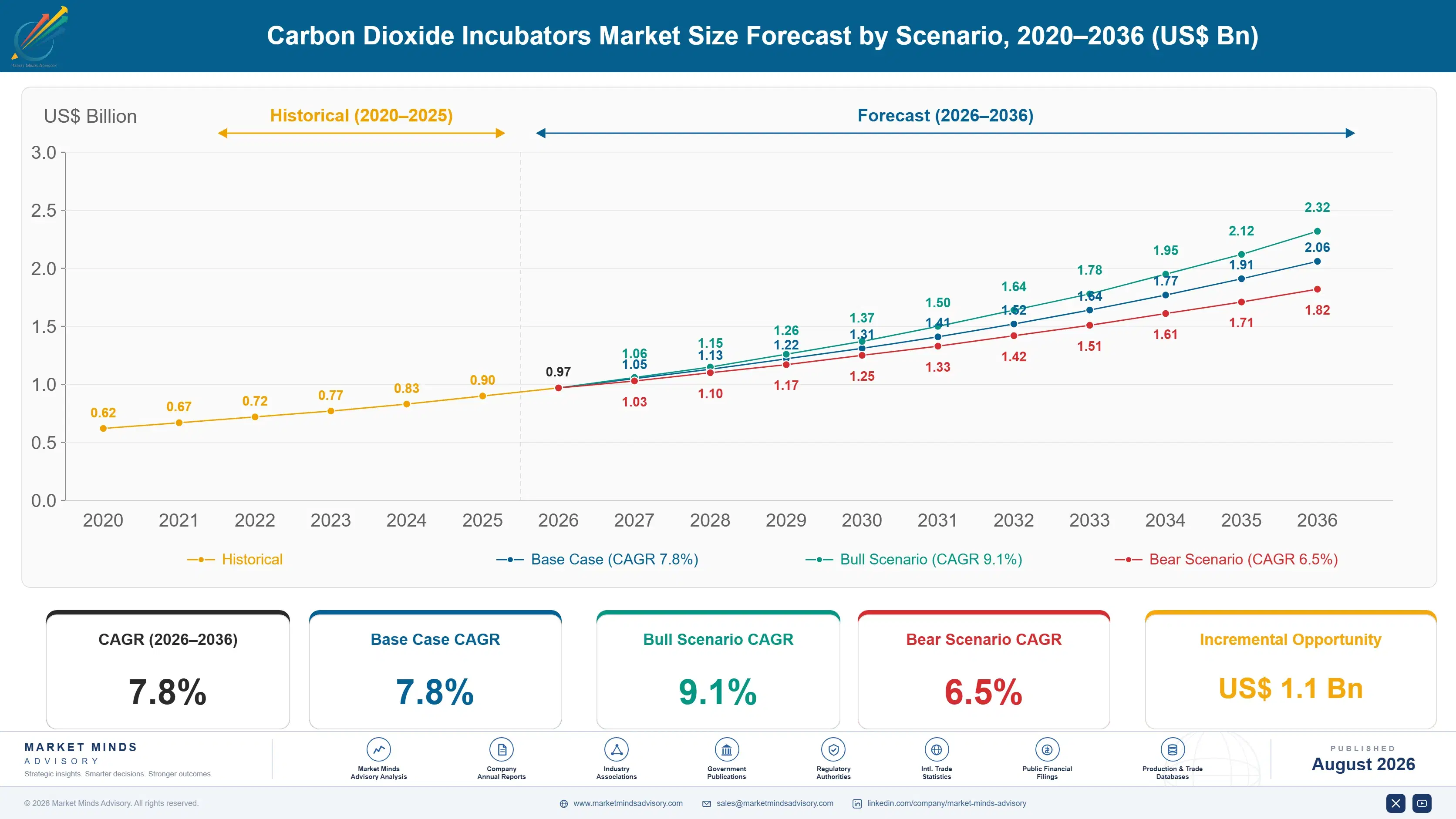
carbon-dioxide-incubators-market-size-forecast-scenario-1787304216414
Growth ran at roughly 6.6% between 2020 and 2025, and laboratory construction drove most of it. Pandemic-era research funding and biopharmaceutical capacity expansion filled new facilities that each needed incubators before any experiment could start, and Chinese research laboratory building continued through the whole period at a scale nothing else matched. Fertility clinic expansion added a second demand source behaving quite differently.
Base case growth of 7.8% rests on three mechanisms. Fertility treatment volumes keep rising as parenthood is delayed and as insurance and public funding widen across several major markets. Physiological oxygen culture is becoming standard for stem cell, organoid and embryo work, which requires tri-gas control rather than ordinary carbon dioxide regulation. And cell therapy and biologics manufacturing keep adding laboratory capacity that must be equipped before anything can be produced.
The bull case at 9.1% assumes time-lapse imaging becomes the fertility standard of care in more national systems, which would replace a large installed base of conventional incubators rather than merely adding to it. The bear case at 6.5% is a funding case: research budgets across Western markets have tightened, and laboratory construction is the first capital line deferred when an institution protects operating spend.

Carbon Dioxide Incubators: Contamination Risk and Culture Design

Holding thirty-seven degrees and five per cent carbon dioxide has not been technically difficult for a very long time. What manufacturers actually compete on is what happens when something goes wrong, because a contamination event destroys every culture in the chamber and roughly 9% of laboratories report one in any given year. Copper interiors, high-efficiency filtration, twelve-hour sterilisation cycles and chamber subdivision all address that single risk.
TOP FIVE CONCENTRATION57%Established laboratory equipment makers alongside a fertility specialist franchise
CONTAMINATION EVENT RATE9%Laboratories reporting a culture contamination incident within any year
AVERAGE UNIT PRICEUSD 12,400Blended price across laboratory, tri-gas and fertility configurations
DECONTAMINATION CYCLE TIME12 hoursDuration of a high temperature sterilisation cycle taking chambers offline
REPLACEMENT CYCLE LENGTH11 yearsTypical service life before laboratories replace an operating incubator
FERTILITY APPLICATION SHARE21%Unit demand originating from assisted reproduction rather than research laboratories
Fertility work raised the stakes considerably and changed the product with it. An embryo cohort cannot be recovered if a chamber is compromised, and opening a door disturbs every other patient's culture in the same unit. Benchtop time-lapse incubators answered both problems by giving each patient a small isolated chamber and imaging embryos continuously instead of removing them for assessment under a microscope.
That design also introduced something this category never had, which is a consumable stream. Time-lapse instruments require culture dishes made specifically for the imaging geometry, so an installed instrument commits a clinic to buying those dishes for its whole service life. Laboratory incubators sell once every eleven years and generate almost nothing afterwards. Fertility instruments sell once and then bill continuously.
"Nobody has bought an incubator for its temperature stability in twenty years. They buy the recovery time after a door opens, the decontamination cycle they hope never to run, and increasingly the dishes that only fit that particular instrument."
Director, Life Science Instrumentation and Laboratory Equipment Practice · MMA T

Market Trends

Time-lapse imaging removes the need to open the door

Conventional embryo assessment requires removing a dish from the incubator and examining it under a microscope, which exposes every culture in the chamber to ambient conditions and disturbs the environment for hours afterwards. Time-lapse instruments image continuously inside small isolated chambers, so the door stays closed and each patient's cultures are physically separated from every other patient's. Fertility laboratories adopting them report better environmental stability and a considerably lower consequence from any single contamination event occurring. European clinic groups cite chamber isolation rather than any improvement in reported pregnancy rates as the operational justification for replacing conventional units.
Market Impact: Fertility now 21% of demand
Physiological oxygen culture requires tri-gas control as standard

Cells in tissue experience oxygen tensions well below atmospheric, and culturing at ambient oxygen produces measurably different behaviour in stem cells, organoids and embryos. Laboratories increasingly specify five per cent oxygen conditions, which requires nitrogen supply and tri-gas control rather than carbon dioxide regulation alone. That changes the instrument, the gas plumbing and the running cost of the laboratory together. Tri-gas configurations now appear in specifications that would have called for a standard incubator only a few years ago. Cell therapy manufacturers have begun adopting tri-gas capability as a standard facility specification rather than as a specialist option.
Market Impact: Adds over 400 new facilities

Market Opportunities and Growth Drivers

Fertility treatment volumes rise as parenthood is delayed

Median age at first birth keeps rising across every developed market and across urban populations in emerging ones, and fertility declines sharply with maternal age. Treatment cycle volumes have grown accordingly, and insurance mandates and public funding have widened across several major markets, which removes the cost barrier for a substantial additional population. Every new clinic and every capacity expansion requires incubators before it can operate at all, and fertility now accounts for roughly 21% of unit demand. Clinics adopting time-lapse systems replace an installed base rather than merely adding to it.
Market Impact: Replacement runs beyond 11 years

Cell therapy manufacturing adds laboratory capacity requiring equipment

Autologous and allogeneic cell therapy production requires substantial clean laboratory capacity, and every process development suite, quality control laboratory and manufacturing area needs controlled culture environments before a single batch can be made. That build-out has continued across biopharmaceutical companies and contract manufacturers regardless of research funding conditions, because it follows clinical pipeline commitments rather than annual budget cycles. Incubator demand from that source is capital-project driven and visible several years in advance. Specifications are written during facility design rather than at procurement, which changes when a manufacturer needs to be present.
Market Impact: Pricing roughly 40% below imports

Market Restraints and Challenges

Eleven year replacement cycles leave the installed base static

A carbon dioxide incubator is a simple, durable instrument that laboratories run for roughly eleven years and frequently longer, and failure rates are low enough that few are replaced before they stop working. The root cause is that the core function was solved decades ago and incremental improvement rarely justifies replacing a working unit. Commercial impact is that growth depends almost entirely on new laboratory construction rather than on upgrade cycles. Manufacturers respond by pursuing capital projects and by building consumable-linked instruments. Consumable attachment is the only mechanism anybody has found to break that pattern.
Market Impact: Chambers isolated for 1 patient

Chinese domestic manufacturers undercut Western instrument pricing

Haier Biomedical, Blue Pard and comparable producers supply carbon dioxide incubators at prices Western manufacturers cannot approach, and specification quality has improved to the point where Chinese research laboratories rarely specify imported units for routine work. The root cause is a domestic cost base and a research market large enough to support scale independently. Commercial impact is that the largest single source of laboratory construction is now largely closed to Western suppliers. Responses centre on fertility, regulated manufacturing and high-specification applications instead. Competing on price there subsidises the effort from applications that genuinely earn.
Market Impact: Cultures held near 5% oxygen
3 additional market trends, 4 additional growth drivers, and 2 additional restraints and challenges are covered in the full report. Contact sales@marketmindsadvisory.com to access the complete intelligence.

Segment CAGR and Growth Architecture

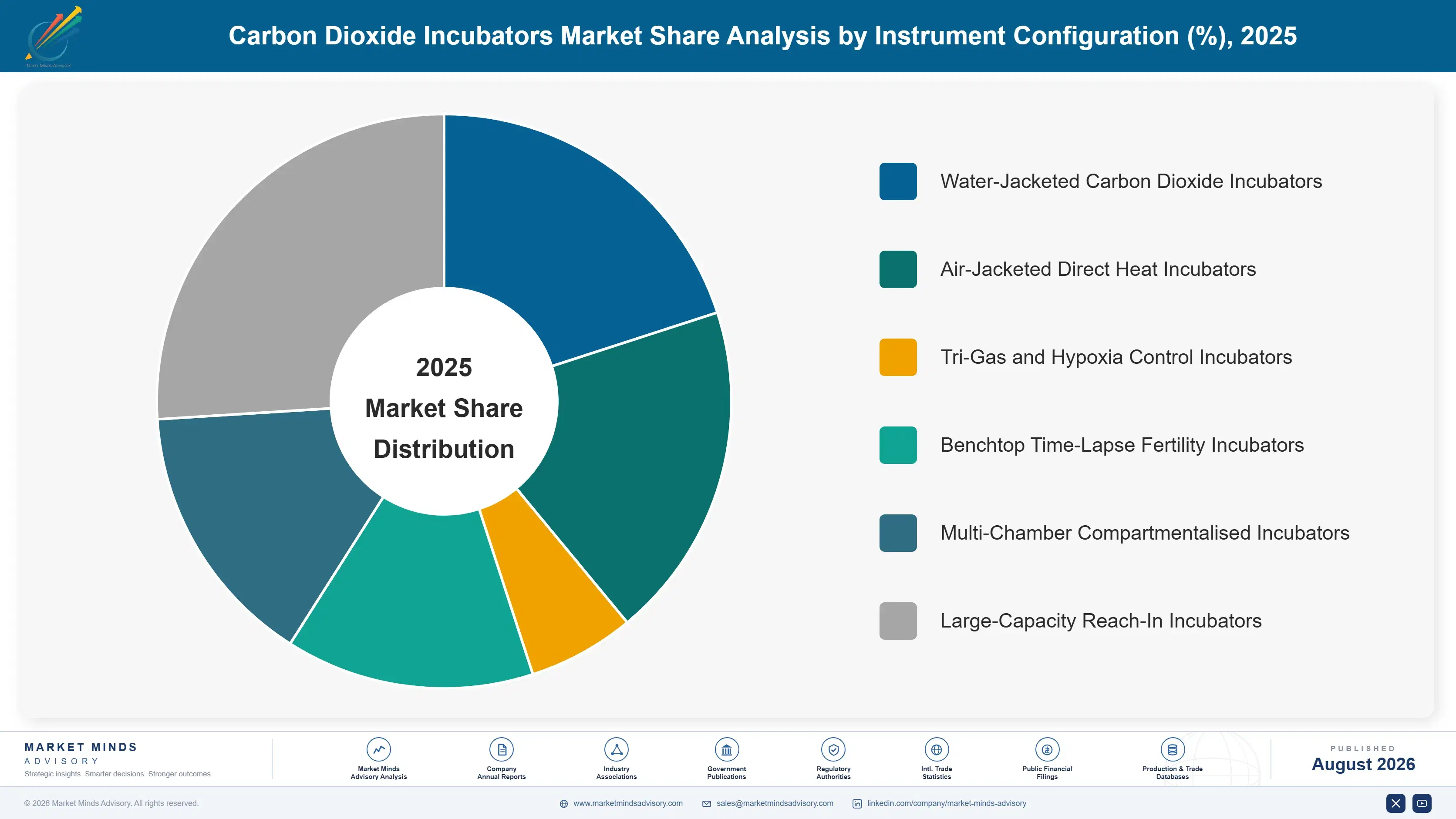
Segmentation follows instrument configuration, because configuration determines the recovery behaviour after door opening, the contamination containment achieved, the gas supply required and the price the instrument commands. Six configurations cover carbon dioxide incubation without overlap. Application, whether research, fertility or regulated manufacturing, cuts across several configurations and is treated as a use attribute here.
carbon-dioxide-incubators-market-market-share-analysis-1787304216979

Benchtop Time-Lapse IVF Incubators

Growing at 11.7%, a full 1.50x the market rate, time-lapse instruments give each patient a small isolated chamber and image embryos continuously rather than requiring removal for microscope assessment. The door stays closed, environmental disturbance disappears and a contamination event affects one patient rather than an entire chamber. Culture dishes are made specifically for the imaging geometry, so an installed instrument commits a clinic to buying those dishes across its service life. That consumable stream is the genuine commercial innovation here, and no conventional laboratory incubator has anything comparable attached to it. Competing instruments from CooperSurgical, Esco and others are narrowing the technical gap steadily, which makes the consumable relationship the more durable asset.
CAGR 11.7%

Tri-Gas and Hypoxia Control Incubators

Tri-gas configurations grow at 9.6% by adding nitrogen injection to hold oxygen below atmospheric levels, typically around five per cent, which reflects the conditions cells actually experience in tissue. Stem cell, organoid and embryo culture all show measurably different behaviour under physiological oxygen, and laboratories increasingly specify it as standard rather than as a special requirement. The instrument costs more, the gas supply is more complex and laboratory running costs rise with nitrogen consumption. Specifications that would have called for a conventional incubator a few years ago now routinely require this capability. Nitrogen consumption raises laboratory running costs materially, which is a conversation the instrument supplier rarely gets to have.
CAGR 9.6%
Full segment breakdown across 6 segments available in the complete report.

Regional Architecture and Country Demand Map

Regional value follows laboratory construction and fertility clinic capacity together, and those two demand sources behave nothing alike. Research building is budget-driven and cyclical while fertility capacity follows treatment volumes that rise steadily regardless of funding conditions. Construction rather than research activity drives this category.

East Asia

East Asia takes the largest share at 30% on two demand sources that reinforce each other. Chinese research laboratory and biopharmaceutical facility construction has run at a scale nothing elsewhere matches for a decade, and every new facility requires incubators before any work begins. Domestic manufacturers including Haier Biomedical and Blue Pard supply most of that demand at prices imported instruments cannot approach. Japan performs among the highest fertility treatment volumes of any country and its clinics adopt time-lapse instruments readily. South Korean and Taiwanese laboratory construction adds steadily to the regional base. Domestic supply and domestic demand reinforce each other here in a way no other region matches. Imported instruments are rarely specified for routine domestic research work.
Share: 30% | CAGR: 8.8% (2026 to 2036)

North America

Twenty-six per cent of value, growing at 7.0%. Academic and biotechnology research laboratories account for most demand, and that source has tightened noticeably as federal research funding conditions changed, with laboratory construction typically the first capital line an institution defers. Cell therapy manufacturing build-out has continued regardless, since it follows clinical pipeline commitments rather than annual budgets. Fertility clinic expansion is substantial and increasingly funded through employer benefit coverage rather than out of pocket. Instrument pricing here is the highest of any region and specification requirements are correspondingly demanding. Cell therapy build-out has continued regardless of what research funding has done. Instrument pricing here is the highest of any region tracked, and specification requirements are correspondingly demanding throughout.
Share: 26% | CAGR: 7.0% (2026 to 2036)
Regional intelligence for 5 additional markets available in the complete report: Western Europe, South Asia and Pacific, Latin America, Middle East and Africa, Eastern Europe. Contact sales@marketmindsadvisory.com.
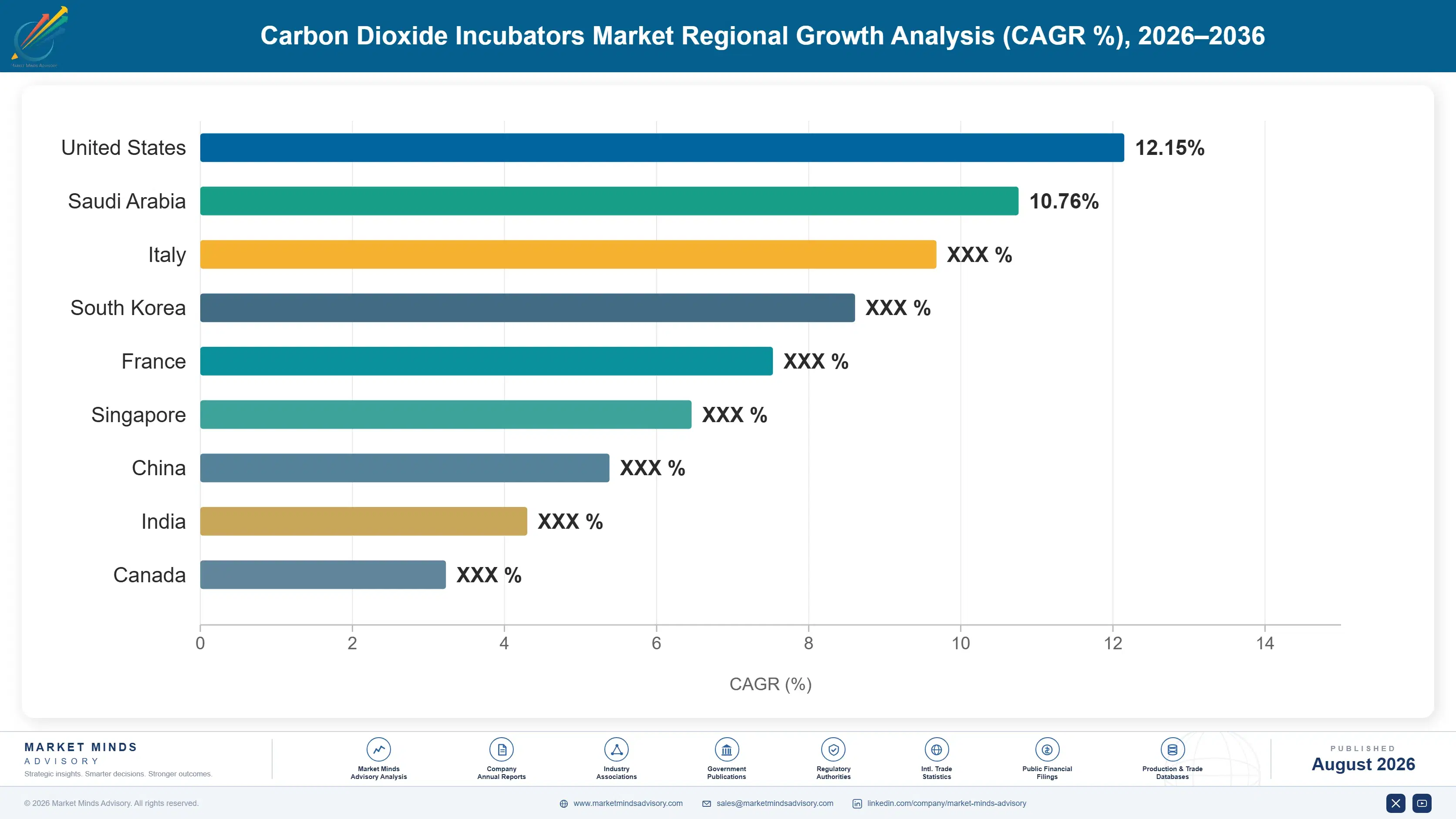
carbon-dioxide-incubators-market-country-cagr-analysis-1787304217505

Where Incubator Value Actually Sits

The instrument lasts roughly eleven years, the core function was solved decades ago and Chinese manufacturers undercut Western pricing across routine work. Value accrues to whoever attaches a consumable, whoever wins the specification during a capital project, and whoever sells contamination consequence rather than environmental performance. Temperature stability persuades nobody at all any more.

Attach a consumable the instrument geometry requires

A laboratory incubator sells once every 11 years and generates almost nothing afterwards, which is a poor business regardless of unit price. Time-lapse fertility instruments require culture dishes made for the imaging geometry, so an installed unit bills continuously across its service life. That is the only genuine recurring revenue anybody in this category has built. Designing instruments so that a consumable is functionally necessary rather than merely recommended is the single most valuable commercial decision available here. Nobody outside fertility has yet attempted the model. That is the only genuine recurring revenue anybody in this category has ever built.
Market Impact: Converts an 11 year sale into recur

Win specification during laboratory capital project design

New facilities specify equipment during design and procurement rather than shopping afterwards, and cell therapy and biopharmaceutical projects commit years ahead of commissioning. A manufacturer engaged at design stage is specified into the build, while one arriving at tender competes on price against instruments already written into a document. Roughly 400 new cell therapy facilities are being built or planned, and each one equips before it produces anything. Capital project engagement is a sales discipline most instrument companies have not built. Arriving at tender means competing on price against an instrument already named in the specification document.
Market Impact: Covers over 400 planned new cell th

Sell contamination consequence rather than temperature performance

Every instrument on the market holds temperature and gas concentration adequately, so specification comparison on those measures persuades nobody. Roughly 9% of laboratories experience a contamination event annually, and each one destroys weeks of work or, in fertility, an irreplaceable embryo cohort. Chamber subdivision, copper surfaces, filtration and twelve-hour sterilisation cycles all address that, and framing the purchase around consequence rather than capability changes which competitor a buyer compares against. An embryo cohort cannot be recovered at all, and a cell therapy batch is patient-specific. Consequence framing changes which competitors a buyer even considers comparing against.
Market Impact: Affects roughly 9% of all laborator

Concede routine research volume and hold regulated applications

Chinese manufacturers supply routine laboratory incubators at roughly 40% below Western pricing with specification quality that research laboratories now accept without reservation. Competing there subsidises the effort from applications that genuinely earn. Fertility clinics, regulated cell therapy manufacturing and pharmaceutical quality control all require documentation, validation support and service response that price-led suppliers do not provide. Concentrating commercial resource on those applications raises blended margin materially and abandons volume that was never profitable. Documentation, validation support and service response are what those applications actually require, and price-led suppliers provide none of it.
Market Impact: Chinese pricing sits roughly 40% be

Who Controls the Margin Pool

Concentration sits at 57% across the top five, measured on annual revenue from carbon dioxide incubators and directly tied consumables, the single basis applied throughout. Thermo Fisher Scientific leads on laboratory scale and catalogue reach, with Eppendorf, PHC Holdings and Binder following on instrument engineering reputation. Vitrolife occupies a different position entirely, holding a fertility franchise built on time-lapse imaging and the culture dishes those instruments require.
Competition runs on three dimensions that have little to do with holding temperature. Contamination containment design decides research and clinical specifications, since every instrument controls environment adequately and none of them controls consequence equally. Consumable attachment decides lifetime revenue, and only the fertility instruments have achieved it. Service response and validation documentation decide regulated applications, where an instrument failure halts a manufacturing batch rather than an experiment.

Pressure builds from two directions. Chinese manufacturers including Haier Biomedical supply routine laboratory instruments at prices Western competitors cannot match, and have effectively closed the largest single source of new laboratory demand to imported units. Separately, fertility specialists are extending time-lapse and consumable models into adjacent culture applications. Rankings shift most where a manufacturer attaches a genuine consumable to an instrument selling once a decade.
carbon-dioxide-incubators-market-company-positioning-matrix-1787304218025

Competitive Moat and Risk Dimensions

THERMO FISHER SCIENTIFIC

Moat: Laboratory catalogue and service reach

Thermo Fisher reaches laboratories through a catalogue covering consumables, reagents and instruments together, so an incubator is frequently added to a requisition alongside everything else a culture laboratory buys. Global service coverage matters enormously when an instrument failure risks live cultures, and few competitors can match response times across as many geographies.
THERMO FISHER SCIENTIFIC

Risk: No consumable attachment

Laboratory incubators sell once every eleven years and generate essentially no recurring revenue afterwards, which fertility instruments have now demonstrated is avoidable. Chinese manufacturers undercut routine laboratory pricing substantially. Research funding tightening across Western markets hits precisely the customer base the company serves most heavily.
VITROLIFE

Moat: Time-lapse consumable tie-in

Time-lapse instruments require culture dishes designed for the imaging geometry, so every installed unit generates dish revenue for its entire service life. Combined with embryo assessment software and fertility media, that gives Vitrolife a recurring relationship with a clinic rather than a one-off equipment transaction, which no conventional incubator manufacturer has managed to build.
VITROLIFE

Risk: Fertility cycle dependence

The position rests on assisted reproduction volumes and on time-lapse remaining the preferred approach, and competing instruments from CooperSurgical, Esco and others are narrowing the technical gap. Fertility funding varies enormously between national systems and changes with policy. Adjacent culture applications have not yet adopted the consumable-linked model.

Players Tracked

Prominent Players

Thermo Fisher Scientific
Eppendorf
PHC Holdings
Binder
Vitrolife

Other Key Players

Esco Group
CooperSurgical
Memmert
NuAire
Sheldon Manufacturing
Haier Biomedical
Boekel Scientific
LEEC
ASTEC
IVFtech
Kitazato
Labotect
Blue Pard
Yiheng Scientific
Genea Biomedx

Recent Developments

MARCH 2025

Fertility clinics accelerate time-lapse incubator adoption across European networks

European fertility clinic groups accelerated replacement of conventional incubators with time-lapse benchtop systems, citing undisturbed culture conditions and per-patient chamber isolation rather than any improvement in reported pregnancy rates as the operational justification for the change. Replacement rather than expansion drove the purchases. Chamber isolation was the stated reason.
Signal: Contamination consequence rather than any
AUGUST 2025

Haier Biomedical expands carbon dioxide incubator export distribution

Haier Biomedical widened international distribution for its carbon dioxide incubator range, an organic commercial expansion rather than an acquisition, extending pricing established across Chinese research laboratories into emerging market and European academic procurement channels. No acquisition or partnership formed part of the expansion. Specification quality is now widely accepted.
Signal: Chinese pricing is now reaching the academ
JANUARY 2026

Cell therapy manufacturers specify tri-gas capability as facility standard

Several cell therapy manufacturers adopted tri-gas oxygen control as a standard facility specification rather than a special requirement, reflecting evidence that physiological oxygen conditions alter cell behaviour measurably during expansion and process development work. Specifications were set during facility design work. Nitrogen supply requirements followed accordingly.
Signal: Physiological oxygen is becoming a default

Stainless Steel, Sensors and Assembly Exposure

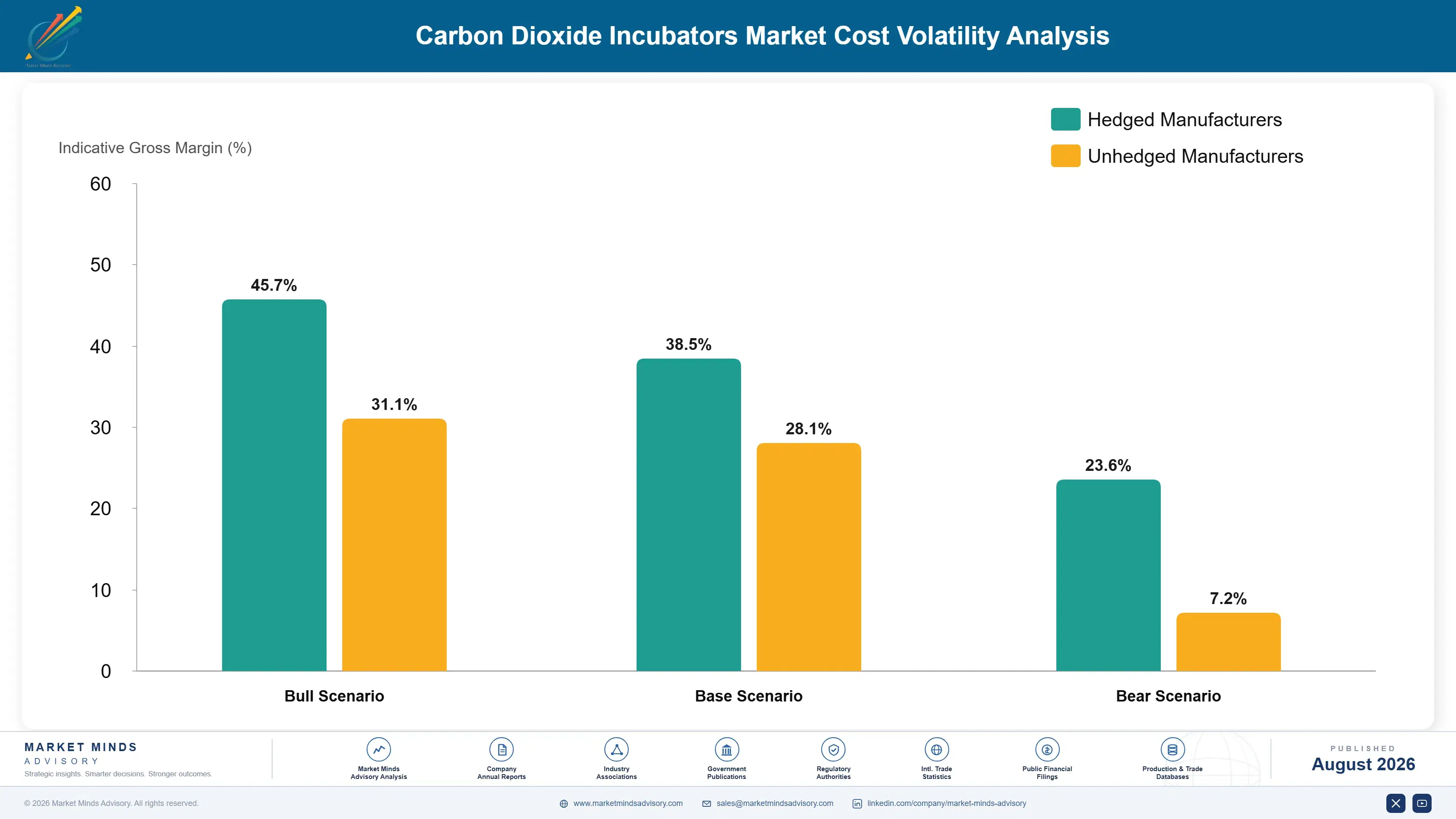
Cost structures are dominated by fabricated metal and by sensing rather than by anything sophisticated. Stainless steel and copper chamber components account for roughly 27% of instrument cost of goods, with copper carrying a premium justified by its antimicrobial surface properties. Infrared and thermal conductivity carbon dioxide sensors, oxygen sensors on tri-gas models, and control electronics contribute a further 24%, sourced from specialist suppliers.
Copper and stainless steel pricing through 2021 and 2023 illustrated the exposure. Both moved sharply and instrument manufacturers running annual price lists could not reprice mid-year, with Eppendorf and PHC Holdings both referencing raw material and component cost pressure in their reporting across those years. Sensor lead times extended simultaneously during semiconductor allocation, which constrained build rates independently of what the metals were costing. Build rates fell regardless of metal pricing.

The disadvantage falls hardest on Western manufacturers assembling in high-cost locations. A Chinese producer assembles comparable instruments at labour, facility and component costs Western plants cannot approach, which is precisely how routine laboratory pricing fell roughly 40% below imported equivalents. Geography compounds it: sensor supply is largely Asian wherever assembly happens, so Western manufacturers import key components and add the highest assembly cost.
carbon-dioxide-incubators-market-cost-volatility-analysis-1787304218220

Qualify secondary carbon dioxide and oxygen sensor suppliers

Sensors are the component most likely to constrain build rates and they come from a narrow specialist base. Qualifying alternatives requires calibration and validation work that only makes sense done once across a whole instrument range, and it removes an exposure that halted assembly at several manufacturers during the last allocation cycle. Assembly halted at several manufacturers.

Hedge copper exposure against annual instrument price lists

Copper is used deliberately for its antimicrobial surface behaviour rather than for cost, so substitution is not available without losing a genuine product property. Hedging matched to annual list price cycles converts a volatile input into a predictable one, which matters because instrument pricing cannot be revised mid-year without disrupting quotations already issued. Quotations already issued cannot be revised.

Shift revenue mix toward consumables carrying no metal exposure

Culture dishes and instrument-specific consumables carry polymer and packaging cost rather than metal or sensor exposure, and they price independently of instrument list cycles. Moving revenue mix toward them provides a cushion against component cost movement that no procurement strategy on a metal-intensive instrument can supply by itself. Polymer exposure is far easier to manage than metal.

Portfolio Architecture for Margin Defence

Margin architecture divides on whether an instrument generates revenue after installation. Routine laboratory incubators sell once and earn nothing further, which is why Chinese pricing has been so damaging in that tier. Tri-gas and multi-chamber instruments earn better on specification complexity and smaller qualified supplier fields. Time-lapse fertility systems earn most, because the culture dishes they require bill continuously for the instrument's whole service life.
The volume versus premium tension is really a business model tension. Routine research instruments are the largest unit volume and the weakest position, competing against manufacturers with permanently lower cost bases on a product where specification comparison persuades nobody. Fertility and regulated manufacturing applications are far fewer units, require documentation and service that price-led competitors do not provide, and carry recurring revenue behind them.

High-value pools sit where an instrument failure has consequences somebody must answer for. Fertility laboratories losing an embryo cohort, cell therapy manufacturers losing a patient-specific batch, and pharmaceutical quality control laboratories losing a release test all need validated equipment with documented service response. Routine academic research culture sits at the opposite extreme, where an incubator is a commodity purchase decided largely on delivered price.

Volume / Commodity-Adjacent Tier

Routine water-jacketed and air-jacketed laboratory incubators sold into academic and general research settings, where Chinese manufacturers price roughly forty per cent below imported equivalents with specification quality buyers now accept.
Gross Margin: 26-38%

Premium / Certified Tier

Tri-gas hypoxia systems, multi-chamber configurations and validated instruments for regulated manufacturing, protected by specification complexity, documentation requirements and service response commitments that price-led suppliers do not offer. An instrument failure halts a batch rather than an experiment.
Gross Margin: 42-56%

Sustainability / Regulatory / Next-Generation Tier

Time-lapse fertility incubators with instrument-specific culture dishes, embryo assessment software and fertility media attached. Best margins in the category and the only genuine recurring revenue anybody here has built. Nothing else in the category bills after installation.
Gross Margin: 58-72%
carbon-dioxide-incubators-market-portfolio-architecture-1787304218724

Capital Projects Against Static Installed Bases

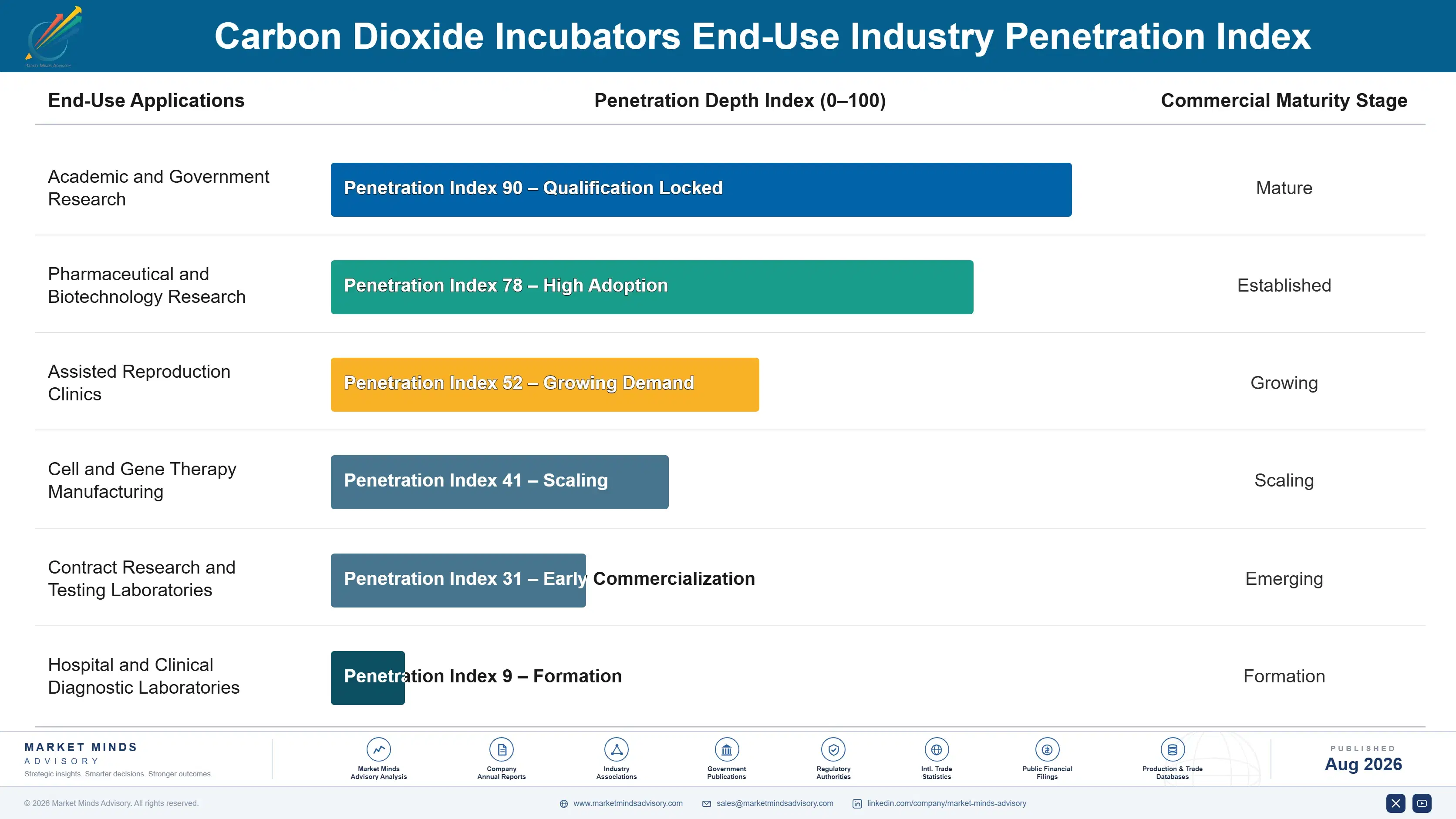
Demand arrives with buildings rather than with budgets. A new research facility, cell therapy suite or fertility clinic equips itself before any work begins, and that single purchase then covers the next eleven years or longer. Existing laboratories replace instruments only when one fails, which is infrequent. The category therefore grows with construction rather than with research activity, and those two diverge more often than manufacturers plan for.
Stickiness varies sharply by application and by whether a consumable is attached. Fertility clinics running time-lapse instruments are effectively committed, because the dishes fit only that instrument and staff training and embryo assessment protocols are built around it. Regulated manufacturing sites are similarly committed through validation documentation. Routine research laboratories show almost no attachment and buy whatever the procurement framework offers at acceptable specification.

Buyer profiles differ completely between the two demand sources. Research instruments are bought by laboratory managers or through institutional framework agreements, largely on price within an acceptable specification band. Fertility instruments are bought by clinical embryology directors evaluating culture conditions, imaging capability and consumable cost together. Capital project purchases involve engineering consultants and validation specialists who write specifications years before procurement happens.
carbon-dioxide-incubators-market-end-use-penetration-index-1787304219216

Where Incubator Strategy Must Land

These are among the four positions where our research anticipates prominent divergence between winners and laggards over the coming forecast period. Each is grounded in the demand model, the regulatory perimeter, and the announced capacity pipeline.
01 / CONSUMABLE ATTACHMENT DESIGN

An instrument selling once a decade is a poor business

Laboratory incubators run for roughly eleven years and generate essentially nothing after installation, which makes unit price the entire commercial return however good the engineering happens to be. Time-lapse fertility instruments demonstrated the alternative clearly, by requiring culture dishes matched precisely to the imaging geometry, so every installed unit bills continuously for its whole service life. Designing so that a consumable is functionally necessary rather than merely recommended is the single most valuable commercial decision available anywhere in this category.
02 / CAPITAL PROJECT ENGAGEMENT

Specifications are written years before any tender appears

New research facilities, cell therapy suites and fertility clinics equip themselves during design and procurement rather than shopping around after commissioning, and roughly four hundred cell therapy facilities are being built or actively planned right now. A manufacturer engaged at design stage is written into the specification, while one arriving at tender competes on price against an instrument already named in the document. Capital project selling is a commercial discipline that most instrument companies have never built properly at all.
03 / CONSEQUENCE FRAMING DISCIPLINE

Every incubator holds temperature, so stop competing there

Environmental control was solved decades ago, and specification comparison on temperature or gas stability persuades nobody actually making a purchasing decision today. Roughly 9% of laboratories experience a contamination event each year, and every one of them destroys weeks of culture work or, in fertility, an embryo cohort that cannot be replaced at all. Chamber subdivision, copper surfaces, filtration and sterilisation cycles all address consequence directly, and framing the purchase there changes which competitors a buyer even considers comparing against.
04 / SEGMENT CONCESSION DISCIPLINE

Routine research volume is not worth defending any more

Chinese manufacturers supply routine laboratory incubators at roughly 40% below Western pricing, with specification quality that research laboratories have already accepted without any reservation at all across their largest domestic market. Competing on that particular ground simply subsidises the effort from fertility and regulated applications that genuinely earn their margin instead. Concentrating commercial resource instead on fertility clinics, cell therapy manufacturing and pharmaceutical quality control raises blended margin quite materially while abandoning volume that had never been genuinely profitable in the first place.

Engagement Snapshot From the Field

A live engagement with an industry participant carrying material or product regulatory and market exposure ahead of a defining policy shift, showing how our research translates into a defensible multi-year portfolio strategy.
MARKET MINDS ADVISORY · CLIENT ENGAGEMENT SUMMARY
Carbon Dioxide Incubators Producer Strategic Portfolio Review and Transition Roadmap 2026·Investment Scenario on Carbon Dioxide Incubators Exposure Evaluation 2025-26
CLIENT PROFILE
A European laboratory equipment manufacturer producing carbon dioxide incubators, laboratory ovens and controlled environment chambers for research and industrial customers across European and North American markets. Annual incubator revenue was approximately USD 62 million (client-reported, unverified by MMA), with roughly 80% from routine research configurations. The company held no fertility product, no consumable line and no validation documentation package for regulated manufacturing.
STRATEGIC CHALLENGE
Chinese manufacturers had taken substantial share in routine research incubators across European academic procurement frameworks, and instrument unit volumes had declined for three consecutive years while pricing eroded alongside. The board needed to decide whether to reduce manufacturing cost to defend that volume, or to redirect development toward tri-gas systems, regulated manufacturing validation packages and a consumable-linked configuration instead.
MMA APPROACH
MMA conducted 47 expert interviews across laboratory managers, clinical embryology directors, cell therapy facility engineers, validation consultants and institutional procurement officers in six countries. A quantitative survey of 3,800 respondents established instrument selection criteria, replacement triggers and consumable purchasing behaviour across research and clinical settings. We then modelled revenue and margin under both options against observed Chinese pricing trajectories and cell therapy facility construction pipelines.
KEY FINDINGS
  1. Institutional procurement officers selected routine research incubators almost entirely on delivered price within an acceptable specification band, and none regarded brand or country of origin as relevant.
  2. Clinical embryology directors evaluated culture conditions, imaging capability and consumable cost together, and none would adopt an instrument without a validated dish supply behind it.
  3. Cell therapy facility engineers wrote equipment specifications during design and rarely revisited them at procurement, and no surveyed manufacturer had engaged them at that stage.
  4. Instruments carrying attached consumables generated several times the lifetime revenue of equivalent standalone units, and that gap widened across longer service lives.
CLIENT PROFILE
A European laboratory equipment manufacturer producing carbon dioxide incubators, laboratory ovens and controlled environment chambers for research and industrial customers across European and North American markets. Annual incubator revenue was approximately USD 62 million (client-reported, unverified by MMA), with roughly 80% from routine research configurations. The company held no fertility product, no consumable line and no validation documentation package for regulated manufacturing.
STRATEGIC CHALLENGE
Chinese manufacturers had taken substantial share in routine research incubators across European academic procurement frameworks, and instrument unit volumes had declined for three consecutive years while pricing eroded alongside. The board needed to decide whether to reduce manufacturing cost to defend that volume, or to redirect development toward tri-gas systems, regulated manufacturing validation packages and a consumable-linked configuration instead.
MMA APPROACH
MMA conducted 47 expert interviews across laboratory managers, clinical embryology directors, cell therapy facility engineers, validation consultants and institutional procurement officers in six countries. A quantitative survey of 3,800 respondents established instrument selection criteria, replacement triggers and consumable purchasing behaviour across research and clinical settings. We then modelled revenue and margin under both options against observed Chinese pricing trajectories and cell therapy facility construction pipelines.
KEY FINDINGS
  1. Institutional procurement officers selected routine research incubators almost entirely on delivered price within an acceptable specification band, and none regarded brand or country of origin as relevant.
  2. Clinical embryology directors evaluated culture conditions, imaging capability and consumable cost together, and none would adopt an instrument without a validated dish supply behind it.
  3. Cell therapy facility engineers wrote equipment specifications during design and rarely revisited them at procurement, and no surveyed manufacturer had engaged them at that stage.
  4. Instruments carrying attached consumables generated several times the lifetime revenue of equivalent standalone units, and that gap widened across longer service lives.
RECOMMENDED STRATEGY
Phase 1: Phase one: stop defending routine research volume on price, accepting the share loss rather than funding it from margin earned elsewhere. Phase 2: Phase two: develop tri-gas configurations with full validation documentation packages, targeting cell therapy facilities during capital project design rather than at tender. Phase 3: Phase three: evaluate a consumable-linked configuration for adjacent culture applications, since no competitor outside fertility had yet attempted that particular model.
OUTCOME
The client withdrew from two academic framework tenders and redirected roughly USD 14 million into tri-gas development and validation documentation (client-reported, unverified by MMA). Regulated manufacturing revenue grew from a negligible base to roughly a sixth of incubator sales within two years, and blended gross margin improved about eight percentage points.

Frequently Asked Questions

Foundational context covering the market sizes, CAGR, scope, country, region and competition that inform every finding below. This section is provided to cover basics and most often pre-purchase conversations, answered from the MMA Primary Research Dataset.

What is the current size of the Carbon Dioxide Incubators Market?

The global carbon dioxide incubators market was valued at USD 0.9 billion in 2025, covering water-jacketed, air-jacketed, tri-gas, time-lapse fertility, multi-chamber and large-capacity configurations. Laboratory ovens and biological safety cabinets fall outside this definition.

How large will the Carbon Dioxide Incubators Market be by 2036?

MMA forecasts the market at USD 2.06 billion by 2036, expanding 2.12 times from the 2026 base of USD 0.97 billion. That represents roughly USD 1.09 billion of incremental value across the forecast decade.

What is the CAGR for the Carbon Dioxide Incubators Market 2026 to 2036?

The base case compound annual growth rate is 7.8%, with a bull case of 9.1% and a bear case of 6.5%. The bear case reflects tightening research budgets deferring the laboratory construction that drives demand.

Which segment is growing fastest?

Benchtop time-lapse fertility incubators grow at 11.7%, a full 1.50x the overall market rate. They isolate each patient in a separate chamber and require culture dishes matched to the imaging geometry.

Who are the major companies in the Carbon Dioxide Incubators Market?

Thermo Fisher Scientific, Eppendorf, PHC Holdings, Binder and Vitrolife together hold 57% of revenue. Vitrolife occupies a different position, holding a fertility franchise built on imaging and attached consumables.

Which country is growing fastest?

India grows fastest at 13.2%, as fertility clinic numbers expand following regulatory formalisation of assisted reproduction. East Asia is the largest region at 30% of value on research construction and fertility volume.

Report Segmentation Architecture

The full report scope spans multiple orthogonal segmentation dimensions, with cross-tabulated demand data provided for each dimension pair. Coverage extends further to regional breakdowns, trend trajectories, and the competitive detail needed to support segment-level decision-making.

By Instrument Configuration

  • Water-Jacketed Carbon Dioxide Incubators
  • Air-Jacketed Direct Heat Incubators
  • Tri-Gas and Hypoxia Control Incubators
  • Benchtop Time-Lapse Fertility Incubators
  • Multi-Chamber Compartmentalised Incubators
  • Large-Capacity Reach-In Incubators

By End-Use Industry

  • Academic and Government Research
  • Pharmaceutical and Biotechnology Research
  • Assisted Reproduction Clinics
  • Cell and Gene Therapy Manufacturing
  • Contract Research and Testing Laboratories
  • Hospital and Clinical Diagnostic Laboratories

By Commercial Dimension

  • Direct Manufacturer Sales
  • Laboratory Distributor Networks
  • Institutional Framework Agreements
  • Capital Project Equipment Packages
  • Instrument and Consumable Bundled Supply
  • Service and Validation Contracts

By Region

  • East Asia
  • North America
  • Western Europe
  • South Asia and Pacific
  • Latin America
  • Middle East and Africa
  • Eastern Europe

Scope, Methodology, and Coverage

Every figure in this report is reproducible from documented input assumptions. The scope below maps the historical period, the forecast horizon, the segmentation dimensions, and the countries covered, alongside the underlying primary and qualitative methodology.
Historical Period
2020 to 2025
Forecast Period
2026 to 2036
Base Year
2025 (USD billions; MMA Primary Research Dataset, August 2026)
Market Definition
This market comprises carbon dioxide incubators used for cell, tissue and embryo culture, measured at manufacturer revenue for instrument hardware and directly tied consumables across direct sales, distributor networks, institutional frameworks, capital project packages and service contracts. Coverage spans water-jacketed and air-jacketed direct heat configurations, tri-gas and hypoxia control systems providing regulated oxygen conditions, benchtop time-lapse fertility incubators with associated imaging and instrument-specific culture dishes, multi-chamber compartmentalised units, and large-capacity reach-in models, supplied to academic research, pharmaceutical and biotechnology, assisted reproduction, cell and gene therapy manufacturing, contract research and clinical laboratory settings. Standard laboratory ovens and incubators without carbon dioxide control, biological safety cabinets and laminar flow hoods, cryogenic and ultra-low temperature storage, shaking incubators and bioreactors, cell culture media, sera and reagents sold independently of instruments, and laboratory information management systems fall outside scope.
Quantitative Units
USD billions (current prices); instrument unit shipments by configuration; average price per unit; installed base and replacement cycle length; attached consumable revenue per instrument
Segmentation Dimensions
By Instrument Configuration; By End-Use Industry; By Commercial Dimension; By Region
Regions Covered
East Asia, North America, Western Europe, South Asia and Pacific, Latin America, Middle East and Africa, Eastern Europe
Countries Covered
China, Japan, South Korea, Taiwan, United States, Canada, Mexico, Germany, Switzerland, Denmark, United Kingdom, France, Italy, Spain, Netherlands, Sweden, India, Australia, Singapore, Thailand, Malaysia, Vietnam, Brazil, Argentina, Chile, Colombia, Saudi Arabia, United Arab Emirates, Israel, South Africa, Poland, Czechia, Hungary, and additional markets relevant to laboratory equipment analysis
Key Companies Profiled
Thermo Fisher Scientific, Eppendorf, PHC Holdings, Binder, Vitrolife, Esco Group, CooperSurgical, Memmert, NuAire, Sheldon Manufacturing, Haier Biomedical, Boekel Scientific, LEEC, ASTEC, IVFtech, Kitazato, Labotect, Blue Pard, Yiheng Scientific, Genea Biomedx
Quantitative Methodology
Primary survey, n=3,800 respondents, Q4 2025, six countries; demand-side model with trade association cross-validation
Qualitative Methodology
47 expert interviews, Q4 2025; applied to validate demand model assumptions, identify emerging dynamics, and assess competitive positioning
Report Format
PDF and XLSX data workbook (Word format preview document)
Publisher
Market Minds Advisory
Report Code
MMA-2026-TEC-220
Published
August 2026
Contact
sales@marketmindsadvisory.com | www.marketmindsadvisory.com

Purchase the full Carbon Dioxide Incubators Market Report (2026 to 2036).

The full MMA report treats contamination consequence rather than environmental control as the variable buyers actually purchase, and traces how consumable attachment transformed the economics of one configuration while leaving the rest selling once a decade. It sizes six instrument configurations and seven regions to 2036, modelling unit shipments, pricing, installed base turnover and attached consumable revenue separately. Competitive assessment covers twenty manufacturers on one consistent revenue basis. Input cost exposure is traced through copper and stainless steel, sensor supply and assembly location. Four commercial levers and a strategic verdict close the report, grounded in 47 expert interviews and a 3,800-respondent survey.
Six instrument configurations sized separately to 2036
Attached consumable revenue modelled across instrument service lives
Capital project specification timing mapped by facility type
Twenty manufacturers assessed on one consistent basis
Chinese pricing displacement quantified across research applications
Anonymised client engagement with tested strategic recommendations

Built For The People Who Decide

From boardroom strategy to bench-side execution, this report is read cover-to-cover by leaders shaping the next decade of their industry, turning demand scenarios, market dynamics and valuation benchmarks into decisions.
CXOs/ Presidents/ VPs/ Managers
M&A and Corporate Development
Strategy Teams and R&D Heads
Procurement and Product Directors
Regulatory and Compliance Leaders
Investor Relations and Equity Analysts