Market Minds Advisory
Carbon Brush Market

Carbon Brush Market: The Technology That Killed The Core Is Building The Growth

Power electronics took the commutator applications that carried this industry for a century. The same electronics now put voltage on motor shafts that destroys bearings, and a brush is the fix.

Lead Analyst

David Horsley

Published

September 2026

Make Smarter Decisions with Customized Research Insights

Request a free sample report and evaluate market opportunities, growth trends, and competitive dynamics relevant to your business needs.

2025 MARKET VALUE$1.2BMarket Size 2025
2036 FORECAST VALUE$1.8BBase Case , 2026 to 2036
CAGR 2026 TO 20363.8 %Bull 5.0% / Bear 2.6%
INCREMENTAL OPPORTUNITY$0.6BNet 10- year value creation
EXPANSION MULTIPLE1.46x2036 value over 2026 base
Strategic Levers
M&A Pipeline
Regional Outlook
Country Rankings
Competitive Intelligence
Segmental Deep-dive
Call-Us : 91 93563 13602

Executive Snapshot and Market Trajectory

Brushless motors took the commutator applications that carried this industry for a century, and that half is genuinely declining. The drives that replaced them created a different problem a brush solves. The market reaches USD 1.2 billion in 2025 and grows at 3.8%. Nothing about that was planned by anybody.
Shaft grounding and bearing discharge brushes grow fastest at 11.4%, exactly three times the market rate, because a variable frequency drive puts common-mode voltage on the motor shaft and that voltage destroys the bearing through electrical discharge. East Asia holds 36% of value on graphite processing and motor manufacturing together. Western Europe takes 21% and North America 18%. Graphite processing and motor populations reinforce each other there.
Concentration runs at 62%, high because brush grade formulation is knowledge held by a small number of very old firms rather than a manufacturing capability anybody can acquire. Competition turns on grade selection for the specific machine, since 44% of premature failures trace to the wrong grade rather than to a defect. Most brush manufacturers have not yet noticed where their growth now sits. Their growth now sits where their heritage does not.
Market Definition
The carbon brush market covers sliding electrical contacts transferring current or discharging voltage between a stationary conductor and a rotating machine element, together with the brush holders, springs, and shunts supplied with them. It spans commutator and slip ring current transfer, shaft grounding and bearing discharge, signal transfer, and static earthing across carbon, electrographite, resin-bonded, and metal graphite grades. Slip rings and commutators themselves, rail pantograph collector strips, bearings, and complete motors are excluded.
Base Year Value
$1.2B in 2025 (MMA Primary Research Dataset, August 2026)
Forecast Period
2026 to 2036, eleven discrete annual values
CAGR
3.8% base case. Bull 5.0%. Bear 2.6%.
Fastest Growth Segment
Shaft Grounding and Bearing Current Discharge: 11.4% CAGR
Fastest Growth Country
India: 6.4% CAGR
Fastest Growth Region
South Asia and Pacific: 5.8% CAGR
Largest Region
East Asia: 36% of 2025 global value
Market Leaders
Mersen, Schunk Group, Morgan Advanced Materials, Helwig Carbon Products, Toyo Tanso. Source: MMA Primary Research Dataset, July 2026.
Primary Survey
n=3,800 procurement and R&D decision-makers, Q4 2025, six countries
Methodology
Demand-side build-up, cross-validated against public data, 47 expert interviews

Carbon Brush Market Forecast Scenarios

carbon-brush-market-size-forecast-scenario-1787333527676
Between 2020 and 2025 two halves of this market moved in opposite directions and nearly cancelled out. Commutator volume kept declining as brushless motors took the traction, appliance, and tool applications that once carried enormous numbers. Wind generator slip rings, industrial slip rings, and shaft grounding all grew against that decline. A 2.7% historical CAGR is the net of a structural loss and a genuine gain nobody planned for.
Three mechanisms carry the 3.8% base case. Variable frequency drive penetration is the largest, since every drive-fed motor above a modest size develops shaft voltage that destroys bearings and needs grounding to prevent it. Wind generator maintenance is the second, because doubly-fed machines carry slip rings needing brushes changed on a nacelle at height. And industrial motor populations across Asia keep growing, which sustains the slip ring and static earthing demand underneath everything else.
The 5.0% bull case turns on shaft grounding becoming standard specification on drive-fed motors rather than a remedy applied after a bearing fails. The 2.6% bear case is commutator decline accelerating as the last brushed applications convert. Neither scenario is influenced by anything a brush manufacturer does, which is an uncomfortable position for an industry to occupy.

An Industry Saved By What Was Killing It

Everybody has written this industry off since brushless motors arrived, and for the commutator half they were right. Traction, appliance, and power tool applications that consumed brushes in enormous numbers have converted almost completely. That segment declines at 1.4% and will keep declining until it stops mattering. The applications are gone and are not returning.
TOP FIVE CONCENTRATION62%Grade formulation knowledge sits with very few old firms
AVERAGE BRUSH PRICEUSD 14Blended across grades, sizes, and current transfer applications
SERVICE COST MULTIPLEOver 90 timesOffshore replacement visit cost against the brush itself
BRUSH SERVICE LIFE2,000 to 8,000 hoursOperating hours between replacements across typical duty conditions
GRADE ERROR SHARE44%Premature failures traced to grade selection rather than manufacture
LEADING PRODUCER SHARE39%Graphite processing concentrates where the raw material industry sits
What nobody predicted is that the drives replacing those motors create a problem only a brush solves. A variable frequency drive puts common-mode voltage on the motor shaft, that voltage discharges through the bearing races, and the bearing fails in months rather than years. Grounding the shaft with a carbon or microfibre brush prevents it, and that segment grows at 11.4%. The technology that removed the core is building the growth.
Grade selection is what separates suppliers and it is invisible from outside. A brush looks like a block of carbon and behaves like a designed contact system, where composition determines contact drop, friction, and the film that forms on the collector. Choose wrong and you scar a slip ring costing far more than every brush it will ever consume.
"The brush is fourteen dollars and the slip ring it runs against is worth tens of thousands. I have watched buyers save three dollars a brush and destroy a generator collector inside a year. Nobody in that purchasing decision understood they were specifying a tribological system."
Senior Analyst, Rotating Equipment Practice · MMA Construction and Industrial Eq

Market Trends

Drive Fed Motors Create The Problem Brushes Now Solve

A variable frequency drive switches fast enough to induce common-mode voltage on the motor shaft, and when that voltage exceeds the dielectric strength of the bearing lubricant it discharges through the races. The result is fluting, pitting, and bearing failure in months on a machine designed for years. A conductive brush or microfibre ring grounding the shaft gives the current a path that avoids the bearing entirely, at a cost far below any bearing replacement. Drive penetration keeps rising across industrial motors, and each installation is a potential grounding application. The segment grows at 11.4% while the traditional core declines.
Market Impact: Grade errors cause 44% of failures

Wind Maintenance Economics Invert The Brush Purchase

A doubly-fed induction generator carries slip rings and brushes that must be inspected and replaced inside a nacelle, at height, and increasingly offshore. The brush costs perhaps fourteen dollars and the visit to change it costs over ninety times that once vessel time, crew, and lost generation are counted. That inverts every normal purchasing instinct, because a grade lasting twice as long is worth paying almost anything for. Operators who understand this specify long-life grades and condition monitoring, and those who do not keep sending crews offshore to save nothing at all.
Market Impact: Asia holds 48% of installed motors

Market Opportunities and Growth Drivers

Grade Selection Errors Damage Machines Worth Far More

A brush grade determines contact voltage drop, friction coefficient, current density capability, and the patina that forms on the collector surface, and getting it wrong produces either rapid brush wear or scoring on a slip ring worth tens of thousands. Roughly 44% of premature failures trace to grade selection rather than to any manufacturing problem. That makes the application knowledge more valuable than the product, and it sits with a small number of firms who have accumulated it across a century. Buyers who discover this after a collector failure become loyal customers immediately.
Market Impact: Commutator segment declines 1.4% ye

Asian Motor Populations Sustain The Underlying Volume

Industrial slip ring motors, generators, cranes, hoists, and mill drives continue to be installed across China, India, and Southeast Asia in numbers that developed markets no longer approach, and every one of them consumes brushes throughout its life. That base is not growing quickly but it is very large and entirely dependable, since a slip ring machine cannot run without brushes at all. Domestic manufacturers supply most of the standard grades at prices international firms cannot match. What travels is the grade knowledge for demanding applications rather than the product itself.
Market Impact: Collectors cost 2,000 times a brush

Market Restraints and Challenges

Commutator Applications Are Disappearing Permanently Everywhere

Brushless motors have taken traction, appliance, power tool, and automotive auxiliary applications that once consumed brushes in enormous numbers, and none of those applications is coming back. The root cause is that a brushless machine has no wearing contact and needs no maintenance, which is a genuinely better answer wherever the electronics can be afforded. Commercially this means the largest historical segment declines at 1.4% every year regardless of what any manufacturer does. Suppliers are mitigating by moving into shaft grounding, slip ring service, and condition monitoring rather than defending the commutator base.
Market Impact: Bearings fail within 6 months

Buyers Treat A Designed Contact System As A Commodity

A brush looks like a rectangular block of carbon, which invites procurement teams to compare prices per unit and switch suppliers on that basis alone. The root cause is that the tribological function is invisible and the consequence of getting it wrong appears months later on the collector rather than immediately on the brush. Commercially this pushes standard grades toward the cheapest source and erodes the value of the application knowledge that actually matters. Suppliers are mitigating with condition monitoring services, collector inspection programmes, and documented grade recommendations tied to specific machines.
Market Impact: Visits cost 90 times more
3 additional market trends, 4 additional growth drivers, and 2 additional restraints and challenges are covered in the full report. Contact sales@marketmindsadvisory.com to access the complete intelligence.

Segment CAGR and Growth Architecture

Segmentation follows the electrical function the sliding contact performs, because that determines the current density, the grade chemistry required, the machine it serves, and whether the buyer is replacing a consumable or solving a failure. Grade material, machine type, and end-use industry are handled in the framework and commentary instead of here. Function decides the buyer and the grade.
carbon-brush-market-market-share-analysis-1787333528209

Shaft Grounding and Bearing Current Discharge

Shaft grounding grows fastest at 11.4%, exactly three times the market rate, and it exists only because power electronics created the problem. A variable frequency drive induces common-mode voltage on the motor shaft, and when that exceeds the dielectric strength of the bearing grease it arcs through the races, producing fluting and failure in months on a machine rated for years. A conductive brush or microfibre ring gives the current a path around the bearing. The component costs very little against a bearing replacement and far less against the production stopped by one. Adoption is still remedial rather than specified in most markets, which is exactly why the segment has so much room left to run.
CAGR 11.4%

Slip Ring Current Transfer

Slip ring transfer grows at 5.6%, carrying wind generators, industrial motors, cranes, and any machine passing current to a rotating element continuously. Wind is the interesting part, because a doubly-fed induction generator needs brushes changed inside a nacelle at height and increasingly offshore, where the visit costs over ninety times the brush. That inverts the purchasing logic entirely and rewards grades lasting twice as long almost regardless of price. Industrial slip ring machines across Asia sustain a large and dependable base underneath the wind demand. Grade selection matters most in this segment, since a scored collector costs thousands of times what the brushes ever did. Access economics have inverted the purchasing logic completely here.
CAGR 5.6%
Full segment breakdown across 7 segments available in the complete report.

Regional Architecture and Country Demand Map

Regional shares follow installed motor and generator populations alongside graphite processing capacity, which puts the weight in different places from most electrical component markets. Growth depends on drive penetration and wind capacity rather than on any change in the underlying machine base. Drive penetration explains most of the movement.

East Asia

East Asia holds 36% of value, above the 30% ceiling this framework applies, on two reinforcing positions. China processes most of the world's graphite and manufactures brushes at prices no Western firm approaches, and it also operates an industrial motor and generator population larger than any other region. Domestic manufacturers dominate standard grades entirely while demanding applications in steel, mining, and power generation still specify imported product on grade knowledge rather than on material quality. Japanese suppliers hold precision and high current positions built on carbon materials expertise. Growth at 4.5% exceeds the global rate on drive penetration across an installed base big enough that even modest adoption produces substantial volume.
Share: 36% | CAGR: 4.5% (2026 to 2036)

Western Europe

Grade knowledge rather than volume explains Western Europe's 21% share, and it is where most of the formulation expertise in this industry still resides. French, German, and British firms accumulated brush chemistry across a century of generator and traction work, and that knowledge travels internationally as specification rather than as product. Wind generator maintenance is a substantial and growing demand pool, particularly offshore where replacement economics reward long-life grades heavily. Industrial motor populations are mature and shrinking slowly. Growth at 2.8% is the slowest of any region, reflecting commutator decline and industrial contraction against wind and grounding demand that has not yet grown large enough to offset either. Knowledge travels further than the product does.
Share: 21% | CAGR: 2.8% (2026 to 2036)
Regional intelligence for 5 additional markets available in the complete report: North America, South Asia and Pacific, Latin America, Eastern Europe, Middle East and Africa. Contact sales@marketmindsadvisory.com.
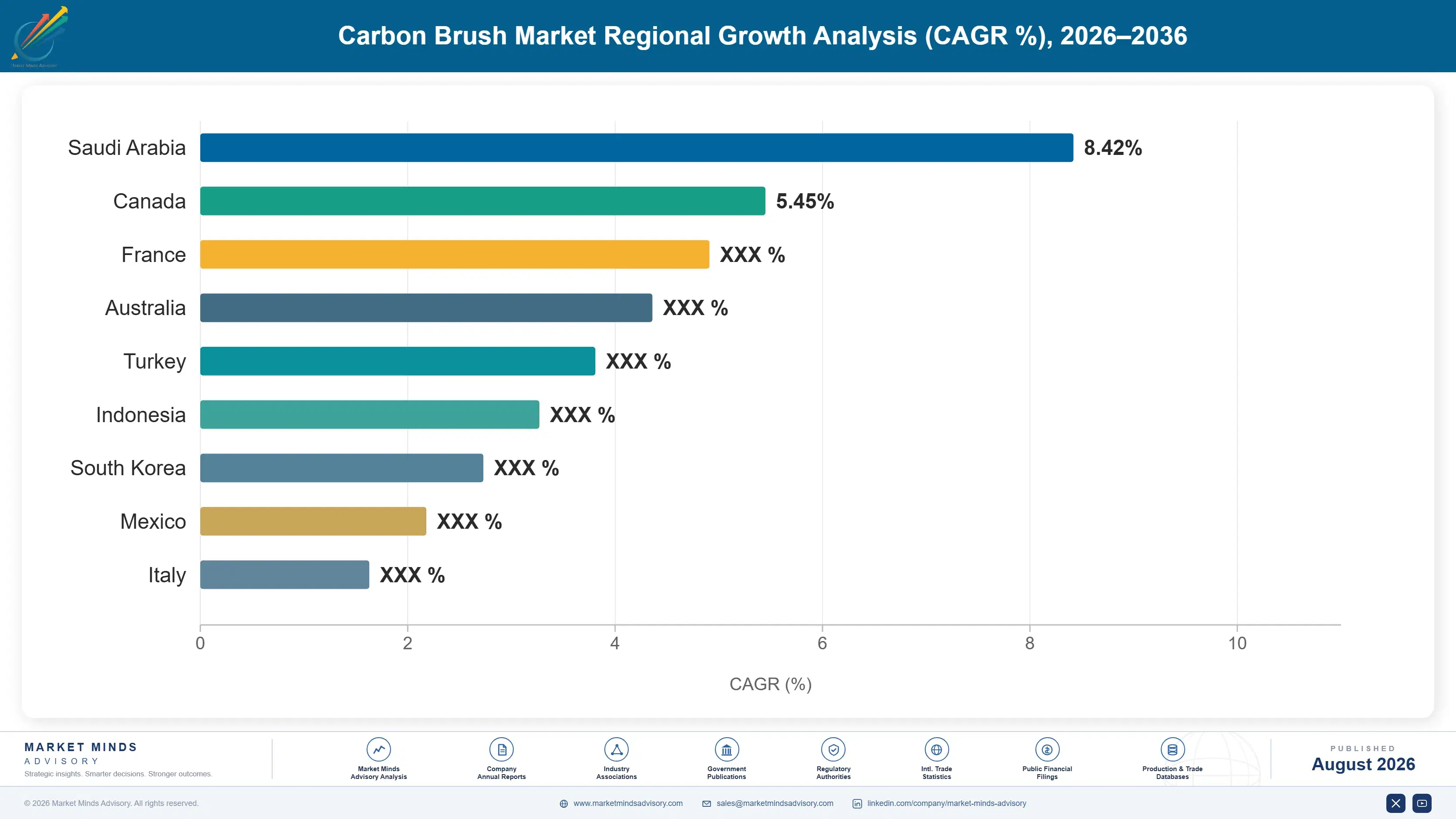
carbon-brush-market-country-cagr-analysis-1787333528719

Where Brush Suppliers Actually Earn

Four levers matter here, and none is the price of the block. Grounding adoption, grade specification authority, service economics on inaccessible machines, and collector protection decide outcomes, because the brush is trivial and everything around it is not. A supplier competing on price per brush against another block of carbon is arguing about the least valuable part of the transaction.

Sell Grounding As Specification, Not As Remedy

Shaft grounding is bought today mostly after a bearing has already failed, which means the supplier arrives to fix damage rather than to prevent it. Getting grounding written into motor specifications for drive-fed machines converts a remedial purchase into a standard fitment across an enormous installed population. That conversation belongs with motor manufacturers, drive suppliers, and specifying engineers rather than with maintenance departments. The segment grows at 11.4% on remedial demand alone, and specification adoption would change the scale of it entirely rather than merely the rate. Scale rather than rate is what changes.
Market Impact: Grounding now grows at 11.4% every

Own The Grade Recommendation For Each Machine

Around 44% of premature brush failures trace to grade selection rather than manufacture, and the buyer has no way of knowing which grade suits a particular collector, current density, and atmosphere. A supplier who documents a recommendation against a specific machine, monitors how it performs, and adjusts it becomes very difficult to displace on price. That is application service rather than product supply, and it costs engineering time rather than capital. Competitors quoting from a part number cannot answer the question the customer should have been asking. Part numbers cannot answer that question.
Market Impact: Grade errors cause 44% of all prema

Price Against The Service Visit, Not The Component

An offshore wind brush change costs over ninety times the brush once vessel time, crew, and lost generation are counted, and the same logic applies to any machine that is difficult to reach. A grade lasting twice as long halves the visits, which is worth vastly more than any plausible price premium on the consumable. Suppliers who model the customer's total intervention cost sell longer-life grades at prices that look indefensible per unit and obvious per year. Very few present that 90 times comparison, and customers rarely construct it unprompted.
Market Impact: Offshore visits cost 90 times the b

Protect The Collector, Then Discuss The Brush

A slip ring or commutator costs roughly 2,000 times what the brushes running on it ever will, and the wrong grade scores it, glazes it, or wears it unevenly. Framing the sale around protecting that asset rather than supplying a consumable reaches a maintenance manager who cares about machine life rather than a buyer comparing unit prices. Collector inspection, surface film assessment, and documented condition reporting all support that framing and generate the evidence for it. It also makes the annual price conversation a considerably less enjoyable exercise for procurement.
Market Impact: Collectors cost roughly 2,000 times

Who Controls the Margin Pool

Concentration sits at 62% for the top five, high for a product this simple, because brush grade formulation is knowledge accumulated across a century rather than a manufacturing capability that can be bought. The gap between leaders and challengers is application authority rather than material quality, which is broadly comparable across serious suppliers. All participants here are assessed on one basis, revenue from carbon brushes and their associated holders and shunts.
Competition runs on four lines. Grade recommendation authority decides who the customer trusts on a machine that matters. Grounding capability decides access to the only segment growing quickly. Service and monitoring reach decides who sees the collector before it fails. Price decides standard grades in Asia, where domestic manufacturers set the level for everybody.

Two pressures will shift positions. Shaft grounding is bringing in specialists with no brush heritage at all, several of whom built the category before the traditional manufacturers noticed it existed. Meanwhile Chinese producers hold graphite processing cost positions Western firms cannot approach on standard grades. Positions favour whoever combines grade authority with genuine grounding capability, which is a combination almost nobody currently holds.
carbon-brush-market-company-positioning-matrix-1787333529239

Competitive Moat and Risk Dimensions

MERSEN

Moat: Grade portfolio and generator depth

Mersen holds one of the widest grade portfolios in the industry alongside application records on generator and slip ring machines accumulated over a century. That history is what a customer relies on when specifying for an expensive collector. Graphite and carbon materials capability across other businesses supports formulation work no pure brush maker can fund alone.
MERSEN

Risk: Exposure to commutator decline

A portfolio built around traditional current transfer faces a commutator segment declining at 1.4% annually with no prospect of recovery. Shaft grounding has been developed largely by specialists outside the brush industry, and catching up there means competing on a technology rather than on accumulated grade knowledge. Chinese cost positions reach standard grades that still carry substantial volume.
SCHUNK GROUP

Moat: Materials science and rail depth

Schunk combines carbon materials research with application depth in rail traction, industrial drives, and wind generators, which lets it develop grades for conditions competitors address with catalogue products. Vertical integration into carbon material production supports both cost and formulation control. Wind generator positions are unusually strong given how demanding the service economics in that application have become.
SCHUNK GROUP

Risk: Concentrated in mature applications

Rail traction and industrial drives are mature end markets growing slowly at best, and both continue to lose brushed applications to brushless alternatives over time. The German cost base is difficult to defend on standard grades against Asian supply. Shaft grounding requires a route to motor manufacturers and drive suppliers rather than to the maintenance organisations the company knows well.

Players Tracked

Prominent Players

Mersen
Schunk Group
Morgan Advanced Materials
Helwig Carbon Products
Toyo Tanso

Other Key Players

Ohio Carbon Blank
Fuji Carbon Manufacturing
Nippon Carbon
Tris Inc
Sunlight Carbon
Donghai Carbon
Electro Static Technology
Cutsforth
Sohre Turbomachinery
Inpro Seal
Carbex
Elektrokarbon
SGL Carbon
Kaiyuan Carbon
Assam Carbon Products

Recent Developments

FEBRUARY 2025

Motor manufacturers begin specifying shaft grounding as standard

Several industrial motor manufacturers moved shaft grounding from an option to standard fitment on drive-fed machines above a threshold power, following warranty experience with bearing discharge damage. These were product specification changes rather than commercial events, and they convert a remedial purchase into factory fitment across a very large population.
Signal: Factory fitment reaches every machine, whe
SEPTEMBER 2024

Offshore wind operators adopt longer life brush grades

Offshore wind operators moved toward extended life brush grades and condition monitoring on doubly-fed generators, driven by the cost of nacelle access rather than by any component price consideration. These were maintenance strategy changes rather than transactions, and they reward grade performance over unit economics entirely.
Signal: When access costs ninety times the part, t
JUNE 2024

Chinese graphite processing capacity expands further

Chinese graphite processing and carbon product capacity expanded again, deepening a cost advantage in standard brush grades that Western manufacturers have not contested for years. These were graphite capacity additions rather than any corporate transaction, and they concentrate in commodity grades rather than in specialist formulations.
Signal: A cost advantage in commodity grades pushe

Graphite, Copper, Binders, And Firing

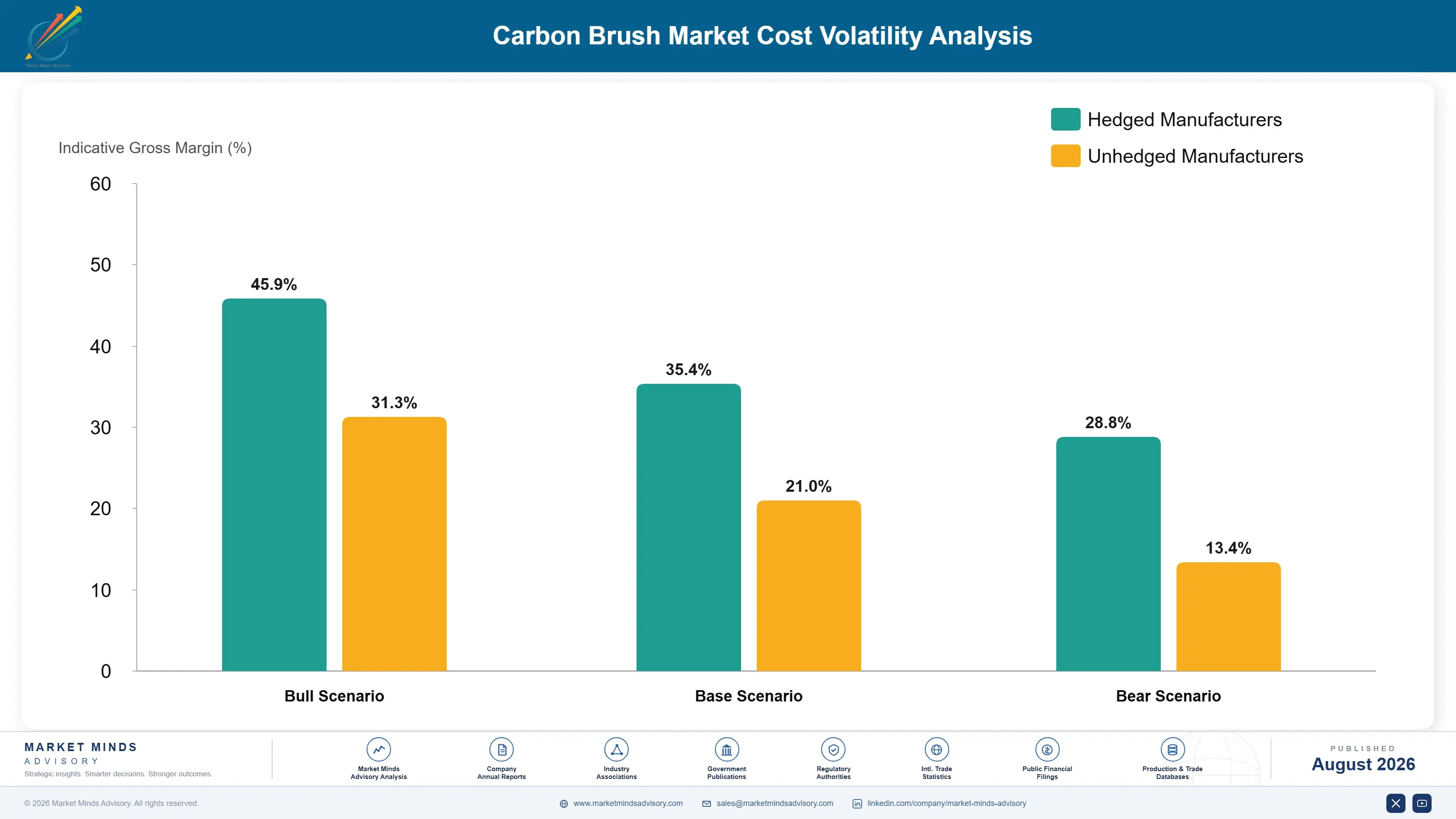
Cost structure is dominated by carbon feedstock and the energy to process it. Synthetic and natural graphite carries 34% to 48% of brush cost, with Chinese processing setting the reference price for everybody. Copper and silver powder in metal graphite grades runs 18% to 32% and moves on exchange pricing directly. Resin binders add 6% to 12%. Firing and graphitisation energy takes the remainder.
Graphite pricing moved sharply through 2022 and 2023 as battery demand competed for the same processing capacity, while European energy costs raised graphitisation cost across the period and the IEA documented that industrial constraint. Copper moved independently and violently. Mersen and SGL Carbon both disclosed input cost pressure across those years. Suppliers holding annual price agreements with industrial customers had limited pass-through and absorbed much of it themselves.

Each range above exceeds three points because a metal graphite grade and a resin-bonded carbon grade share almost no inputs beyond the binder. Exposure separates by grade mix. A metal graphite supplier carries copper and silver risk it can index against exchanges. A synthetic graphite supplier competes for feedstock against battery manufacturers who pay considerably more. Chinese producers hold feedstock proximity and graphitisation energy cost together.
carbon-brush-market-cost-volatility-analysis-1787333529437

Index industrial agreements to graphite and copper

Graphite and metal powder together carry most of brush cost and both move on markets no brush maker influences, while industrial supply agreements are routinely fixed annually. That combination is a commodity position nobody intended to take. Indexation costs a negotiating concession at renewal and removes an exposure that has already erased margin across this sector more than once.

Secure graphite feedstock against battery competition

Synthetic graphite processing capacity is increasingly contracted to battery manufacturers who pay more per tonne than any brush application can justify, which leaves brush makers competing for residual supply. Multi-year feedstock agreements cost commitment against volumes that grow slowly. They also mean production continues when competitors cannot obtain material, which in a slow-growing market is how share actually changes hands.

Consolidate grades rather than extending the catalogue

Most brush makers carry hundreds of grades accumulated across decades, many of them differing marginally and each requiring its own tooling, firing schedule, and inventory. Rationalising to a smaller set covering the same applications costs engineering time once and improves firing utilisation, stock turns, and focus. Very few do it, because every grade has a customer somewhere who insists.

Portfolio Architecture for Margin Defence

Three tiers sit inside this category and application difficulty draws the lines. Standard commutator and general purpose grades form the volume tier, where Chinese producers set pricing and the product is genuinely interchangeable. Specified slip ring and traction grades earn more, because grade authority on a specific machine is what the customer is actually buying. Shaft grounding and monitored service programmes price highest, since each solves a failure rather than replacing a consumable.
The tension is between catalogue volume that fills the furnace and application work that earns the return. Standard grades ship in quantity at prices falling against Asian supply every year. Application engineering earns better and scales with people rather than with capacity. Suppliers organised as materials manufacturers find the second uncomfortable, because it needs engineers visiting machines rather than chemists optimising formulations.

High-value pools concentrate where the consequence of getting it wrong is large: shaft grounding on drive-fed motors, offshore wind generator grades where access costs dominate, specified grades protecting collectors worth thousands of times the brush, and monitoring services that see a problem before the machine does. The commodity end is standard commutator grades, where price is the only variable and the segment is declining anyway.

Volume / Commodity-Adjacent Tier

Standard commutator and general purpose grades sold by part number into replacement demand. The range is wide because Chinese graphite processing and Western manufacturing carry entirely different cost structures on comparable product.
Gross Margin: 20-34%

Premium / Certified Tier

Specified slip ring, traction, and generator grades recommended against particular machines and conditions. The range is wide because grade authority commands pricing that the identical material sold by part number never achieves.
Gross Margin: 34-50%

Sustainability / Regulatory / Next-Generation Tier

Shaft grounding assemblies, extended life offshore grades, and condition monitoring service programmes. The range is wide because grounding hardware carries very different economics from a monitoring subscription on the same machine.
Gross Margin: 46-66%
carbon-brush-market-portfolio-architecture-1787333529939

High-value Sub-segments and Strategic Watch-out

Shaft Grounding and Bearing Current Discharge

High value and high growth at 11.4%, exactly three times the market rate, because drive-fed motors develop shaft voltage that destroys bearings and only a conductive path prevents it. Adoption is still remedial rather than specified almost everywhere, which is why so much of the opportunity remains ahead.
Gross Margin: 46-66%

Slip Ring Current Transfer

High value with steady growth at 5.6%, carrying wind generators, industrial motors, and cranes where current passes continuously to a rotating element. Offshore access economics reward long-life grades heavily, and grade selection protects collectors worth thousands of times the brushes. Access economics reward longevity heavily.
Gross Margin: 34-50%

Static Discharge and Earthing

The volume core by unit count at 4.1%, serving earthing and static dissipation duties across machinery, printing, and material handling where charge accumulation causes damage or hazard. Requirements are modest, competition is broad, and specification rarely names a manufacturer at all. Requirements are modest and competition is broad.
Gross Margin: 34-50%

Commutator Current Transfer

The strategic watch-out at 1.4% and declining, as brushless machines take the traction, appliance, and tool applications that once carried enormous volume. Nothing reverses this, and capital spent defending the segment earns less than the same money spent on grounding. Nothing reverses this decline at all.
Gross Margin: 20-34%

How Brush Demand Actually Repeats

Demand commits at grade selection and then repeats every few thousand operating hours for the life of the machine, which frequently runs to decades. A grade that performs well on a particular collector becomes the part number a maintenance store reorders without anybody revisiting the decision. That gives real incumbency to a fourteen dollar consumable. The competitive moments are a new machine, a collector problem, and a procurement review treating it as a commodity.
Stickiness varies with how visible the consequence of change is. Generator and wind slip ring grades stick hardest, since changing one risks an expensive collector nobody wants to own. Traction and heavy industrial grades stick nearly as hard through performance history. Standard industrial motor grades stick moderately. General earthing and static brushes stick least, because nothing much happens if a cheaper one is fitted.

The buyer has split between a maintenance engineer who knows what the grade does and a procurement function that sees a block of carbon with a price. Twenty years ago the engineer decided. Now a category manager runs a tender and consults the engineer afterwards. Suppliers reaching only the engineer lose on price, and those reaching only procurement lose the machine.
carbon-brush-market-end-use-penetration-index-1787333530430

Our Call On Carbon Brushes

These are among the four positions where our research anticipates prominent divergence between winners and laggards over the coming forecast period. Each is grounded in the demand model, the regulatory perimeter, and the announced capacity pipeline.
01 / GROUNDING SPECIFICATION PUSH

Get fitted at the factory, not after failure

Shaft grounding grows at 11.4% on remedial demand alone, which means almost every sale today follows a bearing that already failed and a customer who already lost production. Moving grounding into motor specifications for drive-fed machines above a threshold converts it from a repair into standard fitment across an installed population several orders larger than the failures. That conversation belongs with motor manufacturers, drive suppliers, and specifying engineers rather than with the maintenance departments brush companies have always called on.
02 / GRADE AUTHORITY OWNERSHIP

Recommend the grade, then defend the machine

Roughly 44% of premature brush failures trace to grade selection rather than to anything wrong with the manufacture, and the buyer has no means of knowing which grade suits a particular collector, current density, and atmosphere. A supplier who documents a recommendation against a specific machine, monitors how it performs, and adjusts it becomes very difficult to displace on a price comparison. Competitors quoting from a part number cannot answer the question the customer should have been asking in the first place.
03 / ACCESS COST PRICING

Price against the visit, not the component

An offshore wind brush change costs over ninety times the brush itself once vessel time, crew, and lost generation are counted, and the same arithmetic holds for any machine that is awkward to reach. A grade lasting twice as long halves the interventions, which is worth far more than any plausible premium on a fourteen dollar consumable could ever be. Suppliers who model total intervention cost sell long-life grades at prices that look indefensible per unit and entirely obvious per year.
04 / COMMUTATOR EXIT DISCIPLINE

Harvest the decline, fund the growth

Brushless machines have taken the traction, appliance, and power tool applications that carried this industry's volume for a century, and the commutator segment declines at 1.4% annually with no plausible recovery. Capital spent defending that base earns considerably less than the same money spent building grounding capability or grade monitoring services instead. Manufacturers still organising their engineering and sales effort around the largest historical segment are carefully optimising for exactly the part of the business that is disappearing fastest of all.

Engagement Snapshot From the Field

A live engagement with an industry participant carrying material or product regulatory and market exposure ahead of a defining policy shift, showing how our research translates into a defensible multi-year portfolio strategy.
MARKET MINDS ADVISORY · CLIENT ENGAGEMENT SUMMARY
Carbon Brush Producer Strategic Portfolio Review and Transition Roadmap 2026·Investment Scenario on Carbon Brush Exposure Evaluation 2025-26
CLIENT PROFILE
A European carbon brush manufacturer with roughly USD 74 million in annual revenue engaged MMA after four consecutive years of volume decline that management attributed to Chinese price competition (client-reported, unverified by MMA). The company held excellent grade formulation capability, a century of application records, and no shaft grounding product of any kind at that point.
STRATEGIC CHALLENGE
Sales wanted price matching against Asian suppliers on standard grades. Technical wanted funding for new grade development in traditional applications. Nobody had analysed which segments the volume was actually leaving, or whether the lost tonnage was replaceable at all. The board needed a position before committing the next investment cycle.
MMA APPROACH
MMA decomposed five years of the client's volume by application function rather than by grade, which the company had never analysed that way. We interviewed 60 industrial and wind maintenance customers on how grade decisions are made and who makes them. We then modelled three routes: price competition on standard grades, further grade development, and building shaft grounding capability.
KEY FINDINGS
  1. Volume loss was concentrated almost entirely in commutator applications converting to brushless machines rather than in share lost to competitors (client-reported, unverified by MMA).
  2. Price competition modelled worst of the three routes, because the lost volume was leaving the category entirely rather than moving to a cheaper supplier.
  3. Customers with shaft grounding requirements were buying from specialists with no brush heritage, and none had thought to ask the client about it.
  4. Grade recommendation service was valued highly by maintenance engineers and entirely invisible to the procurement teams who were actually placing the orders themselves.
CLIENT PROFILE
A European carbon brush manufacturer with roughly USD 74 million in annual revenue engaged MMA after four consecutive years of volume decline that management attributed to Chinese price competition (client-reported, unverified by MMA). The company held excellent grade formulation capability, a century of application records, and no shaft grounding product of any kind at that point.
STRATEGIC CHALLENGE
Sales wanted price matching against Asian suppliers on standard grades. Technical wanted funding for new grade development in traditional applications. Nobody had analysed which segments the volume was actually leaving, or whether the lost tonnage was replaceable at all. The board needed a position before committing the next investment cycle.
MMA APPROACH
MMA decomposed five years of the client's volume by application function rather than by grade, which the company had never analysed that way. We interviewed 60 industrial and wind maintenance customers on how grade decisions are made and who makes them. We then modelled three routes: price competition on standard grades, further grade development, and building shaft grounding capability.
KEY FINDINGS
  1. Volume loss was concentrated almost entirely in commutator applications converting to brushless machines rather than in share lost to competitors (client-reported, unverified by MMA).
  2. Price competition modelled worst of the three routes, because the lost volume was leaving the category entirely rather than moving to a cheaper supplier.
  3. Customers with shaft grounding requirements were buying from specialists with no brush heritage, and none had thought to ask the client about it.
  4. Grade recommendation service was valued highly by maintenance engineers and entirely invisible to the procurement teams who were actually placing the orders themselves.
RECOMMENDED STRATEGY
Phase 1: Phase 1 (0 to 9 months): Abandon price matching on standard grades and begin shaft grounding product development work immediately instead. Phase 2: Phase 2 (9 to 24 months): Build documented grade recommendation into a service offer visible to procurement, not only to engineers. Phase 3: Phase 3 (24 to 42 months): Manage commutator grades for cash rather than investment and redirect the engineering budget. Toward grounding instead.
OUTCOME
The board stopped price matching and funded grounding development, which sales resisted as abandoning customers and later accepted. Margin recovered on standard grades once discounting ceased, and the first grounding products have reached qualification with two motor manufacturers (client-reported, unverified by MMA). Commutator volume continues declining exactly as modelled.

Frequently Asked Questions

Foundational context covering the market sizes, CAGR, scope, country, region and competition that inform every finding below. This section is provided to cover basics and most often pre-purchase conversations, answered from the MMA Primary Research Dataset.

What is the current size of the Carbon Brush Market?

The global market is valued at USD 1.2 billion in 2025, covering sliding contacts for commutator and slip ring current transfer, shaft grounding, signal transfer, and static earthing. Slip rings, commutators, and complete motors are excluded.

How large will the Carbon Brush Market be by 2036?

The market is forecast to reach USD 1.82 billion by 2036 in the base case, about 1.46 times the 2026 level. That represents incremental value of roughly USD 0.57 billion.

What is the CAGR for the Carbon Brush Market 2026 to 2036?

The market grows at a 3.8% CAGR in the base case, with bull and bear scenarios at 5.0% and 2.6%. The spread turns on grounding specification adoption against continued commutator decline.

Which segment is growing fastest?

Shaft grounding and bearing discharge brushes grow fastest at 11.4%, exactly three times the overall rate, because drive-fed motors develop shaft voltage that destroys bearings. Slip ring transfer follows at 5.6%.

Who are the major companies in the Carbon Brush Market?

Leading participants include Mersen, Schunk Group, Morgan Advanced Materials, Helwig Carbon Products, and Toyo Tanso. Concentration is high at roughly 62%, because grade formulation is knowledge rather than manufacturing capability.

Which country is growing fastest?

India grows fastest at a 6.4% CAGR, on industrial motor installation, mining activity, and rising drive penetration creating new grounding requirements. China follows on installed base scale.

Report Segmentation Architecture

The full report scope spans multiple orthogonal segmentation dimensions, with cross-tabulated demand data provided for each dimension pair. Coverage extends further to regional breakdowns, trend trajectories, and the competitive detail needed to support segment-level decision-making.

By Electrical Function

  • Shaft Grounding and Bearing Current Discharge
  • Slip Ring Current Transfer
  • Static Discharge and Earthing
  • Signal and Instrumentation Transfer
  • Commutator Current Transfer

By End-Use Industry

  • Wind and Power Generation
  • Industrial Motors and Drives
  • Rail and Traction Systems
  • Mining Metals and Heavy Industry
  • Appliances Tools and Automotive

By Sales Model

  • Direct Sale with Grade Recommendation
  • Original Equipment Manufacturer Supply
  • Industrial Distribution Channel
  • Service and Monitoring Contract

By Region

  • East Asia
  • Western Europe
  • North America
  • South Asia and Pacific
  • Latin America
  • Eastern Europe
  • Middle East and Africa

Scope, Methodology, and Coverage

Every figure in this report is reproducible from documented input assumptions. The scope below maps the historical period, the forecast horizon, the segmentation dimensions, and the countries covered, alongside the underlying primary and qualitative methodology.
Historical Period
2020 to 2025
Forecast Period
2026 to 2036
Base Year
2025 (USD billions; MMA Primary Research Dataset, August 2026)
Market Definition
The carbon brush market comprises the manufacture and sale of sliding electrical contacts transferring current or discharging voltage between a stationary conductor and a rotating machine element, valued at manufacturer selling prices to equipment builders, end users, maintenance contractors, and industrial distributors. It spans electrographite, resin-bonded graphite, carbon graphite, and metal graphite grades containing copper or silver, in commutator and slip ring current transfer duty, shaft grounding and bearing current discharge assemblies including conductive microfibre constructions, signal and instrumentation transfer, and static discharge and earthing applications, together with the brush holders, constant force springs, shunts, and terminals supplied with them. Slip rings, commutators, and collector assemblies themselves, rail pantograph collector strips and third rail shoes, bearings and bearing insulation, electrical machines and generators, and carbon products for non-contact applications including electrodes, seals, and bearings are excluded. Collector resurfacing, machine overhaul, and vibration monitoring services sold independently sit outside scope.
Quantitative Units
USD billions (current prices); volume in millions of brushes shipped
Segmentation Dimensions
By Electrical Function; By End-Use Industry; By Sales Model; By Region
Regions Covered
East Asia, Western Europe, North America, South Asia and Pacific, Latin America, Eastern Europe, Middle East and Africa
Countries Covered
China, Japan, South Korea, Taiwan, India, Germany, France, UK, Italy, Spain, Netherlands, Sweden, Switzerland, Austria, USA, Canada, Mexico, Brazil, Chile, Peru, Colombia, Argentina, Australia, Indonesia, Thailand, Vietnam, Saudi Arabia, United Arab Emirates, South Africa, Egypt, Turkey, Poland, Czechia, Romania, Hungary, and additional markets relevant to this sector
Key Companies Profiled
Mersen, Schunk Group, Morgan Advanced Materials, Helwig Carbon Products, Toyo Tanso, Ohio Carbon Blank, Fuji Carbon Manufacturing, Nippon Carbon, Tris Inc, Sunlight Carbon, Donghai Carbon, Electro Static Technology, Cutsforth, Sohre Turbomachinery, Inpro Seal, Carbex, Elektrokarbon, SGL Carbon, Kaiyuan Carbon, Assam Carbon Products
Quantitative Methodology
Primary survey, n=3,800 respondents, Q4 2025, six countries; demand-side model with trade association cross-validation
Qualitative Methodology
47 expert interviews, Q4 2025; applied to validate demand model assumptions, identify emerging dynamics, and assess competitive positioning
Report Format
PDF and XLSX data workbook (Word format preview document)
Publisher
Market Minds Advisory
Report Code
MMA-2026-CON-554
Published
August 2026
Contact
sales@marketmindsadvisory.com | www.marketmindsadvisory.com

Purchase the full Carbon Brush Market Report (2026 to 2036).

The full MMA Carbon Brush report sizes the market across five electrical functions, five end-use industries, four sales models, and seven regions through 2036. It profiles 20 participants on a consistent basis of brush and holder revenue, scoring each on grade portfolio depth, application authority, shaft grounding capability, and service reach. Scenario models quantify how drive penetration, grounding specification adoption, and commutator decline move both volume and achievable margin. The report also includes shaft grounding adoption modelling by motor population, grade failure analysis by application, wind maintenance economics by installation type, and graphite feedstock exposure benchmarking by supplier.
Five-function and four-channel market sizing to 2036
Twenty-participant benchmark on brush and holder revenue
Shaft grounding adoption modelling across the drive-fed motor population
Grade failure analysis by application and operating condition
Wind maintenance economics by onshore and offshore installation
Graphite feedstock exposure benchmarking across major suppliers

Built For The People Who Decide

From boardroom strategy to bench-side execution, this report is read cover-to-cover by leaders shaping the next decade of their industry, turning demand scenarios, market dynamics and valuation benchmarks into decisions.
CXOs/ Presidents/ VPs/ Managers
M&A and Corporate Development
Strategy Teams and R&D Heads
Procurement and Product Directors
Regulatory and Compliance Leaders
Investor Relations and Equity Analysts