Market Minds Advisory
Car Care Products Market

Car Care Products Market: Car Care Products Market: Professional Channel Volume, Unverifiable Coating Claims and Shipping Water

Roughly three quarters of a ready-to-use bottle is water, the growth is in coatings whose durability no recognised test defines, and enthusiasts are not where the volume goes. The detail shop is the real customer.

Lead Analyst

Published

September 2026

Make Smarter Decisions with Customized Research Insights

Request a free sample report and evaluate market opportunities, growth trends, and competitive dynamics relevant to your business needs.

2025 MARKET VALUE$12.4BMarket Size 2025
2036 FORECAST VALUE$22.6BBase Case , 2026 to 2036
CAGR 2026 TO 20365.6 %Bull 6.8% / Bear 4.4%
INCREMENTAL OPPORTUNITY$9.5BNet 10- year value creation
EXPANSION MULTIPLE1.73x2036 value over 2026 base
Strategic Levers
M&A Pipeline
Regional Outlook
Country Rankings
Competitive Intelligence
Segmental Deep-dive
Call-Us : 91 93563 13602

Executive Snapshot and Market Trajectory.

The enthusiast in the driveway is the audience and the professional is the customer. About 61% of volume moves through detailing shops, car washes and dealer reconditioning, bought in bulk on cost per vehicle by buyers who never see a retail bottle or its marketing.
Ceramic and graphene coatings grow at 8.4%, half again the market rate of 5.6%, on claims nothing verifies. Interior cleaning and protection follows at 7.1% as electric vehicle owners treat cabins like devices. Wash and shampoo products grow slowest at 4.2%, squeezed by touchless washes and by municipal restrictions on driveway washing across much of Europe. Waterless formulations address that and remain a small share of consumer ranges.
Two numbers explain most of the commercial opportunity here. Roughly 74% of a ready-to-use product is water that somebody pays to ship, and professional chemical cost per vehicle treated sits near USD 2.80, which is small enough that performance rather than price decides a detailer's specification. Nothing on a retail shelf is built for that buyer's conversation. A detailer selects on cure window and working time rather than on any durability claim at all.
Market Definition
This market covers automotive appearance care chemicals and consumables, spanning wash and shampoo products, wax, sealant and paint protection, ceramic and graphene coatings, interior cleaning and protection, wheel, tyre and trim products, and glass and visibility products. Sizing is at manufacturer revenue across retail and professional channels. Engine oils and lubricants, coolants and functional fluids, paint and body repair materials, wash equipment and machinery, and vehicle wrapping films are excluded.
Base Year Value
$12.4B in 2025 (MMA Primary Research Dataset, September 2026)
Forecast Period
2026 to 2036, eleven discrete annual values
CAGR
5.6% base case. Bull 6.8%. Bear 4.4%.
Fastest Growth Segment
Ceramic And Graphene Coatings: 8.4% CAGR
Fastest Growth Country
India: 8.4% CAGR
Fastest Growth Region
South Asia and Pacific: 7.6% CAGR
Largest Region
East Asia: 31% of 2025 global value
Market Leaders
3M, Turtle Wax, Energizer Holdings, Illinois Tool Works, SONAX. Source: MMA Primary Research Dataset, July 2026.
Primary Survey
n=3,800 procurement and R&D decision-makers, Q4 2025, six countries
Methodology
Demand-side build-up, cross-validated against public data, 47 expert interviews

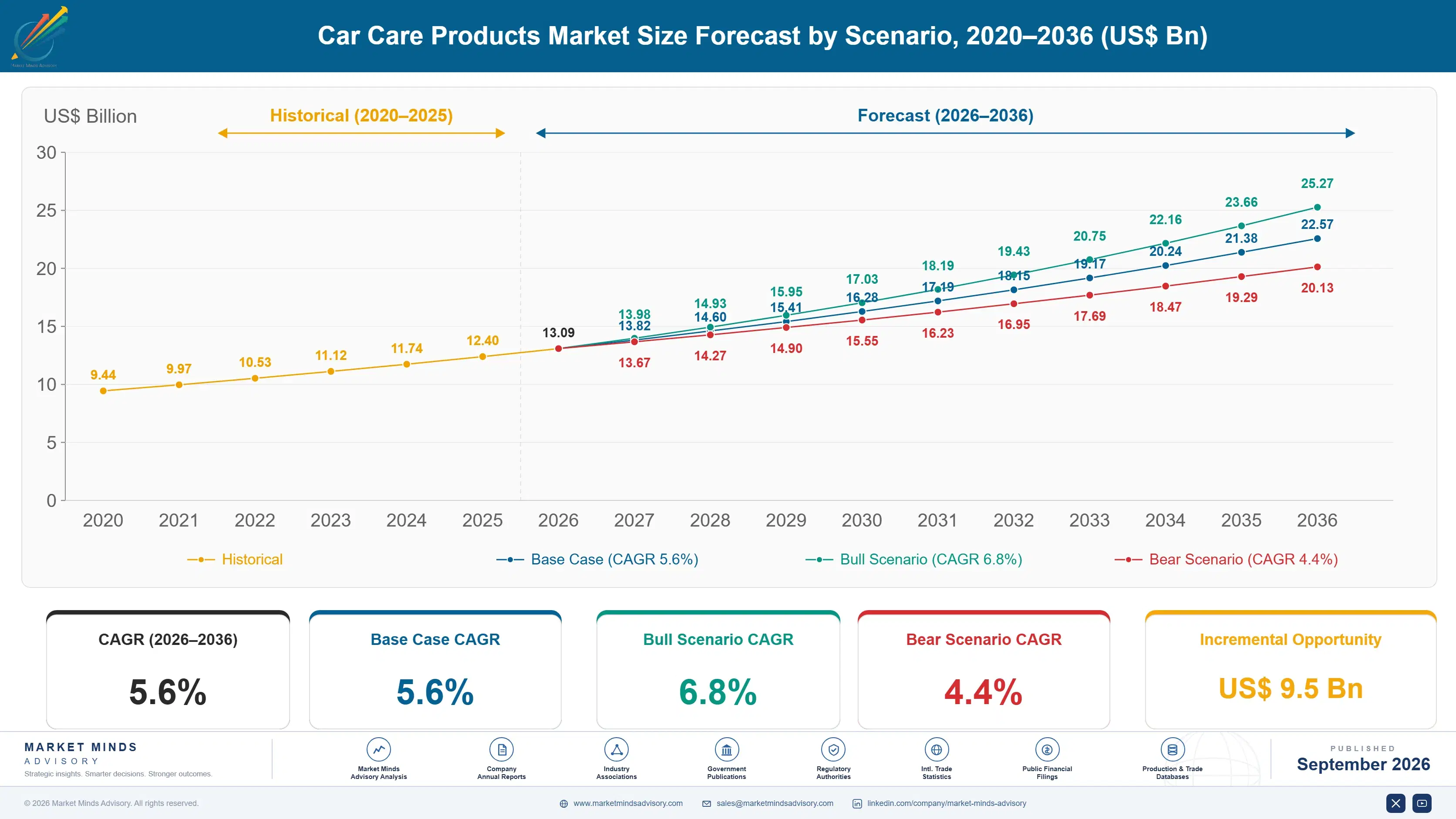
Car Care Products Market Forecast Scenarios

car-care-products-market-size-forecast-scenario-1790022717313
Growth of 4.5% between 2020 and 2025 came from opposite directions in the two halves of this market. Consumer washing surged through 2020 and 2021 as people stayed home and detailed their own cars, then fell away sharply once professional washes reopened and the novelty passed. Professional and dealer reconditioning recovered more slowly, kept growing, and now carries the category.
Three mechanisms carry the base case. Coatings grow at 8.4% because a detailer charging for a multi-year protection service needs a product to sell, and the chemical cost is trivial against the labour. Indian and Southeast Asian vehicle parcs expand rapidly with professional detailing forming alongside them, and India grows at 8.4%. Electric vehicle ownership shifts assortment toward interior and paint care while removing engine bay products entirely from the basket.
The bull case is a durability standard. If any recognised body defines how coating longevity is measured, the products that genuinely last separate from those that do not, and professional specification moves decisively toward them. The bear case is water restriction. Municipal prohibitions on driveway washing continue spreading across Europe and water-stressed regions, and each one removes the consumer occasion that sells shampoo, wax and microfibre together.

Who Actually Buys This

Car care marketing addresses an enthusiast washing a car on a Sunday and the money is made somewhere else entirely. Around 61% of volume moves through detailing shops, automatic and hand car washes and dealer reconditioning departments, all of which buy concentrate in bulk on a cost per vehicle basis. That buyer never encounters a retail bottle, a shelf display or any of the advertising built around one. Two entirely separate businesses share one product name.
TOP FIVE CONCENTRATION28%Combined manufacturer revenue share held by the five largest participants
PROFESSIONAL CHANNEL SHARE61%Volume moving through detailing, wash and dealer channels
AVERAGE RETAIL PRICEUSD 14Weighted retail price across consumer car care product categories
COATING DURABILITY STANDARDS0Recognised tests defining how long a coating lasts
WATER IN FORMULATION74%Proportion of a ready to use product that is water
COST PER VEHICLE TREATEDUSD 2.80Chemical cost consumed treating one vehicle in a shop
Coating claims are the least verifiable in the category and the fastest growing part of it. A nine on the pencil hardness scale describes resistance to a graphite lead on a flat film, not resistance to a car wash brush or a stone chip, and it is routinely presented as though it meant the latter. Durability claims of five or nine years rest on no recognised test at all, because none exists.
Concentration is the commercial gap nobody has pressed. Roughly 74% of a ready-to-use consumer product is water, shipped in a plastic bottle across continents at a cost that has nothing to do with what the chemistry does. Professional channels already buy concentrate. Consumer ranges almost universally do not.
"This industry advertises to the man in the driveway and invoices the detail shop down the road. The shop cares about cost per car and how the finish looks under LED lighting, and almost nothing on a retail shelf is designed for that conversation."
Director, Automotive Aftermarket and Specialty Chemicals Practice · MMA Automotive Practice · September 2026

Market Trends

Coatings Sell Labour Rather Than Chemistry

A professional ceramic or graphene coating application is priced in the hundreds while the chemical consumed costs a fraction of that, which makes the product a licence to charge for preparation and labour rather than a material sale. Coatings grow at 8.4% against a category rate of 5.6% as a direct result. Detailers select on cure behaviour, working time and how forgiving the product is under shop lighting rather than on any durability claim, because they will not be there in five years. Manufacturers selling to detailers on longevity are answering a question nobody asked.
Market Impact: India grows 2.8 points faster
Electric Vehicles Change The Basket Rather Than Shrink It

An electric vehicle removes engine bay cleaners, exhaust tip polish and several underbonnet products from the basket entirely while adding attention elsewhere. Owners treat the car as a device and spend more on interior screen, plastic and upholstery care, and paint protection attaches at higher rates because the vehicle is newer and more expensive on average. Interior cleaning and protection grows at 7.1%. The net effect on spend per vehicle is roughly neutral. Retailers stocking the old basket hold shelf space for products a growing share of the parc cannot use.
Market Impact: Professional channels take 61%

Market Opportunities and Growth Drivers

Indian Vehicle Parc Growth Builds Professional Detailing Alongside

Indian passenger vehicle ownership continues expanding at a pace no developed market approaches, and professional detailing has formed alongside it rather than after it, which is unusual. India grows at 8.4%, the fastest national market covered here. Organised detailing chains and franchised outlets have scaled faster than independent operators, which concentrates purchasing and favours suppliers able to service a national account. Dust and heat also make paint protection a practical purchase rather than a cosmetic one across much of the country. Suppliers able to service a national account are advantaged accordingly.
Market Impact: Exactly 0 recognised tests exist

Dealer Reconditioning Volumes Grow With Used Vehicle Trade

Every used vehicle passing through a franchised or independent dealer is reconditioned before resale, and the chemical spend on that process is predictable, specified centrally and entirely invisible to consumer marketing. Used vehicle transaction volumes have grown as new vehicle affordability tightened, which raises reconditioning throughput directly. Dealer groups buy on cost per vehicle and on process time rather than on brand, and 61% of category volume now moves through professional channels of which this is a substantial part. None of that spend is visible to consumer marketing or responds to a retail promotion.
Market Impact: Wash products grow at only 4.2%

Market Restraints and Challenges

No Recognised Test Defines Coating Durability Claims

Coating products advertise five or nine year durability and a pencil hardness figure, and neither rests on any recognised standard. The root cause is that pencil hardness measures resistance to a graphite lead on a flat film while buyers read it as scratch resistance, and no body has defined an automotive coating longevity test at all. Commercially this suppresses trust in the fastest-growing segment and leaves honest products indistinguishable from optimistic ones. Some manufacturers publish accelerated weathering data, which works precisely because so few competitors bother. Honest products currently look identical to optimistic ones.
Market Impact: Grows 2.8 points above category

Municipal Water Rules Remove The Driveway Washing Occasion

Driveway washing is restricted or prohibited across a growing number of European municipalities and water-stressed regions, because untreated run-off carries surfactants and hydrocarbons into storm drains. The root cause is environmental regulation rather than any change in consumer interest. Commercially each restriction removes the occasion that sold shampoo, wax, mitt and drying towel together, and pushes the customer toward a professional wash that buys nothing at retail. Waterless and rinseless formulations address it directly and remain a small share of consumer ranges. A professional wash buys nothing at retail, so the customer is lost twice over.
Market Impact: Interior care grows at 7.1%
4 additional market trends, 3 additional growth drivers, and 2 additional restraints and challenges are covered in the full report. Contact sales@marketmindsadvisory.com to access the complete intelligence.

Segment CAGR and Growth Architecture

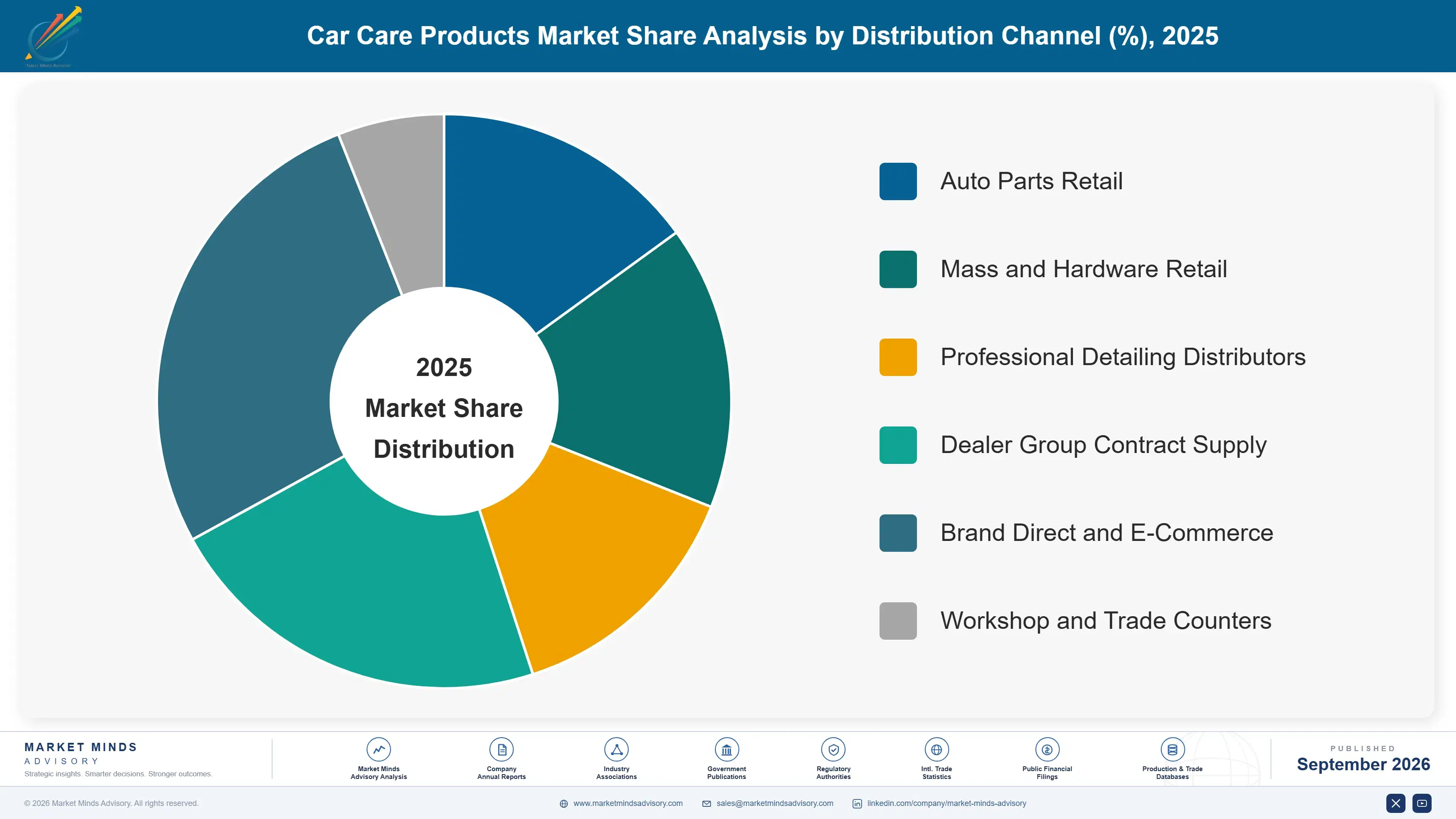
Segmentation follows product function, the dimension on which formulation, channel, application method and price all divide together in this market. Six functions are assessed at manufacturer revenue across retail and professional channels. Lubricants, functional fluids, paint and body repair materials, wash machinery and wrapping films sit outside scope. Retail and professional volumes are sized together throughout.
car-care-products-market-market-share-analysis-1790022717898

Ceramic And Graphene Coatings

Coatings grow at 8.4%, half again the market rate of 5.6%, and what is actually being sold is labour rather than chemistry. A professional application is priced in the hundreds while the material consumed costs a small fraction of that, so the product functions as a licence to charge for surface preparation, correction and controlled application. Detailers select on cure window, working time and how forgiving a product is under shop lighting, because a difficult coating costs them a bay for a day. Durability claims influence the consumer conversation and almost nothing about the professional purchase, since the detailer will not be present when the claim is tested. The chemical is trivial against the labour it enables.
CAGR 8.4%

Interior Cleaning And Protection

Interior products grow at 7.1% and electric vehicle ownership is reshaping what that means. A cabin dominated by a large display, soft-touch plastics and frequently by textile or synthetic upholstery needs screen-safe cleaners, anti-static treatments and plastic protectants rather than the solvent-heavy products a older interior tolerated. Owners also treat these vehicles as devices and clean the cabin more often than they wash the exterior, which inverts a long-standing pattern. Professional detailers report interior work growing faster than paint work, and the labour content is higher, which suits shops looking to raise revenue per bay. Older solvent-heavy interior products damage modern soft-touch surfaces, which makes relabelling an existing range a warranty exposure rather than a shortcut.
CAGR 7.1%
Full segment breakdown across 6 segments available in the complete report.

Regional Architecture and Country Demand Map

Regional shares measure manufacturer revenue where product is sold. East Asia sits marginally above its standard band and Middle East and Africa just below, driven by vehicle parc size and by how far professional detailing has organised. Water regulation shapes the consumer half of this market considerably.

East Asia

At 31% this sits marginally above the standard band, and the Chinese vehicle parc alongside a rapidly professionalising detailing industry accounts for most of it. Chinese detailing chains have scaled quickly and buy centrally, which concentrates purchasing in a way the fragmented Western professional channel does not. Japanese consumer car care is unusually developed, with Soft99 and domestic brands supporting a genuine enthusiast culture that persists across generations. Korean demand follows a similar pattern at smaller scale. Growth of 6.5% comes from parc expansion and from detailing formalising rather than from consumer spending rising. Central buying by Chinese chains concentrates purchasing in a way fragmented Western professional channels never have.
Share: 31% | CAGR: 6.5% (2026 to 2036)

North America

The 27% position sits inside the standard band and this is where the consumer and professional halves are most clearly separated. Retail car care occupies substantial shelf space across auto parts, mass and hardware channels, while professional volume moves through detailing supply distributors and dealer group contracts that share almost no products with the shelf. Turtle Wax, Armor All and Meguiar's hold the consumer positions. Coating adoption is furthest advanced here in professional application. Growth of 4.9% reflects a mature parc where reconditioning throughput rather than ownership growth drives volume. The consumer and professional ranges share almost no products, which means two separate businesses operate under the same brand names across the same country without meeting.
Share: 27% | CAGR: 4.9% (2026 to 2036)
Regional intelligence for 5 additional markets available in the complete report: Western Europe, South Asia and Pacific, Latin America, Eastern Europe, Middle East and Africa. Contact sales@marketmindsadvisory.com.
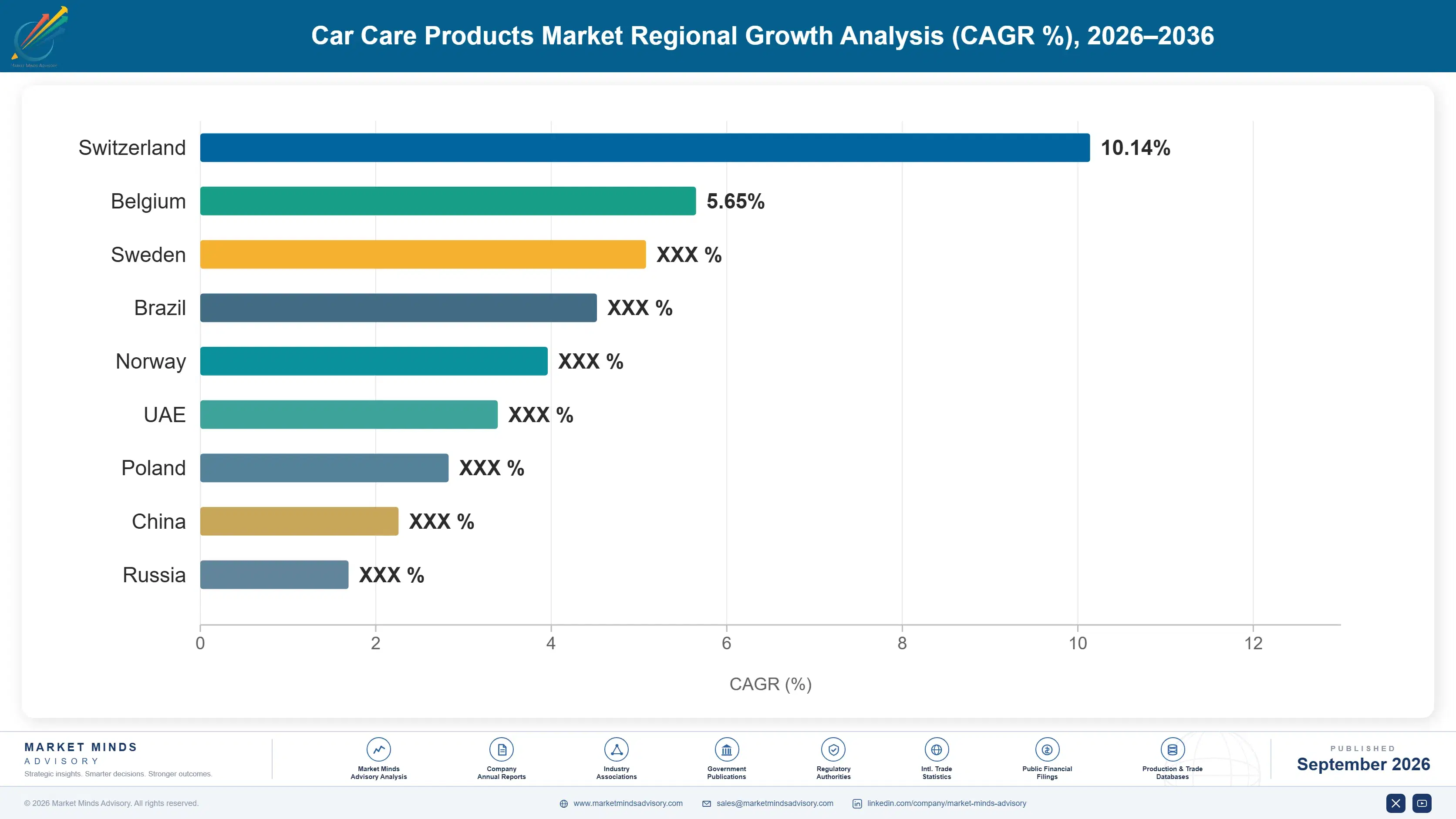
car-care-products-market-country-cagr-analysis-1790022718425

Four Moves Worth Making Now

These four follow from the same two observations: the professional buys most of the volume on a cost per vehicle basis, and the consumer pays to ship water in a bottle. Each has been executed by at least one participant with measurable results, and none requires new chemistry or manufacturing capacity. Two of the four work on the professional channel.

Sell Consumer Ranges As Diluted Concentrates

Roughly 74% of a ready-to-use consumer product is water shipped in a plastic bottle across continents, which professional channels already avoid by buying concentrate and diluting on site. Moving consumer ranges to concentrate with a reusable trigger bottle cuts freight and packaging cost by around 46% per unit of active delivered. Participants doing this report gross margin improving several points while retail price falls. The obstacle is shelf presentation and dilution instructions rather than anything technical about the formulation itself. Professional buyers have worked this way for decades without difficulty, so the formulation exists already.
Market Impact: Cuts freight and packaging cost by roughly 46%

Publish Accelerated Weathering Data On Coatings

Coating durability claims of five or nine years rest on no recognised standard and pencil hardness figures describe something buyers consistently misread. Publishing accelerated weathering results with the test conditions stated converts an unverifiable claim into evidence, and it costs a laboratory programme rather than reformulation. Participants who publish report professional specification wins rising by roughly 1.6 times, because a detailer staking a reputation on a multi-year service wants something defensible. Almost no competitor currently provides anything comparable. A laboratory programme costs far less than reformulating anything, and the data already sits in most development files.
Market Impact: Raises professional specification wins to roughly 1.6 times

Sell Coatings On Application Behaviour Not Longevity

A detailer selects a coating on cure window, working time, high-spot forgiveness and how it reads under shop lighting, because a difficult product costs a bay for a day and a correction job if it flashes early. Durability matters to the consumer conversation and almost nothing to the purchase. Manufacturers reframing technical documentation and sales training around application behaviour report conversion in professional channels rising by around 38%. The chemistry does not change; what changes is which attributes the sales conversation is built on. Durability belongs in the consumer conversation and nowhere near the purchase.
Market Impact: Raises professional channel conversion by roughly 38% overall

Build Dedicated Electric Vehicle Interior Ranges

An electric vehicle removes engine bay and exhaust products from the basket while adding screen-safe cleaners, anti-static plastic treatments and upholstery care, and owners clean cabins more often than they wash exteriors. Interior products grow at 7.1% and the labour content suits detailers raising revenue per bay. Participants building dedicated ranges rather than relabelling existing interior products report attach rates around 2.1 times higher. Solvent tolerance in modern cabins is genuinely lower, so relabelling creates warranty exposure as well as missing the opportunity. Screen-safe chemistry is a genuine formulation requirement rather than a marketing claim.
Market Impact: Lifts product attach rates to roughly 2.1 times

Who Controls the Margin Pool

Concentration is moderate at 28% held by the top five, measured consistently on manufacturer revenue across retail and professional channels rather than on units, which would distort across a concentrate drum and a retail trigger bottle. The leader to challenger gap is wide in retail shelf position and in professional distributor relationships, which are separate networks requiring separate capability, and narrow in formulation, where contract chemical manufacturers supply competent product to anyone.
Competition runs on three dimensions currently. Retail shelf space decides consumer volume, and auto parts, mass and hardware buyers manage the category on velocity rather than on any performance claim. Professional distributor and dealer group relationships decide the 61% of volume that never touches a shelf. Technical credibility with detailers decides the coating segment, and it is earned through training programmes and application support rather than through advertising.

Pressure is building where consumer-led participants meet professional channels and where coating claims meet scrutiny. Brands built on retail shelf presence are underrepresented in the channel carrying most volume, and building professional distribution requires technical support capability they do not have. Participants publishing weathering data are separating from a field making claims that nothing verifies.
car-care-products-market-company-positioning-matrix-1790022718953

Competitive Moat and Risk Dimensions

3M

Moat: Professional Systems And Abrasives

Ownership of the abrasive and compound systems that professional paint correction depends on places the company inside the detailing process rather than beside it, and Meguiar's provides a consumer position alongside. Technical training infrastructure for body shops and detailers builds specification habits that persist for years beyond any individual product launch.
3M

Risk: Breadth Dilutes Coating Focus

An enormous industrial portfolio makes the coating segment a small line for the group while specialist competitors treat it as their entire business, investing in application support and detailer training at levels a diversified manufacturer struggles to justify. The fastest-growing part of this market rewards exactly that narrow focus.
TURTLE WAX

Moat: Retail Shelf And Brand Recognition

Decades of consumer brand recognition across auto parts, mass and hardware retail secure shelf space that category buyers allocate on historical velocity, and that position is very difficult for a challenger to contest without a substantial promotional investment. Recent professional range development extends the brand into the channel carrying most volume.
TURTLE WAX

Risk: Consumer Weighting Against Professional Volume

Revenue weighting toward retail places the business in the smaller half of a market where 61% of volume moves through professional channels buying on cost per vehicle. Building distributor relationships and detailer technical support requires capability and credibility that consumer brand strength does not transfer into automatically.

Players Tracked

Prominent Players

3M
Turtle Wax
Energizer Holdings
Illinois Tool Works
SONAX

Other Key Players

Soft99
Autoglym
Chemical Guys
Gtechniq
CarPro
Koch Chemie
Menzerna
Mothers Polish
Adam's Polishes
Griot's Garage
Shell
TotalEnergies
Kaercher
Bilt Hamber
Wurth

Recent Developments

FEBRUARY 2025

3M expands automotive aftermarket polish manufacturing capacity

The company added production capacity for abrasives and polishing compounds serving body shop and professional detailing demand. This was organic capital investment funded internally, with no joint venture, acquisition or external manufacturing partner involved in the project at any stage. Consumer product lines at the site were unaffected.
Signal: Capacity is following professional correction work rather than consumer shelf demand. Correction work is where the volume grows.
SEPTEMBER 2024

Energizer Holdings consolidates Armor All manufacturing footprint

The company concentrated automotive appearance product manufacturing into fewer facilities as part of a wider cost programme. This was an internal footprint decision taken on cost grounds, involving no divestiture, acquisition or external capacity partner whatsoever. Product formulations and specifications were unchanged throughout the move.
Signal: Consumer car care volumes no longer support the manufacturing footprint they once did. Consumer volumes no longer justify the footprint.
MAY 2025

SONAX signs Chinese professional detailing distribution agreement

The company entered a multi-year distribution agreement with a Chinese detailing chain covering professional appearance products and technical training. The arrangement is a commercial distribution contract involving no equity stake or joint venture structure of any kind. Existing European distribution arrangements continued unaffected. Training is included in the arrangement.
Signal: Chinese detailing chains buy centrally, which makes national agreements unusually valuable here. National detailing agreements are unusually valuable there.

What The Chemistry Costs

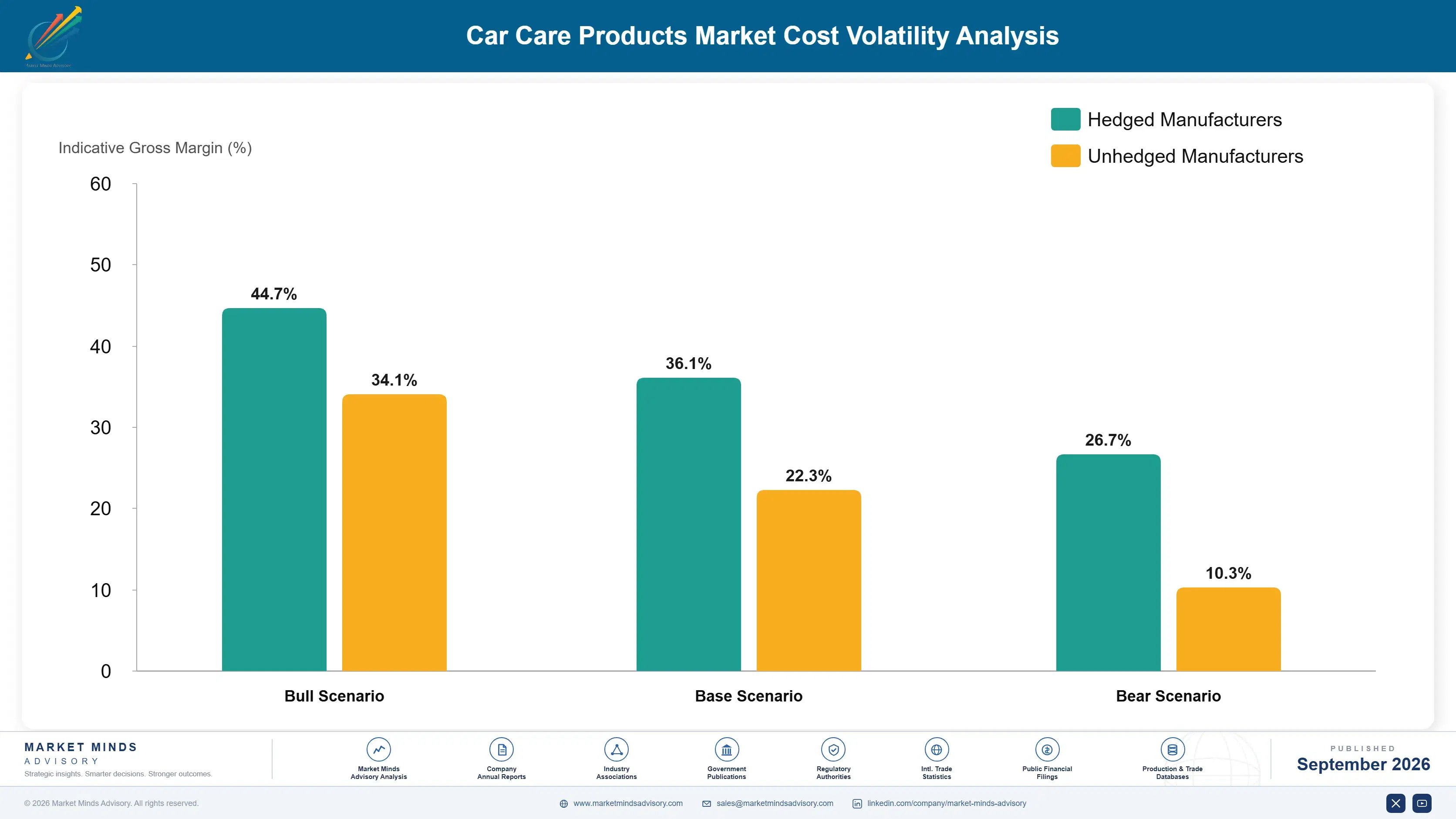
Surfactants account for roughly 24% of formulation cost across wash and cleaning products, tracking petrochemical and oleochemical feedstocks. Silicones and siloxanes dominate protectants and coatings at about 19%, and they price on an entirely separate supply chain running through industrial silicon. Packaging takes around 22%, which is high because trigger sprays and closures cost considerably more than the bottle, and freight sits outside all of it.
The 2021 siloxane shortage showed how narrow that second supply chain is. Chinese industrial silicon production was curtailed by regional power restrictions, siloxane availability tightened sharply within weeks and pricing moved several times over across two quarters. 3M and Energizer Holdings reporting for that period both identify raw material availability and cost inflation across automotive appearance categories as requiring pricing and sourcing action. Substitution needed reformulation rather than a purchase order, which took quarters.

Exposure varies by formulation and by channel, which decides who can hold a price. Coating and protectant manufacturers carry concentrated silicone exposure with limited substitution. Wash product manufacturers carry surfactant exposure that moves with different feedstocks entirely. Consumer brands shipping ready-to-use product carry a freight cost on water that concentrate buyers never pay at all.
car-care-products-market-cost-volatility-analysis-1790022719149

Qualify a second siloxane source outside Chinese supply

Silicone and siloxane supply concentrates heavily in Chinese industrial silicon capacity subject to regional power policy, and substitution requires reformulation and stability testing rather than a purchase order. Qualifying European or American supply ahead of disruption costs a development cycle. Most manufacturers begin only after an allocation event has already interrupted production. Allocation events rarely give notice.

Move consumer ranges toward concentrate and refill formats

Roughly three quarters of a ready-to-use product is water carried across continents in a plastic bottle at full freight cost. Concentrate formats remove that permanently and reduce packaging alongside it. Professional channels already buy this way, so the formulation work is largely complete and only the consumer presentation needs building. Only the consumer presentation needs building.

Specify trigger sprays across a common closure standard

Trigger sprays and closures cost more than the bottles they sit on, and most ranges carry several incompatible designs for reasons that no longer apply. Consolidating to a common standard improves purchasing terms and simplifies refill compatibility. The engineering review is short and the saving continues across the life of the range. Refill compatibility improves alongside it.

Portfolio Architecture for Margin Defence

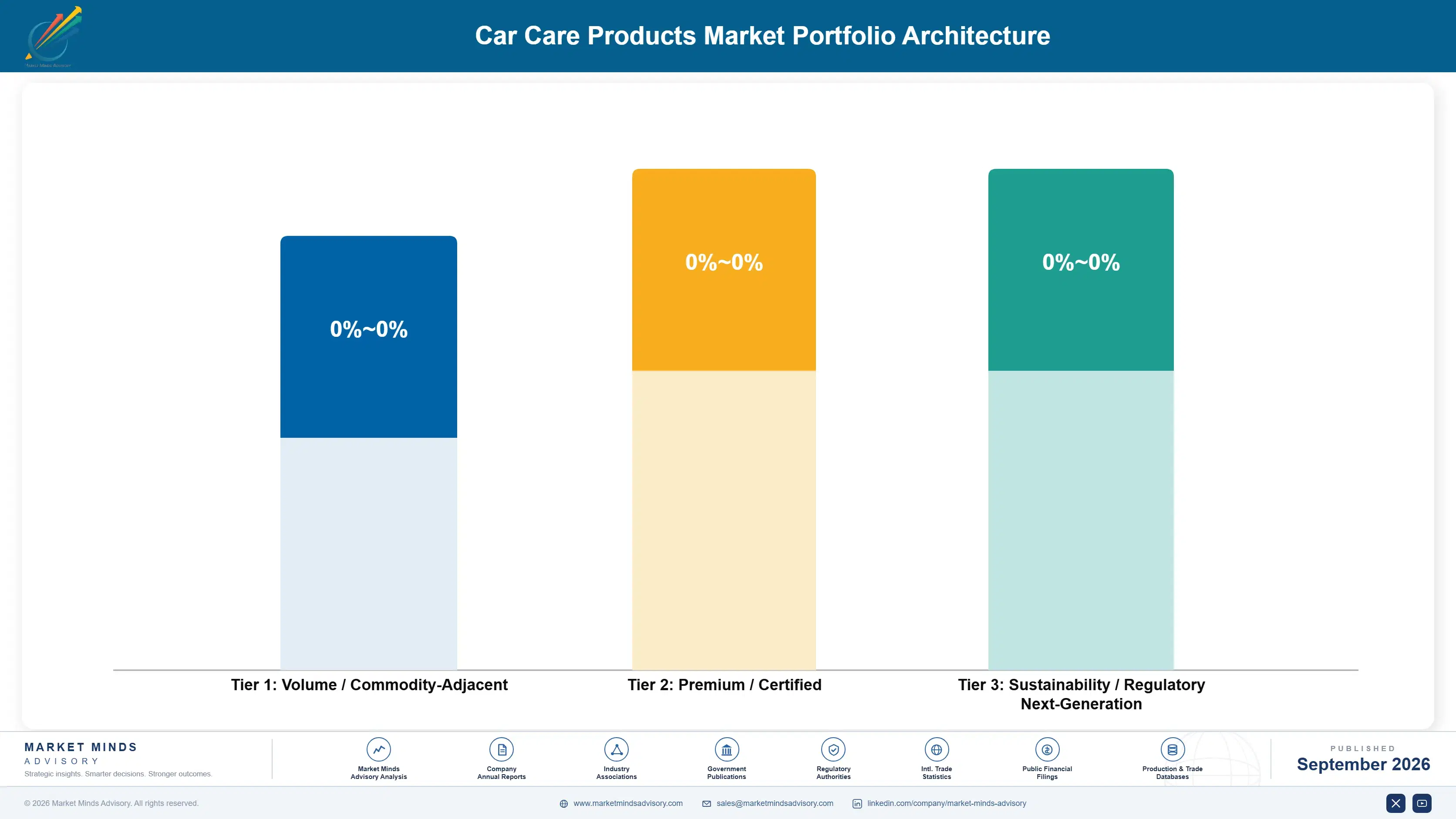
Margin architecture divides by channel and by whether labour sits behind the product, rather than by formulation cost, which a chemistry model would not predict. Consumer wash and shampoo products sold through auto parts and mass retail run at gross margins in the low to high thirties, competing on promotional price against private label and carrying freight on water the buyer did not need.
Professional concentrates and correction compounds sold through detailing distributors hold gross margins in the mid forties to low fifties. The spread reflects technical support and training rather than formulation, since a detailer who was taught to use a compound properly keeps buying it. Cost per vehicle treated near USD 2.80 also means performance rather than price governs the specification decision entirely.

The highest-value pool sits in coatings, at margins in the high fifties to mid sixties. The chemical is trivial against an application priced in the hundreds, and the manufacturer is effectively selling a detailer the ability to charge for a service. Consumer wash products hold shelf presence and generate volume. They do not fund the technical organisation that supports everything above them.

Volume / Commodity-Adjacent

Consumer wash and shampoo products sold through auto parts and mass retail. These compete on promotional price against private label while carrying full freight on water the buyer never needed shipped.
Gross Margin: 32 to 40%

Premium / Certified

Professional concentrates and correction compounds sold through detailing distributors. The eight-point range reflects technical support and training depth rather than formulation, since a trained detailer keeps specifying. Performance rather than price governs the decision.
Gross Margin: 46 to 54%

Sustainability / Regulatory / Next-Generation

Ceramic and graphene coatings where the chemical is trivial against an application priced in the hundreds. The manufacturer is selling a detailer the ability to charge for a service rather than selling material.
Gross Margin: 56 to 64%
car-care-products-market-portfolio-architecture-1790022719652

High-value Sub-segments and Strategic Watch-out

Professional Coating Systems

High value and high growth at 8.4%. The chemical cost is small against an application priced in the hundreds, so the product is a licence to charge for labour. Detailers select on cure window rather than on any durability claim. Technical training rather than advertising wins the specification.
Gross Margin: 58 to 64%

Electric Vehicle Interior Ranges

High value and high growth at 7.1%. Modern cabins tolerate far less solvent and owners clean interiors more often than they wash exteriors. Dedicated ranges attach at roughly 2.1 times the rate of relabelled products. The labour content also suits detailers raising revenue per bay.
Gross Margin: 50 to 56%

Consumer Wash And Shampoo

Volume core, growing slowest at 4.2% as touchless washes and municipal water restrictions remove the driveway occasion. It holds shelf presence while carrying freight on water that nobody needed shipped anywhere. Private label competes directly on promotional price, and no attribute in the bottle distinguishes one from another.
Gross Margin: 32 to 39%

Unsubstantiated Coating Claims

Strategic watch-out. Durability and hardness claims rest on no recognised test, and pencil hardness measures something buyers consistently misread. The fourteen-point range reflects how differently participants price an unverifiable promise. Accelerated weathering data exists in most development files and almost nobody publishes it against stated conditions.
Gross Margin: 48 to 62%

How Specification Actually Sticks

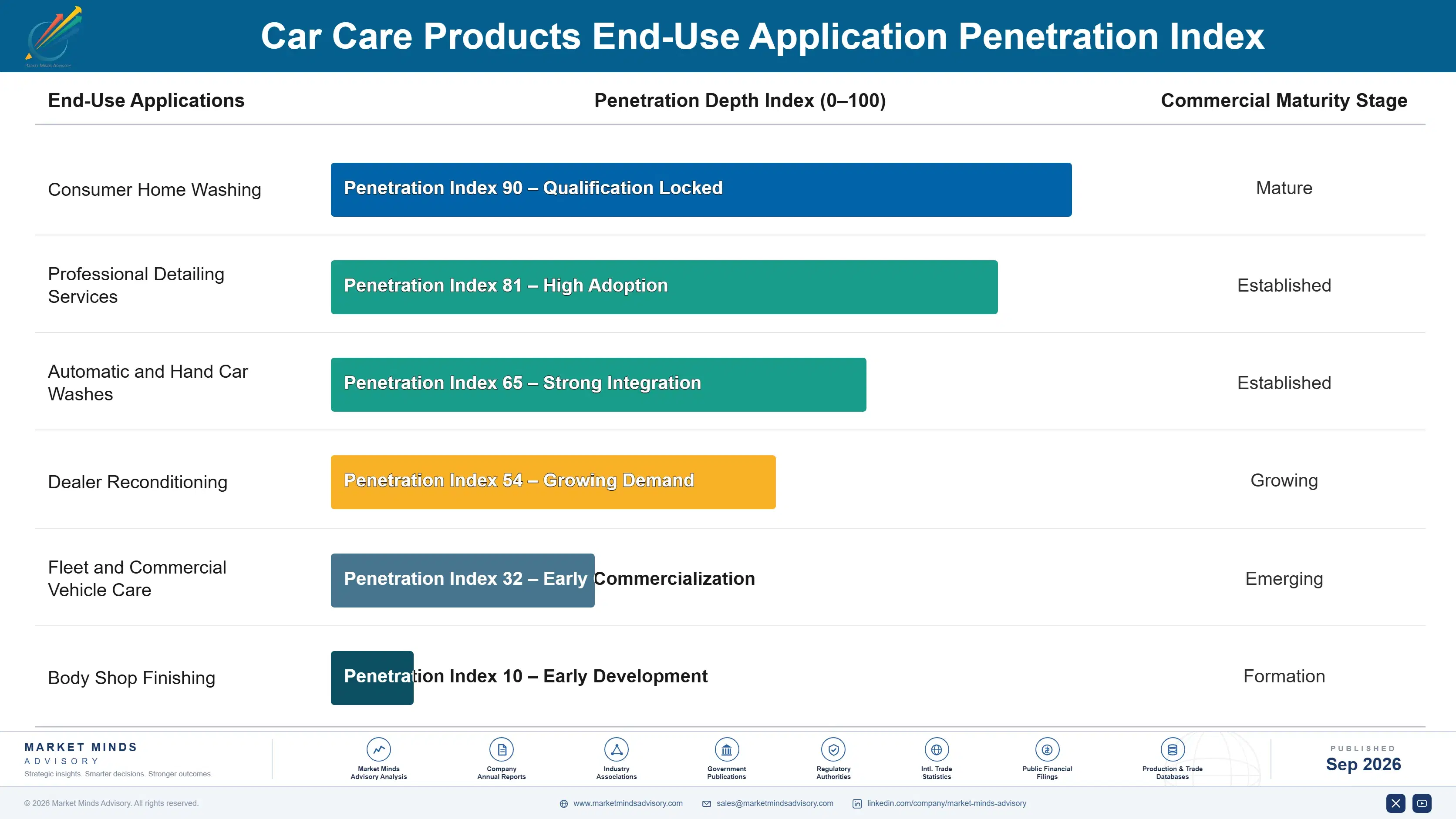
Professional demand is training-anchored and it is far stickier than any consumer relationship in this category. A detailer taught to use a compound and pad system properly, who has learned its cut, its finishing behaviour and how it reads under shop lighting, keeps buying it because switching means relearning a process on a customer's paint. That makes technical training the actual retention mechanism, and it explains why specialist brands hold professional positions against far larger manufacturers.
Stickiness varies sharply by channel. Dealer group contracts are specified centrally and reviewed on cost per vehicle, so they switch on price at renewal despite high volume. Independent detailers are the most loyal group, because the process knowledge is personal and expensive to rebuild. Consumer buyers have almost no attachment at all and select on shelf position, promotional price and whichever bottle looks most convincing.

Buyer behaviour shifted in one direction since 2020. The consumer cohort that started detailing at home during that period and continued has become considerably more technical, buying products that professionals use and following application guidance rather than marketing. That group is small in volume, influential online, and evaluates claims the advertising was never built to withstand.
car-care-products-market-end-use-penetration-index-1790022720169

Where This Market Pays

These are among the four positions where our research anticipates prominent divergence between winners and laggards over the coming forecast period. Each is grounded in the demand model, the regulatory perimeter, and the announced capacity pipeline.
01 / CONCENTRATE FORMAT CONVERSION

Stop shipping water in a retail bottle

Roughly 74% of a ready-to-use consumer product is water carried across continents in a plastic bottle at full freight cost, which professional channels already avoid entirely by buying concentrate and diluting on site. Moving consumer ranges to concentrate with a reusable trigger bottle cuts freight and packaging cost by around 46% per unit of active delivered. The obstacle is shelf presentation and dilution guidance rather than anything technical, since the formulation work already exists, and professional channels have bought this way for decades without any difficulty.
02 / COATING CLAIM SUBSTANTIATION

Publish weathering data against the test conditions

Coating durability claims of five or nine years rest on no recognised standard, and pencil hardness figures describe resistance to a graphite lead on a flat film rather than anything a car encounters. Publishing accelerated weathering results with stated test conditions converts an unverifiable claim into evidence at laboratory cost rather than reformulation cost. Participants who publish report professional specification wins rising by roughly 1.6 times, because a detailer staking a reputation wants something defensible behind it, and almost no competitor currently provides anything comparable in any market.
03 / PROFESSIONAL SALES REFRAMING

Sell the coating on how it applies

A detailer selects a coating on cure window, working time, high-spot forgiveness and how it reads under shop lighting, because a difficult product costs a bay for a day and possibly a correction job afterwards. Durability matters to the consumer conversation and almost nothing to the purchase decision. Manufacturers rebuilding technical documentation and sales training around application behaviour report professional channel conversion rising by around 38%, without changing the chemistry in any way, and what changes is which attributes the sales conversation is actually built around.
04 / ELECTRIC CABIN FORMULATION

Build for the interior, not relabel the old one

An electric vehicle removes engine bay and exhaust products from the basket while adding screen-safe cleaners, anti-static plastic treatments and upholstery care, and owners clean cabins more often than they wash exteriors. Modern cabin materials tolerate considerably less solvent than older interiors did, so relabelling an existing product creates warranty exposure alongside a missed opportunity. Participants building dedicated ranges report attach rates around 2.1 times those achieved by relabelled equivalents, and screen-safe chemistry is a genuine formulation requirement rather than a marketing claim.

Engagement Snapshot From the Field

A live engagement with an industry participant carrying material or product regulatory and market exposure ahead of a defining policy shift, showing how our research translates into a defensible multi-year portfolio strategy.
MARKET MINDS ADVISORY · CLIENT ENGAGEMENT SUMMARY
Car Care Products Producer Strategic Portfolio Review and Transition Roadmap 2026·Investment Scenario on Car Care Products Exposure Evaluation 2025-26
CLIENT PROFILE
A European manufacturer of car care chemicals selling through auto parts retail and a small professional distributor network across eleven markets, with revenue near USD 186 million (client-reported, unverified by MMA). Retail accounted for roughly 78% of revenue. The coating range carried nine year durability claims with no supporting test data, and every consumer product shipped ready to use.
STRATEGIC CHALLENGE
Revenue had been flat for three years while the category grew, and management attributed it to retail shelf pressure from private label. A promotional investment programme had been approved. Nobody had sized the professional channel the company barely served, or examined why detailers specified competitor coatings over its own. Neither question had been examined with evidence.
MMA APPROACH
MMA sized professional channel volume across the client's eleven markets and interviewed 46 detailers about coating selection criteria. Freight and packaging cost was modelled for concentrate against ready-to-use formats. Competitor technical documentation was benchmarked for substantiation, and cost per vehicle treated was calculated across the client range at professional dilution rates.
KEY FINDINGS
  1. Professional channels accounted for 59% of category volume in the client's markets, and the company held under 4% share of it against 19% in retail.
  2. Of 46 detailers interviewed, 41 named cure window and high-spot forgiveness as primary coating selection criteria and none named the durability claim at all.
  3. Concentrate formats would cut freight and packaging cost by 44% per unit of active delivered, and every product in the range was already available as a professional concentrate internally.
  4. Two competitors published accelerated weathering data with stated conditions, and both held professional specification positions substantially above their retail share. Neither competitor advertised heavily to consumers.
CLIENT PROFILE
A European manufacturer of car care chemicals selling through auto parts retail and a small professional distributor network across eleven markets, with revenue near USD 186 million (client-reported, unverified by MMA). Retail accounted for roughly 78% of revenue. The coating range carried nine year durability claims with no supporting test data, and every consumer product shipped ready to use.
STRATEGIC CHALLENGE
Revenue had been flat for three years while the category grew, and management attributed it to retail shelf pressure from private label. A promotional investment programme had been approved. Nobody had sized the professional channel the company barely served, or examined why detailers specified competitor coatings over its own. Neither question had been examined with evidence.
MMA APPROACH
MMA sized professional channel volume across the client's eleven markets and interviewed 46 detailers about coating selection criteria. Freight and packaging cost was modelled for concentrate against ready-to-use formats. Competitor technical documentation was benchmarked for substantiation, and cost per vehicle treated was calculated across the client range at professional dilution rates.
KEY FINDINGS
  1. Professional channels accounted for 59% of category volume in the client's markets, and the company held under 4% share of it against 19% in retail.
  2. Of 46 detailers interviewed, 41 named cure window and high-spot forgiveness as primary coating selection criteria and none named the durability claim at all.
  3. Concentrate formats would cut freight and packaging cost by 44% per unit of active delivered, and every product in the range was already available as a professional concentrate internally.
  4. Two competitors published accelerated weathering data with stated conditions, and both held professional specification positions substantially above their retail share. Neither competitor advertised heavily to consumers.
RECOMMENDED STRATEGY
Phase 1: Phase one: cancel the promotional programme and rebuild coating technical documentation around application behaviour rather than durability claims. Detailers named cure window, not longevity. Phase 2: Phase two: commission accelerated weathering testing and publish results with full test conditions stated openly. Two competitors already publish theirs openly. Phase 3: Phase three: launch consumer concentrate formats using the professional formulations already available internally. The formulations already exist internally as professional concentrates.
OUTCOME
Professional channel share rose from 4% to 11% across four quarters (client-reported, unverified by MMA), with published weathering data cited directly in two national detailing chain specifications. The promotional programme was abandoned, and consumer concentrate formats reached 14% of retail volume in their first year on shelf.

Frequently Asked Questions

Foundational context covering the market sizes, CAGR, scope, country, region and competition that inform every finding below. This section is provided to cover basics and most often pre-purchase conversations, answered from the MMA Primary Research Dataset.

What is the current size of the Car Care Products Market?

The market was valued at USD 12.4 billion in 2025, rising to USD 13.1 billion in 2026. Sizing is at manufacturer revenue across retail and professional channels.

How large will the Car Care Products Market be by 2036?

MMA forecasts USD 22.6 billion by 2036, an increase of USD 9.5 billion over the 2026 base. That represents expansion of 1.73 times across the forecast period.

What is the CAGR for the Car Care Products Market 2026 to 2036?

The base case CAGR is 5.6%, with a bull case of 6.8% and a bear case of 4.4%. Historical growth between 2020 and 2025 ran at 4.5%.

Which segment is growing fastest?

Ceramic and graphene coatings grow at 8.4%, half again the market rate, because the product is effectively a licence for detailers to charge for labour. Interior care follows at 7.1%.

Who are the major companies in the Car Care Products Market?

3M, Turtle Wax, Energizer Holdings, Illinois Tool Works and SONAX lead on manufacturer revenue, holding a combined 28%. Specialist coating brands hold professional positions far above their overall share.

Which country is growing fastest?

India grows fastest at 8.4%, as passenger vehicle ownership expands and professional detailing forms alongside it rather than afterwards, concentrating purchasing in organised chains. Dust and heat make paint protection practical rather than cosmetic.

Report Segmentation Architecture

The full report scope spans multiple orthogonal segmentation dimensions, with cross-tabulated demand data provided for each dimension pair. Coverage extends further to regional breakdowns, trend trajectories, and the competitive detail needed to support segment-level decision-making.

By Product Function

  • Wash and Shampoo Products
  • Wax, Sealant and Paint Protection
  • Ceramic and Graphene Coatings
  • Interior Cleaning and Protection
  • Wheel, Tyre and Trim Products
  • Glass and Visibility Products

By End-Use Application

  • Consumer Home Washing
  • Professional Detailing Services
  • Automatic and Hand Car Washes
  • Dealer Reconditioning
  • Fleet and Commercial Vehicle Care
  • Body Shop Finishing

By Distribution Channel

  • Auto Parts Retail
  • Mass and Hardware Retail
  • Professional Detailing Distributors
  • Dealer Group Contract Supply
  • Brand Direct and E-Commerce
  • Workshop and Trade Counters

By Region

  • East Asia
  • North America
  • Western Europe
  • South Asia and Pacific
  • Latin America
  • Eastern Europe
  • Middle East and Africa

Scope, Methodology, and Coverage

Every figure in this report is reproducible from documented input assumptions. The scope below maps the historical period, the forecast horizon, the segmentation dimensions, and the countries covered, alongside the underlying primary and qualitative methodology.
Historical Period
2020 to 2025
Forecast Period
2026 to 2036
Base Year
2025 (USD billions; MMA Primary Research Dataset, September 2026)
Market Definition
This market covers automotive appearance care chemicals and consumables, spanning wash and shampoo products, wax, sealant and paint protection, ceramic and graphene coatings, interior cleaning and protection, wheel, tyre and trim products, and glass and visibility products. Sizing is at manufacturer revenue across auto parts, mass, professional distributor, dealer contract, direct and trade counter channels. Engine oils and lubricants, coolants and functional fluids, paint and body repair materials, wash equipment and machinery, and vehicle wrapping films are excluded throughout.
Quantitative Units
USD billions at manufacturer revenue; volume in millions of litres; chemical cost per vehicle treated in dollars.
Segmentation Dimensions
Product function, end-use application, distribution channel, and geographic region.
Regions Covered
East Asia, North America, Western Europe, South Asia and Pacific, Latin America, Eastern Europe, Middle East and Africa
Countries Covered
China, United States, Germany, India, Japan, Brazil
Key Companies Profiled
3M, Turtle Wax, Energizer Holdings, Illinois Tool Works, SONAX, Soft99, Autoglym, Chemical Guys, Gtechniq, CarPro, Koch Chemie, Menzerna, Mothers Polish, Adam's Polishes, Griot's Garage, Shell, TotalEnergies, Kaercher, Bilt Hamber, Wurth
Quantitative Methodology
Primary survey, n=3,800 respondents, Q4 2025, six countries; demand-side model with trade association cross-validation
Qualitative Methodology
47 expert interviews, Q4 2025; applied to validate demand model assumptions, identify emerging dynamics, and assess competitive positioning
Report Format
PDF and XLSX data workbook (Word format preview document)
Publisher
Market Minds Advisory
Report Code
MMA-2026-AUT-783
Published
September 2026
Contact
sales@marketmindsadvisory.com | www.marketmindsadvisory.com

Purchase the full Car Care Products Market Report (2026 to 2036).

The full report sizes the car care products market across six product functions, six end-use applications and six distribution channels for all seven global regions. It includes professional channel sizing separated from retail, with detailer selection criteria collected through direct interviews across major markets. Coating claim substantiation is benchmarked participant by participant against published test conditions. Freight and packaging cost is modelled for concentrate against ready-to-use formats, and chemical cost per vehicle treated is calculated at professional dilution rates. Competitive assessment covers 20 participants on a consistent manufacturer revenue basis.
Professional channel sized separately from retail volume
Detailer selection criteria collected through direct interviews
Coating claim substantiation benchmarked participant by participant
Concentrate against ready-to-use cost modelled fully
Six product functions sized through 2036
Twenty participants assessed on manufacturer revenue

Built For The People Who Decide

From boardroom strategy to bench-side execution, this report is read cover-to-cover by leaders shaping the next decade of their industry, turning demand scenarios, market dynamics and valuation benchmarks into decisions.
CXOs/ Presidents/ VPs/ Managers
M&A and Corporate Development
Strategy Teams and R&D Heads
Procurement and Product Directors
Regulatory and Compliance Leaders
Investor Relations and Equity Analysts