Market Minds Advisory
Capacitor Film Slitter Market

Capacitor Film Slitter Market: Capacitor Film Slitter Market. EV Power Electronics Growth Drives Precision Slitting Demand

Capacitor film manufacturers are upgrading to precision slitting equipment as electric vehicle power electronics and renewable energy inverters demand tighter width tolerances and higher throughput than legacy slitting lines can reliably deliver.

Lead Analyst

Published

September 2026

Make Smarter Decisions with Customized Research Insights

Request a free sample report and evaluate market opportunities, growth trends, and competitive dynamics relevant to your business needs.

2025 MARKET VALUE$0.6BMarket Size 2025
2036 FORECAST VALUE$1.2BBase Case , 2026 to 2036
CAGR 2026 TO 20366.5 %Bull 7.8% / Bear 5.2%
INCREMENTAL OPPORTUNITY$0.6BNet 10- year value creation
EXPANSION MULTIPLE1.88x2036 value over 2026 base
Strategic Levers
M&A Pipeline
Regional Outlook
Country Rankings
Competitive Intelligence
Segmental Deep-dive
Call-Us : 91 93563 13602

Executive Snapshot and Market Trajectory.

Capacitor film manufacturers worldwide are now increasingly upgrading slitting equipment as electric vehicle power electronics demand tighter width tolerances than legacy lines can deliver, pushing capital investment toward precision automated slitting systems capable of higher throughput, lower defect rates, and reduced material waste per production run across every plant.
Fully automated high-speed slitters are growing fastest as manufacturers seek to reduce the width variation and edge defects that cause capacitor failures in high-voltage automotive applications operating under demanding thermal and electrical stress conditions across extended service lifetimes. Electric vehicle traction inverter capacitor film drives the largest current share of demand, reflecting the automotive sector's stringent quality requirements and rapidly growing production volumes across multiple vehicle platforms and manufacturers globally.
Competitive intensity remains moderate as established slitting equipment makers defend long-standing film manufacturer relationships while newer automation-focused entrants compete on throughput speed and defect detection integration rather than raw cutting precision alone. Film manufacturer capital expenditure cycles are shaping which equipment vendors can credibly win multi-year supply contracts without lengthy qualification and installation delays that push revenue recognition well into future fiscal years and budget cycles.
Market Definition
This market covers precision slitting equipment used to cut wide rolls of metallized polymer film into narrow capacitor-grade tape for winding into film capacitors used in power electronics applications. It excludes the film manufacturing and metallization equipment itself, and finished capacitor winding and assembly machinery.
Base Year Value
$0.6B in 2025 (MMA Primary Research Dataset, September 2026)
Forecast Period
2026 to 2036, eleven discrete annual values
CAGR
6.5% base case. Bull 7.8%. Bear 5.2%.
Fastest Growth Segment
Fully Automated High-Speed Slitters: 9.5% CAGR
Fastest Growth Country
India: 8.5% CAGR
Fastest Growth Region
South Asia and Pacific: 8.5% CAGR
Largest Region
East Asia: 30% of 2025 global value
Market Leaders
Kampf Schneid- und Wickeltechnik, Atlas Converting, Titan Kogyo, Comexi, Cera Group
Primary Survey
n=3,800 procurement and R&D decision-makers, Q4 2025, six countries
Methodology
Demand-side build-up, cross-validated against public data, 47 expert interviews

Capacitor Film Slitter Market Forecast Scenarios

capacitor-film-slitter-market-size-forecast-scenario-1788503254685
Capacitor film slitter demand between 2020 and 2025 grew steadily as electric vehicle production ramped and film manufacturers invested in capacity expansion to meet growing power electronics component demand. Supply chain disruptions during 2021 and 2022 briefly delayed equipment delivery timelines industry-wide, but demand recovered fully once component and steel supply constraints eased, reflecting durable underlying capacitor film production growth.
The base case assumes continued expansion driven by three commercial mechanisms: electric vehicle production volume growth requiring proportionally more capacitor film capacity and slitting throughput, renewable energy inverter manufacturers scaling production to meet grid-scale storage and solar installation demand, and film manufacturers replacing aging slitting lines with automated systems offering better defect detection and yield. Data center power supply capacitor demand is also emerging as a meaningful new growth vector beyond traditional automotive and renewable applications.
A bull scenario centers on faster than expected electric vehicle and renewable energy production growth, pulling capacitor film slitter demand well above currently modeled base case levels. The bear risk is a prolonged electric vehicle demand slowdown combined with continued legacy equipment utilization, which would delay the automated slitter replacement cycle that currently drives most vendor revenue growth.

Where Precision Cutting Meets Power Electronics Growth

Capacitor film slitters sit at the intersection of precision converting equipment and power electronics component manufacturing, delivering the tight width tolerance and clean edge quality that high-voltage film capacitors require to avoid premature failure in demanding automotive and industrial applications. The category expanded from general-purpose film converting equipment into a specialized capital goods segment as capacitor quality requirements tightened alongside automotive electrification and grid infrastructure modernization.
MARKET CONCENTRATIONCR5 52%Top five equipment makers hold a substantial combined revenue share
AVERAGE SYSTEM PRICE$1.5M to $4MTypical fully automated slitting line price range across configurations
TOP PRODUCING COUNTRY SHAREGermany leadsSingle country contributes the largest share of equipment production
SLITTING SPEED IMPROVEMENT~3x over legacyTypical throughput gain automated systems deliver over older lines
DEFECT RATE REDUCTION~60% fewer defectsTypical improvement in edge quality from automated inspection systems
EQUIPMENT REPLACEMENT CYCLE~12 to 15 yearsTypical operating lifespan before a production line requires replacement
Automated defect detection integration increasingly substitutes for manual visual inspection, catching edge damage and width variation in real time rather than after a full roll has already been processed and potentially scrapped entirely. Equipment differentiation increasingly depends on total line throughput and changeover speed rather than raw cutting precision alone, since faster changeover between film types improves overall equipment utilization across a manufacturer's full production schedule.
Competitive advantage increasingly rests on integration depth with upstream metallization equipment and downstream capacitor winding lines rather than standalone slitter performance alone, since coordinated line design reduces material handling and waste across the full production sequence. Vendors lacking demonstrated automotive-grade quality certification face growing difficulty winning contracts with capacitor makers supplying electric vehicle traction inverter programs requiring extensive supplier qualification.
"Nobody buys a slitter for the blade anymore. They buy it for the inspection system that tells them which meter of film to scrap before it becomes a warranty claim."
Principal Analyst, Precision Converting and Power Electronics Equipment Practice · MMA Precision Slitting Equipment for Metallized Capacitor Film Manufacturing Practice · September 2026

Market Trends

Automated Inline Defect Detection Becomes Standard

Slitting equipment makers increasingly integrate automated optical inspection systems directly into the cutting line, flagging edge defects and width variation in real time rather than relying on manual sampling inspection performed after a roll completes processing. Kampf and Atlas Converting have both made inline inspection a standard feature on their newest automated slitting lines rather than an optional add-on component. This shift matters because it catches quality problems before an entire roll is wasted, improving material yield meaningfully while also generating the documented quality traceability data that automotive capacitor customers increasingly require as part of their supplier qualification process.
Market Impact: Adds 2 lines per fab
Data Center Power Supplies Create New Demand Vector

Data center power supply capacitor demand is emerging as a meaningful new growth vector beyond the traditional automotive and renewable energy applications that have historically anchored capacitor film slitter demand growth. Rising data center power density driven by AI computing infrastructure buildout is increasing the film capacitor content per power supply unit, creating incremental demand independent of the automotive electrification cycle that dominates current market narratives. This diversification matters because it reduces slitter equipment maker exposure to any single end-use category's demand cyclicality, smoothing overall revenue growth across multiple simultaneously expanding application categories.
Market Impact: Segment growing 9 percent yearly

Market Opportunities and Growth Drivers

Electric Vehicle Production Growth Drives Capacity Investment

Global electric vehicle production volume continues climbing steadily, and every additional vehicle produced requires film capacitors for traction inverter and onboard charger power electronics, directly driving capacitor film manufacturer capacity expansion and associated slitting equipment purchases. This direct volume relationship makes electric vehicle production forecasts a primary input to capacitor film slitter demand modeling, more so than most other end-use categories tracked in this report. Film manufacturers are also increasingly specifying automated slitting lines for new capacity additions rather than replicating legacy manual equipment configurations used in older production facilities.
Market Impact: Adds 6 to 12 months

Renewable Energy Inverter Demand Expands Addressable Market

Solar and wind inverter manufacturers are scaling production to meet grid-scale renewable energy storage and generation demand, directly increasing film capacitor consumption for power conversion applications requiring high reliability under variable environmental operating conditions. This renewable energy demand diversifies capacitor film slitter revenue beyond pure automotive exposure, reducing vendor dependence on electric vehicle production cycle timing alone. Renewable energy customers also typically demand comparable automotive-grade quality certification, reinforcing the broader industry shift toward automated, traceable slitting equipment across every major application category. Vendors serving both automotive and renewable customers increasingly report more stable order pipelines as a result.
Market Impact: Adds 20 to 30 percent

Market Restraints and Challenges

Long Equipment Qualification Cycles Delay Revenue Recognition

Capacitor film manufacturers typically require six to twelve months of qualification testing before approving a new slitting line for full production use, delaying equipment vendor revenue recognition considerably compared to less regulated industrial equipment categories with shorter approval timelines. The root cause is that capacitor film quality directly affects downstream automotive safety-critical component reliability, requiring extensive validation before manufacturers will risk production disruption from an unproven new equipment configuration. This lengthy cycle disadvantages smaller equipment vendors lacking capital to sustain extended qualification investment without near-term revenue. Some vendors are mitigating this by offering extended trial periods with performance guarantees.
Market Impact: Cuts scrapped material 60 percent

High Capital Cost Limits Smaller Manufacturer Adoption

Fully automated high-speed slitting lines carry substantial upfront capital costs that smaller and mid-sized capacitor film manufacturers often struggle to justify against uncertain future demand growth, particularly during periods of broader economic uncertainty affecting capital expenditure decisions. The root cause is that automated inspection and high-speed cutting technology commands a meaningful price premium over legacy manual slitting equipment that remains functionally adequate for lower-volume or less demanding application segments. This cost barrier concentrates automated equipment adoption among larger, well-capitalized manufacturers serving demanding automotive customers. Some vendors are mitigating this by offering equipment financing and leasing arrangements.
Market Impact: Adds 8 percent to demand
3 additional market trends, 4 additional growth drivers, and 2 additional restraints and challenges are covered in the full report. Contact sales@marketmindsadvisory.com to access the complete intelligence.

Segment CAGR and Growth Architecture

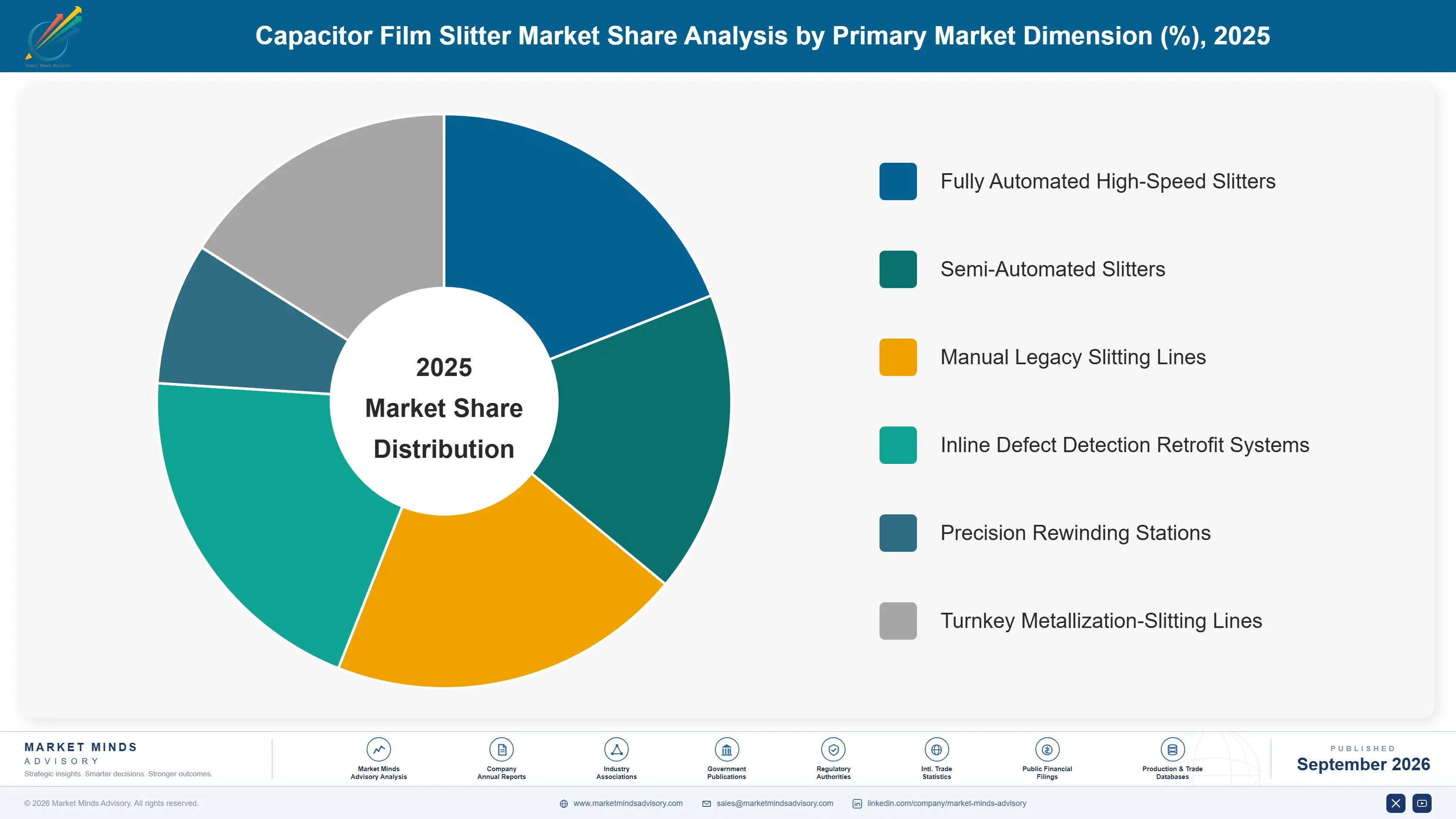
Capacitor film slitters segment by the level of process automation and inspection integration, spanning fully automated high-speed slitters, semi-automated slitters, manual legacy slitting lines, inline defect detection retrofit systems, precision rewinding stations, and turnkey converting lines bundling slitting with upstream metallization equipment for large-scale capacitor film producers worldwide across every plant size and budget tier.
capacitor-film-slitter-market-market-share-analysis-1788503255244

Fully Automated High-Speed Slitters

Fully automated high-speed slitters integrate inline optical defect detection, automated tension control, and rapid changeover capability into a single production line, letting capacitor film manufacturers achieve both higher throughput and lower defect rates than legacy manual equipment configurations can reliably deliver. Growth outpaces the broader market because automotive customers increasingly require the documented quality traceability data that only automated inspection systems can generate consistently across every meter of film processed. Manufacturers serving electric vehicle traction inverter capacitor programs increasingly specify fully automated equipment as a baseline requirement rather than an optional upgrade, converting what was once a premium differentiator into a standard qualification prerequisite for winning new automotive supply contracts.
CAGR 9.5%

Semi-Automated Slitters

Semi-automated slitters combine automated cutting and tensioning mechanisms with manual visual inspection performed by trained operators, offering a middle-ground cost and capability point between legacy fully manual equipment and premium fully automated systems with inline defect detection. This segment grows more slowly than fully automated systems because manufacturers serving less demanding industrial applications, rather than automotive customers, often find semi-automated equipment adequate for their quality requirements at meaningfully lower capital cost. Smaller and mid-sized capacitor film manufacturers frequently choose this configuration as a capital-efficient entry point before eventually upgrading to fully automated systems once production volume and customer quality requirements justify the additional investment. Equipment financing options increasingly help these smaller manufacturers bridge the gap toward eventual full automation.
CAGR 6.0%
Full segment breakdown across 6 segments available in the complete report.

Regional Architecture and Country Demand Map

East Asia leads given its dominant capacitor film manufacturing base across China, Japan, and Taiwan, home to the world's deepest metallized film production capacity and equipment expertise base, while South Asia and Pacific posts the fastest growth as India expands domestic capacitor production capacity substantially.

North America

The United States hosts significant capacitor film slitting equipment demand driven by domestic electric vehicle production expansion and CHIPS Act-adjacent power electronics manufacturing investment aimed at strengthening domestic supply chains. American capacitor film manufacturers increasingly specify fully automated slitting equipment for new capacity additions, reflecting stringent automotive customer quality requirements that legacy manual equipment cannot reliably satisfy. Mexico's growing role as an automotive component manufacturing hub also contributes meaningfully to regional demand as manufacturers there increasingly serve North American vehicle assembly plants directly. Canada contributes a smaller share, tracking similar automotive and renewable energy adoption trends as its southern neighbor. Growing domestic power electronics manufacturing investment further reinforces this steady regional demand base.
Share: 23% | CAGR: 7.0% (2026 to 2036)

Western Europe

German automakers and their capacitor supply chain drive the largest share of European demand, specifying automated slitting equipment for electric vehicle traction inverter capacitor film supplied to Volkswagen, BMW, and Mercedes-Benz production lines across their expanding battery electric lineups. Kampf Schneid- und Wickeltechnik maintains substantial domestic manufacturing presence, giving European capacitor film producers a qualified local equipment supplier that reduces dependence on Asian imports. Growth trails East Asia and North America somewhat, reflecting slower European electric vehicle production growth relative to Chinese and American manufacturers. France and the Nordic countries contribute additional demand through their growing renewable energy infrastructure investment programs. Regional equipment vendors increasingly compete on specialized automotive qualification support rather than raw system pricing alone.
Share: 21% | CAGR: 5.0% (2026 to 2036)
Regional intelligence for 5 additional markets available in the complete report: East Asia, South Asia and Pacific, Latin America, Middle East and Africa, Eastern Europe. Contact sales@marketmindsadvisory.com.
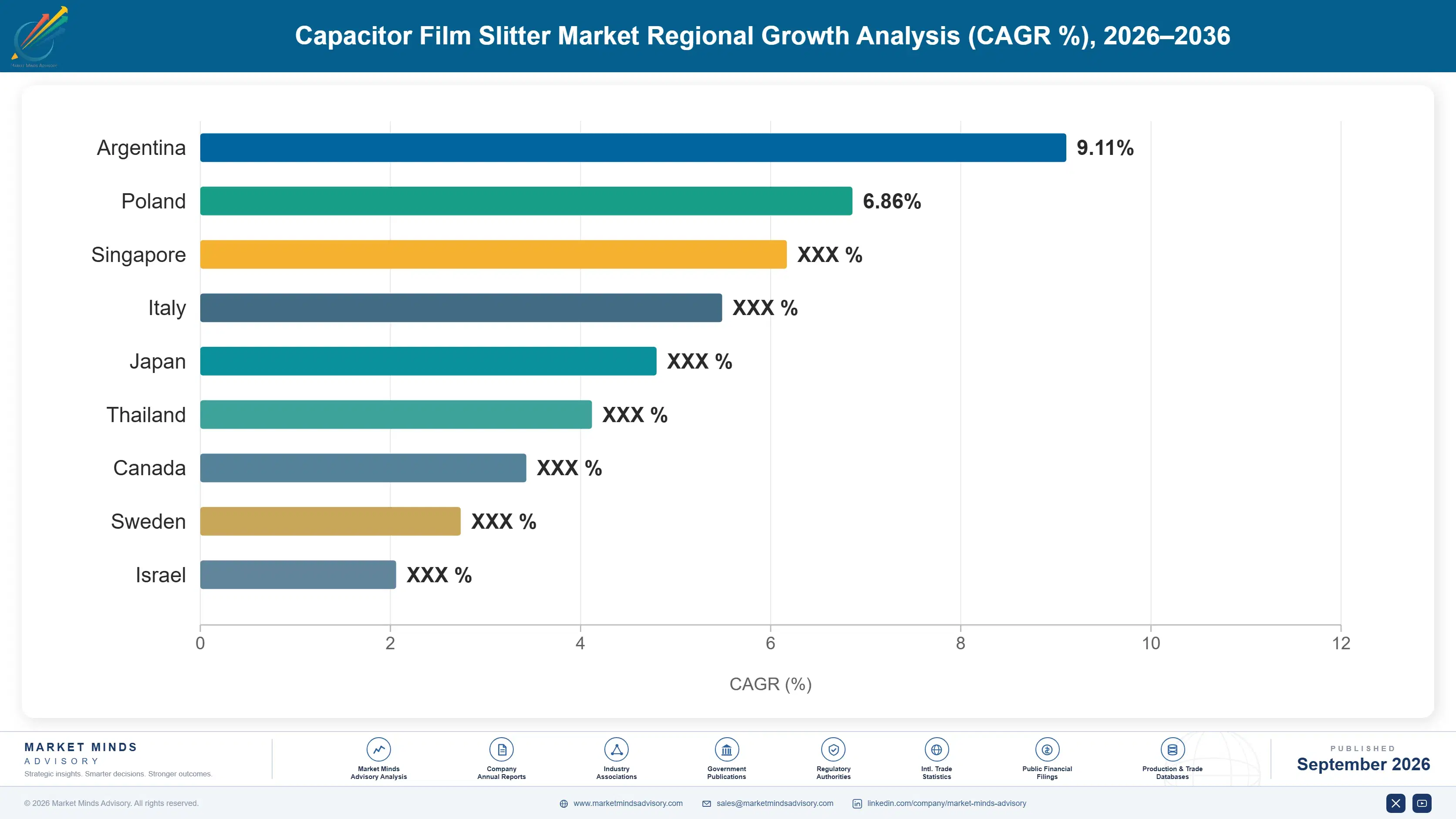
capacitor-film-slitter-market-country-cagr-analysis-1788503255766

Where Equipment Makers Build Lasting Margin

Beyond initial equipment sale price, capacitor film slitter makers build durable revenue through mechanisms that deepen customer dependency and demonstrate measurable production yield improvements over multi-year equipment lifecycles, rewarding vendors that invest early in defect detection accuracy, service contract structuring, and line integration breadth rather than pure cutting speed competition across every served customer segment.

Structuring Multi-Year Preventive Maintenance Service Contracts

Vendors are structuring multi-year preventive maintenance contracts that guarantee blade sharpness, tension calibration, and optical inspection system accuracy, converting what was once occasional reactive repair revenue into predictable recurring service income tied directly to production uptime requirements. Capacitor film manufacturers particularly value this predictability given the production disruption that unplanned slitter downtime causes across an entire converting line. Service contract attach rates typically reach 70 percent of new equipment sales, demonstrating genuine customer willingness to pay for uptime assurance over unplanned repair risk. Larger vendors increasingly bundle remote diagnostics into these preventive maintenance offerings.
Market Impact: Service attach rate reaches roughly 70pp of sales

Selling Automated Defect Detection Software Upgrades

Vendors increasingly sell automated defect detection software as a separate upgrade to customers still operating semi-automated slitting lines, letting manufacturers add inline inspection capability without purchasing an entirely new production line outright. This software upgrade path typically commands 10 to 15 percent of the original equipment price, providing meaningful incremental revenue from an existing installed equipment base rather than requiring a new equipment sale. Customers increasingly accept this model because it extends the useful life of existing capital equipment while still meeting evolving automotive quality traceability requirements. This model lets vendors monetize software investment beyond their traditional hardware sales footprint.
Market Impact: Software upgrades add roughly 10 to 15pp margin

Offering Equipment Financing and Leasing Programs

Vendors are increasingly offering equipment financing and leasing programs that let smaller and mid-sized capacitor film manufacturers access fully automated slitting equipment without the substantial upfront capital expenditure that outright purchase requires, broadening the addressable customer base considerably beyond large, well-capitalized manufacturers. This recurring revenue model also provides vendors with more predictable cash flow than lumpy one-time equipment sales, smoothing revenue recognition across a longer customer relationship period. Roughly 20 percent of new customers now choose financing arrangements over outright purchase, a share vendors expect to grow further. Vendors expect this share to climb further as awareness spreads.
Market Impact: Financing now reaches roughly 20pp of new buyers

Integrating Upstream Metallization Equipment Into Bundled Sales

Vendors that bundle slitting equipment with upstream metallization line sales capture a larger share of a capacitor film manufacturer's total capital expenditure budget, rather than competing purely on standalone slitter specifications against equipment-only competitors. This bundled equipment sale approach typically commands 25 to 35 percent higher total contract value than a standalone slitter sale alone, reflecting the coordinated line design and integration engineering work involved. Manufacturers increasingly prefer a single vendor relationship for coordinated line commissioning rather than managing multiple equipment suppliers separately across a complex production line installation. This bundling also strengthens long-term customer retention meaningfully.
Market Impact: Bundled sales add roughly 25 to 35pp value

Who Controls the Margin Pool

Concentration among the top five capacitor film slitting equipment makers sits at roughly fifty-two percent, reflecting the category's meaningful barriers to entry around precision mechanical engineering and automotive-grade quality certification built over years. Kampf and Atlas Converting lead on installed base and automotive qualification breadth, while the gap separating them from mid-tier challengers like Titan Kogyo remains wide enough that displacing an incumbent typically requires a full equipment replacement cycle rather than incremental improvement.
Current competitive activity centers on inline defect detection integration and equipment financing program expansion, since both directly address the capital cost and quality traceability barriers that historically limited automated equipment adoption among smaller manufacturers. Several vendors have also launched bundled slitting and metallization line offerings, capturing a larger share of customer capital expenditure budgets.

Emerging pressure comes from Chinese domestic equipment makers scaling production to serve the country's rapidly growing capacitor film manufacturing base, threatening established German and Japanese incumbents on price within that specific market. Ranking shifts are most likely among vendors lacking either automotive-grade quality certification or demonstrated financing program capability, since both dimensions increasingly separate durable market leaders from vulnerable mid-tier competitors.
capacitor-film-slitter-market-company-positioning-matrix-1788503256291

Competitive Moat and Risk Dimensions

KAMPF SCHNEID- UND WICKELTECHNIK

Moat: Deep Automotive Qualification History

Kampf maintains the broadest portfolio of automotive-qualified slitting equipment installations among independent equipment makers, giving it demonstrated reliability credentials that smaller competitors cannot easily match without years of comparable customer relationship building and validated production history. This installed base advantage compounds as reference customers vouch for reliability during new customer sales cycles.
KAMPF SCHNEID- UND WICKELTECHNIK

Risk: European Cost Base Exposure

Kampf's German manufacturing base carries meaningfully higher labor and operating costs than Asian competitors, creating margin pressure as Chinese domestic equipment makers increasingly compete on price for less demanding, lower-specification equipment configurations. Kampf has responded partly by expanding financing offerings to remain competitive on total cost of ownership.
ATLAS CONVERTING

Moat: Broad Precision Converting Portfolio

Atlas Converting's broader precision converting equipment portfolio beyond capacitor film alone gives it cross-selling opportunities and engineering expertise that pure-play capacitor film slitter specialists cannot access without diversifying their own product line significantly. This breadth also lets Atlas Converting weather downturns in any single application category more easily than specialists.
ATLAS CONVERTING

Risk: Diluted Category Focus Risk

Atlas Converting's diversified equipment portfolio means capacitor film slitting receives less dedicated research and development investment than pure-play specialists focused entirely on this single, increasingly demanding application category and its evolving requirements. Competitors with narrower, deeper category focus increasingly out-innovate Atlas Converting on capacitor-specific features.

Players Tracked

Prominent Players

Kampf Schneid- und Wickeltechnik
Atlas Converting
Titan Kogyo
Comexi
Cera Group

Other Key Players

Bobst Group
Nordmeccanica
Polytype Converting
Dornier Machinery
Suzhou Chunfeng Machinery
Focus Machinery
Hi-Tech Machinery
Zhejiang Tianma Machinery
Reifenhauser Group
Windmoeller & Hoelscher
Kroenert
Faustel Inc
Davis-Standard
Erhardt+Leimer
PCMC (Paper Converting Machine Company)

Recent Developments

FEBRUARY 2026

Kampf Launches Inline AI Defect Detection System

Kampf launched a new inline artificial intelligence defect detection system designed to identify edge defects and width variation with greater accuracy than previous generation optical inspection technology used across its installed equipment base. The launch represents an internal product development effort rather than an acquisition of external technology.
Signal: Signals continued vendor investment in defect detection accuracy as a durable key differentiator ahead of rivals
NOVEMBER 2025

Atlas Converting Signs Supply Agreement With Indian Manufacturer

Atlas Converting signed a multi-year equipment supply agreement with a major Indian capacitor film manufacturer expanding domestic production capacity backed by government incentive programs supporting local component manufacturing. The agreement is a supply partnership rather than an acquisition or joint venture between the two companies.
Signal: Extends an established vendor's reach into the region's fastest-growing capacitor manufacturing market segment and customer base
AUGUST 2025

Titan Kogyo Acquires Automated Inspection Software Startup

Titan Kogyo acquired a smaller automated inspection software startup to accelerate development of defect detection capability for its slitting equipment product line serving Japanese and export capacitor film manufacturing customers. The acquisition brought in specialized computer vision algorithms that Titan Kogyo plans to integrate directly into its instrumentation.
Signal: Demonstrates the automated inspection expansion pattern this report identifies as central to future vendor growth strategy

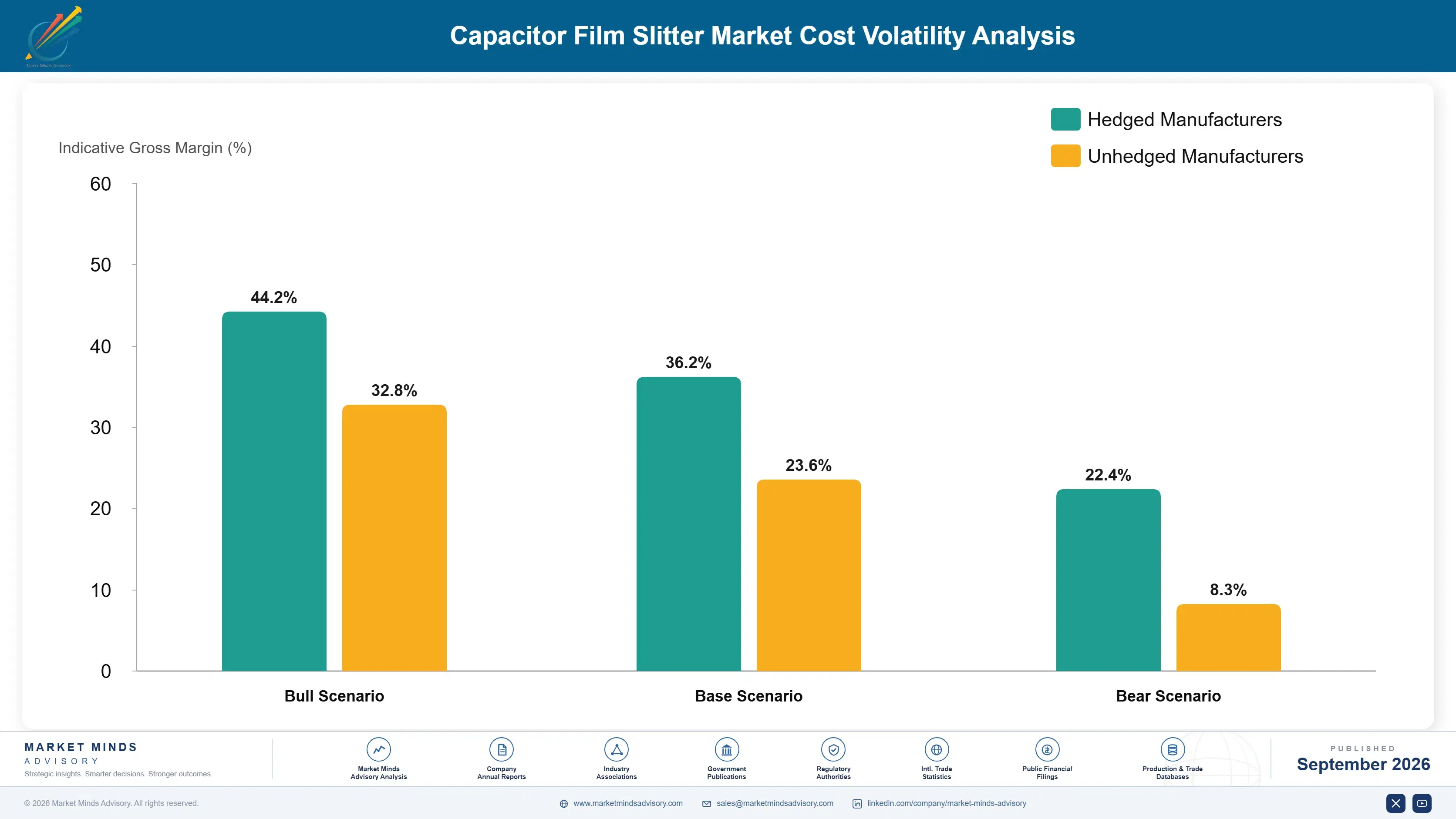
Precision Steel and Optics Cost Exposure

Capacitor film slitting equipment cost structures are dominated by precision-ground steel blades and rollers, servo motor drive systems, and optical inspection components, rather than commodity structural steel or standard industrial parts. Blade steel requires specialized metallurgical grades capable of maintaining cutting edge precision across millions of production cycles, concentrating supply among a limited number of qualified precision steel manufacturers primarily located in Germany and Japan.
Servo motor and precision bearing prices rose meaningfully during 2022 and 2023 amid broader industrial automation component supply chain disruptions, according to equipment maker annual reports discussing rising component procurement costs across the sector and its many suppliers. Vendors without diversified component sourcing relationships absorbed a larger share of this cost increase directly, while others expanded qualified supplier networks to reduce single-source dependency risk going forward.

Smaller vendors lacking established relationships with precision component suppliers face a genuine competitive disadvantage versus larger competitors able to negotiate volume-based pricing agreements directly with steel and servo motor manufacturers. This exposure varies by player type: vendors with long-standing supplier relationships weathered the 2022 to 2023 component cost increases more smoothly than smaller regional competitors lacking comparable purchasing scale and negotiating leverage.
capacitor-film-slitter-market-cost-volatility-analysis-1788503256495

Diversify Precision Component Sourcing

Vendors are qualifying multiple precision steel and servo motor suppliers rather than depending on a single source, reducing exposure to any individual supplier's capacity constraints or pricing changes during periods of tight industrial component supply. This diversification strategy has proven especially valuable during periods of geopolitical trade tension affecting specific producing countries and their export policies.

Negotiate Multi-Year Component Supply Agreements

Vendors are negotiating multi-year supply agreements with key precision component manufacturers, locking in pricing and delivery commitments that reduce exposure to spot market price volatility while giving suppliers the demand visibility needed to plan capacity. Vendors report these agreements have meaningfully reduced unplanned cost increases compared to spot market purchasing across recent years and cycles.

Standardize Component Specifications Across Product Lines

Vendors are standardizing precision component specifications across multiple equipment product lines rather than customizing parts for each configuration, increasing purchasing volume per component and improving negotiating position with key suppliers considerably over time. This standardization also simplifies service parts inventory management for both vendors and their installed customer base across every serviced region worldwide.

Portfolio Architecture for Margin Defence

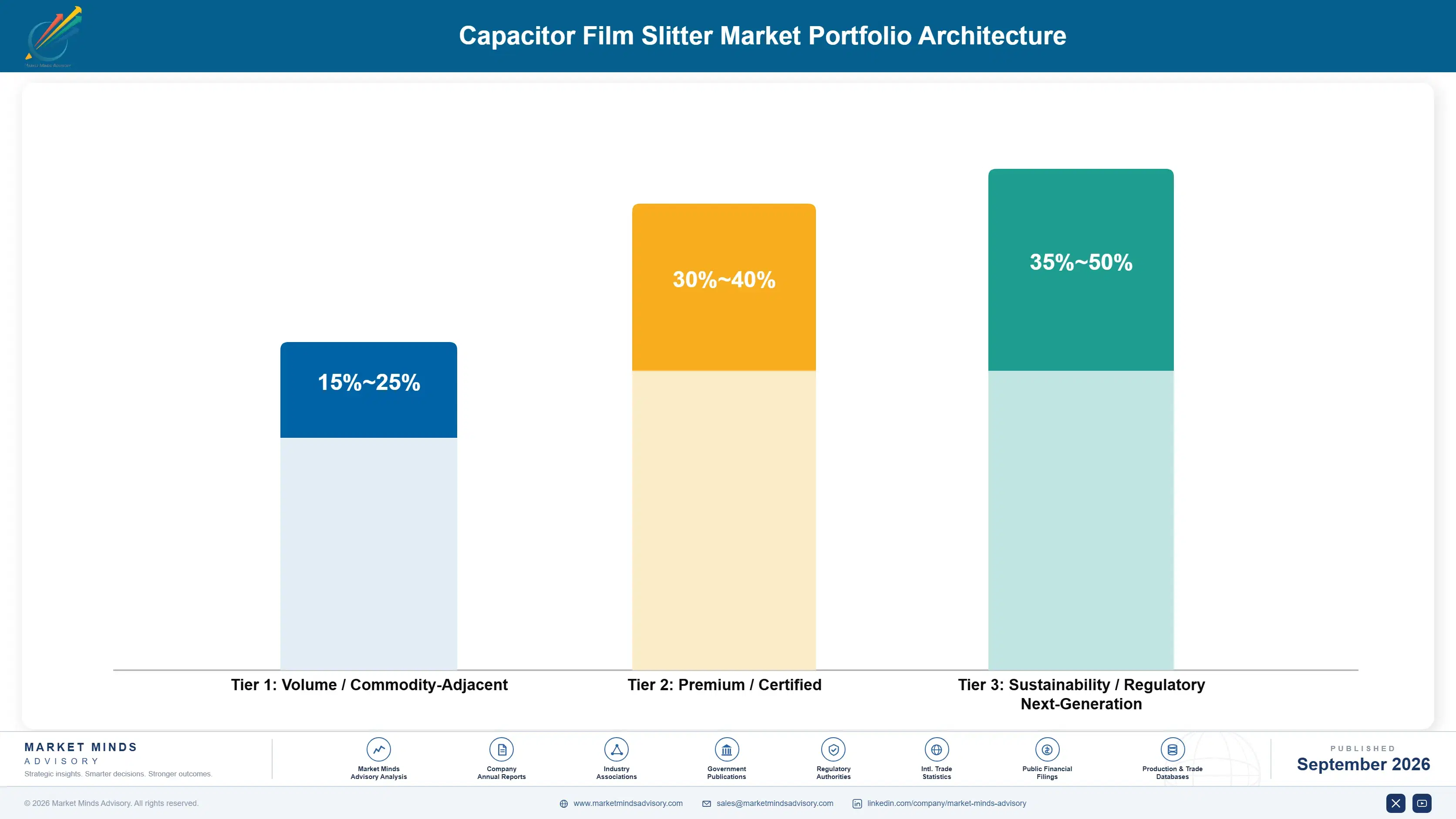
Portfolio economics across capacitor film slitter makers split between semi-automated and legacy equipment competing largely on price, and fully automated systems with integrated defect detection commanding meaningfully higher margins given automotive qualification requirements and service contract attachment sold alongside the core equipment across every customer segment served today, from smaller independent manufacturers to large multinational capacitor producers.
The tension between volume and premium positioning shows clearly in customer segment served: smaller manufacturers serving less demanding industrial applications favor lower-cost semi-automated equipment, while automotive-focused capacitor film producers command substantially higher effective margins through fully automated systems, service contracts, and financing arrangements bundled into a single comprehensive equipment relationship spanning the full production line lifecycle and every subsequent equipment upgrade cycle.

High-value margin pools concentrate around service contracts and bundled metallization-slitting line sales, both requiring specialized integration expertise that smaller vendors cannot easily replicate without years of accumulated engineering experience and customer trust. Vendors positioned purely as standalone equipment manufacturers will struggle to capture this premium tier without meaningful, sustained investment in service capability and line integration engineering over time. Larger vendors with established service organizations increasingly capture this premium tier ahead of smaller regional competitors.

Volume / Commodity-Adjacent

Semi-automated and legacy manual slitting equipment competing largely on price against similar undifferentiated offerings from established competitors serving less demanding applications outside automotive-grade quality requirements and formal traceability documentation standards required elsewhere.
Gross Margin: 15-25%

Premium / Certified

Fully automated slitting lines with integrated defect detection sold to automotive-qualified capacitor film manufacturers requiring documented quality traceability data across every meter of processed film production output shipped to demanding automotive customers.
Gross Margin: 30-40%

Sustainability / Regulatory / Next-Generation

Multi-year service contracts and bundled metallization-slitting line sales requiring specialized integration expertise smaller vendors cannot easily replicate quickly, commanding the category's strongest and most defensible margin position available across the portfolio.
Gross Margin: 35-50%
capacitor-film-slitter-market-portfolio-architecture-1788503256999

High-value Sub-segments and Strategic Watch-out

Fully Automated High-Speed Slitters

The fastest-growing, highest-value segment as automotive customers increasingly require documented quality traceability data that only automated inspection systems can generate consistently across every meter of processed film, converting what was once optional into a standard qualification requirement for new supply contracts across the entire industry.
Gross Margin: 30-40%

Multi-Year Service Contracts

High-value and steadily growing as manufacturers increasingly prefer predictable recurring maintenance costs over unplanned repair expenses that disrupt production schedules, rewarding vendors that can demonstrate consistent equipment uptime performance across multi-year contract relationships, renewal cycles, expanding service scopes, and growing installed facility footprints worldwide today.
Gross Margin: 35-50%

Semi-Automated Slitters

The volume core of the market, generating steady equipment revenue but facing margin pressure from increasingly capable low-cost competitors entering the segment, requiring efficient manufacturing operations to sustain acceptable margins as competition intensifies across every served geography, customer size tier, and equipment application category tracked.
Gross Margin: 15-25%

Chinese Domestic Equipment Entrants

A strategic watch-out category where rapidly scaling domestic Chinese equipment makers could meaningfully compress pricing across the broader global market over time, potentially reshaping which vendors capture the automotive qualification opportunity this report identifies as the category's central near-term growth driver and primary margin source.
Gross Margin: N/A, emerging

How Service Contracts Compound Equipment Value

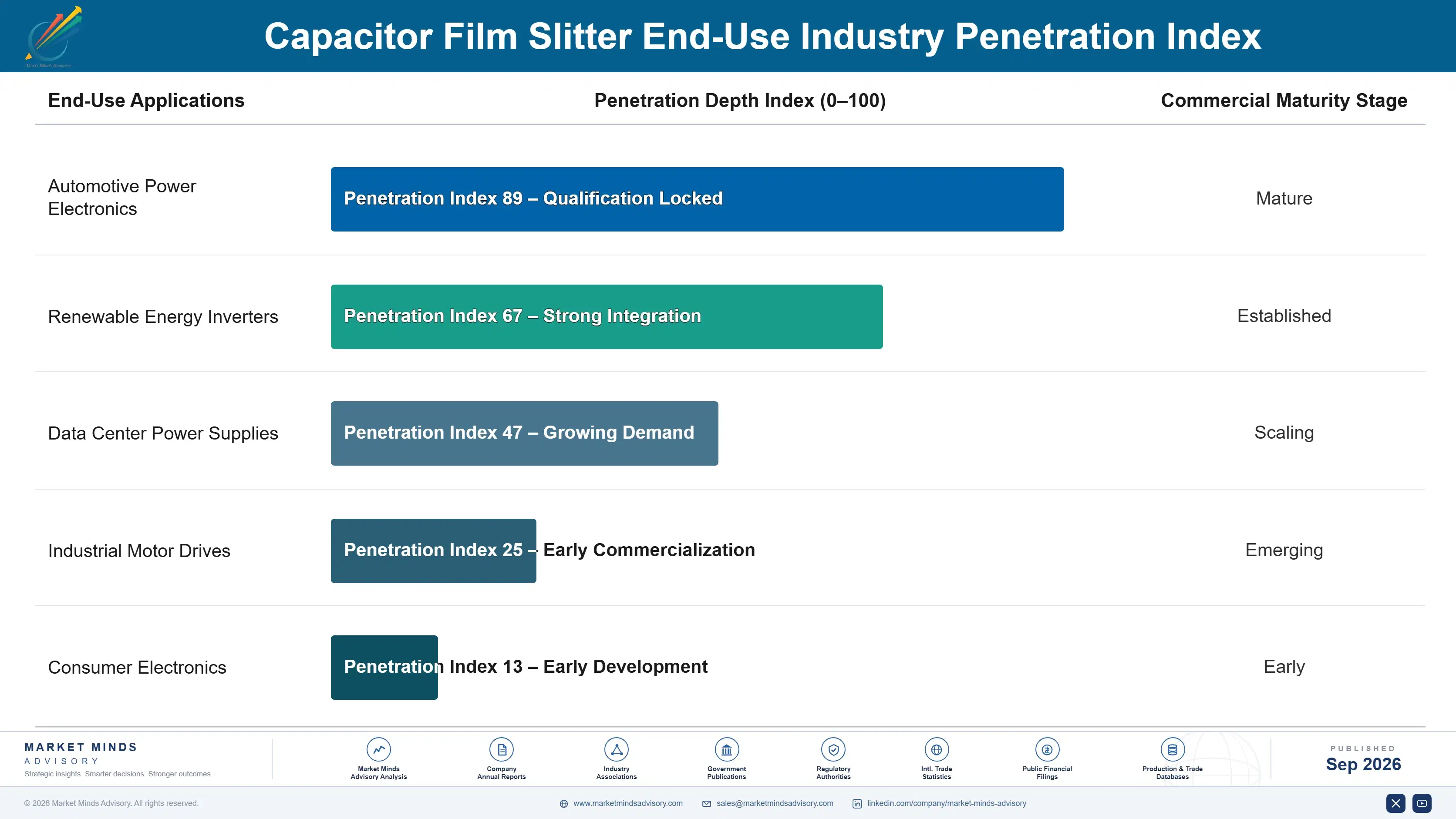
Multi-year preventive maintenance contracts function like an annuity once a manufacturer's production line becomes dependent on continuous blade sharpness and calibration stability, since switching to a competing equipment vendor mid-relationship risks disrupting the production qualification and quality validation built up over months of documented performance history that a new vendor relationship would need to establish entirely from the beginning, adding real transition cost.
Adoption stickiness varies by end-use vertical: automotive-focused capacitor film manufacturers show the deepest lock-in given regulatory validation requirements tied to specific equipment serial numbers and calibration records, while manufacturers serving less regulated industrial applications switch more readily given simpler procurement processes and lower integration requirements tied to any single vendor's specific software or calibration methodology across a typical facility's equipment lifecycle.

Generational shifts in manufacturing engineering are reshaping buyer profiles, as newer production engineers entering the workforce now expect touchscreen software interfaces and automated calibration routines as a baseline equipment capability rather than a premium feature reserved for the most expensive systems only. This mindset shift accelerates purchasing decisions toward vendors offering genuinely simplified operation and remote diagnostics. Vendors slow to modernize interfaces risk losing ground to newer entrants targeting this generational preference shift directly.
capacitor-film-slitter-market-end-use-penetration-index-1788503257488

MMA Verdict on Capacitor Film Slitters

These are among the four positions where our research anticipates prominent divergence between winners and laggards over the coming forecast period. Each is grounded in the demand model, the regulatory perimeter, and the announced capacity pipeline.
01 / AUTOMATED INSPECTION PRIORITY

Prioritize inline defect detection over raw cutting speed

Vendors still competing primarily on cutting speed specifications risk losing ground to competitors that can demonstrate documented quality traceability data increasingly required by automotive capacitor customers across every major vehicle platform program and supply chain tier. Investing in automated defect detection integration compounds over time as accumulated inspection data improves customer confidence and shortens future sales qualification cycles considerably compared to unproven equipment configurations. Vendors should prioritize this investment ahead of incremental speed improvements that matter less to demanding automotive buyers.
02 / FINANCING PROGRAM EXPANSION

Expand equipment financing to capture smaller manufacturers

Vendors offering only outright purchase options leave meaningful revenue on the table by excluding smaller and mid-sized capacitor film manufacturers unable to justify the substantial upfront capital expenditure that fully automated equipment traditionally requires before any measurable return. Expanding financing and leasing programs broadens the addressable customer base while also smoothing vendor revenue recognition across a longer, more predictable customer relationship period than lumpy one-time equipment sales alone provide. Vendors should treat financing as a genuine growth lever worth pursuing.
03 / COMPONENT SUPPLY DIVERSIFICATION

Diversify precision component sourcing across suppliers

Vendors dependent on a single precision steel or servo motor supplier face genuine supply disruption risk during periods of tight component availability across the broader industrial automation manufacturing industry and its many international customers and regions. Qualifying multiple suppliers or negotiating multi-year supply agreements reduces this exposure meaningfully, even at somewhat higher near-term qualification cost for engineering and procurement teams managing supplier relationships across regions. Vendors delaying this diversification risk production delays that damage customer relationships and contract renewal prospects.
04 / BUNDLED LINE INTEGRATION

Pursue bundled metallization-slitting line sales opportunities

Vendors competing purely on standalone slitter specifications leave meaningful revenue on the table compared to competitors capturing a larger share of customer capital expenditure through bundled metallization and slitting line sales offerings sold as a single integrated package. This bundled positioning captures additional revenue from the same underlying customer relationship while making vendor switching considerably more disruptive for customers managing coordinated production line commissioning and installation. Vendors delaying this expansion risk losing ground to more comprehensive, loyalty-building competitors already active in the market today.

Engagement Snapshot From the Field

A live engagement with an industry participant carrying material or product regulatory and market exposure ahead of a defining policy shift, showing how our research translates into a defensible multi-year portfolio strategy.
MARKET MINDS ADVISORY · CLIENT ENGAGEMENT SUMMARY
Capacitor Film Slitter Producer Strategic Portfolio Review and Transition Roadmap 2026·Investment Scenario on Capacitor Film Slitter Exposure Evaluation 2025-26
CLIENT PROFILE
The client is a mid-sized capacitor film manufacturer operating two production facilities, currently using semi-automated slitting equipment but facing pressure from an automotive customer to demonstrate documented quality traceability data for a new electric vehicle traction inverter capacitor supply contract. The company had never operated fully automated inspection-equipped equipment and needed guidance on equipment selection and financing options.
STRATEGIC CHALLENGE
Leadership needed to decide whether to upgrade to fully automated slitting equipment with inline defect detection to win the automotive contract, weighing the substantial capital expenditure required against the risk of losing the contract entirely to a better-equipped rival already operating comparable automated inspection technology at full production scale today.
MMA APPROACH
MMA conducted a structured vendor evaluation across four slitting equipment makers, assessing inline defect detection accuracy, automotive qualification support, and financing program availability against the client's existing facility layout and production volume requirements, supplementing vendor-provided data with reference calls to comparable capacitor film manufacturing clients already using each vendor's systems.
KEY FINDINGS
  1. Two of four evaluated vendors lacked demonstrated automotive-grade quality certification support the client's prospective customer explicitly required before any contract award decision.
  2. Vendors offering equipment financing quoted meaningfully lower effective upfront cost than requiring full cash payment for equivalent automated equipment configurations paid upfront.
  3. The selected vendor's inline defect detection system reduced scrapped material considerably during reference client production runs conducted as part of the evaluation.
  4. Reference clients reported the automated equipment paid for itself within the contract's first two years through reduced material waste and rework costs.
CLIENT PROFILE
The client is a mid-sized capacitor film manufacturer operating two production facilities, currently using semi-automated slitting equipment but facing pressure from an automotive customer to demonstrate documented quality traceability data for a new electric vehicle traction inverter capacitor supply contract. The company had never operated fully automated inspection-equipped equipment and needed guidance on equipment selection and financing options.
STRATEGIC CHALLENGE
Leadership needed to decide whether to upgrade to fully automated slitting equipment with inline defect detection to win the automotive contract, weighing the substantial capital expenditure required against the risk of losing the contract entirely to a better-equipped rival already operating comparable automated inspection technology at full production scale today.
MMA APPROACH
MMA conducted a structured vendor evaluation across four slitting equipment makers, assessing inline defect detection accuracy, automotive qualification support, and financing program availability against the client's existing facility layout and production volume requirements, supplementing vendor-provided data with reference calls to comparable capacitor film manufacturing clients already using each vendor's systems.
KEY FINDINGS
  1. Two of four evaluated vendors lacked demonstrated automotive-grade quality certification support the client's prospective customer explicitly required before any contract award decision.
  2. Vendors offering equipment financing quoted meaningfully lower effective upfront cost than requiring full cash payment for equivalent automated equipment configurations paid upfront.
  3. The selected vendor's inline defect detection system reduced scrapped material considerably during reference client production runs conducted as part of the evaluation.
  4. Reference clients reported the automated equipment paid for itself within the contract's first two years through reduced material waste and rework costs.
RECOMMENDED STRATEGY
Phase 1: Phase one: install a single fully automated slitting line to fulfill the initial automotive contract volume before broader facility-wide investment. Phase 2: Phase two: expand automated equipment to the second production facility once initial performance and customer satisfaction metrics clear defined thresholds. Phase 3: Phase three: phase out remaining semi-automated equipment as existing contracts reach natural renewal points requiring comparable quality documentation standards eventually.
OUTCOME
The client installed its automated slitting line and won the automotive supply contract, reporting a meaningful reduction in scrapped material during the first year of production (client-reported, unverified by MMA). Leadership credited the equipment financing arrangement with making the capital investment feasible on the contract's tight timeline.

Frequently Asked Questions

Foundational context covering the market sizes, CAGR, scope, country, region and competition that inform every finding below. This section is provided to cover basics and most often pre-purchase conversations, answered from the MMA Primary Research Dataset.

What is the current size of the Capacitor Film Slitter Market?

The Capacitor Film Slitter Market is valued at 0.6 billion dollars in 2025. It is expected to reach 0.64 billion dollars by 2026 as automation adoption accelerates.

How large will the Capacitor Film Slitter Market be by 2036?

The market is projected to reach 1.2 billion dollars by 2036, up from 0.64 billion dollars in 2026. That represents a 1.88 times expansion over the forecast period.

What is the CAGR for the Capacitor Film Slitter Market 2026 to 2036?

The market is forecast to grow at a 6.5 percent compound annual growth rate between 2026 and 2036. This reflects steady demand tied to electric vehicle production growth.

Which segment is growing fastest?

Fully Automated High-Speed Slitters lead at a 9.5 percent CAGR, roughly 1.46 times the overall market rate. Automotive quality traceability requirements are driving this adoption.

Who are the major companies in the Capacitor Film Slitter Market?

Leading equipment makers include Kampf, Atlas Converting, Titan Kogyo, Comexi, and Cera Group. Together these five companies hold an estimated 52 percent combined market share.

Which country is growing fastest?

India leads at an 8.5 percent CAGR, driven by rapidly expanding electric vehicle and renewable energy manufacturing backed by government incentive programs. Export quality requirements are also accelerating adoption.

Report Segmentation Architecture

The full report scope spans multiple orthogonal segmentation dimensions, with cross-tabulated demand data provided for each dimension pair. Coverage extends further to regional breakdowns, trend trajectories, and the competitive detail needed to support segment-level decision-making.

By Primary Market Dimension

  • Fully Automated High-Speed Slitters
  • Semi-Automated Slitters
  • Manual Legacy Slitting Lines
  • Inline Defect Detection Retrofit Systems
  • Precision Rewinding Stations
  • Turnkey Metallization-Slitting Lines

By End-Use Industry

  • Automotive Power Electronics
  • Renewable Energy Inverters
  • Data Center Power Supplies
  • Industrial Motor Drives
  • Consumer Electronics

By Commercial Dimension

  • Direct Equipment Purchase
  • Equipment Financing and Leasing
  • Multi-Year Service Contracts
  • Bundled Line Integration Sales

By Region

  • North America
  • Western Europe
  • East Asia
  • South Asia and Pacific
  • Latin America
  • Middle East and Africa
  • Eastern Europe

Scope, Methodology, and Coverage

Every figure in this report is reproducible from documented input assumptions. The scope below maps the historical period, the forecast horizon, the segmentation dimensions, and the countries covered, alongside the underlying primary and qualitative methodology.
Historical Period
2020 to 2025
Forecast Period
2026 to 2036
Base Year
2025 (USD billions; MMA Primary Research Dataset, September 2026)
Market Definition
This market covers precision slitting equipment used to cut wide rolls of metallized polymer film into narrow capacitor-grade tape for winding into film capacitors used in power electronics applications. It excludes the film manufacturing and metallization equipment itself, and finished capacitor winding and assembly machinery.
Quantitative Units
USD billions, market share percentages, CAGR percentages
Segmentation Dimensions
Automation level type, end-use industry, commercial dimension, region
Regions Covered
North America, Western Europe, East Asia, South Asia and Pacific, Latin America, Middle East and Africa, Eastern Europe
Countries Covered
United States, Germany, Japan, China, Taiwan, South Korea, India, Brazil, United Arab Emirates, and 30 additional countries across all seven global regions
Key Companies Profiled
Kampf Schneid- und Wickeltechnik, Atlas Converting, Titan Kogyo, Comexi, Cera Group, and 15 additional equipment makers
Quantitative Methodology
Primary survey, n=3,800 respondents, Q4 2025, six countries; demand-side model with trade association cross-validation
Qualitative Methodology
47 expert interviews, Q4 2025; applied to validate demand model assumptions, identify emerging dynamics, and assess competitive positioning
Report Format
PDF and XLSX data workbook (Word format preview document)
Publisher
Market Minds Advisory
Report Code
MMA-2026-CON-654
Published
September 2026
Contact
sales@marketmindsadvisory.com | www.marketmindsadvisory.com

Purchase the full Capacitor Film Slitter Market Report (2026 to 2036).

This report examines the Capacitor Film Slitter Market across its full 2026 to 2036 forecast horizon, covering market sizing, segmentation, competitive dynamics, and regional demand patterns in depth. It draws on primary survey data from 3,800 respondents and 47 expert interviews conducted in the fourth quarter of 2025. The analysis profiles twenty leading equipment makers and quantifies revenue levers, component cost exposure, and portfolio economics across the category's major segments. Strategic recommendations address automated inspection priorities, financing program expansion, and component diversification for vendors and investors.
Full 2026-2036 market sizing and forecast data
Seven-region demand and growth rate breakdown
Twenty-company competitive profiles and moat analysis
Segment-level CAGR and market share detail
Revenue lever and component cost exposure analysis
Anonymised client case study with strategy recommendations

Built For The People Who Decide

From boardroom strategy to bench-side execution, this report is read cover-to-cover by leaders shaping the next decade of their industry, turning demand scenarios, market dynamics and valuation benchmarks into decisions.
CXOs/ Presidents/ VPs/ Managers
M&A and Corporate Development
Strategy Teams and R&D Heads
Procurement and Product Directors
Regulatory and Compliance Leaders
Investor Relations and Equity Analysts