Market Minds Advisory
Canine Cancer Screening Market

Canine Cancer Screening Market: Selling A Test For A Dog That Looks Perfectly Well

No insurer mandates it, no government funds it, and the patient shows no symptoms. Every dollar in canine cancer screening depends on a veterinarian raising the subject during a routine annual wellness appointment.

Lead Analyst

Alice Ballenger

Published

September 2026

Make Smarter Decisions with Customized Research Insights

Request a free sample report and evaluate market opportunities, growth trends, and competitive dynamics relevant to your business needs.

2025 MARKET VALUE$0.3BMarket Size 2025
2036 FORECAST VALUE$1.2BBase Case , 2026 to 2036
CAGR 2026 TO 203614.5 %Bull 15.8% / Bear 13.2%
INCREMENTAL OPPORTUNITY$0.9BNet 10- year value creation
EXPANSION MULTIPLE3.87x2036 value over 2026 base
Strategic Levers
M&A Pipeline
Regional Outlook
Country Rankings
Competitive Intelligence
Segmental Deep-dive
Call-Us : 91 93563 13602

Executive Snapshot and Market Trajectory

Nobody has to buy this. There is no national screening programme, no insurer mandate, and no symptomatic dog demanding attention, so every sale begins with a veterinarian choosing to raise cancer during a routine wellness visit that already runs short of time and pays nothing at all for the conversation.
The market reaches USD 0.28 billion in 2025 and compounds at 14.5% to USD 1.24 billion by 2036, an expansion multiple of 3.87 times. Liquid biopsy cell-free DNA panels grow fastest at 20.3%, exactly 1.40 times the market rate. North America holds 36% of value, above the band this framework applies, because veterinary oncology referral capacity and owner willingness to spend both concentrate there heavily.
Concentration sits at 32% across the top five, split between reference laboratory groups holding existing veterinary distribution and screening specialists with better assays but no channel of their own to sell through. Breed-linked risk gives this field a targeting mechanism that human oncology screening simply lacks. Specificity matters far more than sensitivity here, because a single false positive triggers an expensive diagnostic workup that nobody reimburses and no owner expected.
Market Definition
The canine cancer screening market covers tests and services used to detect malignancy in dogs showing no clinical signs, spanning blood-based cell-free DNA and nucleosome assays, protein and enzyme biomarker panels, urine and faecal biomarker tests, screening-indicated imaging, and cytology-based wellness panels. Diagnostic workup of symptomatic animals, tumour staging, treatment selection genomics, therapeutics, and screening in species other than dogs are excluded.
Base Year Value
$0.3B in 2025 (MMA Primary Research Dataset, August 2026)
Forecast Period
2026 to 2036, eleven discrete annual values
CAGR
14.5% base case. Bull 15.8%. Bear 13.2%.
Fastest Growth Segment
Liquid Biopsy Cell-Free DNA Panels: 20.3% CAGR
Fastest Growth Country
China: 18.2% CAGR
Fastest Growth Region
South Asia and Pacific: 17.0% CAGR
Largest Region
North America: 36% of 2025 global value
Market Leaders
IDEXX Laboratories, Antech Diagnostics, VolitionRx, PetDx, Heska. Source: MMA Primary Research Dataset, July 2026.
Primary Survey
n=3,800 procurement and R&D decision-makers, Q4 2025, six countries
Methodology
Demand-side build-up, cross-validated against public data, 47 expert interviews

Canine Cancer Screening Market Forecast Scenarios

canine-cancer-screening-market-size-forecast-scenario-1787297918068
Between 2020 and 2025 this field went from research curiosity to commercial reality and then discovered how hard the commercial part is. Pandemic-era pet acquisition pushed veterinary spending sharply higher, the first cell-free DNA screening panels launched, and adoption ran well below every launch forecast. A 13.4% historical CAGR combines genuine product arrival with a distribution problem nobody solved.
Three mechanisms carry the 14.5% base case. Breed-targeted screening is the first, since lifetime cancer risk in some pedigrees runs above half and gives veterinarians a defensible reason to recommend testing at a specific age. Pet insurance expansion is the second, as wellness riders increasingly cover screening panels outright. And corporate veterinary group consolidation is the third, because a protocol adopted centrally reaches thousands of clinics at once rather than one at a time.
The 15.8% bull case rests on a major insurer adding cancer screening to standard wellness cover, which would remove the owner payment decision entirely and change adoption overnight. The 13.2% bear case is false positive experience: a run of healthy dogs sent for expensive imaging that finds nothing would damage veterinarian confidence faster than any marketing budget could rebuild it.

Screening A Patient Who Cannot Consent

Screening healthy animals is a fundamentally different business from diagnosing sick ones, and the industry keeps underestimating the distance. A sick dog arrives with an owner already prepared to spend. A well dog arrives for vaccinations, and somebody must introduce the idea that an invisible disease might be present. That conversation takes several minutes in an appointment that runs twenty, and no veterinarian is compensated for having it.
TOP FIVE CONCENTRATION32%Reference laboratories and screening specialists occupy quite different positions
LIQUID BIOPSY PRICEUSD 425Owner-paid price for a single blood-based screening panel
BREED LIFETIME RISK60%Share of one popular breed developing malignancy during life
SCREENING ATTACH RATE4%Portion of senior wellness visits including any cancer screen
INSURANCE PENETRATION3.9%Share of dogs worldwide carrying any form of health cover
MEDIAN DIAGNOSIS AGE8.8 yearsTypical age at which canine malignancy is first identified
Breed genetics change the arithmetic in a way human screening cannot replicate. Golden Retrievers carry lifetime cancer risk near 60%, Bernese Mountain Dogs are heavily predisposed to histiocytic sarcoma, and Boxers, Rottweilers, and Flat-Coated Retrievers each carry recognised patterns. Pedigree defines a high-risk cohort before any biomarker is measured, which sharpens positive predictive value and gives the recommendation a concrete basis an owner accepts.
Specificity governs commercial survival here more than sensitivity does. A missed cancer is invisible until much later, but a false positive sends a healthy dog for imaging costing several times the test, paid by an owner who was told nothing was wrong. Three or four of those in a practice and the protocol quietly disappears, regardless of what the validation data says.
"The assays work considerably better than the adoption numbers suggest. What nobody built was a way to pay a veterinarian for the four minutes it takes to explain why a healthy dog needs a cancer test."
Principal, Animal Health Diagnostics Practice · MMA Healthcare Practice &m

Market Trends

Breed Risk Profiles Define A Targetable Screening Cohort

Canine cancer risk clusters by pedigree far more sharply than human cancer risk clusters by any accessible variable, and veterinarians already record breed at every visit. Golden Retrievers approach 60% lifetime incidence, Bernese Mountain Dogs carry extreme histiocytic sarcoma predisposition, and several other breeds show documented patterns from an identifiable age. That converts a general screening pitch into a specific recommendation with a defensible trigger point. Positive predictive value improves considerably when the tested population is genuinely enriched, which matters considerably more here than assay chemistry does at this stage of the market's development.
Market Impact: Covers under 4% of dogs

Corporate Veterinary Groups Adopt Protocols Centrally Rather Than Individually

Consolidation has moved a large share of clinics into corporate groups operating hundreds or thousands of practices under shared medical protocols and shared laboratory contracts. A screening panel added to a senior wellness protocol at group level reaches every clinic simultaneously rather than through individual veterinarian persuasion. That single decision is worth more than years of field sales activity, which is why screening companies now sell to medical directors rather than to practices. It also concentrates the risk substantially, since a single group withdrawing removes thousands of sites at once and gives no notice.
Market Impact: Diagnosis peaks near 9 years

Market Opportunities and Growth Drivers

Pet Insurance Wellness Riders Begin Covering Screening Panels

Pet insurance covers a small share of dogs globally, under 4%, but growth is rapid and wellness riders have started to include diagnostic screening rather than only vaccination and dental work. Where a rider covers the panel outright, the owner payment decision disappears entirely and attach rates rise by a multiple rather than a margin. Insurers are motivated because earlier detection lowers claim severity on treatment they would otherwise fund. Several carriers now list cancer screening explicitly in their optional wellness schedules, and others are running pilots ahead of a decision.
Market Impact: Workup costs USD 1,200

Owner Spending On Senior Dogs Keeps Climbing Steadily

Household veterinary expenditure has risen faster than general consumer spending across most developed markets for over a decade, and the increase concentrates on older animals where owners accept substantial costs to extend life. Median canine cancer diagnosis falls near nine years of age, precisely where that willingness peaks. Specialty oncology referral centres have expanded to meet it, creating the treatment pathway a positive screening result requires. Without somewhere to send a positive result, screening has no clinical or commercial purpose whatsoever, which is why capacity and adoption track each other closely.
Market Impact: Attach rate capped near 4%

Market Restraints and Challenges

False Positives Destroy Veterinarian Confidence Faster Than Data Rebuilds It

A false positive sends a well dog for imaging and specialist consultation costing several times the screening test, paid entirely by an owner previously told nothing was wrong. The root cause is that screening a low-prevalence population makes positive predictive value fragile even at high specificity. Commercially, three or four such episodes in one practice end the protocol regardless of validation evidence. Participants are mitigating through breed and age enrichment that raises pre-test probability, through two-stage confirmatory testing before referral, and through covering follow-up imaging costs on screen-positive animals directly.
Market Impact: Enriches cohort 60% lifetime risk

No Reimbursement Mechanism Pays For The Recommendation Conversation

Explaining why a healthy dog should be tested for cancer takes several minutes inside an appointment already running short, and no fee code compensates the veterinarian for it. The root cause is that veterinary pricing bills procedures and products rather than counselling time. Commercially this caps attach rates near 4% of senior wellness visits regardless of how good the assay itself happens to be. Mitigation runs through owner-facing pre-visit questionnaires, through breed-triggered reminders generated automatically by practice management software, and through margin sharing arrangements that pay the practice properly on every panel sold.
Market Impact: Reaches 3,000 clinics per decision
4 additional market trends, 3 additional growth drivers, and 2 additional restraints and challenges are covered in the full report. Contact sales@marketmindsadvisory.com to access the complete intelligence.

Segment CAGR and Growth Architecture

Segmentation follows the detection method, because what the test physically measures determines where it runs, what it costs an owner, how long the result takes, and whether a general practice can offer it without sending anything to a reference laboratory. Clinical indication and care setting are handled in the framework rather than treated as segments here.
canine-cancer-screening-market-market-share-analysis-1787297918646

Liquid Biopsy Cell-Free DNA Panels

Cell-free DNA panels grow fastest at 20.3%, exactly 1.40 times the market rate, detecting tumour-derived genomic fragments circulating in a routine blood draw. The sample collection is trivial, which is the entire commercial argument, since anything requiring sedation or specialist handling will never reach a general wellness appointment. Analysis runs at centralised reference laboratories with turnaround measured in days rather than minutes, and pricing sits near USD 425 to the owner before any practice markup. Breed and age enrichment matter more to performance than assay chemistry does at this point. Adoption remains far below what the validation data alone would predict, and that gap is a distribution problem rather than a scientific one.
CAGR 20.3%

Nucleosome And Protein Biomarker Assays

Nucleosome and protein biomarker assays grow at 17.6%, measuring circulating markers associated with tumour cell turnover rather than sequencing genomic material directly. Cost per test runs well below cell-free DNA work, which makes these panels viable as a broad first-line screen where the sequencing approach cannot reach on price alone. Some formats run on analysers already installed in larger practices, removing the reference laboratory turnaround entirely and letting a veterinarian discuss results during the same visit. Specificity is the recognised weakness of the format and two-stage confirmation is now common practice. The economics suit high-volume corporate group protocols particularly well, especially where a cheaper first-line screen feeds confirmation onto a sequencing panel.
CAGR 17.6%
Full segment breakdown across 5 segments available in the complete report.

Regional Architecture and Country Demand Map

Two regions carry shares outside the bands this framework applies, and the reason is the same in both cases. Canine cancer screening requires specialty oncology referral capacity plus owner willingness to fund it, and that combination exists in far fewer places than pet ownership does.

North America

North America holds 36% of value against a 32% ceiling in this framework, and the breach reflects genuine concentration rather than any modelling preference. Specialty veterinary oncology referral centres are far denser here than anywhere else, which matters because a screening result with nowhere to go has no clinical purpose. Corporate veterinary groups operating thousands of clinics under shared protocols give screening companies a distribution route that exists in no other region at comparable scale. Pet insurance penetration, while low in absolute terms, exceeds most markets and wellness riders increasingly list screening. Growth at 13.9% sits near the global rate on a base already larger than every other region combined.
Share: 36% | CAGR: 13.9% (2026 to 2036)

Western Europe

Twenty-four percent of value sits in Western Europe, where Sweden and the United Kingdom carry pet insurance penetration far above the global average and Germany and France contribute the largest absolute veterinary spending. Insurance matters more here than elsewhere because coverage removes the owner payment decision that otherwise caps attach rates everywhere. Veterinary practice consolidation has advanced considerably across the United Kingdom and the Netherlands, creating the same central protocol route that works in North America. Referral oncology capacity is good across northern Europe and considerably thinner in southern markets. Growth at 13.2% trails the global rate slightly on a mature base where owner spending per animal is already high.
Share: 24% | CAGR: 13.2% (2026 to 2036)
Regional intelligence for 5 additional markets available in the complete report: East Asia, South Asia and Pacific, Latin America, Middle East and Africa, Eastern Europe. Contact sales@marketmindsadvisory.com.
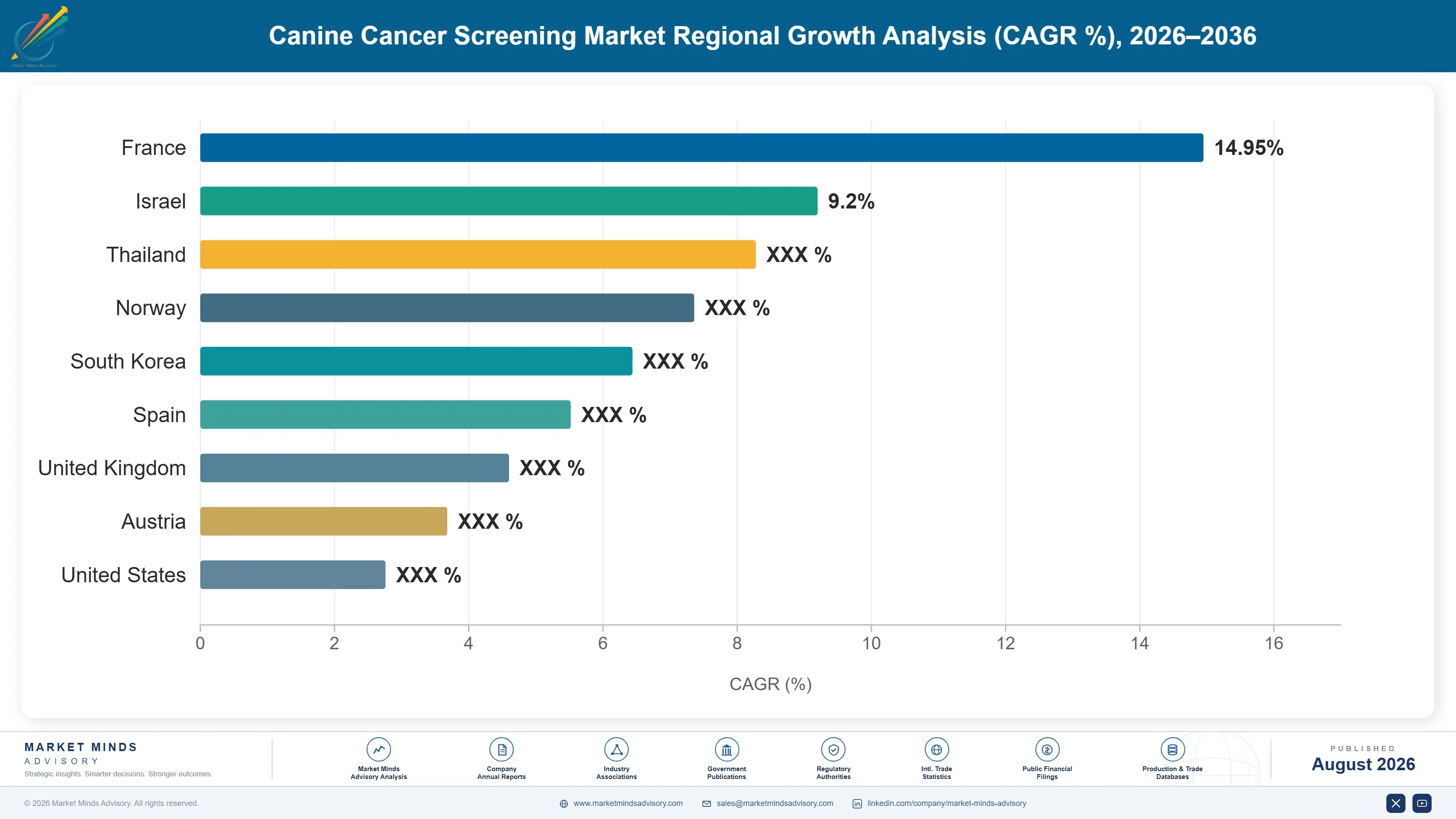
canine-cancer-screening-market-country-cagr-analysis-1787297919163

Getting Paid In A Voluntary Market

Nothing here is compulsory, so every lever works by removing a decision rather than by improving a product. Take the payment decision off the owner, take the recommendation decision off the individual veterinarian, or take the follow-up cost risk off the practice. Four approaches follow from that, and none of them involves better assay chemistry.

Sell Protocols To Corporate Group Medical Directors

A screening panel written into a corporate veterinary group's senior wellness protocol reaches every clinic in that group simultaneously, which for the largest operators means several thousand sites from a single decision. Field sales to individual practices converts at roughly 2% per visit and costs more per acquired clinic than the first year of panel revenue returns. Central adoption inverts that entirely. It concentrates risk too, since one group withdrawing removes thousands of sites overnight, but the acquisition economics are not close, and every specialist that has tried both routes has reached the same conclusion.
Market Impact: Reaches up to 3,000 clinics from one decision

Underwrite Follow-Up Imaging On Positive Results

The commercial threat is not a missed cancer, it is a healthy dog sent for a USD 1,200 imaging workup that finds nothing while the owner pays for it. Covering confirmatory imaging on screen-positive animals costs roughly 8% of panel revenue at realistic positive rates and removes the single reason practices abandon protocols. Veterinarians recommend far more freely once the downside sits with the supplier rather than with the client relationship they have spent years building. Protocol retention improves by roughly 20 percentage points across practices where this cover applies.
Market Impact: Costs roughly 8% of total annual panel revenue

Build Breed-Triggered Reminders Into Practice Software

Practice management systems already hold breed and date of birth for every patient, so a reminder firing when a Golden Retriever reaches six or a Bernese Mountain Dog reaches four requires integration rather than persuasion. Clinics running automated breed-triggered prompts report attach rates around 3 times the unprompted baseline, lifting senior visit penetration from roughly 4% toward 12%. The prompt also gives the veterinarian a concrete opening that takes seconds rather than minutes. Integration work with the major software vendors is slow and expensive, and it is close to unassailable once complete.
Market Impact: Attach rate rises roughly 3 times over baseline

Partner With Insurers On Wellness Rider Inclusion

An insurer that lists cancer screening in a wellness rider removes the owner payment decision completely, and attach rates in covered populations run several times higher than in uncovered ones. The argument to the carrier is claim severity: earlier detection lowers the cost of treatment the insurer would otherwise fund in full. Negotiated panel pricing to insurers typically runs 25% to 30% below owner-paid rates, which is comfortably worth it against the volume difference. Very few screening companies have staffed payer development properly, which is why the channel remains almost entirely unbuilt.
Market Impact: Insurer pricing runs 25% to 30% below owner rates

Who Controls the Margin Pool

Concentration at 32% across the top five reflects a market split between two kinds of participant that need each other. Reference laboratory groups own veterinary distribution, courier logistics, and the practice relationships, but arrived late to screening assays. Screening specialists built better tests and have no channel. All participants here are compared on measured global revenue from companion animal cancer screening products and services, the only basis spanning both.
Competition currently runs on distribution access rather than on analytical performance. IDEXX and Antech reach essentially every clinic through existing laboratory contracts and installed analysers, so a panel added to their menu appears in front of veterinarians without any new sales effort. PetDx and VolitionRx compete on assay evidence and breed-specific validation, and both have had to negotiate their way into corporate group protocols.

Pressure is building where screening meets treatment selection. ImpriMed, Vidium, and FidoCure sit downstream in therapy guidance, and the natural move is upstream into detection where the patient population is far larger. Rankings shift most on corporate group protocol decisions, and on whichever company first persuades a major insurer to fund screening as standard cover.
canine-cancer-screening-market-company-positioning-matrix-1787297919694

Competitive Moat and Risk Dimensions

IDEXX LABORATORIES

Moat: Universal Veterinary Laboratory Distribution Reach

IDEXX reaches essentially every companion animal practice of scale through reference laboratory contracts, courier networks, installed analysers, and practice management software it also supplies. A screening panel added to that menu appears in front of veterinarians with no new sales effort at all. No screening specialist can build an equivalent route within a decade of trying.
IDEXX LABORATORIES

Risk: Slow Assay Innovation Cadence

The company's advantage lies in distribution rather than in novel assay development, and its screening portfolio has trailed the specialists on published breed-specific validation evidence. Veterinary oncologists influence corporate group protocols and they read the data. If a competitor's panel becomes the clinically preferred choice, distribution strength defends volume but not premium pricing.
ANTECH DIAGNOSTICS

Moat: Ownership Inside Veterinary Care Groups

Antech sits within a group that also owns large veterinary hospital networks, which means laboratory volume and clinical protocol setting live under one roof. Screening panels can be written into hospital group protocols directly rather than sold into them. That vertical position is unavailable to every independent competitor and it converts protocol decisions into captive laboratory volume.
ANTECH DIAGNOSTICS

Risk: Channel Conflict With Independents

The same ownership structure that guarantees captive volume makes independent practices wary, since sending samples to a laboratory owned by a competing hospital group raises obvious commercial questions. Independent clinics still represent a large share of companion animal visits in most markets. That reluctance caps reach precisely where organic growth would otherwise be easiest to find.

Players Tracked

Prominent Players

IDEXX Laboratories
Antech Diagnostics
VolitionRx
PetDx
Heska

Other Key Players

Zoetis
Zomedica
Vidium Animal Health
ImpriMed
Oncotect
FidoCure
Torigen Pharmaceuticals
Sonic Healthcare
Neogen
Virbac
Skyla
MiDOG
Nationwide Laboratory Services
Gribbles Veterinary Pathology
Laboklin

Recent Developments

FEBRUARY 2025

VolitionRx Expands Nucleosome Screening Distribution Into European Laboratories

VolitionRx signed additional distribution agreements placing its nucleosome-based canine screening assay with veterinary reference laboratories across several European countries. The arrangements cover supply and laboratory validation only, with no equity component and no exclusivity, and the company said first revenue would follow local validation completion.
Signal: A supply agreement rather than a partnership, reflecting how little channel leverage assay specialists actually hold
JUNE 2025

Large Corporate Veterinary Group Adds Screening To Senior Protocol

A major North American corporate veterinary group added blood-based cancer screening to its recommended senior wellness protocol across its clinic network, following an eighteen-month pilot. The decision was taken centrally by the group medical committee rather than left to individual practice discretion, which is the material point.
Signal: One central medical committee decision moves far more volume than several years of individual practice selling
SEPTEMBER 2025

Pet Insurer Adds Cancer Screening To Wellness Rider Schedule

A United States pet insurance carrier added annual cancer screening to the covered items in its optional wellness rider, at negotiated panel pricing below owner-paid rates. The carrier cited reduced claim severity from earlier detection as its rationale rather than any competitive positioning against other insurers.
Signal: Insurance coverage removes the owner payment decision entirely, which is precisely what constrains screening adoption today

What A Screening Panel Costs To Run

Sequencing reagents and library preparation kits account for roughly 30% to 38% of cost of goods on cell-free DNA panels, and the supplier base narrows to two or three American and Chinese manufacturers. Antibody and enzyme reagents for nucleosome and protein assays add 18% to 24% on those formats, sourced largely from European and North American specialty producers. Courier logistics and laboratory labour account for the balance.
Sequencing consumable pricing fell substantially through 2023 and 2024 as competition arrived in the short-read instrument market, and Illumina's annual report for 2024 documented consumable revenue declining on volume that rose, which is the pattern falling unit prices produce. Canine panel cost of goods improved materially as a result. Antibody reagent pricing moved the other way, tightening on specialty production constraints affecting veterinary and human diagnostics alike.

Exposure separates cleanly by assay format rather than by company size. A specialist running only cell-free DNA panels rides sequencing consumable pricing directly with no offset anywhere in its portfolio. Reference laboratory groups spread that exposure across hundreds of assay types and negotiate reagent contracts at a volume no screening startup approaches. Point-of-care formats sit outside sequencing exposure entirely and carry antibody cost risk instead.
canine-cancer-screening-market-cost-volatility-analysis-1787297919889

Contract Sequencing Volume Across Multiple Assay Lines

A screening specialist buying reagents for one panel has no negotiating position at all, while a laboratory group buying across hundreds of assays does. Pooling volume through a reference laboratory partner rather than contracting directly typically improves reagent pricing by a fifth, and the trade is margin share against cost certainty that a single-product company cannot otherwise obtain.

Qualify A Second Sequencing Chemistry Before It Is Needed

Validating a canine panel on a second sequencing platform takes nine to fifteen months and real money, which is why almost nobody does it in advance. Companies that have can move volume when pricing or supply shifts, and the option value shows up exactly when a single-platform competitor has no room to negotiate anything at all with its supplier.

Move High-Volume Screening To Lower Cost Assay Formats

Nucleosome and protein assays cost a fraction of sequencing-based panels to run and suit a broad first-line screen where cell-free DNA work cannot reach on price. Reserving the expensive format for confirmation on screen-positive animals cuts blended cost of goods considerably while improving positive predictive value, which addresses the commercial and the cost problem together.

Portfolio Architecture for Margin Defence

Margin architecture separates by where the test physically runs and who owns the customer relationship. Panels distributed through third-party reference laboratories earn 28% to 38% to the assay owner, because the laboratory takes a substantial share for handling, reporting, and the clinic relationship it already owns. Direct-to-practice screening programmes with interpretive reporting and breed-linked protocols earn 52% to 64%, since the assay owner captures the whole chain.
The tension is that direct distribution earns far better and reaches far fewer clinics. A specialist selling directly might touch several hundred practices after years of field work, while a reference laboratory menu listing reaches tens of thousands immediately at half the margin. Almost every participant eventually concludes that volume matters more, which is why laboratory groups hold the commercial power in this market.

High-value pools concentrate in interpretive reporting, breed-triggered protocol software, and insurer-funded programmes. All three sit above the assay rather than inside it, and none is easily copied by a competitor with better chemistry. Point-of-care formats carry the widest margin range in the market, because instrument placement economics and consumable pricing pull in opposite directions.

Volume / Commodity-Adjacent

Screening assays distributed through third-party veterinary reference laboratories, where the laboratory owns the clinic relationship and takes a substantial handling and reporting share. The ten-point range reflects the difference between exclusive menu placement and ordinary listing among competing panels.
Gross Margin: 28% to 38%

Premium / Certified

Direct-to-practice screening programmes combining validated assays with breed-linked interpretive reporting and protocol support. The twelve-point range separates a straightforward direct panel sale from a full programme including software integration and follow-up cost underwriting, which prices considerably higher.
Gross Margin: 52% to 64%

Sustainability / Regulatory / Next-Generation

Point-of-care screening formats, insurer-funded programmes, and multi-cancer early detection panels still in validation. The thirty-four point range reflects genuine divergence: instrument placement runs near cost while insurer-funded consumable volume and novel panels price on clinical value rather than on cost.
Gross Margin: 34% to 68%
canine-cancer-screening-market-portfolio-architecture-1787297920387

High-value Sub-segments and Strategic Watch-out

Insurer-Funded Screening Programmes

High value and high growth, because coverage removes the owner payment decision that caps adoption everywhere else in this market. Negotiated pricing runs below owner-paid rates, and the volume difference in covered populations more than compensates for it. Very few companies have staffed insurer relationships properly yet.
Gross Margin: 48% to 58%

Breed-Linked Interpretive Reporting

High value with moderate growth, sitting above the assay rather than inside it and therefore difficult for a competitor with better chemistry to copy. Software integration into practice management systems is slow and expensive to build, and close to unassailable once it is genuinely complete.
Gross Margin: 58% to 66%

Reference Laboratory Panel Distribution

The volume core of this market, reaching tens of thousands of clinics through laboratory menus at roughly half the margin direct programmes earn. Growth tracks corporate group protocol decisions rather than individual veterinarian persuasion, which makes it lumpy in a way the revenue line does not show.
Gross Margin: 28% to 38%

Single-Assay Screening Specialists

Strategic watch-out. Companies with one validated panel and no distribution of their own depend entirely on laboratory partners who are building competing assays internally. Reagent cost exposure is entirely undiversified, the negotiating position is weak, and the laboratory partner eventually owns the clinic relationship completely.
Gross Margin: 30% to 44%

Where The Recurring Revenue Lives

The annuity here is annual rather than contractual, and it is fragile in a way subscription businesses are not. A dog screened at seven should be screened at eight, and a practice running a senior protocol generates that repeat automatically through its recall system. But nothing compels it. One negative experience, one price increase, one change of practice owner, and the protocol lapses with no notice period and no contract to enforce.
Stickiness varies sharply by clinic type. Corporate group practices are deepest, since protocols are set centrally and individual veterinarians follow them without renegotiating each year. Specialty and referral hospitals adopt readily because their clients already accept high spending. Independent general practices are the shallowest, adopting on the enthusiasm of one veterinarian and lapsing when that person leaves. Insurer-funded populations behave differently again, renewing with the policy rather than with the practice.

Buyer profiles have shifted considerably. Purchasing moved from the practice owner to corporate medical committees evaluating protocols across thousands of sites on evidence and cost together. Owners themselves arrive better informed and increasingly ask about screening unprompted, particularly for high-risk breeds. Both shifts favour companies with published breed-specific validation and software integration.
canine-cancer-screening-market-end-use-penetration-index-1787297920873

Where We Come Out

These are among the four positions where our research anticipates prominent divergence between winners and laggards over the coming forecast period. Each is grounded in the demand model, the regulatory perimeter, and the announced capacity pipeline.
01 / CHANNEL ACCESS PRIORITY

Distribution beats assay performance in every scenario we modelled

Reference laboratory groups reach essentially every companion animal practice of scale through contracts, couriers, analysers, and practice software they already supply to those same clinics. A specialist with a demonstrably better panel and no channel of its own will lose to an ordinary panel on the laboratory menu, every single time, without the comparison ever being made. Companies spending their next funding round on incremental assay improvement rather than on distribution access are solving the wrong problem entirely, and several of them will not survive the mistake.
02 / FALSE POSITIVE ECONOMICS

Underwrite the workup or watch protocols quietly disappear

A healthy dog sent for imaging that finds nothing costs the owner several times the screening test and costs the veterinarian a client relationship built over years of visits. Three or four such episodes end a practice protocol regardless of what the validation evidence says, and no amount of field sales activity brings it back afterwards. Covering confirmatory imaging on screen-positive animals costs roughly a twelfth of panel revenue and removes the single reason practices actually abandon screening protocols they had adopted willingly.
03 / PAYER DEVELOPMENT FOCUS

Insurers are the unbuilt channel worth more than owners

Attach rates sit near four percent of senior wellness visits because somebody has to persuade an owner to fund a test for an animal that appears completely healthy at the time. Insurance coverage removes that decision entirely, and carriers have a genuine claim severity argument for funding earlier detection of disease they would otherwise treat. Almost nobody in this market has staffed payer development seriously, which makes insurance the cheapest available route to real volume and the most obviously underpriced opportunity here.
04 / BREED COHORT TARGETING

Pedigree enrichment does more than any chemistry improvement can

Positive predictive value in a low-prevalence screening population depends far more on who gets tested than on how well the assay performs analytically. Canine cancer risk clusters by pedigree more sharply than human risk clusters by any accessible variable, and every practice management system already records breed and date of birth. Breed-triggered protocols raise attach rates roughly threefold while simultaneously improving the positive predictive value that determines whether veterinarians go on recommending the test at all, which is two problems solved by one piece of software integration.

Engagement Snapshot From the Field

A live engagement with an industry participant carrying material or product regulatory and market exposure ahead of a defining policy shift, showing how our research translates into a defensible multi-year portfolio strategy.
MARKET MINDS ADVISORY · CLIENT ENGAGEMENT SUMMARY
Canine Cancer Screening Producer Strategic Portfolio Review and Transition Roadmap 2026·Investment Scenario on Canine Cancer Screening Exposure Evaluation 2025-26
CLIENT PROFILE
A venture-backed veterinary diagnostics company with a single validated canine cancer screening panel, roughly USD 14 million in annual revenue (client-reported, unverified by MMA), and a direct field sales team of eighteen covering North American general practices. The panel carried published breed-specific validation the leadership believed was the strongest available, and the board had funded two years of direct selling on that basis.
STRATEGIC CHALLENGE
Field sales converted around 2% of practice visits and the cost of acquiring each active clinic exceeded its first two years of panel revenue combined. The board wanted to know whether to raise again and expand the sales team, or to accept reference laboratory distribution at roughly half the gross margin and considerably less control over the customer relationship.
MMA APPROACH
MMA modelled clinic acquisition economics across both routes over a seven-year horizon, interviewed nineteen corporate group medical directors and twenty-three independent practice owners on protocol adoption, and reviewed the client's actual conversion and churn data by clinic type. Reagent cost exposure under each volume scenario was modelled separately, as was the value of interpretive reporting retained under laboratory distribution.
KEY FINDINGS
  1. Direct field acquisition cost per active clinic ran roughly 2.3 times first-year panel revenue from that clinic, and payback never occurred within the observed churn window.
  2. Corporate group medical directors ranked distribution convenience and interpretive reporting above published assay sensitivity in seventeen of the nineteen medical director interviews conducted.
  3. Independent practice protocols lapsed at 34% annually, almost entirely when the individual veterinarian who championed adoption left the practice for another role.
  4. Retaining interpretive reporting and breed protocol software under a laboratory distribution agreement preserved roughly 40% of the margin gap the board had assumed was lost entirely.
CLIENT PROFILE
A venture-backed veterinary diagnostics company with a single validated canine cancer screening panel, roughly USD 14 million in annual revenue (client-reported, unverified by MMA), and a direct field sales team of eighteen covering North American general practices. The panel carried published breed-specific validation the leadership believed was the strongest available, and the board had funded two years of direct selling on that basis.
STRATEGIC CHALLENGE
Field sales converted around 2% of practice visits and the cost of acquiring each active clinic exceeded its first two years of panel revenue combined. The board wanted to know whether to raise again and expand the sales team, or to accept reference laboratory distribution at roughly half the gross margin and considerably less control over the customer relationship.
MMA APPROACH
MMA modelled clinic acquisition economics across both routes over a seven-year horizon, interviewed nineteen corporate group medical directors and twenty-three independent practice owners on protocol adoption, and reviewed the client's actual conversion and churn data by clinic type. Reagent cost exposure under each volume scenario was modelled separately, as was the value of interpretive reporting retained under laboratory distribution.
KEY FINDINGS
  1. Direct field acquisition cost per active clinic ran roughly 2.3 times first-year panel revenue from that clinic, and payback never occurred within the observed churn window.
  2. Corporate group medical directors ranked distribution convenience and interpretive reporting above published assay sensitivity in seventeen of the nineteen medical director interviews conducted.
  3. Independent practice protocols lapsed at 34% annually, almost entirely when the individual veterinarian who championed adoption left the practice for another role.
  4. Retaining interpretive reporting and breed protocol software under a laboratory distribution agreement preserved roughly 40% of the margin gap the board had assumed was lost entirely.
RECOMMENDED STRATEGY
Phase 1: Phase one: negotiate non-exclusive reference laboratory distribution while explicitly retaining interpretive reporting and breed-triggered protocol software as separately priced components. Phase 2: Phase two: redeploy two-thirds of the field team onto corporate group medical directors and pet insurance carriers rather than individual independent practices. Phase 3: Phase three: fund confirmatory imaging on screen-positive animals from panel revenue, and market that underwriting explicitly to corporate protocol committees.
OUTCOME
The client signed non-exclusive distribution with two reference laboratory networks within a quarter and retained interpretive reporting revenue as recommended. Panel volume rose 4.1 times over the following year against a 31% reduction in commercial headcount, and blended gross margin fell only nine points rather than the twenty-four the board had feared (client-reported, unverified by MMA).

Frequently Asked Questions

Foundational context covering the market sizes, CAGR, scope, country, region and competition that inform every finding below. This section is provided to cover basics and most often pre-purchase conversations, answered from the MMA Primary Research Dataset.

What is the current size of the Canine Cancer Screening Market?

The global canine cancer screening market reached USD 0.28 billion in 2025, covering tests used to detect malignancy in dogs showing no clinical signs. That includes blood-based panels, biomarker assays, and screening-indicated imaging.

How large will the Canine Cancer Screening Market be by 2036?

MMA forecasts USD 1.24 billion by 2036, up from USD 0.32 billion in 2026, an increase of USD 0.92 billion. That represents an expansion multiple of 3.87 times across the forecast period.

What is the CAGR for the Canine Cancer Screening Market 2026 to 2036?

The base case CAGR is 14.5%, with a bull case of 15.8% and a bear case of 13.2%. Historical growth between 2020 and 2025 ran at 13.4%, well below the launch forecasts issued at the time.

Which segment is growing fastest?

Liquid biopsy cell-free DNA panels grow fastest at 20.3%, exactly 1.40 times the market rate. Nucleosome and protein biomarker assays follow at 17.6% on considerably lower cost per test.

Who are the major companies in the Canine Cancer Screening Market?

IDEXX Laboratories, Antech Diagnostics, VolitionRx, PetDx, and Heska lead, together holding 32% of the market. Laboratory groups own distribution while specialists own the assay evidence.

Which country is growing fastest?

China grows fastest at 18.2%, driven by pet ownership expansion from a small base and premium veterinary chains in tier-one cities adding advanced diagnostics. Referral oncology capacity remains the constraint.

Report Segmentation Architecture

The full report scope spans multiple orthogonal segmentation dimensions, with cross-tabulated demand data provided for each dimension pair. Coverage extends further to regional breakdowns, trend trajectories, and the competitive detail needed to support segment-level decision-making.

By Detection Method

  • Liquid Biopsy Cell-Free DNA Panels
  • Nucleosome And Protein Biomarker Assays
  • Urine And Faecal Biomarker Tests
  • Screening-Indicated Imaging
  • Cytology-Based Wellness Panels

By End-Use Industry

  • Corporate Veterinary Group Practices
  • Independent General Practices
  • Specialty And Referral Oncology Hospitals
  • University Veterinary Teaching Hospitals
  • Breeder And Working Dog Programmes

By Commercial Dimension

  • Reference Laboratory Menu Distribution
  • Direct-To-Practice Programmes
  • Point-Of-Care Instrument Placement
  • Insurer-Funded Wellness Riders
  • Owner-Initiated Direct Purchase

By Region

  • North America
  • Western Europe
  • East Asia
  • South Asia and Pacific
  • Latin America
  • Middle East and Africa
  • Eastern Europe

Scope, Methodology, and Coverage

Every figure in this report is reproducible from documented input assumptions. The scope below maps the historical period, the forecast horizon, the segmentation dimensions, and the countries covered, alongside the underlying primary and qualitative methodology.
Historical Period
2020 to 2025
Forecast Period
2026 to 2036
Base Year
2025 (USD billions; MMA Primary Research Dataset, August 2026)
Market Definition
The canine cancer screening market covers tests, panels, and associated services used to detect malignancy in dogs presenting without clinical signs of disease. Scope spans blood-based cell-free DNA panels, nucleosome and protein biomarker assays, urine and faecal biomarker tests, imaging performed for screening indications, and cytology-based wellness panels, together with interpretive reporting and protocol software sold alongside them. Diagnostic workup of symptomatic animals, tumour staging, treatment selection genomics, therapeutics, and screening in other species are excluded.
Quantitative Units
USD billions at test and service revenue level; tests performed annually; attach rate as share of senior wellness visits.
Segmentation Dimensions
By detection method; by end-use industry; by commercial dimension; by region.
Regions Covered
North America, Western Europe, East Asia, South Asia and Pacific, Latin America, Middle East and Africa, Eastern Europe
Countries Covered
United States, Canada, United Kingdom, Germany, France, Netherlands, Sweden, Spain, Italy, Poland, Japan, South Korea, China, Australia, New Zealand, India, Brazil, Mexico, United Arab Emirates, South Africa.
Key Companies Profiled
IDEXX Laboratories, Antech Diagnostics, VolitionRx, PetDx, Heska, Zoetis, Zomedica, Vidium Animal Health, ImpriMed, Oncotect, FidoCure, Torigen Pharmaceuticals, Sonic Healthcare, Neogen, Virbac, Skyla, MiDOG, Nationwide Laboratory Services, Gribbles Veterinary Pathology, Laboklin.
Quantitative Methodology
Primary survey, n=3,800 respondents, Q4 2025, six countries; demand-side model with trade association cross-validation
Qualitative Methodology
47 expert interviews, Q4 2025; applied to validate demand model assumptions, identify emerging dynamics, and assess competitive positioning
Report Format
PDF and XLSX data workbook (Word format preview document)
Publisher
Market Minds Advisory
Report Code
MMA-2026-HLT-757
Published
August 2026
Contact
sales@marketmindsadvisory.com | www.marketmindsadvisory.com

Purchase the full Canine Cancer Screening Market Report (2026 to 2036).

The full MMA report on canine cancer screening covers detection method, regional, and competitive analysis in detail, with separate treatment of the distribution economics that govern adoption more than assay performance does. It includes clinic acquisition cost modelling across direct and reference laboratory routes, breed-linked risk enrichment analysis, insurer wellness rider coverage tracking, and false positive workup cost exposure by protocol design. Regional chapters cover twenty countries with referral oncology capacity assessed individually. Competitive profiling spans twenty companies compared on a single consistent revenue basis throughout.
Twenty country regional demand mechanism chapters
Clinic acquisition cost modelling by route
Breed-linked risk enrichment analysis tables included
Insurer wellness rider coverage tracking tables
Twenty company competitive profiles compared consistently
False positive workup cost exposure modelling

Built For The People Who Decide

From boardroom strategy to bench-side execution, this report is read cover-to-cover by leaders shaping the next decade of their industry, turning demand scenarios, market dynamics and valuation benchmarks into decisions.
CXOs/ Presidents/ VPs/ Managers
M&A and Corporate Development
Strategy Teams and R&D Heads
Procurement and Product Directors
Regulatory and Compliance Leaders
Investor Relations and Equity Analysts