Market Minds Advisory
Cancer-Focused Genetic Testing Service Market

Cancer-Focused Genetic Testing Service Market: Surveillance Economics, Coverage Dependence, and Clinico-Genomic Data Value

Residual disease monitoring turned a single diagnostic event into a surveillance subscription billed every three months, and that change did more for this category's economics than any sequencing advance ever managed.

Lead Analyst

Alice Ballenger

Published

September 2026

Make Smarter Decisions with Customized Research Insights

Request a free sample report and evaluate market opportunities, growth trends, and competitive dynamics relevant to your business needs.

2025 MARKET VALUE$14.5BMarket Size 2025
2036 FORECAST VALUE$61.3BBase Case , 2026 to 2036
CAGR 2026 TO 203614.0 %Bull 15.3% / Bear 12.8%
INCREMENTAL OPPORTUNITY$44.8BNet 10- year value creation
EXPANSION MULTIPLE3.71x2036 value over 2026 base
Strategic Levers
M&A Pipeline
Regional Outlook
Country Rankings
Competitive Intelligence
Segmental Deep-dive
Call-Us : 91 93563 13602

Executive Snapshot and Market Trajectory

A test ordered once at diagnosis is worth a fraction of one ordered every three months for two years. Residual disease monitoring made that shift, and it explains far more about where revenue is growing than any improvement in sequencing chemistry does. Chemistry stopped being the variable.
Minimal residual disease monitoring compounds at 21.0%, a full 1.50x the market rate, by converting diagnosis into surveillance and one test into eight. North America holds 38% of value, well above the band MMA normally applies, because United States coverage decisions effectively license a test into existence and the entire comprehensive profiling and residual disease sector was built around them. Analytical performance converged and coverage never did.
Concentration sits at 47%, with Guardant Health and Natera leading through serial testing franchises rather than through any single assay. Comprehensive profiling finds an actionable alteration in roughly 38% of patients, which payers understand perfectly well. Coverage rather than clinical performance decides which tests exist commercially, and the collapse of well-regarded competitors made that unmistakably clear. Several capable companies failed waiting for determinations their evidence packages were never designed to satisfy.
Market Definition
This market covers laboratory services performing genetic and genomic testing in oncology, spanning germline hereditary cancer panels, somatic tumour tissue profiling, comprehensive genomic profiling, circulating tumour DNA liquid biopsy, minimal residual disease monitoring, and multi-cancer early detection screening. Measurement is at laboratory service revenue including associated interpretation and reporting. Sequencing instruments and reagents sold to laboratories, research-use genomic services, cancer imaging and pathology services without molecular analysis, and therapeutic products are excluded.
Base Year Value
$14.5B in 2025 (MMA Primary Research Dataset, August 2026)
Forecast Period
2026 to 2036, eleven discrete annual values
CAGR
14.0% base case. Bull 15.3%. Bear 12.8%.
Fastest Growth Segment
Minimal Residual Disease Monitoring: 21.0% CAGR
Fastest Growth Country
China: 19.2% CAGR
Fastest Growth Region
South Asia and Pacific: 16.2% CAGR
Largest Region
North America: 38% of 2025 global value
Market Leaders
Guardant Health, Natera, Roche, Myriad Genetics, and Tempus AI. Source: MMA Primary Research Dataset, July 2026.
Primary Survey
n=3,800 procurement and R&D decision-makers, Q4 2025, six countries
Methodology
Demand-side build-up, cross-validated against public data, 47 expert interviews

Cancer-Focused Genetic Testing Service Market Forecast Scenarios

cancer-focused-genetic-testing-service-market-size-forecast-scenario-1787304210460
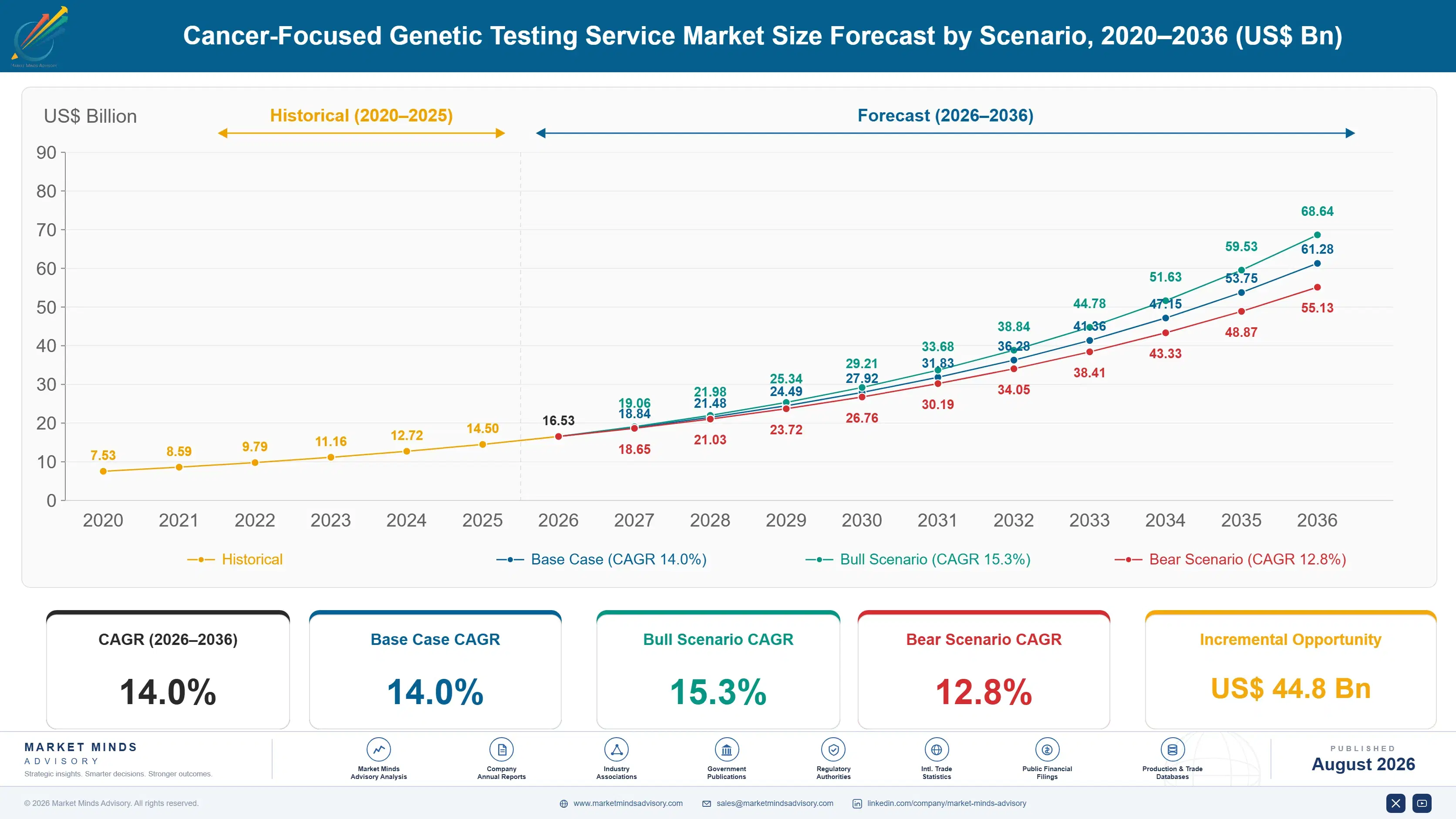
Growth ran at roughly 12.7% between 2020 and 2025, and the composition changed completely across it. Early growth came from comprehensive genomic profiling entering routine oncology practice as targeted therapies multiplied. Later growth came almost entirely from residual disease monitoring, which arrived with coverage decisions attached and converted testing from a diagnostic event into a recurring surveillance service billed several times each year per patient.
Base case growth of 14.0% rests on three mechanisms. Residual disease monitoring keeps extending across tumour types as evidence accumulates, and each approved indication adds a recurring rather than a single test. Liquid biopsy keeps taking cases where tissue is insufficient or a biopsy carries risk, which is common in lung and pancreatic disease. And clinico-genomic database licensing to pharmaceutical partners has become a second revenue line for the largest laboratories.
The bull case at 15.3% assumes multi-cancer early detection secures broad reimbursement, which would open a screening population orders of magnitude larger than the treated one. The bear case at 12.8% is a coverage case: tightened evidence requirements for molecular testing, or reduced payment rates on high-volume assays, would compress the category directly since roughly 63% of testing depends entirely on reimbursement.

Cancer Genomics: Surveillance Billing and Coverage Gatekeeping

The commercial shape of this market changed when testing stopped being an event. Comprehensive profiling at diagnosis produces one order per patient, however sophisticated the assay. Residual disease monitoring produces four a year for two or three years, on the same patient, against the same reimbursement pathway. That difference did more for laboratory economics than every improvement in sequencing chemistry across the same period combined.
TOP FIVE CONCENTRATION47%Serial testing franchises rather than single assay providers now lead
REIMBURSED TEST SHARE63%Testing volume covered by insurance rather than paid privately
AVERAGE TEST PRICEUSD 1,150Blended realised price across germline, somatic and monitoring services
ACTIONABLE FINDING RATE38%Profiled patients carrying an alteration matched to available therapy
RESULT TURNAROUND TIME11 daysTypical interval from specimen receipt to reported clinical result
SERIAL TESTING FREQUENCY4 testsAnnual monitoring assays ordered per patient under surveillance protocols
Coverage decides which tests exist commercially. In the United States a molecular diagnostic without a favourable coverage determination has essentially no market, whatever its published performance, and roughly 63% of testing volume depends on reimbursement rather than private payment. Several well-regarded companies with genuinely capable science failed because coverage did not arrive quickly enough, which the sector has now absorbed as its central operating reality.
The honest clinical picture is narrower than the marketing. Comprehensive profiling identifies an alteration matched to an available therapy in roughly 38% of patients, and a smaller number actually receive that therapy. Payers know these figures precisely. The health economic case rests on the value of the minority who benefit substantially, not on any claim that every profiled patient gains something from the result.
"Everyone in this field talks about the science and the science was settled some time ago. What actually determines whether a company survives is a coverage determination written by people who will never look down a microscope, and the sector took an expensive decade to accept that."
Director, Precision Oncology and Diagnostic Services Practice · MMA Healthcare P

Market Trends

Residual disease monitoring converts diagnosis into recurring surveillance

Circulating tumour DNA assays detecting residual disease after surgery identify recurrence months before imaging does, and clinical practice has moved toward serial testing every three months through the highest-risk period. A patient generates four assays a year for two or three years rather than one at diagnosis. Coverage arrived alongside evidence in colorectal, breast and lung disease, which is unusual and decisive. The recurring billing pattern is why laboratory revenue has grown considerably faster than the number of patients being tested. Tumour-informed approaches requiring a tissue baseline also create switching cost that no diagnostic test has ever generated.
Market Impact: Over 90 biomarker-directed approval
Clinico-genomic databases become a second pharmaceutical revenue line

Laboratories running comprehensive profiling at scale accumulate linked genomic and clinical outcome records across very large patient populations, and pharmaceutical companies pay substantially for access to design trials, identify populations and support regulatory submissions. Tempus, Foundation Medicine and Caris all built that business alongside testing. It carries no incremental laboratory cost, arrives without payer negotiation, and rewards scale directly, which makes it the most attractive revenue any of these companies generate. It requires no payer negotiation at all, and only laboratories with genuine accumulated testing scale can access it, which is a strong argument for pursuing volume.
Market Impact: Reaches 30% lacking adequate tissue

Market Opportunities and Growth Drivers

Targeted therapy approvals require molecular selection before prescribing

A growing share of oncology approvals specify a genomic alteration in the label, which means the test is not optional and the prescription cannot be written without it. Lung, colorectal, breast, prostate and haematological malignancies now all carry multiple biomarker-directed options. Each new approval adds testing demand automatically without any commercial effort from a laboratory, and guideline bodies incorporate the requirement within months. Companion diagnostic obligations convert regulatory decisions directly into laboratory volume. Guideline bodies incorporate each new requirement within months, and no laboratory needs to persuade anybody of anything.
Market Impact: Roughly 63% depends on coverage

Liquid biopsy reaches patients whose tissue cannot be obtained

A substantial share of advanced lung and pancreatic cancer patients have insufficient tissue for molecular analysis, or are too unwell for a repeat biopsy that carries genuine procedural risk. Circulating tumour DNA testing from a blood draw reaches those patients, and guidelines now accept it where tissue is unavailable or inadequate. Turnaround is also faster than tissue, which matters when treatment decisions cannot wait. This is complementary to tissue profiling rather than a replacement for it. Positioning blood as a replacement rather than a complement overstates the evidence and invites clinical pushback that damages credibility.
Market Impact: Actionable in only 38% of cases

Market Restraints and Challenges

Coverage determinations decide which tests have a market at all

A molecular diagnostic without favourable payer coverage has essentially no commercial existence in the United States regardless of its published analytical or clinical performance, and roughly 63% of testing volume depends on reimbursement. The root cause is that patients cannot pay several thousand dollars themselves and oncologists will not order what will not be covered. Commercial impact has been severe, with capable companies failing while awaiting determinations. Laboratories now design evidence generation around coverage requirements from the outset rather than afterwards. Treating coverage as a regulatory afterthought has repeatedly proved fatal.
Market Impact: Generates 4 assays per year

Actionable findings reach a minority of profiled patients

Comprehensive genomic profiling identifies an alteration matched to an available therapy in roughly 38% of patients, and fewer still receive that therapy because of access, fitness or trial availability. The root cause is that most tumours simply lack a currently druggable driver. Commercial impact is a health economic argument that must rest on the substantial benefit to a minority rather than on universal value. Laboratories respond by reporting trial matching, tumour mutational burden and prognostic information alongside therapy matching. Payers understand these figures precisely, and the health economic case has to rest on the minority who benefit substantially.
Market Impact: Adds revenue at 0 marginal cost
3 additional market trends, 4 additional growth drivers, and 2 additional restraints and challenges are covered in the full report. Contact sales@marketmindsadvisory.com to access the complete intelligence.

Segment CAGR and Growth Architecture

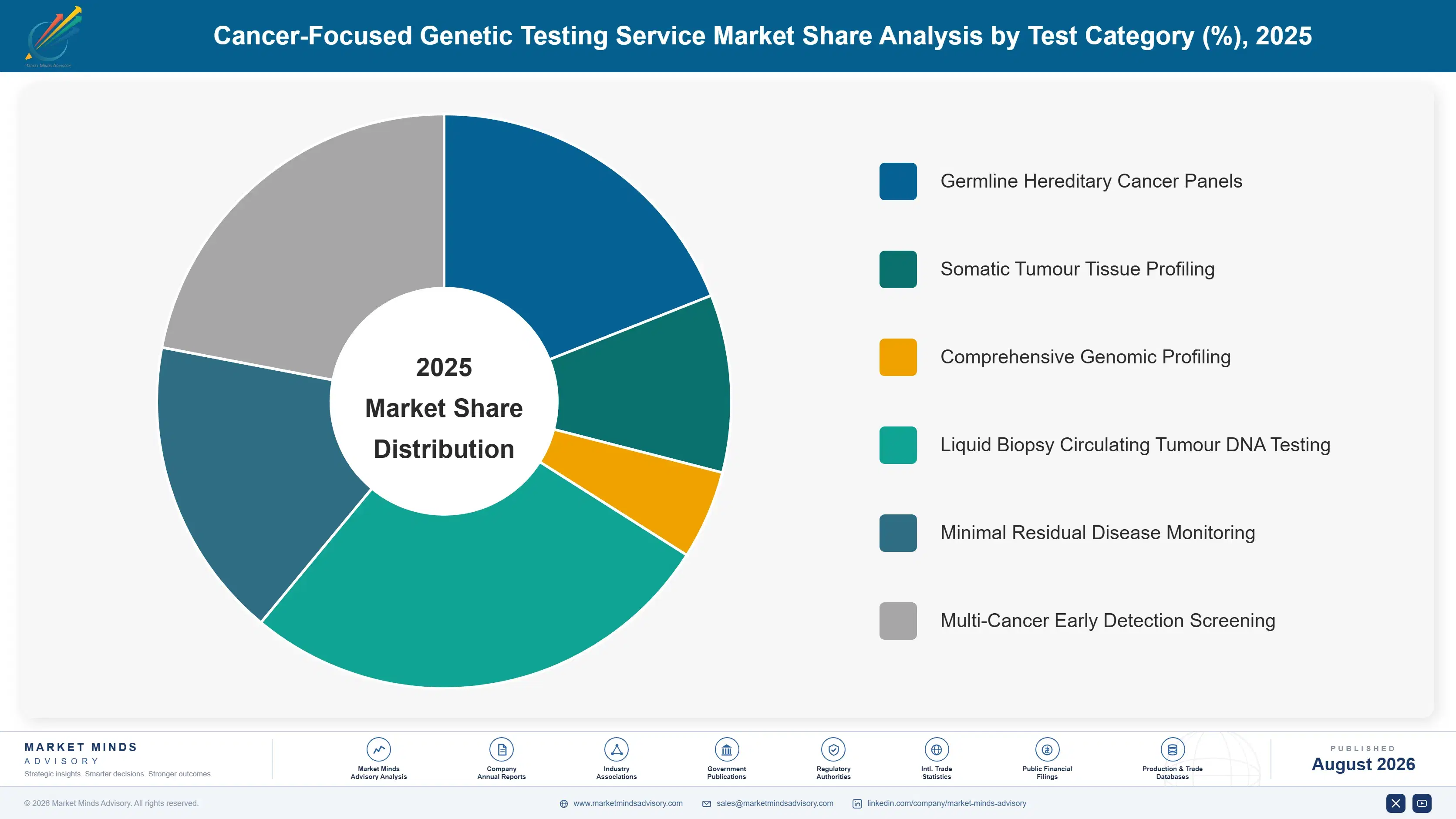
Segmentation follows the test category itself, because category determines the specimen required, the clinical question answered, the coverage pathway and whether the service is ordered once or repeatedly. Six categories cover oncology genetic testing without overlap. Sequencing technology cuts across several categories and is treated as a methodological attribute rather than a segment here.
cancer-focused-genetic-testing-service-market-market-share-analysis-1787304211001

Minimal Residual Disease Monitoring

Growing at 21.0%, a full 1.50x the market rate, residual disease assays detect circulating tumour DNA after curative surgery and identify recurrence months before imaging can. Serial testing every three months through the highest-risk period generates four assays a year for two or three years from a single patient, which is a fundamentally different revenue shape from any diagnostic test. Coverage arrived alongside evidence in colorectal, breast and lung disease rather than years afterwards. Tumour-informed approaches requiring an initial tissue sequencing step create genuine switching cost, since changing provider means starting the baseline again. Payer scrutiny of testing frequency within surveillance protocols is intensifying, and it is the clearest live risk to the whole segment.
CAGR 21.0%

Liquid Biopsy Circulating Tumour DNA Testing

Liquid biopsy profiling grows at 17.4% by reaching patients whose tissue is insufficient, whose biopsy carries real procedural risk, or whose treatment decision cannot wait for tissue processing. Guidelines accept it where tissue is unavailable or inadequate, which covers a substantial share of advanced lung and pancreatic disease. Sensitivity falls at low circulating tumour fraction, so a negative blood result does not exclude an alteration and tissue remains the reference where obtainable. Honest positioning treats the two as complementary, and laboratories offering both capture the whole pathway rather than part of it. Turnaround from a blood draw is also faster than tissue processing, which matters when a treatment decision genuinely cannot wait.
CAGR 17.4%
Full segment breakdown across 6 segments available in the complete report.

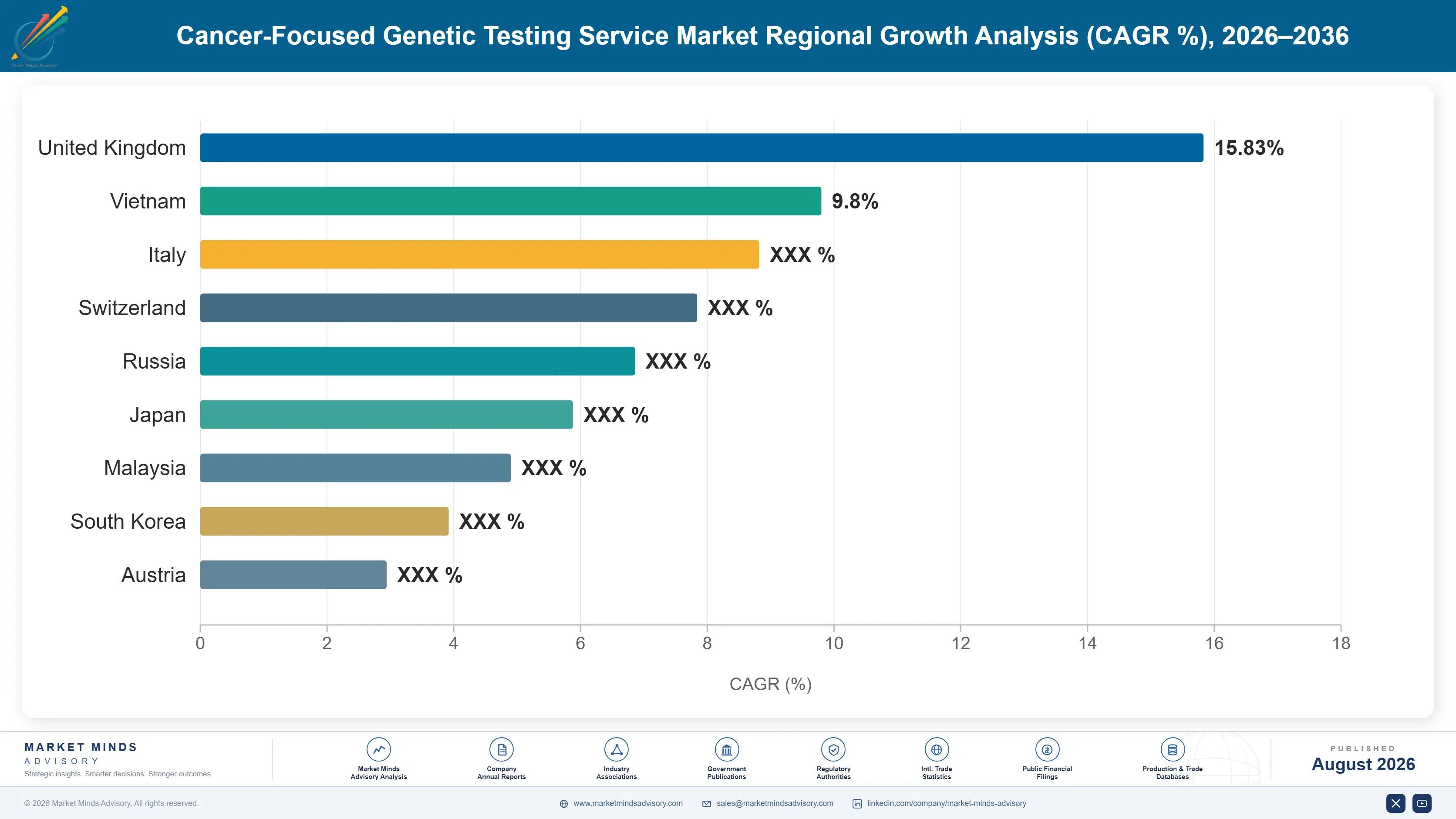
Regional Architecture and Country Demand Map

Regional value follows reimbursement architecture rather than cancer incidence, and the two diverge dramatically. Systems that pay for molecular testing generate most of the revenue, while systems carrying far larger patient populations test a small fraction of them and pay considerably less when they do.

North America

North America holds 38% of value, above the band MMA normally applies. Note: this share is stated out of band because United States coverage determinations effectively create the commercial market for a molecular diagnostic, and the comprehensive profiling and residual disease sector was built entirely around that mechanism. Guardant, Natera, Foundation Medicine, Tempus and Caris are all American companies operating primarily American laboratories. Realised pricing per test is several times any other region. Growth at 13.2% is the second slowest here, because penetration in the treated population is already high and further expansion depends on screening indications rather than diagnosis. Coverage rather than clinical demand has set the pace of every development here.
Share: 38% | CAGR: 13.2% (2026 to 2036)

East Asia

Twenty-three per cent of value, growing at 15.2%, and China compounds at 19.2%, the fastest country tracked. Chinese oncology genomic testing scaled quickly through domestic providers including Burning Rock, Genetron and Amoy Diagnostics, supported by a regulatory pathway that approved companion diagnostics alongside targeted therapies. Pricing sits far below Western levels and hospital-based testing competes with independent laboratories directly. Japanese comprehensive genomic profiling is nationally reimbursed under a defined pathway with strict eligibility, which produces steady controlled volume. South Korean and Taiwanese testing follows Japanese practice at smaller scale. Regional pricing means value share understates tested patient numbers considerably, and domestic providers capture almost all of that volume. Nothing about that dynamic looks likely to reverse.
Share: 23% | CAGR: 15.2% (2026 to 2036)
Regional intelligence for 5 additional markets available in the complete report: Western Europe, South Asia and Pacific, Latin America, Middle East and Africa, Eastern Europe. Contact sales@marketmindsadvisory.com.
cancer-focused-genetic-testing-service-market-country-cagr-analysis-1787304211519

Where Oncology Testing Value Concentrates

Analytical performance stopped differentiating these services some years ago and coverage never stopped deciding them. Value accrues to whoever bills repeatedly rather than once, whoever secured a coverage determination before competitors did, and whoever accumulated enough linked outcome data to sell it to somebody other than a payer. The assay itself decides very little now.

Build recurring surveillance rather than single diagnostic orders

A comprehensive profile at diagnosis bills once per patient however sophisticated it is. Residual disease monitoring bills 4 times a year for two or three years from the same patient, against the same coverage pathway and with far lower incremental laboratory cost after the baseline. That is the single largest economic difference in this category and it explains why revenue has grown faster than patient numbers. Tumour-informed approaches requiring an initial tissue baseline also create switching cost that diagnostic testing never generated. Oncologists will not restart a surveillance series midway through.
Market Impact: Bills 4 times each year per surveil

Design evidence generation around coverage requirements from the start

In the United States a molecular test without favourable coverage has no commercial existence whatever its performance, and roughly 63% of volume depends on reimbursement. Capable companies have failed waiting for determinations that their evidence packages were never designed to satisfy. Building studies to the specific endpoints, populations and comparators that coverage bodies require costs more upfront and shortens the interval between launch and revenue considerably. Treating coverage as a regulatory afterthought rather than a design input has repeatedly proved fatal. Journals and coverage bodies want quite different things. That distinction has repeatedly decided which companies survived.
Market Impact: Determines 63% of the total testing

Monetise linked clinico-genomic data to pharmaceutical partners

Laboratories running profiling at scale accumulate genomic results linked to treatment and outcome across very large populations, and pharmaceutical companies pay substantially for access to design trials and support submissions. That revenue carries essentially zero incremental laboratory cost, requires no payer negotiation and scales directly with testing volume already performed. It is the most attractive revenue in the category and it is available only to laboratories with genuine scale, which is a strong argument for pursuing volume even at thin testing margins. Pharmaceutical partners require minimum cohort sizes that only 2 or 3 laboratories can currently reach alone.
Market Impact: Carries near 0 incremental cost to

Offer tissue and blood together rather than competing between them

Roughly 30% of advanced lung and pancreatic patients lack tissue adequate for molecular analysis, and liquid biopsy sensitivity falls at low circulating tumour fraction, so neither approach covers the whole pathway alone. Laboratories offering both capture every patient rather than losing those whose specimen type they cannot handle. Positioning blood as a replacement for tissue overstates the evidence and invites clinical pushback that damages credibility. Complementary positioning is both more honest and commercially broader. Laboratories offering both capture the whole pathway rather than losing every patient whose specimen type they cannot handle at all.
Market Impact: Captures the 30% of patients lackin

Who Controls the Margin Pool

Concentration sits at 47% across the top five, measured on annual revenue from oncology genetic and genomic testing services, the single basis applied throughout. Guardant Health and Natera lead through residual disease franchises billing repeatedly rather than once. Roche follows through Foundation Medicine, Myriad Genetics through hereditary germline testing, and Tempus AI through a combination of profiling and clinico-genomic data licensing that few competitors match.
Competition runs on coverage, recurrence and data scale rather than on assay performance, which converged years ago and is regulated to comparable standards. Whoever secures a coverage determination first in a tumour type establishes practice before competitors can bill at all. Whoever converts a diagnostic relationship into serial monitoring captures a patient for years. Whoever accumulates linked outcome data at scale earns from pharmaceutical partners without payer involvement.

Pressure builds from two directions. Chinese providers including Burning Rock and Genetron supply domestic demand at prices Western laboratories cannot approach, and Indian laboratories are following the same path. Separately, hospital systems are bringing profiling in house as sequencing costs fall, which removes send-out volume from independent laboratories. Rankings shift most where a laboratory converts single diagnostic orders into recurring surveillance across an entire tumour type.
cancer-focused-genetic-testing-service-market-company-positioning-matrix-1787304212047

Competitive Moat and Risk Dimensions

GUARDANT HEALTH

Moat: Liquid biopsy coverage position

Guardant established circulating tumour DNA profiling in routine practice and secured the coverage determinations that made it billable, which competitors then had to obtain independently rather than inherit. Its residual disease and screening programmes extend the same blood-based platform across the whole disease course, so a single specimen type serves diagnosis, monitoring and eventually detection.
GUARDANT HEALTH

Risk: Screening evidence dependence

A meaningful part of the company's forward value rests on colorectal and multi-cancer screening indications where reimbursement is not established and evidence requirements are considerably higher than for treated patients. Competitors hold stronger tumour-informed residual disease positions. Chinese and Indian laboratories are building comparable capability at far lower cost bases.
NATERA

Moat: Tumour-informed monitoring switching cost

Tumour-informed residual disease testing requires sequencing the patient's own tumour to build a personalised assay, which means changing provider mid-surveillance discards the baseline and restarts the series. That creates switching cost no diagnostic test generates, and it locks a patient to one laboratory across years of quarterly billing under an established coverage pathway.
NATERA

Risk: Concentration in one modality

The residual disease franchise carries a very large share of company value, and any coverage revision on serial testing frequency would affect the whole position at once. Tumour-agnostic competitors avoid the baseline sequencing step and cost less to run. Payer scrutiny of testing frequency in surveillance protocols is intensifying across several tumour types.

Players Tracked

Prominent Players

Guardant Health
Natera
Roche
Myriad Genetics
Tempus AI

Other Key Players

Caris Life Sciences
Exact Sciences
GRAIL
Labcorp
Quest Diagnostics
NeoGenomics
SOPHiA GENETICS
Qiagen
Thermo Fisher Scientific
Agilent Technologies
Burning Rock Biotech
Genetron Holdings
Amoy Diagnostics
MedGenome
Datar Cancer Genetics

Recent Developments

FEBRUARY 2025

Payers extend residual disease monitoring coverage to additional tumour types

United States payers widened coverage for circulating tumour DNA residual disease monitoring into further solid tumour indications, extending a recurring billing pathway that had previously been confined largely to colorectal and breast disease surveillance protocols. Evidence requirements had been published in advance. Determinations followed predictably.
Signal: Each coverage extension converts a whole d
SEPTEMBER 2025

Tempus AI expands pharmaceutical clinico-genomic data licensing agreements

Tempus AI widened data licensing arrangements with pharmaceutical partners seeking linked genomic and outcome records for trial design and regulatory submission support, revenue that carries no incremental laboratory cost and requires no payer coverage determination at all. Minimum cohort thresholds applied throughout. No coverage determination was required.
Signal: Data licensing is the most attractive reve
JANUARY 2026

Chinese providers expand comprehensive profiling capacity for domestic oncology

Chinese oncology genomics providers including Burning Rock and Genetron expanded comprehensive profiling capacity for domestic hospital demand, organic investment rather than acquisition, at price points substantially below what Western independent laboratories can operate at profitably. Hospital-based testing competes with them directly. Western laboratories cannot operate profitably there.
Signal: Domestic Chinese pricing now makes Western

Sequencing, Interpretation and Billing Cost Exposure

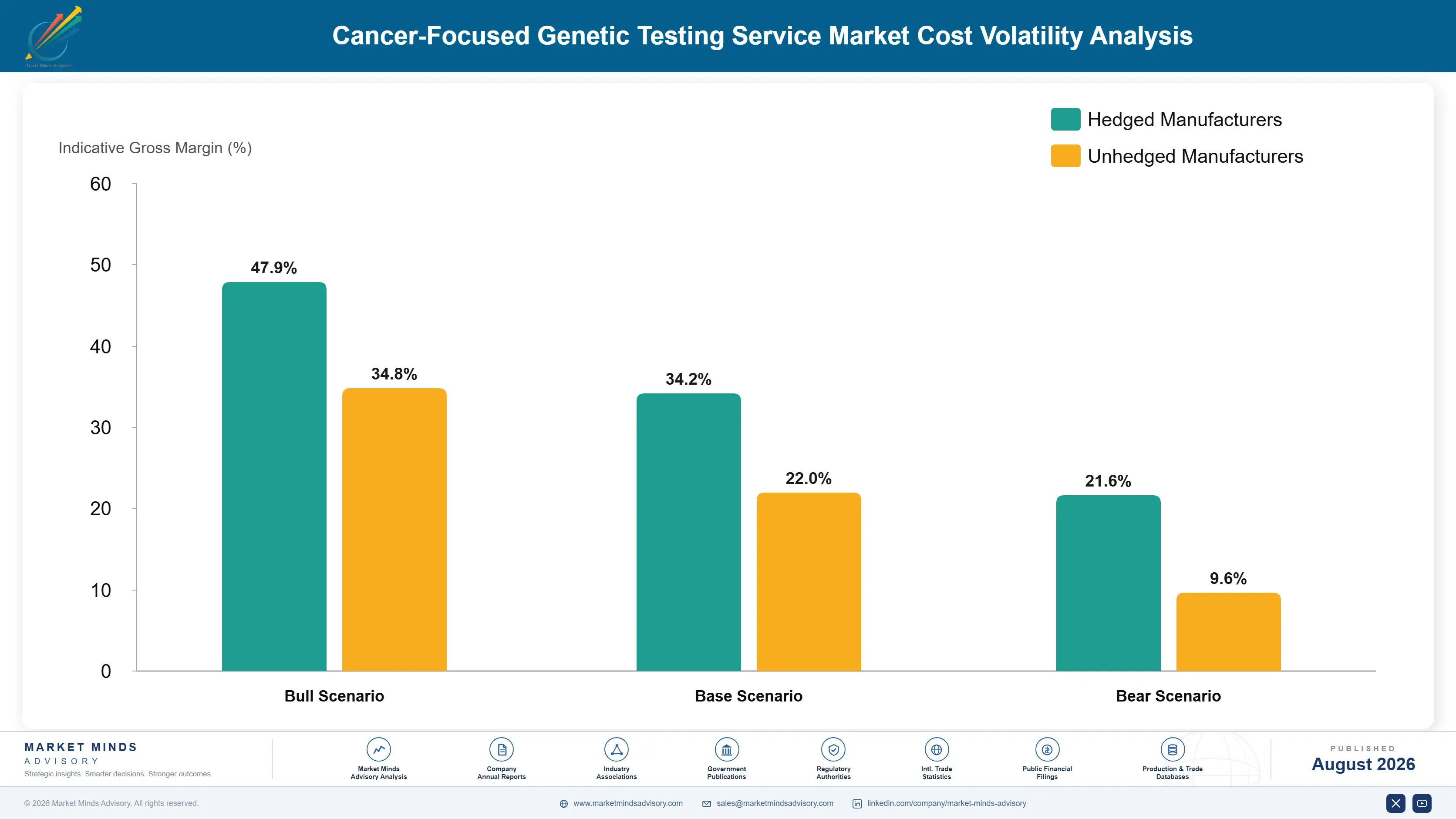
Cost structures have inverted over the past decade. Sequencing reagents and consumables account for roughly 21% of cost of delivery and keep falling, while variant interpretation, medical review and clinical reporting labour contribute around 29% and keep rising because they depend on scarce molecular pathologists and genetic counsellors. Billing, prior authorisation and appeals operations add a further 17%, which is unusually high and entirely a consequence of coverage complexity.
Sequencing consumable pricing moved sharply following instrument competition through 2023 and 2024, and Illumina and Thermo Fisher Scientific both documented pricing and volume pressure in their reporting across those years. Laboratories benefited on input cost while facing reimbursement rates that payers reduced in parallel, so the saving largely passed through rather than improving margin. Interpretation labour cost moved the other way throughout the same period.

The disadvantage falls hardest on laboratories without scale in interpretation and billing. Variant curation cost is largely fixed per variant rather than per sample, so a laboratory running high volume amortises a knowledge base that a smaller competitor rebuilds continuously. Geography compounds it: Chinese and Indian laboratories carry interpretation and operations labour costs Western providers cannot approach.
cancer-focused-genetic-testing-service-market-cost-volatility-analysis-1787304212242

Build reusable variant knowledge bases rather than curating per case

Variant interpretation cost is fixed per variant rather than per sample, so the same alteration reviewed repeatedly across thousands of cases should be curated once and reused thereafter. Laboratories with disciplined knowledge base architecture amortise that work across enormous volume, while smaller competitors repeat interpretation continuously and carry the cost every time. Discipline in architecture decides that.

Automate prior authorisation and appeals operations aggressively

Billing, authorisation and appeals consume an unusually large share of cost of delivery purely because coverage rules are complex and vary by payer. Systematic automation of eligibility checking, documentation assembly and appeal generation reduces that materially, and it also shortens the cash conversion cycle that constrains laboratories growing volume faster than collections. Cash conversion improves alongside it.

Negotiate multi-year sequencing consumable agreements at committed volume

Sequencing consumable pricing responds strongly to committed annual volume, and instrument competition has given laboratories more negotiating room than they held previously. Multi-year commitments at scale secure pricing that spot purchasing never reaches, and the saving matters more now that payers have reduced reimbursement rates in parallel with input cost declines. Spot purchasing never reaches those levels.

Portfolio Architecture for Margin Defence

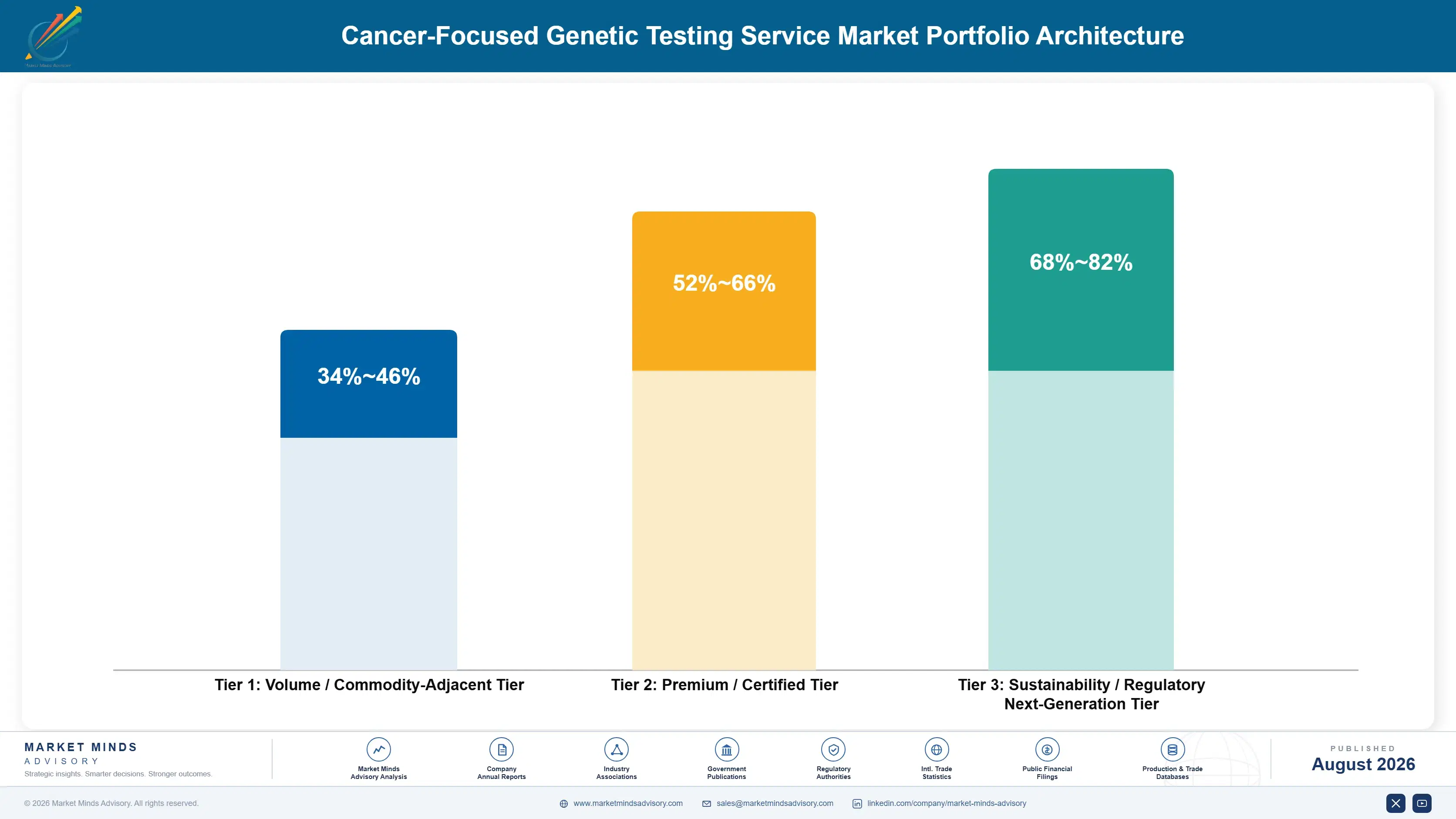
Margin architecture divides on whether a test bills once or repeatedly and on whether coverage exists. Germline hereditary panels are widely offered, reimbursed at modest rates and increasingly commoditised. Comprehensive profiling earns better where coverage is established and turnaround is competitive. Residual disease monitoring earns most among testing services because the baseline cost is incurred once and the recurring assays afterwards carry far lower incremental cost.
The volume versus premium tension has an unusual resolution here. Volume is worth pursuing even at thin testing margins, because clinico-genomic data licensing revenue scales with the number of linked records a laboratory holds and carries essentially no incremental cost. A laboratory running large profiling volume at breakeven can earn substantially from pharmaceutical partners on data the testing already generated, which changes how volume should be valued. That changes how volume itself should be valued.

High-value pools sit outside the payer relationship entirely. Data licensing to pharmaceutical partners, biopharmaceutical clinical trial testing services and self-paying international patients all price without coverage negotiation. Reimbursed germline panels and single-gene companion diagnostics sit at the opposite extreme, with rates set by payers and eroding, and with several laboratories offering functionally identical services into the same accounts.

Volume / Commodity-Adjacent Tier

Germline hereditary panels and single-gene companion diagnostics, widely offered by many laboratories at payer-set rates that keep eroding, with turnaround time and service the only meaningful differentiators remaining. Hospital insourcing keeps removing send-out volume.
Gross Margin: 34-46%

Premium / Certified Tier

Comprehensive genomic profiling and liquid biopsy testing, protected by coverage determinations, guideline positions and the clinical relationships that route complex cases to established laboratories rather than newer entrants. Complex cases route to established laboratories by habit.
Gross Margin: 52-66%

Sustainability / Regulatory / Next-Generation Tier

Residual disease surveillance and clinico-genomic data licensing, protected by recurring billing, tumour-informed baseline switching cost and data scale that only high-volume laboratories can accumulate at all. Only genuine volume makes the data business available at all.
Gross Margin: 68-82%
cancer-focused-genetic-testing-service-market-portfolio-architecture-1787304212735

Recurring Billing Across Disease Courses

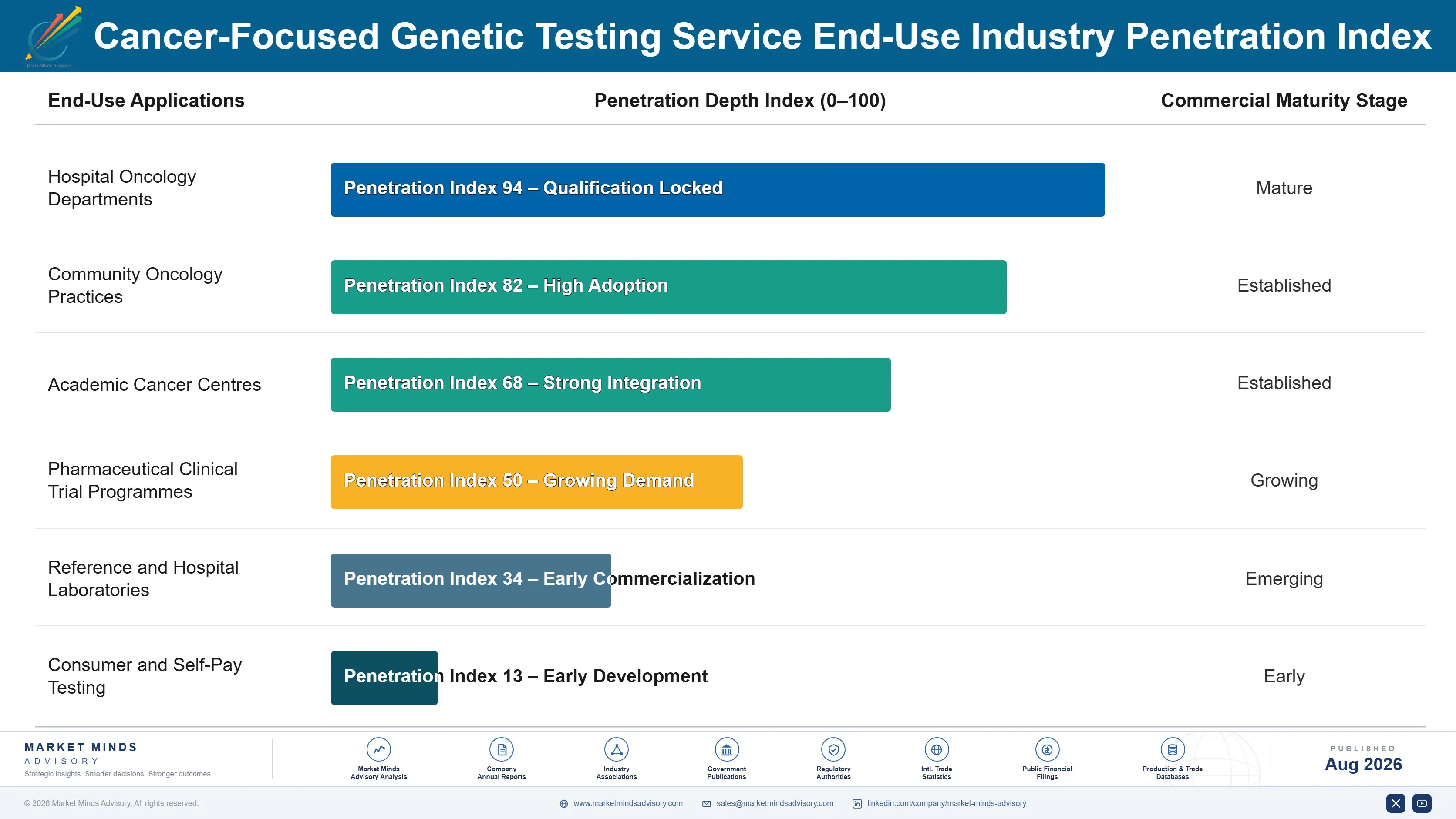
Demand now attaches to a disease course rather than to a diagnostic moment. A patient profiled at diagnosis, monitored quarterly through surveillance and profiled again at progression generates a decade of laboratory orders rather than one. That change came from residual disease monitoring securing coverage alongside evidence, and it is why revenue has grown considerably faster than the number of patients entering testing across the same period.
Stickiness depends on whether a baseline exists. Tumour-informed residual disease testing sequences the patient's own tumour to build a personalised assay, so changing laboratory mid-surveillance discards that baseline and restarts the series, which almost no oncologist will do. Comprehensive profiling shows moderate stickiness through clinical relationship and report familiarity. Germline panels show almost none, moving on turnaround time and price between functionally identical providers.

Buyer profiles have widened considerably. Medical oncologists order most testing, but pathologists control specimen routing, molecular tumour boards influence which panels are used, and health system laboratory directors increasingly decide whether testing happens in house at all. Payers sit behind every one of those decisions through coverage policy. Laboratories organised around a single oncologist relationship find several other parties now stand between them and the specimen.
cancer-focused-genetic-testing-service-market-end-use-penetration-index-1787304213225

Where Oncology Testing Strategy Lands

These are among the four positions where our research anticipates prominent divergence between winners and laggards over the coming forecast period. Each is grounded in the demand model, the regulatory perimeter, and the announced capacity pipeline.
01 / RECURRING ORDER DESIGN

Bill across a disease course, not at a diagnostic moment

A comprehensive genomic profile at diagnosis bills only once per patient however sophisticated the assay happens to be, while residual disease surveillance bills four separate times a year for two or three years from that very same patient. Incremental laboratory cost after the baseline is far lower, and the coverage pathway has already been established across the major tumour types. That single difference explains why category revenue has grown considerably faster than the number of patients actually entering testing at all.
02 / COVERAGE-LED EVIDENCE DESIGN

Design the studies payers require, not the ones journals want

A molecular diagnostic without favourable coverage has essentially no commercial existence in the United States whatever its analytical performance, and roughly 63% of all testing volume depends entirely on reimbursement rather than private payment. Genuinely capable companies have failed outright while waiting for determinations that their evidence packages were never designed to satisfy. Building studies to the specific endpoints, populations and comparators that coverage bodies require costs more upfront and dramatically shortens the interval between launch and any revenue arriving at all.
03 / DATA ASSET MONETISATION

Volume is worth having even at breakeven testing margins

Laboratories running genomic profiling at real scale accumulate results linked to treatment and outcome, and pharmaceutical partners pay substantially for access to that in order to design trials and support regulatory submissions. That revenue carries essentially zero incremental laboratory cost and needs no payer negotiation or coverage determination of any kind. It changes how thin testing margins ought to be valued, because volume generates a second revenue line that only laboratories with genuine accumulated scale can ever access at all.
04 / SPECIMEN COVERAGE BREADTH

Offer blood and tissue rather than arguing between them

Roughly 30% of advanced lung and pancreatic cancer patients lack tissue adequate for any molecular analysis, while liquid biopsy sensitivity falls sharply at low circulating tumour fraction, so a negative blood result excludes nothing at all. Neither approach covers the whole pathway by itself, and positioning either one as replacing the other overstates the evidence quite badly. Laboratories offering both specimen types capture every patient in the pathway rather than losing those whose specimen type they simply cannot handle at all.

Engagement Snapshot From the Field

A live engagement with an industry participant carrying material or product regulatory and market exposure ahead of a defining policy shift, showing how our research translates into a defensible multi-year portfolio strategy.
MARKET MINDS ADVISORY · CLIENT ENGAGEMENT SUMMARY
Cancer-Focused Genetic Testing Service Producer Strategic Portfolio Review and Transition Roadmap 2026·Investment Scenario on Cancer-Focused Genetic Testing Service Exposure Evaluation 2025-26
CLIENT PROFILE
An independent molecular diagnostics laboratory providing germline hereditary panels and somatic tumour profiling to oncology practices and hospital systems across several United States regions, with annual revenue of approximately USD 165 million (client-reported, unverified by MMA). Roughly 70% came from single-order diagnostic testing. The company held no residual disease monitoring offering and no pharmaceutical data licensing arrangements at all.
STRATEGIC CHALLENGE
Reimbursement rates on germline and single-gene panels had declined for three consecutive years while hospital systems brought profiling in house, and order volume growth no longer translated into revenue growth. The board needed to decide whether to compete on turnaround and price in diagnostic testing, or to invest in residual disease monitoring capability where recurring billing and coverage pathways had already been established by others.
MMA APPROACH
MMA conducted 47 expert interviews across medical oncologists, molecular pathologists, health system laboratory directors, payer medical policy staff and pharmaceutical translational medicine leads in six countries. A quantitative survey of 3,800 respondents established ordering behaviour, provider selection and specimen routing decisions. We then modelled revenue and contribution under both options against observed reimbursement trajectories and coverage determination timelines for surveillance testing.
KEY FINDINGS
  1. Oncologists ordering tumour-informed residual disease testing reported never changing laboratory mid-surveillance, because doing so discards the personalised baseline and restarts the monitoring series entirely.
  2. Health system laboratory directors were insourcing germline and single-gene testing wherever volume justified it, and expected to continue regardless of any pricing action by independent laboratories.
  3. Pharmaceutical translational medicine leads valued linked genomic and outcome records highly but required minimum cohort sizes the client's testing volume alone would take years to reach.
  4. Payer medical policy staff indicated evidence requirements for surveillance testing were defined and stable, and that determinations followed predictably where studies matched those specifications.
CLIENT PROFILE
An independent molecular diagnostics laboratory providing germline hereditary panels and somatic tumour profiling to oncology practices and hospital systems across several United States regions, with annual revenue of approximately USD 165 million (client-reported, unverified by MMA). Roughly 70% came from single-order diagnostic testing. The company held no residual disease monitoring offering and no pharmaceutical data licensing arrangements at all.
STRATEGIC CHALLENGE
Reimbursement rates on germline and single-gene panels had declined for three consecutive years while hospital systems brought profiling in house, and order volume growth no longer translated into revenue growth. The board needed to decide whether to compete on turnaround and price in diagnostic testing, or to invest in residual disease monitoring capability where recurring billing and coverage pathways had already been established by others.
MMA APPROACH
MMA conducted 47 expert interviews across medical oncologists, molecular pathologists, health system laboratory directors, payer medical policy staff and pharmaceutical translational medicine leads in six countries. A quantitative survey of 3,800 respondents established ordering behaviour, provider selection and specimen routing decisions. We then modelled revenue and contribution under both options against observed reimbursement trajectories and coverage determination timelines for surveillance testing.
KEY FINDINGS
  1. Oncologists ordering tumour-informed residual disease testing reported never changing laboratory mid-surveillance, because doing so discards the personalised baseline and restarts the monitoring series entirely.
  2. Health system laboratory directors were insourcing germline and single-gene testing wherever volume justified it, and expected to continue regardless of any pricing action by independent laboratories.
  3. Pharmaceutical translational medicine leads valued linked genomic and outcome records highly but required minimum cohort sizes the client's testing volume alone would take years to reach.
  4. Payer medical policy staff indicated evidence requirements for surveillance testing were defined and stable, and that determinations followed predictably where studies matched those specifications.
RECOMMENDED STRATEGY
Phase 1: Phase one: stop competing on price in germline and single-gene panels, accepting volume loss to hospital insourcing rather than funding it from elsewhere. Phase 2: Phase two: develop tumour-informed residual disease capability and design the supporting evidence package directly to published payer coverage specifications from the outset. Phase 3: Phase three: pursue a data partnership with a larger laboratory to reach pharmaceutical cohort thresholds, rather than attempting to accumulate records alone.
OUTCOME
The client withdrew from price competition in commoditised panels and launched residual disease testing eighteen months later with coverage secured in two tumour types (client-reported, unverified by MMA). Recurring surveillance revenue reached roughly a seventh of the total within a year, and blended gross margin improved about nine percentage points despite lower diagnostic order volume.

Frequently Asked Questions

Foundational context covering the market sizes, CAGR, scope, country, region and competition that inform every finding below. This section is provided to cover basics and most often pre-purchase conversations, answered from the MMA Primary Research Dataset.

What is the current size of the Cancer-Focused Genetic Testing Service Market?

The global cancer-focused genetic testing service market was valued at USD 14.5 billion in 2025, covering germline panels, tumour profiling, comprehensive genomic profiling, liquid biopsy, residual disease monitoring and early detection screening. Sequencing instruments and reagents fall outside this definition.

How large will the Cancer-Focused Genetic Testing Service Market be by 2036?

MMA forecasts the market at USD 61.28 billion by 2036, expanding 3.71 times from the 2026 base of USD 16.53 billion. That represents roughly USD 44.75 billion of incremental value across the forecast decade.

What is the CAGR for the Cancer-Focused Genetic Testing Service Market 2026 to 2036?

The base case compound annual growth rate is 14.0%, with a bull case of 15.3% and a bear case of 12.8%. The bull case depends on multi-cancer early detection securing broad reimbursement, which has not happened.

Which segment is growing fastest?

Minimal residual disease monitoring grows at 21.0%, a full 1.50x the overall market rate. Serial testing converts a single diagnostic order into roughly four recurring assays each year per patient under surveillance.

Who are the major companies in the Cancer-Focused Genetic Testing Service Market?

Guardant Health, Natera, Roche, Myriad Genetics and Tempus AI together hold 47% of revenue. The leaders compete through recurring surveillance franchises and data licensing rather than through any difference in assay performance.

Which country is growing fastest?

China grows fastest at 19.2%, supported by domestic providers and a regulatory pathway approving companion diagnostics alongside targeted therapies. North America remains the largest region at 38% of value on reimbursement architecture.

Report Segmentation Architecture

The full report scope spans multiple orthogonal segmentation dimensions, with cross-tabulated demand data provided for each dimension pair. Coverage extends further to regional breakdowns, trend trajectories, and the competitive detail needed to support segment-level decision-making.

By Test Category

  • Germline Hereditary Cancer Panels
  • Somatic Tumour Tissue Profiling
  • Comprehensive Genomic Profiling
  • Liquid Biopsy Circulating Tumour DNA Testing
  • Minimal Residual Disease Monitoring
  • Multi-Cancer Early Detection Screening

By End-Use Industry

  • Hospital Oncology Departments
  • Community Oncology Practices
  • Academic Cancer Centres
  • Pharmaceutical Clinical Trial Programmes
  • Reference and Hospital Laboratories
  • Consumer and Self-Pay Testing

By Commercial Dimension

  • Reimbursed Clinical Testing
  • Hospital and Health System Contracts
  • Pharmaceutical Trial Testing Services
  • Clinico-Genomic Data Licensing
  • Self-Pay and International Patient Testing
  • Public Health System Genomic Programmes

By Region

  • North America
  • East Asia
  • Western Europe
  • South Asia and Pacific
  • Latin America
  • Middle East and Africa
  • Eastern Europe

Scope, Methodology, and Coverage

Every figure in this report is reproducible from documented input assumptions. The scope below maps the historical period, the forecast horizon, the segmentation dimensions, and the countries covered, alongside the underlying primary and qualitative methodology.
Historical Period
2020 to 2025
Forecast Period
2026 to 2036
Base Year
2025 (USD billions; MMA Primary Research Dataset, August 2026)
Market Definition
This market comprises laboratory services performing genetic and genomic analysis in oncology, measured at laboratory service revenue including specimen processing, sequencing, variant interpretation and clinical reporting, across reimbursed clinical, hospital contract, pharmaceutical trial, self-pay and public health programme channels. Coverage spans germline hereditary cancer predisposition panels, somatic tumour tissue profiling from single-gene assays through targeted panels, comprehensive genomic profiling, circulating tumour DNA liquid biopsy profiling, tumour-informed and tumour-agnostic minimal residual disease monitoring, multi-cancer early detection screening services, and the clinico-genomic data licensing revenue that laboratories generate from those activities. Sequencing instruments, reagents and consumables sold to laboratories, research-use-only genomic services, immunohistochemistry and conventional pathology without molecular analysis, cancer imaging services, cytogenetic karyotyping performed outside oncology, and therapeutic or device products fall outside scope.
Quantitative Units
USD billions (current prices); test volumes by category; average realised price per test; reimbursed share of volume; serial testing frequency per patient
Segmentation Dimensions
By Test Category; By End-Use Industry; By Commercial Dimension; By Region
Regions Covered
North America, East Asia, Western Europe, South Asia and Pacific, Latin America, Middle East and Africa, Eastern Europe
Countries Covered
United States, Canada, China, Japan, South Korea, Taiwan, Germany, United Kingdom, France, Italy, Spain, Netherlands, Switzerland, Denmark, India, Australia, Singapore, Malaysia, Thailand, Brazil, Mexico, Argentina, Colombia, Saudi Arabia, United Arab Emirates, Israel, South Africa, Poland, Czechia, Hungary, and additional markets relevant to oncology testing analysis
Key Companies Profiled
Guardant Health, Natera, Roche, Myriad Genetics, Tempus AI, Caris Life Sciences, Exact Sciences, GRAIL, Labcorp, Quest Diagnostics, NeoGenomics, SOPHiA GENETICS, Qiagen, Thermo Fisher Scientific, Agilent Technologies, Burning Rock Biotech, Genetron Holdings, Amoy Diagnostics, MedGenome, Datar Cancer Genetics
Quantitative Methodology
Primary survey, n=3,800 respondents, Q4 2025, six countries; demand-side model with trade association cross-validation
Qualitative Methodology
47 expert interviews, Q4 2025; applied to validate demand model assumptions, identify emerging dynamics, and assess competitive positioning
Report Format
PDF and XLSX data workbook (Word format preview document)
Publisher
Market Minds Advisory
Report Code
MMA-2026-HLT-192
Published
August 2026
Contact
sales@marketmindsadvisory.com | www.marketmindsadvisory.com

Purchase the full Cancer-Focused Genetic Testing Service Market Report (2026 to 2036).

The full MMA report treats coverage determination as the commercial gate it actually is, and recurring surveillance billing as the change that reshaped this category's economics. It sizes six test categories and seven regions to 2036, modelling test volumes, realised pricing, reimbursed share and serial testing frequency separately so recurring revenue can be distinguished from diagnostic volume. Competitive assessment covers twenty laboratories on one consistent service revenue basis. Cost exposure is traced through sequencing consumables, variant interpretation labour and billing operations. Four commercial levers and a strategic verdict close the report, grounded in 47 expert interviews and a 3,800-respondent survey.
Six test categories sized separately to 2036
Recurring surveillance billing modelled against diagnostic order volume
Coverage determination timelines mapped by tumour type
Twenty laboratories assessed on one consistent basis
Clinico-genomic data licensing economics quantified against testing scale
Anonymised client engagement with tested strategic recommendations

Built For The People Who Decide

From boardroom strategy to bench-side execution, this report is read cover-to-cover by leaders shaping the next decade of their industry, turning demand scenarios, market dynamics and valuation benchmarks into decisions.
CXOs/ Presidents/ VPs/ Managers
M&A and Corporate Development
Strategy Teams and R&D Heads
Procurement and Product Directors
Regulatory and Compliance Leaders
Investor Relations and Equity Analysts