Market Minds Advisory
Canada Executive Education Program Market

Canada Executive Education Program Market: Canada Executive Education Program Market. Corporate Leadership Development, Digital Credentials, and Cross-Border Program Delivery, 2026 to 2036

Corporate learning budgets are shifting from generic open-enrollment courses toward customized, outcome-tracked leadership programs, forcing legacy business schools to prove measurable impact against a growing field of corporate university and digital-credential competitors.

Lead Analyst

Published

September 2026

Make Smarter Decisions with Customized Research Insights

Request a free sample report and evaluate market opportunities, growth trends, and competitive dynamics relevant to your business needs.

2025 MARKET VALUE$1.2BMarket Size 2025
2036 FORECAST VALUE$3.2BBase Case , 2026 to 2036
CAGR 2026 TO 20369.5 %Bull 10.7% / Bear 8.3%
INCREMENTAL OPPORTUNITY$1.9BNet 10- year value creation
EXPANSION MULTIPLE2.48x2036 value over 2026 base
Strategic Levers
M&A Pipeline
Regional Outlook
Country Rankings
Competitive Intelligence
Segmental Deep-dive
Call-Us : 91 93563 13602

Executive Snapshot and Market Trajectory.

Canada's executive education market is being reshaped by employers demanding documented behavioral change rather than attendance certificates, pushing providers to embed coaching, three-hundred-sixty-degree assessment, and post-program accountability tracking into offerings once judged solely on faculty reputation, campus prestige, and alumni network reach across the country.
Corporate learning budgets are consolidating around fewer, deeper provider relationships as chief learning officers favor customized cohort programs over open-enrollment seats, with hybrid delivery now the fastest-expanding format because it lets Toronto and Montreal-based schools enroll international executives without campus travel, while sector-specific leadership tracks in finance, healthcare, and energy concentrate demand among mid-career managers preparing for general management roles within three to five years, a horizon employers increasingly track through internal promotion data.
Competition increasingly pits established Canadian business schools against Ivy League satellite programs, corporate universities built in-house by large employers, and digital credential platforms bundling university branding with self-paced delivery, while federal skills-training incentives and provincial upskilling grants introduced since 2023 have pulled new corporate buyers into the market who previously relied entirely on internal mentorship for leadership development, widening demand across several new industry verticals nationwide.
Market Definition
The Canada Executive Education Program Market covers custom corporate, open-enrollment, hybrid and online certificate, sector-specific leadership, and global immersion programs delivered by Canadian business schools and corporate training providers to working executives and senior managers. It excludes undergraduate business degrees, MBA programs pursued as a primary credential, and general professional certification unrelated to leadership or management development.
Base Year Value
$1.2B in 2025 (MMA Primary Research Dataset, September 2026)
Forecast Period
2026 to 2036, eleven discrete annual values
CAGR
9.5% base case. Bull 10.7%. Bear 8.3%.
Fastest Growth Segment
Online and Hybrid Certificate Programs: 13.0% CAGR
Fastest Growth Country
India: 15.0% CAGR
Fastest Growth Region
South Asia and Pacific: 11.5% CAGR
Largest Region
North America: 32% of 2025 global value
Market Leaders
Harvard Business School Executive Education, INSEAD, IMD Business School, Wharton Executive Education, and London Business School lead by enrolled executive participant volume. Source: MMA Primary Research Dataset, July 2026.
Primary Survey
n=3,800 procurement and R&D decision-makers, Q4 2025, six countries
Methodology
Demand-side build-up, cross-validated against public data, 47 expert interviews

Canada Executive Education Program Market Forecast Scenarios

canada-executive-education-program-market-size-forecast-scenario-1789988010897
Between 2020 and 2025, enrollment recovered unevenly from pandemic-driven campus closures, with hybrid formats absorbing most of the rebound while traditional in-person open-enrollment seats grew only modestly, reflecting employers' new comfort with remote and blended executive learning delivery and a lasting preference among finance and technology sector clients for shorter, more frequent program cycles over multi-week residential courses.
The base case assumes continued corporate budget reallocation toward measurable leadership outcomes, sustained federal and provincial skills-training incentives lowering effective tuition for employer-sponsored cohorts, and steady growth in international executive enrollment as Canadian schools market cost advantages relative to comparable United States programs. Together these three mechanisms reinforce double-digit hybrid segment expansion through 2036, with custom corporate programs growing in parallel as large employers renew multi-year leadership development contracts rather than rebuild internal training functions from scratch.
A bull scenario assumes accelerated adoption of AI-personalized coaching modules pulling forward enrollment cycles as employers seek faster proof of return on training spend. A bear scenario assumes a prolonged corporate training budget freeze during a broader economic slowdown, delaying multi-year custom program renewals across finance and energy sector clients and pushing buyers back toward cheaper, unstructured internal mentorship in the interim.

Where Documented Outcomes Now Set Program Value

Canadian executive education has moved past its historic reliance on brand prestige and campus setting, with corporate buyers now requiring pre- and post-program competency assessment before renewing multi-year contracts. Providers unable to produce this data are losing renewal negotiations to schools that built measurement into program design a decade ago, and the gap is widening each budget cycle.
MARKET CONCENTRATION (CR5)22%Top five providers hold modest combined enrollment share
AVERAGE PROGRAM FEE$14,500Per-executive fee for a two-week custom cohort program
TORONTO AND MONTREAL SHARE58%Combined enrollment concentrated in these two metro hubs
REPEAT CORPORATE CLIENT RATE64%Employers renewing multi-year custom program contracts on an annual basis
INTERNATIONAL ENROLLMENT SHARE31%Participants who traveled from outside Canada specifically for these programs
HYBRID DELIVERY ADOPTION47%Programs now offered in blended online and in-person format
Toronto and Montreal host the bulk of delivery capacity, reflecting proximity to head offices in banking, insurance, and energy, though Vancouver has expanded meaningfully as a technology-sector hub for shorter certificate programs. International enrollment, concentrated among executives from India, has grown steadily as Canadian tuition undercuts comparable United States programs by a wide margin while offering similar faculty credentials, accreditation, and program duration.
Hybrid delivery has become the default format rather than a pandemic-era workaround, with most providers now running cohorts that mix in-person residencies with asynchronous coursework spread across several months. This shift has lowered the marginal cost of enrolling additional international participants substantially, since it removes much of the travel and visa burden that once capped how many overseas executives a single cohort could reasonably accommodate each intake cycle.
"Faculty reputation still opens the door, but it no longer closes the sale. Corporate buyers now ask for a competency dashboard before they ask who is teaching."
Director, Corporate Learning and Leadership Development Practice · MMA Technology Practice · September 2026

Market Trends

AI-Personalized Coaching Modules Enter Mainstream Programs

Leading providers now embed AI-driven coaching tools that analyze recorded leadership simulations and generate individualized feedback reports within days rather than the weeks a human assessor once required. Rotman and Ivey have both piloted these tools inside custom corporate cohorts since 2024, reporting participant satisfaction scores several points higher than traditional feedback formats. Early adopters use the faster turnaround to justify premium pricing on custom programs, arguing that compressed feedback cycles let participants apply lessons before the next project cycle begins, a claim large corporate buyers increasingly expect providers to substantiate with real cohort data rather than marketing claims alone.
Market Impact: Renewal rates rose to 64%
Federal and Provincial Skills Grants Expand Reach

Ottawa's expanded Canada Job Grant and several provincial upskilling programs introduced since 2023 now reimburse a meaningful share of employer-sponsored executive program fees, lowering effective cost for mid-sized companies that previously found custom cohorts unaffordable. Schulich and Smith School of Business have both restructured pricing to highlight grant eligibility explicitly in corporate proposals, a tactic that has pulled new manufacturing and logistics sector buyers into a market historically dominated by finance and energy clients. Providers expect this buyer expansion to continue as provincial governments extend matching funds through 2028 budget cycles.
Market Impact: Fees run 30 to 40% lower

Market Opportunities and Growth Drivers

Chief Learning Officers Demand Measurable ROI

Corporate learning budgets face tighter scrutiny than at any point in the past decade, with finance departments now requiring providers to demonstrate promotion rates, retention improvements, or productivity gains tied directly to program completion before contracts renew. Several large Canadian banks have restructured procurement to require quarterly outcome reporting rather than end-of-program satisfaction surveys alone, a shift smaller providers without dedicated analytics staff have struggled to match. This has accelerated consolidation toward the handful of schools able to fund measurement infrastructure at scale, reinforcing a two-tier competitive structure across the broader provider landscape nationally.
Market Impact: Displaces roughly 15% of demand

Cost Arbitrage Pulls International Enrollment Northward

Canadian program fees typically run thirty to forty percent below comparable United States offerings at schools with similar faculty credentials and accreditation, a gap that has widened as the loonie weakened against the dollar through 2024 and 2025. Indian and Southeast Asian corporate sponsors increasingly route executives to Toronto and Vancouver programs rather than Boston or New York, citing comparable outcomes at meaningfully lower total program cost including travel. Canadian schools have responded by marketing this arbitrage explicitly in international recruitment materials, a tactic uncommon before 2023 but now standard practice among the five largest providers by volume.
Market Impact: Processing delays average 12 weeks

Market Restraints and Challenges

Corporate Universities Absorb Custom Program Demand

Large employers with sufficient scale increasingly build internal corporate universities rather than outsourcing custom leadership development, a shift driven partly by concerns over intellectual property exposure when proprietary case material is shared with external faculty. The root cause is a maturing internal learning function: companies that once lacked instructional design capability now retain former business school faculty directly. This displaces external providers from the highest-margin custom segment specifically. Some schools have responded by offering white-label curriculum licensing and faculty-for-hire arrangements, preserving a revenue relationship even as direct program delivery moves in-house for the largest corporate accounts.
Market Impact: Feedback turnaround cut roughly 70%

Visa Processing Delays Slow International Enrollment Growth

Canadian study and business visitor visa processing times lengthened considerably during 2024, creating a root-cause bottleneck for international executives attempting to enroll in short in-person residencies scheduled months in advance. The commercial impact falls hardest on shorter programs where a delayed visa can force a participant to miss an entire cohort intake rather than simply arrive late. Providers are mitigating this by front-loading hybrid online coursework before the in-person residency window, letting participants begin substantive work while visa applications remain pending, and by building longer lead times into international marketing calendars generally.
Market Impact: Grants cover 50% of program fees
4 additional market trends, 3 additional growth drivers, and 3 additional restraints and challenges are covered in the full report. Contact sales@marketmindsadvisory.com to access the complete intelligence.

Segment CAGR and Growth Architecture

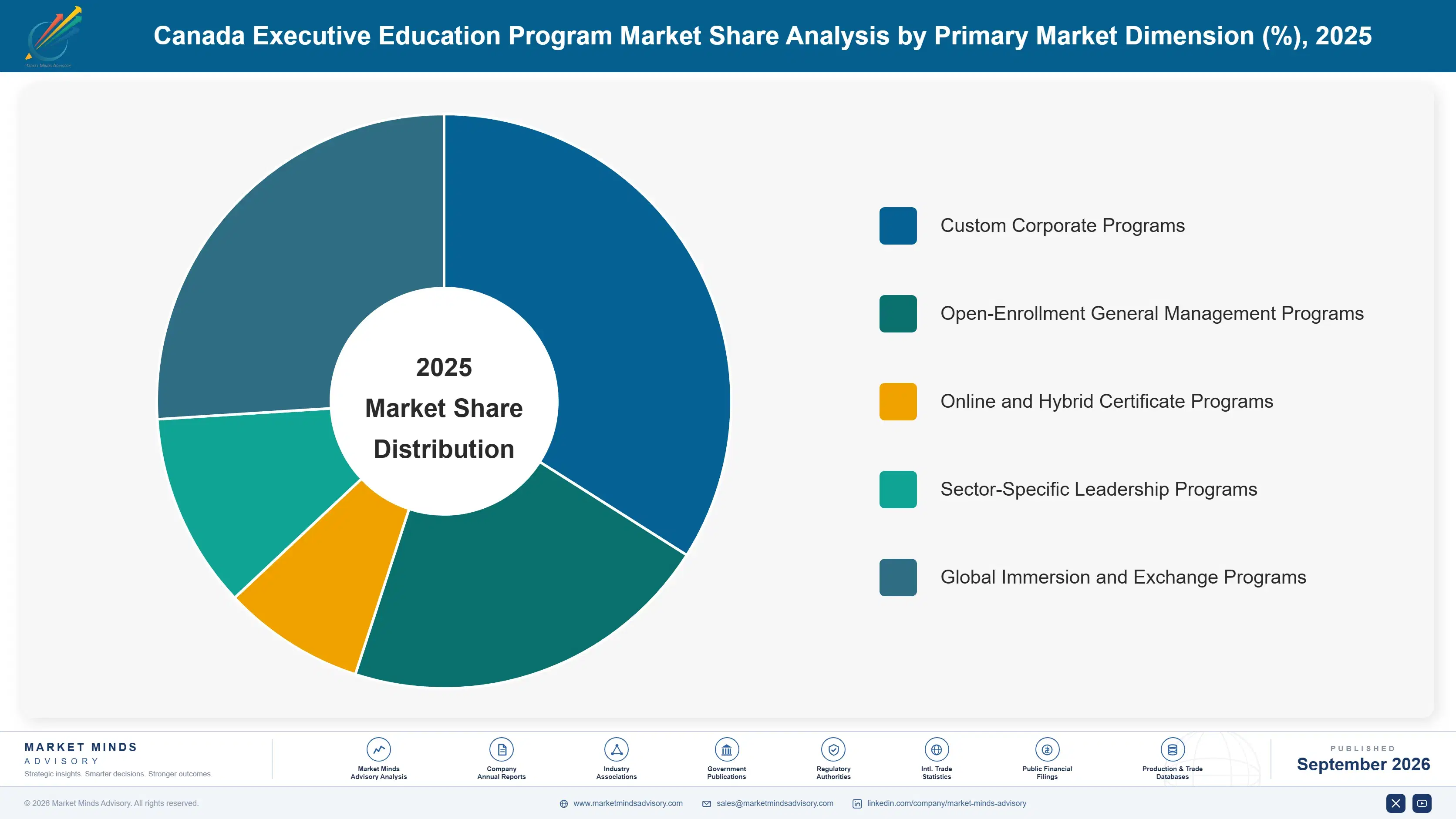
Canadian executive education splits into five program types distinguished by structure, delivery format, and commercial relationship rather than by subject matter alone. Custom corporate engagements, open-enrollment general management courses, hybrid and online certificates, sector-specific leadership tracks, and global immersion programs each carry distinct pricing, sales cycles, and renewal dynamics that shape provider strategy across the country.
canada-executive-education-program-market-market-share-analysis-1789988011814

Online and Hybrid Certificate Programs

Online and hybrid certificate programs have become the fastest-growing format because they remove the travel and visa constraints that historically capped international enrollment, letting a single cohort mix Toronto-based executives with participants joining remotely from India, the Gulf, and Southeast Asia. Providers have restructured curriculum delivery around asynchronous modules paired with shorter, more frequent in-person residencies rather than a single multi-week campus stay, lowering both cost and disruption for corporate sponsors. Rotman, Ivey, and Schulich have each expanded hybrid certificate catalogs since 2023, and enrollment growth in this format now consistently outpaces every other segment as employers favor its lower total cost and faster completion cycle for mid-career managers nationwide.
CAGR 13.0%

Global Immersion and Exchange Programs

Global immersion and exchange programs pair a Canadian residency with a short module delivered through a partner school abroad, typically in Europe or Asia, giving participants direct exposure to unfamiliar regulatory and cultural business environments they would not otherwise encounter. Demand has grown quickly among multinational employers seeking to prepare executives for cross-border assignments, and several Canadian schools have formalized reciprocal exchange agreements with European and Asian partner institutions since 2024 specifically to support this format. Pricing runs meaningfully higher than domestic-only programs given added travel and partner-institution fees, but corporate sponsors increasingly treat the premium as justified given the scarcity of comparable cross-border leadership exposure available through purely domestic alternatives.
CAGR 11.5%
Full segment breakdown across 5 segments available in the complete report.

Regional Architecture and Country Demand Map

Regional distribution here reflects where enrolled executive participants originate rather than where programs are delivered, since nearly all programs run through Canadian campuses. North America dominates given Canada's own base plus significant cross-border United States enrollment, while East Asia and South Asia and Pacific contribute the fastest-growing international cohorts.

North America

North America accounts for the largest share of enrolled participants, combining Canada's own domestic executive population with a meaningful flow of United States managers who choose Canadian programs for lower tuition at comparable faculty quality. Banking, insurance, and energy employers headquartered in Toronto and Calgary generate the bulk of custom corporate contracts, while cross-border enrollment concentrates among mid-sized American firms priced out of Ivy League custom programs. Provincial upskilling grants available only to Canadian-registered employers further anchor domestic demand, and repeat corporate clients in this region renew custom cohort contracts at notably higher rates than international sponsors, reflecting closer, longer-standing relationships between regional business schools and their home-market corporate accounts.
Share: 32% | CAGR: 10.5% (2026 to 2036)

Western Europe

Western Europe enrollment reflects multinational employers headquartered in London, Paris, and Frankfurt sending senior managers to Canadian programs for cost reasons and to diversify faculty perspective away from domestic business school networks. HEC Paris and INSEAD affiliations give some Canadian schools credibility with European corporate learning departments already familiar with those institutions through joint faculty appointments. Demand concentrates in global immersion and sector-specific finance leadership tracks rather than shorter certificate formats, since European sponsors more often fund extended residential programs as part of formal succession planning processes reaching several years into the future. Currency movements between the euro and the Canadian dollar have made Canadian tuition comparatively attractive since 2024, reinforcing this flow into 2026 and beyond.
Share: 20% | CAGR: 8.0% (2026 to 2036)
Regional intelligence for 5 additional markets available in the complete report: East Asia, South Asia and Pacific, Latin America, Middle East and Africa, Eastern Europe. Contact sales@marketmindsadvisory.com.
canada-executive-education-program-market-country-cagr-analysis-1789988012740

Levers Providers Are Pulling to Grow Margin

Providers competing for the same corporate learning budget increasingly differentiate through pricing structure and delivery mechanics rather than curriculum alone, since faculty quality has become table stakes across the top providers nationally. The levers below reflect where Canadian schools are actively investing to defend margin against corporate universities and lower-cost digital alternatives entering the market.

Bundling Coaching Analytics Into Base Program Pricing

Providers are folding AI-assisted coaching analytics into standard program pricing rather than selling it as a costly add-on, using the bundled feature to justify fee increases of roughly 8 to 12 percent on renewed custom contracts. This shift responds directly to corporate buyer demand for documented outcomes, letting providers charge premium rates while simultaneously reducing the marginal cost of producing that documentation at scale across dozens of concurrent cohorts. Early adopters report renewal negotiations moving faster once analytics are already embedded rather than pitched separately, shortening sales cycles considerably for repeat corporate accounts.
Market Impact: Lifts renewal pricing by roughly 8 to 12 percent

Expanding Grant-Eligible Program Structures for Mid-Market

Schools are restructuring shorter certificate programs specifically to qualify for federal and provincial skills grants, opening a mid-market buyer segment that previously found custom cohorts unaffordable at full list price. This has expanded the addressable buyer base by an estimated 20 percent among manufacturing and logistics employers who had never previously purchased executive education from a Canadian business school. Providers report that grant-eligible buyers convert into full-price repeat customers within two renewal cycles more often than expected, turning a subsidized entry point into a durable revenue relationship over subsequent years.
Market Impact: Expands the addressable buyer base by about 20 percent

Charging Premium Rates for Cross-Border Immersion Modules

Global immersion programs command fee premiums of 25 to 35 percent over domestic-only equivalents, and providers are expanding partner-institution networks specifically to sell more of this higher-margin format to multinational corporate sponsors seeking cross-border exposure. Formal reciprocal agreements with European and Asian business schools, several signed since 2024, let Canadian providers offer credible cross-border modules without building costly permanent overseas facilities themselves. Sponsors treat the premium as justified given genuine cross-cultural exposure, and providers report these programs carry meaningfully higher renewal rates than comparable domestic-only sector-specific leadership tracks over a three-year window.
Market Impact: Commands a fee premium of 25 to 35 percent

Selling White-Label Curriculum to Corporate Universities

Rather than losing custom program revenue entirely to in-house corporate universities, several Canadian schools now license curriculum frameworks and provide faculty-for-hire arrangements, capturing a smaller but durable revenue share from clients that would otherwise disappear completely from the provider relationship. This licensing model typically returns 15 to 20 percent of the revenue a full custom engagement would have generated, but carries substantially lower delivery cost since the school avoids running the program directly. Providers view this as a defensive move that preserves brand presence inside large corporate accounts even as direct delivery shifts in-house.
Market Impact: Recovers 15 to 20 percent of otherwise-lost revenue

Who Controls the Margin Pool

Enrolled executive participant volume across the top five providers sums to roughly 22 percent of the addressable Canadian market, leaving a fragmented field of schools and training firms competing for the rest. Harvard Business School Executive Education and INSEAD lead by this measure despite being non-Canadian, reflecting how top custom contracts still flow to internationally branded programs. Rotman and Ivey trail meaningfully, though both hold domestic advantages in finance and energy tracks.
Current competitive activity centers on embedding measurable outcomes into program design, with most top-ten providers offering pre- and post-program competency assessment as standard rather than premium. Several schools have expanded hybrid delivery infrastructure, investing in coaching-analytics platforms to support asynchronous coursework at scale. Reciprocal exchange agreements between Canadian and European or Asian schools have become standard for supporting global immersion offerings without permanent overseas facilities.

Emerging pressure comes less from rival schools than from in-house corporate universities and digital credential platforms offering lower-cost, self-paced alternatives backed by recognizable branding. Rankings among traditional providers are likely to shift as schools without outcome-measurement infrastructure lose renewals to better-resourced rivals, already visible in banking and energy contracts. Smaller regional schools defending a genuine sector niche appear best positioned to hold share.
canada-executive-education-program-market-company-positioning-matrix-1789988013625

Competitive Moat and Risk Dimensions

HARVARD BUSINESS SCHOOL EXECUTIVE EDUCATION

Moat: Global Brand Recognition Advantage

Harvard Business School Executive Education draws on more than a century of brand equity that lets it command premium pricing without needing to prove outcomes as rigorously as newer entrants must. Corporate buyers often default to Harvard for the most visible senior leadership mandates, shortening internal approval for large custom contracts considerably.
HARVARD BUSINESS SCHOOL EXECUTIVE EDUCATION

Risk: High Price Limits Volume

Harvard's premium pricing structure caps addressable volume among mid-sized Canadian employers who cannot justify the fee gap over comparable Canadian alternatives, particularly as those alternatives close the outcome-measurement credibility gap that once justified Harvard's premium almost automatically. This leaves Harvard exposed at the margin as budget-conscious buyers increasingly test lower-cost options for programs below the most senior leadership tier.
INSEAD

Moat: Genuine Global Faculty Network

INSEAD's multi-campus model spanning Europe, Asia, and the Middle East gives it a genuinely global faculty network that Canadian-only competitors cannot easily replicate, making it a natural default for multinational employers seeking cross-border leadership exposure. This multi-campus footprint, built over decades, supports premium pricing on global immersion formats specifically where authentic cross-border faculty presence matters most to corporate sponsors.
INSEAD

Risk: Distance From Domestic Buyers

INSEAD's lack of a permanent Canadian campus limits its ability to compete for sector-specific domestic contracts that depend on proximity to head offices in Toronto or Calgary, ceding this segment largely to Canadian schools. As grant-eligible, hybrid-delivery competitors close the international faculty gap through partnerships, INSEAD's advantage among cost-sensitive mid-market Canadian buyers is likely to narrow over coming years.

Players Tracked

Prominent Players

Harvard Business School Executive Education
INSEAD
IMD Business School
Wharton Executive Education
London Business School

Other Key Players

Rotman School of Management
Ivey Business School
Schulich School of Business
HEC Paris
IE Business School
Kellogg School of Management Executive Education
Stanford Graduate School of Business Executive Education
Columbia Business School Executive Education
MIT Sloan Executive Education
Duke Corporate Education
Cornell SC Johnson Executive Education
University of Michigan Ross Executive Education
McGill University Desautels Faculty of Management
Smith School of Business
Said Business School

Recent Developments

MARCH 2026

Rotman Signs Singapore Exchange Agreement

Rotman School of Management signed a reciprocal exchange agreement with a leading Singapore business school, letting participants in either school's global immersion program complete a residency module abroad. The agreement adds a new Asian delivery site to Rotman's cross-border offerings without capital investment in permanent overseas facilities.
Signal: Signals Canadian schools are formalizing overseas partnerships rather than building costly permanent campuses abroad themselves going forward
NOVEMBER 2025

Ivey Launches AI Coaching Module

Ivey Business School launched an AI-personalized coaching module across its custom corporate cohort programs, following a pilot conducted with two large Canadian financial services clients this year. The tool generates individualized leadership feedback within days of a recorded simulation, replacing a manual process that took weeks.
Signal: Signals AI-assisted assessment is moving from pilot programs into standard custom program delivery nationally across the industry
JULY 2025

Schulich Restructures Grant-Eligible Pricing

Schulich School of Business restructured its hybrid certificate pricing to explicitly highlight eligibility under an expanded federal skills-training grant, targeting mid-sized manufacturing and logistics employers new to executive education purchasing entirely this cycle. The move followed similar pricing changes at competing schools chasing the same buyers.
Signal: Signals grant-eligible pricing is becoming a standard competitive tool for reaching mid-market buyers nationwide going forward

What Actually Drives Program Delivery Cost

Faculty compensation represents the largest input cost for executive education, typically running 40 to 50 percent of program delivery cost, sourced primarily from full-time business school faculty supplemented by adjunct practitioners drawn from industry. Campus facility costs, coaching-analytics licensing, and international travel for immersion faculty round out the remaining major cost categories, concentrated in owned downtown Toronto and Montreal properties.
Faculty compensation across Canadian business schools rose meaningfully during 2023 and 2024 as competition for adjunct practitioners with current industry experience intensified, a trend documented in Statistics Canada's education workforce compensation releases covering that period. Schools competing for the same small pool of practitioners with both subject expertise and strong teaching evaluations found themselves bidding up day rates considerably, particularly for instructors covering artificial intelligence topics in highest corporate demand.

Smaller regional schools without endowment income or large alumni donor bases absorb faculty cost increases directly into tuition, pricing them out of competing for the most senior custom mandates against better-capitalized rivals. This favors institutions like Rotman and Ivey with larger internal faculty rosters that reduce reliance on costly external adjuncts, while schools dependent on visiting faculty face thinner margins on comparable formats.
canada-executive-education-program-market-cost-volatility-analysis-1789988013941

Building Larger Internal Faculty Rosters

Several schools are investing in permanent faculty hires with recent industry experience rather than relying on costly external adjuncts for every cohort, reducing exposure to competitive bidding for practitioner instructors during peak demand periods. This shift lowers per-cohort delivery cost over time even though initial hiring costs run considerably higher than a single adjunct engagement would.

Sharing Faculty Across Partner Institutions

Reciprocal exchange agreements let partner schools share faculty across global immersion modules rather than each institution independently recruiting instructors for every regional market it serves internationally each program year. This spreads fixed faculty recruitment cost across a larger combined participant base, improving margin on cross-border programs specifically without raising tuition for participating corporate sponsors.

Automating Assessment to Offset Faculty Cost

AI-assisted coaching analytics reduce the number of billable hours senior faculty must spend on individual feedback delivery, letting schools offset rising faculty day rates without cutting the number of faculty-led sessions built into each cohort program. Providers report this substitution effect is now large enough to meaningfully soften overall per-cohort margin pressure across the industry.

Portfolio Architecture for Margin Defence

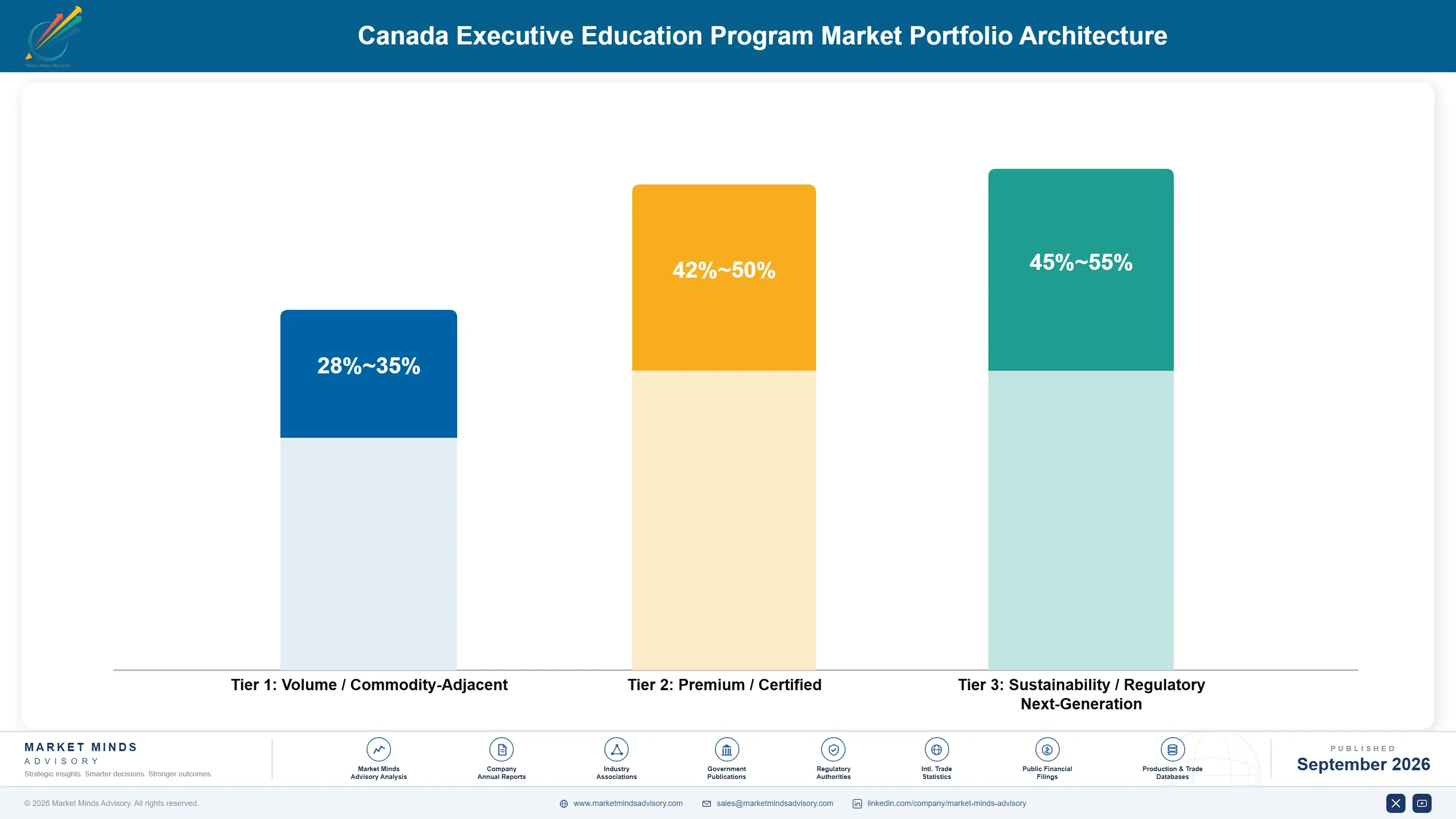
Canadian executive education splits into three margin tiers rather than a single pricing structure, reflecting how differently priced formats carry fundamentally different cost bases across the industry. Volume-tier open-enrollment programs run on thinner per-seat margins offset by higher enrollment counts, while premium custom and certified programs command materially higher margins per participant.
Tension between volume and premium tiers plays out most visibly in how schools allocate faculty time, since senior faculty capacity is finite and premium custom mandates pay considerably more per faculty hour than open-enrollment seats do. Schools increasingly ration senior faculty toward premium engagements, pushing volume-tier programs toward junior faculty, recorded content, and standardized case material instead of live instruction from experienced senior staff.

High-value margin pools concentrate specifically in custom corporate programs for financial services and energy clients and in cross-border global immersion formats, both of which combine strong pricing power with relatively low marginal delivery cost once core faculty and partnership infrastructure already exists across the network. Sustainability and regulatory-compliance leadership tracks represent the newest emerging pool worth watching closely as ESG mandates expand across corporate Canada and beyond its borders.

Volume / Commodity-Adjacent

Standardized open-enrollment general management courses and shorter single-topic certificate programs sold at accessible price points to build enrollment volume and brand visibility broadly across the market and among first-time corporate buyers.
Gross Margin: 28-35%

Premium / Certified

Custom corporate cohort programs and sector-specific leadership tracks built for a single employer or industry vertical, carrying meaningfully stronger pricing power and renewal economics than open-enrollment formats provide over time.
Gross Margin: 42-50%

Sustainability / Regulatory / Next-Generation

Cross-border global immersion programs and sustainability-focused leadership tracks addressing emerging regulatory and ESG competency requirements that employers increasingly mandate for senior managers across most industries and geographies today and going forward.
Gross Margin: 45-55%
canada-executive-education-program-market-portfolio-architecture-1789988014779

High-value Sub-segments and Strategic Watch-out

Custom Corporate Programs (Financial Services and Energy)

Custom corporate leadership programs for financial services and energy clients carry the strongest combination of high growth and high margin, driven by regulatory pressure on banks to document management competency and by deep, repeat-client renewal relationships built over many years of continuous, closely managed engagement.
Gross Margin: 48-55%

Global Immersion and Exchange Programs

Global immersion and exchange programs post strong margins and healthy growth as multinational employers expand cross-border leadership development, though growth trails the fastest-expanding hybrid certificate format since immersion programs require costlier partner-institution logistics that limit how quickly available program capacity can realistically scale each intake cycle.
Gross Margin: 44-50%

Open-Enrollment General Management Programs

Open-enrollment general management courses remain the volume core of the market, filling classrooms at accessible price points with steady but modest growth, and providers rely on this segment to maintain brand visibility even as its margin contribution per participant continues to lag behind premium formats.
Gross Margin: 28-33%

Sector-Specific Leadership Programs

Sector-specific leadership tracks warrant close monitoring as corporate universities increasingly build comparable in-house programs for their largest clients, threatening to displace external providers from precisely the mandates that once anchored this segment's steady historical growth and dependable long-term renewal revenue base for most providers going forward.
Gross Margin: 38-45%

Why Corporate Renewal Contracts Compound

Executive education runs closer to an annuity business than a one-off transaction once a corporate client signs a multi-year custom program contract, since renewal negotiations typically start from an established relationship rather than a competitive tender process. Repeat corporate clients account for a meaningfully larger share of revenue than first-time buyers, and providers structure pricing specifically to reward multi-year commitments over single-cohort purchases.
Adoption stickiness varies considerably by end-use vertical: financial services and energy clients renew custom program contracts at markedly higher rates than manufacturing or logistics buyers newly entering the market through grant-eligible pricing. This gap reflects how deeply embedded executive education has become in financial services succession planning specifically, compared to sectors still treating it as a discretionary training line item rather than a core leadership pipeline investment.

Buyer profiles are shifting generationally as chief learning officers who came up through digital-first corporate training functions replace predecessors more comfortable with traditional campus-based programs, pushing procurement toward providers who can demonstrate measurable outcomes rather than rely on faculty prestige alone. This generational shift favors schools that invested early in coaching analytics and hybrid delivery infrastructure over those still competing primarily on campus reputation and historical brand equity.
canada-executive-education-program-market-end-use-penetration-index-1789988015643

Priorities for Canadian Education Providers

These are among the four positions where our research anticipates prominent divergence between winners and laggards over the coming forecast period. Each is grounded in the demand model, the regulatory perimeter, and the announced capacity pipeline.
01 / OUTCOME MEASUREMENT INVESTMENT

Build Assessment Infrastructure Before Buyers Demand It

Corporate buyers now expect documented competency assessment as a baseline requirement rather than a differentiator, and providers still relying on satisfaction surveys alone are losing renewal negotiations to better-instrumented rivals across nearly every major account. Building coaching-analytics infrastructure requires meaningful upfront investment, but the schools that moved early are already using faster feedback cycles to justify premium renewal pricing on multi-year contracts. Providers who wait until buyers explicitly demand this capability will find themselves negotiating from a position of catch-up rather than strength.
02 / INTERNATIONAL ENROLLMENT EXPANSION

Prioritize Hybrid Formats to Capture Cost-Sensitive Buyers

India represents the fastest-growing source of international enrollment, driven by cost arbitrage against comparable United States and United Kingdom programs and by relatively fast business visitor visa processing for corporate sponsors overall. Hybrid delivery formats remove the travel and visa burden that once capped how many international executives a single cohort could reasonably accommodate during any given intake cycle. Providers that expand hybrid certificate capacity specifically for this buyer segment stand to capture disproportionate enrollment growth over the coming decade.
03 / PARTNERSHIP NETWORK DEVELOPMENT

Formalize Reciprocal Agreements Rather Than Build Overseas Campuses

Global immersion programs command meaningful fee premiums, but building permanent overseas facilities to support them requires capital most Canadian schools cannot reasonably justify against uncertain long-term demand in unfamiliar foreign markets. Reciprocal exchange agreements with European and Asian partner institutions deliver comparable credibility and faculty access at a fraction of the capital cost, letting schools scale cross-border offerings quickly and flexibly. Providers without at least one formal reciprocal partnership by 2028 risk ceding this higher-margin segment entirely to better-networked competitors.
04 / CORPORATE UNIVERSITY DEFENSE

License Curriculum Rather Than Lose Large Accounts Entirely

Large employers building internal corporate universities represent a genuine commercial threat to the highest-margin custom program segment, and resisting this shift outright has generally failed for providers who tried it directly. White-label curriculum licensing and faculty-for-hire arrangements let schools retain a meaningful revenue relationship even as direct program delivery moves in-house for the largest corporate accounts. Providers who treat this shift as inevitable and negotiate licensing terms early preserve more long-term value than those who wait until the account is already lost.

Engagement Snapshot From the Field

A live engagement with an industry participant carrying material or product regulatory and market exposure ahead of a defining policy shift, showing how our research translates into a defensible multi-year portfolio strategy.
MARKET MINDS ADVISORY · CLIENT ENGAGEMENT SUMMARY
Canada Executive Education Program Producer Strategic Portfolio Review and Transition Roadmap 2026·Investment Scenario on Canada Executive Education Program Exposure Evaluation 2025-26
CLIENT PROFILE
The client is a mid-sized Canadian financial services firm with roughly 2,400 employees and a senior management layer of about 90 people facing an unusually high wave of anticipated retirements over the following five years. Internal succession planning had historically relied on informal mentorship rather than structured leadership development, leaving the firm without a documented pipeline of successors for several critical senior roles.
STRATEGIC CHALLENGE
The firm needed to accelerate readiness for roughly fifteen high-potential managers within eighteen months while demonstrating measurable competency gains to its board, which had grown skeptical of past training spend that produced no documented behavioral change. Existing open-enrollment programs the firm had used previously offered no mechanism for tracking individual progress against defined leadership competencies over time.
MMA APPROACH
MMA worked with the client's learning and development team to evaluate five Canadian and international executive education providers against a consistent framework covering assessment methodology, faculty credentials, and post-program tracking capability. The analysis recommended a custom cohort program combining pre-assessment, a hybrid delivery format, and quarterly competency check-ins over a twelve-month engagement window rather than a single intensive residency.
KEY FINDINGS
  1. Fourteen of fifteen participants completed the full twelve-month program, with documented competency gains averaging a meaningful improvement across four measured leadership dimensions.
  2. Nine participants received promotion into more senior roles within twelve months of program completion, well above the firm's historical internal promotion baseline rate.
  3. The hybrid delivery format reduced time away from operational duties by roughly half compared to the firm's prior fully residential program format used previously.
  4. Board confidence in leadership development spend improved measurably, supporting approval of a second cohort program beginning the following fiscal year without extended debate.
CLIENT PROFILE
The client is a mid-sized Canadian financial services firm with roughly 2,400 employees and a senior management layer of about 90 people facing an unusually high wave of anticipated retirements over the following five years. Internal succession planning had historically relied on informal mentorship rather than structured leadership development, leaving the firm without a documented pipeline of successors for several critical senior roles.
STRATEGIC CHALLENGE
The firm needed to accelerate readiness for roughly fifteen high-potential managers within eighteen months while demonstrating measurable competency gains to its board, which had grown skeptical of past training spend that produced no documented behavioral change. Existing open-enrollment programs the firm had used previously offered no mechanism for tracking individual progress against defined leadership competencies over time.
MMA APPROACH
MMA worked with the client's learning and development team to evaluate five Canadian and international executive education providers against a consistent framework covering assessment methodology, faculty credentials, and post-program tracking capability. The analysis recommended a custom cohort program combining pre-assessment, a hybrid delivery format, and quarterly competency check-ins over a twelve-month engagement window rather than a single intensive residency.
KEY FINDINGS
  1. Fourteen of fifteen participants completed the full twelve-month program, with documented competency gains averaging a meaningful improvement across four measured leadership dimensions.
  2. Nine participants received promotion into more senior roles within twelve months of program completion, well above the firm's historical internal promotion baseline rate.
  3. The hybrid delivery format reduced time away from operational duties by roughly half compared to the firm's prior fully residential program format used previously.
  4. Board confidence in leadership development spend improved measurably, supporting approval of a second cohort program beginning the following fiscal year without extended debate.
RECOMMENDED STRATEGY
Phase 1: Phase one: conduct baseline competency assessment and select fifteen high-potential managers across retail banking and wealth management divisions for the inaugural cohort. Phase 2: Phase two: deliver a twelve-month hybrid cohort program combining quarterly in-person residencies with asynchronous coursework and structured quarterly competency check-ins throughout. Phase 3: Phase three: track post-program promotion outcomes and competency retention over eighteen months, feeding results directly into board reporting and second-cohort program design.
OUTCOME
The engagement produced a documented leadership pipeline where none had existed previously, with measurable competency gains and above-baseline promotion outcomes giving the board confidence to approve continued investment (client-reported, unverified by MMA). The firm has since committed to running the program annually rather than treating it as a one-time intervention.

Frequently Asked Questions

Foundational context covering the market sizes, CAGR, scope, country, region and competition that inform every finding below. This section is provided to cover basics and most often pre-purchase conversations, answered from the MMA Primary Research Dataset.

What is the current size of the Canada Executive Education Program Market?

The Canada Executive Education Program Market was valued at $1.2 billion in 2025. This figure covers custom corporate, open-enrollment, hybrid and online certificate, sector-specific leadership, and global immersion programs delivered to working executives.

How large will the Canada Executive Education Program Market be by 2036?

MMA projects the market will reach $3.25 billion by 2036, up from $1.31 billion in 2026. This represents a 2.48-times expansion over the forecast decade.

What is the CAGR for the Canada Executive Education Program Market 2026 to 2036?

The market is projected to grow at a 9.5% compound annual growth rate between 2026 and 2036. This compares to a historical CAGR of roughly 8.5% between 2020 and 2025.

Which segment is growing fastest?

Online and hybrid certificate programs lead all segments at a 13.0% CAGR, roughly 1.37 times the overall market rate. Global immersion and exchange programs follow closely at 11.5%.

Who are the major companies in the Canada Executive Education Program Market?

Harvard Business School Executive Education, INSEAD, IMD Business School, Wharton Executive Education, and London Business School lead by enrolled executive participant volume. Rotman and Ivey hold strong domestic positions.

Which country is growing fastest?

India is the fastest-growing source of enrollment at a 15.0% CAGR, driven by cost arbitrage against comparable United States and United Kingdom programs. Fast business visitor visa processing reinforces this flow.

Report Segmentation Architecture

The full report scope spans multiple orthogonal segmentation dimensions, with cross-tabulated demand data provided for each dimension pair. Coverage extends further to regional breakdowns, trend trajectories, and the competitive detail needed to support segment-level decision-making.

By Primary Market Dimension

  • Custom Corporate Programs
  • Open-Enrollment General Management Programs
  • Online and Hybrid Certificate Programs
  • Sector-Specific Leadership Programs
  • Global Immersion and Exchange Programs

By End-Use Industry

  • Financial Services
  • Energy and Natural Resources
  • Manufacturing and Logistics
  • Technology
  • Healthcare

By Commercial Dimension

  • Employer-Sponsored Custom Cohorts
  • Individual Open-Enrollment Purchase
  • Grant-Subsidized Enrollment

By Region

  • North America
  • Western Europe
  • East Asia
  • South Asia and Pacific
  • Latin America
  • Middle East and Africa
  • Eastern Europe

Scope, Methodology, and Coverage

Every figure in this report is reproducible from documented input assumptions. The scope below maps the historical period, the forecast horizon, the segmentation dimensions, and the countries covered, alongside the underlying primary and qualitative methodology.
Historical Period
2020 to 2025
Forecast Period
2026 to 2036
Base Year
2025 (USD billions; MMA Primary Research Dataset, September 2026)
Market Definition
The Canada Executive Education Program Market covers custom corporate, open-enrollment, hybrid and online certificate, sector-specific leadership, and global immersion programs delivered by Canadian providers to working executives and senior managers. It excludes undergraduate business degrees, primary MBA credentials, and general professional certification unrelated to leadership development.
Quantitative Units
USD Billion, Enrolled Executive Participants, CAGR %
Segmentation Dimensions
Program Type, End-Use Industry, Commercial Dimension, Region
Regions Covered
North America, Western Europe, East Asia, South Asia and Pacific, Latin America, Middle East and Africa, Eastern Europe
Countries Covered
Canada, United States, United Kingdom, France, Germany, China, South Korea, India, Australia, Brazil, Mexico, United Arab Emirates, South Africa, Poland
Key Companies Profiled
Harvard Business School Executive Education, INSEAD, IMD Business School, Wharton Executive Education, London Business School, Rotman School of Management, Ivey Business School, Schulich School of Business, HEC Paris, IE Business School, Kellogg School of Management Executive Education, Stanford Graduate School of Business Executive Education, Columbia Business School Executive Education, MIT Sloan Executive Education, Duke Corporate Education, Cornell SC Johnson Executive Education, University of Michigan Ross Executive Education, McGill University Desautels Faculty of Management, Smith School of Business, Said Business School
Quantitative Methodology
Primary survey, n=3,800 respondents, Q4 2025, six countries; demand-side model with trade association cross-validation
Qualitative Methodology
47 expert interviews, Q4 2025; applied to validate demand model assumptions, identify emerging dynamics, and assess competitive positioning
Report Format
PDF and XLSX data workbook (Word format preview document)
Publisher
Market Minds Advisory
Report Code
MMA-2026-TEC-195
Published
September 2026
Contact
sales@marketmindsadvisory.com | www.marketmindsadvisory.com

Purchase the full Canada Executive Education Program Market Report (2026 to 2036).

This report examines the Canada Executive Education Program Market across five program types, seven demand-origin regions, and the competitive dynamics reshaping how business schools price and deliver leadership development. It quantifies market size, growth, and segment-level trends through 2036. The analysis draws on primary survey data covering three thousand eight hundred respondents and forty-seven expert interviews conducted in the fourth quarter of 2025. It also covers competitive positioning and input cost pressure. Revenue strategies available to providers navigating rising corporate demand for documented program outcomes round out the analysis.
Ten-Year Market Sizing and Forecast Model
Five-Segment MECE Program Type Classification Taxonomy
Seven-Region Enrollment Origin Breakdown and Analysis
Competitive Benchmarking of Twenty Named Providers
Revenue Lever and Margin Economics Analysis
Anonymized Client Engagement Case Study Review

Built For The People Who Decide

From boardroom strategy to bench-side execution, this report is read cover-to-cover by leaders shaping the next decade of their industry, turning demand scenarios, market dynamics and valuation benchmarks into decisions.
CXOs/ Presidents/ VPs/ Managers
M&A and Corporate Development
Strategy Teams and R&D Heads
Procurement and Product Directors
Regulatory and Compliance Leaders
Investor Relations and Equity Analysts