Market Minds Advisory
Canada Credit Cards Market

Canada Credit Cards Market: Fintech Challengers Redraw Rewards Economics

Digital-first fintech issuers are pulling cardholder growth away from the Big Five banks, forcing legacy issuers to rebuild reward economics around instant approval and transparent fee structures rather than points program complexity alone.

Lead Analyst

Published

September 2026

Make Smarter Decisions with Customized Research Insights

Request a free sample report and evaluate market opportunities, growth trends, and competitive dynamics relevant to your business needs.

2025 MARKET VALUE$8.5BMarket Size 2025
2036 FORECAST VALUE$17.2BBase Case , 2026 to 2036
CAGR 2026 TO 20366.6 %Bull 7.8% / Bear 5.4%
INCREMENTAL OPPORTUNITY$8.1BNet 10- year value creation
EXPANSION MULTIPLE1.89x2036 value over 2026 base
Strategic Levers
M&A Pipeline
Regional Outlook
Country Rankings
Competitive Intelligence
Segmental Deep-dive
Call-Us : 91 93563 13602

Executive Snapshot and Market Trajectory

Digital-first fintech issuers are pulling cardholder growth away from the Big Five banks, as younger consumers increasingly prefer instant digital approval and transparent fee structures over traditional points program complexity. Legacy issuers built around branch-based underwriting are scrambling to catch up quickly. Few anticipated this pace.
Premium and travel credit cards are growing considerably faster than co-branded retail cards, reflecting recovering travel demand and rising consumer appetite for points and miles redemption. Ontario and British Columbia account for the largest share of cardholder volume, reflecting concentrated urban population density and bank branch networks relative to other tracked regions this cycle. Issuers who anticipated this shift early are capturing disproportionate share of new cardholders.
Competition remains highly concentrated among the Big Five banks who together anchor most card issuance, though digital-first fintech challengers are increasingly winning younger cardholders through simplified approval and no-fee positioning. Rising interchange fee regulatory scrutiny and growing buy-now-pay-later competition are the two forces most likely to reshape which issuers retain cardholder profitability over the next several years. Slower-moving legacy incumbents risk losing ground to better-funded fintech challengers. Regulatory pressure is accelerating this reshuffle nationwide.
Market Definition
This report covers consumer and business credit card products issued in Canada, including rewards and cashback, premium and travel, co-branded retail, secured and credit-building, business and commercial, and digital-first fintech-issued cards. It excludes debit cards, prepaid cards, and buy-now-pay-later products not structured as revolving credit card accounts.
Base Year Value
$8.5B in 2025 (MMA Primary Research Dataset, August 2026)
Forecast Period
2026 to 2036, eleven discrete annual values
CAGR
6.6% base case. Bull 7.8%. Bear 5.4%.
Fastest Growth Segment
Digital-First Fintech-Issued Credit Cards: 12.5% CAGR
Fastest Growth Country
Canada: 7.0% CAGR
Fastest Growth Region
South Asia and Pacific: 8.6% CAGR
Largest Region
North America: 87% of 2025 global value
Market Leaders
Royal Bank of Canada, Toronto-Dominion Bank, Bank of Nova Scotia, Bank of Montreal, Canadian Imperial Bank of Commerce. Source: MMA Analysis based on company annual reports.
Primary Survey
n=3,800 procurement and R&D decision-makers, Q4 2025, six countries
Methodology
Demand-side build-up, cross-validated against public data, 47 expert interviews

Canada Credit Cards Market Forecast Scenarios

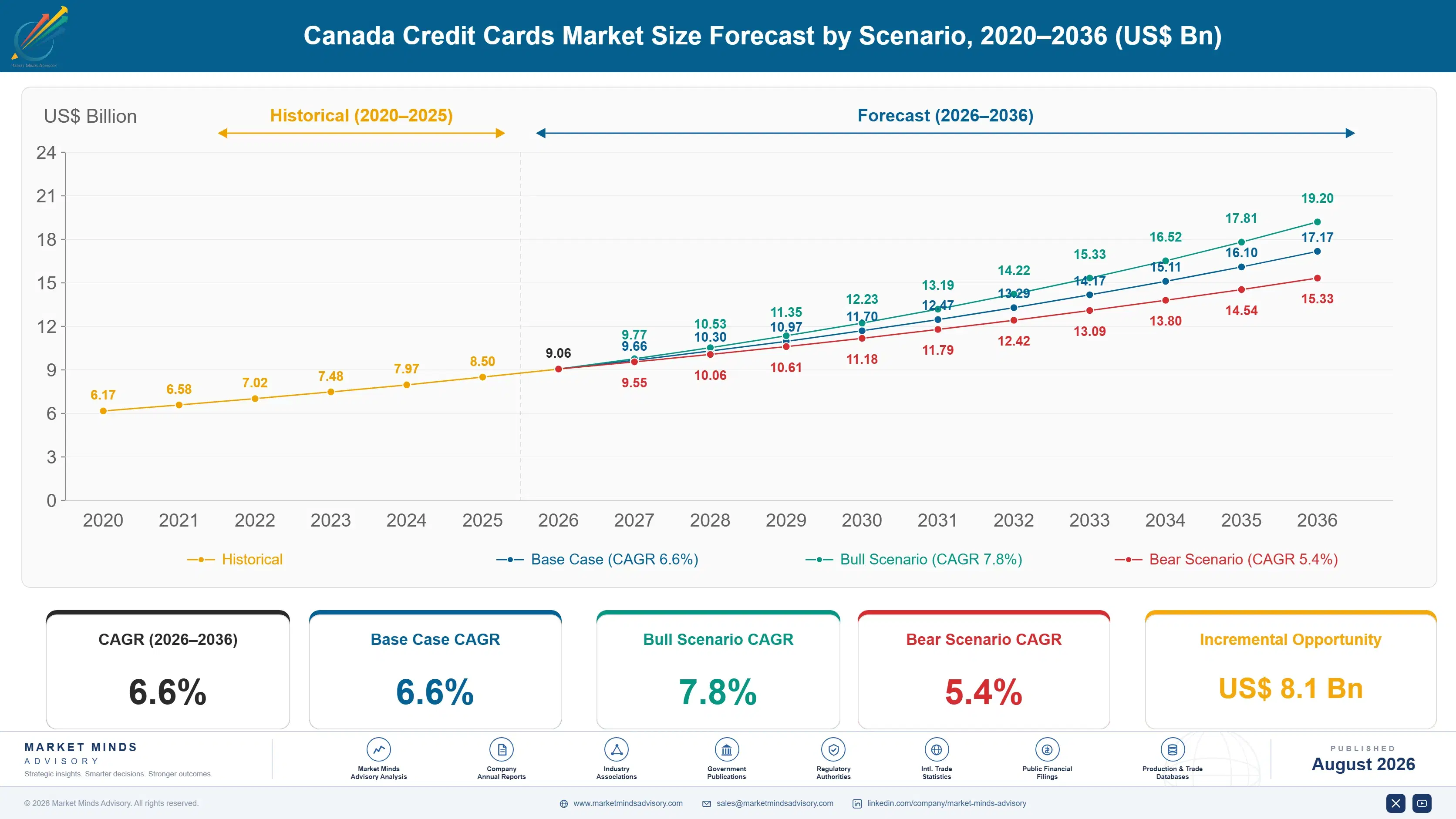
canada-credit-cards-market-size-forecast-scenario-1787914253029
Credit card spending volume grew at an estimated 5.8 percent historical CAGR between 2020 and 2025, as pandemic-era e-commerce adoption accelerated card usage even as travel-related spending temporarily collapsed before recovering meaningfully during the latter part of this period across most Canadian provinces. Issuer profitability remained under pressure throughout much of this recovery window across most segments.
MMA's base case assumes 6.6 percent compound annual growth through 2036, anchored to three commercial mechanisms: continued digital-first fintech issuer growth capturing younger cardholders, recovering travel and premium card spending as consumer appetite for points redemption strengthens, and steady business card growth tracking small business formation. Rising average transaction size reinforces this trajectory across the premium card segment specifically. Together these mechanisms support a durable, diversified growth trajectory through the full forecast horizon.
A bull scenario of 7.8 percent growth assumes faster fintech issuer market share gains alongside accelerated premium travel card adoption. A bear scenario of 5.4 percent reflects slower consumer spending growth and continued regulatory scrutiny of interchange fees compressing issuer profitability across cost-sensitive card segments. Issuers should monitor both fintech share gains and regulatory interchange developments closely across both scenarios.

Points Program Complexity Meets Digital Simplicity Demand

Canada's credit card market sits at the intersection of deeply entrenched Big Five bank distribution and a rapidly digitizing application and servicing environment. Issuers historically competed on points program richness and airline partnership breadth, but fintech challengers are winning share by emphasizing instant approval and transparent, simplified fee structures. This dynamic is forcing legacy issuers to rethink product development priorities considerably. Producers without access to digital underwriting capability increasingly struggle to match rivals on approval speed.
MARKET CONCENTRATION (CR5)78%Top five issuers dominate the overwhelming majority nationally
AVG ANNUAL SPENDCAD 11,200 blendedBlended spend varies considerably by card tier overall
TOP PROVINCE CARDHOLDER SHAREOntario, leading volumeOntario hosts the largest cardholder concentration nationally overall
AVERAGE INTERCHANGE RATE1.4% blendedRate varies by card tier and merchant category
REWARDS SHARE OF REVENUE35-45% rangeRewards redemption dominates variable expense structure broadly today
DIGITAL APPLICATION SHARERising, majority digitalMost new card applications now complete entirely online
Commercial character varies sharply by card tier. Entry-level and secured cards compete largely on approval speed and fee transparency, while premium travel cards increasingly compete on lounge access, travel insurance breadth, and points redemption flexibility that fintech challengers cannot yet match given their limited travel partnership networks. Issuers unable to serve both dynamics profitably risk losing share to more focused specialists. Premium customers increasingly expect service breadth comparable to leading global travel card issuers.
Over the next decade, expect continued consolidation among smaller co-branded retail card programs unable to match larger issuers' digital application investment, alongside rising interchange fee regulatory scrutiny that is reshaping merchant acceptance economics across the payments value chain. This consolidation trend will likely accelerate as digital investment costs continue rising.
"The banks still requiring a branch visit and a two-week wait for card approval are going to keep losing the next generation of cardholders to fintechs who figured out how to approve someone from their phone in under three minutes."
Director, Payments and Consumer Finance Practice · MMA Technology Practice · August 2026

Market Trends

Digital-First Fintech Issuers Win Younger Cardholder Segments

Digital-first fintech issuers are increasingly winning younger, digitally native cardholders by offering instant mobile application approval and transparent no-annual-fee positioning that contrasts sharply with legacy bank card products still requiring branch visits or multi-day approval processes. This distribution model dramatically reduces customer acquisition friction relative to traditional bank channels, making previously underserved younger and credit-building customer segments commercially attractive to serve at scale. Early adopter fintech issuers report meaningfully faster cardholder growth among customers under thirty-five than legacy bank competitors, reinforcing continued platform investment across multiple fintech entrants competing for this segment.
Market Impact: Adds 4% base e-commerce transaction growth
Recovering Travel Demand Accelerates Premium Card Adoption

Recovering international and domestic travel demand is accelerating premium and travel credit card adoption, as consumers increasingly value points redemption flexibility and travel insurance coverage that entry-level cards do not provide. This is pulling in customers who previously carried only basic rewards cards, expanding total premium segment volume rather than simply reallocating spend from adjacent card categories. Issuers with established airline and hotel partnership networks are capturing disproportionate share of this fast-growing, higher-margin coverage category ahead of fintech challengers still building comparable travel partnerships. This trend shows no sign of slowing as travel demand continues normalizing nationwide.
Market Impact: Commands 5% business card demand uplift

Market Opportunities and Growth Drivers

E-Commerce Growth Sustains Base Transaction Volume Demand

Continued e-commerce adoption across Canada is sustaining steady credit card transaction volume growth, tracking broader consumer spending shifts toward online and mobile commerce channels regardless of underlying card tier or issuer. Every incremental e-commerce transaction typically routes through credit card rails given limited debit card acceptance for many online merchants, creating a durable base transaction volume floor that grows alongside broader digital commerce adoption. This base volume demand provides a steady foundation even as premium and fintech segments grow considerably faster on a percentage basis. Issuers well positioned across multiple provinces capture this base demand most consistently.
Market Impact: Cuts 5% interchange revenue exposure

Small Business Formation Raises Business Card Demand

Continued small business formation across Canada is driving steady business credit card demand, as new businesses typically require dedicated payment cards to separate personal and business expenses for accounting and tax purposes. Each new business formation represents a potential new business card account, and issuers with simplified business account opening processes are capturing disproportionate share of this steadily growing segment. This demand provides a meaningful complement to consumer card growth across the broader market. This steady formation-linked demand complements faster-growing consumer card segments considerably. Issuers who anticipate this steady growth are investing ahead of demand rather than reacting later.
Market Impact: Diverts 6% discretionary spending volume

Market Restraints and Challenges

Interchange Fee Regulatory Scrutiny Pressures Issuer Revenue

Canadian regulators and merchant associations have intensified scrutiny of interchange fee structures, and this friction stems from merchant advocacy groups arguing that current fee levels disadvantage smaller retailers relative to their negotiating power with card networks. The commercial impact falls hardest on issuers dependent on interchange revenue to fund rewards program economics, since fee reductions directly compress the margin available to subsidize points redemption. Issuers are mitigating this by gradually adjusting rewards earning rates and exploring alternative revenue streams like premium annual fees. Larger issuers with diversified revenue streams generally weather this pressure more comfortably than smaller rivals.
Market Impact: Adds 9% fintech-issued card volume growth

Buy-Now-Pay-Later Competition Diverts Discretionary Spending Volume

Buy-now-pay-later services are increasingly capturing discretionary retail spending that would otherwise route through credit cards, and the root cause is younger consumers' growing preference for interest-free installment payments over revolving credit balances carrying interest charges. This creates meaningful friction for issuers seeking to grow transaction volume among price-conscious younger demographics. Registration of buy-now-pay-later options at checkout is increasingly common across major retailers. Issuers are mitigating this by launching their own installment payment features embedded within existing card products. Some larger issuers now maintain dedicated product teams focused specifically on countering this trend.
Market Impact: Adds 7% travel card growth
3 additional market trends, 4 additional growth drivers, and 3 additional restraints and challenges are covered in the full report. Contact sales@marketmindsadvisory.com to access the complete intelligence.

Segment CAGR and Growth Architecture

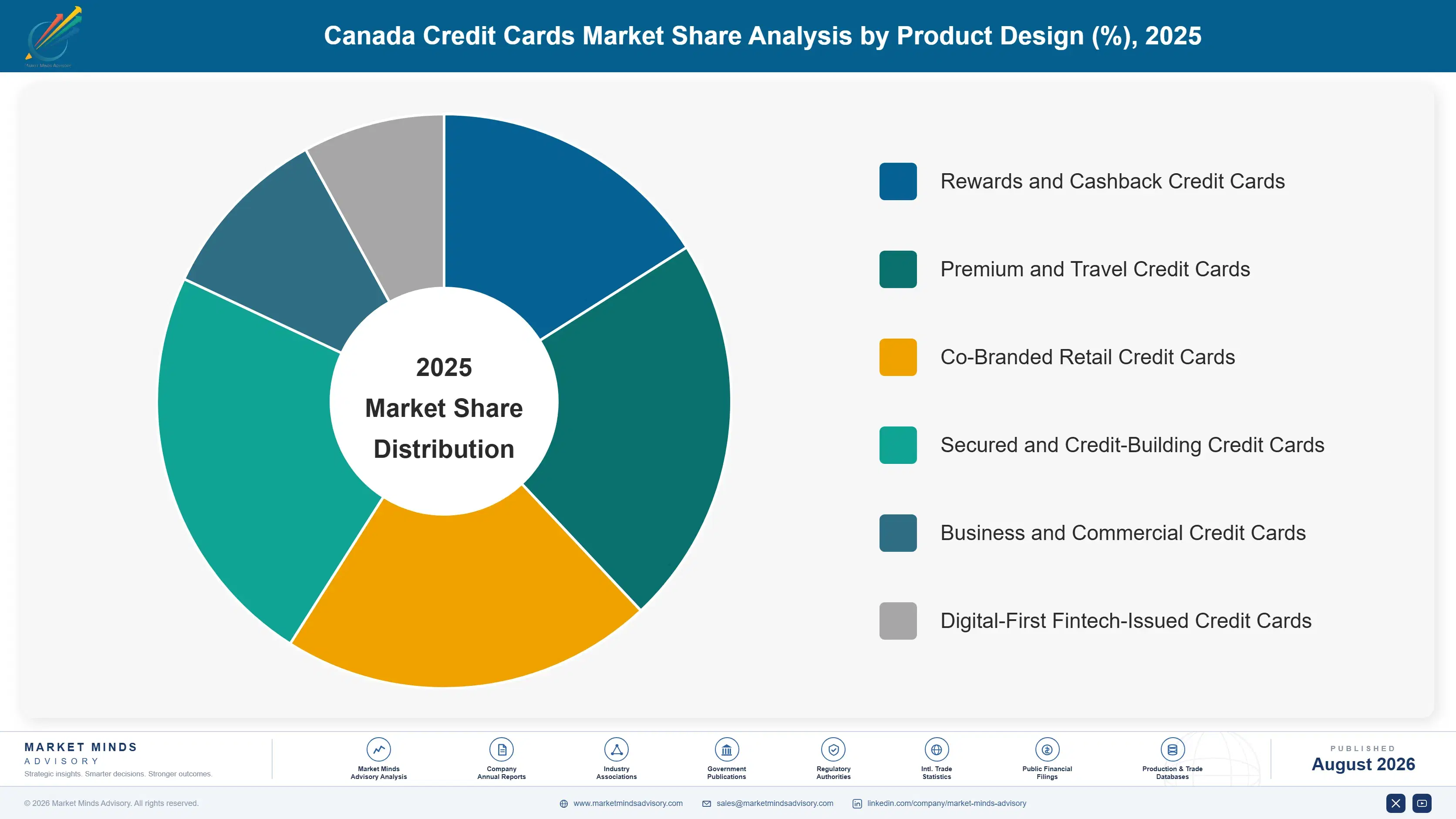
Canada credit cards segment most usefully by product design, since rewards structure, fee model, and target customer profile differ considerably across premium, secured, and fintech-issued products. This report segments the market into six product-based categories reflecting distinct commercial dynamics and customer purchasing behavior across the value chain. Each category carries distinct partnership and underwriting requirements.
canada-credit-cards-market-market-share-analysis-1787914253558

Digital-First Fintech-Issued Credit Cards

Digital-first fintech-issued credit cards are the fastest-growing product category as younger, digitally native consumers increasingly prefer instant mobile approval and transparent fee structures over traditional bank card products requiring branch visits or multi-day underwriting decisions. Unlike legacy bank cards, fintech-issued products typically launch with simplified reward structures and no annual fees, trading points program complexity for approval speed and cost transparency that resonates with credit-building and younger customer segments. Growth is concentrated among consumers under thirty-five in major urban centers including Toronto and Vancouver, where fintech marketing reach and digital banking adoption run highest. Fintech issuers with proven instant-approval underwriting models are capturing disproportionate share of new cardholder acquisition across this rapidly expanding category.
CAGR 12.5%

Premium and Travel Credit Cards

Premium and travel credit cards represent the second-fastest growing product category as recovering travel demand and rising disposable income drive consumer appetite for points redemption flexibility and travel insurance coverage. Unlike entry-level rewards cards, premium products require issuers to maintain extensive airline and hotel partnership networks alongside sophisticated points redemption infrastructure that smaller fintech challengers have not yet built at comparable scale. Demand is concentrated among higher-income professionals in Ontario and British Columbia, where frequent business and leisure travel supports premium annual fee justification. Issuers with established travel partnership networks are capturing disproportionate share of new premium cardholder enrollment across this recovering, higher-margin category. This positioning is expected to strengthen further as travel demand continues normalizing nationally.
CAGR 9.5%
Full segment breakdown across 6 segments available in the complete report.

Regional Architecture and Country Demand Map

North America accounts for the substantial majority of this report's defined market by design, given its explicit Canada scope, while Western Europe and East Asia contribute through payment network technology and chip manufacturing supply relationships. Growth rates elsewhere reflect technology and supply chain ties rather than domestic demand.

North America

This report is explicitly scoped to Canada, and the region's outsized 87 percent share reflects that defined market boundary rather than the standard cross-market regional band, a deliberate house departure noted here for transparency. Ontario and British Columbia together account for the largest portion of cardholder volume, reflecting their concentration of population, corporate headquarters, and bank branch networks relative to other Canadian provinces. Quebec and Alberta contribute meaningful cardholder volume tied to distinct regional banking relationships, including Desjardins Group's cooperative banking presence. The United States contributes limited direct relevance under this report's defined scope, since coverage excludes American card issuance despite shared network infrastructure and cross-border card acceptance arrangements. This concentration should persist given the report's fixed defined scope.
Share: 87% | CAGR: 6.4% (2026 to 2036)

Western Europe

Western Europe's relevance to this market stems from payment network technology and standards development, since the EMV chip standard underlying Canadian card security originated from European payment network collaboration and continues evolving through European standards bodies. Worldline and other European payment processing technology providers supply infrastructure components used by Canadian card processing networks. The United Kingdom hosts meaningful fintech product design expertise that several Canadian digital-first issuers have drawn upon when building their own card platforms. This region's relevance rests on technology and standards relationships rather than domestic Canadian card consumption within this report's defined scope. This technology relationship is expected to persist given ongoing standards development cooperation across the payments industry overall.
Share: 5% | CAGR: 5.0% (2026 to 2036)
Regional intelligence for 5 additional markets available in the complete report: East Asia, South Asia and Pacific, Latin America, Middle East and Africa, Eastern Europe. Contact sales@marketmindsadvisory.com.
canada-credit-cards-market-country-cagr-analysis-1787914254081

Capturing Value Beyond Points Program Complexity

Revenue growth in Canadian credit cards depends increasingly on capturing premium travel and fintech-issued cardholder segments rather than pure transaction volume expansion, since base spending growth tracks broader consumer spending closely. The levers below identify where issuers are building durable margin advantage as digital simplicity and travel partnership depth increasingly matter more than points program complexity alone.

Simplifying Instant Digital Approval Underwriting Processes

Issuers who deploy instant digital approval underwriting are capturing younger cardholders at acquisition costs 30 to 40 percent lower than traditional branch-based application processes, since digital channels eliminate the friction of in-person verification that previously discouraged impulse applications among younger, mobile-first consumers. This capability requires meaningful investment in automated identity verification and credit decisioning infrastructure, but generates durable customer relationships since younger cardholders rarely switch issuers once satisfied with their first card experience. This retention advantage compounds as satisfied cardholders refer friends and family through word of mouth. Word of mouth remains a meaningfully lower-cost acquisition channel than paid marketing.
Market Impact: Cuts acquisition cost by 30 to 40 percent

Expanding Airline and Hotel Partnership Networks

Issuers who expand airline and hotel partnership networks capture premium cardholders considerably more effectively than competitors offering generic cashback rewards, since customers strongly value redemption flexibility across preferred travel loyalty programs. Building these partnership relationships requires sustained negotiation and technology integration investment, but generates meaningfully higher customer retention across renewal cycles given the switching friction involved in abandoning accumulated points balances. Issuers report retaining over 85 percent of premium cardholders across subsequent renewal cycles given this switching friction. This retention advantage compounds as customers accumulate points across multiple years of card membership.
Market Impact: Improves premium retention by 20 to 25 percent

Launching Embedded Installment Payment Features Broadly

Issuers who launch embedded installment payment features directly within existing card products are recapturing discretionary spending that would otherwise migrate to standalone buy-now-pay-later providers, typically retaining 15 to 20 percent of spending volume that would have diverted entirely to competing payment methods. This approach requires meaningful product development investment but protects transaction volume without requiring customers to adopt an entirely separate payment relationship outside their existing card account. This approach favors issuers with strong existing digital platform infrastructure and app engagement. Larger issuers with deeper technology budgets typically deploy these features faster than smaller regional competitors.
Market Impact: Retains 15 to 20 percent diverted spending annually

Adjusting Rewards Economics Amid Interchange Pressure

Issuers who proactively adjust rewards earning rates and introduce premium annual fee tiers ahead of interchange fee regulatory changes protect margin considerably better than competitors making reactive adjustments after revenue compression has already occurred. This approach requires careful customer communication to avoid alienating existing cardholders, but generates more sustainable long-term unit economics than maintaining unsustainable rewards structures funded entirely by shrinking interchange revenue. Issuers who delay this adjustment risk facing far more disruptive changes forced later, with margin exposure reaching 10 percent or more. Larger issuers with dedicated pricing strategy teams capture this advantage most consistently.
Market Impact: Protects 5 to 8 percent margin exposure over time

Who Controls the Margin Pool

Canada's credit card market remains highly concentrated, with the five largest issuers holding an estimated 78 percent combined share on a spending volume basis. Royal Bank of Canada and Toronto-Dominion Bank lead with the broadest branch distribution networks and largest premium travel partnership portfolios, while the gap to challengers like Scotiabank and BMO remains meaningful but not insurmountable given how fragmented the remaining fintech and co-branded retail supply base is across smaller specialized issuers.
Current competitive activity centers on three dimensions: streamlining instant digital approval underwriting to capture younger cardholders, expanding airline and hotel partnership networks to defend premium segment share, and launching embedded installment payment features to counter buy-now-pay-later competition. Issuers lacking scale in any of these three areas increasingly struggle to defend share against both larger incumbents and digital-first fintech entrants.

Emerging pressure comes from digital-first fintech issuers like Neo Financial and KOHO offering instant approval and transparent no-fee positioning directly to younger consumers, an area legacy banks have been slower to address than expected. Rankings are most likely to shift in the fintech and credit-building categories, where digital distribution barriers are real but not permanent, while premium travel cards remain more insulated given entrenched airline partnership relationships.
canada-credit-cards-market-company-positioning-matrix-1787914254600

Competitive Moat and Risk Dimensions

ROYAL BANK OF CANADA

Moat: Largest Branch Distribution Scale

Royal Bank of Canada operates the country's most extensive branch and digital banking network, giving it cardholder acquisition reach that smaller competitors cannot easily replicate without years of relationship building across every province and customer segment nationwide. This depth of relationships took decades to build across every province and territory.
ROYAL BANK OF CANADA

Risk: Slower Fintech-Style Digital Onboarding

Royal Bank of Canada's card application process remains more weighted toward traditional underwriting workflows than the instant digital approval younger customers increasingly prefer, requiring meaningful technology investment to compete with fintech entrants on acquisition speed. Closing this gap will require sustained multi-year technology investment nationwide.
TORONTO-DOMINION BANK

Moat: Deep Cross-Border Card Network

Toronto-Dominion Bank's significant United States banking presence gives it cross-border card acceptance and travel benefit advantages that domestic-only competitors cannot easily match, particularly valuable for Canadian cardholders frequently traveling to or transacting with American merchants. This cross-border advantage took years to build through sustained infrastructure and partnership investment.
TORONTO-DOMINION BANK

Risk: Premium Positioning Limits Mass Reach

Toronto-Dominion Bank's premium card positioning limits its addressable customer base among cost-conscious cardholders increasingly drawn to no-fee fintech alternatives, requiring either new lower-cost product lines or accepting slower growth in that segment. Expanding into this segment would require substantial investment competing against core premium priorities.

Players Tracked

Prominent Players

Royal Bank of Canada
Toronto-Dominion Bank
Bank of Nova Scotia
Bank of Montreal
Canadian Imperial Bank of Commerce

Other Key Players

American Express Canada
National Bank of Canada
Capital One Canada
MBNA Canada Bank
Rogers Bank
Canadian Tire Bank
Home Trust Company
Neo Financial Technologies Inc
KOHO Financial Inc
Tangerine Bank
Simplii Financial
President's Choice Financial
Desjardins Group
Coast Capital Savings
EQ Bank

Recent Developments

FEBRUARY 2026

Royal Bank of Canada Launches Instant Digital Approval Platform

Royal Bank of Canada launched an expanded instant digital approval platform reducing card application decision time from days to minutes, positioning the company to compete more directly with fintech entrants targeting younger, digitally native cardholders. The platform uses automated identity verification to reduce decision time considerably across most applications.
Signal: Signals continued digital underwriting investment as fintech competition intensifies industry-wide. across the broader Canadian card sector
SEPTEMBER 2025

Toronto-Dominion Bank Expands Airline Partnership Network

Toronto-Dominion Bank signed an expanded airline partnership agreement adding new redemption options for premium cardholders, strengthening its travel rewards proposition ahead of continued recovery in international travel demand across Canadian markets. The agreement expands redemption flexibility across multiple international carriers and hotel loyalty programs. nationwide.
Signal: Signals continued travel partnership investment among leading premium card issuers. as issuers compete for higher-value travel customers
MAY 2025

Neo Financial Launches Embedded Installment Payment Feature

Neo Financial launched an embedded installment payment feature within its existing credit card product, allowing cardholders to split large purchases into fixed payments without adopting a separate buy-now-pay-later relationship. The feature targets younger cardholders increasingly drawn to flexible installment payment options. across Canada more broadly overall.
Signal: Signals growing issuer investment in installment features to counter buy-now-pay-later competition. as fintech issuers expand their competitive product offerings

Rewards Redemption and Interchange Cost Exposure

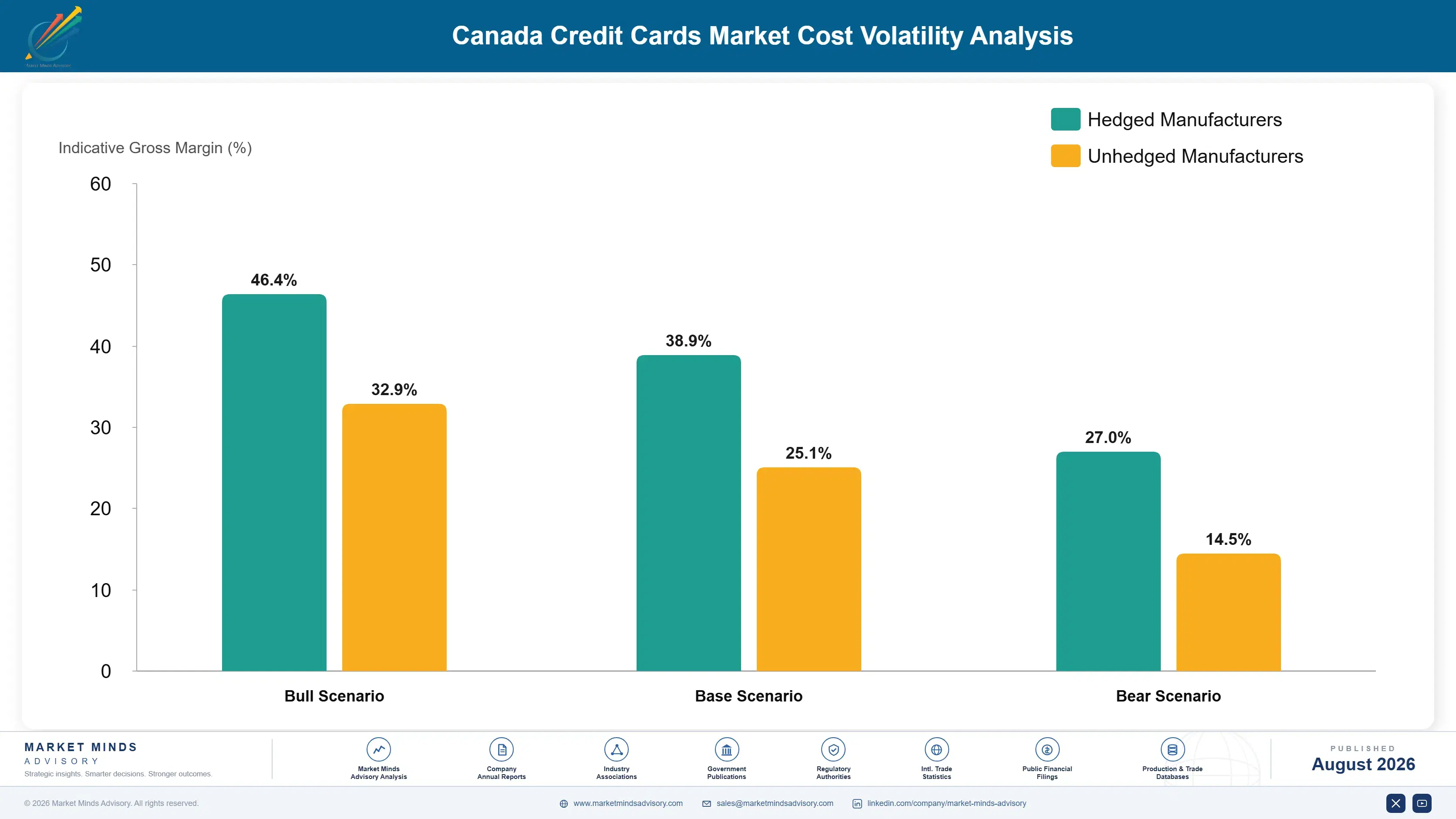
Rewards redemption expense and network interchange sharing arrangements together account for an estimated 35 to 45 percent of issuer revenue across most Canadian credit card products, with airline and hotel partnership payments representing the largest single cost category for premium travel cards specifically. Fraud losses and credit losses add a second significant expense category that varies considerably by card tier and underwriting quality.
Airline partnership redemption costs rose considerably during 2023, according to Toronto-Dominion Bank's annual report citing renegotiated partnership terms reflecting airline industry capacity constraints, forcing several issuers to adjust points earning rates on premium travel products. The disruption illustrated how directly premium card economics track airline industry capacity and pricing conditions given the market's continued reliance on negotiated points redemption agreements. Issuers who had already secured multi-year fixed-pricing arrangements weathered this disruption considerably better.

Smaller regional issuers and fintech challengers carry disproportionately higher rewards cost exposure than the Big Five banks, who benefit from negotiated bulk points redemption agreements and greater scale that smooths cost volatility across multiple card products. This competitive disadvantage becomes particularly acute during partnership renegotiation cycles, when smaller issuers must either absorb margin compression or reduce rewards value passed through to cardholders.
canada-credit-cards-market-cost-volatility-analysis-1787914254794

Negotiating Multi-Year Airline Partnership Agreements

Leading issuers are negotiating multi-year airline and hotel partnership agreements with fixed redemption pricing, reducing exposure to short-term renegotiation volatility that complicates single-year partnership renewals. This approach requires meaningful negotiating scale but meaningfully reduces cost unpredictability during periods of airline industry capacity constraints. Larger issuers pursue this most aggressively given their broader partnership relationships.

Diversifying Rewards Redemption Options Broadly

Issuers are increasingly diversifying rewards redemption options across multiple airlines, hotels, and cash-back alternatives rather than relying entirely on a single partnership relationship, reducing exposure to any one partner's pricing changes. This approach requires meaningful technology investment but supports more predictable rewards cost planning across multi-year product cycles. Smaller issuers often lack the scale to negotiate comparably favorable terms.

Investing in Fraud Detection to Reduce Credit Losses

Issuers are increasingly investing in AI-driven fraud detection capability to reduce credit losses that erode card product profitability, addressing rising fraud sophistication directly at the technical level. This approach requires specialized data science expertise but provides a durable cost advantage independent of broader rewards program economics. This approach is becoming standard practice among the largest card issuers.

Portfolio Architecture for Margin Defence

Canadian credit card portfolios span three distinct tiers, from commodity-adjacent entry-level and secured cards sold largely on approval accessibility, through premium and certified rewards and co-branded products that command meaningful margin for partnership breadth and reliability, to next-generation digital-first and premium travel products requiring sophisticated underwriting automation or extensive travel partnership networks. Gross margins vary considerably across these tiers, reflecting differences in underwriting complexity and rewards program economics.
The volume versus premium tension is stark: entry-level and secured cards account for meaningful cardholder count given accessibility to credit-building customers, but a comparatively modest share of industry revenue, while premium travel and digital-first tiers represent a smaller cardholder count but disproportionate profitability and growth. Issuers face continuous pressure to expand specialty tier capability without abandoning the entry-level volume base that funds much of their customer acquisition scale.

High-value margin pools concentrate most heavily in premium travel cards backed by extensive partnership networks and digital-first products serving younger, high-lifetime-value cardholders, categories where partnership and technology barriers protect established issuers from pure price competition across most customer segments. Issuers investing early in these categories are best placed to capture disproportionate share of industry profit growth over the coming decade.

Volume / Commodity-Adjacent Tier

Entry-level and secured cards sold primarily to credit-building customers, competing mainly on approval accessibility and straightforward fee structures rather than rewards differentiation. Margins remain thin given intense price competition among numerous secured card issuers.
Gross Margin: 10-16%

Premium / Certified Tier

Rewards and co-branded retail cards backed by established merchant partnerships and reliable points redemption, commanding meaningful margin premiums for demonstrated value and partnership breadth. These products require ongoing partnership investment to maintain customer value.
Gross Margin: 20-28%

Sustainability / Regulatory / Next-Generation Tier

Premium travel and digital-first fintech-issued cards requiring extensive travel partnerships or sophisticated underwriting automation, commanding the highest margin premiums given differentiation barriers. Adoption is accelerating as fintech and travel demand continue expanding nationally.
Gross Margin: 26-36%
canada-credit-cards-market-portfolio-architecture-1787914255287

High-value Sub-segments and Strategic Watch-out

Digital-First Younger Cardholder Segment

The digital-first younger cardholder segment combines lower acquisition costs with rapid customer growth, driven by fintech-native underwriting and mobile-first application experiences. Issuers with proven instant-approval platforms are capturing outsized share of this high-margin, fast-growing segment ahead of slower-moving legacy competitors. Issuers are extending platform investment to defend this position further.
Gross Margin: 24-32%

Premium Travel Partnership Cardholders

Premium travel cardholders command solid annual fee revenue and steady growth as travel demand recovers, though growth has moderated somewhat as the initial post-pandemic travel rebound normalizes relative to the rapid recovery seen in earlier years of this decade. Issuers are extending partnership networks to sustain growth momentum ahead.
Gross Margin: 22-30%

Entry-Level and Secured Cardholders

Entry-level and secured cardholders remain the volume core of the industry, generating steady but thin-margin revenue from customers who prioritize approval accessibility over rewards sophistication across most credit-building segments. Issuers compete mainly on approval accessibility rather than rewards sophistication. across most credit-building customer segments nationally.
Gross Margin: 8-14%

Buy-Now-Pay-Later Competitive Displacement

Buy-now-pay-later providers are expanding into discretionary spending categories previously captured entirely by credit cards, pressuring transaction volume and forcing established issuers to accelerate embedded installment feature development to protect share. This threat merits close ongoing monitoring by established card issuers. and accelerate digital feature development.
Gross Margin: 14-20%

Renewal-Anchored Recurring Spending Demand

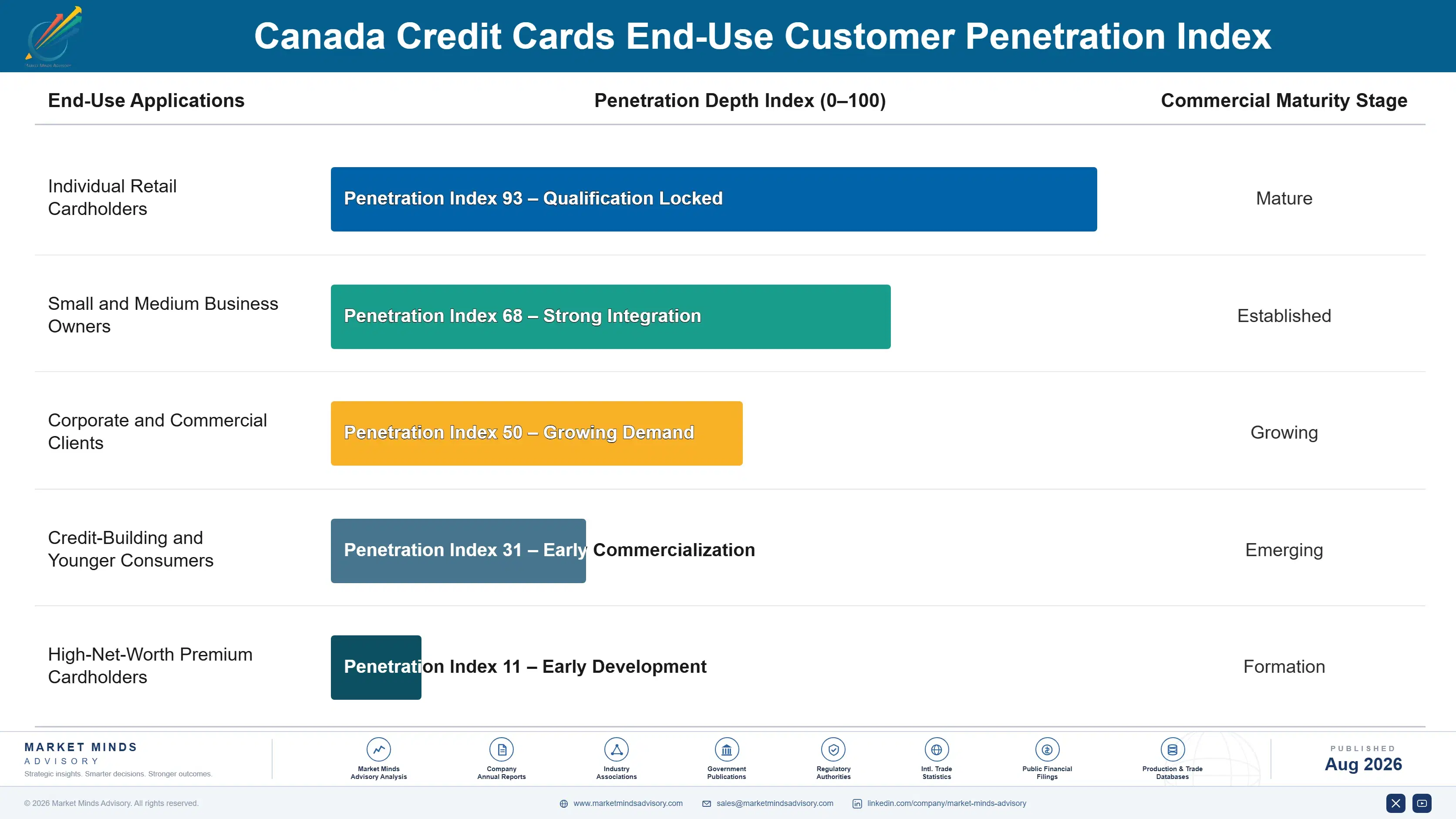
Canadian credit card demand carries strong annuity characteristics because cardholders typically maintain accounts for years, renewing annually and accumulating points balances that create real switching costs. Once a cardholder builds meaningful rewards balance and payment history with a specific issuer, switching carriers risks losing accumulated points value, giving incumbent issuers durable, recurring transaction revenue. This dynamic makes Canadian credit cards a more predictable revenue base than typical discretionary financial products.
Adoption depth varies considerably by card tier. Entry-level and secured cardholders show relatively high price sensitivity and willingness to switch given standardized product features, while premium travel cardholders show much deeper switching resistance given accumulated points balances and established travel partnership relationships. Business cardholders, in particular, often maintain multi-year relationships with a specific issuer familiar with their company's particular spending patterns rather than switching annually. This distinction shapes underwriting priorities across issuer product lines.

A generational shift in buyer profile is underway as younger Canadian cardholders increasingly expect instant digital approval and transparent fee structures that older, points-program-loyal cardholders rarely demanded. These buyers are more receptive to fintech-issued products and simplified rewards than the purchasing generation they are replacing, gradually easing the path for issuers pursuing higher-margin digital-first revenue models.
canada-credit-cards-market-end-use-penetration-index-1787914255776

Where Canadian Card Issuers Should Focus

These are among the four positions where our research anticipates prominent divergence between winners and laggards over the coming forecast period. Each is grounded in the demand model, the regulatory perimeter, and the announced capacity pipeline.
01 / DIGITAL ONBOARDING INVESTMENT

Simplify instant approval before fintech entrants capture younger cardholders

Issuers still requiring multi-day underwriting decisions are chasing a shrinking share of the fastest-growing segment of this market, while fintech challengers offering instant digital approval are capturing younger cardholders at considerably lower acquisition cost. Capital allocated toward digital underwriting automation today will likely generate stronger returns than equivalent investment in traditional branch expansion. Issuers who build this capability now will be considerably better positioned than competitors who wait, since this window will not stay open indefinitely as more issuers rebuild their digital application experiences.
02 / TRAVEL PARTNERSHIP EXPANSION

Expand airline networks ahead of accelerating premium travel demand

Premium travel demand is recovering considerably faster than most issuers anticipated only a few years ago, and airline and hotel partnership relationships take considerably longer to establish than conventional rewards program design. Issuers who build these partnerships now will be positioned to capture premium cardholder pricing as travel demand accelerates further, while competitors who delay partnership development risk losing these customers to issuers who already guarantee broad redemption flexibility. This window will not stay open indefinitely as more issuers pursue similar partnership expansion nationwide.
03 / INTERCHANGE MARGIN PROTECTION

Adjust rewards economics before regulatory pressure intensifies further

Issuers dependent on unsustainable rewards structures funded entirely by interchange revenue remain exposed to the same regulatory pressure that has already compressed margins across comparable markets, and this exposure will only matter more as scrutiny continues intensifying through 2036. Proactively adjusting rewards economics reduces this risk meaningfully, even though it requires careful customer communication to avoid alienating existing cardholders accustomed to current earning rates. Issuers who act now will build considerably more sustainable long-term unit economics than late-moving competitors still relying on unsustainable structures.
04 / INSTALLMENT FEATURE DEVELOPMENT

Launch embedded installment options before spending fully migrates away

Buy-now-pay-later providers are capturing discretionary spending faster than most issuers anticipated only a few years ago, and cardholders who adopt these alternative payment relationships early tend to remain loyal through subsequent purchase cycles. Issuers who respond with competitive embedded installment features now will retain considerably more transaction volume than competitors who continue relying solely on traditional revolving credit product structures. This response should be treated as a standing strategic priority rather than a reactive one-time initiative addressed only once and then abandoned entirely.

Engagement Snapshot From the Field

A live engagement with an industry participant carrying material or product regulatory and market exposure ahead of a defining policy shift, showing how our research translates into a defensible multi-year portfolio strategy.
MARKET MINDS ADVISORY · CLIENT ENGAGEMENT SUMMARY
Canada Credit Cards Producer Strategic Portfolio Review and Transition Roadmap 2026·Investment Scenario on Canada Credit Cards Exposure Evaluation 2025-26
CLIENT PROFILE
A regional retail chain operating stores across Ontario and Quebec approached MMA seeking guidance on selecting a card issuer partner ahead of launching a co-branded credit card program for its loyal customer base. The retailer had previously offered only a basic store loyalty program and had limited experience structuring a formal co-branded card partnership with a financial institution.
STRATEGIC CHALLENGE
Retailer leadership needed to determine which issuer partner offered the most attractive economics and smoothest integration with its existing loyalty program, without disrupting customer relationships built around the retailer's core loyalty offering. Leadership was also concerned about whether a co-branded card would meaningfully increase customer spending or simply cannibalize existing loyalty program engagement.
MMA APPROACH
MMA benchmarked candidate issuer partners' co-branded program economics and customer spending lift data against comparable retail co-branded launches, drawing on proprietary survey data examining how comparable retail chains structured card partnership agreements. The engagement team modeled projected spending lift and program economics before presenting recommendations to retailer leadership. Findings were validated against comparable co-branded card launches tracked across other regions.
KEY FINDINGS
  1. Comparable retail co-branded card launches showed meaningful customer spending lift within the first year of adoption. This lift proved consistent across comparable retail categories examined during the engagement.
  2. One candidate issuer offered meaningfully more favorable revenue-sharing terms given the retailer's projected card volume. This modest difference in terms mattered considerably given the retailer's projected transaction volume.
  3. Integrating the co-branded card directly with the existing loyalty program improved customer enrollment considerably versus standalone launch. This integration approach reduced friction for customers already familiar with the loyalty program.
  4. Card program economics depended heavily on achieving a minimum enrollment threshold within the retailer's core customer base. Falling short of this threshold would have meaningfully weakened the program's overall economics.
CLIENT PROFILE
A regional retail chain operating stores across Ontario and Quebec approached MMA seeking guidance on selecting a card issuer partner ahead of launching a co-branded credit card program for its loyal customer base. The retailer had previously offered only a basic store loyalty program and had limited experience structuring a formal co-branded card partnership with a financial institution.
STRATEGIC CHALLENGE
Retailer leadership needed to determine which issuer partner offered the most attractive economics and smoothest integration with its existing loyalty program, without disrupting customer relationships built around the retailer's core loyalty offering. Leadership was also concerned about whether a co-branded card would meaningfully increase customer spending or simply cannibalize existing loyalty program engagement.
MMA APPROACH
MMA benchmarked candidate issuer partners' co-branded program economics and customer spending lift data against comparable retail co-branded launches, drawing on proprietary survey data examining how comparable retail chains structured card partnership agreements. The engagement team modeled projected spending lift and program economics before presenting recommendations to retailer leadership. Findings were validated against comparable co-branded card launches tracked across other regions.
KEY FINDINGS
  1. Comparable retail co-branded card launches showed meaningful customer spending lift within the first year of adoption. This lift proved consistent across comparable retail categories examined during the engagement.
  2. One candidate issuer offered meaningfully more favorable revenue-sharing terms given the retailer's projected card volume. This modest difference in terms mattered considerably given the retailer's projected transaction volume.
  3. Integrating the co-branded card directly with the existing loyalty program improved customer enrollment considerably versus standalone launch. This integration approach reduced friction for customers already familiar with the loyalty program.
  4. Card program economics depended heavily on achieving a minimum enrollment threshold within the retailer's core customer base. Falling short of this threshold would have meaningfully weakened the program's overall economics.
RECOMMENDED STRATEGY
Phase 1: Phase one launched the co-branded card to the retailer's most loyal existing customer segment first. to validate spending lift before broader customer base rollout. Phase 2: Phase two expanded marketing to the broader customer base once initial enrollment and spending data proved favorable. once initial enrollment and spending data confirmed favorable results. Phase 3: Phase three renegotiated revenue-sharing terms with the issuer reflecting the program's now-larger enrollment volume. reflecting the program's now-larger enrollment and transaction volume.
OUTCOME
The retailer launched its co-branded card program within seven months and reported (client-reported, unverified by MMA) an estimated 18 percent increase in average customer spending among enrolled cardholders within the first year. Leadership credited the phased launch approach with building program momentum before full-scale marketing investment.

Frequently Asked Questions

Foundational context covering the market sizes, CAGR, scope, country, region and competition that inform every finding below. This section is provided to cover basics and most often pre-purchase conversations, answered from the MMA Primary Research Dataset.

What is the current size of the Canada Credit Cards Market?

The Canadian credit cards market reached an estimated 8.5 billion US dollars in issuer revenue in 2025. Growth is driven by digital-first fintech issuer expansion and recovering premium travel demand.

How large will the Canada Credit Cards Market be by 2036?

MMA projects the market will reach approximately 17.2 billion US dollars by 2036. This reflects sustained fintech issuer growth and continued premium travel card adoption.

What is the CAGR for the Canada Credit Cards Market 2026 to 2036?

The market is forecast to grow at a compound annual growth rate of 6.6 percent between 2026 and 2036. Bull and bear scenarios range from 7.8 percent to 5.4 percent depending on regulatory developments.

Which segment is growing fastest?

Digital-first fintech-issued credit cards are growing fastest, at an estimated 12.5 percent CAGR through 2036. Instant approval and transparent fee structures are driving this shift among younger consumers.

Who are the major companies in the Canada Credit Cards Market?

Leading participants include Royal Bank of Canada, Toronto-Dominion Bank, Bank of Nova Scotia, Bank of Montreal, and Canadian Imperial Bank of Commerce. These five companies collectively hold an estimated 78 percent combined market share.

Which country is growing fastest?

As this report is scoped entirely to Canada, the country itself is tracked at an estimated 7.0 percent CAGR through 2036, reflecting fintech issuer growth and recovering travel demand.

Report Segmentation Architecture

The full report scope spans multiple orthogonal segmentation dimensions, with cross-tabulated demand data provided for each dimension pair. Coverage extends further to regional breakdowns, trend trajectories, and the competitive detail needed to support segment-level decision-making.

By Product Design

  • Rewards and Cashback Credit Cards
  • Premium and Travel Credit Cards
  • Co-Branded Retail Credit Cards
  • Secured and Credit-Building Credit Cards
  • Business and Commercial Credit Cards
  • Digital-First Fintech-Issued Credit Cards

By End-Use Customer

  • Individual Retail Cardholders
  • Small and Medium Business Owners
  • Corporate and Commercial Clients
  • Credit-Building and Younger Consumers
  • High-Net-Worth Premium Cardholders

By Commercial Dimension

  • Direct Bank Branch Distribution
  • Digital and Mobile Application Channel
  • Co-Branded Retail Partnership Channel
  • Employer and Affinity Group Distribution

By Region

  • North America
  • Western Europe
  • East Asia
  • South Asia and Pacific
  • Latin America
  • Middle East and Africa
  • Eastern Europe

Scope, Methodology, and Coverage

Every figure in this report is reproducible from documented input assumptions. The scope below maps the historical period, the forecast horizon, the segmentation dimensions, and the countries covered, alongside the underlying primary and qualitative methodology.
Historical Period
2020 to 2025
Forecast Period
2026 to 2036
Base Year
2025 (USD billions; MMA Primary Research Dataset, August 2026)
Market Definition
This report covers consumer and business credit card products issued in Canada, including rewards and cashback, premium and travel, co-branded retail, secured and credit-building, business and commercial, and digital-first fintech-issued cards. It excludes debit cards, prepaid cards, and buy-now-pay-later products not structured as revolving credit card accounts.
Quantitative Units
USD billions (current prices); cardholder count (where cited)
Segmentation Dimensions
Product Design; End-Use Customer; Commercial Dimension; By Region
Regions Covered
North America, Western Europe, East Asia, South Asia and Pacific, Latin America, Middle East and Africa, Eastern Europe
Countries Covered
USA, China, Germany, France, UK, Japan, South Korea, India, Australia, Canada, Brazil, Mexico, Indonesia, Vietnam, Thailand, Malaysia, UAE, Saudi Arabia, South Africa, Nigeria, Turkey, Poland, Netherlands, Italy, Spain, Sweden, Switzerland, Argentina, Colombia, Singapore, and additional markets relevant to this sector
Key Companies Profiled
Royal Bank of Canada, Toronto-Dominion Bank, Bank of Nova Scotia, Bank of Montreal, Canadian Imperial Bank of Commerce, American Express Canada, National Bank of Canada, Capital One Canada, MBNA Canada Bank, Rogers Bank, Canadian Tire Bank, Home Trust Company, Neo Financial Technologies Inc, KOHO Financial Inc, Tangerine Bank, Simplii Financial, President's Choice Financial, Desjardins Group, Coast Capital Savings, EQ Bank
Quantitative Methodology
Primary survey, n=3,800 respondents, Q4 2025, six countries; demand-side model with trade association cross-validation
Qualitative Methodology
47 expert interviews, Q4 2025; applied to validate demand model assumptions, identify emerging dynamics, and assess competitive positioning
Report Format
PDF and XLSX data workbook (Word format preview document)
Publisher
Market Minds Advisory
Report Code
MMA-2026-TEC-102
Published
August 2026
Contact
sales@marketmindsadvisory.com | www.marketmindsadvisory.com

Purchase the full Canada Credit Cards Market Report (2026 to 2036).

This report delivers a complete strategic assessment of the Canada credit cards market, covering sizing, segmentation, regional dynamics, and competitive positioning through 2036. It draws on MMA's proprietary primary survey of 3,800 respondents and 47 expert interviews conducted in the fourth quarter of 2025 across six countries. Analysts translate these findings into actionable guidance on digital onboarding investment, travel partnership expansion, and interchange margin protection for participants across the value chain. The report is designed for executives evaluating capital allocation decisions across the Canada credit card category.
Detailed six-segment MECE product-based market segmentation
Full seven-region demand architecture with growth drivers
Competitive benchmarking across twenty tracked regional issuers
Rewards and interchange cost exposure and mitigation analysis
Portfolio tiering and margin economics by card tier
Anonymized client case study with strategic recommendations

Built For The People Who Decide

From boardroom strategy to bench-side execution, this report is read cover-to-cover by leaders shaping the next decade of their industry, turning demand scenarios, market dynamics and valuation benchmarks into decisions.
CXOs/ Presidents/ VPs/ Managers
M&A and Corporate Development
Strategy Teams and R&D Heads
Procurement and Product Directors
Regulatory and Compliance Leaders
Investor Relations and Equity Analysts