Market Minds Advisory
Camping Portable Toilets Market

Camping Portable Toilets Market: Camping Portable Toilets Market: The Composting Claim, Disposal Access and Additive Chemistry Under Restriction, 2026 to 2036

Roughly one dry toilet in twelve is ever used long enough for anything to compost. The rest are urine-diverting buckets sold on a claim that a weekend away makes impossible.

Lead Analyst

Published

September 2026

Make Smarter Decisions with Customized Research Insights

Request a free sample report and evaluate market opportunities, growth trends, and competitive dynamics relevant to your business needs.

2025 MARKET VALUE$0.7BMarket Size 2025
2036 FORECAST VALUE$1.4BBase Case , 2026 to 2036
CAGR 2026 TO 20366.8 %Bull 8.0% / Bear 5.6%
INCREMENTAL OPPORTUNITY$0.7BNet 10- year value creation
EXPANSION MULTIPLE2.00x2036 value over 2026 base
Strategic Levers
M&A Pipeline
Regional Outlook
Country Rankings
Competitive Intelligence
Segmental Deep-dive
Call-Us : 91 93563 13602

Executive Snapshot and Market Trajectory.

Only about 8% of dry separating toilets are used long enough for composting to actually occur. Composting needs weeks at temperature and a weekend camper empties the solids container into a bin after three days. Urine diversion is the part that works. That distinction matters commercially.
Composting and dry separating toilets grow at 10.2%, half again the market rate of 6.8%, on an environmental argument their own usage pattern defeats. Bag and liner systems follow at 9.1%, and they are the more honest product: they convert a disposal problem into a bin problem and never claim otherwise. Cassette formats grow far more slowly. Cassette formats grow at barely half the category rate.
Disposal access is the constraint nobody in this trade sells against. A cassette toilet is worth exactly as much as the nearest legal emptying point, which averages 2.7 kilometres when touring and frequently does not exist at all for van dwellers. Product design still assumes a serviced campsite pitch that a growing share of owners never uses. Bag systems grew precisely because they answer that question honestly. They make no environmental claim about it whatsoever.
Market Definition
This market covers portable toilet units purchased by consumers for camping, caravanning, boating, and emergency preparedness, including portable flush cassette toilets, fixed caravan cassette systems, composting and dry separating toilets, bag and liner based toilet systems, folding and collapsible frame toilets, and bucket style non-flush toilets. Sanitation additives and consumables are counted within the unit type they serve. It excludes rented event and construction site sanitation units, permanently plumbed sanitary ware, marine holding tank systems, and municipal or commercial welfare facilities.
Base Year Value
$0.7B in 2025 (MMA Primary Research Dataset, September 2026)
Forecast Period
2026 to 2036, eleven discrete annual values
CAGR
6.8% base case. Bull 8.0%. Bear 5.6%.
Fastest Growth Segment
Composting And Dry Separating Toilets: 10.2% CAGR
Fastest Growth Country
China: 11.8% CAGR
Fastest Growth Region
South Asia and Pacific: 8.8% CAGR
Largest Region
Western Europe: 30% of 2025 global value
Market Leaders
Thetford, Dometic Group, Separett, SOG Vertriebs, and Camco Manufacturing lead the field. Source: MMA Primary Research Dataset, July 2026.
Primary Survey
n=3,800 procurement and R&D decision-makers, Q4 2025, six countries
Methodology
Demand-side build-up, cross-validated against public data, 47 expert interviews

Camping Portable Toilets Market Forecast Scenarios

camping-portable-toilets-market-size-forecast-scenario-1790014386318
Between 2020 and 2025 the category grew at 5.7% on a demand shift that arrived from outside camping altogether. Van conversion and vehicle dwelling expanded sharply, emergency preparedness purchasing rose across several markets, and dry separating toilets moved from a specialist niche into mainstream retail. Cassette demand grew far more slowly, tracking an ageing touring population.
The base case at 6.8% rests on three mechanisms. Dry separating formats keep taking share on an environmental positioning that consumers accept without examining. Chinese domestic camping expands faster than any other market and pulls volume with it. And additive chemistry restrictions push replacement purchasing, since campsites refusing formaldehyde products force owners toward units and consumables that work with enzyme chemistry instead. None of the three requires the composting claim to survive examination.
The bull case at 8.0% depends on van dwelling continuing to grow and product design finally addressing disposal for owners without a serviced pitch. The bear case at 5.6% is honesty catching up with the composting claim: roughly 8% of dry toilets are used long enough to compost anything, and a regulator or consumer group that says so publicly would take the environmental argument out of the fastest growing segment.

What The Weekend Makes Impossible

Composting is a biological process requiring weeks of retained material at sustained temperature with the right moisture and carbon balance. A camper away for three nights fills a solids container, drives home, and empties it into a household bin. Nothing has composted and nothing was ever going to. Around 8% of these units are used in a pattern that permits the process the category is named after.
TOP FIVE CONCENTRATION44%Share of category revenue held by the leading manufacturers
UNITS ACTUALLY COMPOSTING8%Dry toilets used long enough for composting to occur
DISPOSAL POINT AVAILABILITY2.7 kmTypical distance to a legal emptying facility when touring
FORMALDEHYDE CHEMICAL SHARE37%Additive volume still using chemistry many campsites refuse
CONSUMABLE ATTACHMENT RATE63%Owners buying sanitation additives from the unit manufacturer
AVERAGE UNIT SELLING PRICEUSD 142Delivered retail price averaged across all toilet architectures
Urine diversion is the part that genuinely works, and it is why the products sell. Separating liquid from solid stops the anaerobic reaction that produces the smell everyone associates with chemical toilets, which is a real engineering achievement and a genuine improvement over a cassette. The marketing leads with composting because it sounds better than odour management, and odour management is what the buyer actually receives.
Disposal is the constraint that decides how useful any of it is. A cassette holds around twenty litres and needs a chemical disposal point, averaging 2.7 kilometres away when touring and absent entirely across most of the geography van dwellers occupy. Bag systems grew because they answer that question honestly, converting a disposal problem into a bin problem without claiming to be anything else.
"Sell urine diversion and odour control, which is real and works. Stop selling composting to people who will be home on Sunday night. The industry knows exactly how long a weekend is, and it has decided that the word on the box is worth more than the accuracy."
Practice Director, Outdoor Leisure and Recreational Vehicle Equipment · MMA Construction and Industrial Equipment Practice · September 2026

Market Trends

Dry Separation Sells On A Process That Never Happens

Composting and dry separating toilets grow at 10.2%, the fastest rate here, on an environmental claim that a typical usage pattern makes impossible. Urine diversion genuinely solves odour, which is the benefit owners actually receive and appreciate. Only around 8% of units see the retention time composting requires. Manufacturers lead with the composting language because it markets better than odour management, and no regulator has yet asked them to justify what happens inside the container. Repositioning onto odour control is available to any manufacturer willing to take it. That repositioning is available to anybody willing to take it.
Market Impact: Country grows at 11.8%
Bag Systems Answer The Disposal Question Honestly

Bag and liner based systems grow at 9.1% by converting a disposal problem into a bin problem, which is the single most useful thing a portable toilet can do for somebody with nowhere legal to empty a cassette. Gelling agents solidify the contents and the sealed bag goes into general waste where local rules permit. The consumables cost is genuinely high over a season, and buyers accept it because the alternative is driving to find a disposal point. Van dwellers and wild campers adopted the format first and remain the strongest part of demand.
Market Impact: Covers 37% of additives

Market Opportunities and Growth Drivers

Chinese Domestic Camping Expands Faster Than Anywhere

Chinese growth of 11.8% leads every country covered, driven by domestic camping and self-drive touring expanding from a very low base across a population with rising discretionary time and limited campsite infrastructure. That infrastructure gap matters commercially, since sites without disposal points push buyers toward bag and dry separating formats rather than cassettes. Domestic manufacturers supply most of that demand and have begun exporting into Western markets at considerably lower prices. Domestic Chinese manufacturers supply almost all of that demand and have begun exporting into Western markets at prices established brands cannot match on comparable moulding.
Market Impact: Distance averages 2.7 km

Additive Restrictions Now Force Replacement Purchasing

Around 37% of additive volume still uses formaldehyde or glutaraldehyde chemistry, and a growing number of campsites refuse it outright because it destroys the bacteria their treatment plants depend on. Owners caught out at a site gate replace both the chemical and frequently the unit, since older cassettes were designed around chemistry that works faster than the enzyme alternatives. Replacement demand from this source is far larger than product failure ever generated. Older cassettes were engineered around chemistry that fixes waste quickly, and they ventilate poorly when an owner switches to a biological additive that works considerably more slowly.
Market Impact: Performance drops above 25C

Market Restraints and Challenges

Legal Disposal Access Limits Where Units Work

A cassette averages 2.7 kilometres from the nearest legal emptying point when touring, and across the geography van dwellers occupy there is frequently nothing at all. The root cause is that campsite disposal infrastructure was built for a serviced touring model that a growing share of owners has abandoned. Commercially it caps how far cassette formats can grow. Manufacturers respond with bag systems, with larger dry separating capacity, and with disposal point mapping applications. None of those approaches creates disposal infrastructure that does not exist, which is the honest limit on what any manufacturer can achieve here.
Market Impact: Only 8% actually compost

Enzyme Additives Work Slower And Smell Worse

Campsites refusing formaldehyde chemistry push owners toward enzyme and bacterial additives, which need considerably longer to act and perform poorly above about twenty-five degrees. The root cause is that biological breakdown is genuinely slower than chemical fixation. Commercially it produces dissatisfaction that owners blame on the unit rather than the additive. Manufacturers respond with improved ventilation design, with sealed valve systems, and with additive formulations tuned for warm conditions. Owners generally blame the toilet rather than the bottle, which means the additive restriction damages unit brands that had nothing to do with the chemistry decision.
Market Impact: Segment grows at 9.1%
3 additional market trends, 4 additional growth drivers, and 2 additional restraints and challenges are covered in the full report. Contact sales@marketmindsadvisory.com to access the complete intelligence.

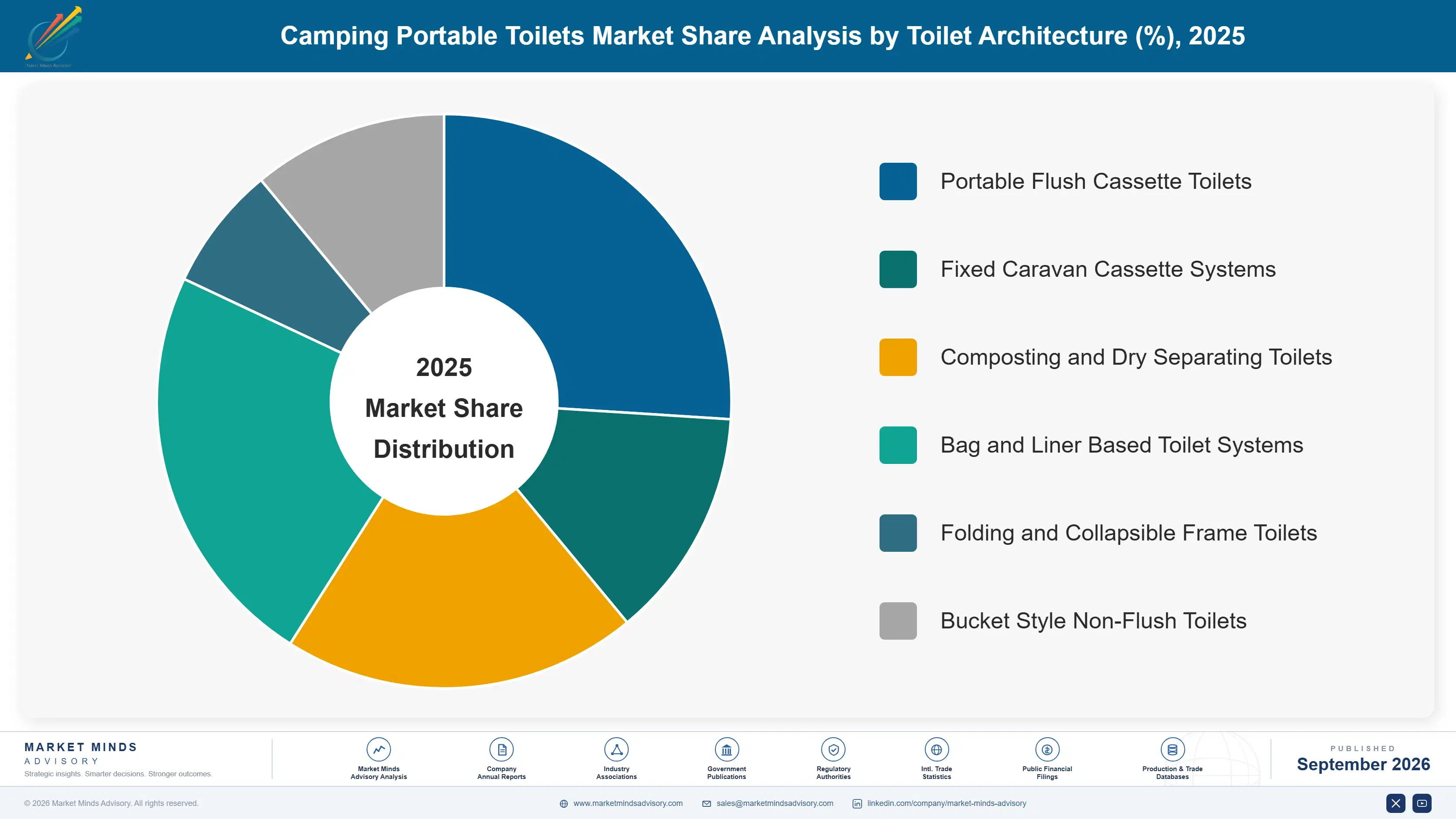
Segment CAGR and Growth Architecture

Segmentation follows toilet architecture across six categories: portable flush cassette toilets, fixed caravan cassette systems, composting and dry separating toilets, bag and liner based toilet systems, folding and collapsible frame toilets, and bucket style non-flush toilets. Sanitation additives are counted within the architecture they serve rather than tracked separately. Spare parts and seals are counted the same way.
camping-portable-toilets-market-market-share-analysis-1790014386876

Composting And Dry Separating Toilets

Dry separating toilets grow at 10.2%, half again the market rate of 6.8%, and the naming is the least accurate thing about an otherwise good product. Separating urine from solids prevents the anaerobic reaction that produces odour, which is a genuine engineering advance and the benefit buyers actually experience. Composting requires weeks of retention at temperature and roughly 8% of units are used that way. The honest positioning is odour control without chemicals, which would sell perfectly well, and manufacturers lead with composting because the word carries more weight than the mechanism does. No regulator has yet asked anybody to justify the wording. Odour control would sell the product perfectly well on its own merits.
CAGR 10.2%

Bag And Liner Based Toilet Systems

Bag systems grow at 9.1% by solving the problem the rest of the category avoids, which is what an owner does when there is no legal disposal point within reach. Gelling agents solidify the contents, the sealed bag enters general waste where local rules allow it, and nothing needs emptying anywhere in particular. Consumable cost over a season is genuinely high and buyers accept it readily, because the alternative is a drive to find a disposal facility. Van dwellers and wild campers adopted these formats first and remain the strongest part of the demand. Local waste rules vary considerably and several jurisdictions prohibit exactly this disposal route, which packaging addresses in small print.
CAGR 9.1%
Full segment breakdown across 6 segments available in the complete report.

Regional Architecture and Country Demand Map

Regional shares track where portable toilet units are purchased by consumers rather than where they are manufactured, since Chinese production supplies buyers across every region. One region sits outside the standard share band, for the reason named in its own paragraph and summarised for operator review.

Western Europe

At 30% this sits above the standard band, and the evidence genuinely points here rather than eastward. Touring caravan and motorhome density per head is the highest in the world, campsite disposal infrastructure is the most developed, and the leading manufacturers are Dutch, Swedish, and German businesses that defined the product category. Growth of 5.3% is the slowest of the seven regions, reflecting an ageing touring population. Campsite additive restrictions are also enforced more actively here than anywhere else, which drives replacement demand. Dry separating specialists are also concentrated here, several of them Swedish and German businesses that built the segment before it reached mainstream retail anywhere else. They defined the segment before mainstream retail noticed.
Share: 30% | CAGR: 5.3% (2026 to 2036)

North America

The recreational vehicle fleet here is the largest anywhere by unit count, though a far higher proportion carry plumbed black water systems rather than portable units, which caps the addressable base relative to fleet size. Growth of 6.5% runs close to the world rate. Emergency preparedness purchasing is materially larger than in any other region, driven by hurricane, wildfire, and earthquake exposure. Bag systems sell strongly into that use case, where storage life matters more than any other attribute. Van conversion has grown faster here than in any other region over five years, and those owners face the same disposal problem as European van dwellers with considerably less campsite infrastructure to fall back on.
Share: 28% | CAGR: 6.5% (2026 to 2036)
Regional intelligence for 5 additional markets available in the complete report: East Asia, South Asia and Pacific, Latin America, Middle East and Africa, Eastern Europe. Contact sales@marketmindsadvisory.com.
camping-portable-toilets-market-country-cagr-analysis-1790014387408

Where Manufacturers Build Real Value

Four commercial moves separate the manufacturers building durable positions in this market from those simply competing on moulding cost against Chinese imports. Each of them addresses an honest problem in this category: a claim that will not survive scrutiny, disposal access, additive chemistry, and a consumable stream that most brands leave on the table entirely.

Sell Odour Control Rather Than Composting

Only about 8% of dry separating units are used long enough for composting to occur, while urine diversion genuinely eliminates the odour every buyer is actually trying to avoid. Brands positioning on odour control rather than composting report return rates 2.7 times lower, because expectations match what the product delivers. The honest claim also survives the consumer group scrutiny that the composting language will eventually attract to this whole segment. Odour is what buyers judge these products on regardless of the wording. Expectations then match what the product actually delivers.
Market Impact: Cuts product return rates to 2.7 times lower

Map Disposal Points And Ship The Application

A cassette averages 2.7 kilometres from a legal emptying point when touring and frequently has none at all in van dwelling territory. Brands supplying disposal mapping applications with their units report repeat purchase rates 2.2 times higher across the same owner base. It costs a modest software investment, it addresses the constraint that decides whether the product is usable, and no competitor currently treats disposal as part of what they sell. Owners currently solve it with forum posts and unofficial maps. No competitor treats disposal as part of what they sell.
Market Impact: Raises repeat purchase rates to 2.2 times higher

Design Around Enzyme Chemistry Not Formaldehyde

About 37% of additive volume still uses formaldehyde chemistry that a growing number of campsites refuse outright, and enzyme replacements act more slowly and perform poorly above twenty-five degrees. Brands designing ventilation and valve sealing around biological additives report satisfaction scores 34% to 48% higher in warm conditions. Older cassettes were engineered for chemistry that is disappearing, and rebuilding around what remains permitted is overdue across most of the field. The chemistry these units were designed around is disappearing site by site. Rebuilding around what remains permitted is overdue across the field.
Market Impact: Raises satisfaction scores by 34 to 48% overall

Capture The Consumable Stream Quite Deliberately

Around 63% of owners buy sanitation additives from their unit manufacturer, which leaves more than a third of a recurring revenue stream going to third parties on every unit sold. Brands building subscription or bundled consumable supply report lifetime account values 3.1 times greater than unit sales alone deliver. The unit is bought once and the additive is bought every few weeks, which makes the consumable the more valuable half of the relationship. Third party liner suppliers currently take that revenue without effort. The unit sells once and the bottle sells continuously.
Market Impact: Raises lifetime account values to 3.1 times greater

Who Controls the Margin Pool

Concentration is moderate. Five manufacturers hold 44% of category revenue, measured consistently on that basis across all participants, and the remainder spreads across European dry toilet specialists, American outdoor equipment brands, and a growing number of Chinese producers competing on moulding cost. Barriers to entry in bucket and bag formats are close to nothing. Tooling is the only real capital requirement in most formats, which is why the field keeps widening rather than consolidating.
Competition currently turns on three dimensions: odour management engineering, which is what buyers actually experience regardless of the claim on the box; consumable attachment, where the recurring revenue lives; and additive compatibility, since units designed around formaldehyde chemistry perform badly on the enzyme products campsites now require. Disposal access support has become a fourth dimension that no established manufacturer currently addresses in any serious way.

Pressure builds from two directions. Chinese producers compete hard on price in bucket, folding, and bag formats. Meanwhile dry separating specialists take share from cassette incumbents. Rankings will shift toward manufacturers holding consumable streams and honest positioning, since neither is quickly assembled by a competitor arriving late. Positioning accuracy is becoming a competitive question rather than a marketing preference.
camping-portable-toilets-market-company-positioning-matrix-1790014387939

Competitive Moat and Risk Dimensions

THETFORD

Moat: Cassette Standard And Installed Base

Cassette dimensions and disposal interfaces the business established are now the effective standard across European campsites and caravan manufacture, which makes its consumables and replacement parts the default for a very large installed fleet. That position generates recurring revenue independent of new unit sales and is genuinely difficult for any competitor to displace.
THETFORD

Risk: Format Shift Away From Cassettes

Dry separating and bag formats grow at rates the cassette business cannot match, and both address the disposal constraint that cassettes cannot solve. An installed base advantage protects consumable revenue while the format itself loses share, which delays rather than prevents the underlying problem. Entering both growing formats means competing without that standard advantage.
SEPARETT

Moat: Urine Diversion Engineering Depth

Long specialisation in separating design produces odour performance that newer entrants copying the concept have not consistently matched, and odour is what buyers actually judge these products on. That competence sits in the fastest growing part of the market and took considerable time to develop properly rather than approximately.
SEPARETT

Risk: Exposure To Composting Claim Scrutiny

The segment is sold on a composting claim that roughly 8% of usage patterns support, and a consumer group or regulator examining it would damage the whole category including the businesses with the best engineering. Repositioning onto odour control before that happens is available and not yet widely taken.

Players Tracked

Prominent Players

Thetford
Dometic Group
Separett
SOG Vertriebs
Camco Manufacturing

Other Key Players

Reliance Products
Cleanwaste
Trelino
Nature's Head
Air Head Composting Toilets
Kildwick
Boxio
Sun-Mar
Laveo
Stansport
Coleman
Fiamma
OGO Composting Toilets
Enders Colsman
Trobolo

Recent Developments

FEBRUARY 2026

Thetford Launches Urine Diverting Unit Marketed On Odour Control

Thetford released a urine diverting portable toilet positioned explicitly on odour elimination rather than composting, the first mainstream product in the segment to describe what the technology actually does for a typical owner. Packaging and retail listings were rewritten together, and the composting language was removed entirely rather than qualified.
Signal: Honest positioning becomes a differentiator before regulators require it. Competitors now carry an exposure this product does not.
SEPTEMBER 2025

Dometic Expands European Cassette Toilet Production Capacity

Dometic Group completed an organic capacity expansion for cassette toilet manufacture at a European plant, funded internally with no partner involved, after replacement demand driven by campsite additive restrictions outran available moulding and assembly throughput. Ventilation and valve sealing were redesigned around enzyme additives in the same programme.
Signal: Chemical restrictions are generating more replacement volume than product failure. Design is catching up with permitted chemistry at last.
JUNE 2025

Separett Acquires German Dry Separating Toilet Manufacturer

Separett completed an acquisition of a German dry separating toilet manufacturer, adding van conversion channel relationships and a consumable liner business to a portfolio previously weighted toward fixed cabin installations. The liner business rather than the hardware was the principal asset, since consumables recur and units do not.
Signal: Consumable revenue streams are being bought alongside the hardware itself. Recurring revenue is what these transactions now target.

What A Portable Toilet Costs

Three input groups dominate cost. Polyethylene and polypropylene mouldings run 34% to 42% of cost of goods sold, and the eight-point range separates simple bucket formats from multi-part cassette assemblies. Seals, valves, pumps, and hardware take 22% to 30%, with cassette systems firmly at the upper end. Packaging and freight add 20% to 28%, which is high and follows directly from shipping a large hollow object.
Polyethylene resin pricing moved through 2024 and 2025 as cracker capacity and energy costs adjusted across several regions simultaneously, and American Chemistry Council statistics alongside EIA energy series documented the underlying movement. Several manufacturers described the resulting margin pressure in their annual reports for those years. Enzyme additive costs followed fermentation economics on an entirely separate path throughout. Freight rates moved on a third track again across the same period.

The competitive disadvantage mechanism runs through freight rather than through moulding. A portable toilet is mostly enclosed air, so a producer shipping finished units across an ocean carries volumetric cost that regional moulding avoids entirely. Exposure varies sharply by format: bucket and folding products are almost pure freight cost, while cassette systems carry enough hardware value to absorb long distance shipping considerably better.
camping-portable-toilets-market-cost-volatility-analysis-1790014388144

Mould Regionally Rather Than Shipping Enclosed Air

Freight runs up to 28% of cost of goods sold on products that are mostly hollow, which rewards moulding near demand over concentrating production anywhere. Tooling is the main capital requirement and it is modest relative to the freight saved, particularly across bucket, folding, and dry separating formats where hardware content is low. Cassette systems justify longer shipping distances.

Contract Resin Against Cracker Capacity Cycles

Polyethylene and polypropylene pricing follows cracker capacity and energy costs on cycles entirely unrelated to camping demand, and this category is far too small to influence either. Contracting against those cycles rather than reacting to them removes most of the exposure at very modest administrative cost. This category is far too small to move resin pricing at all.

Qualify Enzyme Additive Suppliers Well Ahead

Campsites refusing formaldehyde chemistry are increasing steadily, and enzyme additive supply concentrates among relatively few fermentation producers with commitments to larger industries. Holding qualified alternatives protects the consumable revenue stream, which is the more valuable half of the customer relationship over any unit lifetime. Allocation rather than price is the exposure worth managing. Fermentation producers serve far larger industries first.

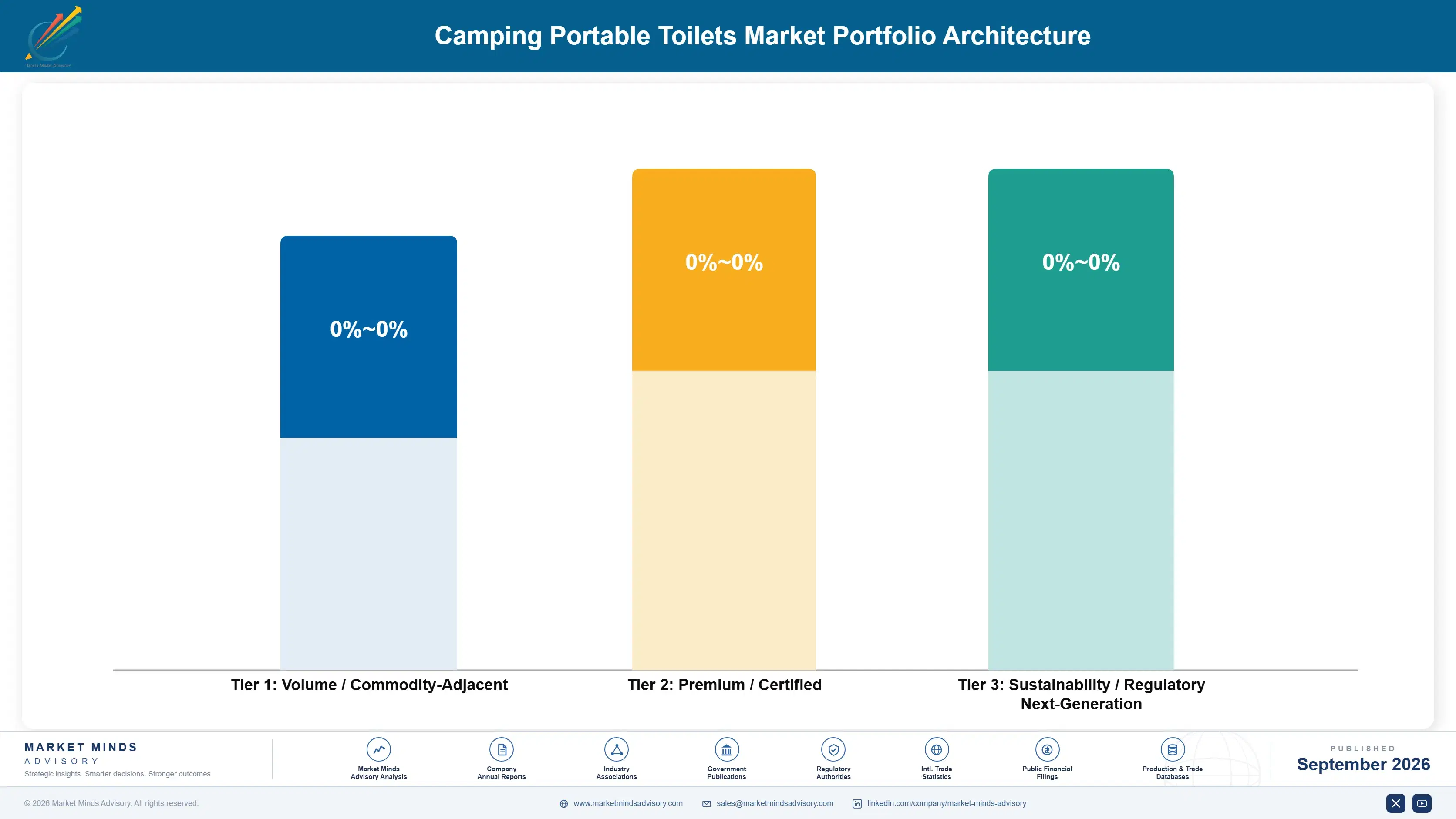
Portfolio Architecture for Margin Defence

Margin follows engineering content and consumable attachment together. Bucket and folding formats compete close to commodity terms against Chinese imports with nothing defensible in the product. Cassette systems earn moderately on hardware complexity and consumable pull. Dry separating units earn better on odour engineering, and bag systems earn most in aggregate, because the consumable is bought constantly rather than occasionally. The margin spread across those four groups is wide for a moulded product.
The tension between volume and premium runs through how the owner uses the product. Occasional campers buy the cheapest adequate unit and few consumables, which is a transaction rather than a relationship. Van dwellers and full-time users buy on odour performance and durability and then consume additives or liners continuously, which makes them worth many times more over any realistic ownership period.

High-value pools concentrate where the product is used heavily and disposal is difficult: van conversions, remote touring, and emergency preparedness stockpiles that get replaced on a schedule. Where the purchase is a folding seat for two weekends a year, price decides and any competent import will serve the purpose perfectly well. That divide follows usage intensity rather than income.

Volume / Commodity-Adjacent

Bucket, folding, and basic frame toilets competing on delivered price against Chinese imports of comparable moulding quality. The ten-point range reflects tooling amortisation and freight position rather than any property a buyer would identify in a shop.
Gross Margin: 22% to 32%

Premium / Certified

Cassette systems and fixed caravan installations carrying valve engineering, seal quality, and consumable compatibility across an installed base. The twelve-point range separates manufacturers holding the disposal interface standard from those building compatible alternatives.
Gross Margin: 36% to 48%

Sustainability / Regulatory / Next-Generation

Dry separating units and bag systems sold with consumable supply and honest odour positioning rather than composting claims. The fourteen-point range reflects whether the consumable stream is captured or surrendered to third party suppliers.
Gross Margin: 50% to 64%
camping-portable-toilets-market-portfolio-architecture-1790014388650

High-value Sub-segments and Strategic Watch-out

Bag Systems With Consumable Supply

Highest value in the category, since the liner and gelling agent are purchased continuously rather than once at the point of sale. The fourteen-point range reflects whether the manufacturer captures that stream or a third party liner supplier takes it. Subscription supply is the obvious route.
Gross Margin: 52% to 66%

Dry Separating Odour Systems

High value growing at 10.2% on urine diversion engineering that genuinely works, whatever the box happens to claim. The fourteen-point range reflects separating design quality, which newer entrants copying the concept have not consistently matched. Positioning accuracy is the segment's main exposure. Copying entrants have not matched it.
Gross Margin: 42% to 56%

Cassette Systems And Consumables

Volume core where an installed base generates additive and spare part revenue independently of new unit sales entirely. The ten-point range reflects whether the manufacturer holds the disposal interface standard campsites and caravan builders have adopted. Format share is falling despite the installed base. Consumables outlast the format.
Gross Margin: 34% to 44%

Bucket And Folding Formats

The strategic watch-out. Chinese imports match the moulding, buyers compare on price alone, and no consumable attaches to the purchase in any meaningful way. The ten-point range reflects tooling scale and freight position and nothing else. No consumable attaches to the purchase at all. Price is the whole comparison.
Gross Margin: 20% to 30%

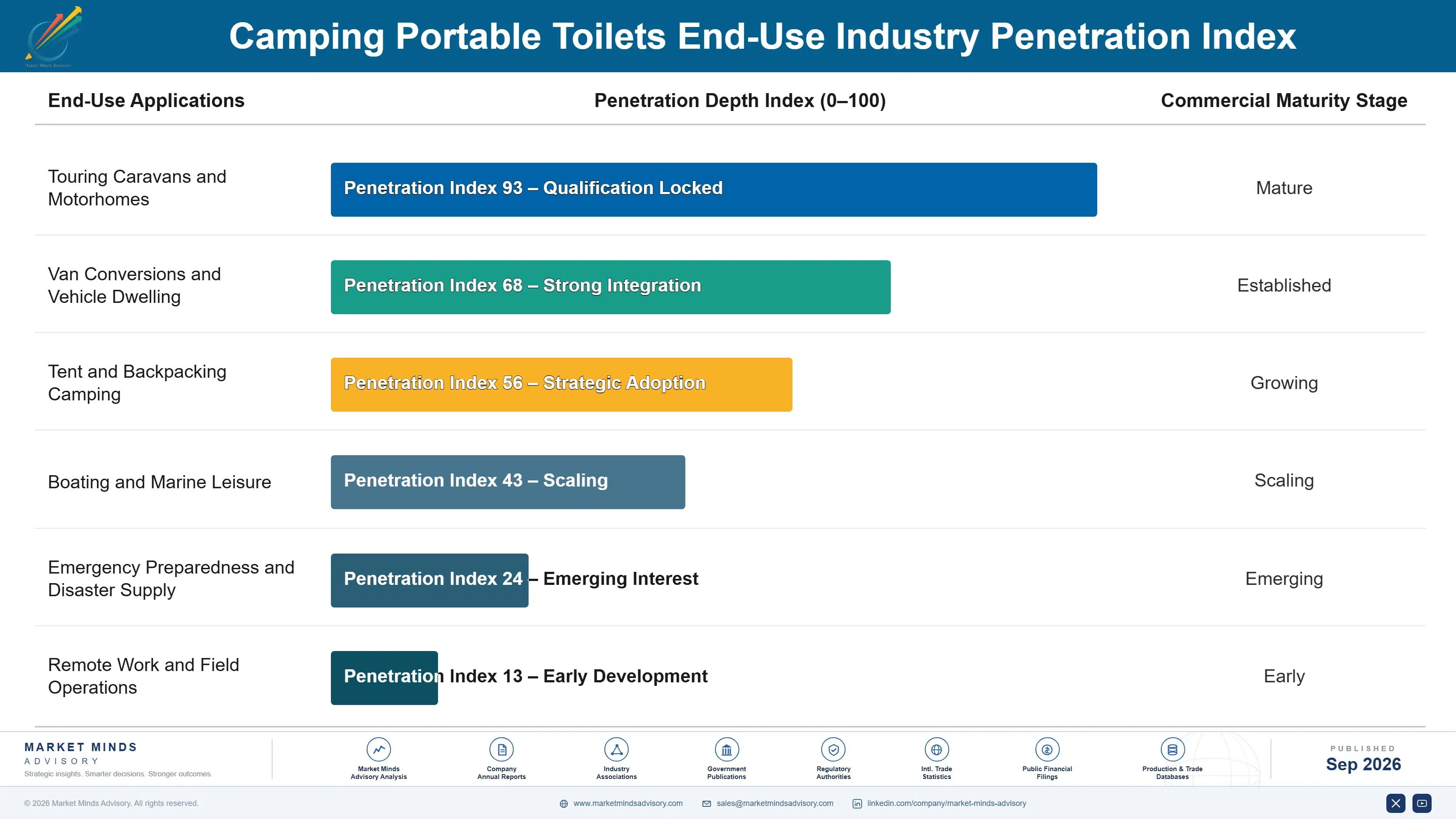
How This Demand Repeats

The unit is bought once and the consumables are bought constantly, which makes the additive or liner stream the more valuable half of any customer relationship. About 63% of owners buy sanitation additives from their unit manufacturer, leaving more than a third of that recurring revenue with third parties. Manufacturers who have built subscription supply capture considerably more from the same installed base than those selling hardware alone.
Attachment depth divides sharply between occasional and continuous users. A household camping twice a year buys the cheapest adequate unit and one bottle of additive, and switches without hesitation at the next purchase. A van dweller using the product daily judges it on odour performance, buys consumables continuously, and stays with what works for years. The second group is worth many times the first over any ownership period.

The buyer profile has moved away from the serviced touring pitch that the product was designed around. Caravan owners with electric hookup and a disposal point remain a large part of demand and no longer set the direction, while van converters, wild campers, and emergency preparedness buyers all share a common problem the traditional cassette was never built to solve at all.
camping-portable-toilets-market-end-use-penetration-index-1790014389155

Where This Market Rewards

These are among the four positions where our research anticipates prominent divergence between winners and laggards over the coming forecast period. Each is grounded in the demand model, the regulatory perimeter, and the announced capacity pipeline.
01 / CLAIM ACCURACY CORRECTION

Nothing composts over a long weekend

Composting requires weeks of retained material at sustained temperature, and only around 8% of dry separating units are ever used in a pattern that permits it. Brands positioning explicitly on odour control rather than composting report return rates 2.7 times lower, because the expectation then matches what the product actually delivers to an owner. The honest claim also survives the consumer scrutiny this segment will eventually attract, which no manufacturer in the segment currently appears to have planned for at all.
02 / DISPOSAL ACCESS SOLVING

Sell the emptying point, not the tank

A cassette averages 2.7 kilometres from a legal emptying point when touring and frequently has none at all across the geography van dwellers actually occupy. Brands supplying disposal mapping applications alongside their units report repeat purchase rates 2.2 times higher across the same owner base. It addresses the constraint that decides whether the product is usable, and no competitor currently treats disposal as part of the offer, leaving owners to solve it with forum posts and unofficial community maps instead.
03 / ENZYME COMPATIBLE DESIGN

The chemistry it was built for is going

Roughly 37% of additive volume still uses the formaldehyde chemistry that more campsites refuse each season, and the enzyme replacements act slowly and struggle badly above twenty-five degrees. Brands that design their ventilation and valve sealing around biological additives now report satisfaction scores 34% to 48% higher in warm weather conditions. Rebuilding around what remains permitted is overdue across most of the installed product design in this category, since the chemistry those units were engineered around is disappearing site by site.
04 / CONSUMABLE STREAM CAPTURE

The bottle matters more than the box

About 63% of owners buy sanitation additives from their unit manufacturer, leaving over a third of a recurring stream to third parties on every single unit sold. Brands building subscription or bundled consumable supply report lifetime account values 3.1 times greater than unit sales alone produce. The hardware is bought once and the consumable is bought every few weeks, which settles which half of the relationship is worth defending, and third party liner suppliers currently collect that revenue without any effort.

Engagement Snapshot From the Field

A live engagement with an industry participant carrying material or product regulatory and market exposure ahead of a defining policy shift, showing how our research translates into a defensible multi-year portfolio strategy.
MARKET MINDS ADVISORY · CLIENT ENGAGEMENT SUMMARY
Camping Portable Toilets Producer Strategic Portfolio Review and Transition Roadmap 2026·Investment Scenario on Camping Portable Toilets Exposure Evaluation 2025-26
CLIENT PROFILE
A European outdoor equipment manufacturer with portable sanitation revenue near EUR 74 million (client-reported, unverified by MMA), selling cassette and dry separating toilets across fourteen countries. Return rates on the dry separating range had risen for two consecutive years while unit sales grew, and customer service volumes had roughly doubled over the same period. The board wanted the cause identified before further investment.
STRATEGIC CHALLENGE
The engineering team attributed returns to a manufacturing tolerance issue and had begun a design revision programme. Nobody had reviewed what returning customers actually said in their complaints, or compared those reasons against how the product was described on the packaging and in retail listings. A tolerance problem and a labelling problem require entirely different remedies.
MMA APPROACH
MMA coded two years of return reasons and service contacts by theme, surveyed both returning and retaining owners on expectations at purchase, compared packaging and listing language across the client and four competitors, and modelled outcomes under design revision, repositioning, and both together. Actual owner usage patterns were measured separately, since nobody had established how long the units were in service between emptyings.
KEY FINDINGS
  1. Around 71% of returns cited disappointment that the contents had not composted, which is a labelling problem rather than anything a design revision would have addressed.
  2. Retaining owners rated odour performance highly and almost none of them mentioned composting, suggesting the product satisfied buyers whose expectations had been set differently.
  3. Only 9% of surveyed owners used the unit in a pattern permitting composting, and none of them had been told what that pattern would need to be.
  4. Competitor listings used identical composting language, so the entire segment shared an exposure that no manufacturer had yet addressed publicly. None had qualified the language in any way.
CLIENT PROFILE
A European outdoor equipment manufacturer with portable sanitation revenue near EUR 74 million (client-reported, unverified by MMA), selling cassette and dry separating toilets across fourteen countries. Return rates on the dry separating range had risen for two consecutive years while unit sales grew, and customer service volumes had roughly doubled over the same period. The board wanted the cause identified before further investment.
STRATEGIC CHALLENGE
The engineering team attributed returns to a manufacturing tolerance issue and had begun a design revision programme. Nobody had reviewed what returning customers actually said in their complaints, or compared those reasons against how the product was described on the packaging and in retail listings. A tolerance problem and a labelling problem require entirely different remedies.
MMA APPROACH
MMA coded two years of return reasons and service contacts by theme, surveyed both returning and retaining owners on expectations at purchase, compared packaging and listing language across the client and four competitors, and modelled outcomes under design revision, repositioning, and both together. Actual owner usage patterns were measured separately, since nobody had established how long the units were in service between emptyings.
KEY FINDINGS
  1. Around 71% of returns cited disappointment that the contents had not composted, which is a labelling problem rather than anything a design revision would have addressed.
  2. Retaining owners rated odour performance highly and almost none of them mentioned composting, suggesting the product satisfied buyers whose expectations had been set differently.
  3. Only 9% of surveyed owners used the unit in a pattern permitting composting, and none of them had been told what that pattern would need to be.
  4. Competitor listings used identical composting language, so the entire segment shared an exposure that no manufacturer had yet addressed publicly. None had qualified the language in any way.
RECOMMENDED STRATEGY
Phase 1: Phase one: halt the design revision and rewrite packaging and retail listings around odour elimination rather than composting. Tolerances were never the problem. Phase 2: Phase two: publish clear guidance on what retention time composting genuinely requires, for the minority of owners who want it. Phase 3: Phase three: build consumable liner supply into the range, capturing the recurring revenue currently going to third parties. That stream recurs where hardware does not.
OUTCOME
Return rates on the dry separating range fell 44% within three quarters of the relabelling (client-reported, unverified by MMA). The design revision programme was cancelled entirely. Service contact volumes returned to their previous level without any product change. Competitors have so far left the composting language on their own packaging unchanged.

Frequently Asked Questions

Foundational context covering the market sizes, CAGR, scope, country, region and competition that inform every finding below. This section is provided to cover basics and most often pre-purchase conversations, answered from the MMA Primary Research Dataset.

What is the current size of the Camping Portable Toilets Market?

The market was worth USD 0.7 billion in 2025 and stands at USD 0.7 billion in 2026. Value covers consumer purchased portable toilet units across all architectures.

How large will the Camping Portable Toilets Market be by 2036?

MMA forecasts USD 1.4 billion by 2036, an increase of USD 0.7 billion across the forecast period. That represents 2.00 times the 2026 base of USD 0.7 billion.

What is the CAGR for the Camping Portable Toilets Market 2026 to 2036?

The base case compound annual growth rate is 6.8%, with a bull case at 8.0% and a bear case at 5.6%. Historical growth from 2020 to 2025 ran at 5.7%.

Which segment is growing fastest?

Composting and dry separating toilets grow at 10.2%, half again the market rate of 6.8%. Urine diversion genuinely solves odour, though only about 8% of units ever compost anything.

Who are the major companies in the Camping Portable Toilets Market?

Thetford, Dometic Group, Separett, SOG Vertriebs, and Camco Manufacturing lead the category. Together they hold 44% of revenue, with Chinese producers competing hard on price.

Which country is growing fastest?

China grows at 11.8%, the fastest of any country covered here. Domestic camping and self-drive touring are expanding from a very low base while campsite infrastructure lags well behind participation.

Report Segmentation Architecture

The full report scope spans multiple orthogonal segmentation dimensions, with cross-tabulated demand data provided for each dimension pair. Coverage extends further to regional breakdowns, trend trajectories, and the competitive detail needed to support segment-level decision-making.

By Toilet Architecture

  • Portable Flush Cassette Toilets
  • Fixed Caravan Cassette Systems
  • Composting and Dry Separating Toilets
  • Bag and Liner Based Toilet Systems
  • Folding and Collapsible Frame Toilets
  • Bucket Style Non-Flush Toilets

By End-Use Industry

  • Touring Caravans and Motorhomes
  • Van Conversions and Vehicle Dwelling
  • Tent and Backpacking Camping
  • Boating and Marine Leisure
  • Emergency Preparedness and Disaster Supply
  • Remote Work and Field Operations

By Commercial Dimension

  • Outdoor Specialist Retail
  • Caravan and Motorhome Dealers
  • General Merchandise and Hardware
  • Online Retail and Marketplaces
  • Direct to Consumer Brand Sales
  • Consumable Subscription Supply

By Region

  • Western Europe
  • North America
  • East Asia
  • South Asia and Pacific
  • Latin America
  • Middle East and Africa
  • Eastern Europe

Scope, Methodology, and Coverage

Every figure in this report is reproducible from documented input assumptions. The scope below maps the historical period, the forecast horizon, the segmentation dimensions, and the countries covered, alongside the underlying primary and qualitative methodology.
Historical Period
2020 to 2025
Forecast Period
2026 to 2036
Base Year
2025 (USD billions; MMA Primary Research Dataset, September 2026)
Market Definition
This market covers portable toilet units purchased by consumers for camping, caravanning, boating, and emergency preparedness, across portable flush cassette toilets, fixed caravan cassette systems, composting and dry separating toilets, bag and liner based systems, folding and collapsible frame toilets, and bucket style non-flush toilets. Sanitation additives are counted within the unit type served. It excludes rented event and construction sanitation units, plumbed sanitary ware, marine holding tanks, and municipal welfare facilities.
Quantitative Units
USD billions, retail value at manufacturer selling price
Segmentation Dimensions
Toilet architecture, end-use application, commercial dimension, region
Regions Covered
Western Europe, North America, East Asia, South Asia and Pacific, Latin America, Middle East and Africa, Eastern Europe
Countries Covered
Germany, Netherlands, Sweden, France, United Kingdom, Italy, Spain, Denmark, Poland, Czechia, United States, Canada, Mexico, China, Japan, South Korea, Australia, New Zealand, India, Indonesia, Thailand, Brazil, Chile, Colombia, Argentina, Saudi Arabia, United Arab Emirates, Oman, Egypt, South Africa
Key Companies Profiled
Thetford, Dometic Group, Separett, SOG Vertriebs, Camco Manufacturing, Reliance Products, Cleanwaste, Trelino, Nature's Head, Air Head Composting Toilets, Kildwick, Boxio, Sun-Mar, Laveo, Stansport, Coleman, Fiamma, OGO Composting Toilets, Enders Colsman, Trobolo
Quantitative Methodology
Primary survey, n=3,800 respondents, Q4 2025, six countries; demand-side model with trade association cross-validation
Qualitative Methodology
47 expert interviews, Q4 2025; applied to validate demand model assumptions, identify emerging dynamics, and assess competitive positioning
Report Format
PDF and XLSX data workbook (Word format preview document)
Publisher
Market Minds Advisory
Report Code
MMA-2026-CON-301
Published
September 2026
Contact
sales@marketmindsadvisory.com | www.marketmindsadvisory.com

Purchase the full Camping Portable Toilets Market Report (2026 to 2036).

The full report sizes the camping portable toilet market across six toilet architectures, seven regions, and thirty countries, with forecasts to 2036 under base, bull, and bear cases. It establishes how rarely dry separating toilets are used in a pattern that permits composting, maps disposal point availability against the geography owners actually travel, and traces how campsite additive restrictions are driving replacement demand. Competitive analysis covers twenty participants evaluated consistently on category revenue, with detailed treatment of consumable stream capture. Cost structure, freight economics on hollow products, and lifetime account values are analysed throughout. Primary research includes 3,800 survey responses and 47 expert interviews.
Six toilet architectures sized and forecast separately
Twenty participants evaluated on category revenue consistently
Composting claim tested against observed owner usage patterns
Disposal point availability mapped across touring and van dwelling
Additive chemistry restrictions tracked by market and campsite policy
Consumable attachment and lifetime account values quantified by format

Built For The People Who Decide

From boardroom strategy to bench-side execution, this report is read cover-to-cover by leaders shaping the next decade of their industry, turning demand scenarios, market dynamics and valuation benchmarks into decisions.
CXOs/ Presidents/ VPs/ Managers
M&A and Corporate Development
Strategy Teams and R&D Heads
Procurement and Product Directors
Regulatory and Compliance Leaders
Investor Relations and Equity Analysts