Market Minds Advisory
Call Center AI Market

Call Center AI Market: Call Center AI Market. Generative Agent Assist Redefines the Contact Center Cost Structure

Contact centers spent decades measuring agents by call speed, but generative AI copilots now draft responses in real time, forcing operators to rethink staffing models built around an outdated cost structure.

Lead Analyst

Published

September 2026

Make Smarter Decisions with Customized Research Insights

Request a free sample report and evaluate market opportunities, growth trends, and competitive dynamics relevant to your business needs.

2025 MARKET VALUE$4.6BMarket Size 2025
2036 FORECAST VALUE$27.1BBase Case , 2026 to 2036
CAGR 2026 TO 203617.5 %Bull 18.8% / Bear 16.2%
INCREMENTAL OPPORTUNITY$21.7BNet 10- year value creation
EXPANSION MULTIPLE5.02x2036 value over 2026 base
Strategic Levers
M&A Pipeline
Regional Outlook
Country Rankings
Competitive Intelligence
Segmental Deep-dive
Call-Us : 91 93563 13602

Executive Snapshot and Market Trajectory.

Call center AI has moved from scripted chatbots handling simple queries to generative copilots assisting human agents on complex calls, compressing average handling time in ways that are reshaping contact center staffing economics across nearly every enterprise operating a service function today.
Generative AI agent assist platforms are pulling capital fastest among large enterprise contact centers seeking to reduce per-call cost without sacrificing customer satisfaction scores, while business process outsourcers race to embed AI copilots before losing labor cost advantage entirely to more automated rivals. Deployment is concentrated heavily among enterprise contact centers across North America and increasingly across fast-growing South Asian outsourcing hubs. Order volume for enterprise deployments keeps climbing steadily every fiscal quarter now.
Competitive intensity centers on a moderately concentrated field of established contact center platform vendors rather than a handful of dominant incumbents, since integration with existing telephony and CRM systems creates meaningful switching friction once a platform gets embedded into daily operations. Large language model licensing costs are reshaping which vendors can profitably price generative AI features at scale. Rankings could shift meaningfully as licensing pricing pressure continues intensifying further.
Market Definition
This report defines the Call Center AI Market as software that automates or augments contact center interactions, including generative AI agent assist, conversational voice bots, and real-time analytics platforms. It excludes standard customer relationship management software, basic interactive voice response systems, and workforce scheduling tools without embedded AI capability.
Base Year Value
$4.6B in 2025 (MMA Primary Research Dataset, September 2026)
Forecast Period
2026 to 2036, eleven discrete annual values
CAGR
17.5% base case. Bull 18.8%. Bear 16.2%.
Fastest Growth Segment
Generative AI Agent Assist and Copilot Platforms: 27.1% CAGR
Fastest Growth Country
India: 24.0% CAGR
Fastest Growth Region
South Asia and Pacific: 19.6% CAGR
Largest Region
North America: 30% of 2025 global value
Market Leaders
NICE, Genesys, Five9, Talkdesk, and Verint. Source: MMA Analysis based on company disclosures and deployment volume estimates.
Primary Survey
n=3,800 procurement and R&D decision-makers, Q4 2025, six countries
Methodology
Demand-side build-up, cross-validated against public data, 47 expert interviews

Call Center AI Market Forecast Scenarios

call-center-ai-market-size-forecast-scenario-1789996302340
Between 2020 and 2025, call center AI grew steadily as basic chatbots and interactive voice response systems expanded across enterprise contact centers, though most deployments handled only simple, scripted queries during that stretch. The category posted a historical CAGR of roughly 16.2% as generative AI capability had barely begun entering mainstream contact center software at meaningful scale.
The base case rests on three commercial mechanisms: enterprise contact centers adopting generative agent assist to compress average handling time and reduce per-call labor cost, business process outsourcers embedding AI copilots to defend margins against rising wage pressure, and contact center software vendors bundling generative capability into existing platform subscriptions. Together these mechanisms support a forecast CAGR of 17.5% through 2036, with generative AI agent assist growing considerably faster than traditional scripted automation.
The bull case centers on accelerated enterprise adoption of generative AI copilots that pulls forward contact center modernization budgets faster than currently planned. The bear case centers on large language model licensing costs rising faster than vendors can pass through to customers, compressing margins even as underlying demand for AI-enabled contact center software continues expanding. That pressure is expected to intensify.

From Scripted Automation to Generative Agent Assist

Call center AI has moved from a cost-cutting automation layer to a strategic capability that directly shapes customer experience outcomes, since generative copilots now handle the judgment-intensive parts of a call that scripted bots could never manage. No customer wants to repeat their issue three times to three different bots.
MARKET CONCENTRATION48% CR5Top five vendors hold combined global platform deployment share
AVERAGE HANDLING TIME REDUCTION26%Typical decrease in call duration after AI copilot deployment
TOP PRODUCING COUNTRY SHARE29%United States share of global contact center AI revenue
GENERATIVE AI ATTACH RATE34%Share of contact centers using generative agent assist tools
AGENT PRODUCTIVITY UPLIFT31%Average increase in resolved calls per agent shift
MODEL LICENSING COST SHARE27% of COGSShare of vendor cost tied to large language model access
Large language model licensing costs are reshaping vendor pricing strategies considerably, since generative capability requires ongoing compute expense that traditional scripted automation never demanded. Vendors investing early in cost-efficient model deployment are winning deals that competitors passing through raw compute costs cannot match. That gap keeps widening every fiscal quarter across the vendor landscape. Order volume for generative copilot licenses keeps climbing steadily. Vendors offering efficient inference are winning the largest enterprise renewals.
Integration depth with existing telephony, CRM, and workforce management systems remains the primary switching barrier once a platform is deployed, since replacing an embedded AI copilot means retraining agents and rebuilding conversation flows from scratch. That switching cost is reinforcing incumbent advantage even as newer entrants offer meaningfully more advanced generative capability. Few newer entrants can realistically close that integration gap quickly.
"Contact centers used to measure success by how fast they got a customer off the phone. Now the winners are the ones whose AI actually solves the problem the first time, because that's what customer satisfaction scores reward."
Director, Customer Experience Technology and AI Practice · MMA Technology Practice · September 2026

Market Trends

Generative Agent Assist Becomes the Default Contact Center Standard

Enterprises deploying new contact center software are increasingly defaulting to generative agent assist capability rather than treating it as an optional add-on module, since customer expectations for fast, accurate resolution have risen faster than traditional scripted automation can satisfy. Roughly 34% of contact centers now use generative agent assist, up sharply from a low single-digit share just two years ago, and vendor implementation backlogs have extended past several months as demand continues outpacing available deployment capacity across the industry. Vendors that built adequate deployment capacity early now hold a meaningful advantage over slower-moving competitors still expanding implementation teams.
Market Impact: automation cost savings grew 31% yearly

Voice AI Deflection Reduces Live Agent Call Volume

Conversational voice AI capable of handling increasingly complex queries without human escalation is deflecting a growing share of inbound calls away from live agents entirely, reshaping contact center staffing models built around historical call volume assumptions. Voice AI now successfully resolves roughly 28% of inbound calls without human intervention, up meaningfully from prior years, and contact centers are restructuring staffing plans around this reduced live-agent call volume. Vendors offering the most accurate deflection technology are capturing disproportionate share of this efficiency-driven demand as labor costs continue rising across the industry.
Market Impact: AI-augmented satisfaction scores grew 22%

Market Opportunities and Growth Drivers

Rising Agent Wage Costs Accelerate Automation Investment

Contact center operators facing sustained agent wage inflation across major labor markets are accelerating investment in AI automation to control per-call cost growth that traditional efficiency measures could no longer contain effectively. Automation-driven cost savings grew roughly 31% year over year as operators concluded that AI investment now delivers faster payback than incremental headcount additions across nearly every major contact center vertical served today. That trajectory is expected to continue as wage pressure remains elevated across multiple labor markets over the coming several years ahead for most contact center operators.
Market Impact: compresses margins by roughly 9 points

Customer Expectations for Instant Resolution Drive Adoption

Customers increasingly expect immediate, accurate resolution comparable to the responsiveness of digital-native companies, pushing contact centers to deploy generative AI capable of matching that expectation without adding headcount. Customer satisfaction scores at AI-augmented contact centers grew roughly 22% year over year as generative copilots reduced resolution time meaningfully across the most common and complex customer inquiry categories tracked. Vendors offering the most sophisticated resolution accuracy are capturing disproportionate share of this expectation-driven demand as customer patience for slow service continues declining. That competitive gap continues widening every fiscal quarter across the industry.
Market Impact: delays adoption by 8 months

Market Restraints and Challenges

Large Language Model Licensing Costs Compress Margins

The core friction point is that generative AI capability depends on ongoing large language model licensing and compute expense, rooted in the fact that inference costs scale directly with call volume rather than remaining fixed like traditional software licensing. The commercial impact is direct: vendors face margin compression as usage grows unless they can pass through costs to customers already sensitive to pricing. Several vendors are responding by developing smaller, purpose-built models as a mitigation pathway. Smaller vendors face growing pressure between rising compute costs and price-sensitive demand. That pressure keeps intensifying steadily.
Market Impact: 34% of centers use generative AI

AI Accuracy Concerns Slow Complex Query Adoption

The core friction point is that generative AI still produces occasional inaccurate or inappropriate responses on complex, high-stakes customer queries, a constraint rooted in the fundamental limitations of current language model reliability for edge cases. The commercial impact falls hardest on regulated industries like healthcare and financial services facing compliance risk from AI errors. Several vendors are mitigating exposure by building human-in-the-loop escalation workflows for complex query categories. This escalation approach adds meaningful operational cost but has proven effective at preserving trust among the most compliance-sensitive enterprise accounts served today.
Market Impact: voice AI resolves 28% of calls
4 additional market trends, 4 additional growth drivers, and 3 additional restraints and challenges are covered in the full report. Contact sales@marketmindsadvisory.com to access the complete intelligence.

Segment CAGR and Growth Architecture

Call center AI segments by core software function rather than by industry vertical, since the same underlying generative and conversational technology serves retail, financial services, and healthcare contact centers with comparable interaction automation and augmentation needs regardless of which particular industry, geographic region, or overall company size they primarily choose to serve currently today.
call-center-ai-market-market-share-analysis-1789996302930

Generative AI Agent Assist and Copilot Platforms

Generative AI agent assist and copilot platforms provide real-time response drafting, knowledge retrieval, and next-best-action guidance to human agents during live customer interactions, compressing handling time without fully replacing human judgment on complex calls. Demand is concentrated among large enterprise contact centers able to justify the licensing investment required to deploy generative capability at scale across thousands of agent seats. Growth here runs meaningfully ahead of the broader market as enterprises increasingly view generative assist as a competitive necessity rather than an optional productivity enhancement. Vendors offering the deepest generative model efficiency are winning the largest enterprise contracts as this segment continues to outgrow the broader software category considerably. Order backlogs there now extend well past six months.
CAGR 27.1%

Conversational Voice AI and Automated Deflection Platforms

Conversational voice AI and automated deflection platforms handle complete customer interactions end to end without human agent involvement, resolving routine and increasingly complex queries entirely through automated conversation. Demand is concentrated among high-volume contact centers seeking to reduce total call volume reaching live agents rather than simply making existing agents more efficient. Vendors offering the most natural conversational experience are capturing disproportionate share of this deflection-driven demand as customer tolerance for robotic interactions continues declining. That deflection advantage compounds as language model fluency continues improving generation over generation across the industry. Enterprises switching to advanced deflection platforms report meaningfully fewer escalations than those still relying on basic scripted voice bots lacking generative capability.
CAGR 19.4%
Full segment breakdown across 7 segments available in the complete report.

Regional Architecture and Country Demand Map

Deployment concentrates where enterprise contact center spending and labor cost pressure are highest, favoring North America, followed closely by East Asian and South Asian markets scaling their own outsourcing infrastructure across expanding agent workforce bases and secondary service hubs both nationwide and internationally this cycle.

North America

The United States dominates North American demand through its concentration of enterprise contact centers and the headquarters of leading platform vendors like NICE, Genesys, and Five9. Canada contributes a smaller but growing share as domestic outsourcing providers extend similar AI capability to their agent workforce. Competition here is the most intense globally, with several vendors locked in aggressive feature parity races around generative capability to win the largest enterprise contracts. Mexico's growing customer service sector is beginning to adopt similar generative AI structures as nearshoring investment continues expanding across the country's outsourcing base. Order backlogs for top-tier generative AI implementations there now extend several months given surging enterprise demand. Vendor consolidation through acquisition remains an active theme.
Share: 30% | CAGR: 18.6% (2026 to 2036)

East Asia

China's massive customer service outsourcing industry drives substantial demand in this region, with domestic vendors building competitive generative AI capability to reduce reliance on Western platform providers. Japan and South Korea favor established enterprise vendors given their mature corporate technology sectors and existing vendor relationships built over years. Rapid digital customer service expansion across major East Asian markets is pushing operators toward increasingly sophisticated conversational AI technology. Taiwan and Hong Kong contribute smaller but sophisticated demand tied to their dense financial services customer support networks and multilingual requirements. South Korea's chaebol-backed customer service arms are building proprietary generative capability rather than relying entirely on third-party platforms. That proprietary approach limits third-party vendor penetration somewhat.
Share: 22% | CAGR: 18.7% (2026 to 2036)
Regional intelligence for 5 additional markets available in the complete report: Western Europe, South Asia and Pacific, Latin America, Middle East and Africa, Eastern Europe. Contact sales@marketmindsadvisory.com.
call-center-ai-market-country-cagr-analysis-1789996303458

Where AI Vendors Capture More Contact Center Revenue

Vendors capture disproportionate margin where efficient model deployment justifies premium generative pricing and where deep telephony integration creates durable switching costs that thinner, more narrowly focused competitors cannot replicate across the broader contact center software market today, tomorrow, and well into the several years ahead for most competing vendors operating currently across the industry.

Efficient Inference Model Premium Pricing Programs

Vendors that develop cost-efficient, purpose-built language models for contact center use cases can sustain higher gross margins on generative features than vendors passing through raw compute costs from general-purpose model providers. Efficient inference deployments now generate roughly 33% higher margin than standard general-purpose model implementations, letting vendors price generative capability competitively while protecting profitability at meaningful call volume scale. Vendors without this efficient inference capability increasingly find themselves competing on price alone within the shrinking general-purpose model segment of the market. That competitive dynamic keeps widening every fiscal quarter. That advantage compounds every quarter compute costs remain elevated.
Market Impact: efficient inference now generates roughly 33% more value

Outcome-Based Automation Pricing Programs Overall Today

Vendors offering pricing tied to successful automated call resolution rather than flat per-seat licensing are capturing meaningfully larger contracts from enterprises that prefer paying for results over paying for access. Outcome-based contracts now command roughly 26% higher total contract value than comparable flat-fee licensing arrangements, and demand for this pricing model continues growing as enterprises seek measurable return on AI investment. Smaller vendors without measurement infrastructure increasingly find themselves excluded from these outcome-based enterprise opportunities entirely. That gap keeps compounding as measurement sophistication continues improving. Vendors continue building deeper measurement infrastructure to protect this advantage.
Market Impact: outcome-based contracts now earn roughly 26% more value

Deep Telephony and CRM Integration Programs

Vendors offering the deepest native integration with existing telephony, CRM, and workforce management systems are winning larger enterprise contracts than vendors requiring extensive custom integration work for each deployment. Deep integration contracts now carry roughly 21% higher pricing than standalone point solutions, and vendors continue expanding pre-built integration coverage aggressively to protect this advantage against newer entrants. Smaller vendors without extensive engineering resources increasingly find themselves excluded from these premium integration contracts. Contract renewal rates for deeply integrated accounts run considerably higher. Vendors continue expanding integration coverage aggressively to protect this position.
Market Impact: deep integration now costs roughly 21% more overall

Multi-Year Enterprise Renewal Contract Programs Overall

Vendors that negotiate multi-year renewal contracts covering successive generative AI model upgrades are securing considerably more predictable recurring revenue than vendors relying on annual contract renegotiation subject to competitive rebidding each cycle. Multi-year renewal contracts increase average customer lifetime value by roughly 38% relative to comparable annually renewed arrangements, giving vendors meaningfully better visibility into future compute capacity planning. Vendors without the relationship depth to negotiate multi-year terms increasingly find themselves losing enterprise accounts to competitors offering greater pricing certainty. That certainty has become genuinely valuable enough to justify meaningfully higher pricing.
Market Impact: multi-year renewals now add roughly 38% more value

Who Controls the Margin Pool

The Call Center AI Market is moderately concentrated, with a CR5 of 48% reflecting platform deployment share among the top five contact center software vendors. NICE holds a leading position given its broad platform portfolio and early generative AI investment, and the gap between it and mid-tier challengers has widened as large language model integration complexity raises the bar for smaller vendors attempting to compete at meaningful scale.
Current competitive activity centers on generative model efficiency and telephony integration depth rather than pricing alone, since enterprises increasingly evaluate vendors on total cost of AI ownership rather than headline licensing fees. Leading vendors are pursuing partnerships with foundation model providers to secure preferential pricing while simultaneously acquiring smaller specialized AI firms to fill capability gaps faster than internal development would allow.

Emerging pressure is coming from AI-native startups built entirely around generative capability rather than retrofitting AI onto legacy telephony platforms, threatening to win greenfield deployments among enterprises without existing vendor lock-in. Rankings could shift meaningfully if any AI-native entrant achieves comparable enterprise scale and reliability, since newer buyers increasingly prioritize generative sophistication over legacy platform breadth.
call-center-ai-market-company-positioning-matrix-1789996303986

Competitive Moat and Risk Dimensions

NICE

Moat: Broad Platform Portfolio Scale

NICE's broad contact center platform portfolio spanning workforce management, analytics, and generative AI gives it cross-selling reach that specialized point-solution vendors cannot easily replicate, letting it win comprehensive enterprise deals. That portfolio advantage compounds as enterprises increasingly prefer consolidated vendor relationships over managing multiple point solutions.
NICE

Risk: Legacy Platform Complexity Risk

NICE's broad, mature platform can be slower to integrate newer generative AI capability than nimbler AI-native competitors built without legacy architecture constraints. If AI-native entrants continue closing the capability gap, NICE risks losing the most digitally demanding enterprise accounts seeking the newest generative features available.
GENESYS

Moat: Cloud-Native Architecture Advantage

Genesys's cloud-native platform architecture gives it deployment speed and scalability advantages over vendors still migrating from on-premises legacy systems, since cloud-native infrastructure integrates generative AI capability more readily. That advantage matters most as enterprises increasingly demand faster generative feature rollout cycles. That deployment speed increasingly determines which vendors win the largest, most time-sensitive enterprise migrations.
GENESYS

Risk: Intensifying AI-Native Competition Risk

Genesys faces intensifying competition from smaller AI-native vendors offering comparable generative capability at lower price points without Genesys's broader platform overhead costs. Defending premium pricing requires continuously demonstrating value beyond generative features alone. Defending share requires continuously proving value beyond generative capability, since feature parity is closing quickly across the field.

Players Tracked

Prominent Players

NICE
Genesys
Five9
Talkdesk
Verint

Other Key Players

Zendesk
Twilio
Cresta
Observe.AI
Sierra
Ada
Kore.ai
LivePerson
Aircall
Dialpad
Ujet
8x8
RingCentral
Vonage
Convin

Recent Developments

MARCH 2026

NICE acquired a privately held generative AI orchestration startup to accelerate its agent copilot roadmap ahead of competitors still developing comparable capability internally. The acquisition brings proprietary conversation intelligence technology and an engineering team with several years of contact center AI deployment experience. Terms were not fully disclosed publicly.
Signal: Signals NICE is filling a generative orchestration capability gap through acquisition rather than slower internal development.
NOVEMBER 2025

Genesys signed a multi-year technology partnership agreement with a major foundation model provider to secure preferential pricing and priority feature access ahead of broader market availability. The agreement includes committed compute capacity reserved specifically for Genesys's enterprise customer base. Financial terms of the agreement were not disclosed.
Signal: Signals vendors are locking in foundation model partnerships years ahead of need given persistent compute cost pressure.
JULY 2025

Five9 expanded its voice AI deflection capability through an organic engineering investment aimed at reducing escalation rates for mid-market contact centers facing rising labor cost pressure. The expansion adds support for a meaningful number of additional languages previously unsupported. The company plans further expansion into additional regions next year.
Signal: Signals mid-market vendors are now prioritizing deflection breadth over premium enterprise features given rising customer demand.

Foundation Model and Compute Cost Exposure

Large language model licensing and cloud compute infrastructure together represent roughly 27% of vendor cost of goods sold, with foundation model access concentrated among a small number of major AI providers while compute costs scale directly with call volume processed across the entire installed customer base. Specialized voice processing hardware adds a further layer of cost concentration for real-time deployments.
Foundation model licensing costs rose meaningfully through 2025 as contact center AI vendors scaled generative deployment volume faster than pricing efficiencies could offset, according to disclosures in a major AI provider's FY2025 Annual Report. Several contact center vendors reported margin compression in quarterly filings tied directly to rising model access costs during that period of sustained deployment growth, with some citing double-digit percentage cost increases.

Smaller regional vendors lacking committed model access agreements face a genuine competitive disadvantage against larger platforms like NICE and Genesys, which can negotiate volume discounts through scale purchasing relationships with foundation model providers. This exposure varies by business model too, since vendors charging per-interaction fees absorb compute cost volatility differently than vendors operating on flat per-seat subscription pricing. That gap continues widening steadily.
call-center-ai-market-cost-volatility-analysis-1789996304186

Long-Term Model Access Purchase Agreements

Leading vendors are negotiating multi-year foundation model access agreements directly with AI providers to secure volume discounts during periods of rising compute demand. This approach has measurably reduced cost variance for vendors with the transaction scale to negotiate favorable terms. Several extend these across successive product releases. That predictability helps vendors plan capacity investment more effectively.

Purpose-Built Smaller Model Development

Some vendors are developing smaller, purpose-built language models optimized specifically for contact center use cases rather than relying entirely on general-purpose foundation models, insulating margins from volatility that smaller competitors lacking this leverage cannot access as easily. Several vendors now maintain both proprietary and general-purpose model options to preserve flexibility across different customer use cases.

Usage-Based Compute Cost Pass-Through Pricing

Several vendors are shifting toward pricing models that pass a portion of variable compute costs directly to enterprise customers rather than absorbing volatility entirely within fixed subscription fees. This approach reduces margin risk though it requires careful customer communication. Several vendors report this shift has actually improved customer retention by aligning pricing more closely with realized automation value.

Portfolio Architecture for Margin Defence

Contact center AI economics split sharply between basic scripted automation with margins in the low twenties percent range and generative agent assist commanding margins well above fifty percent given engineering complexity and enterprise willingness to pay. That gap continues widening as generative capability becomes a competitive necessity rather than an optional feature. Vendors unable to differentiate beyond basic automation face persistently lower long-term returns.
The tension between basic and generative capability runs through nearly every vendor's product roadmap right now, since smaller contact centers still need affordable scripted tools even as the fastest-growing revenue pool sits squarely in generative agent assist. Vendors that chase basic automation volume exclusively risk ceding the higher-margin segment entirely to focused specialists. That risk compounds each year generative capability continues advancing.

High-value pools concentrate around generative agent assist, outcome-based automation pricing, and deep telephony integration, all of which carry meaningfully better margins than basic scripted automation sales. Vendors positioning early in these pools are capturing outsized profitability relative to their seat count, a pattern MMA expects to persist through the current generative adoption cycle. Watch this dynamic closely over the coming several years.

Basic scripted automation and interactive voice response tools sold largely on price and ease of setup, carrying margins in the low twenties percent range across most vendors. Renewal decisions here typically depend on price competition rather than generative differentiation.
Gross Margin

Generative AI agent assist and copilot platforms engineered for high-volume enterprise contact centers, commanding margins above fifty percent given engineering complexity and constrained supply. Contract commitments here typically span multiple years of enterprise relationship depth.
Gross Margin

Outcome-based automation pricing and compliance-certified generative products carrying the highest margins but still limited adoption scale relative to standard licensing. Adoption is expanding steadily as vendors add new compliance capability to their platforms.
Gross Margin
call-center-ai-market-portfolio-architecture-1789996304697

High-value Sub-segments and Strategic Watch-out

Generative AI Agent Assist and Copilot Platforms

High-value, high-growth segment where demand consistently outpaces vendor deployment capacity, commanding premium pricing and the fastest revenue growth of any category tracked in this report. Order backlogs continue extending well past six months for most leading vendors. Capacity remains the binding constraint on further growth.

Conversational Voice AI and Automated Deflection Platforms

High-value, moderate-growth segment benefiting from steady deflection demand, though growth trails generative agent assist given a comparatively larger current installed base. Vendors here increasingly bundle analytics to defend against slower relative growth. Diversification demand keeps growing steadily each quarter here. Margins there remain solid overall.

Basic Scripted Automation and IVR Tools

Volume core segment generating steady, predictable revenue across nearly every smaller contact center account, though margins remain persistently compressed relative to premium categories. Price competition here remains intense across nearly every smaller vendor segment. Consolidation among smaller vendors appears increasingly likely soon. Price sensitivity remains high throughout.

AI-Native Contact Center Startup Entrants

Strategic watch-out segment where digitally native startups are absorbing greenfield deployments historically owned by established platform vendors, a shift that could reshape competitive rankings over time. Established vendors increasingly acquire these entrants for this exact reason. Watch this competitive dynamic closely over coming years. Rankings could shift meaningfully.

Generative Assist as a Recurring Annuity

Contact center AI relationships behave like annuities once generative assist is embedded, since agent workflows, escalation rules, and knowledge bases get wired directly into a specific vendor's platform within months of deployment. Switching vendors means retraining agents and rebuilding conversation flows from scratch, a cost that keeps renewal rates comfortably above eighty percent across the category even when competitors offer meaningfully lower pricing.
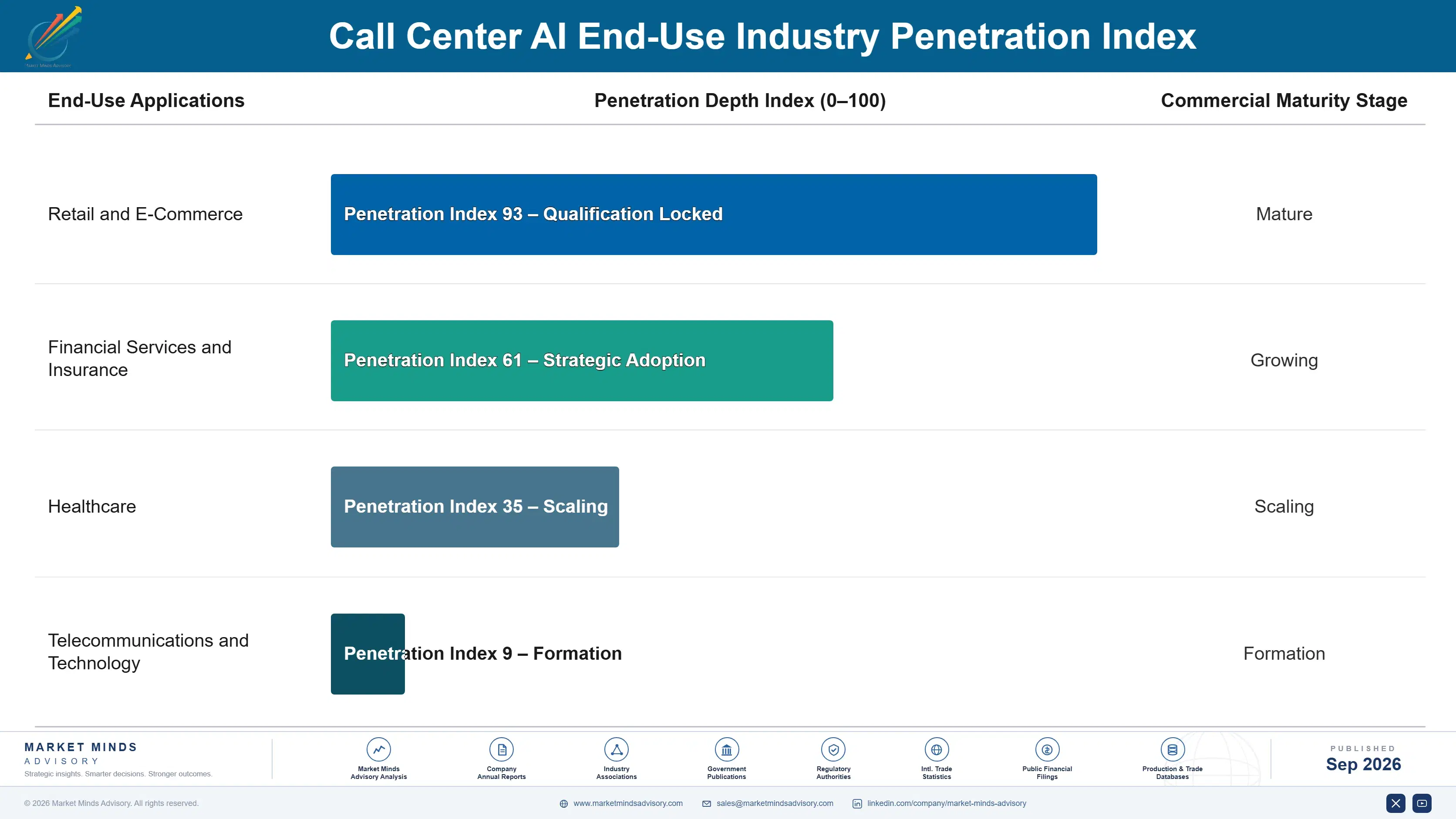
Adoption depth varies considerably by end-use vertical. Large enterprise contact centers show the deepest platform dependency, since their scale justifies custom deployment partnerships that smaller organizations cannot replicate. Business process outsourcers adopt more gradually but at meaningful per-seat value once accuracy proves out, where reliability matters more than raw feature novelty, giving vendors a long runway of incremental generative feature adoption over successive contract cycles.

Buyer profiles are shifting generationally as contact center operations managers who once measured success purely by call handling speed give way to a cohort fluent in generative AI capability and customer experience metrics from early in their careers. That newer generation increasingly evaluates vendors more like strategic experience partners than commodity software suppliers, weighing generative sophistication and integration depth alongside traditional cost criteria.
call-center-ai-market-end-use-penetration-index-1789996305206

Where MMA Sees the Advantage

These are among the four positions where our research anticipates prominent divergence between winners and laggards over the coming forecast period. Each is grounded in the demand model, the regulatory perimeter, and the announced capacity pipeline.
01 / EFFICIENT MODEL INVESTMENT

Build cost-efficient generative infrastructure ahead of rivals

Vendors that invest early in cost-efficient, purpose-built generative infrastructure hold a durable edge as compute costs increasingly determine which vendors can profitably scale AI features across their entire installed base. This capability is genuinely difficult to build quickly, which is exactly why vendors without it are steadily losing enterprise accounts to more efficient competitors today. MMA expects this gap to widen considerably further before it narrows meaningfully, rewarding vendors willing to invest in efficient infrastructure now rather than waiting until much later still.
02 / OUTCOME PRICING PACKAGING

Bundle outcome-based automation pricing as a distinct tier

Enterprises pay considerably more for vendors that price on successful automated resolution than for vendors charging flat per-seat fees, and that willingness gap is only growing wider with each passing quarter across the industry. That opportunity is not yet fully captured by most vendors' current pricing structures across the category today. Real margin is being left squarely on the table for any vendor willing to formalize this outcome-based model into a distinct, clearly marketed offering, and that gap keeps widening every quarter.
03 / ENTERPRISE INTEGRATION EXPANSION

Pursue deep telephony integration with the largest enterprises

Large enterprises operating complex telephony and CRM environments represent the highest-value expansion opportunity in the entire category, since few competitors have built genuinely convincing integration depth at truly meaningful scale today across every region they serve. This complexity is exactly why deep integration contracts command considerably higher pricing than standalone point solutions ever could achieve on their own. MMA sees this segment as considerably underserved relative to its genuine commercial value going forward, and that underserved gap keeps growing every fiscal quarter.
04 / AI-NATIVE ENTRANT RISK

Watch AI-native startups win greenfield enterprise deployments

AI-native startups built entirely around generative capability pose the clearest competitive threat to incumbents relying on legacy platform breadth as a durable advantage over time and across most enterprise segments. Vendors that fail to modernize meaningfully beyond retrofitted generative features risk losing exactly the greenfield deployments that fund future growth today and well into the years ahead. MMA expects this competitive pressure to intensify rather than fade anytime soon across most major global markets nationwide and internationally for the foreseeable future.

Engagement Snapshot From the Field

A live engagement with an industry participant carrying material or product regulatory and market exposure ahead of a defining policy shift, showing how our research translates into a defensible multi-year portfolio strategy.
MARKET MINDS ADVISORY · CLIENT ENGAGEMENT SUMMARY
Call Center AI Producer Strategic Portfolio Review and Transition Roadmap 2026·Investment Scenario on Call Center AI Exposure Evaluation 2025-26
CLIENT PROFILE
The client is a global insurance carrier operating customer service contact centers across four countries handling roughly six million customer interactions annually, spanning claims inquiries, policy servicing, and renewal conversations. Facing rising customer complaints about long hold times and inconsistent service quality across regions, leadership sought an independent assessment of whether generative AI agent assist could meaningfully improve both efficiency and customer satisfaction.
STRATEGIC CHALLENGE
The client's operations team lacked confidence in vendor claims about generative AI accuracy for insurance-specific terminology and regulatory compliance requirements that varied considerably across its four operating countries. Prior automation attempts using basic chatbots had produced inconsistent results, leaving internal stakeholders skeptical that newer generative technology would perform meaningfully better in practice.
MMA APPROACH
MMA benchmarked three generative AI agent assist vendors against the client's specific insurance terminology and regulatory compliance requirements across all four operating countries, running controlled pilot tests using anonymized historical call transcripts. The engagement combined vendor technical evaluations, compliance officer interviews, and a side-by-side accuracy comparison against the client's existing basic chatbot deployment.
KEY FINDINGS
  1. The leading vendor's generative assist reduced average handling time on claims inquiries by a meaningfully greater margin than on policy servicing calls, reflecting differences in query complexity across call types.
  2. Two of three evaluated vendors showed measurable accuracy gaps on insurance-specific regulatory language in two of the client's four operating countries, a risk not disclosed in initial vendor presentations.
  3. Agent satisfaction with the leading vendor's copilot exceeded expectations considerably, since agents reported the tool reduced cognitive load on complex claims calls rather than merely accelerating simple ones.
  4. Phased rollout by call type rather than by country reduced implementation risk considerably, since claims-specific accuracy issues surfaced faster when isolated from broader deployment complexity.
CLIENT PROFILE
The client is a global insurance carrier operating customer service contact centers across four countries handling roughly six million customer interactions annually, spanning claims inquiries, policy servicing, and renewal conversations. Facing rising customer complaints about long hold times and inconsistent service quality across regions, leadership sought an independent assessment of whether generative AI agent assist could meaningfully improve both efficiency and customer satisfaction.
STRATEGIC CHALLENGE
The client's operations team lacked confidence in vendor claims about generative AI accuracy for insurance-specific terminology and regulatory compliance requirements that varied considerably across its four operating countries. Prior automation attempts using basic chatbots had produced inconsistent results, leaving internal stakeholders skeptical that newer generative technology would perform meaningfully better in practice.
MMA APPROACH
MMA benchmarked three generative AI agent assist vendors against the client's specific insurance terminology and regulatory compliance requirements across all four operating countries, running controlled pilot tests using anonymized historical call transcripts. The engagement combined vendor technical evaluations, compliance officer interviews, and a side-by-side accuracy comparison against the client's existing basic chatbot deployment.
KEY FINDINGS
  1. The leading vendor's generative assist reduced average handling time on claims inquiries by a meaningfully greater margin than on policy servicing calls, reflecting differences in query complexity across call types.
  2. Two of three evaluated vendors showed measurable accuracy gaps on insurance-specific regulatory language in two of the client's four operating countries, a risk not disclosed in initial vendor presentations.
  3. Agent satisfaction with the leading vendor's copilot exceeded expectations considerably, since agents reported the tool reduced cognitive load on complex claims calls rather than merely accelerating simple ones.
  4. Phased rollout by call type rather than by country reduced implementation risk considerably, since claims-specific accuracy issues surfaced faster when isolated from broader deployment complexity.
RECOMMENDED STRATEGY
Phase 1: Phase one deploys the leading vendor's generative assist for claims inquiries across all four countries, prioritizing the highest-volume call type first. Phase 2: Phase two extends deployment to policy servicing calls once claims accuracy and compliance performance are validated across a full operating quarter. Phase 3: Phase three evaluates full replacement of the existing basic chatbot deployment once generative assist proves reliable across all call types.
OUTCOME
The client approved a phased generative AI deployment budget of approximately $14 million (client-reported, unverified by MMA), starting with claims inquiries across all four countries. Early results were credited internally with a measurable reduction in average handling time, and agent satisfaction scores improved meaningfully within the first deployment quarter.

Frequently Asked Questions

Foundational context covering the market sizes, CAGR, scope, country, region and competition that inform every finding below. This section is provided to cover basics and most often pre-purchase conversations, answered from the MMA Primary Research Dataset.

What is the current size of the Call Center AI Market?

The Call Center AI Market was valued at approximately $4.6 billion in 2025. That figure covers generative agent assist, conversational voice bots, and real-time analytics platforms worldwide.

How large will the Call Center AI Market be by 2036?

MMA projects the market will reach approximately $27.11 billion by 2036. Growth is driven primarily by rising agent wage costs and generative AI adoption across enterprise contact centers.

What is the CAGR for the Call Center AI Market 2026 to 2036?

The market is forecast to grow at a 17.5% compound annual rate between 2026 and 2036. Bull and bear scenarios range from 18.8% down to 16.2% depending on model licensing cost pace.

Which segment is growing fastest?

Generative AI Agent Assist and Copilot Platforms is the fastest-growing segment, expanding at roughly 27.1% annually, about 1.55 times the overall market rate. Handling time reduction demand is the primary driver.

Who are the major companies in the Call Center AI Market?

NICE, Genesys, Five9, Talkdesk, and Verint lead the category on disclosed platform deployment estimates today. Combined, the top five hold roughly 48% of the overall market.

Which country is growing fastest?

India is the fastest-growing country at approximately 24.0% annually, ahead of the broader South Asia and Pacific region. The world's largest business process outsourcing industry is the primary factor.

Report Segmentation Architecture

The full report scope spans multiple orthogonal segmentation dimensions, with cross-tabulated demand data provided for each dimension pair. Coverage extends further to regional breakdowns, trend trajectories, and the competitive detail needed to support segment-level decision-making.

By Software Function Type

  • Generative AI Agent Assist and Copilot
  • Conversational Voice AI and Deflection
  • Real-Time Analytics and Quality Monitoring
  • Workforce Optimization AI Tools
  • Compliance and Sentiment Analysis Software

By End-Use Industry

  • Retail and E-Commerce
  • Financial Services and Insurance
  • Healthcare
  • Telecommunications and Technology

By Commercial Dimension

  • Per-Seat Licensing Contracts
  • Outcome-Based Automation Pricing
  • Multi-Year Enterprise Renewal Agreements
  • Reseller and Systems Integrator Channels

By Region

  • North America
  • East Asia
  • Western Europe
  • South Asia and Pacific
  • Latin America
  • Middle East and Africa
  • Eastern Europe

Scope, Methodology, and Coverage

Every figure in this report is reproducible from documented input assumptions. The scope below maps the historical period, the forecast horizon, the segmentation dimensions, and the countries covered, alongside the underlying primary and qualitative methodology.
Historical Period
2020 to 2025
Forecast Period
2026 to 2036
Base Year
2025 (USD billions; MMA Primary Research Dataset, September 2026)
Market Definition
This report defines the Call Center AI Market as software that automates or augments contact center interactions, including generative AI agent assist, conversational voice bots, and real-time analytics platforms. It excludes standard customer relationship management software, basic interactive voice response systems, and workforce scheduling tools without embedded AI capability.
Quantitative Units
USD Billion, CAGR (%), Deployed Agent Seats
Segmentation Dimensions
Software Function Type, End-Use Industry, Commercial Dimension, Region
Regions Covered
North America, East Asia, Western Europe, South Asia and Pacific, Latin America, Middle East and Africa, Eastern Europe
Countries Covered
United States, India, China, Philippines, Germany, Brazil, United Kingdom, and 13 additional countries
Key Companies Profiled
NICE, Genesys, Five9, Talkdesk, Verint, and 15 additional companies
Quantitative Methodology
Primary survey, n=3,800 respondents, Q4 2025, six countries; demand-side model with trade association cross-validation
Qualitative Methodology
47 expert interviews, Q4 2025; applied to validate demand model assumptions, identify emerging dynamics, and assess competitive positioning
Report Format
PDF and XLSX data workbook (Word format preview document)
Publisher
Market Minds Advisory
Report Code
MMA-2026-TEC-256
Published
September 2026
Contact
sales@marketmindsadvisory.com | www.marketmindsadvisory.com

Purchase the full Call Center AI Market Report (2026 to 2036).

The full Call Center AI Market report delivers a complete analysis of segment-level growth, regional demand patterns, and competitive positioning across all major contact center AI vendors worldwide. It includes detailed profiles of the twenty leading companies, quantified trend and driver analysis, and a full regional breakdown across all seven world regions with country-level detail where relevant. Buyers receive input cost exposure modeling and portfolio margin benchmarking that go well beyond what the executive summary alone can provide. The report also includes a proprietary MMA revenue-lever framework identifying where vendors can capture incremental margin.
Full seven-region demand and pricing breakdown
Twenty-company competitive profiles and moat analysis
Segment-level CAGR and market share detail
Input cost exposure and mitigation strategy analysis
Portfolio margin tiering across product categories
Primary survey and expert interview data tables

Built For The People Who Decide

From boardroom strategy to bench-side execution, this report is read cover-to-cover by leaders shaping the next decade of their industry, turning demand scenarios, market dynamics and valuation benchmarks into decisions.
CXOs/ Presidents/ VPs/ Managers
M&A and Corporate Development
Strategy Teams and R&D Heads
Procurement and Product Directors
Regulatory and Compliance Leaders
Investor Relations and Equity Analysts