Market Minds Advisory
Calendering Equipment Market

Calendering Equipment Market: Roll Precision as the Output Ceiling

Nonwoven hygiene and filtration producers now specify calender lines built for higher line speed and tighter thickness tolerance, automotive interior suppliers expand synthetic leather capacity, and machinery builders without proven roll-bending technology lose large contracts.

Lead Analyst

David Horsley

Published

September 2026

Make Smarter Decisions with Customized Research Insights

Request a free sample report and evaluate market opportunities, growth trends, and competitive dynamics relevant to your business needs.

2025 MARKET VALUE$2.8BMarket Size 2025
2036 FORECAST VALUE$4.6BBase Case , 2026 to 2036
CAGR 2026 TO 20364.6 %Bull 5.8% / Bear 3.4%
INCREMENTAL OPPORTUNITY$1.7BNet 10- year value creation
EXPANSION MULTIPLE1.57x2036 value over 2026 base
Strategic Levers
M&A Pipeline
Regional Outlook
Country Rankings
Competitive Intelligence
Segmental Deep-dive
Call-Us : 91 93563 13602

Executive Snapshot and Market Trajectory

Sheet material producers increasingly treat calendering line specification as a throughput and tolerance engineering decision rather than a routine capital equipment purchase, since roll precision directly determines output quality and production speed across plastic, rubber, and nonwoven manufacturing operations worldwide, from film extrusion lines to hygiene product converting plants.
Nonwoven fabric calendering leads growth at 7.0%, roughly 1.52 times the overall rate, as hygiene and filtration product manufacturers expand capacity requiring precise thickness control that older calender designs cannot deliver at modern production speeds without added downtime for recalibration. East Asia now holds the largest regional share at 29%, driven by China's dominant plastics, rubber, and textile manufacturing base and sustained capital investment across the sector's expanding downstream processing and industrial fabrication base.
Competitive intensity stays moderate at 45% held by five suppliers, since roll-bending technology and precision engineering requirements fragment share across dozens of specialized machinery builders rather than concentrating around a handful of global platforms the way more standardized equipment categories often do. Buyers increasingly select suppliers on documented thickness tolerance data rather than nameplate speed specifications alone across most large capacity investment decisions and multi-year equipment contracts.
Market Definition
Base Year Value
$2.8B in 2025 (MMA Primary Research Dataset, August 2026)
Forecast Period
2026 to 2036, eleven discrete annual values
CAGR
4.6% base case. Bull 5.8%. Bear 3.4%.
Fastest Growth Segment
Nonwoven Fabric Calendering: 7.0% CAGR
Fastest Growth Country
China: 6.8% CAGR
Fastest Growth Region
South Asia and Pacific: 6.7% CAGR
Largest Region
East Asia: 29% of 2025 global value
Market Leaders
Primary Survey
n=3,800 procurement and R&D decision-makers, Q4 2025, six countries
Methodology
Demand-side build-up, cross-validated against public data, 47 expert interviews

Calendering Equipment Market Forecast Scenarios

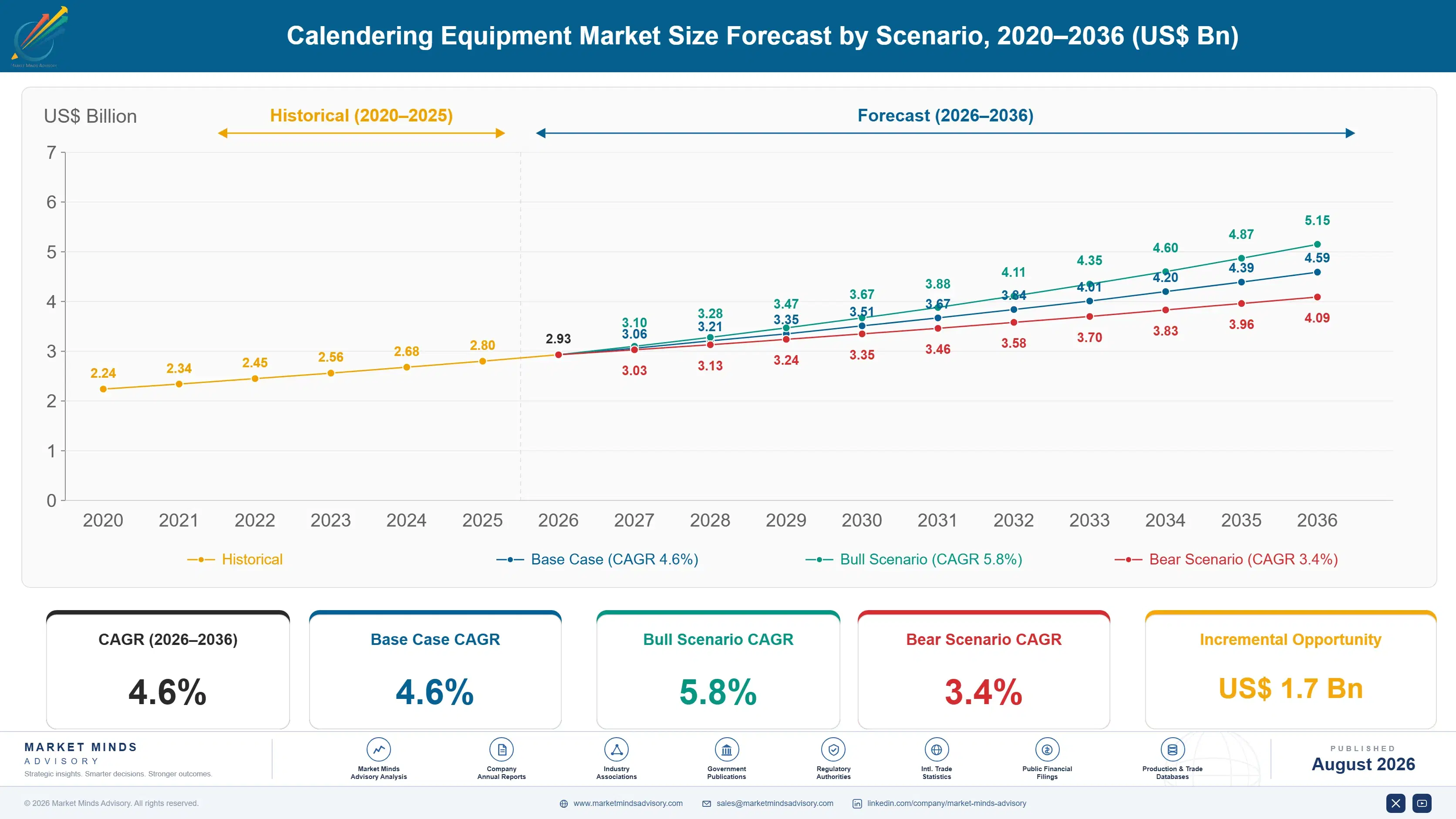
calendering-equipment-market-size-forecast-scenario-1787301121365
Between 2020 and 2025 the market grew at an estimated 4.1% annually, slowed initially by pandemic-driven industrial capex cuts before recovering as nonwoven hygiene product demand surged and automotive interior suppliers resumed delayed capacity expansion projects across major manufacturing regions, from Southeast Asia to Eastern Europe and North American manufacturing corridors serving diverse downstream industries alike.
Three mechanisms carry the base case to 4.6%. First, nonwoven hygiene and filtration producers keep expanding capacity as consumer demand for medical and personal care products continues growing steadily. Second, automotive interior suppliers keep specifying synthetic leather calendering capacity as vehicle production volumes recover across major markets. Third, aging calender line fleets across mature manufacturing regions keep requiring replacement as thickness tolerance requirements tighten industry-wide across most downstream applications and customer specification sheets.
The bull case at 5.8% assumes sustained nonwoven and automotive capacity investment keeps replacement and expansion demand elevated throughout the forecast period across most major producing regions. The bear case at 3.4% assumes a broader industrial slowdown delays capacity expansion projects, pushing manufacturers to extend existing calender line life rather than committing to new capital purchases across the broader industry.

Roll Precision as the Real Purchasing Standard

Calendering equipment sits at the center of sheet material economics for any manufacturer converting raw polymer, rubber, or fiber into continuous rolled product, since roll precision and thickness control directly determine output quality and downstream process yield across nearly every application. Documented tolerance performance, not nameplate line speed, increasingly separates competing suppliers across major capacity investment decisions and multi-year equipment contracts.
MARKET CONCENTRATION (CR5)45%Five suppliers hold moderate share across specialized machinery field
THICKNESS TOLERANCEPlus or minus 2 to 5 micronsTypical precision specification for modern calender line output
TOP PRODUCING COUNTRY SHARE27%China supplies largest share of installed calendering equipment capacity
EQUIPMENT SERVICE LIFE20 to 30 yearsTypical operating duration before major line replacement occurs
ROLL STEEL COST SHARE28-36% of COGSForged steel and precision bearing inputs weigh heavily on costs
TRADE INTENSITY42% cross-borderMachinery components frequently cross borders before final line assembly
Commercially, the category behaves like a specialized capital equipment business wrapped inside a broader industrial engineering relationship. Suppliers bundle machinery hardware with installation engineering and multi-year service contracts under long-term supply agreements, which locks buyers into a single qualified vendor across an entire production line rather than encouraging component-by-component shopping on price. Switching suppliers requires costly requalification against production tolerance standards.
Over the next decade, expect nonwoven and synthetic leather calendering capacity to keep expanding faster than traditional plastic film applications, as hygiene product and automotive interior demand outpace broader industrial output growth across most major markets. Digital process control integration will also keep expanding across new calender line installations, letting operators maintain tighter tolerance consistency at higher production speeds across increasingly demanding applications.
"A calender line that runs a hundred meters a minute is worthless if the sheet varies by more than a few microns. Speed sells the brochure. Tolerance wins the order."
Director, Industrial Machinery and Process Equipment Practice · MMA Industrial E

Market Trends

Hygiene Product Manufacturers Expand Nonwoven Capacity

Global hygiene product manufacturers continue expanding nonwoven fabric production capacity to meet sustained demand for diapers, feminine care, and adult incontinence products across both developed and emerging markets. Each new nonwoven production line requires calendering equipment engineered for the specific thickness and bonding characteristics these products demand, distinct from the broader plastic film calendering equipment base. Kimberly-Clark and Procter & Gamble have both disclosed capacity expansion investments requiring new calendering equipment procurement across multiple manufacturing regions. Equipment suppliers report growing specification requirements for higher line speeds without compromising the thickness consistency these hygiene applications demand.
Market Impact: Adds 8,000 lines needing replacement
Automotive Interior Suppliers Expand Synthetic Leather Capacity

Automotive interior component suppliers keep expanding synthetic leather production capacity as vehicle manufacturers specify vegan and cost-effective leather alternatives across an increasing share of interior trim applications across multiple vehicle segments. Each new synthetic leather production line requires precision calendering equipment capable of achieving consistent surface texture and thickness across wide sheet widths. Major automotive suppliers have disclosed expanded synthetic leather capacity investments tied directly to vehicle production recovery across major manufacturing markets. Suppliers with proven automotive-grade calendering technology are capturing disproportionate share of this expanding demand segment across most major automotive manufacturing regions worldwide.
Market Impact: Adds 20% filtration capacity yearly

Market Opportunities and Growth Drivers

Aging Equipment Fleets Require Simultaneous Replacement

A substantial share of calendering lines installed across mature manufacturing regions during earlier industrial expansion cycles are approaching or exceeding their designed service life simultaneously, creating a concentrated replacement wave rather than steady annual turnover. Equipment operating well beyond typical service life increasingly struggles to meet tightening thickness tolerance requirements that downstream customers now specify as standard rather than premium. That concentrated replacement need creates sustained demand independent of any single capacity expansion cycle, since operators cannot indefinitely defer replacement once tolerance performance falls meaningfully below customer specification requirements across the board.
Market Impact: Requires 3-8 million per line

Filtration Media Demand Expands Nonwoven Calendering Capacity

Air and liquid filtration media manufacturers keep expanding production capacity as environmental regulation and industrial process requirements drive sustained demand for high-performance filtration products across automotive, HVAC, and industrial applications worldwide. Each new filtration media production line specifies calendering equipment engineered for the precise density and permeability control filtration performance requires, distinct from simpler nonwoven applications used elsewhere. Suppliers with proven filtration-grade calendering technology are capturing disproportionate share of this expanding specialty demand segment as regulatory requirements continue tightening across major industrial markets globally, from automotive assembly plants to commercial HVAC installations.
Market Impact: Delays response 12-18 months

Market Restraints and Challenges

High Capital Cost Limits Smaller Manufacturer Investment

Modern precision calendering lines require capital investment measured in millions of dollars per installation, creating a barrier that constrains smaller regional manufacturers from upgrading equipment even where tolerance requirements clearly justify the investment. The root cause is engineering complexity: precision roll-bending technology and digital process control systems require specialized components and integration expertise that keep costs elevated compared with simpler, lower-tolerance equipment alternatives. That cost barrier pushes smaller manufacturers toward extending existing equipment life rather than upgrading proactively. Suppliers are responding with modular upgrade packages that improve tolerance performance without requiring complete line replacement.
Market Impact: Adds 40 new nonwoven lines yearly

Long Lead Times Delay Capacity Response to Demand Shifts

Precision calendering equipment typically requires twelve to eighteen months from order placement to commissioned production, a lead time that complicates manufacturers' ability to respond quickly to sudden demand shifts in fast-growing applications like nonwoven hygiene products. The root cause is engineering customization: each line requires application-specific engineering and precision component manufacturing that cannot be meaningfully compressed without compromising tolerance performance. That delay forces manufacturers to make capacity commitments based on demand forecasts rather than confirmed orders. Suppliers are responding by maintaining strategic component inventory to compress delivery timelines where possible.
Market Impact: Adds 15% synthetic leather capacity
3 additional market trends, 4 additional growth drivers, and 2 additional restraints and challenges are covered in the full report. Contact sales@marketmindsadvisory.com to access the complete intelligence.

Segment CAGR and Growth Architecture

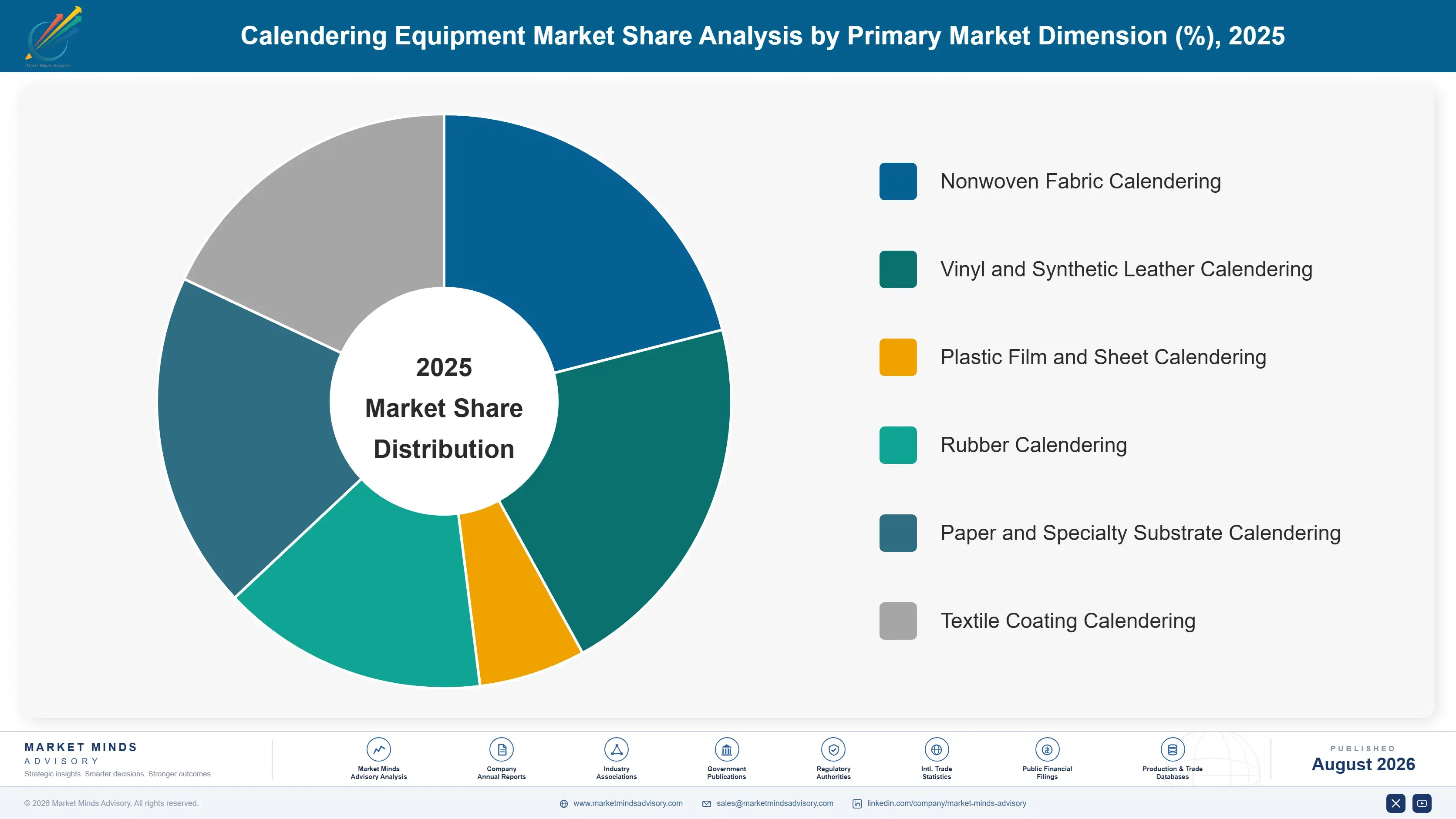
Segmentation follows material application, a single downstream-output logic spanning plastic film and sheet, rubber, textile, paper and pulp, nonwoven fabric, and vinyl and synthetic leather calendering. Each application carries distinct roll configuration, tolerance requirement, and buyer group, so commercial position tracks the material output rather than the underlying machinery architecture or roll configuration alone.
calendering-equipment-market-market-share-analysis-1787301122139

Nonwoven Fabric Calendering

Nonwoven fabric calendering grows fastest at 7.0%, about 1.52 times the overall market rate, as hygiene and filtration product manufacturers expand capacity requiring precise thickness control that older calender designs cannot deliver at modern production speeds. Each new nonwoven production line demands equipment engineered for the specific thickness and bonding characteristics hygiene and filtration applications require, distinct from the broader plastic film calendering equipment base serving other industries. Comerio Ercole and Berstorff have both expanded nonwoven-specific product lines, and manufacturers increasingly specify documented thickness consistency data during vendor qualification rather than relying on nameplate speed specifications alone during large procurement decisions across multiple production line generations and successive expansion phases nationwide.
CAGR 7.0%

Vinyl and Synthetic Leather Calendering

Vinyl and synthetic leather calendering grows second-fastest at 6.0%, driven by automotive interior suppliers and furniture manufacturers specifying vegan and cost-effective leather alternatives across an increasing share of applications previously served exclusively by genuine leather. Each new production line requires precision calendering equipment capable of achieving consistent surface texture and thickness across wide sheet widths demanded by automotive and furniture customers. Major automotive suppliers have disclosed expanded synthetic leather capacity investments tied directly to vehicle production recovery, and equipment suppliers increasingly specify documented surface finish consistency during customer qualification processes across major automotive and furniture manufacturing accounts spanning multiple regional production hubs across North America, Europe, and East Asia alike.
CAGR 6.0%
Full segment breakdown across 6 segments available in the complete report.

Regional Architecture and Country Demand Map

East Asia leads at 29% of global value on China's dominant plastics, rubber, and textile manufacturing base, followed by North America at 22% and Western Europe at 21% on sustained precision equipment demand. Remaining regions together account for the balance of overall global demand today.

North America

United States plastics and automotive interior manufacturers anchor North American demand, where synthetic leather and specialty film production continue expanding as domestic manufacturing investment incentives attract capacity that previously located overseas, particularly for automotive and hygiene end-use applications. Nonwoven hygiene product manufacturers maintain substantial domestic production capacity requiring ongoing equipment replacement and expansion investment across major manufacturing states such as North Carolina, Georgia, and Wisconsin. Canada's rubber and plastics processing sector follows comparable investment patterns at meaningfully smaller absolute scale across fewer provincial markets. Growth of 4.9% outpaces the global rate as onshoring incentives and nonwoven capacity expansion compound across an already substantial installed equipment base spanning multiple downstream manufacturing sectors.
Share: 22% | CAGR: 4.9% (2026 to 2036)

Western Europe

Germany and Italy host substantial precision machinery manufacturing capability, with several leading calendering equipment builders headquartered in the region serving both domestic and export customers worldwide across multiple downstream industries. France's automotive interior and specialty textile sectors sustain steady demand for precision calendering capacity tied to long-established manufacturing relationships with automakers headquartered across the region. The region's mature and technically demanding industrial base means replacement demand dominates over new capacity expansion compared with faster-growing emerging markets in Asia and Latin America. Growth of 3.1% trails the global average because the region's manufacturing base, while technically sophisticated, has already achieved substantial equipment modernization in recent investment cycles spanning the past decade and beyond.
Share: 21% | CAGR: 3.1% (2026 to 2036)
Regional intelligence for 5 additional markets available in the complete report: East Asia, South Asia and Pacific, Latin America, Middle East and Africa, Eastern Europe. Contact sales@marketmindsadvisory.com.
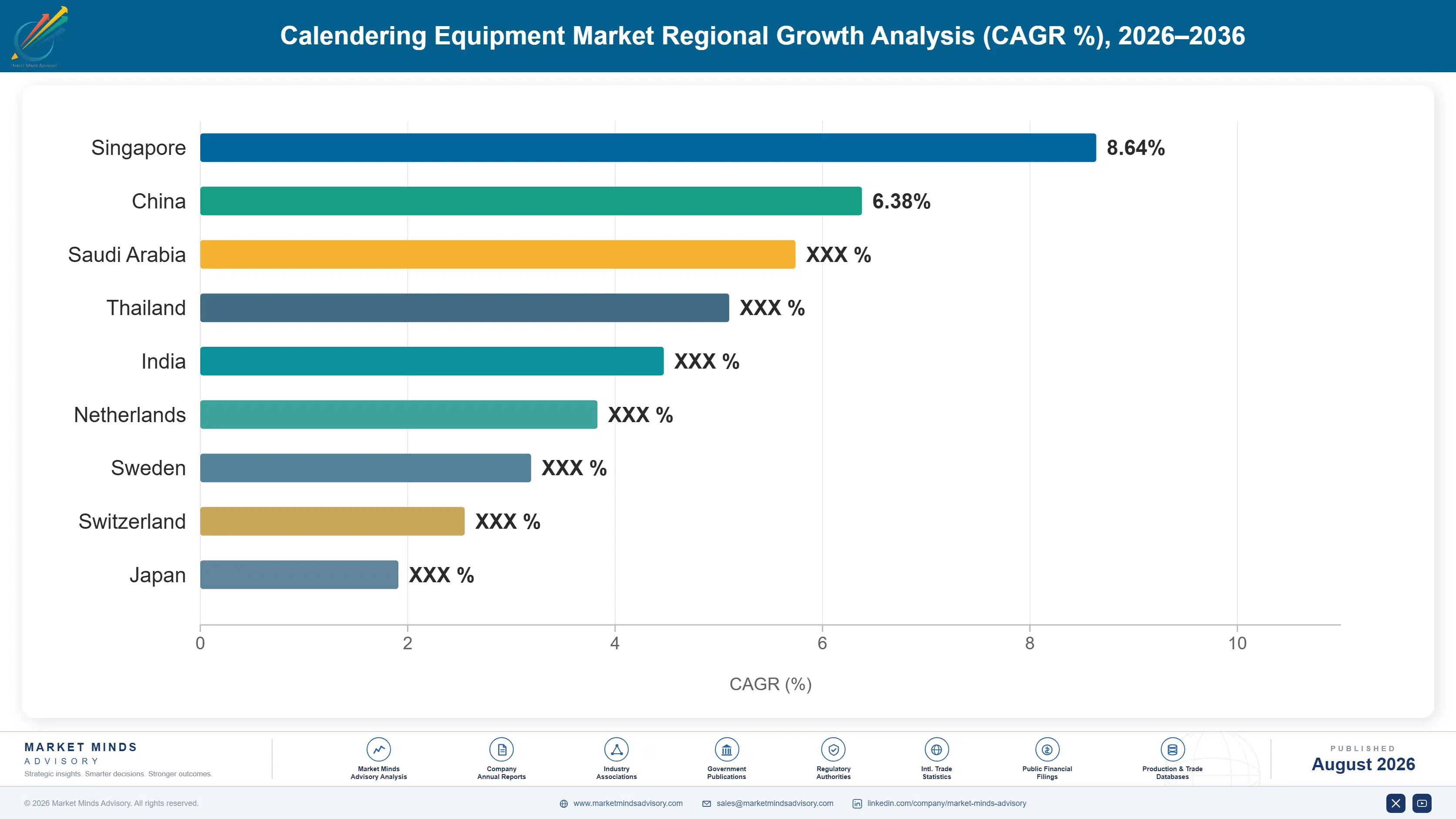
calendering-equipment-market-country-cagr-analysis-1787301122775

Where Calendering Equipment Suppliers Add Margin

Roll technology, automation depth, and aftermarket service determine which suppliers capture premium pricing rather than compete purely on throughput specifications. Buyers increasingly pay a premium for tolerance consistency, uptime guarantees, and integration support over the equipment's full operating life, not just the headline speed rating printed on a sales brochure or a trade show banner.

Precision Roll Bending Technology Licensing Programs

Suppliers holding proprietary roll-bending and thermal-compensation technology command premium pricing on lines specified for tight-tolerance nonwoven and film applications, where a single supplier's patented crown-control system can add 15 to 20 percent to line pricing versus a conventional roll stack. Licensing this technology to regional partners in China and India extends reach into price-sensitive markets without full capital investment in local manufacturing capacity. Aftermarket calibration services tied to the licensed technology generate recurring revenue across the equipment's operating life, typically twenty to thirty years, independent of new line sales cycles that fluctuate with capital spending.
Market Impact: Adds a 15 to 20 percent price premium

Digital Line Monitoring and Predictive Maintenance

Retrofitting sensor packages and predictive maintenance software onto existing calender lines creates a recurring software and service revenue stream that did not previously exist for most equipment builders. Customers running continuous three-shift operations pay a premium for systems that flag bearing wear or roll misalignment before an unplanned stoppage costs a full production day, since unplanned downtime on a single line can exceed 50,000 dollars per incident. Suppliers bundling this software with multi-year service contracts convert a one-time equipment sale into an annuity relationship worth several percentage points of the original line price every year.
Market Impact: Adds 3 to 5 percent annual service revenue

Turnkey Line Integration and Commissioning Services

Manufacturers moving beyond selling standalone calenders toward full turnkey line integration, spanning unwind, calendering, and winding stations under a single commissioning contract, capture engineering and project management fees that a component-only sale never reaches. This shift is most pronounced among nonwoven hygiene producers commissioning entirely new production sites, where a full turnkey package can run 40 to 60 percent above the calender's standalone list price. It also deepens the customer relationship ahead of the next equipment replacement cycle, since the original integrator typically wins the follow-on replacement contract a decade or more later.
Market Impact: Adds 40 to 60 percent to turnkey deal value

Who Controls the Margin Pool

Five suppliers hold 45 percent of global calendering equipment output measured by installed production capacity shipped over the trailing three years, leaving a fragmented tail of regional builders competing on price and delivery lead time. Berstorff GmbH and Comerio Ercole S.p.A. lead on technology depth, both commanding a lead over the next tier of challengers on tight-tolerance nonwoven and film applications. The gap narrows sharply outside precision-critical segments.
Competitive activity currently centers on automation depth and digital retrofit offerings rather than raw line speed, which most established suppliers have already optimized close to physical limits. Several builders have expanded service networks into Southeast Asia and India to shorten response times for nonwoven producers scaling capacity there. Roll-bending licensing deals and joint development agreements with compounders have also become more common as suppliers differentiate beyond hardware specifications.

Chinese domestic equipment builders are narrowing the technology gap fastest, pressuring European incumbents on mid-tier nonwoven and film lines where tolerance requirements are less demanding than premium automotive interior applications. Rankings are most likely to shift in digital monitoring, where software-capable entrants could displace hardware-only incumbents on service revenue.
calendering-equipment-market-company-positioning-matrix-1787301123367

Competitive Moat and Risk Dimensions

BERSTORFF GMBH

Moat: Proprietary Roll Crown Control

Berstorff's patented thermal crown-compensation system maintains sheet thickness tolerance within two to three microns across the full roll width, a specification most competitors cannot match on wide-format nonwoven and film lines. This technical edge locks in premium pricing on tight-tolerance orders and has protected the company's position with major hygiene product manufacturers for over a decade.
BERSTORFF GMBH

Risk: German Cost Base Exposure

Berstorff's engineering and manufacturing base remains concentrated in Germany, exposing the company to euro-denominated labor and energy costs that Asian competitors do not carry. This cost disadvantage narrows margin on price-competitive mid-tier orders and has pushed the company toward higher-value, tolerance-critical segments where its technology premium still clears the cost gap comfortably.
COMERIO ERCOLE S.P.A.

Moat: Rubber Calendering Heritage

Comerio Ercole's decades of specialization in rubber and synthetic leather calendering give it engineering depth in roll metallurgy and surface finishing that newer entrants cannot replicate quickly. This heritage translates into a strong reputation among automotive interior and industrial rubber processors who prioritize proven reliability over lower upfront equipment cost.
COMERIO ERCOLE S.P.A.

Risk: Narrow End-Market Concentration

The company's revenue depends heavily on automotive and industrial rubber applications, leaving it more exposed than diversified competitors to cyclical swings in vehicle production volumes. A prolonged downturn in automotive interior demand would hit Comerio Ercole's order book harder than suppliers with meaningful nonwoven or film exposure to offset the decline.

Key Players

Berstorff GmbH
Kuhne Group
Farrel Corporation
Kabra Extrusiontechnik Ltd.
Comerio Ercole S.p.A.

Others

Icma San Giorgio S.p.A.
Battenfeld-Cincinnati
Colmec S.p.A.
Rajoo Engineers Limited
Windmoeller & Hoelscher Corporation
Davis-Standard LLC
Reifenhauser GmbH & Co. KG
Buss AG
Maris SpA
Bandera Luigi & C. S.r.l.
Amut S.p.A.
Santex Rimar Group
Trützschler Group SE
Andritz AG
Voith GmbH & Co. KGaA

Recent Developments

MARCH 2026

Berstorff Signs Multi-Line Nonwoven Hygiene Supply Agreement

Berstorff GmbH announced a supply agreement with a major European nonwoven hygiene producer to equip three new production lines with its latest crown-control calendering technology, expanding the company's installed base among tight-tolerance hygiene manufacturers. The agreement includes a multi-year service and calibration contract covering all three lines.
Signal: Deepens Berstorff's foothold in premium hygiene-grade nonwoven calendering equipment applications across the broader European hygiene products market
NOVEMBER 2025

Kuhne Group Acquires Roll Manufacturing Specialist

Kuhne Group acquired a smaller German roll-manufacturing specialist to bring precision roll production in-house rather than relying on third-party suppliers, shortening lead times on custom roll orders and reducing exposure to external roll pricing volatility. The transaction closed in November 2025 following standard regulatory clearance in both jurisdictions.
Signal: Vertical integration into roll manufacturing reduces Kuhne's dependency on external roll suppliers going forward across future product lines
JULY 2025

Comerio Ercole Expands Synthetic Leather Line Capacity

Comerio Ercole S.p.A. commissioned a new dedicated production line for synthetic leather calendering equipment at its Italian manufacturing facility, responding to rising automotive interior demand from European and North American automakers expanding vehicle interior synthetic leather content across multiple vehicle platforms, trim levels, and model years.
Signal: Signals confidence in sustained automotive synthetic leather demand growth across established European and North American vehicle platforms

Roll Steel Supply Sets the Cost Ceiling

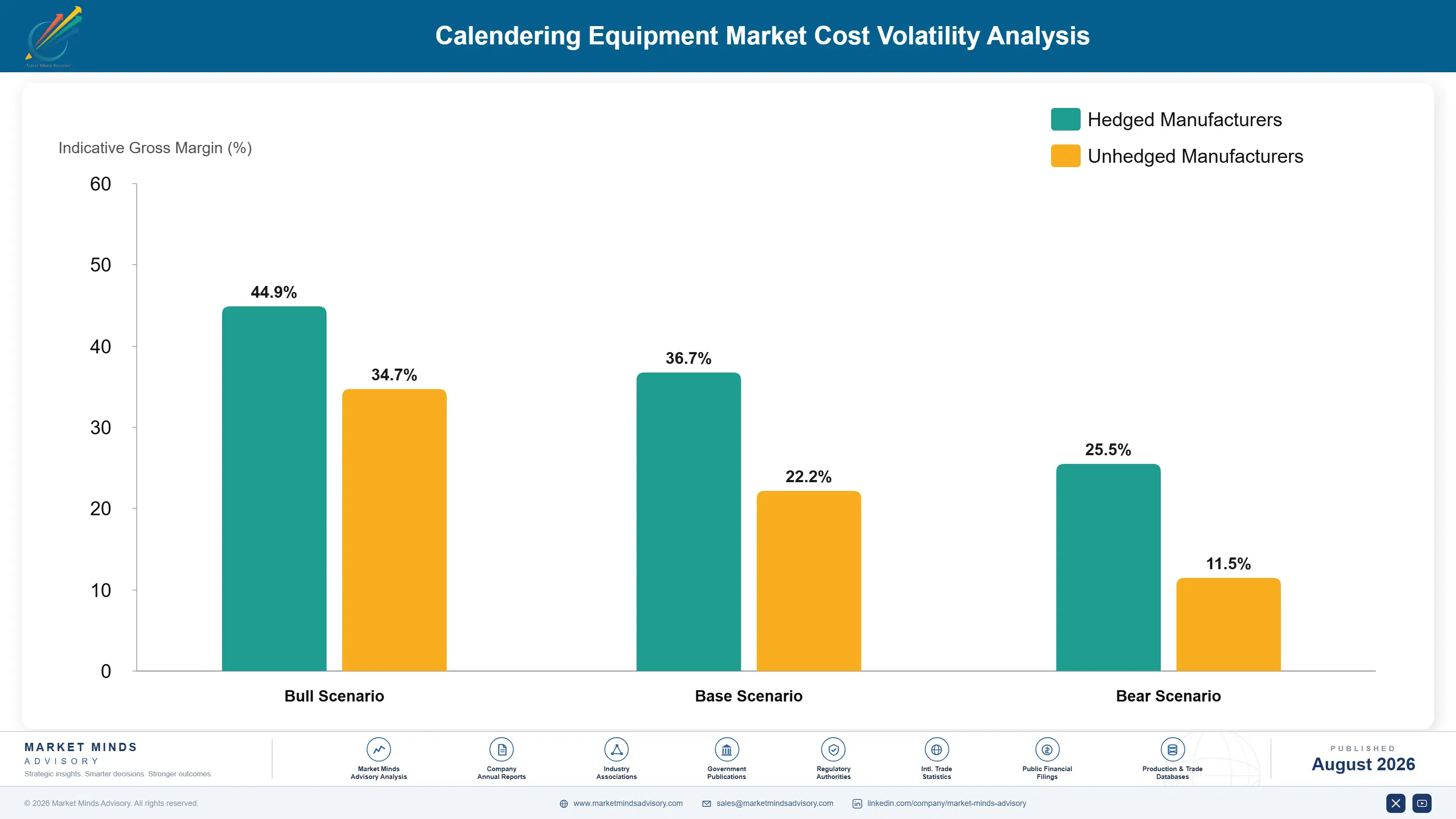
Roll steel forgings represent the largest single input cost, running 28 to 36 percent of total cost of goods sold on a fully assembled calender line, sourced primarily from specialty steel producers in Germany, Japan, and increasingly China for lower-tier applications. Precision bearings and drive motors add another meaningful share, typically sourced from established European and Japanese industrial component suppliers with long lead times on custom specifications.
Steel forging capacity tightened sharply through 2024 as European specialty steel producers curtailed output amid high energy costs, pushing roll blank lead times from twelve to over twenty weeks according to the German BMWK's industrial capacity reporting. Equipment builders absorbed part of the cost increase rather than passing it fully to customers already committed to multi-year contracts, compressing margins on orders booked before the shift.

Smaller regional equipment builders without long-term steel supply agreements face the sharpest exposure, since they lack the purchasing volume to secure priority allocation during tight supply periods that larger suppliers negotiate around. Vertically integrated players with in-house roll manufacturing, or long-standing forging relationships, absorb volatility more predictably and can quote firmer delivery timelines, a competitive advantage in bid situations where buyers pay a premium for schedule certainty.
calendering-equipment-market-cost-volatility-analysis-1787301123574

Multi-Year Forward Steel Purchasing Agreements

Leading suppliers now lock in roll steel volumes eighteen to twenty-four months ahead through fixed-price forward agreements with primary forging partners, insulating order backlogs from spot price swings across multiple forging regions. This trades pricing flexibility for delivery certainty, a swap most large customers value more highly than a marginally lower unit price today.

In-House Roll Manufacturing Investment

Several builders have acquired or built internal roll-forging capability rather than depend entirely on external suppliers, shortening lead times and capturing margin previously paid to third-party forging partners across the supply chain. The upfront capital cost is substantial but pays back over multiple product cycles for high-volume builders with steady order books and predictable demand.

Portfolio Architecture for Margin Defence

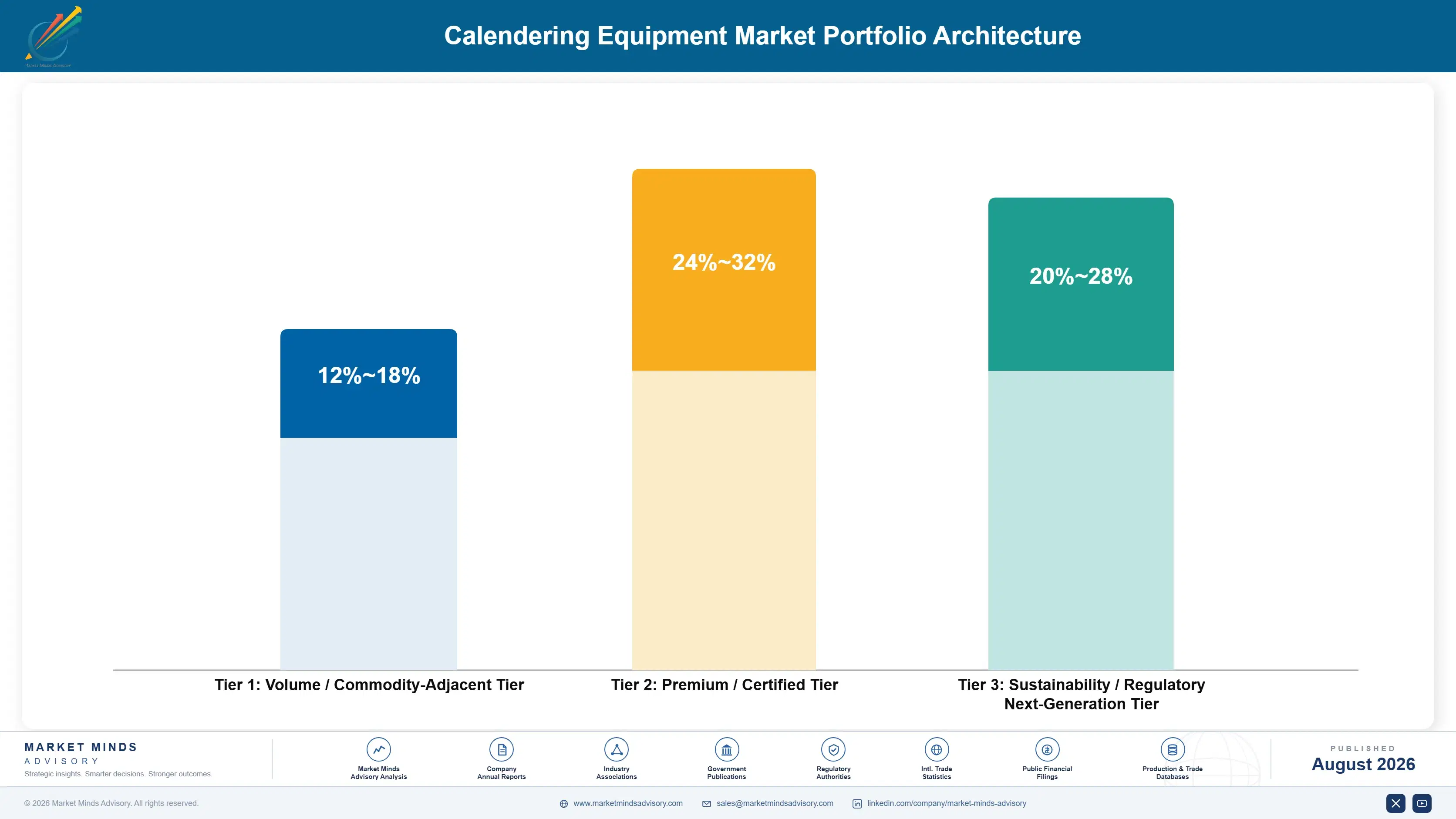
Calendering equipment pricing splits into three commercial tiers rather than a single continuum, each carrying distinct margin economics tied to the technical demands of the application. Volume commodity-adjacent lines compete almost entirely on throughput and price, leaving thin margins for builders without scale advantages, while premium and next-generation tiers command a meaningfully wider spread across nearly every major end-use category served today.
Premium certified lines, built for tight-tolerance nonwoven, filtration, and automotive interior applications, carry substantially higher margins because customers pay for documented consistency and reduced scrap rates rather than raw speed. The tension between volume and premium positioning shapes nearly every supplier's product roadmap, since chasing volume-tier price competition erodes the margin that funds premium-tier engineering investment and long-term research programs.

Sustainability and regulatory-driven lines, designed for recycled-content processing and lower energy consumption per meter produced, remain a smaller but fast-growing pool as downstream customers face their own emissions reporting requirements. High-value margin pools concentrate in premium and next-generation tiers serving hygiene, filtration, and automotive customers willing to pay for certified performance across the equipment's full operating life and multiple production shifts across the equipment's installed base.

Volume / Commodity-Adjacent Tier

Standard-specification lines for general packaging film and basic textile calendering, competing primarily on price and delivery lead time against a fragmented field of regional builders worldwide, with limited technical differentiation between competing suppliers.
Gross Margin: 12-18%

Premium / Certified Tier

Tight-tolerance lines for nonwoven hygiene, filtration, and automotive interior applications, certified to customer-specific thickness and consistency standards with documented process control records, formal customer qualification procedures, and ongoing calibration audits.
Gross Margin: 24-32%

Sustainability / Regulatory / Next-Generation Tier

Lines engineered for recycled-content feedstock processing and reduced energy consumption per meter, purchased by customers facing their own downstream sustainability and emissions reporting mandates today and expected to tighten further.
Gross Margin: 20-28%
calendering-equipment-market-portfolio-architecture-1787301124122

High-value Sub-segments and Strategic Watch-out

Nonwoven Hygiene Calendering

Fastest-growing and highest-margin pool today, driven by sustained global hygiene product demand and manufacturers' willingness to pay for tight tolerance and documented consistency across every production run, particularly among the largest multinational hygiene product manufacturers expanding capacity across North America, Europe, and East Asia simultaneously.
Gross Margin: 26-34%

Automotive Synthetic Leather Calendering

High-value pool growing moderately as automakers expand synthetic leather content in vehicle interiors, trading margin for volume as electric vehicle production scales across multiple global automotive markets and interior component supply chains adjust to changing material preferences and cost targets over time, particularly across North American and European vehicle platforms.
Gross Margin: 22-30%

General Packaging Film Calendering

Large volume core generating steady but thin margins, serving commodity film applications where price competition from regional builders limits pricing power for established multinational equipment suppliers competing for the same large-volume customer accounts worldwide, particularly across Asian and Latin American manufacturing hubs competing on cost.
Gross Margin: 12-18%

Recycled-Content Line Retrofits

Strategic watch-out as downstream sustainability mandates could force rapid retrofit demand that outpaces current supplier engineering capacity, creating a bottleneck risk worth monitoring closely now as regulatory timelines in Europe and parts of Asia continue tightening faster than most suppliers had originally anticipated in their capacity plans.
Gross Margin: 20-28%

The Annuity Behind Every Line Sale

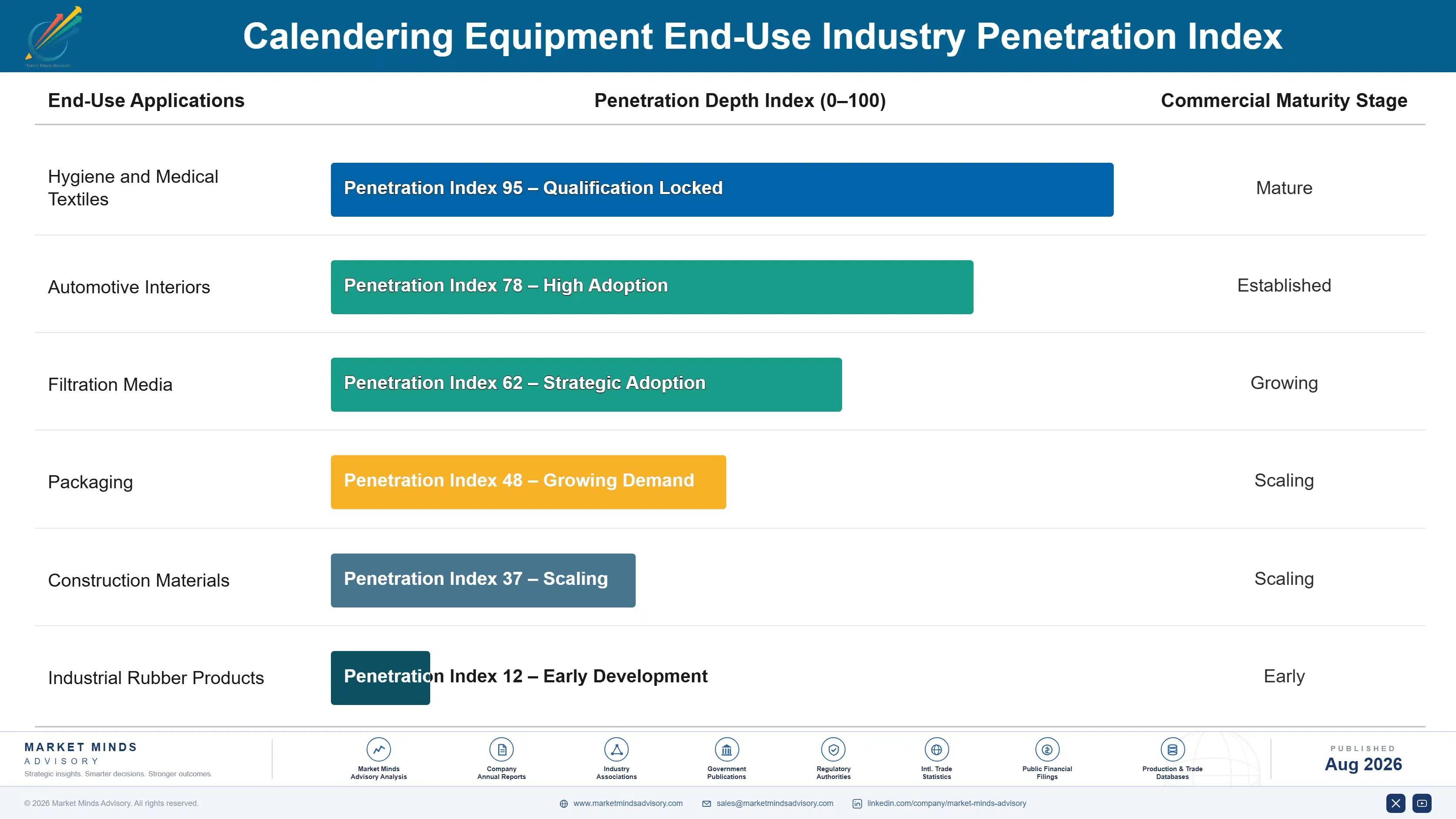
Calendering equipment generates revenue well beyond the initial line sale, since every installed unit requires roll refurbishment, bearing replacement, and periodic recalibration across a twenty to thirty year operating life. Suppliers with strong service networks capture a growing share of this annuity stream, often worth several percentage points of original line value each year over the equipment's full lifetime, independent of new capital equipment cycles.
Adoption stickiness varies meaningfully by end-use vertical once a supplier's line is qualified into a customer's production process. Nonwoven hygiene producers rarely switch calender suppliers mid-contract because requalifying tolerance specifications against a new machine risks product recalls, so switching costs run high. Automotive interior suppliers show similar loyalty tied to original equipment manufacturer approval processes, while general packaging film producers switch more readily since specifications are less exacting and price competition dominates purchasing decisions.

Buyer profiles are shifting generationally as procurement teams increasingly favor suppliers offering digital monitoring and predictive maintenance data over those selling hardware alone. Younger plant engineers trained on connected manufacturing systems expect equipment that reports its own performance, a preference reshaping which suppliers win renewal contracts as incumbent decision-makers retire and hand procurement authority to a more data-oriented generation.
calendering-equipment-market-end-use-penetration-index-1787301124711

What Suppliers Should Do Next

These are among the four positions where our research anticipates prominent divergence between winners and laggards over the coming forecast period. Each is grounded in the demand model, the regulatory perimeter, and the announced capacity pipeline.
01 / TECHNOLOGY INVESTMENT PRIORITY

Prioritize roll precision technology over raw line speed claims

Buyers now pay a documented premium for tolerance consistency rather than headline throughput numbers, and that premium is widening as nonwoven and filtration customers tighten specification requirements year over year across their qualified supplier lists. Suppliers without proprietary crown-control or thermal-compensation technology will find themselves squeezed into the volume tier, where five points of margin separate survival from slow decline over a full product cycle. The investment case favors engineering depth over manufacturing scale alone, particularly for suppliers targeting hygiene and automotive accounts.
02 / SERVICE NETWORK EXPANSION

Build recurring service revenue before hardware margins compress further

Digital monitoring and predictive maintenance retrofits convert a one-time equipment sale into a multi-year revenue relationship worth several percentage points of line value annually across the customer's full fleet of installed equipment. Suppliers that delay this shift risk losing renewal contracts to software-capable entrants lacking a hardware installed base but offering genuinely superior data services and analytics dashboards. The window to establish service-led customer relationships is narrowing as more competitors recognize the same opportunity and race to build comparable offerings.
03 / SUPPLY CHAIN RESILIENCE

Secure multi-year roll steel agreements ahead of the next tightening cycle

Roll steel forgings run 28 to 36 percent of cost of goods sold, and the 2024 capacity tightening showed how quickly lead times can double when European producers curtail output amid rising energy costs across the German and European industrial base. Suppliers locking in forward agreements or building in-house forging capability quote firmer delivery timelines than competitors exposed to spot pricing swings. That certainty becomes a genuine competitive advantage when customers are choosing between vendors on schedule risk alone, a factor that increasingly decides large multi-line contract awards.
04 / REGIONAL CAPACITY POSITIONING

Expand East Asian service presence ahead of China's continued share gains

East Asia already holds 29 percent of global demand and grows faster than the overall market as China's manufacturing base scales further and domestic equipment builders steadily narrow the technology gap with established Western and Japanese suppliers on comparable precision specifications. Suppliers without meaningful regional service infrastructure risk ceding replacement and upgrade contracts to local competitors who can respond faster and price more competitively on comparable specifications. Establishing regional presence now protects future installed-base renewal revenue against faster-moving local rivals gaining share every year across the region's fastest-growing manufacturing hubs.

Engagement Snapshot From the Field

A live engagement with an industry participant carrying material or product regulatory and market exposure ahead of a defining policy shift, showing how our research translates into a defensible multi-year portfolio strategy.
MARKET MINDS ADVISORY · CLIENT ENGAGEMENT SUMMARY
Calendering Equipment Producer Strategic Portfolio Review and Transition Roadmap 2026·Investment Scenario on Calendering Equipment Exposure Evaluation 2025-26
CLIENT PROFILE
A mid-size European nonwoven fabric producer operating four production sites across Germany and Poland, supplying hygiene product manufacturers and medical textile customers. The client generated approximately 180 million euros in annual revenue (client-reported, unverified by MMA) and was planning a significant capacity expansion to meet growing filtration and hygiene demand across its core European customer base.
STRATEGIC CHALLENGE
The client needed to select calendering equipment suppliers for two new production lines while facing steel forging lead times that had roughly doubled since 2024, threatening its planned commissioning timeline for both facilities. Leadership also questioned whether to prioritize established European suppliers or evaluate faster-improving Chinese alternatives on total lifecycle cost and long-term reliability.
MMA APPROACH
MMA conducted supplier benchmarking across five equipment builders using primary interviews with plant engineers and procurement leads, alongside analysis of roll steel supply chain exposure and tolerance performance data across each supplier's reference installations. The engagement mapped total cost of ownership across a twenty-year operating horizon rather than upfront purchase price alone.
KEY FINDINGS
  1. Tolerance consistency data mattered more to the client's hygiene customers than the headline speed rating quoted by two competing suppliers during initial evaluation rounds.
  2. Chinese suppliers offered 25 to 30 percent lower upfront pricing (client-reported, unverified by MMA) but carried longer commissioning support timelines than European alternatives.
  3. Forward steel purchasing agreements reduced the client's exposure to further lead-time extension during the planned commissioning window across both new production lines.
  4. Suppliers offering digital monitoring retrofits demonstrated measurably lower unplanned downtime across comparable installed lines at reference sites the client's engineering team visited directly.
CLIENT PROFILE
A mid-size European nonwoven fabric producer operating four production sites across Germany and Poland, supplying hygiene product manufacturers and medical textile customers. The client generated approximately 180 million euros in annual revenue (client-reported, unverified by MMA) and was planning a significant capacity expansion to meet growing filtration and hygiene demand across its core European customer base.
STRATEGIC CHALLENGE
The client needed to select calendering equipment suppliers for two new production lines while facing steel forging lead times that had roughly doubled since 2024, threatening its planned commissioning timeline for both facilities. Leadership also questioned whether to prioritize established European suppliers or evaluate faster-improving Chinese alternatives on total lifecycle cost and long-term reliability.
MMA APPROACH
MMA conducted supplier benchmarking across five equipment builders using primary interviews with plant engineers and procurement leads, alongside analysis of roll steel supply chain exposure and tolerance performance data across each supplier's reference installations. The engagement mapped total cost of ownership across a twenty-year operating horizon rather than upfront purchase price alone.
KEY FINDINGS
  1. Tolerance consistency data mattered more to the client's hygiene customers than the headline speed rating quoted by two competing suppliers during initial evaluation rounds.
  2. Chinese suppliers offered 25 to 30 percent lower upfront pricing (client-reported, unverified by MMA) but carried longer commissioning support timelines than European alternatives.
  3. Forward steel purchasing agreements reduced the client's exposure to further lead-time extension during the planned commissioning window across both new production lines.
  4. Suppliers offering digital monitoring retrofits demonstrated measurably lower unplanned downtime across comparable installed lines at reference sites the client's engineering team visited directly.
RECOMMENDED STRATEGY
Phase 1: Phase one: select a European supplier with proven tolerance performance and secure forward steel pricing well ahead of commissioning to protect the timeline. Phase 2: Phase two: negotiate a bundled digital monitoring and predictive maintenance package directly into the original equipment contract terms rather than as a later add-on. Phase 3: Phase three: qualify a secondary Chinese supplier for future lower-tolerance capacity needs to diversify sourcing risk and improve future negotiating leverage.
OUTCOME
The client selected a European supplier and secured an eighteen-month forward steel agreement, commissioning both lines on schedule despite continued industry-wide lead time pressure. Reported early-stage tolerance performance and unplanned downtime rates for the new lines were meaningfully lower than the client's older installed base (client-reported, unverified by MMA).

Frequently Asked Questions

Foundational context covering the market sizes, CAGR, scope, country, region and competition that inform every finding below. This section is provided to cover basics and most often pre-purchase conversations, answered from the MMA Primary Research Dataset.

What is the current size of the Calendering Equipment Market?

The global calendering equipment market reached 2.8 billion dollars in 2025, with nonwoven and film applications accounting for most of that installed base worldwide across major manufacturing regions.

How large will the Calendering Equipment Market be by 2036?

The market is projected to reach 4.59 billion dollars by 2036, representing a 1.57 times expansion over the eleven-year forecast period driven by nonwoven and automotive demand.

What is the CAGR for the Calendering Equipment Market 2026 to 2036?

The market is forecast to grow at a 4.6% compound annual rate. Bull and bear scenarios range from 5.8% to 3.4% depending on capacity investment.

Which segment is growing fastest?

Nonwoven fabric calendering leads at a 7.0% CAGR, roughly 1.52 times the overall market rate, as hygiene and filtration demand drives most of that additional growth.

Who are the major companies in the Calendering Equipment Market?

Berstorff GmbH, Kuhne Group, Farrel Corporation, Kabra Extrusiontechnik Ltd., and Comerio Ercole S.p.A. lead the field, together holding 45% of global output measured on a capacity basis.

Which country is growing fastest?

China leads at a 6.8% CAGR, driven by expanding plastics, rubber, and textile manufacturing capacity. Domestic equipment builders are also narrowing the technology gap with established suppliers.

Report Segmentation Architecture

The full report scope spans multiple orthogonal segmentation dimensions, with cross-tabulated demand data provided for each dimension pair. Coverage extends further to regional breakdowns, trend trajectories, and the competitive detail needed to support segment-level decision-making.

By Primary Market Dimension

  • Nonwoven Fabric Calendering
  • Vinyl and Synthetic Leather Calendering
  • Plastic Film and Sheet Calendering
  • Rubber Calendering
  • Paper and Specialty Substrate Calendering
  • Textile Coating Calendering

By End-Use Industry

  • Hygiene and Medical Textiles
  • Automotive Interiors
  • Filtration Media
  • Packaging
  • Construction Materials
  • Industrial Rubber Products

By Commercial Dimension

  • Direct Equipment Sales
  • Turnkey Line Integration
  • Aftermarket Service and Retrofit
  • Roll Refurbishment Services
  • Digital Monitoring Subscriptions

By Region

  • North America
  • Western Europe
  • East Asia
  • South Asia and Pacific
  • Latin America
  • Middle East and Africa
  • Eastern Europe

Scope, Methodology, and Coverage

Every figure in this report is reproducible from documented input assumptions. The scope below maps the historical period, the forecast horizon, the segmentation dimensions, and the countries covered, alongside the underlying primary and qualitative methodology.
Historical Period
2020 to 2025
Forecast Period
2026 to 2036
Base Year
2025 (USD billions; MMA Primary Research Dataset, August 2026)
Market Definition
This report covers calendering equipment used to process nonwoven fabrics, plastic films, rubber sheet, vinyl, and synthetic leather into precise-thickness continuous sheet through heated roll stacks. It excludes upstream extrusion and compounding equipment as well as downstream converting and laminating machinery sold as standalone systems.
Quantitative Units
USD billions (current prices); installed line counts and capacity utilization rates where applicable
Segmentation Dimensions
By Technology Type; By End-Use Industry; By Commercial Dimension; By Region
Regions Covered
North America, Western Europe, East Asia, South Asia and Pacific, Latin America, Middle East and Africa, Eastern Europe
Countries Covered
USA, China, Germany, France, UK, Japan, South Korea, India, Australia, Canada, Brazil, Mexico, Indonesia, Vietnam, Thailand, Malaysia, UAE, Saudi Arabia, South Africa, Nigeria, Turkey, Poland, Netherlands, Italy, Spain, Sweden, Switzerland, Argentina, Colombia, Singapore, and additional markets relevant to this sector
Key Companies Profiled
Berstorff GmbH, Kuhne Group, Farrel Corporation, Kabra Extrusiontechnik Ltd., Comerio Ercole S.p.A., Icma San Giorgio S.p.A., Battenfeld-Cincinnati, Colmec S.p.A., Rajoo Engineers Limited, Windmoeller & Hoelscher Corporation, Davis-Standard LLC, Reifenhauser GmbH & Co. KG, Buss AG, Maris SpA, Bandera Luigi & C. S.r.l., Amut S.p.A., Santex Rimar Group, Trützschler Group SE, Andritz AG, Voith GmbH & Co. KGaA
Quantitative Methodology
Primary survey, n=3,800 respondents, Q4 2025, six countries; demand-side model with trade association cross-validation
Qualitative Methodology
47 expert interviews, Q4 2025; applied to validate demand model assumptions, identify emerging dynamics, and assess competitive positioning
Report Format
PDF and XLSX data workbook (Word format preview document)
Publisher
Market Minds Advisory
Report Code
MMA-2026-CON-206
Published
August 2026
Contact
sales@marketmindsadvisory.com | www.marketmindsadvisory.com

Purchase the full Calendering Equipment Market Report (2026 to 2036).

The full report provides complete segmentation data across all six calendering equipment segments, detailed profiles of the top twenty market participants, and country-level analysis across all seven global regions covered by this study. It includes a proprietary MMA capacity utilization index built from primary survey data collected across forty-seven expert interviews conducted throughout the fourth quarter of 2025. Buyers also receive quarterly market updates through the end of 2026. Direct analyst access is included for methodology questions or custom data requests specific to their strategic priorities.
Full seven-region CAGR and market share breakdown
Twenty-company competitive profile database included in full
Segment-level pricing and gross margin analysis
Roll steel input cost exposure tracking model
Quarterly market update subscription through 2026
Direct analyst access for custom data queries

Built For The People Who Decide

From boardroom strategy to bench-side execution, this report is read cover-to-cover by leaders shaping the next decade of their industry, turning demand scenarios, market dynamics and valuation benchmarks into decisions.
CXOs/ Presidents/ VPs/ Managers
M&A and Corporate Development
Strategy Teams and R&D Heads
Procurement and Product Directors
Regulatory and Compliance Leaders
Investor Relations and Equity Analysts