Market Minds Advisory
Cable Assemblies Market

Cable Assemblies Market: Cable Assemblies Market. Data Center Build-Out and EV Harness Complexity Push Assemblies Beyond Commodity Wiring

AI data center power density and electric vehicle wiring harness complexity are pushing cable assembly buyers to specify engineered, application-tested assemblies rather than commodity wire-and-connector combinations sourced on price alone.

Lead Analyst

Published

September 2026

Make Smarter Decisions with Customized Research Insights

Request a free sample report and evaluate market opportunities, growth trends, and competitive dynamics relevant to your business needs.

2025 MARKET VALUE$78.5BMarket Size 2025
2036 FORECAST VALUE$161.9BBase Case , 2026 to 2036
CAGR 2026 TO 20366.8 %Bull 8.1% / Bear 5.6%
INCREMENTAL OPPORTUNITY$78.0BNet 10- year value creation
EXPANSION MULTIPLE1.93x2036 value over 2026 base
Strategic Levers
M&A Pipeline
Regional Outlook
Country Rankings
Competitive Intelligence
Segmental Deep-dive
Call-Us : 91 93563 13602

Executive Snapshot and Market Trajectory.

AI data center power density and electric vehicle wiring harness complexity are pushing buyers to specify engineered, application-tested cable assemblies rather than commodity wire-and-connector combinations sourced primarily on unit price, reshaping procurement priorities across an industry long treated as a low-margin afterthought by most enterprise buyers.
Standard interconnect and power distribution assemblies remain the largest deployed category by unit volume, since general industrial and consumer electronics applications still account for the bulk of overall shipments across the industry each year. High-current data center power assemblies are capturing the fastest-growing share of new purchasing budget as AI server racks demand power delivery capacity that standard assemblies were never engineered to carry reliably at scale.
TE Connectivity and Amphenol hold the deepest customer relationships through decades of connector and assembly supply history, but newer entrants specializing in high-current data center assemblies are winning share where legacy suppliers have been slower to engineer purpose-built solutions for hyperscale customers. Thermal and current-carrying capacity validation has become the decisive purchasing criterion, since an undersized assembly in a high-density rack creates a genuine fire and reliability risk buyers will not accept.
Market Definition
The cable assemblies market covers pre-terminated wire and cable products combined with connectors, terminals, or other hardware into a ready-to-install interconnect solution for power, signal, or data transmission. It excludes bare wire and cable sold without termination, standalone connectors sold separately from an assembled cable, and fiber optic cable assemblies marketed and sold as a distinct fiber optic product category.
Base Year Value
$78.5B in 2025 (MMA Primary Research Dataset, September 2026)
Forecast Period
2026 to 2036, eleven discrete annual values
CAGR
6.8% base case. Bull 8.1%. Bear 5.6%.
Fastest Growth Segment
High-Current Data Center Power Assemblies: 15.6% CAGR
Fastest Growth Country
India: 9.8% CAGR
Fastest Growth Region
South Asia and Pacific: 9.0% CAGR
Largest Region
East Asia: 28% of 2025 global value
Market Leaders
TE Connectivity, Amphenol, Molex, Prysmian Group, and Nexans lead the competitive landscape.
Primary Survey
n=3,800 procurement and R&D decision-makers, Q4 2025, six countries
Methodology
Demand-side build-up, cross-validated against public data, 47 expert interviews

Cable Assemblies Market Forecast Scenarios

cable-assemblies-market-size-forecast-scenario-1790009642138
The cable assemblies market compounded at roughly 6.0 percent between 2020 and 2025, a period shaped by steady industrial and automotive baseline demand followed by a sharp acceleration as AI data center build-out and electric vehicle production began contributing incremental unit volume beyond the category's traditional application base nationwide and abroad across several major economies.
MMA's base case assumes 6.8 percent annual growth through 2036, anchored by three commercial mechanisms: AI data center power density requirements specifying high-current assemblies at a rate that general industrial demand alone never generated, electric vehicle wiring harness complexity expanding per-vehicle assembly content well beyond internal combustion vehicle requirements, and renewable energy infrastructure build-out requiring specialized power distribution assemblies across an expanding base of solar and wind installation projects worldwide.
The bull case centers on AI data center capital expenditure accelerating faster than current forecasts assume, pulling forward high-current assembly demand across a broader base of hyperscale operators worldwide. The bear case is a broader technology capital expenditure slowdown that delays data center construction timelines, reducing near-term demand for the category's fastest-growing and highest-margin application segment specifically across most major suppliers.

High-Current Validation Now Sets Assembly Specification

Cable assemblies have spent decades as a genuinely commoditized category, where buyers specified a wire gauge and connector type and selected whichever supplier offered the lowest unit price for an essentially interchangeable product. AI data center power density has broken that pattern entirely, since an undersized or poorly engineered assembly now represents a genuine operational and safety risk rather than a minor procurement inconvenience.
MARKET CONCENTRATIONCR5 34%top five vendors hold well under half of category revenue
AVERAGE ASSEMBLY VALUE$46typical per-unit price across mid-complexity industrial and automotive assemblies
DATA CENTER SEGMENT SHARE14%of total category revenue tied to high-current server rack demand
CURRENT RATING STANDARD600Atypical maximum rating specified across newest data center power assemblies
THERMAL FAILURE RATE0.4%of installed assemblies experience a documented overheating incident annually
COPPER COST SHARE44% of COGSraw copper conductor material remains the largest single input cost
Standard interconnect assemblies remain the volume backbone of the category, serving general industrial and consumer electronics applications that tolerate commodity sourcing at competitive pricing. High-current data center power assemblies are growing meaningfully faster, since AI server racks concentrate power delivery requirements into a footprint that standard assemblies were never engineered to carry reliably without overheating risk.
Vendors that can document thermal validation and current-carrying capacity testing are winning data center design wins away from competitors offering only standard commercial-grade assemblies. TE Connectivity and Amphenol both lean on decades of connector engineering expertise to reassure hyperscale buyers, but newer entrants building dedicated high-current product lines are proving they can match reliability while offering faster lead times for rapidly scaling data center construction programs.
"A cable assembly used to be the part nobody thought about until it failed. Now it's the part that decides whether a server rack can actually run at full power."
Senior Analyst, Electronic Interconnect and Power Distribution Practice · MMA Technology Practice · September 2026

Market Trends

High-Current Data Center Power Assemblies Redefine Specification

AI server racks concentrate power delivery requirements into a footprint that standard cable assemblies were never engineered to carry reliably, forcing suppliers to develop dedicated high-current product lines with thermal and current-carrying capacity validation that general industrial assemblies never required. This shift matters commercially because high-current data center assemblies command substantially higher unit pricing than standard commercial variants, and vendors that have invested in dedicated engineering and testing infrastructure are capturing disproportionate share of this fast-growing, higher-margin design activity. Several suppliers have launched dedicated data center product lines within the past two years specifically targeting hyperscale operator power distribution requirements.
Market Impact: Adds 12 billion in demand

Electric Vehicle Harness Complexity Expands Per-Vehicle Content

Electric vehicle wiring harness architectures require substantially more assembly content per vehicle than internal combustion platforms, since battery management, motor control, and charging systems each demand dedicated high-voltage and signal assemblies that traditional powertrains never needed in comparable quantity or complexity. This shift matters commercially because it represents genuinely incremental demand beyond the category's traditional automotive baseline, rather than simply substituting one application for another within a roughly fixed total addressable market. Suppliers with automotive-qualified high-voltage assembly capability are positioned to capture disproportionate share of this expanding per-vehicle content as electric vehicle production continues scaling.
Market Impact: Sustains 28 percent of category revenue

Market Opportunities and Growth Drivers

AI Data Center Capital Expenditure Expands Addressable Market

Rising global AI data center construction investment is directly expanding the addressable market for high-current cable assemblies, since each new hyperscale facility requires substantial power distribution assembly content that traditional data center designs never needed in comparable density or current-carrying capacity. This capital expenditure matters commercially because it represents genuinely incremental demand beyond the category's traditional industrial and automotive base, rather than simply substituting one application for another within a roughly fixed total addressable market. Suppliers with early hyperscale design wins are positioned to capture disproportionate share of this expanding volume as facility construction continues at pace.
Market Impact: Adds 18 percent to material costs

Electric Vehicle Production Growth Sustains Harness Volume

Rising global electric vehicle production volume is directly sustaining growth in automotive cable assembly demand, since each vehicle's expanded wiring harness architecture requires substantially more assembly content than comparable internal combustion platforms ever needed across the powertrain and battery systems. This volume growth matters commercially because it represents durable, multi-year demand tied to vehicle platform production cycles rather than shorter-term project-based orders, giving suppliers meaningful revenue visibility once a design win is secured on a vehicle program. Suppliers with automotive-qualified assembly capability are positioned to capture this sustained volume as production scales globally.
Market Impact: Adds 4 to 6 months

Market Restraints and Challenges

Copper Price Volatility Compresses Commodity Assembly Margins

Copper conductor material accounts for a substantial share of cable assembly production cost, and the root cause of margin pressure is that copper commodity pricing has experienced significant volatility in recent years driven by supply constraints and surging demand from electric vehicle and renewable energy applications competing for the same underlying raw material. The commercial impact falls hardest on suppliers of standard commodity assemblies whose thin margins leave little room to absorb raw material cost swings without passing them through to price-sensitive customers. Some vendors are mitigating this by negotiating longer-term copper supply contracts with fixed pricing terms.
Market Impact: Commands a 55 percent premium

Thermal Validation Requirements Extend Qualification Timelines

High-current data center assemblies require extensive thermal validation and current-carrying capacity testing before hyperscale operators will approve a design for deployment, and the root cause is that operators have become genuinely risk-averse toward power distribution failures following several well-publicized data center incidents that raised industry-wide awareness of thermal risk. This forces suppliers to complete lengthy qualification testing cycles before securing a design win, adding real time-to-revenue delay compared with standard commercial assembly sales that require minimal validation. Some vendors are mitigating this by building dedicated thermal testing infrastructure to compress qualification timelines internally.
Market Impact: Adds 40 percent more assembly content
4 additional market trends, 3 additional growth drivers, and 2 additional restraints and challenges are covered in the full report. Contact sales@marketmindsadvisory.com to access the complete intelligence.

Segment CAGR and Growth Architecture

Six product categories cover the market: standard interconnect assemblies, high-current data center power assemblies, automotive wiring harness assemblies, industrial control and instrumentation assemblies, medical device assemblies, and military and aerospace assemblies. Classification follows application specification alone, not conductor type, connector style, or termination method, keeping the hierarchy consistent throughout this report and its appendices.
cable-assemblies-market-market-share-analysis-1790009642710

High-Current Data Center Power Assemblies

High-current data center power assemblies are the fastest-growing product category, at a 15.6 percent CAGR against a base rate of 6.8 percent, pulled forward by AI server rack power density that concentrates electrical delivery requirements into a footprint standard assemblies were never engineered to carry reliably without overheating risk. This capability matters commercially because high-current assemblies command substantially higher unit pricing than standard commercial variants, and vendors that have invested in dedicated thermal validation and current-carrying capacity testing infrastructure are capturing disproportionate share of this fast-growing, higher-margin design activity. Several suppliers have launched dedicated data center product lines within the past two years, and hyperscale operators increasingly list documented thermal validation as a mandatory sourcing requirement.
CAGR 15.6%

Automotive Wiring Harness Assemblies

Automotive wiring harness assemblies carry the second-fastest growth rate, at 10.4 percent, as electric vehicle platforms require substantially more assembly content per vehicle than internal combustion designs, since battery management, motor control, and charging systems each demand dedicated high-voltage and signal assemblies traditional powertrains never needed at comparable scale. This capability matters commercially because it represents genuinely incremental demand beyond the category's traditional automotive baseline, converting a single vehicle platform design win into durable, multi-year revenue as production scales across a vehicle's full manufacturing lifecycle. Suppliers with automotive-qualified high-voltage assembly capability are increasingly favored by vehicle manufacturers standardizing electric platform designs across multiple vehicle programs simultaneously to reduce qualification overhead.
CAGR 10.4%
Full segment breakdown across 6 segments available in the complete report.

Regional Architecture and Country Demand Map

East Asia leads cable assembly demand by a modest but genuinely consistent margin, anchored by dense electronics and automotive assembly concentration across China, Japan, and South Korea, narrowly ahead of a North American base scaling fast on AI data center construction and hyperscale operator concentration.

East Asia

China's massive electronics and automotive assembly base, spanning both domestic consumption and export-oriented manufacturing, drives the largest single share of regional demand, backed by expanding domestic electric vehicle production and rapidly growing data center construction activity. Japan's automotive and industrial electronics sector maintains substantial demand tied to its sophisticated precision manufacturing base and long-standing quality standards across multiple applications. South Korea's electronics export sector, anchored by major consumer electronics and semiconductor manufacturers, adds further volume through both domestic consumption and component re-export. Growth here outpaces the global base rate as electric vehicle and data center construction activity across the region continues expanding steadily. Taiwan's semiconductor foundry base also supports component manufacturing at meaningful scale.
Share: 28% | CAGR: 7.4% (2026 to 2036)

North America

The United States hosts the world's largest concentration of hyperscale AI data center construction activity, driving substantial demand for high-current power distribution assemblies that traditional data center designs never required at comparable density. TE Connectivity and Amphenol, both maintaining deep domestic customer relationships, are capturing much of this fast-growing demand alongside their established industrial and automotive accounts. Canada's smaller but growing data center and industrial manufacturing sector adds incremental volume through parallel infrastructure investment. Growth here outpaces the global base rate as AI data center construction activity continues accelerating faster than most other application categories the region serves. Financial and industrial buyers alike continue to value the concentrated design authority.
Share: 27% | CAGR: 8.2% (2026 to 2036)
Regional intelligence for 5 additional markets available in the complete report: Western Europe, South Asia and Pacific, Latin America, Middle East and Africa, Eastern Europe. Contact sales@marketmindsadvisory.com.
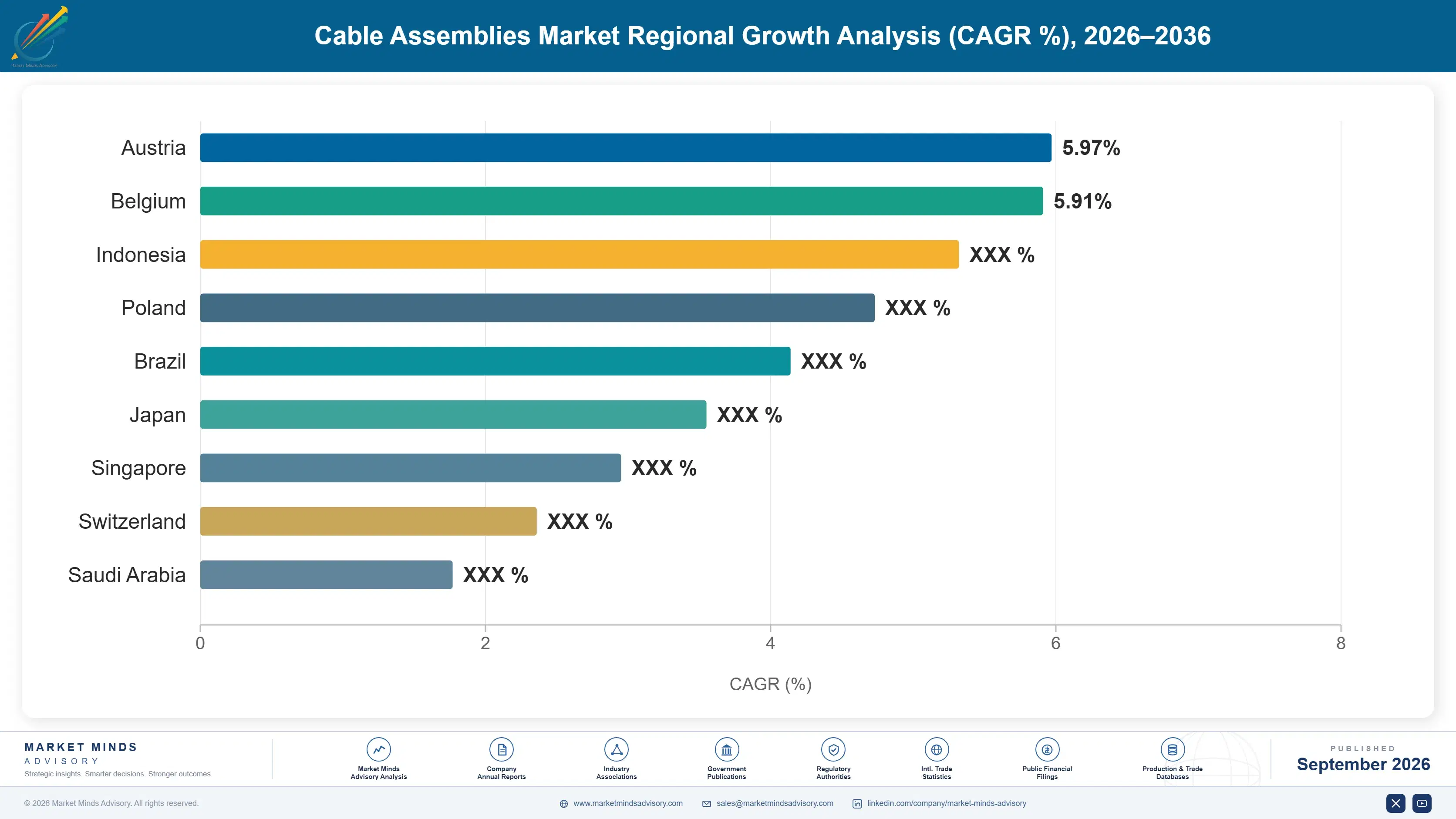
cable-assemblies-market-country-cagr-analysis-1790009643257

Where Cable Assembly Margin Actually Concentrates

Commodity unit pricing no longer defines this category's economics anymore at all, not even remotely close to what it once did for most vendors currently competing for share. Margin concentrates in documented thermal validation, automotive high-voltage qualification, and hyperscale design-in relationships, capabilities that commodity-only suppliers competing purely on wire gauge and price cannot easily replicate.

Thermal Validation Data Commands Data Center Premium

Vendors that can document thermal validation and current-carrying capacity testing are converting that evidence directly into premium pricing over competitors offering only standard commercial-grade assemblies without comparable certification or testing history documented behind them at all, ever. TE Connectivity and Amphenol both report data center assembly contracts commanding 45 to 55 percent higher pricing than standard industrial variants with comparable copper content, since hyperscale operators will not accept an unvalidated assembly regardless of cost pressure elsewhere in the build. This mechanism rewards vendors who invested early in dedicated testing infrastructure.
Market Impact: Commands a 45 to 55 percent price premium

Automotive High-Voltage Qualification Locks In Platform Revenue

Vendors that secure automotive high-voltage assembly qualification are winning electric vehicle platform design wins that persist for roughly 8 years across the platform's entire production lifecycle, converting a single qualification investment into durable, recurring revenue across the vehicle program's full manufacturing run and well beyond its initial commercial market launch date and years afterward. Automotive customers rarely switch assembly suppliers mid-platform once a design is qualified, since requalification imposes real cost and schedule risk that manufacturers actively avoid through careful upfront supplier selection. This mechanism is becoming an increasingly important revenue driver industry-wide.
Market Impact: Locks in 8 full years of volume today

Hyperscale Design-In Relationships Drive Repeat Orders

Vendors that establish design-in relationships with major hyperscale data center operators are capturing repeat order volume across multiple facility build-outs, since operators standardize assembly specifications across their global construction program once a supplier proves reliable at initial deployment scale and pace across several regions simultaneously and reliably. This repeat business dynamic gives design-in vendors roughly 65 percent more predictable revenue than competitors dependent on winning each individual facility contract competitively from scratch every single time. Vendors with established hyperscale relationships are increasingly favored for new facility awards as operators prioritize proven supply chain reliability.
Market Impact: Wins 65 percent of all repeat facility orders

Value-Added Assembly Services Beyond Core Wire Sale

Vendors are increasingly offering dedicated design engineering, custom testing, and just-in-time inventory management services alongside core assembly sales, converting what was once a purely transactional wire purchase into a genuine engineering partnership relationship that customers value throughout platform development. This services category now accounts for roughly 9 to 13 percent of total vendor revenue among the largest assembly suppliers, a share growing steadily as customers increasingly value integrated support during complex qualification and integration processes. This mirrors a broader electronic components industry trend toward value-added services monetization beyond core product sales alone.
Market Impact: Adds 9 to 13 percent recurring revenue share

Who Controls the Margin Pool

At 34 percent, CR5 concentration reflects a genuinely fragmented market where the gap between the leader and the broader field remains narrow across most application segments. TE Connectivity leads through decades of connector and assembly engineering, but Amphenol and Molex are both closing that gap quickly in the fastest-growing high-current data center category.
Current competitive activity centers on documented thermal validation, automotive high-voltage qualification, and hyperscale design-in relationships rather than raw unit pricing. Vendors are racing to publish quantified current-carrying capacity and thermal performance data since data center operators increasingly demand measurement rigor before approving deployment. Several vendors have also begun bundling value-added design engineering services into supply contracts, folding a separate consulting relationship into a single procurement decision.

The next competitive shift is coming from newer entrants building dedicated high-current production capacity specifically for AI data center customers, a threat that could compress legacy suppliers' margins on standard commercial assemblies as commodity pricing pressure intensifies. That threat remains contained to data center applications for now, since broad-portfolio automotive and industrial applications still favor established suppliers with the widest available product breadth. Smaller specialty vendors focused on medical device assemblies are proving harder for large diversified suppliers to displace.
cable-assemblies-market-company-positioning-matrix-1790009643780

Competitive Moat and Risk Dimensions

TE CONNECTIVITY

Moat: Deepest connector engineering heritage

TE Connectivity's decades-long presence in connector and assembly engineering gives it the deepest customer relationship base and product breadth of any vendor in the category, and buyers rarely switch away from a proven supplier once qualified into a platform. That installed base also generates substantial recurring revenue across multiple product generations as customers renew platform designs.
TE CONNECTIVITY

Risk: Slower niche precision segment focus

TE Connectivity's broad product portfolio focus means dedicated investment in narrow precision niches like high-current data center assemblies sometimes moves more slowly than smaller, more focused competitors specifically targeting a single high-value application segment. Newer entrants focused narrowly on data center power are capturing design wins in specific niches faster than TE Connectivity's broader organization can respond.
AMPHENOL

Moat: Strong hyperscale relationship depth

Amphenol has built particularly deep relationships with major hyperscale data center operators through its broader connector and interconnect portfolio, giving it natural cross-selling advantage into high-current assembly design wins alongside its connector sales. This bundled positioning lets Amphenol win assembly contracts as part of larger power architecture design conversations with major operators.
AMPHENOL

Risk: Narrower standard commercial product depth

Amphenol's data center focused growth strategy has left its standard commercial-grade product line somewhat less competitive on pure unit pricing than suppliers dedicating more manufacturing capacity to high-volume commodity applications. Building comparable commodity-tier cost competitiveness requires investment that competes internally with Amphenol's data center growth priorities.

Players Tracked

Prominent Players

TE Connectivity Ltd
Amphenol Corporation
Molex LLC
Prysmian Group SpA
Nexans SA

Other Key Players

Yazaki Corporation
Sumitomo Electric Industries Ltd
Leoni AG
JAE Electronics Inc
Hirose Electric Co Ltd
Rosenberger Hochfrequenztechnik GmbH
Belden Inc
Coleman Cable LLC
Encore Wire Corporation
Southwire Company LLC
Fujikura Ltd
Furukawa Electric Co Ltd
3M Company
Panduit Corp
L-com Inc

Recent Developments

JANUARY 2026

TE Connectivity Launches High-Current Data Center Product Line

TE Connectivity introduced a new family of high-current power distribution assemblies specifically designed for AI data center rack applications, extending its existing connector portfolio into tighter thermal validation standards than its previous generation offered. The launch targets hyperscale operators seeking documented reliability without switching suppliers.
Signal: High-current thermal validation is fast becoming a standard product specification across most major global vendor lines
SEPTEMBER 2025

Amphenol Acquires Automotive High-Voltage Assembly Specialist

Amphenol completed the acquisition of a smaller automotive high-voltage assembly specialist to strengthen its electric vehicle wiring harness product line beyond its existing data center and industrial portfolio. The deal brings automotive qualification expertise that Amphenol had previously developed more slowly through internal engineering resources alone.
Signal: Automotive high-voltage qualification expertise is increasingly acquired rather than built entirely organically by competing vendors nationwide
APRIL 2026

Molex Signs Major Hyperscale Data Center Supply Agreement

Molex signed a multi-year supply agreement with a major hyperscale data center operator to provide high-current power assemblies across the operator's expanding global facility construction program. The agreement extends Molex's existing data center strategy and provides a reference deployment other hyperscale operators are likely to evaluate closely.
Signal: Multi-year supply agreements are becoming a preferred contract structure for hyperscale design wins across the industry

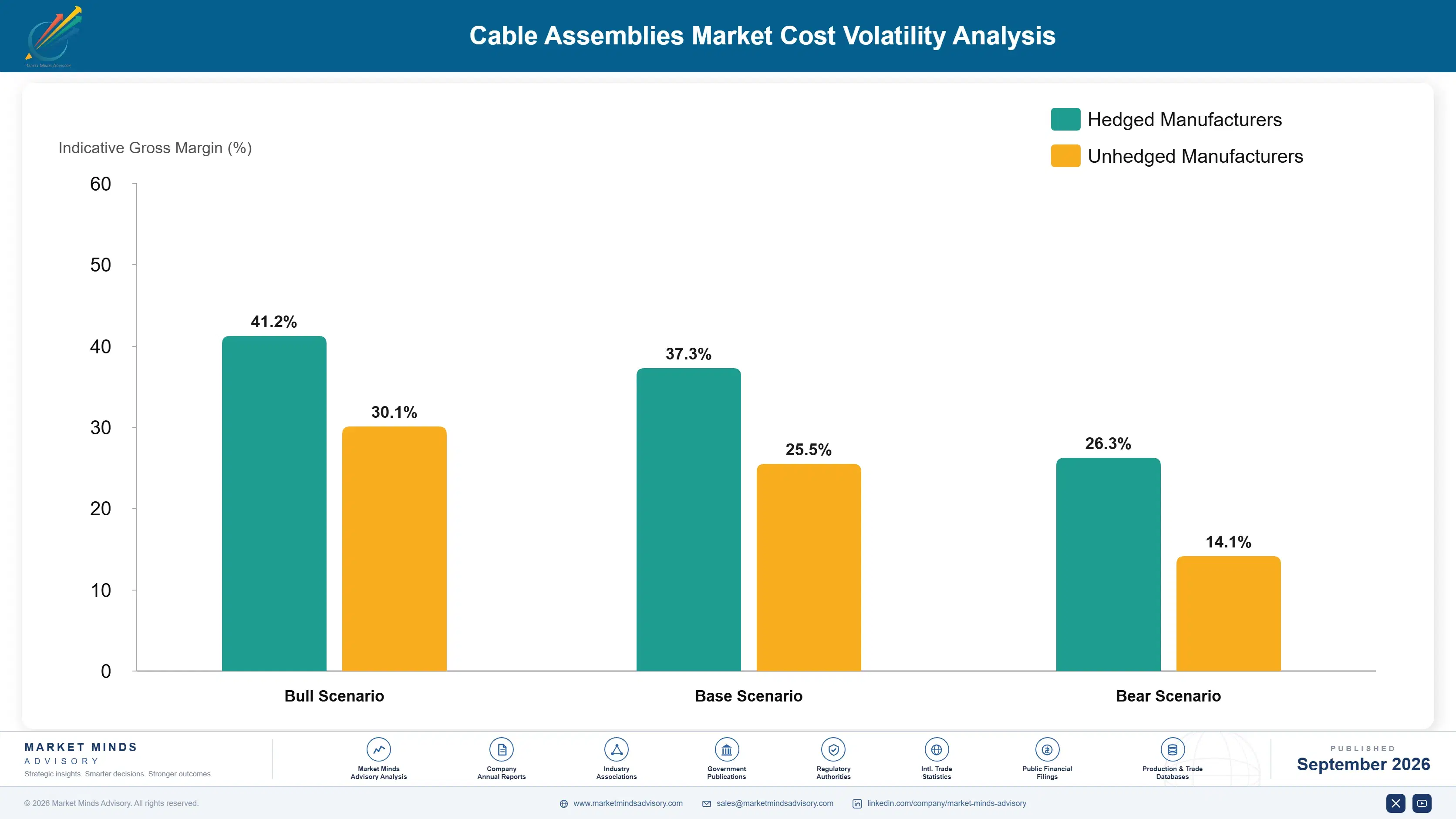
Copper Conductor and Labor Cost Exposure

Raw copper conductor material accounts for roughly 44 percent of cable assembly cost of goods sold, sourced from a globally traded commodity market where pricing reflects supply constraints and surging demand from electric vehicle and renewable energy applications. Assembly labor, including termination and quality testing, adds a further 18 to 22 percent, concentrated in lower-cost manufacturing regions.
Copper pricing volatility hit sharply starting in 2023, when demand for copper across electric vehicle, renewable energy, and data center construction applications surged simultaneously, straining global mining and refining capacity that had seen limited new investment for years. Southwire Company's 2024 annual filing disclosures cited elevated copper input costs as a driver of margin pressure across its cable and wire product lines, and several assembly suppliers disclosed rising material costs as a direct concern through 2024 and 2025.

Larger suppliers with long-term copper supply contracts and hedging programs absorbed this cost pressure with far less disruption than smaller suppliers reliant on spot-market purchases, a resilience gap that persists today. Exposure also varies by assembly complexity: vendors producing high-current data center assemblies requiring substantial copper content face materially higher material cost sensitivity than lower-current signal assembly producers.
cable-assemblies-market-cost-volatility-analysis-1790009643976

Long-Term Copper Supply Hedging Contracts

Larger vendors are locking in long-term copper supply agreements and financial hedging instruments that fix input pricing well below prevailing spot-market rates during periods of significant and sustained volatility across most regions, trading some flexibility for meaningful cost predictability that smaller competitors generally cannot access at any comparable scale or timeframe today at all.

Alternative Conductor Material Substitution Research

Vendors are increasingly researching aluminum and hybrid conductor alternatives for lower-current applications where copper's superior conductivity is not strictly necessary at all times across most modern product designs and a wide range of current-carrying applications available today, reducing overall material cost exposure while maintaining acceptable performance for a growing share of commercial applications and diverse use cases industry-wide.

Manufacturing Automation Reduces Labor Cost Sensitivity

Vendors are increasingly investing in automated termination and testing equipment that reduces dependence on manual labor for standard assembly production processes across multiple manufacturing facilities worldwide and domestically as well, lowering overall labor cost exposure while improving consistency and throughput across high-volume manufacturing facilities globally and domestically at a genuinely meaningful scale and pace.

Portfolio Architecture for Margin Defence

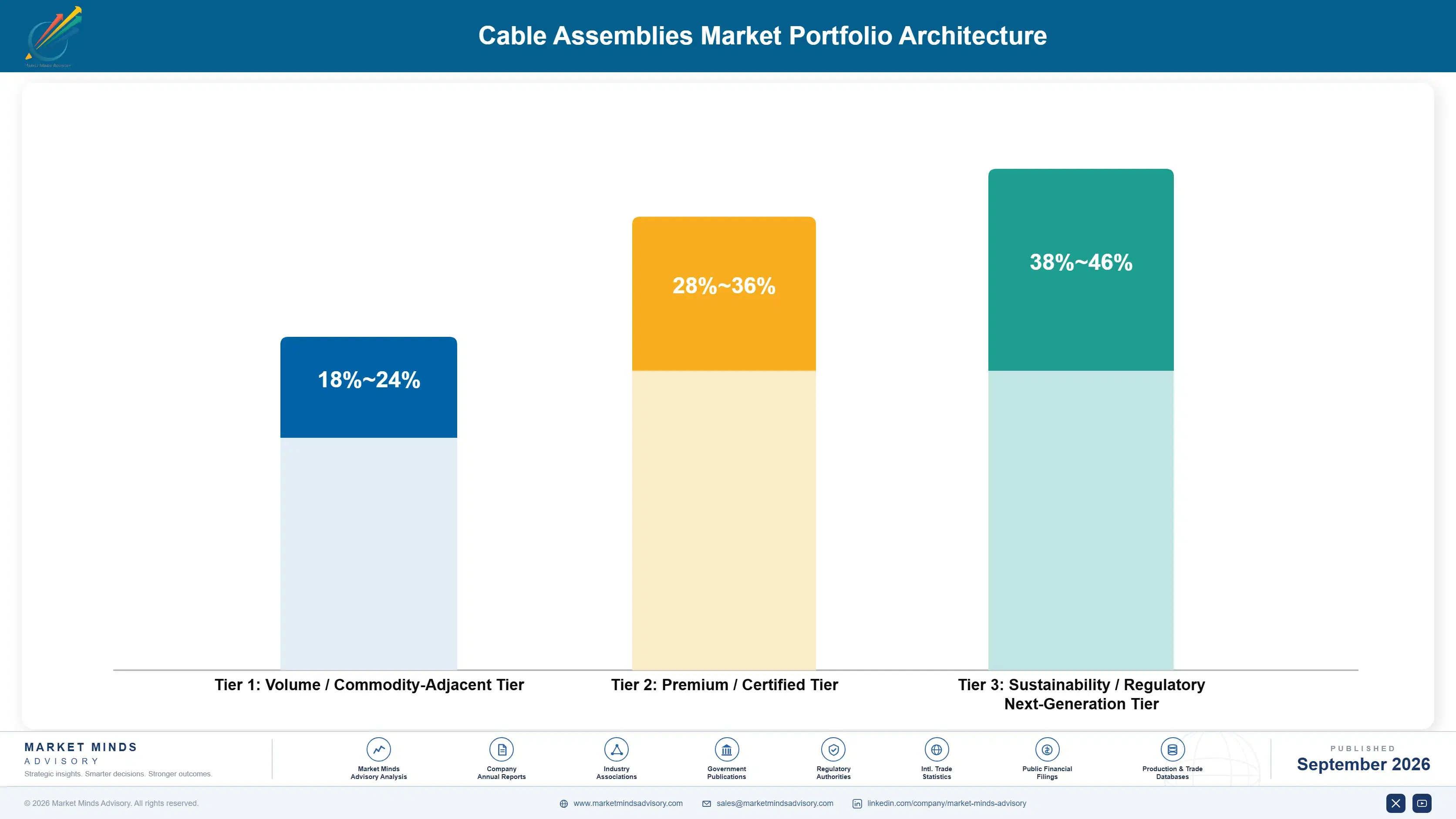
Cable assembly margin structure runs on three distinct tiers that separate on validation intensity rather than raw copper content alone. Commodity harnesses compete almost entirely on unit price and delivery lead time, while assemblies built for data center power distribution or automotive high-voltage systems carry certification, testing, and full traceability requirements that buyers pay a genuine, durable premium to secure across the product lifecycle.
The volume tier still ships most units by count but claims a shrinking share of industry profit pools, and vendors chasing scale alone increasingly find themselves squeezed between rising copper input costs and price-sensitive buyers who treat harnesses as interchangeable commodities. Premium and certified work absorbs heavier upfront engineering cost but returns it through longer contract tenure, lower customer churn, and materially better renewal pricing power over time.

High-value pools now concentrate heavily in data center power assemblies and electric vehicle harnesses, where design complexity, safety certification, and thermal validation together create switching costs that commodity producers cannot replicate quickly or cheaply. That concentration is actively reshaping where vendors deploy capital, favoring test infrastructure and certification labs over sheer stamping and crimping capacity expansion.

Volume / Commodity-Adjacent Tier

Standard low-voltage harnesses and general-purpose wiring assemblies sold primarily on price and delivery reliability, with limited certification overhead, thinner scale-dependent margins, and intense competition from low-cost regional producers chasing volume contracts on tight annual bidding cycles.
Gross Margin: 18-24%

Premium / Certified Tier

Automotive-grade and industrial assemblies carrying UL, IATF, or equivalent certification, validated for defined current and thermal ranges with documented traceability through the supply chain, long qualification cycles, and multi-year sole-source production agreements.
Gross Margin: 28-36%

Sustainability / Regulatory / Next-Generation Tier

High-current data center power assemblies and EV charging harnesses engineered for emerging safety codes, recyclable insulation mandates, and next-generation voltage architectures that command sustained pricing power and long design-in relationships with hyperscale buyers.
Gross Margin: 38-46%
cable-assemblies-market-portfolio-architecture-1790009644483

High-value Sub-segments and Strategic Watch-out

High-Current Data Center Power Assemblies

Fastest-growing and highest-margin segment today, driven by hyperscale build-out and rising rack power density that pushes assemblies well beyond commodity wiring into certified, tested, thermally validated product commanding premium pricing throughout the qualification and renewal cycle for hyperscale and colocation data center buyers alike across every major region.
Gross Margin: 40-48%

Automotive Wiring Harness Assemblies

Large, high-value pool growing steadily on electric vehicle content expansion, where high-voltage safety certification and thermal validation requirements sustain durable premium pricing over legacy internal combustion platforms across most regional automotive manufacturing bases, supplier tiers, and vehicle platform generations entering production now and over the next several years.
Gross Margin: 30-38%

Industrial Control Wiring Assemblies

Volume core of the market, supplying factory automation and process control equipment at steady but thinner margins, dependent on long-standing customer relationships and consistently reliable delivery windows across multi-year industrial capital investment cycles worldwide, particularly across discrete manufacturing and process industries expanding automation footprints today.
Gross Margin: 20-26%

Legacy Consumer Electronics Assemblies

Strategic watch-out segment facing commoditization and share erosion as consumer device makers push aggressive cost reduction and simplified wiring architectures that shrink assembly content per unit steadily year over year across most major device categories, pressuring vendors reliant on that shrinking legacy revenue base going forward.
Gross Margin: 14-19%

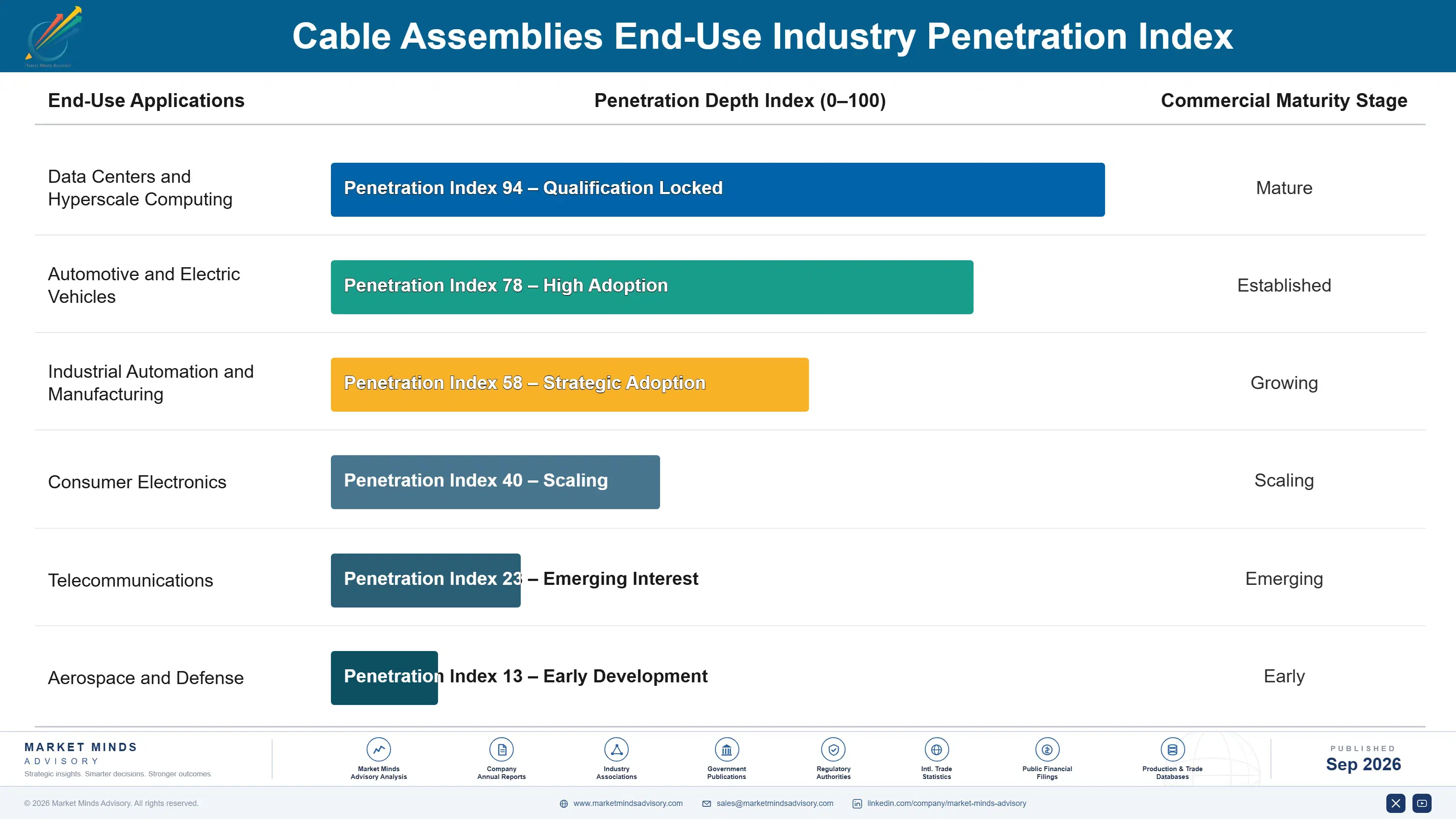
Recurring Demand Beneath Cable Assemblies

Cable assembly demand runs closer to an annuity than a one-time purchase for most industrial and automotive buyers. Once a design wins qualification on a vehicle platform or a data center rack architecture, replacement and expansion orders flow for years without a fresh competitive bid, giving incumbent suppliers a durable, multi-cycle revenue stream that new entrants find genuinely hard to break into quickly.
Stickiness varies sharply by end-use vertical, though. Automotive relationships run deepest, anchored by multi-year platform contracts and rigorous safety requalification that discourages switching mid-cycle. Data center buyers show similar depth once a vendor clears certification, but the relationship is younger and less tested across a full hardware refresh cycle. Industrial automation sits in between, loyal but more price-sensitive during downturns than either automotive or data center accounts tend to be.

Buyer profiles are shifting generationally as procurement teams turn over across nearly every customer segment today. Younger engineering and sourcing leads increasingly favor vendors offering digital traceability and sustainability documentation over pure incumbency, a meaningful change legacy suppliers with strong historical relationships are still adjusting to across multiple regions and customer segments simultaneously, and not always successfully.
cable-assemblies-market-end-use-penetration-index-1790009644973

Where Cable Assembly Strategy Should Focus

These are among the four positions where our research anticipates prominent divergence between winners and laggards over the coming forecast period. Each is grounded in the demand model, the regulatory perimeter, and the announced capacity pipeline.
01 / ASSEMBLY CAPACITY ALLOCATION

Shift capital toward certified high-current assembly lines

Data center power assembly demand is outrunning qualified capacity across every major producing region right now, and the gap is widening faster than most vendors expected just a year ago. Vendors that add certified, high-current test infrastructure ahead of demand capture premium pricing and multi-year hyperscale contracts before competitors catch up to them at scale. Those still allocating capital to commodity stamping lines risk stranding assets as buyers migrate steadily toward validated, higher-margin product across nearly every application segment they currently serve.
02 / CUSTOMER CONCENTRATION RISK

Diversify beyond automotive OEM tier-one dependence

Many mid-sized assemblers still derive most revenue from a handful of automotive tier-one relationships, leaving them exposed to platform cancellations and aggressive renegotiation cycles that can erase a full year of margin quickly and without warning. Building parallel revenue in data center and industrial automation reduces that single-customer risk meaningfully over a two to three year horizon. Vendors that diversify now enter renewal negotiations from a position of genuine leverage rather than outright dependence on any single buyer relationship going forward.
03 / INPUT COST HEDGING DISCIPLINE

Lock in copper hedges before the next volatility spike

Copper represents a substantial share of assembly cost, and price swings pass through directly to margin for vendors without hedging programs already in place well before the next spike hits hardest and fastest. Larger competitors already lock in multi-year supply agreements that smaller rivals cannot easily replicate at comparable scale or favorable pricing terms today. Firms that establish hedging discipline now protect margin through the next inevitable commodity cycle, whenever it arrives, and preserve pricing credibility with downstream customers over time.
04 / REGIONAL FOOTPRINT EXPANSION

Expand East Asian and South Asian assembly footprint

Electronics and automotive assembly demand keeps concentrating in East Asia while South Asia and Pacific post the fastest regional growth rate anywhere in the market today, a combination few vendors are structured to exploit fully just yet. Vendors under-invested in local production face longer lead times and real tariff exposure relative to regionally embedded competitors already established there for years. Building footprint in both regions now secures proximity to the fastest-growing demand pools available anywhere globally in this category today.

Engagement Snapshot From the Field

A live engagement with an industry participant carrying material or product regulatory and market exposure ahead of a defining policy shift, showing how our research translates into a defensible multi-year portfolio strategy.
MARKET MINDS ADVISORY · CLIENT ENGAGEMENT SUMMARY
Cable Assemblies Producer Strategic Portfolio Review and Transition Roadmap 2026·Investment Scenario on Cable Assemblies Exposure Evaluation 2025-26
CLIENT PROFILE
The client is a multinational industrial connectivity manufacturer with production facilities spread across three continents, supplying wiring harnesses and power assemblies to automotive, data center, and factory automation customers worldwide today. Annual revenue exceeds two billion dollars (client-reported, unverified by MMA), with roughly forty percent derived from long-term automotive tier-one supply contracts nearing renewal soon.
STRATEGIC CHALLENGE
Rising copper costs and slowing legacy automotive volumes were compressing margins across the client's largest business unit, while a competing data center opportunity required capital the client had not yet allocated. Leadership needed an independent assessment of where to redirect capacity investment before the next budget cycle locked in spending decisions for another two years.
MMA APPROACH
MMA conducted structured interviews with procurement and engineering leaders across four regional facilities, benchmarked capacity utilization against primary survey data, and modeled margin outcomes under three capital allocation scenarios. The engagement combined the qualitative expert interview dataset with MMA's proprietary segment growth forecasts to stress-test each scenario against copper price volatility.
KEY FINDINGS
  1. Automotive tier-one margins had compressed nearly six percentage points over three years (client-reported, unverified by MMA) as contract renegotiations increasingly favored large buyers.
  2. Data center power assembly requests reaching the client's sales team had roughly tripled year over year, far outpacing the company's available certified production capacity.
  3. Competitors operating dedicated high-current test labs were winning hyperscale contracts that the client's own engineering organization was simply unable to bid on at all.
  4. Copper hedging coverage sat well below industry peer levels, leaving roughly sixty percent of total exposure unprotected against near-term spot market volatility.
CLIENT PROFILE
The client is a multinational industrial connectivity manufacturer with production facilities spread across three continents, supplying wiring harnesses and power assemblies to automotive, data center, and factory automation customers worldwide today. Annual revenue exceeds two billion dollars (client-reported, unverified by MMA), with roughly forty percent derived from long-term automotive tier-one supply contracts nearing renewal soon.
STRATEGIC CHALLENGE
Rising copper costs and slowing legacy automotive volumes were compressing margins across the client's largest business unit, while a competing data center opportunity required capital the client had not yet allocated. Leadership needed an independent assessment of where to redirect capacity investment before the next budget cycle locked in spending decisions for another two years.
MMA APPROACH
MMA conducted structured interviews with procurement and engineering leaders across four regional facilities, benchmarked capacity utilization against primary survey data, and modeled margin outcomes under three capital allocation scenarios. The engagement combined the qualitative expert interview dataset with MMA's proprietary segment growth forecasts to stress-test each scenario against copper price volatility.
KEY FINDINGS
  1. Automotive tier-one margins had compressed nearly six percentage points over three years (client-reported, unverified by MMA) as contract renegotiations increasingly favored large buyers.
  2. Data center power assembly requests reaching the client's sales team had roughly tripled year over year, far outpacing the company's available certified production capacity.
  3. Competitors operating dedicated high-current test labs were winning hyperscale contracts that the client's own engineering organization was simply unable to bid on at all.
  4. Copper hedging coverage sat well below industry peer levels, leaving roughly sixty percent of total exposure unprotected against near-term spot market volatility.
RECOMMENDED STRATEGY
Phase 1: Phase one: reallocate twenty percent of planned automotive capital expenditure toward a certified high-current test and assembly line within twelve months. Phase 2: Phase two: expand copper hedging coverage to match peer benchmarks and renegotiate two underperforming automotive contracts before their scheduled renewal dates. Phase 3: Phase three: pursue two hyperscale data center design-in relationships using the newly certified capacity as the primary competitive proof point.
OUTCOME
Within eighteen months the client secured its first hyperscale data center supply contract and reported (client-reported, unverified by MMA) a four-point gross margin improvement in the newly certified product line, alongside materially reduced exposure to copper spot price swings across its broader industrial connectivity portfolio.

Frequently Asked Questions

Foundational context covering the market sizes, CAGR, scope, country, region and competition that inform every finding below. This section is provided to cover basics and most often pre-purchase conversations, answered from the MMA Primary Research Dataset.

What is the current size of the Cable Assemblies Market?

The Cable Assemblies Market reached an estimated 78.5 billion dollars in 2025. Growth is being driven primarily by data center power distribution and electric vehicle harness demand.

How large will the Cable Assemblies Market be by 2036?

MMA forecasts the market will reach approximately 161.9 billion dollars by 2036 under the base case scenario. That represents roughly a 1.93 times expansion from 2026 levels.

What is the CAGR for the Cable Assemblies Market 2026 to 2036?

The base case CAGR is 6.8 percent annually across the forecast period. Bull and bear scenarios range from 8.1 percent down to 5.6 percent respectively.

Which segment is growing fastest?

High-Current Data Center Power Assemblies is growing fastest at 15.6 percent CAGR, roughly 2.29 times the overall market rate. Hyperscale build-out is the primary driver behind that pace.

Who are the major companies in the Cable Assemblies Market?

Leading players include TE Connectivity, Amphenol, Molex, Prysmian Group, and Nexans. Together the top five hold an estimated 34 percent combined share of the market.

Which country is growing fastest?

India leads country-level growth at 9.8 percent CAGR, ahead of the regional and global averages. Expanding electronics manufacturing and automotive production are the main contributing factors.

Report Segmentation Architecture

The full report scope spans multiple orthogonal segmentation dimensions, with cross-tabulated demand data provided for each dimension pair. Coverage extends further to regional breakdowns, trend trajectories, and the competitive detail needed to support segment-level decision-making.

By Primary Market Dimension

  • High-Current Data Center Power Assemblies
  • Automotive Wiring Harness Assemblies
  • Industrial Control Wiring Assemblies
  • Consumer Electronics Wiring Assemblies
  • Telecommunications and Networking Assemblies
  • Aerospace and Defense Wiring Assemblies

By End-Use Industry

  • Data Centers and Hyperscale Computing
  • Automotive and Electric Vehicles
  • Industrial Automation and Manufacturing
  • Consumer Electronics
  • Telecommunications
  • Aerospace and Defense

By Commercial Dimension

  • Original Equipment Manufacturer Direct Supply
  • Contract Manufacturing Services
  • Aftermarket and Replacement Distribution
  • Value-Added Reseller Channels
  • Custom Engineering Services

By Region

  • East Asia
  • North America
  • Western Europe
  • South Asia and Pacific
  • Latin America
  • Middle East and Africa
  • Eastern Europe

Scope, Methodology, and Coverage

Every figure in this report is reproducible from documented input assumptions. The scope below maps the historical period, the forecast horizon, the segmentation dimensions, and the countries covered, alongside the underlying primary and qualitative methodology.
Historical Period
2020 to 2025
Forecast Period
2026 to 2036
Base Year
2025 (USD billions; MMA Primary Research Dataset, September 2026)
Market Definition
The cable assemblies market covers pre-terminated wire and cable products combined with connectors, terminals, or other hardware into a ready-to-install interconnect solution for power, signal, or data transmission. It excludes bare wire and cable sold without termination, standalone connectors sold separately from an assembled cable, and fiber optic cable assemblies marketed and sold as a distinct fiber optic product category.
Quantitative Units
USD Billion
Segmentation Dimensions
Product type, end-use industry, and commercial distribution channel
Regions Covered
East Asia, North America, Western Europe, South Asia and Pacific, Latin America, Middle East and Africa, Eastern Europe
Countries Covered
United States, China, Germany, Japan, India, South Korea, United Kingdom, and 14 additional countries
Key Companies Profiled
TE Connectivity Ltd, Amphenol Corporation, Molex LLC, Prysmian Group SpA, Nexans SA, Yazaki Corporation, Sumitomo Electric Industries Ltd, Leoni AG, JAE Electronics Inc, Hirose Electric Co Ltd, Rosenberger Hochfrequenztechnik GmbH, Belden Inc, Coleman Cable LLC, Encore Wire Corporation, Southwire Company LLC, Fujikura Ltd, Furukawa Electric Co Ltd, 3M Company, Panduit Corp, L-com Inc
Quantitative Methodology
Primary survey, n=3,800 respondents, Q4 2025, six countries; demand-side model with trade association cross-validation
Qualitative Methodology
47 expert interviews, Q4 2025; applied to validate demand model assumptions, identify emerging dynamics, and assess competitive positioning
Report Format
PDF and XLSX data workbook (Word format preview document)
Publisher
Market Minds Advisory
Report Code
MMA-2026-CON-327
Published
September 2026
Contact
sales@marketmindsadvisory.com | www.marketmindsadvisory.com

Purchase the full Cable Assemblies Market Report (2026 to 2036).

This report provides a comprehensive assessment of the global Cable Assemblies Market across all major product categories, end-use industries, and geographic regions through 2036. It combines MMA's primary survey dataset of 3,800 respondents with 47 expert interviews to quantify segment-level growth, competitive positioning, and regional demand mechanisms. Coverage spans market sizing, segmentation, regional dynamics, competitive benchmarking, input cost exposure, and portfolio economics. The analysis is designed to support capacity planning, sourcing strategy, and market entry decisions for manufacturers, investors, and industrial buyers evaluating this space.
Ten-year quantitative forecast by product segment
Seven-region demand and pricing breakdown analysis
Competitive benchmarking of top twenty players
Input cost exposure and mitigation analysis
Margin tier and portfolio economics mapping
Primary survey and expert interview data

Built For The People Who Decide

From boardroom strategy to bench-side execution, this report is read cover-to-cover by leaders shaping the next decade of their industry, turning demand scenarios, market dynamics and valuation benchmarks into decisions.
CXOs/ Presidents/ VPs/ Managers
M&A and Corporate Development
Strategy Teams and R&D Heads
Procurement and Product Directors
Regulatory and Compliance Leaders
Investor Relations and Equity Analysts