Market Minds Advisory
Butterfly Valves Market

Butterfly Valves Market: Actuation Integration and Emissions Compliance Strategy

Water utilities and process industry operators are replacing manual butterfly valves with actuated, IIoT-enabled versions as remote monitoring requirements and tightening emissions regulations converge to make valve automation a standard specification.

Lead Analyst

David Horsley

Published

September 2026

Make Smarter Decisions with Customized Research Insights

Request a free sample report and evaluate market opportunities, growth trends, and competitive dynamics relevant to your business needs.

2025 MARKET VALUE$8.4BMarket Size 2025
2036 FORECAST VALUE$17.2BBase Case , 2026 to 2036
CAGR 2026 TO 20366.7 %Bull 7.9% / Bear 5.4%
INCREMENTAL OPPORTUNITY$8.2BNet 10- year value creation
EXPANSION MULTIPLE1.91x2036 value over 2026 base
Strategic Levers
M&A Pipeline
Regional Outlook
Country Rankings
Competitive Intelligence
Segmental Deep-dive
Call-Us : 91 93563 13602

Executive Snapshot and Market Trajectory

Butterfly valves have moved from a simple mechanical shutoff component into a networked flow control asset. Plant operators and water utilities increasingly specify actuated valves with position feedback and remote diagnostics because regulatory compliance reporting and predictive maintenance programs now depend on data the valve itself must generate.
Actuated and smart butterfly valves are growing fastest, pulled by process industry demand for remote position verification and predictive maintenance data across distributed plant and pipeline networks, expanding roughly 52% faster than the category average. East Asia retains the largest regional share, supported by China's dominant industrial manufacturing base, expanding water infrastructure investment, and the region's deep concentration of valve component and casting suppliers.
Competitive intensity centers on actuation integration and diagnostic capability rather than raw valve count. Emerson and Flowserve are racing regional specialists to bundle actuators, position sensors, and cloud-based monitoring into single validated flow control packages. Regulatory pressure, particularly expanding fugitive emissions standards in the EU and United States and tightening water utility leak detection requirements, is pulling upgrade demand forward faster than valve failure rates alone would explain across most industrial and municipal categories.
Market Definition
The Butterfly Valves market covers manually operated and actuated quarter-turn valves used to regulate or isolate fluid flow in pipelines, including concentric, double-offset, and triple-offset designs sold across water and wastewater, oil and gas, chemical processing, and HVAC applications. It excludes ball valves, gate valves, and other non-quarter-turn flow control devices not based on a rotating disc mechanism.
Base Year Value
$8.4B in 2025 (MMA Primary Research Dataset, August 2026)
Forecast Period
2026 to 2036, eleven discrete annual values
CAGR
6.7% base case. Bull 7.9%. Bear 5.4%.
Fastest Growth Segment
Actuated and Smart Butterfly Valves: 10.2% CAGR
Fastest Growth Country
China: 9.8% CAGR
Fastest Growth Region
South Asia and Pacific: 8.9% CAGR
Largest Region
East Asia: 29% of 2025 global value
Market Leaders
Emerson Electric Co., Flowserve Corporation, Crane Co., KSB SE & Co. KGaA, Bray International Inc. Source: MMA Analysis based on company annual reports.
Primary Survey
n=3,800 procurement and R&D decision-makers, Q4 2025, six countries
Methodology
Demand-side build-up, cross-validated against public data, 47 expert interviews

Butterfly Valves Market Forecast Scenarios

butterfly-valves-market-size-forecast-scenario-1787301970606
Butterfly valve demand grew steadily through 2020 to 2025, slowed in 2020 as industrial capital spending paused during the pandemic, then accelerated as water infrastructure investment programs resumed and process industry capacity expansion continued across Asia. Actuated and smart valve adoption accelerated faster than the category as remote monitoring and emissions compliance requirements intensified, producing a historical CAGR of 5.8% that understates the acceleration underway.
The base case assumes 6.7% annual growth through 2036, driven by three mechanisms. First, water and wastewater infrastructure investment programs across North America, Europe, and Asia require new and replacement valves for pipeline modernization projects. Second, expanding fugitive emissions regulations in process industries are accelerating conversion from manual to actuated valves with leak detection and position verification capability. Third, predictive maintenance adoption is pulling forward replacement of aging valves that cannot generate the diagnostic data modern maintenance programs require.
The bull case assumes faster water infrastructure funding disbursement and accelerated emissions regulation enforcement pull growth toward 7.9%. The bear case centers on delayed infrastructure spending and continued reliance on manual valve repair over replacement in cost-constrained markets, pulling growth down toward 5.4% if global industrial capital spending disappoints relative to current project pipelines and announcements.

Actuation Integration and Emissions Compliance Economics

Butterfly valve selection has become a compliance and data decision as much as a flow control one. Plant operators and utilities increasingly specify actuated valves with position feedback because emissions reporting and predictive maintenance programs now directly depend on data the valve itself must generate and transmit.
CR5 CONCENTRATION44%Reflects moderate consolidation among global flow control manufacturers
ACTUATED VALVE PRICE PREMIUM50-75%Premium buyers pay over standard manually operated valves
CHINA MANUFACTURING SHARE27%Share of global butterfly valve production located there currently
FUGITIVE EMISSIONS REDUCTION60-85%Typical leak reduction achieved through actuated valve conversion
CASTING COST SHARE35-45%Portion of valve cost tied to body castings and seats
AVERAGE VALVE SERVICE LIFE20-30 yearsTypical operational lifespan before major overhaul or replacement
China generates roughly 27% of global butterfly valve production, reflecting both its dominant industrial manufacturing base and its expanding water infrastructure investment relative to other regions still importing most actuated valve technology. Valve makers price accordingly, charging meaningfully more for fully actuated, IIoT-enabled packages sold into process industry and premium municipal applications than into cost-constrained regions still relying primarily on manual valves.
The next decade will reward valve makers that integrate actuators, position sensors, and cloud-based diagnostics into single validated flow control packages faster than those still selling standalone mechanical valves. Regulatory pressure, more than raw flow capacity, will set the pace of actuated conversion in cost-constrained markets still running legacy manual valves. Expect diagnostic data attachment rates to keep rising as predictive maintenance programs expand, compressing valve maker installation margins even as total category revenue expands steadily across nearly every major industrial and municipal market worldwide.
"A manual butterfly valve doesn't tell you anything until it fails. An actuated one tells you it's drifting out of position three weeks before that happens. That's the entire pitch, and plant operators are finally buying it."
Director, Industrial Flow Control and Automation Practice · MMA Construction and

Market Trends

Actuated Valves With Remote Diagnostics Become Standard Specification

Process industry operators and water utilities increasingly specify actuated butterfly valves with position feedback and remote diagnostic capability as a standard requirement rather than an optional upgrade, since distributed pipeline networks and process plants make manual inspection both impractical and insufficient for continuous compliance verification. Valve makers are responding by embedding cellular and industrial IoT connectivity directly into standard actuator configurations rather than offering it as an aftermarket add-on, reducing cost and installation complexity for operators managing hundreds of valve positions. Early adopters report meaningfully faster detection of valve drift and seat wear before a failure occurs.
Market Impact: Adds infrastructure-funded demand 1

Fugitive Emissions Regulations Accelerate Actuated Valve Conversion

Expanding fugitive emissions regulations, including updated US EPA leak detection and repair requirements and the EU's Industrial Emissions Directive, are pushing process industry operators to replace manual butterfly valves with actuated versions capable of continuous position verification and automated leak reporting. Compliance timelines vary by jurisdiction, but the direction is consistent across major industrial markets, giving valve makers a reliable multi-year replacement demand signal independent of underlying valve failure rates. Operators increasingly bundle actuated valve conversion with broader plant emissions monitoring programs to capture efficiency from combined inspection and reporting site visits.
Market Impact: Adds automated valve demand 18-25%

Market Opportunities and Growth Drivers

Water Infrastructure Investment Drives Replacement Demand

Government water infrastructure investment programs, including the US Bipartisan Infrastructure Law's water and wastewater funding and comparable EU cohesion fund allocations, are directing meaningful capital toward pipeline and treatment plant modernization projects that require both replacement and new butterfly valve installations. Municipal utilities that previously deferred valve replacement due to budget constraints now have dedicated funding streams earmarked for infrastructure modernization, removing the capital barrier that historically slowed replacement cycles. Valve makers report that infrastructure-funded projects tend to specify actuated and monitoring-equipped valves rather than basic manual units, since funding programs often favor advanced configurations.
Market Impact: Raises capital cost by 50-75%

Process Industry Automation Requires Actuated Valve Upgrades

Process industry operators across chemical, oil and gas, and power generation sectors are automating plant operations to reduce headcount requirements and improve safety, and actuated valves with remote control capability are a foundational component of that automation strategy since manual valves cannot be integrated into automated process control systems. This automation trend benefits valve makers, since automated plants specify actuated configurations across their entire valve population rather than automating only critical control points. Plant operators report automation-driven valve upgrades increasingly bundle position feedback and diagnostic capability, since the incremental cost of monitoring is small relative to the actuator investment.
Market Impact: Compresses valve margins by 5-10%

Market Restraints and Challenges

High Actuation Cost Slows Smaller Operator Adoption

Fully actuated butterfly valves with position feedback and remote diagnostics carry capital costs that can exceed the annual valve budget of many smaller operators, and financing options remain limited since actuated valve technology lacks the resale market depth that helps lenders value collateral for more established equipment categories. The root cause is that actuator and sensor technology adds meaningful cost on top of the base mechanical valve, and smaller operators cannot justify that premium against their smaller footprint and lower regulatory exposure. Smaller operators unable to justify full actuation are responding by prioritizing conversion at their highest-risk valve positions first.
Market Impact: Cuts leak detection time by 50-70%

Casting Material Cost Volatility Compresses Manufacturer Margins

Body castings, discs, and seat materials account for 35 to 45% of butterfly valve manufacturing cost, and base metal price volatility during 2021 and 2022 forced valve makers to absorb margin compression or pass through mid-project price increases that strained customer relationships. The root cause is that valve makers typically quote fixed project pricing months before casting procurement and machining occur, leaving them exposed to metal price movement between quote and delivery in a way many shorter-lead-time equipment categories are not. Valve makers are responding by shortening quote validity periods and negotiating price escalation clauses into larger contracts.
Market Impact: Cuts fugitive emissions by 60-85%
3 additional market trends, 4 additional growth drivers, and 2 additional restraints and challenges are covered in the full report. Contact sales@marketmindsadvisory.com to access the complete intelligence.

Segment CAGR and Growth Architecture

This report segments the butterfly valves market by valve type across concentric valves, double-offset valves, triple-offset valves, actuated and smart valves, wafer-style valves, and lug-style valves. Valve type was chosen over end-use application because purchasing and specification decisions follow valve design and actuation capability rather than the specific pipeline or process the valve ultimately serves.
butterfly-valves-market-market-share-analysis-1787301971135

Actuated and Smart Butterfly Valves

Actuated and smart butterfly valves are the fastest-growing category at 10.2% annually, roughly 52% faster than the market average. Fugitive emissions compliance and predictive maintenance requirements are the primary demand drivers, since actuated valves deliver the continuous position verification and diagnostic data that manual valves cannot provide across high-volume industrial and municipal applications. Process industry operators converting to actuated systems report meaningfully faster detection of valve drift and seat wear, letting maintenance teams intervene before a leak or failure actually occurs. Emerson and Flowserve lead this category, with cloud-based analytics platforms increasingly differentiating premium actuated configurations from basic automated valves on diagnostic accuracy and integration with existing plant control systems.
CAGR 10.2%

Triple-Offset Butterfly Valves

Triple-offset butterfly valves, the second-fastest category at 8.4% annually, benefit from their ability to deliver bubble-tight shutoff performance and higher temperature and pressure ratings than concentric or double-offset designs, making them the preferred choice for demanding oil and gas, power generation, and chemical processing applications. Process industry operators increasingly specify triple-offset valves for critical isolation and control points where zero-leakage performance is a genuine safety and environmental requirement rather than a discretionary preference. Valve makers report triple-offset valves increasingly specified alongside actuated and monitoring capability, since the high-consequence applications where triple-offset performance matters most also tend to carry the strictest compliance monitoring requirements. Adoption is concentrated among larger process industry operators with the capital to justify the premium equipment investment.
CAGR 8.4%
Full segment breakdown across 6 segments available in the complete report.

Regional Architecture and Country Demand Map

East Asia retains the largest regional share on China's industrial manufacturing scale and water infrastructure investment, with South Asia and Pacific expanding fastest as industrial and municipal infrastructure investment accelerate. North America and Western Europe follow, while Latin America, the Middle East and Africa, and Eastern Europe remain earlier-stage markets.

North America

US water infrastructure investment under the Bipartisan Infrastructure Law is directing meaningful funding toward pipeline and treatment plant modernization, generating steady valve replacement demand independent of the broader industrial capital spending cycle. Process industry operators across oil and gas, chemical, and power generation sectors are converting manual valves to actuated configurations to meet tightening fugitive emissions requirements from EPA leak detection and repair rules. Canada's resource sector and municipal water infrastructure generate comparable demand dynamics to the US, though at smaller absolute scale given the smaller population and industrial base. Mexico's manufacturing sector, boosted by nearshoring investment, is generating growing industrial valve demand tied to new facility construction across multiple industrial sectors.
Share: 23% | CAGR: 6.1% (2026 to 2036)

Western Europe

Germany, France, and the UK are advancing emissions-driven actuated valve conversion fastest within the region, supported by the EU's Industrial Emissions Directive and generally stricter enforcement of fugitive emissions compliance than in most other global markets. Germany's industrial automation manufacturing base gives it particular strength in higher-tier actuated and smart valve categories specifically, serving both domestic demand and meaningful export volume. The UK's water utility sector, operating under regulatory pressure to reduce both leakage and energy consumption, is a significant source of valve replacement demand. Southern European markets including Spain and Italy are converting legacy valves somewhat more slowly, reflecting both later regulatory implementation and tighter municipal utility capital budgets.
Share: 20% | CAGR: 5.0% (2026 to 2036)
Regional intelligence for 5 additional markets available in the complete report: East Asia, South Asia and Pacific, Latin America, Middle East and Africa, Eastern Europe. Contact sales@marketmindsadvisory.com.
butterfly-valves-market-country-cagr-analysis-1787301971648

Where Butterfly Valve Margins Concentrate

Margin in this market increasingly sits in actuation systems, diagnostic software, and service contracts rather than the base mechanical valve body alone. Four levers explain most of the gap between valve makers still competing purely on unit price and those capturing recurring revenue across the full equipment lifecycle from initial installation through ongoing operation and maintenance.

Bundling Actuators and Diagnostic Sensor Packages

Valve makers offering integrated packages that bundle actuators, position sensors, and cloud-based diagnostics into a single validated configuration command 50 to 75% price premiums over standalone manual valves, since process industry operators increasingly value reduced compliance risk and faster fault detection over marginal component-level cost savings. This bundling also reduces the specialized engineering hours makers need per installation, since pre-engineered packages require less custom integration work than specifying components independently for each project. Valve makers without bundling capability increasingly lose specification to competitors offering validated packages, particularly on infrastructure-funded projects with compressed installation timelines.
Market Impact: Commands a 50-75% premium over manu

Monetizing Remote Valve Diagnostics Software Subscriptions

Valve makers increasingly bundle cloud-based remote diagnostics software subscriptions with actuated valve sales, charging operators an ongoing per-valve or per-site fee for position data, leak alerting, and predictive maintenance reporting layered on top of the physical valve sale. This subscription revenue carries margins closer to enterprise software than industrial equipment, and attachment rates are rising above 40% on new actuated installations as operators increasingly view continuous diagnostics as essential given regulatory documentation requirements. Valve makers with the most capable monitoring platforms report meaningfully higher customer retention across their installed base.
Market Impact: Monitoring subscription attachment

Expanding Valve Service and Calibration Contracts

Operators increasingly purchase multi-year service and calibration contracts alongside actuated valve installation, since maintaining diagnostic accuracy requires periodic sensor calibration and actuator maintenance that many operators lack the in-house specialized expertise to perform independently. These service contracts carry margins meaningfully above the equipment sale itself, and valve makers with dedicated field service organizations report renewal rates above 58% as operators increasingly value guaranteed response times for critical process and pipeline infrastructure. Valve makers without extensive service infrastructure are increasingly losing installed-base service revenue to independent instrumentation service companies specializing in multi-vendor valve maintenance.
Market Impact: Service contract renewal rates now

Winning Infrastructure-Funded Project Specifications Before Competitors

Valve makers that engage water utilities and process operators early in infrastructure-funded project planning, before formal specifications are finalized, capture disproportionate specification share since early engagement lets them influence technical requirements toward their own valve capabilities rather than competing purely on price against a fixed specification. This early engagement advantage compounds across a customer's broader capital program, since makers that win early projects build reference installations and customer relationships that support winning subsequent projects within the same funding program. Valve makers without dedicated business development resources lose roughly 22% of available specification value to competitors with more proactive customer relationships.
Market Impact: Captures a 22%+ share of funded pro

Who Controls the Margin Pool

CR5 concentration sits at 44%, reflecting moderate consolidation among established flow control manufacturers. Emerson and Flowserve lead on installation scale and process industry relationships, but the gap to challengers including Crane Co. and KSB remains meaningful, since valve assembly itself requires less capital intensity than precision casting manufacturing, letting smaller specialists compete effectively on price and service.
Competitive activity plays out on three fronts. Pre-engineered actuation package bundling is the most visible, with nearly every major manufacturer now offering validated actuator-sensor-diagnostics configurations. Remote diagnostics software is the second front, where Emerson and Flowserve use their cloud platform investment to differentiate beyond valve hardware alone. Infrastructure-funded project specification is the third front, where manufacturers compete for early utility and operator engagement that determines specification advantage across an entire capital program.

Pressure is building from two directions rankings have not caught up with. Chinese domestic manufacturers including Neway Valve have moved from budget alternatives into genuine technical competitors specifically on actuated valves, taking share from established Western suppliers in price-sensitive expansion markets. Indian manufacturers including L&T Valves are simultaneously expanding domestic capability to serve the country's own rapidly growing water infrastructure investment, reducing historical dependence on imported equipment.
butterfly-valves-market-company-positioning-matrix-1787301972164

Competitive Moat and Risk Dimensions

EMERSON ELECTRIC CO.

Moat: Broadest Industrial Automation Portfolio

Emerson's position as a full-line industrial automation supplier, spanning valves, actuators, instrumentation, and control systems, gives it cross-selling access to process industry capital budgets that pure-play valve specialists cannot match, letting it win integrated plant automation orders spanning multiple equipment categories across a single customer relationship.
EMERSON ELECTRIC CO.

Risk: Premium Pricing Limits Access

Emerson's premium positioning and full-line engineering overhead translate into pricing that smaller regional operators increasingly find difficult to justify relative to competitively priced Chinese alternatives offering comparable core valve functionality without the broader integrated automation platform capability those larger operators actually value most in their own capital planning.
FLOWSERVE CORPORATION

Moat: Deep Process Industry Application Expertise

Flowserve's decades of process industry application engineering experience give its valves a reliability reputation in demanding oil and gas, chemical, and power generation applications that newer competitors, despite closing the price gap significantly, have not yet fully matched in the eyes of the most safety-conscious process operators.
FLOWSERVE CORPORATION

Risk: Slower Municipal Water Market Penetration

Flowserve's traditional strength in process industry applications has translated less quickly into municipal water utility relationships than some competitors with dedicated water sector sales organizations, leaving it more exposed to losing infrastructure-funded municipal project specifications to competitors with deeper existing utility relationships and dedicated municipal account teams.

Players Tracked

Prominent Players

Emerson Electric Co.
Flowserve Corporation
Crane Co.
KSB SE & Co. KGaA
Bray International Inc.

Other Key Players

AVK Holding A/S
Velan Inc.
Metso Outotec Corporation
Rotork plc
Neway Valve Co. Ltd.
Samson AG
DeZURIK Inc.
Val-Matic Valve & Manufacturing Corp.
Mueller Water Products Inc.
L&T Valves Limited
Sistag AG
TALIS Group GmbH
ADAMS Industries Inc.
Zhejiang Zhengyuan Valve Co. Ltd.
Schneider Electric SE

Recent Developments

MARCH 2025

Emerson Expands Actuated Valve Manufacturing Capacity

Emerson completed an organic capacity expansion at its actuated valve manufacturing facility to add dedicated smart valve production lines, responding to rising demand from process industry operators seeking IIoT-enabled diagnostic capability and shorter delivery lead times on new valve orders across North American and European markets currently expanding capacity.
Signal: Signals Emerson is committing manufacturin
JULY 2025

Flowserve Acquires Remote Diagnostics Software Startup

Flowserve acquired a specialist remote diagnostics and predictive maintenance software startup to strengthen its valve monitoring platform's analytics capability and reduce unplanned downtime for process industry customers, adding software engineering talent it previously lacked in-house for rapid feature development and faster commercial deployment across its portfolio.
Signal: Indicates valve makers are increasingly bu
NOVEMBER 2025

Bray International Signs Supply Agreement With Municipal Water Utility Consortium

Bray International signed a multi-year supply agreement with a consortium of municipal water utilities to provide actuated butterfly valves and remote monitoring support across their infrastructure modernization programs, replacing a prior fragmented procurement approach with a single qualified supplier relationship covering multiple utility service areas.
Signal: Confirms municipal utility consortiums are

Casting Material and Component Exposure

Body castings, discs, and seat materials account for 35 to 45% of butterfly valve manufacturing cost, with actuators, sensors, and control electronics making up a growing share of the remainder for actuated configurations. Casting materials are sourced from a broad global foundry base, while actuator and sensor components draw on a more concentrated group of specialized automation suppliers.
Base metal prices for stainless steel and specialty alloys rose more than 22% within two quarters during 2022 as broader commodity market volatility spilled into specialty casting material availability, according to company annual report disclosures from major valve makers. That constraint forced several manufacturers to extend delivery lead times on new orders and renegotiate fixed-price project contracts mid-cycle, an unusual step in an industry that typically holds project pricing steady once a contract is signed and casting begins.

Scale manufacturers like Emerson and Flowserve negotiate casting material and component supply contracts across their full global product portfolio, giving them better pricing than smaller regional specialists buying at lower volumes. Manufacturers with in-house foundry capability carry a durable cost and availability advantage over competitors relying entirely on third-party casting suppliers, reshaping which manufacturers can credibly commit to large infrastructure project delivery timelines.
butterfly-valves-market-cost-volatility-analysis-1787301972361

Qualifying Multiple Casting Suppliers

Manufacturers are qualifying casting suppliers across multiple regions rather than relying on a single foundry, reducing exposure to any single supplier's capacity constraints or price movements during commodity shortages. This adds supplier qualification complexity but has measurably reduced delivery delays passed through to customers during recent commodity supply disruptions and unexpected demand spikes alike.

Locking Multi-Year Casting Material Supply Agreements

Larger manufacturers are negotiating multi-year fixed-price casting material supply agreements directly with metal producers, trading some upside if prices fall for protection against sudden spikes tied to broader commodity market volatility. Smaller manufacturers without comparable purchasing volume typically cannot access these terms and remain more exposed to spot metal pricing swings throughout the year.

Building In-House Foundry Capability

Several manufacturers are building in-house casting and foundry capability rather than relying entirely on third-party casting suppliers, trading upfront capital investment for long-run control over material cost and delivery timing. Smaller manufacturers without comparable capital access typically cannot pursue this path and remain dependent on third-party casting supplier availability and pricing terms set largely by others.

Portfolio Architecture for Margin Defence

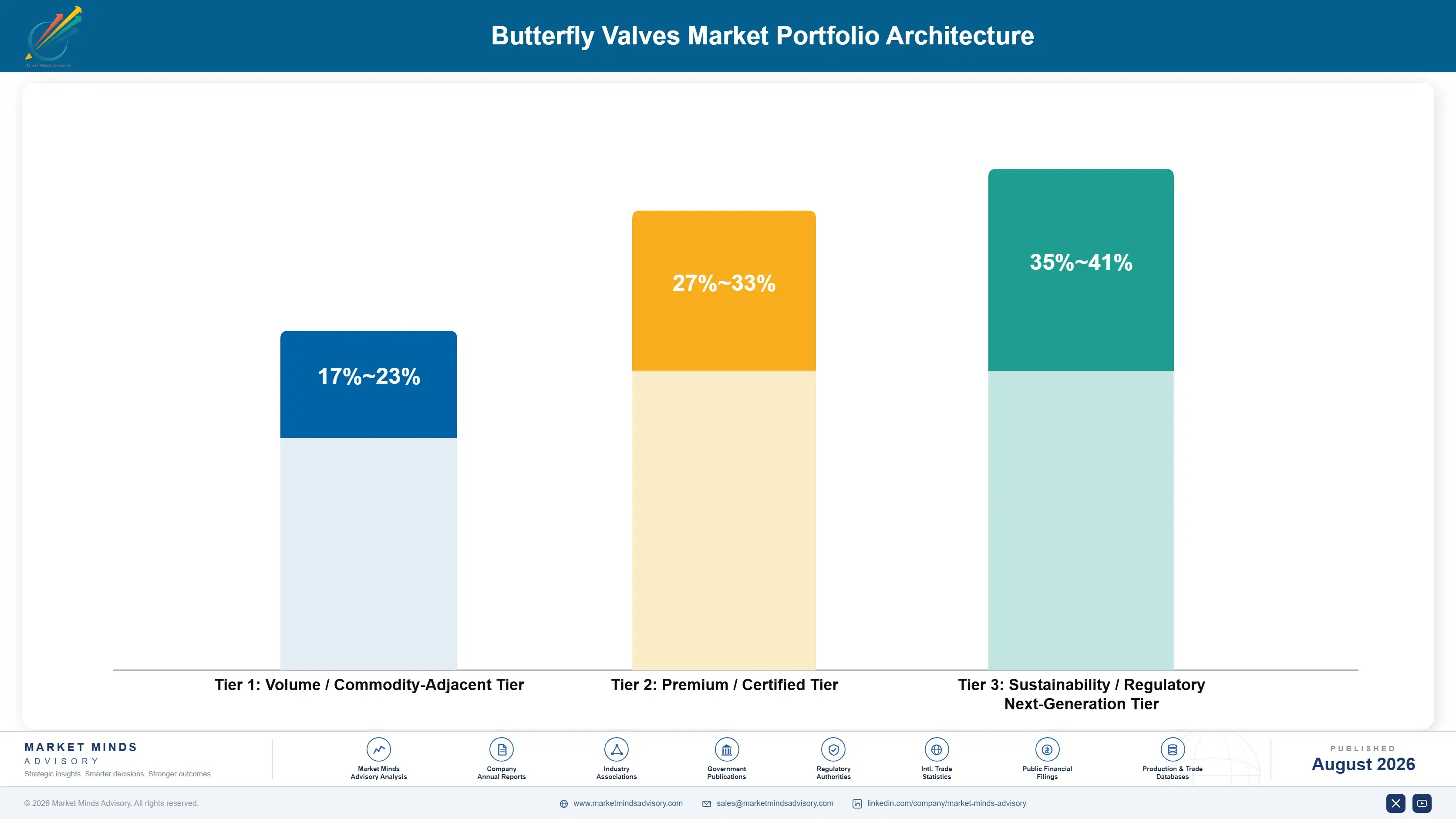
Portfolio economics split into three tiers. Volume commodity-adjacent valves, primarily manual concentric and wafer-style configurations, run on thin margins driven by intense price competition among regional manufacturers and increasingly capable Chinese component suppliers. Premium and certified valves, carrying actuation and validated diagnostic performance data, command meaningfully better margins because operators pay for reduced compliance risk and faster fault detection capability.
The tension between volume and premium runs deep, since cost-constrained municipal buyers want the lowest acquisition cost per valve while process industry and infrastructure-funded customers increasingly demand the diagnostic capability that only actuated-tier configurations deliver consistently. Emerson and Flowserve manage this by maintaining separate manual and actuated product lines, letting customers choose configuration based on their specific regulatory exposure and available budget.

High-value pools concentrate in actuated and smart valves, where software capability and process industry application expertise both support pricing power that ordinary mechanical valve manufacturing cannot replicate. Capital is flowing fastest into diagnostics software development and actuator integration engineering, as manufacturers race to establish the technology position that will define premium competitiveness through the next decade across every major regional market worldwide, not just the largest economies.

Volume / Commodity-Adjacent Tier

Manual concentric and wafer-style valves without actuation or diagnostic capability, priced primarily on unit cost and competing mainly on delivery speed and basic reliability across high-volume, price-sensitive municipal and light industrial applications.
Gross Margin: 17-23%

Premium / Certified Tier

Actuated valves bundled with validated diagnostic performance data and service contracts that process industry and infrastructure-funded customers value for reduced compliance risk and predictable long-term operating performance across the equipment lifecycle.
Gross Margin: 27-33%

Sustainability / Regulatory / Next-Generation Tier

Fully actuated smart valve platforms with cloud diagnostics and predictive maintenance capability addressing tightening emissions and infrastructure funding requirements, where software capability and early-mover advantage both support the strongest pricing power in the category currently.
Gross Margin: 35-41%
butterfly-valves-market-portfolio-architecture-1787301972851

How Butterfly Valve Demand Recurs

Butterfly valve demand carries a genuine annuity quality through service contracts, diagnostic software subscriptions, and actuator maintenance layered on top of the initial valve installation. Operators require ongoing calibration and component maintenance to preserve diagnostic accuracy regardless of capital spending cycles, and service contract renewal rates above 58% give valve makers a recurring revenue stream that persists independent of new installation cycles or broader capital spending
Adoption depth varies meaningfully by end-use segment. Process industry and critical infrastructure applications show the deepest actuated adoption, since compliance and safety requirements are both most demanding there. Municipal water and wastewater applications show growing but more varied adoption, tracking infrastructure funding cycles more closely. Agricultural and light commercial applications remain earlier-stage, since manual valve technique still dominates those lower-value, more price-sensitive applications across most current markets globally.

A younger generation of plant engineers and utility operators, trained on data-driven predictive maintenance and remote diagnostics dashboards rather than manual inspection routines, is accelerating demand for actuated valve platforms. That generational shift is reshaping which manufacturers even get invited into infrastructure and process plant capital equipment evaluation processes, reshaping vendor shortlist criteria as a result.
butterfly-valves-market-end-use-penetration-index-1787301973338

What Wins in Butterfly Valves

These are among the four positions where our research anticipates prominent divergence between winners and laggards over the coming forecast period. Each is grounded in the demand model, the regulatory perimeter, and the announced capacity pipeline.
01 / ACTUATION TECHNOLOGY INVESTMENT

Invest in actuation and diagnostics before it becomes standard equipment

Valve makers that invest in actuation and diagnostic capability ahead of it becoming standard equipment capture premium pricing and infrastructure-funded specification access before that becomes a baseline market expectation rather than a differentiator. Waiting until actuation becomes standard means competing for customer capital budgets against makers that built their diagnostics reputation years earlier, at a moment when demand is accelerating across the entire category simultaneously. Early movers are also better positioned to win infrastructure-funded project specifications that increasingly specify actuation compatibility as an evaluation criterion.
02 / INFRASTRUCTURE FUNDING ENGAGEMENT

Engage utilities early in infrastructure-funded project planning cycles

Valve makers that engage water utilities and process operators early in infrastructure-funded project planning capture disproportionate specification share since early engagement lets them influence technical requirements before a competitor writes a fixed specification favoring their own products. Waiting until formal specifications are published means competing purely on price against requirements a competitor may have already shaped in their own favor. The window to establish these early relationships narrows as funding programs mature and customers develop established vendor relationships that become harder to displace over subsequent funding phases.
03 / DIAGNOSTICS PLATFORM INVESTMENT

Build proprietary monitoring software rather than relying on third parties

Valve makers that build proprietary remote diagnostics software capture recurring subscription revenue that persists independent of new installation cycles, unlike those relying on third-party monitoring platforms that capture much of that margin instead. Emerson's and Flowserve's monitoring subscription attachment rates above 40% demonstrate how sticky this revenue becomes once operators build maintenance workflows around a specific platform's dashboard and alerting configuration. The window for proprietary monitoring software to function as genuine differentiation narrows as third-party platforms become more capable and cheaper to integrate.
04 / COST-COMPETITIVE PRODUCT STRATEGY

Develop lower-cost actuated configurations for price-sensitive expansion markets

Valve makers that develop lower-cost actuated configurations for price-sensitive expansion markets in India and Southeast Asia capture volume specification share that premium-only product lines cannot access, protecting market position as Chinese competitors close the technology gap while maintaining meaningfully lower pricing. Manufacturers that rely exclusively on premium-tier products risk ceding entire expansion markets to competitors offering adequate capability at more accessible capital cost. The window to develop this cost-competitive positioning narrows as expansion markets mature and vendor relationships solidify around early entrants.

Engagement Snapshot From the Field

A live engagement with an industry participant carrying material or product regulatory and market exposure ahead of a defining policy shift, showing how our research translates into a defensible multi-year portfolio strategy.
MARKET MINDS ADVISORY · CLIENT ENGAGEMENT SUMMARY
Butterfly Valves Producer Strategic Portfolio Review and Transition Roadmap 2026·Investment Scenario on Butterfly Valves Exposure Evaluation 2025-26
CLIENT PROFILE
The client is a regional water utility operating 18 treatment and pumping facilities with an installed valve base exceeding 2,400 units, more than 60% of which remain manually operated, and evaluating an infrastructure modernization capital budget exceeding US$38 million (client-reported, unverified by MMA). The utility was evaluating vendor selection and actuation program prioritization ahead of finalizing its modernization plan.
STRATEGIC CHALLENGE
The client needed to determine which valve positions should receive priority actuation and which vendor would deliver sufficient diagnostic reliability to satisfy both regulatory leak reporting requirements and internal maintenance efficiency goals, given budget constraints that made facility-wide actuation impractical within a single funding cycle without exceeding its approved capital budget.
MMA APPROACH
MMA conducted a facility-by-facility analysis correlating current valve condition, criticality, and leak history against available actuation vendor options and infrastructure funding criteria. The engagement combined primary interviews with the utility's operations staff and comparative benchmarking against peer utilities that had already begun similar actuation conversion programs of their own accord.
KEY FINDINGS
  1. Roughly 30% of the client's valve positions, concentrated at the highest-criticality treatment points, accounted for a disproportionate share of historical leak incidents and emergency maintenance calls.
  2. Actuation at the highest-criticality facilities alone would generate enough compliance and maintenance efficiency savings to justify the investment within approximately three years.
  3. Available infrastructure funding criteria favored actuated and diagnostics-equipped configurations specifically, meaningfully reducing the client's effective incremental cost for the premium technology tier.
  4. Peer benchmarking showed utilities that prioritized high-criticality facilities for early actuation achieved better overall program returns than those converting facilities uniformly by age.
CLIENT PROFILE
The client is a regional water utility operating 18 treatment and pumping facilities with an installed valve base exceeding 2,400 units, more than 60% of which remain manually operated, and evaluating an infrastructure modernization capital budget exceeding US$38 million (client-reported, unverified by MMA). The utility was evaluating vendor selection and actuation program prioritization ahead of finalizing its modernization plan.
STRATEGIC CHALLENGE
The client needed to determine which valve positions should receive priority actuation and which vendor would deliver sufficient diagnostic reliability to satisfy both regulatory leak reporting requirements and internal maintenance efficiency goals, given budget constraints that made facility-wide actuation impractical within a single funding cycle without exceeding its approved capital budget.
MMA APPROACH
MMA conducted a facility-by-facility analysis correlating current valve condition, criticality, and leak history against available actuation vendor options and infrastructure funding criteria. The engagement combined primary interviews with the utility's operations staff and comparative benchmarking against peer utilities that had already begun similar actuation conversion programs of their own accord.
KEY FINDINGS
  1. Roughly 30% of the client's valve positions, concentrated at the highest-criticality treatment points, accounted for a disproportionate share of historical leak incidents and emergency maintenance calls.
  2. Actuation at the highest-criticality facilities alone would generate enough compliance and maintenance efficiency savings to justify the investment within approximately three years.
  3. Available infrastructure funding criteria favored actuated and diagnostics-equipped configurations specifically, meaningfully reducing the client's effective incremental cost for the premium technology tier.
  4. Peer benchmarking showed utilities that prioritized high-criticality facilities for early actuation achieved better overall program returns than those converting facilities uniformly by age.
RECOMMENDED STRATEGY
Phase 1: Phase 1 (Months 1-3): Prioritize actuation at the highest-criticality facilities identified through the leak history and compliance risk analysis conducted earlier. Phase 2: Phase 2 (Months 4-14): Expand actuation to remaining facilities, sequencing rollout by available infrastructure funding tranches and valve condition assessments. Phase 3: Phase 3 (Months 15-22): Evaluate program performance against leak reduction and maintenance efficiency assumptions, then finalize remaining facility timelines and budget allocations.
OUTCOME
The client's phased actuation program reduced leak incidents at the priority facilities meaningfully within the first operating year, exceeding its internal base case projection (client-reported, unverified by MMA). Prioritizing high-criticality facilities rather than uniform age-based conversion improved overall program return on investment across the full facility network.

Frequently Asked Questions

Foundational context covering the market sizes, CAGR, scope, country, region and competition that inform every finding below. This section is provided to cover basics and most often pre-purchase conversations, answered from the MMA Primary Research Dataset.

What is the current size of the Butterfly Valves Market?

The market was valued at US$8.4 billion in 2025 and is projected to reach US$9.0 billion in 2026 as water infrastructure investment and emissions regulation continue accelerating.

How large will the Butterfly Valves Market be by 2036?

MMA projects the market will reach US$17.2 billion by 2036, roughly 1.91 times its 2026 value, driven by actuated valve conversion and sustained infrastructure funding growth.

What is the CAGR for the Butterfly Valves Market 2026 to 2036?

The market is projected to grow at a 6.7% CAGR between 2026 and 2036, with a bull case of 7.9% and a bear case of 5.4%.

Which segment is growing fastest?

Actuated and smart butterfly valves are the fastest-growing segment at 10.2% annually, roughly 52% faster than the category average, driven by emissions compliance and predictive maintenance demand.

Who are the major companies in the Butterfly Valves Market?

Leading manufacturers include Emerson, Flowserve, Crane Co., KSB, and Bray International, which together hold roughly two-fifths of category revenue on a disclosed-revenue basis across their global valve portfolios.

Which country is growing fastest?

China leads country-level growth at an estimated 9.8% annually, supported by rapidly expanding industrial manufacturing and water infrastructure investment across both coastal and inland provinces.

Report Segmentation Architecture

The full report scope spans multiple orthogonal segmentation dimensions, with cross-tabulated demand data provided for each dimension pair. Coverage extends further to regional breakdowns, trend trajectories, and the competitive detail needed to support segment-level decision-making.

By Valve Type

  • Concentric Butterfly Valves
  • Double-Offset Butterfly Valves
  • Triple-Offset Butterfly Valves
  • Actuated and Smart Butterfly Valves
  • Wafer-Style Butterfly Valves
  • Lug-Style Butterfly Valves

By End-Use Application

  • Water and Wastewater Treatment
  • Oil and Gas
  • Chemical and Process Industries
  • Power Generation
  • HVAC and Commercial Buildings

By Commercial Dimension

  • Municipal and Public Sector
  • Process Industry Direct
  • System Integrator and Distributor
  • Distribution Channel

By Region

  • North America
  • Western Europe
  • East Asia
  • South Asia and Pacific
  • Latin America
  • Middle East and Africa
  • Eastern Europe

Scope, Methodology, and Coverage

Every figure in this report is reproducible from documented input assumptions. The scope below maps the historical period, the forecast horizon, the segmentation dimensions, and the countries covered, alongside the underlying primary and qualitative methodology.
Historical Period
2020 to 2025
Forecast Period
2026 to 2036
Base Year
2025 (USD billions; MMA Primary Research Dataset, August 2026)
Market Definition
The Butterfly Valves market covers manually operated and actuated quarter-turn valves used to regulate or isolate fluid flow in pipelines, including concentric, double-offset, and triple-offset designs sold across water and wastewater, oil and gas, chemical processing, and HVAC applications. It excludes ball valves, gate valves, and other non-quarter-turn flow control devices not based on a rotating disc mechanism.
Quantitative Units
USD billions (current prices); unit shipments in thousands where disclosed by segment
Segmentation Dimensions
By Valve Type; By End-Use Application; By Commercial Dimension; By Region
Regions Covered
North America, Western Europe, East Asia, South Asia and Pacific, Latin America, Middle East and Africa, Eastern Europe
Countries Covered
USA, China, Germany, France, UK, Japan, South Korea, India, Australia, Canada, Brazil, Mexico, Indonesia, Vietnam, Thailand, Malaysia, UAE, Saudi Arabia, South Africa, Nigeria, Turkey, Poland, Netherlands, Italy, Spain, Sweden, Switzerland, Argentina, Colombia, Singapore, and additional markets relevant to this sector
Key Companies Profiled
Emerson Electric Co., Flowserve Corporation, Crane Co., KSB SE & Co. KGaA, Bray International Inc., AVK Holding A/S, Velan Inc., Metso Outotec Corporation, Rotork plc, Neway Valve Co. Ltd., Samson AG, DeZURIK Inc., Val-Matic Valve & Manufacturing Corp., Mueller Water Products Inc., L&T Valves Limited
Quantitative Methodology
Primary survey, n=3,800 respondents, Q4 2025, six countries; demand-side model with trade association cross-validation
Qualitative Methodology
47 expert interviews, Q4 2025; applied to validate demand model assumptions, identify emerging dynamics, and assess competitive positioning
Report Format
PDF and XLSX data workbook (Word format preview document)
Publisher
Market Minds Advisory
Report Code
MMA-2026-CON-123
Published
August 2026
Contact
sales@marketmindsadvisory.com | www.marketmindsadvisory.com

Purchase the full Butterfly Valves Market Report (2026 to 2036).

The full report delivers a complete quantitative and qualitative assessment of the butterfly valves market through 2036, including valve-type and country-level forecasts across all seven MMA-tracked regions. It profiles the twenty leading manufacturers shaping competitive dynamics, with detailed moat and risk analysis for the top two players and a full development timeline of recent corporate activity. The report includes primary survey data from 3,800 respondents and 47 expert interviews conducted in Q4 2025, alongside a dedicated input cost and infrastructure funding analysis. Buyers receive segmentation, regional, and competitive datasets formatted for direct integration into internal strategic planning models.
Valve-type and regional forecasts through 2036 inclusive
Competitive profiles of twenty leading global manufacturers
Primary survey data from 3,800 global respondents
Expert interview insights from 47 industry practitioners
Input cost and infrastructure funding risk analysis
Editable data tables for internal strategic modeling

Built For The People Who Decide

From boardroom strategy to bench-side execution, this report is read cover-to-cover by leaders shaping the next decade of their industry, turning demand scenarios, market dynamics and valuation benchmarks into decisions.
CXOs/ Presidents/ VPs/ Managers
M&A and Corporate Development
Strategy Teams and R&D Heads
Procurement and Product Directors
Regulatory and Compliance Leaders
Investor Relations and Equity Analysts