Market Minds Advisory
Business Process Automation (BPA) Market

Business Process Automation (BPA) Market: Business Process Automation (BPA) Market. Robotic Process Automation, Workflow Software, and Intelligent Document Processing, 2026 to 2036

Enterprises racing to cut back-office headcount costs are pushing BPA vendors to bolt AI-driven document understanding onto software that was originally built only to click buttons on a screen repeatedly.

Lead Analyst

Published

September 2026

Make Smarter Decisions with Customized Research Insights

Request a free sample report and evaluate market opportunities, growth trends, and competitive dynamics relevant to your business needs.

2025 MARKET VALUE$14.8BMarket Size 2025
2036 FORECAST VALUE$51.5BBase Case , 2026 to 2036
CAGR 2026 TO 203612.0 %Bull 13.3% / Bear 10.7%
INCREMENTAL OPPORTUNITY$34.9BNet 10- year value creation
EXPANSION MULTIPLE3.11x2036 value over 2026 base
Strategic Levers
M&A Pipeline
Regional Outlook
Country Rankings
Competitive Intelligence
Segmental Deep-dive
Call-Us : 91 93563 13602

Executive Snapshot and Market Trajectory.

Business process automation has moved well past its early reputation as simple screen-scraping software, as enterprises now expect bots to read unstructured documents and make judgment calls that previously required a trained human employee to complete correctly and consistently every single working day across every department and function.
AI-driven intelligent document processing is growing fastest as enterprises push beyond rule-based automation toward systems that extract meaning from invoices, contracts, and forms without predefined templates that break the moment a document format changes even slightly. North America leads regional demand given its concentration of large enterprises running mature automation programs across finance, insurance, and healthcare back-office functions at meaningful scale across the country and beyond.
Competitive character increasingly centers on platform breadth and AI capability depth rather than pure automation speed, since buyers now expect a single vendor to cover process discovery, automation, and document understanding together rather than stitching together separate point solutions from multiple providers competing on narrow feature sets alone, a shift that has reshaped how vendors package and price their entire product line and structure sales teams around fewer, larger enterprise accounts.
Market Definition
The Business Process Automation Market covers robotic process automation, workflow and business process management platforms, intelligent document processing, and low-code process automation software used by enterprises to automate repetitive back-office and administrative tasks. It excludes general-purpose enterprise resource planning suites, customer relationship management software, and standalone data analytics tools without process automation functionality.
Base Year Value
$14.8B in 2025 (MMA Primary Research Dataset, September 2026)
Forecast Period
2026 to 2036, eleven discrete annual values
CAGR
12.0% base case. Bull 13.3%. Bear 10.7%.
Fastest Growth Segment
AI-Driven Intelligent Document Processing: 16.0% CAGR
Fastest Growth Country
Philippines: 15.0% CAGR
Fastest Growth Region
South Asia and Pacific: 14.2% CAGR
Largest Region
North America: 30% of 2025 global value
Market Leaders
Leading vendors: UiPath, Automation Anywhere, Microsoft, Appian, Pegasystems. Source: MMA Primary Research Dataset, July 2026.
Primary Survey
n=3,800 procurement and R&D decision-makers, Q4 2025, six countries
Methodology
Demand-side build-up, cross-validated against public data, 47 expert interviews

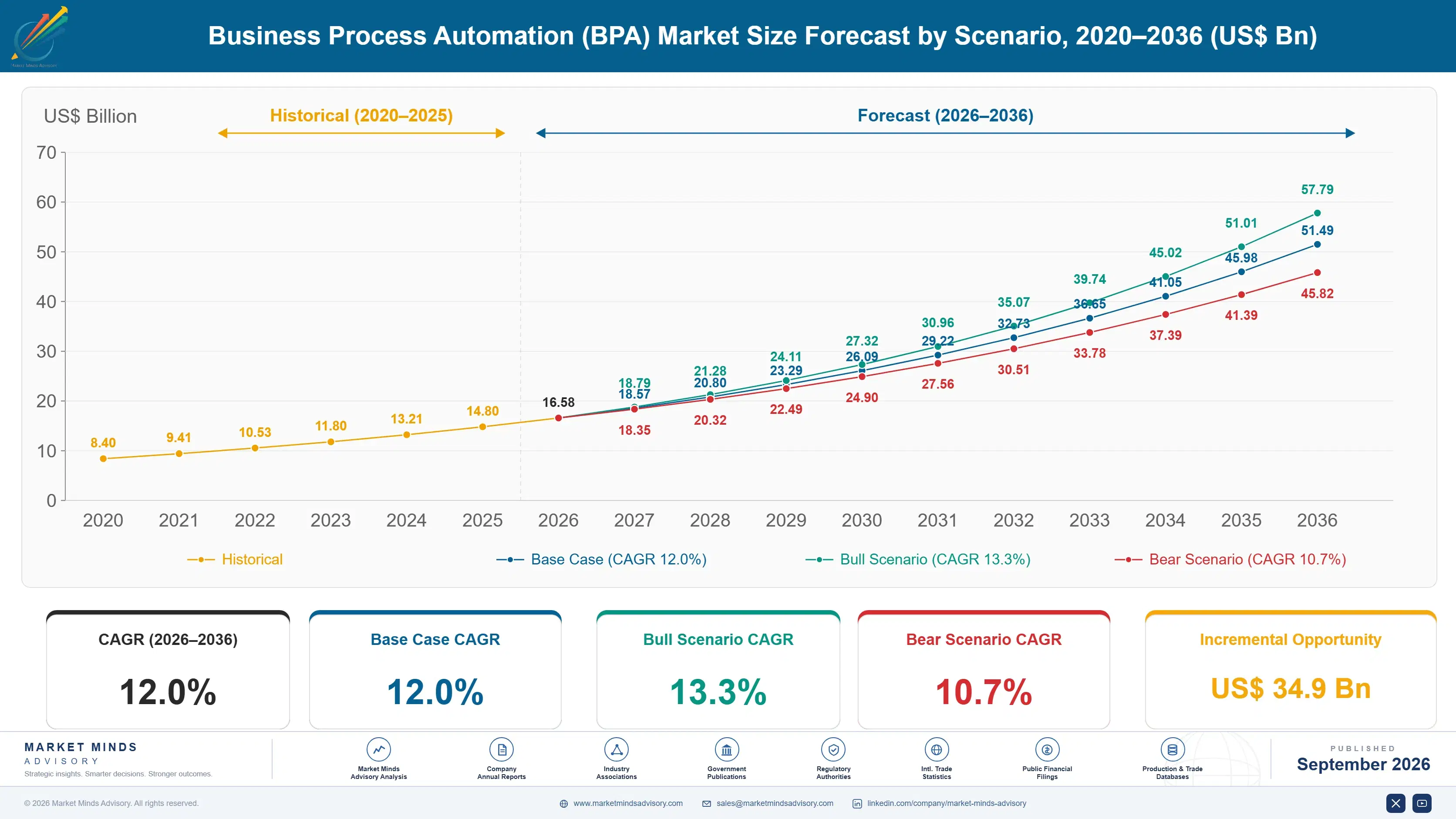
Business Process Automation (BPA) Market Forecast Scenarios

business-process-automation-bpa-market-size-forecast-scenario-1789993062203
Growth through 2020 to 2025 was strong, driven initially by pandemic-era remote work forcing enterprises to digitize manual paper processes almost overnight, though many early robotic process automation deployments struggled to scale past a handful of narrow use cases without breaking whenever underlying applications changed unexpectedly across the enterprise's whole IT estate and technology stack.
Base case growth through 2036 rests on three commercial mechanisms: rising enterprise pressure to cut back-office headcount costs amid persistent labor market tightness across most developed economies and rising wage inflation, growing AI capability that finally handles unstructured documents reliably enough for production use at meaningful scale, and expanding low-code platforms that let business users build automations without dedicated developer resources previously required for every single deployment across the organization.
A bull scenario turns on faster enterprise AI adoption proving return on investment convincingly across more back-office functions simultaneously, accelerating budget approval that currently moves slowly through lengthy procurement review cycles. The bear risk is that generative AI assistants absorb enough automation use cases directly that dedicated standalone BPA platforms lose relevance for simpler workflows previously requiring a separate purchase entirely.

From Rule-Following Bots to Judgment-Making Software

Business process automation has evolved from a narrow cost-cutting tool for repetitive keyboard tasks into a genuine enterprise platform play, as vendors race to bundle process discovery, automation, document understanding, and analytics into a single suite that enterprises purchase once rather than assembling from separate specialized point solutions across multiple procurement cycles and internal budget owners spread across many departments.
MARKET CONCENTRATIONCR5: 32%Top five vendors hold roughly a third of the market
AVERAGE ENTERPRISE CONTRACT VALUE$185,000Typical large enterprise annual platform subscription spend reported broadly
TOP ADOPTING COUNTRY SHAREUSA: 30%Reflects concentration of large enterprises with mature automation programs
PROCESS AUTOMATION RATE8 percentage pointsAverage share of eligible processes fully automated after deployment
BOT DEPLOYMENT TIMELINE2 to 4 monthsTypical time from process selection to production bot deployment
CUSTOMER RENEWAL RATE88%Annual subscription renewal rate reported across leading platform vendors
Vendors compete less on raw automation speed today and more on how reliably their AI-driven document processing handles genuinely unstructured inputs like handwritten forms and inconsistent invoice layouts, since brittle rule-based extraction remains the single largest reason automation projects stall after an initial successful pilot deployment fails to scale further across the broader organization and its many different departments and business units.
Low-code platforms have shifted who actually builds automations within the enterprise, moving capability from a small dedicated developer team toward business analysts and operations staff who understand the process being automated firsthand, a change that has meaningfully accelerated deployment timelines at organizations willing to make the necessary cultural and organizational shift required to support this genuinely new way of working across every level.
"Vendors still selling this as button-clicking software are going to get squeezed out. The ones who survive are the ones who figured out that the real product is judgment, not repetition."
Practice Lead, Enterprise Software and Automation Research · MMA Technology Practice · September 2026

Market Trends

Generative AI Absorbs Unstructured Document Processing Tasks

Large language models have made it dramatically easier to extract meaning from unstructured documents like contracts, emails, and handwritten forms without building custom extraction models for every single document type encountered across the enterprise, a capability that traditional rule-based automation could never reliably deliver at genuine production scale across an entire organization. Every major BPA vendor has integrated generative AI capability into their platforms over the past two years, and RFPs from large enterprises now routinely require demonstrated document understanding accuracy above 90% before a vendor even reaches final-round evaluation.
Market Impact: Back-office labor costs up over 15%

Process Mining Adoption Reveals Automation Opportunities Systematically

Enterprises increasingly deploy process mining software before automation projects begin, analyzing system logs to identify genuinely high-value automation candidates rather than relying entirely on manager intuition about which processes waste the most time and resources across the entire organization and its many separate operating departments today. This systematic approach has meaningfully improved automation project success rates, and several large consultancies now require process mining analysis as a mandatory first step before recommending any automation investment to enterprise clients undertaking a broader digital transformation initiative spanning multiple business units and functions.
Market Impact: Audit trail completeness reaches nearly 100%

Market Opportunities and Growth Drivers

Back-Office Labor Costs Rise Amid Tight Hiring Markets

Enterprises across finance, insurance, and healthcare administration face persistent difficulty hiring and retaining back-office staff for repetitive data entry and document processing roles, a labor market condition that has pushed wage costs steadily upward across most developed economies over the past several years and shows little sign of reversing soon or slowing down meaningfully. Several large enterprises have publicly disclosed back-office labor cost increases exceeding 15% over the past two years alone, directly strengthening the return on investment case for automation software that reduces headcount dependency for these specific roles.
Market Impact: Bot failures: 4 to 6 yearly

Regulatory Compliance Requirements Demand Auditable Process Trails

Financial services and healthcare enterprises face increasingly stringent regulatory requirements to demonstrate auditable, consistent process execution across every single business transaction handled, a standard that manual human processing struggles to guarantee reliably at scale given natural variation in how individual employees handle edge cases day to day and week to week. Automated processes generate a complete, timestamped audit trail by default, and several major regulators have specifically cited automation adoption favorably during compliance examinations, giving enterprises an additional non-cost-driven reason to invest in automation platforms beyond pure efficiency gains alone.
Market Impact: Rollout delays: 3 to 6 months

Market Restraints and Challenges

Bot Fragility Against Application Changes Remains Common

Automated processes built around a specific screen layout or application version frequently break when the underlying software receives a routine update, and the root cause is that many early automation implementations were built as rigid, screen-based scripts rather than more resilient API-driven integrations designed to withstand interface changes over time. Vendors are mitigating this by shifting toward AI-driven interface recognition that adapts to layout changes automatically and by encouraging customers to prioritize API-based integration wherever the underlying application actually supports it, reducing brittleness meaningfully across the entire deployed automation fleet.
Market Impact: Document accuracy requirements now exceed 90%

Employee Resistance Slows Internal Automation Adoption

Employees whose roles include tasks being automated often resist adoption out of genuine job security concerns, and the underlying cause is that many enterprises have historically framed automation projects purely around headcount reduction rather than role transformation toward higher-value work across the entire organization and its departments. Vendors and enterprise change management teams are mitigating this by reframing automation initiatives around freeing employees from tedious tasks to focus on judgment-intensive work, and several large enterprises now explicitly guarantee no layoffs tied directly to specific automation projects to reduce internal resistance meaningfully.
Market Impact: Process mining lifts project success 30%
3 additional market trends, 3 additional growth drivers, and 4 additional restraints and challenges are covered in the full report. Contact sales@marketmindsadvisory.com to access the complete intelligence.

Segment CAGR and Growth Architecture

The market divides into five segments by functional capability, spanning AI-driven intelligent document processing, robotic process automation software, workflow and business process management platforms, process mining and analytics, and low-code automation development tools, each addressing a distinct step in the enterprise automation lifecycle from initial process discovery through execution, ongoing monitoring, and continuous optimization.
business-process-automation-bpa-market-market-share-analysis-1789993062740

AI-Driven Intelligent Document Processing

AI-driven intelligent document processing is growing fastest as enterprises push beyond rigid template-based extraction toward systems that genuinely understand unstructured documents like handwritten forms, inconsistent invoices, and free-text contracts without breaking whenever formatting varies slightly between different sources and document types encountered on a daily basis across the enterprise and its many departments. This segment increasingly captures the largest share of new platform spending, since document-heavy back-office processes in finance, insurance, and healthcare represent the largest remaining pool of manual work that traditional rule-based automation could never reliably handle, pushing legacy RPA vendors to rapidly acquire or build genuine AI capability they historically lacked entirely and now scramble to develop internally.
CAGR 16.0%

Robotic Process Automation Software

Robotic process automation software remains the second-fastest-growing segment as enterprises continue expanding bot deployment across finance, HR, and customer service back-office functions even as growth moderates somewhat from earlier peak years driven by initial pandemic-era digitization spending and pent-up automation demand across every major industry vertical worldwide and every company size and geography. This segment increasingly determines vendor selection at larger enterprises managing thousands of deployed bots simultaneously across multiple business units and geographies, since reliability, monitoring, and centralized bot governance capability alone can no longer succeed without a genuinely comprehensive management layer keeping every automated process properly running, monitored, and updated across the entire distributed deployment footprint and organization.
CAGR 13.0%
Full segment breakdown across 5 segments available in the complete report.

Regional Architecture and Country Demand Map

North America leads demand given its exceptional concentration of large enterprises running mature automation programs across finance, insurance, and healthcare back-office functions coast to coast, while East Asia and Western Europe follow closely with substantial adoption across their own established banking and manufacturing administration sectors.

North America

American financial services and healthcare enterprises run some of the most mature automation programs anywhere in the world, having deployed thousands of bots across claims processing, loan origination, and billing reconciliation workflows over more than a decade of iterative investment and continual refinement across every business line. Persistent back-office labor shortages across the country have strengthened the return on investment case for automation meaningfully, and several large American consultancies now offer dedicated automation practice groups serving this specific demand across every industry vertical. Canadian financial institutions contribute a smaller but steady secondary demand pool, often following automation playbooks first proven at larger American parent companies and regional banking peers across the border.
Share: 30% | CAGR: 12.8% (2026 to 2036)

Western Europe

German and British financial services firms drive the bulk of Western European demand, with London serving as a genuine hub for insurance and banking back-office automation given the sheer concentration of major financial institutions headquartered there and across the wider city. French enterprises have adopted more cautiously, often citing data residency requirements and employee works council consultation processes that slow deployment timelines relative to less regulated markets elsewhere in the region. Growth trails North America and East Asia given generally more conservative enterprise technology budgets and labor protections that make headcount-focused automation business cases harder to build and defend internally, though efficiency-focused framing has helped overcome some of this hesitation over time.
Share: 22% | CAGR: 10.7% (2026 to 2036)
Regional intelligence for 5 additional markets available in the complete report: East Asia, South Asia and Pacific, Latin America, Middle East and Africa, Eastern Europe. Contact sales@marketmindsadvisory.com.
business-process-automation-bpa-market-country-cagr-analysis-1789993063296

How BPA Vendors Actually Grow Margin

Beyond raw bot deployment volume, four distinct commercial mechanisms determine which vendors actually expand margin rather than simply chasing seat count growth each and every single fiscal quarter: AI document processing upselling, platform consolidation across the automation stack, vertical-specific workflow templates, and managed services attach revenue layered on top of the base software subscription.

Upselling AI Document Processing to RPA Customers

Vendors that sell basic robotic process automation first, then upsell AI-driven document processing modules once a customer has proven automation value on simpler rule-based tasks, capture meaningfully higher revenue per account than vendors selling document AI capability to a skeptical buyer with no prior automation experience at all to draw upon. Several leading platforms report document processing attach rates exceeding 35% within the first two years of the base RPA relationship, turning an already-established customer into the fastest-growing revenue line without requiring a brand-new logo acquisition at all this year.
Market Impact: Document AI attach rate exceeds 35% within 2 years

Consolidating the Automation Stack Into One Platform

Vendors that expand from single-point automation capability into a genuinely comprehensive platform spanning process discovery, automation, and document understanding capture budget that would otherwise flow to three or four separate point solution vendors serving the same enterprise customer across multiple departments and business units simultaneously and continuously. Enterprises increasingly prefer consolidated platforms specifically to reduce vendor management overhead and licensing complexity, and several leading vendors report platform consolidation deals running 2 to 3 times larger than single-capability contracts, making broad platform investment a genuinely favorable long-term margin strategy for the business.
Market Impact: Consolidated deals run 2 to 3x larger overall

Building Deep Vertical-Specific Automation Workflow Templates

Vendors that build pre-configured automation templates tailored to specific industry workflows, such as insurance claims processing or mortgage loan origination, win deals faster and command premium pricing over generic configurable automation platforms requiring lengthy customization before any bot can actually go live and start delivering measurable value to the business each and every quarter. Practice-specific templates reduce implementation time meaningfully, and several vendors report verticalized go-to-market motions produce win rates roughly 22% higher than horizontal sales approaches targeting any back-office buyer regardless of specific industry served or overall company size.
Market Impact: Vertical templates lift win rates fully by 22%

Bundling Deep Managed Automation Operations Services

Vendors increasingly bundle managed bot monitoring, maintenance, and continuous optimization services on top of the base automation platform subscription, capturing revenue that would otherwise flow to independent systems integrators hired separately by the enterprise customer to keep bots running reliably at scale and without interruption. Services attach revenue now represents a meaningful share of total contract value at several leading vendors, sometimes exceeding 18% of first-year deal value, and this bundling also deepens customer relationships and reduces churn risk since switching means rebuilding the entire automated process library from scratch.
Market Impact: Services attach reaches over 18% of deal value

Who Controls the Margin Pool

Competitive concentration sits at a modest CR5 near 32%, evaluated on annualized recurring revenue across the category, leaving considerable daylight between the two established RPA leaders and a wide field of platform and workflow competitors. UiPath and Automation Anywhere hold the largest revenue bases, both having built dominant positions during the earlier RPA boom, and the gap to Microsoft's rapidly growing Power Automate offering has narrowed meaningfully in recent years.
Current competitive activity centers on AI document processing capability and platform breadth rather than pure bot deployment speed, which most serious vendors now treat as table stakes. Several vendors have pursued acquisitions of smaller intelligent document processing and process mining startups over the past two years specifically to accelerate capability rather than build it natively, while others have doubled down on vertical-specific workflow depth competitors lack.

Rankings are most likely to shift as Microsoft's Power Automate, bundled favorably with existing enterprise Office and Azure relationships, continues gaining share against standalone RPA specialists lacking that same natural distribution advantage. Consolidation among mid-tier platform vendors appears increasingly likely, and private equity interest in vertical-specific automation application companies has picked up noticeably as buyers recognize the durability of embedded back-office software.
business-process-automation-bpa-market-company-positioning-matrix-1789993063825

Competitive Moat and Risk Dimensions

UIPATH

Moat: Largest Installed Bot Base

UiPath's early-mover position in the original RPA wave gave it the largest installed base of deployed bots and trained developer community anywhere in the category, creating genuine switching costs since retraining staff and rebuilding automations on a competing platform requires substantial time and budget most enterprises are reluctant to spend.
UIPATH

Risk: Slowing Core Growth Rate

UiPath's core RPA revenue growth has slowed meaningfully as the category matures and enterprises complete initial deployment waves, forcing the company to expand aggressively into AI and process mining adjacencies where it faces genuinely established competitors already holding meaningful share in each of those specific segments.
MICROSOFT

Moat: Bundled Office and Azure Distribution

Microsoft's Power Automate benefits directly from bundled distribution through existing Office 365 and Azure enterprise agreements, letting the company win deals through incremental upsell to accounts it already serves rather than competing purely on standalone automation feature depth against dedicated automation specialists in every single deal.
MICROSOFT

Risk: Perceived Shallow Feature Depth

Enterprises running the most complex, mission-critical automation programs often perceive Power Automate as less mature than dedicated RPA specialists for handling genuinely difficult edge cases, pushing some large accounts toward hybrid deployments that use Microsoft for simpler tasks and dedicated specialists for the more complex ones instead.

Players Tracked

Prominent Players

UiPath
Automation Anywhere
Microsoft
Appian
Pegasystems

Other Key Players

IBM
SS&C Blue Prism
Software AG
Nintex
Kofax
ABBYY
Celonis
WorkFusion
Laiye
Newgen Software
Bizagi
Camunda
EdgeVerve
ServiceNow
Zoho

Recent Developments

APRIL 2026

UiPath Acquires Intelligent Document Processing Startup

UiPath acquired a smaller intelligent document processing startup in April 2026 to strengthen its unstructured document understanding capability for insurance and financial services customers, adding specialized machine learning talent that had previously required a slower internal development timeline spanning multiple product cycles. The deal closed for an undisclosed amount.
Signal: Signals accelerating AI capability consolidation through acquisition across the leading RPA vendor tier this fiscal year
JUNE 2026

Microsoft Expands Power Automate Process Mining Features

Microsoft launched expanded process mining and analytics capability within Power Automate in June 2026, directly targeting a segment previously dominated by dedicated specialists, and bundling the new capability into existing enterprise agreements at no additional licensing cost for qualifying customers. The launch drew immediate competitive attention from rivals.
Signal: Signals bundled distribution advantage extending even further into adjacent automation capability areas across the whole industry
JANUARY 2026

Appian Signs Reseller Agreement With Global Systems Integrator

Appian signed a multi-year reseller and implementation partnership agreement with a major global systems integrator in January 2026, expanding its enterprise sales reach into large multinational corporations that previously evaluated Appian only through direct sales channels lacking dedicated implementation support at meaningful scale. Terms were not disclosed publicly.
Signal: Signals growing vendor reliance on channel partnerships to reach large enterprise accounts even more efficiently now

AI Compute Costs Now Dominate Development Budgets

AI model training and inference compute represents the largest cost input for BPA vendors, running roughly 35% of cost of goods sold, sourced primarily through hyperscale cloud provider contracts with Microsoft Azure, Amazon Web Services, and Google Cloud infrastructure services. Engineering talent costs add a smaller but still meaningful secondary cost line for most platform vendors.
A meaningful AI compute cost spike hit the category in late 2025 as demand for large language model inference capacity outpaced available data center capacity industry-wide across most major cloud regions, an event documented in multiple company investor updates and referenced in IEA reporting on data center energy demand growth. Several vendors renegotiated cloud contracts and adopted smaller, more efficient specialized models to manage rising costs going forward.

Vendors without significant scale face a real cost disadvantage against UiPath and Automation Anywhere, both of which can negotiate volume-based cloud compute pricing unavailable to smaller platform competitors managing comparable AI workloads. This exposure varies by geography too, since vendors running compute entirely through Western cloud providers face meaningfully higher costs than those with access to lower-cost regional data center capacity.
business-process-automation-bpa-market-cost-volatility-analysis-1789993064022

Adopting Smaller, More Efficient Specialized Models

Vendors are increasingly deploying smaller, task-specific AI models trained for narrow document processing use cases rather than routing every single request through the largest general-purpose language models available on the wider market today, reducing inference compute cost substantially while maintaining acceptable accuracy for common back-office use cases across most customer deployments and industries served.

Diversifying Cloud Provider Relationships Across Regions

Leading vendors increasingly maintain compute contracts with multiple cloud providers across different regions rather than depending entirely on a single provider for their entire infrastructure needs and workloads at scale, reducing exposure to any one vendor's pricing changes or capacity constraints during periods of unusually high industry-wide AI compute demand across the broader market.

Negotiating Multi-Year Committed Use Discounts

Vendors are negotiating multi-year committed use agreements with cloud providers that lock in discounted compute pricing in exchange for guaranteed minimum spend commitments made well upfront, trading some short-term flexibility for meaningfully lower unit costs that protect margin as AI workloads continue scaling rapidly alongside growing customer demand across every single product line offered.

Portfolio Architecture for Margin Defence

The market splits between commodity-adjacent basic RPA tools priced accessibly with thinner margins, and premium AI-driven platforms combining document processing, process mining, and workflow automation together carrying meaningfully higher gross margins because deep AI capability and platform breadth justify substantially higher pricing at larger enterprise accounts running complex, multi-department automation programs across the business and its many functions.
Tension between volume RPA and premium AI-driven platforms plays out in how vendors allocate investment, since basic bot licensing requires ongoing cost competitiveness while premium document processing demands continuous AI development that smaller vendors rarely fund adequately given their limited engineering budgets and headcount. Most successful vendors treat basic RPA as an installed-base acquisition funnel rather than a standalone profit center, funding premium development from that steadier baseline revenue instead.

The highest-value margin pools concentrate around AI-driven document processing and vertical-specific workflow applications serving large enterprise accounts willing to pay premium rates for measurable back-office efficiency gains, a customer set that increasingly determines which vendors capture the fastest-growing and most profitable share of the entire market going forward, leaving pure RPA vendors competing on thinner and ever-thinner margins with each passing quarter.

Volume / Commodity-Adjacent

Basic robotic process automation licenses and simple rule-based bot deployment tools priced accessibly for smaller enterprises with straightforward, well-defined automation needs and quite limited technical staff or budget to spare.
Gross Margin: 22-32%

Premium / Certified

Full automation platforms combining RPA, workflow management, and standard document processing serving mid-market and larger enterprises requiring reliable multi-department deployment support and ongoing dedicated vendor account management services throughout the contract.
Gross Margin: 42-52%

Sustainability / Regulatory / Next-Generation

AI-driven intelligent document processing and process mining serving the largest enterprise accounts willing to pay premium rates for measurable, sustained back-office efficiency improvement across every single department they operate globally.
Gross Margin: 48-58%
business-process-automation-bpa-market-portfolio-architecture-1789993064518

High-value Sub-segments and Strategic Watch-out

AI-Driven Intelligent Document Processing

High-value and high-growth, this segment commands premium pricing from enterprises willing to pay for measurable back-office efficiency gains, and its growth rate outpaces every other segment currently by a wide and widening margin as generative AI capability matures across every vendor's platform and product line.
Gross Margin: 48-58%

Robotic Process Automation Software

High-value with moderate growth, enterprises continue expanding bot deployment across back-office functions, though adoption has matured enough at larger accounts that growth has settled into a much steadier pace overall than the considerably faster-growing document processing segment described in detail earlier in this same overview section.
Gross Margin: 38-48%

Workflow and Business Process Management

The volume core of the market, this segment generates the bulk of transaction count and recurring seat-based revenue across thousands of smaller enterprise accounts, even though per-seat margins run well below the premium AI tiers described above and show little sign of expanding meaningfully in coming years.
Gross Margin: 25-35%

Standalone Basic RPA Bots

A strategic watch-out segment: horizontal low-code platforms keep steadily adding RPA-adjacent automation features that satisfy smaller firms without ever requiring a dedicated purchase, and vendors must watch this encroachment closely as it threatens the commodity tier most directly and could eventually spread even further upmarket.
Gross Margin: 18-28%

Recurring Revenue Built Into Every Workflow

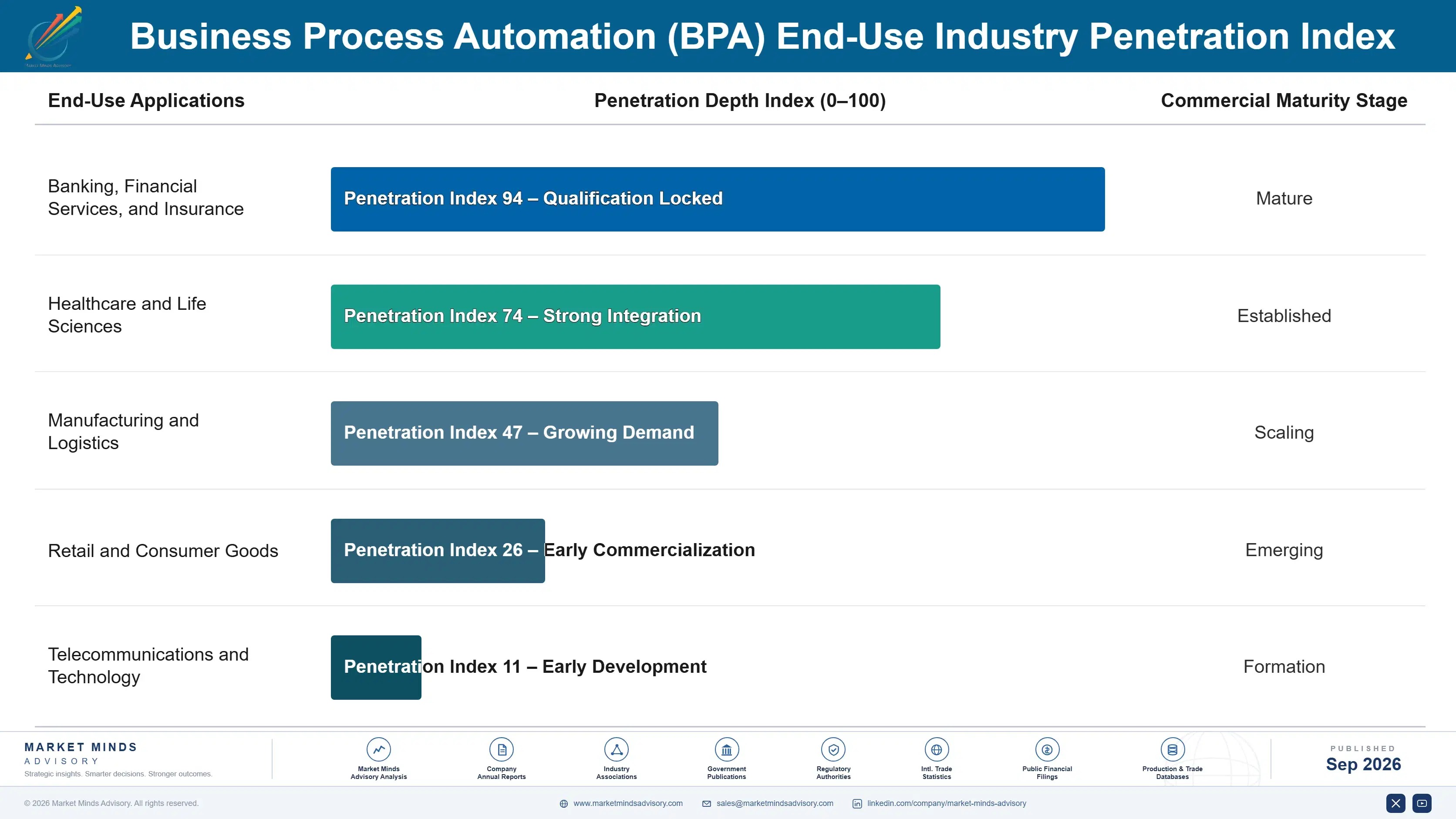
BPA platform revenue runs almost entirely on annual subscription contracts rather than one-time licensing, since enterprises need continuous bot monitoring, maintenance, and updates every single working day rather than a single point-in-time software purchase that sits unused between projects, and renewal rates consistently exceed 85% once automation becomes embedded in core back-office operations across every department the enterprise actually operates and manages.
Adoption depth varies meaningfully by function: finance and insurance back-office teams integrate automation so deeply into daily processing that switching vendors risks disrupting active claims or billing workflows entirely across multiple interconnected systems, while marketing and HR teams treat automation more as a convenience layer and switch more readily when a cheaper alternative offers adequate coverage for their comparatively simpler operational needs.

Buyer profiles have shifted generationally as procurement increasingly runs through operations and IT leadership together rather than either department acting entirely alone, bringing more rigorous evaluation criteria and longer sales cycles but also stickier, better-integrated deployments once a contract finally closes after multiple stakeholder review rounds and a considerably more thorough technical evaluation than firms conducted in years past across the enterprise.
business-process-automation-bpa-market-end-use-penetration-index-1789993065013

What Matters Most Going Forward

These are among the four positions where our research anticipates prominent divergence between winners and laggards over the coming forecast period. Each is grounded in the demand model, the regulatory perimeter, and the announced capacity pipeline.
01 / AI DOCUMENT INVESTMENT

Intelligent document processing now determines which vendors win enterprise deals

AI-driven document processing has become the single most important growth driver in this software category today, well ahead of any other capability vendors can offer to enterprise buyers. Vendors still shipping only rule-based extraction are losing deals to competitors who can reliably process genuinely unstructured documents and quantify the accuracy improvements that follow from each deployment. Building this capability now, rather than treating it as a future roadmap item, positions a vendor to capture the fastest-growing segment of new enterprise spending over the next several years.
02 / PLATFORM CONSOLIDATION STRATEGY

Bundling process discovery, automation, and document understanding wins larger deals

Vendors offering a genuinely consolidated platform spanning process discovery, automation, and document understanding win larger deals than point-solution competitors forcing enterprises to stitch together multiple separate vendor relationships, licensing agreements, and support contracts across the organization and its many teams. This gap looks set to widen further as buyers grow increasingly tired of managing fragmented vendor portfolios across the organization and its many separate departments. A narrow single-capability strategy increasingly risks losing enterprise deals to genuinely broader platform competitors offering considerably more.
03 / EMPLOYEE ADOPTION STRATEGY

Reframing automation around role transformation reduces internal resistance meaningfully

Employee resistance rooted in genuine job security concerns remains one of the most underappreciated barriers slowing enterprise automation adoption at meaningful scale across most organizations attempting this transition. Vendors and enterprise buyers that reframe automation initiatives around freeing employees from tedious tasks toward higher-value judgment work close deals faster and see meaningfully lower internal resistance during rollout and long afterward. Ignoring this dynamic and framing automation purely around headcount reduction continues to needlessly slow deployment timelines across the industry as a whole.
04 / VERTICAL TEMPLATE STRATEGY

Generalist automation vendors should build vertical-specific workflow templates now

Vendors offering pre-configured automation templates tailored to specific industry workflows win deals faster and command meaningfully higher pricing than generalist competitors trying to serve every kind of back-office buyer equally well across the board and every single vertical. This gap looks set to widen further as buyers grow more sophisticated about evaluating vendor fit against their exact operational requirements and industry vertical. A horizontal strategy increasingly risks mediocrity everywhere rather than genuine strength anywhere specific and truly defensible over time.

Engagement Snapshot From the Field

A live engagement with an industry participant carrying material or product regulatory and market exposure ahead of a defining policy shift, showing how our research translates into a defensible multi-year portfolio strategy.
MARKET MINDS ADVISORY · CLIENT ENGAGEMENT SUMMARY
Business Process Automation (BPA) Producer Strategic Portfolio Review and Transition Roadmap 2026·Investment Scenario on Business Process Automation (BPA) Exposure Evaluation 2025-26
CLIENT PROFILE
The client was a mid-size regional property and casualty insurer processing roughly 40,000 claims monthly, generating approximately $620 million in annual premium revenue (client-reported, unverified by MMA) across personal and commercial lines. The insurer had deployed basic robotic process automation for simple data entry tasks but still relied entirely on manual review for claims documents involving unstructured attachments.
STRATEGIC CHALLENGE
Claims processing time varied wildly depending on document complexity, with manual review of unstructured attachments like handwritten forms and photos creating a persistent bottleneck. Management estimated this bottleneck cost the firm roughly $8 million annually (client-reported, unverified by MMA) in processing delays, overtime staffing costs, and customer satisfaction penalties tied to claims turnaround.
MMA APPROACH
MMA conducted a structured platform evaluation benchmarking four leading intelligent document processing vendors against the insurer's specific claims documentation requirements, incorporating primary interviews with claims processing staff and finance leadership. The analysis modeled projected processing time reduction and total cost of ownership across each finalist platform using MMA's proprietary benchmarking dataset covering comparable regional insurer deployments.
KEY FINDINGS
  1. The two AI-capable finalist platforms projected claims processing time reductions of 30 to 40 percentage points (client-reported, unverified by MMA) within the first year of deployment.
  2. Unstructured document handling accounted for roughly 65% of total claims processing delay, more than any other single identified operational bottleneck examined during the audit.
  3. Implementation cost estimates varied by nearly $900,000 between finalist vendors, driven primarily by differing document type coverage and available training data requirements.
  4. Claims staff ranked accuracy on handwritten and photographed documents as their single highest-priority requirement, well above raw processing speed generally considered by other teams.
CLIENT PROFILE
The client was a mid-size regional property and casualty insurer processing roughly 40,000 claims monthly, generating approximately $620 million in annual premium revenue (client-reported, unverified by MMA) across personal and commercial lines. The insurer had deployed basic robotic process automation for simple data entry tasks but still relied entirely on manual review for claims documents involving unstructured attachments.
STRATEGIC CHALLENGE
Claims processing time varied wildly depending on document complexity, with manual review of unstructured attachments like handwritten forms and photos creating a persistent bottleneck. Management estimated this bottleneck cost the firm roughly $8 million annually (client-reported, unverified by MMA) in processing delays, overtime staffing costs, and customer satisfaction penalties tied to claims turnaround.
MMA APPROACH
MMA conducted a structured platform evaluation benchmarking four leading intelligent document processing vendors against the insurer's specific claims documentation requirements, incorporating primary interviews with claims processing staff and finance leadership. The analysis modeled projected processing time reduction and total cost of ownership across each finalist platform using MMA's proprietary benchmarking dataset covering comparable regional insurer deployments.
KEY FINDINGS
  1. The two AI-capable finalist platforms projected claims processing time reductions of 30 to 40 percentage points (client-reported, unverified by MMA) within the first year of deployment.
  2. Unstructured document handling accounted for roughly 65% of total claims processing delay, more than any other single identified operational bottleneck examined during the audit.
  3. Implementation cost estimates varied by nearly $900,000 between finalist vendors, driven primarily by differing document type coverage and available training data requirements.
  4. Claims staff ranked accuracy on handwritten and photographed documents as their single highest-priority requirement, well above raw processing speed generally considered by other teams.
RECOMMENDED STRATEGY
Phase 1: Phase 1 (Months 1 to 2): Complete structured vendor evaluation and total cost of ownership modeling across all four finalists. Phase 2: Phase 2 (Months 3 to 7): Deploy the selected platform for the highest-volume claim types and validate accuracy carefully first. Phase 3: Phase 3 (Months 8 to 12): Expand coverage to all remaining claim types and fully retire manual document review processes.
OUTCOME
The insurer selected and fully deployed an intelligent document processing platform across all claim types within twelve months, reporting a 34 percentage point processing time reduction (client-reported, unverified by MMA) within the first full year after go-live. Customer satisfaction scores tied to claims turnaround improved measurably across the entire book of business.

Frequently Asked Questions

Foundational context covering the market sizes, CAGR, scope, country, region and competition that inform every finding below. This section is provided to cover basics and most often pre-purchase conversations, answered from the MMA Primary Research Dataset.

What is the current size of the Business Process Automation (BPA) Market?

The Business Process Automation Market was valued at $14.8 billion in 2025, the base year for this report. Growth has accelerated as generative AI finally handles unstructured documents reliably at production scale.

How large will the Business Process Automation (BPA) Market be by 2036?

MMA projects the market will reach $51.49 billion by 2036, up from $16.58 billion in 2026. That represents a 3.11x expansion over the ten-year forecast period.

What is the CAGR for the Business Process Automation (BPA) Market 2026 to 2036?

The market is projected to grow at a 12.0% CAGR between 2026 and 2036, with a bull case of 13.3% and a bear case of 10.7% depending on AI adoption speed.

Which segment is growing fastest?

AI-driven intelligent document processing is growing fastest at a 16.0% CAGR, roughly 1.33 times the overall market rate, as enterprises push well beyond rule-based extraction.

Who are the major companies in the Business Process Automation (BPA) Market?

Leading vendors include UiPath, Automation Anywhere, Microsoft, Appian, and Pegasystems, evaluated on annualized recurring revenue. Combined, the top five hold roughly 32% of the market.

Which country is growing fastest?

The Philippines is growing fastest at a 15.0% CAGR, reflecting its concentration of business process outsourcing firms adopting automation to protect margins under client pricing pressure.

Report Segmentation Architecture

The full report scope spans multiple orthogonal segmentation dimensions, with cross-tabulated demand data provided for each dimension pair. Coverage extends further to regional breakdowns, trend trajectories, and the competitive detail needed to support segment-level decision-making.

By Functional Capability

  • AI-Driven Intelligent Document Processing
  • Robotic Process Automation Software
  • Workflow and Business Process Management
  • Process Mining and Analytics
  • Low-Code Automation Development Tools
  • Professional Services and Integration

By End-Use Industry

  • Banking, Financial Services, and Insurance
  • Healthcare and Life Sciences
  • Manufacturing and Logistics
  • Retail and Consumer Goods
  • Telecommunications and Technology

By Commercial Dimension

  • Enterprise Platform Subscription
  • Managed Services and Integration
  • Usage-Based Bot Licensing
  • Professional Services Engagement

By Region

  • North America
  • Western Europe
  • East Asia
  • South Asia and Pacific
  • Latin America
  • Middle East and Africa
  • Eastern Europe

Scope, Methodology, and Coverage

Every figure in this report is reproducible from documented input assumptions. The scope below maps the historical period, the forecast horizon, the segmentation dimensions, and the countries covered, alongside the underlying primary and qualitative methodology.
Historical Period
2020 to 2025
Forecast Period
2026 to 2036
Base Year
2025 (USD billions; MMA Primary Research Dataset, September 2026)
Market Definition
The Business Process Automation Market covers robotic process automation, workflow and business process management platforms, intelligent document processing, and low-code process automation software used by enterprises to automate repetitive back-office and administrative tasks. It excludes general-purpose enterprise resource planning suites, customer relationship management software, and standalone data analytics tools without process automation functionality.
Quantitative Units
USD billions (current prices); bot license count; CAGR percentage; regional share percentage
Segmentation Dimensions
By Functional Capability; By End-Use Industry; By Commercial Dimension; By Region
Regions Covered
North America, Western Europe, East Asia, South Asia and Pacific, Latin America, Middle East and Africa, Eastern Europe
Countries Covered
USA, China, Germany, France, UK, Japan, South Korea, India, Australia, Canada, Brazil, Mexico, Philippines, Vietnam, Indonesia, Singapore, UAE, Saudi Arabia, South Africa, Nigeria, Poland, Italy, Spain, Sweden, Switzerland, Netherlands, Argentina, Turkey, Malaysia, and additional markets relevant to this sector
Key Companies Profiled
UiPath, Automation Anywhere, Microsoft, Appian, Pegasystems, IBM, SS&C Blue Prism, Software AG, Nintex, Kofax, ABBYY, Celonis, WorkFusion, Laiye, Newgen Software, Bizagi, Camunda, EdgeVerve, ServiceNow, Zoho
Quantitative Methodology
Primary survey, n=3,800 respondents, Q4 2025, six countries; demand-side model with trade association cross-validation
Qualitative Methodology
47 expert interviews, Q4 2025; applied to validate demand model assumptions, identify emerging dynamics, and assess competitive positioning
Report Format
PDF and XLSX data workbook (Word format preview document)
Publisher
Market Minds Advisory
Report Code
MMA-2026-TEC-204
Published
September 2026
Contact
sales@marketmindsadvisory.com | www.marketmindsadvisory.com

Purchase the full Business Process Automation (BPA) Market Report (2026 to 2036).

This report provides a comprehensive assessment of the global Business Process Automation Market through 2036, covering functional segmentation, regional demand patterns, and competitive positioning across RPA, workflow, document processing, and process mining vendors. It quantifies market sizing, growth scenarios, and pricing dynamics shaped by rising back-office labor costs and growing enterprise confidence in AI-driven document understanding capability. Analysis extends to input cost exposure, portfolio margin architecture, and demand stickiness by back-office function. The report closes with forward-looking strategic recommendations for vendors and investors evaluating this category.
Ten-year market sizing and forecast model
Full functional capability and segmentation analysis
Full seven-region demand and growth breakdown
Competitive benchmarking of top twenty vendors
Input cost exposure and mitigation strategy review
Strategic verdict and revenue lever recommendations

Built For The People Who Decide

From boardroom strategy to bench-side execution, this report is read cover-to-cover by leaders shaping the next decade of their industry, turning demand scenarios, market dynamics and valuation benchmarks into decisions.
CXOs/ Presidents/ VPs/ Managers
M&A and Corporate Development
Strategy Teams and R&D Heads
Procurement and Product Directors
Regulatory and Compliance Leaders
Investor Relations and Equity Analysts