Market Minds Advisory
Business Cloud VoIP & UC Services Market

Business Cloud VoIP & UC Services Market: Business Cloud VoIP and UC Services Market. AI Assistants Enter the Meeting Room

Enterprises retire on-premises PBX systems for cloud unified communications platforms as AI transcription and meeting summarization become baseline procurement requirements, pushing vendors toward embedded assistant features that legacy telephony contracts never priced in.

Lead Analyst

Published

September 2026

Make Smarter Decisions with Customized Research Insights

Request a free sample report and evaluate market opportunities, growth trends, and competitive dynamics relevant to your business needs.

2025 MARKET VALUE$28.5BMarket Size 2025
2036 FORECAST VALUE$85.5BBase Case , 2026 to 2036
CAGR 2026 TO 203610.5 %Bull 11.8% / Bear 9.3%
INCREMENTAL OPPORTUNITY$54.0BNet 10- year value creation
EXPANSION MULTIPLE2.71x2036 value over 2026 base
Strategic Levers
M&A Pipeline
Regional Outlook
Country Rankings
Competitive Intelligence
Segmental Deep-dive
Call-Us : 91 93563 13602

Executive Snapshot and Market Trajectory.

Cloud unified communications has moved from a cost-saving telephony replacement into an AI-enabled productivity platform, since transcription, meeting summarization, and sentiment analysis now influence purchase decisions as much as call quality ever did. Legacy PBX retirement is accelerating accordingly. Enterprises now expect measurable productivity outcomes.
Demand splits across three tracks: enterprises replacing legacy on-premises PBX systems with hosted telephony ahead of hardware end-of-life deadlines, contact centers integrating AI-powered collaboration tools that summarize calls and surface actionable insights automatically, and distributed workforces requiring reliable mobile and remote worker extensions across devices and locations. North America holds the largest share of spend, anchored by major cloud communications vendors and the enterprise buyers who adopt their platforms earliest.
Competitive intensity concentrates around five vendors holding roughly two-fifths of category revenue, while dozens of specialized providers compete for individual vertical and mid-market accounts on integration depth and pricing flexibility. AI feature parity is reshaping vendor selection criteria faster than call quality or reliability differences ever did, pushing legacy telephony-focused vendors toward rapid AI feature development they had not previously prioritized. Rankings could shift as parity spreads across every competing platform. Vendors are watching closely.
Market Definition
This report covers business cloud VoIP and unified communications services, hosted telephony, messaging, video conferencing, and collaboration platforms delivered as a subscription service to enterprise and mid-market business customers. It excludes consumer-grade VoIP applications not marketed for business use, on-premises PBX hardware sold without a hosted service component, and standalone video conferencing tools not integrated into a broader unified communications platform.
Base Year Value
$28.5B in 2025 (MMA Primary Research Dataset, September 2026)
Forecast Period
2026 to 2036, eleven discrete annual values
CAGR
10.5% base case. Bull 11.8%. Bear 9.3%.
Fastest Growth Segment
AI-Powered Meeting and Collaboration Tools: 15.0% CAGR
Fastest Growth Country
United States: 11.5% CAGR
Fastest Growth Region
South Asia and Pacific: 12.5% CAGR
Largest Region
North America: 32% of 2025 global value
Market Leaders
Microsoft, Cisco, RingCentral, Zoom, and 8x8. Source: MMA Primary Research Dataset, July 2026.
Primary Survey
n=3,800 procurement and R&D decision-makers, Q4 2025, six countries
Methodology
Demand-side build-up, cross-validated against public data, 47 expert interviews

Business Cloud VoIP & UC Services Market Forecast Scenarios

business-cloud-voip-uc-services-market-size-forecast-scenario-1789986483418
Between 2020 and 2025 the category grew at roughly 9.5% a year, accelerating sharply as remote and hybrid work arrangements normalized cloud-based communication tools that many enterprises had previously treated as a secondary priority behind core on-premises telephony infrastructure investment. Enterprise budget owners increasingly treat these results as the new baseline expectation for continued adoption.
The base case assumes 10.5% annual growth through 2036, resting on three mechanisms operating together: enterprises retiring legacy on-premises PBX hardware as end-of-life deadlines force migration decisions regardless of broader IT budget cycles, AI-powered collaboration features becoming a baseline procurement requirement that vendors must match to remain competitive, and contact center operations integrating unified communications platforms more deeply with customer relationship management systems. None of the three mechanisms depends entirely on the others holding.
The bull case centers on AI feature capability accelerating faster than currently planned, pulling forward premium tier upgrades across the installed enterprise base. The bear case turns on economic pressure delaying planned PBX replacement projects and extending legacy hardware service life beyond manufacturer support windows, compressing near-term migration-driven unit growth. Analysts are tracking both scenarios closely given how quickly conditions have shifted recently.

Where Cloud UC Investment Concentrates

Cloud unified communications has moved from a straightforward telephony cost-reduction decision into a productivity platform evaluation that touches nearly every department, since AI transcription and meeting summarization features now generate measurable time savings that finance teams track alongside traditional telephony cost comparisons. That shift changes who evaluates vendors: IT teams still weigh reliability and security compliance, but operations and productivity teams increasingly drive feature prioritization during vendor selection.
MARKET CONCENTRATION (CR5)40%Leading vendors hold roughly two-fifths of total revenue
AVERAGE SEAT PRICE$24.50Enterprise seat pricing reflects bundled feature depth overall
TOP ADOPTING COUNTRY SHARE23%United States accounts for the largest single share
NET REVENUE RETENTION116%Existing customers consistently expand spending well after deployment
AI FEATURE ADOPTION RATE52%Enterprise customers now actively use embedded assistant tools
CLOUD INFRASTRUCTURE COST SHARE31% of COGSHosting and processing infrastructure remains a major expense
Vendors compete on AI feature depth and integration breadth as much as call quality, since enterprises that adopted cloud UC purely for cost savings increasingly expect embedded assistant capability comparable to what competing platforms already offer as standard. That has pushed legacy telephony-focused vendors toward rapid AI feature development, while platform vendors with existing productivity suite relationships bundle communications capability at increasingly aggressive pricing.
Migration complexity varies enormously by enterprise size, from straightforward small business deployments completed in days to multi-quarter enterprise rollouts requiring careful integration with existing customer relationship management and business system infrastructure. Vendors who can demonstrate proven enterprise migration methodology are winning larger contracts against rivals still selling a one-size-fits-all deployment approach. Vendors publish migration playbooks specifically to reassure cautious enterprise buyers evaluating extended timelines.
"Nobody buys cloud UC for the dial tone anymore. They buy it because the AI assistant summarizes the call before the sales rep even hangs up, and that summary is what actually gets read by management."
Practice Lead, Enterprise Communications and Collaboration Software · MMA Technology / Enterprise Software and Communications Practice · September 2026

Market Trends

AI Assistants Become a Baseline Unified Communications Feature

Vendors are embedding AI-powered transcription, meeting summarization, and sentiment analysis directly into core unified communications platforms rather than selling these capabilities as separate premium add-ons, converting what was once a differentiated feature into an expected baseline capability across the category. This shift reflects enterprise customers increasingly measuring return on investment through productivity metrics like reduced meeting follow-up time rather than pure telephony cost savings alone. Several major vendors have released native AI meeting assistant features within the past two years, each reporting measurable adoption growth that reinforces the feature's move from differentiator to baseline expectation.
Market Impact: Expands 44 percent of licenses

Legacy PBX End-of-Life Deadlines Force Migration Decisions

Major legacy PBX hardware and software platforms are reaching manufacturer end-of-support deadlines across multiple product generations simultaneously, forcing enterprises still running on-premises telephony infrastructure to make migration decisions regardless of where they sit in broader IT budget planning cycles. This deadline-driven migration pattern gives cloud UC vendors unusually predictable near-term demand visibility tied to publicly announced hardware support timelines rather than discretionary technology refresh decisions alone. Enterprises delaying migration past support deadlines face security and reliability risk that increasingly outweighs the cost of deferred migration projects. Enterprises increasingly cite deadline pressure directly during vendor evaluation conversations.
Market Impact: Extends renewal cycles by 18 percent

Market Opportunities and Growth Drivers

Distributed Workforce Arrangements Sustain Cloud Communications Demand

Permanent hybrid and remote work arrangements at large employers continue sustaining demand for cloud communications platforms that support consistent connectivity across home offices, corporate locations, and mobile devices in ways legacy on-premises telephony infrastructure was never designed to handle efficiently. This demand pattern has proven durable well beyond the initial pandemic-driven adoption wave, since employers report distributed work arrangements becoming a permanent feature of talent retention strategy rather than a temporary accommodation. Roughly forty-four percent of enterprises surveyed reported expanding cloud UC seat licenses specifically to support permanent distributed workforce policies.
Market Impact: Extends deployment 4 to 8 months

Contact Center Integration Deepens Platform Stickiness

Enterprises are increasingly integrating unified communications platforms directly with contact center and customer relationship management systems, creating a unified data and workflow environment that makes switching platforms considerably more disruptive than a standalone telephony replacement would be. This deeper integration pattern is strengthening vendor relationships and extending typical contract renewal cycles, since enterprises increasingly view unified communications infrastructure as a core business system rather than a discrete IT utility that can be swapped easily between vendors at contract renewal. Vendors increasingly market this stickiness advantage directly to prospective enterprise buyers.
Market Impact: Delays rollout 6 to 9 months

Market Restraints and Challenges

Enterprise Migration Complexity Extends Deployment Timelines

Large enterprise cloud UC migrations require careful integration with existing customer relationship management, business system, and network infrastructure that can extend deployment timelines well beyond what smaller business migrations typically require, creating genuine adoption friction for complex organizations. The root cause is that enterprise communications infrastructure often carries years of accumulated custom integration and configuration that migrating to a new platform must replicate carefully to avoid disrupting business operations during transition. Vendors are responding by building specialized enterprise migration teams and phased rollout methodologies specifically designed to reduce this deployment risk.
Market Impact: Adds 52 percent adoption

Data Privacy Regulation Complicates AI Feature Deployment

AI transcription and analysis features that process call and meeting content increasingly face regulatory scrutiny under data privacy frameworks that vary considerably across jurisdictions, creating compliance complexity that complicates consistent global feature deployment for multinational enterprise customers. The root cause is that regulators in multiple jurisdictions have not yet harmonized guidance on AI-processed communications data, leaving vendors to build region-specific compliance configurations rather than a single global feature set. Vendors are responding by building granular consent and data residency controls specifically designed to satisfy varying regional requirements. Analysts expect these controls to broaden coverage meaningfully over time.
Market Impact: Pulls forward 30 percent of migrations
4 additional market trends, 3 additional growth drivers, and 3 additional restraints and challenges are covered in the full report. Contact sales@marketmindsadvisory.com to access the complete intelligence.

Segment CAGR and Growth Architecture

Segments split by service function rather than by deployment size, since the same underlying cloud infrastructure often serves enterprises and mid-market customers interchangeably, and service function is what actually separates growth rates and monetization models across the category most clearly for every buyer tracked here. Every function shares this same underlying platform economics across buyers.
business-cloud-voip-uc-services-market-market-share-analysis-1789986484006

AI-Powered Meeting and Collaboration Tools

This segment covers AI-driven transcription, meeting summarization, and sentiment analysis features integrated into unified communications platforms, the fastest-growing category because enterprises increasingly treat these capabilities as a baseline productivity requirement rather than an optional add-on. Microsoft and Zoom have built substantial revenue around embedded AI assistant features, competing on transcription accuracy and workflow integration depth rather than raw feature availability alone. Growth accelerates further as enterprises increasingly measure return on investment through quantifiable productivity metrics like reduced meeting follow-up time, giving procurement teams a defensible business case to justify continued and expanding investment in AI-powered collaboration capability across broader employee populations. Vendors that hesitate lose competitive ground quickly to faster-moving rivals in this space.
CAGR 15.0%

Unified Communications as a Service Platforms

Unified communications as a service platforms that bundle voice, video, messaging, and collaboration into a single integrated subscription are growing quickly as enterprises consolidate what used to be several separate point solutions into one unified vendor relationship. Cisco and RingCentral compete for large enterprise consolidation contracts that lock in a platform choice for years once deployed at scale across a large organization. Growth here tracks closely with legacy PBX replacement cycles, since enterprises retiring on-premises telephony infrastructure increasingly choose a comprehensive unified platform rather than replacing telephony alone and maintaining separate point solutions for video and messaging capability. Vendors that win these consolidation deals anchor enterprise relationships for years afterward.
CAGR 13.0%
Full segment breakdown across 6 segments available in the complete report.

Regional Architecture and Country Demand Map

North America holds the largest share on the strength of a dense concentration of major cloud communications vendors, while East Asia and Western Europe follow as legacy PBX replacement accelerates across enterprise customers worldwide. Narrowing that gap further will take years given entrenched vendor relationships.

North America

The United States hosts a dense concentration of major cloud communications vendors headquartered in the region, giving American enterprises first access to newly launched AI features months before they reach international markets and sustaining a durable adoption lead. Large enterprise consolidation onto unified platforms is proceeding faster here than in most other regions, driven by aggressive vendor sales investment and a large addressable base of legacy PBX infrastructure approaching end of life simultaneously. Canadian enterprises are following a similar adoption trajectory roughly a product cycle behind their American counterparts. Contact center integration with customer relationship management systems concentrates heavily in this region given the scale of major enterprise software vendor relationships already established.
Share: 32% | CAGR: 11.5% (2026 to 2036)

Western Europe

Germany, France, and the United Kingdom are steadily migrating from legacy on-premises telephony infrastructure, though data protection requirements under European privacy law push enterprises toward more conservative AI feature deployment than some other regions require given the sensitivity of call and meeting content processed by transcription tools. Regional enterprises increasingly specify data residency requirements directly in vendor selection criteria, adding compliance complexity that multinational vendors must address specifically for European deployments. Growth trails North America because procurement here typically involves broader multi-stakeholder compliance sign-off before significant platform migration proceeds, extending typical deployment timelines beyond what similarly sized American enterprises usually require. Enterprise procurement teams increasingly compare vendor compliance documentation before shortlisting candidates.
Share: 22% | CAGR: 9.0% (2026 to 2036)
Regional intelligence for 5 additional markets available in the complete report: East Asia, South Asia and Pacific, Latin America, Middle East and Africa, Eastern Europe. Contact sales@marketmindsadvisory.com.
business-cloud-voip-uc-services-market-country-cagr-analysis-1789986484542

Where Cloud UC Margins Actually Build

Margin expansion concentrates around AI feature tiers and enterprise integration services rather than base seat licensing, since embedded assistant capability and custom integration work carry far higher recurring margin than the underlying calling infrastructure once a customer relationship is established. Vendors ignoring this shift lose margin steadily to faster-moving rivals across the entire category.

AI Feature Tiers Sold as Premium Seat Upgrades

Vendors are packaging advanced AI transcription, summarization, and analytics capability into premium seat tiers that command meaningfully higher monthly pricing than base calling and messaging seats alone, since enterprises increasingly value the productivity gains these features deliver over pure telephony cost savings. Customers report paying a premium of roughly 32% over base seat pricing for AI-enabled tiers, since the alternative is absorbing the manual note-taking and follow-up time these features specifically eliminate. This tiering structure is becoming standard among vendors evaluating enterprise monetization strategy. This tiering structure is becoming standard among vendors evaluating enterprise monetization strategy overall.
Market Impact: Adds a strong 32 percent AI tier premium

Enterprise Integration and Migration Services Overall

Vendors are offering dedicated integration and migration services that connect unified communications platforms with existing customer relationship management and business systems, commanding meaningfully higher project revenue than standard subscription fees alone since large enterprises increasingly prefer outsourcing complex integration work to specialized vendor teams rather than building internal capability. This service tier now commands roughly 26% of total first-year contract value beyond base subscription fees, reflecting the genuine engineering expertise complex enterprise integration requires. Enterprises increasingly prefer this predictable outsourced approach over building comparable internal capability. Enterprises value this predictability highly.
Market Impact: Adds a strong 26 percent integration service revenue

Contact Center Bundle Cross-Sell Into Existing Accounts

Rather than selling unified communications and contact center capability as separate contracts, vendors increasingly cross-sell bundled contact center integration into existing communications accounts, capturing incremental revenue from customers who already trust the vendor's core infrastructure. This bundling channel now represents close to 27% of new contact center segment revenue among the largest vendors, up sharply from a much smaller share several years ago, as enterprises prefer a single vendor relationship over separate point solution contracts. Enterprises increasingly favor this single-vendor bundling over separate point solution contracts. Vendors gain sustained recurring revenue from this bundling approach over time.
Market Impact: Captures a full 27 percent of segment revenue

Multi-Year Enterprise Renewal Commitments With Expansion Pricing

Vendors are structuring multi-year renewal contracts with built-in expansion pricing tied to seat count or feature tier growth, converting what was once an annual renegotiation into predictable recurring revenue that expands automatically as customers grow their own organization or adopt additional platform capability. Net revenue retention across the category averages 116%, meaning existing customers collectively spend more each year even before counting new customer acquisition entirely. Vendors that prioritize this alignment capture disproportionate expansion revenue as adoption deepens. Vendors report this structure meaningfully strengthens customer retention over multiple renewal cycles.
Market Impact: Sustains a very strong 116 percent revenue retention

Who Controls the Margin Pool

Five vendors control roughly 40% of global cloud UC revenue, a meaningful concentration that reflects the scale advantages of established platform relationships balanced against a genuinely broad base of specialized competitors serving vertical and mid-market accounts. Microsoft and Cisco lead by a meaningful margin over RingCentral, Zoom, and 8x8, though the gap has narrowed as pure-play cloud vendors expand enterprise capability.
Current competitive activity plays out across three fronts: platform vendors racing to embed AI assistant capability ahead of rivals, pure-play cloud communications vendors building deeper contact center and CRM integration to differentiate against bundled platform incumbents, and legacy telephony vendors accelerating cloud migration capability to retain installed enterprise customers. All participants are evaluated here on a subscription seat and usage revenue basis, consistently disclosed across annual reports industrywide.

Pure-play cloud communications specialists represent the clearest source of emerging pressure on bundled platform incumbents, since focused product development lets smaller vendors out-execute generalist platforms on specific high-value integration use cases. Rankings could shift first among mid-market accounts most sensitive to integration depth, before any comparable threat reaches the large enterprise tier that still anchors the largest vendors' recurring revenue base.
business-cloud-voip-uc-services-market-company-positioning-matrix-1789986485076

Competitive Moat and Risk Dimensions

MICROSOFT CORPORATION

Moat: Deep Productivity Suite Integration

Microsoft bundles unified communications capability directly into its broader productivity suite that most large enterprises already license, letting it price communications features in ways standalone vendors cannot match. That bundled relationship also gives Microsoft deep visibility into renewal timing across a customer's entire software stack, not just the communications module alone.
MICROSOFT CORPORATION

Risk: Feature Complexity Slows Adoption

Microsoft's broad productivity suite bundle can create feature complexity that slows adoption when customers specifically want a focused best-of-breed communications solution rather than a full suite, ceding those faster-moving deals to nimbler pure-play competitors offering simpler deployment. Enterprise buyers occasionally cite this friction when evaluating alternative standalone vendors instead.
CISCO SYSTEMS INC

Moat: Enterprise Network Infrastructure Relationships

Cisco's decades of enterprise network infrastructure relationships give it credibility and design-win access for unified communications deployments that newer entrants cannot replicate quickly. That reputation supports premium pricing on large enterprise contracts even against lower-cost challengers offering comparable technical specifications on paper. Enterprise buyers value this proven track record considerably when evaluating new communications infrastructure investments.
CISCO SYSTEMS INC

Risk: Cloud Transition Execution Risk

Cisco's large installed base of on-premises telephony customers represents both an asset and a liability, since aggressively pushing cloud migration risks alienating loyal enterprise customers who feel pushed toward new contracts faster than they planned, potentially sending them toward competitors instead. Missteps in migration incentive design could accelerate customer attrition faster than anticipated.

Players Tracked

Prominent Players

Microsoft Corporation
Cisco Systems Inc
RingCentral Inc
Zoom Communications Inc
8x8 Inc

Other Key Players

Vonage Holdings Corp
Nextiva Inc
Dialpad Inc
GoTo Technologies USA Inc
Twilio Inc
Genesys Cloud Services Inc
NICE Ltd
Five9 Inc
Ooma Inc
Mitel Networks Corporation
Avaya Inc
Intermedia Cloud Communications Inc
Wildix srl
Bandwidth Inc
Zoho Corporation

Recent Developments

MARCH 2026

Microsoft Expands AI Meeting Assistant Across Enterprise Tiers

Microsoft expanded its AI meeting assistant capability, including automated summarization and action item extraction, to additional enterprise subscription tiers previously requiring a separate premium add-on purchase, responding to competitive pressure from rivals offering comparable capability. Enterprise customers welcomed the expansion as a meaningful improvement in included platform value.
Signal: Signals AI feature bundling becoming a primary competitive battleground across every major enterprise subscription tier broadly.
OCTOBER 2025

RingCentral Acquires Contact Center Analytics Startup

RingCentral acquired a venture-backed startup specializing in contact center conversation analytics, adding sentiment analysis and coaching capability directly into its existing unified communications platform rather than requiring customers to integrate a separate third-party analytics tool. The acquired team continues developing new analytics capability for future platform releases.
Signal: Signals platform vendors consolidating adjacent analytics capability through direct acquisition rather than a much slower partnership.
MAY 2026

Zoom Signs Multi-Year Enterprise Agreement With Global Financial Services Firm

Zoom signed a multi-year enterprise agreement with a global financial services firm covering unified communications deployment across dozens of regional offices, including data residency configurations tailored to varying regional privacy compliance requirements. Other multinational firms are reportedly evaluating similar enterprise agreements across the industry currently.
Signal: Signals large enterprise multinational contracts becoming increasingly central to platform vendor growth strategy going forward now.

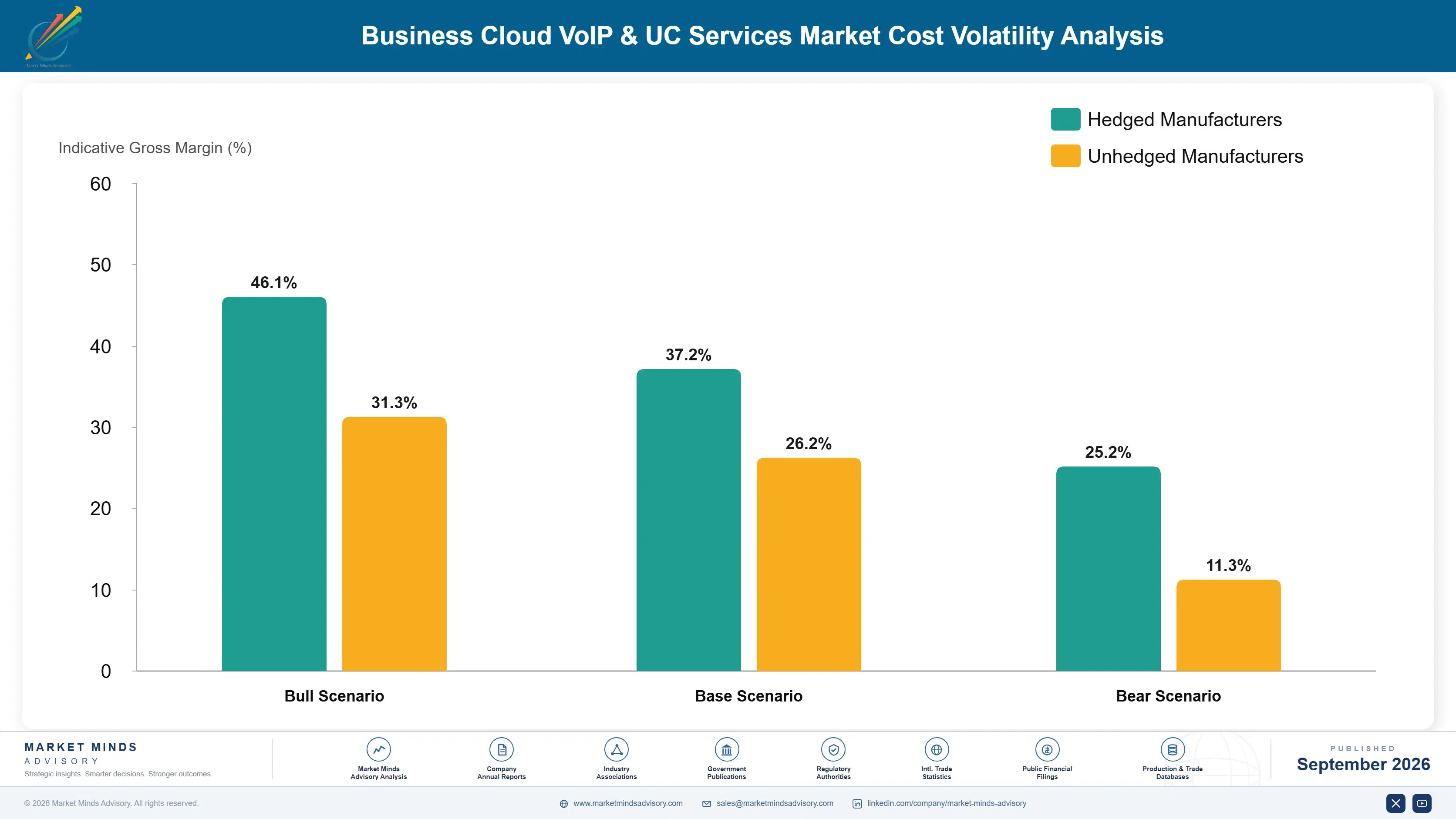
What Drives Cloud UC Delivery Cost

Cloud hosting and processing infrastructure account for roughly 31% of platform delivery cost, sourced primarily from major cloud providers whose global data center footprint determines achievable call quality latency for geographically distributed enterprise customers. Engineering talent for AI feature development and integration work makes up a further substantial share of ongoing cost, concentrated among specialized machine learning and telephony engineers.
Cloud compute costs rose meaningfully during 2024 as broader artificial intelligence workload demand competed for the same data center capacity that AI transcription and analysis features depend on, a trend documented in several major cloud provider annual reports for that fiscal year. Vendors running dense AI processing infrastructure absorbed several quarters of margin compression before renegotiating volume-based hosting contracts that partially offset the increase going forward.

Vendors operating their own data center infrastructure, namely Microsoft and Cisco, weathered the compute cost spike better than smaller vendors who rent hyperscale capacity at retail pricing tiers and had far less negotiating leverage during the shortage. That gap in cost exposure is pushing smaller vendors toward multi-cloud sourcing strategies and longer-term committed-use contracts that trade some flexibility for meaningfully better unit pricing.
business-cloud-voip-uc-services-market-cost-volatility-analysis-1789986485273

Multi-Cloud Committed-Use Sourcing Contracts

Several vendors have signed committed-use contracts spanning multiple cloud providers rather than relying on a single vendor, trading some operational simplicity for meaningfully better unit pricing and reduced exposure to any single provider's future price increases during peak demand periods. This diversification reduces exposure to allocation constraints during periods of high demand competition. Franchisees report faster access.

Model Efficiency Optimization to Reduce Inference Cost

Engineering teams are optimizing AI transcription and analysis model architecture specifically to reduce compute cost per processed call, meaningfully lowering the inference expense that dominates AI feature delivery cost without sacrificing the accuracy enterprise customers expect from these tools. Engineering teams report meaningfully improved cost efficiency without sacrificing transcription accuracy at all. Cost per call keeps falling.

Edge Processing to Reduce Core Infrastructure Load

Vendors are pushing more call quality optimization logic to lightweight edge nodes rather than routing every processing task back to centralized servers, meaningfully reducing core infrastructure load while also improving latency for geographically distant enterprise customers and their remote workers. This architecture also improves reliability for enterprise customers operating across multiple time zones. Latency improvements benefit every distant user.

Portfolio Architecture for Margin Defence

Portfolio economics split into three tiers running from basic hosted telephony through certified enterprise unified communications platforms to next-generation AI feature and integration service offerings carrying the richest margin. Volume tier products compete on price against low-cost hosted VoIP providers, while premium and next-generation tiers retain pricing power tied to AI feature depth and measured enterprise reliability built up over multiple contract renewal cycles. That gap has held steady for years despite challenger investment.
The tension between volume and premium tiers shows up clearest among mid-market enterprises, who want flagship-level AI capability and integration depth at a fraction of large enterprise pricing and are increasingly served by standardized platform tiers borrowing capability originally built for the largest flagship customers. Vendors manage that tension by keeping the richest AI and integration features exclusive to premium contract tiers for as long as commercially possible. Vendors who misjudge this trade-off risk losing volume within a single renewal cycle.

High-value margin pools concentrate in AI feature tiers and enterprise integration services, both of which the top five vendors currently capture disproportionately relative to their base seat licensing market share alone. Smaller vendors instead compete on niche vertical specialization where leaders choose not to invest.

Volume / Commodity-Adjacent Tier

Basic hosted telephony and messaging seats competing mainly on price against low-cost hosted VoIP providers serving smaller businesses. Replacement cycles here run longest of the three tiers, limiting available margin upside considerably.
Gross Margin: 24-32%

Premium / Certified Tier

Unified communications platforms with reliable enterprise-grade infrastructure and dedicated customer success support trusted across large organizations. This tier anchors most vendor profitability during any given fiscal year currently. Buyers value this tier highly.
Gross Margin: 44-52%

Sustainability / Regulatory / Next-Generation Tier

AI feature tiers, enterprise integration services, and contact center bundles layered on top of base platforms, commanding the richest margin available. Adoption here is still climbing steeply among large enterprise buyers each year.
Gross Margin: 56-64%
business-cloud-voip-uc-services-market-portfolio-architecture-1789986485773

High-value Sub-segments and Strategic Watch-out

AI Feature Tiers for Enterprise Accounts

This segment combines strong growth with the richest margin in the category, since AI infrastructure already built for platform purposes requires little incremental cost to package into premium seat tiers. Vendor research budgets increasingly prioritize this segment over legacy connectivity features alone. This priority shows no sign of shifting soon.
Gross Margin: 56-64%

Enterprise Integration and Migration Services

Integration services carry strong margin and steady growth tied to legacy PBX replacement cycles as more enterprises reach hardware end-of-life deadlines requiring migration each year. Enterprises increasingly expect this capability bundled at no additional negotiation effort required. Enterprises increasingly expect this as a baseline procurement expectation.
Gross Margin: 48-56%

Basic Hosted Telephony and Messaging Seats

The largest unit volume pool remains basic hosted telephony bundled into standard subscriptions, where growth is moderate and margin is thin, but scale remains commercially essential. Vendors rarely walk away from this tier despite its comparatively thinner margin profile. Scale remains essential to funding development elsewhere.
Gross Margin: 24-32%

Legacy On-Premises PBX Migration Contracts

One-time PBX migration contracts carry decent margin today but face a shrinking addressable base as most large enterprises complete their initial cloud transition within the next several years. Vendors are gradually sunsetting these contracts as remaining legacy hardware completes retirement. Revenue should decline gradually rather than collapse suddenly.
Gross Margin: 32-40%

Why Cloud UC Contracts Compound

Cloud UC contracts behave like annuity assets rather than one-time software purchases, since AI feature tiers, integration services, and contact center bundling all generate ongoing revenue against a single initial platform decision for years afterward. Vendors treating a deployment as a one-time sale cede lifetime value to rivals building recurring layers on top of the same enterprise relationship. Vendors ignoring this compounding potential lose ground to better-instrumented rivals over time.
Adoption depth varies sharply by function. Enterprise contact center operations integrate unified communications into multi-year customer experience programs with dedicated budget lines, producing deep, sticky relationships that survive individual product upgrade cycles and vendor sales team turnover alike. Small business customers, by contrast, often adopt through simpler standalone contracts, making that buyer segment more price-sensitive and more likely to switch vendors when contracts renew. Vendors courting large enterprise accounts increasingly design tools around that stickier renewal pattern.

A generational shift is also underway as IT leaders who came up entirely in the cloud-native era treat AI-powered communications as the obvious default architecture rather than a migration project, skipping the extended pilot-program evaluation stage that leaders who managed earlier PBX transitions still often insist on running first.
business-cloud-voip-uc-services-market-end-use-penetration-index-1789986486270

Where To Place Cloud UC Bets

These are among the four positions where our research anticipates prominent divergence between winners and laggards over the coming forecast period. Each is grounded in the demand model, the regulatory perimeter, and the announced capacity pipeline.
01 / AI FEATURE INVESTMENT PRIORITY

Build embedded AI before it becomes table stakes

Vendors still selling communications as pure connectivity infrastructure are leaving durable margin on the table while leaders expand AI transcription and summarization features that enterprises increasingly treat as a baseline requirement rather than a premium extra. The window to build comparable AI capability is narrowing as more competing platforms ship comparable features, consolidating buyer expectations around functionality that used to differentiate premium tiers alone, risking permanent loss of preferred vendor status for those who wait. Smaller vendors should prioritize AI feature integration now, even at meaningful engineering cost.
02 / ENTERPRISE INTEGRATION SERVICES

Build dedicated integration teams ahead of large enterprise migration wave

Large enterprise cloud UC migrations increasingly require specialized integration capability that generic implementation teams cannot deliver reliably, and vendors without this capability risk losing enterprise deals to rivals with proven migration methodology already in place. Building this capability requires investment in specialized engineering staffing beyond typical sales support, but the premium project revenue it delivers compounds through renewed contracts rather than any single project alone. Vendors that invest in integration capability now will win disproportionate enterprise migration share across every major account segment.
03 / CONTACT CENTER CROSS-SELL STRATEGY

Build contact center bundling capability to capture incremental revenue from existing accounts

Contact center integration represents a significant cross-sell opportunity within an existing communications customer base, and vendors without bundled contact center capability are ceding this revenue to specialized competitors who can offer a more complete solution to the same accounts. Building this capability requires investment beyond core communications infrastructure, but the cross-sell revenue captured from customers who already trust the vendor's core platform meaningfully justifies that investment, and vendors that win these relationships anchor customer accounts for years. Vendors that invest now will capture disproportionate contact center share.
04 / COMPUTE COST RESILIENCE PLANNING

Diversify cloud infrastructure sourcing before the next AI compute cost spike arrives

The 2024 compute cost spike demonstrated how exposed vendors renting single-provider hyperscale capacity at retail pricing are to broader artificial intelligence infrastructure demand entirely outside their own control. Vendors should pursue committed-use multi-cloud contracts and model efficiency optimization simultaneously rather than betting on any single mitigation working alone to protect margin, since diversified sourcing now proves meaningfully more resilient than single-provider reliance across the industry. Waiting for the next cost spike to begin diversifying will repeat the same margin compression smaller vendors absorbed during 2024.

Engagement Snapshot From the Field

A live engagement with an industry participant carrying material or product regulatory and market exposure ahead of a defining policy shift, showing how our research translates into a defensible multi-year portfolio strategy.
MARKET MINDS ADVISORY · CLIENT ENGAGEMENT SUMMARY
Business Cloud VoIP & UC Services Producer Strategic Portfolio Review and Transition Roadmap 2026·Investment Scenario on Business Cloud VoIP & UC Services Exposure Evaluation 2025-26
CLIENT PROFILE
The client operates a mid-sized regional insurance carrier running a legacy on-premises PBX system supporting several thousand employees across dozens of branch offices, with the hardware approaching a manufacturer end-of-support deadline that would leave the system unpatched against emerging security vulnerabilities. Rising maintenance costs on the aging infrastructure had already strained the client's IT budget for two consecutive years.
STRATEGIC CHALLENGE
Management needed to decide which cloud UC vendor could best support integration with the client's existing customer relationship management and claims processing systems, while also evaluating how quickly the migration needed to complete given the approaching hardware end-of-support deadline and limited internal IT staff capacity to manage a complex multi-branch transition.
MMA APPROACH
MMA benchmarked the client's existing infrastructure and integration requirements against comparable insurance carrier cloud UC migrations and vendor pricing gathered through primary interviews with peer companies. The engagement modeled three migration pacing scenarios against the hardware end-of-support deadline and separately assessed each finalist vendor's claims system integration capability. The analysis also weighed internal IT staffing constraints against vendor-supported migration timelines.
KEY FINDINGS
  1. The selected vendor's pre-built insurance industry integration templates reduced projected implementation timeline considerably compared to custom development alternatives., exceeding what the client's IT team had initially projected
  2. Branch-by-branch phased migration reduced operational disruption risk considerably compared to an all-at-once cutover approach across every location., a meaningful factor in the final rollout sequencing decision
  3. AI-powered call summarization proved particularly valuable for claims documentation workflows the client had not initially prioritized in vendor evaluation., a benefit the client had not initially prioritized
  4. Competing insurance carriers that delayed similar migrations faced measurably higher security exposure after their hardware support deadlines passed., a pattern the client specifically wanted to avoid repeating
CLIENT PROFILE
The client operates a mid-sized regional insurance carrier running a legacy on-premises PBX system supporting several thousand employees across dozens of branch offices, with the hardware approaching a manufacturer end-of-support deadline that would leave the system unpatched against emerging security vulnerabilities. Rising maintenance costs on the aging infrastructure had already strained the client's IT budget for two consecutive years.
STRATEGIC CHALLENGE
Management needed to decide which cloud UC vendor could best support integration with the client's existing customer relationship management and claims processing systems, while also evaluating how quickly the migration needed to complete given the approaching hardware end-of-support deadline and limited internal IT staff capacity to manage a complex multi-branch transition.
MMA APPROACH
MMA benchmarked the client's existing infrastructure and integration requirements against comparable insurance carrier cloud UC migrations and vendor pricing gathered through primary interviews with peer companies. The engagement modeled three migration pacing scenarios against the hardware end-of-support deadline and separately assessed each finalist vendor's claims system integration capability. The analysis also weighed internal IT staffing constraints against vendor-supported migration timelines.
KEY FINDINGS
  1. The selected vendor's pre-built insurance industry integration templates reduced projected implementation timeline considerably compared to custom development alternatives., exceeding what the client's IT team had initially projected
  2. Branch-by-branch phased migration reduced operational disruption risk considerably compared to an all-at-once cutover approach across every location., a meaningful factor in the final rollout sequencing decision
  3. AI-powered call summarization proved particularly valuable for claims documentation workflows the client had not initially prioritized in vendor evaluation., a benefit the client had not initially prioritized
  4. Competing insurance carriers that delayed similar migrations faced measurably higher security exposure after their hardware support deadlines passed., a pattern the client specifically wanted to avoid repeating
RECOMMENDED STRATEGY
Phase 1: Phase 1 (Months 1 to 3): Migrate headquarters staff and highest-priority branch offices ahead of the support deadline., coordinating closely with the vendor's dedicated migration team Phase 2: Phase 2 (Months 4 to 8): Complete branch-by-branch migration across remaining locations with claims system integration., monitoring integration performance closely throughout the rollout Phase 3: Phase 3 (Months 9 to 11): Retire legacy PBX infrastructure entirely and expand AI feature adoption across claims teams., ahead of the next annual budget planning cycle
OUTCOME
Within eleven months the client reported completing migration ahead of the hardware end-of-support deadline, alongside meaningfully faster claims documentation turnaround using AI call summarization (client-reported, unverified by MMA), attributing both improvements to the phased migration approach and the vendor's insurance-specific integration capability. Staff satisfaction with the new claims workflow also improved measurably during the transition.

Frequently Asked Questions

Foundational context covering the market sizes, CAGR, scope, country, region and competition that inform every finding below. This section is provided to cover basics and most often pre-purchase conversations, answered from the MMA Primary Research Dataset.

What is the current size of the Business Cloud VoIP & UC Services Market?

The market is valued at 28.5 billion dollars in 2025. It is projected to reach 31.5 billion dollars in 2026 as legacy PBX replacement accelerates.

How large will the Business Cloud VoIP & UC Services Market be by 2036?

The market is projected to reach roughly 85.5 billion dollars by 2036. That represents nearly three times the 2026 value over the ten-year forecast window.

What is the CAGR for the Business Cloud VoIP & UC Services Market 2026 to 2036?

The base case CAGR is 10.5% annually through 2036. Bull and bear scenarios range from 9.3% to 11.8% depending on AI feature pace and PBX replacement timelines.

Which segment is growing fastest?

AI-powered meeting and collaboration tools lead at a 15.0% CAGR, well ahead of every other segment. That pace is roughly 1.43 times the overall market's average growth rate.

Who are the major companies in the Business Cloud VoIP & UC Services Market?

Microsoft, Cisco, RingCentral, Zoom, and 8x8 lead the category by revenue, together holding roughly forty percent of total global category revenue across every application segment.

Which country is growing fastest?

The United States leads country-level growth at an 11.5% CAGR, ahead of every other national market tracked. Dense cloud communications vendor concentration drives that pace.

Report Segmentation Architecture

The full report scope spans multiple orthogonal segmentation dimensions, with cross-tabulated demand data provided for each dimension pair. Coverage extends further to regional breakdowns, trend trajectories, and the competitive detail needed to support segment-level decision-making.

By Service Function Type

  • AI-Powered Meeting and Collaboration Tools
  • Unified Communications as a Service Platforms
  • Hosted VoIP Telephony Services
  • Contact Center as a Service Integration
  • SIP Trunking Services
  • Mobile and Remote Worker UC Extensions

By End-Use Industry

  • Financial Services
  • Technology and Business Services
  • Healthcare
  • Retail and Consumer
  • Government and Public Sector

By Commercial Dimension

  • Direct Enterprise Licensing
  • Platform-Bundled Distribution
  • Managed Integration Services
  • Contact Center Cross-Sell Bundles

By Region

  • North America
  • Western Europe
  • East Asia
  • South Asia and Pacific
  • Latin America
  • Middle East and Africa
  • Eastern Europe

Scope, Methodology, and Coverage

Every figure in this report is reproducible from documented input assumptions. The scope below maps the historical period, the forecast horizon, the segmentation dimensions, and the countries covered, alongside the underlying primary and qualitative methodology.
Historical Period
2020 to 2025
Forecast Period
2026 to 2036
Base Year
2025 (USD billions; MMA Primary Research Dataset, September 2026)
Market Definition
This report covers business cloud VoIP and unified communications services, hosted telephony, messaging, video conferencing, and collaboration platforms delivered as a subscription service to enterprise and mid-market business customers. It excludes consumer-grade VoIP applications not marketed for business use, on-premises PBX hardware sold without a hosted service component, and standalone video conferencing tools not integrated into a broader unified communications platform.
Quantitative Units
USD billions (current prices); enterprise seat counts where applicable
Segmentation Dimensions
By Service Function Type; By End-Use Industry; By Commercial Dimension; By Region
Regions Covered
North America, Western Europe, East Asia, South Asia and Pacific, Latin America, Middle East and Africa, Eastern Europe
Countries Covered
USA, China, Germany, France, UK, Japan, South Korea, India, Australia, Canada, Brazil, Mexico, Indonesia, Vietnam, Thailand, Malaysia, UAE, Saudi Arabia, South Africa, Nigeria, Turkey, Poland, Netherlands, Italy, Spain, Sweden, Switzerland, Argentina, Colombia, Singapore, and additional markets relevant to this sector
Key Companies Profiled
Microsoft Corporation, Cisco Systems Inc, RingCentral Inc, Zoom Communications Inc, 8x8 Inc, Vonage Holdings Corp, Nextiva Inc, Dialpad Inc, GoTo Technologies USA Inc, Twilio Inc, Genesys Cloud Services Inc, NICE Ltd, Five9 Inc, Ooma Inc, Mitel Networks Corporation, Avaya Inc, Intermedia Cloud Communications Inc, Wildix srl, Bandwidth Inc, Zoho Corporation
Quantitative Methodology
Primary survey, n=3,800 respondents, Q4 2025, six countries; demand-side model with trade association cross-validation
Qualitative Methodology
47 expert interviews, Q4 2025; applied to validate demand model assumptions, identify emerging dynamics, and assess competitive positioning
Report Format
PDF and XLSX data workbook (Word format preview document)
Publisher
Market Minds Advisory
Report Code
MMA-2026-TEC-603
Published
September 2026
Contact
sales@marketmindsadvisory.com | www.marketmindsadvisory.com

Purchase the full Business Cloud VoIP & UC Services Market Report (2026 to 2036).

The full report delivers a complete quantitative and qualitative assessment of the business cloud VoIP and unified communications market through 2036, including segment-level sizing across all six service function categories and country-level detail across thirty markets. It profiles twenty vendors with comparative positioning on AI feature depth, integration capability, and contact center bundling. Analysts also model three forecast scenarios against AI feature pace and PBX replacement timelines. Buyers receive the underlying data tables, primary survey results from 3,800 respondents, and 47 expert interviews supporting every forecast assumption in the report.
Segment-level sizing across six service function categories
Country-level data across thirty covered markets
Comparative competitive profiles of twenty vendors
Primary survey results from 3,800 respondents
Expert interview transcripts from 47 professionals
Five-year revenue lever and margin analysis

Built For The People Who Decide

From boardroom strategy to bench-side execution, this report is read cover-to-cover by leaders shaping the next decade of their industry, turning demand scenarios, market dynamics and valuation benchmarks into decisions.
CXOs/ Presidents/ VPs/ Managers
M&A and Corporate Development
Strategy Teams and R&D Heads
Procurement and Product Directors
Regulatory and Compliance Leaders
Investor Relations and Equity Analysts