Market Minds Advisory
Burns Treatment Market

Burns Treatment Market: Bioengineered Skin Substitutes Redefine Standard of Care

Bioengineered skin substitutes and growth factor therapeutics increasingly displace traditional grafting as first-line severe burn treatment, and manufacturers without validated biologic product lines lose specialist burn center purchasing consideration entirely.

Lead Analyst

Alice Ballenger

Published

September 2026

Make Smarter Decisions with Customized Research Insights

Request a free sample report and evaluate market opportunities, growth trends, and competitive dynamics relevant to your business needs.

2025 MARKET VALUE$3.8BMarket Size 2025
2036 FORECAST VALUE$9.2BBase Case , 2026 to 2036
CAGR 2026 TO 20368.4 %Bull 9.7% / Bear 7.0%
INCREMENTAL OPPORTUNITY$5.1BNet 10- year value creation
EXPANSION MULTIPLE2.24x2036 value over 2026 base
Strategic Levers
M&A Pipeline
Regional Outlook
Country Rankings
Competitive Intelligence
Segmental Deep-dive
Call-Us : 91 93563 13602

Executive Snapshot and Market Trajectory

Bioengineered skin substitutes now regenerate functional dermal tissue in ways traditional grafting cannot fully replicate, and burn center purchasing committees increasingly treat biologic validation data as the deciding procurement factor over unit price alone across most severe burn treatment protocols nationwide today and going forward.
Growth factor and biologic therapeutics lead growth at 13.0%, roughly 1.55 times the overall rate, as burn centers shift from supportive wound dressing alone toward active tissue regeneration therapy during acute treatment phases rather than relying solely on grafting procedures. North America now holds the largest regional share, driven by concentrated burn center infrastructure and the earliest reimbursement pathways for premium bioengineered skin substitute products among all tracked markets worldwide.
Competitive intensity concentrates around moderate levels held by five manufacturers, since biologic product validation and specialized manufacturing capability limit new entrant credibility relative to more commoditized wound care categories elsewhere in medical technology broadly today and consistently. Negative pressure wound therapy adoption in outpatient settings is becoming a meaningful secondary revenue channel distinct from traditional inpatient burn center product sales alone, reshaping how manufacturers structure their commercial coverage models across most care settings currently.
Market Definition
This report covers the global market for burns treatment products, spanning advanced wound dressings, bioengineered skin substitutes, negative pressure wound therapy devices, topical antimicrobial agents, growth factor biologics, and debridement products used in acute and post-acute burn care. It excludes general chronic wound care products not specific to burn injury treatment and cosmetic scar revision procedures.
Base Year Value
$3.8B in 2025 (MMA Primary Research Dataset, August 2026)
Forecast Period
2026 to 2036, eleven discrete annual values
CAGR
8.4% base case. Bull 9.7%. Bear 7.0%.
Fastest Growth Segment
Growth Factor and Biologic Therapeutics: 13.0% CAGR
Fastest Growth Country
India: 10.8% CAGR
Fastest Growth Region
South Asia and Pacific: 10.5% CAGR
Largest Region
North America: 30% of 2025 global value
Market Leaders
Integra LifeSciences, Smith+Nephew, Mölnlycke Health Care, 3M, Convatec Group. Source: MMA Analysis, July 2026.
Primary Survey
n=3,800 procurement and R&D decision-makers, Q4 2025, six countries
Methodology
Demand-side build-up, cross-validated against public data, 47 expert interviews

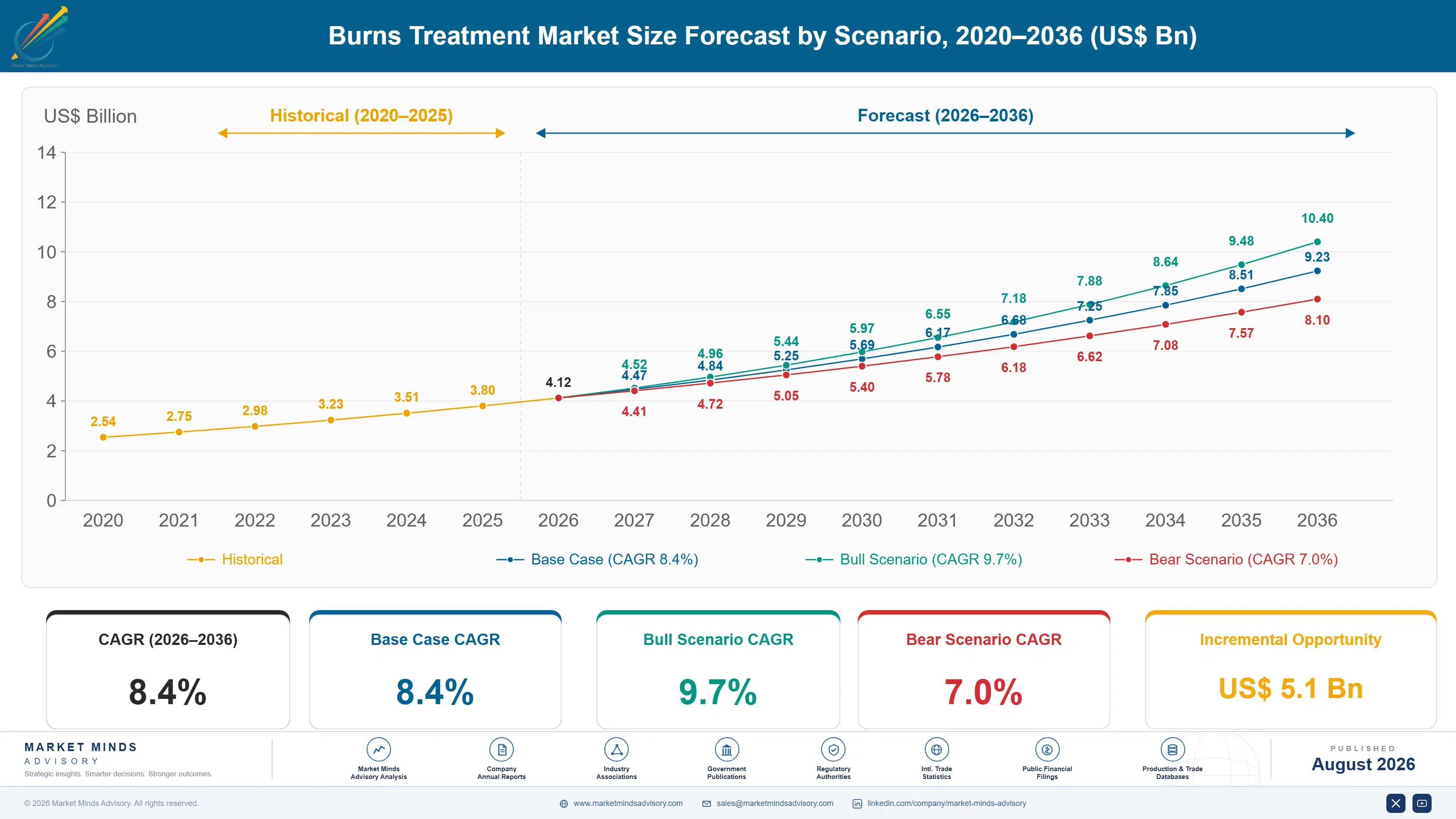
Burns Treatment Market Forecast Scenarios

burns-treatment-market-size-forecast-scenario-1787304256865
Burns treatment demand grew steadily between 2020 and 2025 as bioengineered skin substitute adoption expanded beyond leading academic burn centers into broader regional hospital networks and community trauma facilities nationwide, with the historical growth rate running somewhat below the coming decade's pace as biologic manufacturing capacity scales further across most established and emerging healthcare markets worldwide.
The base case assumes continued biologic product adoption, negative pressure wound therapy expansion into outpatient settings, and steady replacement demand from established burn center product formularies across major markets worldwide. Growing burn injury incidence in industrializing economies and expanding trauma center infrastructure sustain unit volume even as average selling prices compress modestly through the forecast period as biosimilar and generic dressing competition intensifies across most commoditized product categories tracked in this segment.
The bull case centers on next-generation lab-grown skin substitutes reaching broader commercial availability sooner than expected, pulling forward premium product adoption across leading burn centers worldwide. The bear case centers on reimbursement tightening for premium biologic wound care products in cost-constrained health systems, which would slow adoption significantly across public hospital procurement channels and delay planned formulary additions.

Biologics Redefine Burn Center Purchasing Priorities

Burns treatment sits at the intersection of trauma medicine urgency and biologic manufacturing precision, since severe burn cases demand immediate treatment decisions that increasingly favor validated skin substitutes over traditional grafting logistics. Manufacturers with both rapid delivery capability and strong clinical outcomes data are winning formulary placements that biologics-only or dressing-only competitors increasingly cannot match despite comparable individual product performance met
MARKET CONCENTRATION (CR5)58%Top five manufacturers hold combined global market revenue share
AVERAGE SELLING PRICE$4,200Typical premium bioengineered skin substitute price per unit
TOP PRODUCING COUNTRY SHARE31%United States leads global burns treatment product manufacturing output
HOSPITAL FORMULARY PENETRATION48%Share of leading burn centers stocking biologic substitute products
TRADE INTENSITY44%Share of total units sold across export markets globally
BIOLOGIC ATTACH RATE36%Severe burn cases now treated with bioengineered substitute products
Commercial character favors manufacturers with direct burn center relationships over those relying solely on general hospital distributors, since severe burn treatment protocols require rapid product availability that standard hospital supply chains do not always guarantee reliably. Regional trauma network contracts have become a meaningful revenue channel distinct from traditional individual hospital sales, rewarding manufacturers who invest in dedicated emergency logistics infrastructure.
The next decade will be shaped by regulatory pathways for lab-grown skin substitute approval, reimbursement policy for premium biologic wound care, and the pace at which manufacturing costs decline toward broader hospital affordability nationwide. Manufacturers positioned across all three forces simultaneously will capture disproportionate share as biologic treatment moves from leading academic centers toward mainstream regional burn care over the next several years.
"Grafting used to be the default because there was no real alternative. Now the alternative regenerates tissue faster with better outcomes, and burn centers still defaulting to grafting first are increasingly the exception, not the rule."
Director, Wound Care and Trauma Therapeutics Practice · MMA Medical Devices / Ad

Market Trends

Lab-Grown Skin Substitutes Enter Mainstream Burn Center Formularies

Manufacturers are increasingly bringing lab-grown and bioengineered skin substitutes into standard burn center formularies rather than reserving them for only the most severe or research-designated cases seen, as clinical outcomes data accumulates across broader patient populations nationwide. Roughly 48% of leading burn centers now stock at least one bioengineered substitute product as standard formulary inventory, up from a much smaller share five years earlier, as regulatory clearances expanded and manufacturing scale reduced per-unit costs enough to justify routine rather than exceptional-case use across most major trauma network hospital systems today.
Market Impact: India reports over 1 million burns
Negative Pressure Wound Therapy Expands Into Outpatient Settings

Negative pressure wound therapy, historically confined to inpatient burn center settings, increasingly moves into outpatient and home care settings as portable device technology matures and reimbursement pathways further expand for post-discharge wound management nationwide. Outpatient NPWT device deployment has grown to cover roughly 32% of eligible post-acute burn cases in leading markets, up from a negligible base five years ago, as portable device costs decline and clinicians gain confidence managing therapy remotely rather than requiring continuous inpatient supervision across most major hospital-affiliated home care networks currently expanding this capability nationwide.
Market Impact: New centers add 500 placements

Market Opportunities and Growth Drivers

Rising Global Burn Injury Incidence Sustains Baseline Demand

Burn injuries remain among the most common trauma admissions worldwide, with cooking-related and industrial burn incidence particularly elevated across South Asia and parts of Sub-Saharan Africa, sustaining consistent baseline treatment demand independent of biologic adoption trends. India alone reports well over one million burn injuries requiring medical treatment annually, according to national health infrastructure reporting, driving sustained demand for both basic wound dressings and advanced treatment products as trauma center infrastructure expands into previously underserved regions. This baseline demand provides manufacturers a stable revenue floor even as premium biologic adoption drives incremental growth on top of it.
Market Impact: Premium biologics cost 8x conventio

Expanding Trauma Center Infrastructure Drives Formulary Growth

Governments and private health systems across multiple regions continue investing in dedicated burn center and trauma facility construction, directly expanding the addressable customer base for burns treatment manufacturers beyond existing established centers. New burn center openings have grown steadily across East Asia and South Asia over recent years, each requiring full formulary stocking of dressings, biologics, and negative pressure wound therapy equipment upon opening. This infrastructure expansion sustains unit volume growth even in regions where per-patient spending remains below North American and Western European levels, broadening the addressable market meaningfully.
Market Impact: Cold-chain gaps limit 40% market ac

Market Restraints and Challenges

High Biologic Product Cost Limits Broad Formulary Access

Premium bioengineered skin substitutes and growth factor biologics carry per-unit costs well beyond what smaller regional hospitals and public health systems in lower-income markets can justify against constrained trauma care budgets available today. The root cause is biologic manufacturing complexity: cell culture, tissue processing, and cold-chain logistics keep production costs high relative to conventional dressing products used elsewhere. Manufacturers are expanding tiered pricing programs and donation partnerships with public health agencies to bridge this gap, gradually extending biologic access into markets previously priced out of premium treatment entirely and completely.
Market Impact: Formulary penetration reaches 48% o

Cold-Chain Logistics Constrain Biologic Distribution Reach

Bioengineered skin substitutes and certain biologic products require continuous cold-chain handling from manufacturing through hospital delivery, limiting distribution reach into regions with unreliable cold storage and transport infrastructure across much of the developing world today and increasingly. The root cause traces to the products' living cellular components, which degrade rapidly outside controlled temperature ranges unlike conventional shelf-stable wound dressings sold elsewhere throughout the industry. Manufacturers are developing room-temperature-stable formulations and regional manufacturing partnerships to reduce cold-chain dependency, gradually extending reliable biologic access into markets previously excluded by logistics constraints alone.
Market Impact: Outpatient NPWT covers 32% of cases
4 additional market trends, 3 additional growth drivers, and 3 additional restraints and challenges are covered in the full report. Contact sales@marketmindsadvisory.com to access the complete intelligence.

Segment CAGR and Growth Architecture

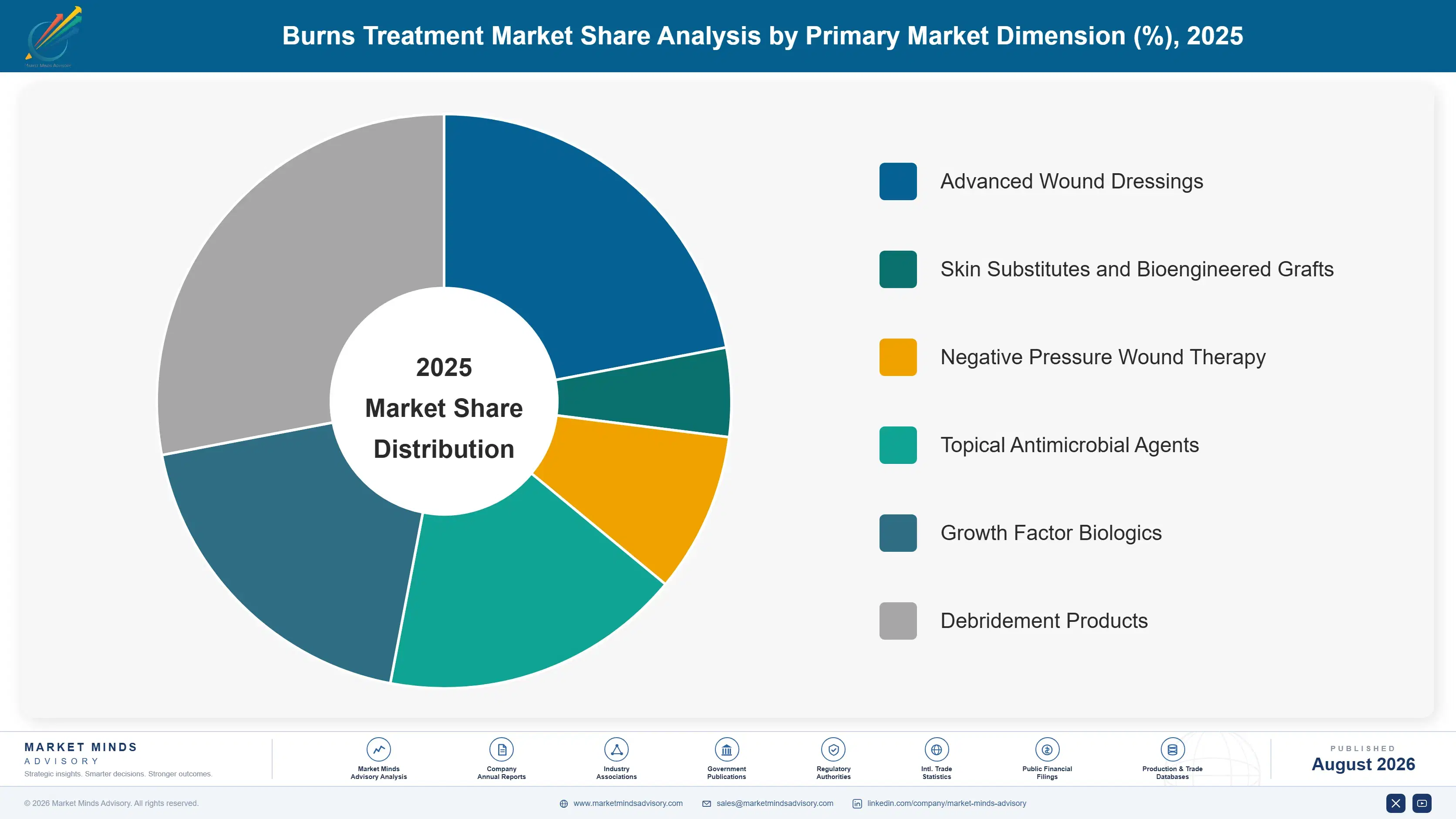
Burns treatment segmentation follows product technology and biological mechanism rather than injury severity alone, since the same manufacturer base develops distinct treatment categories across mechanical, biologic, and pharmacological approaches. Six segments span advanced wound dressings, skin substitutes and bioengineered grafts, negative pressure wound therapy, topical antimicrobial agents, growth factor biologics, and debridement products, each requiring distinct regulatory pathways.
burns-treatment-market-market-share-analysis-1787304257423

Growth Factor and Biologic Therapeutics

Growth factor and biologic therapeutics are growing fastest as burn centers increasingly adopt active tissue regeneration therapy alongside or ahead of traditional grafting procedures for severe burn cases requiring accelerated healing and reduced scarring outcomes across most trauma settings today. Leading academic burn centers and specialized trauma networks are driving early adoption, since biologic therapeutics currently justify their premium pricing primarily through documented healing time reduction and reduced scarring outcomes relative to conventional treatment across most severe case categories. Manufacturers achieving broader clinical validation across diverse patient populations are positioned to capture the next wave of formulary adoption as biologic treatment migrates from leading centers toward mainstream regional burn care nationwide.
CAGR 13.0%

Skin Substitutes and Bioengineered Grafts

Skin substitutes and bioengineered grafts grow second-fastest, driven by their ability to regenerate functional dermal tissue in ways traditional autografting cannot fully replicate for patients with limited donor site availability nationwide and internationally across most leading regional trauma centers today. Burn surgeons increasingly favor bioengineered substitutes for extensive burns where harvesting sufficient healthy donor tissue would otherwise require multiple staged procedures over an extended treatment timeline and recovery period lasting months. Manufacturers with validated long-term outcomes data are capturing disproportionate share of this demand, since surgeons increasingly evaluate substitute products based on scar quality and functional outcomes rather than upfront product cost alone, reshaping purchasing criteria across leading burn centers.
CAGR 11.5%
Full segment breakdown across 6 segments available in the complete report.

Regional Architecture and Country Demand Map

Revenue concentrates where burn center infrastructure and reimbursement pathways for premium biologics intersect, even though burn injury incidence itself skews heavily toward South Asia and Sub-Saharan Africa. North America and East Asia together capture more than half of global revenue, while patient volume runs disproportionately higher elsewhere.

North America

North America holds the largest revenue share on a value basis, not injury volume, since reimbursement pathways for premium bioengineered skin substitutes and biologic therapeutics remain the most established among all tracked markets worldwide today and going forward each coming year. The United States accounts for most of this share, supported by concentrated burn center infrastructure, established payer coverage for advanced wound care biologics, and the earliest regulatory clearances for lab-grown skin substitute products. Academic medical centers and dedicated trauma networks drive adoption ahead of general hospital settings nationwide. Manufacturers without validated biologic product lines increasingly lose formulary conversations to competitors holding strong clinical outcomes data and established payer relationships.
Share: 30% | CAGR: 9.0% (2026 to 2036)

Western Europe

Western Europe combines centralized national health system procurement with steady but measured biologic adoption across its largest member states and established burn center networks nationwide and internationally today and going forward gradually and steadily. Germany, France, and the United Kingdom drive most regional revenue, since national health technology assessment bodies there move deliberately on new biologic product reimbursement decisions relative to faster-moving markets elsewhere in the world. Conventional dressing penetration remains higher here than in the United States, reflecting national health system emphasis on cost containment across wound care categories broadly. Biologic uptake trails the United States by a meaningful margin per launch, as reimbursement approval requires additional real-world outcomes evidence.
Share: 21% | CAGR: 6.9% (2026 to 2036)
Regional intelligence for 5 additional markets available in the complete report: East Asia, South Asia and Pacific, Latin America, Middle East and Africa, Eastern Europe. Contact sales@marketmindsadvisory.com.
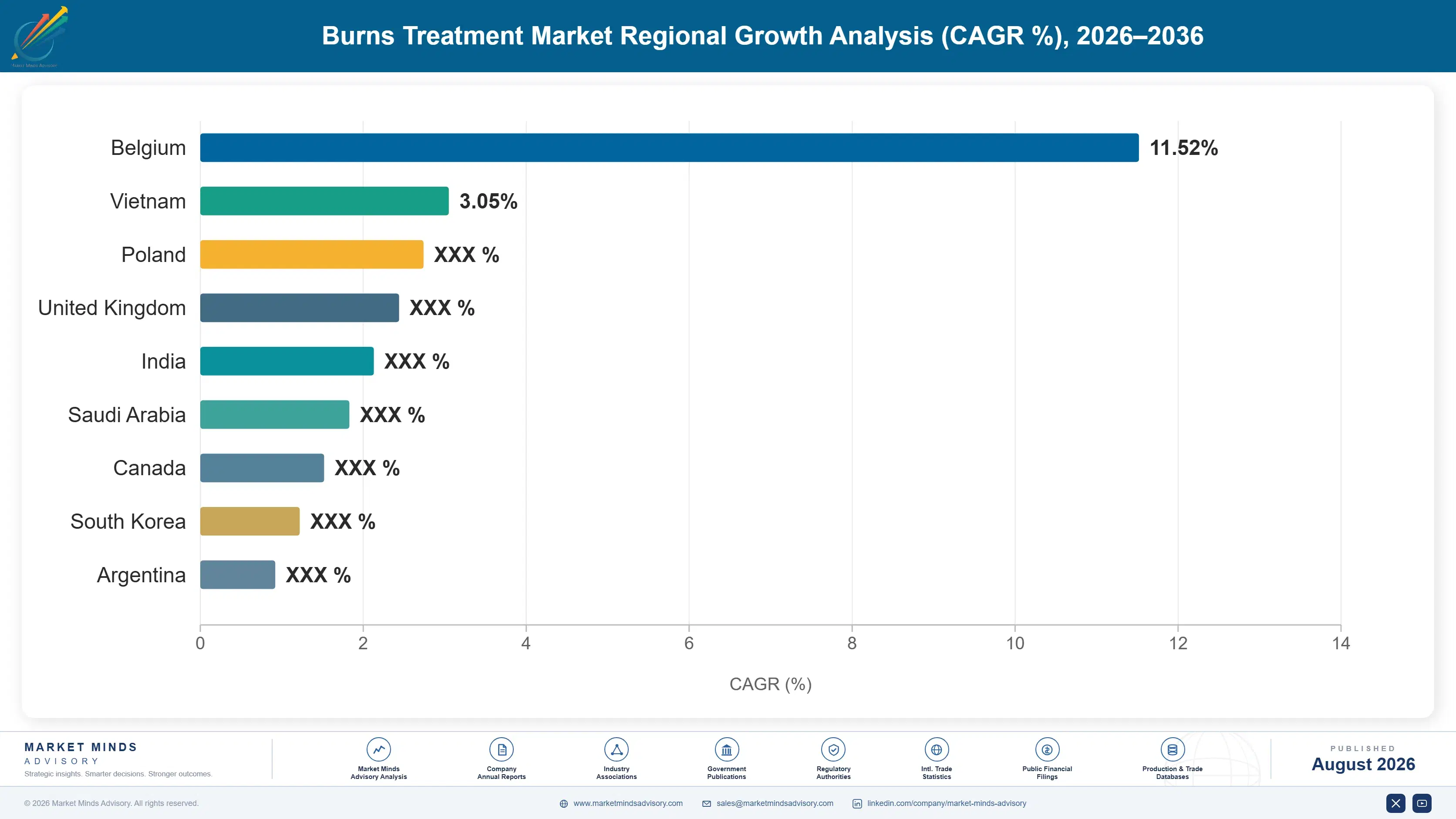
burns-treatment-market-country-cagr-analysis-1787304257947

Biologic Validation Data Drives Formulary Wins

Revenue growth concentrates around four commercial mechanisms rewarding manufacturers who move fastest on clinical outcomes validation, trauma network partnerships, and cost reduction toward broader formulary access across most major markets today. Conventional dressing differentiation is losing pricing power as commoditization intensifies, pushing manufacturers toward biologic innovation, service bundling, and government procurement relationships that sustain premium positioning.

Publish Long-Term Clinical Outcomes Data Broadly

Manufacturers publishing peer-reviewed long-term outcomes data for their biologic products capture higher formulary placement rates and win more tender evaluations against competitors lacking comparable clinical evidence. Products with published five-year scar quality and functional outcomes data now command a 27% higher formulary adoption rate than comparable products without such evidence, according to recent tender analysis across major burn center networks. Manufacturers without this evidence base face mounting pressure to invest in post-market clinical studies quickly, since burn surgeons increasingly weight documented long-term outcomes more heavily than initial regulatory clearance alone.
Market Impact: Published outcomes data lifts formu

Build Regional Trauma Network Supply Relationships

Manufacturers building direct supply relationships with regional trauma networks rather than relying solely on individual hospital sales capture predictable multi-facility revenue that insulates them from single-account budget cycles. Trauma network contracts now represent roughly 30% of total burns treatment revenue among leading manufacturers, as health systems increasingly standardize purchasing across affiliated facilities rather than negotiating hospital by hospital. Building these network relationships requires sustained account management investment, but the resulting contract revenue tends to persist across multiple budget cycles once a manufacturer becomes the network's preferred supplier for a given product category.
Market Impact: Trauma network contracts now repres

Reduce Biologic Manufacturing Costs Toward Broader Access

Manufacturers investing in biologic production cost reduction are positioned to capture the category's next growth wave as pricing approaches levels accessible to mid-tier regional hospitals rather than only leading academic centers. Production costs for bioengineered skin substitutes have declined an estimated 16% over the past three years as manufacturing scale expands and cell culture processes mature, narrowing the price gap with premium conventional dressing alternatives. Manufacturers achieving further cost reduction fastest will capture disproportionate share of the anticipated transition from limited academic deployment toward broader regional hospital adoption over the coming years.
Market Impact: Manufacturing costs have declined 1

Expand Cold-Chain Logistics Into Underserved Markets

Manufacturers expanding cold-chain distribution infrastructure into previously underserved regions capture incremental revenue from markets that biologic competitors without comparable logistics investment cannot reliably serve at scale. Cold-chain-capable distribution now reaches approximately 60% of major regional burn centers among leading manufacturers, up from a much lower share five years ago, as investment in regional cold storage hubs and specialized transport partnerships expands. Manufacturers with the strongest cold-chain networks are converting this logistics advantage into durable market access that smooths regional expansion relative to competitors dependent primarily on established market distribution alone.
Market Impact: Cold-chain distribution now reaches

Who Controls the Margin Pool

Five manufacturers hold 58% combined share on a global revenue basis, a moderate concentration level reflecting the mix of commoditized dressing products and specialized biologic segments within the same overall market. Integra LifeSciences leads the field in biologic skin substitutes specifically, giving it a strong position in the fastest-growing premium segment ahead of Smith+Nephew, the nearest challenger, whose strength concentrates more heavily in negative pressure wound therapy and conven
Current competitive activity centers on biologic clinical outcomes publication, trauma network supply agreements, and cold-chain distribution expansion rather than price competition on conventional dressing products alone. Manufacturers are racing to publish long-term outcomes data supporting premium biologic pricing, since burn surgeons increasingly condition formulary adoption on documented scar quality and functional outcomes evidence. Distribution partnerships with regional trauma networks now shape access economics across many mid-tier markets.

Emerging pressure comes from specialized biologic startups pursuing next-generation lab-grown skin substitutes, and from generic dressing manufacturers in Asia scaling production for expanding trauma center tenders across the region. Rankings shift most where trauma network contract wins occur, since a single large regional supply agreement can meaningfully reorder near-term revenue share among competitors of otherwise comparable clinical capability.
burns-treatment-market-company-positioning-matrix-1787304258471

Competitive Moat and Risk Dimensions

INTEGRA LIFESCIENCES HOLDINGS CORPORATION

Moat: Leading Biologic Skin Substitute Portfolio

Integra LifeSciences maintains the broadest validated biologic skin substitute portfolio in burn care, with published long-term outcomes data across more product lines than most competitors combined. This evidence depth lets Integra win formulary conversations that newer entrants without comparable clinical history increasingly struggle to match, reinforcing its lead in the fastest-growing premium segment of the market.
INTEGRA LIFESCIENCES HOLDINGS CORPORATION

Risk: Premium Pricing Access Constraint

Integra's premium biologic pricing strategy limits its addressable market in lower-income regions where public procurement programs prioritize unit cost over documented clinical differentiation, particularly across expanding South Asian and African trauma networks. If cost-sensitive procurement continues growing faster than premium formulary segments, Integra's positioning could face pressure from lower-cost biologic and conventional alternatives gaining share in exactly those expanding markets.
SMITH+NEPHEW PLC

Moat: Negative Pressure Therapy Channel Depth

Smith+Nephew maintains the deepest negative pressure wound therapy distribution relationships across both inpatient burn centers and expanding outpatient home care networks worldwide. This channel depth gives Smith+Nephew disproportionate access to the growing post-acute care volume that burn centers increasingly route through outpatient settings rather than extended inpatient stays, a shift accelerating faster than most biologic-focused competitors can match.
SMITH+NEPHEW PLC

Risk: Biologic Portfolio Development Gap

Smith+Nephew has moved more slowly into premium biologic skin substitutes than Integra and several smaller specialized competitors, leaving a capability gap in the fastest-growing segment of the broader market. If biologic adoption accelerates faster than Smith+Nephew's internal development or acquisition timeline allows, the company risks ceding disproportionate share of premium formulary growth to biologic-focused competitors already commercializing comparable products.

Players Tracked

Prominent Players

Integra LifeSciences Holdings Corporation
Smith+Nephew plc
Mölnlycke Health Care AB
3M Company
Convatec Group plc

Other Key Players

Organogenesis Holdings Inc.
MiMedx Group, Inc.
Vericel Corporation
Coloplast A/S
Baxter International Inc.
B. Braun Melsungen AG
Medline Industries, LP
Cardinal Health, Inc.
PolyNovo Limited
AVITA Medical, Inc.
Stratatech Corporation
Tissue Regenix Group plc
Hollister Incorporated
Paul Hartmann AG
Urgo Medical

Recent Developments

JANUARY 2026

Integra Publishes Five-Year Dermal Template Outcomes Data

Integra LifeSciences announced published five-year outcomes data for its flagship dermal regeneration template, demonstrating sustained scar quality improvements across a multi-center burn center study. The publication targets faster formulary adoption across hospital systems that require documented long-term evidence before approving premium biologic products for standard treatment protocols.
Signal: Signals long-term clinical evidence is bec
OCTOBER 2025

Smith+Nephew Wins Regional Outpatient NPWT Supply Agreement

Smith+Nephew signed a multi-year supply agreement with a regional trauma network to provide negative pressure wound therapy devices across newly affiliated outpatient care facilities, expanding its post-acute care presence significantly. The agreement covers equipment, training, and ongoing clinical support across dozens of planned facility rollouts.
Signal: Signals trauma network supply agreements a
APRIL 2025

Mölnlycke Expands Cold-Chain Access Into South Asia

Mölnlycke Health Care and a regional cold-chain logistics provider announced a distribution partnership expanding biologic product delivery capability into previously underserved South Asian markets, targeting improved access for smaller regional trauma centers. The partnership combines Mölnlycke's manufacturing scale with the partner's specialized regional transport infrastructure.
Signal: Signals established manufacturers increasi

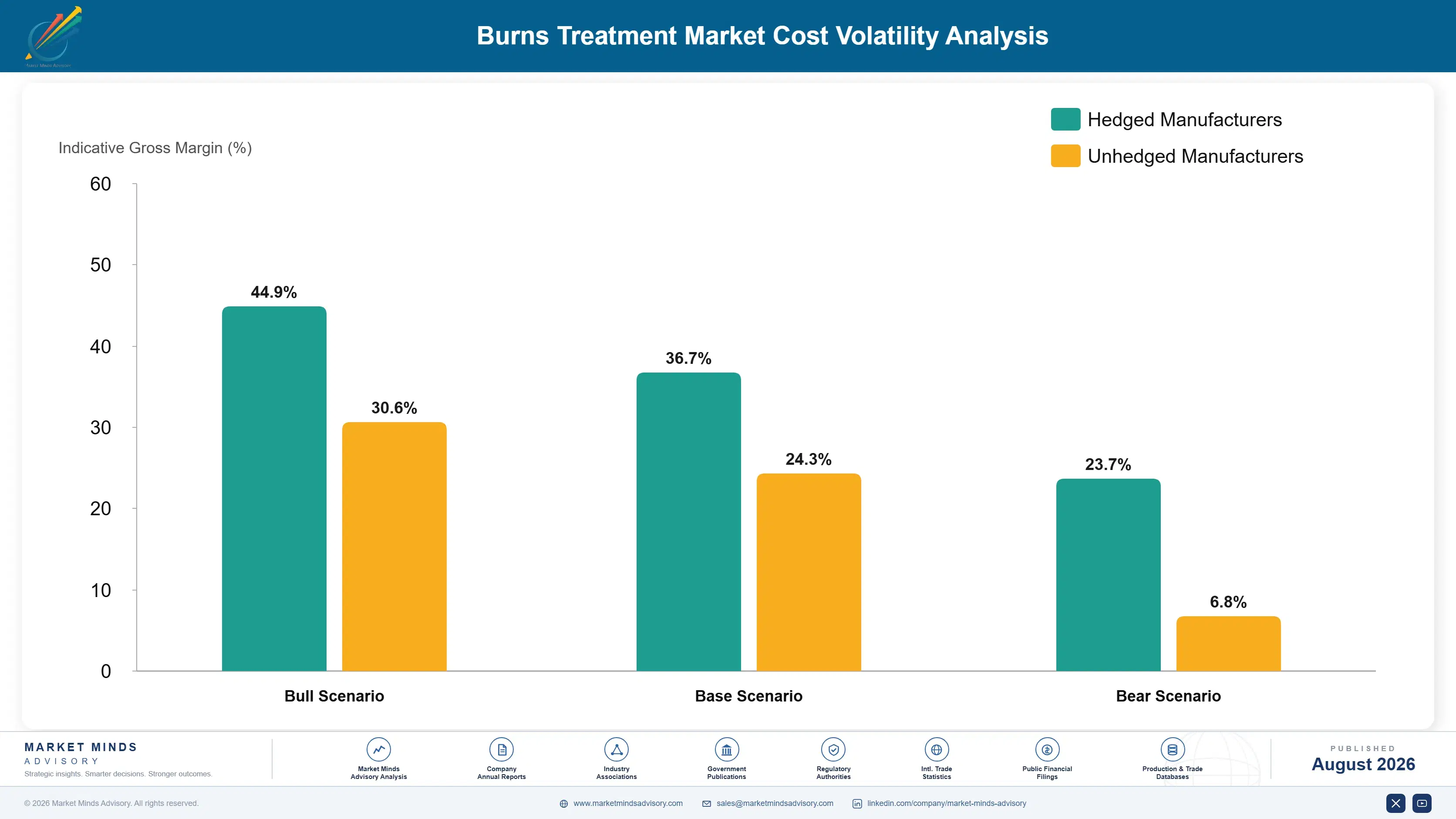
Biologic Manufacturing Inputs Shape Cost Structure

Cell culture media, tissue processing materials, and cold-chain packaging account for roughly 38% of cost of goods sold across biologic skin substitute production, with a further 18% attributable to sterile processing and quality validation. Most biologic manufacturing concentrates in the United States and Western Europe, while conventional dressing raw materials increasingly source from China and India.
Specialized cell culture media pricing rose an estimated 14% during 2023, according to company annual report disclosures citing global biopharmaceutical input cost pressure affecting the broader cell and tissue therapy manufacturing sector, before stabilizing through 2024 as alternative suppliers scaled capacity. Silver and other antimicrobial dressing raw material costs also saw measurable volatility over the same period, according to USDA-adjacent commodity data covering specialty material imports relevant to advanced wound care manufacturing.

Larger biologic manufacturers with vertically integrated cell culture and tissue processing capacity absorb input cost volatility more easily than smaller specialized competitors dependent on third-party suppliers for critical biologic inputs. Manufacturers serving donor-funded and public health procurement programs face the sharpest exposure, since multi-year fixed-price government contracts leave little room to pass through input cost increases once agreements are signed and locked in place.
burns-treatment-market-cost-volatility-analysis-1787304258673

Qualify Secondary Cell Culture Media Suppliers

Manufacturers increasingly qualify secondary cell culture media suppliers across multiple biopharmaceutical input providers, reducing exposure to any single supplier's capacity constraints or pricing volatility entirely. This dual-sourcing approach adds modest qualification cost upfront but has measurably reduced supply interruption incidents for manufacturers who adopted it early, ahead of recent biopharmaceutical input cost pressure affecting the sector.

Vertically Integrate Tissue Processing Capacity

Larger manufacturers are investing directly in in-house tissue processing and cell culture capacity rather than relying entirely on external specialized suppliers, reducing exposure to third-party pricing and lead time constraints. This vertical integration requires substantial upfront capital investment but has already shortened lead times for manufacturers pursuing it ahead of broader industry adoption of comparable capability.

Structure Multi-Year Input Pricing Agreements

Manufacturers serving government and donor-funded procurement programs increasingly negotiate multi-year input pricing agreements with key suppliers that mirror the multi-year procurement contracts they themselves sign, aligning cost and revenue timing more closely. This reduces margin compression risk from mismatched contract cycles, though it requires suppliers willing to accept longer-term price certainty over spot-market flexibility.

Portfolio Architecture for Margin Defence

Portfolio economics split across three tiers defined by biologic content and clinical validation depth rather than product category alone. Volume conventional dressings and basic antimicrobial products carry thin margins driven by steady multi-manufacturer competition, while premium biologic skin substitutes and growth factor therapeutics command materially wider margins, reflecting clinical validation investment and specialist positioning that commodity dressing competitors cannot easily replic
Volume and premium tiers pull manufacturer strategy in different directions, since public health and donor-funded procurement rewards manufacturers who can supply enormous dressing volume at competitive per-unit cost, while specialist burn centers reward manufacturers who can demonstrate biologic differentiation through validated clinical outcomes. Few manufacturers compete credibly across both tiers, since the manufacturing scale, clinical investment, and commercial infrastructure required for each differ substantially.

High-value margin pools concentrate almost entirely in biologic skin substitutes and growth factor therapeutics serving leading burn centers in North America, Western Europe, and East Asia's premium private healthcare segments. Volume tiers generate the overwhelming majority of unit count but a comparatively modest share of total industry profit pool, a divergence widening as clinical validation accelerates faster than dressing pricing pressure eases.

Volume / Commodity-Adjacent

Conventional wound dressings and basic antimicrobial products sold predominantly through public health procurement and general hospital distribution, competing largely on unit price and reliable supply availability across most global regions.
Gross Margin: 18-28%

Premium / Certified

Advanced dressings and negative pressure wound therapy devices sold through specialist burn center and hospital channels, commanding meaningfully wider margins through clinical differentiation and dedicated service support capability offered broadly.
Gross Margin: 38-50%

Sustainability / Regulatory / Next-Generation

Biologic skin substitutes and growth factor therapeutics still expanding into mainstream burn center formularies, priced at the category's highest premium levels given limited near-term competitive alternatives available currently worldwide today.
Gross Margin: 55-70%
burns-treatment-market-portfolio-architecture-1787304259175

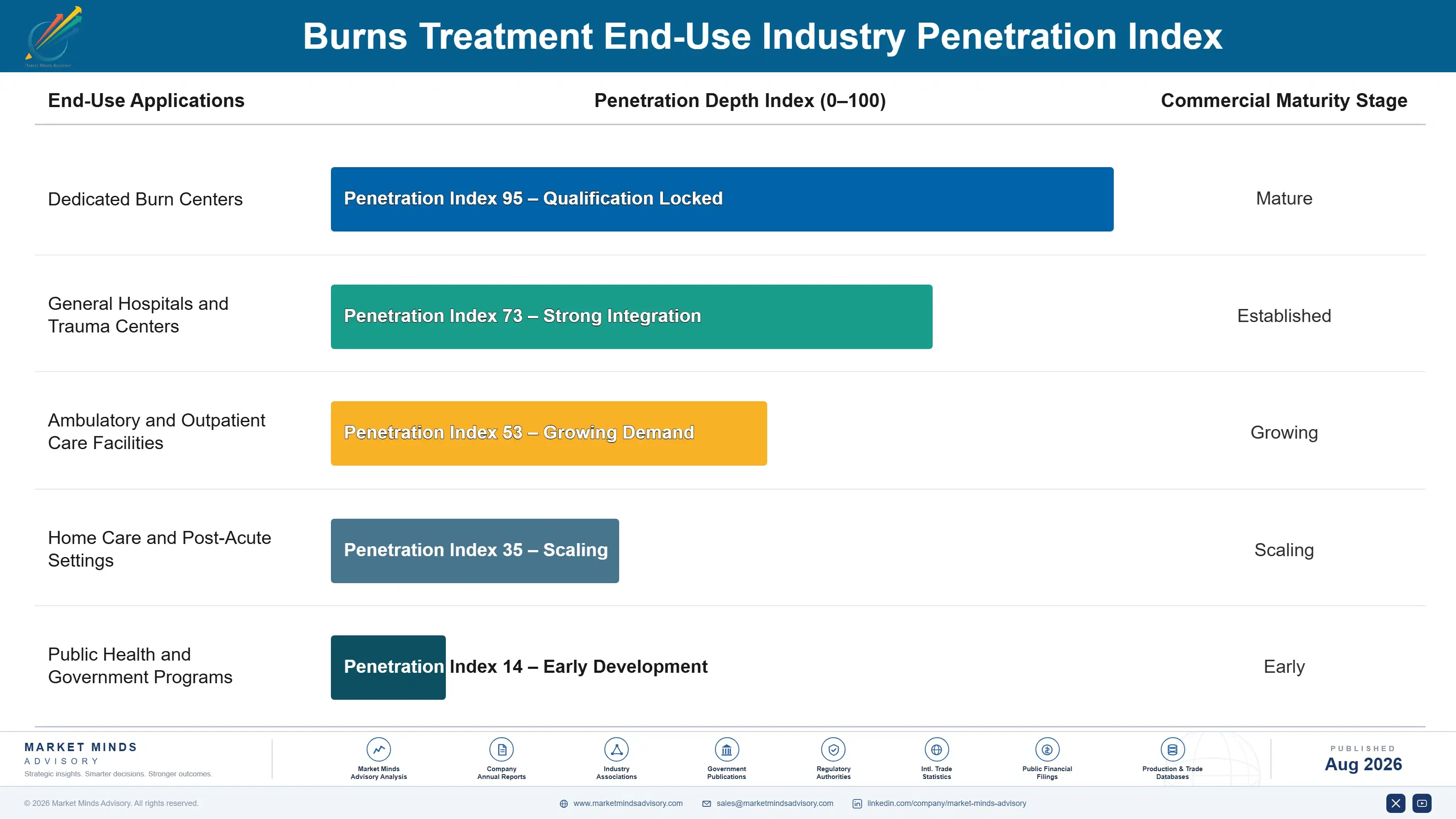
Treatment Continuity Anchors Recurring Product Demand

Burns treatment revenue functions on a treatment-continuity model rather than a single-episode transaction, since severe burn recovery requires sustained dressing changes, scar management, and follow-up care over months rather than a single procedure. This recurring dynamic underpins manufacturer willingness to invest in comprehensive product lines spanning acute treatment through long-term scar management, since retained patient relationships generate predictable multi-month revenue regardless
Adoption depth varies meaningfully by end-use vertical, running deepest in dedicated burn centers and academic trauma networks that standardize treatment protocols across their full patient population, and shallowest in general hospitals still defaulting to conventional dressing-only approaches for less severe cases. Biologic stickiness proves particularly strong once surgeons experience improved scar outcomes firsthand, with switch-back rates to conventional grafting alone remaining low across most centers tracked.

Buyer profiles are shifting generationally as younger burn surgeons trained on biologic treatment protocols increasingly expect skin substitute availability as a baseline formulary requirement rather than an exceptional-case option. Procurement committees report this generational preference is accelerating purchasing decisions toward biologic-inclusive formularies faster than reimbursement policy has formally adjusted, pulling premium product adoption earlier into typical hospital procurement cycles.
burns-treatment-market-end-use-penetration-index-1787304259664

Where MMA Sees the Advantage

These are among the four positions where our research anticipates prominent divergence between winners and laggards over the coming forecast period. Each is grounded in the demand model, the regulatory perimeter, and the announced capacity pipeline.
01 / CLINICAL EVIDENCE INVESTMENT

Publish Long-Term Outcomes Data Before Competitors Establish Standard

Manufacturers without published long-term outcomes data are losing formulary conversations to competitors who invested early in multi-year clinical follow-up studies across their biologic product lines instead of relying on initial regulatory clearance alone across most categories tracked. Formulary data now shows committees default to whichever manufacturer demonstrates documented scar quality and functional outcomes, not whichever received clearance first without follow-up evidence available today. MMA sees clinical evidence depth, not clearance timing alone, as the clearer near-term differentiator through the current ten-year forecast window.
02 / TRAUMA NETWORK POSITIONING

Build Regional Trauma Network Relationships Before Competitors Lock Them In

Trauma network supply agreements built early tend to persist through subsequent budget cycles, giving first movers durable multi-facility relationship advantages that later entrants find genuinely costly to displace once agreements are formally in place and renewed regularly across most program cycles. Manufacturers waiting for network relationships to mature organically are ceding this advantage to faster-moving competitors already embedded in multi-year account management investments across several regions. MMA views trauma-network positioning as a multi-year strategic asset worth pursuing immediately and consistently.
03 / BIOLOGIC COST REDUCTION

Invest in Biologic Manufacturing Scale to Broaden Formulary Access

Manufacturers that reduce biologic production costs fastest will capture the category's next growth wave as pricing approaches levels accessible to mid-tier regional hospitals rather than remaining confined to leading academic centers indefinitely across most current markets. Competitors delaying manufacturing scale investment risk ceding this transition entirely to whichever manufacturer reaches broader affordability first, a timing advantage that compounds meaningfully once achieved across expanding regional markets. MMA sees this cost curve as the clearest strategic inflection point ahead for the category.
04 / COLD-CHAIN DISTRIBUTION REACH

Extend Cold-Chain Logistics Into Underserved Regional Markets

Manufacturers concentrating exclusively on established markets risk missing the substantial unmet demand across South Asia and Sub-Saharan Africa, where burn injury incidence runs highest but cold-chain distribution infrastructure remains most limited and underdeveloped currently across most regions tracked. Mölnlycke's regional cold-chain partnership illustrates how this distribution investment compounds as underserved markets gain reliable biologic access over time across multiple regions and program types. MMA recommends building comparable logistics reach rather than relying solely on established market distribution networks going forward.

Engagement Snapshot From the Field

A live engagement with an industry participant carrying material or product regulatory and market exposure ahead of a defining policy shift, showing how our research translates into a defensible multi-year portfolio strategy.
MARKET MINDS ADVISORY · CLIENT ENGAGEMENT SUMMARY
Burns Treatment Producer Strategic Portfolio Review and Transition Roadmap 2026·Investment Scenario on Burns Treatment Exposure Evaluation 2025-26
CLIENT PROFILE
The client operates a three-hospital regional burn center network in Eastern Europe with reported annual wound care procurement spend of approximately 8 million US dollars (client-reported, unverified by MMA) split across dressings, biologics, and negative pressure wound therapy equipment. The network sought to introduce biologic skin substitutes into its formulary but lacked comparative outcomes and cost data to justify the investment to its governing health authority.
STRATEGIC CHALLENGE
Leadership needed to determine whether introducing biologic skin substitutes would improve patient outcomes enough to justify a materially higher per-case cost than the network's existing conventional grafting and dressing protocols, particularly given the governing health authority's cost containment mandate applied across every procurement category in the network's annual budget cycle.
MMA APPROACH
MMA combined its primary survey dataset with expert interviews across regional burn surgeons and health authority procurement officers to model expected outcomes improvement and total cost of care impact from biologic adoption across the network. The engagement produced case-mix-specific recommendations identifying which patient categories would benefit most from biologic treatment investment.
KEY FINDINGS
  1. Biologic skin substitutes reduced average length of hospital stay by an estimated 18% for full-thickness burn cases, partially offsetting the higher upfront product cost.
  2. Only a specific subset of cases, representing roughly 30% of severe admissions, showed outcomes improvement large enough to justify the incremental biologic cost under current pricing.
  3. The health authority's existing reimbursement structure did not yet account for reduced length-of-stay savings, understating the true total cost of care benefit.
  4. Regional cold-chain logistics limited reliable biologic product availability to only two of the three network hospitals without additional infrastructure investment currently planned.
CLIENT PROFILE
The client operates a three-hospital regional burn center network in Eastern Europe with reported annual wound care procurement spend of approximately 8 million US dollars (client-reported, unverified by MMA) split across dressings, biologics, and negative pressure wound therapy equipment. The network sought to introduce biologic skin substitutes into its formulary but lacked comparative outcomes and cost data to justify the investment to its governing health authority.
STRATEGIC CHALLENGE
Leadership needed to determine whether introducing biologic skin substitutes would improve patient outcomes enough to justify a materially higher per-case cost than the network's existing conventional grafting and dressing protocols, particularly given the governing health authority's cost containment mandate applied across every procurement category in the network's annual budget cycle.
MMA APPROACH
MMA combined its primary survey dataset with expert interviews across regional burn surgeons and health authority procurement officers to model expected outcomes improvement and total cost of care impact from biologic adoption across the network. The engagement produced case-mix-specific recommendations identifying which patient categories would benefit most from biologic treatment investment.
KEY FINDINGS
  1. Biologic skin substitutes reduced average length of hospital stay by an estimated 18% for full-thickness burn cases, partially offsetting the higher upfront product cost.
  2. Only a specific subset of cases, representing roughly 30% of severe admissions, showed outcomes improvement large enough to justify the incremental biologic cost under current pricing.
  3. The health authority's existing reimbursement structure did not yet account for reduced length-of-stay savings, understating the true total cost of care benefit.
  4. Regional cold-chain logistics limited reliable biologic product availability to only two of the three network hospitals without additional infrastructure investment currently planned.
RECOMMENDED STRATEGY
Phase 1: Phase 1 (Months 1-2): Introduce biologic substitutes for the identified high-benefit case subset at the two cold-chain-capable hospitals first immediately. Phase 2: Phase 2 (Months 3-6): Present length-of-stay savings data to the health authority to advocate for updated reimbursement accounting for total cost of care. Phase 3: Phase 3 (Months 7-12): Invest in cold-chain infrastructure at the third hospital once updated reimbursement supports network-wide biologic access fully.
OUTCOME
The network adopted the phased biologic introduction, reporting a 15% reduction in total cost of care for the targeted case subset within the first six months of implementation (client-reported, unverified by MMA). The health authority subsequently agreed to review reimbursement methodology to reflect length-of-stay savings.

Frequently Asked Questions

Foundational context covering the market sizes, CAGR, scope, country, region and competition that inform every finding below. This section is provided to cover basics and most often pre-purchase conversations, answered from the MMA Primary Research Dataset.

What is the current size of the Burns Treatment Market?

The global burns treatment market was valued at approximately 3.8 billion US dollars in 2025. This figure spans wound dressings, skin substitutes, negative pressure wound therapy, antimicrobial agents, biologics, and debridement products.

How large will the Burns Treatment Market be by 2036?

The burns treatment market is projected to reach approximately 9.2 billion US dollars by 2036, up from 4.12 billion in 2026. This represents a 2.24 times expansion over the ten-year forecast period.

What is the CAGR for the Burns Treatment Market 2026 to 2036?

The market is forecast to grow at an 8.4% compound annual growth rate between 2026 and 2036. Bull and bear scenarios range from 9.7% to 7.0%, reflecting biologic adoption pace uncertainty.

Which segment is growing fastest?

Growth factor and biologic therapeutics are the fastest-growing segment, expanding at 13.0% annually, roughly 1.55 times the overall market rate. Burn centers are shifting toward active tissue regeneration therapy ahead of traditional grafting.

Who are the major companies in the Burns Treatment Market?

Leading companies include Integra LifeSciences, Smith+Nephew, Mölnlycke Health Care, 3M, and Convatec Group. These five manufacturers collectively hold 58% combined share on a global revenue basis.

Which country is growing fastest?

India is the fastest-growing country market, expanding at 10.8% annually as trauma center infrastructure expands to address the country's high burn injury incidence. This growth reflects volume expansion under public health investment.

Report Segmentation Architecture

The full report scope spans multiple orthogonal segmentation dimensions, with cross-tabulated demand data provided for each dimension pair. Coverage extends further to regional breakdowns, trend trajectories, and the competitive detail needed to support segment-level decision-making.

By Primary Market Dimension

  • Advanced Wound Dressings
  • Skin Substitutes and Bioengineered Grafts
  • Negative Pressure Wound Therapy
  • Topical Antimicrobial Agents
  • Growth Factor Biologics
  • Debridement Products

By End-Use Industry

  • Dedicated Burn Centers
  • General Hospitals and Trauma Centers
  • Ambulatory and Outpatient Care Facilities
  • Home Care and Post-Acute Settings
  • Public Health and Government Programs

By Commercial Dimension

  • Direct Hospital System Sales
  • Regional Trauma Network Contracts
  • Government and Donor-Funded Procurement
  • Distributor and Wholesale Channel

By Region

  • North America
  • Western Europe
  • East Asia
  • South Asia and Pacific
  • Latin America
  • Middle East and Africa
  • Eastern Europe

Scope, Methodology, and Coverage

Every figure in this report is reproducible from documented input assumptions. The scope below maps the historical period, the forecast horizon, the segmentation dimensions, and the countries covered, alongside the underlying primary and qualitative methodology.
Historical Period
2020 to 2025
Forecast Period
2026 to 2036
Base Year
2025 (USD billions; MMA Primary Research Dataset, August 2026)
Market Definition
This report covers the global market for burns treatment products, spanning advanced wound dressings, bioengineered skin substitutes, negative pressure wound therapy devices, topical antimicrobial agents, growth factor biologics, and debridement products used in acute and post-acute burn care. It excludes general chronic wound care products not specific to burn injury treatment and cosmetic scar revision procedures.
Quantitative Units
USD billions (current prices); formulary penetration and treatment coverage percentages where applicable
Segmentation Dimensions
By Primary Market Dimension; By End-Use Industry; By Commercial Dimension; By Region
Regions Covered
North America, Western Europe, East Asia, South Asia and Pacific, Latin America, Middle East and Africa, Eastern Europe
Countries Covered
USA, China, Germany, France, UK, Japan, South Korea, India, Australia, Canada, Brazil, Mexico, Indonesia, Vietnam, Thailand, Malaysia, UAE, Saudi Arabia, South Africa, Nigeria, Turkey, Poland, Netherlands, Italy, Spain, Sweden, Switzerland, Argentina, Colombia, Singapore, and additional markets relevant to this sector
Key Companies Profiled
Integra LifeSciences Holdings Corporation; Smith+Nephew plc; Mölnlycke Health Care AB; 3M Company; Convatec Group plc; Organogenesis Holdings Inc.; MiMedx Group, Inc.; Vericel Corporation; Coloplast A/S; Baxter International Inc.; B. Braun Melsungen AG; Medline Industries, LP; Cardinal Health, Inc.; PolyNovo Limited; AVITA Medical, Inc.; Stratatech Corporation; Tissue Regenix Group plc; Hollister Incorporated; Paul Hartmann AG; Urgo Medical
Quantitative Methodology
Primary survey, n=3,800 respondents, Q4 2025, six countries; demand-side model with trade association cross-validation
Qualitative Methodology
47 expert interviews, Q4 2025; applied to validate demand model assumptions, identify emerging dynamics, and assess competitive positioning
Report Format
PDF and XLSX data workbook (Word format preview document)
Publisher
Market Minds Advisory
Report Code
MMA-2026-MED-510
Published
August 2026
Contact
sales@marketmindsadvisory.com | www.marketmindsadvisory.com

Purchase the full Burns Treatment Market Report (2026 to 2036).

This report delivers a complete assessment of the global burns treatment market, covering wound dressings, skin substitutes, negative pressure wound therapy, antimicrobial agents, growth factor biologics, and debridement products across all seven MMA-tracked regions through 2036. It combines primary survey data from 3,800 respondents with 47 expert interviews across burn surgeons, procurement officers, and manufacturers to quantify segment, regional, and competitive dynamics. Readers receive detailed sizing, forecast scenarios, and margin analysis across three commercial tiers. The report also profiles twenty companies and includes a full competitive assessment of moat and risk positioning across the five leading manufacturers.
Ten-Year Forecast Across Three Growth Scenarios
Seven-Region Market Sizing With Country-Level Detail
Twenty Company Competitive Profiles and Benchmarking
Segment-Level Growth Analysis Across Six Categories
Input Cost and Supply Chain Risk Assessment
Portfolio Margin Architecture Across Three Tiers

Built For The People Who Decide

From boardroom strategy to bench-side execution, this report is read cover-to-cover by leaders shaping the next decade of their industry, turning demand scenarios, market dynamics and valuation benchmarks into decisions.
CXOs/ Presidents/ VPs/ Managers
M&A and Corporate Development
Strategy Teams and R&D Heads
Procurement and Product Directors
Regulatory and Compliance Leaders
Investor Relations and Equity Analysts