Market Minds Advisory
Burglar Alarm Systems Market

Burglar Alarm Systems Market: Burglar Alarm Systems Market. Trends and Forecast 2026 to 2036

Rising residential burglary rates in emerging economies and insurer-mandated monitoring requirements are pushing wired panels toward AI video verification, forcing legacy manufacturers to prove false-alarm reduction claims that police departments increasingly demand before dispatching officers.

Lead Analyst

Published

September 2026

Make Smarter Decisions with Customized Research Insights

Request a free sample report and evaluate market opportunities, growth trends, and competitive dynamics relevant to your business needs.

2025 MARKET VALUE$42.6BMarket Size 2025
2036 FORECAST VALUE$94.4BBase Case , 2026 to 2036
CAGR 2026 TO 20367.5 %Bull 8.7% / Bear 6.3%
INCREMENTAL OPPORTUNITY$48.6BNet 10- year value creation
EXPANSION MULTIPLE2.06x2036 value over 2026 base
Strategic Levers
M&A Pipeline
Regional Outlook
Country Rankings
Competitive Intelligence
Segmental Deep-dive
Call-Us : 91 93563 13602

Executive Snapshot and Market Trajectory.

Police departments in major cities across several countries are now refusing to dispatch on unverified alarms, and that single policy shift is forcing the entire industry toward AI video verification faster than any marketing campaign could have managed on its own merit alone.
Insurers and municipal police departments are both tightening requirements around alarm verification, pushing installers to replace legacy motion-only panels with camera-equipped systems capable of confirming an intrusion before authorities respond to the reported scene of the incident. North America and East Asia concentrate the largest share of installed base value, driven respectively by dense commercial monitoring contracts and rapid residential construction tied to urbanization across major metropolitan corridors nationwide.
Competitive character centers on monitoring service retention rather than hardware sales alone, since recurring subscription revenue now generates more profit than the initial panel installation for most established providers operating at scale across residential and commercial segments alike nationwide. Regulatory pressure around false-alarm fines in major metropolitan areas is pushing manufacturers toward video and AI-based verification specifically to avoid the escalating fines police departments increasingly levy on repeat offenders and unresponsive monitoring companies.
Market Definition
The Burglar Alarm Systems Market covers intrusion detection hardware, control panels, sensors, and associated monitoring services designed to detect and report unauthorized entry into residential and commercial premises. It excludes standalone video surveillance systems sold without integrated intrusion detection and fire alarm systems regulated under separate life-safety codes.
Base Year Value
$42.6B in 2025 (MMA Primary Research Dataset, September 2026)
Forecast Period
2026 to 2036, eleven discrete annual values
CAGR
7.5% base case. Bull 8.7%. Bear 6.3%.
Fastest Growth Segment
AI-Based Video Analytics Alarm Systems: 12.5% CAGR
Fastest Growth Country
India: 10.0% CAGR
Fastest Growth Region
South Asia and Pacific: 9.5% CAGR
Largest Region
North America: 31% of 2025 global value
Market Leaders
Leading participants include Johnson Controls, Honeywell, Bosch Security Systems, ADT, and Assa Abloy.
Primary Survey
n=3,800 procurement and R&D decision-makers, Q4 2025, six countries
Methodology
Demand-side build-up, cross-validated against public data, 47 expert interviews

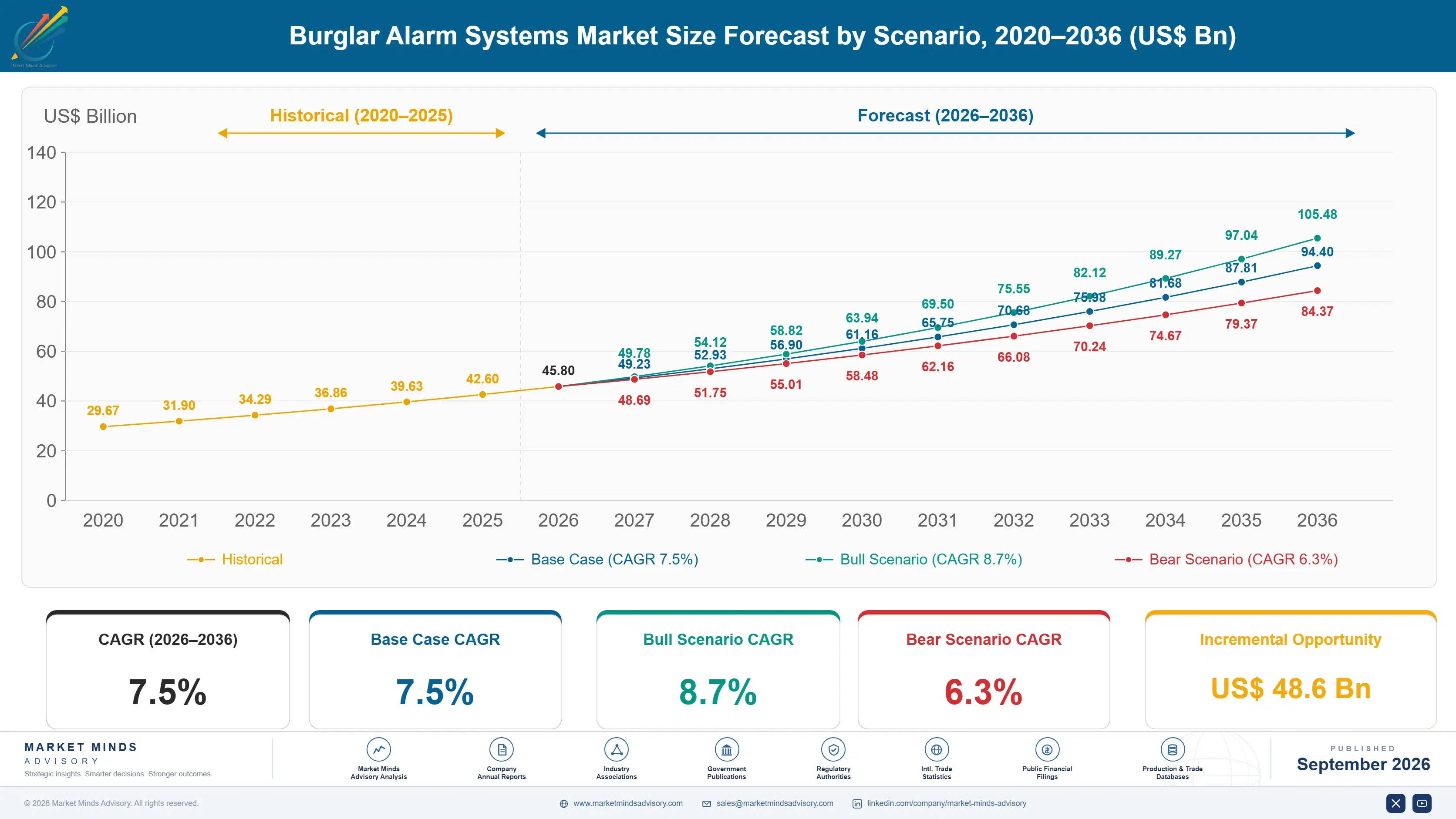
Burglar Alarm Systems Market Forecast Scenarios

burglar-alarm-systems-market-size-forecast-scenario-1789996157143
Between 2020 and 2025, the market grew steadily as commercial reopening after pandemic disruptions restored demand for monitored security contracts, while residential adoption accelerated on falling smart panel prices and rising crime awareness in several major markets. Growth moderated somewhat toward the end of the period as semiconductor component shortages briefly delayed panel shipments across most manufacturers.
The base case assumes continued conversion from unmonitored to professionally monitored systems, expanding insurer premium discounts for verified alarm technology, and growing municipal false-alarm ordinances pushing legacy panel replacement across major cities worldwide. Residential installers will keep bundling smart home integration with core intrusion detection hardware, commercial customers will expand video-verified monitoring contracts substantially across multiple industries, and emerging market urbanization will drive first-time system adoption across new housing construction projects.
A bull scenario emerges if municipal verified-response mandates spread faster than expected, pulling forward legacy panel replacement across every major metropolitan market simultaneously and compressing the typical replacement cycle considerably. The bear risk is that do-it-yourself smart home security kits erode the professionally monitored segment's growth, particularly among price-sensitive residential customers who forgo monthly monitoring fees entirely.

Where Verified Response Determines Contract Value

Burglar alarm systems are shifting from a one-time hardware sale into a recurring service relationship, as monitoring subscriptions and video verification fees now generate more lifetime revenue than the initial panel installation for most established providers operating across residential and commercial segments alike, reshaping how vendors value and price a new customer relationship from the very first sales conversation onward.
MARKET CONCENTRATIONCR5 35%Top five vendors hold under half of revenue
AVERAGE SYSTEM PRICE$450Typical cost for a basic residential base package
TOP PRODUCING COUNTRY SHARE26%China leads global alarm hardware manufacturing output volume
FALSE ALARM RATE10-20%Typical share of dispatched calls found to be unverified
MONITORING ATTACH RATE58%Portion of installed systems carrying an active paid monitoring plan
CONTRACT RETENTION LENGTH5-7 yearsAverage duration before a customer contract typically churns away
Vendors compete on false-alarm reduction and verified-response speed rather than raw sensor count, since police departments in a growing number of jurisdictions have begun deprioritizing or outright refusing dispatch on alarms lacking video or audio confirmation of an actual intrusion event taking place on premises at the time of the call. This shift has made verification technology a purchase requirement rather than an optional upgrade.
The next decade will be shaped by AI-based video analytics distinguishing real intrusions from false triggers, insurer premium incentives tied to verified alarm technology, and consolidation among regional monitoring companies as scale becomes increasingly necessary to fund the AI development costs smaller providers cannot afford alone. Smart home integration is also blurring the line between security and general home automation systems.
"An alarm system that cries wolf twice gets ignored the third time, by the customer and by the police department both. Verification isn't a premium feature anymore, it's table stakes."
Director, Physical Security and Monitoring Services Practice · MMA Construction and Industrial Equipment Practice · September 2026

Market Trends

AI Video Analytics Cut False Alarm Rates

Machine learning models trained to distinguish human intruders from pets, weather, and shadows are replacing simple motion detection across new panel installations, addressing the false alarm problem that has driven police departments in dozens of major cities toward verified-response-only dispatch policies. Vendors report false alarm rates falling from roughly thirty percent under legacy motion sensors down to below ten percent with AI-based video verification deployed at scale. This accuracy improvement has become a primary purchasing criterion for both residential customers avoiding municipal fines and commercial customers managing large, multi-site security portfolios.
Market Impact: Mandates wiring in 2026 codes
Insurance Premium Discounts Reward Verified Systems

Major insurers in North America and Western Europe now offer premium discounts of ten to twenty percent for policyholders installing monitored, video-verified alarm systems, treating verification technology as a measurable risk reduction rather than a simple marketing feature offered by installers everywhere. This financial incentive has accelerated conversion from unmonitored to professionally monitored contracts among cost-conscious homeowners who previously viewed monthly monitoring fees as an unnecessary expense they could skip. Several insurers have begun requiring proof of verified alarm installation as a condition for high-value property coverage in burglary-prone areas.
Market Impact: Standardizes contracts across 100+ locations

Market Opportunities and Growth Drivers

Urban Residential Construction Drives First-Time Adoption

Rapid residential construction across India, Southeast Asia, and parts of Latin America is creating a large pool of first-time homeowners installing security systems for the first time as part of standard move-in preparations rather than a retrofit decision made years later. Several national housing programs have added minimum security specifications to new residential building codes, requiring at minimum basic intrusion detection wiring even where full system installation remains optional at the point of sale. This construction-linked demand channel provides sustained multi-year volume that smooths adoption across the forecast period rather than concentrating it around retrofit replacement cycles alone.
Market Impact: Diverts 15% of purchases to self-monitoring

Rising Burglary Rates Push Commercial Adoption

Commercial property crime has risen sharply in several major metropolitan markets over the past few years, pushing retail chains, warehouses, and small businesses to install or upgrade monitored alarm systems as insurance underwriters tighten coverage terms for currently uninsured properties across most affected regions. Retail chains operating more than one hundred locations have standardized on enterprise-wide monitoring contracts to negotiate better per-site pricing while ensuring consistent verified-response protocols across every store regardless of local market conditions. This commercial demand channel now grows faster than residential adoption in several developed markets.
Market Impact: Adds 3 to 5% compliance cost

Market Restraints and Challenges

Do-It-Yourself Kits Increasingly Undercut Professional Installation

Smart home security kits sold directly to consumers through retail and online channels let homeowners self-install basic intrusion detection without a professional installer or a monthly monitoring contract, eroding the recurring revenue base that funds most alarm companies' service infrastructure. The root cause is that camera and sensor hardware costs have fallen enough that self-monitoring through a smartphone app feels adequate to many price-sensitive customers who never call a professional monitoring center. Industry surveys suggest roughly fifteen percent of new residential security purchases now bypass professional monitoring entirely. Providers are responding with lower-cost self-monitored tiers alongside traditional packages.
Market Impact: Cuts false alarm rates below 10%

Data Privacy Rules Complicate Video Storage

Video-verified alarm systems capture and store footage of private property, increasingly subject to data protection regulations that restrict retention periods and require consent disclosures for footage that might capture neighboring properties or public sidewalks. The underlying cause is that verification technology developed faster than the privacy regulatory framework governing continuous residential video capture, leaving vendors navigating inconsistent rules across jurisdictions. Compliance costs for data storage and consent management now add several percentage points to monitoring service margins in the most heavily regulated markets. Vendors are building configurable retention features directly into camera firmware.
Market Impact: Offers 10 to 20% premium discounts
3 additional market trends, 3 additional growth drivers, and 4 additional restraints and challenges are covered in the full report. Contact sales@marketmindsadvisory.com to access the complete intelligence.

Segment CAGR and Growth Architecture

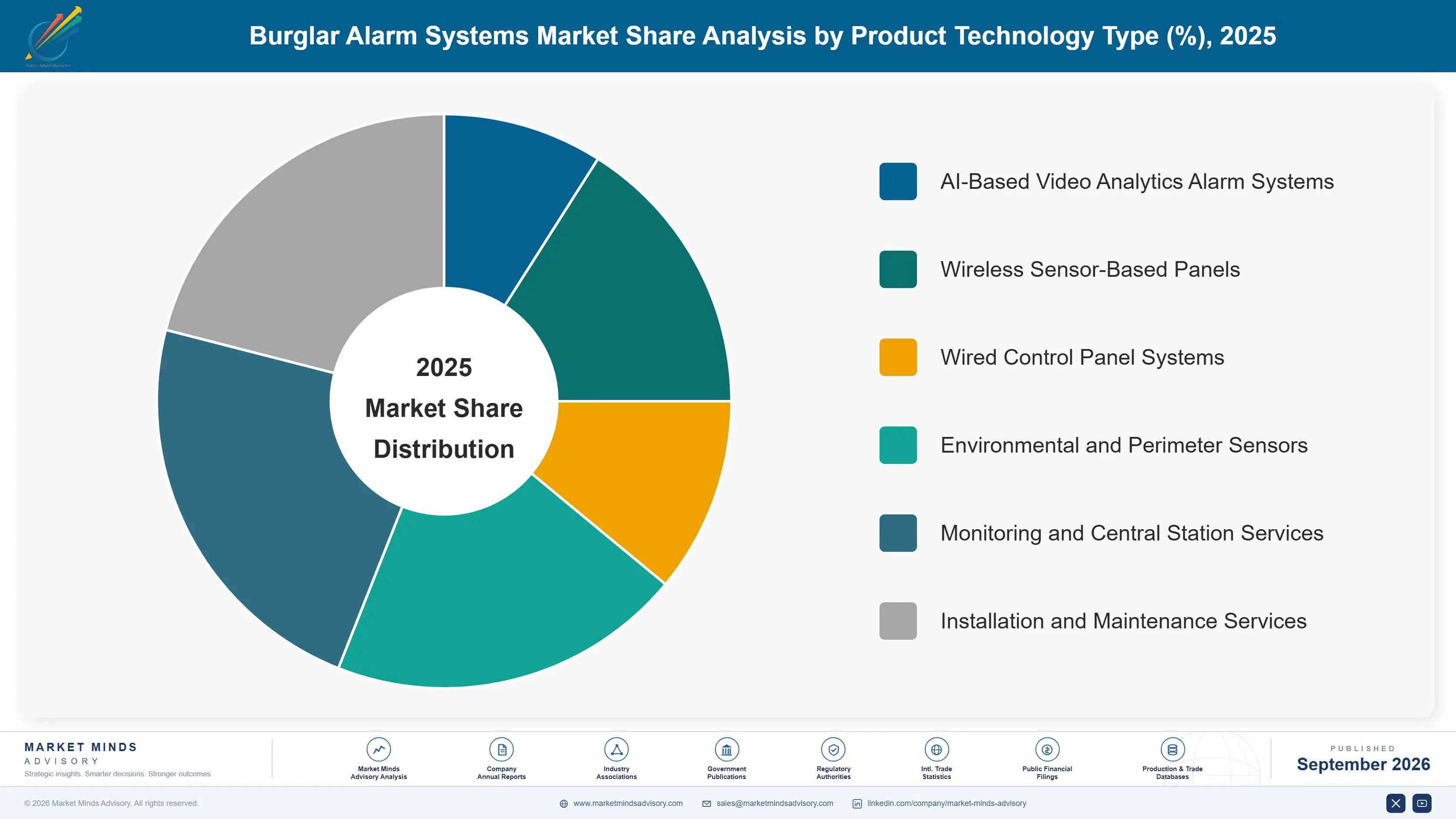
Burglar alarm systems segment by underlying technology, the dimension separating legacy wired panels from AI-enabled and wireless alternatives now driving the majority of new installations across residential and commercial buyers alike. AI video analytics and wireless panels are pulling further ahead as verification requirements and installation flexibility both favor newer architectures over older wired designs.
burglar-alarm-systems-market-market-share-analysis-1789996157685

AI-Based Video Analytics Alarm Systems

AI-based video analytics alarm systems pair camera sensors with on-device or cloud machine learning models trained to distinguish genuine human intruders from pets, weather, and passing shadows before triggering a dispatch alert. Police departments in a growing number of jurisdictions now require some form of visual confirmation before responding, making this segment a purchase requirement rather than an optional upgrade for both residential and commercial customers alike. Component costs for edge AI processing have fallen enough that video analytics capability now appears in mid-range residential panels rather than only premium commercial installations, and adoption is accelerating fastest in markets where municipal false-alarm fines have grown most severe and enforcement has tightened.
CAGR 12.5%

Wireless Sensor-Based Panels

Wireless sensor-based panels eliminate the drilling, conduit, and rewiring costs that make wired system installation expensive and disruptive, particularly in existing residential properties where retrofit wiring is impractical or prohibitively costly for most homeowners. Installers favor wireless architecture for its dramatically shorter installation time, often completing a full residential system in under two hours compared to a full day for comparable wired installations requiring extensive drilling work throughout the property. Battery life improvements and more reliable mesh networking protocols have addressed early reliability concerns that once limited wireless adoption to smaller properties, pulling wireless panels into larger commercial deployments that previously defaulted to wired systems by default and long-standing industry convention.
CAGR 10.0%
Full segment breakdown across 6 segments available in the complete report.

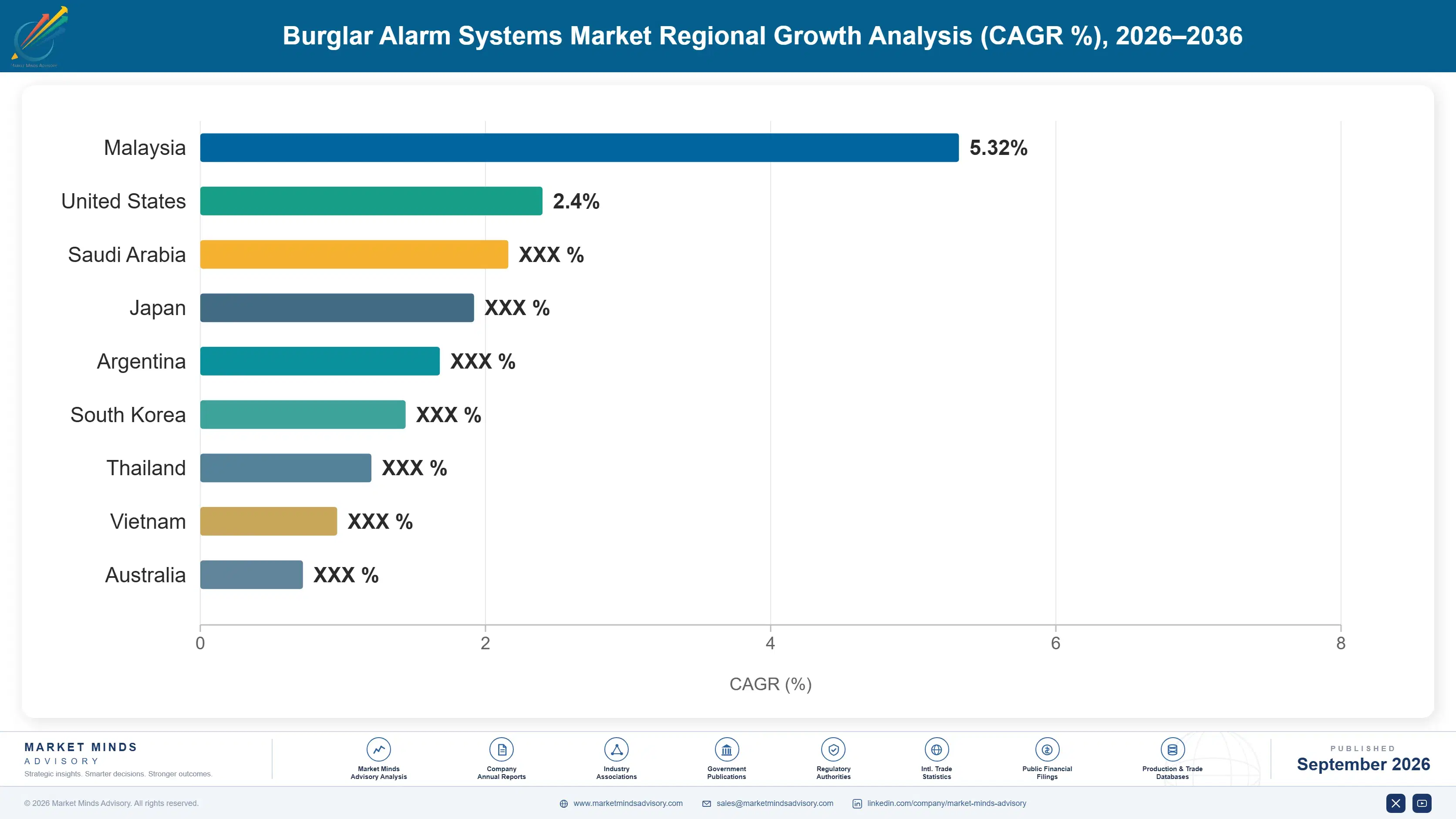
Regional Architecture and Country Demand Map

North America retains the deepest professionally monitored penetration and largest installed base value overall, supported by mature insurer and police-response infrastructure built up over several decades. East Asia follows closely on residential construction volume and rapidly expanding urban security demand across major metropolitan markets nationwide.

North America

The deepest professionally monitored security penetration in the world anchors North America's leading share of the burglar alarm systems market. United States insurers have built decades of actuarial data linking monitored alarm ownership to reduced burglary claims, translating directly into premium discounts that keep monitoring subscription attach rates high across residential and commercial customers nationwide. Canada mirrors this pattern at a smaller scale, with similar insurer incentive structures driving adoption. Municipal false-alarm ordinances in major cities have pushed verified-response requirements that accelerated the shift toward AI video analytics faster than in most other regions. This combination of mature monitoring infrastructure and regulatory pressure gives the region its largest revenue share.
Share: 31% | CAGR: 8.0% (2026 to 2036)

Western Europe

Regulatory pressure around data protection and mature market saturation shape demand growth across Western Europe more than construction volume does elsewhere in the broader world market today. Germany and the United Kingdom lead adoption of AI video verification tied to municipal false-alarm reduction policies similar to those seen in North America. France's insurance sector has introduced premium discount programs comparable to the American model, though adoption lags due to lower historical monitoring penetration rates overall. The European Union's data protection framework has pushed several vendors toward on-device video processing architectures that avoid transmitting footage externally, a compliance requirement now treated as a baseline design standard across the region's commercial installations.
Share: 21% | CAGR: 6.0% (2026 to 2036)
Regional intelligence for 5 additional markets available in the complete report: East Asia, South Asia and Pacific, Latin America, Middle East and Africa, Eastern Europe. Contact sales@marketmindsadvisory.com.
burglar-alarm-systems-market-country-cagr-analysis-1789996158213

Where Alarm Providers Can Capture More Margin

Hardware alone has commoditized as panel manufacturing scales globally across most producing regions worldwide, so durable margin pools sit in monitoring subscriptions, verification services, and insurance partnerships rather than the physical panel itself. Providers combining hardware with a recurring service layer capture disproportionate value relative to their unit shipment share across the entire market.

Bundling AI Verification Software Subscription Tiers

Providers that layer AI video verification software on top of a basic hardware installation capture a recurring per-month subscription fee that hardware sales alone cannot generate, converting a modest installation charge into a multi-year monitoring relationship with the broader customer base. Customers accept the added monthly cost because verified alarms clear police dispatch faster and qualify for insurance premium discounts that offset the subscription price. Several providers have raised average customer lifetime value by 35 percent after introducing tiered verification subscriptions, since software margin runs above thin panel hardware margin.
Market Impact: Raises average customer lifetime value by 35 percent

Partnering With Insurers on Premium Discount Programs

Providers negotiating direct partnerships with insurers to offer bundled premium discounts alongside monitored alarm subscriptions capture a customer acquisition advantage that competitors without insurer relationships cannot easily match, since the discount effectively subsidizes part of the subscription cost for the customer at signup time each and every year. Vendors with active insurer partnerships report customer acquisition costs running 20 percent lower than providers relying solely on direct marketing spend, since the insurer channel delivers pre-qualified, price-sensitive customers already motivated by a clear financial incentive to convert and sign a long-term contract.
Market Impact: Cuts customer acquisition costs by roughly 20 percent

Selling Smart Home Integration as an Upsell

Customers purchasing a basic intrusion detection package increasingly accept an upsell into broader smart home integration, including smart locks, lighting, and thermostat control managed through the same monitoring app and subscription relationship they already pay for on a regular monthly basis each and every time. Providers offering this expanded platform report average revenue per customer running 28 percent higher than security-only subscriptions, since the additional smart home devices carry their own margin while deepening switching costs that keep customers from churning to a competitor at contract renewal time each year.
Market Impact: Lifts average revenue per customer by 28 percent

Offering Enterprise Commercial Multi-Site Monitoring Contracts

Retail chains and commercial customers operating dozens or hundreds of locations prefer a single enterprise-wide monitoring contract over separately negotiated agreements at each individual site location across their entire footprint nationwide, opening a clear opportunity for providers to sell centralized monitoring and reporting dashboards as a premium service layer on top of the standard base contract price offered. Providers offering enterprise contract management report average deal sizes 45 percent larger than single-site agreements, since customers value consolidated billing, consistent verified-response protocols, and unified reporting across their entire property portfolio nationwide.
Market Impact: Grows average deal size by roughly 45 percent

Who Controls the Margin Pool

The burglar alarm systems market shows moderate fragmentation with a CR5 of thirty-five percent, reflecting an industry with several large diversified security conglomerates rather than a single dominant leader. Johnson Controls and Honeywell lead on revenue given their broad building security and automation portfolios, holding a meaningful gap over challengers such as ADT and Assa Abloy, whose narrower monitoring and access focus limits their cross-sell reach into commercial building systems.
Current competitive activity centers on AI verification technology, as hardware manufacturers race to embed video analytics capability that reduces the false-alarm rate driving municipal fines and police deprioritization. Several vendors have also launched insurer partnership programs bundling premium discounts with monitoring contracts, deepening customer relationships beyond a simple hardware sale and monthly monitoring fee.

Emerging pressure comes from smart home technology companies that could bundle basic intrusion detection directly into broader home automation platforms, potentially squeezing standalone alarm specialists out of the price-sensitive residential segment specifically. Rankings are most likely to shift among regional monitoring companies, where a large insurer partnership or municipal contract win can move a provider from a local player into a multi-state competitor within a single product cycle.
burglar-alarm-systems-market-company-positioning-matrix-1789996158729

Competitive Moat and Risk Dimensions

JOHNSON CONTROLS

Moat: Diversified Building Systems Portfolio

Johnson Controls sells fire, HVAC, and access control systems alongside intrusion detection, letting it bundle security into large commercial building contracts that pure-play alarm companies cannot match. This breadth also gives Johnson Controls a service technician network few standalone security vendors can replicate at comparable national scale.
JOHNSON CONTROLS

Risk: Slower Consumer Product Innovation

Johnson Controls' focus on large commercial building contracts leaves it less nimble in the fast-moving residential and consumer smart home segment, where startups iterate on app features and pricing far faster than a diversified industrial conglomerate typically can. A residential specialist that ships superior consumer software first could capture design wins before Johnson Controls responds.
HONEYWELL

Moat: Established Building Automation Relationships

Honeywell's existing building automation and fire safety relationships with large commercial property owners give it direct access to security procurement decisions that independent alarm vendors must win through separate sales channels entirely. This distribution reach lets Honeywell bundle intrusion detection directly into broader building management contracts.
HONEYWELL

Risk: Exposure to Commercial Construction Cycles

A meaningful share of Honeywell's security revenue ties to new commercial construction and major building renovation projects, exposing the segment to the same cyclical swings that affect broader commercial real estate investment. A construction slowdown would compress this revenue line faster than competitors focused on residential and retrofit demand.

Players Tracked

Prominent Players

Johnson Controls
Honeywell
Bosch Security Systems
ADT
Assa Abloy

Other Key Players

Vivint
SimpliSafe
Ring
Alarm.com
Napco Security Technologies
Resideo Technologies
Hikvision
Dahua Technology
Axis Communications
UTC Fire and Security
Securitas
Verisure
Comelit Group
Risco Group
DSC (Digital Security Controls)

Recent Developments

APRIL 2026

Honeywell Acquires AI Video Analytics Software Startup

Honeywell acquired a privately held AI video analytics developer to add false-alarm reduction capability to its intrusion detection product line, integrating the acquired firm's machine learning models directly into upcoming commercial and residential panel offerings. The deal gives Honeywell in-house verification software it previously sourced through third-party licensing arrangements.
Signal: Signals hardware vendors internalizing AI verification capability rather than continuing to license it from smaller specialists.
OCTOBER 2025

ADT Signs Multi-Year Insurer Partnership Agreement

ADT and a major national insurer signed a multi-year partnership agreement offering bundled premium discounts to customers installing ADT-monitored, video-verified alarm systems across residential properties nationwide. The agreement gives ADT priority access to the insurer's customer base while locking in guaranteed referral volume through 2029.
Signal: Shows insurers and alarm providers deepening commercial ties well ahead of the broader industry-wide adoption trends.
JANUARY 2026

Bosch Expands Manufacturing Capacity for Wireless Panels

Bosch Security Systems expanded its organic manufacturing capacity for wireless sensor-based panels by opening a new production line dedicated to residential installation kits, responding to rising demand from installers seeking faster deployment than wired system installation allows. The expansion adds dedicated assembly capacity the company previously lacked.
Signal: Reflects growing installer preference nationwide for wireless architecture over legacy wired panel systems considerably each year.

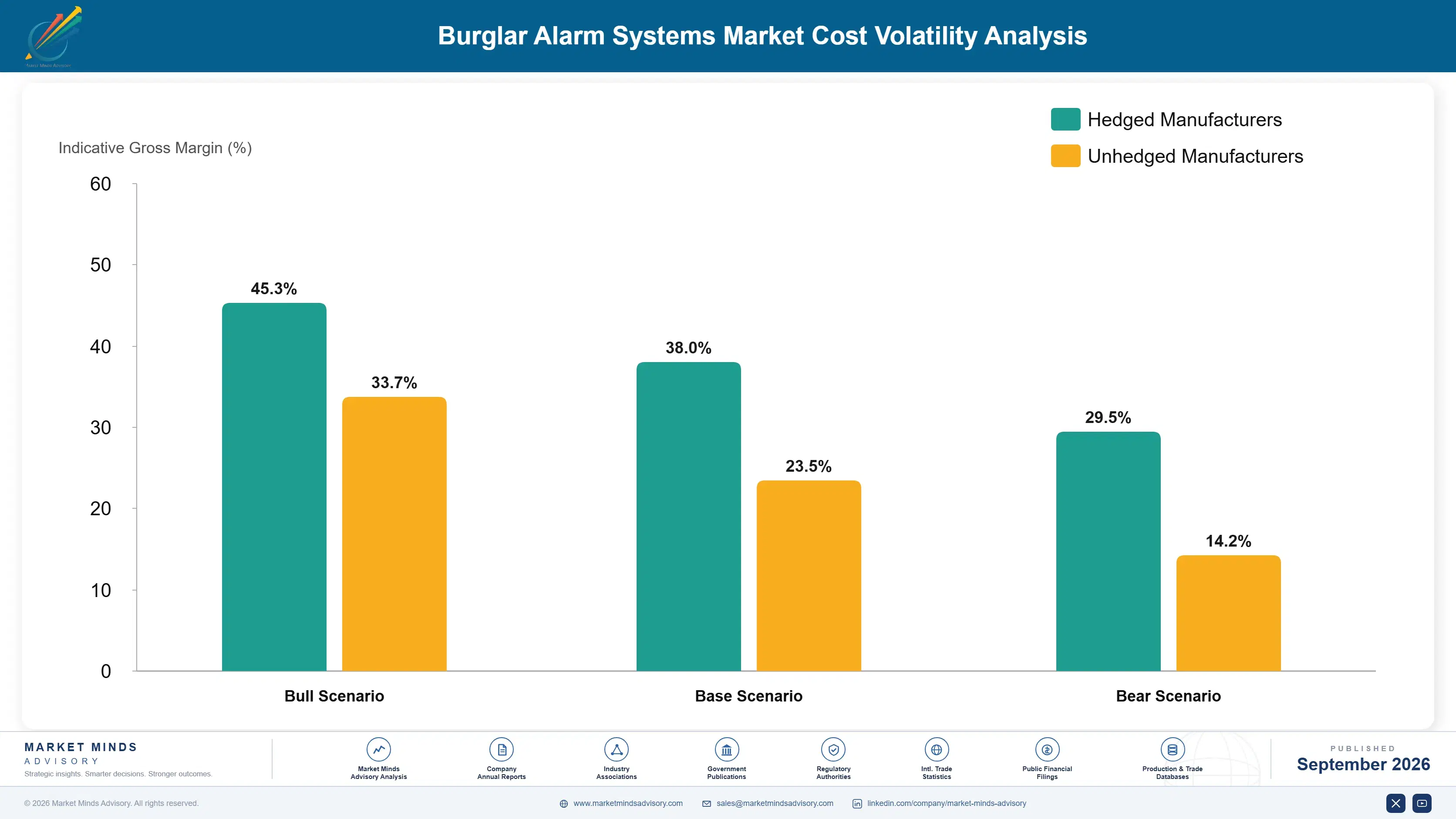
Sensor Electronics and Camera Component Exposure

Sensor electronics and camera components together account for roughly forty percent of a modern alarm panel's bill of materials, with plastic housing and wiring harnesses adding another twenty percent to the total. Image sensors and processing chips are sourced almost entirely from East Asian semiconductor foundries, regardless of where final panel assembly ultimately takes place.
The clearest recent volatility event traces to the 2021 to 2022 global semiconductor shortage, when expanding automotive and consumer electronics chip demand pulled foundry capacity away from security hardware customers, a dynamic documented in the International Energy Agency's tracking of semiconductor-dependent industries during that period. Component lead times for image sensors extended from roughly six weeks to beyond twenty-four weeks during the shortage's peak, forcing several manufacturers to delay panel shipments and prioritize commercial customers over residential orders.

This exposure disadvantages smaller regional manufacturers more heavily than the largest diversified players, since companies like Johnson Controls and Honeywell negotiate component pricing across diversified global supply agreements that smooth allocation pressure during shortages. Vendors dependent entirely on merchant semiconductor supply face unpredictable lead times that larger, vertically diversified competitors avoid, and this gap widens further during periods of high demand across adjacent electronics categories.
burglar-alarm-systems-market-cost-volatility-analysis-1789996158927

Diversify Semiconductor Sourcing Across Multiple Foundries

Manufacturers are qualifying image sensor and processing chip suppliers across multiple foundries rather than relying on a single source, spreading exposure to any one region's capacity constraints or allocation decisions across the broader supply base. This adds qualification cost upfront but has shortened recovery time during component shortages and given procurement teams stronger negotiating leverage overall.

Lock In Long-Term Component Supply Agreements

Larger vendors are signing multi-year supply agreements directly with semiconductor foundries to secure priority allocation ahead of smaller competitors during periods of tight capacity across the industry overall. Smaller manufacturers without comparable purchasing volume increasingly pool orders through distributor consortiums to access similar priority treatment collectively, spreading risk across a wider group of buyers.

Redesign Panels Around Simpler Sensor Architectures

Engineering teams are testing simpler sensor configurations that rely on fewer specialized components for entry-level product tiers, reducing exposure to any single chip category's shortage risk while keeping premium tiers on more advanced sensors and processing hardware. This design flexibility adds development cost but has already lowered bill-of-materials exposure for several vendors testing the new approach.

Portfolio Architecture for Margin Defence

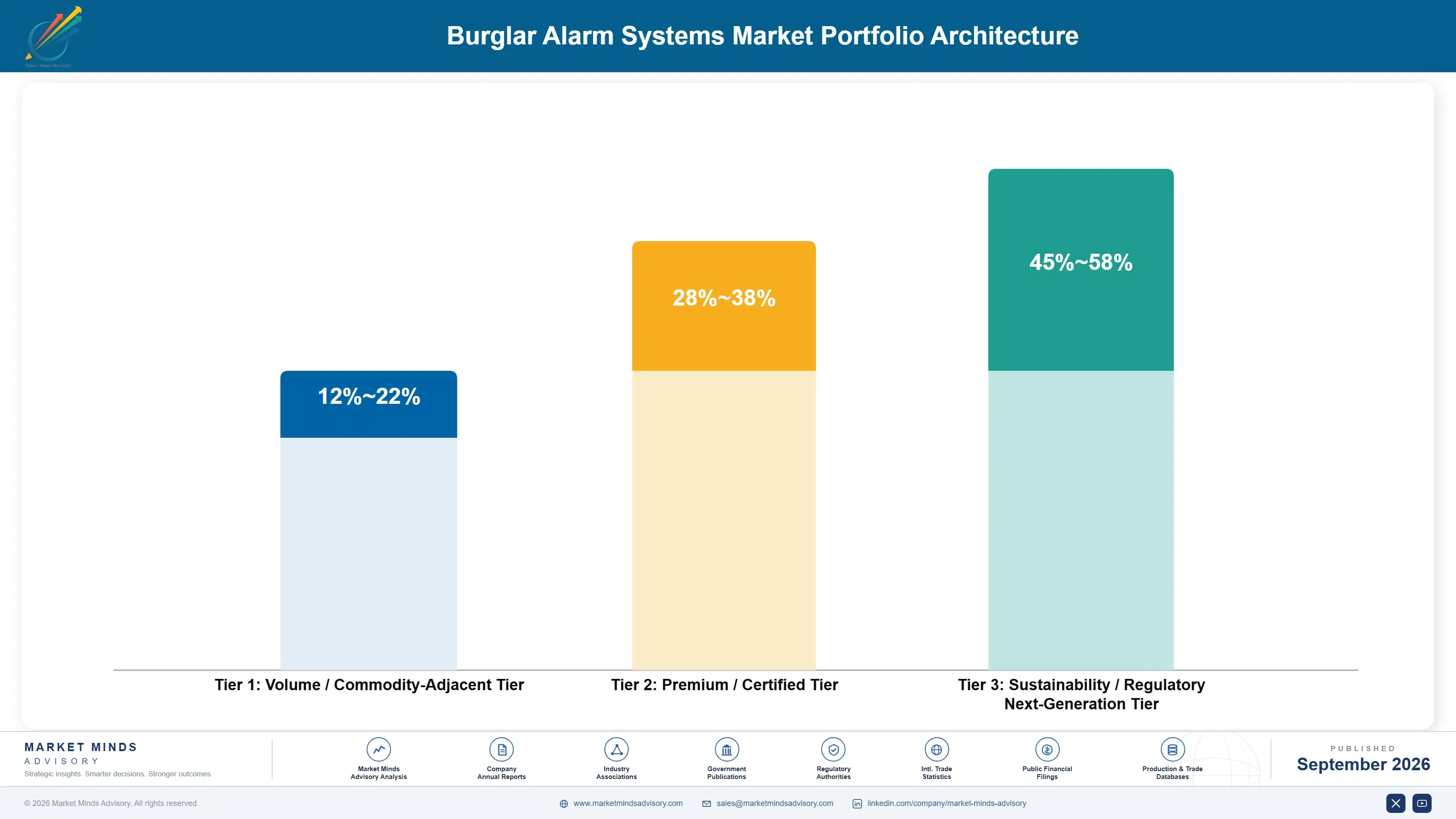
Burglar alarm portfolios split into three margin tiers tracking how verified and service-attached each product line is relative to a standardized commodity panel sold at scale across the broader market. Volume commodity-adjacent hardware carries thin margins driven by manufacturing scale competition among many suppliers, while certified premium AI-verified systems command a markup tied to false-alarm reduction guarantees and insurer partnership eligibility requirements.
The volume versus premium tension appears most clearly in how vendors allocate research investment across competing product families: chasing high-volume commodity panel orders requires aggressive cost reduction that can erode the margin structure supporting premium AI-verified and smart home integrated product lines simultaneously. Vendors trying to serve both ends with a single manufacturing line typically end up uncompetitive in each segment they attempt to serve.

High-value margin pools concentrate in monitoring subscriptions and verification software rather than in the base panel itself, which explains why the fastest-growing revenue lines sit closer to AI verification services than to standard commodity hardware. Vendors positioning purely as commodity panel manufacturers face the steepest long-term margin compression as hardware manufacturing scales globally across every producing region worldwide.

Volume / Commodity-Adjacent Tier

Standardized wired and basic wireless panels sold into cost-sensitive residential and small commercial applications, priced on unit cost competition with gross margins typically in the twelve to twenty-two percent range across most suppliers.
Gross Margin: 12-22%

Premium / Certified Tier

AI-verified and video-integrated systems carrying insurer partnership eligibility, sold at a premium for documented false-alarm reduction and verified-response capability, with gross margins running twenty-eight to thirty-eight percent for certified vendors.
Gross Margin: 28-38%

Sustainability / Regulatory / Next-Generation Tier

Smart home integrated, software-attached platforms combining monitoring subscriptions with multi-year service contracts, carrying the highest margins in the entire portfolio overall at forty-five to fifty-eight percent gross margin across most deployed configurations.
Gross Margin: 45-58%
burglar-alarm-systems-market-portfolio-architecture-1789996159431

High-value Sub-segments and Strategic Watch-out

AI-Based Video Analytics Alarm Systems

AI-based video analytics alarm systems for residential and commercial verified response, combining the fastest unit growth with the highest software-attachment margins found anywhere in the portfolio, making this segment the priority allocation target for most vendors' engineering investment over the next several forecast years ahead.
Gross Margin: 32-45%

Wireless Sensor-Based Panels

Wireless sensor-based panels for residential retrofit and new construction projects nationwide, growing quickly on falling installation costs but facing longer sales cycles among commercial customers still standardized on existing wired infrastructure that takes years to fully replace across a whole building portfolio and budget cycle.
Gross Margin: 22-32%

Standard Wired Control Panel Systems (Volume Core)

Standard wired control panel systems for legacy commercial installations across most markets worldwide today still, the largest installed base and steadiest cash generator in the category even as unit pricing declines gradually and margins compress each successive year across most regions and customer segments alike.
Gross Margin: 12-20%

Do-It-Yourself Self-Monitored Kits (Strategic Watch)

Do-it-yourself self-monitored kits sold through retail channels nationwide and increasingly online marketplaces today, a segment eroding professional monitoring attach rates, worth monitoring closely for whether established providers can successfully convert self-monitored customers into paid subscription relationships over the next several forecast years still ahead of us.
Gross Margin: 15-25%

Monitoring Contracts Run on Annuity Terms

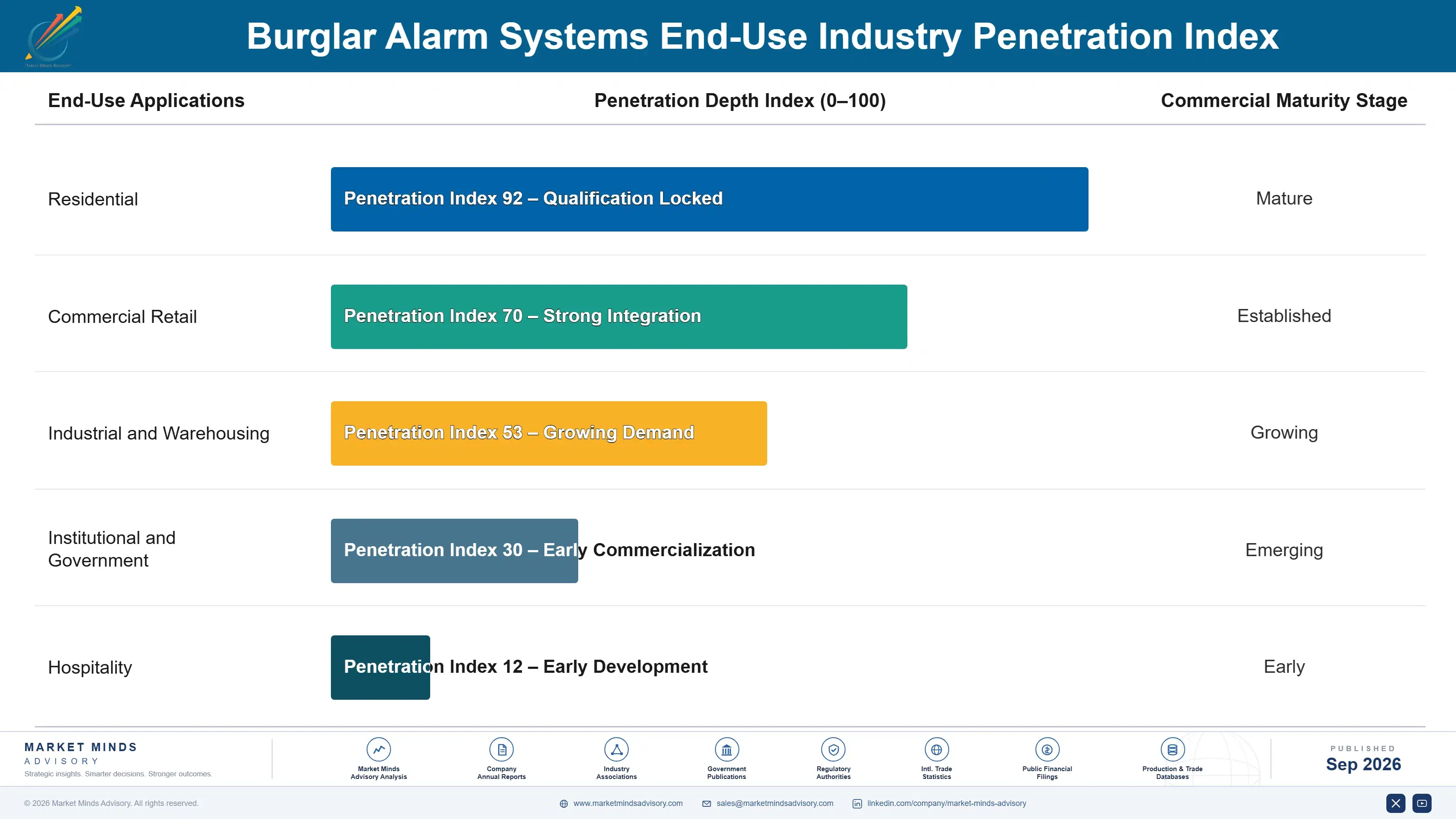
Burglar alarm contracts increasingly behave like annuities rather than one-time hardware purchases, since monthly monitoring subscriptions lock in a multi-year revenue stream that outlasts the panel's own useful life by several contract renewal cycles across a typical customer relationship. A provider that wins a customer at initial installation can expect five to seven years of recurring monitoring revenue before that customer churns or upgrades hardware.
Adoption depth varies sharply by end-use vertical: commercial customers treat monitored alarm systems as a near-universal compliance and insurance requirement, while residential adoption remains uneven, concentrated in higher-income households but still largely absent from budget-conscious renters who view monthly monitoring fees as discretionary spending they can skip. Retail chain adoption sits between these extremes, growing steadily as enterprise-wide monitoring contracts spread across the sector.

Buyer profiles are shifting generationally as younger homeowners increasingly evaluate security systems alongside broader smart home compatibility rather than treating alarm purchase as a standalone decision made independently of other connected devices in the home. This shift favors vendors that can demonstrate smooth integration with popular smart home platforms over those competing purely on traditional intrusion detection specifications alone.
burglar-alarm-systems-market-end-use-penetration-index-1789996159923

Where the Real Margin Sits

These are among the four positions where our research anticipates prominent divergence between winners and laggards over the coming forecast period. Each is grounded in the demand model, the regulatory perimeter, and the announced capacity pipeline.
01 / AI VERIFICATION INVESTMENT PRIORITY

Prioritize AI Video Verification Over Legacy Motion Sensing

Vendors concentrating engineering investment on AI-based video analytics are positioned ahead of the market's fastest-growing segment, expanding at twelve and a half percent annually against a seven and a half percent market average overall. Police departments in a growing number of jurisdictions now require visual confirmation before dispatch, making verification a purchase requirement rather than an optional upgrade. Companies still treating video analytics as a premium add-on risk losing accounts to competitors building verification into every tier of their product line.
02 / INSURER PARTNERSHIP DEVELOPMENT

Build Direct Insurer Partnership Programs Now

Providers with active insurer partnerships report customer acquisition costs running twenty percent lower than those relying solely on direct marketing spend, since the insurer channel delivers pre-qualified customers already motivated by a clear financial incentive to convert. Building these relationships takes time and requires actuarial data most smaller providers lack the scale to generate independently on their own. Vendors that delay this investment will keep paying an acquisition cost premium that better-connected competitors have already eliminated from their unit economics.
03 / SMART HOME INTEGRATION UPSELL

Sell Smart Home Integration as a Standard Upsell

Customers accepting a smart home integration upsell generate average revenue per account running twenty-eight percent higher than security-only subscriptions, since additional connected devices carry their own margin while deepening switching costs considerably over the customer relationship's full lifetime. This upsell path also protects against do-it-yourself kit competition, since bundled platform value is harder to replicate than a standalone alarm panel alone. Providers that treat smart home integration as optional rather than standard risk ceding this margin pool to more aggressive competitors entirely.
04 / SUPPLY CHAIN DIVERSIFICATION PLANNING

Diversify Semiconductor Sourcing Ahead of Shortages

Image sensor and processing chip supply concentrates heavily in East Asian foundries, leaving vendors exposed to the same volatility that produced twenty-four-week lead times during the recent semiconductor shortage across the entire industry worldwide today still. Qualifying suppliers across multiple foundries adds upfront verification cost but shortens recovery time substantially when the next regional disruption occurs. Vendors treating this diversification as optional rather than mandatory will keep losing shipment volume to competitors who can maintain supply through the next shock.

Engagement Snapshot From the Field

A live engagement with an industry participant carrying material or product regulatory and market exposure ahead of a defining policy shift, showing how our research translates into a defensible multi-year portfolio strategy.
MARKET MINDS ADVISORY · CLIENT ENGAGEMENT SUMMARY
Burglar Alarm Systems Producer Strategic Portfolio Review and Transition Roadmap 2026·Investment Scenario on Burglar Alarm Systems Exposure Evaluation 2025-26
CLIENT PROFILE
The client is a regional professional monitoring company with roughly 340 million dollars in annual revenue (client-reported, unverified by MMA), operating a residential and small commercial alarm monitoring business across a mid-size metropolitan market. The company had relied primarily on direct marketing for customer acquisition but faced rising costs as national competitors expanded into its service territory. Leadership sought an independent assessment before committing budget.
STRATEGIC CHALLENGE
The client faced rising customer acquisition costs as national competitors with insurer partnerships undercut its direct marketing approach on both price and conversion rate. Internal sales and marketing teams disagreed on whether to pursue insurer partnerships directly or continue investing in traditional advertising channels, and leadership wanted a data-driven recommendation before the annual budget cycle.
MMA APPROACH
MMA conducted structured interviews with the client's sales leadership alongside its own primary survey and expert interview datasets to benchmark customer acquisition costs and conversion rates across insurer-partnered and non-partnered monitoring companies. The analysis mapped regional insurer market share against the client's existing customer base to identify the highest-value partnership targets.
KEY FINDINGS
  1. Monitoring companies with active insurer partnerships reported customer acquisition costs averaging 20 percent lower than the client's current direct marketing spend across comparable metropolitan markets.
  2. Three regional insurers controlling a combined 45 percent of the client's metropolitan area's homeowner policy market had no existing alarm monitoring partnership in place at the time of the engagement.
  3. Customers acquired through insurer referral channels showed contract retention rates roughly 15 percent higher than customers acquired through direct marketing, reducing long-term churn-related revenue loss.
  4. Building insurer partnerships required actuarial data sharing agreements that took an estimated four to six months to negotiate, longer than the client's existing quarterly marketing planning cycle allowed.
CLIENT PROFILE
The client is a regional professional monitoring company with roughly 340 million dollars in annual revenue (client-reported, unverified by MMA), operating a residential and small commercial alarm monitoring business across a mid-size metropolitan market. The company had relied primarily on direct marketing for customer acquisition but faced rising costs as national competitors expanded into its service territory. Leadership sought an independent assessment before committing budget.
STRATEGIC CHALLENGE
The client faced rising customer acquisition costs as national competitors with insurer partnerships undercut its direct marketing approach on both price and conversion rate. Internal sales and marketing teams disagreed on whether to pursue insurer partnerships directly or continue investing in traditional advertising channels, and leadership wanted a data-driven recommendation before the annual budget cycle.
MMA APPROACH
MMA conducted structured interviews with the client's sales leadership alongside its own primary survey and expert interview datasets to benchmark customer acquisition costs and conversion rates across insurer-partnered and non-partnered monitoring companies. The analysis mapped regional insurer market share against the client's existing customer base to identify the highest-value partnership targets.
KEY FINDINGS
  1. Monitoring companies with active insurer partnerships reported customer acquisition costs averaging 20 percent lower than the client's current direct marketing spend across comparable metropolitan markets.
  2. Three regional insurers controlling a combined 45 percent of the client's metropolitan area's homeowner policy market had no existing alarm monitoring partnership in place at the time of the engagement.
  3. Customers acquired through insurer referral channels showed contract retention rates roughly 15 percent higher than customers acquired through direct marketing, reducing long-term churn-related revenue loss.
  4. Building insurer partnerships required actuarial data sharing agreements that took an estimated four to six months to negotiate, longer than the client's existing quarterly marketing planning cycle allowed.
RECOMMENDED STRATEGY
Phase 1: Phase 1 (Insurer Outreach): Approach the three identified regional insurers with a formal partnership proposal within the first two months. Phase 2: Phase 2 (Pilot Program): Launch a pilot referral program with the first insurer partner to validate acquisition cost improvements before wider rollout. Phase 3: Phase 3 (Full Rollout): Expand the successful insurer partnerships across the entire service territory over the following twelve months fully.
OUTCOME
The client signed a partnership agreement with one of the three identified insurers within five months and reported a measurable reduction in customer acquisition cost within the first two quarters (client-reported, unverified by MMA). The client subsequently began negotiations with a second insurer to expand the referral program further.

Frequently Asked Questions

Foundational context covering the market sizes, CAGR, scope, country, region and competition that inform every finding below. This section is provided to cover basics and most often pre-purchase conversations, answered from the MMA Primary Research Dataset.

What is the current size of the Burglar Alarm Systems Market?

The Burglar Alarm Systems Market is valued at 42.6 billion dollars in 2025, the base year for this analysis. It is projected to reach 45.8 billion dollars in 2026 as verification requirements accelerate replacement demand.

How large will the Burglar Alarm Systems Market be by 2036?

The market is forecast to reach 94.4 billion dollars by 2036, up from 45.8 billion dollars in 2026. This represents a 2.06 times expansion over the ten-year forecast period.

What is the CAGR for the Burglar Alarm Systems Market 2026 to 2036?

The market is projected to grow at a compound annual growth rate of 7.5 percent between 2026 and 2036. Bull and bear scenarios range from 8.7 percent to 6.3 percent depending on verification mandate adoption.

Which segment is growing fastest?

AI-Based Video Analytics Alarm Systems is the fastest-growing segment, expanding at 12.5 percent annually, 1.67 times the overall market rate. Falling police dispatch tolerance for unverified alarms is pulling this segment into mainstream adoption.

Who are the major companies in the Burglar Alarm Systems Market?

Leading participants include Johnson Controls, Honeywell, Bosch Security Systems, ADT, and Assa Abloy. These five companies hold a combined CR5 of 35 percent, reflecting a moderately fragmented competitive landscape.

Which country is growing fastest?

India is the fastest-growing country, expanding at 10.0 percent annually as urban residential and commercial construction drives first-time system adoption. This outpaces the broader South Asia and Pacific regional average.

Report Segmentation Architecture

The full report scope spans multiple orthogonal segmentation dimensions, with cross-tabulated demand data provided for each dimension pair. Coverage extends further to regional breakdowns, trend trajectories, and the competitive detail needed to support segment-level decision-making.

By Product Technology Type

  • AI-Based Video Analytics Alarm Systems
  • Wireless Sensor-Based Panels
  • Wired Control Panel Systems
  • Environmental and Perimeter Sensors
  • Monitoring and Central Station Services
  • Installation and Maintenance Services

By End-Use Industry

  • Residential
  • Commercial Retail
  • Industrial and Warehousing
  • Institutional and Government
  • Hospitality

By Commercial Dimension

  • Direct-to-Consumer Sales
  • Professional Installer Channel
  • Insurer-Partnered Referral Channel

By Region

  • North America
  • Western Europe
  • East Asia
  • South Asia and Pacific
  • Latin America
  • Middle East and Africa
  • Eastern Europe

Scope, Methodology, and Coverage

Every figure in this report is reproducible from documented input assumptions. The scope below maps the historical period, the forecast horizon, the segmentation dimensions, and the countries covered, alongside the underlying primary and qualitative methodology.
Historical Period
2020 to 2025
Forecast Period
2026 to 2036
Base Year
2025 (USD billions; MMA Primary Research Dataset, September 2026)
Market Definition
The Burglar Alarm Systems Market covers intrusion detection hardware, control panels, sensors, and associated monitoring services designed to detect and report unauthorized entry into residential and commercial premises. It excludes standalone video surveillance systems sold without integrated intrusion detection and fire alarm systems regulated under separate life-safety codes.
Quantitative Units
USD Billion, CAGR (%)
Segmentation Dimensions
By Product Technology Type, By End-Use Industry, By Commercial Dimension, By Region
Regions Covered
North America, Western Europe, East Asia, South Asia and Pacific, Latin America, Middle East and Africa, Eastern Europe
Countries Covered
United States, Canada, Germany, United Kingdom, France, China, Japan, South Korea, India, Australia, Vietnam, Indonesia, Brazil, Mexico, United Arab Emirates, Saudi Arabia, South Africa, Poland, Czech Republic, Nigeria
Key Companies Profiled
Johnson Controls, Honeywell, Bosch Security Systems, ADT, Assa Abloy, Vivint, SimpliSafe, Ring, Alarm.com, Napco Security Technologies, Resideo Technologies, Hikvision, Dahua Technology, Axis Communications, UTC Fire and Security, Securitas, Verisure, Comelit Group, Risco Group, DSC (Digital Security Controls)
Quantitative Methodology
Primary survey, n=3,800 respondents, Q4 2025, six countries; demand-side model with trade association cross-validation
Qualitative Methodology
47 expert interviews, Q4 2025; applied to validate demand model assumptions, identify emerging dynamics, and assess competitive positioning
Report Format
PDF and XLSX data workbook (Word format preview document)
Publisher
Market Minds Advisory
Report Code
MMA-2026-CON-115
Published
September 2026
Contact
sales@marketmindsadvisory.com | www.marketmindsadvisory.com

Purchase the full Burglar Alarm Systems Market Report (2026 to 2036).

This report provides a comprehensive analysis of the global Burglar Alarm Systems Market from 2026 through 2036, covering market sizing, segmentation, regional dynamics, and competitive positioning across all major product technologies. It draws on primary survey data from 3,800 respondents and 47 expert interviews conducted in the fourth quarter of 2025 to ground every forecast in verifiable industry behavior. Segment-level growth projections identify where AI video analytics is outpacing legacy wired and motion-only panels as verification requirements spread. Readers also gain regional demand drivers, input cost exposure analysis, and a strategic verdict identifying where margin and growth intersect.
Ten-year market sizing and growth forecast
Six-technology segmentation with detailed growth rate data
Seven-region demand pattern and competitive positioning analysis
Twenty-company competitive benchmarking and moat assessment database
Input cost and supply chain risk assessment
Anonymized client engagement case study with outcomes

Built For The People Who Decide

From boardroom strategy to bench-side execution, this report is read cover-to-cover by leaders shaping the next decade of their industry, turning demand scenarios, market dynamics and valuation benchmarks into decisions.
CXOs/ Presidents/ VPs/ Managers
M&A and Corporate Development
Strategy Teams and R&D Heads
Procurement and Product Directors
Regulatory and Compliance Leaders
Investor Relations and Equity Analysts