Market Minds Advisory
Bulletproof Glass Market

Bulletproof Glass Market: Bulletproof Glass Market: Ratings Chosen Without Assessment, Spall Containment and Replacement Driven By Yellowing, 2026 to 2036

Buildings replace this glazing because it turned yellow at the edges, not because anybody has ever shot at it, and most of the market buys a rating off a table.

Lead Analyst

Published

September 2026

Make Smarter Decisions with Customized Research Insights

Request a free sample report and evaluate market opportunities, growth trends, and competitive dynamics relevant to your business needs.

2025 MARKET VALUE$6.8BMarket Size 2025
2036 FORECAST VALUE$13.6BBase Case , 2026 to 2036
CAGR 2026 TO 20366.6 %Bull 7.8% / Bear 5.4%
INCREMENTAL OPPORTUNITY$6.4BNet 10- year value creation
EXPANSION MULTIPLE1.89x2036 value over 2026 base
Strategic Levers
M&A Pipeline
Regional Outlook
Country Rankings
Competitive Intelligence
Segmental Deep-dive
Call-Us : 91 93563 13602

Executive Snapshot and Market Trajectory.

Around 19% of bullet-resistant glazing specifications follow any documented threat assessment. The rest select a protection level from a published table, which produces over-specified lobbies and under-specified perimeters in roughly equal measure. Nobody involved treats this as a problem worth fixing. Nobody treats that as a problem worth fixing.
Glass-clad polycarbonate laminates grow at 9.9%, half again the market rate of 6.6%, because they stop the round and contain the fragments rather than throwing glass into the protected space. Monolithic and laminated polycarbonate follows at 8.4%. All-glass laminates, which spall by design, grow at barely two thirds the category rate. Weight per unit of protection is also considerably better. Weight per unit of protection is considerably better as well.
The replacement driver is optical rather than ballistic. About 71% of units come out because they yellowed or delaminated at the edge, typically between five and fifteen years depending on sealing and exposure. Nobody in this market replaces glazing because it was shot, and edge sealing quality therefore determines product life far more than any protection rating does. Manufacturers competing on protection level compete on what never triggers a purchase. Edge sealing decides it instead.
Market Definition
This market covers transparent armour rated for ballistic protection, including glass-clad polycarbonate laminates, monolithic and laminated polycarbonate, glass-polymer hybrid ionoplast systems, insulated ballistic glazing units, glass-clad acrylic laminates, and all-glass ballistic laminates. It excludes security and burglar-resistant glazing without a ballistic rating, blast-resistant glazing rated only for pressure, ordinary laminated safety glass, opaque armour in steel, ceramic or composite, and personal body armour.
Base Year Value
$6.8B in 2025 (MMA Primary Research Dataset, September 2026)
Forecast Period
2026 to 2036, eleven discrete annual values
CAGR
6.6% base case. Bull 7.8%. Bear 5.4%.
Fastest Growth Segment
Glass-Clad Polycarbonate Laminates: 9.9% CAGR
Fastest Growth Country
Mexico: 12.4% CAGR
Fastest Growth Region
South Asia and Pacific: 8.6% CAGR
Largest Region
North America: 30% of 2025 global value
Market Leaders
Saint-Gobain, AGC Inc, Guardian Glass, SCHOTT, and NSG Group lead the field. Source: MMA Primary Research Dataset, July 2026.
Primary Survey
n=3,800 procurement and R&D decision-makers, Q4 2025, six countries
Methodology
Demand-side build-up, cross-validated against public data, 47 expert interviews

Bulletproof Glass Market Forecast Scenarios

bulletproof-glass-market-size-forecast-scenario-1790015586468
Between 2020 and 2025 the category grew at 5.3% on demand that arrived from several unrelated directions at once. School and government hardening programmes expanded across North America, Latin American vehicle armouring grew steadily, and commercial banking and retail specification continued at established levels. Polycarbonate-containing constructions took share from all-glass laminates throughout the period on spall containment.
The base case at 6.6% rests on three mechanisms. Institutional hardening programmes continue as public buildings are refurbished on capital cycles rather than in response to any single event. Mexican and Brazilian vehicle armouring expands as security conditions sustain demand no other region approaches per head. And optical replacement cycles turn over an installed base that was largely fitted in the two decades before this one. None of the three depends on any single security incident occurring.
The bull case at 7.8% depends on threat assessment becoming standard practice, which would raise average specified levels in the places genuinely at risk. The bear case at 5.4% is weight: rifle-rated constructions reach around 78 kilograms per square metre, only about 22% of existing frames can carry rated glazing without replacement, and that limits retrofit demand regardless of how much security spending rises.

What Actually Ends A Window

Protection ratings describe a specific threat and nothing else. A construction rated for handgun rounds will not stop a rifle, and the difference between those two cases is roughly a factor of three in thickness and weight. Around 19% of specifications follow any documented assessment of what the actual threat is, so buildings routinely install rifle-rated glazing in reception areas and handgun-rated glazing where rifles are the realistic risk.
TOP FIVE CONCENTRATION34%Share of category revenue held by the leading manufacturers
THREAT ASSESSMENT RATE19%Specifications preceded by any documented assessment of risk
SPALL PROTECTION SHARE43%Installations using constructions that contain fragments inward instead
OPTICAL REPLACEMENT DRIVER71%Units replaced for yellowing or delamination rather than damage
RIFLE RATED AREAL WEIGHT78 kgMass per square metre at the highest common protection levels
RETROFIT FEASIBILITY RATE22%Existing frames able to carry rated glazing without replacement
Spall is the second thing specifications tend to miss. An all-glass laminate stops the projectile and sends glass fragments into the room behind it at velocities that injure people the glazing was installed to protect. Polycarbonate-backed constructions contain those fragments. Only about 43% of installed area uses a no-spall construction, and the distinction rarely appears in a tender document at all.
What actually removes glazing from a building is neither of those. Polycarbonate-containing laminates yellow under ultraviolet exposure and delaminate from the edges inward where sealing was inadequate, and roughly 71% of replacements happen for optical reasons rather than because anything struck the glass. Edge sealing quality therefore determines service life far more decisively than the protection rating printed on the label.
"In twenty years of specifying this material I have never replaced a panel because somebody shot it. I have replaced hundreds because they went cloudy at the edges. We sell a ballistic rating and the customer experiences an optical product, and the two have almost nothing to do with each other."
Practice Director, Security Glazing and Protective Materials · MMA Chemicals and Materials Practice · September 2026

Market Trends

Spall Containment Now Displaces All-Glass Constructions

Glass-clad polycarbonate grows at 9.9%, the fastest rate here, because it stops the round without throwing glass fragments into the space the glazing protects. All-glass laminates spall by design and grow at barely two thirds the category rate as a result. Around 43% of installed area currently uses a no-spall construction, which means most existing installations would injure occupants during exactly the event they were specified to survive. The cost difference between the two constructions is modest and the argument is straightforward, and almost nobody selling into this market currently bothers to make it to a specifier.
Market Impact: Country grows at 12.4%
Optical Life Rather Than Ballistic Rating Sets Replacement

About 71% of bullet-resistant units are replaced for yellowing or edge delamination rather than for any impact damage, typically between five and fifteen years after installation depending on ultraviolet exposure and sealing quality. Manufacturers competing on protection level are therefore competing on the attribute that almost never triggers a purchase. Edge sealing and ultraviolet stabilisation determine what a customer actually experiences across the whole service life. A customer buying a fifteen year installation is buying an optical product with a ballistic rating attached, and very little in the way this category is sold reflects that ordering of priorities.
Market Impact: Lags 3 years behind approval

Market Opportunities and Growth Drivers

Mexican Vehicle Armouring Leads Every Market Covered

Mexican growth of 12.4% leads every country covered, driven by civilian and corporate vehicle armouring at rates no other market approaches per head of population. Vehicle glazing demands curvature, optical clarity, and weight limits that architectural work never imposes, which makes it a technically distinct business. Brazilian demand follows a comparable pattern, and both markets sustain specialist armouring workshops that buy laminate directly rather than through construction channels. Those workshops operate on entirely different specification logic from architectural work, since curvature, weight, and optical clarity all bind simultaneously in a way a flat panel never faces.
Market Impact: Only 22% of frames qualify

Institutional Hardening Runs On Capital Cycles

School, government, and healthcare hardening programmes proceed as buildings reach scheduled refurbishment rather than in response to individual events, which makes the demand considerably more predictable than the subject matter suggests. Budget approval typically precedes installation by two to three years. That lag means current activity reflects decisions taken well before now, and it insulates the category from the short-term swings that security spending otherwise shows. Refurbishment schedules therefore predict this demand considerably better than any security event does, and manufacturers tracking capital programmes forecast far more accurately than those watching the news.
Market Impact: Only 19% assess threats

Market Restraints and Challenges

Weight Makes Most Retrofit Physically Impossible

Rifle-rated constructions reach around 78 kilograms per square metre and only about 22% of existing frames can carry rated glazing without replacement, and the root cause is that ordinary window framing was never engineered for that load. Commercially it converts most upgrade enquiries into full window replacement projects at many times the glazing cost. Manufacturers respond with lighter polycarbonate-heavy constructions and with frame reinforcement systems sold alongside. None of that changes the underlying physics, which is that stopping a rifle round requires mass the building was never designed to hold.
Market Impact: Covers 43% of installations

Ratings Get Selected Without Any Threat Assessment

Roughly 19% of specifications follow a documented threat assessment, and the root cause is that architects and facility managers select a level from a published table without access to any risk analysis. Commercially it produces over-specification in low-risk areas and under-specification where rifles are the realistic threat. Manufacturers respond with assessment services, with threat-mapped specification tools, and with training for the specifiers who make these choices. Very few fabricators offer assessment, which leaves the position available to whoever builds the capability first. The position sits open to whoever builds the capability first, and building it costs training rather than plant.
Market Impact: Drives 71% of replacements
4 additional market trends, 3 additional growth drivers, and 2 additional restraints and challenges are covered in the full report. Contact sales@marketmindsadvisory.com to access the complete intelligence.

Segment CAGR and Growth Architecture

Segmentation follows laminate construction across six categories: glass-clad polycarbonate laminates, monolithic and laminated polycarbonate, glass-polymer hybrid ionoplast systems, insulated ballistic glazing units, glass-clad acrylic laminates, and all-glass ballistic laminates. Protection level, end-use application, and framing system are treated as separate dimensions rather than mixed into this hierarchy. Edge sealing is counted within the construction it protects.
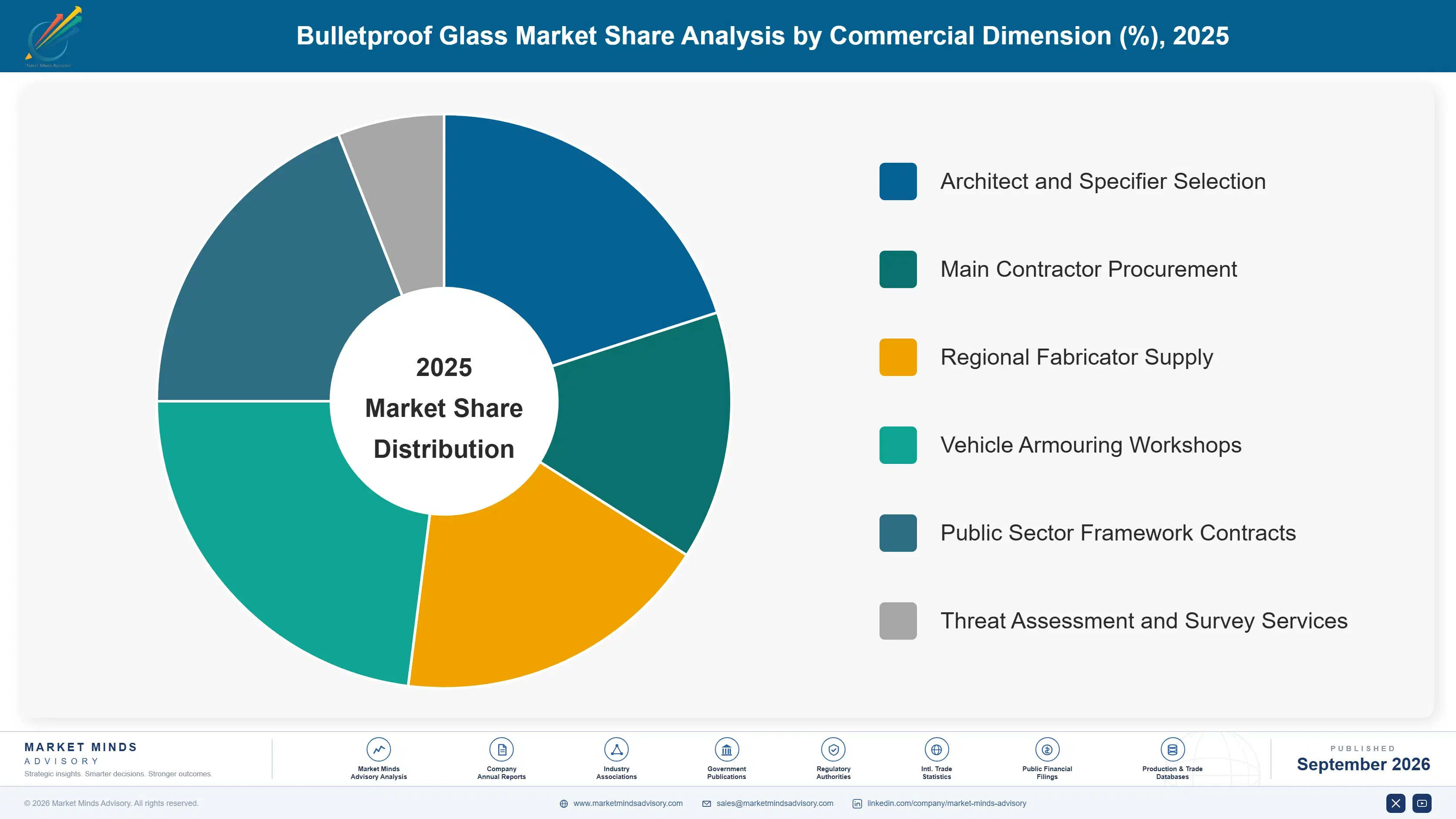
bulletproof-glass-market-market-share-analysis-1790015587075

Glass-Clad Polycarbonate Laminates

Glass-clad polycarbonate grows at 9.9%, half again the market rate of 6.6%, on spall containment rather than on stopping power. The glass face resists abrasion and cleaning chemicals while the polycarbonate backing absorbs residual energy and holds fragments inside the laminate rather than releasing them toward whoever the glazing protects. Weight per unit of protection is considerably better than all-glass equivalents, which matters enormously given frame load limits. The weakness is optical: polycarbonate yellows under ultraviolet exposure and delaminates from poorly sealed edges, which is what actually ends the service life. Edge sealing quality decides how long the panel stays clear. Most fabricators treat sealing as a finishing operation rather than a design element.
CAGR 9.9%

Monolithic And Laminated Polycarbonate

Polycarbonate constructions grow at 8.4% where weight is the binding constraint rather than surface durability. Areal weight runs far below any glass-containing equivalent at comparable protection, which makes them the practical choice for vehicle armouring, retrofit into frames that cannot carry glass, and any application where the structure was not designed for this load. The surface scratches readily and hazes under routine cleaning, so hard-coated grades are effectively mandatory in public areas. Optical service life is shorter than glass-clad alternatives and the weight advantage frequently outweighs that. Vehicle armouring workshops buy these constructions almost exclusively, since a vehicle cannot carry the mass a glass-containing laminate would add at equivalent protection.
CAGR 8.4%
Full segment breakdown across 6 segments available in the complete report.

Regional Architecture and Country Demand Map

Regional shares here reflect where rated glazing is actually being installed rather than where the laminates themselves are manufactured, since fabrication is inherently regional and a finished panel travels extremely poorly indeed. All seven regions sit inside the standard bands for both share and growth.

North America

Institutional hardening across schools, government buildings, and healthcare facilities generates more demand here than in any other region, and those programmes run on refurbishment capital cycles rather than on immediate reaction. Growth of 6.2% tracks close to the world rate. Banking and retail cash-handling specification is mature and largely replacement driven. Specialist fabricators hold a substantial share against the international glass groups, since fabrication is inherently regional and installation support matters more than manufacturing scale. Threat assessment practice here is no better than the world average despite the volume of institutional work, which is the clearest available opportunity for any fabricator willing to build the capability. Nobody has yet built it at scale.
Share: 30% | CAGR: 6.2% (2026 to 2036)

East Asia

Chinese float glass and polycarbonate production supplies laminators across the region and increasingly exports finished panels into markets that once fabricated domestically. Growth of 7.6% exceeds the world rate. Institutional and financial sector specification is expanding as building standards formalise, and Japanese and Korean demand skews toward higher optical quality at premium prices. Chinese manufacturers have closed most of the ballistic performance gap while remaining behind on edge sealing durability. Edge sealing durability is where the remaining performance gap sits, and it happens to be the attribute that governs replacement rather than the ballistic performance that governs specification. That gap decides service life rather than protection. Specification volume is rising steadily.
Share: 24% | CAGR: 7.6% (2026 to 2036)
Regional intelligence for 5 additional markets available in the complete report: Western Europe, South Asia and Pacific, Latin America, Middle East and Africa, Eastern Europe. Contact sales@marketmindsadvisory.com.
bulletproof-glass-market-country-cagr-analysis-1790015587600

Where Fabricators Build Real Positions

Four commercial moves separate fabricators building durable positions from those quoting a protection level against a drawing. Each addresses something this market knows and does not act on: nobody assesses threats, spall is ignored, weight decides feasibility, and optical failure ends every installation. Three of the four are services rather than products. None requires new manufacturing capability at all.

Sell Threat Assessment Before Selling Glazing

Around 19% of specifications follow any documented threat assessment, which produces over-specification in lobbies and under-specification at perimeters simultaneously. Fabricators offering assessment as a service report average project values 2.7 times higher, because a properly assessed building specifies more where it matters and less where it does not. It also removes the tender from a straight price comparison against a level printed on a drawing. Very few fabricators currently offer it at all. Building the capability costs training rather than plant, which makes the position unusually accessible to anybody willing to take it seriously.
Market Impact: Raises average project values to 2.7 times higher

Specify Spall Containment As Standard Practice

Only about 43% of installed area uses a construction that contains fragments, which means most installations would injure occupants during the event they were specified to survive. Fabricators writing no-spall construction into every quotation report specification win rates 2.2 times higher once the distinction is explained to a client. The cost difference is modest and the argument is straightforward, and almost nobody in this trade currently makes it. Occupants would be injured by the glazing protecting them. Most installed area would injure the occupants it was fitted to protect. The argument is straightforward and rarely made.
Market Impact: Raises specification win rates to 2.2 times higher

Quote Frame Capacity Alongside Every Panel

Rifle-rated glazing reaches around 78 kilograms per square metre and roughly 22% of existing frames can carry it without replacement. Fabricators surveying frame capacity before quoting report project cancellation rates 3.1 times lower than those pricing glazing alone. The customer who learns early that a retrofit means new framing either budgets for it or specifies a lighter construction, and both outcomes are far better than discovering it at installation. Discovery at installation is the most expensive outcome available. A survey costs a site visit and prevents a project collapsing. Lighter constructions are the alternative answer.
Market Impact: Cuts project cancellation rates to 3.1 times lower

Warrant Optical Life Not Ballistic Performance

About 71% of replacements happen because a panel yellowed or delaminated rather than because anything struck it, so optical durability is what a customer actually experiences across fifteen years of ownership. Fabricators warranting edge integrity and light transmission report repeat specification 2.9 times higher across estate portfolios. Ballistic performance is guaranteed by the rating already, which makes warranting it commercially meaningless to anybody buying. The customer already has that guarantee from the rating itself. Estate portfolios in particular consolidate around fabricators who warrant what actually fails, since the alternative is running a tender every fifteen years for the same buildings.
Market Impact: Raises repeat specification rates to 2.9 times higher

Who Controls the Margin Pool

Concentration is moderate. Five manufacturers hold 34% of category revenue, measured consistently on that basis across all participants, and the remainder spreads across regional laminating fabricators, vehicle armouring specialists, and Chinese producers who have closed most of the ballistic performance gap in recent years. Barriers to entry in fabrication are moderate and in specification service considerably higher, which is where the field genuinely separates.
Competition currently turns on three dimensions: edge sealing and ultraviolet stabilisation, which decide how long a panel stays clear; fabrication proximity, since laminated panels are heavy and fragile in transit; and specification support, where assessment and frame surveying separate suppliers from price quoters. Vehicle glazing capability has become a fourth dimension, and it is served through channels sharing almost nothing with architectural work.

Pressure builds from two directions. Chinese producers compete hard on price with acceptable ballistic performance. Meanwhile regional fabricators hold installation relationships that manufacturing scale does not reach. Rankings will shift toward suppliers warranting optical life, since that is what customers actually experience. Assessment capability is the clearest unclaimed position anywhere in this market. Nobody has claimed the assessment position at any meaningful scale.
bulletproof-glass-market-company-positioning-matrix-1790015588122

Competitive Moat and Risk Dimensions

SAINT-GOBAIN

Moat: Interlayer And Lamination Depth

Control over interlayer chemistry alongside glass production allows edge sealing and ultraviolet stabilisation to be engineered together rather than assembled from bought-in components, which directly determines the optical service life that governs replacement. That vertical position took decades and is not available to fabricators buying sheet and interlayer separately.
SAINT-GOBAIN

Risk: Regional Fabricator Relationship Gap

Laminated panels are heavy, fragile, and uneconomic to ship far, so installation relationships sit with regional fabricators who hold the specifier contact and the survey capability. Manufacturing depth does not reach the point where a protection level and a frame survey are actually decided on a project.
AGC INC

Moat: Vehicle Glazing Curvature Capability

Forming rated laminates to vehicle curvature while holding optical clarity is genuinely difficult, and capability built through automotive glass production transfers directly into armouring work that architectural fabricators cannot attempt. That competence serves the fastest growing demand in Latin America and in corporate security fleets worldwide.
AGC INC

Risk: Architectural Specification Distance

Strength in vehicle glazing does not create the specifier relationships that decide architectural projects, where a fabricator with survey capability and local installation support wins work regardless of laminate quality. The two halves of this market are served through channels that share almost nothing. Building both channels takes years of separate investment.

Players Tracked

Prominent Players

Saint-Gobain
AGC Inc
Guardian Glass
SCHOTT
NSG Group

Other Key Players

Global Security Glazing
Insulgard Security Products
Total Security Solutions
Armortex
Riot Glass
Apogee Enterprises
Sisecam
Xinyi Glass
Fuyao Glass Industry Group
CSG Holding
Taiwan Glass
Isoclima
Press Glass
Romag
SmartGlass International

Recent Developments

FEBRUARY 2026

Saint-Gobain Publishes Accelerated Delamination Testing Across Rated Range

Saint-Gobain began publishing accelerated ultraviolet and edge delamination test results across its rated glazing range, disclosing the optical durability that governs replacement rather than the ballistic rating that governs specification. Test conditions and durations are stated alongside results rather than summarised into a claim, which allows genuine comparison between products.
Signal: Optical life becomes a competitive claim instead of an unstated liability. Competitors must answer or concede the durability argument.
SEPTEMBER 2025

Xinyi Glass Expands Ballistic Laminate Production Capacity

Xinyi Glass completed an organic capacity expansion for ballistic laminate production, funded internally with no partner involved, after institutional and financial sector specification across Asian markets outran available autoclave and edge sealing throughput. Edge sealing capability was added in the same programme. Output serves regional laminators and export customers alike.
Signal: Chinese capacity now targets specification work rather than commodity glazing. Chinese producers now target specification rather than price.
MAY 2025

Apogee Enterprises Acquires Security Glazing Fabricator

Apogee Enterprises completed an acquisition of a security glazing fabricator with established institutional specification relationships, adding threat assessment capability and frame survey services to a business built around architectural glass supply. Survey and assessment staff were the principal asset acquired rather than any fabrication capacity.
Signal: Specification services are being acquired rather than developed internally. Service capability is bought faster than it is built.

What Rated Glazing Costs

Three input groups dominate cost. Float glass and polycarbonate sheet run 34% to 42% of cost of goods sold, and the eight-point range separates all-glass constructions from polycarbonate-heavy laminates where the polymer dominates. Interlayer materials including polyvinyl butyral, ionoplast, and polyurethane take 26% to 34%. Autoclave energy and edge sealing add 18% to 26% across the range.
Polycarbonate resin pricing moved through 2024 and 2025 as bisphenol and phosgene chemistry capacity adjusted while electronics and automotive demand competed for the same output, and American Chemistry Council statistics documented the underlying movements. Several fabricators described the resulting margin pressure in their annual reports. Float glass pricing followed furnace energy costs on a separate and considerably slower path. Interlayer pricing followed a third industrial track again.

The competitive disadvantage mechanism runs through edge sealing rather than through material purchasing. Sealing determines whether a panel stays clear for fifteen years or delaminates in five, and it costs a small fraction of the laminate while governing 71% of replacement decisions. Exposure varies sharply by process discipline: fabricators treating edge sealing as a finishing step carry warranty costs that those treating it as a design element avoid.
bulletproof-glass-market-cost-volatility-analysis-1790015588317

Treat Edge Sealing As Design Not Finishing

Edge delamination and yellowing account for around 71% of replacements while sealing represents a small share of laminate cost. Fabricators designing the edge condition alongside the ballistic stack rather than sealing a finished panel afterwards carry considerably lower warranty exposure and can genuinely warrant optical life. Most fabricators still seal a finished panel afterwards.

Contract Polycarbonate Against Electronics Demand

Polycarbonate pricing follows electronics and automotive demand across industries far larger than protective glazing, and this category exerts no influence over any of it. Contracting against those cycles rather than reacting to them removes most of the exposure and secures allocation when sheet supply tightens unexpectedly. Sheet supply tightens for reasons no fabricator can anticipate.

Fabricate Close To Installation Rather Than Ship

Rated laminates are heavy, thick, and fragile in transit, and breakage on a long shipment destroys both the panel and the project schedule. Fabricating within reasonable reach of installation removes that risk entirely and supports the survey and specification services that win the work in the first place. Breakage in transit destroys both panel and schedule.

Portfolio Architecture for Margin Defence

Margin follows service content rather than laminate construction. All-glass laminates compete close to commodity terms and are losing share on spall in any case. Insulated units earn moderately on fabrication complexity. Glass-clad polycarbonate earns better on performance per kilogram, and assessed specifications sold with frame surveys and optical warranties earn most, because the fabricator is selling a solved problem. The margin spread across those four groups is wide for a fabricated product.
The tension between volume and premium runs through how the project reaches the fabricator. A panel quoted against a drawing specifying a protection level competes purely on price with every other fabricator receiving the same drawing. A project where the fabricator conducted the threat assessment and the frame survey has no comparable quotation, and it prices accordingly.

High-value pools concentrate where the technical difficulty is real: vehicle armouring requiring curvature and optical clarity, diplomatic and government work with demanding transmission requirements, and retrofit projects where frame capacity limits what can physically be installed. Where the requirement is a flat panel at a stated rating into a new frame, price decides entirely. That divide follows service content rather than construction.

Volume / Commodity-Adjacent

All-glass and glass-clad acrylic laminates quoted against drawings that already specify a protection level and panel dimensions. The ten-point range reflects autoclave utilisation and glass purchasing rather than any capability a specifier would recognise.
Gross Margin: 20% to 30%

Premium / Certified

Glass-clad polycarbonate and insulated rated units supplied with spall containment and installation support to institutional projects. The twelve-point range separates fabricators with genuine edge sealing discipline from those treating it as a finishing operation.
Gross Margin: 34% to 46%

Sustainability / Regulatory / Next-Generation

Assessed specifications with frame surveys, optical life warranties, and vehicle glazing requiring curvature and clarity. The fourteen-point range reflects service depth and whether the fabricator conducted the assessment or received a completed drawing.
Gross Margin: 50% to 64%
bulletproof-glass-market-portfolio-architecture-1790015588815

High-value Sub-segments and Strategic Watch-out

Assessed Specification Projects

Highest value in the category, since a fabricator conducting the threat assessment faces no comparable competing quotation at tender. The fourteen-point range reflects assessment capability, which around a fifth of projects currently receive from anybody at all. No comparable quotation exists at tender. Assessment removes the price comparison.
Gross Margin: 52% to 66%

Vehicle Armouring Laminates

High value requiring curvature and optical clarity that architectural fabricators cannot achieve with the same equipment. The fourteen-point range reflects forming capability, which is genuinely difficult and concentrated among very few producers worldwide. Weight constraints bind absolutely in a vehicle. Very few producers can form it.
Gross Margin: 44% to 58%

Glass-Clad Polycarbonate Panels

Volume core growing at 9.9% on spall containment that all-glass constructions cannot provide at any thickness. The ten-point range reflects edge sealing discipline, which determines optical life and therefore the warranty exposure carried. Sealing decides how long panels stay clear. Warranty exposure follows directly. Sealing is the whole difference.
Gross Margin: 34% to 44%

All-Glass Ballistic Laminates

The strategic watch-out. Constructions spall by design, Chinese producers match the performance at lower cost, and specifications increasingly exclude them once the distinction is explained. The ten-point range reflects glass purchasing and autoclave scale. Share is falling as the distinction spreads. Specifications increasingly exclude them.
Gross Margin: 18% to 28%

How This Demand Recurs

Recurrence runs on an optical clock rather than a security one. A panel installed today will be replaced in five to fifteen years because it yellowed or delaminated, and roughly 71% of replacements happen for exactly that reason. That makes the installed base a predictable pipeline for whoever fabricated it, provided the customer remembers who did and provided the experience was not the reason they are replacing it early.
Attachment depth follows service rather than product. A facility manager who received a threat assessment, a frame survey, and an optical warranty calls the same fabricator for the next building. One who received a quotation against a drawing runs another tender. Estate portfolios in particular consolidate around fabricators who handled the difficult parts, since repeating that work internally is not practical.

The buyer has shifted from security departments toward facilities and capital projects teams, which changes what the conversation contains. A security manager discusses threats and ratings. A capital projects manager discusses frame loads, glazing schedules, and whole-life cost, and a fabricator arriving with ballistic performance data alone is answering questions that person is not asking.
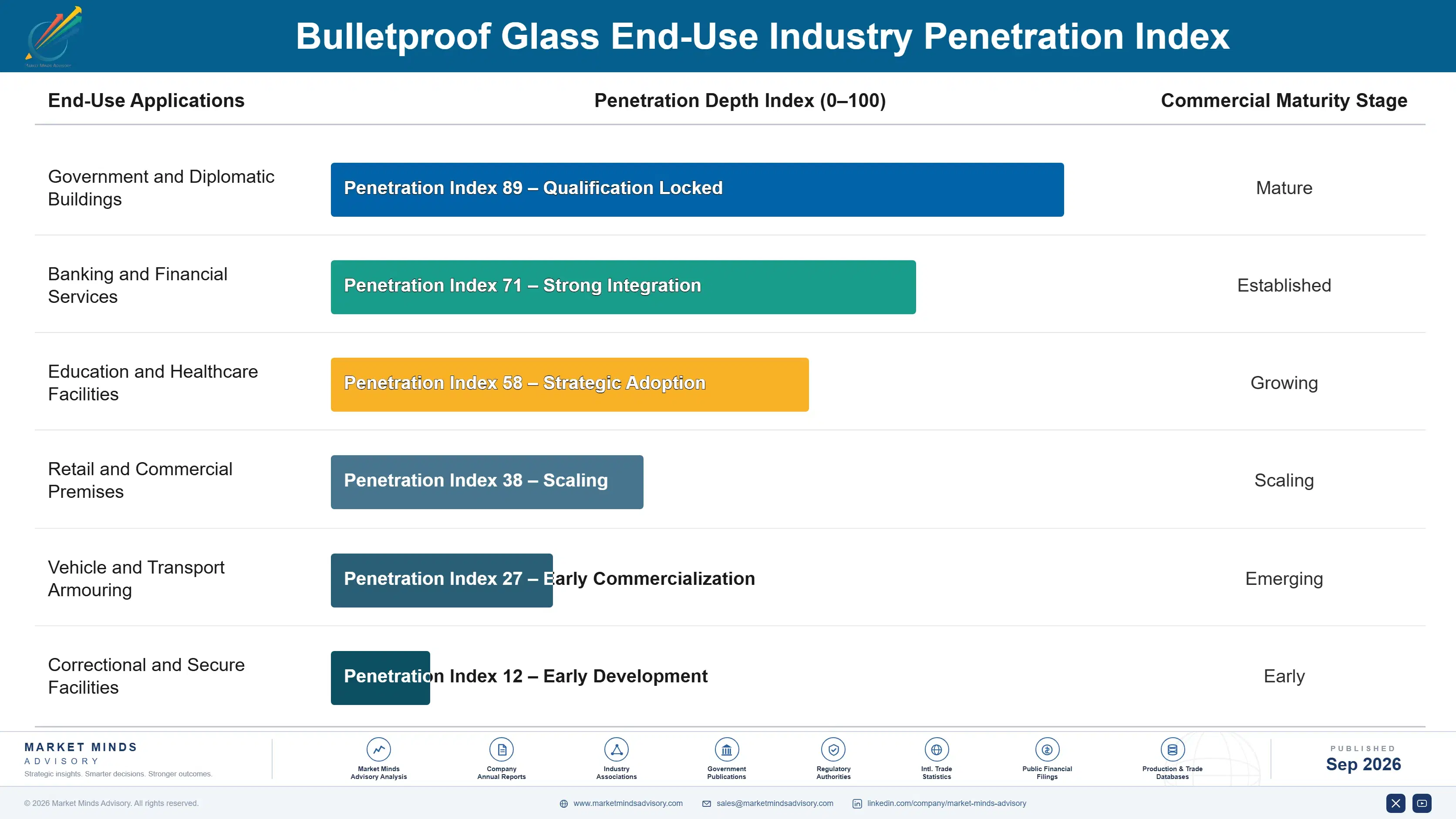
bulletproof-glass-market-end-use-penetration-index-1790015589305

Where This Market Rewards

These are among the four positions where our research anticipates prominent divergence between winners and laggards over the coming forecast period. Each is grounded in the demand model, the regulatory perimeter, and the announced capacity pipeline.
01 / THREAT ASSESSMENT SERVICE

Most specifications come off a table

Roughly 19% of bullet-resistant glazing specifications follow any documented threat assessment at all, which produces over-specified lobbies and under-specified perimeters at the very same time. Fabricators offering threat assessment as a service report average project values 2.7 times higher, since a properly assessed building specifies more where it genuinely matters and less where it does not. It also removes the work from a straight price comparison against a drawing, and very few fabricators anywhere currently offer that assessment capability at all.
02 / SPALL CONTAINMENT STANDARD

Stopping the round is only half

Only about 43% of installed area uses a construction that contains fragments inward, so most installations would injure the occupants they were specified to protect during the event itself. Fabricators writing no-spall construction into every quotation report specification win rates 2.2 times higher once that distinction is properly explained to a client. The cost difference is modest and almost nobody in the trade currently makes the argument, which leaves the position wide open to whoever decides to make it first.
03 / FRAME CAPACITY SURVEYING

Most buildings cannot carry it

Rifle-rated constructions reach around 78 kilograms per square metre, and roughly 22% of existing frames can carry rated glazing without needing to be replaced entirely. Fabricators surveying frame capacity before they quote report project cancellation rates 3.1 times lower than competitors who price the glazing alone. A customer who learns early either budgets for framing or chooses a lighter construction, and both beat discovering it during installation, which is comfortably the most expensive outcome available to anybody in this trade.
04 / OPTICAL LIFE WARRANTY

Nobody replaces it for being shot

About 71% of these units are eventually replaced because they yellowed or delaminated at the edges, rather than because anything ever actually struck the glass at all. Fabricators who warrant edge integrity and light transmission now report repeat specification 2.9 times higher across whole estate portfolios than competitors warranting only the ballistic performance. The rating already guarantees the ballistic performance, which makes warranting it commercially meaningless to any buyer, since the customer already holds that guarantee through the rating itself.

Engagement Snapshot From the Field

A live engagement with an industry participant carrying material or product regulatory and market exposure ahead of a defining policy shift, showing how our research translates into a defensible multi-year portfolio strategy.
MARKET MINDS ADVISORY · CLIENT ENGAGEMENT SUMMARY
Bulletproof Glass Producer Strategic Portfolio Review and Transition Roadmap 2026·Investment Scenario on Bulletproof Glass Exposure Evaluation 2025-26
CLIENT PROFILE
A public sector estate owner responsible for 340 buildings with an annual security glazing budget near USD 26 million (client-reported, unverified by MMA). Replacement volumes had risen sharply over five years while no building in the estate had experienced a ballistic incident, and the capital team could not explain the pattern. The board asked for the pattern explained before further capital was committed.
STRATEGIC CHALLENGE
The security department read rising replacement as evidence of ageing protection and had proposed accelerating the upgrade programme. Nobody had examined why panels were being removed, or whether the constructions specified fifteen years earlier had been appropriate to the buildings they were installed in. Ageing protection and optical failure imply entirely different remedies at very different costs.
MMA APPROACH
MMA reviewed replacement records and removal reasons across the estate, tested retained panels for light transmission and edge integrity, compared original specifications against building-by-building threat exposure, and modelled programme cost under acceleration, specification revision, and warranty-led procurement. Spall behaviour was assessed separately across the installed base, since no original specification had addressed it in any building.
KEY FINDINGS
  1. Around 78% of replacements over five years were triggered by yellowing or edge delamination, and no panel in the estate had been replaced following any impact.
  2. Original specifications had applied a single protection level across the entire estate regardless of building function, location, or any documented assessment of exposure.
  3. Roughly a third of installed area used all-glass constructions that would spall inward, including in occupied public-facing reception areas. None of those areas had been identified as an issue previously.
  4. Accelerating the programme would have replaced sound panels early while continuing to specify the constructions that were failing optically in the first place.
CLIENT PROFILE
A public sector estate owner responsible for 340 buildings with an annual security glazing budget near USD 26 million (client-reported, unverified by MMA). Replacement volumes had risen sharply over five years while no building in the estate had experienced a ballistic incident, and the capital team could not explain the pattern. The board asked for the pattern explained before further capital was committed.
STRATEGIC CHALLENGE
The security department read rising replacement as evidence of ageing protection and had proposed accelerating the upgrade programme. Nobody had examined why panels were being removed, or whether the constructions specified fifteen years earlier had been appropriate to the buildings they were installed in. Ageing protection and optical failure imply entirely different remedies at very different costs.
MMA APPROACH
MMA reviewed replacement records and removal reasons across the estate, tested retained panels for light transmission and edge integrity, compared original specifications against building-by-building threat exposure, and modelled programme cost under acceleration, specification revision, and warranty-led procurement. Spall behaviour was assessed separately across the installed base, since no original specification had addressed it in any building.
KEY FINDINGS
  1. Around 78% of replacements over five years were triggered by yellowing or edge delamination, and no panel in the estate had been replaced following any impact.
  2. Original specifications had applied a single protection level across the entire estate regardless of building function, location, or any documented assessment of exposure.
  3. Roughly a third of installed area used all-glass constructions that would spall inward, including in occupied public-facing reception areas. None of those areas had been identified as an issue previously.
  4. Accelerating the programme would have replaced sound panels early while continuing to specify the constructions that were failing optically in the first place.
RECOMMENDED STRATEGY
Phase 1: Phase one: halt the acceleration and commission building-level threat assessments before specifying anything further across the estate. No building had experienced any incident. Phase 2: Phase two: require no-spall construction and edge sealing warranties on all future procurement rather than specifying only a protection level. Phase 3: Phase three: replace on measured optical condition rather than on installation age across the remaining installed base. Installation age predicted condition poorly.
OUTCOME
Programme spend fell 22% in the first year while protection coverage improved on assessed exposure (client-reported, unverified by MMA). Replacement intervals extended as warranted constructions entered the estate. Threat assessment is now a standing requirement before any glazing specification. Spall containment is now specified as standard across every public-facing area.

Frequently Asked Questions

Foundational context covering the market sizes, CAGR, scope, country, region and competition that inform every finding below. This section is provided to cover basics and most often pre-purchase conversations, answered from the MMA Primary Research Dataset.

What is the current size of the Bulletproof Glass Market?

The market was worth USD 6.8 billion in 2025 and reaches USD 7.2 billion in 2026. Value covers transparent armour rated for ballistic protection across all constructions.

How large will the Bulletproof Glass Market be by 2036?

MMA forecasts USD 13.6 billion by 2036, an increase of USD 6.4 billion across the forecast period. That represents 1.89 times the 2026 base of USD 7.2 billion.

What is the CAGR for the Bulletproof Glass Market 2026 to 2036?

The base case compound annual growth rate is 6.6%, with a bull case at 7.8% and a bear case at 5.4%. Historical growth from 2020 to 2025 ran at 5.3%.

Which segment is growing fastest?

Glass-clad polycarbonate laminates grow at 9.9%, half again the market rate of 6.6%. They contain fragments inward rather than spalling glass into the protected space.

Who are the major companies in the Bulletproof Glass Market?

Saint-Gobain, AGC Inc, Guardian Glass, SCHOTT, and NSG Group lead the category. Together they hold 34% of revenue, with regional fabricators holding the installation relationships that decide most projects.

Which country is growing fastest?

Mexico grows at 12.4%, the fastest of any country covered here. Civilian and corporate vehicle armouring runs at rates no other market approaches per head of population.

Report Segmentation Architecture

The full report scope spans multiple orthogonal segmentation dimensions, with cross-tabulated demand data provided for each dimension pair. Coverage extends further to regional breakdowns, trend trajectories, and the competitive detail needed to support segment-level decision-making.

By Laminate Construction

  • Glass-Clad Polycarbonate Laminates
  • Monolithic and Laminated Polycarbonate
  • Glass-Polymer Hybrid Ionoplast Systems
  • Insulated Ballistic Glazing Units
  • Glass-Clad Acrylic Laminates
  • All-Glass Ballistic Laminates

By End-Use Industry

  • Government and Diplomatic Buildings
  • Banking and Financial Services
  • Education and Healthcare Facilities
  • Retail and Commercial Premises
  • Vehicle and Transport Armouring
  • Correctional and Secure Facilities

By Commercial Dimension

  • Architect and Specifier Selection
  • Main Contractor Procurement
  • Regional Fabricator Supply
  • Vehicle Armouring Workshops
  • Public Sector Framework Contracts
  • Threat Assessment and Survey Services

By Region

  • North America
  • East Asia
  • Western Europe
  • South Asia and Pacific
  • Latin America
  • Middle East and Africa
  • Eastern Europe

Scope, Methodology, and Coverage

Every figure in this report is reproducible from documented input assumptions. The scope below maps the historical period, the forecast horizon, the segmentation dimensions, and the countries covered, alongside the underlying primary and qualitative methodology.
Historical Period
2020 to 2025
Forecast Period
2026 to 2036
Base Year
2025 (USD billions; MMA Primary Research Dataset, September 2026)
Market Definition
This market covers transparent armour rated for ballistic protection, across glass-clad polycarbonate laminates, monolithic and laminated polycarbonate, glass-polymer hybrid ionoplast systems, insulated ballistic glazing units, glass-clad acrylic laminates, and all-glass ballistic laminates. It excludes security glazing without a ballistic rating, blast-resistant glazing rated only for pressure, ordinary laminated safety glass, opaque armour in steel, ceramic or composite, and personal body armour.
Quantitative Units
USD billions, revenue at fabricator selling price
Segmentation Dimensions
Laminate construction, end-use industry, commercial dimension, region
Regions Covered
North America, East Asia, Western Europe, South Asia and Pacific, Latin America, Middle East and Africa, Eastern Europe
Countries Covered
United States, Canada, Mexico, China, Japan, South Korea, Taiwan, Germany, France, United Kingdom, Italy, Spain, Netherlands, Poland, Czechia, India, Australia, Singapore, Indonesia, Thailand, Brazil, Colombia, Chile, Argentina, Saudi Arabia, United Arab Emirates, Qatar, Israel, Nigeria, South Africa
Key Companies Profiled
Saint-Gobain, AGC Inc, Guardian Glass, SCHOTT, NSG Group, Global Security Glazing, Insulgard Security Products, Total Security Solutions, Armortex, Riot Glass, Apogee Enterprises, Sisecam, Xinyi Glass, Fuyao Glass Industry Group, CSG Holding, Taiwan Glass, Isoclima, Press Glass, Romag, SmartGlass International
Quantitative Methodology
Primary survey, n=3,800 respondents, Q4 2025, six countries; demand-side model with trade association cross-validation
Qualitative Methodology
47 expert interviews, Q4 2025; applied to validate demand model assumptions, identify emerging dynamics, and assess competitive positioning
Report Format
PDF and XLSX data workbook (Word format preview document)
Publisher
Market Minds Advisory
Report Code
MMA-2026-CHM-361
Published
September 2026
Contact
sales@marketmindsadvisory.com | www.marketmindsadvisory.com

Purchase the full Bulletproof Glass Market Report (2026 to 2036).

The full report sizes the bulletproof glass market across six laminate constructions, seven regions, and thirty countries, with forecasts to 2036 under base, bull, and bear cases. It quantifies how rarely protection levels are chosen after any threat assessment, measures how much installed area would spall inward during the event it was specified for, and establishes optical failure as the dominant replacement driver. Competitive analysis covers twenty participants evaluated consistently on category revenue, with detailed treatment of edge sealing discipline. Cost structure, frame capacity constraints, and specification service margins are analysed throughout. Primary research includes 3,800 survey responses and 47 expert interviews.
Six laminate constructions sized and forecast separately
Twenty participants evaluated on category revenue consistently
Threat assessment practice measured against specification decisions
Spall containment penetration analysed across installed area
Optical failure modes quantified against replacement records
Frame capacity constraints mapped against retrofit feasibility

Built For The People Who Decide

From boardroom strategy to bench-side execution, this report is read cover-to-cover by leaders shaping the next decade of their industry, turning demand scenarios, market dynamics and valuation benchmarks into decisions.
CXOs/ Presidents/ VPs/ Managers
M&A and Corporate Development
Strategy Teams and R&D Heads
Procurement and Product Directors
Regulatory and Compliance Leaders
Investor Relations and Equity Analysts