Market Minds Advisory
Brush Rocker Market

Brush Rocker Market: Keeping Slip Ring Motors Running Through The Replacement Cycle

Slip ring motors run large mills and hoists that variable frequency drives cannot economically replace, and the gear lifting and short-circuiting their carbon brushes wears on a predictable cycle repair shops plan around.

Lead Analyst

David Horsley

Published

September 2026

Make Smarter Decisions with Customized Research Insights

Request a free sample report and evaluate market opportunities, growth trends, and competitive dynamics relevant to your business needs.

2025 MARKET VALUE$0.4BMarket Size 2025
2036 FORECAST VALUE$0.6BBase Case , 2026 to 2036
CAGR 2026 TO 20363.5 %Bull 4.5% / Bear 2.5%
INCREMENTAL OPPORTUNITY$0.2BNet 10- year value creation
EXPANSION MULTIPLE1.42x2036 value over 2026 base
Strategic Levers
M&A Pipeline
Regional Outlook
Country Rankings
Competitive Intelligence
Segmental Deep-dive
Call-Us : 91 93563 13602

Executive Snapshot and Market Trajectory

Brush rocker gear remains a small, unglamorous component, but it sits on the critical maintenance path for every slip ring motor still running in mining, cement, and marine service, and there is no substitute once one wears out. Repair shops increasingly stock kits rather than wait on lead times.
Commercial demand concentrates around large wound-rotor motors in mining hoists, cement kiln drives, and marine propulsion, where slip ring technology remains preferred over squirrel-cage alternatives for very high starting torque applications. Motorized brush rocker gear is pulling ahead of manual assemblies as operators automate lifting and short-circuiting sequences on larger installations. East Asia leads deployment volume on China's heavy industrial motor base, with South Asia and Pacific close behind on India's mining and cement expansion.
Competitive character splits between carbon brush and current collection specialists selling brush rocker gear as a defined product line and large motor OEMs manufacturing it in-house as part of complete slip ring motor packages. Regulatory pressure is essentially absent here, but replacement-cycle economics are not: brush rocker gear wears predictably over years of service, and shops plan stocking around that known window.
Market Definition
The brush rocker market covers manual and motorized brush rocker gear, brush lifting and short-circuiting devices, and related replacement components used to control carbon brush contact with slip rings in wound-rotor induction motors and with commutators in DC motors and generators. It excludes the motors themselves, general carbon brush products sold independent of rocker gear, and unrelated motor control electronics.
Base Year Value
$0.4B in 2025 (MMA Primary Research Dataset, August 2026)
Forecast Period
2026 to 2036, eleven discrete annual values
CAGR
3.5% base case. Bull 4.5%. Bear 2.5%.
Fastest Growth Segment
Motorized Brush Rocker Gear: 6.0% CAGR
Fastest Growth Country
India: 5.5% CAGR
Fastest Growth Region
South Asia and Pacific: 5.5% CAGR
Largest Region
East Asia: 28% of 2025 global value
Market Leaders
Morgan Advanced Materials, Schunk Carbon Technology, Mersen S.A., CG Power and Industrial Solutions, Helwig Carbon Products. Source: MMA Analysis based on company annual reports.
Primary Survey
n=3,800 procurement and R&D decision-makers, Q4 2025, six countries
Methodology
Demand-side build-up, cross-validated against public data, 47 expert interviews

Brush Rocker Market Forecast Scenarios

brush-rocker-market-size-forecast-scenario-1787302051529
Between 2020 and 2025 the market grew at a 3.5% historical CAGR, tracking the slow, steady replacement cycle of an installed base that changes little year to year. Growth was neither event-driven nor cyclical in the way faster-growing categories behave. New slip ring motor installations added modest incremental demand alongside a stable aftermarket base. Repair shops largely treated stocking as reactive rather than planned procurement.
The base case carries the market to a 3.5% CAGR through 2036 on three mechanisms. First, large wound-rotor motors in mining, cement, and marine applications continue new installation where starting torque needs favour slip ring technology over drive-based alternatives. Second, an ageing global installed base generates predictable, recurring replacement demand across maintenance cycles. Third, motorized gear adoption commands a meaningful price premium over manual assemblies, lifting average selling price gradually. Larger installations pay that premium without hesitation.
The bull case reaches 4.5% if mining and cement capacity expansion in South Asia runs ahead of current expectations, pulling new slip ring motor installations and associated rocker gear orders forward. The bear case falls to 2.5% if drive adoption displaces slip ring technology faster than expected, narrowing the installed base rocker gear depends on.

Why This Small Component Still Sets Motor Uptime

Three forces converge on this small component category at once. Large wound-rotor motors in mining, cement, and marine applications continue new installation where starting torque needs favour slip ring technology. An ageing global installed base generates predictable, recurring replacement demand across maintenance cycles. And motorized rocker gear adoption on larger installations commands a meaningful price premium over manual assemblies.
MARKET CONCENTRATIONCR5: 45%Carbon brush specialists and motor OEMs split nearly half
AVERAGE SELLING PRICEUSD 800 to 22,000 per unitPricing spans small manual assemblies to large motorized systems
TOP PRODUCING COUNTRY SHAREChina: 24% of units shippedHeavy industrial motor manufacturing concentrates production across regions
CAPACITY UTILISATION60 to 68%Niche component production lines run below broader motor industry rates
INPUT COST SHARE25 to 32% of COGSCarbon and graphite brush material dominates recurring cost spending
REPLACEMENT CYCLE LENGTH6 to 10 yearsWear parts inside the assembly cycle faster than housing
Commercially, the market behaves like a specialised maintenance component rather than a discretionary purchase. Buyers specify by motor frame size, ring diameter, and lift mechanism type rather than by price alone, because an incompatible replacement part causes downtime that costs far more than the part itself. That specification discipline protects margin for makers with genuine slip ring motor engineering depth and keeps generic aftermarket suppliers from moving into technically demanding large-frame applications.
Over the next decade, motorization becomes the incremental growth story inside an otherwise mature category. Motorized brush rocker gear is closing the price gap with manual assemblies as automated lifting sequences reduce maintenance labour on large installations. Makers that combine reliable mechanical engineering with automation retrofit capability, rather than manual gear alone, will capture the larger installation contracts that generate most of the category's incremental growth.
"Nobody gets excited about a brush rocker until the hoist motor stops mid-shift, and then the plant manager will pay almost anything for the part that gets it running again by morning."
Director, Electric Motor Components and Aftermarket Practice · MMA Electric Moto

Market Trends

Motorized Lifting Sequences Replace Manual Rocker Operation

Large wound-rotor motors on mining hoists and cement kiln drives increasingly specify motorized brush rocker gear that lifts and short-circuits carbon brushes automatically once a motor reaches running speed, rather than requiring a technician to operate a manual lever at start-up. That automation reduces both labour requirements and the risk of a missed or delayed lift sequence that accelerates brush and slip ring wear considerably. Schunk Carbon Technology and CG Power have both expanded motorized rocker gear product lines specifically for large-frame installations where automation delivers the clearest maintenance and reliability benefit.
Market Impact: Adds 1 unit per MW-scale motor

Ageing Installed Base Drives Predictable Replacement Demand

A large share of the global slip ring motor installed base was commissioned decades ago and continues operating in mining, cement, and marine applications where replacement with newer technology remains economically unjustified given the motor's remaining service life. Brush rocker gear inside these installations wears on a predictable six to ten year cycle, well ahead of the motor housing itself, generating recurring replacement demand independent of any new motor installation activity. Morgan Advanced Materials and Mersen have both built dedicated aftermarket replacement programmes specifically to serve this ageing, geographically dispersed installed base.
Market Impact: Sustains demand across 20+ year fle

Market Opportunities and Growth Drivers

High-Torque Mining And Cement Applications Favour Slip Ring Motors

Mining hoists, crushers, and cement kiln drives require very high starting torque that slip ring induction motors deliver more cost-effectively than squirrel-cage motors paired with variable frequency drives at the largest frame sizes, particularly above several megawatts of rated output. That technical advantage keeps slip ring technology specified on new large installations even as drives displace it in smaller applications across most other industrial categories. Every new slip ring motor installed at this scale requires a matched rocker gear assembly, and mining and cement capacity expansion in South Asia and parts of Africa continues generating steady demand.
Market Impact: Narrows addressable base 3-5% per y

Marine Propulsion Fleets Sustain A Stable Replacement Base

Older cargo vessels and specialised marine applications continue running slip ring propulsion and auxiliary motors that were commissioned years ago and remain in service well past their original design life given the high cost of full propulsion system replacement. Brush rocker gear failure at sea creates an operational emergency that shipping operators cannot tolerate, pushing fleet operators toward planned replacement on a fixed maintenance schedule rather than waiting for an in-service failure to force an emergency port call. Helwig Carbon and Mersen both maintain dedicated marine aftermarket distribution networks specifically to serve this schedule-driven, safety-critical replacement demand.
Market Impact: Creates 6-10 year gaps

Market Restraints and Challenges

Variable Frequency Drive Adoption Narrows The Addressable Base

Variable frequency drives paired with squirrel-cage induction motors have displaced slip ring technology across most mid-sized industrial applications over the past two decades, the root cause being that drive electronics now deliver comparable starting torque control at lower maintenance cost without any brush wear component. That displacement has narrowed the addressable installed base for rocker gear to the largest, highest-torque applications where slip ring technology retains a genuine technical advantage that drives cannot yet fully replicate economically. Makers are responding by focusing product development specifically on the large-frame mining, cement, and marine segments where slip ring technology remains durably competitive.
Market Impact: Cuts brush wear 20-30% per cycle

Long Replacement Cycles Limit Predictable Order Volume

A six to ten year replacement cycle means individual customers place infrequent orders, the root cause being that rocker gear is genuinely durable equipment engineered to outlast most other maintenance components inside the same motor by a considerable margin. That infrequency makes demand forecasting difficult for smaller makers without a large, diversified installed base to draw steady replacement orders from across any given year. Larger makers are responding by building maintenance contract relationships that smooth order timing across a customer's full fleet, and by expanding into adjacent consumables that generate more frequent order cycles alongside the rocker gear.
Market Impact: Recurs every 6-10 years per motor
3 additional market trends, 3 additional growth drivers, and 2 additional restraints and challenges are covered in the full report. Contact sales@marketmindsadvisory.com to access the complete intelligence.

Segment CAGR and Growth Architecture

Segmentation follows mechanism type, the single engineering logic that determines lift method, automation level, and application compatibility. Manual assemblies, motorized gear, lifting and short-circuiting devices, slip ring systems, DC motor rings, and replacement kits each serve a genuinely distinct maintenance need and are evaluated consistently throughout this report. Underlying motor equipment sits outside this hierarchy entirely.
brush-rocker-market-market-share-analysis-1787302052060

Motorized Brush Rocker Gear

Motorized brush rocker gear grows fastest at 6.0%, about 1.71 times the market's 3.5% overall rate, as large installations increasingly automate the lift and short-circuit sequence that a technician previously operated manually at every motor start. Automation removes the risk of a delayed or missed manual lift, which accelerates brush and slip ring wear and can force an unplanned outage on equipment that is often expensive to take offline even briefly. Schunk Carbon Technology and CG Power have both expanded motorized product lines specifically for large-frame mining and cement installations where automation delivers the clearest maintenance and reliability benefit relative to its added cost. Adoption concentrates first among the largest new installations, spreading into retrofit upgrades as operators modernise fleets.
CAGR 6.0%

Replacement Brush Rocker Kits

Replacement brush rocker kits grow second-fastest at 5.2%, driven by an ageing global slip ring motor installed base that generates recurring, predictable replacement demand independent of any new motor installation activity. Rather than sourcing individual custom-order components after a failure, repair shops increasingly stock standardised replacement kits matched to common motor frame sizes, cutting both procurement lead time and unplanned downtime for their customers considerably. Morgan Advanced Materials and Mersen have both expanded standardised kit offerings specifically to serve motor repair and rewind shops that previously relied on slower custom fabrication. Adoption is fastest among independent motor repair shops serving mining, cement, and marine customers with ageing equipment fleets. That trend is spreading into smaller repair shops.
CAGR 5.2%
Full segment breakdown across 6 segments available in the complete report.

Regional Architecture and Country Demand Map

Global demand concentrates where heavy industrial motor manufacturing and large-frame installations run deepest. East Asia leads on China's industrial motor base, South Asia and Pacific follows on India's mining expansion, and Western Europe trails both on a mature, declining installed base. Western Europe trails on a mature, slowly narrowing base.

North America

The United States sustains regional demand primarily through aftermarket replacement, since new slip ring motor installations have slowed considerably as variable frequency drives dominate new mid-sized industrial projects across most manufacturing applications. Mining operations in the western states and marine applications along both coasts anchor the remaining large-frame installed base that continues to require rocker gear replacement on schedule. Helwig Carbon holds deep incumbency in North American motor repair shop relationships, supplying replacement kits through an established distributor network. Canada contributes a smaller layer through mining hoist applications in its northern operations. Growth of 3.8% reflects steady aftermarket replacement more than any new installation activity across the region. Marine repair yards along the Gulf Coast add further steady demand.
Share: 24% | CAGR: 3.8% (2026 to 2036)

Western Europe

Germany and the wider region sustain a mature, largely stable installed base tied to legacy heavy industrial motors in steel, cement, and marine applications, with very few new slip ring installations given the region's broader industrial base shift toward smaller, drive-controlled motors. Mersen and Schunk both hold genuine home-market advantage across German and French motor repair accounts, competing on engineering depth against smaller regional specialists. Marine applications along northern European shipping routes sustain a meaningful replacement base independent of onshore industrial demand entirely. Growth of 2.0% reflects that installed base maturity directly, sitting below the global rate as the region's addressable base slowly narrows. Local marine repair yards sustain a small but steady replacement business independently.
Share: 19% | CAGR: 2.0% (2026 to 2036)
Regional intelligence for 5 additional markets available in the complete report: East Asia, South Asia and Pacific, Latin America, Middle East and Africa, Eastern Europe. Contact sales@marketmindsadvisory.com.
brush-rocker-market-country-cagr-analysis-1787302052577

Where Brush Rocker Makers Can Defend Margin

Replacement budgets are shifting toward standardised kits and motorized gear that reduces long-run maintenance labour. The four levers below capture revenue across a customer's full motor fleet rather than one unit at a time, and each rewards makers who can prove reliability credibly across large, dispersed installed bases. That shift rewards makers proving reliability early on.

Sell Fleet-Wide Maintenance Contracts To Large Operators

Mining and cement operators running dozens of large-frame slip ring motors across multiple sites increasingly want one maintenance relationship covering their full fleet rather than ordering replacement parts reactively after each individual failure occurs. Makers that sell fleet-wide maintenance contracts capture recurring revenue smoothed across a predictable replacement schedule rather than competing for each individual order as it arises, and fleet customers rarely shop competitively once a maintenance relationship proves reliable over several cycles. Mersen reports that fleet contract customers generate order values roughly 22% higher over a multi-year horizon than comparable one-off replacement orders placed individually.
Market Impact: Lifts multi-year fleet contract val

Expand Motorized Retrofit Kits For Existing Manual Installations

Large installations still running manual rocker gear represent a meaningful retrofit opportunity, since operators increasingly want the labour and reliability benefit of automation without replacing an otherwise functional motor entirely. Makers offering standardised motorized retrofit kits designed to fit existing manual gear housings capture this upgrade demand at roughly 20% of a full motor replacement's cost, and retrofit customers often become repeat buyers as they upgrade additional units across their fleet over time. Schunk Carbon Technology has expanded retrofit kit availability specifically to capture this underserved upgrade segment across its installed base.
Market Impact: Captures roughly 15-20% of total re

Build Dedicated Marine Aftermarket Distribution Networks

Marine operators need brush rocker gear available quickly at major ports given the operational cost of an idle vessel, and a maker without established port-adjacent distribution loses marine business to competitors who can deliver within days rather than weeks during an emergency replacement situation. Makers that build dedicated marine distribution networks capture premium emergency-replacement pricing that standard industrial distribution channels cannot command, and established marine relationships tend to persist across a fleet operator's entire vessel roster. Helwig Carbon has pursued exactly this distribution strategy since 2023, converting single-vessel relationships into fleet-wide marine accounts.
Market Impact: Commands premium pricing on 100% of

Bundle Rocker Gear Into Complete Slip Ring Motor Packages

Motor OEMs manufacturing new slip ring motors need a matched rocker gear supplier for every unit they build, and securing preferred-supplier status with a major motor manufacturer delivers volume that no number of individual aftermarket orders can match at comparable scale. Component makers that bundle rocker gear supply into complete motor package agreements lock in volume tied directly to the OEM's own production schedule rather than depending on unpredictable aftermarket timing. CG Power has pursued this bundling approach extensively across its own domestic and export motor manufacturing since 2023. That volume tie now spans most of CG Power's domestic output.
Market Impact: Locks in supply across 80%+ of OEM

Who Controls the Margin Pool

Concentration sits at CR5 45%, moderate-to-high for a niche component category split between carbon brush specialists and vertically integrated motor OEMs. Morgan Advanced Materials and Schunk lead on breadth, selling rocker gear as part of wider current collection and carbon brush product lines, while the gap to CG Power is more about reach than depth. All participants are assessed on one consistent basis, brush rocker gear revenue.
Current competitive activity runs across three dimensions. Product development concentrates on motorized retrofit kits to capture upgrade demand on existing manual installations. Distribution investment focuses on marine and mining aftermarket networks rather than general industrial channels alone. And account structure centres on fleet-wide maintenance contracts rather than one-off replacement orders, a shift that rewards makers with genuine multi-site delivery capability across dispersed installed bases.

Emerging pressure comes from Chinese and Indian component makers scaling behind domestic motor manufacturing buildout, winning price-sensitive business that incumbents once assumed was theirs. Rankings will shift toward makers combining motorized capability with proven fleet delivery, since that is what large operators now specify. Manual-gear-only makers without a credible motorized roadmap face the sharpest erosion ahead.
brush-rocker-market-company-positioning-matrix-1787302053093

Competitive Moat and Risk Dimensions

MORGAN ADVANCED MATERIALS

Moat: Deep carbon brush material science

Morgan Advanced Materials holds decades of accumulated carbon and graphite material science expertise that directly determines brush rocker gear wear performance, giving it a genuine reliability advantage on the highest-duty mining and marine applications that newer entrants cannot easily replicate without years of accumulated field testing data.
MORGAN ADVANCED MATERIALS

Risk: Exposed to narrowing addressable base

Morgan's rocker gear business depends on a slip ring motor installed base that variable frequency drives continue to narrow across mid-sized applications, leaving the company more exposed than diversified rivals to a sustained, long-run decline in the category's overall addressable market. That exposure grows as drive economics keep improving across mid-sized applications.
SCHUNK CARBON TECHNOLOGY

Moat: Strong motorized gear engineering

Schunk has invested heavily in motorized rocker gear engineering ahead of most competitors, giving it a meaningful lead in the category's one genuine growth segment and a reference base of large installations that newer motorized entrants struggle to match on demonstrated field reliability. That reference base is difficult for newer motorized entrants to replicate quickly.
SCHUNK CARBON TECHNOLOGY

Risk: Thinner marine distribution reach

Schunk's distribution network leans more heavily toward industrial and mining accounts than dedicated marine channels, leaving room for specialists like Helwig Carbon to win premium emergency-replacement business at ports where Schunk lacks comparable established presence. Helwig's established port relationships give it a durable edge in exactly this emergency-response segment.

Players Tracked

Prominent Players

Morgan Advanced Materials
Schunk Carbon Technology
Mersen S.A.
CG Power and Industrial Solutions
Helwig Carbon Products

Other Key Players

ABB Ltd
Siemens AG
WEG S.A.
TECO-Westinghouse Motor Company
Cantoni Motor S.A.
National Electrical Carbon Products
Ohio Carbon Blank Inc.
Elektrim Motors
Bharat Bijlee Limited
Kirloskar Electric Company
ELIN Motoren GmbH
Marelli Motori S.p.A.
Rotor Electric Works
AC Electric Motors
Loher GmbH

Recent Developments

MAY 2025

Schunk Carbon Technology launches motorized brush rocker gear line

Schunk introduced a new motorized brush rocker gear line purpose-built for large wound-rotor motors above several megawatts of rated output. This was an organic product launch rather than an acquisition, extending Schunk's motorized product coverage into the largest mining and cement frame sizes specifically. across multiple mining and cement accounts.
Signal: Incumbents are investing in motorization a
NOVEMBER 2025

Mersen acquires specialty brush rocker component manufacturer in India

Mersen completed the acquisition of a specialty brush rocker component manufacturer serving India's expanding mining and cement motor market. The deal brought established regional manufacturing capacity and customer relationships in-house, expanding Mersen's South Asian footprint considerably beyond its prior direct presence. across India's expanding motor market.
Signal: Regional acquisitions are becoming the pre
FEBRUARY 2025

CG Power signs supply agreement with cement plant operator

CG Power entered a multi-year supply agreement to provide brush rocker gear replacement across a major cement plant operator's multiple facilities. The agreement was a commercial supply contract, not a joint venture or equity transaction, covering scheduled replacement across the operator's full kiln drive fleet.
Signal: Multi-year, multi-facility supply agreemen

Carbon Brush And Copper Component Cost Exposure

Carbon and graphite brush material runs 25 to 32% of COGS, sourced from a concentrated set of specialised carbon manufacturers that also supply the wider electrical current collection industry. Copper and brass rocker ring and contact components add a further 20 to 28%, with precision bearings and cast housing components accounting for most of the remainder.
The copper price spike running through 2021 and 2022 hit rocker ring and contact component cost directly, since copper prices moved sharply during that period alongside broader industrial metals inflation tied to supply constraints and demand recovery. Mersen S.A.'s 2022 Annual Report disclosed elevated input costs across its electrical components segment, attributing part of the margin pressure to copper and graphite material inflation that persisted through much of the year.

Exposure varies sharply by player type. Vertically integrated majors like Morgan Advanced Materials and Mersen manufacture much of their own carbon brush material in-house, insulating them from the worst supply constraints, while smaller regional makers depend on third-party material suppliers and absorb price spikes directly into thinner margins. Geography matters too, since makers sourcing copper domestically face different exposure than those buying through longer, more exposed international supply chains.
brush-rocker-market-cost-volatility-analysis-1787302053288

Vertically Integrate Carbon Brush Material Production

Manufacturing carbon and graphite brush material in-house rather than sourcing it externally insulates the largest makers from allocation shortages during industry-wide supply crunches. Smaller regional makers lacking that scale have instead pursued long-term supply agreements with established material producers to secure priority allocation. That approach has meaningfully reduced allocation risk across the largest makers' product lines.

Lock Copper Component Supply Through Multi-Year Contracts

Fixed-volume, multi-year procurement contracts with copper and brass suppliers smooth rocker ring acquisition costs across price cycles. Several makers moved a majority of their copper purchasing onto contract pricing rather than spot markets after the 2021 spike exposed their exposure directly. That approach trades some upside during price dips for real protection against sharper spikes.

Shift Product Mix Toward Motorized Gear To Add Margin Buffer

Motorized rocker gear carries meaningfully higher margin than manual assemblies, giving makers a durable way to offset raw material cost volatility over time simply by shifting sales mix toward the category's higher-margin motorized product line. That shift has meaningfully improved blended margin across product lines facing raw material pressure. That shift also reduces exposure to future copper disruption.

Portfolio Architecture for Margin Defence

The portfolio splits into three tiers with real margin separation, and the gap between tiers has widened as motorization becomes a genuine differentiator rather than an add-on feature. Volume-tier manual assemblies compete on price against generic aftermarket alternatives and earn modestly. Premium motorized and fleet-contracted gear earns considerably more because it solves a genuine reliability and labour problem that operators cannot engineer around cheaply.
The tension is between fleet-wide unit volume and per-contract engineering margin. Repair shops buying individual replacement kits across scattered customers push hard on unit price, while large mining and cement operators standardising on fleet-wide maintenance contracts pay for reliability and delivery consistency rather than negotiating down to the last dollar on every unit. Makers serving both buyer types run genuinely different sales motions under one brand.

High-value pools concentrate in motorized gear sold with fleet-wide maintenance contracts and OEM package agreements, where switching cost is highest and price sensitivity lowest. Legacy manual assembly replacement business remains steady in volume but persistently thin in margin, as customers treat it as a commodity purchase rather than a differentiated one, and few makers manage to change that perception.

Volume / Commodity-Adjacent Tier

Manual rocker gear assemblies sold into standard aftermarket replacement, priced against generic component alternatives. Margin stays thin because buyers negotiate primarily on unit price rather than automation features. Buyers rarely differentiate between vendors on anything beyond delivery speed and price.
Gross Margin: 16-26%

Premium / Certified Tier

Motorized gear and fleet-wide maintenance contracts sold into large mining, cement, and marine operators standardising replacement schedules. Buyers pay for reliability and consistency rather than for hardware alone. Delivery timelines and reliability data matter as much as the hardware specification itself.
Gross Margin: 30-42%

Sustainability / Regulatory / Next-Generation Tier

Motorized retrofit kits and OEM package agreements sold into large new installations and modernisation programmes. Margin reflects both engineering scarcity and durable OEM supply relationships. Few makers currently combine both elements convincingly at meaningful commercial scale.
Gross Margin: 36-48%
brush-rocker-market-portfolio-architecture-1787302053784

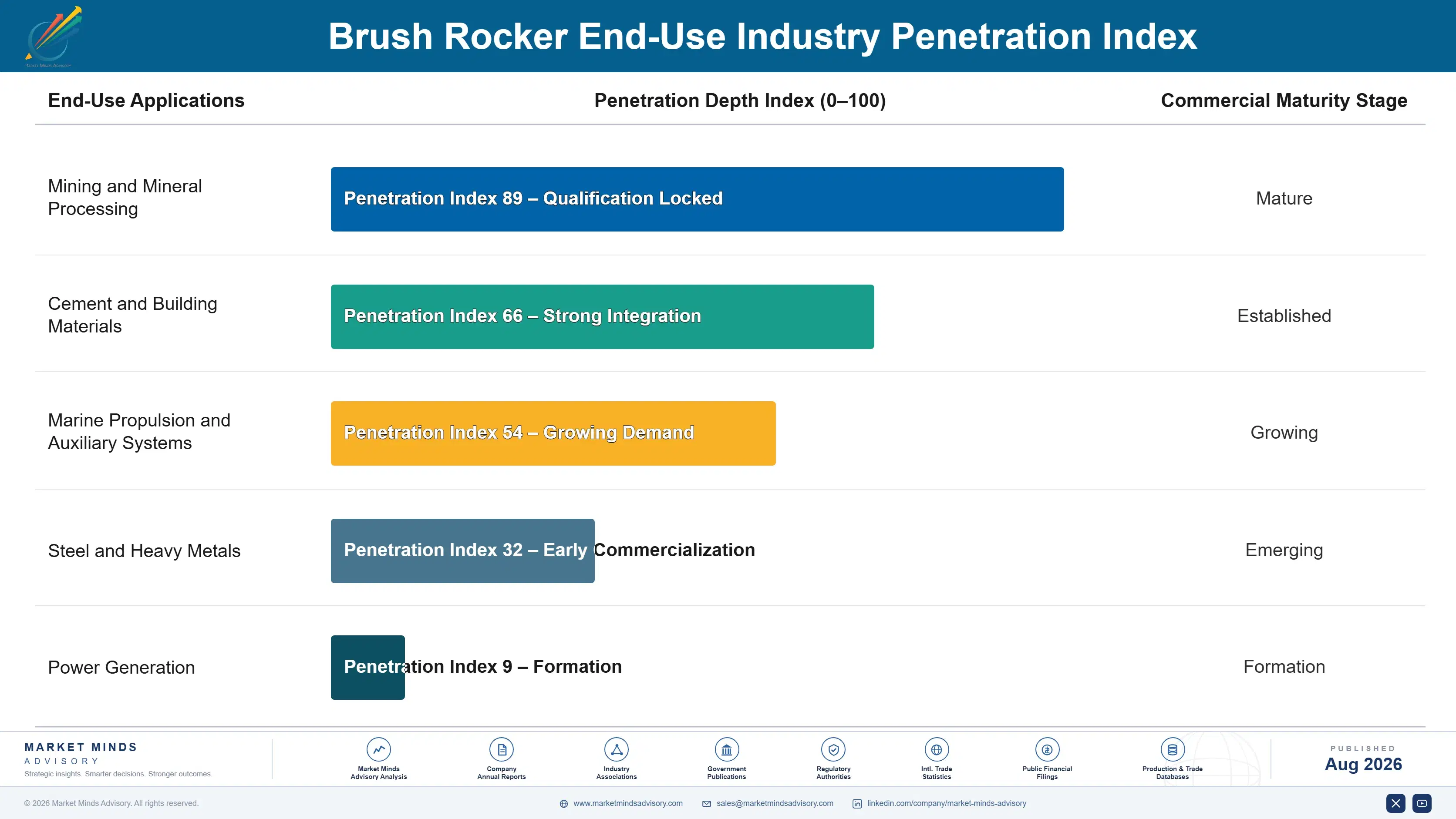
Fleet-Anchored Recurring Replacement Demand

Demand behaves like an annuity once a customer's motor fleet is established, because rocker gear wears on a predictable six to ten year cycle and cannot simply be left in service past that window without risking an unplanned failure. That replacement cycle, plus the underlying new installation demand it does not capture, gives makers a predictable revenue tail well beyond any single sale, converting a one-time part order into an ongoing account relationship across a customer's full motor fleet.
Adoption depth varies sharply by end-use vertical. Mining and cement operators adopt fleet-wide maintenance contracts fastest and deepest, since unplanned motor downtime on hoists and kiln drives carries immediate, quantifiable production cost. Marine operators follow closely on scheduled port-based replacement. Smaller industrial users adopt more reactively, often waiting for an in-service failure to trigger a replacement order rather than planning ahead.

Buyer profiles are shifting generationally. Procurement once sat with maintenance technicians ordering individual replacement parts; it now increasingly involves reliability and asset management engineers who specify fleet-wide maintenance schedules before a single unit fails. That shift moves the real purchasing decision earlier into the planning cycle and rewards makers who can prove reliability credibly across dispersed fleets.
brush-rocker-market-end-use-penetration-index-1787302054275

Where Brush Rocker Value Concentrates

These are among the four positions where our research anticipates prominent divergence between winners and laggards over the coming forecast period. Each is grounded in the demand model, the regulatory perimeter, and the announced capacity pipeline.
01 / MOTORIZED GEAR POSITIONING

Motorization Now Decides The Category's Growth Story

Motorized brush rocker gear is growing at 6.0%, about 1.71 times the market's 3.5% overall rate, and that gap is widening as large installations automate lift sequences that a technician previously operated manually. Makers still anchored on manual assemblies alone risk losing the category's one genuine growth segment to rivals offering proven automation already installed at scale on comparable equipment. The window to build credible motorized capability is closing within this forecast period, not the next one, and latecomers will find the largest reference installations already claimed by faster-moving rivals.
02 / FLEET CONTRACT STRATEGY

Fleet-Wide Maintenance Contracts Are Becoming Table Stakes

Large mining and cement operators increasingly refuse to order replacement parts reactively, preferring fleet-wide maintenance contracts that smooth replacement timing across their full motor fleet and reduce unplanned downtime risk considerably. Makers who sell these contracts capture recurring revenue and pricing power that a single reactive order simply cannot provide, and fleet customers rarely shop competitively once a contract relationship proves reliable. Those relying purely on reactive orders will find themselves squeezed out of the largest, most predictable replacement volume entirely.
03 / OEM PACKAGE CHANNEL

OEM Bundling Will Outgrow Standalone Aftermarket Sales

Motor manufacturers building new slip ring motors are increasingly folding rocker gear specification into their standard equipment package rather than leaving it to a separate aftermarket purchase, concentrating real purchasing power in a small number of OEM relationships that smaller makers cannot easily access at scale. Component makers who secure preferred-supplier status with major motor OEMs capture volume tied directly to production schedules that no number of individual aftermarket orders can replicate. Those without that OEM relationship risk losing this steady channel to better-positioned, longer-established competitors.
04 / REGIONAL MANUFACTURING PRICING

East Asian And Indian Scale Will Keep Pressuring Global Pricing

China and India's expanding heavy industrial motor manufacturing has scaled domestic component makers fast enough to win price-sensitive standard replacement tenders that global incumbents once assumed were theirs by default, and that pricing pressure is starting to spread into broader regional procurement decisions as well. Makers competing purely on price against fast-scaling regional entrants will struggle to hold margin over any meaningful time horizon. The more durable response is competing on motorized engineering and fleet contract depth, categories where regional entrants still visibly lag behind global incumbents.

Engagement Snapshot From the Field

A live engagement with an industry participant carrying material or product regulatory and market exposure ahead of a defining policy shift, showing how our research translates into a defensible multi-year portfolio strategy.
MARKET MINDS ADVISORY · CLIENT ENGAGEMENT SUMMARY
Brush Rocker Producer Strategic Portfolio Review and Transition Roadmap 2026·Investment Scenario on Brush Rocker Exposure Evaluation 2025-26
CLIENT PROFILE
A regional copper mining operator running a fleet of large hoist and crusher motors across two sites approached MMA after an unplanned brush rocker failure halted hoist operations for several days at its primary site. The client reported daily lost production revenue in the low single-digit millions during the outage, alongside emergency replacement costs well above standard part pricing (client-reported, unverified by MMA).
STRATEGIC CHALLENGE
The client had historically ordered replacement parts only after a failure occurred, with no tracking of individual unit service life across its roughly thirty large-frame motors spanning both sites. The recent failure exposed how little visibility maintenance planning had into which units were approaching the end of their typical replacement window, leaving the fleet exposed to further unplanned outages.
MMA APPROACH
MMA benchmarked the client's motor fleet against typical replacement cycle data to estimate which units were approaching end-of-life, then modelled the cost of a fleet-wide maintenance contract against continuing with reactive, emergency-priced ordering. We evaluated three qualified suppliers on fleet contract terms, motorized retrofit availability, and emergency response capability specifically for the client's remote site locations.
KEY FINDINGS
  1. Roughly a third of the client's motor fleet sat within two years of its typical replacement window, with no existing tracking system to flag units approaching that threshold before failure occurred.
  2. A fleet-wide maintenance contract covering scheduled replacement across the full fleet priced below the client's historical emergency-order cost once average annual spend was compared directly against contract terms.
  3. Motorized retrofit kits on the client's largest hoist motors were projected to cut unplanned failure risk considerably by removing the manual lift step that had contributed to the recent outage.
  4. Two of three suppliers evaluated could deliver a fleet-wide contract with guaranteed emergency response times matching the client's remote site logistics; the third could not commit to comparable terms.
CLIENT PROFILE
A regional copper mining operator running a fleet of large hoist and crusher motors across two sites approached MMA after an unplanned brush rocker failure halted hoist operations for several days at its primary site. The client reported daily lost production revenue in the low single-digit millions during the outage, alongside emergency replacement costs well above standard part pricing (client-reported, unverified by MMA).
STRATEGIC CHALLENGE
The client had historically ordered replacement parts only after a failure occurred, with no tracking of individual unit service life across its roughly thirty large-frame motors spanning both sites. The recent failure exposed how little visibility maintenance planning had into which units were approaching the end of their typical replacement window, leaving the fleet exposed to further unplanned outages.
MMA APPROACH
MMA benchmarked the client's motor fleet against typical replacement cycle data to estimate which units were approaching end-of-life, then modelled the cost of a fleet-wide maintenance contract against continuing with reactive, emergency-priced ordering. We evaluated three qualified suppliers on fleet contract terms, motorized retrofit availability, and emergency response capability specifically for the client's remote site locations.
KEY FINDINGS
  1. Roughly a third of the client's motor fleet sat within two years of its typical replacement window, with no existing tracking system to flag units approaching that threshold before failure occurred.
  2. A fleet-wide maintenance contract covering scheduled replacement across the full fleet priced below the client's historical emergency-order cost once average annual spend was compared directly against contract terms.
  3. Motorized retrofit kits on the client's largest hoist motors were projected to cut unplanned failure risk considerably by removing the manual lift step that had contributed to the recent outage.
  4. Two of three suppliers evaluated could deliver a fleet-wide contract with guaranteed emergency response times matching the client's remote site logistics; the third could not commit to comparable terms.
RECOMMENDED STRATEGY
Phase 1: Phase 1 (0 to 3 months): Complete a full fleet audit to identify units approaching their typical replacement window across both sites. Phase 2: Phase 2 (3 to 9 months): Sign a fleet-wide maintenance contract covering scheduled replacement and emergency response for the full motor fleet. Phase 3: Phase 3 (9 to 24 months): Retrofit motorized gear on the largest hoist motors identified as highest-risk during the initial fleet audit.
OUTCOME
The client signed a three-year fleet-wide maintenance contract and completed motorized retrofits on its highest-risk hoist motors within the recommended timeline, avoiding any further unplanned brush rocker failures in the following year. The fleet audit process has since been adopted as standard practice ahead of the client's next site expansion (client-reported, unverified by MMA).

Frequently Asked Questions

Foundational context covering the market sizes, CAGR, scope, country, region and competition that inform every finding below. This section is provided to cover basics and most often pre-purchase conversations, answered from the MMA Primary Research Dataset.

What is the current size of the Brush Rocker Market?

The market was valued at USD 0.42 billion in 2025, and demand is concentrated in large slip ring motors serving mining, cement, and marine applications. Growth remains slow but steady across a mature installed base.

How large will the Brush Rocker Market be by 2036?

The market is projected to reach USD 0.61 billion by 2036, an expansion multiple of 1.42 times its 2026 value. Motorized gear drives most of that incremental growth.

What is the CAGR for the Brush Rocker Market 2026 to 2036?

The base case CAGR is 3.5%, with a bull case of 4.5% and a bear case of 2.5%. The range reflects uncertainty around variable frequency drive displacement.

Which segment is growing fastest?

Motorized brush rocker gear grows fastest at 6.0%, about 1.71 times the overall market rate, as large installations increasingly automate what a technician once operated by hand.

Who are the major companies in the Brush Rocker Market?

Morgan Advanced Materials, Schunk Carbon Technology, Mersen, CG Power, and Helwig Carbon lead the market. Concentration sits at CR5 45%, moderate-to-high for this niche category.

Which country is growing fastest?

India grows fastest at 5.5%, driven by expanding mining and cement capacity that favours slip ring motor technology. China remains the largest market by production volume.

Report Segmentation Architecture

The full report scope spans multiple orthogonal segmentation dimensions, with cross-tabulated demand data provided for each dimension pair. Coverage extends further to regional breakdowns, trend trajectories, and the competitive detail needed to support segment-level decision-making.

By Mechanism Type

  • Manual Brush Rocker Assemblies
  • Motorized Brush Rocker Gear
  • Brush Lifting and Short-Circuiting Devices
  • Slip Ring Brush Rocker Systems
  • DC Motor Brush Rocker Rings
  • Replacement Brush Rocker Kits

By End-Use Industry

  • Mining and Mineral Processing
  • Cement and Building Materials
  • Marine Propulsion and Auxiliary Systems
  • Steel and Heavy Metals
  • Power Generation

By Commercial Dimension

  • OEM Package Supply Agreements
  • Aftermarket Replacement Orders
  • Fleet-Wide Maintenance Contracts
  • Motorized Retrofit Upgrades

By Region

  • North America
  • Western Europe
  • East Asia
  • South Asia and Pacific
  • Latin America
  • Middle East and Africa
  • Eastern Europe

Scope, Methodology, and Coverage

Every figure in this report is reproducible from documented input assumptions. The scope below maps the historical period, the forecast horizon, the segmentation dimensions, and the countries covered, alongside the underlying primary and qualitative methodology.
Historical Period
2020 to 2025
Forecast Period
2026 to 2036
Base Year
2025 (USD billions; MMA Primary Research Dataset, August 2026)
Market Definition
The brush rocker market comprises manual and motorized brush rocker gear, brush lifting and short-circuiting devices, and related replacement components used to control carbon brush contact with slip rings in wound-rotor induction motors and with commutators in DC motors and generators. The motors themselves, general carbon brush products sold independent of rocker gear, and unrelated motor control electronics are excluded.
Quantitative Units
USD billions (current prices); installed and replacement units where applicable
Segmentation Dimensions
By Mechanism Type; By End-Use Industry; By Commercial Dimension; By Region
Regions Covered
North America, Western Europe, East Asia, South Asia and Pacific, Latin America, Middle East and Africa, Eastern Europe
Countries Covered
USA, China, Germany, France, UK, Japan, South Korea, India, Australia, Canada, Brazil, Mexico, Indonesia, Vietnam, Thailand, Malaysia, UAE, Saudi Arabia, South Africa, Nigeria, Turkey, Poland, Netherlands, Italy, Spain, Sweden, Switzerland, Argentina, Colombia, Singapore, and additional markets relevant to this sector
Key Companies Profiled
Morgan Advanced Materials, Schunk Carbon Technology, Mersen S.A., CG Power and Industrial Solutions, Helwig Carbon Products, ABB Ltd, Siemens AG, WEG S.A., TECO-Westinghouse Motor Company, Cantoni Motor S.A., National Electrical Carbon Products, Ohio Carbon Blank Inc., Elektrim Motors, Bharat Bijlee Limited, Kirloskar Electric Company, ELIN Motoren GmbH, Marelli Motori S.p.A., Rotor Electric Works, AC Electric Motors, Loher GmbH
Quantitative Methodology
Primary survey, n=3,800 respondents, Q4 2025, six countries; demand-side model with trade association cross-validation
Qualitative Methodology
47 expert interviews, Q4 2025; applied to validate demand model assumptions, identify emerging dynamics, and assess competitive positioning
Report Format
PDF and XLSX data workbook (Word format preview document)
Publisher
Market Minds Advisory
Report Code
MMA-2026-CON-106
Published
August 2026
Contact
sales@marketmindsadvisory.com | www.marketmindsadvisory.com

Purchase the full Brush Rocker Market Report (2026 to 2036).

The full MMA Brush Rocker report sizes the market across six mechanism types, five end-use industries, four commercial dimensions, and seven regions through 2036. It profiles twenty participants on a consistent brush rocker gear revenue basis, scoring each on engineering depth, motorized capability, and fleet-wide maintenance delivery capacity. Scenario models quantify how variable frequency drive displacement, mining and cement capacity expansion, and marine fleet ageing move both demand and realised pricing. The report also includes delivered-cost modelling by mechanism type and a fleet-contract benchmarking tool built for maintenance, reliability, and procurement teams.
Mechanism type cost and reliability benchmarking
Slip ring motor installed base tracking model
OEM package supply relationship and volume tracker
Marine and mining aftermarket demand forecasting model
Component and materials supply chain risk screen
Fleet-wide maintenance contract benchmarking and pricing tool

Built For The People Who Decide

From boardroom strategy to bench-side execution, this report is read cover-to-cover by leaders shaping the next decade of their industry, turning demand scenarios, market dynamics and valuation benchmarks into decisions.
CXOs/ Presidents/ VPs/ Managers
M&A and Corporate Development
Strategy Teams and R&D Heads
Procurement and Product Directors
Regulatory and Compliance Leaders
Investor Relations and Equity Analysts