Market Minds Advisory
Bromine Market

Bromine Market: Flame Retardant Demand and Drilling Fluid Cycles Reshape a Concentrated Supply Base

Data center and EV battery enclosure flame retardant demand is pulling bromine volume away from a supply base still concentrated around the Dead Sea and Arkansas brine fields, forcing buyers to lock in multi-year contracts.

Lead Analyst

Bilal Shaikh

Published

September 2026

Make Smarter Decisions with Customized Research Insights

Request a free sample report and evaluate market opportunities, growth trends, and competitive dynamics relevant to your business needs.

2025 MARKET VALUE$2.4BMarket Size 2025
2036 FORECAST VALUE$3.8BBase Case , 2026 to 2036
CAGR 2026 TO 20364.2 %Bull 5.3% / Bear 3.0%
INCREMENTAL OPPORTUNITY$1.3BNet 10- year value creation
EXPANSION MULTIPLE1.51x2036 value over 2026 base
Strategic Levers
M&A Pipeline
Regional Outlook
Country Rankings
Competitive Intelligence
Segmental Deep-dive
Call-Us : 91 93563 13602

Executive Snapshot and Market Trajectory

Bromine supply remains tied to a handful of brine deposits, and buyers of flame retardant and drilling fluid grades are locking in multi-year contracts as data center construction and deepwater drilling both pull volume against capacity that barely moves year to year. Buyers face few substitution options regardless of price.
Flame retardants remain the largest application by volume, but clear brine drilling fluids are growing fastest as offshore and deepwater completion activity expands globally. The Dead Sea deposits shared by Israel and Jordan anchor global supply more heavily than any other single geography, a concentration this market carries that few other specialty chemicals share at all. North America and East Asia together add a growing secondary supply base each quarter.
ICL and Albemarle set pricing and allocation discipline across most contract negotiations, given how few economically viable brine deposits exist worldwide. Tightening flame retardant regulation in electronics manufacturing and rising well-completion intensity in shale and offshore basins are both reshaping where incremental bromine demand actually lands each year. Buyers increasingly diversify across multiple qualified suppliers rather than depend on any single deposit-holding producer for critical volume.
Market Definition
The bromine market covers elemental bromine and its primary derivatives, including brominated flame retardants, clear brine completion fluids, biocides, and pharmaceutical and agrochemical intermediates, extracted from natural brine deposits and processed into industrial-grade compounds. It excludes downstream finished products such as electronic housings or completed drilling operations that merely incorporate bromine-based inputs.
Base Year Value
$2.4B in 2025 (MMA Primary Research Dataset, August 2026)
Forecast Period
2026 to 2036, eleven discrete annual values
CAGR
4.2% base case. Bull 5.3%. Bear 3.0%.
Fastest Growth Segment
Oil and Gas Drilling Fluids (Clear Brine Fluids): 6.5% CAGR
Fastest Growth Country
China: 7.4% CAGR
Fastest Growth Region
South Asia and Pacific: 6.2% CAGR
Largest Region
Middle East and Africa: 32% of 2025 global value
Market Leaders
ICL Group Ltd., Albemarle Corporation, Lanxess AG, Jordan Bromine Company, Tosoh Corporation. Source: MMA Analysis based on company annual reports and primary research, July 2026.
Primary Survey
n=3,800 procurement and R&D decision-makers, Q4 2025, six countries
Methodology
Demand-side build-up, cross-validated against public data, 47 expert interviews

Bromine Market Forecast Scenarios

bromine-market-size-forecast-scenario-1787302887354
Bromine demand grew steadily but unspectacularly across 2020 to 2025, with pandemic-era drilling slowdowns offsetting flame retardant demand gains from expanding electronics manufacturing worldwide. The market grew at an estimated 3.6% historical CAGR across the period, reflecting that largely offsetting mix of cyclical drilling demand and steadier flame retardant purchasing patterns across major end markets.
The base case assumes offshore and deepwater drilling activity continues recovering through 2028, data center and EV battery enclosure flame retardant specifications keep tightening, and ICL and Albemarle add incremental Dead Sea and Arkansas extraction capacity to meet both pools. Together these three commercial mechanisms support a 4.2% forecast CAGR, with flame retardants remaining the anchor application even as drilling fluids narrow the volume gap across every major producing region through the decade.
The bull case centers on a sustained offshore drilling upcycle through 2030 pulling clear brine fluid volume well beyond current contract commitments. The bear case centers on a renewed decline in shale and offshore capital spending, whether from lower oil prices or reduced drilling budgets, which would strand incremental bromine capacity investment industry-wide for several years overall.

Concentrated Supply Meets Diverging Demand Cycles

Bromine sits at the intersection of geology and industrial chemistry, since economically viable extraction depends on brine deposits with bromide concentrations rarely found outside a handful of geographies. That geological constraint has kept the supplier base narrow for decades, and no amount of capital can simply create a new deposit where none exists. That scarcity shapes pricing power industrywide.
MARKET CONCENTRATION (CR5)68%Top five producers hold majority share of volume
AVERAGE SELLING PRICE$3,100 per tonneReflects grade, purity, and delivery format required overall
TOP PRODUCING COUNTRY SHAREIsrael, 29%Largest single national base for total extraction capacity
CAPACITY UTILIZATION RATE84%Producers running near practical ceiling on total output
TRADE INTENSITY61% cross-borderMost shipped volume crosses a border before conversion
BRINE EXTRACTION COST SHARE39% of COGSLargest single cost line in total production overall
Commercially, the market splits between a mature flame retardant base sold through long-term supply agreements tied to electronics and construction specifications, and a more cyclical drilling fluids tier sold against offshore and shale completion schedules that swing with oil prices. Water treatment, pharmaceutical, and agrochemical applications round out demand with steadier, less cyclical purchasing patterns. Buyers in each tier negotiate differently.
Over the next decade, deposit access will matter more than processing capacity alone, since nearly every major producer already runs close to practical extraction limits. The suppliers that can add incremental Dead Sea, Arkansas, or Chinese brine capacity fastest stand to capture a widening share of a market that data centers and deepwater drilling are pulling in two different directions at once, across every major producing geography today.
"Bromine is one of the few commodity chemicals where geology, not capital, is the real ceiling. You cannot build a new brine field the way you build a new plant."
Director, Specialty Chemicals Practice · MMA Chemicals & Materials / Specialty I

Market Trends

Data Center Flame Retardant Specification Tightening

Data center operators and electronics manufacturers are tightening flame retardant specifications for server enclosures, cabling, and printed circuit boards as rack power density climbs past 40 kilowatts. Brominated flame retardants remain the dominant chemistry for high-performance electronics applications despite years of regulatory pressure favoring phosphorus and mineral alternatives, since bromine-based formulations still deliver superior flame suppression at lower loading levels. Major hyperscale data center operators have disclosed flame retardant sourcing requirements that reference UL 94 V-0 ratings achievable primarily through brominated compounds, sustaining demand even as some end markets shift toward halogen-free alternatives under separate regulatory pressure.
Market Impact: Requires V-0 rating across most enc

Offshore Drilling Completion Fluid Demand Recovery

Offshore and deepwater drilling activity has recovered steadily since 2023, and clear brine completion fluids made from calcium bromide and zinc bromide remain the preferred high-density fluid for completing wells exceeding 15,000 feet in depth. Each major deepwater completion can require hundreds of thousands of gallons of high-density brine fluid, and operators increasingly specify bromine-based fluids over chloride alternatives for their superior density range and lower corrosion profile in high-pressure, high-temperature wells. TETRA Technologies and other completion fluid suppliers have reported sustained order backlog growth tied to Gulf of Mexico and West Africa deepwater project sanctions through 2027.
Market Impact: Extends lateral lengths past 2 mile

Market Opportunities and Growth Drivers

Electronics Manufacturing Flame Retardant Demand Growth

Global electronics production continues shifting toward higher power densities across data centers, EV battery enclosures, and consumer devices, each of which requires flame retardant materials meeting increasingly strict fire safety standards under UL and IEC frameworks. Brominated flame retardants remain the most cost-effective chemistry for achieving V-0 flame ratings at the loading levels electronics manufacturers require. Manufacturers are responding by qualifying multiple brominated flame retardant grades across their supply base, reducing single-supplier dependence even as they remain committed to bromine chemistry over halogen-free alternatives that require higher loading and add material cost.
Market Impact: Concentrates supply in 3 core geogr

Deepwater and Shale Well Completion Intensity

Deepwater wells and extended-reach shale laterals both require higher-density completion fluids than conventional onshore wells, and operators increasingly specify calcium bromide and zinc bromide clear brine fluids over chloride alternatives for their superior density range and corrosion performance. Average completion fluid volume per well has risen as lateral lengths extend past two miles in major shale basins, directly increasing bromine-based fluid consumption per well drilled. Major operators in the Gulf of Mexico and Permian Basin have disclosed completion fluid specifications that increasingly favor bromine-based formulations over legacy chloride systems for high-pressure well designs.
Market Impact: Displaces up to 15% of share

Market Restraints and Challenges

Concentrated Brine Deposit Geography Limits Supply

Economically viable bromine extraction depends on brine deposits with bromide concentrations that exist in only a handful of geographies worldwide, led by the Dead Sea shared by Israel and Jordan, the Smackover Formation brine fields in Arkansas, and select deposits in Shandong Province, China. That geological concentration means new supply cannot simply be built where demand grows, unlike most industrial chemicals. Producers are responding by investing in deeper extraction and higher-recovery processing technology at existing deposits rather than searching for new ones, since geological survey data suggests few undiscovered large-scale brine deposits remain economically accessible at current bromine prices.
Market Impact: Adds demand at 40 kilowatt density

Halogen-Free Flame Retardant Substitution Pressure Grows

Regulatory pressure in the European Union and select US states continues pushing electronics and construction applications toward halogen-free flame retardant chemistries, driven by environmental persistence and bioaccumulation concerns tied to certain legacy brominated compounds. That pressure has already displaced bromine from some lower-performance applications, though high-performance electronics applications requiring the strictest flame ratings remain harder to substitute without added material cost and thickness. Producers are responding by developing newer, more readily degradable brominated flame retardant formulations designed to meet both fire safety and environmental persistence requirements simultaneously, aiming to preserve share in applications where full substitution remains commercially impractical.
Market Impact: Supports wells exceeding 15,000 foo
3 additional market trends, 3 additional growth drivers, and 4 additional restraints and challenges are covered in the full report. Contact sales@marketmindsadvisory.com to access the complete intelligence.

Segment CAGR and Growth Architecture

Bromine segments by end-use application, the classification buyers and producers use to set grade specifications, delivery format, and contract structure, since flame retardant, drilling fluid, and water treatment buyers each negotiate under entirely different commercial terms and price benchmarks across the industry each year. Producers price each application differently depending on volume commitment and delivery specification required.
bromine-market-market-share-analysis-1787302887891

Oil and Gas Drilling Fluids (Clear Brine Fluids)

Clear brine drilling fluids are the fastest-growing application as offshore and deepwater completion activity recovers and extended-reach shale laterals push completion fluid volume per well higher across major basins. Calcium bromide and zinc bromide fluids remain the preferred high-density option for wells exceeding 15,000 feet, where chloride alternatives cannot match the needed density range. Gulf of Mexico and West Africa project sanctions have accelerated, and each major completion can consume hundreds of thousands of gallons of high-density brine fluid in a single well program. TETRA Technologies and other completion fluid suppliers have reported sustained backlog growth tied to these project sanctions, and if deepwater activity continues recovering, this segment could approach parity with flame retardants in incremental volume growth.
CAGR 6.5%

Brominated Flame Retardants

Brominated flame retardants remain the largest application by volume, covering electronics enclosures, printed circuit boards, construction insulation, and textile treatments across consumer and industrial end markets. Rising data center and EV battery enclosure power density is the primary growth driver, since higher-density applications require flame ratings that brominated chemistry still achieves more cost-effectively than halogen-free alternatives. Regulatory pressure in the European Union continues pushing some lower-performance applications toward substitution, but high-performance electronics applications remain harder to displace without added material cost and thickness. Because deposit access constrains how fast producers can add capacity, flame retardant buyers increasingly negotiate multi-year supply agreements rather than risk allocation shortfalls as data center construction accelerates, a shift from more transactional purchasing.
CAGR 5.8%
Full segment breakdown across 6 segments available in the complete report.

Regional Architecture and Country Demand Map

Bromine supply concentrates overwhelmingly around a handful of brine deposits rather than following demand geography. Middle East and Africa leads on Dead Sea extraction scale even though this exceeds the region's typical band, North America follows on Arkansas brine capacity, and East Asia grows fastest as Chinese deposits expand.

North America

The United States accounts for nearly all of North America's bromine supply, anchored by the Smackover Formation brine fields in Arkansas where Albemarle and Lanxess operate the region's dominant extraction and processing complexes. Rising deepwater Gulf of Mexico drilling activity and expanding Permian Basin shale completion intensity are the primary near-term demand drivers, since both require increasing volumes of calcium bromide and zinc bromide clear brine fluids. Flame retardant demand from domestic electronics and construction manufacturing adds a steadier secondary demand pool tied to data center buildout across major US technology corridors. Canada and Mexico contribute minimal domestic production, relying on US-sourced bromine derivatives for their smaller downstream chemical and water treatment industries.
Share: 24% | CAGR: 4.6% (2026 to 2036)

Western Europe

Western Europe holds only a small share of global bromine supply and demand despite its advanced specialty chemicals industry: the region has no significant domestic brine deposits and depends almost entirely on imports from Israel, Jordan, and the United States for both elemental bromine and flame retardant intermediates. Germany and France anchor regional consumption through Lanxess's European flame retardant formulation operations and a concentrated automotive and electronics manufacturing base that specifies brominated compounds for wiring and enclosure applications. The United Kingdom contributes a smaller demand pool tied to its pharmaceutical and specialty chemical manufacturing sectors. Growth here trails the global average given tightening EU flame retardant substitution regulation and a customer base increasingly exploring halogen-free alternatives ahead of other regions.
Share: 8% | CAGR: 2.8% (2026 to 2036)
Regional intelligence for 5 additional markets available in the complete report: East Asia, South Asia and Pacific, Latin America, Middle East and Africa, Eastern Europe. Contact sales@marketmindsadvisory.com.
bromine-market-country-cagr-analysis-1787302888425

Where Bromine Producers Are Capturing Margin

Four commercial moves separate bromine producers capturing outsized margin from those competing purely on delivered tonne price, each tied to deposit access, application diversification, or contract structure that shields volume from short-term price swings across the industry each year. Each move requires a different mix of capital investment and multi-year commercial commitment before it meaningfully improves margin.

Incremental Brine Extraction Capacity Investment Program

Producers investing in deeper extraction and higher-recovery processing technology at existing brine deposits, rather than searching for new geological sources, are capturing incremental volume that geology otherwise prevents competitors from adding quickly. Expanding extraction capacity at an existing deposit typically costs $80 million to $180 million depending on evaporation pond expansion and processing infrastructure requirements, but each incremental tonne then commands demand that supply-constrained competitors cannot serve regardless of price. Producers without recent extraction capacity investment increasingly lose contract renewal negotiations to better-capitalized competitors as data center and drilling fluid demand both climb simultaneously.
Market Impact: Costs $80 to $180 million per new e

Deepwater Drilling Fluid Supply Agreement Program

Producers securing multi-year supply agreements with offshore drilling operators, guaranteeing defined clear brine fluid volume against project completion schedules, are capturing premium pricing that protects against spot-market competition from smaller regional blenders without comparable density and purity consistency. These agreements typically carry a 7 to 14% price premium over transactional purchasing, reflecting the value operators place on guaranteed high-density fluid supply for high-pressure, high-temperature well completions. Producers able to demonstrate consistent fluid density and reliable delivery increasingly win renewal negotiations over lower-cost competitors lacking comparable technical track records. Producers without such agreements compete purely on price when volume tightens.
Market Impact: Commands 7 to 14% premium over spot

Next-Generation Flame Retardant Formulation Development Program

Producers developing newer, more readily degradable brominated flame retardant formulations are positioning to retain share in electronics applications facing regulatory substitution pressure, rather than ceding those accounts entirely to halogen-free competitors. Developing a qualified next-generation flame retardant formulation typically costs $15 million to $40 million in toxicology, environmental persistence, and performance testing against tightening EU and US regulatory requirements. Producers without this formulation investment risk losing high-performance electronics accounts entirely once regulatory deadlines force customers to requalify their flame retardant supply chain. Early movers in this reformulation effort gain a meaningful head start over slower competitors.
Market Impact: Costs $15 to $40 million per new fo

Vertical Integration Into Derivative Manufacturing Strategy

Producers integrating forward into flame retardant compounding or clear brine fluid blending, rather than selling elemental bromine alone, are capturing margin that pure extraction players leave on the table for downstream converters. Building compounding or blending capacity typically requires $30 million to $70 million in capital investment but lifts realized margin per tonne meaningfully above elemental bromine pricing alone. Producers that remain extraction-only increasingly compete on price against vertically integrated competitors that can subsidize extraction economics with downstream conversion margin. Producers pursuing this strategy typically see margin gains compound over several years of sustained downstream conversion volume.
Market Impact: Lifts margin per tonne by 15 to 25%

Who Controls the Margin Pool

The top five producers hold an estimated 68% of global bromine shipment volume, a high concentration reflecting the deposit scarcity that keeps new entrants out. ICL and Albemarle lead on Dead Sea and Arkansas extraction scale, while a second tier of Chinese and Indian producers competes on price for flame retardant and water treatment applications that do not require premium-grade purity.
Current competitive activity centers on three fronts. Deepwater drilling fluid supply agreements are becoming the norm as offshore operators lock in guaranteed volume ahead of project sanctions. Next-generation flame retardant formulation investment is opening a new front for producers willing to fund testing capital ahead of confirmed regulatory deadlines. And several producers are pursuing forward integration into compounding and blending to capture margin that pure extraction leaves behind.

Emerging pressure comes from Chinese producers moving up the value chain as domestic Shandong deposits expand and downstream electronics manufacturing scale grows, though matching Dead Sea and Arkansas extraction efficiency remains years away for most. If Chinese producers close that efficiency gap, expect share to shift within East Asia first, before any pressure reaches the Dead Sea or Arkansas incumbents given how deeply embedded existing supply agreements are across the industry.
bromine-market-company-positioning-matrix-1787302888998

Competitive Moat and Risk Dimensions

ICL GROUP LTD.

Moat: Dead Sea Reserve Ownership

ICL controls exclusive extraction rights to the Dead Sea's Israeli side, the single largest concentrated bromide reserve on the planet, giving it a cost and scale position no competitor anywhere else in the world can replicate. That reserve position has underpinned ICL's market leadership for decades and cannot be challenged by capital investment alone.
ICL GROUP LTD.

Risk: Single-Region Geopolitical Exposure

ICL's extraction operations concentrate almost entirely in one geopolitically sensitive region, leaving it more exposed than diversified competitors to regional instability, regulatory shifts, or infrastructure disruption. Any sustained disruption to Dead Sea operations would directly constrain global bromine supply with no comparable alternative source able to absorb the shortfall quickly.
ALBEMARLE CORPORATION

Moat: Arkansas Brine Field Integration

Albemarle's vertically integrated Arkansas operations span extraction through flame retardant and drilling fluid manufacturing, giving it cost and logistics advantages that pure extraction competitors cannot match. This integration also lets Albemarle flex production between applications as demand shifts between flame retardants and drilling fluids each year.
ALBEMARLE CORPORATION

Risk: Lithium Segment Capital Competition

Albemarle's bromine business competes internally against its larger lithium segment for capital allocation, meaning bromine-specific capacity investment can lag behind what drilling fluid and flame retardant demand growth would otherwise justify. That dynamic has occasionally left Albemarle's bromine expansion slower than smaller, more focused competitors investing exclusively in extraction capacity.

Players Tracked

Prominent Players

ICL Group Ltd.
Albemarle Corporation
Lanxess AG
Jordan Bromine Company
Tosoh Corporation

Other Key Players

Gulf Resources, Inc.
Shandong Haihua Group Corporation
Tata Chemicals Limited
Honeywell International Inc.
DCW Limited
Solaris Chemtech Industries Limited
Perekop Bromine LLC
Great Lakes Solutions
Weifang Xingmao Chemical Co., Ltd.
Hindustan Salts Limited
Jiangshan Chemical Co., Ltd.
Zibo Rundu Chemical Co., Ltd.
Nippoh Chemicals Co., Ltd.
TETRA Technologies, Inc.
Shandong Wankai New Materials Co., Ltd.

Recent Developments

APRIL 2025

ICL Expands Dead Sea Extraction Capacity

ICL commissioned additional bromine extraction and evaporation pond capacity at its Dead Sea Works facility, expanding dedicated output to meet rising flame retardant and drilling fluid demand. The expansion followed multi-year supply agreements signed with major electronics and drilling fluid customers as both applications climbed simultaneously.
Signal: Confirms producers are pre-committing capa
NOVEMBER 2024

Jordan Bromine Company Signs Multi-Year Drilling Fluid Agreement

Jordan Bromine Company secured a multi-year reserved supply agreement with a major offshore drilling operator covering clear brine completion fluids, guaranteeing defined volume through 2028. The agreement reflects operators' broader push to lock in qualified high-density fluid supply ahead of further deepwater project sanctions. Similar agreements are expected soon.
Signal: Shows operators prioritizing supply certai
FEBRUARY 2025

Albemarle Announces Arkansas Capacity Investment

Albemarle announced incremental extraction capacity investment at its Magnolia, Arkansas bromine production complex to ease allocation constraints affecting flame retardant and drilling fluid customers industry-wide. The investment followed sustained pressure from customers citing bromine allocation as their primary supply constraint. Industry analysts expect similar announcements from competing producers.
Signal: Signals upstream capacity relief remains g

Brine Extraction Economics and Energy Intensity

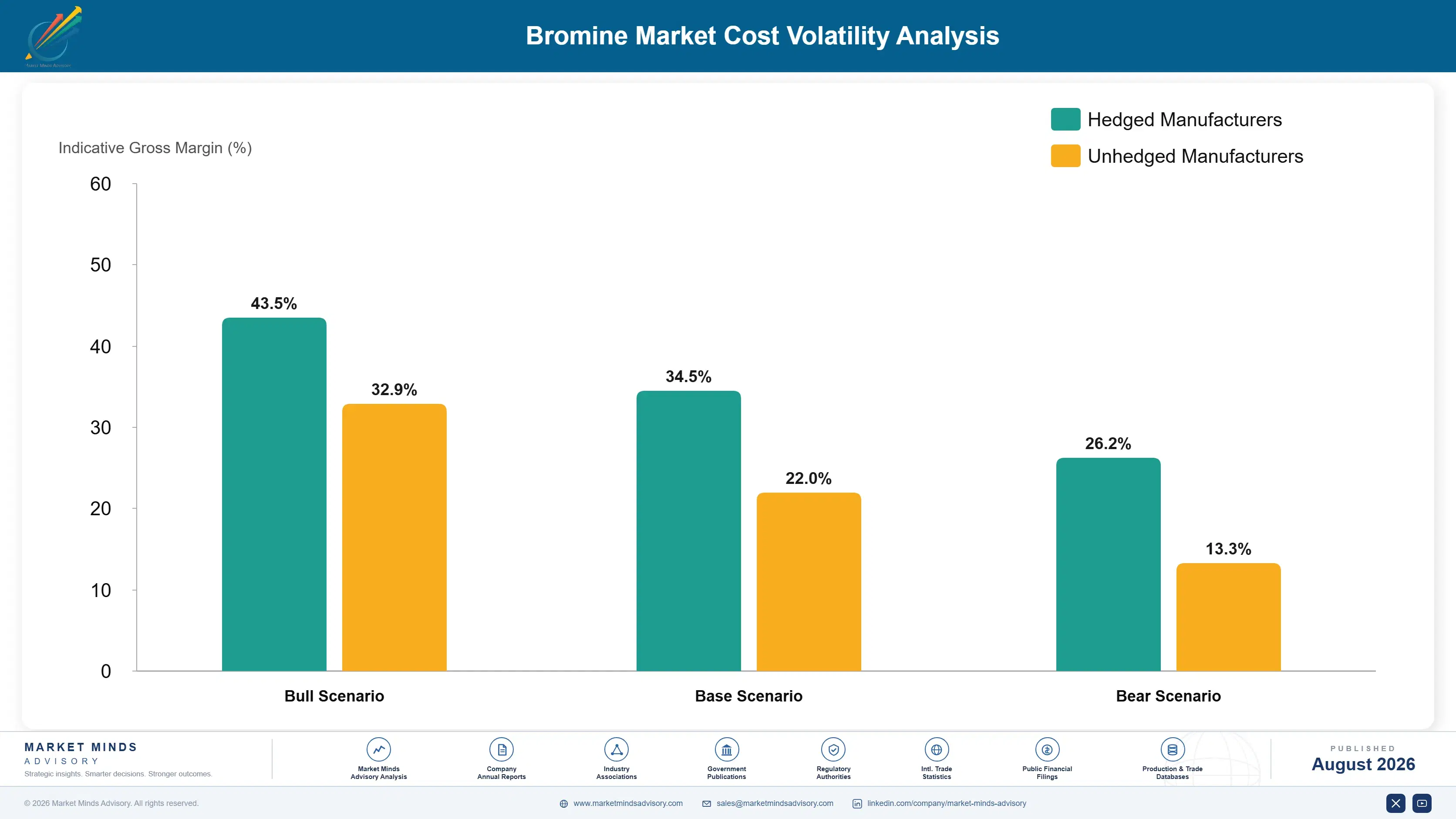
Brine extraction and evaporation processing account for roughly 39% of cost of goods sold in bromine production, with energy costs concentrated among producers operating in favorable climate regions with high natural evaporation rates. Labor and equipment maintenance across extraction and evaporation infrastructure add a further significant share, sourced from specialized workforces near each major brine deposit.
Natural gas and electricity prices spiked during 2022 as energy markets tightened following supply disruption, with several producers reporting processing cost increases exceeding 30% in their 2022 annual reports before pricing stabilized through 2023. Industry supply chain reviews have flagged energy-intensive evaporation processing as bromine production's single most volatile cost component. Several producers have publicly flagged this energy exposure as a leading operational risk heading into 2026.

Smaller regional producers without energy supply agreements absorbed the 2022 price spike hardest, losing contract bids to larger competitors including ICL and Albemarle that had negotiated priority energy pricing and invested in evaporation efficiency improvements. Producers with secured energy contracts weathered the volatility better than those dependent on spot energy markets, a cost advantage that persists across smaller Chinese and Indian producers today.
bromine-market-cost-volatility-analysis-1787302889220

Long-Term Energy Supply Agreements

Larger producers are locking in multi-year natural gas and electricity supply agreements directly with regional utilities, guaranteeing predictable processing costs ahead of demand increases rather than relying on spot energy markets that have grown increasingly volatile since 2022. This approach adds cost certainty to production planning even when spot energy pricing swings sharply during periods of tight supply.

Evaporation Efficiency Investment

Several producers are investing in solar evaporation pond efficiency improvements to reduce natural gas dependence for processing, particularly at Dead Sea and Arkansas facilities where climate conditions favor expanded solar evaporation over energy-intensive mechanical processing. This shift reduces natural gas dependence meaningfully while extending equipment life at facilities already suited to solar evaporation processes.

Application Portfolio Diversification

Producers are pursuing drilling fluid and pharmaceutical intermediate qualification partly to diversify revenue beyond flame retardant applications most exposed to raw material and energy cost pass-through limitations under long-term contract structures. This diversification strategy also spreads producer revenue across a broader set of end-use applications, reducing dependence on any single regulatory or pricing cycle for volume.

Portfolio Architecture for Margin Defence

Bromine portfolios span three margin tiers, from commodity-adjacent elemental bromine and basic derivatives sold largely on price, through certified flame retardant and drilling fluid grades carrying application-specific premiums, toward an emerging next-generation tier built around degradable flame retardant formulations and specialty pharmaceutical intermediates. Gross margin widens meaningfully at each tier as formulation complexity and regulatory qualification depth increase consistently acr
The volume versus premium tension centers on extraction allocation. Producers must choose between dedicating limited brine capacity to high-margin flame retardant and drilling fluid applications with guaranteed contract volume, or serving lower-margin water treatment and basic industrial demand that fills out remaining production capacity. Producers without spare extraction capacity increasingly favor higher-margin applications. That allocation decision increasingly shapes which producers win the highest-margin accounts each year.

High-value margin pools concentrate in next-generation flame retardant formulations and deepwater drilling fluid supply, where regulatory and technical barriers keep competition thin. Elemental bromine and basic water treatment derivatives remain the volume anchor but carry the thinnest margins across the entire portfolio, leaving smaller producers with fewer diversification options than integrated competitors. Producers that diversify across both premium and volume tiers capture the widest margin spread available today.

Volume / Commodity-Adjacent Tier

Elemental bromine and basic water treatment derivatives sold largely on price and delivery reliability without application-specific certification requirements, across most industrial and municipal water treatment buyer segments worldwide each year.
Gross Margin: 16%-24%

Premium / Certified Tier

Flame retardant and drilling fluid grades sold under multi-year supply agreements carrying application-specific pricing power tied to purity and density specifications, built through years of application-specific qualification and proven delivery reliability.
Gross Margin: 32%-42%

Sustainability / Regulatory / Next-Generation Tier

Degradable flame retardant formulations and pharmaceutical intermediates in active qualification, commanding premium pricing against limited proven alternatives currently available, as producers wait for confirmed regulatory approval before committing further capital investment.
Gross Margin: 38%-50%
bromine-market-portfolio-architecture-1787302889745

Contract Lock-In Meets Cyclical Drilling Demand

Flame retardant bromine purchasing functions closer to an annuity than a transactional sale, since electronics manufacturers rarely requalify a flame retardant supplier once a formulation clears fire safety and reliability testing across a product line, a relationship that often persists for years given the cost and schedule risk of requalification. Drilling fluid purchasing behaves very differently, tracking offshore and shale capital spending cycles that swing with oil prices and project sanct
Adoption depth varies sharply by end-use vertical. Electronics and construction flame retardant buyers show the deepest stickiness given multi-year formulation qualification cycles and safety-critical certification requirements, while water treatment and basic industrial buyers switch suppliers more readily since qualification barriers are far lower and price sensitivity plays a larger role in purchasing decisions across smaller accounts.

A generational shift is underway as data center operators, who have no legacy relationship with existing flame retardant formulators, evaluate suppliers on fire safety performance data and environmental persistence credentials rather than decades-long supply relationships. That openness gives newer, more sustainability-focused formulators a rare opening to win share in a market where deposit-based incumbency has otherwise been nearly impossible to dislodge.
bromine-market-end-use-penetration-index-1787302890252

Where Bromine Producers Should Focus Next

These are among the four positions where our research anticipates prominent divergence between winners and laggards over the coming forecast period. Each is grounded in the demand model, the regulatory perimeter, and the announced capacity pipeline.
01 / DEPOSIT CAPACITY STRATEGY

Invest in incremental extraction capacity before allocation tightens further

Producers that expand extraction capacity at existing brine deposits capture incremental volume that geology otherwise prevents competitors from adding quickly, a scarce advantage as data center and drilling fluid demand both climb simultaneously. Building that capacity requires multi-year investment that cannot be replicated overnight, since no new deposit can simply be discovered on demand. Producers waiting until allocation tightens further to begin expansion will miss the current investment window, ceding volume to better-capitalized incumbents that started years earlier, a gap that widens each quarter allocation stays tight.
02 / FLAME RETARDANT REFORMULATION TIMING

Fund next-generation formulation testing ahead of regulatory deadlines

Electronics customers facing tightening EU and US flame retardant regulation have not yet committed to a preferred degradable formulation supplier, leaving a genuine opportunity for producers willing to fund testing ahead of confirmed regulatory deadlines, a window that will not stay open indefinitely. Waiting for regulations to finalize risks missing the qualification window entirely once customers commit to an alternative supplier. The capital required is modest relative to building new extraction capacity, making this a comparatively efficient way to defend share.
03 / DRILLING FLUID CONTRACT STRUCTURE

Prioritize multi-year deepwater supply agreements over spot sales

Deepwater and offshore operators are increasingly willing to sign multi-year supply agreements that guarantee volume and command meaningful pricing premiums over spot-market transactions, a shift already visible in recent contract announcements across the Gulf of Mexico. Producers relying on spot sales remain exposed to the same drilling capital spending cycles that have historically made this application segment far more volatile than flame retardants. Locking in multi-year agreements now, while deepwater activity is recovering, protects margin against the next cyclical downturn.
04 / REGIONAL CAPACITY ALLOCATION

Weight new investment toward East Asia given fastest regional growth

East Asia is growing faster than any other region as Chinese domestic brine deposits expand and electronics manufacturing scale continues climbing, even as extraction efficiency there still lags the Dead Sea and Arkansas benchmarks by a meaningful margin. Producers concentrating capacity expansion solely around legacy Middle Eastern and North American deposits risk ceding share in the region where volume growth will be steepest through 2036. Early investment in Chinese extraction and processing capacity offers a meaningful head start over competitors still anchored entirely to legacy Western geographies.

Engagement Snapshot From the Field

A live engagement with an industry participant carrying material or product regulatory and market exposure ahead of a defining policy shift, showing how our research translates into a defensible multi-year portfolio strategy.
MARKET MINDS ADVISORY · CLIENT ENGAGEMENT SUMMARY
Bromine Producer Strategic Portfolio Review and Transition Roadmap 2026·Investment Scenario on Bromine Exposure Evaluation 2025-26
CLIENT PROFILE
The client is a global flame retardant formulator supplying brominated compounds to electronics and construction manufacturers across three continents, with annual bromine-related procurement spend in the low hundreds of millions of dollars (client-reported, unverified by MMA). The client faced rising allocation uncertainty as its two primary bromine suppliers signaled capacity constraints amid climbing data center demand.
STRATEGIC CHALLENGE
The client needed to decide whether to diversify its supplier base beyond its two incumbent bromine producers, and how much to invest in securing long-term supply agreements, given uncertainty over whether current allocation tightness would ease by 2027 or persist as data center and drilling fluid demand both continued climbing simultaneously across the industry.
MMA APPROACH
MMA benchmarked the client's supplier concentration against five diversified formulators and modeled three bromine allocation scenarios against the client's existing and planned procurement volume, incorporating primary interview data from bromine producers and flame retardant buyers on contract structure and switching behavior across the industry. The analysis also modeled energy cost exposure across the client's supplier base to identify hidden pricing risk beyond raw bromine allocation.
KEY FINDINGS
  1. The client's two-supplier concentration left it more exposed to allocation risk than diversified competitors sourcing from at least three qualified bromine producers across different geographies.
  2. Securing a multi-year supply agreement with a third qualified producer required a modest volume commitment premium but meaningfully reduced allocation risk during future tightening cycles.
  3. Competitors with diversified supplier bases were winning new customer accounts over the client despite comparable formulation quality, largely due to demonstrated supply reliability during recent tightening.
  4. Energy cost exposure at the client's suppliers posed a greater near-term pricing risk than raw bromine allocation itself, a factor the client had not previously incorporated into its supplier evaluation criteria.
CLIENT PROFILE
The client is a global flame retardant formulator supplying brominated compounds to electronics and construction manufacturers across three continents, with annual bromine-related procurement spend in the low hundreds of millions of dollars (client-reported, unverified by MMA). The client faced rising allocation uncertainty as its two primary bromine suppliers signaled capacity constraints amid climbing data center demand.
STRATEGIC CHALLENGE
The client needed to decide whether to diversify its supplier base beyond its two incumbent bromine producers, and how much to invest in securing long-term supply agreements, given uncertainty over whether current allocation tightness would ease by 2027 or persist as data center and drilling fluid demand both continued climbing simultaneously across the industry.
MMA APPROACH
MMA benchmarked the client's supplier concentration against five diversified formulators and modeled three bromine allocation scenarios against the client's existing and planned procurement volume, incorporating primary interview data from bromine producers and flame retardant buyers on contract structure and switching behavior across the industry. The analysis also modeled energy cost exposure across the client's supplier base to identify hidden pricing risk beyond raw bromine allocation.
KEY FINDINGS
  1. The client's two-supplier concentration left it more exposed to allocation risk than diversified competitors sourcing from at least three qualified bromine producers across different geographies.
  2. Securing a multi-year supply agreement with a third qualified producer required a modest volume commitment premium but meaningfully reduced allocation risk during future tightening cycles.
  3. Competitors with diversified supplier bases were winning new customer accounts over the client despite comparable formulation quality, largely due to demonstrated supply reliability during recent tightening.
  4. Energy cost exposure at the client's suppliers posed a greater near-term pricing risk than raw bromine allocation itself, a factor the client had not previously incorporated into its supplier evaluation criteria.
RECOMMENDED STRATEGY
Phase 1: Phase 1 (Months 1 to 4): Benchmark supplier concentration risk and initiate qualification discussions with two additional bromine producers and document findings. Phase 2: Phase 2 (Months 5 to 10): Secure a multi-year supply agreement with a third qualified producer while renegotiating existing contract terms. Phase 3: Phase 3 (Months 11 to 16): Formalize a diversified three-supplier procurement structure weighted toward producers with secured energy contracts across all regions served.
OUTCOME
Within twelve months of implementation, the client secured a multi-year supply agreement with a third qualified bromine producer and reduced its allocation risk exposure meaningfully during a subsequent industry-wide tightening cycle. Client-reported procurement cost volatility declined by an estimated 18% over the following year, though this figure is client-reported and unverified by MMA.

Frequently Asked Questions

Foundational context covering the market sizes, CAGR, scope, country, region and competition that inform every finding below. This section is provided to cover basics and most often pre-purchase conversations, answered from the MMA Primary Research Dataset.

What is the current size of the Bromine Market?

The global bromine market reached an estimated $2.4 billion in 2025. Brominated flame retardants account for the largest share of that volume, reflecting flame retardant, drilling fluid, and other application demand combined.

How large will the Bromine Market be by 2036?

MMA forecasts the market will reach approximately $3.77 billion by 2036. That represents a 1.51x expansion over the 2026 base value across the ten-year forecast period.

What is the CAGR for the Bromine Market 2026 to 2036?

The base case forecast CAGR is 4.2%, with a bull case of 5.3% and a bear case of 3.0% depending on drilling activity and flame retardant demand growth.

Which segment is growing fastest?

Oil and Gas Drilling Fluids is growing fastest at a 6.5% CAGR, roughly 1.55 times the overall market rate, as deepwater and shale completion activity both recover.

Who are the major companies in the Bromine Market?

ICL Group Ltd., Albemarle Corporation, Lanxess AG, Jordan Bromine Company, and Tosoh Corporation lead the market. Together the top five hold an estimated 68% of global shipment volume.

Which country is growing fastest?

China leads growth as its Shandong brine deposits and electronics manufacturing base both scale bromine consumption, growing at an estimated 7.4% CAGR through 2036. Vietnam and India follow closely behind.

Report Segmentation Architecture

The full report scope spans multiple orthogonal segmentation dimensions, with cross-tabulated demand data provided for each dimension pair. Coverage extends further to regional breakdowns, trend trajectories, and the competitive detail needed to support segment-level decision-making.

By End-Use Application

  • Brominated Flame Retardants
  • Oil and Gas Drilling Fluids
  • Water Treatment and Biocides
  • Pharmaceutical and Agrochemical Intermediates
  • PTA and Dye Manufacturing
  • Other Industrial Applications

By End-Use Industry

  • Electronics and Data Centers
  • Oil and Gas
  • Construction
  • Water and Wastewater Treatment
  • Pharmaceuticals and Agriculture

By Commercial Dimension

  • Long-Term Supply Agreements
  • Reserved Capacity Contracts
  • Spot and Transactional Purchasing
  • Formulation-Assist Technical Services

By Region

  • North America
  • Western Europe
  • East Asia
  • South Asia and Pacific
  • Latin America
  • Middle East and Africa
  • Eastern Europe

Scope, Methodology, and Coverage

Every figure in this report is reproducible from documented input assumptions. The scope below maps the historical period, the forecast horizon, the segmentation dimensions, and the countries covered, alongside the underlying primary and qualitative methodology.
Historical Period
2020 to 2025
Forecast Period
2026 to 2036
Base Year
2025 (USD billions; MMA Primary Research Dataset, August 2026)
Market Definition
This report covers elemental bromine and its primary derivatives, including brominated flame retardants, clear brine completion fluids, biocides, and pharmaceutical and agrochemical intermediates, extracted from natural brine deposits and processed into industrial-grade compounds. It excludes downstream finished products such as electronic housings or completed drilling operations that merely incorporate bromine-based inputs.
Quantitative Units
USD billions (current prices); metric tonnes of elemental bromine equivalent where disclosed
Segmentation Dimensions
By End-Use Application; By End-Use Industry; By Commercial Dimension; By Region
Regions Covered
North America, Western Europe, East Asia, South Asia and Pacific, Latin America, Middle East and Africa, Eastern Europe
Countries Covered
USA, China, Germany, France, UK, Japan, South Korea, India, Australia, Canada, Brazil, Mexico, Indonesia, Vietnam, Thailand, Malaysia, UAE, Saudi Arabia, South Africa, Nigeria, Turkey, Poland, Netherlands, Italy, Spain, Sweden, Switzerland, Argentina, Colombia, Singapore, Israel, Jordan, and additional markets relevant to this sector
Key Companies Profiled
ICL Group Ltd., Albemarle Corporation, Lanxess AG, Jordan Bromine Company, Tosoh Corporation, Gulf Resources Inc., Shandong Haihua Group Corporation, Tata Chemicals Limited, Honeywell International Inc., DCW Limited, Solaris Chemtech Industries Limited, Perekop Bromine LLC, Great Lakes Solutions, Weifang Xingmao Chemical Co. Ltd., Hindustan Salts Limited, Jiangshan Chemical Co. Ltd., Zibo Rundu Chemical Co. Ltd., Nippoh Chemicals Co. Ltd., TETRA Technologies Inc., Shandong Wankai New Materials Co. Ltd.
Quantitative Methodology
Primary survey, n=3,800 respondents, Q4 2025, six countries; demand-side model with trade association cross-validation
Qualitative Methodology
47 expert interviews, Q4 2025; applied to validate demand model assumptions, identify emerging dynamics, and assess competitive positioning
Report Format
PDF and XLSX data workbook (Word format preview document)
Publisher
Market Minds Advisory
Report Code
MMA-2026-CHM-127
Published
August 2026
Contact
sales@marketmindsadvisory.com | www.marketmindsadvisory.com

Purchase the full Bromine Market Report (2026 to 2036).

The full report delivers a complete assessment of the global bromine market across all six end-use applications and seven world regions through 2036. It includes detailed competitive profiling of twenty active producers, primary survey data from procurement and formulation decision-makers, and a dedicated deep-dive on brine deposit concentration risk. Buyers receive access to underlying segment and regional data tables alongside the full narrative analysis, supporting both supply security planning and supplier evaluation decisions. The report also benchmarks revenue lever adoption and input cost exposure across the top twenty profiled companies, drawing on MMA's primary survey of 3,800 respondents and 47 expert interviews conducted in Q4 2025.
Twenty-company competitive profiling and margin benchmarking
Six-segment application-level forecast data and tables
Seven-region demand and CAGR breakdown data
Brine deposit concentration risk deep-dive analysis
Energy cost exposure and volatility assessment
Primary interview data from procurement decision-makers

Built For The People Who Decide

From boardroom strategy to bench-side execution, this report is read cover-to-cover by leaders shaping the next decade of their industry, turning demand scenarios, market dynamics and valuation benchmarks into decisions.
CXOs/ Presidents/ VPs/ Managers
M&A and Corporate Development
Strategy Teams and R&D Heads
Procurement and Product Directors
Regulatory and Compliance Leaders
Investor Relations and Equity Analysts