Market Minds Advisory
Bridge Bearings Market

Bridge Bearings Market: Load-Bearing Systems for Global Bridge Infrastructure

Aging expressway and rail bridge inventories across North America and Europe are triggering bearing replacement programs just as China and Southeast Asia commission thousands of new spans, splitting demand between retrofit precision and volume manufacturing.

Lead Analyst

David Horsley

Published

September 2026

Make Smarter Decisions with Customized Research Insights

Request a free sample report and evaluate market opportunities, growth trends, and competitive dynamics relevant to your business needs.

2025 MARKET VALUE$1.8BMarket Size 2025
2036 FORECAST VALUE$2.9BBase Case , 2026 to 2036
CAGR 2026 TO 20364.3 %Bull 5.6% / Bear 3.0%
INCREMENTAL OPPORTUNITY$1.0BNet 10- year value creation
EXPANSION MULTIPLE1.52x2036 value over 2026 base
Strategic Levers
M&A Pipeline
Regional Outlook
Country Rankings
Competitive Intelligence
Segmental Deep-dive
Call-Us : 91 93563 13602

Executive Snapshot and Market Trajectory

Aging bridge inventories across North America and Western Europe are entering peak replacement age simultaneously, forcing transportation agencies to prioritize bearing retrofits over new construction spending within constrained infrastructure budgets, a shift reshaping supplier order books across most mature markets this planning cycle.
Seismic isolation bearings are the fastest-growing application as earthquake-prone regions retrofit critical highway and rail crossings to updated design codes rather than waiting for full bridge replacement cycles to run their course. East Asia holds the largest share of installed capacity, reflecting China's sustained expressway and high-speed rail construction program, while North American demand concentrates heavily in replacement rather than new-build spending across most state highway networks.
Competition splits between European precision bearing specialists and Chinese state-linked bridge engineering conglomerates that supply bearings as part of integrated construction contracts, keeping the top five suppliers well short of dominant control over the broader global market overall. Updated seismic design codes and stricter load rating standards are pushing suppliers toward higher-capacity spherical and lead-rubber isolator designs, with mid-tier challengers gaining share on South Asian and Middle Eastern infrastructure programs financed by multilateral development banks.
Market Definition
The bridge bearings market covers elastomeric, pot, spherical, disc, and seismic isolation bearings that transfer structural loads between a bridge superstructure and its piers or abutments while accommodating thermal expansion, rotation, and seismic movement. It excludes expansion joints, structural steel fabrication, and general construction materials sold independently of a certified bearing assembly.
Base Year Value
$1.8B in 2025 (MMA Primary Research Dataset, August 2026)
Forecast Period
2026 to 2036, eleven discrete annual values
CAGR
4.3% base case. Bull 5.6%. Bear 3.0%.
Fastest Growth Segment
Seismic Isolation Bearings: 6.8% CAGR
Fastest Growth Country
China: 5.9% CAGR
Fastest Growth Region
South Asia and Pacific: 6.3% CAGR
Largest Region
East Asia: 30% of 2025 global value
Market Leaders
Mageba SA, Maurer SE, Freyssinet, RJ Watson Inc., and China Railway Major Bridge Engineering Group Co., Ltd. Source: MMA Analysis based on company annual reports.
Primary Survey
n=3,800 procurement and R&D decision-makers, Q4 2025, six countries
Methodology
Demand-side build-up, cross-validated against public data, 47 expert interviews

Bridge Bearings Market Forecast Scenarios

bridge-bearings-market-size-forecast-scenario-1787301701118
Bridge bearing demand grew steadily between 2020 and 2025 as national infrastructure stimulus programs in the United States and China offset pandemic-era construction delays elsewhere. Replacement demand from bridges built during the 1960s and 1970s expansion era began accelerating from 2023 onward as inspection backlogs cleared, pushing the historical CAGR to roughly 3.6 percent across the period.
The base case assumes 4.3 percent annual growth through 2036, anchored in three mechanisms: aging bridge inventories in North America and Europe reaching mandatory bearing replacement age on a fixed inspection cycle, continued Chinese and Indian expressway and high-speed rail expansion requiring new bearing installations at scale, and tightening seismic design codes that require higher-capacity isolation bearings on both new and retrofitted structures across earthquake-prone regions worldwide, from California to the Himalayan foothills.
A bull case near 5.6 percent CAGR assumes accelerated infrastructure stimulus disbursement in the United States and the European Union pulls forward deferred replacement spending. A bear case near 3.0 percent reflects the risk that municipal and state transportation budgets, squeezed by broader fiscal pressure, defer non-critical bearing replacement projects beyond their scheduled inspection windows.

Replacement Cycles Meet New-Build Expansion

Two industry-wide forces define this market at once. National highway agencies across mature markets are working through decades-old bridge inventories that are now hitting scheduled bearing replacement age simultaneously, creating a wave of retrofit demand independent of new construction cycles. At the same time, expressway and high-speed rail expansion across China, India, and Southeast Asia is generating new-build demand at a scale mature markets cannot match, reshaping where suppliers concen
CR5 CONCENTRATION32%Fragmented across regional and global specialist bearing manufacturers
AVERAGE BEARING SET PRICE$85,000Reflects engineered design and certification testing process complexity
TOP REGION INSTALLED SHAREEast Asia, 30%Concentrated where expressway and high-speed rail construction peak
DESIGN SERVICE LIFE75-120 yearsTypical certified lifespan before mandatory scheduled replacement inspection
SEISMIC RETROFIT BACKLOG18%Share of inventory still awaiting seismic code retrofit
MATERIAL COST SHARE52%Portion of unit cost from steel and elastomer inputs
Commercially, the market splits between engineered, project-specific bearing assemblies for major spans and standardized catalog products for routine highway overpasses. Suppliers that can certify designs against multiple national codes, including AASHTO, Eurocode, and Chinese national standards, win a disproportionate share of cross-border infrastructure financing projects, since certification cost and delay discourage smaller regional competitors from bidding on internationally financed contracts.
Over the next decade, expect seismic performance and design life certification to matter more than unit price for major span projects, even as catalog elastomeric bearings for routine spans remain a price-competitive commodity business dominated by regional fabricators with limited engineering overhead and thin service support beyond basic installation guidance and periodic inspection assistance.
"Everyone prices this like a commodity until a bridge sits on an active fault line. The moment seismic certification enters the conversation, the whole procurement calculus shifts from cheapest bearing to whoever can prove their testing data holds up."
Director, Infrastructure and Structural Systems Practice · MMA Construction & In

Market Trends

Seismic Code Upgrades Drive Isolation Bearing Retrofits

Updated seismic design standards in Japan, the western United States, and increasingly India and Turkey are requiring critical highway and rail bridge crossings to meet higher lateral displacement tolerances than codes in force when the structures were originally built. Transportation agencies are prioritizing lead-rubber and friction pendulum isolation bearings for river crossings and interchange structures identified as critical lifeline infrastructure in regional seismic hazard mapping. Retrofit programs typically bundle bearing replacement with expansion joint and deck repair work to minimize repeated lane closures, extending typical project timelines but concentrating supplier revenue into fewer, larger contracts across a given inspection cycle.
Market Impact: Adds 4,100 bridge replacements annu

High-Speed Rail Expansion Sets New Load Standards

China, India, and several Southeast Asian nations are extending high-speed rail networks that impose bearing load and precision tolerances well beyond typical highway bridge specifications, since rail deck deflection directly affects ride quality and track maintenance intervals. Bearing suppliers serving this segment increasingly need forged steel spherical bearing capability rather than standard elastomeric pads, a manufacturing step that carries meaningfully higher capital cost and quality control overhead. Domestic Chinese suppliers have scaled this capability fastest, supplying most of the country's own rail bearing demand, while international suppliers compete mainly for export contracts into India and Southeast Asia.
Market Impact: Adds 2,800 km new bearing demand

Market Opportunities and Growth Drivers

Aging Bridge Inventories Reach Scheduled Replacement Age

The United States alone maintains more than 620,000 highway bridges, a substantial share built during the interstate expansion of the 1950s through 1970s and now reaching or exceeding the 50 to 75 year design life originally specified for their bearing systems. Federal infrastructure funding tied to the Bipartisan Infrastructure Law has earmarked dedicated bridge repair and replacement funding that state transportation departments are drawing down through multi-year capital programs. Bearing replacement typically accompanies broader deck rehabilitation rather than standing as an isolated project, giving suppliers with integrated rehabilitation capability an advantage over pure bearing manufacturers bidding on component supply alone.
Market Impact: Excludes suppliers from 45% of cont

Expressway Expansion Across South Asia Lifts New-Build Demand

India's national highway authority is targeting several thousand kilometers of new expressway construction annually under its long-term road development program, with elevated corridors and river crossings requiring standardized bearing specifications at a volume the domestic supply base has historically struggled to match. Indonesian and Vietnamese expressway programs, several financed through multilateral development bank lending, are following similar specification standards adapted from Japanese and Chinese design codes. International suppliers are establishing local joint venture manufacturing rather than exporting finished bearings, since import duties and long shipping lead times erode price competitiveness against domestic fabricators on standard highway overpass contracts.
Market Impact: Adds 8% unplanned replacement cost

Market Restraints and Challenges

Certification Costs Deter Smaller Regional Suppliers

Bridge bearings sold into internationally financed infrastructure projects typically require certification testing against multiple national and lender standards, and the root cause of smaller manufacturers' exclusion is that full-scale load and fatigue testing facilities capable of certifying large spherical or seismic isolation bearings cost tens of millions of dollars to build and operate. Regional fabricators without access to certified testing facilities are effectively locked out of major span and seismic retrofit contracts regardless of manufacturing quality. Some governments now fund shared regional testing laboratories to widen the qualified supplier base, though these remain limited in reach.
Market Impact: Adds 620 seismic retrofit contracts

Elastomer Degradation Complicates Long-Term Performance Warranties

Elastomeric bearing pads degrade gradually under sustained load, temperature cycling, and ozone exposure, and the root cause is that compound formulation quality varies significantly across manufacturers without consistent long-term field performance data to distinguish premium from commodity products at specification time. Transportation agencies report replacing some elastomeric bearings well before their nominal design life due to premature cracking or excessive compression set, creating unplanned maintenance costs and specification disputes over warranty responsibility. Leading manufacturers are responding with extended material testing protocols and third-party compound certification intended to differentiate durable formulations at the bidding stage.
Market Impact: Adds 3,400 km rail bearing demand
3 additional market trends, 3 additional growth drivers, and 3 additional restraints and challenges are covered in the full report. Contact sales@marketmindsadvisory.com to access the complete intelligence.

Segment CAGR and Growth Architecture

Segmentation follows bearing technology rather than end-use, since bridge type and span length determine which technologies compete for a given project rather than the reverse. Elastomeric, pot, spherical, disc, seismic isolation, and guided sliding bearings each serve distinct load, movement, and durability requirements within a single bridge design, frequently side by side on one structure.
bridge-bearings-market-market-share-analysis-1787301701649

Seismic Isolation Bearings

Seismic isolation bearings are the fastest-growing segment as earthquake-prone regions retrofit critical highway and rail crossings to updated design codes that require substantially greater lateral displacement capacity than legacy fixed and elastomeric bearings provide. Lead-rubber and friction pendulum designs dominate this category, each suited to different combinations of span weight and expected ground motion. Growth concentrates in Japan, the western United States, Turkey, and increasingly India, where national seismic hazard mapping updates have expanded the population of bridges classified as critical lifeline structures requiring isolation retrofit. Suppliers with certified testing facilities capable of validating large-displacement isolators hold a durable advantage, since qualification alone can take longer than manufacturing the bearings themselves.
CAGR 6.8%

Spherical Bearings

Spherical bearings form the second-fastest segment as high-speed rail and long-span highway projects increasingly specify their higher load capacity and lower maintenance profile over traditional pot bearings. Forged steel spherical bearings accommodate greater rotation under heavier axle loads without the elastomeric disc replacement pot bearings eventually require, reducing lifecycle maintenance cost even at a higher upfront price. China's domestic rail expansion has driven the fastest capacity build-out for this bearing type, and Chinese manufacturers are increasingly exporting spherical bearing capability into Southeast Asian and Middle Eastern rail projects where the technology was previously supplied mainly by European specialists commanding a substantial price premium on comparable load ratings and certified service life.
CAGR 6.1%
Full segment breakdown across 6 segments available in the complete report.

Regional Architecture and Country Demand Map

Bridge bearing demand concentrates where bridge inventories are aging fastest and where new expressway and rail construction is most active. East Asia leads on installed base and new-build volume, North America and Western Europe generate the largest replacement demand, and South Asia is the fastest-growing region as expressway networks expand.

North America

North America's bearing demand is dominated by replacement rather than new construction, since the interstate highway system's original bridge inventory is now largely past the design life its bearings were specified for. Federal infrastructure funding tied to the Bipartisan Infrastructure Law has accelerated state transportation department capital programs, though procurement remains fragmented across fifty separate state agencies with differing specification standards rather than a single national bearing code. Seismic retrofit work concentrates heavily in California and the Pacific Northwest, where updated hazard mapping has expanded the population of bridges classified as critical lifeline structures. Domestic manufacturers hold an advantage on Buy America compliant federally funded projects, limiting import competition on publicly financed contracts specifically.
Share: 24% | CAGR: 4.0% (2026 to 2036)

Western Europe

Western Europe combines a mature, well-documented bridge inventory with some of the world's strictest Eurocode certification requirements for new bearing installations. Germany, France, and Italy lead regional replacement demand, concentrated on autobahn and rail network bridges built during the postwar reconstruction and 1960s expansion periods that are now reaching scheduled bearing replacement age across multiple national networks. Growth trails the global average because the region's installed base is mature and new bridge construction has slowed considerably relative to faster-growing regions elsewhere. Stringent environmental and noise permitting around bridge maintenance work in urban corridors has lengthened typical retrofit project timelines, a friction point regional contractors increasingly manage through nighttime and weekend installation scheduling.
Share: 19% | CAGR: 2.8% (2026 to 2036)
Regional intelligence for 5 additional markets available in the complete report: East Asia, South Asia and Pacific, Latin America, Middle East and Africa, Eastern Europe. Contact sales@marketmindsadvisory.com.
bridge-bearings-market-country-cagr-analysis-1787301702160

Where Bearing Suppliers Find Margin Upside

Suppliers capture the most durable margin not from standard catalog bearings but from certification services, seismic retrofit engineering, and long-term performance warranties layered on top of the core hardware sale. The levers below describe where manufacturers are shifting commercial focus as catalog bearing pricing compresses under intensifying regional fabricator competition across nearly every mature market.

Multi-Code Certification Testing Services For Contractors

Suppliers with in-house or partnered testing facilities capable of certifying bearings against AASHTO, Eurocode, and Chinese national standards simultaneously are winning cross-border infrastructure financing contracts that regional fabricators cannot bid on at all. Rather than certifying only to win a single project, leading manufacturers now offer certification testing as a standalone paid service to smaller contractors who need compliant documentation but lack in-house testing capability. Suppliers offering third-party certification report margins on testing work roughly 20 percentage points above catalog bearing hardware sales, since the service draws on specialized equipment and engineering expertise difficult for competitors to replicate quickly.
Market Impact: Lifts testing service gross margin

Bundled Seismic Retrofit Engineering Service Packages

Rather than selling isolation bearings as a component, several suppliers now sell complete seismic retrofit packages that include structural assessment, bearing selection modeling, and installation supervision for critical highway and rail crossings. This converts what was previously a hardware sale into a higher-value engineering services contract, since transportation agencies increasingly prefer a single accountable vendor over coordinating separate design, supply, and installation contracts themselves. Suppliers offering full retrofit packages report average contract values roughly 40 percent larger than bearing-only supply agreements, reflecting the added engineering, project management, and installation supervision labor bundled into the offer.
Market Impact: Increases average retrofit contract

Extended Performance Warranties On Elastomeric Products

Standard elastomeric bearing warranties typically run five to ten years, but leading manufacturers are now offering extended twenty-year performance warranties backed by enhanced compound testing and documented field inspection programs. This addresses the single biggest specification concern transportation agencies raise, premature elastomer degradation before nominal design life, and lets suppliers differentiate on documented durability rather than unit price alone in competitive bidding. Suppliers offering extended warranties report winning specification preference on roughly 25 percent more competitively bid contracts where warranty terms are scored alongside price, even when their catalog price sits above unwarrantied competitors.
Market Impact: Wins 25 percent more warranty-score

Local Joint Venture Manufacturing In Growth Markets

Rather than exporting finished bearings into India and Southeast Asia, several international suppliers are establishing local joint venture manufacturing to avoid import duties and long shipping lead times that erode price competitiveness against domestic fabricators on standard highway contracts. Joint venture partners typically bring domestic market access and regulatory relationships, while the international partner contributes certified engineering design and quality control systems. Suppliers with established local manufacturing report winning standard highway bearing contracts at price points roughly 15 percent below what direct export pricing could achieve, offsetting thinner unit margins with substantially higher order volumes.
Market Impact: Cuts landed unit cost by roughly 15

Who Controls the Margin Pool

The bridge bearings market carries a CR5 of roughly 32 percent on a certified project revenue basis, reflecting fragmentation across European precision specialists, Chinese state-linked engineering conglomerates, and regional catalog fabricators. The gap between leading suppliers and the next tier of challengers is narrower than in more concentrated capital equipment categories, since testing certification rather than brand recognition anchors most large contract awards.
Current competitive activity centers on three fronts: certification testing capacity expansion aimed at winning cross-border infrastructure financing contracts, joint venture manufacturing announcements in South Asian and Southeast Asian growth markets, and extended warranty programs designed to differentiate elastomeric products on documented durability rather than price. Suppliers without established testing infrastructure increasingly partner with independent laboratories rather than building certification capability from scratch.

Emerging pressure is coming from Chinese state-linked engineering conglomerates that bundle bearing supply into integrated bridge construction contracts, undercutting standalone bearing specialists on total project price even where unit pricing is comparable. Rankings are most likely to shift in South Asian and Middle Eastern markets, where new infrastructure capacity is being commissioned faster than in mature regions and where incumbents have not yet established the local certification and manufacturing presence that anchors customer relationships elsewhere.
bridge-bearings-market-company-positioning-matrix-1787301702687

Competitive Moat and Risk Dimensions

MAGEBA SA

Moat: Independent multi-region testing network

Mageba operates one of the industry's most extensive independently accredited testing networks across Europe and Asia, letting the company certify designs against multiple national codes faster than rivals dependent on shared third-party facilities. That testing depth anchors its position on major cross-border infrastructure financing projects, where certification lead time is often the deciding factor in contract award.
MAGEBA SA

Risk: Cost disadvantage on catalog contracts

Mageba's certification-driven model carries meaningfully higher fixed cost than regional fabricators face, a disadvantage on price-sensitive standard highway overpass contracts where Chinese and domestic manufacturers increasingly compete on catalog bearings alone, eroding share on the routine, high-volume end of the market that still generates steady baseline revenue.
MAURER SE

Moat: Integrated structural monitoring technology

Maurer's structural monitoring and seismic isolation engineering integrates directly with its bearing product line, letting the company sell instrumented performance monitoring alongside hardware rather than as a separate contract, a bundled offer competitors without in-house monitoring technology struggle to match on major seismic retrofit projects.
MAURER SE

Risk: Limited edge on catalog products

Maurer's engineering-intensive positioning is less differentiated on standard catalog elastomeric bearings for routine highway overpasses, where price-sensitive regional fabricators compete aggressively and where the company's monitoring technology adds cost customers on smaller, non-critical spans are often unwilling to pay for given tighter municipal maintenance budgets.

Players Tracked

Prominent Players

Mageba SA
Maurer SE
Freyssinet
RJ Watson Inc.
China Railway Major Bridge Engineering Group Co., Ltd.

Other Key Players

CCL Stressing International
Dywidag-Systems International
ALGA S.p.A.
FIP Industriale S.p.A.
Trelleborg AB
D.S. Brown Company
VSL International Ltd
Kwang Sung Co., Ltd.
China Railway Baoji Bridge Group Co., Ltd.
Sumitomo Riko Company Limited
Goodco Z-Tech Inc.
Corry Rubber Corporation
China Railway Shanhaiguan Bridge Group Co., Ltd.
Bridgestone Corporation
Tensa International Ltd

Recent Developments

APRIL 2025

Mageba Opens Southeast Asia Seismic Testing Laboratory

Mageba opened a new accredited seismic isolation testing laboratory in Southeast Asia in April 2025, extending certified large-displacement isolator testing capacity to a region previously dependent on shipping bearings to Japan or Europe for qualification, cutting typical certification lead time for regional seismic retrofit projects significantly.
Signal: Signals suppliers are building regional te
OCTOBER 2024

Maurer Launches Bundled Structural Health Monitoring Package

Maurer introduced an enhanced structural health monitoring package bundled with its seismic isolation bearings in October 2024, letting transportation agencies track bearing displacement and load performance in real time rather than relying solely on periodic visual inspection, a capability increasingly requested on critical lifeline bridge contracts.
Signal: Shows bearing suppliers absorbing digital
FEBRUARY 2025

RJ Watson Announces Indian Joint Venture Manufacturing

RJ Watson announced a joint venture manufacturing agreement with an Indian structural steel fabricator in February 2025 to produce spherical and elastomeric bearings locally for the national highway authority's expressway expansion program, avoiding import duties that had previously limited the company's price competitiveness on standard highway contracts.
Signal: Confirms local manufacturing partnerships

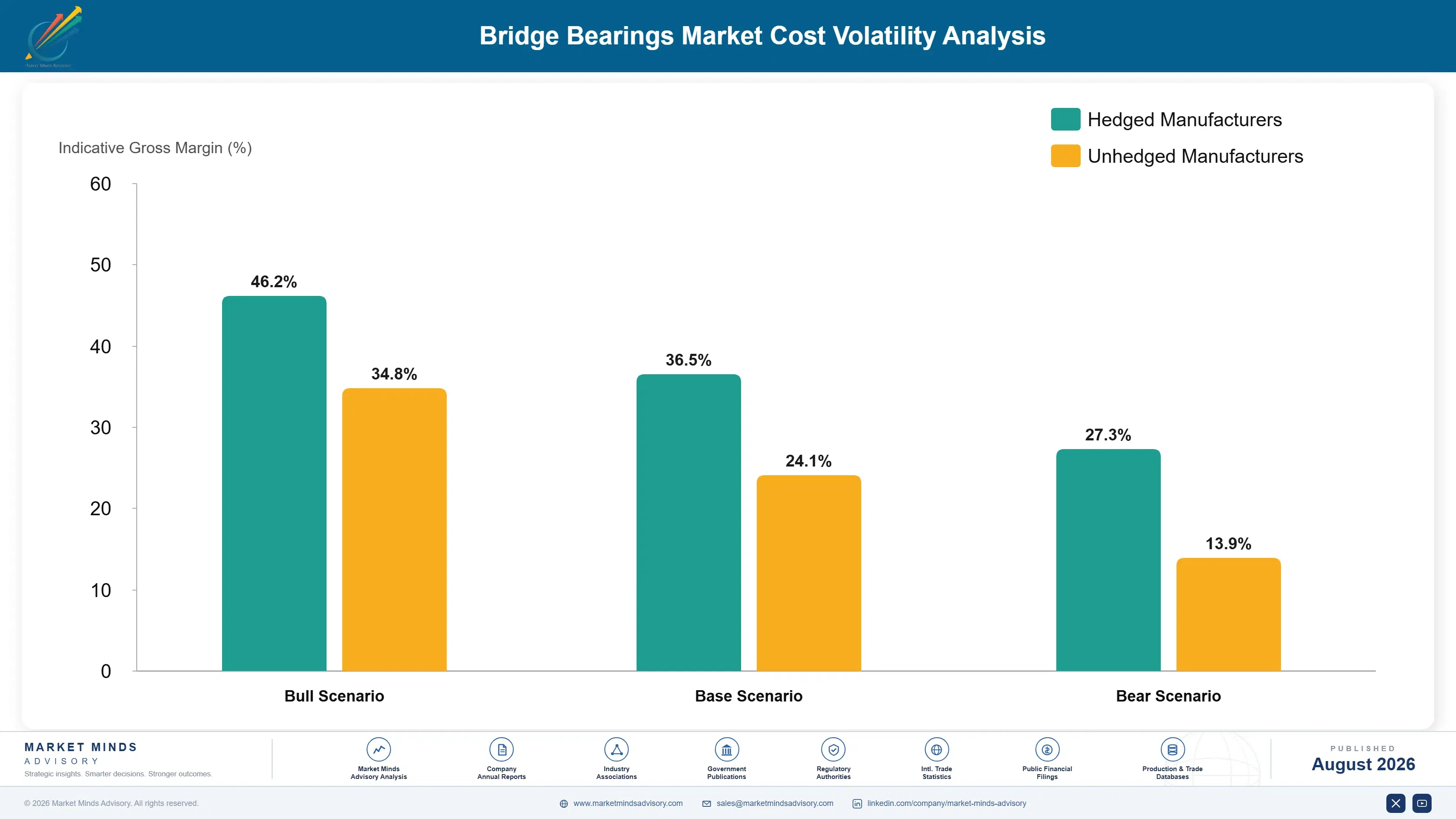
Forged Steel and Elastomer Compound Exposure

Forged and cast alloy steel for spherical and pot bearing housings, together with specialty synthetic rubber compounds for elastomeric pads and isolators, account for roughly 52 percent of cost of goods sold in a typical bearing set. Steel is sourced predominantly from specialty forges in Germany, Japan, and China, while high-performance elastomer compounds draw on a narrower base of synthetic rubber suppliers concentrated in a handful of countries.
Steel price volatility following 2022 supply disruptions pushed forged bearing housing costs up sharply at several European manufacturers, according to EIA and IEA commodity market reporting on industrial metals, forcing suppliers to renegotiate fixed-price contracts signed before the increase took effect and delaying delivery on several major orders. Natural rubber prices have also shown meaningful volatility tied to Southeast Asian harvest conditions, compounding input cost uncertainty for elastomeric manufacturers.

Smaller regional fabricators without long-term steel supply agreements face the sharpest exposure, since they typically buy forged components on spot contracts that leave them vulnerable during tight markets. Larger diversified suppliers with multi-year forging agreements and broader scale have generally passed through less cost volatility to transportation agency customers, widening the gap between top-tier and smaller regional suppliers during periods of input tightness.
bridge-bearings-market-cost-volatility-analysis-1787301702883

Multi-year forging agreements with specialty steel mills

Several larger manufacturers have locked in multi-year pricing agreements with specialty forges in Germany and Japan rather than buying on the spot market, smoothing input cost volatility even when it means paying a modest premium over prevailing spot prices during periods when broader industrial steel demand elsewhere has weakened considerably across export markets generally.

Dual-sourcing elastomer compounds across two supplier regions

Leading manufacturers now qualify synthetic rubber compound formulations from suppliers in at least two different regions rather than relying on a single source, reducing exposure to any single region's harvest or production disruptions. This adds qualification cost upfront but has meaningfully shortened average component lead time recovery during recent tight global supply periods industry-wide.

In-house steel forging for critical bearing components

A small number of vertically integrated suppliers have brought a meaningful portion of steel forging capability fully in-house, insulating their highest-volume seismic and spherical bearing lines from external allocation shortages entirely, though this remains capital-intensive and impractical for smaller regional fabricators lacking the production scale needed to justify the investment given current order volumes.

Portfolio Architecture for Margin Defence

The market organizes into three commercial tiers separated by certification depth and engineering intensity rather than simple load rating. Volume tier products are standardized elastomeric and basic pot bearings sold largely on price for routine highway overpasses. Premium tier systems carry multi-code certification and extended warranty programs. The sustainability and next-generation tier layers in seismic isolation and structural health monitoring on top of certified hardware.
Margin economics favor the premium and next-generation tiers heavily, since volume-tier elastomeric bearings compete largely on unit price against a crowded field of regional fabricators with limited differentiation. Suppliers that can move customers from a catalog hardware sale into certification services and seismic retrofit engineering contracts capture materially higher revenue per project, which is why most established players are actively pushing customers toward higher tiers rather than defending volume-tier share alone.

High-value pools concentrate at seismic retrofit and long-span high-speed rail projects requiring certified spherical or isolation bearings bundled with engineering services, and in the certification testing relationships that anchor major cross-border infrastructure financing contracts. Volume-tier catalog bearing sales remain necessary for market presence but contribute comparatively little to supplier profitability.

Volume / Commodity-Adjacent Tier

Standardized elastomeric and basic pot bearings sold primarily on unit price for routine highway overpasses and low-seismic-risk secondary roads, competing against a crowded field of regional fabricators with limited technical differentiation.
Gross Margin: 16-22%

Premium / Certified Tier

Multi-code certified spherical and disc bearings bundled with extended performance warranties and certification testing services, sold to major span, high-speed rail, and internationally financed infrastructure projects requiring documented compliance across national standards.
Gross Margin: 30-38%

Sustainability / Regulatory / Next-Generation Tier

Lead-rubber and friction pendulum seismic isolation bearings combined with structural health monitoring, sold to critical lifeline highway and rail crossings in earthquake-prone regions where design life certification matters more than unit price.
Gross Margin: 40-48%
bridge-bearings-market-portfolio-architecture-1787301703386

Inspection Cycles Anchor Recurring Demand

Certified bearings generate demand well beyond the initial installation because national bridge inspection codes mandate periodic condition assessment throughout the structure's design life, typically every two years for critical spans, creating a recurring inspection and eventual replacement cycle that hardware-only competitors cannot easily capture on their own. Suppliers who build inspection and monitoring relationships effectively position themselves for the eventual replacement contract tha
Adoption depth varies meaningfully by bridge type. Major seismic-critical and high-speed rail crossings have moved into structural health monitoring and instrumented performance tracking, where switching suppliers means re-qualifying monitoring hardware across an entire network of connected structures. Routine highway overpasses remain firmly in the catalog replacement cycle, where price and delivery lead time matter more than supplier relationship depth or bundled service offerings.

A generational shift in transportation agency engineering staff is reinforcing monitoring adoption. Younger bridge engineers trained on digital inspection platforms increasingly expect bearing performance data delivered as continuous telemetry rather than periodic manual measurement, pushing specification decisions toward suppliers offering integrated monitoring over those selling certified hardware alone, a preference reshaping vendor shortlists at agencies now hiring their next generation of engineers.
bridge-bearings-market-end-use-penetration-index-1787301703873

Where MMA Sees Durable Advantage

These are among the four positions where our research anticipates prominent divergence between winners and laggards over the coming forecast period. Each is grounded in the demand model, the regulatory perimeter, and the announced capacity pipeline.
01 / CERTIFICATION INFRASTRUCTURE DEPTH

Testing capacity, not brand, decides who wins cross-border contracts

Suppliers with in-house or partnered multi-code certification testing facilities capture a disproportionate share of internationally financed infrastructure contracts, since certification lead time is frequently the deciding factor in award decisions rather than brand recognition or unit price. This capability is also the hardest thing for a challenger to build quickly, since accredited testing facilities require years of investment and regulatory approval to establish credibly. MMA views certification testing capacity as the single most predictive metric of supplier durability in this market.
02 / SEISMIC RETROFIT BACKLOG

The seismic retrofit backlog will outgrow new construction through the decade

Updated seismic hazard mapping across Japan, the western United States, Turkey, and increasingly India has expanded the population of bridges classified as critical lifeline structures requiring isolation retrofit, but funding and engineering capacity constraints have kept actual retrofit rates below what code updates alone would predict. Suppliers with proven large-displacement isolator qualification and bundled retrofit engineering capability will capture disproportionate share of this backlog as agencies work through scheduled inspection cycles. MMA expects retrofit-focused suppliers to outgrow new-construction-only competitors meaningfully through the forecast period.
03 / RAIL BEARING LOCALIZATION

Domestic Chinese manufacturing is starting to pressure import-dependent rivals

Domestic Chinese spherical bearing manufacturers have scaled production to serve the country's own high-speed rail expansion, and their cost position is now showing up in export competitiveness against established European and Japanese suppliers bidding on Southeast Asian and Middle Eastern rail contracts. Suppliers dependent on exporting finished bearings into these growth markets face a widening cost disadvantage against domestic and joint venture rivals sourcing steel and labor locally. MMA expects this pressure to intensify fastest in markets where Chinese engineering conglomerates are bidding directly on integrated construction contracts.
04 / ELASTOMER WARRANTY EXPOSURE

Extended compound warranties will become a standard bidding requirement soon

Transportation agencies are increasingly scoring warranty terms alongside price in competitive bidding, reflecting accumulated frustration with elastomeric bearings that degrade well before their nominal design life due to inconsistent compound quality across manufacturers. Suppliers offering extended, third-party-certified performance warranties are winning specification preference even at a price premium over unwarrantied competitors, a pattern MMA expects to spread from major agencies to smaller municipal buyers over the coming several years. Manufacturers unable to document long-term compound durability risk exclusion from future bid shortlists entirely.

Engagement Snapshot From the Field

A live engagement with an industry participant carrying material or product regulatory and market exposure ahead of a defining policy shift, showing how our research translates into a defensible multi-year portfolio strategy.
MARKET MINDS ADVISORY · CLIENT ENGAGEMENT SUMMARY
Bridge Bearings Producer Strategic Portfolio Review and Transition Roadmap 2026·Investment Scenario on Bridge Bearings Exposure Evaluation 2025-26
CLIENT PROFILE
The client is a state transportation department in the western United States responsible for roughly 3,400 highway bridges (client-reported, unverified by MMA), a significant share built before current seismic design codes existed. Recent hazard mapping updates had reclassified a meaningful portion of the department's river crossings and interchange structures as critical lifeline infrastructure requiring seismic isolation retrofit within a fixed compliance timeline.
STRATEGIC CHALLENGE
Management needed to prioritize a multi-year retrofit program across a large bridge inventory with limited engineering staff and a capital budget that could not fund simultaneous retrofit of every reclassified structure. Competing priorities across the department's broader capital program meant retrofit sequencing decisions carried real political and safety consequences if a deprioritized structure suffered damage before its scheduled upgrade.
MMA APPROACH
MMA benchmarked the department's reclassified bridge inventory against isolator supplier certification capacity and typical retrofit project duration, modeled expected seismic risk reduction per dollar spent across candidate sequencing scenarios, and evaluated three isolator suppliers on testing lead time and bundled engineering capability to shorten the department's overall multi-year program timeline.
KEY FINDINGS
  1. Roughly 40 percent of the reclassified structures carried disproportionately higher seismic risk scores relative to daily traffic volume (client-reported, unverified by MMA), suggesting sequencing by risk score rather than structure age would reduce exposure faster.
  2. One supplier's certified testing lead time was nearly half that of competitors for the specific isolator displacement capacity the department's largest river crossings required, materially shortening the achievable program schedule.
  3. Bundled engineering and installation contracts reduced projected total program cost compared with separately procured design, supply, and construction contracts, primarily by eliminating redundant structural assessment work across phases.
  4. Department engineering staff lacked in-house experience specifying large-displacement isolators, creating a training and knowledge transfer need the selected supplier's engineering team was best positioned to address directly.
CLIENT PROFILE
The client is a state transportation department in the western United States responsible for roughly 3,400 highway bridges (client-reported, unverified by MMA), a significant share built before current seismic design codes existed. Recent hazard mapping updates had reclassified a meaningful portion of the department's river crossings and interchange structures as critical lifeline infrastructure requiring seismic isolation retrofit within a fixed compliance timeline.
STRATEGIC CHALLENGE
Management needed to prioritize a multi-year retrofit program across a large bridge inventory with limited engineering staff and a capital budget that could not fund simultaneous retrofit of every reclassified structure. Competing priorities across the department's broader capital program meant retrofit sequencing decisions carried real political and safety consequences if a deprioritized structure suffered damage before its scheduled upgrade.
MMA APPROACH
MMA benchmarked the department's reclassified bridge inventory against isolator supplier certification capacity and typical retrofit project duration, modeled expected seismic risk reduction per dollar spent across candidate sequencing scenarios, and evaluated three isolator suppliers on testing lead time and bundled engineering capability to shorten the department's overall multi-year program timeline.
KEY FINDINGS
  1. Roughly 40 percent of the reclassified structures carried disproportionately higher seismic risk scores relative to daily traffic volume (client-reported, unverified by MMA), suggesting sequencing by risk score rather than structure age would reduce exposure faster.
  2. One supplier's certified testing lead time was nearly half that of competitors for the specific isolator displacement capacity the department's largest river crossings required, materially shortening the achievable program schedule.
  3. Bundled engineering and installation contracts reduced projected total program cost compared with separately procured design, supply, and construction contracts, primarily by eliminating redundant structural assessment work across phases.
  4. Department engineering staff lacked in-house experience specifying large-displacement isolators, creating a training and knowledge transfer need the selected supplier's engineering team was best positioned to address directly.
RECOMMENDED STRATEGY
Phase 1: Phase 1 (Months 1-5): Re-sequence the retrofit priority list by seismic risk score rather than structure age, and finalize isolator supplier selection based on testing capacity. Phase 2: Phase 2 (Months 6-18): Retrofit the highest-risk river crossings first under the bundled engineering and installation contract, with parallel staff training on isolator specification. Phase 3: Phase 3 (Months 19-36): Extend the retrofit program to remaining reclassified structures, incorporating lessons on sequencing and contracting from the first program phase.
OUTCOME
Following the risk-based re-sequencing and bundled contracting approach, the department reported completing retrofit of its highest-risk structures roughly eight months faster than the original sequencing plan and reducing total program cost by an estimated 12 percent (client-reported, unverified by MMA). Staff training under the engagement has since been extended to two additional regional districts.

Frequently Asked Questions

Foundational context covering the market sizes, CAGR, scope, country, region and competition that inform every finding below. This section is provided to cover basics and most often pre-purchase conversations, answered from the MMA Primary Research Dataset.

What is the current size of the Bridge Bearings Market?

The global bridge bearings market was valued at approximately 1.8 billion dollars in 2025. Growth is anchored in aging bridge inventories and expanding rail and expressway construction worldwide.

How large will the Bridge Bearings Market be by 2036?

MMA projects the market will reach approximately 2.86 billion dollars by 2036 under the base case scenario. That represents more than a 50 percent increase over the 2026 market value.

What is the CAGR for the Bridge Bearings Market 2026 to 2036?

The base case CAGR is 4.3 percent annually across the forecast period, reflecting steady infrastructure replacement demand. Bull and bear scenarios range between roughly 3.0 and 5.6 percent.

Which segment is growing fastest?

Seismic isolation bearings are the fastest-growing segment at a projected 6.8 percent CAGR through 2036. That is roughly 1.6 times the overall market growth rate.

Who are the major companies in the Bridge Bearings Market?

Leading suppliers include Mageba, Maurer, Freyssinet, RJ Watson, and China Railway Major Bridge Engineering Group. Together they hold an estimated 32 percent combined share on a certified project revenue basis.

Which country is growing fastest?

China leads regional growth at an estimated 5.9 percent CAGR, driven by sustained expressway and high-speed rail construction. Domestic bearing manufacturing is scaling alongside this infrastructure investment.

Report Segmentation Architecture

The full report scope spans multiple orthogonal segmentation dimensions, with cross-tabulated demand data provided for each dimension pair. Coverage extends further to regional breakdowns, trend trajectories, and the competitive detail needed to support segment-level decision-making.

By Bearing Technology

  • Elastomeric Bearings
  • Pot Bearings
  • Spherical Bearings
  • Disc Bearings
  • Seismic Isolation Bearings
  • Guided Sliding Bearings

By End-Use Structure Type

  • Highway and Expressway Bridges
  • High-Speed and Conventional Rail Bridges
  • Pedestrian and Light Rail Structures
  • Marine and Port Infrastructure Bridges
  • Industrial and Special-Purpose Structures

By Commercial Dimension

  • New Construction Supply
  • Replacement and Retrofit Supply
  • Certification and Testing Services
  • Bundled Engineering Contracts

By Region

  • North America
  • Western Europe
  • East Asia
  • South Asia and Pacific
  • Latin America
  • Middle East and Africa
  • Eastern Europe

Scope, Methodology, and Coverage

Every figure in this report is reproducible from documented input assumptions. The scope below maps the historical period, the forecast horizon, the segmentation dimensions, and the countries covered, alongside the underlying primary and qualitative methodology.
Historical Period
2020 to 2025
Forecast Period
2026 to 2036
Base Year
2025 (USD billions; MMA Primary Research Dataset, August 2026)
Market Definition
The bridge bearings market covers elastomeric, pot, spherical, disc, and seismic isolation bearings that transfer structural loads between a bridge superstructure and its piers or abutments while accommodating thermal expansion, rotation, and seismic movement. It excludes expansion joints, structural steel fabrication, and general construction materials sold independently of a certified bearing assembly.
Quantitative Units
USD billions (current prices); installed unit base and certified bearing set volume where applicable
Segmentation Dimensions
Bearing Technology; End-Use Structure Type; Commercial Dimension; By Region
Regions Covered
North America, Western Europe, East Asia, South Asia and Pacific, Latin America, Middle East and Africa, Eastern Europe
Countries Covered
USA, China, Germany, France, UK, Japan, South Korea, India, Australia, Canada, Brazil, Mexico, Indonesia, Vietnam, Thailand, Malaysia, UAE, Saudi Arabia, South Africa, Nigeria, Turkey, Poland, Netherlands, Italy, Spain, Sweden, Switzerland, Argentina, Colombia, Singapore, and additional markets relevant to this sector
Key Companies Profiled
Mageba SA, Maurer SE, Freyssinet, RJ Watson Inc., China Railway Major Bridge Engineering Group Co., Ltd., CCL Stressing International, Dywidag-Systems International, ALGA S.p.A., FIP Industriale S.p.A., Trelleborg AB, D.S. Brown Company, VSL International Ltd, Kwang Sung Co., Ltd., China Railway Baoji Bridge Group Co., Ltd., Sumitomo Riko Company Limited, Goodco Z-Tech Inc., Corry Rubber Corporation, China Railway Shanhaiguan Bridge Group Co., Ltd., Bridgestone Corporation, Tensa International Ltd
Quantitative Methodology
Primary survey, n=3,800 respondents, Q4 2025, six countries; demand-side model with trade association cross-validation
Qualitative Methodology
47 expert interviews, Q4 2025; applied to validate demand model assumptions, identify emerging dynamics, and assess competitive positioning
Report Format
PDF and XLSX data workbook (Word format preview document)
Publisher
Market Minds Advisory
Report Code
MMA-2026-CON-102
Published
August 2026
Contact
sales@marketmindsadvisory.com | www.marketmindsadvisory.com

Purchase the full Bridge Bearings Market Report (2026 to 2036).

The full report provides detailed sizing and ten-year forecasts for the bridge bearings market across all six bearing technology segments and every major region. It includes company-level competitive profiles for the top twenty suppliers, benchmarked on certified project revenue, alongside detailed analysis of certification testing capacity and seismic retrofit backlog across major markets. Regional chapters cover national bridge inspection codes, infrastructure financing programs, and seismic hazard mapping updates shaping demand through 2036. A dedicated chapter models revenue lever adoption, including certification services and extended warranty pricing, against supplier margin trajectories. Buyers receive a downloadable data workbook alongside the full narrative report.
Ten-year market sizing across six bearing technology segments
Company profiles benchmarked on certified project revenue basis
Regional seismic hazard mapping and inspection code analysis
Certification testing capacity and retrofit backlog benchmarking
Revenue lever modeling against supplier margin trajectories
Downloadable data workbook with full narrative report

Built For The People Who Decide

From boardroom strategy to bench-side execution, this report is read cover-to-cover by leaders shaping the next decade of their industry, turning demand scenarios, market dynamics and valuation benchmarks into decisions.
CXOs/ Presidents/ VPs/ Managers
M&A and Corporate Development
Strategy Teams and R&D Heads
Procurement and Product Directors
Regulatory and Compliance Leaders
Investor Relations and Equity Analysts