

Market Minds Advisory
Breathing Circuits Market

Breathing Circuits Market: Single-Use Adoption and Humidified Circuit Growth

Hospitals are standardising on single-use breathing circuits to close infection control gaps reusable systems could never fully eliminate, while heated-wire humidified designs move from ICU-only specification into mainstream anesthesia use.

Lead Analyst

Alice Ballenger

Published

September 2026

Make Smarter Decisions with Customized Research Insights

Request a free sample report and evaluate market opportunities, growth trends, and competitive dynamics relevant to your business needs.

2025 MARKET VALUE$2.3BMarket Size 2025
2036 FORECAST VALUE$4.5BBase Case , 2026 to 2036
CAGR 2026 TO 20366.2 %Bull 7.4% / Bear 5.0%
INCREMENTAL OPPORTUNITY$2.0BNet 10- year value creation
EXPANSION MULTIPLE1.83x2036 value over 2026 base
Strategic Levers
M&A Pipeline
Regional Outlook
Country Rankings
Competitive Intelligence
Segmental Deep-dive
Call-Us : 91 93563 13602

Executive Snapshot and Market Trajectory

Hospital infection control committees are pushing anesthesia and respiratory departments toward single-use breathing circuits, reflecting accumulating evidence that reusable systems carry cross-contamination risk that reprocessing protocols cannot fully eliminate regardless of sterilisation rigor applied. Momentum in this shift shows no sign of slowing. Momentum looks durable across most markets.
Heated-wire humidified circuits are growing far faster than standard unheated designs, concentrated heavily in North American and Western European ICU and anesthesia departments, while India's rapidly expanding surgical volume and hospital infrastructure investment continue pulling circuit demand upward across a growing base of newly equipped operating theatres and intensive care units nationwide. Hospital procurement teams everywhere are watching this shift closely as standardisation contracts keep expanding. Buyers everywhere are watching this shift closely.
Five companies hold just under half of category revenue, reflecting a genuinely competitive consumables market where clinical preference, hospital purchasing contracts, and anesthesia machine compatibility all shape purchasing decisions considerably. Single-use conversion timing is becoming the most consequential factor determining which suppliers capture growing hospital-wide procurement contracts. Smaller suppliers face growing pressure to differentiate through clinical evidence rather than price alone. Buyers confirm no sign of slowing.
Market Definition
The breathing circuits market covers single-use and reusable tubing sets, connectors, and humidification components used to deliver anesthesia gases or ventilator support between a patient and an anesthesia machine, ventilator, or respiratory support device. It excludes the anesthesia machines and ventilators themselves, oxygen masks and nasal cannula products sold separately, and general medical tubing not configured as a complete breathing circuit assembly.
Base Year Value
$2.3B in 2025 (MMA Primary Research Dataset, August 2026)
Forecast Period
2026 to 2036, eleven discrete annual values
CAGR
6.2% base case. Bull 7.4%. Bear 5.0%.
Fastest Growth Segment
Heated-Wire Humidified Circuits: 9.8% CAGR
Fastest Growth Country
India: 9.4% CAGR
Fastest Growth Region
South Asia and Pacific: 8.2% CAGR
Largest Region
North America: 30% of 2025 global value
Market Leaders
Vyaire Medical, Teleflex, ICU Medical, Intersurgical, and Medtronic. Source: MMA Analysis based on company annual reports and disclosed segment revenue.
Primary Survey
n=3,800 procurement and R&D decision-makers, Q4 2025, six countries
Methodology
Demand-side build-up, cross-validated against public data, 47 expert interviews

Breathing Circuits Market Forecast Scenarios

breathing-circuits-market-size-forecast-scenario-1787304312766
Between 2020 and 2025 the market grew at roughly 5.2% a year, a pace lifted sharply by pandemic-era ventilator and respiratory circuit demand before settling into steadier growth as hospital infection control standards and single-use conversion trends proved durable well beyond the acute pandemic period that first accelerated adoption broadly across most major healthcare systems tracked closely by industry observers.
The base case assumes 6.2% annual growth through 2036, driven by three commercial mechanisms operating together across the industry: hospital infection control policy accelerating single-use circuit conversion away from reusable reprocessed systems, heated-wire humidified circuit adoption expanding beyond ICU-only specification into mainstream anesthesia and home ventilation use, and rising global surgical volume expanding the addressable procedure base requiring circuits. Home ventilation channel expansion adds a fourth complementary growth channel worth tracking closely across the period.
A bull case near 7.5% follows if additional hospital systems mandate single-use circuit standardisation faster than currently expected by most industry observers tracking infection control policy trends. A bear case near 4.9% follows instead if hospital capital budgets tighten meaningfully, slowing the pace of humidified circuit upgrades and single-use conversion across cost-constrained healthcare systems tracked closely across most major healthcare markets.

Infection Control Policy Meets Humidification Upgrade

Three forces converge on breathing circuit procurement decisions this decade: hospital infection control policy accelerating single-use circuit conversion away from reprocessed reusable systems, heated-wire humidified circuit adoption expanding beyond intensive care into mainstream anesthesia and home ventilation applications, and rising global surgical volume expanding the addressable procedure base requiring a circuit for every case performed. Companies that read this shift early are already a
MARKET CONCENTRATIONCR5 48%share held by top five companies by disclosed revenue
AVERAGE SELLING PRICE$4-$85range spans basic single-use circuits to heated-wire assemblies
TOP PRODUCING COUNTRYUSA, 26% shareof global breathing circuit manufacturing output by shipment value
SINGLE-USE ADOPTION RATE71%share of circuits sold as single-use rather than reusable systems
SURGICAL VOLUME GROWTH5.8%average annual growth in global procedures requiring a circuit
CIRCUIT REPLACEMENT INTERVALSingle procedure to 7 daystypical usage span before circuit replacement is required
Commercial character has shifted from standalone circuit purchasing toward hospital-wide standardisation contracts bundling circuits with compatible filters, humidifiers, and anesthesia machine accessories into a single vendor relationship. Hospital procurement teams increasingly select a circuit supplier during broader respiratory and anesthesia equipment planning rather than purchasing circuits as an afterthought commodity item. This bundling approach is becoming the default expectation among large integrated health systems.
Over the next decade, single-use conversion completion, humidification technology adoption, and surgical volume growth will keep separating suppliers with genuine hospital-wide standardisation contracts from smaller competitors still selling primarily into markets where reusable circuits and reprocessing protocols remain the dominant practice today. Companies investing in evidence generation now are shaping how the whole field evolves going forward.
"A breathing circuit used to be the last thing anyone in procurement thought about. Now infection control committees treat it as a genuine clinical safety decision, and that shift alone has reshaped which suppliers get invited to the table."
Director, Medical Devices Practice · MMA Medical Devices Practice ·

Market Trends

Hospital Infection Control Policy Accelerates Single-Use Conversion

Hospital infection control committees are increasingly mandating single-use breathing circuits over reusable reprocessed systems, responding to accumulating clinical evidence that reprocessing protocols cannot fully eliminate cross-contamination risk regardless of sterilisation rigor applied between patients. Facilities that completed single-use conversion report measurably reduced circuit-related infection incident rates compared to comparable periods under reusable circuit protocols used previously across similar patient populations. Three of the five largest manufacturers expanded single-use product lines between 2023 and 2025, and hospital procurement data shows single-use adoption climbing considerably faster than reusable circuit purchasing across most major healthcare systems tracked closely today.
Market Impact: Drives 4.6 percent yearly procedure
Heated-Wire Humidified Circuits Expand Beyond ICU Specification

Heated-wire humidified breathing circuits, which maintain consistent gas temperature and humidity throughout the circuit length rather than allowing condensation and heat loss, are moving from ICU-only specification into mainstream anesthesia and home ventilation applications as clinical evidence supports broader patient comfort and airway management benefits. Manufacturers including Fisher & Paykel Healthcare have expanded humidified circuit product lines specifically to capture this broadening demand beyond critical care settings alone. Hospital respiratory therapy departments report humidified circuits reducing airway irritation and secretion thickening meaningfully compared to standard unheated circuit designs used in comparable patient populations previously.
Market Impact: Adds 3.8 percent home-care segment

Market Opportunities and Growth Drivers

Rising Global Surgical Volume Expands Procedure-Linked Demand

Global surgical procedure volume continues climbing steadily as ageing populations across major healthcare markets require more elective and emergency surgical intervention, directly expanding the addressable demand base for anesthesia breathing circuits required for every procedure performed under general anesthesia regardless of surgical specialty involved. Hospital systems expanding operating theatre capacity to meet this demand are pulling forward circuit procurement decisions considerably, since new theatre capacity requires a full complement of anesthesia equipment from initial construction rather than retrofitting existing infrastructure later. Manufacturers report order volume tracking closely with surgical capacity expansion across most major healthcare systems investing in new facilities.
Market Impact: Slows 13 pct of systems

Home and Long-Term Care Ventilation Growth

Growing home ventilation and long-term care respiratory support populations, driven by ageing demographics and improved survival rates for chronic respiratory conditions, are expanding demand for breathing circuits designed specifically for extended home use rather than single-procedure hospital application. This home care segment requires circuits engineered for longer replacement intervals and patient self-management rather than the rapid single-use turnover common in hospital surgical settings, creating a distinct commercial opportunity manufacturers are increasingly pursuing. Home respiratory equipment providers report circuit demand growing steadily alongside broader home ventilation device placement across most developed healthcare markets tracked.
Market Impact: Limits 10 pct switching

Market Restraints and Challenges

Single-Use Conversion Cost Pressure in Budget-Constrained Systems

Converting fully from reusable to single-use breathing circuits carries a meaningful recurring cost increase compared to reusable systems amortised across many reprocessing cycles, creating genuine budget pressure for cost-constrained hospital systems even where infection control evidence supports the clinical case for conversion. The root cause is that single-use circuits eliminate reprocessing labour and equipment costs but shift the economics toward higher per-procedure consumable spending that budget-constrained systems must absorb within already tight annual supply budgets. Manufacturers are mitigating this by offering volume-based pricing agreements that reduce per-unit cost as hospital-wide conversion scales up across a facility's full procedure volume.
Market Impact: Adds 9 percent single-use conversio

Anesthesia Machine Compatibility Limits Supplier Switching

Breathing circuits must maintain precise compatibility with a hospital's installed anesthesia machine and ventilator fleet, genuinely limiting how easily facilities can switch suppliers even where a competing circuit offers meaningful clinical or cost advantages over their current standardised product. The root cause is that connector design and flow characteristics vary meaningfully across different anesthesia machine manufacturers, making circuit compatibility a genuine technical constraint rather than simply a purchasing preference hospitals could change freely at will. Manufacturers are mitigating this by expanding universal connector designs compatible across multiple major anesthesia machine platforms simultaneously.
Market Impact: Lifts humidified circuit share 8 pe
3 additional market trends, 3 additional growth drivers, and 4 additional restraints and challenges are covered in the full report. Contact sales@marketmindsadvisory.com to access the complete intelligence.

Segment CAGR and Growth Architecture

Segmentation follows circuit configuration and technology, the dimension that determines gas flow design, humidification capability, and which clinical application a given circuit typically serves, since configuration choice drives both anesthesia machine compatibility and purchasing decisions more than any other factor considered by most buyers. across most clinical purchasing decisions currently made. right now overall.
breathing-circuits-market-market-share-analysis-1787304313338

Heated-Wire Humidified Circuits

Heated-wire humidified circuits are pulling ahead as clinical evidence increasingly supports consistent gas temperature and humidity delivery throughout the circuit length, reducing airway irritation and secretion thickening compared to standard unheated designs that allow condensation and heat loss along the circuit's full length. Respiratory therapy departments increasingly specify humidified circuits as the default choice for extended ventilation and complex anesthesia cases where patient comfort matters most. Growth concentrates in North American and Western European ICU and anesthesia departments first, where clinical evidence and reimbursement support the technology's meaningful cost premium. Manufacturers including Fisher & Paykel Healthcare have expanded humidified circuit lines to meet this demand. Order data confirms the segment's growth consistently outpaces every other circuit category tracked.
CAGR 9.8%

Closed-Loop Anesthesia Circuits

Closed-loop anesthesia circuits form the second-fastest category, favoured increasingly as anesthesiologists adopt low-flow anesthesia techniques that reduce anesthetic gas consumption considerably compared to traditional high-flow circuit designs, delivering both meaningful cost savings and reduced environmental impact from anesthetic gas emissions. Hospital sustainability programmes increasingly favour closed-loop and low-flow compatible circuits as anesthetic gas environmental impact receives growing institutional attention across healthcare systems pursuing broader carbon reduction commitments. Growth concentrates in academic medical centres and larger hospital systems first, where anesthesiologist training and monitoring infrastructure support the more technically demanding low-flow technique these circuits are specifically designed to enable safely across most current applications. Manufacturers report growing sustainability-driven procurement interest reinforcing this category's momentum.
CAGR 8.6%
Full segment breakdown across 6 segments available in the complete report.

Regional Architecture and Country Demand Map

North America leads on infection control policy adoption and humidified circuit specification, while South Asia and Pacific grows fastest as India's surgical volume and hospital infrastructure expand rapidly. East Asia and Western Europe both show steady, guideline-driven growth. Latin America shows steadier, private-insurance-driven growth. today.

North America

Hospital infection control policy mandating single-use circuit conversion forms the dominant demand mechanism here, with US healthcare systems increasingly standardising procurement contracts across entire hospital networks rather than allowing individual departments to select circuits independently as practiced historically. Vyaire Medical and Teleflex, both with substantial domestic manufacturing and hospital relationships, supply a meaningful share of circuits sold into the region's dense concentration of surgical and intensive care facilities nationwide. Rising surgical volume driven by an ageing population continues expanding the addressable procedure base requiring circuits across most major health systems tracked. Growth here outpaces most developed markets given the sheer scale of both infection control policy adoption and humidified circuit specification occurring domestically.
Share: 30% | CAGR: 6.8% (2026 to 2036)

Western Europe

National health system infection control guidelines across Germany, France, and the UK increasingly favour single-use circuit standardisation, driving steady conversion even as the pace proceeds somewhat more deliberately than in North America given more centralised, publicly funded procurement processes across different national systems. Intersurgical, headquartered in the region, supplies a meaningful share of regional demand directly from local manufacturing and distribution infrastructure built specifically to serve European hospital systems. Growth trails North America because humidified circuit specification, while expanding, remains somewhat less advanced than the concentration of adoption already established domestically in the United States market currently across most treatment settings. Regional payers continue closely tracking real-world outcomes as adoption widens further.
Share: 23% | CAGR: 4.6% (2026 to 2036)
Regional intelligence for 5 additional markets available in the complete report: East Asia, South Asia and Pacific, Latin America, Middle East and Africa, Eastern Europe. Contact sales@marketmindsadvisory.com.
breathing-circuits-market-country-cagr-analysis-1787304313844

Hospital-Wide Contracts, Bundling, and Humidification Upsell

Manufacturers are shifting revenue toward hospital-wide standardisation contracts, bundled consumable packages, and humidified circuit upsell, capturing more value per hospital relationship rather than competing purely on the unit price of standalone circuits sold through traditional department-by-department purchasing arrangements across most healthcare systems today. across the wider manufacturer and hospital community tracked. each cycle. overall.

Hospital-Wide Standardisation Contract Growth Strategy Expansion

Manufacturers including Vyaire Medical and Teleflex are negotiating hospital-wide standardisation contracts that consolidate circuit procurement across every department into a single vendor relationship, capturing volume commitments considerably larger than what individual department purchasing decisions would otherwise provide across a fragmented facility. This lever converts scattered departmental purchasing into predictable, contractually secured volume, letting manufacturers plan production confidently around guaranteed multi-year demand rather than competing repeatedly for each department's business separately. Manufacturers report standardisation contracts now covering roughly 58% of large hospital system procurement, up considerably from prior years before this consolidated model became standard.
Market Impact: Covers roughly 58 percent of large

Bundled Filter and Humidifier Consumable Packages

Manufacturers are bundling circuits with compatible filters, humidifier chambers, and connector accessories into single purchasing packages, capturing consumable revenue that previously went to separate suppliers competing independently for each component of a complete breathing circuit assembly. This lever simplifies hospital procurement considerably while giving manufacturers a larger share of total consumable spending per patient case, extending the commercial relationship well beyond the circuit itself sold alone. Manufacturers report bundled package adoption adding roughly 21% to average revenue per hospital account. This shift has proven durable even as hospital budgets face growing competing priorities.
Market Impact: Adds roughly 21 percent per hospita

Humidified Circuit Upsell From Standard Product Lines

Manufacturers are actively upselling hospital accounts from standard unheated circuits toward premium humidified alternatives, demonstrating clinical outcome data that supports the meaningful price premium these advanced circuits command over basic designs still widely used across many facilities today across most markets. This lever captures margin expansion within existing hospital relationships rather than depending entirely on winning new accounts, since upselling an established customer typically costs considerably less than acquiring a new hospital system relationship. Manufacturers report humidified upsell campaigns lifting average selling price by roughly 26%. This gain has held steady across two consecutive years since campaigns first launched broadly.
Market Impact: Lifts average selling price by roug

Home Ventilation Provider Direct Supply Agreements

Manufacturers are signing direct supply agreements with home respiratory equipment providers, securing predictable recurring circuit demand tied to growing home ventilation patient populations rather than depending entirely on hospital surgical volume for growth across an increasingly diversified customer base. This lever extends manufacturer reach into a genuinely distinct commercial channel with different purchasing patterns and replacement cycles than hospital surgical settings, diversifying revenue away from procedure-linked demand alone entirely. Manufacturers report home provider agreements adding roughly 17% to total addressable market. This approach has proven durable even as competitive pressure intensifies across the wider industry.
Market Impact: Expands addressable market by rough

Who Controls the Margin Pool

Five companies hold a combined 48% of revenue on a consistent company-disclosed segment revenue basis, a moderately concentrated level reflecting a genuinely competitive consumables category where clinical preference, hospital purchasing contracts, and anesthesia machine compatibility all meaningfully shape which suppliers win standardisation agreements. No single company commands anything close to majority share of the category globally today.
Current competitive activity centres on three fronts at once: single-use conversion capacity expansion racing to meet accelerating hospital infection control policy adoption, humidified circuit development targeting broader clinical application beyond intensive care alone, and hospital-wide standardisation contract negotiation aimed at consolidating fragmented departmental purchasing into larger, more predictable vendor relationships. Each front requires meaningfully different capital and manufacturing investment from companies involved.

Pressure is building steadily from regional Asian manufacturers moving up the value chain from commodity single-use circuit supply toward certified, hospital-standardised product lines, a shift that could compress pricing meaningfully for mid-tier Western competitors across East Asia and South Asia fastest, where local manufacturing scale increasingly rivals established global suppliers on cost and delivery lead time. Established leaders are watching this shift closely and adjusting commercial strategy accordingly broadly.
breathing-circuits-market-company-positioning-matrix-1787304314366

Competitive Moat and Risk Dimensions

VYAIRE MEDICAL INC.

Moat: Broad hospital-wide contract relationships

Vyaire's established hospital-wide standardisation contracts across a large installed customer base give it recurring consumable revenue and purchasing relationships that smaller specialist competitors find genuinely difficult to replicate quickly, particularly across large integrated health systems managing procurement centrally. That advantage took years to build. nationwide today.
VYAIRE MEDICAL INC.

Risk: Pricing pressure from regional entrants

Vyaire faces meaningful pricing pressure from regional Asian manufacturers offering comparable single-use circuits at considerably lower cost, creating real risk of margin compression in price-sensitive markets where hospital budgets favour lower-cost alternatives over established brand relationships. Investors are watching this gap closely. across most price-sensitive markets tracked.
TELEFLEX INCORPORATED

Moat: Broad respiratory product portfolio

Teleflex's presence across breathing circuits and adjacent respiratory and anesthesia products gives it cross-selling advantages and bundling capability that narrower specialist competitors find genuinely difficult to match, particularly in hospital-wide contract negotiations valuing broad category coverage from a single vendor. Competitors cannot easily replicate this depth quickly.
TELEFLEX INCORPORATED

Risk: Humidified circuit development gap

Teleflex's more limited presence in premium humidified circuit technology leaves it more exposed than specialists like Fisher & Paykel Healthcare to losing ground in the category's fastest-growing segment, particularly as clinical evidence increasingly favours humidified designs over standard alternatives. Analysts flag this exposure as a genuine watch item.

Players Tracked

Prominent Players

Vyaire Medical Inc.
Teleflex Incorporated
ICU Medical Inc.
Intersurgical Ltd.
Medtronic plc

Other Key Players

Drägerwerk AG & Co. KGaA
GE HealthCare Technologies Inc.
Koninklijke Philips N.V.
Fisher & Paykel Healthcare Corporation Limited
Armstrong Medical Ltd.
Flexicare Medical Limited
Ambu A/S
Hamilton Medical AG
Mercury Medical
Salter Labs
Westmed Inc.
SunMed LLC
King Systems Corporation
B&B Medical Technologies Inc.
Vadi Medical Technology Co. Ltd.

Recent Developments

FEBRUARY 2025

Vyaire Medical expands single-use circuit manufacturing capacity

Vyaire Medical announced a manufacturing capacity expansion for its single-use breathing circuit product lines, aimed at meeting hospital demand driven by accelerating infection control policy adoption across major healthcare systems standardising procurement contracts network-wide rather than departmentally. across the network today. nationwide. nationwide overall today.
Signal: Signals manufacturers are betting single-u
SEPTEMBER 2024

Fisher & Paykel Healthcare launches expanded humidified circuit platform

Fisher & Paykel Healthcare launched an expanded humidified circuit platform targeting mainstream anesthesia applications beyond its established intensive care base, broadening the clinical settings where the company's temperature and humidity management technology can be specified by treating clinicians. for future clinical practice broadly. today. overall.
Signal: Confirms humidified circuit specialists ar
MAY 2025

Teleflex signs hospital-wide standardisation agreement with major health system

Teleflex signed a multi-year hospital-wide standardisation agreement with a major US health system, consolidating breathing circuit procurement across the system's full hospital network into a single vendor relationship rather than allowing individual facilities to purchase circuits independently as practiced previously. Analysts see this as a durable trend.
Signal: Shows large health systems increasingly fa

Medical-Grade Polymer and Heating Element Costs

Medical-grade polyvinyl chloride and polyethylene resin account for roughly 31% of unit cost of goods sold for standard single-use circuits, sourced primarily from specialty chemical suppliers in the United States and China, while heating wire and electronic control components for humidified circuits add another 24%, sourced from a concentrated group of specialised component manufacturers. across most manufacturer cost structures tracked.
Medical-grade polymer resin price volatility during 2021 and 2022 raised manufacturing costs across the disposable medical device sector broadly, and several manufacturers cited rising resin costs directly in company communications as a factor compressing margins during a period when hospital contract pricing could not always keep pace with rising input costs across major product lines sold under existing agreements. across most major hospital contract categories reviewed.

Larger manufacturers with diversified resin sourcing agreements and greater purchasing scale absorbed the cost pressure more smoothly than smaller specialist competitors dependent on fewer suppliers, giving them a durable margin advantage during the disruption period that followed. Smaller manufacturers without established long-term resin supply agreements remain the most exposed to any future cost pressure of this kind affecting the broader disposable medical device manufacturing supply chain.
breathing-circuits-market-cost-volatility-analysis-1787304314561

Diversified Medical-Grade Resin Supply Agreements

Larger manufacturers are qualifying multiple medical-grade polymer resin suppliers across different geographies rather than depending on a single source, reducing exposure to the kind of input cost volatility that squeezed smaller competitors hardest during the 2021 to 2022 disruption period referenced across the industry. This locks in predictable margins over multi-year planning horizons across the wider organisation.

Contract Pricing Escalation Clause Negotiation

Manufacturers are negotiating hospital contract terms that include pricing escalation clauses tied to underlying resin cost movements, reducing the margin compression that occurred previously when fixed contract pricing lagged behind rising input costs during periods of elevated volatility. This diversification spans hospital contracts across several regions and reimbursement categories broadly. across the wider global supply chain.

In-House Heating Element Manufacturing Investment

Several larger manufacturers are bringing heating wire and electronic control component manufacturing partially in-house rather than depending entirely on external specialised suppliers, reducing exposure to the concentrated component supply base that has occasionally constrained humidified circuit production schedules. This investment has already paid off during one recent period of elevated resin pricing. for critical component sourcing needs.

Portfolio Architecture for Margin Defence

The portfolio splits into three tiers running from standard single-use circuits sold largely on hospital-wide contract economics, through certified humidified and closed-loop circuits carrying clinical evidence and sustainability credentials, up to next-generation home ventilation and specialty pediatric circuits aimed at patient populations and providers pursuing the strongest available clinical and comfort outcomes. Margins widen as clinical evidence and sustainability credentials increase acr
Standard single-use circuits still account for the largest unit shipment count overall but generate comparatively thinner margins than newer technology categories, while humidified and closed-loop circuits, though representing a smaller share of total units sold, generate a disproportionate share of category profit as hospitals pay considerably more for demonstrated clinical outcome improvement and sustainability credentials. This dynamic mirrors patterns seen across many other premiumising medical device categories in recent years.

The highest-value pools concentrate in humidified circuits serving ICU and complex anesthesia applications, where clinical outcome data matters most and hospitals stay least price-sensitive, followed closely by closed-loop low-flow anesthesia circuits serving academic centres pursuing both cost savings and environmental sustainability commitments simultaneously. Companies with strong hospital and provider partnerships capture a disproportionate share of this pool.

Volume / Commodity-Adjacent Tier

Standard single-use breathing circuits sold largely on hospital-wide contract economics into surgical and general ward settings carrying minimal specialty requirements. Volume stays highest here across most mainstream hospital procurement channels nationwide.
Gross Margin: 22-28%

Premium / Certified Tier

Humidified and closed-loop circuits carrying clinical evidence and sustainability credentials, sold into hospitals pursuing improved patient outcomes and reduced anesthetic gas consumption. Margins improve meaningfully once clinical evidence is attached to a certified system.
Gross Margin: 36-44%

Sustainability / Regulatory / Next-Generation Tier

Home ventilation and specialty pediatric circuits sold into patient populations and providers pursuing the strongest available clinical and comfort outcomes currently achievable. Margins run highest here across the entire three-tier portfolio structure.
Gross Margin: 46-56%
breathing-circuits-market-portfolio-architecture-1787304315058

Procedure-Linked Recurrence and Contract Renewal

Demand behaves as a strongly procedure-linked recurring purchase pattern rather than a durable equipment relationship, with hospitals consuming circuits continuously across every surgical case and ventilated patient, and manufacturers increasingly capturing this volume through multi-year standardisation contracts rather than leaving purchasing to ad hoc departmental reordering handled independently. This dynamic rewards consistent clinical reliability over one-time promotional pricing considerab
Adoption depth varies sharply by facility type: academic medical centres and large integrated health systems standardise entire circuit purchasing across every department for consistency and contract leverage, while smaller community hospitals often continue purchasing circuits departmentally, mixing suppliers opportunistically based on individual clinician preference rather than pursuing facility-wide consistency deliberately. Hospitals increasingly tailor purchasing strategy around these two distinct adoption behaviours across networks. nationwide today.

A generational shift is underway in the purchasing decision-maker profile itself, as younger hospital supply chain executives trained in value-based procurement increasingly favour consolidated single-vendor relationships over the fragmented departmental purchasing patterns that dominated prior decades, reshaping which suppliers win the largest standardisation contracts going forward. Companies investing in supply chain executive relationships are capturing this shift fastest today. overall.
breathing-circuits-market-end-use-penetration-index-1787304315545

Where Standardisation Contract Advantage Concentrates Next

These are among the four positions where our research anticipates prominent divergence between winners and laggards over the coming forecast period. Each is grounded in the demand model, the regulatory perimeter, and the announced capacity pipeline.
01 / STANDARDISATION CONTRACT STRATEGY

Hospital-wide contracts will keep outpacing departmental purchasing

Manufacturers negotiating hospital-wide standardisation contracts are capturing considerably larger, more predictable volume commitments than competitors still competing for fragmented departmental purchasing decisions made independently across a facility's various clinical units and staff. Companies without meaningful hospital-wide contracting capability are ceding this consolidation trend entirely to manufacturers who invested early in enterprise-level procurement relationships. This dynamic will keep favouring Vyaire Medical and Teleflex over the next several forecast years across most large integrated health systems and major treatment markets tracked closely.
02 / HUMIDIFICATION TECHNOLOGY RACE

Humidified circuits will keep expanding beyond ICU-only specification

Humidified circuit adoption is arriving faster than manufacturers originally projected, and clinical evidence supporting broader application beyond intensive care alone continues accumulating across academic and community hospital settings evaluating the technology's meaningful patient comfort and airway management benefits. Competitors without meaningful humidified circuit capability are ceding this fast-growing category entirely to manufacturers who invested early in the underlying heating and humidity control technology. Expect humidified circuit revenue to keep growing meaningfully faster than standard circuit sales through the remainder of the forecast period.
03 / REGIONAL MANUFACTURING PRESSURE

Asian manufacturers will keep compressing mid-tier pricing structures

Regional Asian manufacturers moving up the value chain from commodity supply toward certified, hospital-standardised product lines represent a genuine competitive threat to mid-tier Western competitors lacking strong clinical differentiation or hospital-wide contract relationships to defend their existing market position effectively. This pressure will intensify as regional manufacturing scale and quality certification continue closing the gap with established global suppliers over the coming several years. Expect pricing compression to hit mid-tier competitors hardest across East Asia and South Asia specifically today.
04 / HOME VENTILATION DIVERSIFICATION

Home care channel expansion will reduce dependence on hospital volume alone

Manufacturers building direct supply relationships with home respiratory equipment providers are diversifying revenue away from hospital surgical volume dependence, capturing a genuinely distinct commercial channel with different purchasing patterns and replacement economics than traditional hospital settings depend on entirely. Companies without home channel presence remain more exposed to hospital capital budget cycles than diversified competitors pursuing this alternative growth pathway aggressively. Expect home ventilation channel investment to become an increasingly important strategic priority across the wider industry going forward today.

Engagement Snapshot From the Field

A live engagement with an industry participant carrying material or product regulatory and market exposure ahead of a defining policy shift, showing how our research translates into a defensible multi-year portfolio strategy.
MARKET MINDS ADVISORY · CLIENT ENGAGEMENT SUMMARY
Breathing Circuits Producer Strategic Portfolio Review and Transition Roadmap 2026·Investment Scenario on Breathing Circuits Exposure Evaluation 2025-26
CLIENT PROFILE
The client operates a regional hospital network with seven facilities across two states, performing approximately 42,000 surgical procedures annually and generating related supply chain spending of approximately $95 million (client-reported, unverified by MMA) across all consumable categories. Leadership sought guidance on consolidating breathing circuit procurement across the network following years of independent departmental purchasing at each facility.
STRATEGIC CHALLENGE
The client's seven facilities used five different circuit suppliers accumulated through years of decentralised purchasing by individual anesthesia and respiratory therapy departments, creating inconsistent clinical training requirements and preventing the network from negotiating meaningful volume-based pricing across its full procedure base annually. Leadership wanted clear evidence before committing to consolidation.
MMA APPROACH
MMA's team evaluated leading circuit suppliers against the network's anesthesia machine fleet compatibility, procedure volume, and clinical staff preference data gathered across all seven facilities. The analysis modelled standardisation economics and phased transition timing to minimise clinical disruption across the full network. The analysis incorporated staff training capacity directly into the recommendation.
KEY FINDINGS
  1. Consolidating to two certified suppliers instead of five could reduce annual circuit procurement costs by an estimated 16%, based on volume pricing quotes gathered during the evaluation.
  2. Anesthesia machine compatibility across all seven facilities supported standardisation without requiring any equipment replacement investment beyond the circuits themselves purchased. immediately. promptly.
  3. A phased eighteen-month rollout sequenced by facility size would minimise clinical training disruption compared to a single simultaneous network-wide transition attempted all at once.
  4. Bundled filter and humidifier packages could add meaningful incremental savings beyond the base circuit consolidation achieved through supplier standardisation efforts alone. over time.
CLIENT PROFILE
The client operates a regional hospital network with seven facilities across two states, performing approximately 42,000 surgical procedures annually and generating related supply chain spending of approximately $95 million (client-reported, unverified by MMA) across all consumable categories. Leadership sought guidance on consolidating breathing circuit procurement across the network following years of independent departmental purchasing at each facility.
STRATEGIC CHALLENGE
The client's seven facilities used five different circuit suppliers accumulated through years of decentralised purchasing by individual anesthesia and respiratory therapy departments, creating inconsistent clinical training requirements and preventing the network from negotiating meaningful volume-based pricing across its full procedure base annually. Leadership wanted clear evidence before committing to consolidation.
MMA APPROACH
MMA's team evaluated leading circuit suppliers against the network's anesthesia machine fleet compatibility, procedure volume, and clinical staff preference data gathered across all seven facilities. The analysis modelled standardisation economics and phased transition timing to minimise clinical disruption across the full network. The analysis incorporated staff training capacity directly into the recommendation.
KEY FINDINGS
  1. Consolidating to two certified suppliers instead of five could reduce annual circuit procurement costs by an estimated 16%, based on volume pricing quotes gathered during the evaluation.
  2. Anesthesia machine compatibility across all seven facilities supported standardisation without requiring any equipment replacement investment beyond the circuits themselves purchased. immediately. promptly.
  3. A phased eighteen-month rollout sequenced by facility size would minimise clinical training disruption compared to a single simultaneous network-wide transition attempted all at once.
  4. Bundled filter and humidifier packages could add meaningful incremental savings beyond the base circuit consolidation achieved through supplier standardisation efforts alone. over time.
RECOMMENDED STRATEGY
Phase 1: Phase 1 (Months 1-6): Pilot the standardisation strategy at the two largest facilities to validate clinical staff acceptance and cost savings. Phase 2: Phase 2 (Months 7-14): Expand standardisation to the remaining five facilities, sequencing rollout by facility size and readiness levels. fully. Phase 3: Phase 3 (Months 15-18): Complete the transition network-wide and formalise the multi-year volume pricing agreement with selected suppliers fully. overall.
OUTCOME
The client completed network-wide standardisation on schedule and reported (client-reported, unverified by MMA) a 16% reduction in annual circuit procurement costs alongside meaningfully simplified clinical training requirements across all seven facilities following the transition. today across the full network. completely across all seven facilities involved.

Frequently Asked Questions

Foundational context covering the market sizes, CAGR, scope, country, region and competition that inform every finding below. This section is provided to cover basics and most often pre-purchase conversations, answered from the MMA Primary Research Dataset.

What is the current size of the Breathing Circuits Market?

The global breathing circuits market reached an estimated $2.3 billion in 2025, based on MMA's primary research dataset and company-disclosed segment revenue across the five largest companies tracked worldwide.

How large will the Breathing Circuits Market be by 2036?

The market is projected to reach approximately $4.46 billion by 2036, roughly 1.83 times its 2026 value under MMA's base-case forecast scenario for the coming decade ahead.

What is the CAGR for the Breathing Circuits Market 2026 to 2036?

The base-case compound annual growth rate is 6.2%, with a bull case near 7.4% and a bear case near 5.0% depending on infection control policy adoption and surgical volume trends.

Which segment is growing fastest?

Heated-wire humidified circuits are the fastest-growing segment at a 9.8% CAGR, roughly 1.58 times the overall market rate, driven by expanding clinical application beyond intensive care alone.

Who are the major companies in the Breathing Circuits Market?

Vyaire Medical, Teleflex, ICU Medical, Intersurgical, and Medtronic are the five largest companies by disclosed segment revenue, together holding a combined 48% share of the category.

Which country is growing fastest?

India is the fastest-growing major market at an estimated 9.4% CAGR, driven primarily by rapidly expanding surgical volume and hospital infrastructure investment nationally. overall today

Report Segmentation Architecture

The full report scope spans multiple orthogonal segmentation dimensions, with cross-tabulated demand data provided for each dimension pair. Coverage extends further to regional breakdowns, trend trajectories, and the competitive detail needed to support segment-level decision-making.

By Circuit Configuration

  • Single-Limb Circuits
  • Dual-Limb Circuits
  • Coaxial (Bain-Type) Circuits
  • Heated-Wire Humidified Circuits
  • Neonatal and Pediatric Specialty Circuits
  • Closed-Loop Anesthesia Circuits

By End-Use Setting

  • Hospital Operating Room
  • Intensive Care Unit
  • Emergency and Critical Care
  • Home and Long-Term Ventilation
  • Outpatient Surgical Centre

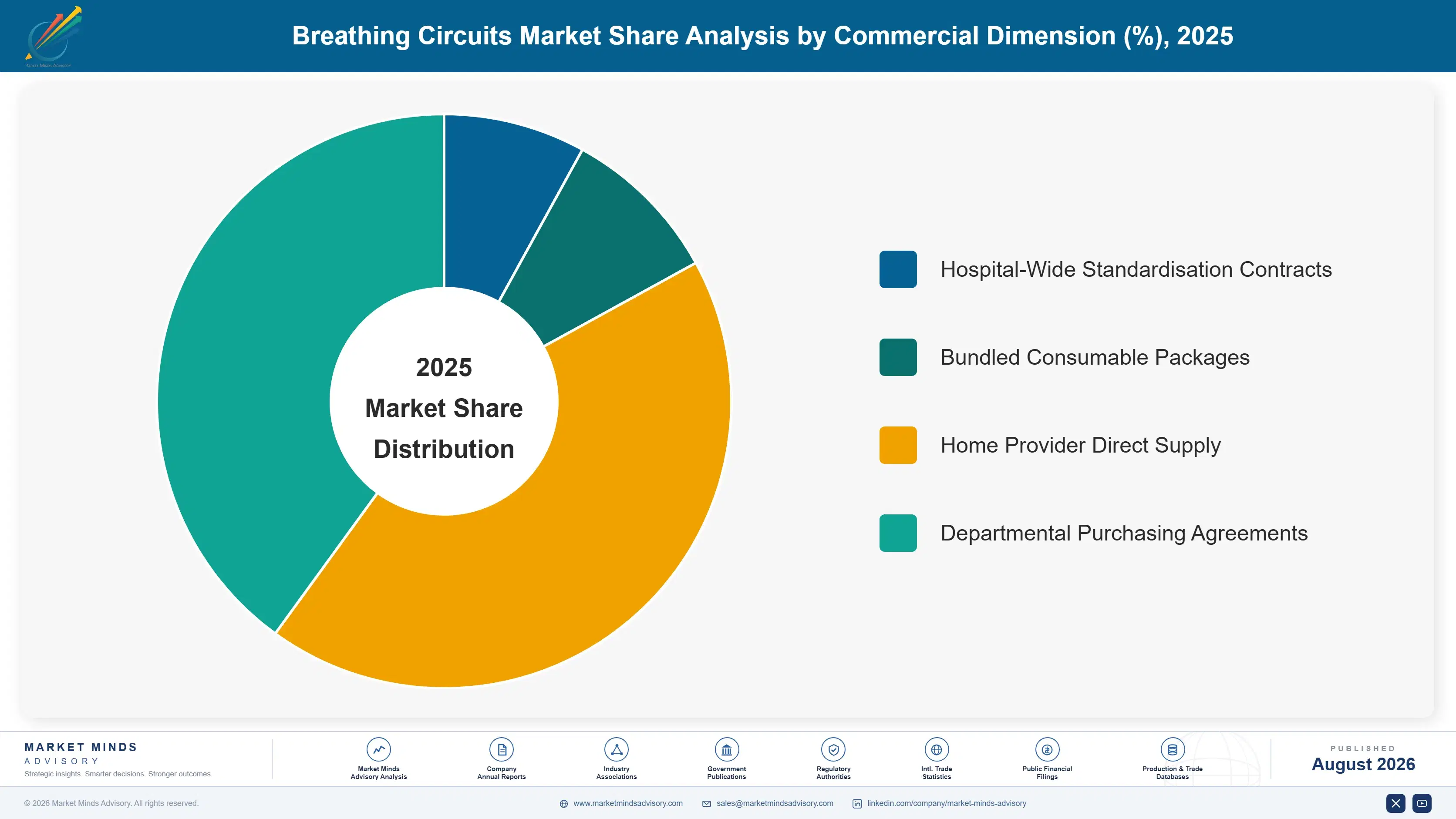
By Commercial Dimension

  • Hospital-Wide Standardisation Contracts
  • Bundled Consumable Packages
  • Home Provider Direct Supply
  • Departmental Purchasing Agreements

By Region

  • North America
  • Western Europe
  • East Asia
  • South Asia and Pacific
  • Latin America
  • Middle East and Africa
  • Eastern Europe

Scope, Methodology, and Coverage

Every figure in this report is reproducible from documented input assumptions. The scope below maps the historical period, the forecast horizon, the segmentation dimensions, and the countries covered, alongside the underlying primary and qualitative methodology.
Historical Period
2020 to 2025
Forecast Period
2026 to 2036
Base Year
2025 (USD billions; MMA Primary Research Dataset, August 2026)
Market Definition
The breathing circuits market covers single-use and reusable tubing sets, connectors, and humidification components used to deliver anesthesia gases or ventilator support between a patient and an anesthesia machine, ventilator, or respiratory support device. The anesthesia machines and ventilators themselves, oxygen masks and nasal cannula products sold separately, and general medical tubing not configured as a complete breathing circuit assembly are excluded from this scope.
Quantitative Units
USD billions (current prices); unit shipment volume where disclosed
Segmentation Dimensions
By Circuit Configuration; By End-Use Setting; By Commercial Dimension; By Region
Regions Covered
North America, Western Europe, East Asia, South Asia and Pacific, Latin America, Middle East and Africa, Eastern Europe
Countries Covered
USA, China, Germany, France, UK, Japan, South Korea, India, Australia, Canada, Brazil, Mexico, Indonesia, Vietnam, Thailand, Malaysia, UAE, Saudi Arabia, South Africa, Nigeria, Turkey, Poland, Netherlands, Italy, Spain, Sweden, Switzerland, Argentina, Colombia, Singapore, and additional markets relevant to this sector
Key Companies Profiled
Vyaire Medical Inc., Teleflex Incorporated, ICU Medical Inc., Intersurgical Ltd., Medtronic plc, Drägerwerk AG & Co. KGaA, GE HealthCare Technologies Inc., Koninklijke Philips N.V., Fisher & Paykel Healthcare Corporation Limited, Armstrong Medical Ltd., Flexicare Medical Limited, Ambu A/S, Hamilton Medical AG, Mercury Medical, Salter Labs, Westmed Inc., SunMed LLC, King Systems Corporation, B&B Medical Technologies Inc., Vadi Medical Technology Co. Ltd.
Quantitative Methodology
Primary survey, n=3,800 respondents, Q4 2025, six countries; demand-side model with trade association cross-validation
Qualitative Methodology
47 expert interviews, Q4 2025; applied to validate demand model assumptions, identify emerging dynamics, and assess competitive positioning
Report Format
PDF and XLSX data workbook (Word format preview document)
Publisher
Market Minds Advisory
Report Code
MMA-2026-MED-104
Published
August 2026
Contact
sales@marketmindsadvisory.com | www.marketmindsadvisory.com

Purchase the full Breathing Circuits Market Report (2026 to 2036).

The full Breathing Circuits Market report delivers detailed segmentation by circuit configuration, end-use setting, and commercial channel across all seven world regions through 2036. It includes company-level competitive profiles for all twenty companies profiled, covering product portfolios, standardisation contract activity, and capacity investments underway across the category. Regional chapters detail country-level infection control policy, surgical volume trends, and import dependence for each of the seven regions covered. A dedicated input cost chapter tracks medical-grade polymer and heating element exposure alongside mitigation strategies used by leading manufacturers today.
Full seven-region data tables and CAGR breakdowns
Twenty-company competitive profiles and moat analysis
Infection control and standardisation policy tracker
Input cost exposure and mitigation playbook detailed
Segment-level growth and margin forecasts provided
Editable data appendix in spreadsheet format

Built For The People Who Decide

From boardroom strategy to bench-side execution, this report is read cover-to-cover by leaders shaping the next decade of their industry, turning demand scenarios, market dynamics and valuation benchmarks into decisions.
CXOs/ Presidents/ VPs/ Managers
M&A and Corporate Development
Strategy Teams and R&D Heads
Procurement and Product Directors
Regulatory and Compliance Leaders
Investor Relations and Equity Analysts