Market Minds Advisory
Breath Analyzers Market

Breath Analyzers Market: A Legal Instrument And A Diagnostic Sharing One Name

One half of this market sells court admissibility to police forces. The other half sells a reimbursed clinical test. They share a name, a sensing principle, and almost nothing else at all.

Lead Analyst

Alice Ballenger

Published

September 2026

Make Smarter Decisions with Customized Research Insights

Request a free sample report and evaluate market opportunities, growth trends, and competitive dynamics relevant to your business needs.

2025 MARKET VALUE$1.3BMarket Size 2025
2036 FORECAST VALUE$3.3BBase Case , 2026 to 2036
CAGR 2026 TO 20368.8 %Bull 10.0% / Bear 7.6%
INCREMENTAL OPPORTUNITY$1.9BNet 10- year value creation
EXPANSION MULTIPLE2.32x2036 value over 2026 base
Strategic Levers
M&A Pipeline
Regional Outlook
Country Rankings
Competitive Intelligence
Segmental Deep-dive
Call-Us : 91 93563 13602

Executive Snapshot and Market Trajectory

Two businesses share this name and very little else besides. One sells evidential alcohol instruments to police forces, where the product is court admissibility and the revenue is mandatory recalibration on a documented cycle. The other sells reimbursed clinical tests entirely, and no court is ever involved in that half.
Volatile organic compound panels grow fastest at 13.2%, exactly 1.50 times the market rate, though from a base small enough that the percentage flatters what is actually happening. East Asia holds 29% of value on urea breath testing volume that nothing else in this field approaches. South Asia and Pacific takes 13%, above the band this framework applies, on very high bacterial infection prevalence and testing penetration well below that burden.
Concentration is low at 38% across the top five, because enforcement suppliers and clinical suppliers barely encounter one another in a tender anywhere. Competition turns on legal defensibility in one half and on reimbursement coding in the other. Exhaled breath carries around 3,000 measurable compounds, and standardising how a sample gets collected has done far more for clinical diagnostics than any recent advance in sensing.
Market Definition
The breath analyzers market covers instruments and consumables that measure compounds in exhaled breath for legal, occupational, or clinical purposes, spanning ethanol measurement for enforcement and workplace testing, urea and isotopic carbon testing, hydrogen and methane testing, nitric oxide measurement, and volatile organic compound panels. Capnography and anaesthetic gas monitoring, spirometry and lung function equipment, blood and urine testing, laboratory mass spectrometry sold for general use, and ignition interlock monitoring services are excluded.
Base Year Value
$1.3B in 2025 (MMA Primary Research Dataset, August 2026)
Forecast Period
2026 to 2036, eleven discrete annual values
CAGR
8.8% base case. Bull 10.0%. Bear 7.6%.
Fastest Growth Segment
Volatile Organic Compound Panels: 13.2% CAGR
Fastest Growth Country
India: 12.6% CAGR
Fastest Growth Region
South Asia and Pacific: 10.8% CAGR
Largest Region
East Asia: 29% of 2025 global value
Market Leaders
Drager, Intoximeters, Lifeloc Technologies, Circassia, Bedfont Scientific. Source: MMA Primary Research Dataset, July 2026.
Primary Survey
n=3,800 procurement and R&D decision-makers, Q4 2025, six countries
Methodology
Demand-side build-up, cross-validated against public data, 47 expert interviews

Breath Analyzers Market Forecast Scenarios

breath-analyzers-market-size-forecast-scenario-1787297909864
Between 2020 and 2025 the two halves of this market moved in opposite directions. Roadside alcohol testing collapsed through 2020 as traffic disappeared and officers avoided close contact, then recovered slowly with enforcement budgets under pressure. Clinical breath testing grew steadily throughout, particularly urea testing across East Asia. A 7.7% historical CAGR averages an enforcement business that shrank and a diagnostic one that did not.
Three mechanisms carry the 8.8% base case forward. Gastric infection testing is the largest, since eradication programmes across East Asia and rising awareness in South Asia keep urea breath test volumes climbing year after year. Ignition interlock programmes are the second, with courts in more jurisdictions mandating devices for repeat offenders and monitoring revenue attached to every installation. And nitric oxide testing is the third, now embedded in asthma guidelines across several countries.
The 10.0% bull case rests on volatile compound panels reaching clinical validation for a common cancer, which would create a screening test using a sample that costs nothing to collect. The 7.6% bear case is enforcement budget pressure, since roadside testing volume depends entirely on police staffing levels that have been cut in several countries and show no sign of recovering.

Two Products, One Word

An evidential alcohol instrument is a legal device that happens to measure chemistry. What a police force buys is a reading that survives cross-examination, which means type approval, tamper-evident logging, chain of custody, and recalibration on a documented schedule. The measurement itself has been solved for decades. Everything commercial about that half of the market follows from the courtroom rather than from the sensor.
TOP FIVE CONCENTRATION38%Enforcement and clinical suppliers barely compete with one another
EVIDENTIAL DEVICE COSTUSD 6,500Court-admissible instrument used by law enforcement at the roadside
IGNITION INTERLOCK BASE400,000Devices fitted to vehicles under court-ordered supervision programmes
UREA TEST VOLUME90 millionAnnual breath tests performed for gastric bacterial infection worldwide
SENSOR DRIFT INTERVAL12 monthsPeriod between mandatory recalibration of an evidential instrument
COMPOUNDS IN BREATH3,000Distinct volatile compounds identifiable in a single exhaled sample
Clinical breath testing is an entirely different proposition sold to entirely different people through entirely different channels. Urea testing for gastric infection, hydrogen testing for carbohydrate malabsorption, and nitric oxide for airway inflammation are reimbursed diagnostics competing against blood tests and endoscopy. The buyer is a gastroenterologist or a respiratory physician, the argument is clinical utility, and no court is ever involved at any point.
The third piece is the one everybody writes about. Exhaled breath carries around 3,000 volatile compounds, some of which change with disease, and the promise of a cancer test from a plastic bag has been five years away for two decades. What has actually moved recently is sampling rather than sensing: standardised collection that makes a result reproducible between two hospitals.
"People keep telling me breath will replace blood. Meanwhile the part of this industry that reliably makes money is recalibrating alcohol instruments for police forces on a twelve-month cycle, which nobody writes articles about."
Director, Point of Care Diagnostics Practice · MMA Medical Devices Practice

Market Trends

Standardised Sampling Finally Moved Volatile Compound Research

Volatile organic compound work stalled for two decades because two laboratories analysing the same patient produced different answers, and the variation came from how breath was collected rather than from how it was measured. Standardised sampling devices controlling flow rate, breath fraction, and ambient contamination have made results reproducible between sites, which is the precondition for any multi-centre validation study worth funding. Several cancer and infection programmes are now running on exactly that basis. The sensing technology barely changed at all, and the field moved anyway, which tells you where the real bottleneck sat all along.
Market Impact: 90 million tests performed annually
Interlock Programmes Convert Devices Into Monitoring Services

Courts in a growing number of jurisdictions require repeat drink-driving offenders to fit an ignition interlock, and the offender pays an installation fee plus a monthly monitoring charge for the full duration of the order. That turns a single device sale into a service contract running twelve to thirty-six months, with data reporting obligations to the supervising court attached throughout. Roughly 400,000 devices are installed at any moment in the United States alone. The recurring revenue substantially exceeds the hardware, which is not true anywhere else in enforcement testing, and the gap widens with every jurisdiction that adopts.
Market Impact: Guidelines recommend in 12 countries

Market Opportunities and Growth Drivers

Gastric Infection Eradication Drives Enormous Test Volume

Helicobacter pylori infects a very large share of the population across East and South Asia, and it is the single largest attributable cause of gastric cancer worldwide. Japanese national policy reimburses testing and eradication explicitly, Chinese guidelines increasingly recommend test-and-treat in symptomatic adults, and Korean screening programmes link gastric endoscopy directly to infection status. Urea breath testing is the preferred non-invasive confirmation and post-treatment check. Around 90 million of these tests are performed annually and the number grows with awareness rather than with prevalence, Testing penetration remains the constraint rather than disease burden anywhere.
Market Impact: Roadside tests fell 30 percent

Nitric Oxide Testing Embedded In Asthma Guidelines

Fractional exhaled nitric oxide measures airway inflammation directly, which distinguishes the asthma patients who will respond to inhaled corticosteroids from those who will not, and several national guidelines now recommend it at the point of diagnosis. That converts a clinician's judgement into a measurement and justifies a device in every respiratory clinic and a growing number of primary care practices. Reimbursement exists in the United Kingdom, parts of Europe, and the United States. Consumable mouthpieces and sensor replacement generate the recurring revenue behind each instrument, and that stream outlasts the analyser placement itself by years.
Market Impact: Alternatives cost 40 percent less

Market Restraints and Challenges

Enforcement Volume Depends On Police Staffing Levels

Roadside breath testing happens only when an officer is present to conduct it, and traffic policing numbers have fallen substantially across several countries over the past decade. The root cause is budget allocation rather than any change in policy or law. Commercially it means instrument replacement cycles stretch, calibration contracts get deferred, and testing volume falls even where the legal framework is entirely unchanged. Participants are mitigating through workplace and occupational testing, through interlock programmes funded by offenders rather than by police forces, and through longer service contracts, none of which fully replaces lost roadside volume.
Market Impact: Reproducibility improved 40 percentage points

Clinical Breath Tests Compete Against Established Alternatives

A urea breath test competes against stool antigen testing and endoscopic biopsy, a hydrogen test competes against dietary elimination, and nitric oxide competes against a clinician simply prescribing a corticosteroid trial and watching what happens. The root cause is that breath is convenient rather than uniquely informative in most current applications. Commercially this caps pricing and makes reimbursement arguments harder than the technology deserves. Mitigation runs toward applications where no good alternative exists, and toward volatile compound panels aimed at diseases nothing currently detects early, where convenience alone would never justify a reimbursement decision.
Market Impact: Monitoring runs 12 to 36 months
3 additional market trends, 2 additional growth drivers, and 4 additional restraints and challenges are covered in the full report. Contact sales@marketmindsadvisory.com to access the complete intelligence.

Segment CAGR and Growth Architecture

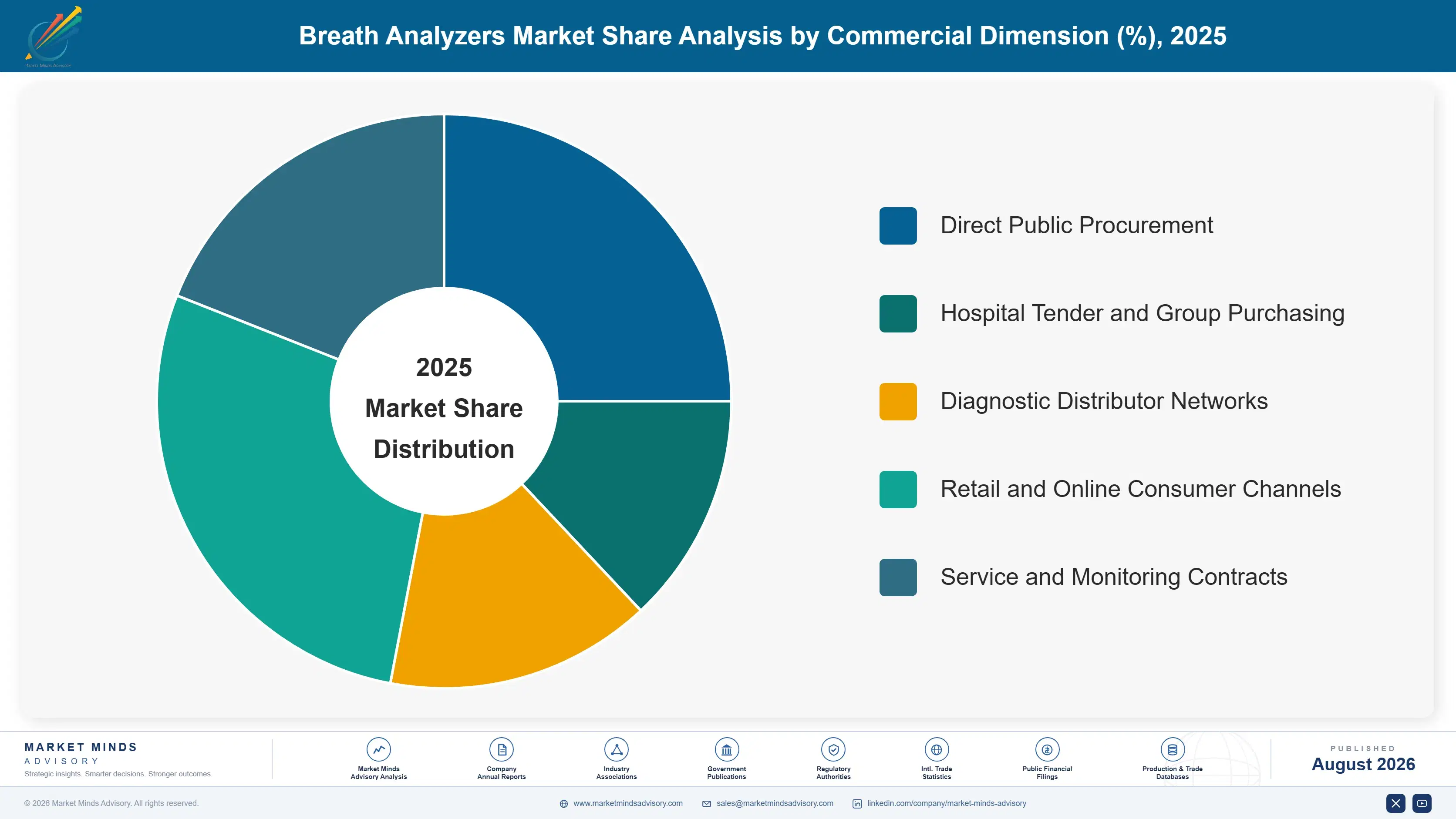
Segmentation follows the analyte being measured, because what a device detects determines whether it is a legal instrument or a clinical test, who buys it, what approval it needs, and how it earns money afterwards. Setting, portability, and sensing technology are handled in the framework and commentary rather than being treated as segments here.
breath-analyzers-market-market-share-analysis-1787297910798

Volatile Organic Compound Panels

Volatile compound panels grow fastest at 13.2%, exactly 1.50 times the market rate, from a base small enough that the percentage flatters what is actually happening considerably. Exhaled breath carries roughly 3,000 detectable compounds and some of them shift measurably with disease, which has made this the most written-about and least commercially delivered corner of the field for two full decades. What finally moved was standardised sampling rather than better sensing, since reproducibility between sites is the precondition for any validation study worth funding. Several cancer and infection programmes now run on that basis. Nothing here is yet a reimbursed routine test anywhere in the world, and the revenue today comes almost entirely from research programmes.
CAGR 13.2%

Nitric Oxide Measurement

Nitric oxide measurement grows at 10.6%, quantifying airway inflammation directly and separating the asthma patients likely to respond to inhaled corticosteroids from those who will not. Several national guidelines now recommend it at the point of diagnosis, which converts a clinical judgement into a measurement and justifies a device in respiratory clinics and increasingly in primary care practices too. Reimbursement exists across the United Kingdom, parts of continental Europe, and the United States, though coding varies considerably. Instrument placement matters far less than the consumable mouthpieces and replaceable sensors behind it, which is where the recurring revenue actually sits, Placement economics therefore beat outright instrument sales in almost every clinical channel.
CAGR 10.6%
Full segment breakdown across 5 segments available in the complete report.

Regional Architecture and Country Demand Map

Regional shares here reflect two unrelated demand systems layered on top of each other. Enforcement testing follows policing intensity and interlock legislation, while clinical testing follows disease prevalence and reimbursement decisions, and the two of them rarely peak in the same country at the same time.

East Asia

East Asia takes 29% of value, the largest share of any region, and gastric infection testing rather than alcohol enforcement explains most of it. Helicobacter pylori prevalence across China, Japan, and Korea is high, the link to gastric cancer is well established in the clinical literature, and Japanese national policy reimburses testing and eradication explicitly. Chinese test-and-treat guidance has widened considerably over the past five years and domestic manufacturers supply urea breath analysers at prices imported systems simply cannot match. Alcohol enforcement is strict and well equipped across all three countries. Growth at 9.6% exceeds the global rate on clinical volume rather than on enforcement, and the gap between the two halves keeps widening.
Share: 29% | CAGR: 9.6% (2026 to 2036)

South Asia and Pacific

Fastest growth sits in South Asia and Pacific at 13% of global value against a 12% ceiling in this framework, and Indian infection prevalence explains the breach entirely. Helicobacter pylori affects a very large share of the Indian population and diagnostic testing penetration remains a small fraction of what that burden implies, which is precisely the gap driving growth here. Private diagnostic chains have added urea breath testing widely because it is profitable and increasingly requested by patients directly. Australian random breath testing rates are among the highest recorded anywhere. Growth at 10.8% is the fastest of any region in this forecast, and the share breach reflects genuine disease burden rather than any modelling choice.
Share: 13% | CAGR: 10.8% (2026 to 2036)
Regional intelligence for 5 additional markets available in the complete report: North America, Western Europe, Latin America, Middle East and Africa, Eastern Europe. Contact sales@marketmindsadvisory.com.
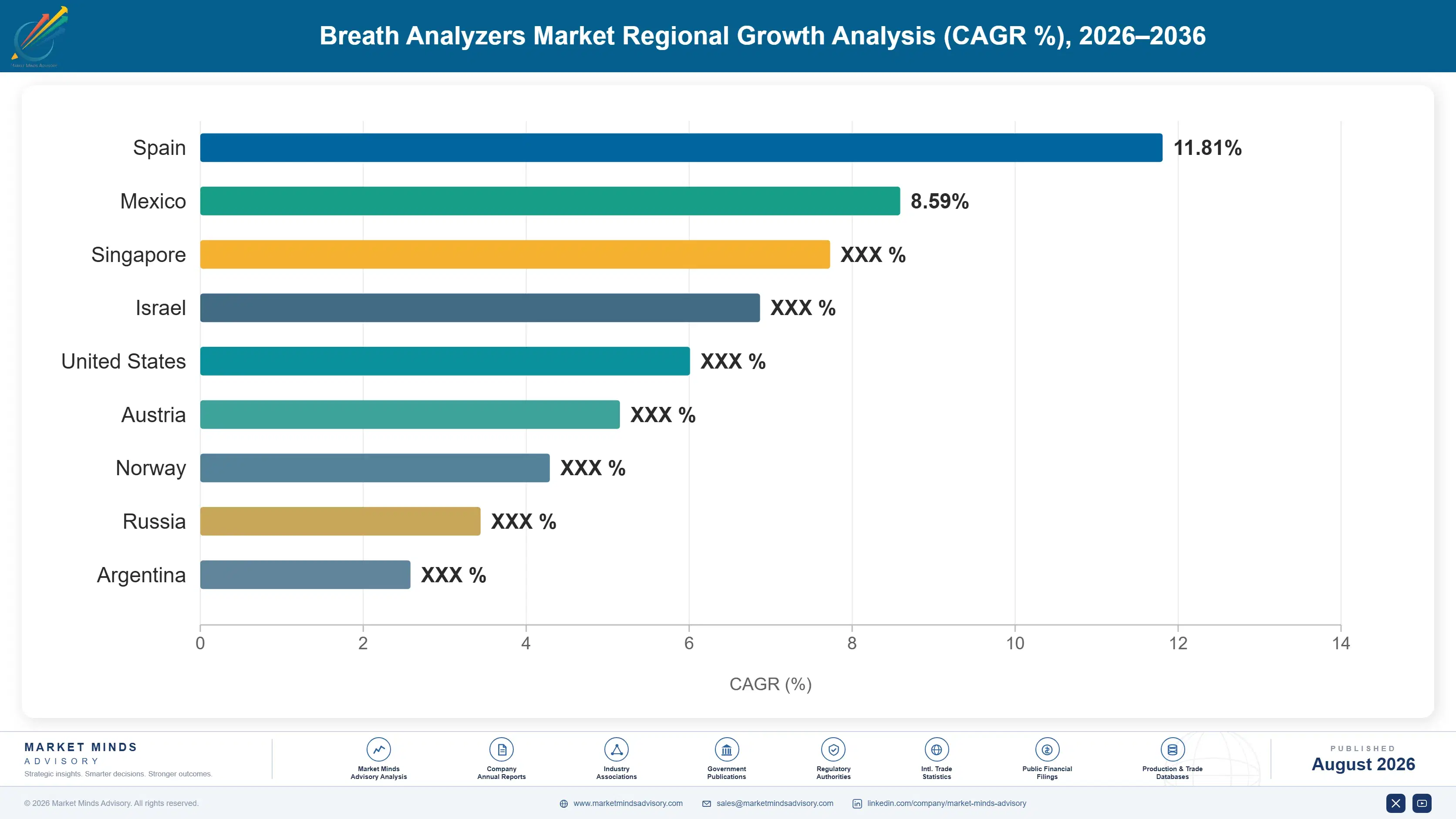
breath-analyzers-market-country-cagr-analysis-1787297911657

Where The Money Actually Recurs

Instrument sales are the least interesting revenue anywhere in this market. Calibration obligations, consumable mouthpieces, court-mandated monitoring contracts, and reagent kits all recur on schedules the customer simply cannot skip, and they carry margins the hardware never will. Four levers follow from that observation rather than from unit volume, and each one compounds without a repurchase decision.

Own The Mandatory Recalibration Schedule Completely

An evidential alcohol instrument must be recalibrated on a documented cycle, typically every 12 months, or its readings stop being admissible. That obligation is written into type approval rather than into a service contract, which means the customer cannot defer it without losing the ability to prosecute. Suppliers who run calibration in-house rather than licensing it to third-party laboratories capture roughly 18% of instrument lifetime value in service revenue at margins near 55%. Police forces almost never switch calibration providers mid-fleet, because the paperwork trail matters more than the price.
Market Impact: Captures roughly 18% of instrument lifetime service value

Price The Consumable, Not The Analyser

Nitric oxide and hydrogen testing both require a single-use mouthpiece or filter per patient, and the analyser itself is a one-time placement lasting five to seven years. Suppliers who place instruments at or below cost and price consumables properly convert a lumpy capital sale into predictable annual revenue of roughly USD 3,000 per active clinic. The clinical argument for placement is easier than the capital budget argument, so adoption accelerates as well. Margin on consumables typically runs 60% to 70% against 30% on the instrument, which is the whole point.
Market Impact: Roughly USD 3,000 in recurring revenue per clinic

Attach Monitoring Services To Interlock Installations

An ignition interlock ordered by a court runs twelve to thirty-six months, and the offender pays installation plus a monthly monitoring fee covering data reporting back to the supervising authority. Suppliers who operate the monitoring network themselves rather than selling devices to independent installers earn USD 70 to USD 90 monthly per active unit, which over a typical order exceeds the hardware revenue by a factor of four. The service is also considerably harder to displace, because switching providers mid-order requires court approval that nobody involved wants to seek, Nobody wants to explain a provider change to a judge.
Market Impact: USD 70 to 90 monthly per active unit

Sell Standardised Sampling Into Research Programmes

Volatile compound research has been held back by irreproducible sampling rather than by weak sensing, which makes standardised collection devices the bottleneck product rather than the analyser itself. Selling collection hardware and protocol support into pharmaceutical and academic breath programmes generates revenue years ahead of any clinical approval, typically USD 200,000 to USD 400,000 per multi-site study. It also embeds the supplier's sampling format into the eventual validated protocol. Whoever's collection device appears in the pivotal trial owns the consumable stream if that test reaches routine practice, That is cheap positioning against an unknowable but potentially large stream.
Market Impact: USD 200,000 to 400,000 per multi-site research study

Who Controls the Margin Pool

Concentration is low at 38% across the top five, and the number understates how little these companies actually compete. Enforcement suppliers and clinical suppliers meet in almost no tenders. Drager is the only participant with real weight in both halves, and even there the two businesses run separately. All participants are compared on measured global revenue from breath measurement products and associated services, the only basis spanning a police contract and a hospital consumable stream.
Competition in enforcement runs on type approval, calibration infrastructure, and the length of the reference list. A police force replacing a fleet cares whether the instrument has survived legal challenge in a comparable jurisdiction. In clinical, competition runs on guideline inclusion and reimbursement coding, where Circassia's nitric oxide position rests on the analyser appearing by name in national asthma guidance.

Pressure is arriving from two directions. Chinese urea breath analyser manufacturers now supply domestic and increasingly export volume at prices Western suppliers cannot approach. Meanwhile Owlstone and a handful of others are building volatile compound platforms that would create an entirely new category if validation lands. Rankings shift most where a single guideline change or one successful legal challenge moves a whole national fleet.
breath-analyzers-market-company-positioning-matrix-1787297912582

Competitive Moat and Risk Dimensions

DRAGER

Moat: Type Approval Across Jurisdictions

Drager instruments hold evidential type approval in a very large number of national jurisdictions, each obtained through separate testing that takes years and costs real money. A police force buying a fleet is buying a device that has already survived cross-examination somewhere comparable. Competitors must repeat that approval process country by country, and no shortcut exists.
DRAGER

Risk: Enforcement Budgets Under Pressure

The strongest part of Drager's breath business is tied directly to traffic policing, and officer numbers have fallen across several major markets over the past decade. Instrument replacement stretches when budgets tighten, and calibration contracts get renegotiated rather than renewed. Its clinical position is real but considerably smaller, offering only partial insulation from that exposure.
INTOXIMETERS

Moat: Deep American Law Enforcement Relationships

Intoximeters has supplied American state and municipal law enforcement for decades, and its instruments are written into state administrative codes by model name in several jurisdictions. Changing that requires a regulatory amendment rather than a purchasing decision. The company's calibration and training network is built around exactly that installed base, which compounds the switching cost considerably.
INTOXIMETERS

Risk: Narrow Geographic And Product Exposure

The company is concentrated in American enforcement and in ethanol measurement specifically, with limited clinical presence and modest international revenue. That focus produces the depth behind its moat and also leaves it exposed to a single category of public spending. Any sustained decline in United States roadside testing volume flows almost directly through to revenue.

Players Tracked

Prominent Players

Drager
Intoximeters
Lifeloc Technologies
Circassia
Bedfont Scientific

Other Key Players

Lion Laboratories
CMI Inc
Alcohol Countermeasure Systems
Smart Start
LifeSafer
Intoxalock
BACtrack
Alcolizer Technology
Andatech
Owlstone Medical
QuinTron Instrument Company
Meridian Bioscience
Otsuka Pharmaceutical
Breathomix
Menssana Research

Recent Developments

MARCH 2025

Owlstone Medical Extends Breath Biopsy Collaboration Into Liver Disease

Owlstone widened an existing pharmaceutical research collaboration to cover volatile compound signatures in liver disease, adding several clinical sites to the sampling network. The agreement funds collection and analysis rather than granting either party commercial rights to any resulting diagnostic test, which the parties both stated clearly.
Signal: Research revenue arrives many years before any regulatory approval, which is very much the whole point
JULY 2025

Drager Launches Updated Evidential Alcohol Instrument For European Forces

Drager introduced a revised evidential analyser with extended calibration intervals and updated tamper logging, targeting European police fleets approaching replacement. Type approval submissions were filed in several countries simultaneously rather than sequentially, which the company said reduces the lag between launch and procurement eligibility across its main European markets.
Signal: Longer calibration intervals cut service revenue while making the fleet purchase considerably easier to justify overall
OCTOBER 2025

Bedfont Scientific Expands Manufacturing Capacity In United Kingdom

Bedfont completed an organic expansion of its Kent manufacturing site, roughly doubling capacity for nitric oxide and hydrogen breath monitors. The investment was funded internally with no external partner or equity involvement, and the company attributed it to distributor demand across Asian and Middle Eastern markets rather than domestic growth.
Signal: Organic capacity addition rather than a partnership, which signals genuine confidence in the durability of export demand

What Sits Inside The Instrument

Electrochemical fuel cells and semiconductor sensors together account for roughly 22% to 28% of manufacturing cost in alcohol instruments, and the specialist suppliers are concentrated in Japan, Germany, and the United Kingdom. Infrared optical benches used in urea and nitric oxide analysers add another 18% to 24%, sourced from a similarly narrow supplier base. Precision machined gas handling and certified calibration reference gases make up the remainder.
Calibration reference gas supply tightened noticeably during 2022 and 2023 as European industrial gas production absorbed the energy price shock the IEA documented, and specialty gas mixtures carry energy intensity well above bulk industrial gases. Certified ethanol and nitric oxide reference standards rose sharply, and lead times on some mixtures stretched past six months at several suppliers. Manufacturers holding no reference gas inventory found calibration operations constrained rather than merely more expensive.

Exposure varies sharply by business model rather than by size. A supplier running its own calibration laboratories absorbs reference gas cost directly and cannot pass it through, because calibration pricing is written into multi-year public procurement contracts that police forces do not reopen. Clinical suppliers reprice consumables annually with far less friction. Chinese manufacturers source sensors domestically and sit outside it.
breath-analyzers-market-cost-volatility-analysis-1787297912881

Hold Reference Gas Inventory Against Contract Terms

Calibration obligations run on fixed schedules regardless of gas availability, so inventory cover matched to contracted calibration volume rather than to average demand protects the service commitment. Twelve months of cover on certified mixtures costs working capital but removes the risk of missing a contractual calibration window, which carries penalties and reputational damage well beyond the gas price itself.

Dual-Source Electrochemical Cells Across Two Regions

Fuel cell supply is concentrated among a handful of specialists in two or three countries, and qualifying a second source in a different region takes twelve to eighteen months of validation work. Doing that before it is needed converts a single point of failure into a manageable one, at a qualification cost far smaller than a production stoppage.

Index Calibration Pricing In Public Procurement Contracts

Multi-year police procurement contracts routinely fix calibration pricing for their full term, which transfers all input cost risk to the supplier. Negotiating an index clause tied to a published gas or energy benchmark at tender stage is achievable, since procurement officers generally prefer a transparent formula to a padded fixed price. Very few suppliers actually ask for it.

Portfolio Architecture for Margin Defence

Margin architecture in this market separates cleanly by whether the customer has a choice. Volume screening devices, passive alcohol sensors, and low-cost personal breathalysers sell on price into competitive channels and earn 24% to 34%, with commodity sensor supply setting the floor. Certified evidential instruments and reimbursed clinical analysers earn 48% to 60%, because type approval and guideline inclusion both function as barriers that pricing cannot cross.
The tension is that volume sits in the low tier and profit sits in the high one, and the two do not feed each other much. A supplier of cheap personal breathalysers builds no credibility whatsoever with a police procurement officer. Reference lists, legal challenge history, and calibration infrastructure are what carry into the evidential tier, and none of those come from consumer volume.

High-value pools concentrate in three places: mandatory recalibration on evidential fleets, consumables attached to placed clinical analysers, and court-mandated interlock monitoring. All three recur without a repurchase decision. Volatile compound platforms sit outside that logic entirely, carrying the widest margin range in the market because nobody yet knows what a validated breath test prices at.

Volume / Commodity-Adjacent

Personal breathalysers, passive screening devices, and disposable alcohol detectors sold through retail, distribution, and bulk workplace channels. Sensor cost sets the floor and competition is direct. The ten-point range reflects the gap between branded consumer products and unbranded bulk screening supply.
Gross Margin: 24% to 34%

Premium / Certified

Evidential alcohol instruments with type approval, reimbursed clinical analysers, and the calibration and consumable streams attached to both. The twelve-point range separates instrument margin from the service and consumable revenue behind it, which runs considerably higher and is where the tier actually earns.
Gross Margin: 48% to 60%

Sustainability / Regulatory / Next-Generation

Volatile compound platforms, standardised sampling systems, and research collection hardware. The twenty-eight point range reflects genuine uncertainty: research-funded programmes price near cost while any validated clinical test would price on outcome value. Nobody knows which end applies yet.
Gross Margin: 38% to 66%
breath-analyzers-market-portfolio-architecture-1787297913705

High-value Sub-segments and Strategic Watch-out

Volatile Compound Panels

Highest growth and the widest margin uncertainty anywhere in this market by some distance. Standardised sampling finally made multi-site validation possible, and several cancer programmes are now running. Whether any of it becomes a reimbursed routine test remains genuinely unresolved after two decades of expectation.
Gross Margin: 38% to 66%

Interlock Monitoring Services

High value with moderate growth, tied directly to how many jurisdictions mandate devices for repeat drink-driving offences. Monthly monitoring revenue across a twelve to thirty-six month court order exceeds hardware by roughly four times, and switching providers mid-order requires court approval nobody wants to seek.
Gross Margin: 52% to 60%

Evidential Alcohol Instruments

The volume core of the enforcement half, with recalibration obligations producing predictable service revenue on a documented annual cycle that customers cannot defer. Growth tracks police staffing rather than legislation, which is the real constraint. Replacement cycles stretch whenever a force defers a fleet decision.
Gross Margin: 48% to 56%

Urea Breath Analysers

Strategic watch-out. The highest-volume clinical application in the market is also where Chinese manufacturers have built genuine cost advantage and are now exporting steadily. Clinical performance is adequate, distribution is established, and Western margin in this application looks increasingly difficult to defend, on quality arguments alone.
Gross Margin: 30% to 44%

Who Buys And Why

The annuity here is compulsory rather than commercial. An evidential instrument must be recalibrated annually or its readings stop being admissible, a placed clinical analyser needs a mouthpiece per patient, and a court-ordered interlock bills monthly for the length of the order. None of those involve a repurchase decision by anybody. That is why service and consumable revenue is worth several times the hardware it attaches to.
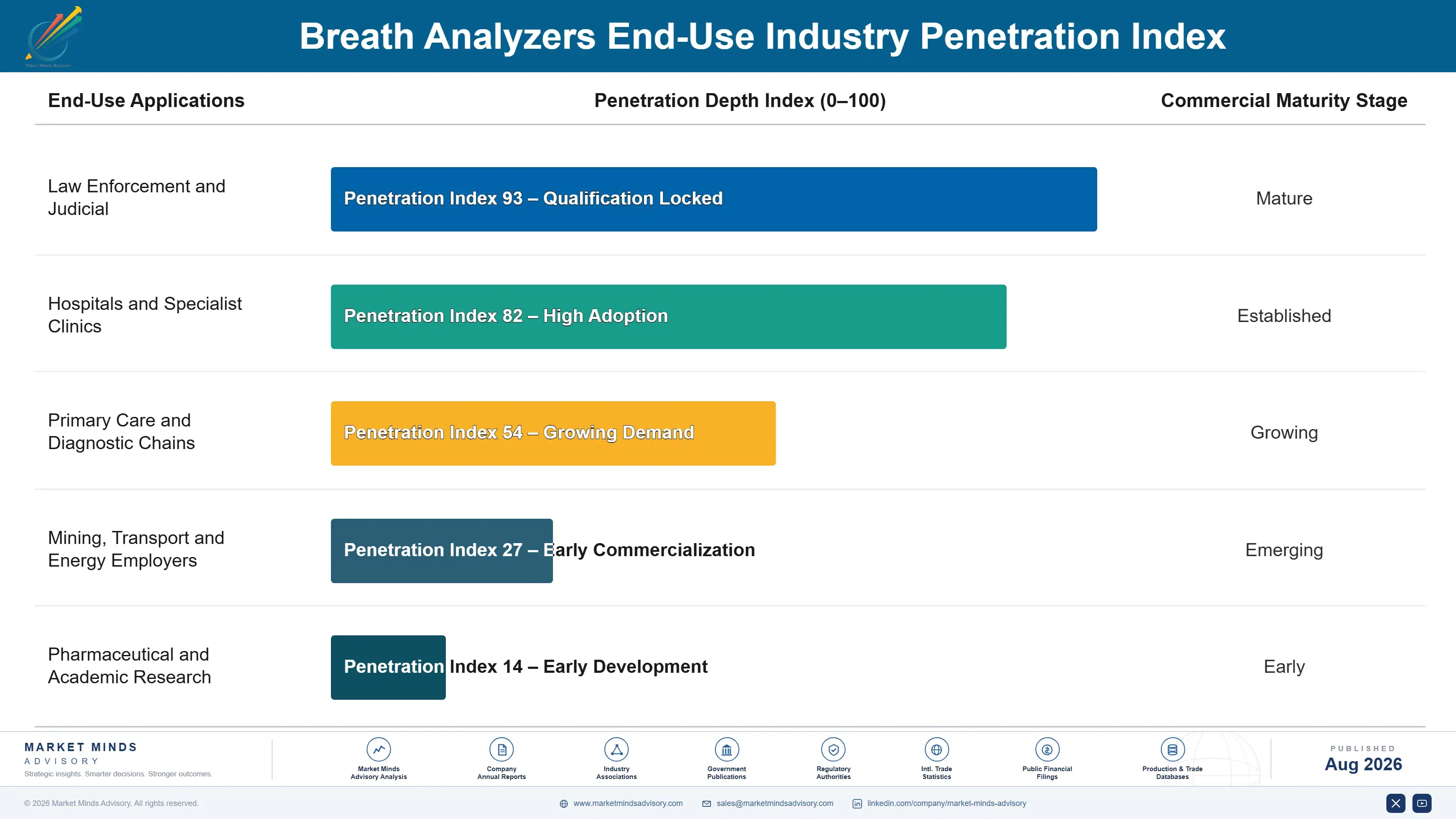
Stickiness varies sharply by vertical. Law enforcement is the deepest, since instruments named in administrative code require regulatory amendment to displace and calibration paperwork spans years of prosecutions. Occupational testing in mining, transport, and energy is nearly as durable, because safety programmes are audited. Gastroenterology adopts on guideline and reimbursement and switches on price. Primary care nitric oxide is the shallowest, where a single unfavourable coverage decision empties a channel.

Buyer profiles have shifted. Police procurement moved from individual forces to national frameworks, which raises the stakes on each decision and rewards suppliers with legal challenge history over those with better specifications. Clinical purchasing moved from the physician to hospital value committees asking what the test displaces. Both changes favour incumbents with documentation.
breath-analyzers-market-end-use-penetration-index-1787297914494

Where We Come Out

These are among the four positions where our research anticipates prominent divergence between winners and laggards over the coming forecast period. Each is grounded in the demand model, the regulatory perimeter, and the announced capacity pipeline.
01 / SERVICE REVENUE CAPTURE

Own calibration and consumables or own nothing worth owning

Hardware in this market is the least valuable thing anybody sells, and every durable position rests on an obligation the customer simply cannot skip or defer. Mandatory recalibration, per-patient consumables, and court-ordered monitoring each recur without any purchasing decision being made, and together they carry margins the instrument itself will never approach at any volume. Suppliers who licensed calibration to third parties or sold analysers through distributors gave away the only revenue in this business that compounds reliably over time.
02 / APPROVAL PORTFOLIO DEPTH

Type approval breadth is the enforcement moat, nothing else

A police force buys a reading that survives cross-examination, which makes jurisdictional type approval and legal challenge history the entire basis of competition across the enforcement half of this market. Each approval takes years of separate testing and real money, so the portfolio cannot be assembled quickly by anybody arriving with a better sensor or a lower price than the incumbent supplier. Specification advantages are close to worthless against a competitor whose instrument already withstood a contested prosecution somewhere broadly comparable.
03 / CLINICAL COST DEFENCE

Urea analyser margin will not hold against Chinese supply

Urea breath testing is the highest-volume clinical application anywhere in this market, and it is also the one where Chinese manufacturers have built real cost advantage on domestically sourced sensors and optical benches. Clinical performance is adequate for the application, regulatory clearances across Asian markets are accumulating quarter by quarter, and distribution runs through diagnostic equipment channels that already exist. Western suppliers defending this position on quality arguments alone are going to lose that position steadily over the coming decade, and the decline has already started.
04 / SAMPLING STANDARD POSITION

Whoever's collection format enters pivotal trials owns the consumable

Volatile compound diagnostics were held back by irreproducible sampling rather than by inadequate sensing, which makes the collection device the strategic product here rather than the analyser sitting behind it. A sampling format written into a pivotal validation study becomes the format written into the eventual clinical protocol, and every single test performed afterward consumes that particular supplier's collection hardware. Selling collection hardware into research programmes today is therefore cheap positioning for a large consumable stream that nobody can yet price.

Engagement Snapshot From the Field

A live engagement with an industry participant carrying material or product regulatory and market exposure ahead of a defining policy shift, showing how our research translates into a defensible multi-year portfolio strategy.
MARKET MINDS ADVISORY · CLIENT ENGAGEMENT SUMMARY
Breath Analyzers Producer Strategic Portfolio Review and Transition Roadmap 2026·Investment Scenario on Breath Analyzers Exposure Evaluation 2025-26
CLIENT PROFILE
A European manufacturer of evidential and screening alcohol instruments with roughly EUR 90 million in annual revenue (client-reported, unverified by MMA), holding type approval across fourteen national jurisdictions and operating three calibration laboratories. Roughly three-quarters of revenue came from law enforcement procurement, with the balance split between occupational testing and a small clinical distribution arrangement the board considered strategically unclear.
STRATEGIC CHALLENGE
Roadside testing volume in the client's two largest markets had declined for four consecutive years with police staffing, while calibration revenue held flat under fixed-price multi-year contracts that carried no cost indexation. The board wanted to know whether clinical breath diagnostics represented a genuine adjacency or an expensive distraction from a defensible enforcement franchise.
MMA APPROACH
MMA mapped revenue and margin across the client's enforcement and clinical lines against the recurring obligation behind each, interviewed procurement officers across six police forces and eleven respiratory and gastroenterology clinicians, and modelled interlock monitoring economics in three jurisdictions where legislation was pending. Contract terms across the client's calibration portfolio were reviewed line by line for indexation exposure.
KEY FINDINGS
  1. Calibration revenue carried 55% gross margin but sat entirely inside fixed-price contracts, with none of the eleven agreements reviewed containing any form of input cost indexation clause.
  2. Police procurement officers ranked legal challenge history above measurement specification in every one of the six forces interviewed, which the client's marketing did not reflect at all.
  3. Clinical distribution generated 6% of revenue at margins below the enforcement average, with no shared sales, regulatory, or service infrastructure between the two businesses whatsoever.
  4. Interlock monitoring in the three modelled jurisdictions offered recurring revenue per unit roughly four times hardware value, and the client held type approval in two of the three already.
CLIENT PROFILE
A European manufacturer of evidential and screening alcohol instruments with roughly EUR 90 million in annual revenue (client-reported, unverified by MMA), holding type approval across fourteen national jurisdictions and operating three calibration laboratories. Roughly three-quarters of revenue came from law enforcement procurement, with the balance split between occupational testing and a small clinical distribution arrangement the board considered strategically unclear.
STRATEGIC CHALLENGE
Roadside testing volume in the client's two largest markets had declined for four consecutive years with police staffing, while calibration revenue held flat under fixed-price multi-year contracts that carried no cost indexation. The board wanted to know whether clinical breath diagnostics represented a genuine adjacency or an expensive distraction from a defensible enforcement franchise.
MMA APPROACH
MMA mapped revenue and margin across the client's enforcement and clinical lines against the recurring obligation behind each, interviewed procurement officers across six police forces and eleven respiratory and gastroenterology clinicians, and modelled interlock monitoring economics in three jurisdictions where legislation was pending. Contract terms across the client's calibration portfolio were reviewed line by line for indexation exposure.
KEY FINDINGS
  1. Calibration revenue carried 55% gross margin but sat entirely inside fixed-price contracts, with none of the eleven agreements reviewed containing any form of input cost indexation clause.
  2. Police procurement officers ranked legal challenge history above measurement specification in every one of the six forces interviewed, which the client's marketing did not reflect at all.
  3. Clinical distribution generated 6% of revenue at margins below the enforcement average, with no shared sales, regulatory, or service infrastructure between the two businesses whatsoever.
  4. Interlock monitoring in the three modelled jurisdictions offered recurring revenue per unit roughly four times hardware value, and the client held type approval in two of the three already.
RECOMMENDED STRATEGY
Phase 1: Phase one: exit the clinical distribution arrangement and redirect the freed sales resource toward occupational testing, where the enforcement credibility genuinely transfers. Phase 2: Phase two: build an interlock monitoring operation in the two jurisdictions where type approval already exists, ahead of pending legislation rather than after it. Phase 3: Phase three: introduce gas price indexation into every calibration contract at renewal, and reprice the three agreements found to be loss-making at current input cost.
OUTCOME
The client exited clinical distribution within two quarters and launched interlock monitoring in one jurisdiction ahead of legislation taking effect, reporting recurring monitoring revenue of EUR 4.1 million in its first full year (client-reported, unverified by MMA). Indexation clauses were accepted in seven of nine calibration renewals negotiated since.

Frequently Asked Questions

Foundational context covering the market sizes, CAGR, scope, country, region and competition that inform every finding below. This section is provided to cover basics and most often pre-purchase conversations, answered from the MMA Primary Research Dataset.

What is the current size of the Breath Analyzers Market?

The global breath analyzers market reached USD 1.3 billion in 2025, covering enforcement alcohol instruments, occupational testing, and clinical breath diagnostics. That figure includes instruments, consumables, and calibration and monitoring services.

How large will the Breath Analyzers Market be by 2036?

MMA forecasts USD 3.29 billion by 2036, up from USD 1.41 billion in 2026, an increase of USD 1.87 billion. That represents an expansion multiple of 2.32 times over the forecast period.

What is the CAGR for the Breath Analyzers Market 2026 to 2036?

The base case CAGR is 8.8%, with a bull case of 10.0% and a bear case of 7.6%. Historical growth between 2020 and 2025 ran at 7.7%, held down by the collapse in roadside testing during 2020.

Which segment is growing fastest?

Volatile organic compound panels grow fastest at 13.2%, exactly 1.50 times the market rate, though from a small base. Nitric oxide measurement follows at 10.6% on guideline-driven asthma adoption.

Who are the major companies in the Breath Analyzers Market?

Drager, Intoximeters, Lifeloc Technologies, Circassia, and Bedfont Scientific lead, together holding 38% of the market. Enforcement and clinical suppliers rarely compete against one another directly.

Which country is growing fastest?

India grows fastest at 12.6%, driven by very high gastric infection prevalence against diagnostic testing penetration that remains a fraction of what that burden implies. Private diagnostic chains are the main channel.

Report Segmentation Architecture

The full report scope spans multiple orthogonal segmentation dimensions, with cross-tabulated demand data provided for each dimension pair. Coverage extends further to regional breakdowns, trend trajectories, and the competitive detail needed to support segment-level decision-making.

By Analyte Measured

  • Ethanol
  • Urea and Isotopic Carbon
  • Hydrogen and Methane
  • Nitric Oxide
  • Volatile Organic Compound Panels

By End-Use Industry

  • Law Enforcement and Judicial
  • Hospitals and Specialist Clinics
  • Primary Care and Diagnostic Chains
  • Mining, Transport and Energy Employers
  • Pharmaceutical and Academic Research

By Commercial Dimension

  • Direct Public Procurement
  • Hospital Tender and Group Purchasing
  • Diagnostic Distributor Networks
  • Retail and Online Consumer Channels
  • Service and Monitoring Contracts

By Region

  • East Asia
  • South Asia and Pacific
  • North America
  • Western Europe
  • Latin America
  • Middle East and Africa
  • Eastern Europe

Scope, Methodology, and Coverage

Every figure in this report is reproducible from documented input assumptions. The scope below maps the historical period, the forecast horizon, the segmentation dimensions, and the countries covered, alongside the underlying primary and qualitative methodology.
Historical Period
2020 to 2025
Forecast Period
2026 to 2036
Base Year
2025 (USD billions; MMA Primary Research Dataset, August 2026)
Market Definition
The breath analyzers market covers instruments, consumables, and associated calibration and monitoring services that measure compounds in exhaled human breath for legal, occupational, or clinical purposes. Scope spans ethanol measurement for enforcement, workplace, and personal use, urea and isotopic carbon testing, hydrogen and methane testing, nitric oxide measurement, and volatile organic compound panels. Capnography, anaesthetic gas monitoring, spirometry, blood and urine testing, and general-purpose laboratory mass spectrometry are excluded.
Quantitative Units
USD billions at manufacturer and service revenue level; installed base in units; test volume in annual procedures.
Segmentation Dimensions
By analyte measured; by end-use industry; by commercial dimension; by region.
Regions Covered
East Asia, South Asia and Pacific, North America, Western Europe, Latin America, Middle East and Africa, Eastern Europe
Countries Covered
United States, Canada, Germany, United Kingdom, France, Italy, Spain, Netherlands, Poland, China, Japan, South Korea, India, Australia, Indonesia, Brazil, Mexico, Saudi Arabia, United Arab Emirates, South Africa.
Key Companies Profiled
Drager, Intoximeters, Lifeloc Technologies, Circassia, Bedfont Scientific, Lion Laboratories, CMI Inc, Alcohol Countermeasure Systems, Smart Start, LifeSafer, Intoxalock, BACtrack, Alcolizer Technology, Andatech, Owlstone Medical, QuinTron Instrument Company, Meridian Bioscience, Otsuka Pharmaceutical, Breathomix, Menssana Research.
Quantitative Methodology
Primary survey, n=3,800 respondents, Q4 2025, six countries; demand-side model with trade association cross-validation
Qualitative Methodology
47 expert interviews, Q4 2025; applied to validate demand model assumptions, identify emerging dynamics, and assess competitive positioning
Report Format
PDF and XLSX data workbook (Word format preview document)
Publisher
Market Minds Advisory
Report Code
MMA-2026-MED-750
Published
August 2026
Contact
sales@marketmindsadvisory.com | www.marketmindsadvisory.com

Purchase the full Breath Analyzers Market Report (2026 to 2036).

The full MMA report on the breath analyzers market runs to detailed segment, regional, and competitive analysis across enforcement, occupational, and clinical demand, with separate treatment of the recurring revenue mechanisms behind each. It includes calibration and consumable economics, interlock monitoring models, type approval mapping across major jurisdictions, and an assessment of Chinese cost competition in urea breath analysers. Regional chapters cover twenty countries with demand mechanisms named individually. Competitive profiling spans twenty companies on a consistent revenue basis. Volatile compound platform validation status is tracked programme by programme.
Twenty country regional demand mechanism chapters
Calibration and consumable margin economics models
Interlock monitoring recurring service revenue economics
Type approval mapping across major jurisdictions
Twenty company competitive profiles compared consistently
Volatile compound validation programme status tracker

Built For The People Who Decide

From boardroom strategy to bench-side execution, this report is read cover-to-cover by leaders shaping the next decade of their industry, turning demand scenarios, market dynamics and valuation benchmarks into decisions.
CXOs/ Presidents/ VPs/ Managers
M&A and Corporate Development
Strategy Teams and R&D Heads
Procurement and Product Directors
Regulatory and Compliance Leaders
Investor Relations and Equity Analysts