Market Minds Advisory
Breastfeeding Accessories Market

Breastfeeding Accessories Market: Insurance Entitlement, Wearable Displacement, and Replacement Part Economics

One clause in United States health legislation entitles every insured mother to a breast pump per pregnancy, and that single provision decides who wins this category far more than any mother's preference does.

Lead Analyst

Alice Ballenger

Published

September 2026

Make Smarter Decisions with Customized Research Insights

Request a free sample report and evaluate market opportunities, growth trends, and competitive dynamics relevant to your business needs.

2025 MARKET VALUE$4.2BMarket Size 2025
2036 FORECAST VALUE$10.8BBase Case , 2026 to 2036
CAGR 2026 TO 20369.0 %Bull 10.3% / Bear 7.8%
INCREMENTAL OPPORTUNITY$6.3BNet 10- year value creation
EXPANSION MULTIPLE2.37x2036 value over 2026 base
Strategic Levers
M&A Pipeline
Regional Outlook
Country Rankings
Competitive Intelligence
Segmental Deep-dive
Call-Us : 91 93563 13602

Executive Snapshot and Market Trajectory

Roughly 71% of breast pumps in the United States are supplied through an insurance entitlement rather than bought in a shop. That makes the immediate customer a durable medical equipment supplier rather than a mother, and it explains almost everything about how this category behaves commercially. Nothing resembles ordinary retail.
Wearable hands-free pumps compound at 13.5%, a full 1.50x the market rate, because workplace pumping rights turned expression from a home activity into an office one and mothers chose devices they could wear under clothing. North America holds 32% of value on that insurance entitlement alone, since no other health system funds a pump per pregnancy and per-birth spend everywhere else is a fraction of it.
Concentration sits at 43%, with Medela's clinical heritage now facing Momcozy selling comparable wearables at a third of the price through direct channels. The quiet annuity is replacement parts: flanges, valves and membranes degrade within about 60 days, and most mothers are given the wrong flange size at the outset, which remains the largest single cause of abandonment. Shelf appeal counts for remarkably little here, and clinical reputation counts for less than most manufacturers assume.
Market Definition
This market covers products supporting breastfeeding and human milk expression, spanning wearable and conventional electric breast pumps, manual pumps, replacement pump parts including flanges, valves and tubing, milk storage bags and feeding containers, nipple care and skin products, and nursing apparel with absorbent pads. Measurement is at manufacturer revenue across insurance, retail, online and rental channels. Infant formula, bottles and teats sold for formula feeding, milk bank services, lactation consultation services, and general baby care products are excluded.
Base Year Value
$4.2B in 2025 (MMA Primary Research Dataset, August 2026)
Forecast Period
2026 to 2036, eleven discrete annual values
CAGR
9.0% base case. Bull 10.3%. Bear 7.8%.
Fastest Growth Segment
Wearable and Hands-Free Electric Pumps: 13.5% CAGR
Fastest Growth Country
India: 13.6% CAGR
Fastest Growth Region
South Asia and Pacific: 11.2% CAGR
Largest Region
North America: 32% of 2025 global value
Market Leaders
Medela, Koninklijke Philips, Pigeon Corporation, Momcozy, and Lansinoh Laboratories. Source: MMA Primary Research Dataset, July 2026.
Primary Survey
n=3,800 procurement and R&D decision-makers, Q4 2025, six countries
Methodology
Demand-side build-up, cross-validated against public data, 47 expert interviews

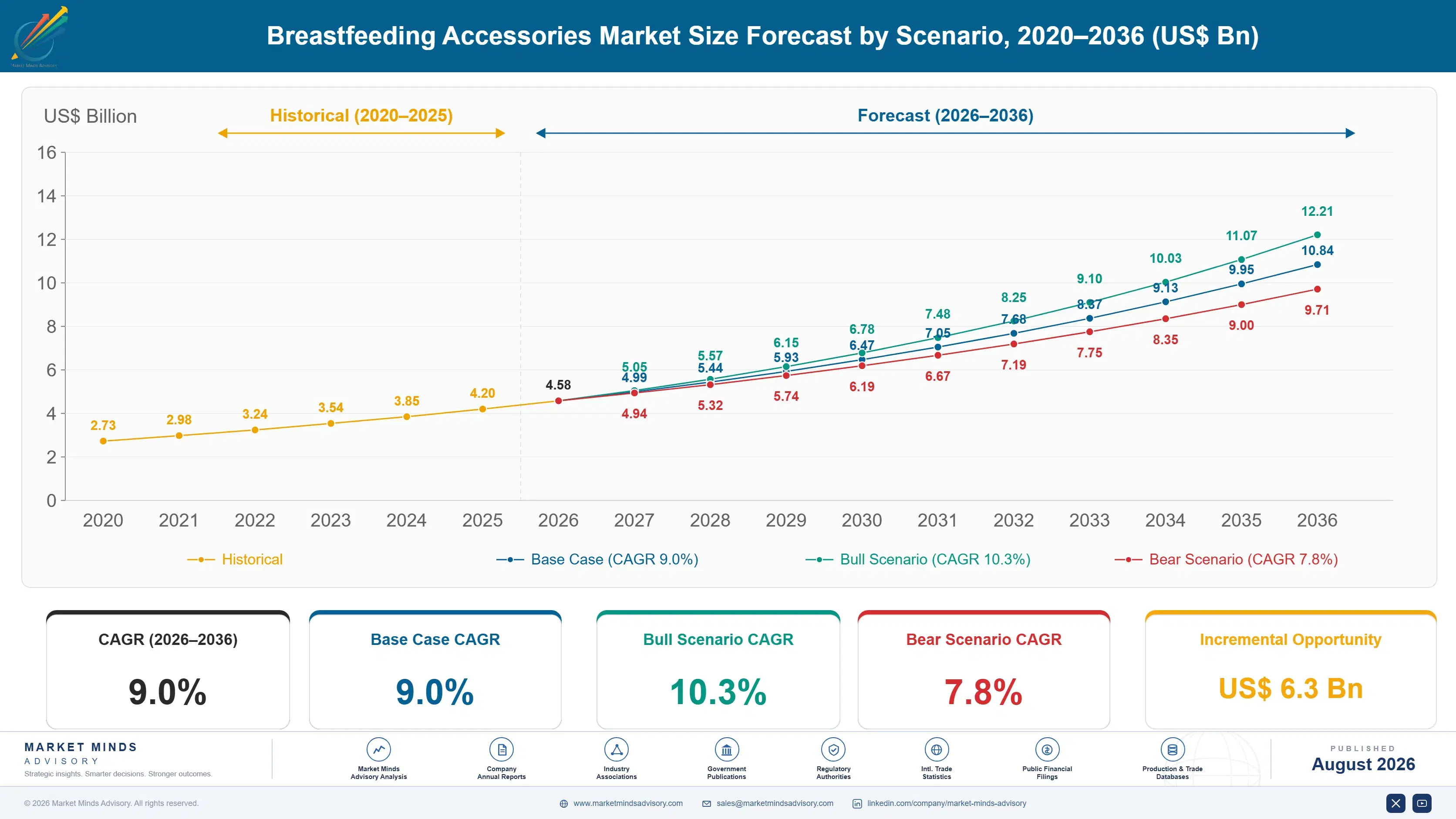
Breastfeeding Accessories Market Forecast Scenarios

breastfeeding-accessories-market-size-forecast-scenario-1787304202394
Growth ran at roughly 7.7% between 2020 and 2025, and two forces pulled hard in opposite directions. Births fell across almost every developed market, removing the demographic base this category has always depended on. Against that, wearable pumps arrived and workplace pumping legislation expanded, both of which raised spending per birth sharply. Per-birth value did considerably more work than volume across the whole period.
Base case growth of 9.0% rests on three mechanisms. Wearable devices keep displacing conventional pumps within an insurance entitlement whose value per mother is fixed, so mix improves without any increase in claims. Workplace pumping rights keep extending across jurisdictions, which converts occasional expression into a daily working routine. And replacement part consumption is finally being recognised and supplied properly, having gone largely unmet for years while mothers used degraded components.
The bull case at 10.3% assumes flange sizing and fitting support becomes standard within insurance-supplied pump provision, which would reduce abandonment substantially and lift both retention and part consumption. The bear case at 7.8% is demographic: birth decline across the United States, China, Korea, Japan and Southern Europe is accelerating, and per-birth spending growth eventually stops offsetting a shrinking number of births.

Breastfeeding Accessories: Entitlement Channels and Wearable Shift

The commercial architecture here is unusual and almost entirely American in origin. United States health legislation requires insurers to cover a breast pump for each pregnancy, which created a durable medical equipment channel supplying roughly 71% of pumps in that market. The mother chooses from what her supplier stocks and pays nothing, so formulary placement matters far more than shelf appeal.
TOP FIVE CONCENTRATION43%Clinical heritage brands now competing against direct-to-consumer challengers
INSURANCE COVERED SHARE71%United States pumps supplied through health insurance rather than retail
AVERAGE PUMP PRICEUSD 185Blended global price across wearable, electric and manual devices
EXCLUSIVE BREASTFEEDING RATE44%Infants exclusively breastfed at six months across tracked populations
RETURN TO WORK TIMING12 weeksMedian point at which mothers resume work and begin expressing
REPLACEMENT PART CYCLE60 daysInterval before valves and membranes degrade enough to reduce output
Workplace legislation changed the product requirement rather than the channel. Extended pumping break and private space rights moved expression out of the home and into offices, warehouses and vehicles, where a device that must be sat with, plugged in and held is close to unusable. Wearable pumps that fit inside a bra answered that directly, and mothers switched to them faster than any device transition this category has seen.
Underneath all of it sits a consumable business that hardly anyone names. Flanges, valves, membranes, duckbills and tubing degrade with use and lose suction within roughly 60 days, and output falls before most mothers realise why. Insurance frequently covers replacement kits and suppliers frequently fail to send them. That gap is simultaneously the clearest unmet need and the most obvious commercial opportunity in the category.
"The most valuable thing in this market is not the pump. It is the fifteen dollar bag of valves and membranes that stops working after two months, which most mothers never replace and most suppliers never offer, while output quietly falls and everybody blames the mother."
Director, Maternal Health and Consumer Medical Devices Practice · MMA Healthcare

Market Trends

Workplace pumping rights reshape what the product must do

Legislation extending pumping break entitlements and private space requirements to millions of additional workers converted expression from something done at home into something done during a shift. A conventional pump requires sitting still, mains power and both hands, none of which a warehouse, a classroom or a delivery vehicle supplies. Wearable devices that fit inside clothing answered the requirement directly rather than incrementally, and mothers adopted them faster than any previous device change. The legislation created the need and the product followed within two years. No manufacturer created this demand, and the ones that responded fastest took the share.
Market Impact: Covers 71% of pump supply
Direct-to-consumer challengers reset wearable price expectations

Momcozy and comparable entrants built wearable pumps at roughly a third of the price the category's early wearable brands established, selling through online marketplaces and social channels rather than through clinical distribution. Performance differences exist and are considerably smaller than the price gap implies. Insurance suppliers responded by stocking lower-cost wearables against the same entitlement value, which improves their own margin on a fixed reimbursement. That combination has moved share quickly and compressed pricing across the whole wearable segment. Premium positions established during the category's first three years are eroding quickly as a direct result.
Market Impact: Extends feeding past 12 weeks

Market Opportunities and Growth Drivers

Insurance entitlement funds a purchase mothers would defer

United States legislation requiring coverage of a breast pump for each pregnancy removed the price decision from an expensive purchase made at a financially difficult moment. Roughly 71% of pumps in that market now move through durable medical equipment suppliers rather than retail. The entitlement renews with every pregnancy, so a mother with three children receives three pumps, and suppliers compete for placement on distributor formularies rather than for consumer attention on a shelf. Formulary placement therefore decides commercial outcomes far more completely than any consumer marketing budget possibly could.
Market Impact: Affects over 60% of users

Milk expression extends breastfeeding duration well past return to work

Median return to work sits near twelve weeks in the United States and considerably later across most of Europe, and expression is what allows breastfeeding to continue past it. Public health targets for exclusive breastfeeding at six months depend on that continuation, and health systems increasingly recognise pumping as the mechanism rather than an inconvenience. Where workplace facilities and equipment are adequate, continuation rates improve measurably, which gives the category a public health argument beyond consumer preference. That gives the category a public health argument extending well beyond ordinary consumer preference or convenience.
Market Impact: Chinese births below 10 million

Market Restraints and Challenges

Incorrect flange sizing drives abandonment nobody measures

Most mothers receive a pump with a standard flange that does not fit them, which reduces milk output, causes nipple pain and damage, and is the largest single reason women stop expressing. The root cause is that pumps ship with one or two sizes and almost nobody is measured. Commercial impact is a category losing customers within weeks of acquiring them, and losing the replacement part revenue that would have followed. Sizing kits, printable measurement guides and virtual fitting support all address it cheaply. Almost nobody does any of it systematically today.
Market Impact: Extends rights to 9 million workers

Falling birth rates remove the demographic base entirely

Births are declining across the United States, China, South Korea, Japan, Italy and most of the developed world, and in several of those markets the decline is accelerating rather than levelling. The root cause sits far outside this industry in housing cost, childcare availability and delayed family formation. Commercial impact is a shrinking number of eligible customers each year, which per-birth spending growth offsets for now and will not indefinitely. Suppliers respond by pursuing emerging markets and by raising value per mother served. No commercial action available to any manufacturer addresses that trend at all.
Market Impact: Prices cut to roughly 33%
4 additional market trends, 2 additional growth drivers, and 3 additional restraints and challenges are covered in the full report. Contact sales@marketmindsadvisory.com to access the complete intelligence.

Segment CAGR and Growth Architecture

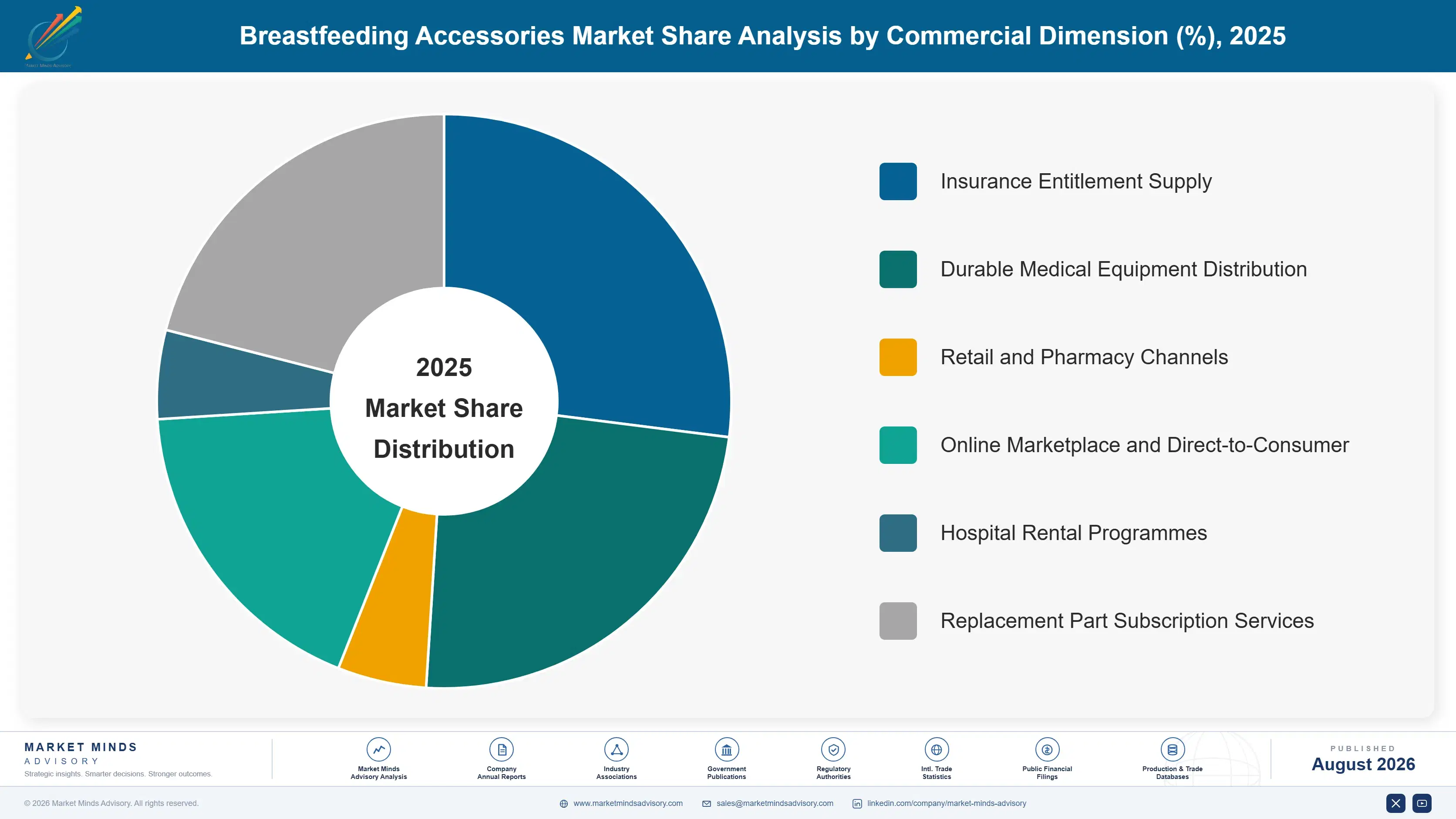
Segmentation follows product type, because type determines the purchase channel, whether insurance funds it, the price point and the replacement cycle that follows. Six product types cover breastfeeding support without overlap. Channel, whether insurance entitlement, retail, online marketplace or hospital rental, cuts across several types and is treated as a commercial attribute here. Type sets the commercial rules.
breastfeeding-accessories-market-market-share-analysis-1787304202928

Wearable and Hands-Free Electric Pumps

Growing at 13.5%, a full 1.50x the market rate, wearable pumps sit entirely inside a bra with no external tubing or bottles, allowing a mother to express while working, driving or caring for another child. Workplace pumping legislation created the requirement and these devices answered it directly. Early premium brands established the category at high prices, and Chinese direct-to-consumer entrants then delivered comparable performance at roughly a third of that, which insurance suppliers adopted quickly because it improves their margin against a fixed entitlement value. Battery life and suction strength remain the genuine engineering constraints. Insurance suppliers adopted the cheaper devices quickly, because a lower device cost against a fixed entitlement improves their own margin directly.
CAGR 13.5%

Milk Storage and Feeding Containers

Storage bags, bottles and freezer organisation systems grow at 10.2% as a direct consequence of pumping volume rather than as an independent category. A mother expressing daily consumes storage continuously, and unlike the pump itself these products are almost never covered by insurance, so they are bought repeatedly at full retail price. Bisphenol-free and food contact material compliance is table stakes rather than differentiating. Growth follows expression frequency, which the wearable transition and workplace legislation have both increased, and the repeat purchase behaviour makes this the steadiest revenue in the category. Repeat purchase behaviour across months of feeding makes this the steadiest revenue anywhere in the category, and it attracts far less competitive attention than it deserves.
CAGR 10.2%
Full segment breakdown across 6 segments available in the complete report.

Regional Architecture and Country Demand Map

Regional value follows funding mechanism and expression rates rather than birth numbers, and those diverge sharply. Markets with insurance entitlements or high workforce participation among mothers spend several times more per birth than markets with more births and no coverage at all. Birth numbers explain surprisingly little.

North America

North America holds the largest share at 32% for one specific legislative reason rather than any general affluence: United States insurers must cover a breast pump for every pregnancy, and roughly 71% of pumps there move through durable medical equipment suppliers as a result. No other health system funds anything comparable. Short maternity leave and high maternal workforce participation then make expression a daily necessity rather than an occasional convenience. Workplace pumping legislation extended break and space rights to millions more workers. Growth at 8.0% is restrained because United States births continue falling, offsetting rising spend per mother. Distributor formulary decisions rather than consumer preference determine which devices mothers actually receive.
Share: 32% | CAGR: 8.0% (2026 to 2036)

East Asia

Twenty-four per cent of value, growing at 9.6%. China is the largest market by volume and the most difficult to forecast, since births fell below ten million annually and the maternal products sector has contracted accordingly, while spending per birth rose as urban families concentrated resources on fewer children. Momcozy built a global wearable business from that domestic base. Japanese and South Korean birth rates are among the lowest recorded anywhere, so both markets grow entirely on per-birth value. Pigeon holds a strong regional position built on decades of maternal product credibility across the whole category. Per-birth value growth is doing all the work here, because birth numbers are moving sharply the other way.
Share: 24% | CAGR: 9.6% (2026 to 2036)
Regional intelligence for 5 additional markets available in the complete report: Western Europe, South Asia and Pacific, Latin America, Middle East and Africa, Eastern Europe. Contact sales@marketmindsadvisory.com.
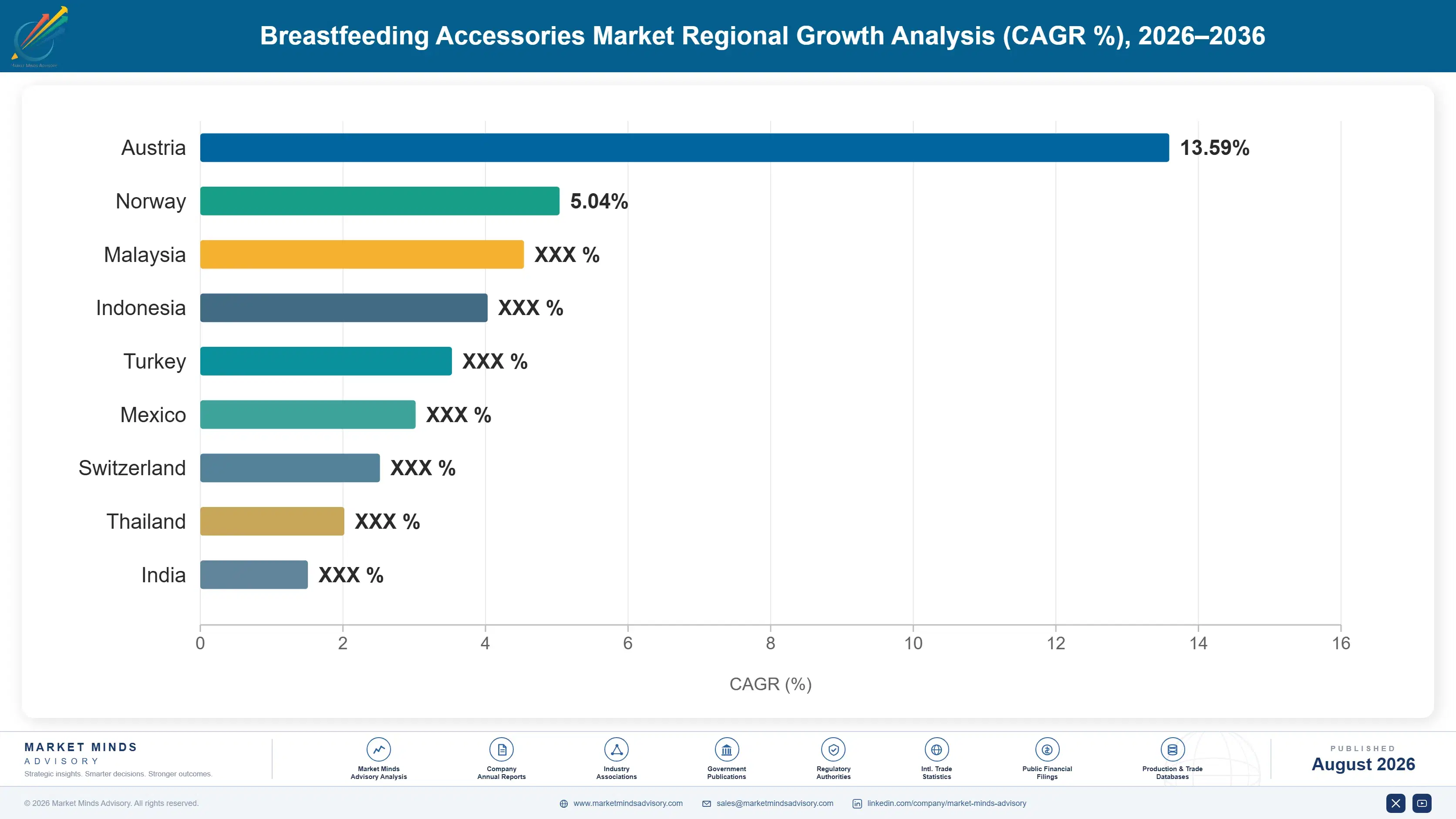
breastfeeding-accessories-market-country-cagr-analysis-1787304203451

Where Breastfeeding Product Value Sits

In the largest market a mother does not choose the pump and does not pay for it, which makes distributor formulary placement worth more than any consumer marketing budget. Value then accrues to replacement parts nobody remembers to supply, and to the fitting support that decides whether a customer stays at all. Consumer marketing decides remarkably little.

Win distributor formulary placement before consumer marketing

Roughly 71% of United States pumps reach mothers through durable medical equipment suppliers who stock a limited range against a fixed insurance entitlement value. A mother selects from that list and pays nothing, so a device absent from the formulary is invisible regardless of how good it is or how well it is advertised. Suppliers choose on their own margin against fixed reimbursement, which is why lower-cost wearables displaced premium ones so quickly. Distributor economics deserve more commercial attention than consumer preference does. Consumer advertising reaches somebody who is not making the decision.
Market Impact: Controls access to 71% of United St

Supply replacement parts before output silently declines

Valves, membranes and duckbills lose suction within roughly 60 days and output falls before most mothers understand why, which many interpret as their own supply failing. Insurance frequently covers replacement kits and suppliers frequently never offer them. Automatic replacement shipment at the correct interval protects milk output, retains the customer and converts a single device sale into a recurring consumable relationship. Manufacturers running scheduled part programmes report materially longer pump usage periods than those selling parts on request. Most mothers never learn that any replacement was necessary in the first place.
Market Impact: Parts degrade within roughly 60 day

Solve flange sizing to stop losing customers in weeks

More than 60% of mothers use an incorrectly sized flange, which reduces output and causes pain, and it is the largest single cause of abandonment across the category. Pumps ship with one or two sizes and almost nobody is measured properly. Including a sizing guide, offering multiple flange sizes in the box and providing virtual fitting support costs very little and directly protects both retention and the replacement part revenue that follows. Almost no supplier does any of it systematically. Retention improves immediately and replacement part consumption follows automatically from it.
Market Impact: Affects well over 60% of all treate

Pursue markets where births are still growing

Births are falling across the United States, China, Japan, Korea and Southern Europe, and in several of those markets the decline is accelerating. India, Indonesia, Nigeria, Egypt and much of Sub-Saharan Africa are not, and urban formal employment among mothers there is rising quickly, which is exactly the condition that creates expression demand. Indian growth at 13.6% shows what that combination produces. Building distribution in those markets takes years, and the demographic argument for starting now is unusually clear. The demographic argument for starting that work now is unusually clear.
Market Impact: Indian growth is reaching 13.6% eve

Who Controls the Margin Pool

Concentration sits at 43% across the top five, measured on annual revenue from breastfeeding accessories and expression products, the single basis applied throughout. Medela leads on clinical heritage and hospital-grade credibility built over decades, Philips and Pigeon through broad maternal and infant portfolios, Momcozy through direct-to-consumer wearable disruption, and Lansinoh through nipple care and storage where its position predates the pump business entirely.
Competition runs on three quite separate contests. Formulary placement with durable medical equipment suppliers decides the largest single channel, and it is won on distributor margin economics rather than on any clinical argument. Consumer preference decides retail and online purchase, where wearable design and price dominate. Hospital rental for preterm and neonatal care is a third contest entirely, won on clinical evidence and service, and Medela holds it comfortably.

Pressure builds from two directions. Chinese direct-to-consumer brands supply wearables at roughly a third of premium pricing and have taken share rapidly across both retail and insurance channels. Separately, falling births remove customers from every developed market simultaneously, which no competitive action addresses. Rankings shift most where a supplier converts a single device sale into a replacement part and fitting relationship that survives the pump itself.
breastfeeding-accessories-market-company-positioning-matrix-1787304203963

Competitive Moat and Risk Dimensions

MEDELA

Moat: Hospital and clinical credibility

Medela built its position in neonatal intensive care and hospital-grade rental, where evidence on milk output, preterm feeding and pump efficacy genuinely matters and purchasing decisions are made by clinicians. That heritage transfers into consumer trust at a moment when mothers are unusually receptive to clinical authority, and it is not something a direct-to-consumer entrant can assemble quickly.
MEDELA

Risk: Consumer price displacement

Wearable competitors deliver comparable everyday performance at roughly a third of the price, and insurance suppliers prefer them because a cheaper device improves margin against a fixed entitlement. Clinical heritage protects the hospital business and does not protect consumer share. Falling births in the company's strongest European and North American markets compound the pressure.
MOMCOZY

Moat: Direct channel cost position

Momcozy built wearable pumps at a manufacturing cost position that premium brands cannot approach, then sold them through online marketplaces and social channels without any clinical distribution overhead. Insurance suppliers adopted the range quickly because a lower device cost against a fixed entitlement improves their own economics, which gave the company both channels at once.
MOMCOZY

Risk: Clinical credibility gap

The company has no hospital-grade or neonatal position, which matters where clinicians influence choice and in markets where health systems rather than consumers purchase. Price-led positions invite the same competition that created them, and further low-cost entrants are arriving. Regulatory scrutiny of medical device claims is tightening across several markets simultaneously.

Players Tracked

Prominent Players

Medela
Koninklijke Philips
Pigeon Corporation
Momcozy
Lansinoh Laboratories

Other Key Players

Willow Innovations
Chiaro Technology
Spectra Baby USA
Ameda
Ardo Medical
Handi-Craft Company
Newell Brands
Mayborn Group
Artsana
Haakaa
Motif Medical
Zomee
Combi Corporation
Goodbaby International
Richell Corporation

Recent Developments

MARCH 2025

Durable medical equipment suppliers expand low-cost wearable pump formularies

United States durable medical equipment suppliers widened formulary listings for lower-cost wearable breast pumps, improving their own margin against a fixed insurance entitlement value while offering mothers the hands-free format that workplace pumping legislation had made necessary. Several premium devices lost their formulary positions accordingly.
Signal: Distributor margin against fixed reimburse
AUGUST 2025

Momcozy expands European retail and marketplace distribution

Momcozy widened European retail and online marketplace distribution for its wearable pump range, an organic commercial expansion rather than an acquisition, bringing direct-to-consumer pricing into markets where premium clinical brands had faced little price competition previously. Pricing sat well below the incumbent clinical brand levels.
Signal: Price competition is now reaching those Eu
JANUARY 2026

Medela introduces flange sizing support across consumer pump range

Medela added flange measurement guidance and multiple size options across its consumer pump range, addressing incorrect sizing that reduces milk output, causes pain and remains the single largest reason mothers abandon expression within the first weeks of use. No competing brand offers comparable fitting support today.
Signal: Fitting support is finally being treated a

Motor, Silicone and Battery Cost Exposure

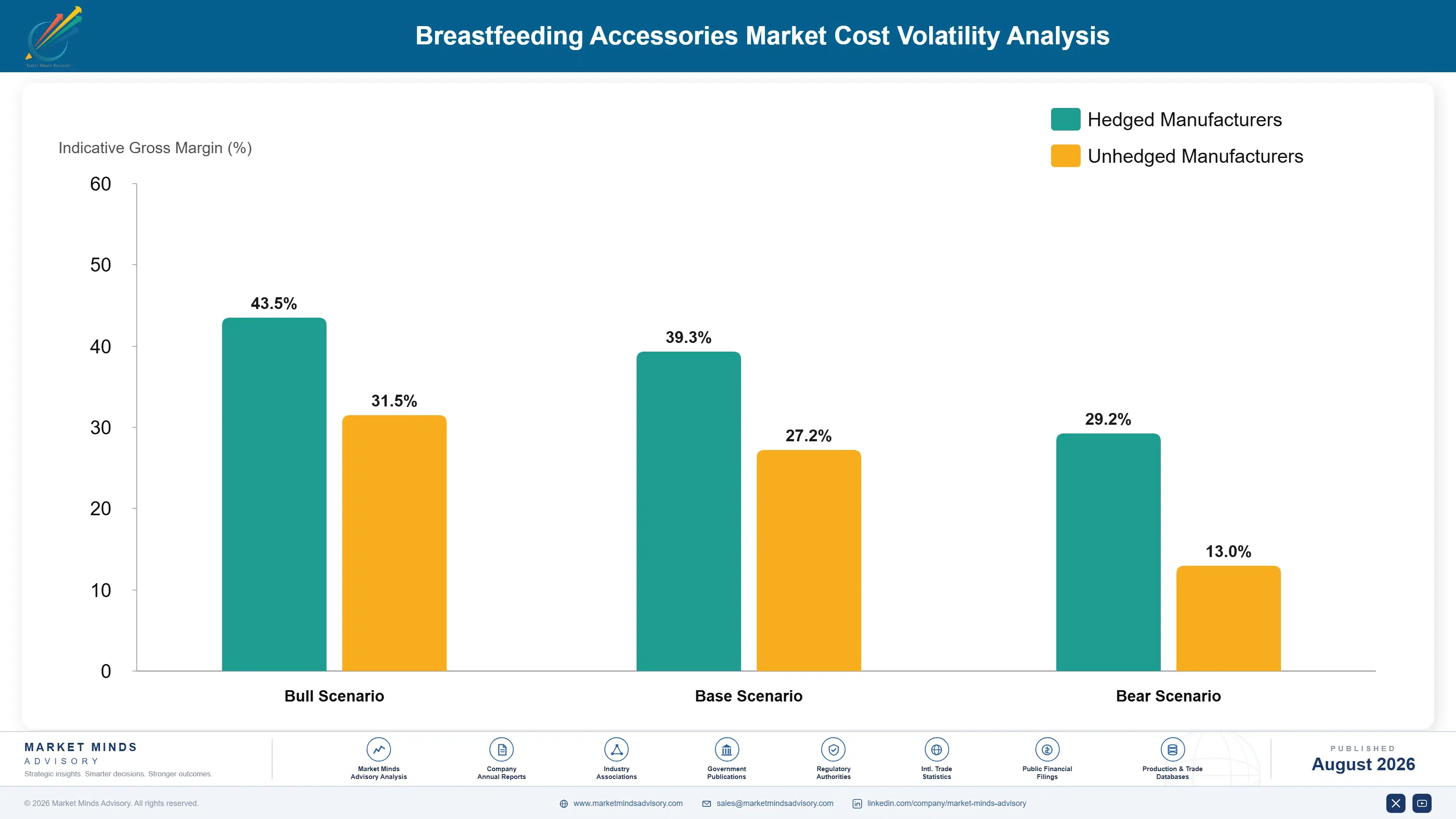
Cost structures are dominated by a handful of components that every brand buys from the same supplier base. Miniature vacuum motors and pump mechanisms account for roughly 24% of device cost of goods, with lithium battery cells contributing around 16% in wearable formats where they must be small and long-lasting. Medical-grade silicone for flanges, valves and membranes adds a further 18%, and moulded housings carry most of the remainder.
Battery cell allocation through 2022 and 2023 illustrated the exposure clearly. Small-format lithium cells were allocated toward consumer electronics and power tool customers ordering far larger volumes, and Newell Brands and Artsana both referenced component availability and input cost pressure in their reporting across those years. Wearable pumps depend entirely on cells of that specification, and brands without standing supply commitments could not build regardless of what they offered.

The disadvantage falls hardest on brands without manufacturing scale. A supplier ordering fifty thousand units annually from a contract manufacturer queues behind one ordering several million and pays small-volume component pricing throughout. Geography compounds it: Chinese manufacturers hold motor, battery and silicone cost positions Western brands cannot approach, which is precisely how wearable pricing fell to roughly a third within three years.
breastfeeding-accessories-market-cost-volatility-analysis-1787304204161

Secure standing lithium cell commitments through quiet demand periods

Small-format cell allocation is decided by standing volume commitment rather than by price, and wearable pump brands rarely outrank consumer electronics customers when supply tightens. Holding commitments through comfortable periods costs money and is the difference between shipping and not shipping when the next allocation cycle arrives, as several brands discovered. Few brands carry that commitment.

Consolidate manufacturing volume with fewer contract partners

Fragmented ordering across several factories leaves a brand paying small-volume component pricing and sitting at the back of every allocation queue. Concentrating annual volume with one or two partners improves both cost and priority materially, provided second-source qualification is maintained on the motor and cell specifications that matter most. Dependency has to be managed deliberately.

Shift margin defence toward replacement parts and fitting services

Device component costs cannot be passed through, because insurance entitlement values and retail price expectations are both fixed externally. Replacement parts carry silicone cost only and fitting support carries almost none. Moving revenue mix toward both provides a cushion that no procurement strategy on a commodity device can supply by itself. Both carry far lower component exposure.

Portfolio Architecture for Margin Defence

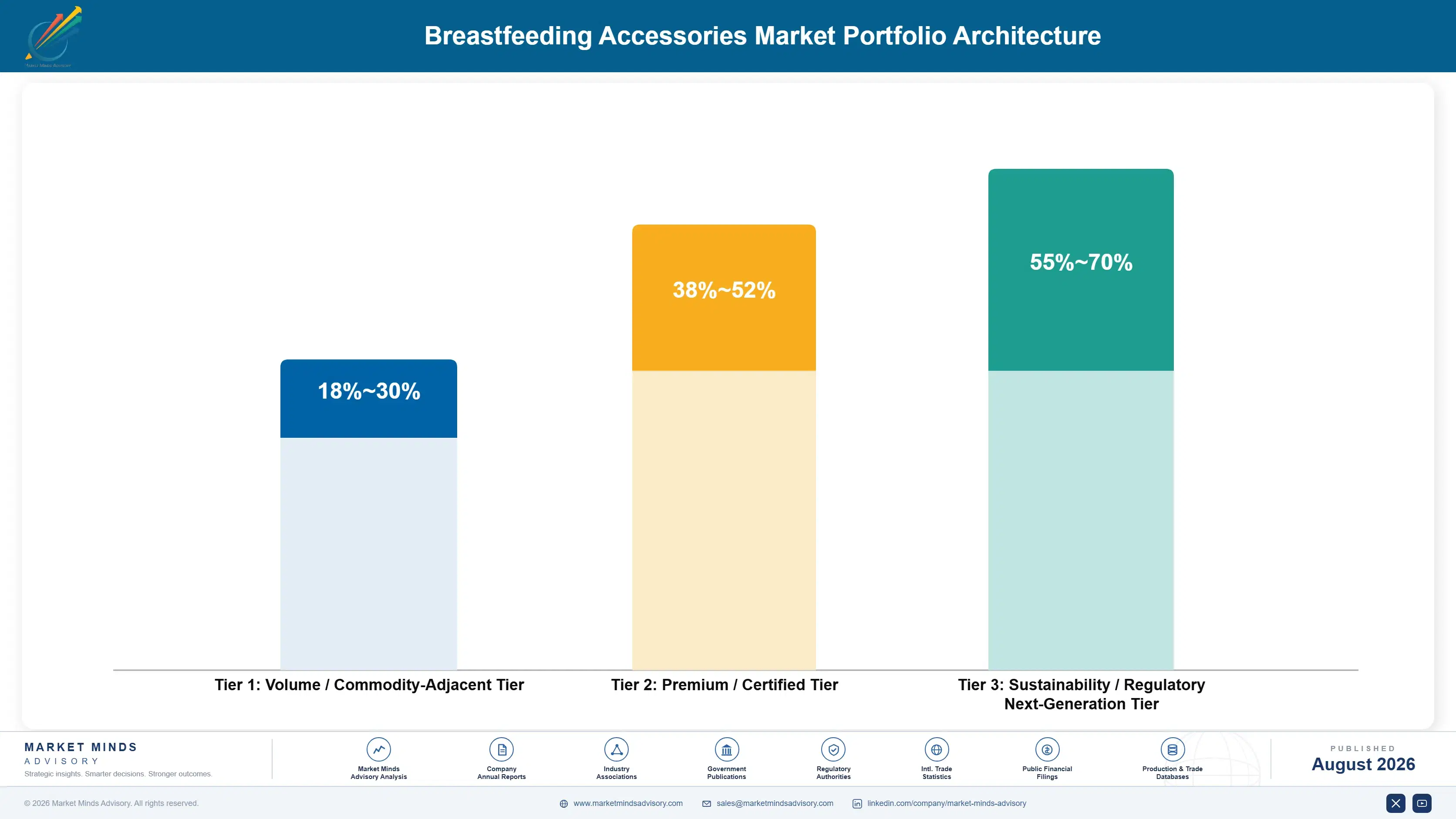
Margin architecture divides on whether insurance sets the price. Pumps supplied against a fixed entitlement earn whatever remains after the distributor takes its margin, which is why lower-cost devices displaced premium ones so quickly. Retail wearable sales earn consumer electronics margins under active price competition. Replacement parts and fitting services earn most, because they are inexpensive to make, frequently reimbursed separately and almost nobody supplies them properly.
The volume versus premium tension runs between the device and everything that follows it. The pump is a one-time transaction at a price somebody else sets, and it is the part every competitor fights over. Storage bags, replacement parts, nipple care and nursing apparel are bought repeatedly at full retail across months of feeding, and they attract far less competitive attention than their contribution deserves.

High-value pools sit where clinical authority or recurring need applies. Hospital-grade rental for preterm and neonatal feeding is a small, defensible business decided by clinicians on evidence. Replacement part subscriptions convert a device sale into a recurring relationship. Insurance-supplied pumps sit at the other extreme entirely, with the price fixed, the distributor taking a margin and the manufacturer competing on whatever remains.

Volume / Commodity-Adjacent Tier

Pumps supplied against fixed insurance entitlements and entry retail devices, where the distributor sets effective economics and Chinese manufacturing has reset price expectations across the whole wearable format. Manufacturers compete for whatever margin remains.
Gross Margin: 18-30%

Premium / Certified Tier

Branded retail wearables, nursing apparel and nipple care products bought directly by consumers at full price, where design, comfort and brand trust still support a premium over marketplace alternatives. Marketplace alternatives keep narrowing that premium.
Gross Margin: 38-52%

Sustainability / Regulatory / Next-Generation Tier

Hospital-grade rental for neonatal and preterm feeding, replacement part subscriptions and fitting support services, protected by clinical evidence, recurring need and the fact that almost nobody else supplies them. Almost nobody else supplies these properly.
Gross Margin: 55-70%
breastfeeding-accessories-market-portfolio-architecture-1787304204654

Short Windows Across Repeat Pregnancies

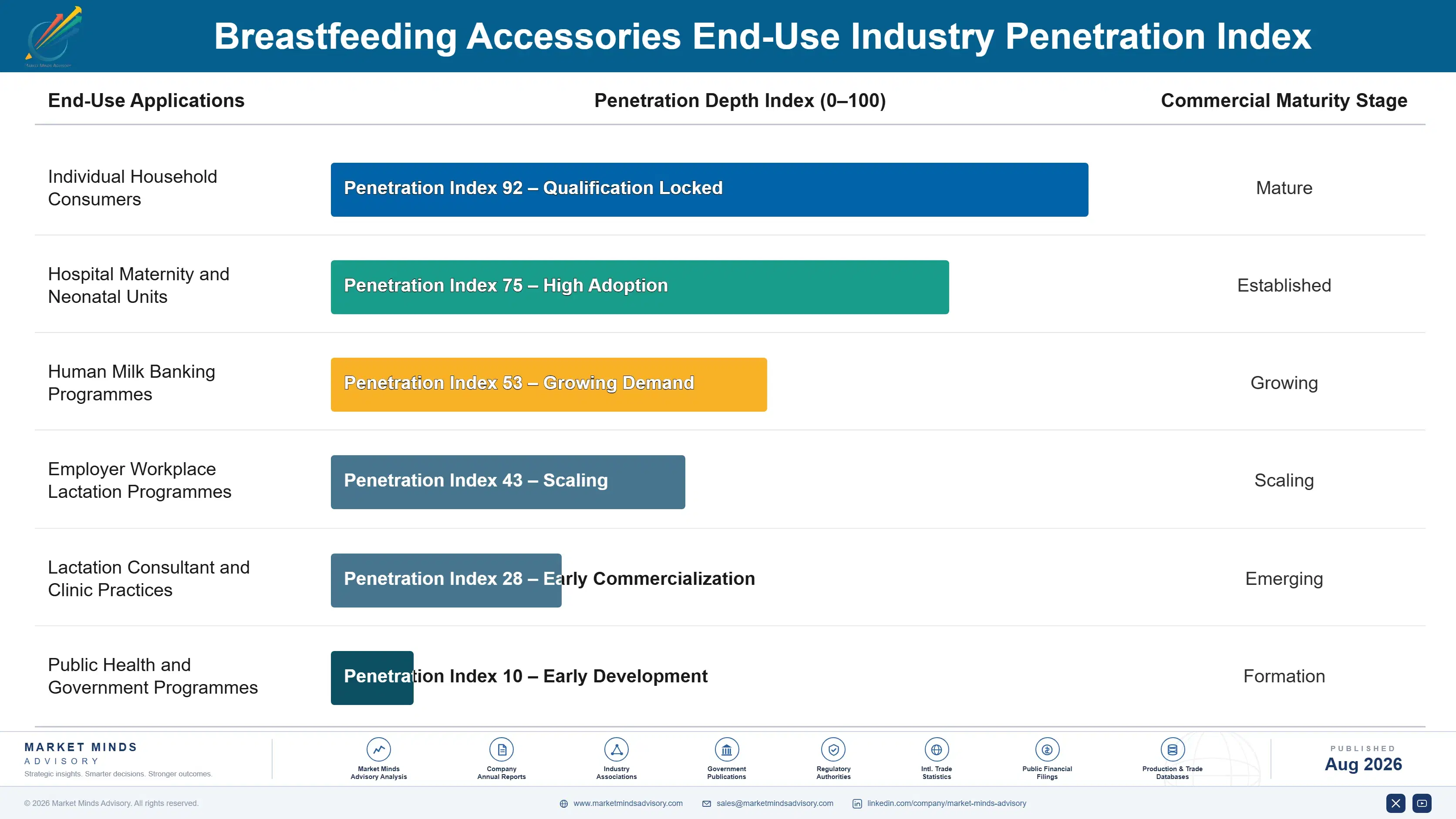
The customer relationship here is unusually brief and unusually intense. A mother expresses milk for months rather than years, buys almost everything she needs within the first weeks, and then largely stops until a subsequent pregnancy. That compresses acquisition, consumption and churn into a window shorter than most consumer categories manage a single purchase cycle in, and it places enormous weight on the first weeks.
Stickiness depends on whether the equipment actually worked. A mother whose pump produced good output with correctly fitted flanges returns to the same brand for a second child and recommends it in the parent networks that drive most discovery in this category. One whose output disappointed, usually because of sizing nobody corrected, abandons the brand entirely. Insurance-supplied pumps show the weakest attachment, since the mother never chose the brand.

Buyer profiles differ completely by channel. In the United States a durable medical equipment supplier is the effective customer, choosing formulary stock on its own margin against a fixed entitlement. In retail and online markets the mother chooses, heavily influenced by parent communities and social recommendation rather than by advertising. In hospital rental a neonatal clinician decides on evidence. Very few companies serve all three.
breastfeeding-accessories-market-end-use-penetration-index-1787304205143

Where Breastfeeding Strategy Must Land

These are among the four positions where our research anticipates prominent divergence between winners and laggards over the coming forecast period. Each is grounded in the demand model, the regulatory perimeter, and the announced capacity pipeline.
01 / FORMULARY PLACEMENT PRIORITY

The mother does not choose and does not pay

Roughly 71% of United States pumps reach mothers through durable medical equipment suppliers who stock a limited range against a fixed insurance entitlement, so a device missing from that formulary is effectively invisible whatever its quality. Those suppliers select on their own margin against fixed reimbursement, which is precisely why lower-cost wearables displaced premium devices within two years. Distributor economics therefore deserve considerably more commercial attention than any consumer advertising budget does, because advertising reaches somebody who is not deciding.
02 / REPLACEMENT PART PROGRAMMES

The consumable annuity nobody in this category supplies

Valves, membranes and duckbills lose suction within roughly 60 days and milk output falls before most mothers understand why, which a great many mothers wrongly interpret as their own milk supply failing them. Insurance frequently covers replacement kits, and suppliers frequently never offer them to anybody at all. Automatic scheduled shipment at the correct interval protects milk output, retains the customer and converts a single device transaction into a recurring consumable relationship that competitors are still almost entirely ignoring today.
03 / FITTING SUPPORT INVESTMENT

Wrong flange size loses customers within three weeks

More than 60% of mothers use an incorrectly sized flange, which reduces milk output and causes real pain, and it is the largest single reason women stop expressing at all. Pumps ship with only one or two flange sizes and almost nobody is ever measured properly by anyone. Including sizing guides, multiple flange sizes in the box and virtual fitting support costs very little, and it directly protects both retention and the replacement part revenue that would otherwise have followed.
04 / DEMOGRAPHIC BASE SHIFT

Every developed market is losing customers each year

Births are now falling across the United States, China, Japan, South Korea and most of Southern Europe, and across several of those markets the decline is now accelerating rather than levelling out. Rising spend per mother offsets that for now and cannot possibly do so indefinitely, because the underlying base itself keeps shrinking. India at 13.6%, alongside Indonesia, Nigeria and Egypt, combines growing birth numbers with rising urban maternal employment, and building distribution across those markets takes years nobody has spare.

Engagement Snapshot From the Field

A live engagement with an industry participant carrying material or product regulatory and market exposure ahead of a defining policy shift, showing how our research translates into a defensible multi-year portfolio strategy.
MARKET MINDS ADVISORY · CLIENT ENGAGEMENT SUMMARY
Breastfeeding Accessories Producer Strategic Portfolio Review and Transition Roadmap 2026·Investment Scenario on Breastfeeding Accessories Exposure Evaluation 2025-26
CLIENT PROFILE
A European breast pump manufacturer selling conventional electric and manual pumps plus accessories across European and North American markets, with annual revenue of approximately USD 145 million (client-reported, unverified by MMA). Roughly 62% came from conventional electric pumps, split between United States insurance channels and European retail. The company had no wearable product on the market and no replacement part programme of any kind.
STRATEGIC CHALLENGE
Wearable competitors had taken share rapidly in the United States insurance channel while Chinese entrants undercut European retail pricing, and conventional electric pump volumes had declined for three consecutive years. The board wanted to know whether to develop a competitive wearable device quickly, or to invest instead in replacement part programmes and fitting services where no competitor had built any meaningful position at all.
MMA APPROACH
MMA conducted 47 expert interviews across durable medical equipment supplier purchasing managers, lactation consultants, neonatal clinicians, retail category buyers and contract manufacturers in six countries. A quantitative survey of 3,800 mothers established device selection, replacement behaviour, fitting experience and abandonment reasons. We then modelled revenue and margin under both options against observed wearable adoption rates and insurance formulary decision patterns in each market.
KEY FINDINGS
  1. Durable medical equipment purchasing managers selected formulary stock primarily on their own margin against fixed entitlement value, and none cited clinical evidence as a determining factor.
  2. More than six in ten surveyed mothers reported flange discomfort or reduced output, and fewer than one in five had ever been measured or offered an alternative flange size.
  3. Almost no surveyed mother had replaced valves or membranes at the recommended interval, and most were unaware that replacement was necessary or that insurance frequently covered it.
  4. Wearable development timelines quoted by contract manufacturers ran eighteen to twenty-four months, by which point competing devices would have completed a further price reduction cycle.
CLIENT PROFILE
A European breast pump manufacturer selling conventional electric and manual pumps plus accessories across European and North American markets, with annual revenue of approximately USD 145 million (client-reported, unverified by MMA). Roughly 62% came from conventional electric pumps, split between United States insurance channels and European retail. The company had no wearable product on the market and no replacement part programme of any kind.
STRATEGIC CHALLENGE
Wearable competitors had taken share rapidly in the United States insurance channel while Chinese entrants undercut European retail pricing, and conventional electric pump volumes had declined for three consecutive years. The board wanted to know whether to develop a competitive wearable device quickly, or to invest instead in replacement part programmes and fitting services where no competitor had built any meaningful position at all.
MMA APPROACH
MMA conducted 47 expert interviews across durable medical equipment supplier purchasing managers, lactation consultants, neonatal clinicians, retail category buyers and contract manufacturers in six countries. A quantitative survey of 3,800 mothers established device selection, replacement behaviour, fitting experience and abandonment reasons. We then modelled revenue and margin under both options against observed wearable adoption rates and insurance formulary decision patterns in each market.
KEY FINDINGS
  1. Durable medical equipment purchasing managers selected formulary stock primarily on their own margin against fixed entitlement value, and none cited clinical evidence as a determining factor.
  2. More than six in ten surveyed mothers reported flange discomfort or reduced output, and fewer than one in five had ever been measured or offered an alternative flange size.
  3. Almost no surveyed mother had replaced valves or membranes at the recommended interval, and most were unaware that replacement was necessary or that insurance frequently covered it.
  4. Wearable development timelines quoted by contract manufacturers ran eighteen to twenty-four months, by which point competing devices would have completed a further price reduction cycle.
RECOMMENDED STRATEGY
Phase 1: Phase one: launch a scheduled replacement part programme across the existing installed base immediately, since it required no new product development at all. Phase 2: Phase two: add multiple flange sizes and virtual fitting support to every pump sold, addressing the largest identified cause of abandonment and protecting part revenue. Phase 3: Phase three: license rather than develop a wearable platform, accepting lower margin in exchange for reaching the market before another price reduction cycle.
OUTCOME
The client launched replacement part subscriptions within two quarters and reported roughly a fifth of its installed base enrolled within a year (client-reported, unverified by MMA). Fitting support reduced early-stage returns measurably, and a licensed wearable reached European retail eleven months ahead of the internal development timeline it replaced.

Frequently Asked Questions

Foundational context covering the market sizes, CAGR, scope, country, region and competition that inform every finding below. This section is provided to cover basics and most often pre-purchase conversations, answered from the MMA Primary Research Dataset.

What is the current size of the Breastfeeding Accessories Market?

The global breastfeeding accessories market was valued at USD 4.2 billion in 2025, covering wearable and conventional breast pumps, replacement parts, milk storage, nipple care and nursing apparel. Infant formula and lactation consultation services fall outside this definition.

How large will the Breastfeeding Accessories Market be by 2036?

MMA forecasts the market at USD 10.84 billion by 2036, expanding 2.37 times from the 2026 base of USD 4.58 billion. That represents roughly USD 6.26 billion of incremental value across the forecast decade.

What is the CAGR for the Breastfeeding Accessories Market 2026 to 2036?

The base case compound annual growth rate is 9.0%, with a bull case of 10.3% and a bear case of 7.8%. The bear case reflects accelerating birth rate decline across developed markets.

Which segment is growing fastest?

Wearable hands-free electric pumps grow at 13.5%, a full 1.50x the overall market rate. Workplace pumping legislation created the requirement and these devices answered it directly rather than incrementally.

Who are the major companies in the Breastfeeding Accessories Market?

Medela, Koninklijke Philips, Pigeon Corporation, Momcozy and Lansinoh Laboratories together hold 43% of revenue. Clinical heritage brands now face direct-to-consumer challengers selling comparable wearables at roughly a third of the price.

Which country is growing fastest?

India grows fastest at 13.6%, as urban formal employment among mothers rises and organised retail puts pumps within reach of middle-class households. North America remains the largest region at 32% of value.

Report Segmentation Architecture

The full report scope spans multiple orthogonal segmentation dimensions, with cross-tabulated demand data provided for each dimension pair. Coverage extends further to regional breakdowns, trend trajectories, and the competitive detail needed to support segment-level decision-making.

By Product Type

  • Wearable and Hands-Free Electric Pumps
  • Conventional Double Electric Pumps
  • Manual and Single Breast Pumps
  • Milk Storage and Feeding Containers
  • Nipple Care and Skin Products
  • Nursing Apparel and Absorbent Pads

By End-Use Industry

  • Individual Household Consumers
  • Hospital Maternity and Neonatal Units
  • Human Milk Banking Programmes
  • Employer Workplace Lactation Programmes
  • Lactation Consultant and Clinic Practices
  • Public Health and Government Programmes

By Commercial Dimension

  • Insurance Entitlement Supply
  • Durable Medical Equipment Distribution
  • Retail and Pharmacy Channels
  • Online Marketplace and Direct-to-Consumer
  • Hospital Rental Programmes
  • Replacement Part Subscription Services

By Region

  • North America
  • East Asia
  • Western Europe
  • South Asia and Pacific
  • Latin America
  • Middle East and Africa
  • Eastern Europe

Scope, Methodology, and Coverage

Every figure in this report is reproducible from documented input assumptions. The scope below maps the historical period, the forecast horizon, the segmentation dimensions, and the countries covered, alongside the underlying primary and qualitative methodology.
Historical Period
2020 to 2025
Forecast Period
2026 to 2036
Base Year
2025 (USD billions; MMA Primary Research Dataset, August 2026)
Market Definition
This market comprises products supporting breastfeeding and human milk expression, measured at manufacturer revenue across insurance entitlement, durable medical equipment distribution, retail, online marketplace, hospital rental and subscription channels. Coverage spans wearable and hands-free electric breast pumps, conventional double and single electric pumps, manual pumps, hospital-grade rental pumps, replacement pump components including flanges, valves, membranes, duckbills and tubing, milk storage bags, bottles and feeding containers used for expressed milk, nipple care creams, balms and hydrogel products, and nursing apparel including bras and absorbent pads. Infant formula and formula preparation equipment, bottles and teats sold for formula feeding, human milk bank processing services, lactation consultation and clinical support services, general baby care and nursery products, and maternity apparel not related to feeding fall outside scope.
Quantitative Units
USD billions (current prices); pump unit shipments by type; average price per device; replacement part attachment rates; insurance covered supply share
Segmentation Dimensions
By Product Type; By End-Use Industry; By Commercial Dimension; By Region
Regions Covered
North America, East Asia, Western Europe, South Asia and Pacific, Latin America, Middle East and Africa, Eastern Europe
Countries Covered
United States, Canada, Mexico, China, Japan, South Korea, Taiwan, Germany, United Kingdom, France, Italy, Spain, Netherlands, Sweden, India, Australia, Indonesia, Vietnam, Philippines, Thailand, Brazil, Argentina, Colombia, Chile, Saudi Arabia, United Arab Emirates, Egypt, Nigeria, South Africa, Poland, Czechia, Hungary, and additional markets relevant to maternal product analysis
Key Companies Profiled
Medela, Koninklijke Philips, Pigeon Corporation, Momcozy, Lansinoh Laboratories, Willow Innovations, Chiaro Technology, Spectra Baby USA, Ameda, Ardo Medical, Handi-Craft Company, Newell Brands, Mayborn Group, Artsana, Haakaa, Motif Medical, Zomee, Combi Corporation, Goodbaby International, Richell Corporation
Quantitative Methodology
Primary survey, n=3,800 respondents, Q4 2025, six countries; demand-side model with trade association cross-validation
Qualitative Methodology
47 expert interviews, Q4 2025; applied to validate demand model assumptions, identify emerging dynamics, and assess competitive positioning
Report Format
PDF and XLSX data workbook (Word format preview document)
Publisher
Market Minds Advisory
Report Code
MMA-2026-HLT-185
Published
August 2026
Contact
sales@marketmindsadvisory.com | www.marketmindsadvisory.com

Purchase the full Breastfeeding Accessories Market Report (2026 to 2036).

The full MMA report treats the United States insurance entitlement as the commercial architecture it actually is, quantifying how distributor formulary economics rather than consumer preference decide which pumps reach mothers. It sizes six product types and seven regions to 2036, modelling pump shipments, replacement part attachment, expression rates and birth trajectories separately so that per-birth value growth can be distinguished from volume. Competitive assessment covers twenty companies on one consistent revenue basis. Component cost exposure is traced through pump motors, lithium cells and medical-grade silicone. Four commercial levers and a strategic verdict close the report, grounded in 47 expert interviews and a 3,800-respondent survey.
Six product types sized separately to 2036
Insurance entitlement channel economics modelled in full detail
Replacement part attachment quantified against installed device base
Twenty companies assessed on one consistent basis
Birth rate trajectories modelled against per-birth spending growth
Anonymised client engagement with tested strategic recommendations

Built For The People Who Decide

From boardroom strategy to bench-side execution, this report is read cover-to-cover by leaders shaping the next decade of their industry, turning demand scenarios, market dynamics and valuation benchmarks into decisions.
CXOs/ Presidents/ VPs/ Managers
M&A and Corporate Development
Strategy Teams and R&D Heads
Procurement and Product Directors
Regulatory and Compliance Leaders
Investor Relations and Equity Analysts