Market Minds Advisory
Breast Lesion Localization Device Market

Breast Lesion Localization Device Market: Non-Wire Surgical Guidance and Radiology-Surgery Workflow Through 2036

Hospitals are abandoning day-of-surgery wire placement fast enough to strand radiology scheduling built around it, pushing breast centres toward seed and reflector systems that can be placed days ahead of surgery instead.

Lead Analyst

Alice Ballenger

Published

September 2026

Make Smarter Decisions with Customized Research Insights

Request a free sample report and evaluate market opportunities, growth trends, and competitive dynamics relevant to your business needs.

2025 MARKET VALUE$0.6BMarket Size 2025
2036 FORECAST VALUE$1.6BBase Case , 2026 to 2036
CAGR 2026 TO 20369.8 %Bull 11.1% / Bear 8.6%
INCREMENTAL OPPORTUNITY$1.0BNet 10- year value creation
EXPANSION MULTIPLE2.55x2036 value over 2026 base
Strategic Levers
M&A Pipeline
Regional Outlook
Country Rankings
Competitive Intelligence
Segmental Deep-dive
Call-Us : 91 93563 13602

Executive Snapshot and Market Trajectory

Breast surgeons are quietly abandoning the day-of-surgery wire placement ritual that has defined lumpectomy scheduling for decades, betting that seed and reflector-based localization frees radiology slots and cuts patient anxiety at the same time. That single scheduling shift is reshaping which vendors win hospital contracts right now.
Radar reflector localization is pulling ahead of every other technology, growing at roughly one and a half times the market's blended rate as breast centres value placement flexibility that does not require coordinating with same-day surgery scheduling. North America holds the largest single regional share, reflecting where most non-wire localization technologies first earned regulatory clearance and built surgeon training infrastructure years before other regions caught up to that same standard.
A concentrated group of specialty device makers, Merit Medical, Endomagnetics, Hologic, Elucent Medical, and Cook Medical among them, still set the pace on non-wire technology and surgeon training programs, while wire-guided localization remains a commodity accessory business sold mostly on price and distribution reach. Reimbursement coding parity across placement techniques and radiology-surgery scheduling coordination are both shaping how fast hospitals convert away from wire toward newer, flexible-placement alternatives across every department involved in scheduling.
Market Definition
The breast lesion localization device market covers devices and systems used to mark non-palpable breast lesions for surgical excision, including wire-guided needles, radioactive seeds, magnetic seeds, radar reflectors, and RFID tags, along with their companion detection consoles. It excludes breast biopsy devices themselves and excludes general surgical navigation systems not specific to breast lesion marking.
Base Year Value
$0.6B in 2025 (MMA Primary Research Dataset, August 2026)
Forecast Period
2026 to 2036, eleven discrete annual values
CAGR
9.8% base case. Bull 11.1%. Bear 8.6%.
Fastest Growth Segment
Radar Reflector Localization Systems: 15.4% CAGR
Fastest Growth Country
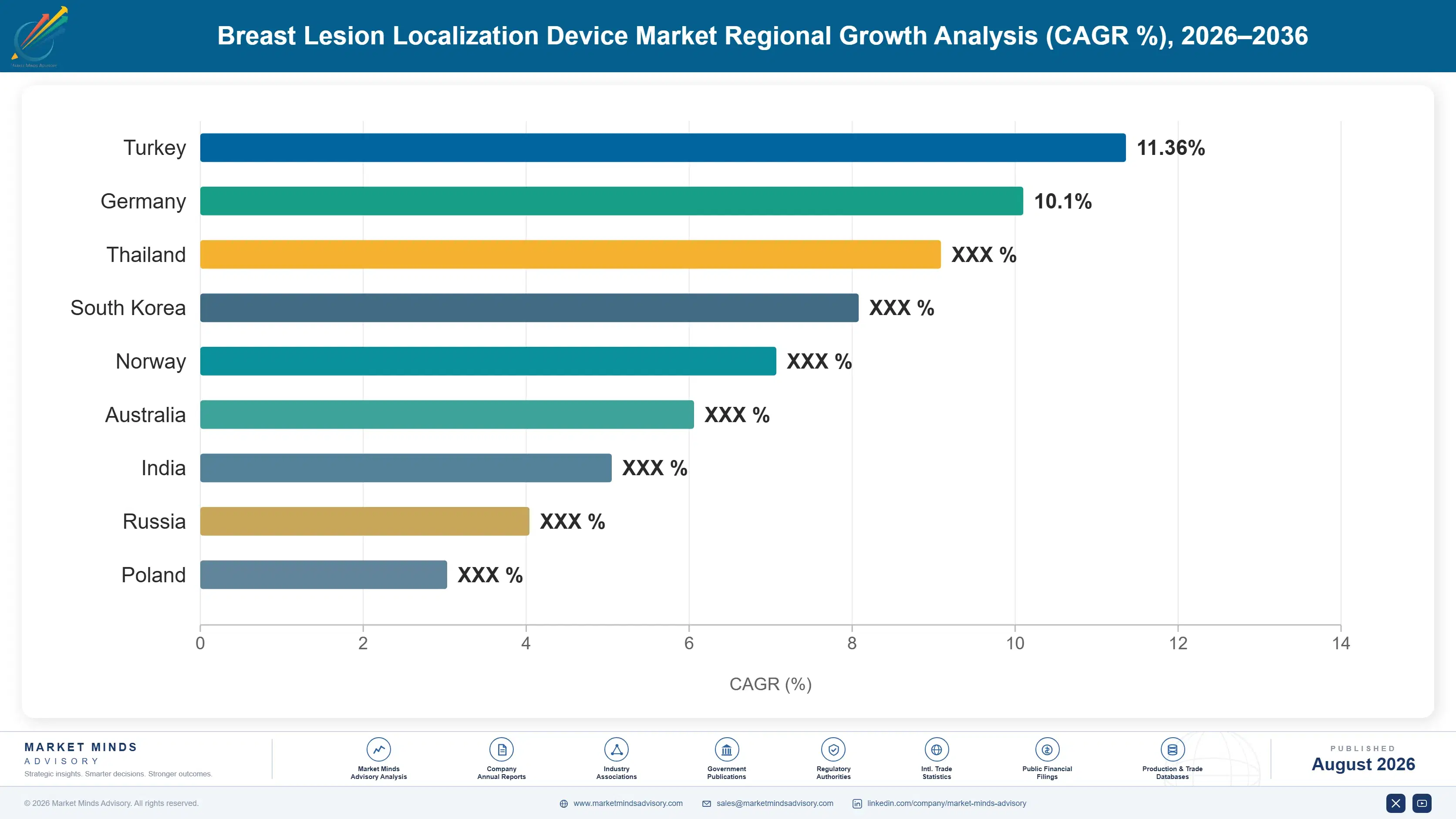
Australia: 13.0% CAGR
Fastest Growth Region
South Asia and Pacific: 11.8% CAGR
Largest Region
North America: 30% of 2025 global value
Market Leaders
Merit Medical Systems, Endomagnetics Ltd, Hologic Inc., Elucent Medical Inc., Cook Medical. Source: MMA Analysis based on company annual reports.
Primary Survey
n=3,800 procurement and R&D decision-makers, Q4 2025, six countries
Methodology
Demand-side build-up, cross-validated against public data, 47 expert interviews

Breast Lesion Localization Device Market Forecast Scenarios

breast-lesion-localization-device-market-size-forecast-scenario-1787304057967
Between 2020 and 2025 the market grew steadily as non-wire localization technologies cleared regulatory review and breast centres began converting away from wire placement, a shift that accelerated once pandemic-era scheduling pressure exposed how inefficient day-of-surgery wire placement actually was for both patients and radiology staff. Non-wire technique adoption across the MMA-tracked hospital sample roughly tripled across that five-year stretch, concentrated heavily at academic and high-volume breast centres.
The base case through 2036 rests on three mechanisms: continued conversion from wire-guided to non-wire localization as surgeon training expands and radiology departments reclaim same-day scheduling capacity across their broader patient panels, reimbursement systems achieving payment parity across localization techniques that currently still favour legacy wire coding in several national markets, and device makers bundling detection console placements with recurring per-procedure tag or seed sales that lock in multi-year hospital relationships rather than one-off equipment purchases.
A bull scenario turns on faster reimbursement parity for non-wire techniques across more national health systems, pulling conversion forward at hospitals currently rationing non-wire use to complex cases only. The bear case is continued radiologist and surgeon inertia around a wire-based workflow that still works clinically, slowing conversion far below the pace device makers currently expect.

Where Legacy Wire Placement Meets Non-Wire Workflow Innovation

Breast lesion localization spans a wide technology spectrum, from a several-dollar wire needle requiring same-day radiology coordination to a several-hundred-dollar reflector or seed system that can be placed days before surgery and detected with a dedicated console at the time of the operation. That spread means blended average selling price tells you almost nothing about where the actual commercial opportunity and margin concentration actually sit, and treating this as one undifferentiated dev
MARKET CONCENTRATIONCR5 64%top five device makers hold nearly two-thirds combined share
AVERAGE SELLING PRICE$285 per procedure kitblended price spanning wire, seed, and reflector formats
TOP PRODUCING COUNTRYUSA, 29% shareleads global device development and clinical adoption volume
CAPACITY UTILISATION76%specialty manufacturers running comfortably below peak production throughput
TRADE INTENSITY34% cross-bordershare of finished devices shipped across national borders yearly
FEEDSTOCK COST SHARE31% of COGSprecision metal and electronic components within total device cost
Wire-guided localization remains a scale business won on distribution reach and hospital purchasing contracts, where accessory makers compete mostly on price and delivery reliability rather than clinical differentiation. Non-wire systems behave completely differently, priced on workflow efficiency data and surgeon training depth, and sold through direct relationships with breast surgery and radiology departments rather than general procurement channels, a sales motion closer to capital equipment than commodity accessory supply.
Over the next decade, reimbursement coding parity, radiology-surgery scheduling coordination pressure, and rising breast-conserving surgery volume in fast-growing Asian health systems will keep reshaping who competes profitably at each end of this technology spectrum. Makers straddling both ends, wire accessories and non-wire consoles, are best positioned to absorb reimbursement shocks in either segment.
"Nobody switches localization technology because the wire failed clinically. They switch because the wire broke the day's operating room schedule, and that is a workflow problem device makers finally learned to sell against."
Director, Surgical Oncology and Breast Health Practice · MMA Medical Devices Pra

Market Trends

Breast Centres Convert to Free Radiology Scheduling Capacity

Breast centres are converting from wire-guided to non-wire localization specifically to free up radiology scheduling capacity, since wire placement traditionally requires same-day coordination between mammography and the operating room that non-wire techniques eliminate entirely. Roughly 58% of United States academic breast centres reported using a non-wire technique as their primary approach in 2025, up from under 25% four years earlier, largely driven by scheduling flexibility rather than localization accuracy differences alone. Device makers are responding by expanding placement windows to a full week before surgery, since longer flexibility windows increasingly decide which system a breast centre adopts first.
Market Impact: 21% rise in procedures tracked
MRI Compatibility Reshapes Non-Wire Technology Selection

Multiple non-wire technologies, magnetic seeds, radar reflectors, and RFID tags, now compete directly for the same hospital contracts, and breast surgery departments increasingly demand MRI-compatible options after finding magnetic seeds interfere with post-placement imaging in certain clinical cases. Roughly 34% of United States breast centres surveyed by MMA cited MRI compatibility as a deciding factor in their non-wire technology selection, a consideration that favours radar reflector and RFID systems over magnetic alternatives in this specific patient population. Manufacturers are responding with expanded clinical evidence packages addressing imaging compatibility directly in their sales materials and physician outreach programs.
Market Impact: Saves roughly $410 per case

Market Opportunities and Growth Drivers

Rising Breast-Conserving Surgery Volume Drives Localization Demand

Breast-conserving surgery volume keeps climbing as screening mammography programs expand and earlier-stage detection makes lumpectomy the preferred approach over mastectomy for a growing share of diagnosed patients across most developed health systems tracked. Breast-conserving procedures across the MMA-tracked hospital network sample rose roughly 21% since 2021, a trend oncology associations expect to continue as screening guidelines expand eligible patient populations further over the coming decade. Each breast-conserving case involving a non-palpable lesion requires localization, multiplying device demand directly alongside the underlying surgical volume growth rather than trailing it separately over time.
Market Impact: Rations use to roughly 40%

Scheduling Efficiency Gains Justify Non-Wire Capital Spend

Radiology departments citing scheduling efficiency gains from non-wire techniques report meaningfully more predictable daily throughput once wire-placement coordination is removed from the morning schedule entirely, freeing staff for other imaging work. Hospital operations data shows non-wire adoption saves an estimated $410 per case in reduced scheduling conflicts and radiology overtime versus comparable wire-guided workflows still used at many community facilities, a figure hospital administrators increasingly cite directly when approving non-wire technology capital purchases at budget committee meetings held each and every fiscal quarter across the entire regional hospital system network.
Market Impact: Cited by 40% of hospitals surveyed

Market Restraints and Challenges

Reimbursement Coding Lag Slows Non-Wire Conversion

Reimbursement coding for non-wire localization techniques still lags wire-guided coding in several health systems, with payers treating newer techniques as an optional upgrade rather than a distinct, clinically differentiated intervention deserving separate reimbursement. The root cause is coding frameworks that predate widespread non-wire technology approval and have not been updated to reflect current surgical practice patterns. Hospitals in cost-constrained systems ration non-wire use to only the most scheduling-sensitive cases as a result, and several device makers are now funding health economics studies specifically to support updated coding proposals with major payers.
Market Impact: 58% of academic centres now non-wir

Radiation Licensing Burden Limits Seed Localization Reach

Radioactive seed localization requires a licensed nuclear medicine handling process that adds regulatory complexity many smaller hospitals cannot support internally, limiting that specific technology's reach regardless of its clinical performance track record. Roughly 40% of community hospitals surveyed by MMA cited radiation licensing burden as the primary reason they avoid radioactive seed localization entirely, favouring magnetic or radar alternatives instead of pursuing a nuclear medicine license. Manufacturers of non-radioactive systems are directly targeting this hospital segment with marketing that emphasises the absence of licensing requirements as a core selling point in every sales conversation.
Market Impact: Cited by 34% as deciding factor
3 additional market trends, 2 additional growth drivers, and 4 additional restraints and challenges are covered in the full report. Contact sales@marketmindsadvisory.com to access the complete intelligence.

Segment CAGR and Growth Architecture

Segmentation follows localization technology, the dimension breast surgery and radiology departments themselves use to justify purchase, since wire, seed, reflector, and RFID systems each demand distinct detection hardware, surgeon training programs, and reimbursement coding pathways that rarely overlap with one another in daily hospital procurement and clinical scheduling practice across most facilities studied in this report.
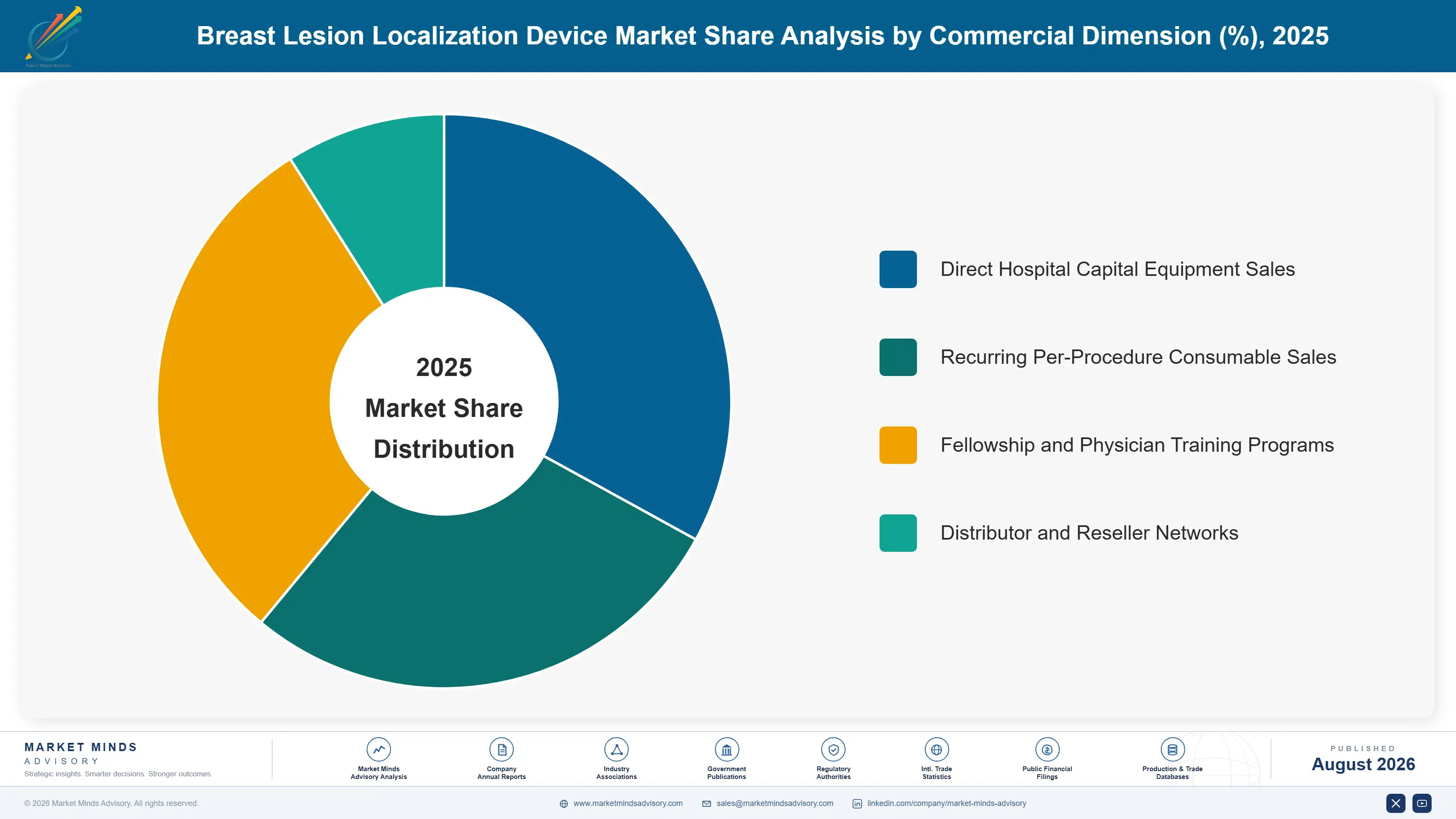
breast-lesion-localization-device-market-market-share-analysis-1787304058547

Radar Reflector Localization Systems

Radar reflector localization is the fastest-growing technology category today, adopted specifically because it requires no radioactive material handling and offers the longest pre-surgery placement window of any current technique, in some protocols extending to several weeks before the operating date. Breast centres value the scheduling independence this creates between radiology and surgery, since reflector placement can happen entirely outside the surgical day without any special licensing or same-day coordination requirement. Growth concentrates among larger hospital systems with the capital budget to invest in dedicated detection consoles, while smaller community hospitals remain slower to adopt given the upfront equipment cost relative to their annual case volume and yearly capital budget cycle.
CAGR 15.4%

Magnetic Seed Localization Systems

Magnetic seed localization is the second-fastest category, propelled by strong clinical adoption data and a detection console that many hospitals already consider a proven, well-established technology relative to newer radar alternatives entering the market more recently. Seeds are placed under image guidance similarly to reflectors, offering comparable scheduling flexibility, though some centres report occasional MRI compatibility concerns that favour non-magnetic alternatives for patients requiring post-placement imaging or repeat surveillance scans. Purchasing typically runs through capital equipment budgets separate from routine surgical supply procurement, reflecting the console investment required alongside the ongoing per-procedure seed cost that accrues steadily with every single case performed across the entire calendar fiscal year and beyond.
CAGR 13.2%
Full segment breakdown across 6 segments available in the complete report.

Regional Architecture and Country Demand Map

North America holds the largest single share, reflecting where most non-wire localization technologies first earned regulatory clearance and built surgeon training infrastructure. South Asia and the Pacific is growing fastest as breast-conserving surgery volume and non-wire technology access expand from a comparatively small installed base across the region.

North America

United States academic breast centres carry the highest non-wire localization penetration globally, driven by early regulatory clearance and surgeon training programs built over nearly a decade of clinical experience. Reimbursement coding parity has expanded steadily since 2023, though coverage still varies meaningfully by state and individual insurer, leaving some hospitals to absorb the capital cost without direct offset. Canadian provincial health systems trail US adoption by several years, largely due to slower device approval and reimbursement recognition cycles across provincial plans. Community hospitals remain the last meaningful pocket of wire-only holdouts across the region, constrained mainly by capital cost and case volume relative to larger academic medical centres located nearby.
Share: 30% | CAGR: 10.6% (2026 to 2036)

Western Europe

German and British breast centres were early adopters of non-wire localization standards, publishing much of the clinical outcome data other regions now cite when justifying their own reimbursement decisions before local trial data existed. United Kingdom National Health Service procurement still favours traditional wire localization in many trusts, slowing private-sector conversion relative to fully private continental European breast centres nearby. French and Italian breast surgery departments have invested heavily in radar reflector systems specifically, pulling adoption forward faster than reimbursement policy alone would otherwise support. Premium platform makers concentrate marketing spend here given the region's high average procedure volume per breast centre relative to most other emerging markets tracked worldwide.
Share: 23% | CAGR: 8.4% (2026 to 2036)
Regional intelligence for 5 additional markets available in the complete report: East Asia, South Asia and Pacific, Latin America, Middle East and Africa, Eastern Europe. Contact sales@marketmindsadvisory.com.
breast-lesion-localization-device-market-country-cagr-analysis-1787304059062

Where Localization Device Margin Sits

Margin in breast lesion localization concentrates wherever a manufacturer can attach detection console placement and recurring per-procedure sales to its technology, not wherever accessory volume is largest. Four commercial moves separate makers capturing durable non-wire margin from those still competing on commodity wire-needle price alone against interchangeable regional suppliers with very little real differentiation to show for it.

Placing Consoles to Lock In Recurring Consumables

Placing a dedicated detection console at a hospital, often subsidised or provided at low upfront cost, locks in years of recurring per-procedure seed or reflector sales that generate far more lifetime revenue than the console itself ever earns directly. Manufacturers with installed console bases report recurring consumable attachment rates above 90%, since a hospital that has already invested staff training and workflow redesign around a specific console rarely switches technology for a single procedure's cost difference. That switching cost compounds over a console's multi-year service life into a meaningfully larger total contract value than any single sale would suggest.
Market Impact: Locks in consumable attachment rate

Funding Health Economics Data to Speed Approval

Funding health economics studies that quantify scheduling efficiency gains, reduced radiology overtime, and fewer cancelled procedures gives a manufacturer a defensible basis for capital equipment approval that competitors without comparable data cannot match quickly or cheaply. Manufacturers with published workflow economics data report hospital approval cycles roughly 35% faster than those relying purely on clinical accuracy claims alone, since hospital finance committees increasingly weight operational savings as heavily as clinical performance in capital purchase decisions each budget cycle. That approval speed advantage compounds across hospital accounts, since published data travels faster than any single sales call.
Market Impact: Cuts hospital approval cycles by 35

Securing Breast Surgery Fellowship Training Partnerships

Securing exclusive or preferred surgeon training partnerships with breast surgery fellowship programs gives a manufacturer a pipeline of newly trained surgeons who default to the technology they learned on throughout their subsequent careers in independent or academic practice. Manufacturers investing in fellowship training report new-surgeon adoption rates roughly 40% higher than those relying purely on established-surgeon conversion, since changing technique after fellowship carries real retraining cost few surgeons willingly absorb once established in independent practice. This advantage compounds over each successive fellowship cohort trained on a specific manufacturer's system each year.
Market Impact: Lifts new-surgeon adoption by rough

Targeting Community Hospitals With Radiation-Free Positioning

Expanding radiation-free technology positioning specifically toward community hospitals that cannot support nuclear medicine licensing removes a real adoption barrier that otherwise excludes an entire hospital segment from the non-wire conversion story entirely. Manufacturers marketing directly against licensing burden report meaningfully faster community hospital adoption than those competing purely on general clinical merit, cutting the effective sales cycle by roughly 30% in markets where licensing friction has historically excluded smaller facilities entirely from adopting any radioactive seed-based technology at all, regardless of that technology's underlying clinical accuracy or performance record over time.
Market Impact: Cuts the onboarding sales cycle by

Who Controls the Margin Pool

Concentration sits high at CR5 64%, evaluated on global device and consumable revenue combined, the basis that best captures scale across wire-accessory challengers and console-integrated incumbents alike. Merit Medical and Endomagnetics lead the radar reflector and magnetic seed segments respectively, while the gap down to smaller specialty challengers is wider than the headline CR5 figure alone suggests.
Competitive activity now runs across three fronts simultaneously. Premium non-wire incumbents compete on health economics evidence and surgeon training depth, since that combination increasingly decides which technology a breast centre standardises on for years. Wire-accessory makers compete mainly on price and distribution reach, undercutting non-wire alternatives on upfront cost alone. A third front has opened around community hospital penetration, as manufacturers increasingly target radiation-licensing-averse facilities that the radioactive seed segment has never reached.

Emerging pressure is coming from RFID-based challengers scaling detection accuracy fast enough to threaten both the magnetic seed and radar reflector incumbents on their own technical merits. Rankings could shift meaningfully if reimbursement coding reform resolves the current parity gap across techniques, since that would remove one of the main barriers currently protecting early movers with mature clinical evidence from newer, cheaper challengers entering the category.
breast-lesion-localization-device-market-company-positioning-matrix-1787304059589

Competitive Moat and Risk Dimensions

MERIT MEDICAL SYSTEMS

Moat: Radar Reflector Technology Leadership

Merit Medical's SCOUT radar reflector platform holds the longest published clinical track record among non-wire technologies, anchoring its position as the default choice for hospitals prioritising placement flexibility and scheduling independence from same-day surgery coordination. That evidence depth continues to widen the gap over newer entrants lacking comparable long-term outcome data.
MERIT MEDICAL SYSTEMS

Risk: Console Hardware Replacement Cycle Risk

Merit Medical's installed console base eventually requires hardware refresh cycles that carry real switching risk if a competitor's next-generation platform offers meaningfully better detection accuracy or workflow integration at the point of replacement. Hospitals evaluating a refresh often re-open the entire vendor decision rather than automatically renewing.
ENDOMAGNETICS

Moat: Magnetic Seed Clinical Evidence Depth

Endomagnetics built one of the earliest and largest published clinical evidence bases for magnetic seed localization, giving it credibility with conservative adopters that newer entrants without comparable trial data cannot replicate quickly or cheaply. That trust extends across multiple countries where its studies were conducted.
ENDOMAGNETICS

Risk: MRI Compatibility Perception Risk

Persistent clinician concern about magnetic seed interference with post-placement MRI imaging, even where clinically manageable in most cases, continues to push some hospitals toward non-magnetic alternatives, eroding Endomagnetics' addressable patient population over time as awareness of the concern spreads further among referring physicians and radiologists nationwide.

Players Tracked

Prominent Players

Merit Medical Systems Inc.
Endomagnetics Ltd
Hologic Inc.
Elucent Medical Inc.
Cook Medical Incorporated

Other Key Players

C.R. Bard Inc.
Argon Medical Devices Inc.
Becton, Dickinson and Company
Boston Scientific Corporation
IZI Medical Products LLC
SOMATEX Medical Technologies GmbH
Health Beacons Inc.
Rubicon Medical Corporation
Mammotome
Devicor Medical Products Inc.
Sysmex Corporation
Theranostics Health Inc.
Sanarus Technologies LLC
Ranfac Corp.
Suros Surgical Systems Inc.

Recent Developments

FEBRUARY 2025

Elucent Medical Launches Next-Generation EnVisio Platform

Elucent Medical launched an updated version of its EnVisio Navigation System featuring an expanded lesion tag detection range and a simplified console interface for operating room use. The launch was an organic product introduction rather than an acquisition, reflecting continued internal investment in the non-wire category.
Signal: Detection range and console usability are
JUNE 2025

Merit Medical Signs Major Hospital Network Supply Agreement

Merit Medical Systems signed a multi-year supply agreement with a large United States hospital network to deploy SCOUT reflector systems across its breast surgery departments. The agreement is a commercial supply contract rather than a joint venture or acquisition, securing enterprise-wide standardisation ahead of anticipated demand growth.
Signal: Large hospital networks are increasingly c
OCTOBER 2025

Hologic Acquires RFID Localization Tag Developer

Hologic acquired a smaller RFID localization tag developer to expand its LOCalizer platform beyond its existing product line into adjacent detection technology and imaging compatibility features. The transaction was structured as a full acquisition rather than a licensing arrangement or minority equity stake of any kind.
Signal: Diagnostics incumbents are acquiring their

Precision Component and Validation Exposure

Precision metal components and miniaturised electronics, seed casings, reflector antennas, and detection console circuitry, account for roughly 31% of total device production cost, sourced mainly from specialty medical component manufacturers in the United States, Germany, and Switzerland who supply most of the industry's qualified volume. Regulatory testing and clinical validation costs add a second, growing cost layer specific to this device category.
Merit Medical Systems' 2024 annual report cited elevated component costs for precision metal and electronic assemblies as a meaningful drag on device margins, tracing much of it to specialty medical component supply disruptions that lingered from 2022 into 2023. Component prices rose double digits at the peak of that disruption before partially easing through 2024, and several manufacturers reported extending supplier qualification to additional component producers to reduce single-source dependency going forward.

Smaller regional device makers without diversified component sourcing absorb these cost swings directly, a disadvantage that compounds for challengers concentrated in a single country's supply base. Established majors with diversified, multi-region sourcing can smooth these swings across a broader supplier base, while console-based technologies carry the added exposure of sourcing both precision metal components and detection electronics simultaneously.
breast-lesion-localization-device-market-cost-volatility-analysis-1787304059784

Qualifying Multiple Component Suppliers Across Regions

Extending supplier qualification to additional precision component producers across the United States, Germany, and Switzerland reduces reliance on any single supplier's capacity or pricing power. Several manufacturers accelerated this diversification after 2022's disruption exposed how concentrated their sourcing had become across too few qualified vendors regionally, adding redundancy across multiple countries and several newly qualified sourcing partners identified since then.

Long-Term Precision Component Supply Contracts

Locking in multi-year supply agreements with precision metal and electronics manufacturers protects production schedules from shortages that periodically affect the broader medical device supply chain and its many contract manufacturers spread across several countries. This approach requires forecasting demand further out than manufacturers traditionally have, but it has paid off reliably during past shortage episodes across the wider industry.

Vertical Integration Into Precision Manufacturing

Owning precision component manufacturing rather than outsourcing it reduces exposure to supplier pricing swings and gives manufacturers priority access during periods of tight capacity across the sector. The approach requires significant capital but has paid off for majors that invested early, insulating margins better than pure assemblers eventually managed to achieve across comparable product lines and market segments.

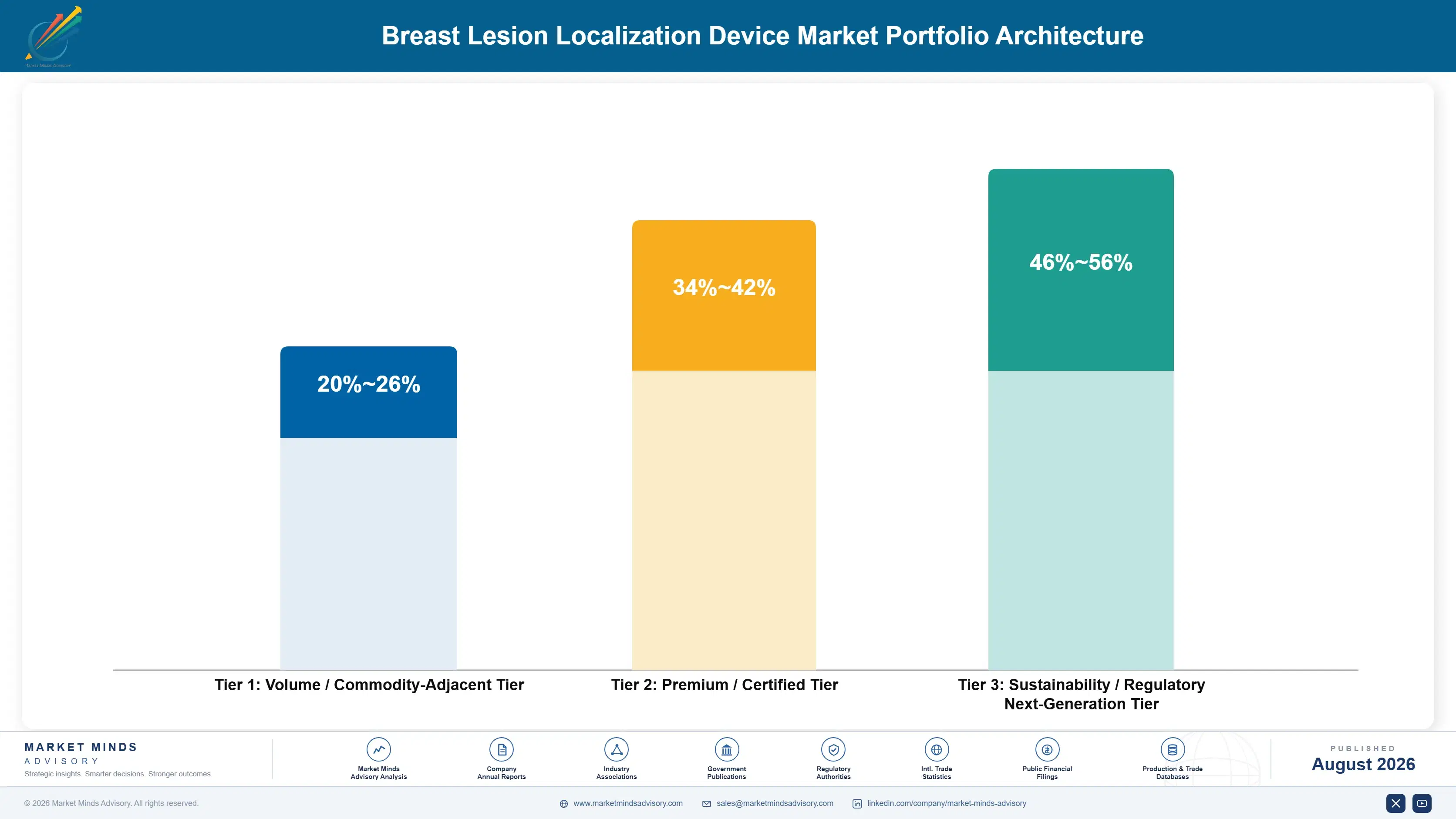
Portfolio Architecture for Margin Defence

Three margin tiers coexist within this single device category. Volume-grade wire-guided accessories run thin margins set largely by hospital purchasing contracts and direct price competition among many regional suppliers competing almost entirely on cost. Certified radioactive seed systems sit meaningfully higher, while magnetic seed and radar reflector platforms with console integration command the richest margin of the three because clinical evidence and surgeon training barriers keep competit
The volume-versus-premium tension shows up clearly in capital allocation. Manufacturers that keep reinvesting in wire-accessory production capacity are chasing a shrinking margin pool relative to those redirecting capital toward console-integrated non-wire platforms, even though wire accessories still generate meaningful unit volume for most companies today. Boards increasingly favour the specialty side when allocating the next dollar of capital investment, despite its smaller current revenue base.

High-value margin pools concentrate specifically in console-integrated platforms with published health economics data and in fellowship training partnerships that lock in future surgeon loyalty for years to come. Everything else in the portfolio behaves closer to a commodity surgical accessory than a differentiated medical device, priced on distribution reach rather than clinical performance, and that gap shows no sign of narrowing soon.

Volume / Commodity-Adjacent Tier

Wire-guided localization needles sold through hospital purchasing contracts, priced largely on distribution reach and delivery reliability rather than clinical differentiation of any kind, with thin room to compete on anything else.
Gross Margin: 20-26%

Premium / Certified Tier

Radioactive seed localization systems carrying licensed nuclear medicine handling protocols and clinical validation, sold at a real, defensible premium over unbranded wire alternatives across most major markets studied in this report today.
Gross Margin: 34-42%

Sustainability / Regulatory / Next-Generation Tier

Magnetic seed and radar reflector platforms with console integration and published health economics data, requiring sustained clinical investment that thins the competitive field sharply and protects incumbent pricing for years at a stretch.
Gross Margin: 46-56%
breast-lesion-localization-device-market-portfolio-architecture-1787304060309

Console-Anchored Hospital Loyalty

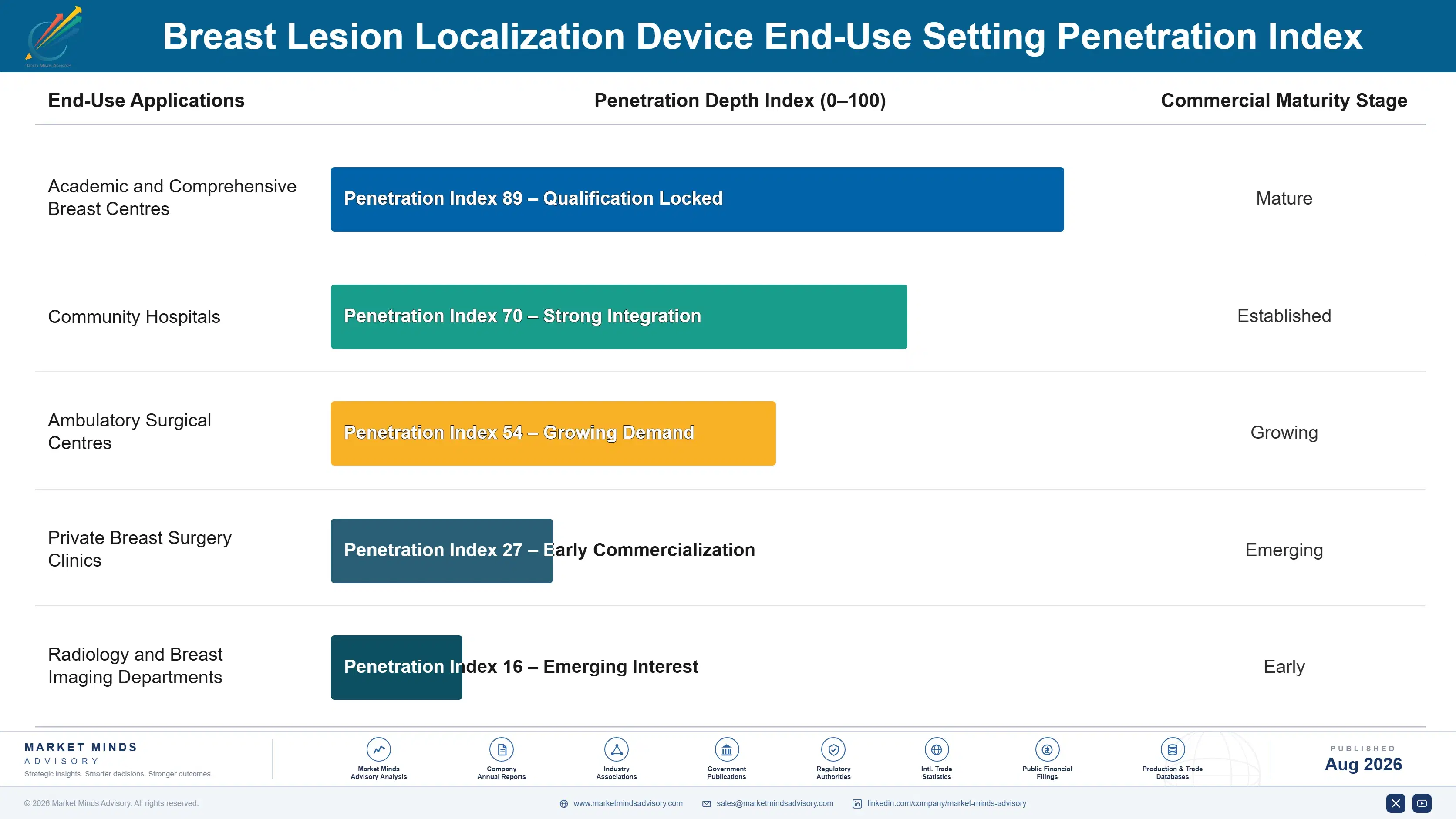
Breast lesion localization devices are not a subscription business by default, but console-based platforms increasingly behave like one. Once a breast centre invests in a specific detection console and trains its surgical staff, switching costs run high enough that repeat consumable purchasing continues for years without a full vendor re-evaluation each cycle.
Adoption depth varies sharply by hospital type. Academic and high-volume breast centres, once trained on a specific platform, rarely switch unless quality or health economics support genuinely slips, since retraining surgical staff carries real disruption cost. Smaller community hospitals without console investment behave completely differently, remaining on wire-guided localization far longer since no comparable training investment has been made. Fellowship-trained surgeon preference increasingly separates sticky accounts from price-sensitive ones across most hospital systems tracked.

A generational shift is underway in who specifies localization purchases. Decisions once made almost entirely by cost-conscious hospital procurement officers chasing lowest delivered cost are increasingly shaped by breast surgery leadership and radiology directors who weight scheduling efficiency and clinical outcomes data well above unit price alone. That shift favours manufacturers who invested early in health economics evidence over those still competing purely on accessory price.
breast-lesion-localization-device-market-end-use-penetration-index-1787304060802

Where Localization Device Margin Concentrates

These are among the four positions where our research anticipates prominent divergence between winners and laggards over the coming forecast period. Each is grounded in the demand model, the regulatory perimeter, and the announced capacity pipeline.
01 / CONSOLE PLATFORM INVESTMENT PRIORITY

Prioritise console-integrated non-wire platforms over wire accessory expansion.

Breast centres are converting away from day-of-surgery wire placement faster than commodity accessory makers can realistically catch up on health economics evidence and console integration, which means investment made today captures demand that wire accessories cannot reach at comparable margin. Manufacturers that keep expanding wire-accessory capacity are chasing a shrinking margin pool relative to those building console-integrated platforms instead. Console placement itself functions as a moat, since a rival cannot simply undercut price once a hospital has already trained staff and invested in a specific detection system.
02 / HEALTH ECONOMICS EVIDENCE STRATEGY

Build workflow economics data before competitors close the credibility gap.

Winning capital equipment approval at major hospitals increasingly requires published scheduling efficiency and cost-savings data, not just strong clinical accuracy claims on their own merits alone. Manufacturers that invest early in this evidence infrastructure build a durable advantage that outlasts any single product cycle or short-term pricing pressure from smaller rivals entering the category over time and across multiple budget cycles. Underinvesting here cedes the richest margin tier of the market to whichever competitor solves the evidence problem first for a given hospital account.
03 / REGIONAL MARKET ENTRY

Enter East Asian and South Asian markets ahead of infrastructure build-out.

East Asia already leads on manufacturing scale and screening infrastructure, and South Asia and the Pacific is growing fastest as breast-conserving surgery volume and non-wire access expand from a comparatively small installed base across the wider region today. Manufacturers without local clinical education relationships risk missing multi-year hospital contracts already being awarded to early movers with established local presence and physician trust built over years. Establishing regional training capability now positions a manufacturer well ahead of the next wave of breast surgery infrastructure investment.
04 / FELLOWSHIP TRAINING CHANNEL STRATEGY

Build breast surgery fellowship partnerships before rivals lock in exclusivity.

Newly trained surgeons default to whichever localization technology they learned during fellowship, and manufacturers who fund this training early earn surgeon loyalty that direct sales outreach alone cannot replicate at comparable cost. Waiting until fellowship partnerships become standard practice means competing for programs against manufacturers who built these relationships years earlier and already hold faculty trust. Building that training foundation now, rather than reacting once a competitor has secured the leading programs, is the cheaper path by a wide margin over time.

Engagement Snapshot From the Field

A live engagement with an industry participant carrying material or product regulatory and market exposure ahead of a defining policy shift, showing how our research translates into a defensible multi-year portfolio strategy.
MARKET MINDS ADVISORY · CLIENT ENGAGEMENT SUMMARY
Breast Lesion Localization Device Producer Strategic Portfolio Review and Transition Roadmap 2026·Investment Scenario on Breast Lesion Localization Device Exposure Evaluation 2025-26
CLIENT PROFILE
The client is a nine-hospital regional health system in the southeastern United States, anchored by two comprehensive breast cancer centres. The system reported annual breast surgery device spend of approximately $6.4 million (client-reported, unverified by MMA) and was evaluating whether to standardise on a single non-wire localization platform across all nine facilities rather than the fragmented wire-and-seed mix it had used historically.
STRATEGIC CHALLENGE
The system's nine hospitals used three different localization approaches, wire guidance, radioactive seeds, and one pilot magnetic seed program, creating inconsistent radiology scheduling, duplicated staff training, and inconsistent outcomes documentation that made system-wide efficiency reporting to hospital leadership nearly impossible to assemble accurately, weakening its position in annual vendor negotiations.
MMA APPROACH
MMA benchmarked three non-wire technology vendors on health economics evidence, detection console reliability, and total cost per case across all nine facilities. The engagement combined vendor interviews with facility-level scheduling data analysis to model the total cost and clinical impact of standardising on a single platform system-wide across every breast surgery department.
KEY FINDINGS
  1. One vendor's published health economics data cut capital equipment committee approval time by roughly 33% versus the system's typical review process today.
  2. Standardising on a single platform would reduce annual staff retraining costs by an estimated $520,000 across all nine facilities combined each year.
  3. Two of the three technologies lacked sufficient regional service coverage to reliably support all nine facilities without meaningful response delay during peak volume.
  4. Bundled console procurement combined with structured training could lower blended per-case device cost by roughly 19% system-wide within the first full year.
CLIENT PROFILE
The client is a nine-hospital regional health system in the southeastern United States, anchored by two comprehensive breast cancer centres. The system reported annual breast surgery device spend of approximately $6.4 million (client-reported, unverified by MMA) and was evaluating whether to standardise on a single non-wire localization platform across all nine facilities rather than the fragmented wire-and-seed mix it had used historically.
STRATEGIC CHALLENGE
The system's nine hospitals used three different localization approaches, wire guidance, radioactive seeds, and one pilot magnetic seed program, creating inconsistent radiology scheduling, duplicated staff training, and inconsistent outcomes documentation that made system-wide efficiency reporting to hospital leadership nearly impossible to assemble accurately, weakening its position in annual vendor negotiations.
MMA APPROACH
MMA benchmarked three non-wire technology vendors on health economics evidence, detection console reliability, and total cost per case across all nine facilities. The engagement combined vendor interviews with facility-level scheduling data analysis to model the total cost and clinical impact of standardising on a single platform system-wide across every breast surgery department.
KEY FINDINGS
  1. One vendor's published health economics data cut capital equipment committee approval time by roughly 33% versus the system's typical review process today.
  2. Standardising on a single platform would reduce annual staff retraining costs by an estimated $520,000 across all nine facilities combined each year.
  3. Two of the three technologies lacked sufficient regional service coverage to reliably support all nine facilities without meaningful response delay during peak volume.
  4. Bundled console procurement combined with structured training could lower blended per-case device cost by roughly 19% system-wide within the first full year.
RECOMMENDED STRATEGY
Phase 1: Phase 1 (Months 1 to 2): Finalise vendor selection and negotiate a system-wide multi-year platform and training agreement package terms. Phase 2: Phase 2 (Months 3 to 6): Roll out standardised consoles and staff training across all nine facilities in staged regional waves. Phase 3: Phase 3 (Months 7 to 9): Consolidate outcomes documentation reporting and renegotiate vendor contracts using the unified system-wide volume data.
OUTCOME
The system completed platform standardisation across eight of nine facilities within eight months and reported a 17% reduction in blended device cost per case (client-reported, unverified by MMA), alongside meaningfully faster radiology scheduling turnaround times system-wide following the switch to a single integrated platform system.

Frequently Asked Questions

Foundational context covering the market sizes, CAGR, scope, country, region and competition that inform every finding below. This section is provided to cover basics and most often pre-purchase conversations, answered from the MMA Primary Research Dataset.

What is the current size of the Breast Lesion Localization Device Market?

The global breast lesion localization device market was valued at approximately $0.58 billion in 2025. This spans wire-guided, radioactive seed, magnetic seed, and radar reflector localization technologies.

How large will the Breast Lesion Localization Device Market be by 2036?

The market is projected to reach approximately $1.63 billion by 2036. Growth is led by radar reflector and magnetic seed technologies rather than legacy wire-guided localization.

What is the CAGR for the Breast Lesion Localization Device Market 2026 to 2036?

The market is expected to grow at a compound annual growth rate of 9.8% across the forecast period. Bull and bear scenarios range from roughly 8.6% to 11.1% depending on reimbursement policy.

Which segment is growing fastest?

Radar reflector localization systems are the fastest-growing segment, expanding at roughly one and a half times the market's blended rate. Magnetic seed localization systems follow as the second-fastest segment.

Who are the major companies in the Breast Lesion Localization Device Market?

Leading participants include Merit Medical Systems, Endomagnetics, Hologic, Elucent Medical, and Cook Medical. Assessments are based on global device and consumable revenue combined across every technology type.

Which country is growing fastest?

Australia is the fastest-growing country tracked, driven by strong reimbursement structures and breast surgery infrastructure comparable to North America. Its growth rate sits well above the region's already elevated average.

Report Segmentation Architecture

The full report scope spans multiple orthogonal segmentation dimensions, with cross-tabulated demand data provided for each dimension pair. Coverage extends further to regional breakdowns, trend trajectories, and the competitive detail needed to support segment-level decision-making.

By Localization Technology

  • Wire-Guided Localization Systems
  • Radioactive Seed Localization Systems
  • Magnetic Seed Localization Systems
  • Radar Reflector Localization Systems
  • RFID Tag Localization Systems
  • Intraoperative Ultrasound-Guided Accessories

By End-Use Setting

  • Academic and Comprehensive Breast Centres
  • Community Hospitals
  • Ambulatory Surgical Centres
  • Private Breast Surgery Clinics
  • Radiology and Breast Imaging Departments

By Commercial Dimension

  • Direct Hospital Capital Equipment Sales
  • Recurring Per-Procedure Consumable Sales
  • Fellowship and Physician Training Programs
  • Distributor and Reseller Networks

By Region

  • North America
  • Western Europe
  • East Asia
  • South Asia and Pacific
  • Latin America
  • Middle East and Africa
  • Eastern Europe

Scope, Methodology, and Coverage

Every figure in this report is reproducible from documented input assumptions. The scope below maps the historical period, the forecast horizon, the segmentation dimensions, and the countries covered, alongside the underlying primary and qualitative methodology.
Historical Period
2020 to 2025
Forecast Period
2026 to 2036
Base Year
2025 (USD billions; MMA Primary Research Dataset, August 2026)
Market Definition
The breast lesion localization device market covers devices and systems used to mark non-palpable breast lesions for surgical excision, including wire-guided needles, radioactive seeds, magnetic seeds, radar reflectors, and RFID tags, along with their companion detection consoles. It excludes breast biopsy devices themselves and excludes general surgical navigation systems not specific to breast lesion marking.
Quantitative Units
USD billions (current prices); units of localization devices and kits sold
Segmentation Dimensions
By Localization Technology; By End-Use Setting; By Commercial Dimension; By Region
Regions Covered
North America, Western Europe, East Asia, South Asia and Pacific, Latin America, Middle East and Africa, Eastern Europe
Countries Covered
USA, China, Germany, France, UK, Japan, South Korea, India, Australia, Canada, Brazil, Mexico, Indonesia, Vietnam, Thailand, Malaysia, UAE, Saudi Arabia, South Africa, Nigeria, Turkey, Poland, Netherlands, Italy, Spain, Sweden, Switzerland, Argentina, Colombia, Singapore, and additional markets relevant to this sector
Key Companies Profiled
Merit Medical Systems Inc., Endomagnetics Ltd, Hologic Inc., Elucent Medical Inc., Cook Medical Incorporated, C.R. Bard Inc., Argon Medical Devices Inc., Becton, Dickinson and Company, Boston Scientific Corporation, IZI Medical Products LLC, SOMATEX Medical Technologies GmbH, Health Beacons Inc., Rubicon Medical Corporation, Mammotome, Devicor Medical Products Inc., Sysmex Corporation, Theranostics Health Inc., Sanarus Technologies LLC, Ranfac Corp., Suros Surgical Systems Inc.
Quantitative Methodology
Primary survey, n=3,800 respondents, Q4 2025, six countries; demand-side model with trade association cross-validation
Qualitative Methodology
47 expert interviews, Q4 2025; applied to validate demand model assumptions, identify emerging dynamics, and assess competitive positioning
Report Format
PDF and XLSX data workbook (Word format preview document)
Publisher
Market Minds Advisory
Report Code
MMA-2026-MED-119
Published
August 2026
Contact
sales@marketmindsadvisory.com | www.marketmindsadvisory.com

Purchase the full Breast Lesion Localization Device Market Report (2026 to 2036).

The full report delivers a complete quantitative and qualitative assessment of the global breast lesion localization device market across wire, seed, and reflector product categories. It includes detailed segmentation by localization technology, end-use setting, and commercial channel, alongside country-level sizing across thirty-plus individual markets worldwide. Competitive profiling covers twenty companies assessed on global device and consumable revenue, with primary research drawn from MMA's expert interview program and its quantitative industry survey. Buyers receive fully editable data files supporting internal strategic planning, investment screening, and supplier qualification decisions each quarter.
Segment-level sizing and 2026 to 2036 forecasts
Full seven-region breakdown with country-level detail
Twenty-company competitive revenue benchmarking data set
Editable data tables delivered in Excel format
Primary survey and expert interview findings included
Quarterly market update subscription option available

Built For The People Who Decide

From boardroom strategy to bench-side execution, this report is read cover-to-cover by leaders shaping the next decade of their industry, turning demand scenarios, market dynamics and valuation benchmarks into decisions.
CXOs/ Presidents/ VPs/ Managers
M&A and Corporate Development
Strategy Teams and R&D Heads
Procurement and Product Directors
Regulatory and Compliance Leaders
Investor Relations and Equity Analysts